
Lesson 5 FDOP Case Study Geographic Area Fire

Description: Lesson 5 FDOP Case Study Geographic Area Fire Danger Operating Plan Workshop FMO Perspective - Local Application Its all about decision making and informing decision makers. Objectives Demonstrate the importance of adhering to the
Related Topics
Download Presentation
"Lesson 5 FDOP Case Study Geographic Area Fire" is the property of its rightful owner. Permission is granted to download and print the materials on this website for personal, non-commercial use only, and to display it on your personal computer provided you do not modify the materials and that you retain all copyright notices contained in the materials. By downloading content from our website, you accept the terms of this agreement.
Presentation Transcript
slide1. Lesson 5 FDOP Case Study Geographic Area
Fire Danger Operating Plan Workshop FMO Perspective - Local Application
“It’s all about decision making and informing decision makers.”<br>
slide2. Objectives Demonstrate the importance of adhering to the recommended “best practices” as discussed in Lesson 3.
Relate a local view of the interagency planning and implementation of a fire danger operating plan.
List several fire management decisions based on NFDRS outputs.
Discuss the Southeast Zone (SEZ) Fire Danger Operating Plan (FDOP) connection between local fire occurrence issues and decisions based on fire danger products.<br>
slide3. Introduction Southeast Zone (SEZ) Interagency Fire Danger Operating Plan (FDOP) was initially developed in 2012.
Has been revised several times. Currently operating under the 2017 version.
A 2018 version has been developed using the NFDRS 2016 model.
The SEZ FDOP working group continues to solicit advice and input towards improving the plan to meet fire managers needs and expectations.<br>
slide4. Interagency FDOP Agency Partners National Park Service
Coronado National Forest
Arizona BLM Gila District
US Fish and Wildlife Service
Tohono O’odham Nation/BIA Papago Agency
Arizona Department of Forestry and Fire Management, Southeast District<br>
slide5. Preparedness Information<br>
slide6. Preparedness Information for Agency Personnel Fire Danger Operating Plan development process blends:
Science
Historical Data
Established Processes
Local Knowledge<br>
slide7. Preparedness Information for Agency Personnel Fire Danger Operating Plan provides:
Unified framework for local interagency fire managers and agency administrators.
Provides tools to assist in decision making
Provides information that can lead to safe, efficient, and effective fire responses.<br>
slide8. Preparedness Information to Aid Decision Makers Current Information (WIMS data, NFDRS outputs, current weather information, etc.)
NFDRS outputs provide information on current conditions related to fire danger and fire behavior potential.
Forecast Information
Available in a variety of formats (daily fire weather forecasts, spot weather forecasts, seasonal outlooks, etc.)
Predictive Services can help to provide applicable and accurate forecast information.<br>
slide9. NFDRS Information Aids Fire Management Officers in providing daily fire preparedness direction based on:
Current Fire Danger
Current Fire Activity
Current Local Suppression Resource Availability or Commitment<br>
slide10. NFDRS Information The Dispatch Center helps to provide daily fire danger information to local units:
Daily adjective fire danger rating
Staffing Level
Response Level
Preparedness Level for the Zone<br>
slide11. NFDRS Information for Agency Administrators The FDOP provides continuity of information for leadership personnel.
FMO’s can provide agency administrators with an accurate depiction of the daily fire danger situation.
Current fire danger level
Current fire weather forecast information
Agency Administrators can support justification for fire preparedness decisions:
Availability of support staff outside of the fire organization
Restrictions or Closure Order considerations
Severity requests to augment local suppression resources<br>
slide12. NFDRS Information for Agency Administrators Decision documentation (WFDSS requirements on large, extended wildland fires):
Initial decisions need to provide the Agency Administrator’s overall direction
Fire program managers provide current fire danger and fire weather information to Agency Administrators to assist in the decision documentation process.
This information aids the Agency Administrator, FMO, and resource staff in the development incident specific objectives and requirements, a clear course of action for the management of the incident, and a rationale statement that supports the decision document.<br>
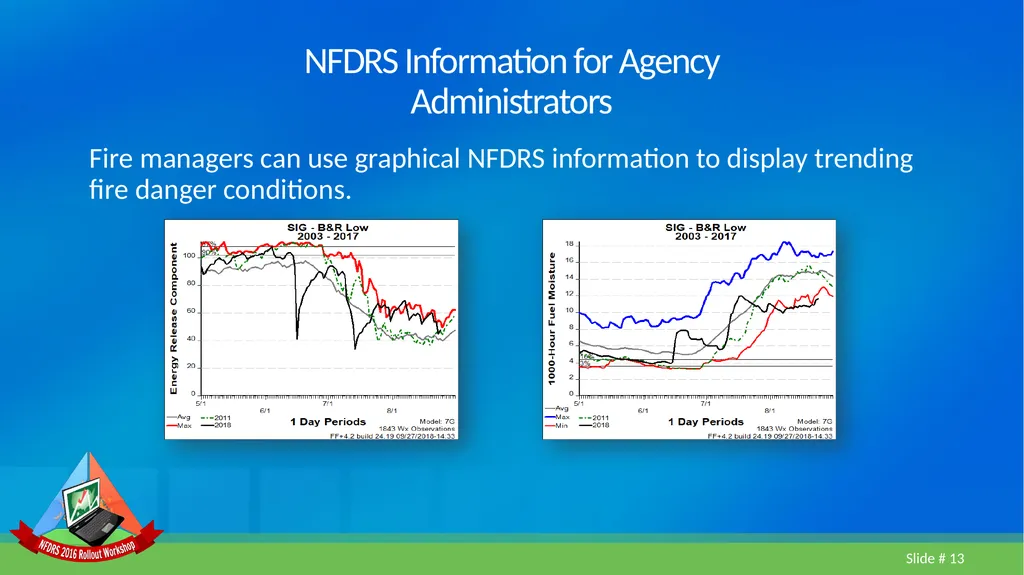
slide13. NFDRS Information for Agency Administrators Fire managers can use graphical NFDRS information to display trending fire danger conditions.<br>
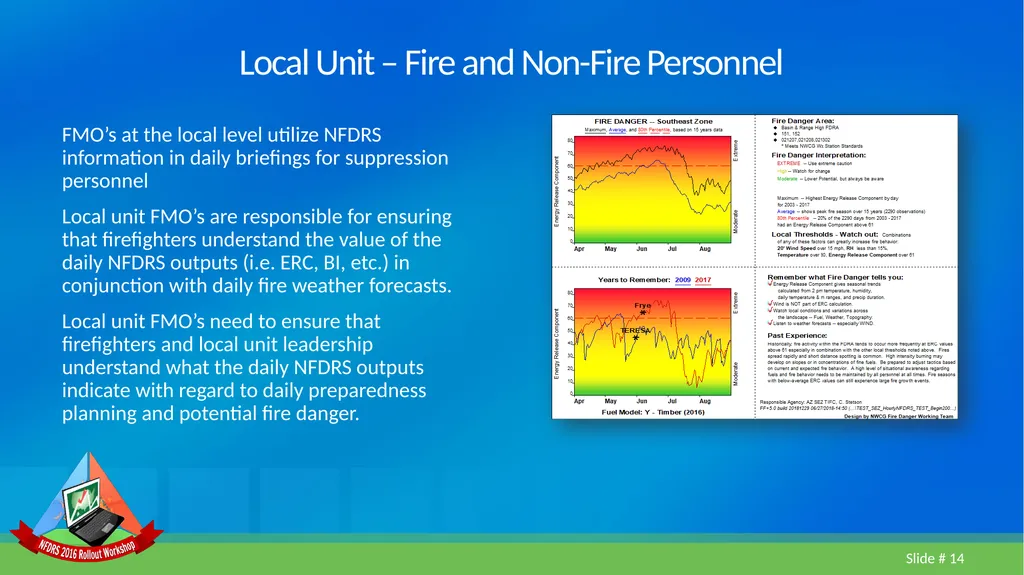
slide14. Local Unit – Fire and Non-Fire Personnel FMO’s at the local level utilize NFDRS information in daily briefings for suppression personnel
Local unit FMO’s are responsible for ensuring that firefighters understand the value of the daily NFDRS outputs (i.e. ERC, BI, etc.) in conjunction with daily fire weather forecasts.
Local unit FMO’s need to ensure that firefighters and local unit leadership understand what the daily NFDRS outputs indicate with regard to daily preparedness planning and potential fire danger.<br>
slide15. Local Unit Decisions NFDRS information can be used to aid in deciding:
Daily staffing
Restrictions for local industrial cooperators.
Prescribed Fire Go/No-Go decisions.
Allow fire to be managed to meet resource benefit objectives or implement suppression actions.
Availability of resources for scheduled project work.
Availability of non-fire personnel to support fire suppression activities.<br>
slide16. Industrial Cooperators NFDRS-based benchmarks (i.e. Adjective Fire Danger Rating, Preparedness Level) assist FMO’s and agency administrators when evaluating restrictions or limitations on industrial activities.
FMO’s, COR’s, and agency staff ensure that industrial cooperators understand which activities are allowed at the different levels of fire danger and why it is important to adhere to the identified BMP’s.<br>
slide17. Public Information FMO’s work with Public Information Officers (PIO’s) to effectively communicate fire danger information to the public.
It is important for the public and the media to understand why certain restrictions or closures are being considered or implemented.
NFDRS outputs are just as important when considering rescinding restrictions or closure orders.
Fire program mangers for all cooperating agencies within the SEZ utilize the Adjective Fire Danger Rating tool to convey current fire danger conditions to the public<br>
slide18. Adjective Fire Danger Rating WIMS will automatically calculate the adjective class rating.
TDC manually determines Adjective Fire Danger Rating for each FDRA based on fire business thresholds developed using FFP.
The actual determination is based on the current or forecasted value of a selected staffing index (ERC) and ignition component (IC) using the tables in the FDOP.<br>
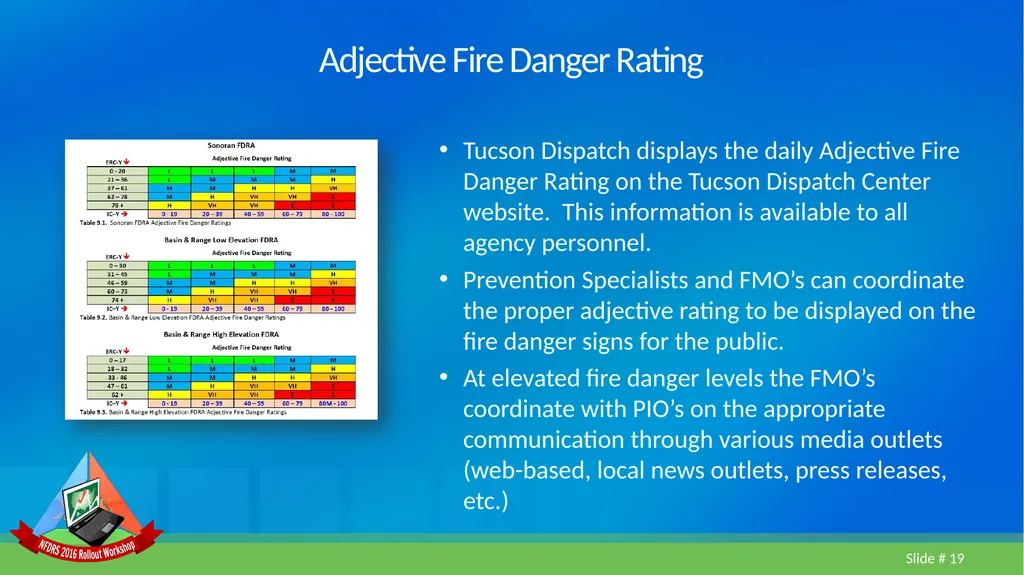
slide19. Adjective Fire Danger Rating Tucson Dispatch displays the daily Adjective Fire Danger Rating on the Tucson Dispatch Center website. This information is available to all agency personnel.
Prevention Specialists and FMO’s can coordinate the proper adjective rating to be displayed on the fire danger signs for the public.
At elevated fire danger levels the FMO’s coordinate with PIO’s on the appropriate communication through various media outlets (web-based, local news outlets, press releases, etc.)<br>
slide20. Preparedness Levels Preparedness Level (PL) plans are required at the national, state/regional, and local levels.
The SEZ PL plan uses NFDRS inputs to help provide management direction based on:
5-day Southeast Zone ERC average
Southeast Zone Resource Commitment
Southeast Zone Fire Activity
Southwest Area (SWA) Preparedness Level
7-day Fire Potential for SW06S (SWA Predictive Services)<br>
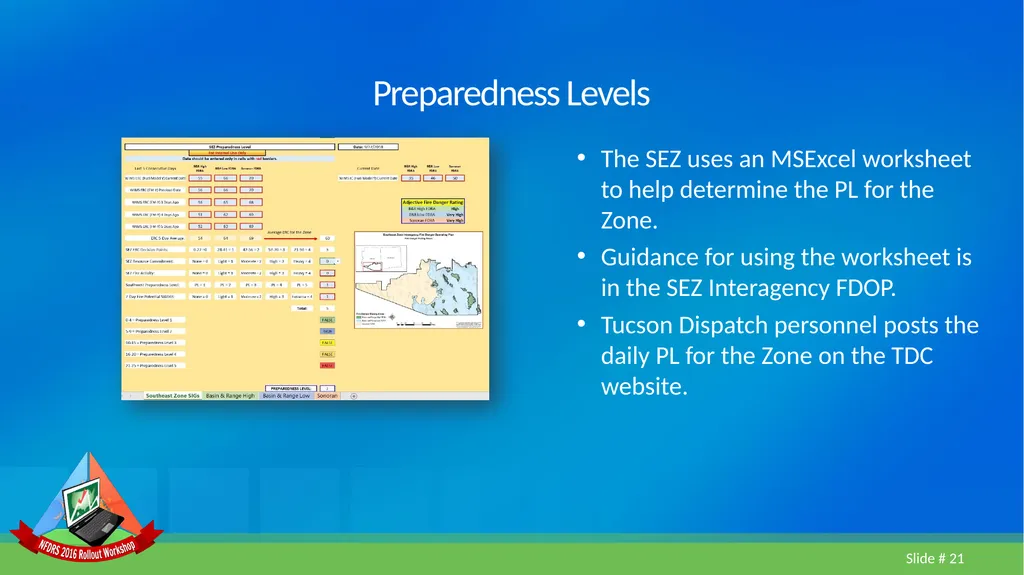
slide21. Preparedness Levels The SEZ uses an MSExcel worksheet to help determine the PL for the Zone.
Guidance for using the worksheet is in the SEZ Interagency FDOP.
Tucson Dispatch personnel posts the daily PL for the Zone on the TDC website.<br>
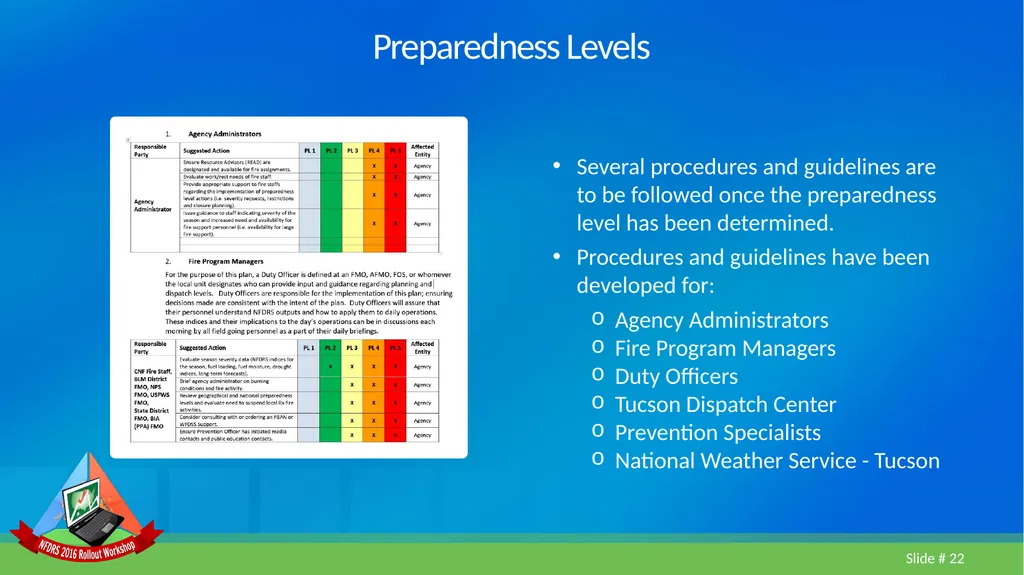
slide22. Preparedness Levels Several procedures and guidelines are to be followed once the preparedness level has been determined.
Procedures and guidelines have been developed for:
Agency Administrators
Fire Program Managers
Duty Officers
Tucson Dispatch Center
Prevention Specialists
National Weather Service - Tucson<br>
slide23. Dispatch Centers Tucson Dispatch Center (TDC) is a significant partner in the use and timely dissemination of NFDRS information for the SEZ.
TDC personnel provides NFDRS information for the SEZ on a daily basis:
Preparedness Level
Adjective Rating
Staffing Level
Response Level
Critical fire weather situations (i.e. Red Flag Warning)
TDC and Fire staff work with the NWS Tucson office personnel during periods of elevated fire danger and provide critical information to the local units.<br>
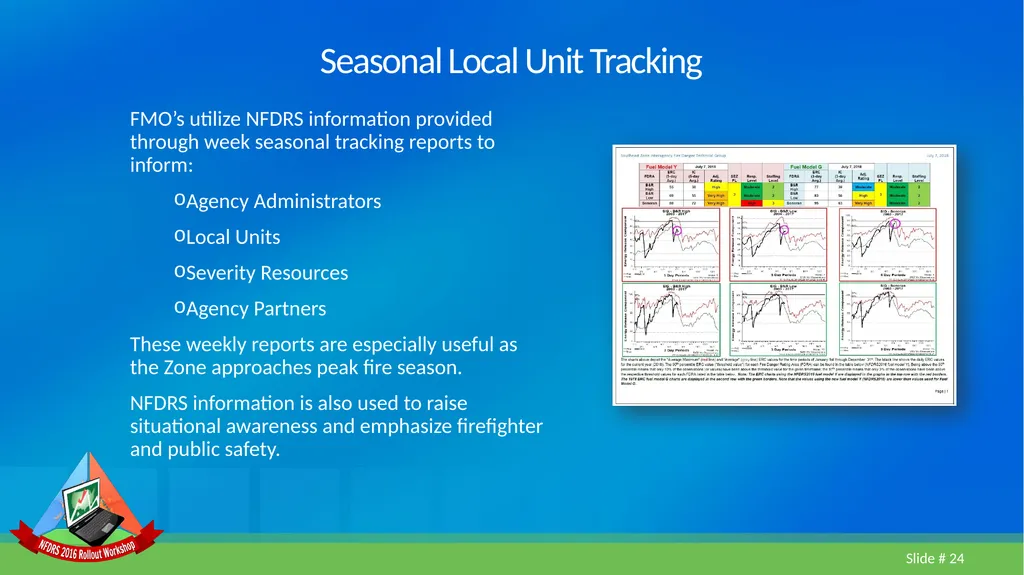
slide24. Seasonal Local Unit Tracking FMO’s utilize NFDRS information provided through week seasonal tracking reports to inform:
Agency Administrators
Local Units
Severity Resources
Agency Partners
These weekly reports are especially useful as the Zone approaches peak fire season.
NFDRS information is also used to raise situational awareness and emphasize firefighter and public safety.<br>
slide25. Summary The FDOP, based on NFDRS information, has provided SEZ fire program managers with decision support tools to help inform agency partners, the public, and industrial cooperators with current information on fire danger conditions within the zone.
NFDRS information is included in daily fire preparedness briefings as well as agency management briefings to help provide management direction based on fire danger, fire activity, and resource commitment and availability.
Most importantly, NFDRS information is used to help maintain a high level of safety awareness for suppression personnel.<br>
slide26. Review Objectives Demonstrate the importance of adhering to the recommended “best practices” as discussed in Lesson 3.
Relate a local view of the interagency planning and implementation of a fire danger operating plan.
List several fire management decisions based on NFDRS outputs.
Discuss the Southeast Zone (SEZ) Fire Danger Operating Plan (FDOP) connection between local fire occurrence issues and decisions based on fire danger products.<br>
slide27. .<br>
Fire Danger Operating Plan Workshop FMO Perspective - Local Application
“It’s all about decision making and informing decision makers.”<br>
slide2. Objectives Demonstrate the importance of adhering to the recommended “best practices” as discussed in Lesson 3.
Relate a local view of the interagency planning and implementation of a fire danger operating plan.
List several fire management decisions based on NFDRS outputs.
Discuss the Southeast Zone (SEZ) Fire Danger Operating Plan (FDOP) connection between local fire occurrence issues and decisions based on fire danger products.<br>
slide3. Introduction Southeast Zone (SEZ) Interagency Fire Danger Operating Plan (FDOP) was initially developed in 2012.
Has been revised several times. Currently operating under the 2017 version.
A 2018 version has been developed using the NFDRS 2016 model.
The SEZ FDOP working group continues to solicit advice and input towards improving the plan to meet fire managers needs and expectations.<br>
slide4. Interagency FDOP Agency Partners National Park Service
Coronado National Forest
Arizona BLM Gila District
US Fish and Wildlife Service
Tohono O’odham Nation/BIA Papago Agency
Arizona Department of Forestry and Fire Management, Southeast District<br>
slide5. Preparedness Information<br>
slide6. Preparedness Information for Agency Personnel Fire Danger Operating Plan development process blends:
Science
Historical Data
Established Processes
Local Knowledge<br>
slide7. Preparedness Information for Agency Personnel Fire Danger Operating Plan provides:
Unified framework for local interagency fire managers and agency administrators.
Provides tools to assist in decision making
Provides information that can lead to safe, efficient, and effective fire responses.<br>
slide8. Preparedness Information to Aid Decision Makers Current Information (WIMS data, NFDRS outputs, current weather information, etc.)
NFDRS outputs provide information on current conditions related to fire danger and fire behavior potential.
Forecast Information
Available in a variety of formats (daily fire weather forecasts, spot weather forecasts, seasonal outlooks, etc.)
Predictive Services can help to provide applicable and accurate forecast information.<br>
slide9. NFDRS Information Aids Fire Management Officers in providing daily fire preparedness direction based on:
Current Fire Danger
Current Fire Activity
Current Local Suppression Resource Availability or Commitment<br>
slide10. NFDRS Information The Dispatch Center helps to provide daily fire danger information to local units:
Daily adjective fire danger rating
Staffing Level
Response Level
Preparedness Level for the Zone<br>
slide11. NFDRS Information for Agency Administrators The FDOP provides continuity of information for leadership personnel.
FMO’s can provide agency administrators with an accurate depiction of the daily fire danger situation.
Current fire danger level
Current fire weather forecast information
Agency Administrators can support justification for fire preparedness decisions:
Availability of support staff outside of the fire organization
Restrictions or Closure Order considerations
Severity requests to augment local suppression resources<br>
slide12. NFDRS Information for Agency Administrators Decision documentation (WFDSS requirements on large, extended wildland fires):
Initial decisions need to provide the Agency Administrator’s overall direction
Fire program managers provide current fire danger and fire weather information to Agency Administrators to assist in the decision documentation process.
This information aids the Agency Administrator, FMO, and resource staff in the development incident specific objectives and requirements, a clear course of action for the management of the incident, and a rationale statement that supports the decision document.<br>
slide13. NFDRS Information for Agency Administrators Fire managers can use graphical NFDRS information to display trending fire danger conditions.<br>
slide14. Local Unit – Fire and Non-Fire Personnel FMO’s at the local level utilize NFDRS information in daily briefings for suppression personnel
Local unit FMO’s are responsible for ensuring that firefighters understand the value of the daily NFDRS outputs (i.e. ERC, BI, etc.) in conjunction with daily fire weather forecasts.
Local unit FMO’s need to ensure that firefighters and local unit leadership understand what the daily NFDRS outputs indicate with regard to daily preparedness planning and potential fire danger.<br>
slide15. Local Unit Decisions NFDRS information can be used to aid in deciding:
Daily staffing
Restrictions for local industrial cooperators.
Prescribed Fire Go/No-Go decisions.
Allow fire to be managed to meet resource benefit objectives or implement suppression actions.
Availability of resources for scheduled project work.
Availability of non-fire personnel to support fire suppression activities.<br>
slide16. Industrial Cooperators NFDRS-based benchmarks (i.e. Adjective Fire Danger Rating, Preparedness Level) assist FMO’s and agency administrators when evaluating restrictions or limitations on industrial activities.
FMO’s, COR’s, and agency staff ensure that industrial cooperators understand which activities are allowed at the different levels of fire danger and why it is important to adhere to the identified BMP’s.<br>
slide17. Public Information FMO’s work with Public Information Officers (PIO’s) to effectively communicate fire danger information to the public.
It is important for the public and the media to understand why certain restrictions or closures are being considered or implemented.
NFDRS outputs are just as important when considering rescinding restrictions or closure orders.
Fire program mangers for all cooperating agencies within the SEZ utilize the Adjective Fire Danger Rating tool to convey current fire danger conditions to the public<br>
slide18. Adjective Fire Danger Rating WIMS will automatically calculate the adjective class rating.
TDC manually determines Adjective Fire Danger Rating for each FDRA based on fire business thresholds developed using FFP.
The actual determination is based on the current or forecasted value of a selected staffing index (ERC) and ignition component (IC) using the tables in the FDOP.<br>
slide19. Adjective Fire Danger Rating Tucson Dispatch displays the daily Adjective Fire Danger Rating on the Tucson Dispatch Center website. This information is available to all agency personnel.
Prevention Specialists and FMO’s can coordinate the proper adjective rating to be displayed on the fire danger signs for the public.
At elevated fire danger levels the FMO’s coordinate with PIO’s on the appropriate communication through various media outlets (web-based, local news outlets, press releases, etc.)<br>
slide20. Preparedness Levels Preparedness Level (PL) plans are required at the national, state/regional, and local levels.
The SEZ PL plan uses NFDRS inputs to help provide management direction based on:
5-day Southeast Zone ERC average
Southeast Zone Resource Commitment
Southeast Zone Fire Activity
Southwest Area (SWA) Preparedness Level
7-day Fire Potential for SW06S (SWA Predictive Services)<br>
slide21. Preparedness Levels The SEZ uses an MSExcel worksheet to help determine the PL for the Zone.
Guidance for using the worksheet is in the SEZ Interagency FDOP.
Tucson Dispatch personnel posts the daily PL for the Zone on the TDC website.<br>
slide22. Preparedness Levels Several procedures and guidelines are to be followed once the preparedness level has been determined.
Procedures and guidelines have been developed for:
Agency Administrators
Fire Program Managers
Duty Officers
Tucson Dispatch Center
Prevention Specialists
National Weather Service - Tucson<br>
slide23. Dispatch Centers Tucson Dispatch Center (TDC) is a significant partner in the use and timely dissemination of NFDRS information for the SEZ.
TDC personnel provides NFDRS information for the SEZ on a daily basis:
Preparedness Level
Adjective Rating
Staffing Level
Response Level
Critical fire weather situations (i.e. Red Flag Warning)
TDC and Fire staff work with the NWS Tucson office personnel during periods of elevated fire danger and provide critical information to the local units.<br>
slide24. Seasonal Local Unit Tracking FMO’s utilize NFDRS information provided through week seasonal tracking reports to inform:
Agency Administrators
Local Units
Severity Resources
Agency Partners
These weekly reports are especially useful as the Zone approaches peak fire season.
NFDRS information is also used to raise situational awareness and emphasize firefighter and public safety.<br>
slide25. Summary The FDOP, based on NFDRS information, has provided SEZ fire program managers with decision support tools to help inform agency partners, the public, and industrial cooperators with current information on fire danger conditions within the zone.
NFDRS information is included in daily fire preparedness briefings as well as agency management briefings to help provide management direction based on fire danger, fire activity, and resource commitment and availability.
Most importantly, NFDRS information is used to help maintain a high level of safety awareness for suppression personnel.<br>
slide26. Review Objectives Demonstrate the importance of adhering to the recommended “best practices” as discussed in Lesson 3.
Relate a local view of the interagency planning and implementation of a fire danger operating plan.
List several fire management decisions based on NFDRS outputs.
Discuss the Southeast Zone (SEZ) Fire Danger Operating Plan (FDOP) connection between local fire occurrence issues and decisions based on fire danger products.<br>
slide27. .<br>