Level 3: Adult Safeguarding Course LeadersManagers Competence at this level is about individuals having an enhanced understanding of adult safeguarding and some of the complexities that can arise in this area. Suitable for: All staff who
"Level 3: Adult Safeguarding Course –" is the property of its rightful owner. Permission is granted to
download and print the materials on this website for personal, non-commercial use only, and to display it
on your personal computer provided you do not modify the materials and that you retain all copyright
notices contained in the materials. By downloading content from our website, you accept the terms of this
agreement.
Presentation Transcript
01
Level 3: Adult Safeguarding Course – Leaders/Managers Competence at this level is about individuals having an enhanced understanding of adult safeguarding and some of the complexities that can arise in this area.
Suitable for: All staff who regularly investigate and/or contribute to supporting adults at risk of abuse and/or their families/carers, and who manage or supervise staff who do. This includes through multi-agency safeguarding procedures and assessing, planning, intervening and evaluating the needs of an adult where there are safeguarding concerns.
Example Staff Groups: Lead doctors, heads of adult safeguarding, named GPs/doctors for organisations commissioning primary care. Named professionals working in provider or commissioning services, consultants, team managers, care home manager, senior care home clinician.<br>
02
Aims and objectives Aim
To enhance your knowledge and skills as a leader/manager with regards to safeguarding, thinking critically about your role in protecting adults with care and support needs alongside supporting team members/colleagues during safeguarding processes.
Objectives
Demonstrate an ability to lead investigations on behalf of social care organisations when requested to enable it to decide whether any action should be taken in the adult’s case
Demonstrate an ability to provide specialist advice to practitioners, both actively and reactively, including clarification about organisational policies, legal issues and the management of adult safeguarding cases.
Demonstrate an ability to effectively communicate local safeguarding knowledge, research and findings from audits and challenge poor practice.<br>
03
Housekeeping, Training Agreement & Introductions Toilets, breaks, course materials, fire exits and mobile phones.
Training agreement.
Introductions.<br>
04
Your role as Managers/Leads in adult safeguarding Ensuring you are up-to-date on good practice & safeguarding knowledge
Ensure your staff can identify and respond to safeguarding concerns (through training, etc)
Ensure all policies are up-to-date, comprehensive and aligned with local multi-agency procedures
Effective staff management (including allegations management, etc)
Meeting statutory requirements, undertaking audits, reviews, etc
Investigate and respond to organisational concerns<br>
05
How To Refer A Concern Refer to Threshold of Needs Matrix
Call the Consultation Line, Safeguarding Adults Service (Oxfordshire County Council) on 01865 328232
Refer online via the OSAB website<br>
06
The Adult Safeguarding Process Initial fact finding
Does the Local Authority have “reasonable grounds to suspect” – Section 42 Care Act 2014
If no, other non-safeguarding actions may occur
Multi-agency policy https://www.osab.co.uk/wp-content/uploads/Procedure-for-adults-who-dont-engage-v2.pdf
If yes, formal Section 42 enquiry
Safeguarding is not a substitute for the criminal justice system<br>
07
What happens next? Partnership working.
Patterns of concerns.
Risk reduction, removal, risk(s) remain.
Outcome terms; unsubstantiated, inconclusive, substantiated, partially substantiated
Individual requests no further involvement.
Balance of probabilities.<br>
08
Legal Awareness and Literacy What are the main pieces of legislation which underpin the work your organisation carries out with adults?
Seek advice
Legal literacy = integrating law (doing things right), ethics (doing things right) and rights (rights based thinking)<br>
09
Mental Capacity Act 2005 and Code of Practice When to assess?
Who should assess?
Challenges - poor documenting, inconsistent approaches, fluctuating capacity, reliance on other professional’s assessment of capacity, disputes<br>
10
Confidentiality, information sharing and consent Barriers to gaining consent
Data Protection Act 1998 and the General Data Protection Regulations of 2018
Caldicott Guardian & principles
Information sharing protocols
Seek advice<br>
11
Information sharing Basic principles of confidentiality and information sharing.
Raise awareness of responsibilities.
Risks of not sharing.
Mental Capacity Act 2005.
Provide a contact number for staff and volunteers to raise concerns.
Be clear – how and when?
Give assurances – evidence helpful, but not always necessary.
Acceptable circumstances not to share?<br>
12
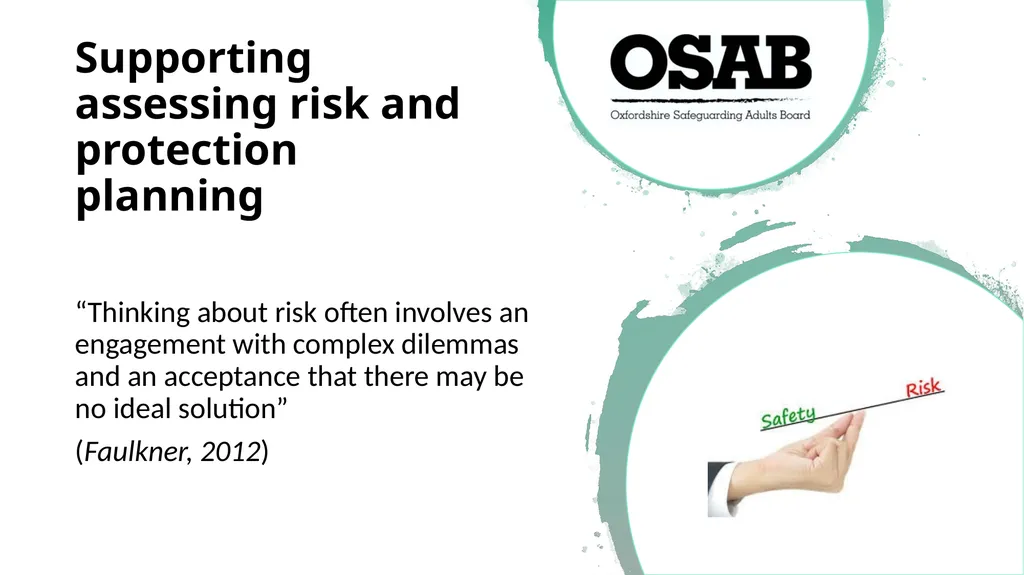
Supporting assessing risk and protection planning “Thinking about risk often involves an engagement with complex dilemmas and an acceptance that there may be no ideal solution”
(Faulkner, 2012)<br>
13
Multi-Agency Risk Assessment Conference (MARAC) Locally, the MARAC involves the Independent Domestic Violence Advocate, Thames Valley Police, Health Organisations, Children’s & Adults social care, Probation Service, Housing, meet once a month in the 3 areas (North, City and South).
They discuss high risk domestic abuse case referrals from any agency. They conduct assessment of risk and create plans to manage the risks.
For more information, visit the Reducing the Risk website: http://www.reducingtherisk.org.uk/cms/content/marac<br>
14
Multi-Agency Public Protection Arrangements (MAPPA) Managing the risks posed by violent and sexual offenders living in the community.
Various agencies such as the police, the Prison Service and Probation work together to protect the public.<br>
15
Break<br>
16
Case Study Activity<br>
17
Allegations of abuse by professionals / staff Whistleblowing policies & Public Interest Disclosure Act 1998
Protect - www.protect-advice.org.uk/
Multi-agency guidance
Case Reviews – Winterbourne View & Mid-Staffordshire Hospitals “Systematic failings”
Whorlton Hall, County Durham
Ill-treatment and wilful neglect<br>
18
Duty of Candour Statutory duty - Health and Social Care Act 2008 (Regulated Activities) Regulations 2014: Regulation 20
Introduced November 2014 for NHS bodies such as trusts and foundation trusts in England.
Extended April 2015 to cover all other care providers registered with the Care Quality Commission (CQC).<br>
19
Reviewing safeguarding practice Regular case/clinical supervision
Case discussion with peers and peer challenge
Audits
Policy updates and reviews<br>
20
Escalating a concern Keys to successful escalation:
Challenge requires supporting evidence
Clear and accurate language
Understanding of the processes
Clear references to policy, procedures and guidance<br>
21
Learning from Reviews Safeguarding Adult Reviews (SARs)
Other Review Processes
Local & National Learning – Hampshire County Council www.hampshiresab.org.uk/learning-from-experience-database 21<br>
22
Learning from SAR’s - Oxfordshire ‘Adult C’ – man in his 40’s, living alone in Oxford.
Neighbour disputes.
Adult C called Police due to noise disturbance.
Adult C’s neighbour called Police due to threats made by Adult C.
Mental Health Act assessment convened – no admission to hospital.
Explosion at the block of flats and Adult C’s body was found in the rubble.<br>
23
Learning from SAR’s - National ‘Mr A’ - 64 year old man - resident in a nursing home in Kent.
Mr A refused to accept care and treatment for many health conditions, which included; diabetes, epilepsy and Korsakoff Syndrome.
Mr A’s refusal of care had caused the cellulitis on his legs to develop into open wounds, which became infested with maggots.
In July 2016 Mr A collapsed and died.<br>
24
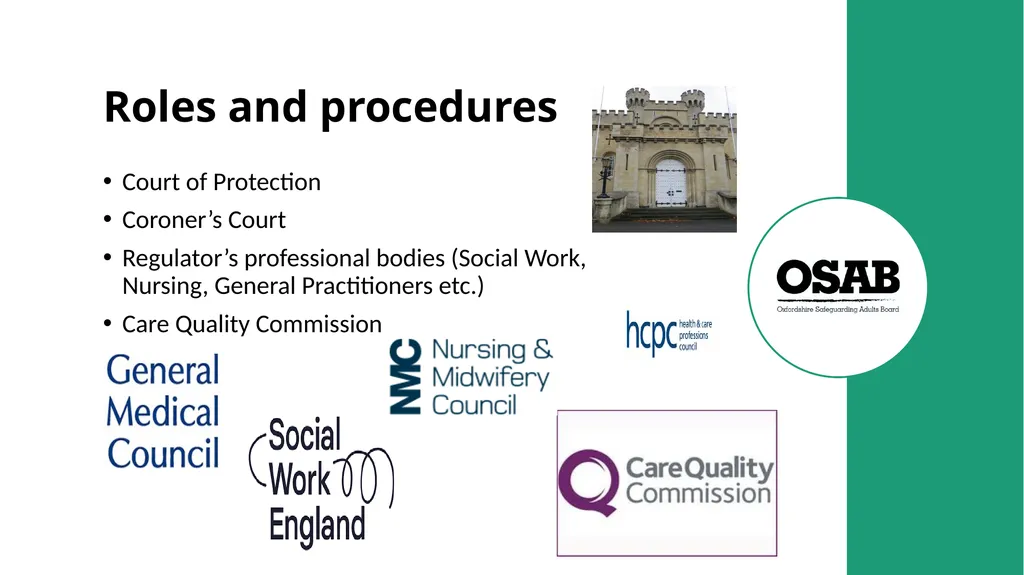
Roles and procedures Court of Protection
Coroner’s Court
Regulator’s professional bodies (Social Work, Nursing, General Practitioners etc.)
Care Quality Commission<br>
25
Summary Provide positive and knowledgeable leadership support to your staff.
Challenge poor practice.
Have a good understanding of organisational policies, legal literacy and the management of safeguarding cases.
Have a good understanding of local safeguarding procedures and support available in your area.
Carry out regular reviews of your organisational and staff’s safeguarding practice.<br>