
Life sciences Grade 12CAPS structured, clear,

Description: Life sciences Grade 12CAPS structured, clear, practical - Helping teachers unlock the power of NCS KNOWLEDGE AREA: Environmental Studies TOPIC 5: Human Impact on the Environment Water Availability and Water Quality Summary of presentation
Related Topics
Download Presentation
"Life sciences Grade 12CAPS structured, clear," is the property of its rightful owner. Permission is granted to download and print the materials on this website for personal, non-commercial use only, and to display it on your personal computer provided you do not modify the materials and that you retain all copyright notices contained in the materials. By downloading content from our website, you accept the terms of this agreement.
Presentation Transcript
slide1. Life sciences Grade 12CAPS
structured, clear, practical - Helping teachers unlock the power of NCS KNOWLEDGE AREA:
Environmental Studies
TOPIC 5: Human Impact on the Environment Water Availability and Water Quality<br>
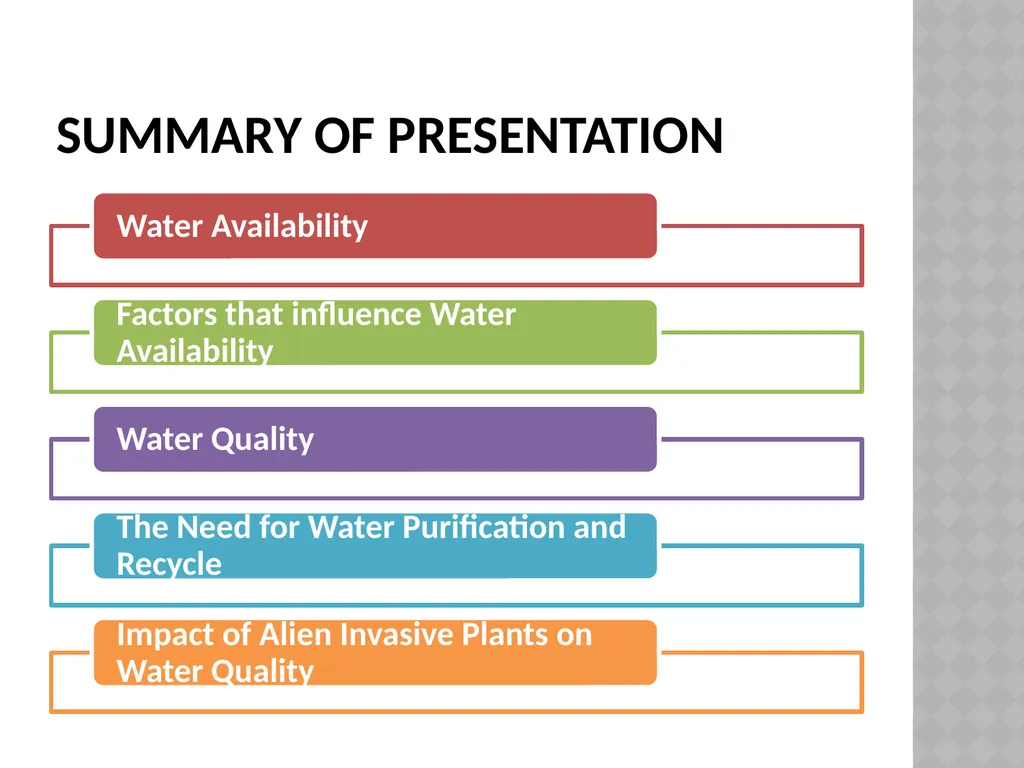
slide2. Summary of presentation<br>
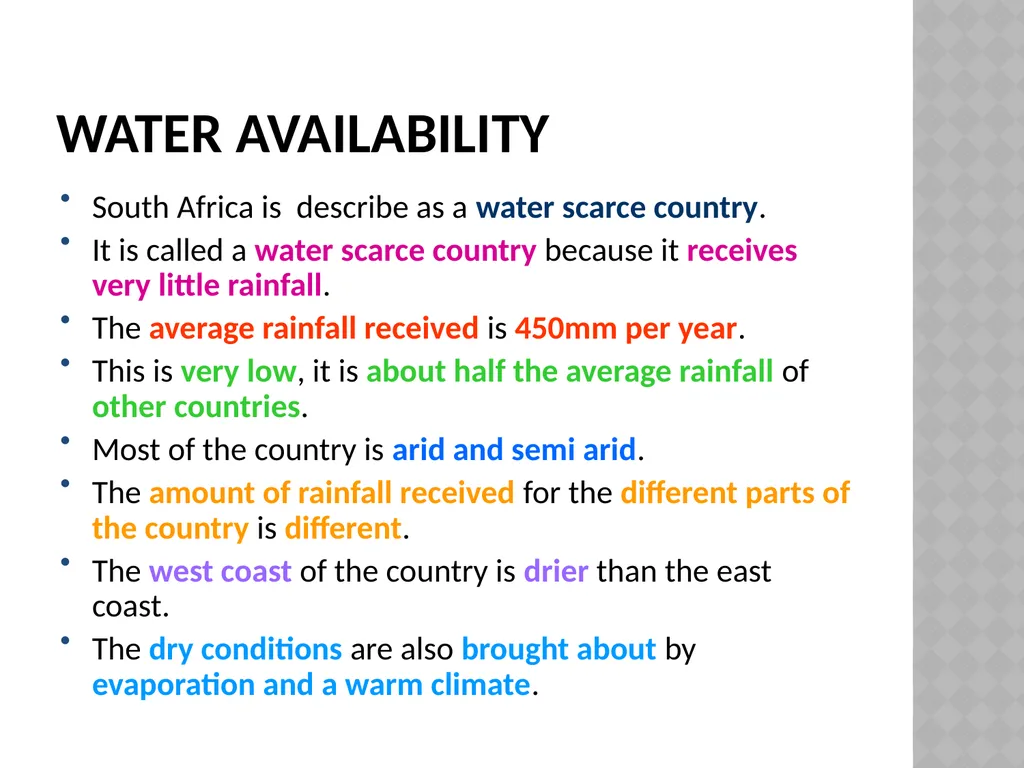
slide3. Water Availability South Africa is describe as a water scarce country.
It is called a water scarce country because it receives very little rainfall.
The average rainfall received is 450mm per year.
This is very low, it is about half the average rainfall of other countries.
Most of the country is arid and semi arid.
The amount of rainfall received for the different parts of the country is different.
The west coast of the country is drier than the east coast.
The dry conditions are also brought about by evaporation and a warm climate.<br>
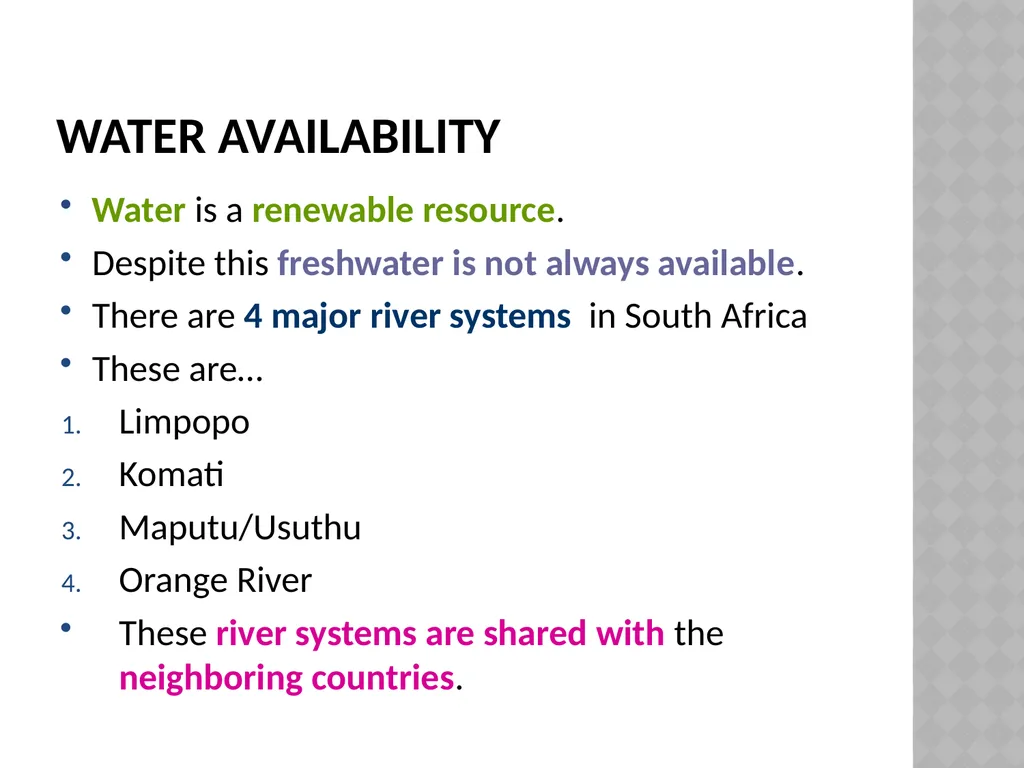
slide4. Water Availability Water is a renewable resource.
Despite this freshwater is not always available.
There are 4 major river systems in South Africa
These are…
Limpopo
Komati
Maputu/Usuthu
Orange River
These river systems are shared with the neighboring countries.<br>
slide5. Factors that influence Water Availability In South Africa water availability is influenced by the following factors…
Construction of dams
Destruction of wetlands
Increased temperatures
Poor farming practices
Droughts and floods
Alien plants and the depletion of the water table
Boreholes and their impact on aquifers
Wastage
Cost of water
We will now discuss these factors.<br>
slide6. Factors that influence Water Availability Construction of Dams.
What is a dam?
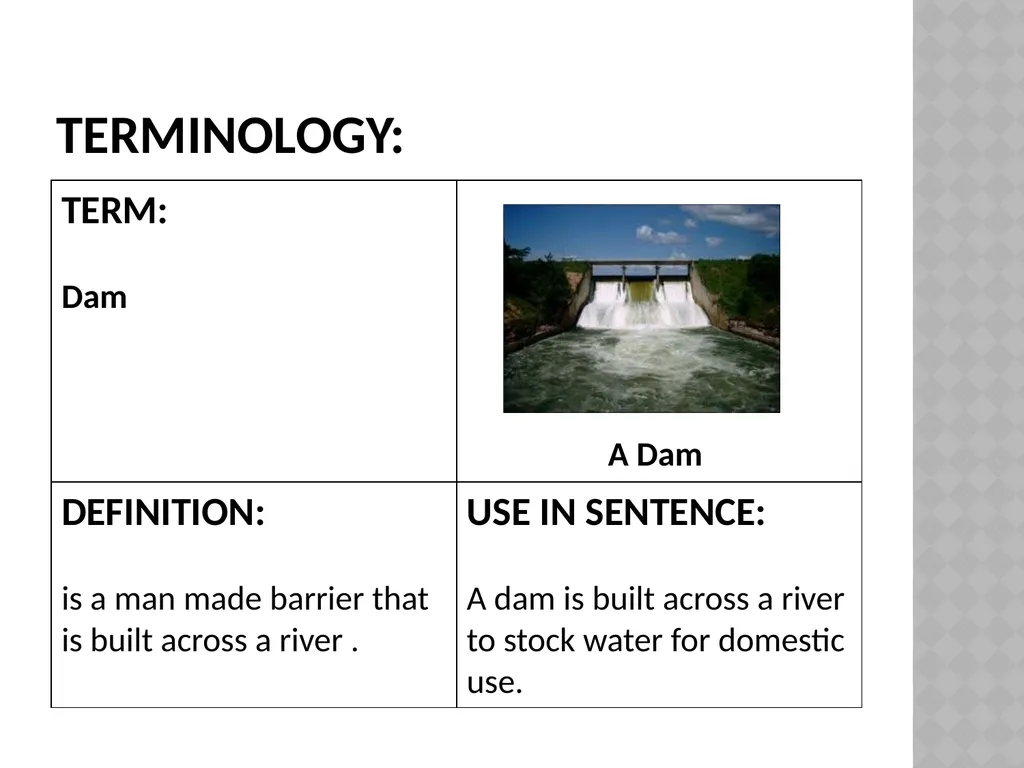
A dam is a man made barrier that is built across a river .
Building of a dam leads to the formation of a lake or reservoir.
A dam has two functions.
These are…
To stock up water
To control the flow of the river<br>
slide7. Factors that influence Water Availability The Main Purpose of a Dam
The main purposes of a dam are as follows…
Supply of Water for Domestic and Industrial Use.
During the rainy season water is collected and stored in the dam.
This ensures that water is available throughout the year for both domestic and industrial use.
This means that water is available all year round even the dry season.
During the dry season water may also be released from the dam.<br>
slide8. Factors that influence Water Availability This makes water available for the plants and animals downstream that may not have water in the dry season.
This is also useful for people living in informal settlements, because they are not supplied with municipal water.
They have access to water all year round.
Flood Control
Dams can be used to regulate the flow of water.
During heavy rainfall the volume of water within the river increases.
The river can burst its banks.<br>
slide9. Factors that influence Water Availability The areas along the river banks will become flooded.
This leads to great loss of both plant and animal life.
The dam can be used to store the water and slow the release of water.
The amount of water released can be controlled through the sluice control.
This prevents flooding downstream.<br>
slide10. Factors that influence Water Availability Generation of Hydro-Electricity
In this case water from a dam is used to generate electric power.
This type of power is called hydro-electric power.<br>
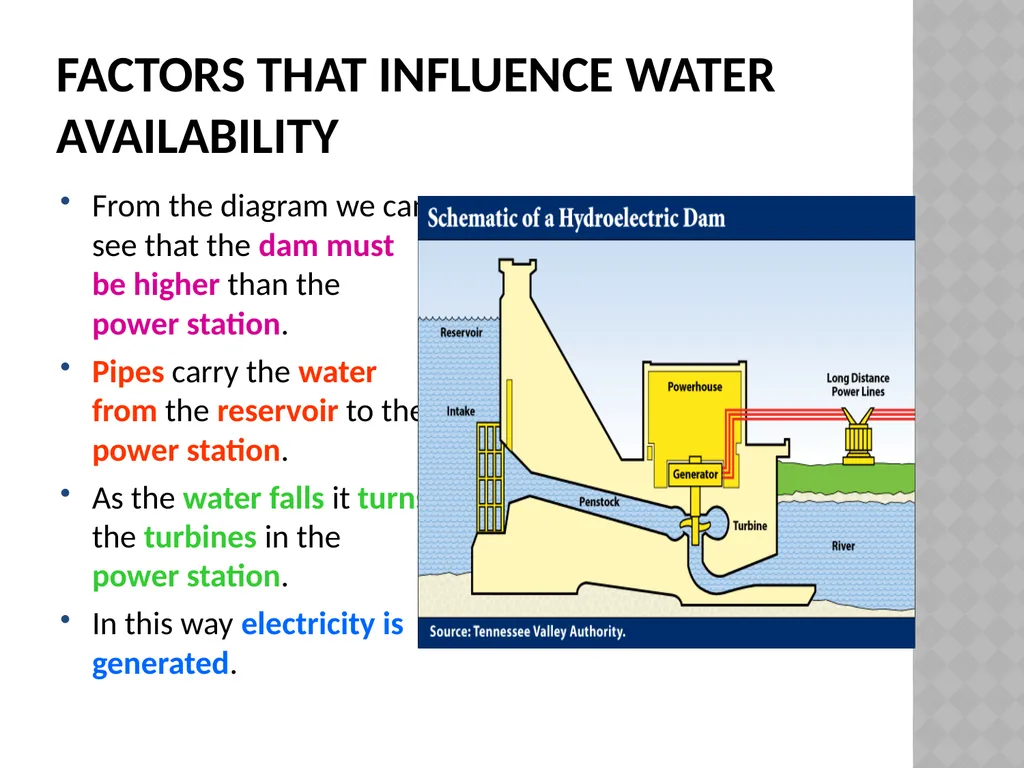
slide11. Factors that influence Water Availability From the diagram we can see that the dam must be higher than the power station.
Pipes carry the water from the reservoir to the power station.
As the water falls it turns the turbines in the power station.
In this way electricity is generated.<br>
slide12. Factors that influence Water Availability Irrigation…
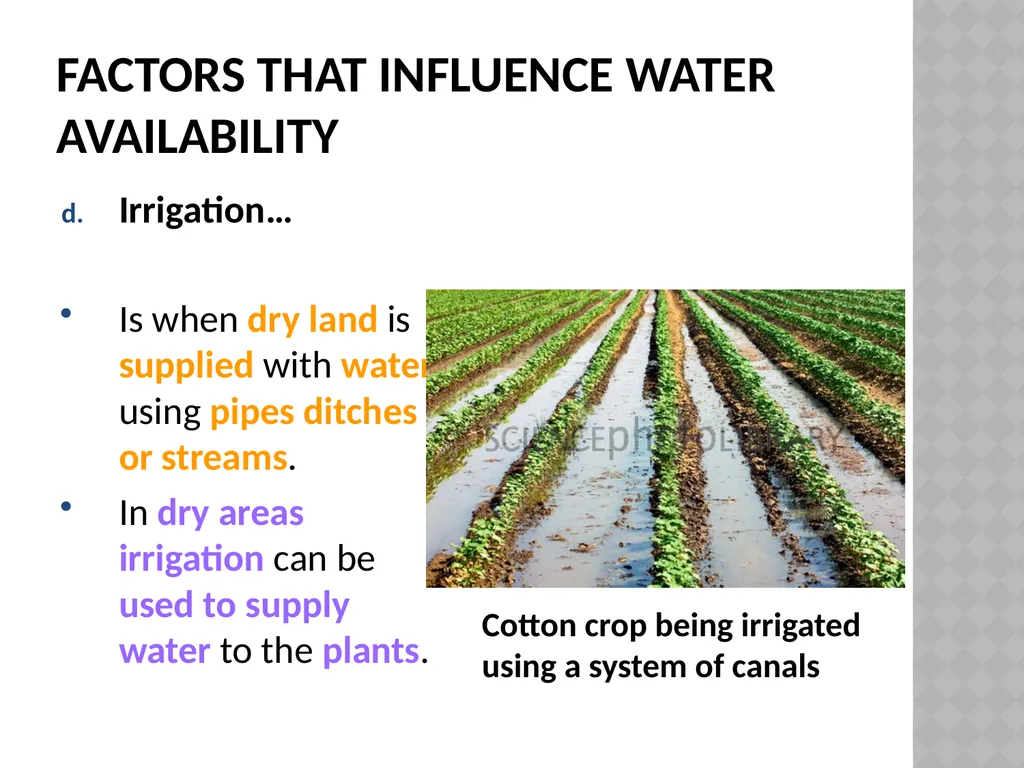
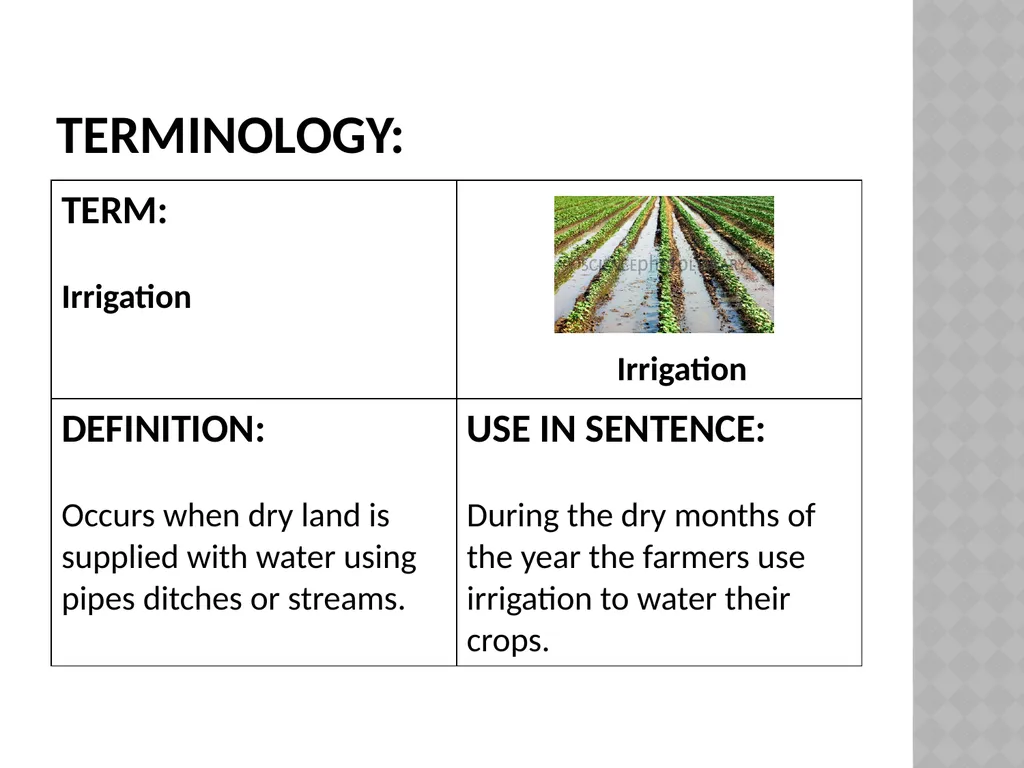
Is when dry land is supplied with water using pipes ditches or streams.
In dry areas irrigation can be used to supply water to the plants. Cotton crop being irrigated
using a system of canals<br>
slide13. Factors that influence Water Availability During the rainy season water is collected and stored in the reservoirs or dams.
During the dry season water can be distributed over the land using a system of pipes or canals.<br>
slide14. Factors that influence Water Availability Disadvantages of Constructing a Dam…
Loss of Biodiversity
Construction of a dam leads to habitat destruction.
Habitats both upstream and downstream are affected.
Upstream- here the water is collected, this results in flooding of the habitat. This in turn leads to the drowning of many plant and animal species.<br>
slide15. Factors that influence Water Availability Down stream – there is less water. Therefore the river banks dry out, resulting in the death of many species. When the flood sluices are opened then many of the remaining species drown.
People and their Livelihoods are Affected.
Many people depend on the river for their livelihoods.
Some people use the river for farming, while other people use the river for fishing.
Damming of the river results in less water downstream.<br>
slide16. Factors that influence Water Availability When the flood gates are open the river banks and sometimes the surrounding areas can flood.
This result in a large number of people being displaced.
Therefore they lose their homes and source of income.
The Natural Balance of the River is Upset…
When a dam is constructed across a river lose soil is held back.
This means that down stream the nature of the river is changed.<br>
slide17. Factors that influence Water Availability This affects all the plants and animals living downstream.
Once again when the flood gates are open the river banks downstream are flooded.
Plants die and animals are forced to leave the area.
The river downstream can also become drier and this can lead to soil erosion.
Under normal conditions during the rainy season the fertile soil is deposited on the river banks.
The dams prevents this from happening.
Eventually the soil on the river banks downstream becomes less fertile.<br>
slide18. Terminology: A Dam<br>
slide19. Terminology: Irrigation<br>
slide20. Factors that influence Water Availability Destruction of Wetlands
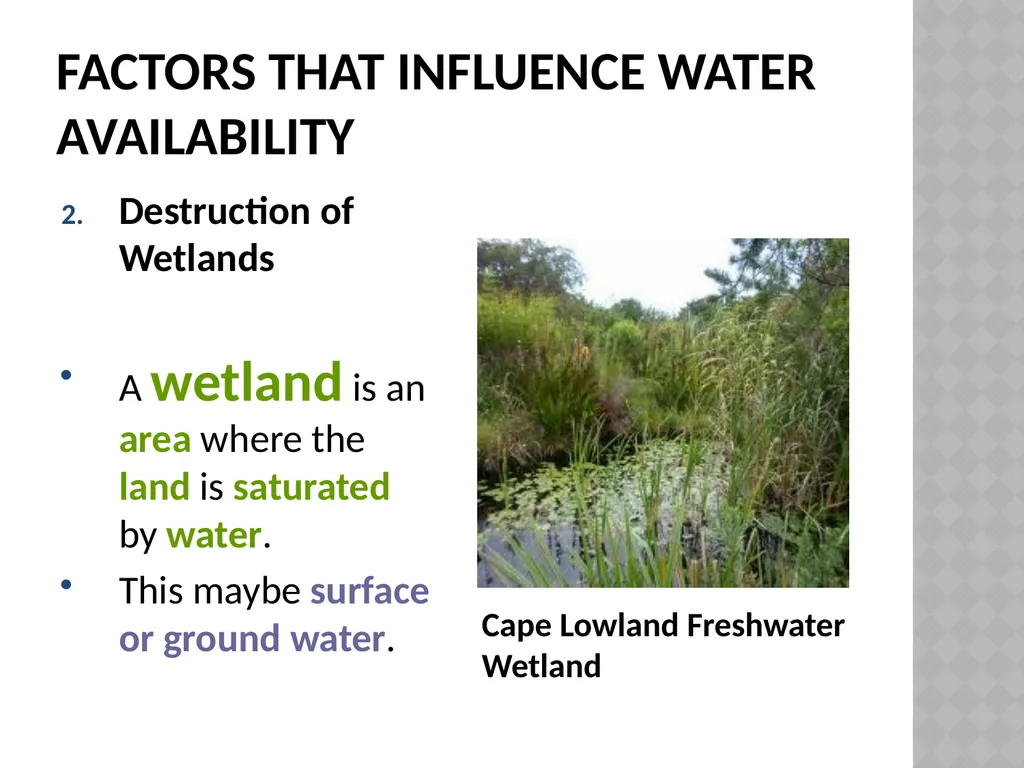
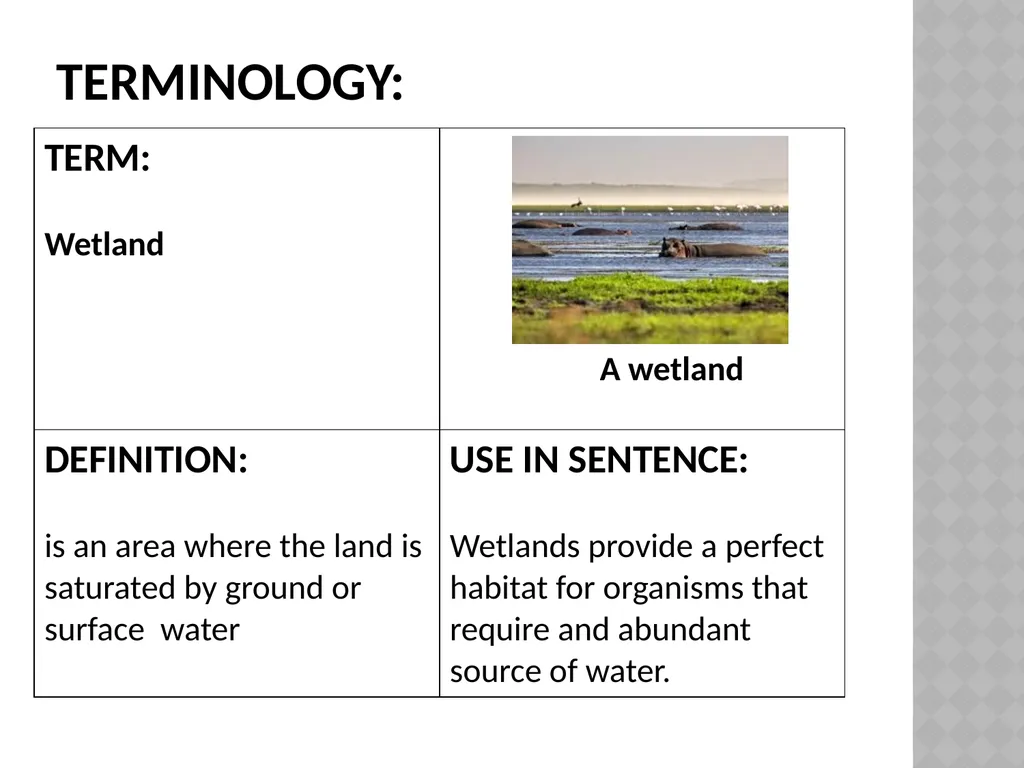
A wetland is an area where the land is saturated by water.
This maybe surface or ground water. Cape Lowland Freshwater
Wetland<br>
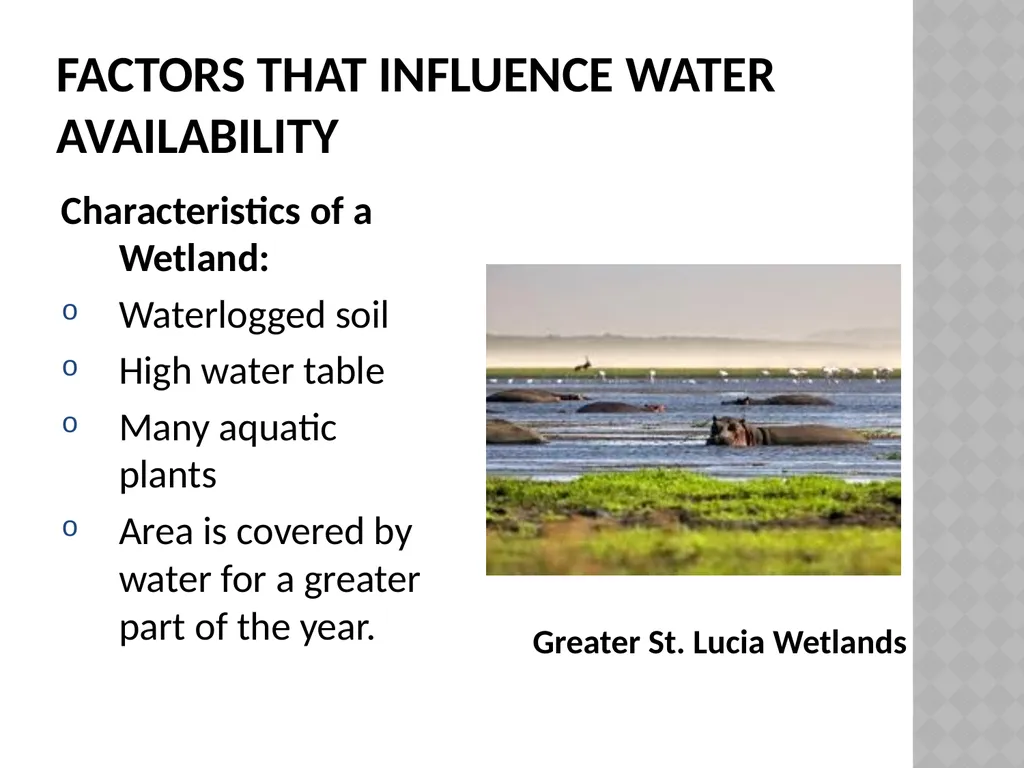
slide21. Factors that influence Water Availability Characteristics of a Wetland:
Waterlogged soil
High water table
Many aquatic plants
Area is covered by water for a greater part of the year. Greater St. Lucia Wetlands<br>
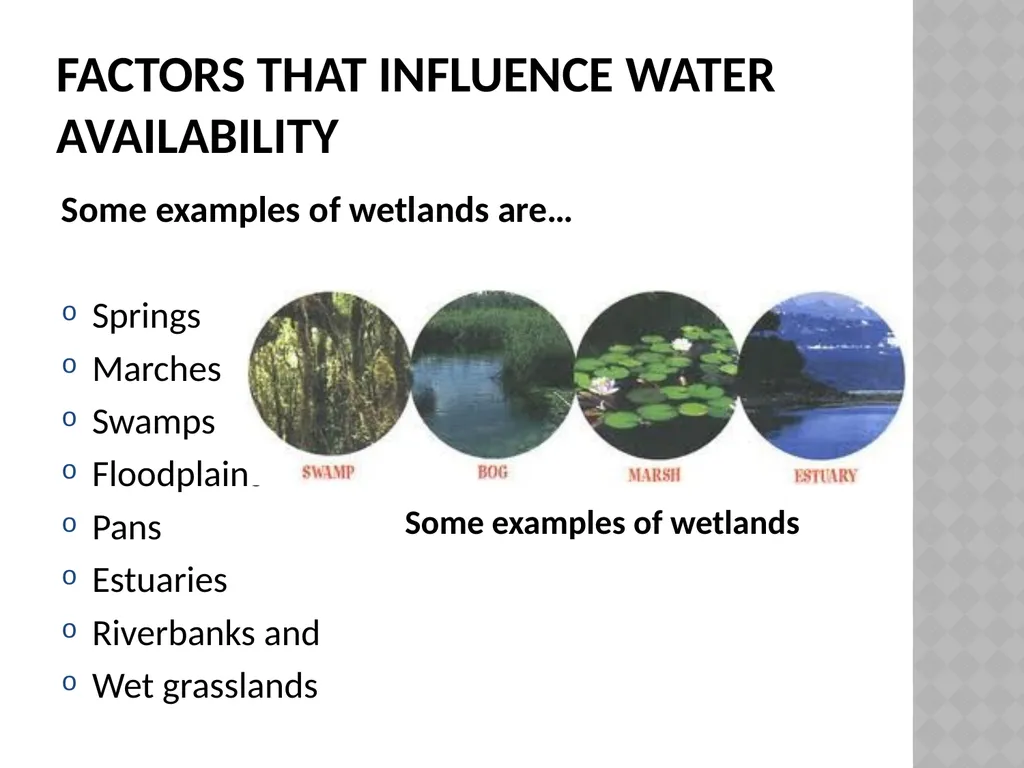
slide22. Factors that influence Water Availability Some examples of wetlands are…
Springs
Marches
Swamps
Floodplains
Pans
Estuaries
Riverbanks and
Wet grasslands Some examples of wetlands<br>
slide23. Factors that influence Water Availability The Role of the Wetland in an Ecosystem…
They purify the water by acting as a filter for pollutants found in the water. They are so successful as purifiers that artificial wetlands are being created to treat domestic and industrial waste.
They store water and are therefore able to supply water for domestic and livestock use, especially in times of drought.<br>
slide24. Factors that influence Water Availability They control floods and in this way reduce soil erosion.
They ensure that the water table always has water.
They are also a habitat for many plants and animals that require an abundant water supply.
Factors that lead to the destruction of the Wetlands…
Wetlands can be destroyed by draining the water and then filling it with soil to create space for housing or even agriculture.<br>
slide25. Factors that influence Water Availability Other factors that lead to the destruction of wetlands are…
Overgrazing which leads to soil erosion
Incorrect placement of dams
Urban development
Pollution
Mining
These factors lead to the changes in the flow of water and the water quality.
This eventually leads to the destruction of the wetland.<br>
slide26. Terminology: A wetland<br>
slide27. Factors that influence Water Availability Increased Temperatures…
Global warming has lead to higher average temperatures.
These higher temperature have increased the rate of evaporation from rivers, lakes , seas and soil.
Even transpiration has increased.
Therefore water available for domestic, industrial and agricultural use by humans has been reduced.<br>
slide28. Factors that influence Water Availability Poor Farming Practices…
Poor farming practices include…
Inefficient irrigation
In many countries open ditch irrigation is used.
This water is easily evaporated because the ditches are not covered.
Water is also lost through the sides and bottoms of the drains because these drains are not waterproof. This is called seepage.
Irrigation of the rivers upstream reduces water supply downstream.<br>
slide29. Factors that influence Water Availability A more efficient type of irrigation is the drip irrigation.
In this method water is released in direct contact with the crops either above or below ground.
There is less lost of water due to evaporation.
Incorrect ploughing methods
If ploughing occurs up and down a hill then water run-off leads to soil erosion.
Therefore top soil is washed away and vegetative cover is reduced.<br>
slide30. Factors that influence Water Availability Lack of vegetation will lead to water flowing away.
This reduces the water holding capacity of the soil.
Ploughing should occur along the contours of the hill.
Overgrazing
Overgrazing leads to parts of the soil being exposed because the layer of vegetation is removed.
The hooves of the grazing stock compact the soil.<br>
slide31. Factors that influence Water Availability This means that their hooves break up the soil particles into very tiny pieces.
This soil is now easily eroded by wind or water.
Therefore the top soil removed.
The soil becomes degraded.
Available water is not held by the soil therefore the water holding capacity of the soil is reduced.
These practices affects the availability of water.<br>
slide32. Factors that influence Water Availability Droughts and Floods…
Availability of water is affected by droughts and floods.
South Africa experiences periods of droughts that alternates with periods of floods.
It is thought that climate change would lead to more frequent periods of droughts and floods.
Climate change may lead to a much wetter rainy season and a much drier dry seasons in South Africa.
This will lead to more droughts and floods.<br>
slide33. Factors that influence Water Availability Flooding will result in increased soil erosion and rich top soil will be washed away into the rivers and dams.
Flooding will reduce the soil’s ability to support crops.
The frequent droughts in the drier western parts of the country will effect the fresh fruit industry.
Exotic Plantations and the Depletion of the Water Table
Exotic plants are also know as alien plants.<br>
slide34. Factors that influence Water Availability Alien plants are those plants that do not occur naturally in an area.
These alien plants have very long roots that can reach the water table.
Some alien plants also require large amounts of water. Example the wattle.
These alien plants are grown for shade or as plantations for commercial purposes.
In the short term it has a lot of economic value but
in the long term it absorbs large amounts of water.<br>
slide35. Factors that influence Water Availability This water may be absorbed form the water table.
Therefore the amount of water available for indigenous plants and animals is greatly reduced.<br>
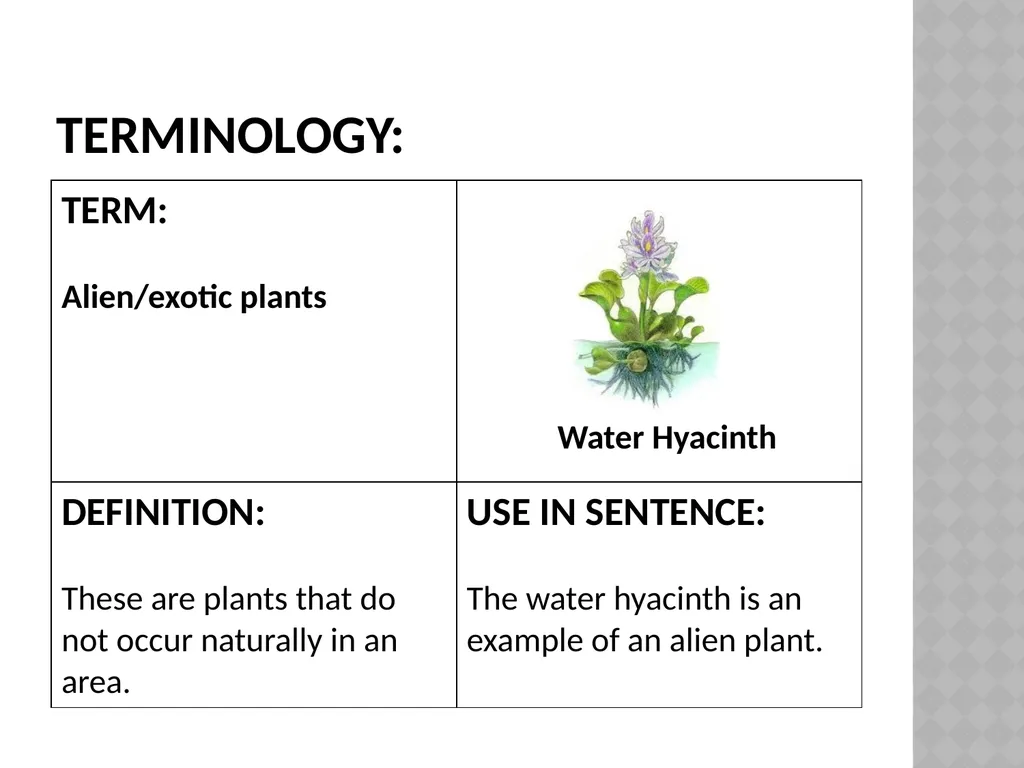
slide36. Terminology: Water Hyacinth<br>
slide37. Factors that influence Water Availability Boreholes and their Effects on Aquifers
Before we discuss this we must first know…<br>
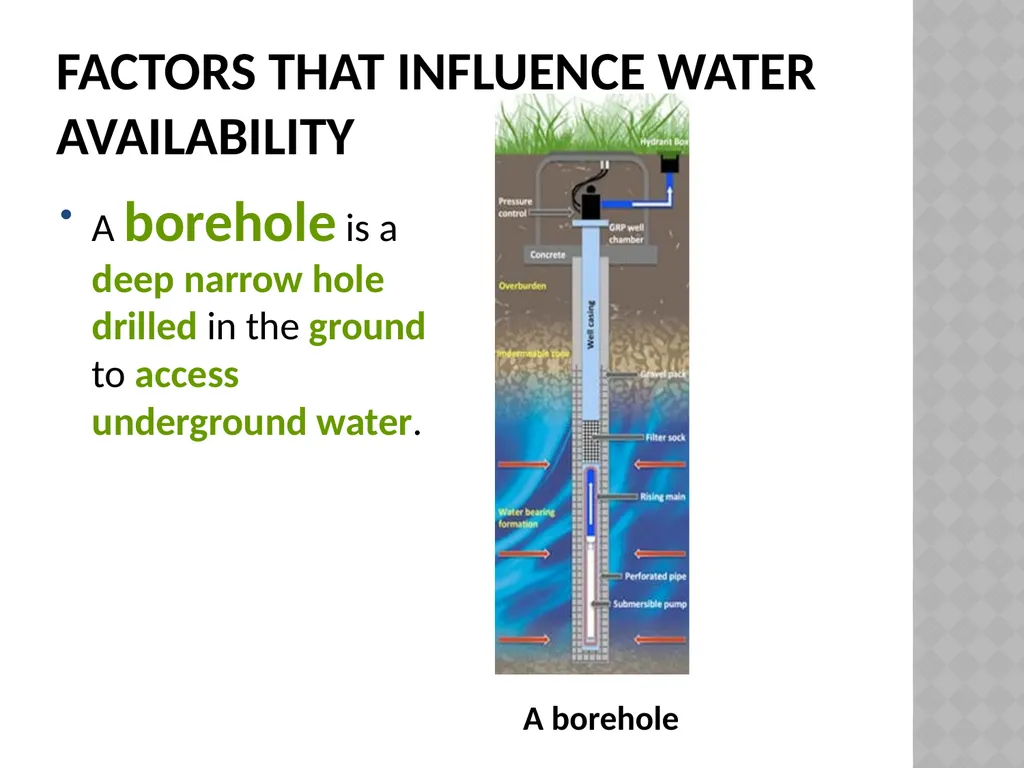
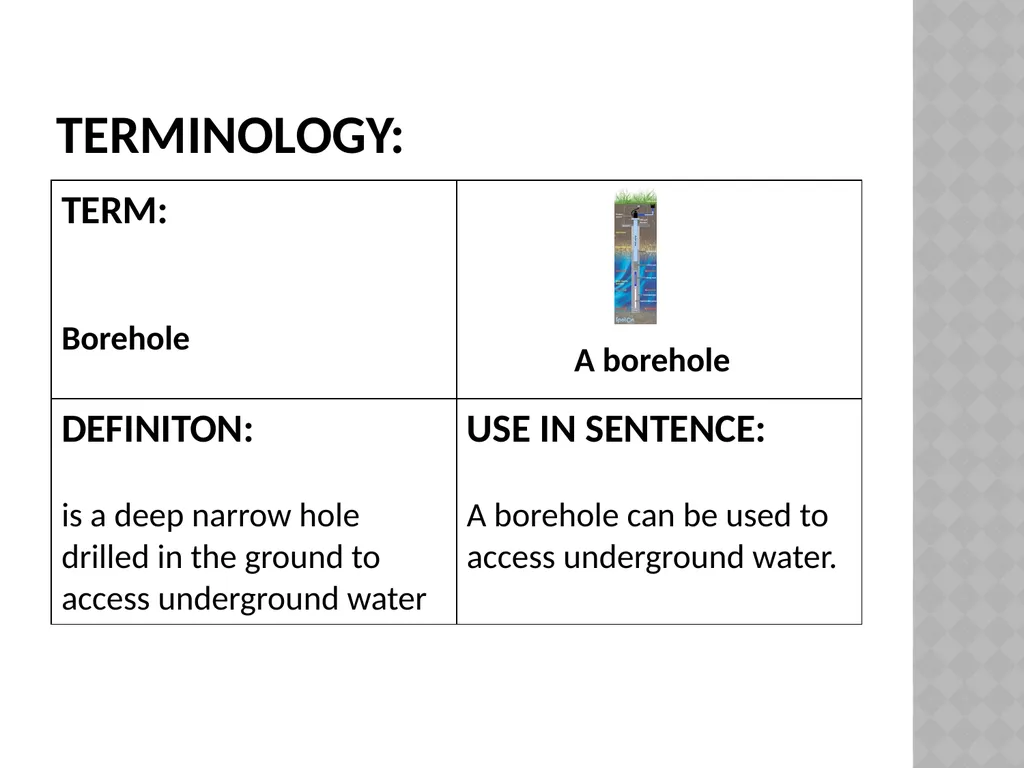
slide38. Factors that influence Water Availability A borehole is a deep narrow hole drilled in the ground to access underground water. A borehole<br>
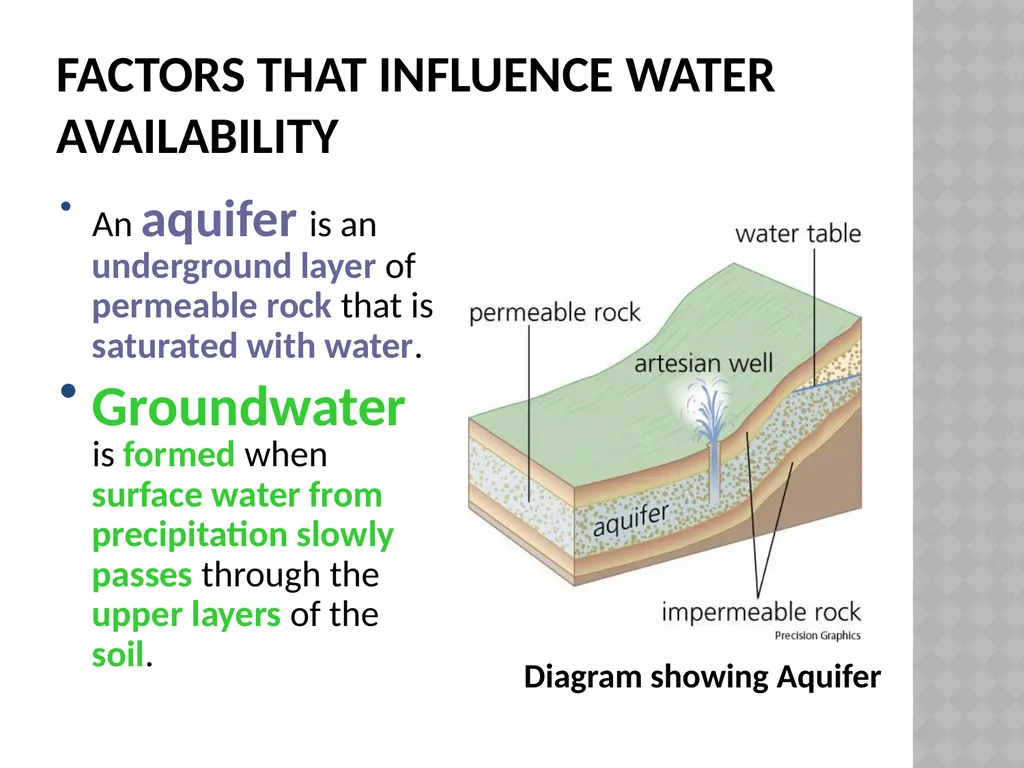
slide39. Factors that influence Water Availability An aquifer is an underground layer of permeable rock that is saturated with water.
Groundwater is formed when surface water from precipitation slowly passes through the upper layers of the soil. Diagram showing Aquifer<br>
slide40. Factors that influence Water Availability Until it finally reaches the layer of permeable rock.
This continues until the soil and permeable rock becomes saturated with water forming the aquifer.
Ground water is an important source of water.
t is used for domestic and agricultural purposes as well as for drinking water.
A borehole is used to extract the ground water.<br>
slide41. Factors that influence Water Availability The top layer of the saturated layer is called the water table.
The water from the aquifer reaches the surface through springs or fountains.
This occurs naturally.
It can also naturally reach the surface by seeping into rivers or lakes.
This water is then naturally replenished.<br>
slide42. Factors that influence Water Availability When a borehole is used to extract groundwater, the water is extracted faster than it can be replenished.
This can lead to…
A lower water table is.
Aquifers can become depleted.
The amount of water in rivers and lakes can be reduced.
The soil can collapse because of a loss of underground support of the water.
Salt water can seep into the ground water near the coast and reduces the amount of available fresh water.<br>
slide43. Terminology: A borehole<br>
slide44. Factors that influence Water Availability Wastage…
Wastage of water occurs in the domestic and agricultural sectors.
Wastage is also brought about by pollution.
Lets look at each one…
Domestic…
In our households water may be wasted in the following ways…<br>
slide45. Factors that influence Water Availability Leaking pipes and dripping taps.
Using washing machines and dishwaters when they are not completely full.
Filling the bath tub to the top or with more water than is required.
Brushing your teeth with the tap running.
Watering the garden during the hottest part of the day, when maximum evaporation would occur.
Washing your car with a hose instead of using a bucket.<br>
slide46. Factors that influence Water Availability Agriculture…
Here wastage occurs through poor irrigation methods which we discussed earlier.
Pollution…
Pollution reduces the amount of available fresh water.
Some sources of water pollution are…
Sewage
Industrial waste<br>
slide47. Factors that influence Water Availability Run-off water from farms
Detergents and cleaning agents
Radioactive wastes
South Africa is an extremely dry country with a limited water resource.
If we continue to waste water our country will not be able to supply our water needs.<br>
slide48. Factors that influence Water Availability The following steps can be taken to ensure that water is not wasted…
Reduce pressure in the water pipes, this would reduce the chances of leaks developing in the pipes.
All household leaks must be fixed.
The population must be educated on how to use water wisely.
These strategies were used by the Emfuleni Municipality that experienced a large amount of water wastage.<br>
slide49. Factors that influence Water Availability Cost
As South African we are extremely lucky, because our constitution states that everyone has the right to safe, clean water.
Therefore the first 6 kilo liters of water are provided free to a family of 5 per month since July 2006.
This means that as consumers we only start paying after the first 6 kilo liters.
This ensured that more people had access to free clean, safe water.<br>
slide50. Water Quality Water quality refers to the physical, chemical and biological characteristics of water.
Water is used for domestic, industrial, agricultural and mining purposes.
Using the water in this way means that substances become dissolved or suspended in it.
The water becomes contaminated and its quality is affected.
Lets look at the pollutants that are added to the water for each of the above uses.<br>
slide51. Water Quality Domestic Pollutants…
Non-biodegradable Pollutants
Many detergents are biodegradable. This means that they are easily broken down by micro-organisms.
Phosphates are added to detergents and shampoos to make rising easier.
The phosphates end up in rivers, lakes and streams etc.
This leads to an increase in the growth of algae.<br>
slide52. Water Quality Pathogenic Bacteria in Sewage…
Water contaminated with sewage has many micro-organisms in it.
Even sewage water that has been treated contains pathogenic micro-organisms.
These pathogenic micro-organisms in the water cause a number of water borne diseases such as cholera, typhoid and dysentery.
This can be avoided if the water is chlorinated before being released into any body of water.<br>
slide53. Water Quality Industrial Pollutants…
Some industrial pollutants are…
Heavy metals in industrial waste water example lead and mercury.
Paint, solvents glue and varnish that affect the reproductive and respiratory systems. These chemicals also affect short term memory and can induce asthma and hearing loss.
Oil and petrol spills from the shipping industry can poison birds, clogs their wings preventing them from flying. The oil also kills the phytoplankton.<br>
slide54. Water Quality affecting all the other organisms in the food chain since it is a source of food.
Waste from the fertilizer industry causes an increase in algal growth when it is released into the water bodies.
Heat brings about thermal pollution.<br>
slide55. Water Quality Agricultural Pollutants…
Pesticides and herbicides ends up in the rivers and dams.
They affect fat metabolism, nerve transmission, resistance to infection and can cause breast cancer.
Many fertilizers contain nitrous oxide which is a greenhouse gas and will lead to climate change.
Fertilizer reaching the rivers can cause increase in algal growth.<br>
slide56. Terminology:<br>
slide57. Terminology:<br>
slide58. Terminology:<br>
slide59. Water Quality Eutrophication and Algal Bloom…
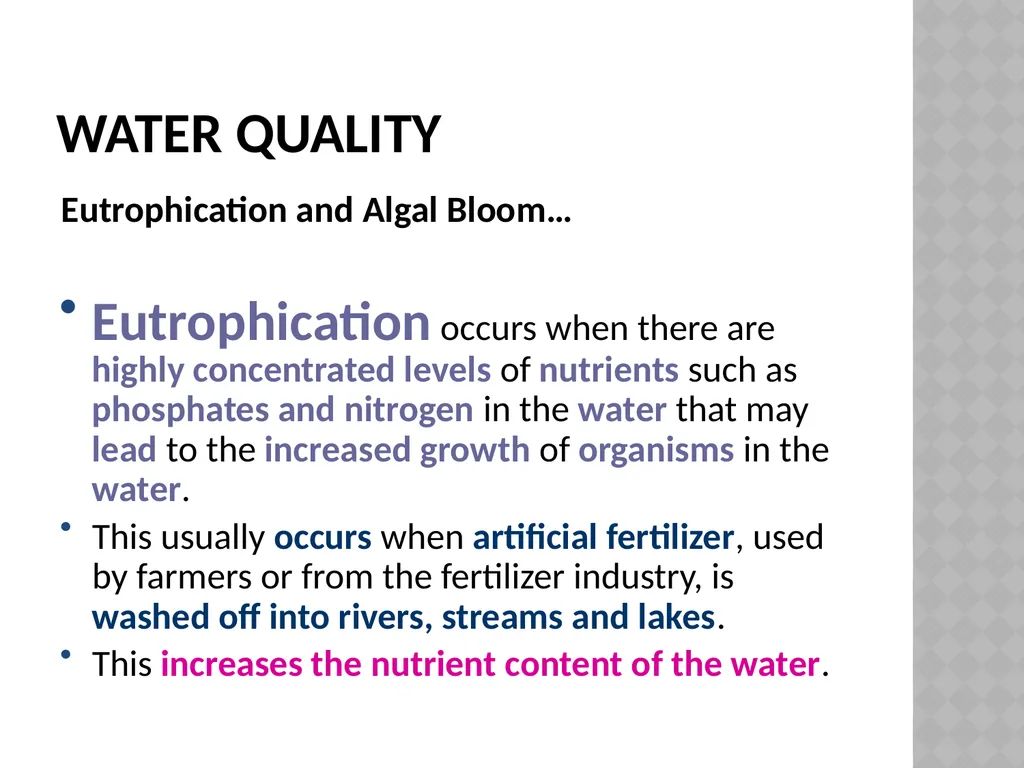
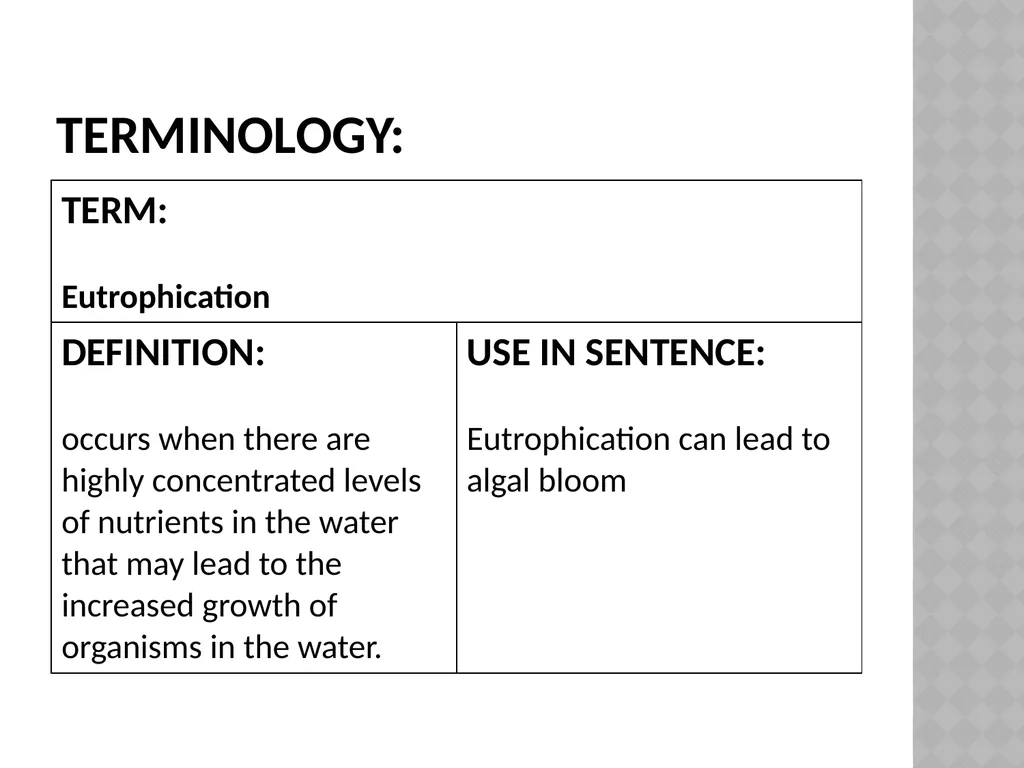
Eutrophication occurs when there are highly concentrated levels of nutrients such as phosphates and nitrogen in the water that may lead to the increased growth of organisms in the water.
This usually occurs when artificial fertilizer, used by farmers or from the fertilizer industry, is washed off into rivers, streams and lakes.
This increases the nutrient content of the water.<br>
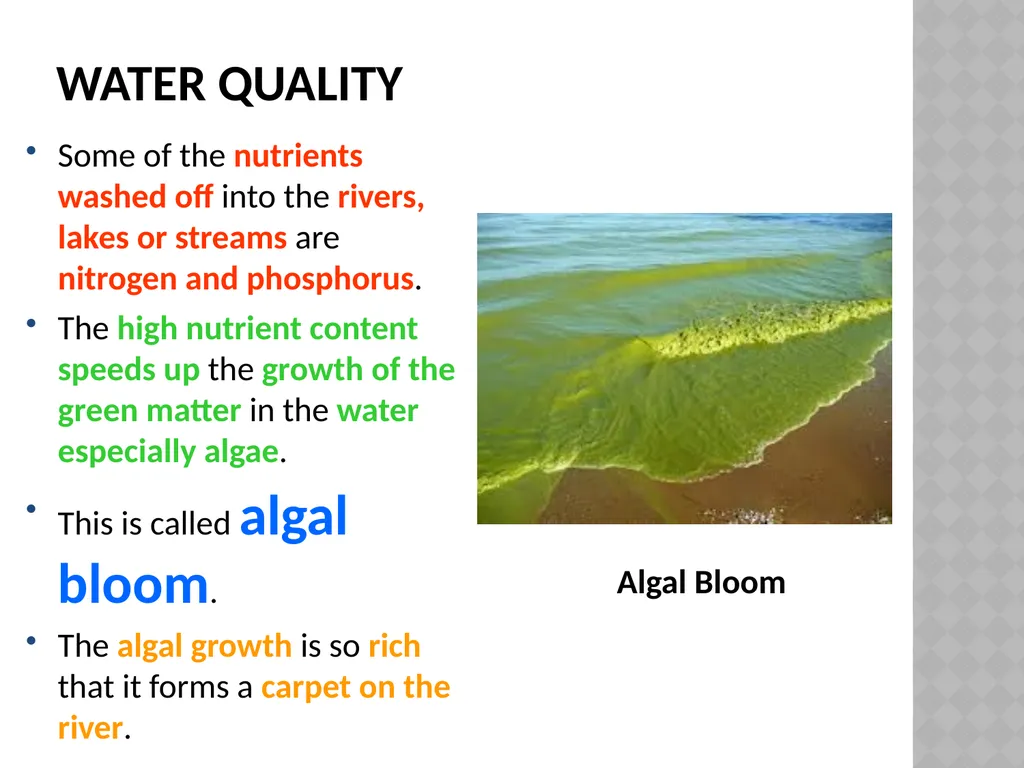
slide60. Water Quality Some of the nutrients washed off into the rivers, lakes or streams are nitrogen and phosphorus.
The high nutrient content speeds up the growth of the green matter in the water especially algae.
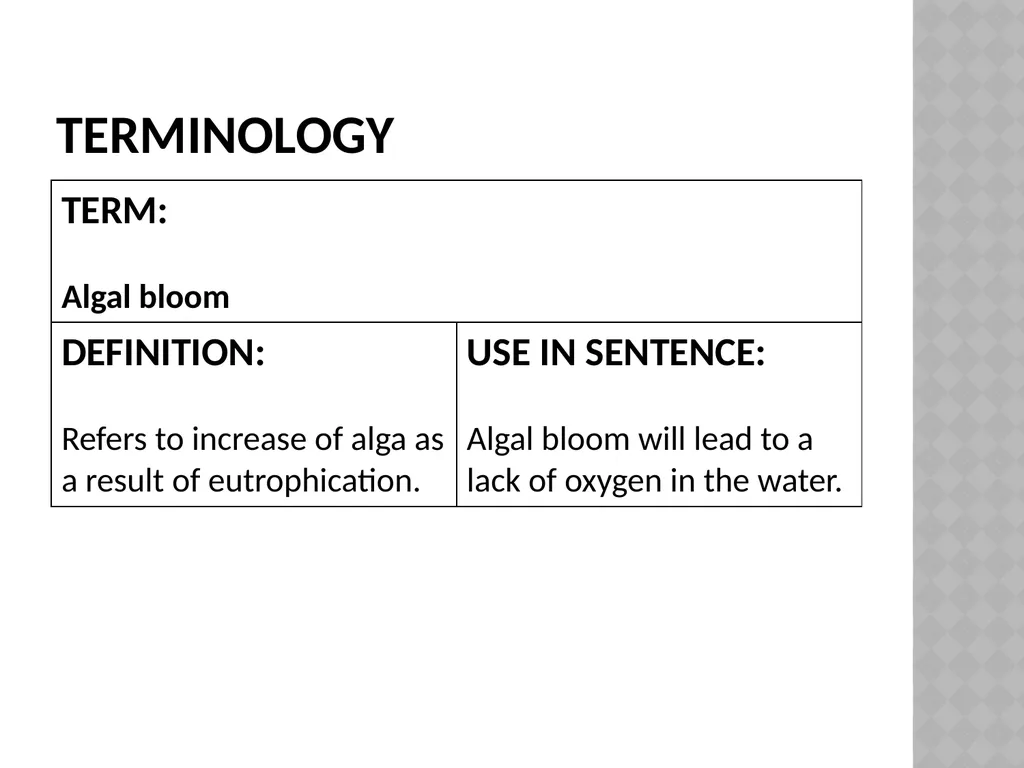
This is called algal bloom.
The algal growth is so rich that it forms a carpet on the river. Algal Bloom<br>
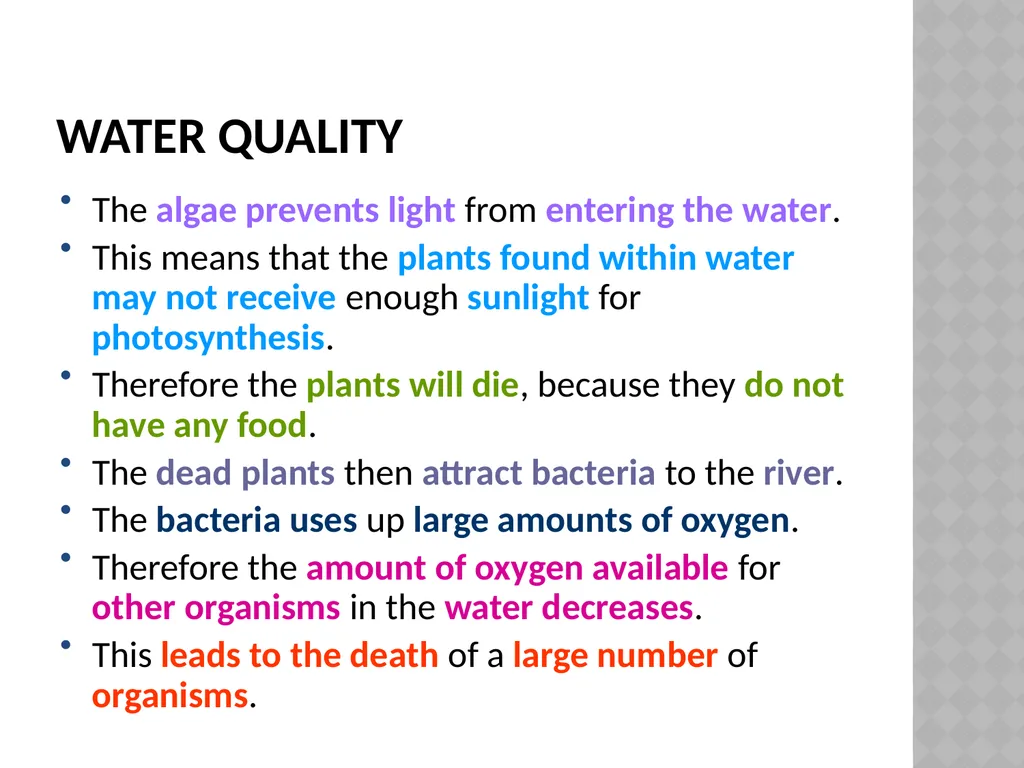
slide61. Water Quality The algae prevents light from entering the water.
This means that the plants found within water may not receive enough sunlight for photosynthesis.
Therefore the plants will die, because they do not have any food.
The dead plants then attract bacteria to the river.
The bacteria uses up large amounts of oxygen.
Therefore the amount of oxygen available for other organisms in the water decreases.
This leads to the death of a large number of organisms.<br>
slide62. Terminology:<br>
slide63. terminology<br>
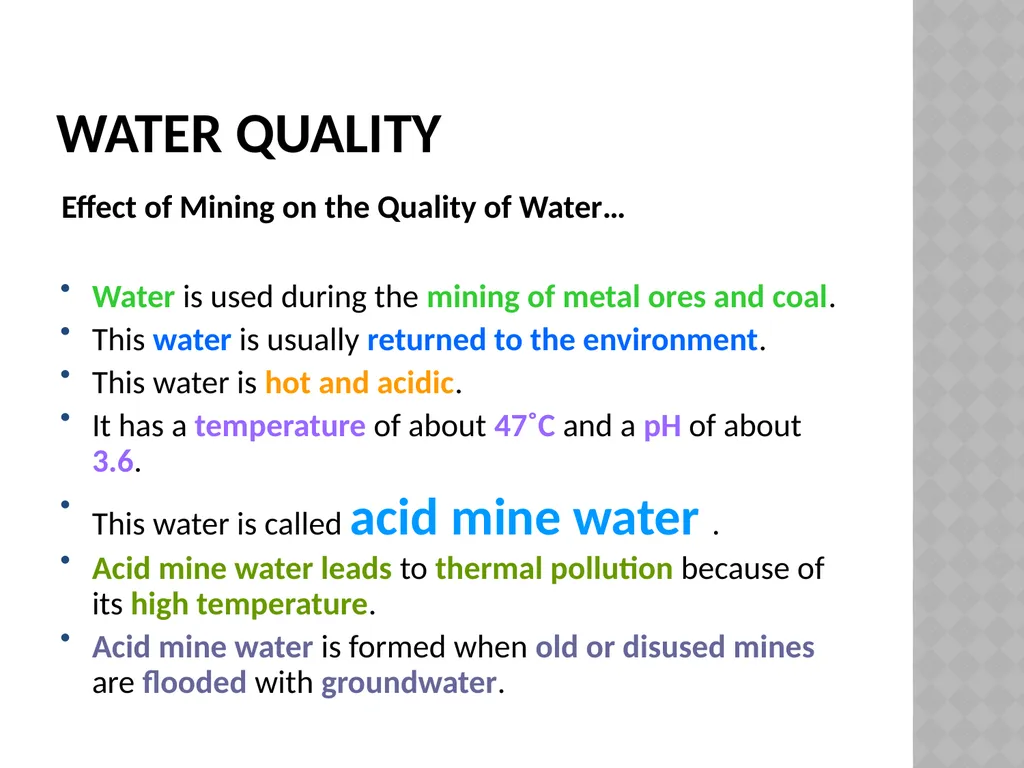
slide64. Water Quality Effect of Mining on the Quality of Water…
Water is used during the mining of metal ores and coal.
This water is usually returned to the environment.
This water is hot and acidic.
It has a temperature of about 47˚C and a pH of about 3.6.
This water is called acid mine water .
Acid mine water leads to thermal pollution because of its high temperature.
Acid mine water is formed when old or disused mines are flooded with groundwater.<br>
slide65. Water Quality Acid mine water is formed in the following way…
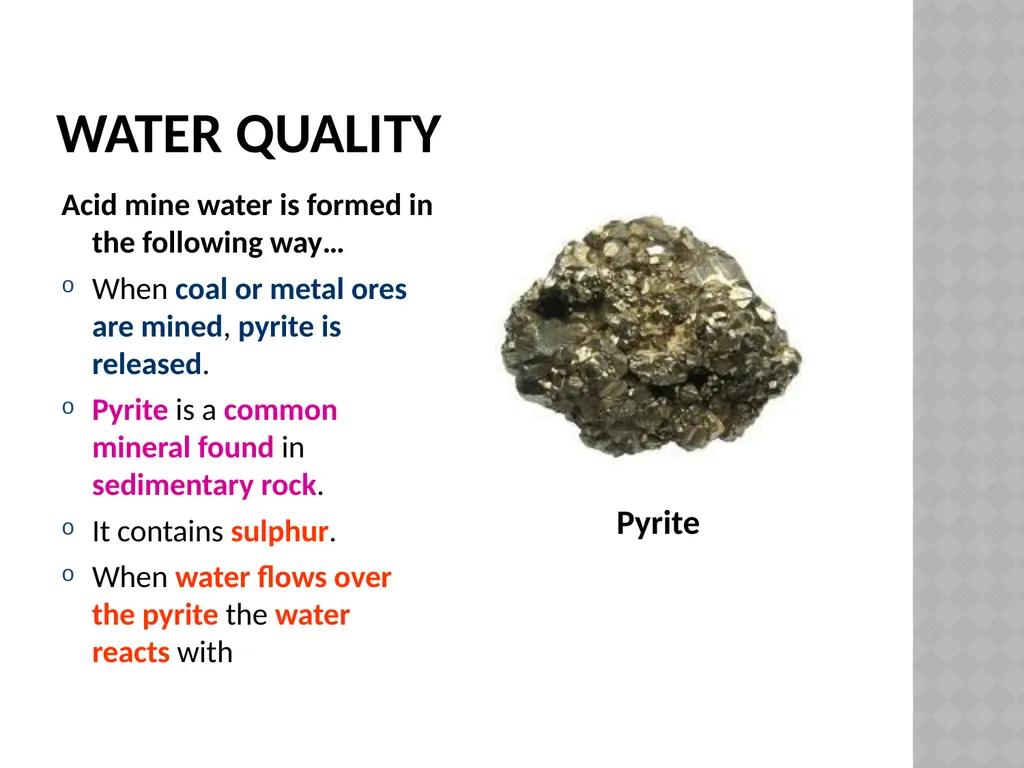
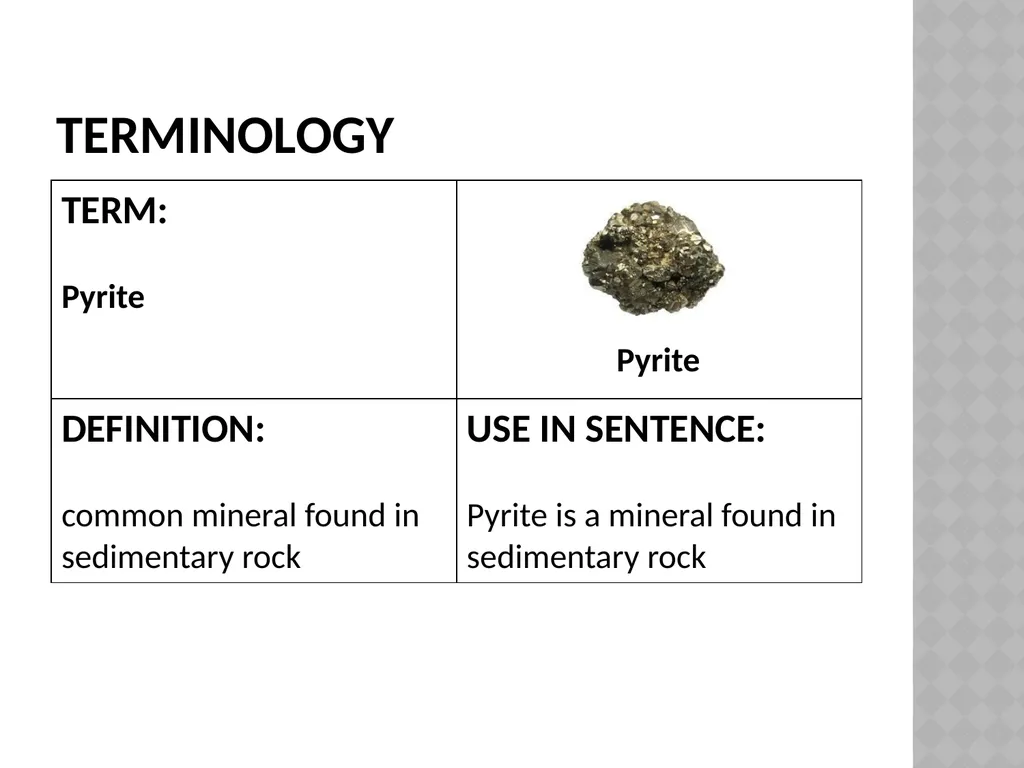
When coal or metal ores are mined, pyrite is released.
Pyrite is a common mineral found in sedimentary rock.
It contains sulphur.
When water flows over the pyrite the water reacts with Pyrite<br>
slide66. Water Quality with the sulphur –bearing minerals.
This chemical reaction turns the water into an acid.
This water is called acid mine drainage (AMD).
This acidic water may also contain toxic heavy metals.
Sometimes this water is drinking water.
This water can cause serious health problems if consumed by humans.
The population size of the aquatic organisms decrease when acid mine water is released into rivers, lakes and streams.<br>
slide67. Water Quality This happens because the heavy metal content of the water increases.
The pH of the water is also lowered.
The high heavy metal content and the lower pH can poison the organisms in the water.
All other organisms in the food chain are affected.
Even humans are affected when they feed on the fish for example.<br>
slide68. Terminology:<br>
slide69. terminology Pyrite<br>
slide70. Terminology:<br>
slide71. Water Quality Thermal Pollution…
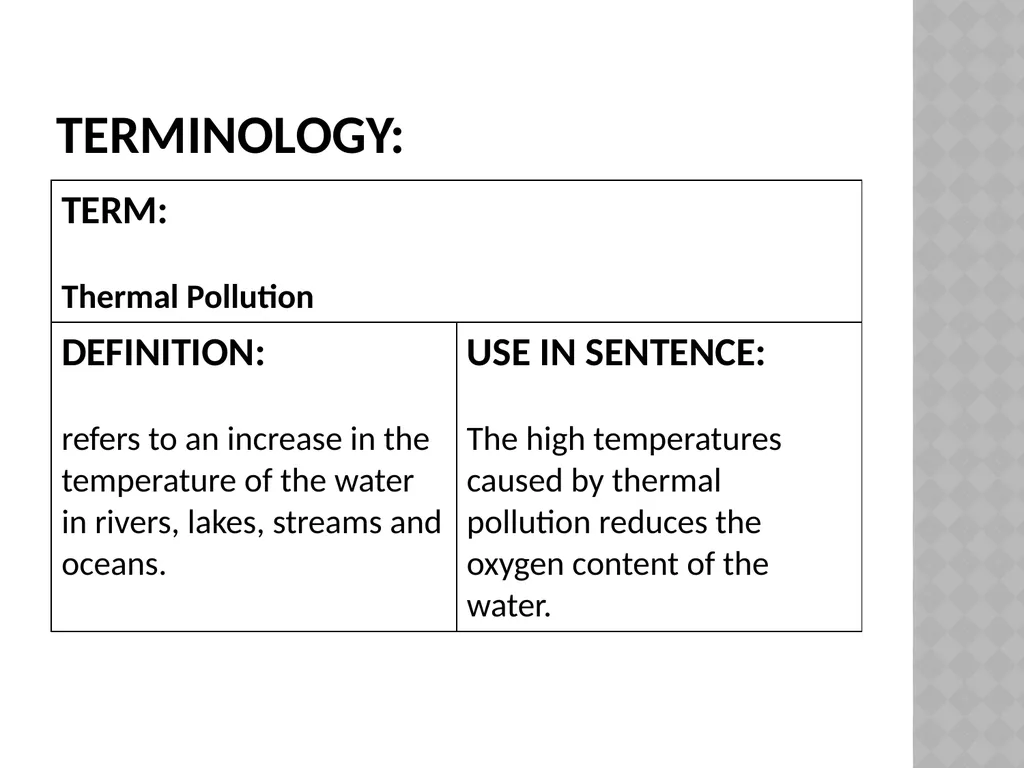
Thermal pollution refers to an increase in the temperature of the water in rivers, lakes, streams and oceans.
Thermal pollution usually occurs when water is used as a coolant in industry.
Therefore large amounts of hot water is released into rivers, lakes, streams and oceans.<br>
slide72. Water Quality This has the following effects on the water…
Some organisms benefit.
However thermal pollution drives oxygen out of the water in 2 ways.
These are as follows…
Remember that hot water drives the oxygen out. Therefore the water has less oxygen, causing many organisms to die due to a lack of oxygen,
The temperature of the water increases and this causes algal bloom. This uses up much oxygen, which in turn reduces the amount of water available for organisms causing them to die.<br>
slide73. Water Quality The high temperature increases the metabolic rate of organisms, therefore they would need more food.<br>
slide74. Terminology:<br>
slide75. Impact of Alien Invasive Plants on Water Quality Effect of Alien Plants on Water Quality
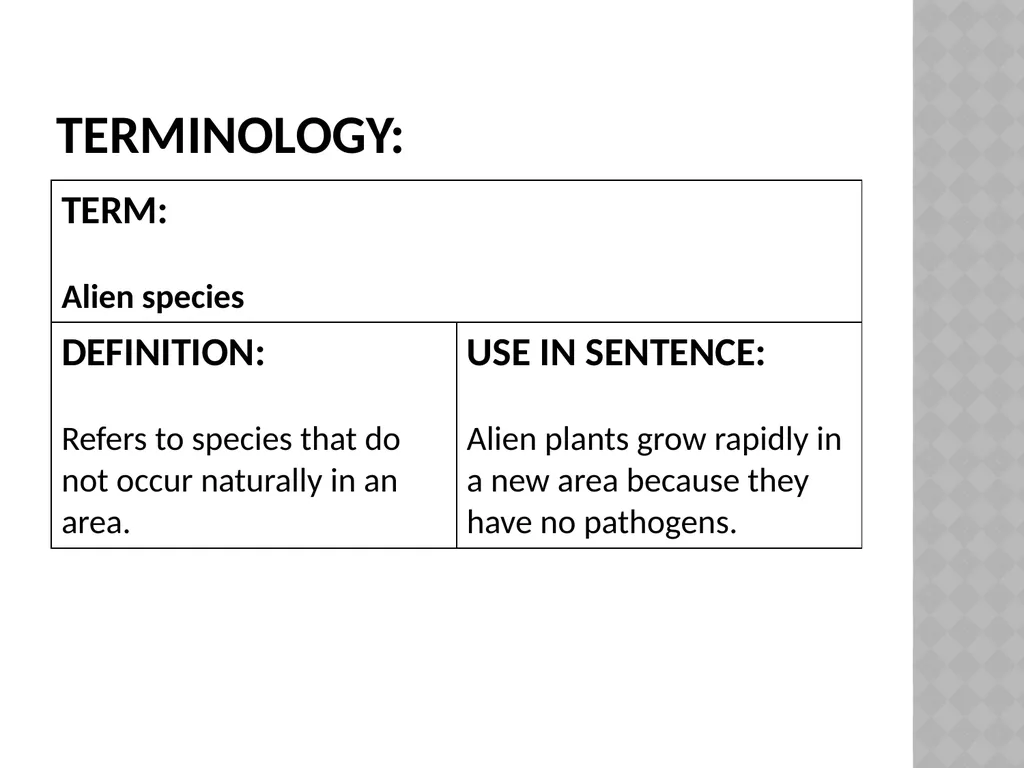
Alien species are also called exotic species.
Alien or exotic species refers to species that do not occur naturally in an area.
This means that the species were introduced to the area.
Alien species usually do very well in the new area.
They thrive and reproduce and spread very quickly.
These plants have no predators or pathogens in the area, therefore they outcompete the indigenous plants.<br>
slide76. Impact of Alien Invasive Plants on Water Quality These grow so quickly that they completely take over the new environment.
They completely change the habitat and affect the functioning of the ecosystem.
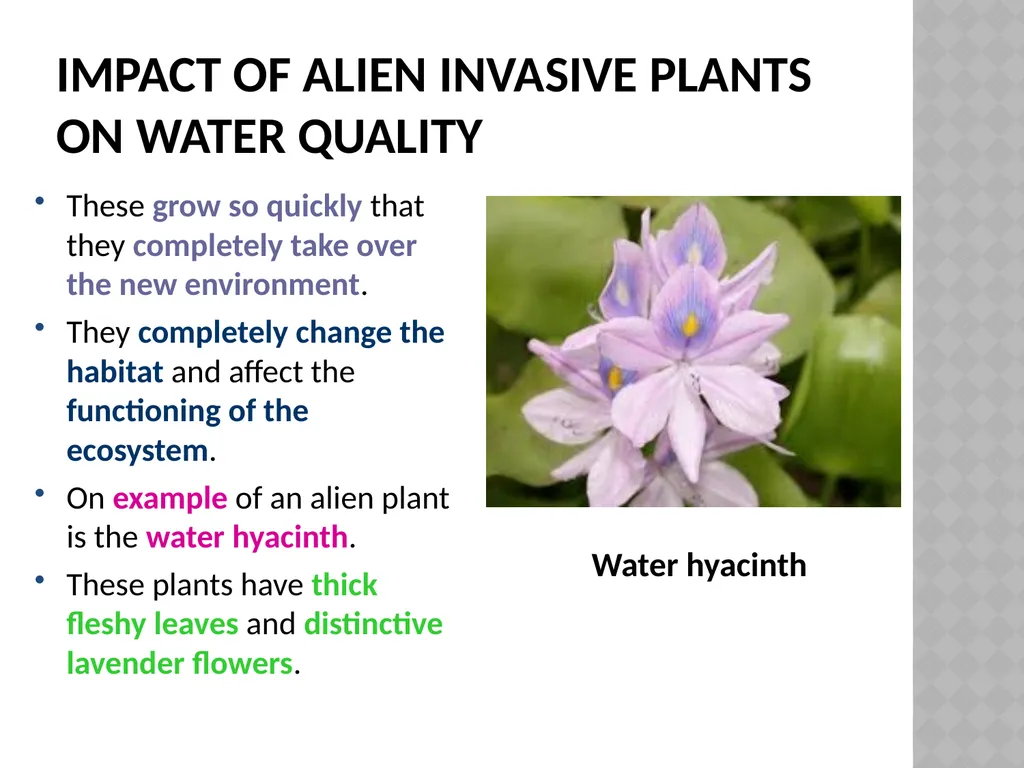
On example of an alien plant is the water hyacinth.
These plants have thick fleshy leaves and distinctive lavender flowers. Water hyacinth<br>
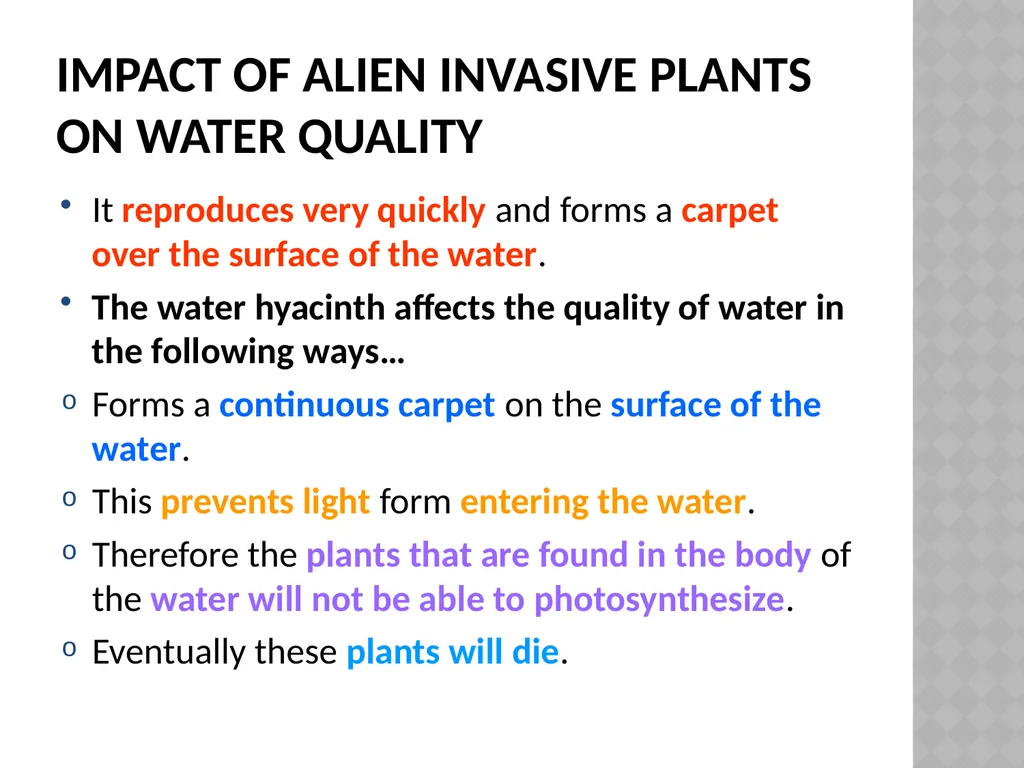
slide77. Impact of Alien Invasive Plants on Water Quality It reproduces very quickly and forms a carpet over the surface of the water.
The water hyacinth affects the quality of water in the following ways…
Forms a continuous carpet on the surface of the water.
This prevents light form entering the water.
Therefore the plants that are found in the body of the water will not be able to photosynthesize.
Eventually these plants will die.<br>
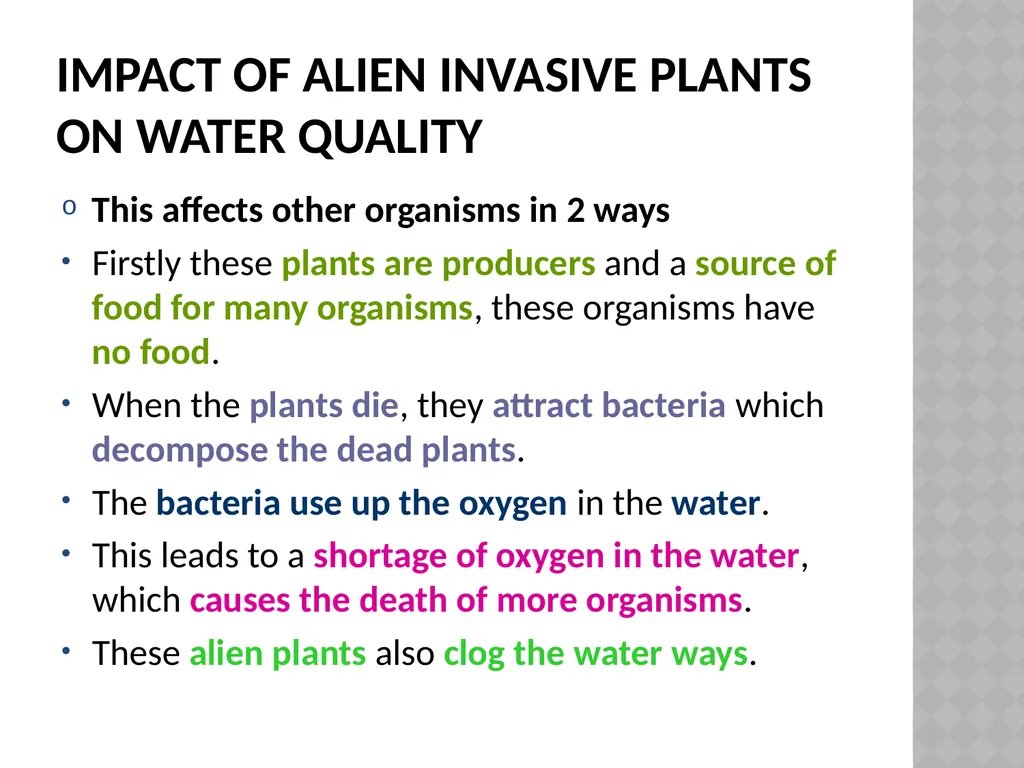
slide78. Impact of Alien Invasive Plants on Water Quality This affects other organisms in 2 ways
Firstly these plants are producers and a source of food for many organisms, these organisms have no food.
When the plants die, they attract bacteria which decompose the dead plants.
The bacteria use up the oxygen in the water.
This leads to a shortage of oxygen in the water, which causes the death of more organisms.
These alien plants also clog the water ways.<br>
slide79. Impact of Alien Invasive Plants on Water Quality Therefore boating, fishing and other water sports are impossible.
Furthermore large amounts of money must be used to clean up these waterways.<br>
slide80. Terminology:<br>
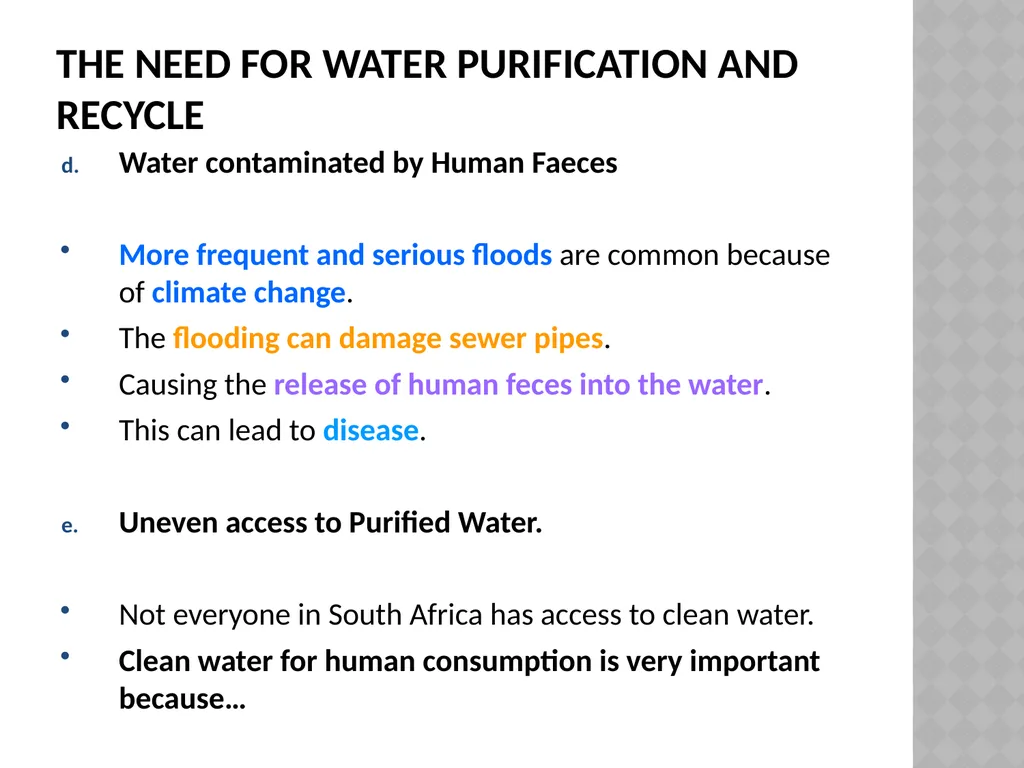
slide81. The Need for Water Purification and Recycle Water need to be purified and re-cycled because of…
The uneven distribution of water.
Water pollution.
The water may contain germs.
During flood sewer pipes may become damaged and this can lead to contamination of water by human faeces.
Now lets look at each of this factors.<br>
slide82. The Need for Water Purification and Recycle Uneven Distribution of Water
Some countries or areas have more water than others.
Therefore not all people have access to clean natural water.
Purifying and re-cycling water is necessary so that all people can have access to clean water.
Water Pollution
Water pollution may occur as a result of domestic, agricultural or industrial use.
Therefore the amount of water used needs to be reduced.<br>
slide83. The Need for Water Purification and Recycle The water must also be recycled and re-used.
Water may contain Germs or Impurities
Rain water that is stored in reservoir or dams contains small particles of dust, sand particles and animal remains and litter.
Water has to be filtered to remove these substances.
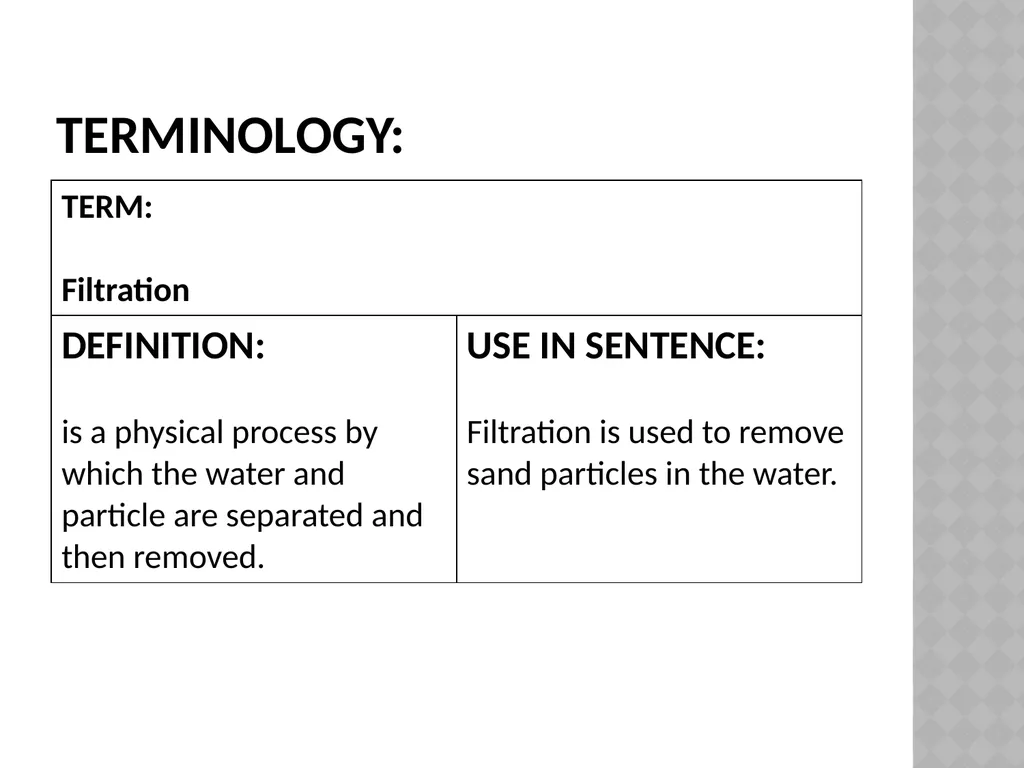
Water is filtered by a process called filtration.
Filtration is a physical process by which the water and particle are separated and then removed.<br>
slide84. The Need for Water Purification and Recycle The water now looks “clean”.
But the water may contain many germs or pathogenic micro-organisms.
Therefore the water needs to be purified.
During this process water is boiled and then treated with chemicals to get rid of the pathogens.
Once the water has been filtered and purified they are safe for human use.
Purified water is then carried by pipes to all the areas were it can be used.<br>
slide85. The Need for Water Purification and Recycle Water contaminated by Human Faeces
More frequent and serious floods are common because of climate change.
The flooding can damage sewer pipes.
Causing the release of human feces into the water.
This can lead to disease.
Uneven access to Purified Water.
Not everyone in South Africa has access to clean water.
Clean water for human consumption is very important because…<br>
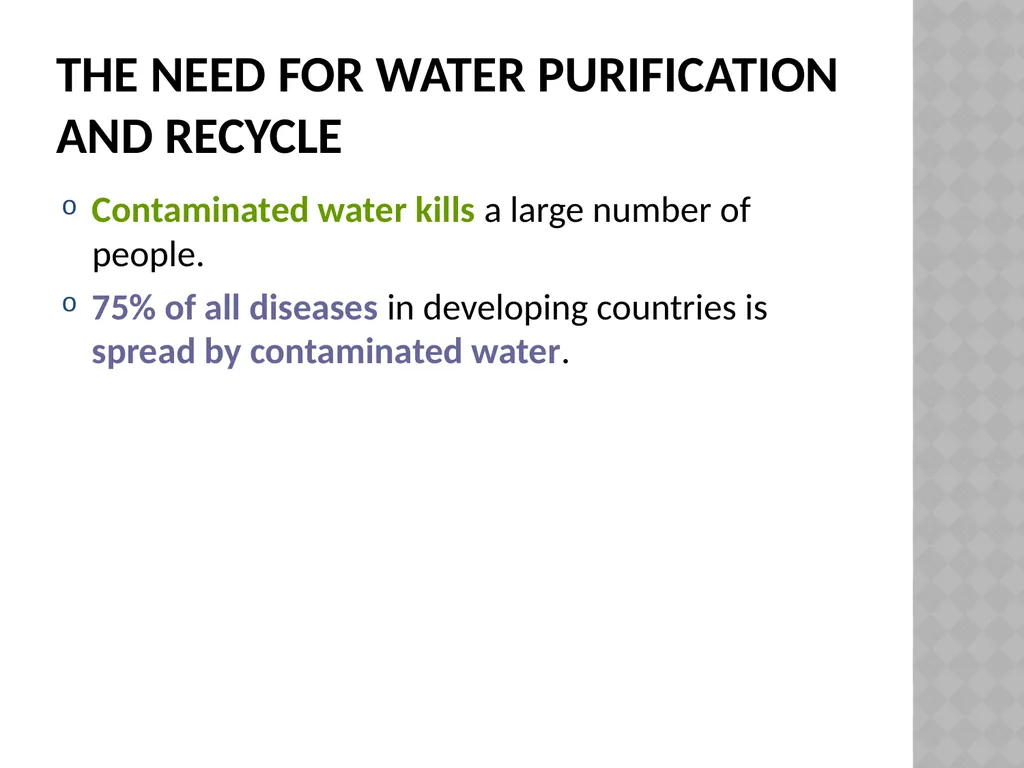
slide86. The Need for Water Purification and Recycle Contaminated water kills a large number of people.
75% of all diseases in developing countries is spread by contaminated water.<br>
slide87. Terminology:<br>
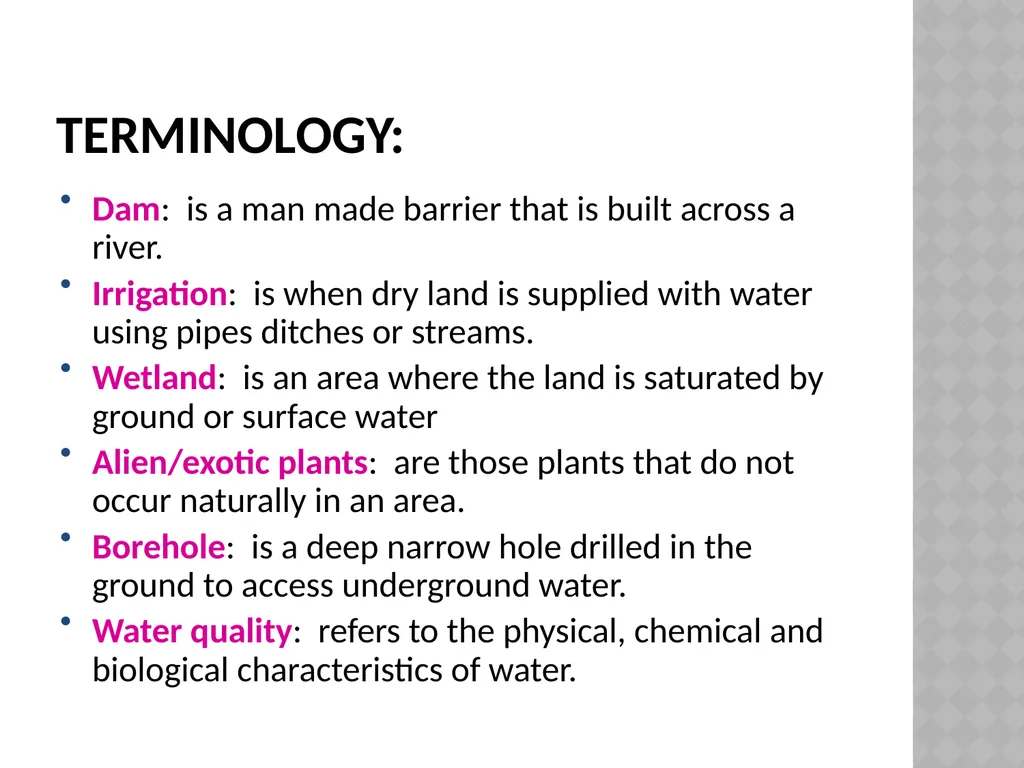
slide88. Terminology: Dam: is a man made barrier that is built across a river.
Irrigation: is when dry land is supplied with water using pipes ditches or streams.
Wetland: is an area where the land is saturated by ground or surface water
Alien/exotic plants: are those plants that do not occur naturally in an area.
Borehole: is a deep narrow hole drilled in the ground to access underground water.
Water quality: refers to the physical, chemical and biological characteristics of water.<br>
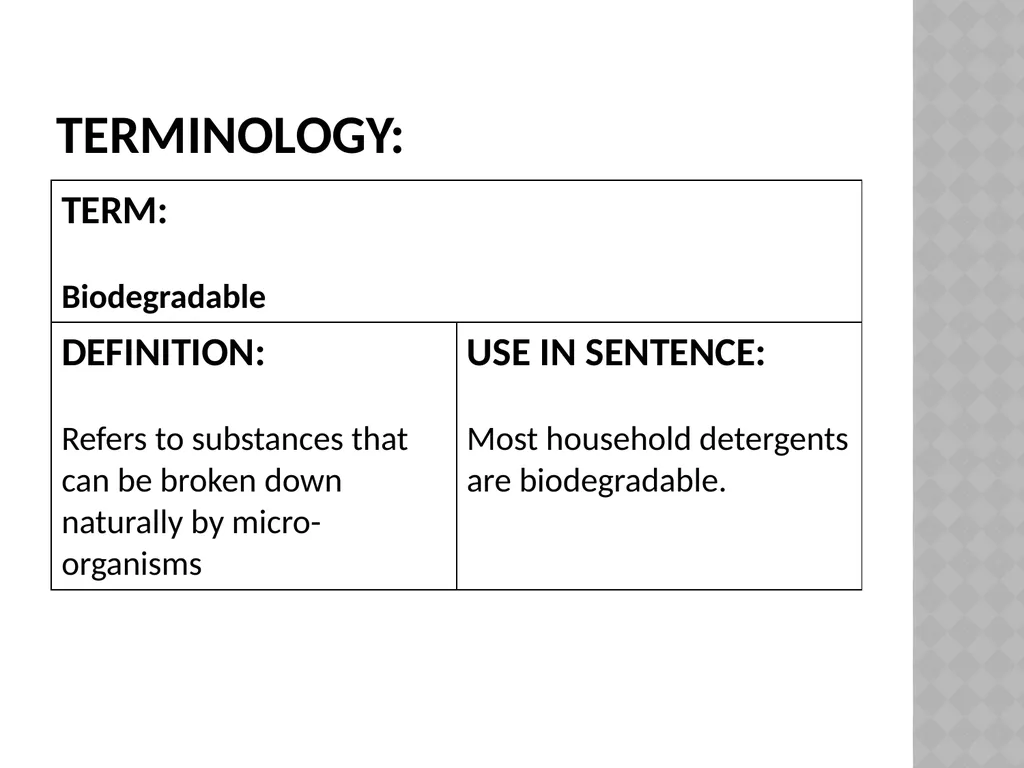
slide89. Terminology: Biodegradable: refers to substances that can be broken down naturally by micro-organisms.
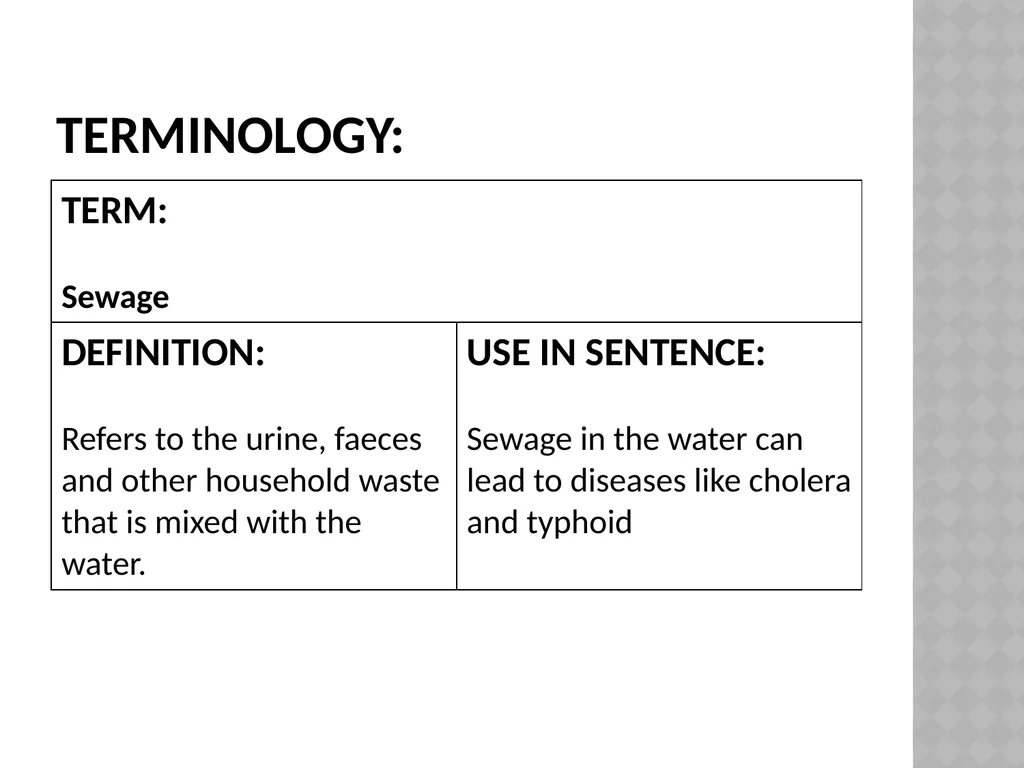
Sewage: refers to the urine, faeces and other household waste that is mixed with the water.
Pathogen: these are organisms that cause diseases.
Eutrophication: occurs when there are highly concentrated levels of nutrients in the water that may lead to the increased growth of organisms in the water.
Algal bloom: refers to increase of algal growth as a result of eutrophication.<br>
slide90. Terminology: Filtration: is a physical process by which the water and particle are separated and then removed.
Thermal Pollution: refers to an increase in the temperature of the water in rivers, lakes, streams and oceans.
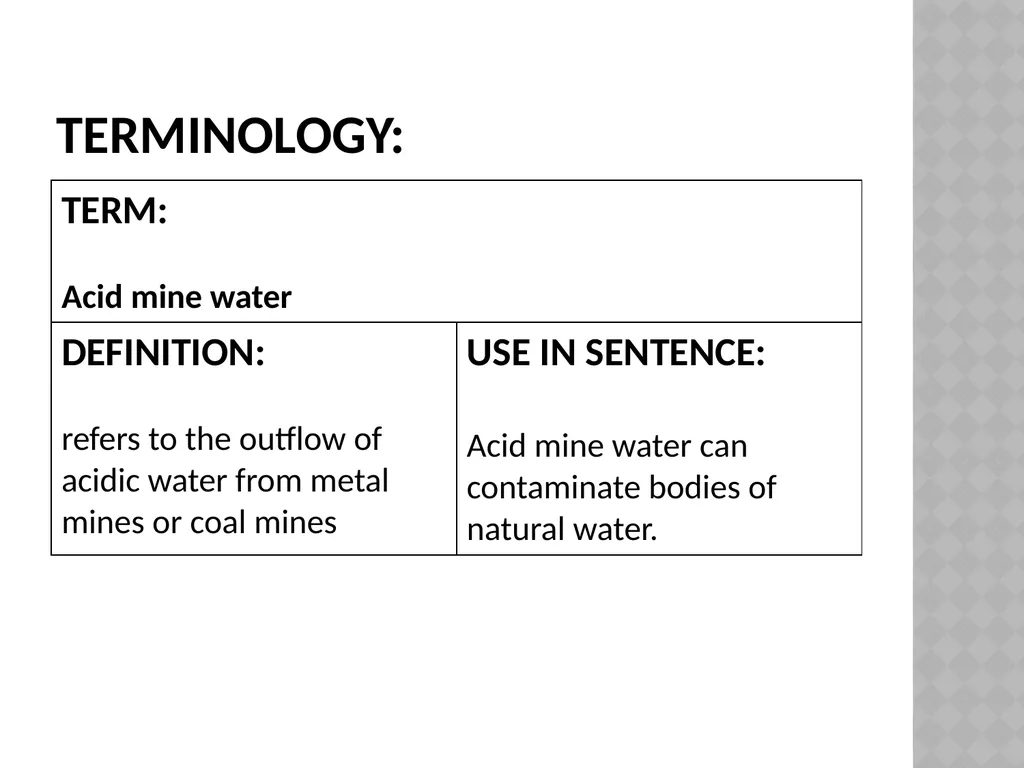
Acid mine drainage: refers to the outflow of acidic water from metal mines or coal mines.
Pyrite: common mineral found in sedimentary rock.
Acid mine water: refers to the outflow of acidic water from metal mines or coal mines<br>
slide91. QUESTION 1 A permeable underground water-bearing layer of rock that stores or transfers ground water.
A. Borehole
B. Aquifer
C. Pyrite
D. None of the above<br>
slide92. QUESTION 2 A barrier built across a river in order to block and control the flow of water…
A. Dam
B. Bridge
C. Borehole
D. Aquifer<br>
slide93. QUESTION 3 When water is run via pipes and canals to supply water to crops
A. Watering
B. Spraying
C. Filtering
D. Irrigation<br>
slide94. QUESTION 4 Land that is saturated with water…
A. Desert
B. Wetland
C. Aquifer
D. Both B and C<br>
slide95. QUESTION 5 The water hyacinth is an example of a/an…
A. Indigenous plant
B. Alien plant
C. Endemic plant
D. Xerophyte<br>
slide96. QUESTION 6 Plants that are accidentally or intentionally brought into an area…
A. Indigenous plant
B. Alien plant
C. Endemic plant
D. Xerophyte<br>
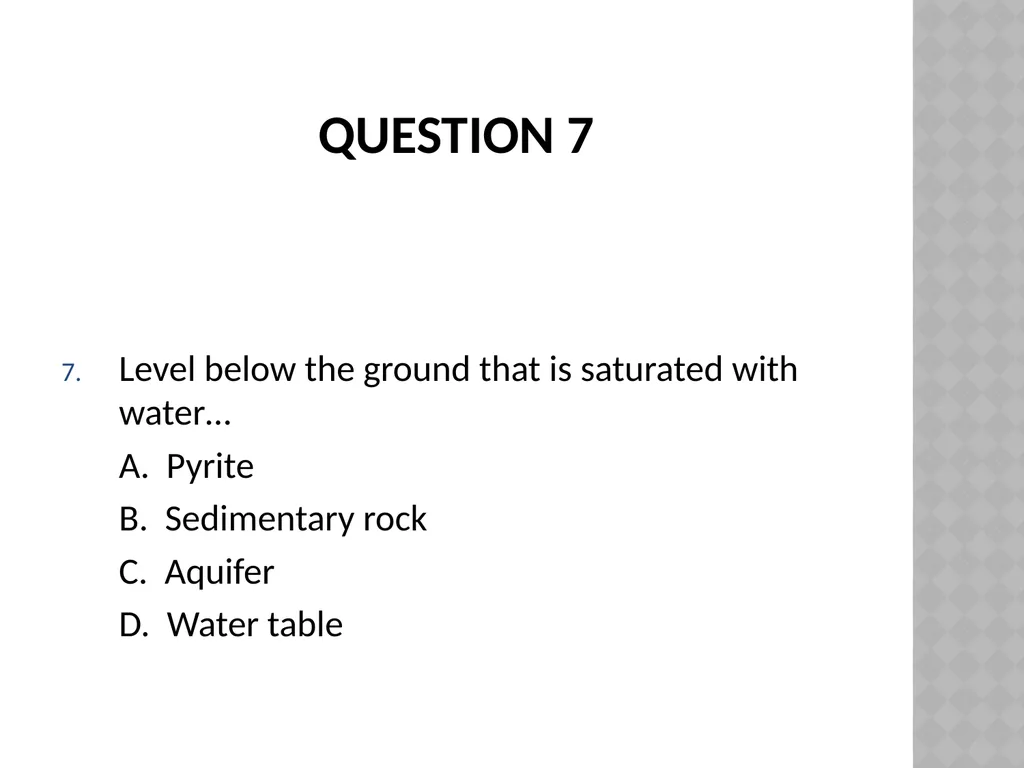
slide97. QUESTION 7 Level below the ground that is saturated with water…
A. Pyrite
B. Sedimentary rock
C. Aquifer
D. Water table<br>
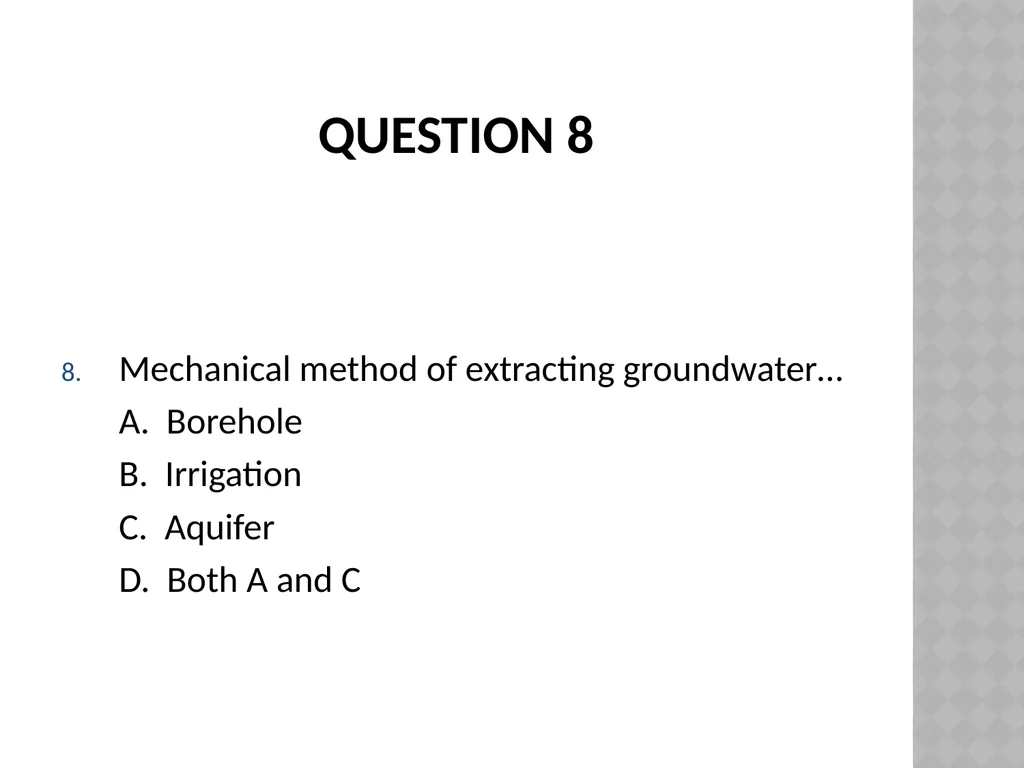
slide98. QUESTION 8 Mechanical method of extracting groundwater…
A. Borehole
B. Irrigation
C. Aquifer
D. Both A and C<br>
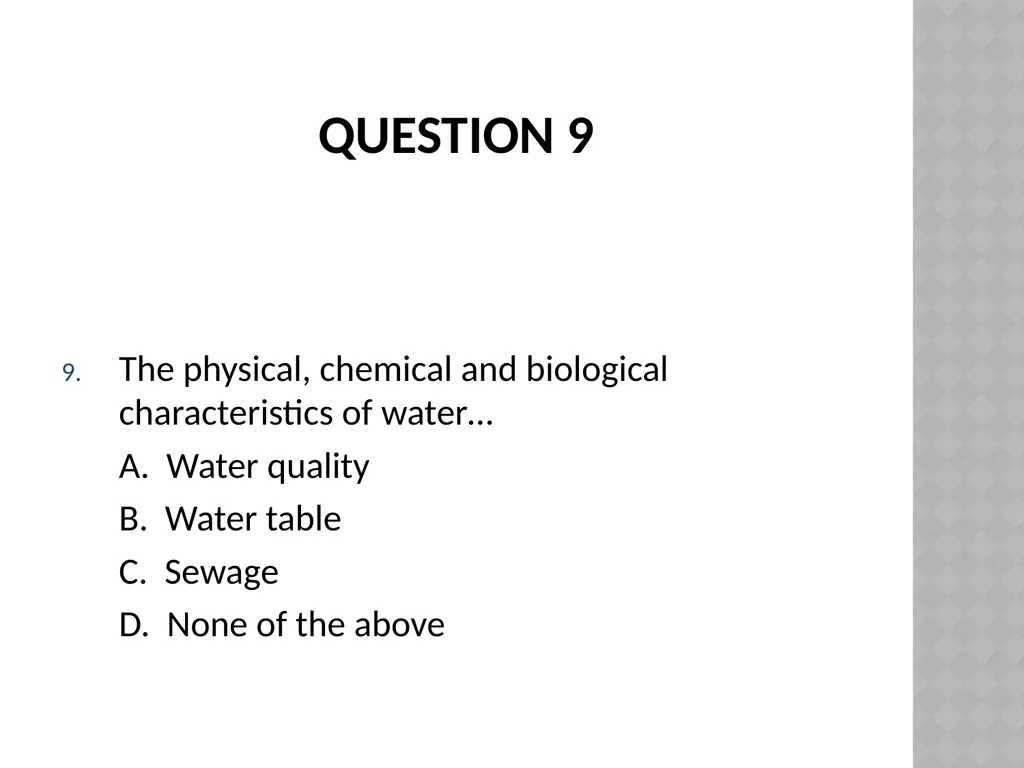
slide99. QUESTION 9 The physical, chemical and biological characteristics of water…
A. Water quality
B. Water table
C. Sewage
D. None of the above<br>
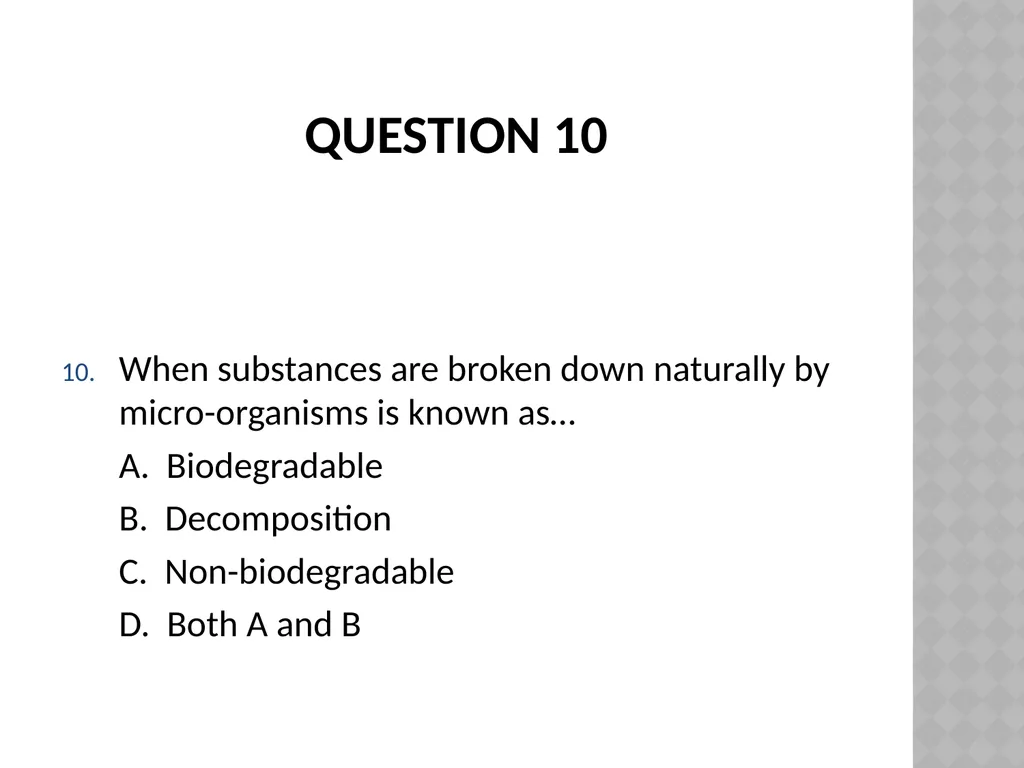
slide100. QUESTION 10 When substances are broken down naturally by micro-organisms is known as…
A. Biodegradable
B. Decomposition
C. Non-biodegradable
D. Both A and B<br>
slide101. QUESTION 11 Urine, faeces and other household waste that is mixed with water is called…
A. Wastes
B. Pollution
C. Sewage
D. AMD<br>
slide102. QUESTION 12 Type of pollution where hot water is released into rivers, lakes etc…
A. Thermal pollution
B. Eutrophication
C. Global water
D. Climate change<br>
slide103. QUESTION 13 Increase in the growth of algae because of increased nutrients in the water…
A. Eutrophication
B. AMD
C. Algal bloom
D. Both A and C<br>
slide104. QUESTION 14 The liquid that is formed when old or disused mines are flooded with groundwater is…
A. AMD
B. Acid mine water
C. Eutrophication
D. All of the above<br>
slide105. QUESTION 15 Toxic substance that maybe found in water that may induce asthma and hearing loss
A. Heavy metals
B. Oil spills
C. Paints and solvents
D. Fertilizer<br>
slide106. QUESTION 16 When ploughing on a hill, ploughing should be done…
A. Downhill
B. Across the contours
C. Alternate downhill with across the contours
D. Makes no difference<br>
slide107. QUESTION 17 Process by which a body of water becomes saturated with nutrients is known as…
A. AMD
B. Seepage
C. Eutrophication
D. All of the above<br>
slide108. QUESTION 18 Alien plants are able to out compete indigenous plants because…
A. They have no pathogens
B. They have no predators
C. They have very long root systems
D. All of the above<br>
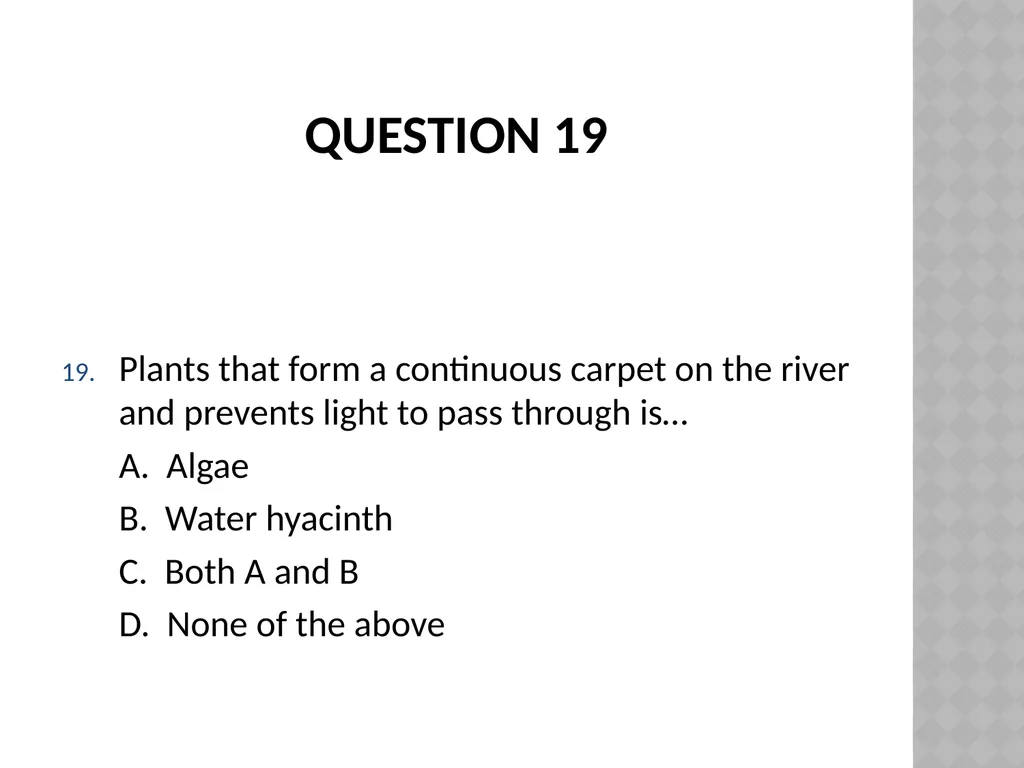
slide109. QUESTION 19 Plants that form a continuous carpet on the river and prevents light to pass through is…
A. Algae
B. Water hyacinth
C. Both A and B
D. None of the above<br>
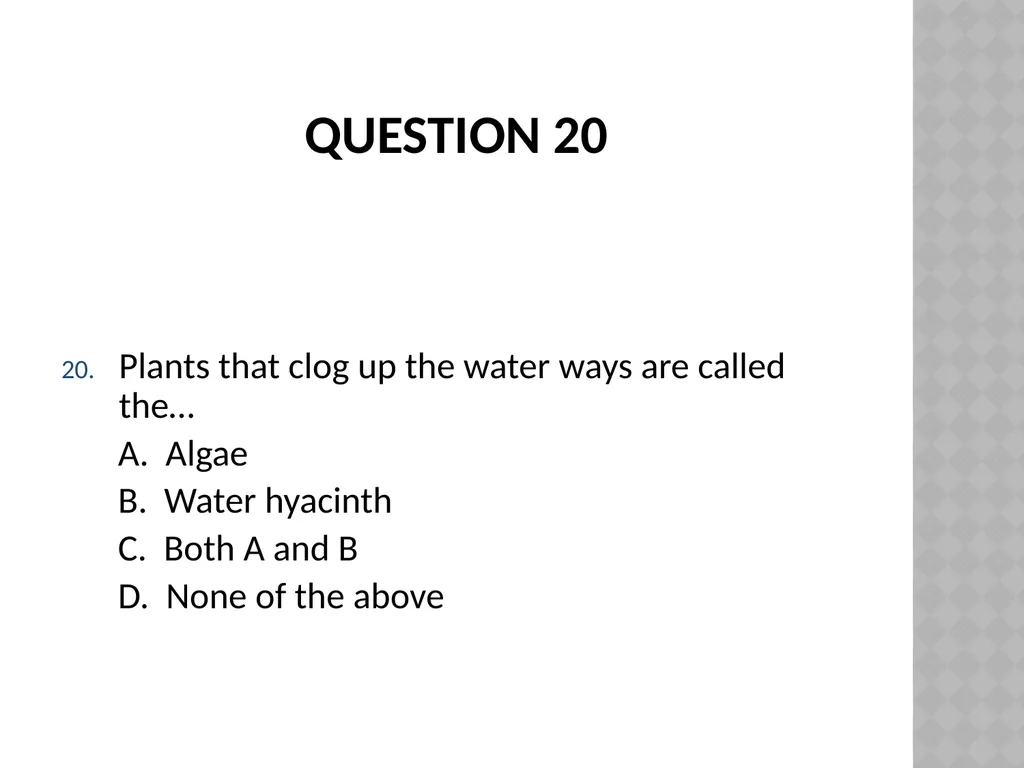
slide110. QUESTION 20 Plants that clog up the water ways are called the…
A. Algae
B. Water hyacinth
C. Both A and B
D. None of the above<br>
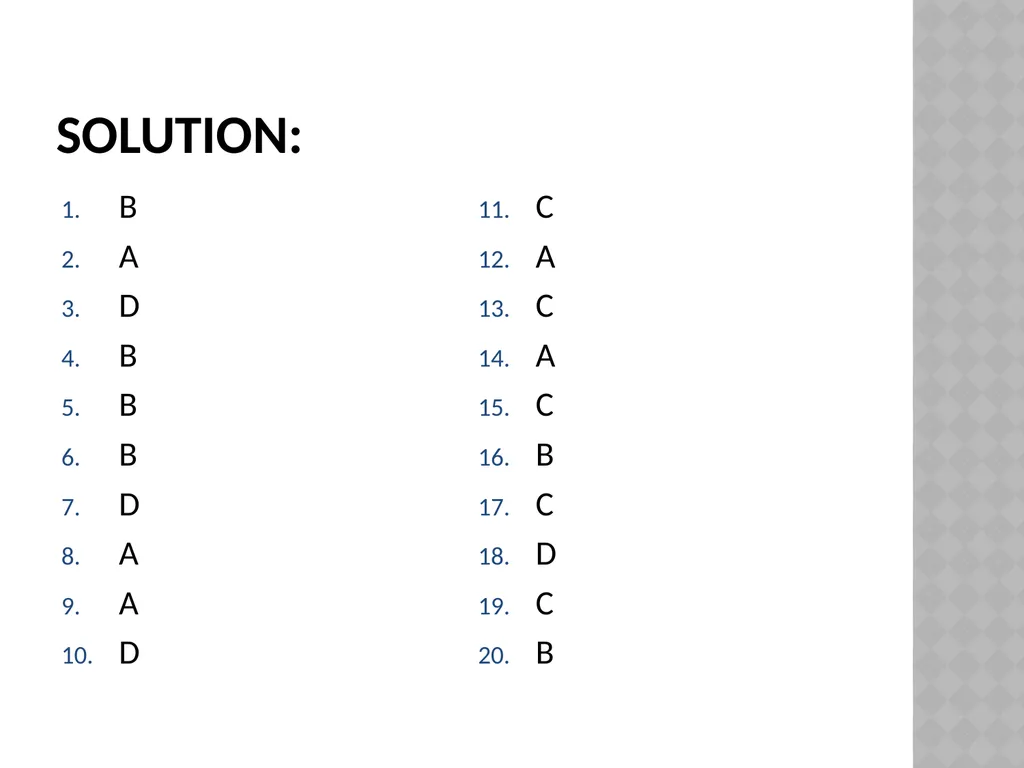
slide111. Solution: B
A
D
B
B
B
D
A
A
D C
A
C
A
C
B
C
D
C
B<br>
Environmental Studies
TOPIC 5: Human Impact on the Environment Water Availability and Water Quality<br>
slide2. Summary of presentation<br>
slide3. Water Availability South Africa is describe as a water scarce country.
It is called a water scarce country because it receives very little rainfall.
The average rainfall received is 450mm per year.
This is very low, it is about half the average rainfall of other countries.
Most of the country is arid and semi arid.
The amount of rainfall received for the different parts of the country is different.
The west coast of the country is drier than the east coast.
The dry conditions are also brought about by evaporation and a warm climate.<br>
slide4. Water Availability Water is a renewable resource.
Despite this freshwater is not always available.
There are 4 major river systems in South Africa
These are…
Limpopo
Komati
Maputu/Usuthu
Orange River
These river systems are shared with the neighboring countries.<br>
slide5. Factors that influence Water Availability In South Africa water availability is influenced by the following factors…
Construction of dams
Destruction of wetlands
Increased temperatures
Poor farming practices
Droughts and floods
Alien plants and the depletion of the water table
Boreholes and their impact on aquifers
Wastage
Cost of water
We will now discuss these factors.<br>
slide6. Factors that influence Water Availability Construction of Dams.
What is a dam?
A dam is a man made barrier that is built across a river .
Building of a dam leads to the formation of a lake or reservoir.
A dam has two functions.
These are…
To stock up water
To control the flow of the river<br>
slide7. Factors that influence Water Availability The Main Purpose of a Dam
The main purposes of a dam are as follows…
Supply of Water for Domestic and Industrial Use.
During the rainy season water is collected and stored in the dam.
This ensures that water is available throughout the year for both domestic and industrial use.
This means that water is available all year round even the dry season.
During the dry season water may also be released from the dam.<br>
slide8. Factors that influence Water Availability This makes water available for the plants and animals downstream that may not have water in the dry season.
This is also useful for people living in informal settlements, because they are not supplied with municipal water.
They have access to water all year round.
Flood Control
Dams can be used to regulate the flow of water.
During heavy rainfall the volume of water within the river increases.
The river can burst its banks.<br>
slide9. Factors that influence Water Availability The areas along the river banks will become flooded.
This leads to great loss of both plant and animal life.
The dam can be used to store the water and slow the release of water.
The amount of water released can be controlled through the sluice control.
This prevents flooding downstream.<br>
slide10. Factors that influence Water Availability Generation of Hydro-Electricity
In this case water from a dam is used to generate electric power.
This type of power is called hydro-electric power.<br>
slide11. Factors that influence Water Availability From the diagram we can see that the dam must be higher than the power station.
Pipes carry the water from the reservoir to the power station.
As the water falls it turns the turbines in the power station.
In this way electricity is generated.<br>
slide12. Factors that influence Water Availability Irrigation…
Is when dry land is supplied with water using pipes ditches or streams.
In dry areas irrigation can be used to supply water to the plants. Cotton crop being irrigated
using a system of canals<br>
slide13. Factors that influence Water Availability During the rainy season water is collected and stored in the reservoirs or dams.
During the dry season water can be distributed over the land using a system of pipes or canals.<br>
slide14. Factors that influence Water Availability Disadvantages of Constructing a Dam…
Loss of Biodiversity
Construction of a dam leads to habitat destruction.
Habitats both upstream and downstream are affected.
Upstream- here the water is collected, this results in flooding of the habitat. This in turn leads to the drowning of many plant and animal species.<br>
slide15. Factors that influence Water Availability Down stream – there is less water. Therefore the river banks dry out, resulting in the death of many species. When the flood sluices are opened then many of the remaining species drown.
People and their Livelihoods are Affected.
Many people depend on the river for their livelihoods.
Some people use the river for farming, while other people use the river for fishing.
Damming of the river results in less water downstream.<br>
slide16. Factors that influence Water Availability When the flood gates are open the river banks and sometimes the surrounding areas can flood.
This result in a large number of people being displaced.
Therefore they lose their homes and source of income.
The Natural Balance of the River is Upset…
When a dam is constructed across a river lose soil is held back.
This means that down stream the nature of the river is changed.<br>
slide17. Factors that influence Water Availability This affects all the plants and animals living downstream.
Once again when the flood gates are open the river banks downstream are flooded.
Plants die and animals are forced to leave the area.
The river downstream can also become drier and this can lead to soil erosion.
Under normal conditions during the rainy season the fertile soil is deposited on the river banks.
The dams prevents this from happening.
Eventually the soil on the river banks downstream becomes less fertile.<br>
slide18. Terminology: A Dam<br>
slide19. Terminology: Irrigation<br>
slide20. Factors that influence Water Availability Destruction of Wetlands
A wetland is an area where the land is saturated by water.
This maybe surface or ground water. Cape Lowland Freshwater
Wetland<br>
slide21. Factors that influence Water Availability Characteristics of a Wetland:
Waterlogged soil
High water table
Many aquatic plants
Area is covered by water for a greater part of the year. Greater St. Lucia Wetlands<br>
slide22. Factors that influence Water Availability Some examples of wetlands are…
Springs
Marches
Swamps
Floodplains
Pans
Estuaries
Riverbanks and
Wet grasslands Some examples of wetlands<br>
slide23. Factors that influence Water Availability The Role of the Wetland in an Ecosystem…
They purify the water by acting as a filter for pollutants found in the water. They are so successful as purifiers that artificial wetlands are being created to treat domestic and industrial waste.
They store water and are therefore able to supply water for domestic and livestock use, especially in times of drought.<br>
slide24. Factors that influence Water Availability They control floods and in this way reduce soil erosion.
They ensure that the water table always has water.
They are also a habitat for many plants and animals that require an abundant water supply.
Factors that lead to the destruction of the Wetlands…
Wetlands can be destroyed by draining the water and then filling it with soil to create space for housing or even agriculture.<br>
slide25. Factors that influence Water Availability Other factors that lead to the destruction of wetlands are…
Overgrazing which leads to soil erosion
Incorrect placement of dams
Urban development
Pollution
Mining
These factors lead to the changes in the flow of water and the water quality.
This eventually leads to the destruction of the wetland.<br>
slide26. Terminology: A wetland<br>
slide27. Factors that influence Water Availability Increased Temperatures…
Global warming has lead to higher average temperatures.
These higher temperature have increased the rate of evaporation from rivers, lakes , seas and soil.
Even transpiration has increased.
Therefore water available for domestic, industrial and agricultural use by humans has been reduced.<br>
slide28. Factors that influence Water Availability Poor Farming Practices…
Poor farming practices include…
Inefficient irrigation
In many countries open ditch irrigation is used.
This water is easily evaporated because the ditches are not covered.
Water is also lost through the sides and bottoms of the drains because these drains are not waterproof. This is called seepage.
Irrigation of the rivers upstream reduces water supply downstream.<br>
slide29. Factors that influence Water Availability A more efficient type of irrigation is the drip irrigation.
In this method water is released in direct contact with the crops either above or below ground.
There is less lost of water due to evaporation.
Incorrect ploughing methods
If ploughing occurs up and down a hill then water run-off leads to soil erosion.
Therefore top soil is washed away and vegetative cover is reduced.<br>
slide30. Factors that influence Water Availability Lack of vegetation will lead to water flowing away.
This reduces the water holding capacity of the soil.
Ploughing should occur along the contours of the hill.
Overgrazing
Overgrazing leads to parts of the soil being exposed because the layer of vegetation is removed.
The hooves of the grazing stock compact the soil.<br>
slide31. Factors that influence Water Availability This means that their hooves break up the soil particles into very tiny pieces.
This soil is now easily eroded by wind or water.
Therefore the top soil removed.
The soil becomes degraded.
Available water is not held by the soil therefore the water holding capacity of the soil is reduced.
These practices affects the availability of water.<br>
slide32. Factors that influence Water Availability Droughts and Floods…
Availability of water is affected by droughts and floods.
South Africa experiences periods of droughts that alternates with periods of floods.
It is thought that climate change would lead to more frequent periods of droughts and floods.
Climate change may lead to a much wetter rainy season and a much drier dry seasons in South Africa.
This will lead to more droughts and floods.<br>
slide33. Factors that influence Water Availability Flooding will result in increased soil erosion and rich top soil will be washed away into the rivers and dams.
Flooding will reduce the soil’s ability to support crops.
The frequent droughts in the drier western parts of the country will effect the fresh fruit industry.
Exotic Plantations and the Depletion of the Water Table
Exotic plants are also know as alien plants.<br>
slide34. Factors that influence Water Availability Alien plants are those plants that do not occur naturally in an area.
These alien plants have very long roots that can reach the water table.
Some alien plants also require large amounts of water. Example the wattle.
These alien plants are grown for shade or as plantations for commercial purposes.
In the short term it has a lot of economic value but
in the long term it absorbs large amounts of water.<br>
slide35. Factors that influence Water Availability This water may be absorbed form the water table.
Therefore the amount of water available for indigenous plants and animals is greatly reduced.<br>
slide36. Terminology: Water Hyacinth<br>
slide37. Factors that influence Water Availability Boreholes and their Effects on Aquifers
Before we discuss this we must first know…<br>
slide38. Factors that influence Water Availability A borehole is a deep narrow hole drilled in the ground to access underground water. A borehole<br>
slide39. Factors that influence Water Availability An aquifer is an underground layer of permeable rock that is saturated with water.
Groundwater is formed when surface water from precipitation slowly passes through the upper layers of the soil. Diagram showing Aquifer<br>
slide40. Factors that influence Water Availability Until it finally reaches the layer of permeable rock.
This continues until the soil and permeable rock becomes saturated with water forming the aquifer.
Ground water is an important source of water.
t is used for domestic and agricultural purposes as well as for drinking water.
A borehole is used to extract the ground water.<br>
slide41. Factors that influence Water Availability The top layer of the saturated layer is called the water table.
The water from the aquifer reaches the surface through springs or fountains.
This occurs naturally.
It can also naturally reach the surface by seeping into rivers or lakes.
This water is then naturally replenished.<br>
slide42. Factors that influence Water Availability When a borehole is used to extract groundwater, the water is extracted faster than it can be replenished.
This can lead to…
A lower water table is.
Aquifers can become depleted.
The amount of water in rivers and lakes can be reduced.
The soil can collapse because of a loss of underground support of the water.
Salt water can seep into the ground water near the coast and reduces the amount of available fresh water.<br>
slide43. Terminology: A borehole<br>
slide44. Factors that influence Water Availability Wastage…
Wastage of water occurs in the domestic and agricultural sectors.
Wastage is also brought about by pollution.
Lets look at each one…
Domestic…
In our households water may be wasted in the following ways…<br>
slide45. Factors that influence Water Availability Leaking pipes and dripping taps.
Using washing machines and dishwaters when they are not completely full.
Filling the bath tub to the top or with more water than is required.
Brushing your teeth with the tap running.
Watering the garden during the hottest part of the day, when maximum evaporation would occur.
Washing your car with a hose instead of using a bucket.<br>
slide46. Factors that influence Water Availability Agriculture…
Here wastage occurs through poor irrigation methods which we discussed earlier.
Pollution…
Pollution reduces the amount of available fresh water.
Some sources of water pollution are…
Sewage
Industrial waste<br>
slide47. Factors that influence Water Availability Run-off water from farms
Detergents and cleaning agents
Radioactive wastes
South Africa is an extremely dry country with a limited water resource.
If we continue to waste water our country will not be able to supply our water needs.<br>
slide48. Factors that influence Water Availability The following steps can be taken to ensure that water is not wasted…
Reduce pressure in the water pipes, this would reduce the chances of leaks developing in the pipes.
All household leaks must be fixed.
The population must be educated on how to use water wisely.
These strategies were used by the Emfuleni Municipality that experienced a large amount of water wastage.<br>
slide49. Factors that influence Water Availability Cost
As South African we are extremely lucky, because our constitution states that everyone has the right to safe, clean water.
Therefore the first 6 kilo liters of water are provided free to a family of 5 per month since July 2006.
This means that as consumers we only start paying after the first 6 kilo liters.
This ensured that more people had access to free clean, safe water.<br>
slide50. Water Quality Water quality refers to the physical, chemical and biological characteristics of water.
Water is used for domestic, industrial, agricultural and mining purposes.
Using the water in this way means that substances become dissolved or suspended in it.
The water becomes contaminated and its quality is affected.
Lets look at the pollutants that are added to the water for each of the above uses.<br>
slide51. Water Quality Domestic Pollutants…
Non-biodegradable Pollutants
Many detergents are biodegradable. This means that they are easily broken down by micro-organisms.
Phosphates are added to detergents and shampoos to make rising easier.
The phosphates end up in rivers, lakes and streams etc.
This leads to an increase in the growth of algae.<br>
slide52. Water Quality Pathogenic Bacteria in Sewage…
Water contaminated with sewage has many micro-organisms in it.
Even sewage water that has been treated contains pathogenic micro-organisms.
These pathogenic micro-organisms in the water cause a number of water borne diseases such as cholera, typhoid and dysentery.
This can be avoided if the water is chlorinated before being released into any body of water.<br>
slide53. Water Quality Industrial Pollutants…
Some industrial pollutants are…
Heavy metals in industrial waste water example lead and mercury.
Paint, solvents glue and varnish that affect the reproductive and respiratory systems. These chemicals also affect short term memory and can induce asthma and hearing loss.
Oil and petrol spills from the shipping industry can poison birds, clogs their wings preventing them from flying. The oil also kills the phytoplankton.<br>
slide54. Water Quality affecting all the other organisms in the food chain since it is a source of food.
Waste from the fertilizer industry causes an increase in algal growth when it is released into the water bodies.
Heat brings about thermal pollution.<br>
slide55. Water Quality Agricultural Pollutants…
Pesticides and herbicides ends up in the rivers and dams.
They affect fat metabolism, nerve transmission, resistance to infection and can cause breast cancer.
Many fertilizers contain nitrous oxide which is a greenhouse gas and will lead to climate change.
Fertilizer reaching the rivers can cause increase in algal growth.<br>
slide56. Terminology:<br>
slide57. Terminology:<br>
slide58. Terminology:<br>
slide59. Water Quality Eutrophication and Algal Bloom…
Eutrophication occurs when there are highly concentrated levels of nutrients such as phosphates and nitrogen in the water that may lead to the increased growth of organisms in the water.
This usually occurs when artificial fertilizer, used by farmers or from the fertilizer industry, is washed off into rivers, streams and lakes.
This increases the nutrient content of the water.<br>
slide60. Water Quality Some of the nutrients washed off into the rivers, lakes or streams are nitrogen and phosphorus.
The high nutrient content speeds up the growth of the green matter in the water especially algae.
This is called algal bloom.
The algal growth is so rich that it forms a carpet on the river. Algal Bloom<br>
slide61. Water Quality The algae prevents light from entering the water.
This means that the plants found within water may not receive enough sunlight for photosynthesis.
Therefore the plants will die, because they do not have any food.
The dead plants then attract bacteria to the river.
The bacteria uses up large amounts of oxygen.
Therefore the amount of oxygen available for other organisms in the water decreases.
This leads to the death of a large number of organisms.<br>
slide62. Terminology:<br>
slide63. terminology<br>
slide64. Water Quality Effect of Mining on the Quality of Water…
Water is used during the mining of metal ores and coal.
This water is usually returned to the environment.
This water is hot and acidic.
It has a temperature of about 47˚C and a pH of about 3.6.
This water is called acid mine water .
Acid mine water leads to thermal pollution because of its high temperature.
Acid mine water is formed when old or disused mines are flooded with groundwater.<br>
slide65. Water Quality Acid mine water is formed in the following way…
When coal or metal ores are mined, pyrite is released.
Pyrite is a common mineral found in sedimentary rock.
It contains sulphur.
When water flows over the pyrite the water reacts with Pyrite<br>
slide66. Water Quality with the sulphur –bearing minerals.
This chemical reaction turns the water into an acid.
This water is called acid mine drainage (AMD).
This acidic water may also contain toxic heavy metals.
Sometimes this water is drinking water.
This water can cause serious health problems if consumed by humans.
The population size of the aquatic organisms decrease when acid mine water is released into rivers, lakes and streams.<br>
slide67. Water Quality This happens because the heavy metal content of the water increases.
The pH of the water is also lowered.
The high heavy metal content and the lower pH can poison the organisms in the water.
All other organisms in the food chain are affected.
Even humans are affected when they feed on the fish for example.<br>
slide68. Terminology:<br>
slide69. terminology Pyrite<br>
slide70. Terminology:<br>
slide71. Water Quality Thermal Pollution…
Thermal pollution refers to an increase in the temperature of the water in rivers, lakes, streams and oceans.
Thermal pollution usually occurs when water is used as a coolant in industry.
Therefore large amounts of hot water is released into rivers, lakes, streams and oceans.<br>
slide72. Water Quality This has the following effects on the water…
Some organisms benefit.
However thermal pollution drives oxygen out of the water in 2 ways.
These are as follows…
Remember that hot water drives the oxygen out. Therefore the water has less oxygen, causing many organisms to die due to a lack of oxygen,
The temperature of the water increases and this causes algal bloom. This uses up much oxygen, which in turn reduces the amount of water available for organisms causing them to die.<br>
slide73. Water Quality The high temperature increases the metabolic rate of organisms, therefore they would need more food.<br>
slide74. Terminology:<br>
slide75. Impact of Alien Invasive Plants on Water Quality Effect of Alien Plants on Water Quality
Alien species are also called exotic species.
Alien or exotic species refers to species that do not occur naturally in an area.
This means that the species were introduced to the area.
Alien species usually do very well in the new area.
They thrive and reproduce and spread very quickly.
These plants have no predators or pathogens in the area, therefore they outcompete the indigenous plants.<br>
slide76. Impact of Alien Invasive Plants on Water Quality These grow so quickly that they completely take over the new environment.
They completely change the habitat and affect the functioning of the ecosystem.
On example of an alien plant is the water hyacinth.
These plants have thick fleshy leaves and distinctive lavender flowers. Water hyacinth<br>
slide77. Impact of Alien Invasive Plants on Water Quality It reproduces very quickly and forms a carpet over the surface of the water.
The water hyacinth affects the quality of water in the following ways…
Forms a continuous carpet on the surface of the water.
This prevents light form entering the water.
Therefore the plants that are found in the body of the water will not be able to photosynthesize.
Eventually these plants will die.<br>
slide78. Impact of Alien Invasive Plants on Water Quality This affects other organisms in 2 ways
Firstly these plants are producers and a source of food for many organisms, these organisms have no food.
When the plants die, they attract bacteria which decompose the dead plants.
The bacteria use up the oxygen in the water.
This leads to a shortage of oxygen in the water, which causes the death of more organisms.
These alien plants also clog the water ways.<br>
slide79. Impact of Alien Invasive Plants on Water Quality Therefore boating, fishing and other water sports are impossible.
Furthermore large amounts of money must be used to clean up these waterways.<br>
slide80. Terminology:<br>
slide81. The Need for Water Purification and Recycle Water need to be purified and re-cycled because of…
The uneven distribution of water.
Water pollution.
The water may contain germs.
During flood sewer pipes may become damaged and this can lead to contamination of water by human faeces.
Now lets look at each of this factors.<br>
slide82. The Need for Water Purification and Recycle Uneven Distribution of Water
Some countries or areas have more water than others.
Therefore not all people have access to clean natural water.
Purifying and re-cycling water is necessary so that all people can have access to clean water.
Water Pollution
Water pollution may occur as a result of domestic, agricultural or industrial use.
Therefore the amount of water used needs to be reduced.<br>
slide83. The Need for Water Purification and Recycle The water must also be recycled and re-used.
Water may contain Germs or Impurities
Rain water that is stored in reservoir or dams contains small particles of dust, sand particles and animal remains and litter.
Water has to be filtered to remove these substances.
Water is filtered by a process called filtration.
Filtration is a physical process by which the water and particle are separated and then removed.<br>
slide84. The Need for Water Purification and Recycle The water now looks “clean”.
But the water may contain many germs or pathogenic micro-organisms.
Therefore the water needs to be purified.
During this process water is boiled and then treated with chemicals to get rid of the pathogens.
Once the water has been filtered and purified they are safe for human use.
Purified water is then carried by pipes to all the areas were it can be used.<br>
slide85. The Need for Water Purification and Recycle Water contaminated by Human Faeces
More frequent and serious floods are common because of climate change.
The flooding can damage sewer pipes.
Causing the release of human feces into the water.
This can lead to disease.
Uneven access to Purified Water.
Not everyone in South Africa has access to clean water.
Clean water for human consumption is very important because…<br>
slide86. The Need for Water Purification and Recycle Contaminated water kills a large number of people.
75% of all diseases in developing countries is spread by contaminated water.<br>
slide87. Terminology:<br>
slide88. Terminology: Dam: is a man made barrier that is built across a river.
Irrigation: is when dry land is supplied with water using pipes ditches or streams.
Wetland: is an area where the land is saturated by ground or surface water
Alien/exotic plants: are those plants that do not occur naturally in an area.
Borehole: is a deep narrow hole drilled in the ground to access underground water.
Water quality: refers to the physical, chemical and biological characteristics of water.<br>
slide89. Terminology: Biodegradable: refers to substances that can be broken down naturally by micro-organisms.
Sewage: refers to the urine, faeces and other household waste that is mixed with the water.
Pathogen: these are organisms that cause diseases.
Eutrophication: occurs when there are highly concentrated levels of nutrients in the water that may lead to the increased growth of organisms in the water.
Algal bloom: refers to increase of algal growth as a result of eutrophication.<br>
slide90. Terminology: Filtration: is a physical process by which the water and particle are separated and then removed.
Thermal Pollution: refers to an increase in the temperature of the water in rivers, lakes, streams and oceans.
Acid mine drainage: refers to the outflow of acidic water from metal mines or coal mines.
Pyrite: common mineral found in sedimentary rock.
Acid mine water: refers to the outflow of acidic water from metal mines or coal mines<br>
slide91. QUESTION 1 A permeable underground water-bearing layer of rock that stores or transfers ground water.
A. Borehole
B. Aquifer
C. Pyrite
D. None of the above<br>
slide92. QUESTION 2 A barrier built across a river in order to block and control the flow of water…
A. Dam
B. Bridge
C. Borehole
D. Aquifer<br>
slide93. QUESTION 3 When water is run via pipes and canals to supply water to crops
A. Watering
B. Spraying
C. Filtering
D. Irrigation<br>
slide94. QUESTION 4 Land that is saturated with water…
A. Desert
B. Wetland
C. Aquifer
D. Both B and C<br>
slide95. QUESTION 5 The water hyacinth is an example of a/an…
A. Indigenous plant
B. Alien plant
C. Endemic plant
D. Xerophyte<br>
slide96. QUESTION 6 Plants that are accidentally or intentionally brought into an area…
A. Indigenous plant
B. Alien plant
C. Endemic plant
D. Xerophyte<br>
slide97. QUESTION 7 Level below the ground that is saturated with water…
A. Pyrite
B. Sedimentary rock
C. Aquifer
D. Water table<br>
slide98. QUESTION 8 Mechanical method of extracting groundwater…
A. Borehole
B. Irrigation
C. Aquifer
D. Both A and C<br>
slide99. QUESTION 9 The physical, chemical and biological characteristics of water…
A. Water quality
B. Water table
C. Sewage
D. None of the above<br>
slide100. QUESTION 10 When substances are broken down naturally by micro-organisms is known as…
A. Biodegradable
B. Decomposition
C. Non-biodegradable
D. Both A and B<br>
slide101. QUESTION 11 Urine, faeces and other household waste that is mixed with water is called…
A. Wastes
B. Pollution
C. Sewage
D. AMD<br>
slide102. QUESTION 12 Type of pollution where hot water is released into rivers, lakes etc…
A. Thermal pollution
B. Eutrophication
C. Global water
D. Climate change<br>
slide103. QUESTION 13 Increase in the growth of algae because of increased nutrients in the water…
A. Eutrophication
B. AMD
C. Algal bloom
D. Both A and C<br>
slide104. QUESTION 14 The liquid that is formed when old or disused mines are flooded with groundwater is…
A. AMD
B. Acid mine water
C. Eutrophication
D. All of the above<br>
slide105. QUESTION 15 Toxic substance that maybe found in water that may induce asthma and hearing loss
A. Heavy metals
B. Oil spills
C. Paints and solvents
D. Fertilizer<br>
slide106. QUESTION 16 When ploughing on a hill, ploughing should be done…
A. Downhill
B. Across the contours
C. Alternate downhill with across the contours
D. Makes no difference<br>
slide107. QUESTION 17 Process by which a body of water becomes saturated with nutrients is known as…
A. AMD
B. Seepage
C. Eutrophication
D. All of the above<br>
slide108. QUESTION 18 Alien plants are able to out compete indigenous plants because…
A. They have no pathogens
B. They have no predators
C. They have very long root systems
D. All of the above<br>
slide109. QUESTION 19 Plants that form a continuous carpet on the river and prevents light to pass through is…
A. Algae
B. Water hyacinth
C. Both A and B
D. None of the above<br>
slide110. QUESTION 20 Plants that clog up the water ways are called the…
A. Algae
B. Water hyacinth
C. Both A and B
D. None of the above<br>
slide111. Solution: B
A
D
B
B
B
D
A
A
D C
A
C
A
C
B
C
D
C
B<br>