
LIFE/work balance We have started a
Description: LIFEwork balance We have started a LIFEworkbalance campaign and we need your help to complete our LIFEwork balance survey. We hope to publish the results soon, so please give 15 minutes of your time to help us get a true picture of
Related Topics
Download Presentation
"LIFE/work balance We have started a" is the property of its rightful owner. Permission is granted to download and print the materials on this website for personal, non-commercial use only, and to display it on your personal computer provided you do not modify the materials and that you retain all copyright notices contained in the materials. By downloading content from our website, you accept the terms of this agreement.
Presentation Transcript
slide1. LIFE/work balance
We have started a #LIFEworkbalance campaign and we need your help to complete our LIFE/work balance survey.
We hope to publish the results soon, so please give 15 minutes of your time to help us get a true picture of school life.
Want to be a part of this campaign? Take the survey on our website and share it with your colleagues!<br>
slide2. Year 4 – Spring Block 2 – Speech – Direct or Indirect Speech?
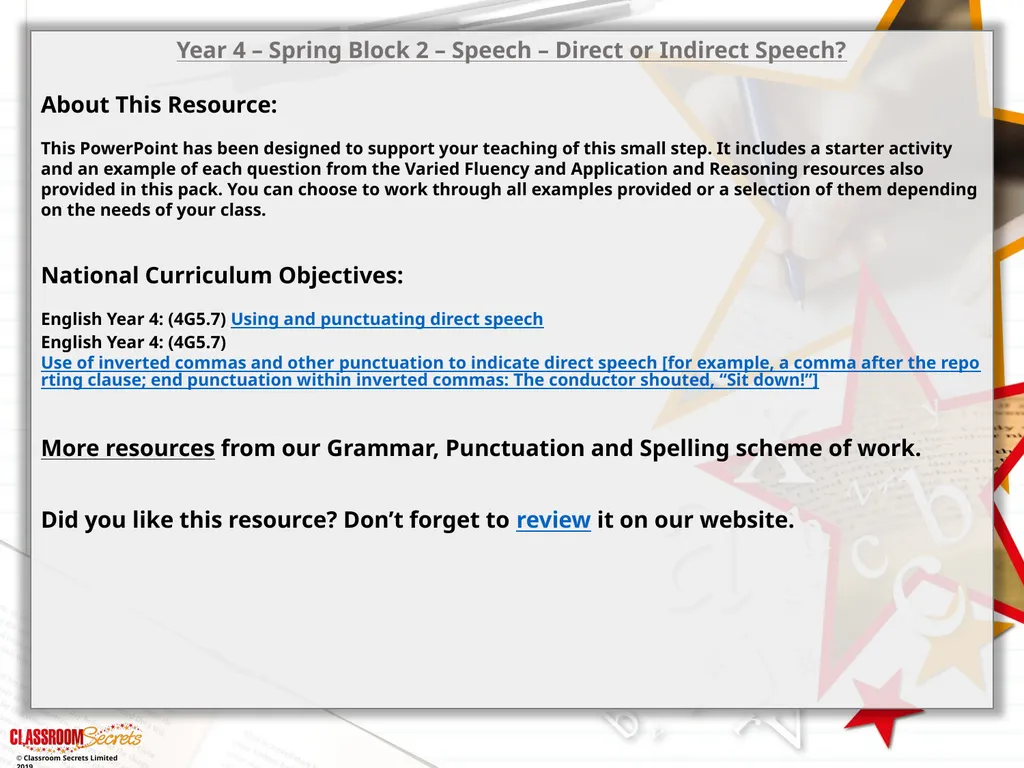
About This Resource:
This PowerPoint has been designed to support your teaching of this small step. It includes a starter activity and an example of each question from the Varied Fluency and Application and Reasoning resources also provided in this pack. You can choose to work through all examples provided or a selection of them depending on the needs of your class.
National Curriculum Objectives:
English Year 4: (4G5.7) Using and punctuating direct speech
English Year 4: (4G5.7) Use of inverted commas and other punctuation to indicate direct speech [for example, a comma after the reporting clause; end punctuation within inverted commas: The conductor shouted, “Sit down!”]
More resources from our Grammar, Punctuation and Spelling scheme of work.
Did you like this resource? Don’t forget to review it on our website.<br>
slide3. Year 4 – Spring Block 2 – Speech – Direct or Indirect Speech?
Notes and Guidance
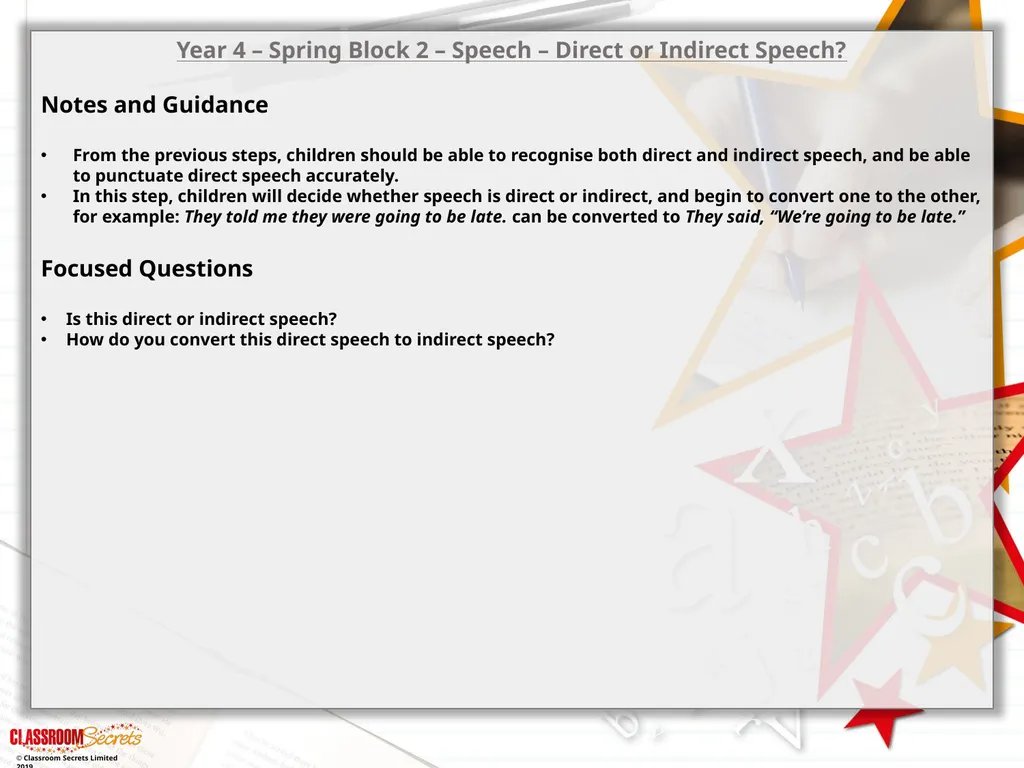
From the previous steps, children should be able to recognise both direct and indirect speech, and be able to punctuate direct speech accurately.
In this step, children will decide whether speech is direct or indirect, and begin to convert one to the other, for example: They told me they were going to be late. can be converted to They said, “We’re going to be late.”
Focused Questions
Is this direct or indirect speech?
How do you convert this direct speech to indirect speech?<br>
slide4. Year 4 – Spring Block 2 – Speech
Step 3: Direct or Indirect Speech?<br>
slide5. Introduction
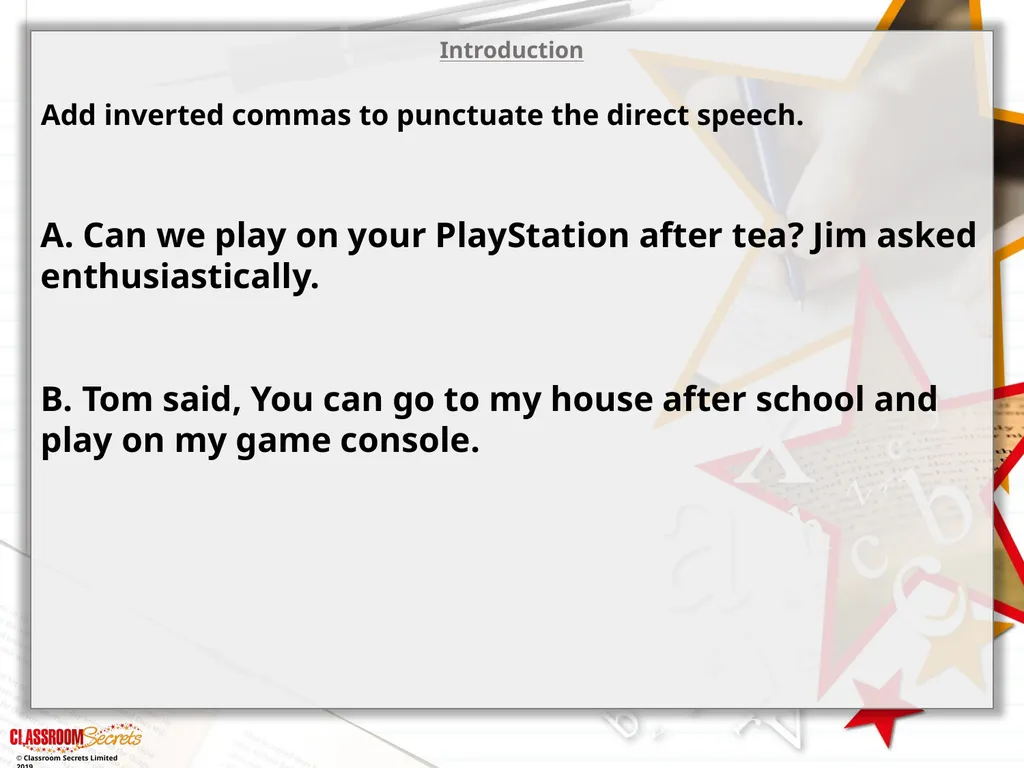
Add inverted commas to punctuate the direct speech.
A. Can we play on your PlayStation after tea? Jim asked enthusiastically.
B. Tom said, You can go to my house after school and play on my game console.<br>
slide6. Introduction
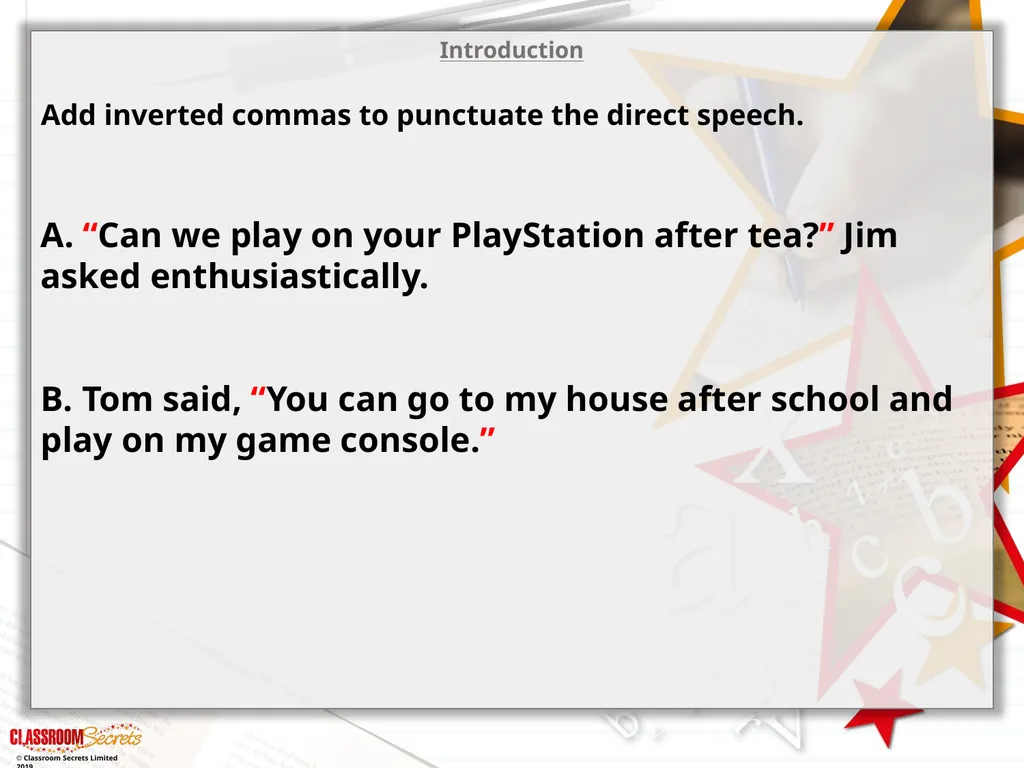
Add inverted commas to punctuate the direct speech.
A. “Can we play on your PlayStation after tea?” Jim asked enthusiastically.
B. Tom said, “You can go to my house after school and play on my game console.”<br>
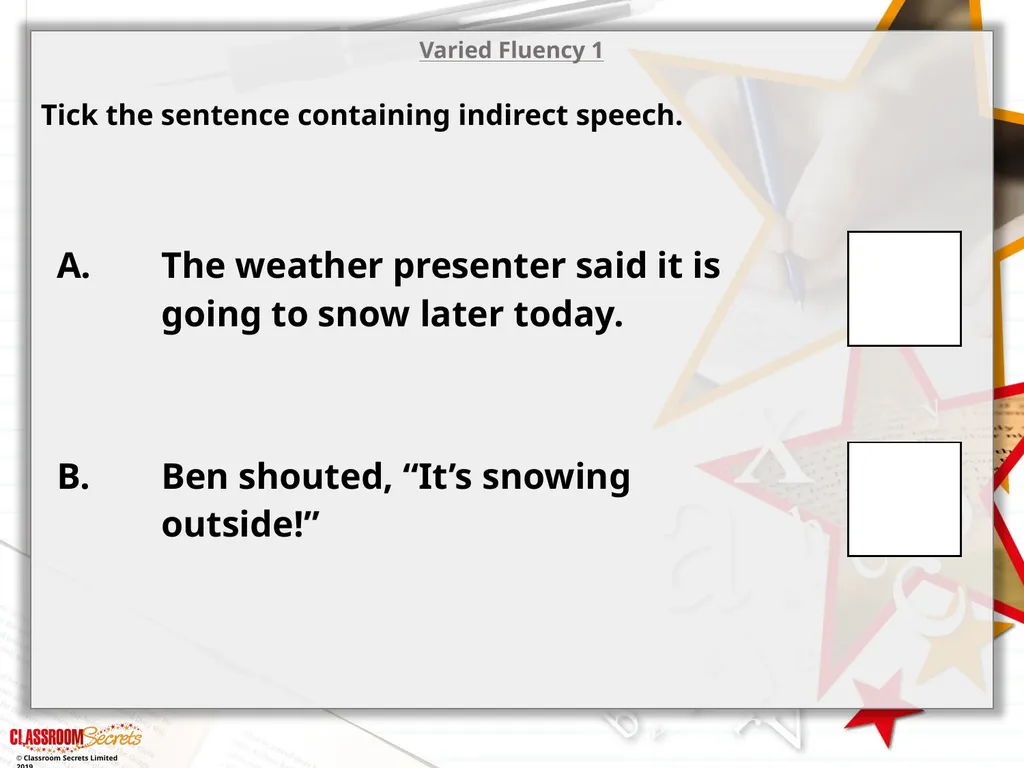
slide7. Varied Fluency 1
Tick the sentence containing indirect speech.<br>
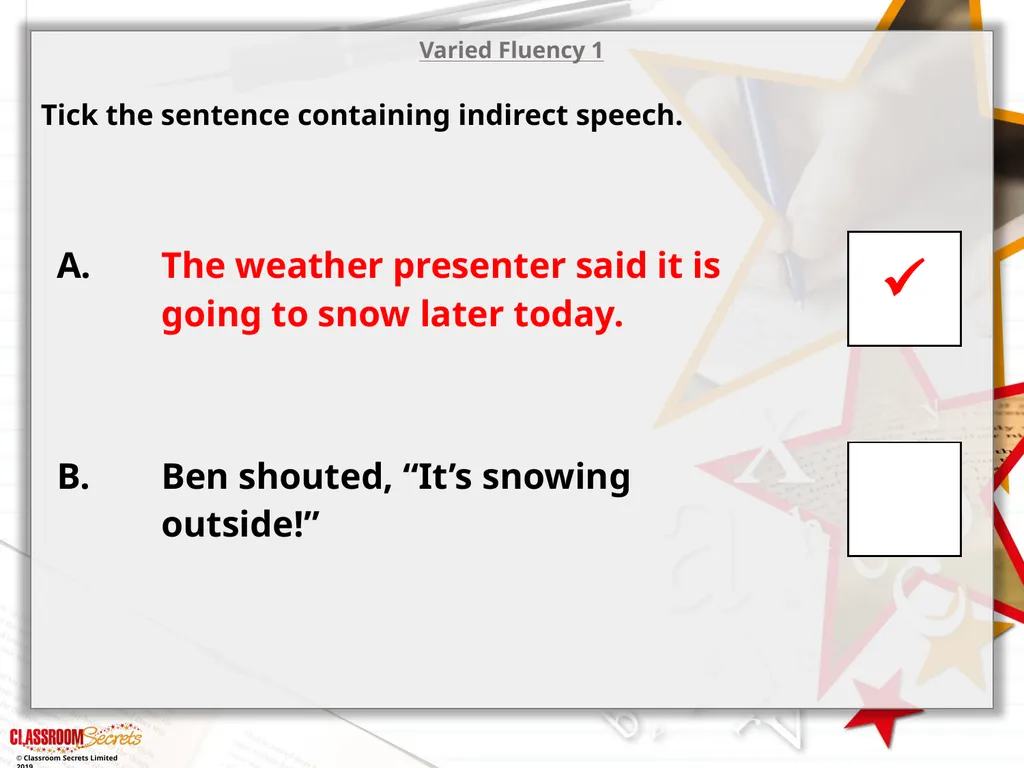
slide8. Varied Fluency 1
Tick the sentence containing indirect speech.<br>
slide9. Varied Fluency 2
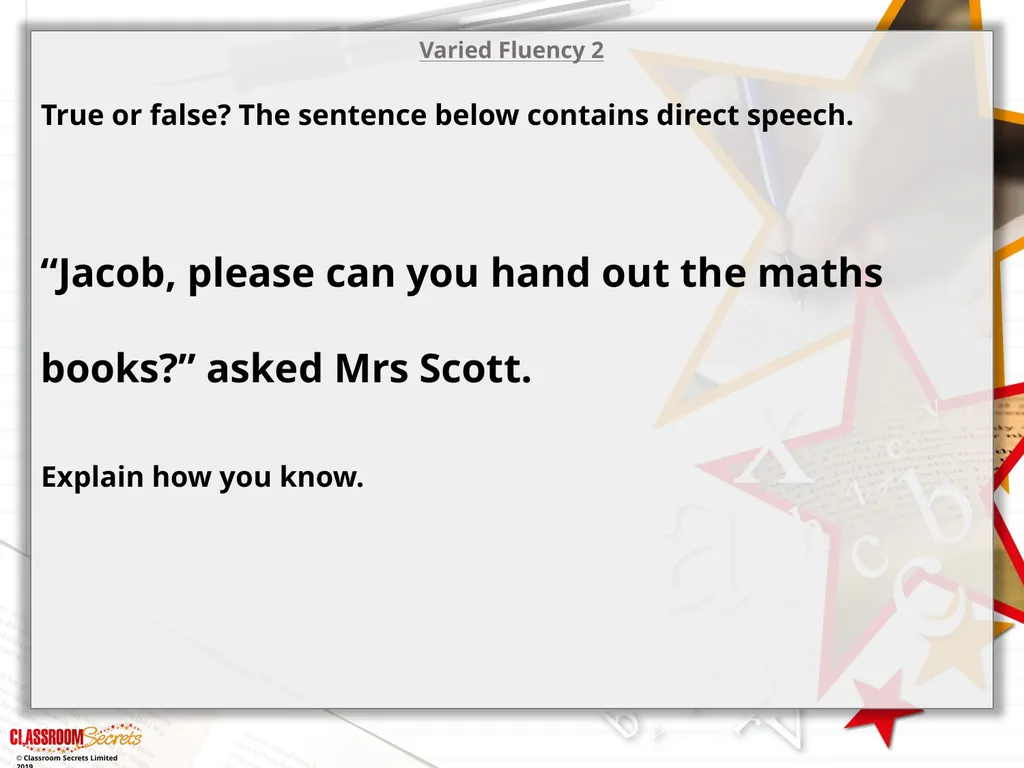
True or false? The sentence below contains direct speech.
“Jacob, please can you hand out the maths books?” asked Mrs Scott.
Explain how you know.<br>
slide10. Varied Fluency 2
True or false? The sentence below contains direct speech.
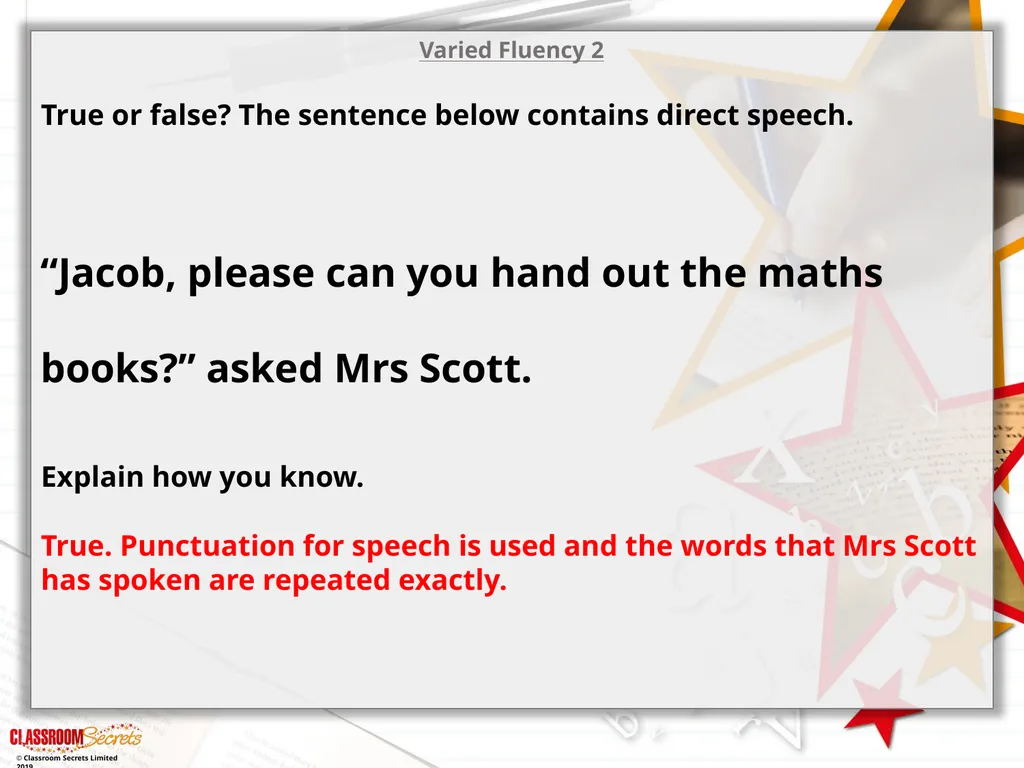
“Jacob, please can you hand out the maths books?” asked Mrs Scott.
Explain how you know.
True. Punctuation for speech is used and the words that Mrs Scott has spoken are repeated exactly.<br>
slide11. Varied Fluency 3
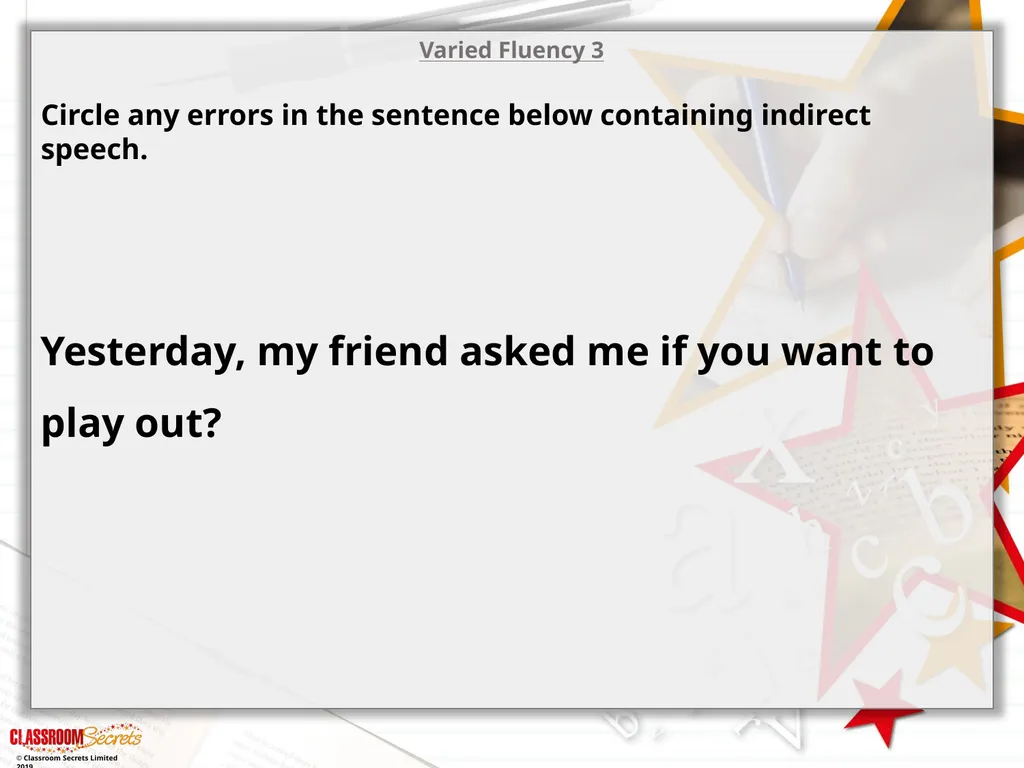
Circle any errors in the sentence below containing indirect speech.
Yesterday, my friend asked me if you want to play out?<br>
slide12. Varied Fluency 3
Circle any errors in the sentence below containing indirect speech.
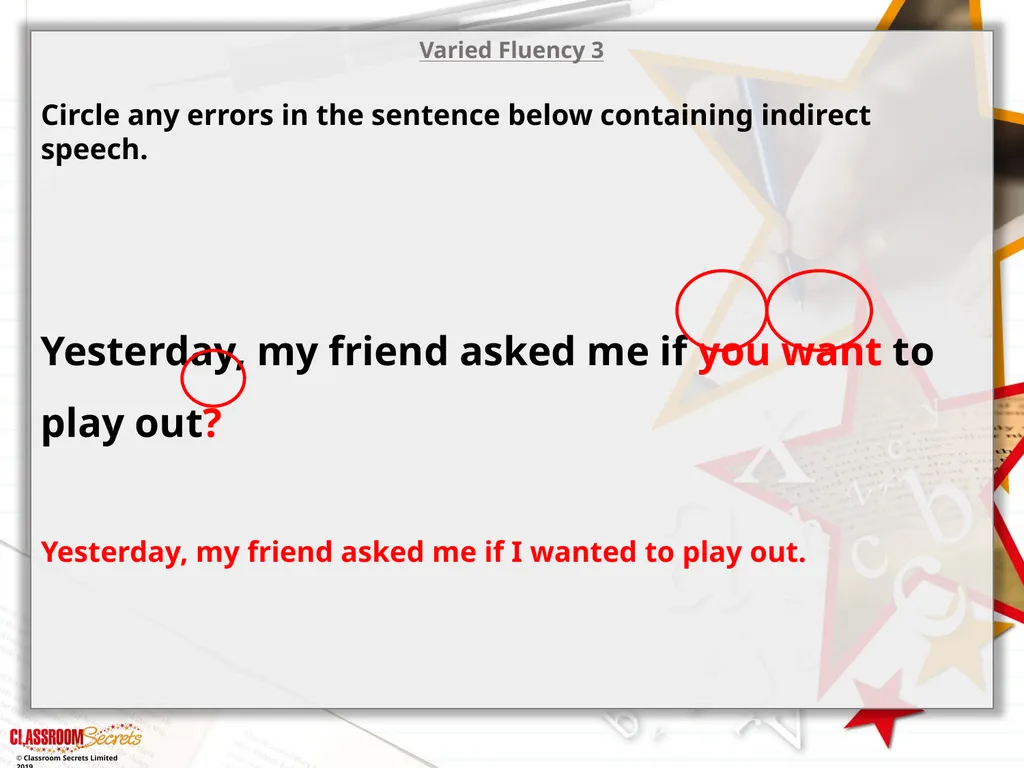
Yesterday, my friend asked me if you want to play out?
Yesterday, my friend asked me if I wanted to play out.<br>
slide13. Varied Fluency 4
Errol has tried to rewrite the speech bubble as direct speech.
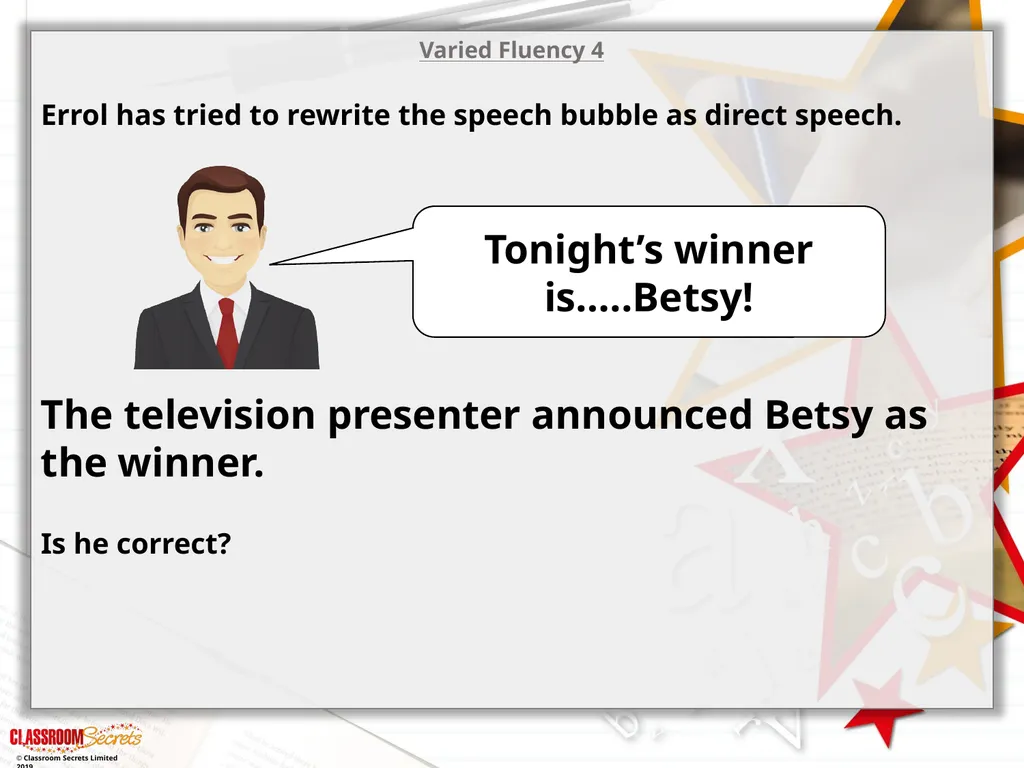
The television presenter announced Betsy as the winner.
Is he correct? Tonight’s winner is…..Betsy!<br>
slide14. Varied Fluency 4
Errol has tried to rewrite the speech bubble as direct speech.
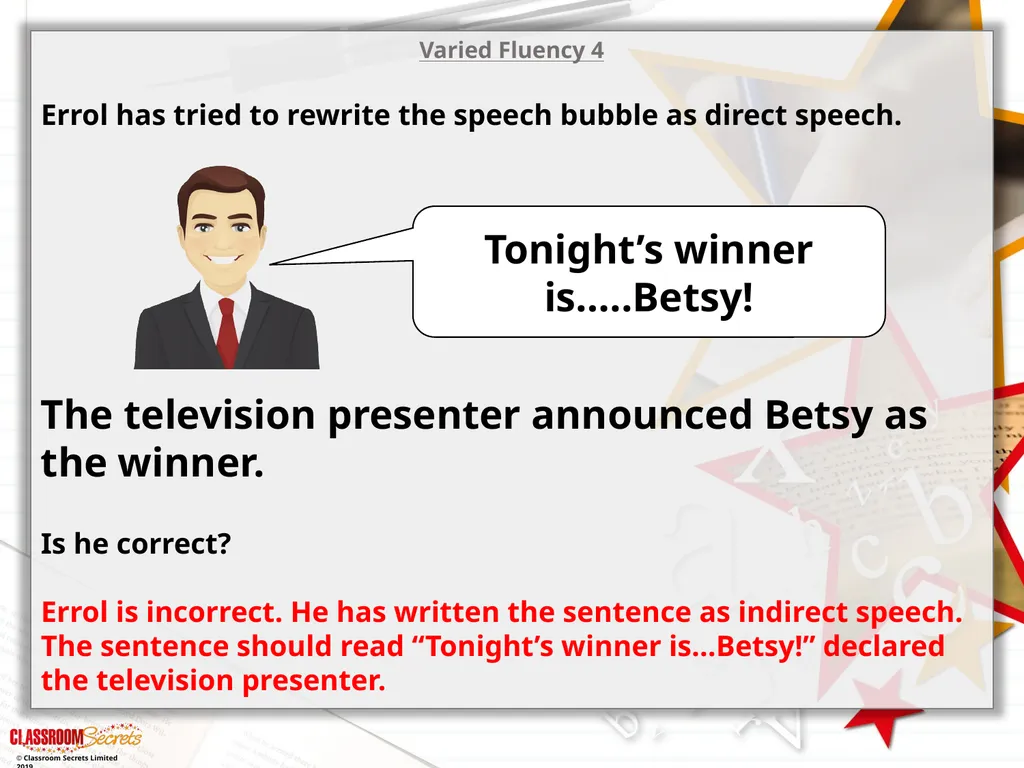
The television presenter announced Betsy as the winner.
Is he correct?
Errol is incorrect. He has written the sentence as indirect speech. The sentence should read “Tonight’s winner is…Betsy!” declared the television presenter. Tonight’s winner is…..Betsy!<br>
slide15. Application 1
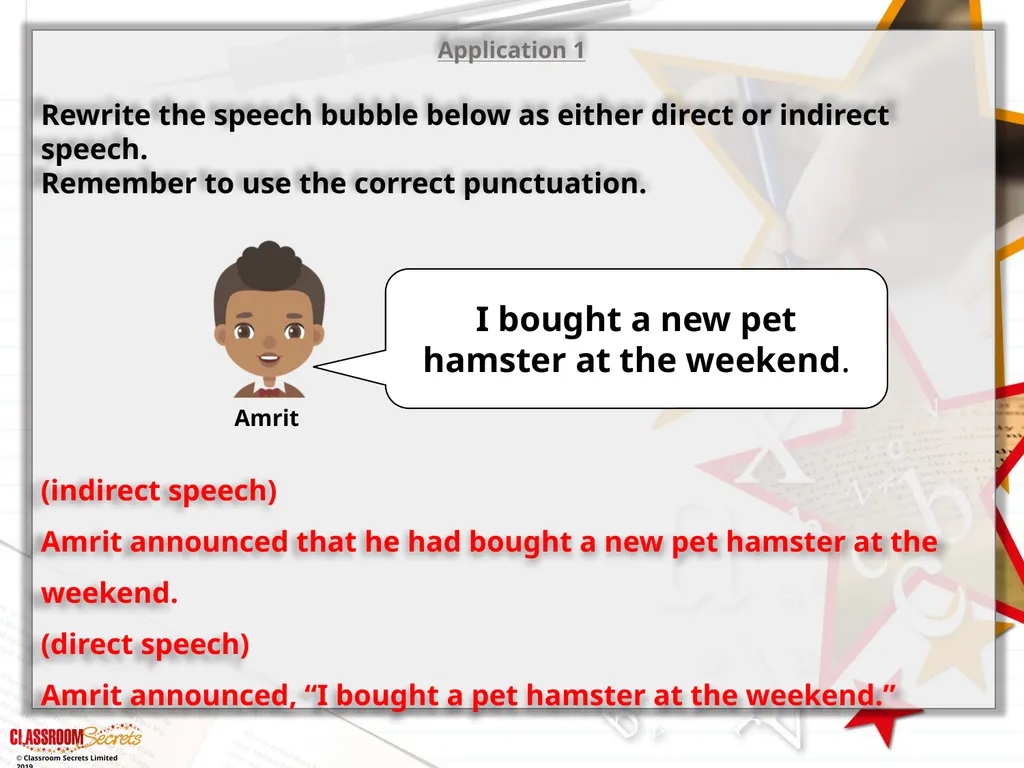
Rewrite the speech bubble below as either direct or indirect speech.
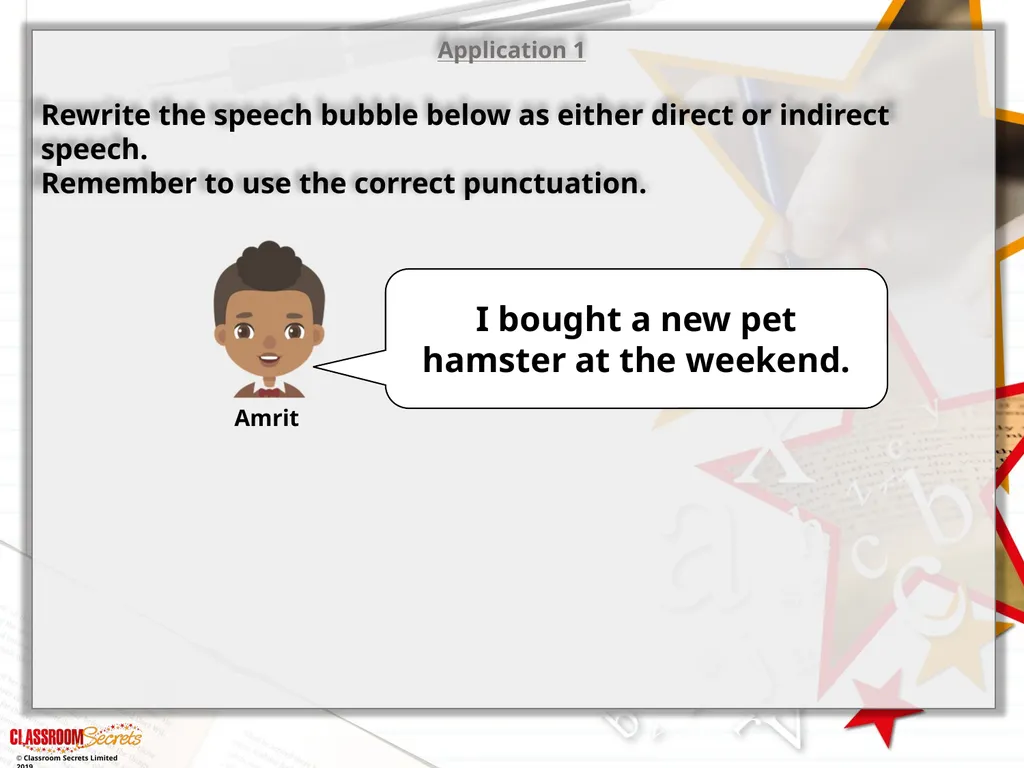
Remember to use the correct punctuation. I bought a new pet hamster at the weekend. Amrit<br>
slide16. Application 1
Rewrite the speech bubble below as either direct or indirect speech.
Remember to use the correct punctuation.
(indirect speech)
Amrit announced that he had bought a new pet hamster at the weekend.
(direct speech)
Amrit announced, “I bought a pet hamster at the weekend.” I bought a new pet hamster at the weekend. Amrit<br>
slide17. Application 2
Complete the sentences below using direct speech with the correct punctuation.
__________________________________ ______________ _ _____ _ _ Beth explained.
Mum agreed __________________________________ ______________ _ _____ _ _<br>
slide18. Application 2
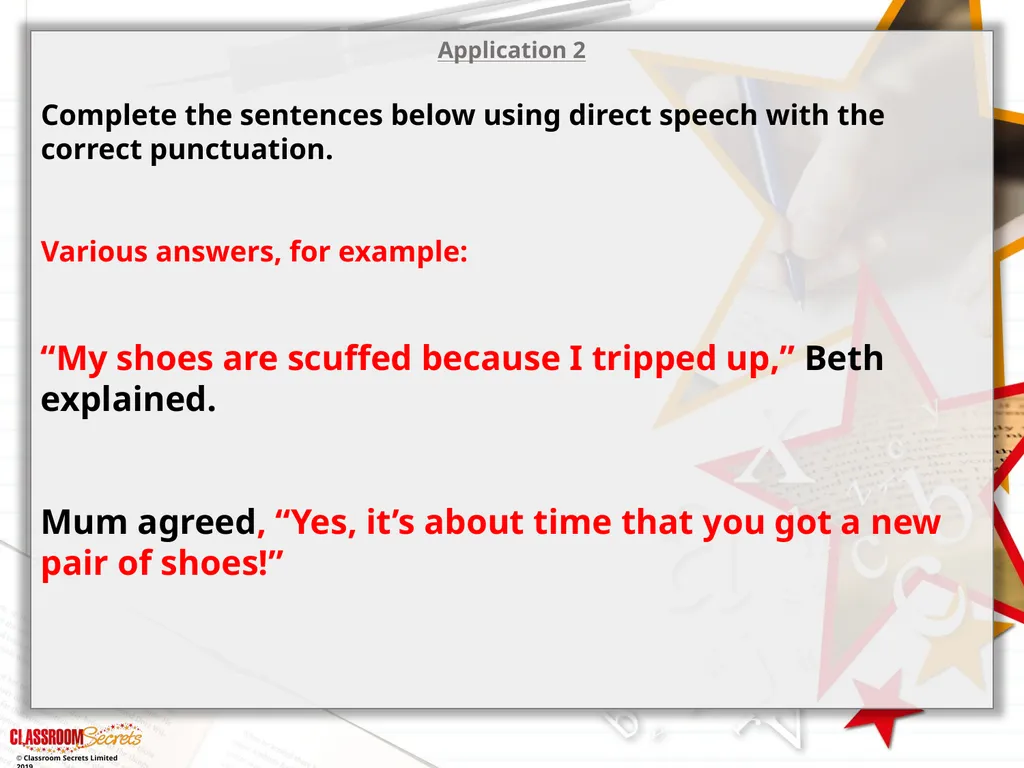
Complete the sentences below using direct speech with the correct punctuation.
Various answers, for example:
“My shoes are scuffed because I tripped up,” Beth explained.
Mum agreed, “Yes, it’s about time that you got a new pair of shoes!”<br>
slide19. Reasoning 1
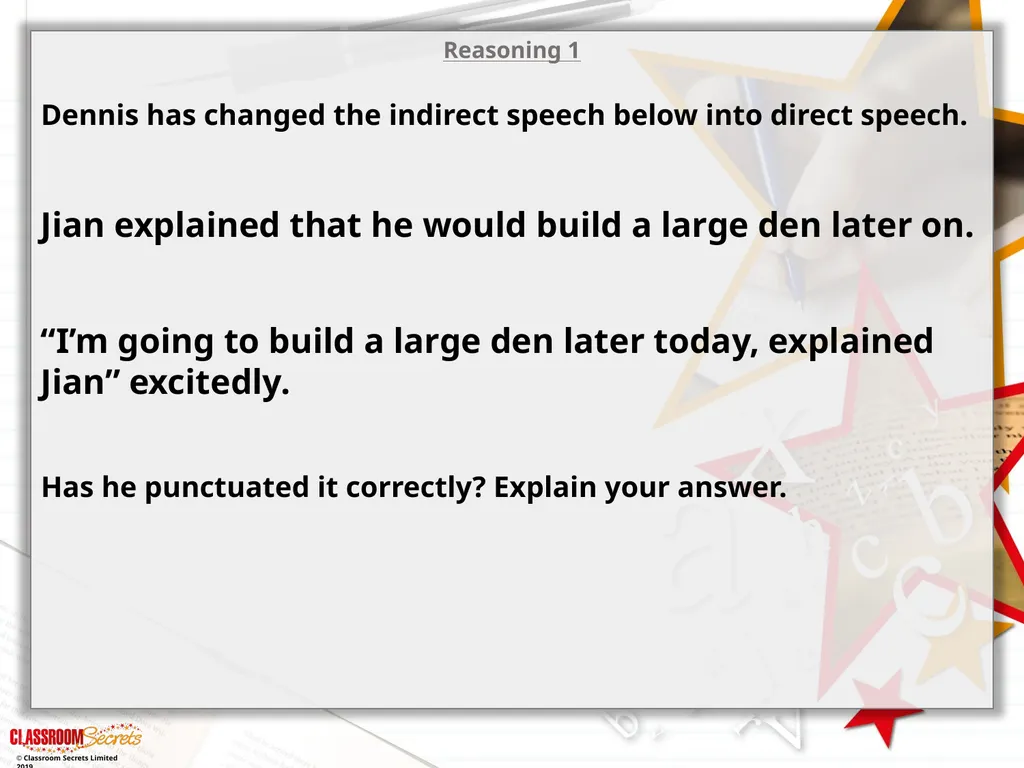
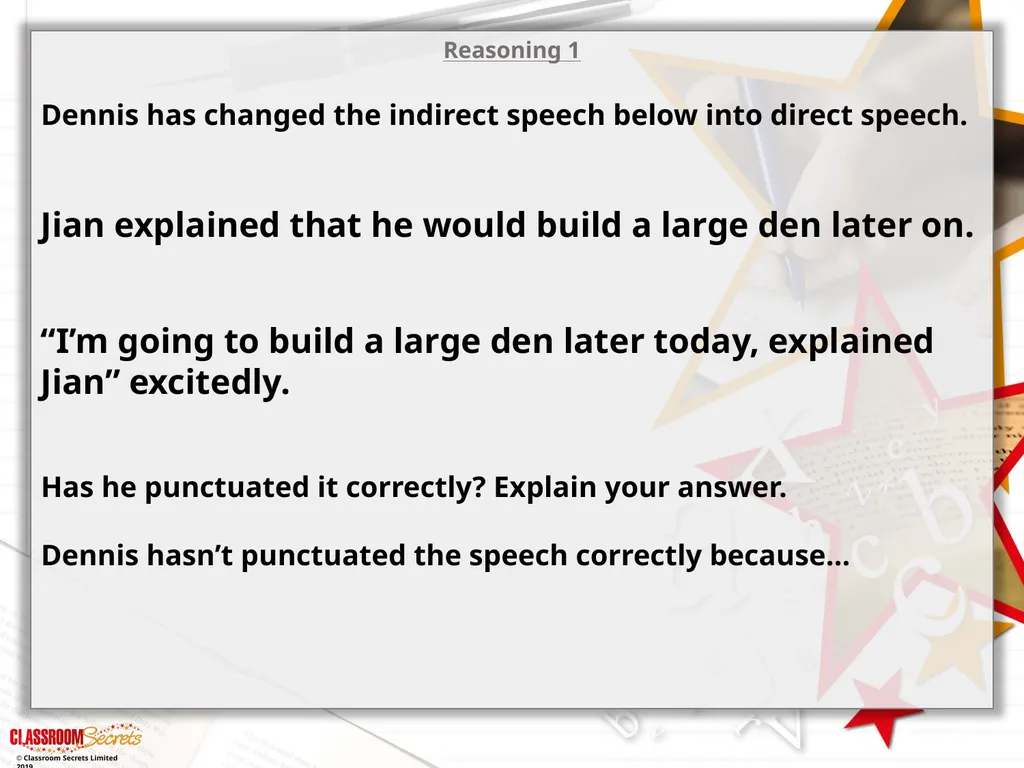
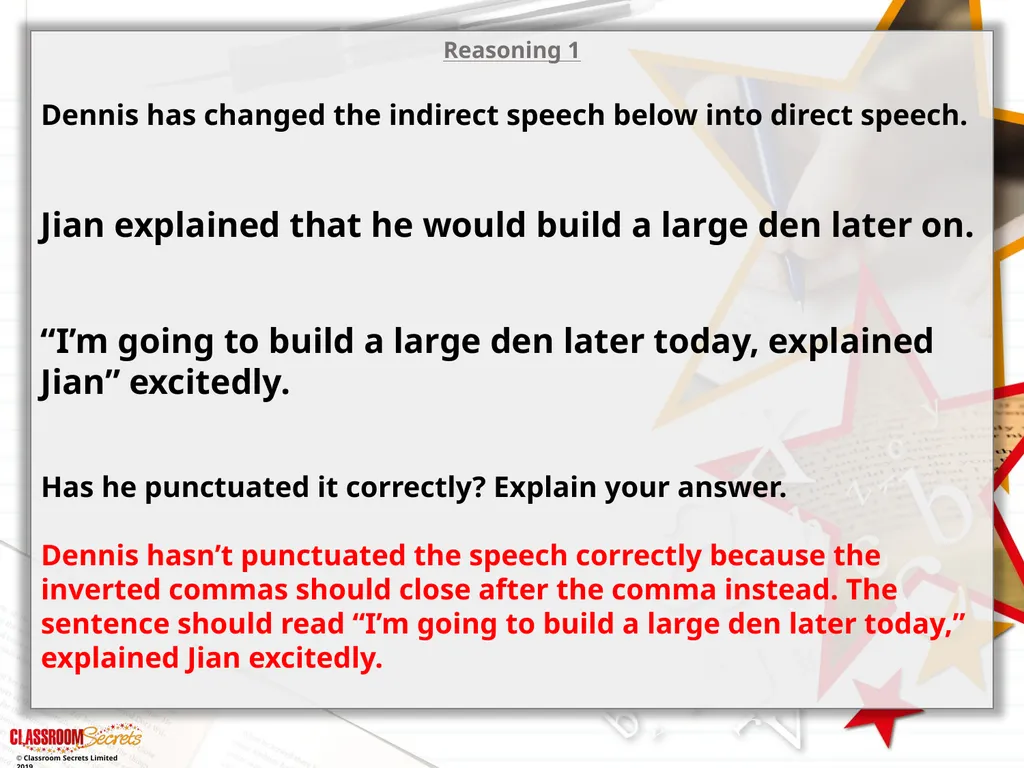
Dennis has changed the indirect speech below into direct speech.
Jian explained that he would build a large den later on.
“I’m going to build a large den later today, explained Jian” excitedly.
Has he punctuated it correctly? Explain your answer.<br>
slide20. Reasoning 1
Dennis has changed the indirect speech below into direct speech.
Jian explained that he would build a large den later on.
“I’m going to build a large den later today, explained Jian” excitedly.
Has he punctuated it correctly? Explain your answer.
Dennis hasn’t punctuated the speech correctly because…<br>
slide21. Reasoning 1
Dennis has changed the indirect speech below into direct speech.
Jian explained that he would build a large den later on.
“I’m going to build a large den later today, explained Jian” excitedly.
Has he punctuated it correctly? Explain your answer.
Dennis hasn’t punctuated the speech correctly because the inverted commas should close after the comma instead. The sentence should read “I’m going to build a large den later today,” explained Jian excitedly.<br>
We have started a #LIFEworkbalance campaign and we need your help to complete our LIFE/work balance survey.
We hope to publish the results soon, so please give 15 minutes of your time to help us get a true picture of school life.
Want to be a part of this campaign? Take the survey on our website and share it with your colleagues!<br>
slide2. Year 4 – Spring Block 2 – Speech – Direct or Indirect Speech?
About This Resource:
This PowerPoint has been designed to support your teaching of this small step. It includes a starter activity and an example of each question from the Varied Fluency and Application and Reasoning resources also provided in this pack. You can choose to work through all examples provided or a selection of them depending on the needs of your class.
National Curriculum Objectives:
English Year 4: (4G5.7) Using and punctuating direct speech
English Year 4: (4G5.7) Use of inverted commas and other punctuation to indicate direct speech [for example, a comma after the reporting clause; end punctuation within inverted commas: The conductor shouted, “Sit down!”]
More resources from our Grammar, Punctuation and Spelling scheme of work.
Did you like this resource? Don’t forget to review it on our website.<br>
slide3. Year 4 – Spring Block 2 – Speech – Direct or Indirect Speech?
Notes and Guidance
From the previous steps, children should be able to recognise both direct and indirect speech, and be able to punctuate direct speech accurately.
In this step, children will decide whether speech is direct or indirect, and begin to convert one to the other, for example: They told me they were going to be late. can be converted to They said, “We’re going to be late.”
Focused Questions
Is this direct or indirect speech?
How do you convert this direct speech to indirect speech?<br>
slide4. Year 4 – Spring Block 2 – Speech
Step 3: Direct or Indirect Speech?<br>
slide5. Introduction
Add inverted commas to punctuate the direct speech.
A. Can we play on your PlayStation after tea? Jim asked enthusiastically.
B. Tom said, You can go to my house after school and play on my game console.<br>
slide6. Introduction
Add inverted commas to punctuate the direct speech.
A. “Can we play on your PlayStation after tea?” Jim asked enthusiastically.
B. Tom said, “You can go to my house after school and play on my game console.”<br>
slide7. Varied Fluency 1
Tick the sentence containing indirect speech.<br>
slide8. Varied Fluency 1
Tick the sentence containing indirect speech.<br>
slide9. Varied Fluency 2
True or false? The sentence below contains direct speech.
“Jacob, please can you hand out the maths books?” asked Mrs Scott.
Explain how you know.<br>
slide10. Varied Fluency 2
True or false? The sentence below contains direct speech.
“Jacob, please can you hand out the maths books?” asked Mrs Scott.
Explain how you know.
True. Punctuation for speech is used and the words that Mrs Scott has spoken are repeated exactly.<br>
slide11. Varied Fluency 3
Circle any errors in the sentence below containing indirect speech.
Yesterday, my friend asked me if you want to play out?<br>
slide12. Varied Fluency 3
Circle any errors in the sentence below containing indirect speech.
Yesterday, my friend asked me if you want to play out?
Yesterday, my friend asked me if I wanted to play out.<br>
slide13. Varied Fluency 4
Errol has tried to rewrite the speech bubble as direct speech.
The television presenter announced Betsy as the winner.
Is he correct? Tonight’s winner is…..Betsy!<br>
slide14. Varied Fluency 4
Errol has tried to rewrite the speech bubble as direct speech.
The television presenter announced Betsy as the winner.
Is he correct?
Errol is incorrect. He has written the sentence as indirect speech. The sentence should read “Tonight’s winner is…Betsy!” declared the television presenter. Tonight’s winner is…..Betsy!<br>
slide15. Application 1
Rewrite the speech bubble below as either direct or indirect speech.
Remember to use the correct punctuation. I bought a new pet hamster at the weekend. Amrit<br>
slide16. Application 1
Rewrite the speech bubble below as either direct or indirect speech.
Remember to use the correct punctuation.
(indirect speech)
Amrit announced that he had bought a new pet hamster at the weekend.
(direct speech)
Amrit announced, “I bought a pet hamster at the weekend.” I bought a new pet hamster at the weekend. Amrit<br>
slide17. Application 2
Complete the sentences below using direct speech with the correct punctuation.
__________________________________ ______________ _ _____ _ _ Beth explained.
Mum agreed __________________________________ ______________ _ _____ _ _<br>
slide18. Application 2
Complete the sentences below using direct speech with the correct punctuation.
Various answers, for example:
“My shoes are scuffed because I tripped up,” Beth explained.
Mum agreed, “Yes, it’s about time that you got a new pair of shoes!”<br>
slide19. Reasoning 1
Dennis has changed the indirect speech below into direct speech.
Jian explained that he would build a large den later on.
“I’m going to build a large den later today, explained Jian” excitedly.
Has he punctuated it correctly? Explain your answer.<br>
slide20. Reasoning 1
Dennis has changed the indirect speech below into direct speech.
Jian explained that he would build a large den later on.
“I’m going to build a large den later today, explained Jian” excitedly.
Has he punctuated it correctly? Explain your answer.
Dennis hasn’t punctuated the speech correctly because…<br>
slide21. Reasoning 1
Dennis has changed the indirect speech below into direct speech.
Jian explained that he would build a large den later on.
“I’m going to build a large den later today, explained Jian” excitedly.
Has he punctuated it correctly? Explain your answer.
Dennis hasn’t punctuated the speech correctly because the inverted commas should close after the comma instead. The sentence should read “I’m going to build a large den later today,” explained Jian excitedly.<br>