
LIMRA Your Global Consulting Partner Presentation
NS
Published · 29 slides · 0 views

1 / 1



Description
LIMRA Your Global Consulting Partner Presentation Graham Morris III Conference Mumbai 4th July 2012 International Bancassurance Models 2 Bancassurance Models overview Structural models Financial models Distribution and Operational Sales
Related Topics
Share
Embed code
Download this presentation From Below
"LIMRA Your Global Consulting Partner Presentation" is the property of its rightful owner. Permission is granted to download and print the materials on this website for personal, non-commercial use only, and to display it on your personal computer provided you do not modify the materials and that you retain all copyright notices contained in the materials. By downloading content from our website, you accept the terms of this agreement.
Presentation Transcript
01
LIMRA Your Global Consulting Partner
Presentation – Graham Morris
III Conference Mumbai 4th July 2012
International Bancassurance Models<br>
Presentation – Graham Morris
III Conference Mumbai 4th July 2012
International Bancassurance Models<br>
02
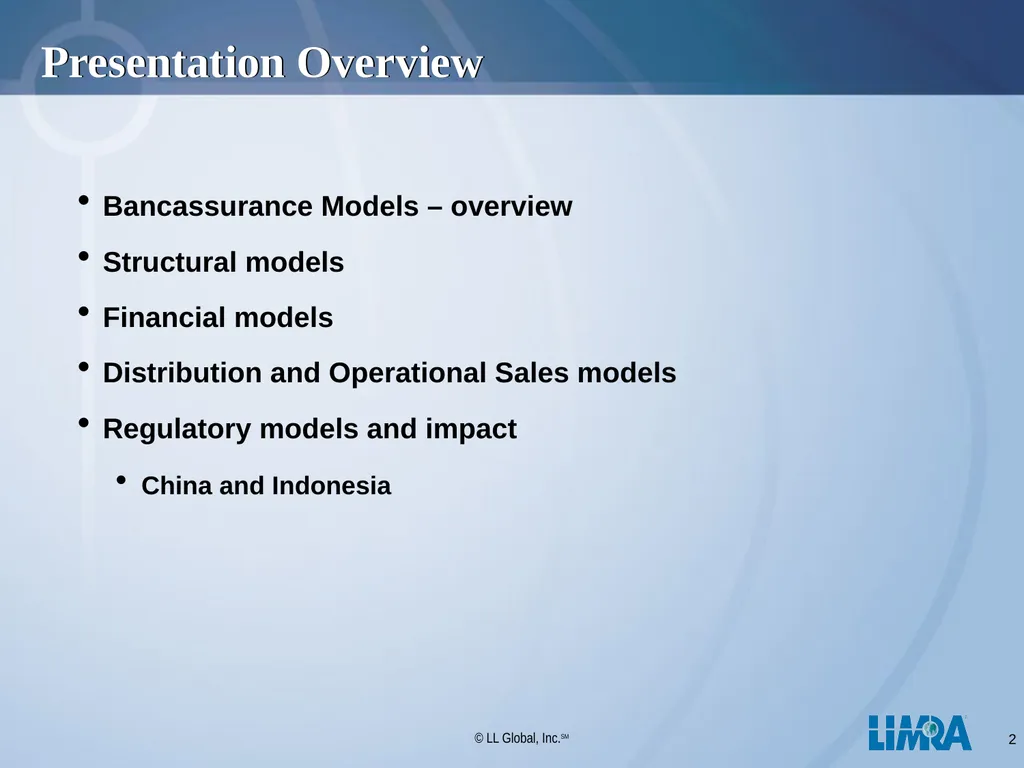
2 Bancassurance Models – overview
Structural models
Financial models
Distribution and Operational Sales models
Regulatory models and impact
China and Indonesia Presentation Overview<br>
Structural models
Financial models
Distribution and Operational Sales models
Regulatory models and impact
China and Indonesia Presentation Overview<br>
03
Bancassurance models - overview<br>
04
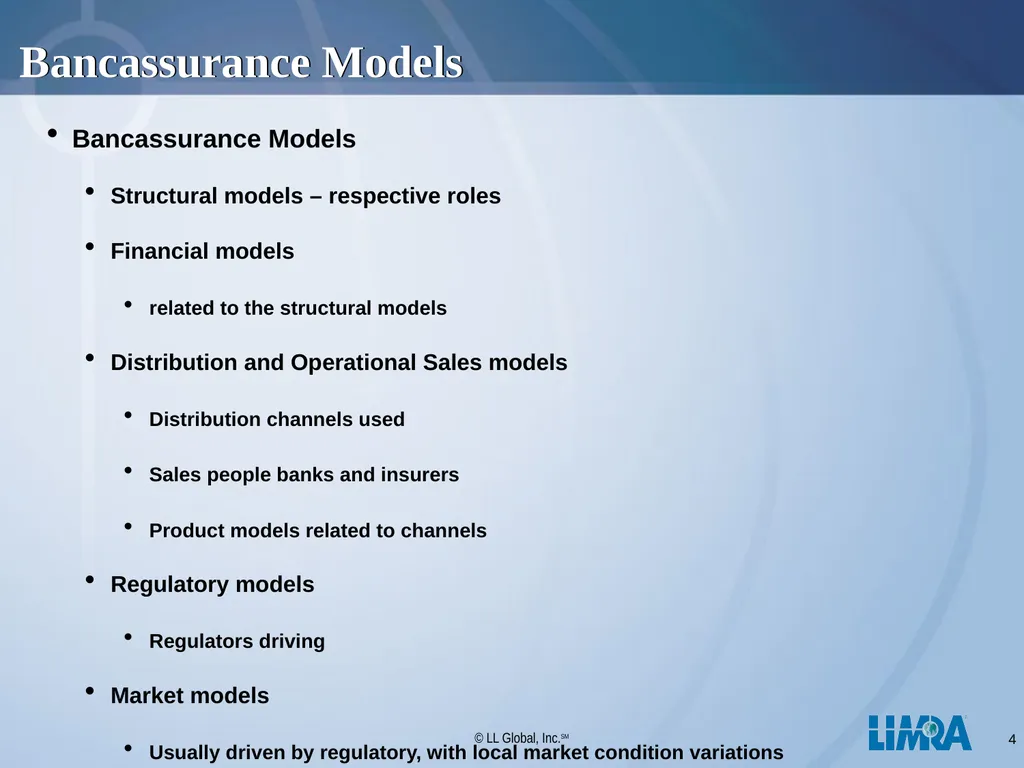
4 Bancassurance Models
Structural models – respective roles
Financial models
related to the structural models
Distribution and Operational Sales models
Distribution channels used
Sales people banks and insurers
Product models related to channels
Regulatory models
Regulators driving
Market models
Usually driven by regulatory, with local market condition variations Bancassurance Models<br>
Structural models – respective roles
Financial models
related to the structural models
Distribution and Operational Sales models
Distribution channels used
Sales people banks and insurers
Product models related to channels
Regulatory models
Regulators driving
Market models
Usually driven by regulatory, with local market condition variations Bancassurance Models<br>
05
Typical Structural Models<br>
06
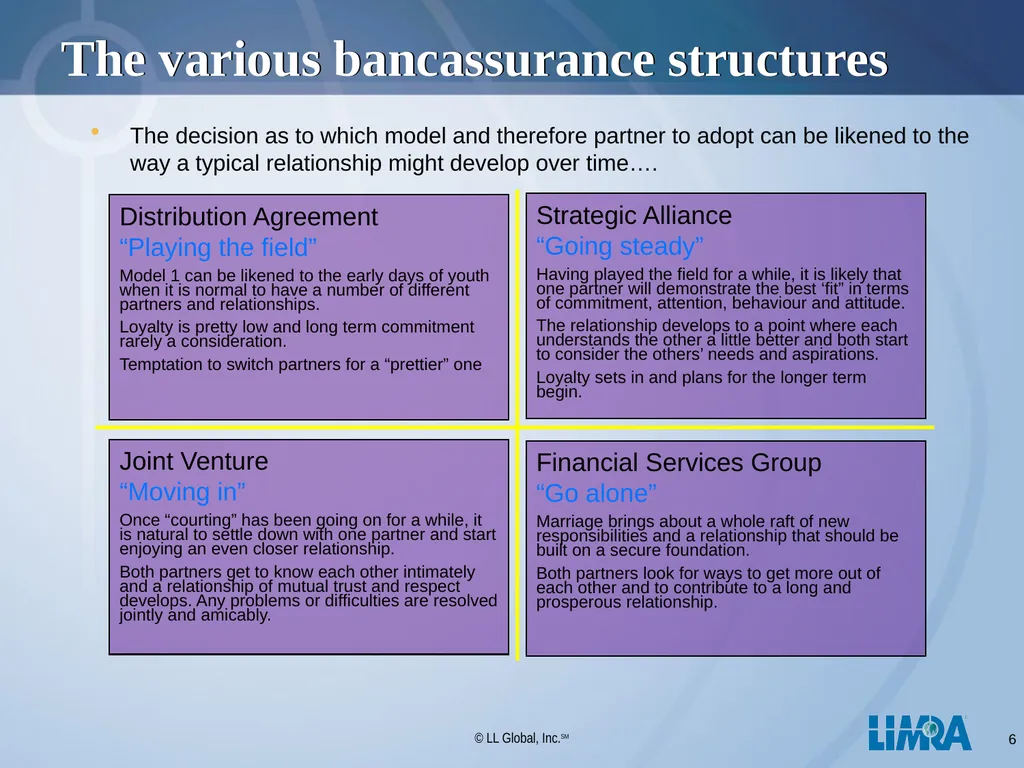
6 The various bancassurance structures The decision as to which model and therefore partner to adopt can be likened to the way a typical relationship might develop over time…. Distribution Agreement
“Playing the field”
Model 1 can be likened to the early days of youth when it is normal to have a number of different partners and relationships.
Loyalty is pretty low and long term commitment rarely a consideration.
Temptation to switch partners for a “prettier” one Strategic Alliance
“Going steady”
Having played the field for a while, it is likely that one partner will demonstrate the best ‘fit” in terms of commitment, attention, behaviour and attitude.
The relationship develops to a point where each understands the other a little better and both start to consider the others’ needs and aspirations.
Loyalty sets in and plans for the longer term begin. Joint Venture
“Moving in”
Once “courting” has been going on for a while, it is natural to settle down with one partner and start enjoying an even closer relationship.
Both partners get to know each other intimately and a relationship of mutual trust and respect develops. Any problems or difficulties are resolved jointly and amicably. Financial Services Group
“Go alone”
Marriage brings about a whole raft of new responsibilities and a relationship that should be built on a secure foundation.
Both partners look for ways to get more out of each other and to contribute to a long and prosperous relationship.<br>
“Playing the field”
Model 1 can be likened to the early days of youth when it is normal to have a number of different partners and relationships.
Loyalty is pretty low and long term commitment rarely a consideration.
Temptation to switch partners for a “prettier” one Strategic Alliance
“Going steady”
Having played the field for a while, it is likely that one partner will demonstrate the best ‘fit” in terms of commitment, attention, behaviour and attitude.
The relationship develops to a point where each understands the other a little better and both start to consider the others’ needs and aspirations.
Loyalty sets in and plans for the longer term begin. Joint Venture
“Moving in”
Once “courting” has been going on for a while, it is natural to settle down with one partner and start enjoying an even closer relationship.
Both partners get to know each other intimately and a relationship of mutual trust and respect develops. Any problems or difficulties are resolved jointly and amicably. Financial Services Group
“Go alone”
Marriage brings about a whole raft of new responsibilities and a relationship that should be built on a secure foundation.
Both partners look for ways to get more out of each other and to contribute to a long and prosperous relationship.<br>
07
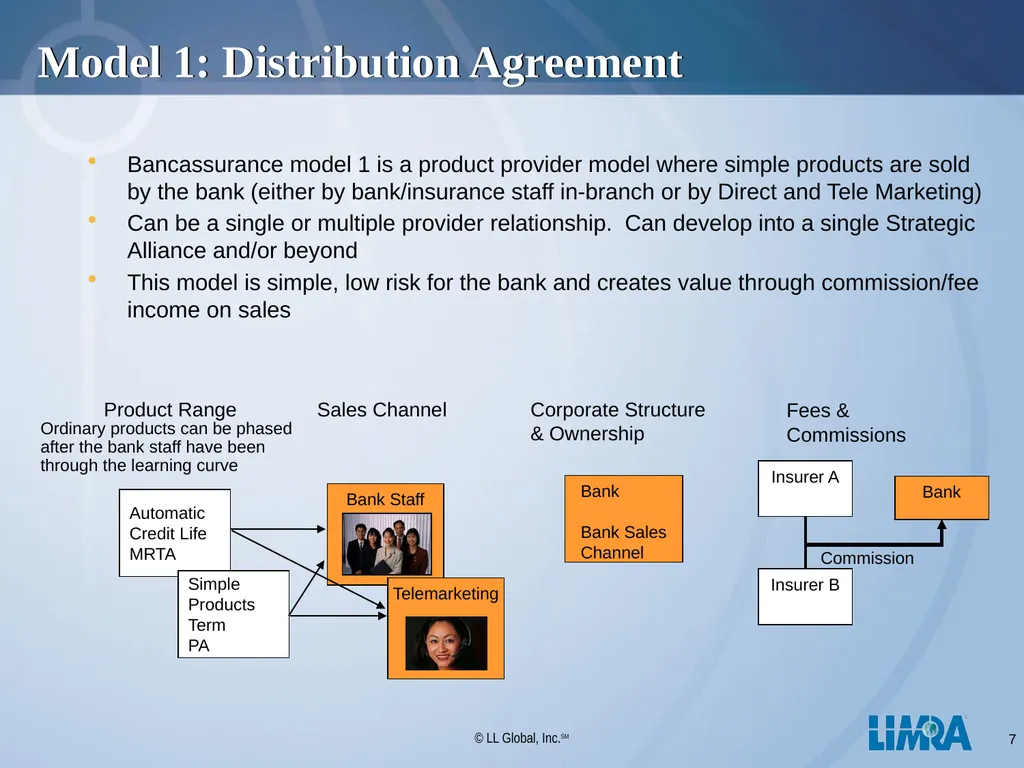
7 Product Range Sales Channel Corporate Structure & Ownership Fees & Commissions Automatic
Credit Life
MRTA Bank Staff Bank
Bank Sales
Channel Bank Commission Insurer A Ordinary products can be phased after the bank staff have been through the learning curve Bancassurance model 1 is a product provider model where simple products are sold by the bank (either by bank/insurance staff in-branch or by Direct and Tele Marketing)
Can be a single or multiple provider relationship. Can develop into a single Strategic Alliance and/or beyond
This model is simple, low risk for the bank and creates value through commission/fee income on sales Model 1: Distribution Agreement Telemarketing Simple Products
Term
PA Insurer B<br>
Credit Life
MRTA Bank Staff Bank
Bank Sales
Channel Bank Commission Insurer A Ordinary products can be phased after the bank staff have been through the learning curve Bancassurance model 1 is a product provider model where simple products are sold by the bank (either by bank/insurance staff in-branch or by Direct and Tele Marketing)
Can be a single or multiple provider relationship. Can develop into a single Strategic Alliance and/or beyond
This model is simple, low risk for the bank and creates value through commission/fee income on sales Model 1: Distribution Agreement Telemarketing Simple Products
Term
PA Insurer B<br>
08
8 Product Range Sales Channel Corporate Structure & Ownership Fees & Commissions Bank
Bank Sales
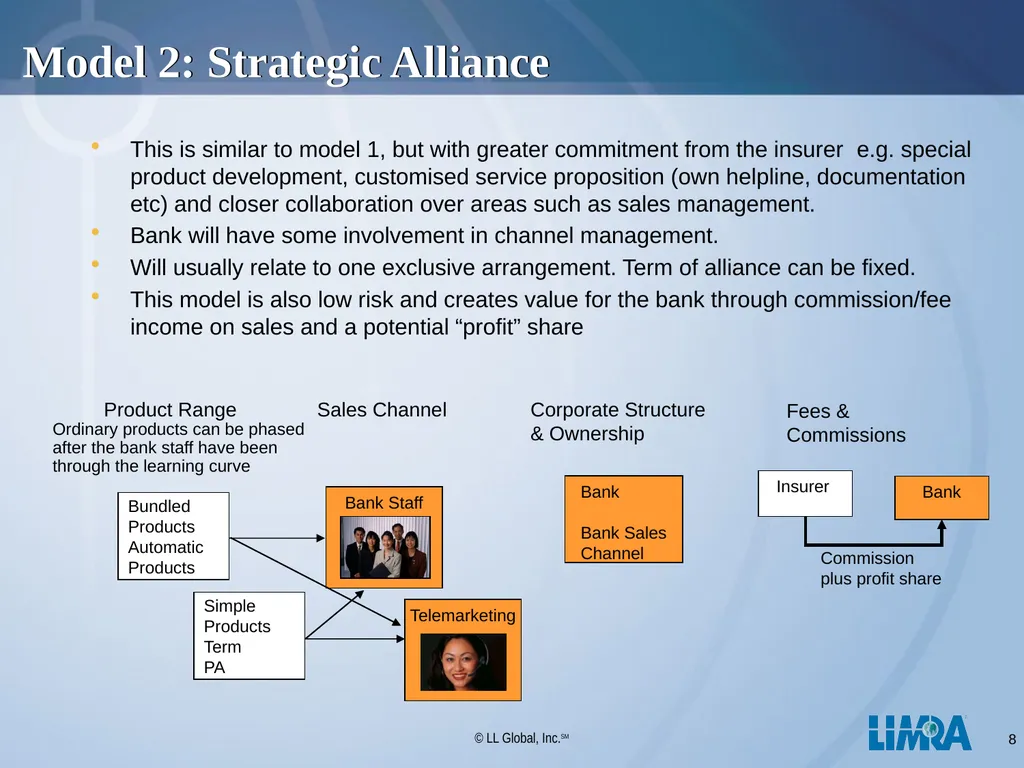
Channel Ordinary products can be phased after the bank staff have been through the learning curve This is similar to model 1, but with greater commitment from the insurer e.g. special product development, customised service proposition (own helpline, documentation etc) and closer collaboration over areas such as sales management.
Bank will have some involvement in channel management.
Will usually relate to one exclusive arrangement. Term of alliance can be fixed.
This model is also low risk and creates value for the bank through commission/fee income on sales and a potential “profit” share Model 2: Strategic Alliance Bank Commission plus profit share Insurer<br>
Bank Sales
Channel Ordinary products can be phased after the bank staff have been through the learning curve This is similar to model 1, but with greater commitment from the insurer e.g. special product development, customised service proposition (own helpline, documentation etc) and closer collaboration over areas such as sales management.
Bank will have some involvement in channel management.
Will usually relate to one exclusive arrangement. Term of alliance can be fixed.
This model is also low risk and creates value for the bank through commission/fee income on sales and a potential “profit” share Model 2: Strategic Alliance Bank Commission plus profit share Insurer<br>
09
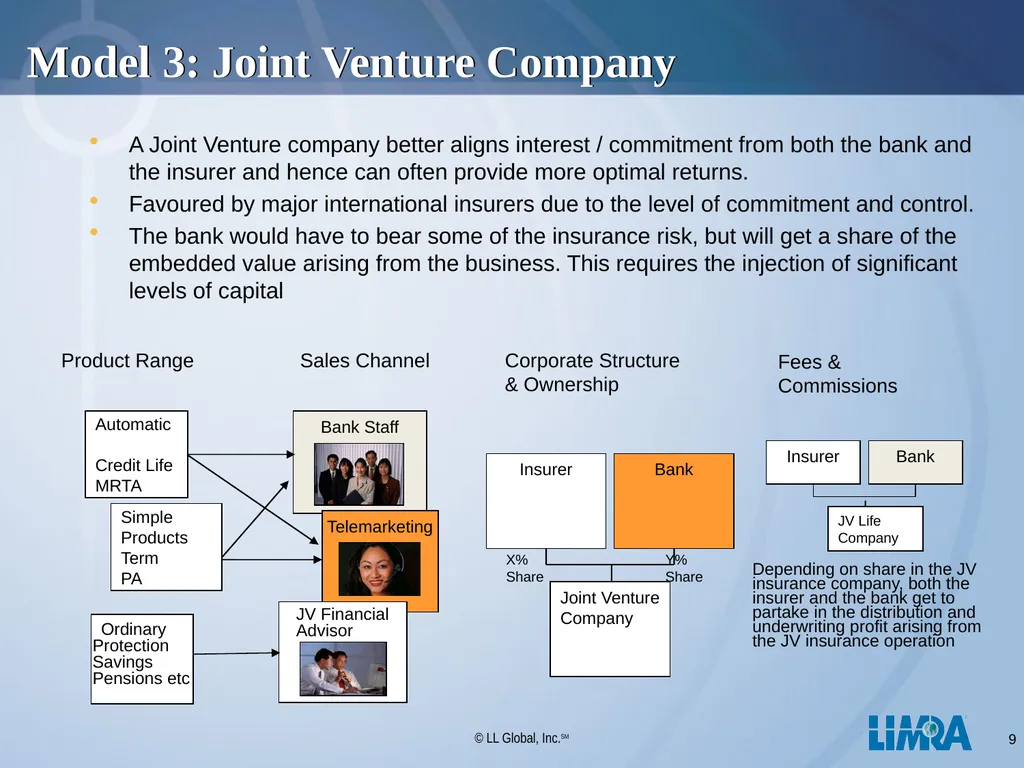
9 Y% Share X% Share A Joint Venture company better aligns interest / commitment from both the bank and the insurer and hence can often provide more optimal returns.
Favoured by major international insurers due to the level of commitment and control.
The bank would have to bear some of the insurance risk, but will get a share of the embedded value arising from the business. This requires the injection of significant levels of capital Model 3: Joint Venture Company Bank Insurer Depending on share in the JV insurance company, both the insurer and the bank get to partake in the distribution and underwriting profit arising from the JV insurance operation Product Range Sales Channel Corporate Structure & Ownership Fees & Commissions Bank Insurer Joint Venture
Company JV Life Company<br>
Favoured by major international insurers due to the level of commitment and control.
The bank would have to bear some of the insurance risk, but will get a share of the embedded value arising from the business. This requires the injection of significant levels of capital Model 3: Joint Venture Company Bank Insurer Depending on share in the JV insurance company, both the insurer and the bank get to partake in the distribution and underwriting profit arising from the JV insurance operation Product Range Sales Channel Corporate Structure & Ownership Fees & Commissions Bank Insurer Joint Venture
Company JV Life Company<br>
10
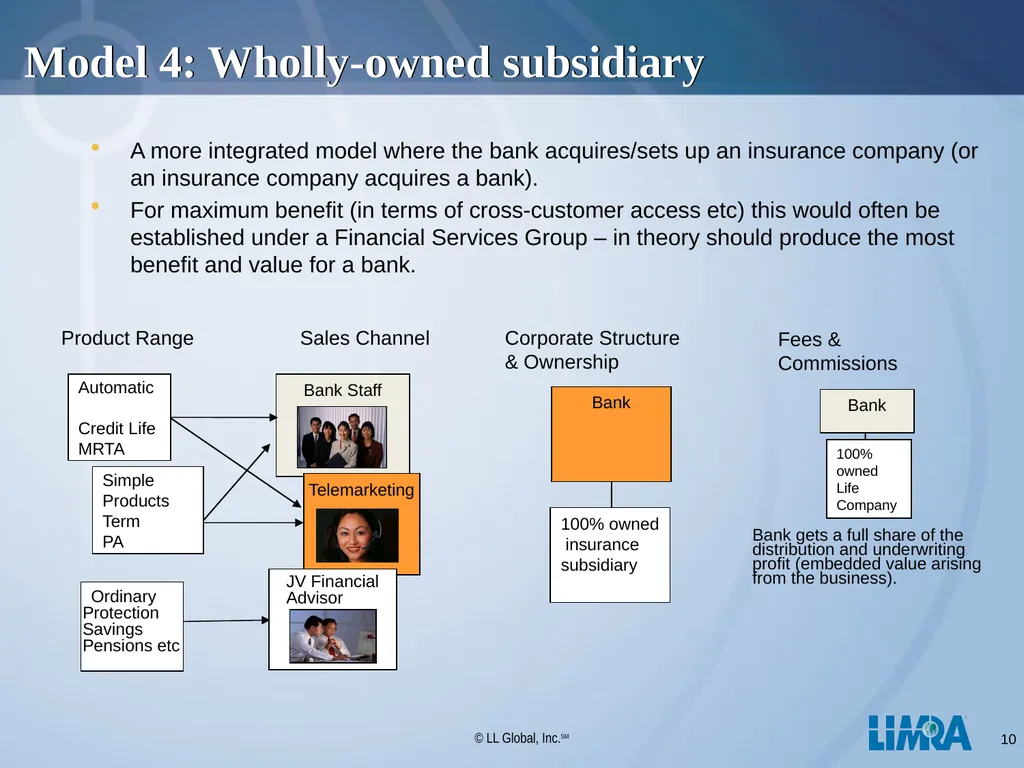
10 A more integrated model where the bank acquires/sets up an insurance company (or an insurance company acquires a bank).
For maximum benefit (in terms of cross-customer access etc) this would often be established under a Financial Services Group – in theory should produce the most benefit and value for a bank. Model 4: Wholly-owned subsidiary Bank Bank gets a full share of the distribution and underwriting profit (embedded value arising from the business). Product Range Sales Channel Corporate Structure & Ownership Fees & Commissions Bank 100% owned insurance subsidiary 100% owned Life Company Telemarketing Simple Products
Term
PA<br>
For maximum benefit (in terms of cross-customer access etc) this would often be established under a Financial Services Group – in theory should produce the most benefit and value for a bank. Model 4: Wholly-owned subsidiary Bank Bank gets a full share of the distribution and underwriting profit (embedded value arising from the business). Product Range Sales Channel Corporate Structure & Ownership Fees & Commissions Bank 100% owned insurance subsidiary 100% owned Life Company Telemarketing Simple Products
Term
PA<br>
11
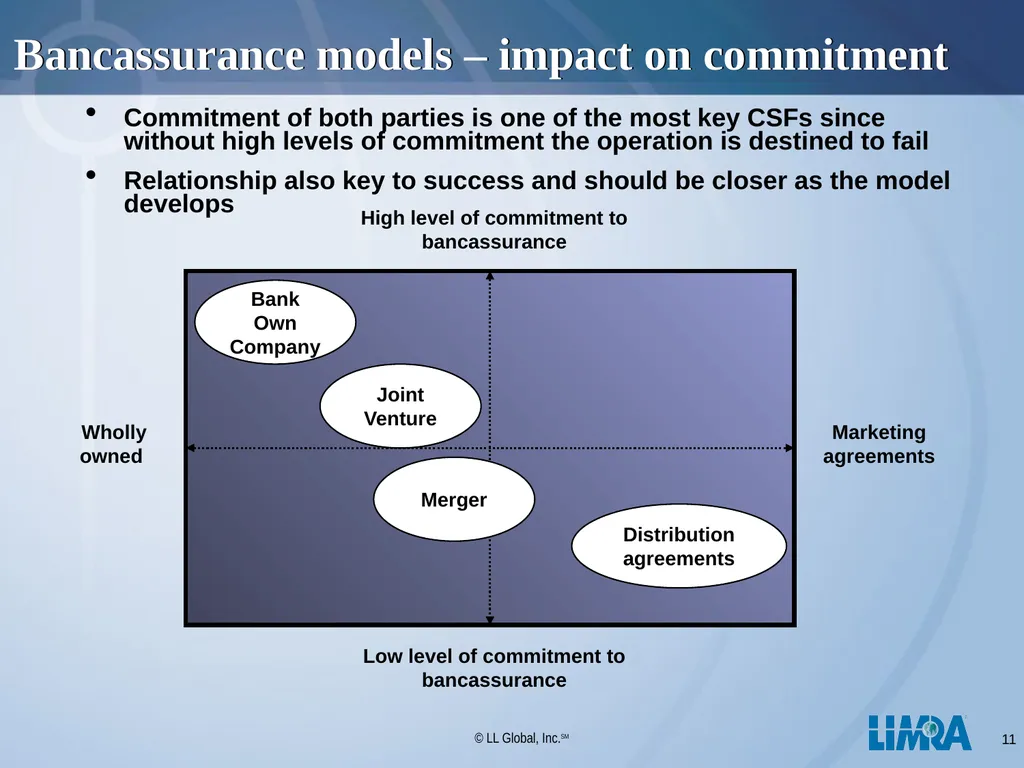
11 Bancassurance models – impact on commitment Commitment of both parties is one of the most key CSFs since without high levels of commitment the operation is destined to fail
Relationship also key to success and should be closer as the model develops High level of commitment to bancassurance Low level of commitment to bancassurance Marketing
agreements Wholly owned Distribution agreements Bank Own
Company Joint Venture Merger<br>
Relationship also key to success and should be closer as the model develops High level of commitment to bancassurance Low level of commitment to bancassurance Marketing
agreements Wholly owned Distribution agreements Bank Own
Company Joint Venture Merger<br>
12
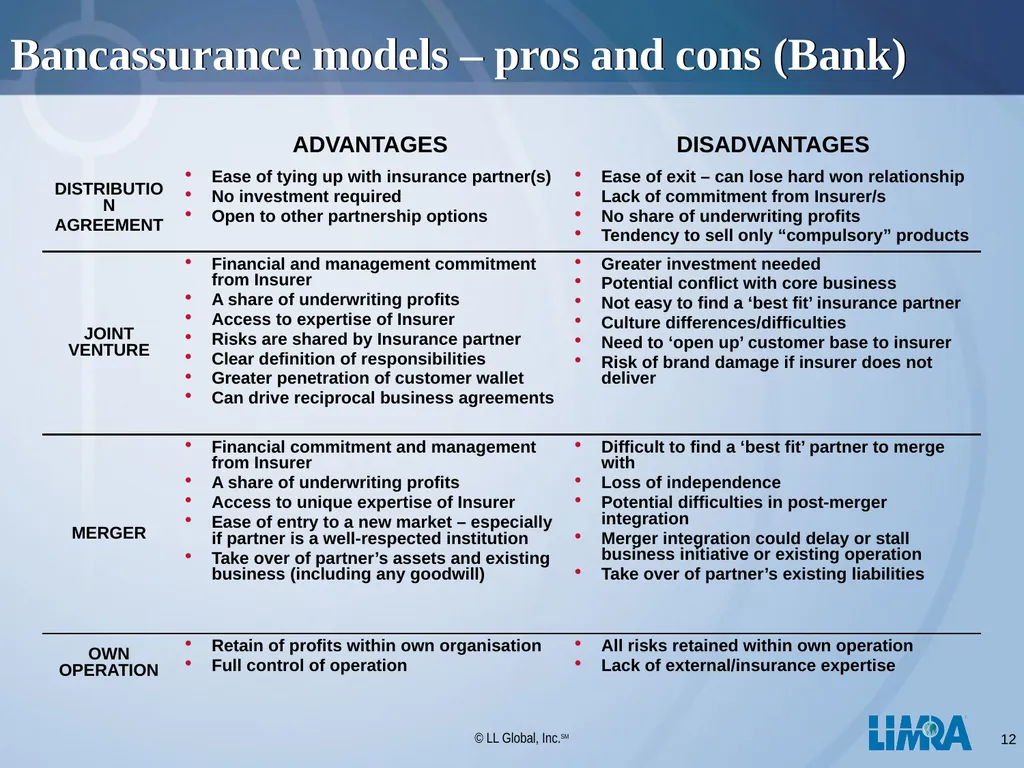
12 Bancassurance models – pros and cons (Bank)<br>
13
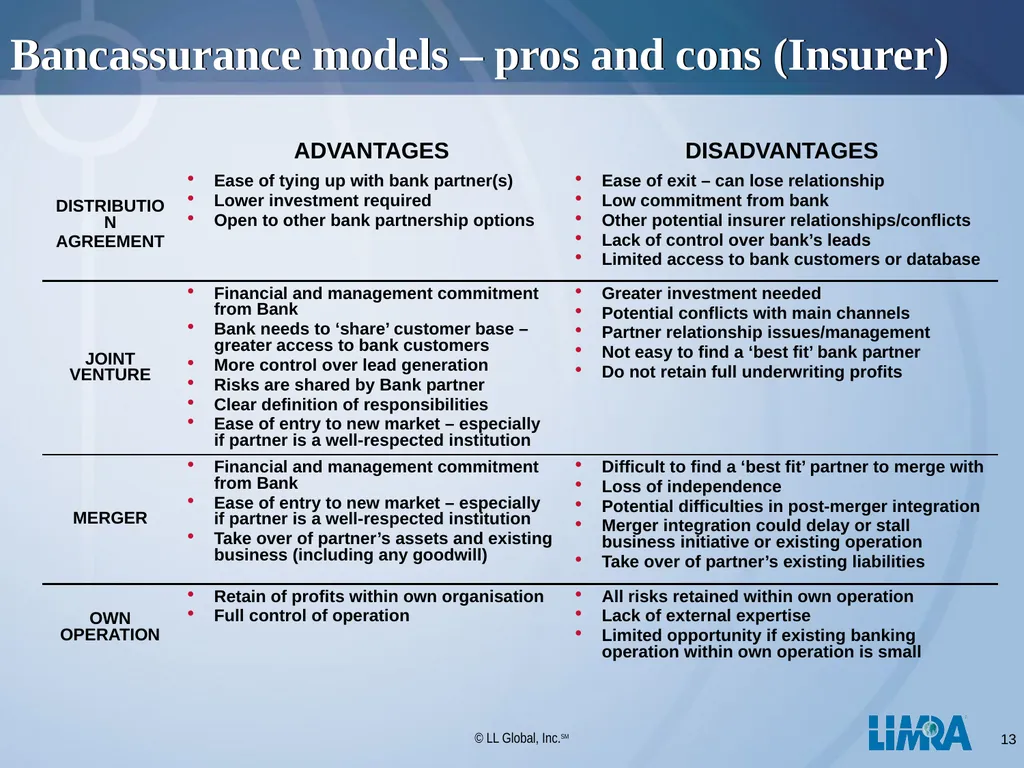
13 Bancassurance models – pros and cons (Insurer)<br>
14
Typical Financial models<br>
15
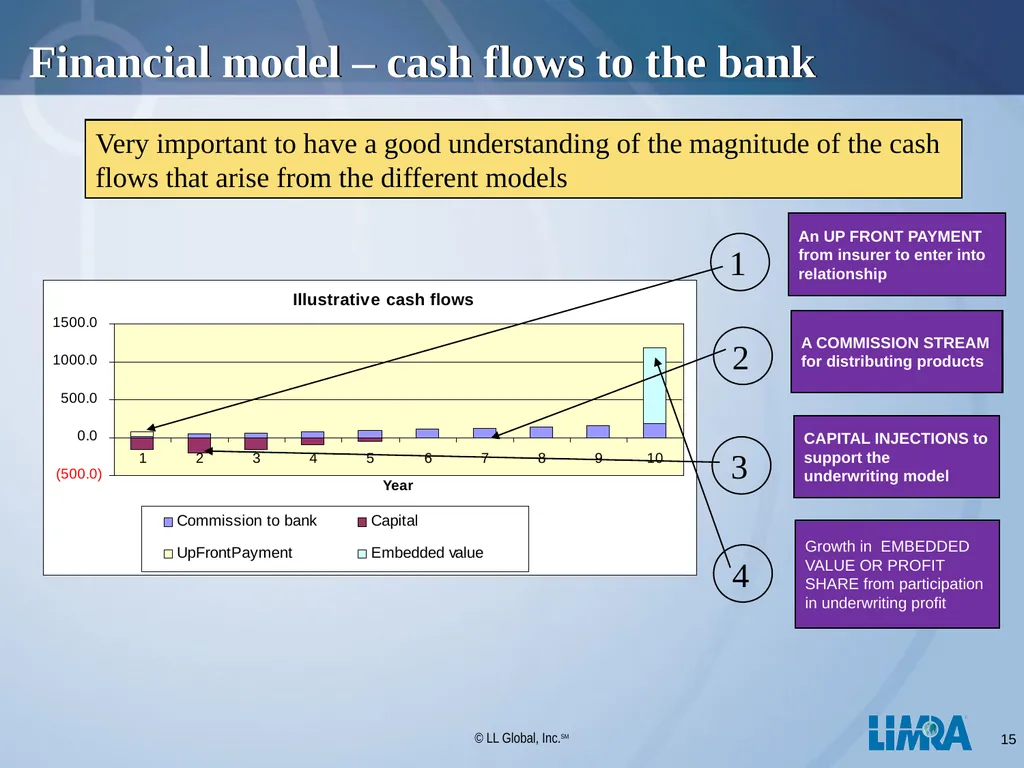
15 Financial model – cash flows to the bank 1 2 3 4 An UP FRONT PAYMENT from insurer to enter into relationship A COMMISSION STREAM for distributing products CAPITAL INJECTIONS to support the underwriting model Growth in EMBEDDED VALUE OR PROFIT SHARE from participation in underwriting profit Very important to have a good understanding of the magnitude of the cash flows that arise from the different models<br>
16
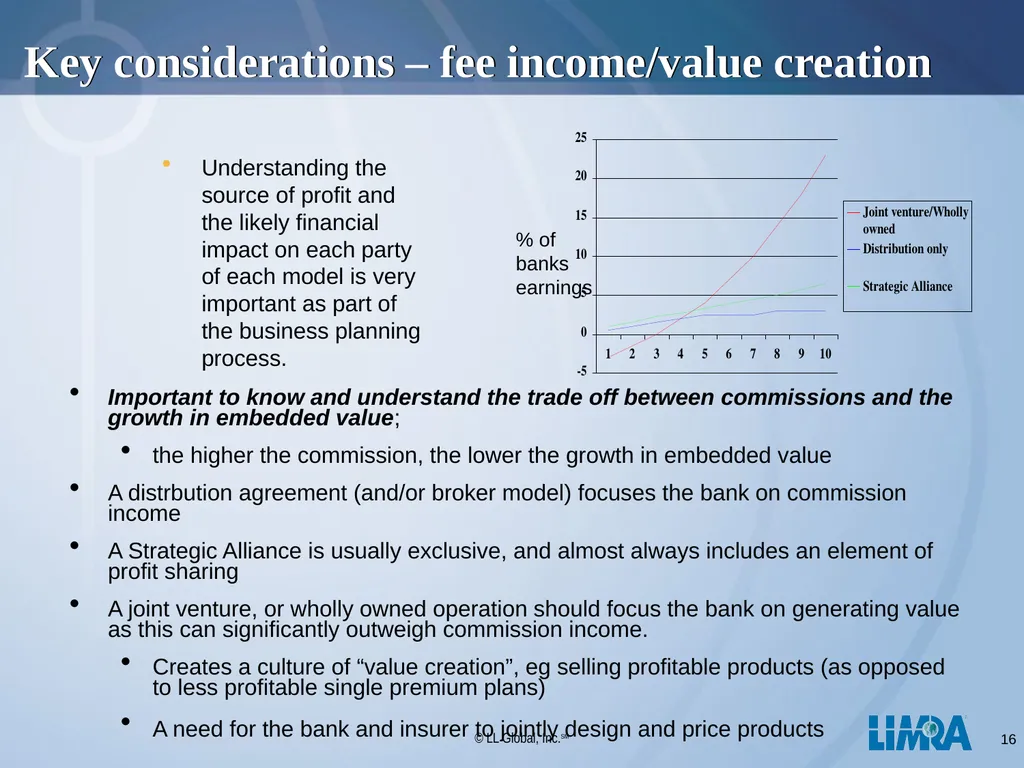
16 Key considerations – fee income/value creation Important to know and understand the trade off between commissions and the growth in embedded value;
the higher the commission, the lower the growth in embedded value
A distrbution agreement (and/or broker model) focuses the bank on commission income
A Strategic Alliance is usually exclusive, and almost always includes an element of profit sharing
A joint venture, or wholly owned operation should focus the bank on generating value as this can significantly outweigh commission income.
Creates a culture of “value creation”, eg selling profitable products (as opposed to less profitable single premium plans)
A need for the bank and insurer to jointly design and price products Understanding the source of profit and the likely financial impact on each party of each model is very important as part of the business planning process.<br>
the higher the commission, the lower the growth in embedded value
A distrbution agreement (and/or broker model) focuses the bank on commission income
A Strategic Alliance is usually exclusive, and almost always includes an element of profit sharing
A joint venture, or wholly owned operation should focus the bank on generating value as this can significantly outweigh commission income.
Creates a culture of “value creation”, eg selling profitable products (as opposed to less profitable single premium plans)
A need for the bank and insurer to jointly design and price products Understanding the source of profit and the likely financial impact on each party of each model is very important as part of the business planning process.<br>
17
Distribution and Operational sales models<br>
18
18 Simple products.
(Refund of Premium type) Lead generation & referrals to FPs & RMs
Simple products & Credit Insurance
(tick box, guaranteed issue) Loan & credit-related products,
mortgages & protection
(endowments, term, PA, ADD) Needs-based, advice driven.
Range of savings, investment & protection Specialist advice, with tailored bancassurance products &
financial planning solutions Level of
Sales
Training High Low Insurance
Specialists
(FP) Financial Services
Consultants (FSC)
(employed by insurance co)
and/or
Relationship
Managers (RM)
(employed by bank) Over-the-counter
Tellers / Customer
Services Officer
(OTC) Direct Marketing
(DM) Deposit Type Packaged Products Savings & Investment Wealth Management & Estate Planning Simplified Underwriting Products Wholesaler support
(Internal & External) Distribution Channels Customers Call
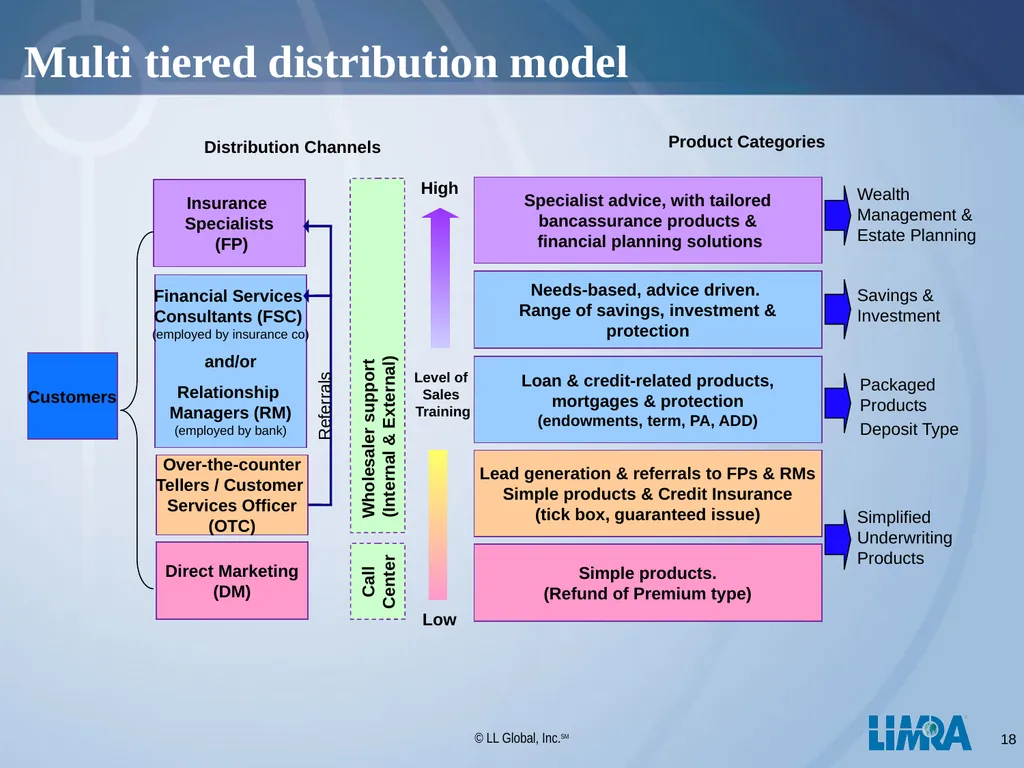
Center Product Categories Referrals Multi tiered distribution model<br>
(Refund of Premium type) Lead generation & referrals to FPs & RMs
Simple products & Credit Insurance
(tick box, guaranteed issue) Loan & credit-related products,
mortgages & protection
(endowments, term, PA, ADD) Needs-based, advice driven.
Range of savings, investment & protection Specialist advice, with tailored bancassurance products &
financial planning solutions Level of
Sales
Training High Low Insurance
Specialists
(FP) Financial Services
Consultants (FSC)
(employed by insurance co)
and/or
Relationship
Managers (RM)
(employed by bank) Over-the-counter
Tellers / Customer
Services Officer
(OTC) Direct Marketing
(DM) Deposit Type Packaged Products Savings & Investment Wealth Management & Estate Planning Simplified Underwriting Products Wholesaler support
(Internal & External) Distribution Channels Customers Call
Center Product Categories Referrals Multi tiered distribution model<br>
19
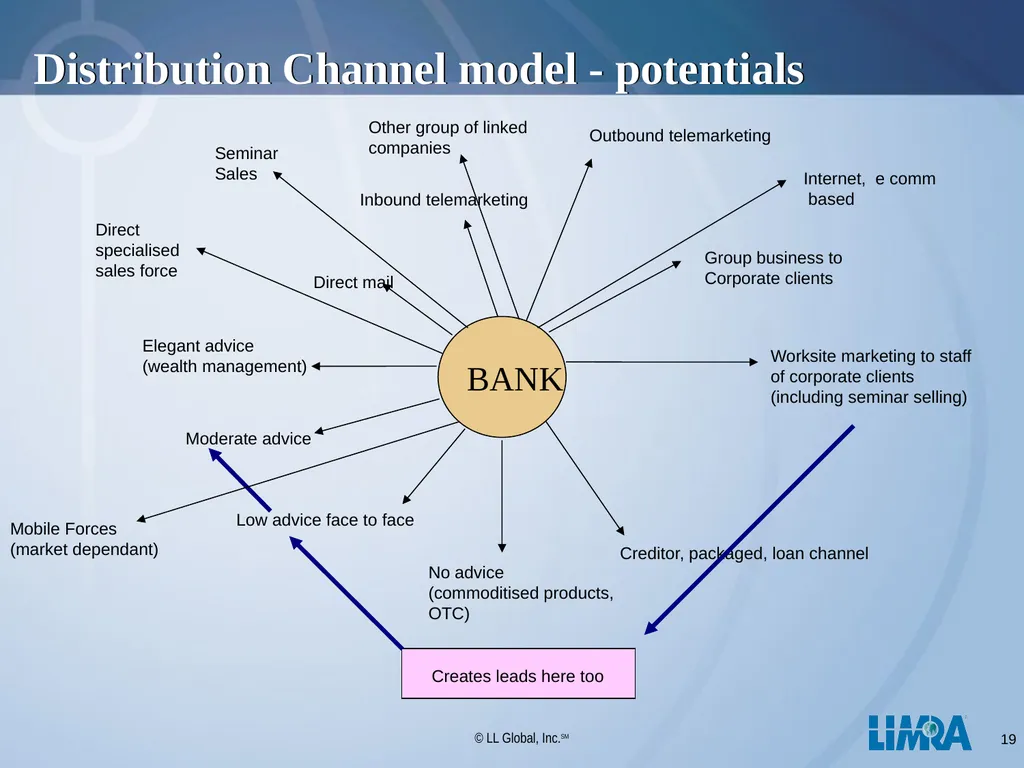
19 Distribution Channel model - potentials<br>
20
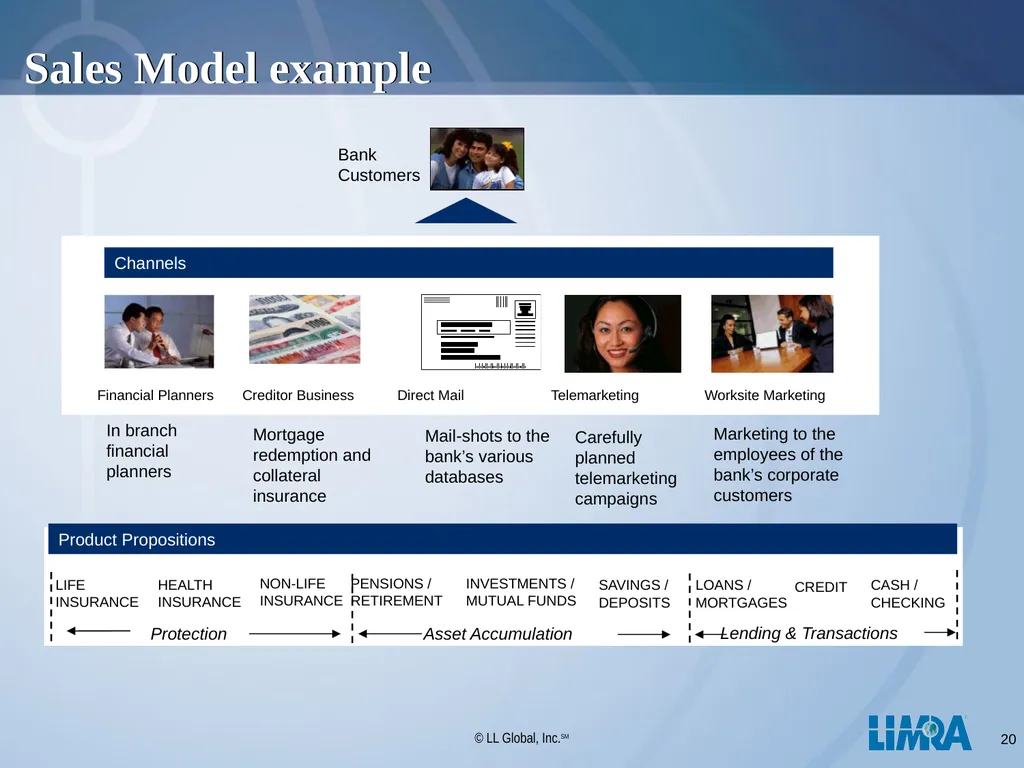
20 Sales Model example<br>
21
Regulatory models and impact
China
and
Indonesia<br>
China
and
Indonesia<br>
22
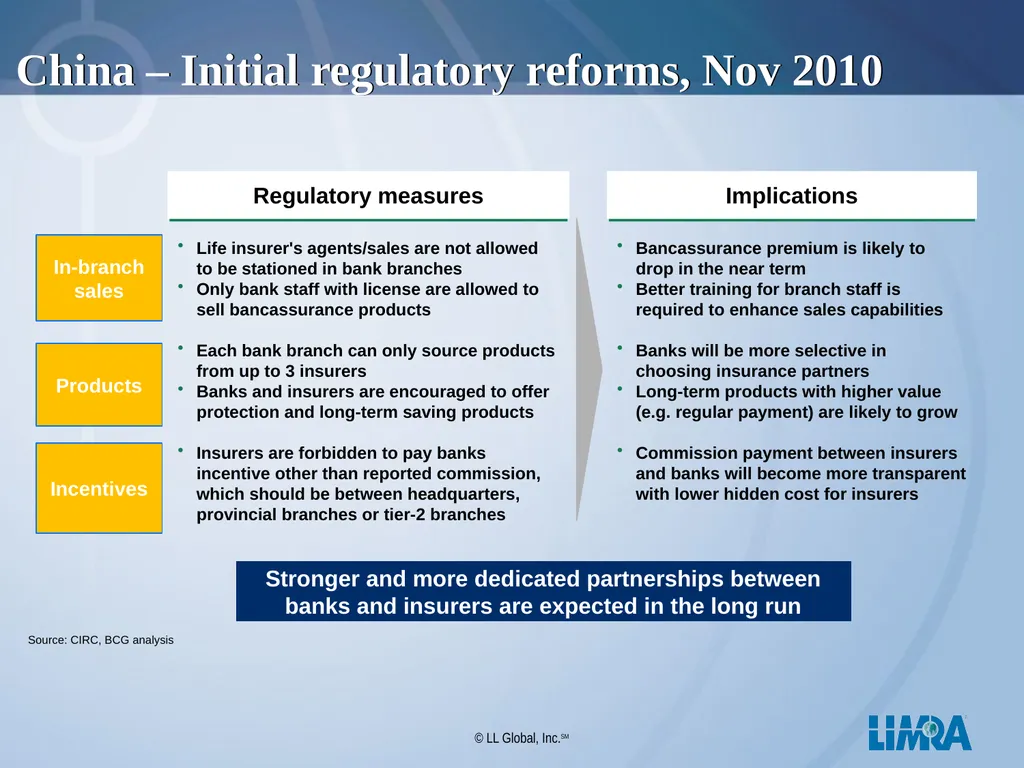
Stronger and more dedicated partnerships between banks and insurers are expected in the long run Regulatory measures Implications Life insurer's agents/sales are not allowed to be stationed in bank branches
Only bank staff with license are allowed to sell bancassurance products
Each bank branch can only source products from up to 3 insurers
Banks and insurers are encouraged to offer protection and long-term saving products
Insurers are forbidden to pay banks incentive other than reported commission, which should be between headquarters, provincial branches or tier-2 branches In-branch sales Incentives Products Bancassurance premium is likely to drop in the near term
Better training for branch staff is required to enhance sales capabilities
Banks will be more selective in choosing insurance partners
Long-term products with higher value (e.g. regular payment) are likely to grow
Commission payment between insurers and banks will become more transparent with lower hidden cost for insurers Source: CIRC, BCG analysis China – Initial regulatory reforms, Nov 2010<br>
Only bank staff with license are allowed to sell bancassurance products
Each bank branch can only source products from up to 3 insurers
Banks and insurers are encouraged to offer protection and long-term saving products
Insurers are forbidden to pay banks incentive other than reported commission, which should be between headquarters, provincial branches or tier-2 branches In-branch sales Incentives Products Bancassurance premium is likely to drop in the near term
Better training for branch staff is required to enhance sales capabilities
Banks will be more selective in choosing insurance partners
Long-term products with higher value (e.g. regular payment) are likely to grow
Commission payment between insurers and banks will become more transparent with lower hidden cost for insurers Source: CIRC, BCG analysis China – Initial regulatory reforms, Nov 2010<br>
23
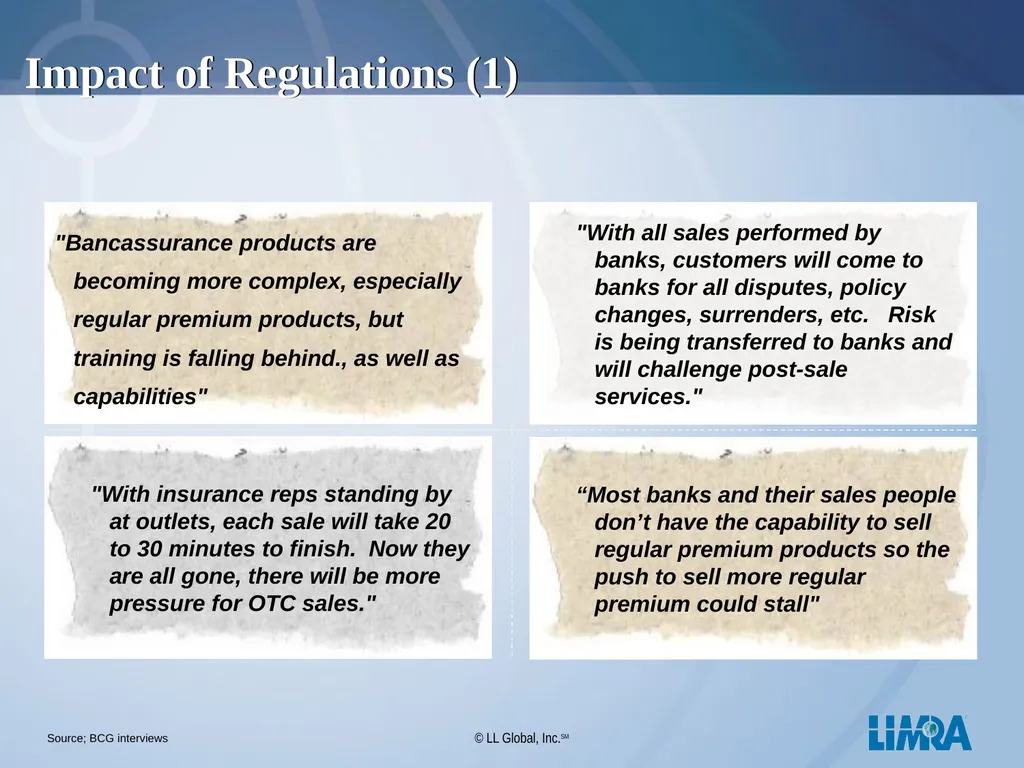
Impact of Regulations (1) "Bancassurance products are becoming more complex, especially regular premium products, but training is falling behind., as well as capabilities" "With insurance reps standing by at outlets, each sale will take 20 to 30 minutes to finish. Now they are all gone, there will be more pressure for OTC sales." "With all sales performed by banks, customers will come to banks for all disputes, policy changes, surrenders, etc. Risk is being transferred to banks and will challenge post-sale services." “Most banks and their sales people don’t have the capability to sell regular premium products so the push to sell more regular premium could stall" Source; BCG interviews<br>
24
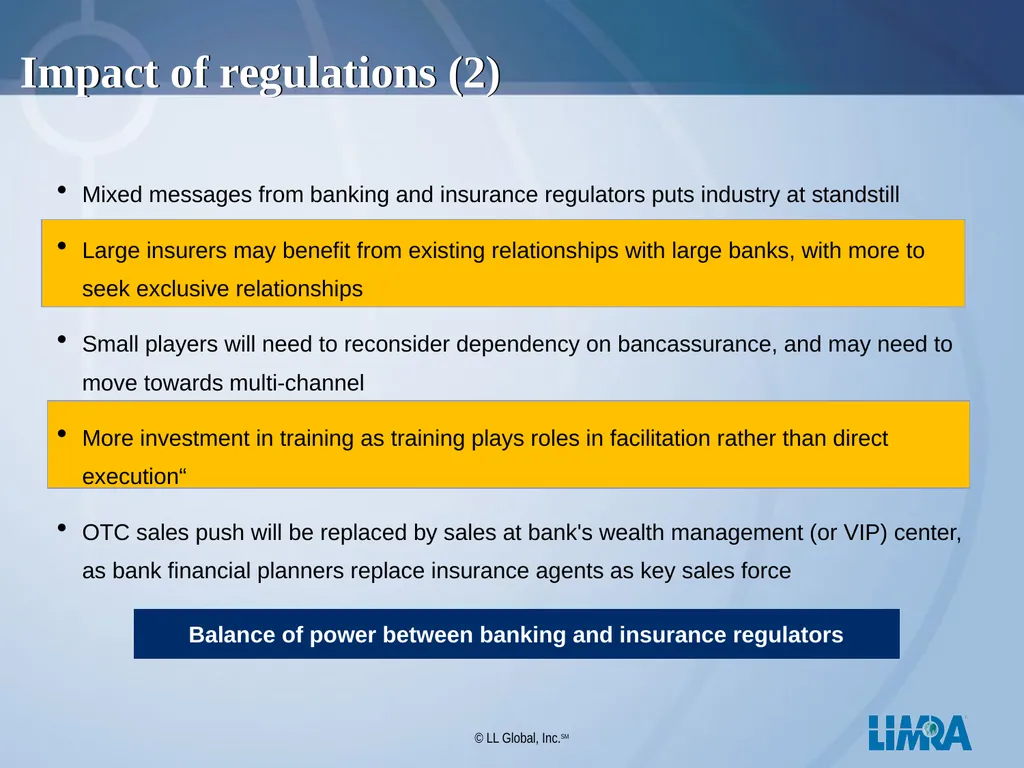
Impact of regulations (2) Mixed messages from banking and insurance regulators puts industry at standstill
Large insurers may benefit from existing relationships with large banks, with more to seek exclusive relationships
Small players will need to reconsider dependency on bancassurance, and may need to move towards multi-channel
More investment in training as training plays roles in facilitation rather than direct execution“
OTC sales push will be replaced by sales at bank's wealth management (or VIP) center, as bank financial planners replace insurance agents as key sales force Balance of power between banking and insurance regulators<br>
Large insurers may benefit from existing relationships with large banks, with more to seek exclusive relationships
Small players will need to reconsider dependency on bancassurance, and may need to move towards multi-channel
More investment in training as training plays roles in facilitation rather than direct execution“
OTC sales push will be replaced by sales at bank's wealth management (or VIP) center, as bank financial planners replace insurance agents as key sales force Balance of power between banking and insurance regulators<br>
25
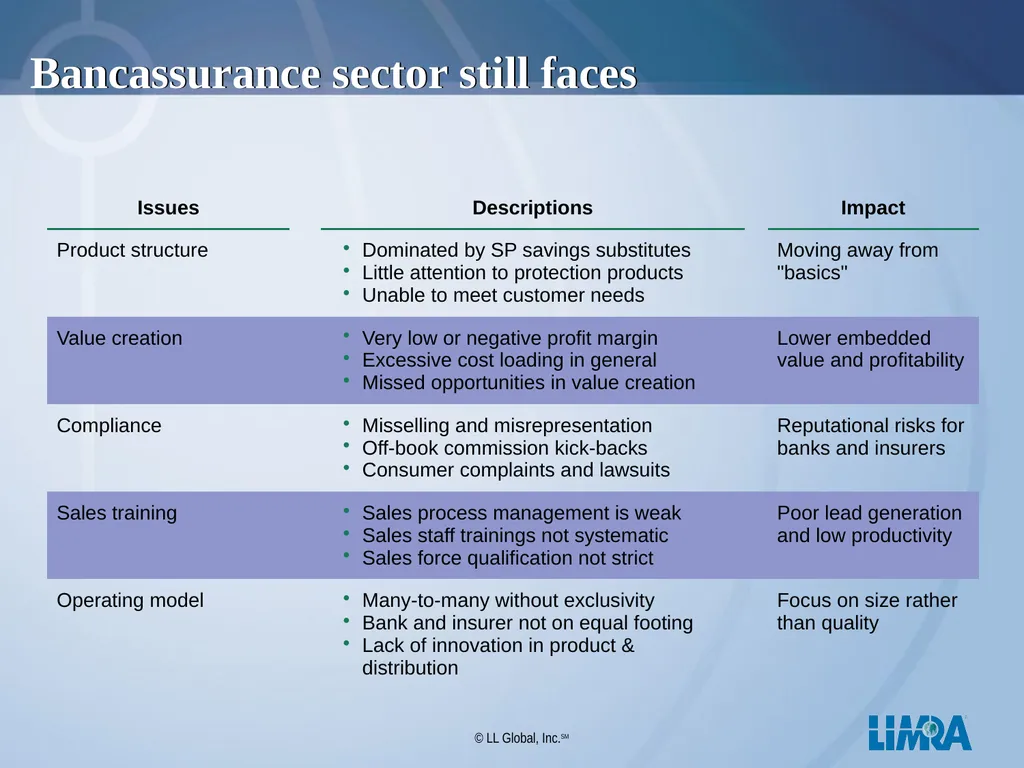
Bancassurance sector still faces<br>
26
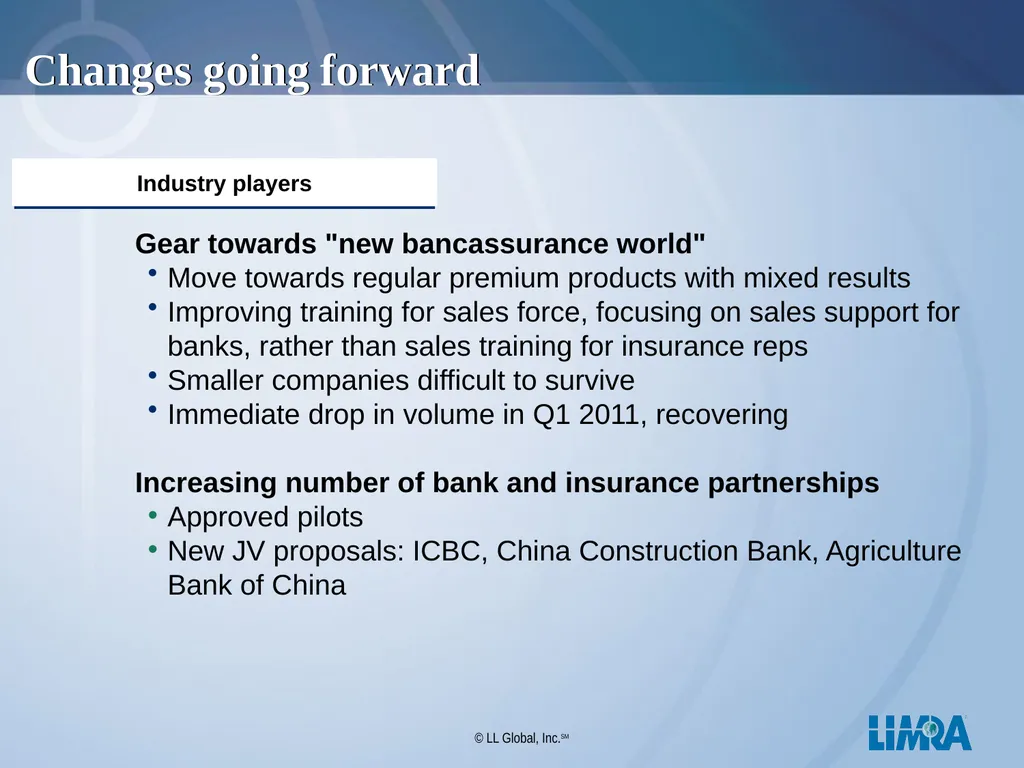
Changes going forward Industry players Gear towards "new bancassurance world"
Move towards regular premium products with mixed results
Improving training for sales force, focusing on sales support for banks, rather than sales training for insurance reps
Smaller companies difficult to survive
Immediate drop in volume in Q1 2011, recovering
Increasing number of bank and insurance partnerships
Approved pilots
New JV proposals: ICBC, China Construction Bank, Agriculture Bank of China<br>
Move towards regular premium products with mixed results
Improving training for sales force, focusing on sales support for banks, rather than sales training for insurance reps
Smaller companies difficult to survive
Immediate drop in volume in Q1 2011, recovering
Increasing number of bank and insurance partnerships
Approved pilots
New JV proposals: ICBC, China Construction Bank, Agriculture Bank of China<br>
27
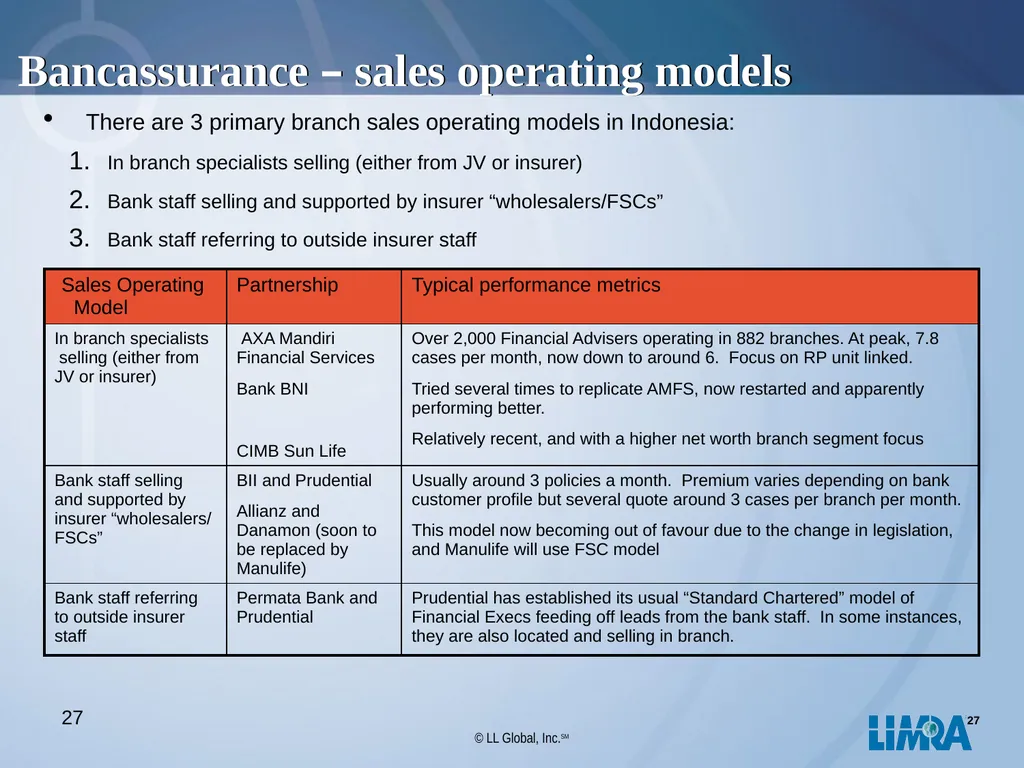
27 Bancassurance – sales operating models There are 3 primary branch sales operating models in Indonesia:
In branch specialists selling (either from JV or insurer)
Bank staff selling and supported by insurer “wholesalers/FSCs”
Bank staff referring to outside insurer staff 27<br>
In branch specialists selling (either from JV or insurer)
Bank staff selling and supported by insurer “wholesalers/FSCs”
Bank staff referring to outside insurer staff 27<br>
28
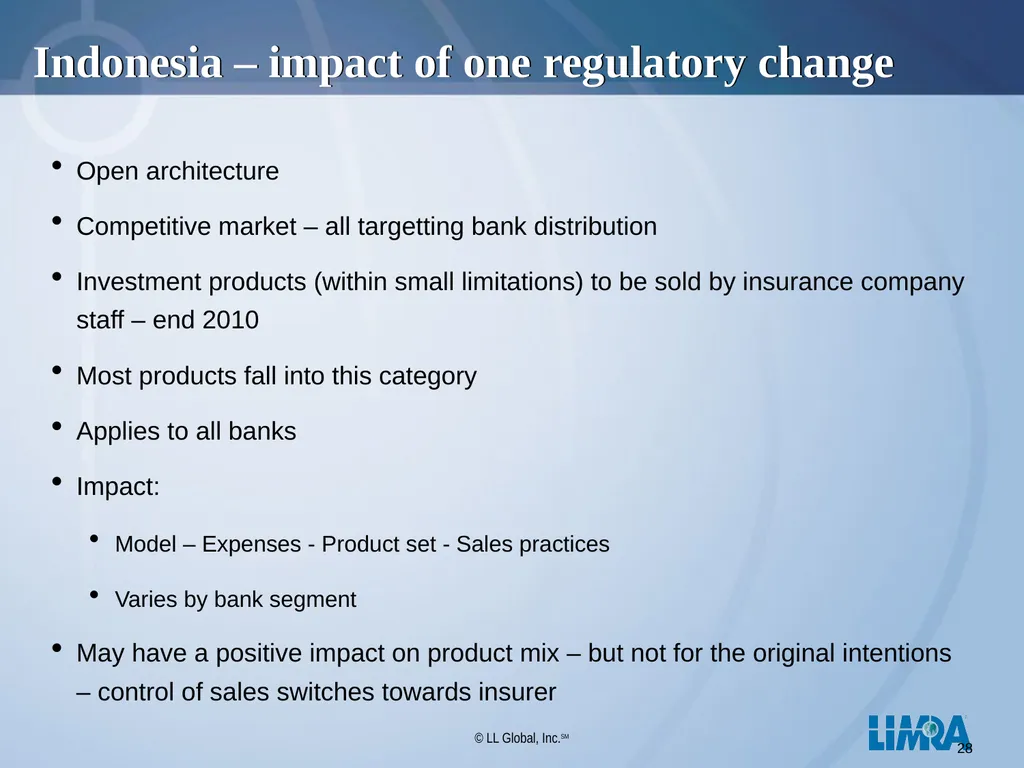
Indonesia – impact of one regulatory change Open architecture
Competitive market – all targetting bank distribution
Investment products (within small limitations) to be sold by insurance company staff – end 2010
Most products fall into this category
Applies to all banks
Impact:
Model – Expenses - Product set - Sales practices
Varies by bank segment
May have a positive impact on product mix – but not for the original intentions – control of sales switches towards insurer 28<br>
Competitive market – all targetting bank distribution
Investment products (within small limitations) to be sold by insurance company staff – end 2010
Most products fall into this category
Applies to all banks
Impact:
Model – Expenses - Product set - Sales practices
Varies by bank segment
May have a positive impact on product mix – but not for the original intentions – control of sales switches towards insurer 28<br>
29
©2010, LL Global, Inc.SM
This publication is a benefit of LIMRA membership.
No part may be shared with other organizations or reproduced in any form without LL Global’s written permission. HARTFORD ATLANTA MIAMI TORONTO LONDON KUALA LUMPUR SHANGHAI HO CHI MINH CITY SEOUL<br>