LINAR EQUATIONS Chapter 4 HOMOGENEOUS LINEAR EQUATIONS In the homogeneous system of linear equations, the constant term in every equation is equal to 0. i.e., no equation in such systems has a constant term in it. A homogeneous linear
"LINAR EQUATIONS Chapter 4 HOMOGENEOUS LINEAR" is the property of its rightful owner. Permission is granted to
download and print the materials on this website for personal, non-commercial use only, and to display it
on your personal computer provided you do not modify the materials and that you retain all copyright
notices contained in the materials. By downloading content from our website, you accept the terms of this
agreement.
Presentation Transcript
01
LINAR EQUATIONS Chapter 4<br>
02
HOMOGENEOUS LINEAR EQUATIONS In the homogeneous system of linear equations, the constant term in every equation is equal to 0. i.e., no equation in such systems has a constant term in it. A homogeneous linear system may have one or infinitely many solutions. But it has at least one solution always.
Let us learn how to find solve the homogeneous system of linear equations and let us see what is meant by trivial and nontrivial solutions.<br>
03
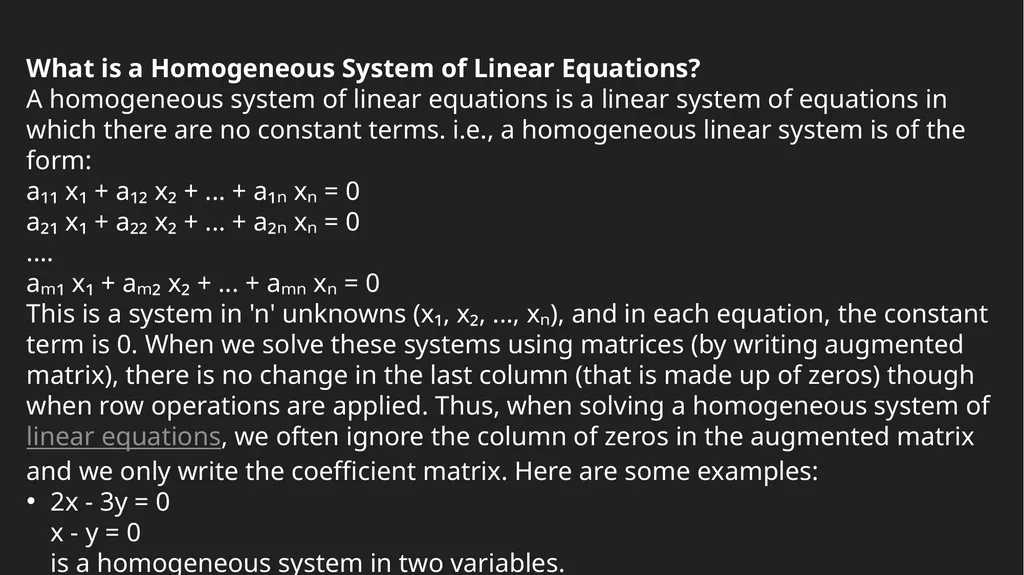
What is a Homogeneous System of Linear Equations?
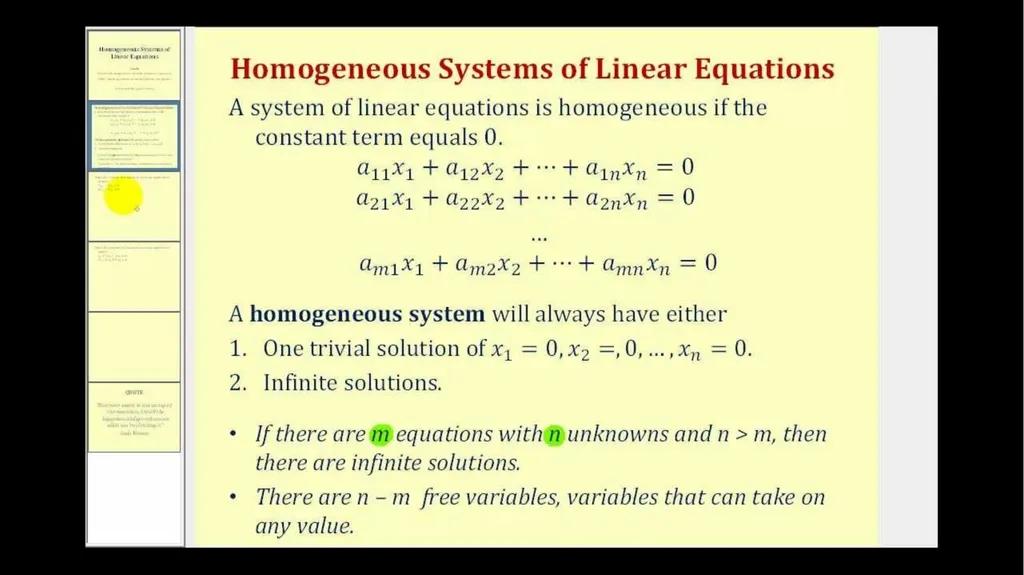
A homogeneous system of linear equations is a linear system of equations in which there are no constant terms. i.e., a homogeneous linear system is of the form:
a₁₁ x₁ + a₁₂ x₂ + ... + a₁ₙ xₙ = 0
a₂₁ x₁ + a₂₂ x₂ + ... + a₂ₙ xₙ = 0
....
aₘ₁ x₁ + aₘ₂ x₂ + ... + aₘₙ xₙ = 0
This is a system in 'n' unknowns (x₁, x₂, ..., xₙ), and in each equation, the constant term is 0. When we solve these systems using matrices (by writing augmented matrix), there is no change in the last column (that is made up of zeros) though when row operations are applied. Thus, when solving a homogeneous system of linear equations, we often ignore the column of zeros in the augmented matrix and we only write the coefficient matrix. Here are some examples:
2x - 3y = 0 x - y = 0 is a homogeneous system in two variables.
x + y + z = 0 y - z = 0 x + 2y = 0 is a homogeneous system in three variables<br>
04
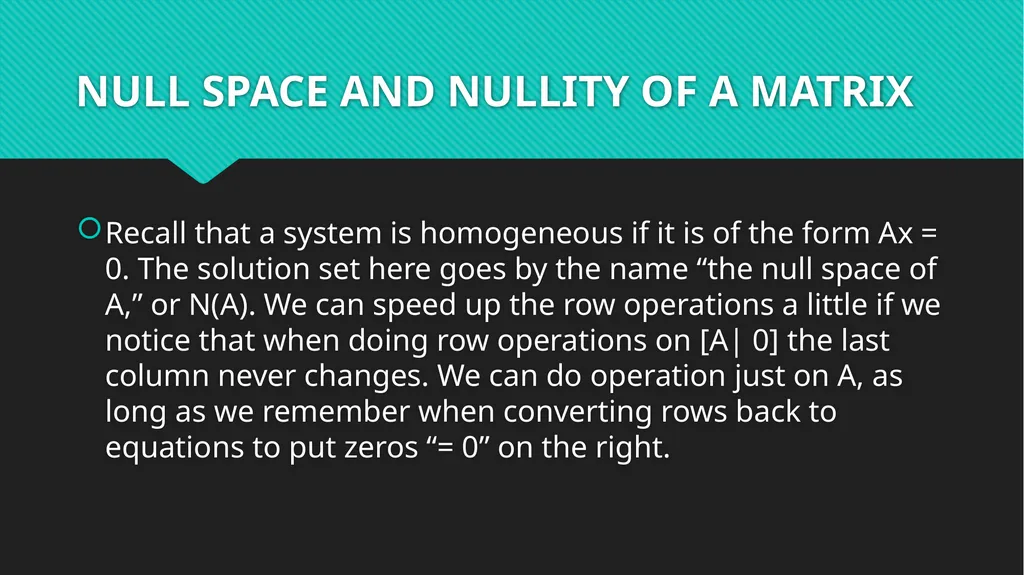
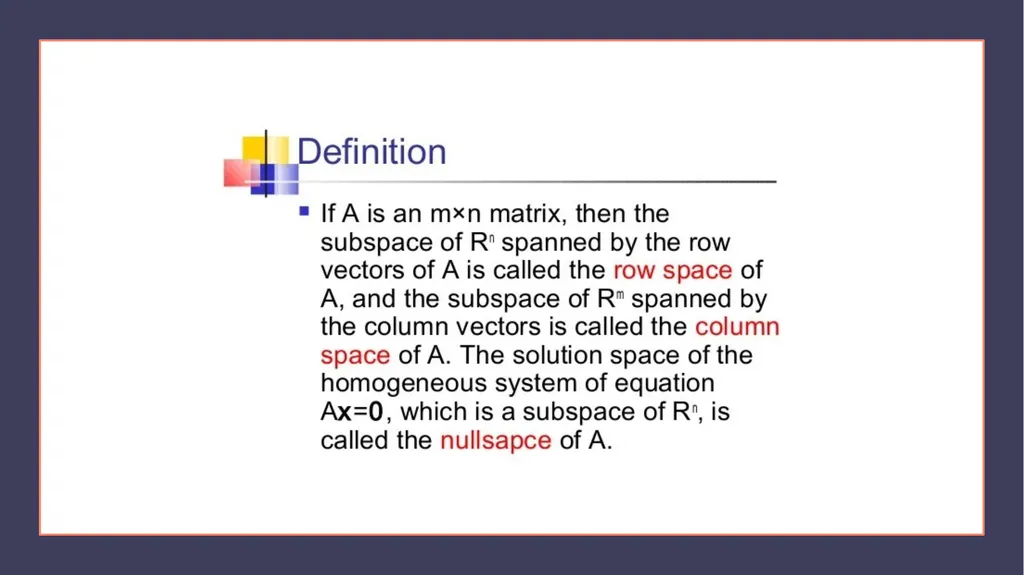
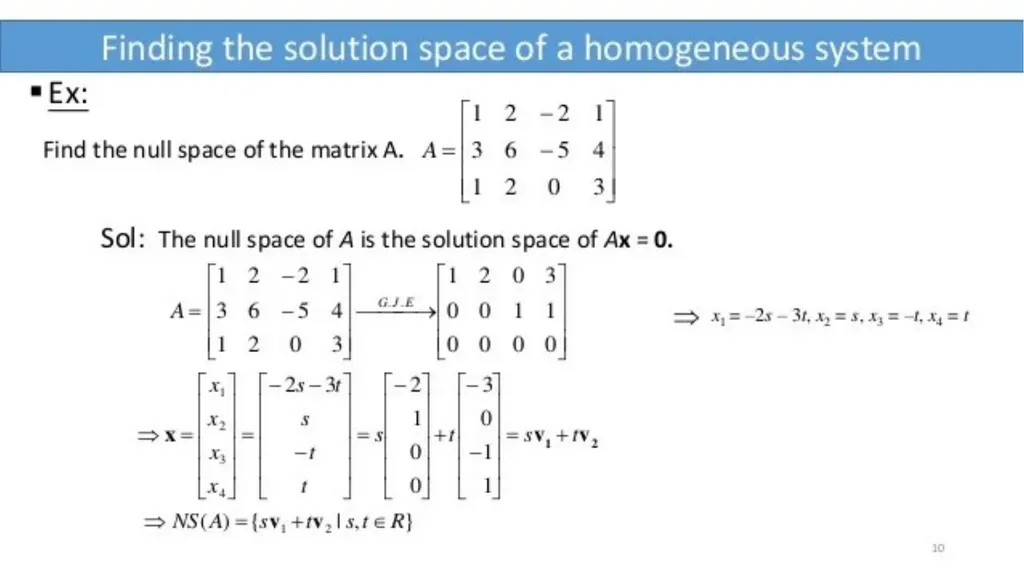
NULL SPACE AND NULLITY OF A MATRIX Recall that a system is homogeneous if it is of the form Ax = 0. The solution set here goes by the name “the null space of A,” or N(A). We can speed up the row operations a little if we notice that when doing row operations on [A| 0] the last column never changes. We can do operation just on A, as long as we remember when converting rows back to equations to put zeros “= 0” on the right.<br>
05
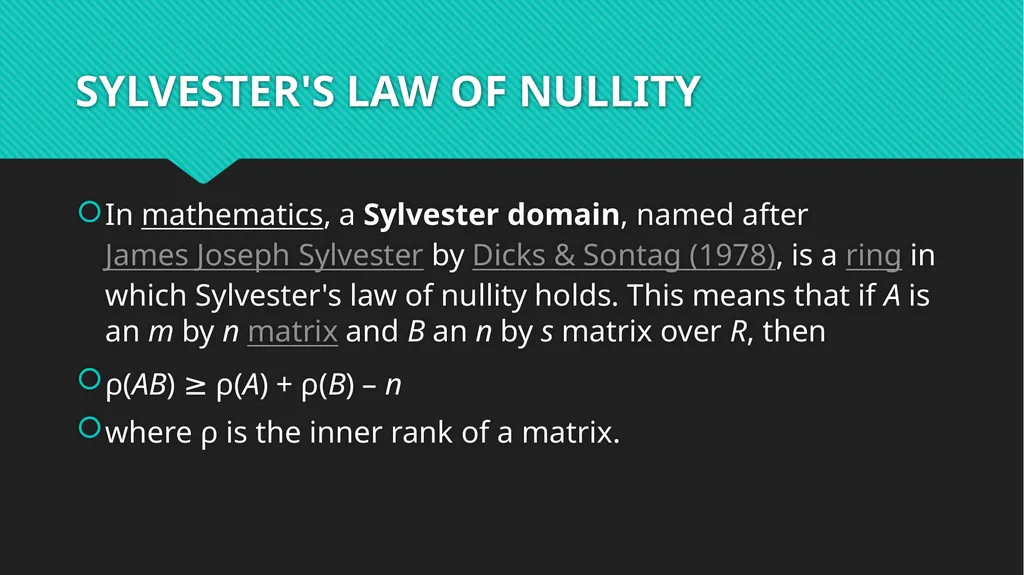
SYLVESTER'S LAW OF NULLITY In mathematics, a Sylvester domain, named after James Joseph Sylvester by Dicks & Sontag (1978), is a ring in which Sylvester's law of nullity holds. This means that if A is an m by n matrix and B an n by s matrix over R, then
ρ(AB) ≥ ρ(A) + ρ(B) – n
where ρ is the inner rank of a matrix.<br>
06
The inner rank of an m by n matrix is the smallest integer r such that the matrix is a product of an m by r matrix and an r by n matrix.
Sylvester (1884) showed that fields satisfy Sylvester's law of nullity and are therefore Sylvester domains.<br>
07
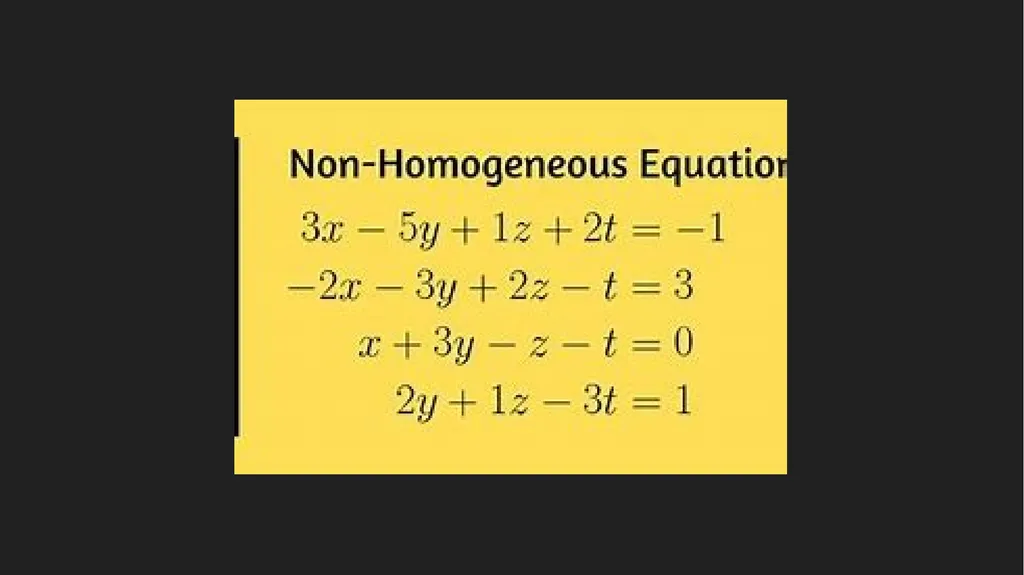
NON HOMOGENEOUS LINEAR EQUATIONS A non-homogeneous system of linear equations is any system where at least one linear equation is non-homogenous –This corresponds to the question of any linear combination of vectors equaling a non-zero target vector • If any one entry of the target vector is not zero, the corresponding system of linear equations is a non-homogenous system<br>