Linearly Compressed Pages: A Main Memory
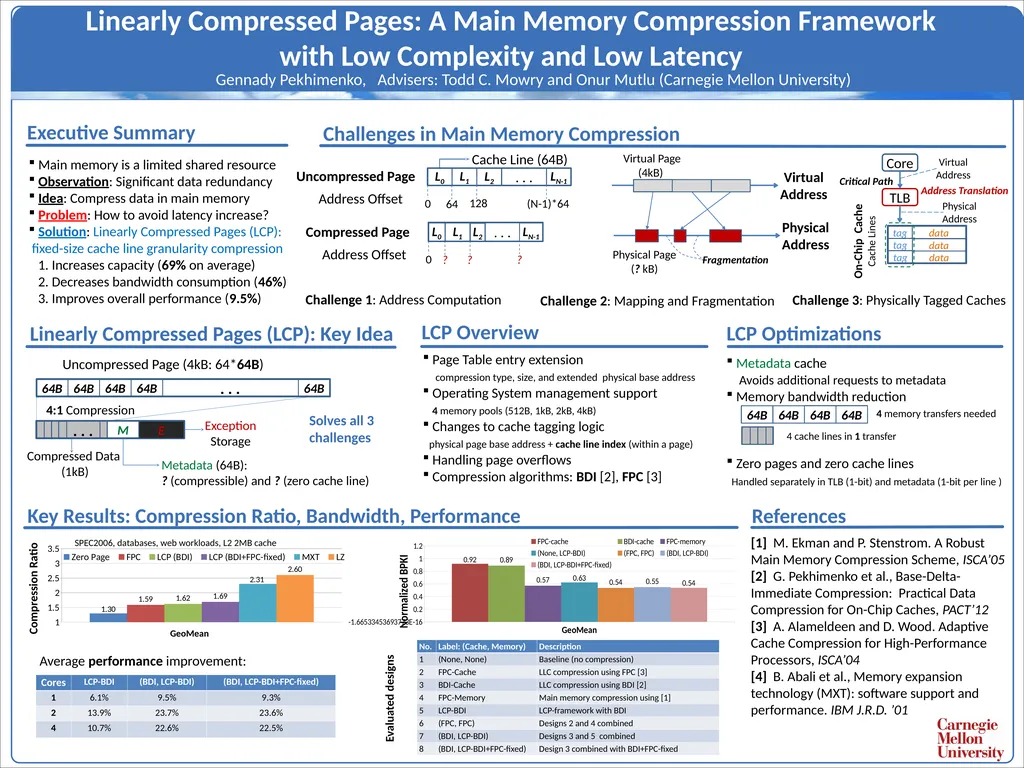
Description: Linearly Compressed Pages: A Main Memory Compression Framework with Low Complexity and Low Latency Gennady Pekhimenko, Advisers: Todd C. Mowry and Onur Mutlu (Carnegie Mellon University) Main memory is a limited shared resource Observation:
Related Topics
Download Presentation
"Linearly Compressed Pages: A Main Memory" is the property of its rightful owner. Permission is granted to download and print the materials on this website for personal, non-commercial use only, and to display it on your personal computer provided you do not modify the materials and that you retain all copyright notices contained in the materials. By downloading content from our website, you accept the terms of this agreement.
Presentation Transcript
slide1. Linearly Compressed Pages: A Main Memory Compression Framework
with Low Complexity and Low Latency Gennady Pekhimenko, Advisers: Todd C. Mowry and Onur Mutlu (Carnegie Mellon University) Main memory is a limited shared resource
Observation: Significant data redundancy
Idea: Compress data in main memory
Problem: How to avoid latency increase?
Solution: Linearly Compressed Pages (LCP):
fixed-size cache line granularity compression
1. Increases capacity (69% on average)
2. Decreases bandwidth consumption (46%)
3. Improves overall performance (9.5%) Challenges in Main Memory Compression Linearly Compressed Pages (LCP): Key Idea LCP Overview Key Results: Compression Ratio, Bandwidth, Performance References L0 L1 L2 . . . LN-1 Cache Line (64B) Uncompressed Page Address Offset 0 64 128 (N-1)*64 L0 L1 L2 . . . LN-1 Compressed Page Address Offset 0 ? ? ? Challenge 1: Address Computation Virtual Page
(4kB) Virtual
Address Physical Page
(? kB) Physical
Address Fragmentation Challenge 2: Mapping and Fragmentation Core TLB On-Chip Cache
Cache Lines tag tag tag Physical Address data data data Virtual
Address Challenge 3: Physically Tagged Caches Critical Path SPEC2006, databases, web workloads, L2 2MB cache Average performance improvement: Evaluated designs [1] M. Ekman and P. Stenstrom. A Robust Main Memory Compression Scheme, ISCA’05
[2] G. Pekhimenko et al., Base-Delta-Immediate Compression: Practical Data Compression for On-Chip Caches, PACT’12
[3] A. Alameldeen and D. Wood. Adaptive Cache Compression for High-Performance Processors, ISCA’04
[4] B. Abali et al., Memory expansion technology (MXT): software support and performance. IBM J.R.D. ’01 64B Uncompressed Page (4kB: 64*64B) 64B 64B 64B . . . 64B . . . Compressed Data
(1kB) M E Metadata (64B):
? (compressible) and ? (zero cache line) Exception
Storage 4:1 Compression LCP Optimizations Page Table entry extension
compression type, size, and extended physical base address
Operating System management support
4 memory pools (512B, 1kB, 2kB, 4kB)
Changes to cache tagging logic
physical page base address + cache line index (within a page)
Handling page overflows
Compression algorithms: BDI [2], FPC [3] Metadata cache
Avoids additional requests to metadata
Memory bandwidth reduction
Zero pages and zero cache lines 64B 64B 64B 64B 4 cache lines in 1 transfer Handled separately in TLB (1-bit) and metadata (1-bit per line ) 4 memory transfers needed Solves all 3
challenges Address Translation<br>

with Low Complexity and Low Latency Gennady Pekhimenko, Advisers: Todd C. Mowry and Onur Mutlu (Carnegie Mellon University) Main memory is a limited shared resource
Observation: Significant data redundancy
Idea: Compress data in main memory
Problem: How to avoid latency increase?
Solution: Linearly Compressed Pages (LCP):
fixed-size cache line granularity compression
1. Increases capacity (69% on average)
2. Decreases bandwidth consumption (46%)
3. Improves overall performance (9.5%) Challenges in Main Memory Compression Linearly Compressed Pages (LCP): Key Idea LCP Overview Key Results: Compression Ratio, Bandwidth, Performance References L0 L1 L2 . . . LN-1 Cache Line (64B) Uncompressed Page Address Offset 0 64 128 (N-1)*64 L0 L1 L2 . . . LN-1 Compressed Page Address Offset 0 ? ? ? Challenge 1: Address Computation Virtual Page
(4kB) Virtual
Address Physical Page
(? kB) Physical
Address Fragmentation Challenge 2: Mapping and Fragmentation Core TLB On-Chip Cache
Cache Lines tag tag tag Physical Address data data data Virtual
Address Challenge 3: Physically Tagged Caches Critical Path SPEC2006, databases, web workloads, L2 2MB cache Average performance improvement: Evaluated designs [1] M. Ekman and P. Stenstrom. A Robust Main Memory Compression Scheme, ISCA’05
[2] G. Pekhimenko et al., Base-Delta-Immediate Compression: Practical Data Compression for On-Chip Caches, PACT’12
[3] A. Alameldeen and D. Wood. Adaptive Cache Compression for High-Performance Processors, ISCA’04
[4] B. Abali et al., Memory expansion technology (MXT): software support and performance. IBM J.R.D. ’01 64B Uncompressed Page (4kB: 64*64B) 64B 64B 64B . . . 64B . . . Compressed Data
(1kB) M E Metadata (64B):
? (compressible) and ? (zero cache line) Exception
Storage 4:1 Compression LCP Optimizations Page Table entry extension
compression type, size, and extended physical base address
Operating System management support
4 memory pools (512B, 1kB, 2kB, 4kB)
Changes to cache tagging logic
physical page base address + cache line index (within a page)
Handling page overflows
Compression algorithms: BDI [2], FPC [3] Metadata cache
Avoids additional requests to metadata
Memory bandwidth reduction
Zero pages and zero cache lines 64B 64B 64B 64B 4 cache lines in 1 transfer Handled separately in TLB (1-bit) and metadata (1-bit per line ) 4 memory transfers needed Solves all 3
challenges Address Translation<br>