
Linguistic Pan-Africanism as a Global Future:
BR
Published · 72 slides · 0 views

1 / 1













Description
Linguistic Pan-Africanism as a Global Future: Reflections on the Language Question in Africa Inaugural Lecture, Ghana Academy of Arts and Sciences (GAAS) Accra, February 10, 2022 By Adams Bodomo, FGA (Vengvengnaa Bonglakyɛre Bɔdɔmɔ)
Related Topics
Share
Embed code
Download this presentation From Below
"Linguistic Pan-Africanism as a Global Future:" is the property of its rightful owner. Permission is granted to download and print the materials on this website for personal, non-commercial use only, and to display it on your personal computer provided you do not modify the materials and that you retain all copyright notices contained in the materials. By downloading content from our website, you accept the terms of this agreement.
Presentation Transcript
01
Linguistic Pan-Africanism as a Global Future:
Reflections on the Language Question in Africa Inaugural Lecture, Ghana Academy of Arts and Sciences (GAAS)
Accra, February 10, 2022
By Adams Bodomo, FGA
(Vengvengnaa Bonglakyɛre Bɔdɔmɔ)
University of Vienna, Austria<br>
Accra, February 10, 2022
By Adams Bodomo, FGA
(Vengvengnaa Bonglakyɛre Bɔdɔmɔ)
University of Vienna, Austria<br>
02
Outline Introduction
Literature Review on the Language Question: Theoretical and Methodological Underpinnings
Pan-Africanism and the Language Question
The Language of Education and Development Discourse: Localized Additive Triangualism
The Language Question in African Literature: Afriphone Literature
From Africa to the World: African Languages in the Global Context
Conclusion<br>
Literature Review on the Language Question: Theoretical and Methodological Underpinnings
Pan-Africanism and the Language Question
The Language of Education and Development Discourse: Localized Additive Triangualism
The Language Question in African Literature: Afriphone Literature
From Africa to the World: African Languages in the Global Context
Conclusion<br>
03
1. Introduction<br>
04
Introduction (I) Language Question in Africa in the 21st Century
About forty years ago, sometime in 1981 or 1982 when I was an undergraduate student of Linguistics at the University of Ghana, as an avid reader of the People’s Daily Graphic, I saw an advert calling for essay submissions to the Ghana Academy of Arts and Sciences (GAAS) on the topic, A National Language for Ghana.
The language issue has always been an important topic for GAAS
I did send in a submission in which I made a passionate argumentation in over 20 pages of a typewritten document on the need to teach many indigenous Ghanaian languages as a basis for evolving a national language with vocabulary input from various Ghanaian languages.
Gaanakasa<br>
About forty years ago, sometime in 1981 or 1982 when I was an undergraduate student of Linguistics at the University of Ghana, as an avid reader of the People’s Daily Graphic, I saw an advert calling for essay submissions to the Ghana Academy of Arts and Sciences (GAAS) on the topic, A National Language for Ghana.
The language issue has always been an important topic for GAAS
I did send in a submission in which I made a passionate argumentation in over 20 pages of a typewritten document on the need to teach many indigenous Ghanaian languages as a basis for evolving a national language with vocabulary input from various Ghanaian languages.
Gaanakasa<br>
05
Introduction (II) So forty years later, today, after knowing my country better than I did as a young undergraduate and after learning more about Africa and teaching it around the world in various places like Europe, North America, and Asia as a professor of African Studies, I want to scale up the Ghana language policy debate to a continental level.
The major theme of this lecture is a passionate appeal as I did forty years ago – and as I have always done since then in my numerous publications on this and related topics – for the promotion and use of indigenous African languages in all sectors of society.
African languages should be used as languages of education, as languages for literary expressions, and as languages in all the institutions of government in Africa.<br>
The major theme of this lecture is a passionate appeal as I did forty years ago – and as I have always done since then in my numerous publications on this and related topics – for the promotion and use of indigenous African languages in all sectors of society.
African languages should be used as languages of education, as languages for literary expressions, and as languages in all the institutions of government in Africa.<br>
06
“From today onwards I want us to speak African languages everywhere.“
Dagaare: A piili zenɛ kyɛ gɛrɛ N boɔrɔ la ka te yele Afereka deme kɔkɔrɛɛ zie zaa.
Akan: ɛfiri ɛnnɛ rekɔ, mepɛ sɛ yɛn nyinaa ara berɛ biara a yɛbɛdi nkutaho wɔ baabiara no, yɛde Afrika kasahoroɔ no mu biara na ɛdi nkutaho.
Ewe: Tsó egbe dzí héyina lá, medí bé míadó Áfrika-gbewó le teƒé ɖe síaa ɖe.
Ga: Kɛjɛ ŋmɛnɛ kɛyaa, masumɔ ni wɔwie wɔjaku Afrika shikwɛɛ wiemɔi yɛ he fɛɛ he.
Hausa: Fita ranan yaw, i na son mu ta magana a chiken iyaalaiyan Afrika kooina.
Bambara: Kà bɔ bì, n bɛ à fɛ an ka fàrafinkanw fɔ yɔrɔ bɛɛ la.
Amharic: ከኣሁን ጀምሮ በሁሉም ቦታ የአፍሪካ ቋንቋዎችን እንዲነገር እፈልጋለሁ። (keahun jemiro be hulum bota yeafrica kankawoch endineger efeligihalehu.)
Arabic: مكان كل في الافریقیة بلغاتنا فلتحدث ،فصاعدا الیوم من (min alyawm fasaeidan, fel nathdeth beloghatuna alafriqia fi kul makan.)
Swahili: Kuanzia leo nataka tuzungumze lugha za Kiafrika kila mahali.
IsiZulu: Kusukela namhlanje asisebenzise izilwimi zesintu sase Afrika noma kuohi noma nini ngaso sonke isikhathi.<br>
Dagaare: A piili zenɛ kyɛ gɛrɛ N boɔrɔ la ka te yele Afereka deme kɔkɔrɛɛ zie zaa.
Akan: ɛfiri ɛnnɛ rekɔ, mepɛ sɛ yɛn nyinaa ara berɛ biara a yɛbɛdi nkutaho wɔ baabiara no, yɛde Afrika kasahoroɔ no mu biara na ɛdi nkutaho.
Ewe: Tsó egbe dzí héyina lá, medí bé míadó Áfrika-gbewó le teƒé ɖe síaa ɖe.
Ga: Kɛjɛ ŋmɛnɛ kɛyaa, masumɔ ni wɔwie wɔjaku Afrika shikwɛɛ wiemɔi yɛ he fɛɛ he.
Hausa: Fita ranan yaw, i na son mu ta magana a chiken iyaalaiyan Afrika kooina.
Bambara: Kà bɔ bì, n bɛ à fɛ an ka fàrafinkanw fɔ yɔrɔ bɛɛ la.
Amharic: ከኣሁን ጀምሮ በሁሉም ቦታ የአፍሪካ ቋንቋዎችን እንዲነገር እፈልጋለሁ። (keahun jemiro be hulum bota yeafrica kankawoch endineger efeligihalehu.)
Arabic: مكان كل في الافریقیة بلغاتنا فلتحدث ،فصاعدا الیوم من (min alyawm fasaeidan, fel nathdeth beloghatuna alafriqia fi kul makan.)
Swahili: Kuanzia leo nataka tuzungumze lugha za Kiafrika kila mahali.
IsiZulu: Kusukela namhlanje asisebenzise izilwimi zesintu sase Afrika noma kuohi noma nini ngaso sonke isikhathi.<br>
07
Pan-Africanism (I) Pan-Africanism is a dominant ideological notion in Africa and its diaspora. As a notion, it means that Africa, Africans, and all people of African descent can only stand to gain a better future if the continent and its people unite and pool their resources together socio-politically, socio-economically, and socio-culturally.
Different levels:
Political pan-Africanism: African Union as flagship demands in many ways knocking down the mostly arbitrary borders imposed on Africa following the Berlin Conference of 1884 (e.g. Mudimbe 1988, Davidson 1994) and thus aiming to remodel a borderless Africa
Economic pan-Africanism: African Continental Free Trade Area (AfCFTA) as flagship; AfCFTA is a crystallization of the dreams of many Pan-Africanists such as Kwame Nkrumah of Ghana, Sekou Toure of Guinea, Tafawa Balewa of Nigeria, and Julius Nyerere of Tanzania to create a broader economic collaboration for all of Africa (Sibanda 2021). encourages the development of more integrated markets and trading zones<br>
Different levels:
Political pan-Africanism: African Union as flagship demands in many ways knocking down the mostly arbitrary borders imposed on Africa following the Berlin Conference of 1884 (e.g. Mudimbe 1988, Davidson 1994) and thus aiming to remodel a borderless Africa
Economic pan-Africanism: African Continental Free Trade Area (AfCFTA) as flagship; AfCFTA is a crystallization of the dreams of many Pan-Africanists such as Kwame Nkrumah of Ghana, Sekou Toure of Guinea, Tafawa Balewa of Nigeria, and Julius Nyerere of Tanzania to create a broader economic collaboration for all of Africa (Sibanda 2021). encourages the development of more integrated markets and trading zones<br>
08
Pan-Africanism (II) This lecture proposes and analyses the notion of linguistic pan-Africanism as an important aspect of the general notion of pan-Africanism.
Linguistic pan-Africanism is the notion that encourages the management of Africa's linguistic resources towards better and more efficient communication and cultural development on the African continent. Without linguistic pan-Africanism it would be hard to achieve political, economic, and cultural pan-Africanism.
Linguistic pan-Africanism encourages the promotion of major indigenous lingua franca in the different regions of Africa. The ultimate aim may be the creation of a pan-African lingua franca Swahili or Afrihili (Afirihili)<br>
Linguistic pan-Africanism is the notion that encourages the management of Africa's linguistic resources towards better and more efficient communication and cultural development on the African continent. Without linguistic pan-Africanism it would be hard to achieve political, economic, and cultural pan-Africanism.
Linguistic pan-Africanism encourages the promotion of major indigenous lingua franca in the different regions of Africa. The ultimate aim may be the creation of a pan-African lingua franca Swahili or Afrihili (Afirihili)<br>
09
Global Future Refers to any major worldwide event that can potentially change some systems
Patomaki (2016) describes global futures as referring to on-going and emerging planetary-scale processes, and to their efficacy and real effects, rather than to abstract clock-time. She interrogates: What, then, are the relevant global processes which are open towards the future?
Roxburgh et al (2020) talk of global future in terms of how global climatic conservation can be achieved for economic prosperity: “To reverse nature's decline, and for humanity to enjoy a sustainable and prosperous future, we urgently need transformational change across our economic and financial systems, so they are geared towards delivering long term sustainable development, and the protection and restoration of nature. We need to agree a New Deal for Nature and People to reverse the loss of biodiversity by 2030 and put nature on a path to recovery for the benefit of people and planet”.<br>
Patomaki (2016) describes global futures as referring to on-going and emerging planetary-scale processes, and to their efficacy and real effects, rather than to abstract clock-time. She interrogates: What, then, are the relevant global processes which are open towards the future?
Roxburgh et al (2020) talk of global future in terms of how global climatic conservation can be achieved for economic prosperity: “To reverse nature's decline, and for humanity to enjoy a sustainable and prosperous future, we urgently need transformational change across our economic and financial systems, so they are geared towards delivering long term sustainable development, and the protection and restoration of nature. We need to agree a New Deal for Nature and People to reverse the loss of biodiversity by 2030 and put nature on a path to recovery for the benefit of people and planet”.<br>
10
In this lecture, we want to view language as part of the global ecology that must be preserved.
Therefore the claim is that evolving and implementing a cogent linguistic pan-Africanist policy can place Africa in such a strong position that Africa can create tectonic changes in the world, as any global future does, and thus ensures that Africa successfully develops its economy and takes its rightful position in the comity of great nations of this world.
The lecture interrogates aspects of these notions with a view to addressing questions such as:
How can Africa place itself linguistically to compete economically and culturally?
What are the strategies for evolving and implementing effective pan-Africanist language policies to ensure that Africa has a bright global future?<br>
Therefore the claim is that evolving and implementing a cogent linguistic pan-Africanist policy can place Africa in such a strong position that Africa can create tectonic changes in the world, as any global future does, and thus ensures that Africa successfully develops its economy and takes its rightful position in the comity of great nations of this world.
The lecture interrogates aspects of these notions with a view to addressing questions such as:
How can Africa place itself linguistically to compete economically and culturally?
What are the strategies for evolving and implementing effective pan-Africanist language policies to ensure that Africa has a bright global future?<br>
11
2. Literature Review on the Language Question:
Theoretical and Methodological Underpinnings<br>
12
The Nature of Language Language is not just only a system of communication, of coding and decoding signs. It is an important identity marker.
Within linguistics and philosophical domains, language is often viewed as an object with which we use to interpret the nature and the world around us, and there is even a strong claim (the Sapir-Whorf Hypothesis (Sapir 1929)) that the structure of one’s languages determines the way in which the one categorizes and interprets reality.
Language is also an important repository of our culture, and is indeed the medium through which we express various aspects of culture like folktales, songs and dances.<br>
Within linguistics and philosophical domains, language is often viewed as an object with which we use to interpret the nature and the world around us, and there is even a strong claim (the Sapir-Whorf Hypothesis (Sapir 1929)) that the structure of one’s languages determines the way in which the one categorizes and interprets reality.
Language is also an important repository of our culture, and is indeed the medium through which we express various aspects of culture like folktales, songs and dances.<br>
13
The Issue of Multilingualism In a multilingual set up, as in the case with all African countries, the language question becomes a prominent issue.
Each country, each region of Africa, has a myriad of indigenous African languages, and a substantial number of foreign, non-African languages.
African polities are quintessentially multilingual, and a large number of them, especially in Africa south of Sahara still continue to use former colonial languages as official languages and languages of education.
The question then arises as to how to manage this situation. The classical position has mostly been to say that having so many languages in each country is a problem.
In the case of Africa, it is seen as the basis of ethnic tension since in much of Africa language is strongly tied to ethnicity.<br>
Each country, each region of Africa, has a myriad of indigenous African languages, and a substantial number of foreign, non-African languages.
African polities are quintessentially multilingual, and a large number of them, especially in Africa south of Sahara still continue to use former colonial languages as official languages and languages of education.
The question then arises as to how to manage this situation. The classical position has mostly been to say that having so many languages in each country is a problem.
In the case of Africa, it is seen as the basis of ethnic tension since in much of Africa language is strongly tied to ethnicity.<br>
14
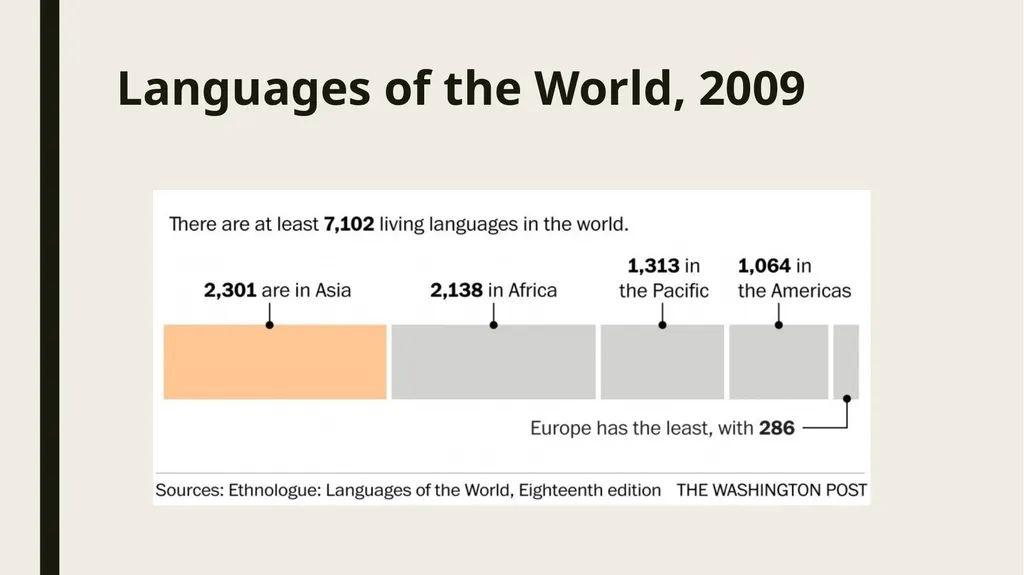
Languages of the World, 2009<br>
15
Language
Families
in Africa (Source:
http://www.nationsonline.org/oneworld/map/african-language-map.htm)<br>
16
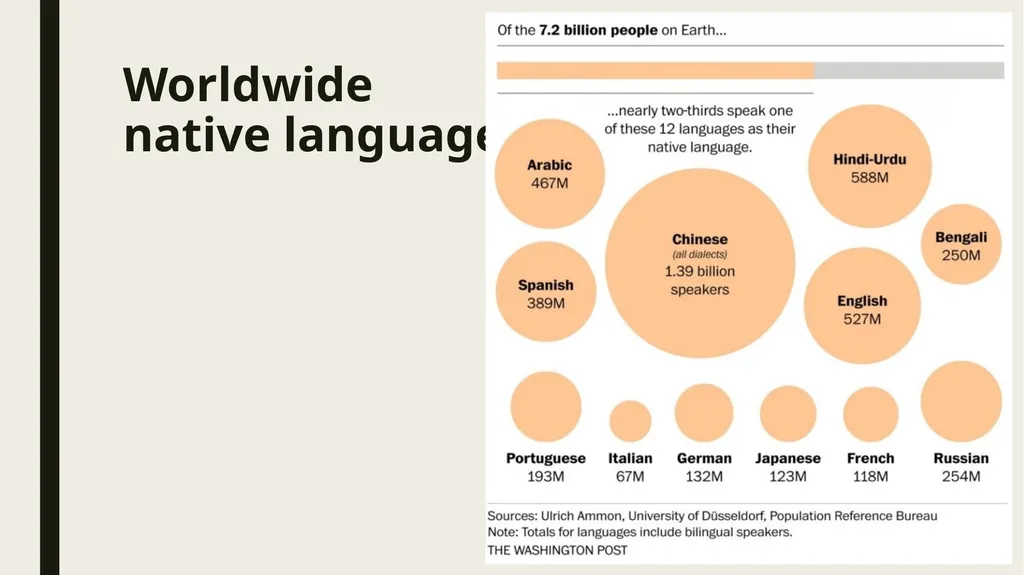
Worldwide
native languages<br>
17
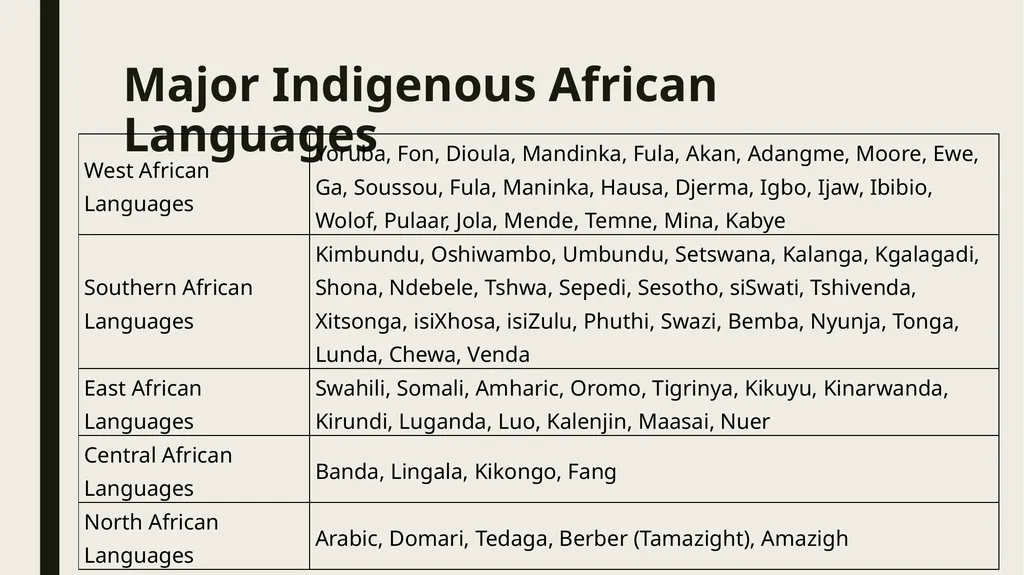
Major Indigenous African Languages<br>
18
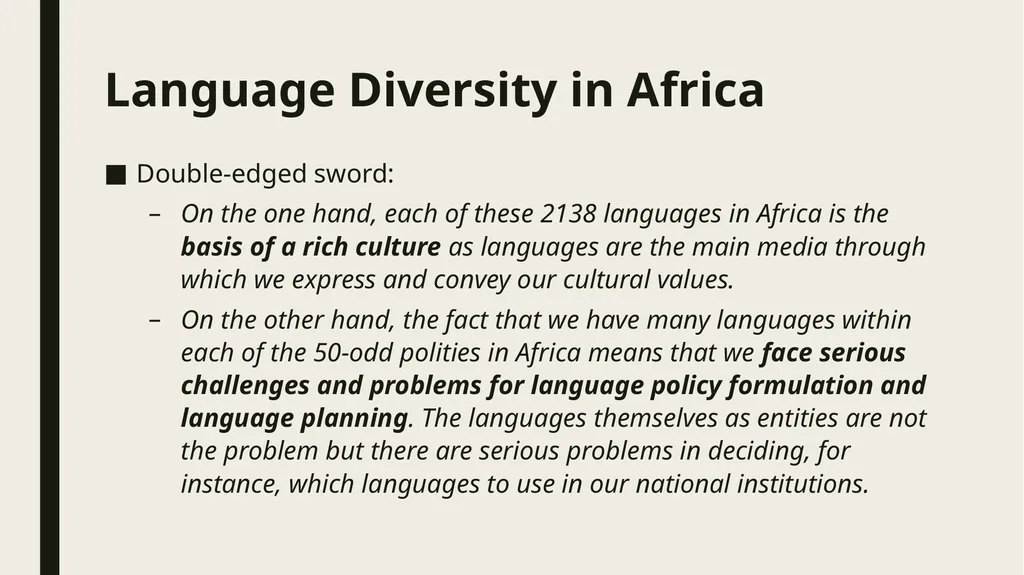
Language Diversity in Africa Double-edged sword:
On the one hand, each of these 2138 languages in Africa is the basis of a rich culture as languages are the main media through which we express and convey our cultural values.
On the other hand, the fact that we have many languages within each of the 50-odd polities in Africa means that we face serious challenges and problems for language policy formulation and language planning. The languages themselves as entities are not the problem but there are serious problems in deciding, for instance, which languages to use in our national institutions.<br>
On the one hand, each of these 2138 languages in Africa is the basis of a rich culture as languages are the main media through which we express and convey our cultural values.
On the other hand, the fact that we have many languages within each of the 50-odd polities in Africa means that we face serious challenges and problems for language policy formulation and language planning. The languages themselves as entities are not the problem but there are serious problems in deciding, for instance, which languages to use in our national institutions.<br>
19
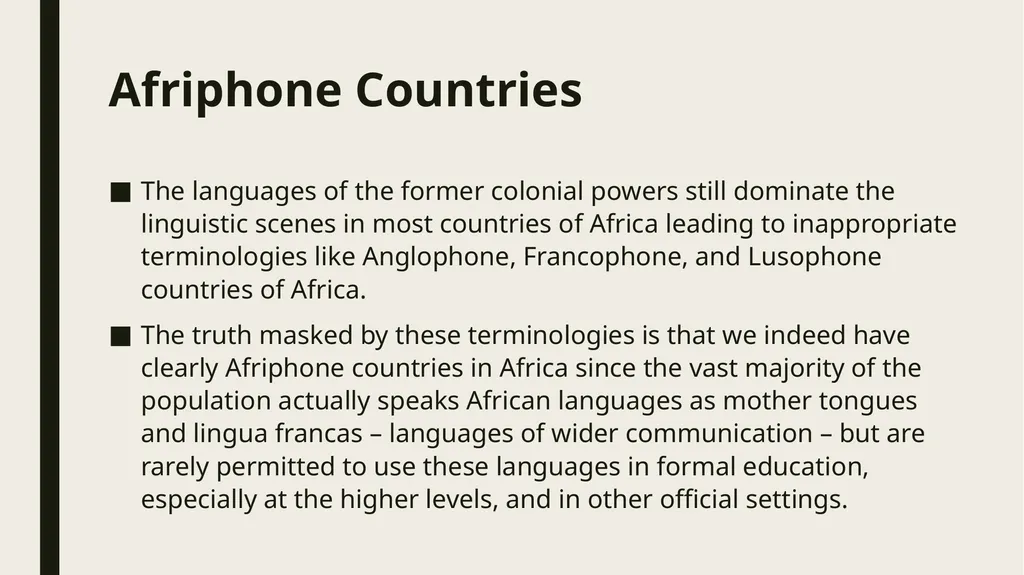
Afriphone Countries The languages of the former colonial powers still dominate the linguistic scenes in most countries of Africa leading to inappropriate terminologies like Anglophone, Francophone, and Lusophone countries of Africa.
The truth masked by these terminologies is that we indeed have clearly Afriphone countries in Africa since the vast majority of the population actually speaks African languages as mother tongues and lingua francas – languages of wider communication – but are rarely permitted to use these languages in formal education, especially at the higher levels, and in other official settings.<br>
The truth masked by these terminologies is that we indeed have clearly Afriphone countries in Africa since the vast majority of the population actually speaks African languages as mother tongues and lingua francas – languages of wider communication – but are rarely permitted to use these languages in formal education, especially at the higher levels, and in other official settings.<br>
20
Theoretical Underpinnings: A Theory of Linguistic Pan-Africanism The primacy of indigenous African languages: All the indigenous languages of Africa are important tools for the socio-economic and socio-cultural development of Africa.
Mother tongue education: Indigenous mother tongue education is an essential feature of the theoretical model of linguistic pan-Africanism outlined here.
Linguistic human rights: The important maxim of right of language and right to language (Mazrui 2000, Mazrui and Mazrui 1998) is crucial in this model.
Linguistic diversity as a global future: There is a clear link between language preservation and environmental protection. If climatic and environmental sustenance are important global future issues, then language and its preservation are a crucial part of this global future.<br>
Mother tongue education: Indigenous mother tongue education is an essential feature of the theoretical model of linguistic pan-Africanism outlined here.
Linguistic human rights: The important maxim of right of language and right to language (Mazrui 2000, Mazrui and Mazrui 1998) is crucial in this model.
Linguistic diversity as a global future: There is a clear link between language preservation and environmental protection. If climatic and environmental sustenance are important global future issues, then language and its preservation are a crucial part of this global future.<br>
21
Methodological Issues The research presented here is based on different contexts of research involving a mix of qualitative and quantitative data collection and analysis methods over a life time of observations and reflections on the nature of language and linguistic studies involving African languages. So a lot of archival research has gone into collating various data and ideas. This is also the basis of extensive debates at various conferences and symposia.<br>
22
3. Pan-Africanism and the Language Question<br>
23
Pan-Africanism and the Language Question Pan-Africanism is one of the most prominent concepts in the study of Africa and its place in the world.
The ‘pan’ in the term simply means ‘all’, ie encompassing all Africans and everything Africa.
Shepperson (1962) and many other writers suggest that we should distinguish between two types of pan-Africanism on the basis of whether we are dealing with a small ‘p’ as in “pan” or whether we are dealing with a capital ‘P’ in “Pan”.<br>
The ‘pan’ in the term simply means ‘all’, ie encompassing all Africans and everything Africa.
Shepperson (1962) and many other writers suggest that we should distinguish between two types of pan-Africanism on the basis of whether we are dealing with a small ‘p’ as in “pan” or whether we are dealing with a capital ‘P’ in “Pan”.<br>
24
Pan-Africanism with a capital „P“ Refers to the body of ideas and literature evolved at formal meetings and congresses.
In the 20th Century about five major Pan-African congresses were held in various cities around the world, from Paris in France to Manchester in the United Kingdom. It was at these meetings attended by prominent scholars and political figures from William Du Bois to Kwame Nkrumah that the key tenets of Pan-Africanism were discussed and adopted.
I would add the various efforts by African leaders to achieve political unity, leading to the formation of the Organization of African Unity (OAU), which later got renamed as the African Union (AU).<br>
In the 20th Century about five major Pan-African congresses were held in various cities around the world, from Paris in France to Manchester in the United Kingdom. It was at these meetings attended by prominent scholars and political figures from William Du Bois to Kwame Nkrumah that the key tenets of Pan-Africanism were discussed and adopted.
I would add the various efforts by African leaders to achieve political unity, leading to the formation of the Organization of African Unity (OAU), which later got renamed as the African Union (AU).<br>
25
pan-Africanism with a small „p“ Comprises lower level manifestations of unity by people of African descent, both within and outside the African continent.
I would add that any time a group of Africans and people of African origins decide to come together to address their interests, they are practising pan-Africanism with a small ‘p’.<br>
I would add that any time a group of Africans and people of African origins decide to come together to address their interests, they are practising pan-Africanism with a small ‘p’.<br>
26
Definition of Pan-Africanism Pan-Africanism is an ideological notion that champions the need for Africa, Africans, and all people of African descent to unite and work towards a better future for the continent and for Africans and all people of African descent.<br>
27
„Africa“ Of course, the term “Africa” too has to be deconstructed.
In my use of the term here, Africa covers the entire landmass of the continent and its islands. We do not make a distinction between the Maghreb and ‘sub-Sahara Africa’; in fact, we avoid the term “sub-sahara Africa” altogether.
In many European conceptualizations of Africa (e.g. Hegel 1956), there is this keen attempt to distinguish between countries like Egypt, Tunisia, Algeria, Libya, Morocco and the rest of Africa. In the spirit of pan-Africanism, Africa includes all parts of Africa, whether north or south of the Sahara Desert.
So Africans in this context refer to citizens and indigenous peoples of all the countries on the African continent and most or all of whom are members of the AU. Africans also include people of African descent who live outside Africa and who trace their ancestry and identity to the African continent. The term ‘diaspora’ is often used to refer to these people.<br>
In my use of the term here, Africa covers the entire landmass of the continent and its islands. We do not make a distinction between the Maghreb and ‘sub-Sahara Africa’; in fact, we avoid the term “sub-sahara Africa” altogether.
In many European conceptualizations of Africa (e.g. Hegel 1956), there is this keen attempt to distinguish between countries like Egypt, Tunisia, Algeria, Libya, Morocco and the rest of Africa. In the spirit of pan-Africanism, Africa includes all parts of Africa, whether north or south of the Sahara Desert.
So Africans in this context refer to citizens and indigenous peoples of all the countries on the African continent and most or all of whom are members of the AU. Africans also include people of African descent who live outside Africa and who trace their ancestry and identity to the African continent. The term ‘diaspora’ is often used to refer to these people.<br>
28
Major names associated with
Pan-Africanism Marcus Garvey, Kwame Nkrumah, Patrice Lumumba, Amilcar Cabral, Tafawa Balewa, Sekou Toure, Jomo Kenyatta, Julius Nyerere, Haile Selassie, Gamal Abdel Nasser, Ahmed Ben Bella, Robert Mugabe, Nelson Mandela, Muammar Gaddafi, Thomas Sankara, etc.
One of the most important and concise explanations of Africanism is by Felix (2002: 9) who sees Pan-Africanism as a concept of “…unity in diversity in terms of an extended and expanded African community.”<br>
One of the most important and concise explanations of Africanism is by Felix (2002: 9) who sees Pan-Africanism as a concept of “…unity in diversity in terms of an extended and expanded African community.”<br>
29
Linguistic
Pan-Africanism<br>
30
Linguistic
Pan-Africanism<br>
31
What is Mother Tongue? At a recent panel discussion, I stated for the umpteeth time that the best language policy for anywhere in Africa is one that ensures that every child is able to be literate (read and write) in their mother tongue, or what linguists sometimes call L1 (first language).
I recognise that these terms are not problem-free. The term 'mother tongue' means "...the language which a person has grown up speaking from early childhood".
Now in my 'mother tongue' or L1, Dagaare, we use the term, tengɛ kɔkɔre. In other African languages like Akan and Hausa it may translate as krom kasa or harshen garina, respectively.
Now, one of the reasons someone might object to the term 'mother tongue' or L1 is to say that children in the urban centres of Africa grow up speaking many languages, making the term 'mother tongue' or L1 problematic. Yes, it is problematic and one must unpack it. But here are the issues:<br>
I recognise that these terms are not problem-free. The term 'mother tongue' means "...the language which a person has grown up speaking from early childhood".
Now in my 'mother tongue' or L1, Dagaare, we use the term, tengɛ kɔkɔre. In other African languages like Akan and Hausa it may translate as krom kasa or harshen garina, respectively.
Now, one of the reasons someone might object to the term 'mother tongue' or L1 is to say that children in the urban centres of Africa grow up speaking many languages, making the term 'mother tongue' or L1 problematic. Yes, it is problematic and one must unpack it. But here are the issues:<br>
32
Mother Tongue (I) First, it is not impossible to have two or more L1s or mother tongues in a multilingual set-up.
Second, and as a rural African, as someone who grew up in a rural area of Africa, I sometimes get unsettled at how some linguists or other social scientists try to impose what happens in the cities of Africa on all of Africa. One example that was given at this panel was that a child in the urban centre like Nima, a suburb of Accra may grow up speaking Ga, Hausa, Twi, and Ewe at the same time, so which is their mother tongue? The fact that this happens in the cities doesn't mean that it happens throughout Africa. In very many rural areas of Africa (though there is an increasing number of villages along main highways and near cities which may also be multilingual (Sagna and Hantgan 2021)), the term tengɛ kɔkɔre (mother tongue) refers to a specific language and is unmistakable.<br>
Second, and as a rural African, as someone who grew up in a rural area of Africa, I sometimes get unsettled at how some linguists or other social scientists try to impose what happens in the cities of Africa on all of Africa. One example that was given at this panel was that a child in the urban centre like Nima, a suburb of Accra may grow up speaking Ga, Hausa, Twi, and Ewe at the same time, so which is their mother tongue? The fact that this happens in the cities doesn't mean that it happens throughout Africa. In very many rural areas of Africa (though there is an increasing number of villages along main highways and near cities which may also be multilingual (Sagna and Hantgan 2021)), the term tengɛ kɔkɔre (mother tongue) refers to a specific language and is unmistakable.<br>
33
Mother Tongue (II) To complicate the matter further, some Africans in the diaspora growing up in places like America, England, France, Germany, etc, as part of their pan-African nationalism, feel ashamed calling their most proficient languages like English and French their mother tongues or L1, and therefore want to throw away the terms altogether.
‘Heritage language‘: For children in the African diaspora, your heritage language(s) is (are) your African language(s), probably spoken by your parents to you at home. But English is your mother tongue/L1. Or French, German, Portuguese!
If you are a linguist in this kind of diaspora situation of mixed, blurred identity please do NOT impose your own situation on other Africans who have a clear linguistic identity.
Language of Identity (tengɛ kɔkɔre, krom kasa, marshen garina, etc.)<br>
‘Heritage language‘: For children in the African diaspora, your heritage language(s) is (are) your African language(s), probably spoken by your parents to you at home. But English is your mother tongue/L1. Or French, German, Portuguese!
If you are a linguist in this kind of diaspora situation of mixed, blurred identity please do NOT impose your own situation on other Africans who have a clear linguistic identity.
Language of Identity (tengɛ kɔkɔre, krom kasa, marshen garina, etc.)<br>
34
Indigenous African Language I am often surprised why some linguists question the term "indigenous African languages".
The term 'indigenous' is a denotation that simply refers to an entity that originates and occurs naturally in a particular locus, an entity which is native to a particular locality. Any negative connotations of the term ‘indigenous’ result from a poor understanding of this denotation, and cannot be a reason why we should abandon the term.
Any language spoken in Africa by communities of people whose original homeland is not traced outside Africa is an indigenous African language.<br>
The term 'indigenous' is a denotation that simply refers to an entity that originates and occurs naturally in a particular locus, an entity which is native to a particular locality. Any negative connotations of the term ‘indigenous’ result from a poor understanding of this denotation, and cannot be a reason why we should abandon the term.
Any language spoken in Africa by communities of people whose original homeland is not traced outside Africa is an indigenous African language.<br>
35
Linguistic
Pan-Africanism<br>
36
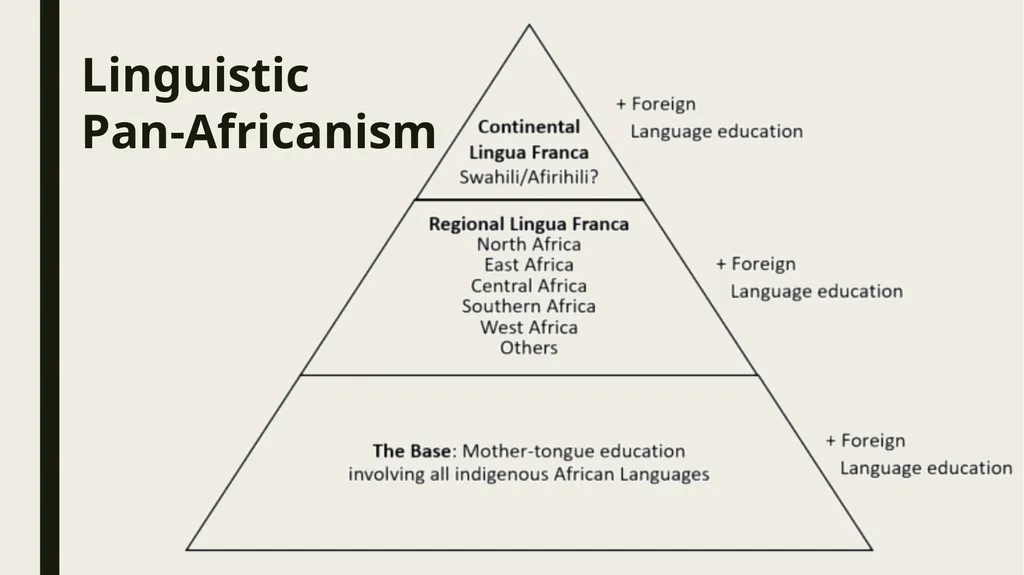
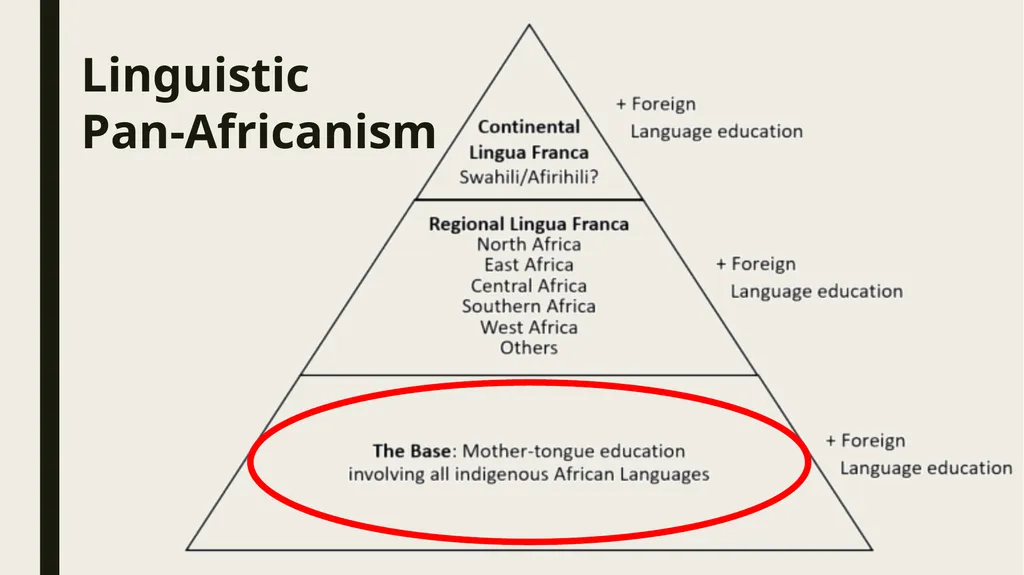
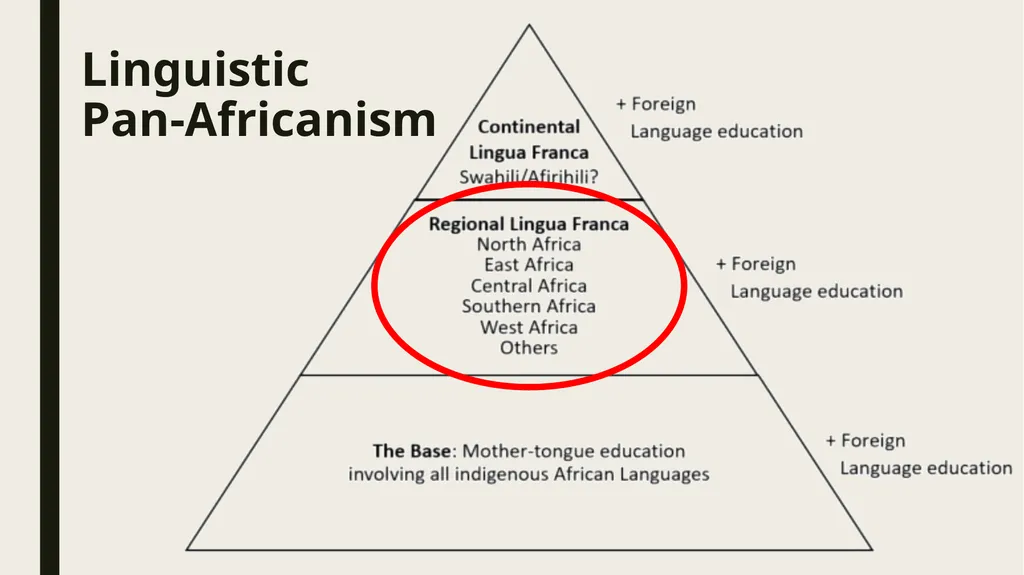
Regional Lingua Franca The most important step for all governments in Africa is to ensure that all children in Africa learn how to read and write in their tengɛ kɔkɔre / krom kasa / marshen garina (mother tongue/L1), then at least one other language of their country/Africa.
Arabic, Amharic, Zulu, Lingala, Hausa, each representing North, East, Southern, Central, and West respectively. Other important languages in West Africa, which is the most diverse part of Africa, could include Bambara, Wolof, Akan, Ewe, Yoruba, and Igbo.<br>
Arabic, Amharic, Zulu, Lingala, Hausa, each representing North, East, Southern, Central, and West respectively. Other important languages in West Africa, which is the most diverse part of Africa, could include Bambara, Wolof, Akan, Ewe, Yoruba, and Igbo.<br>
37
Linguistic
Pan-Africanism<br>
38
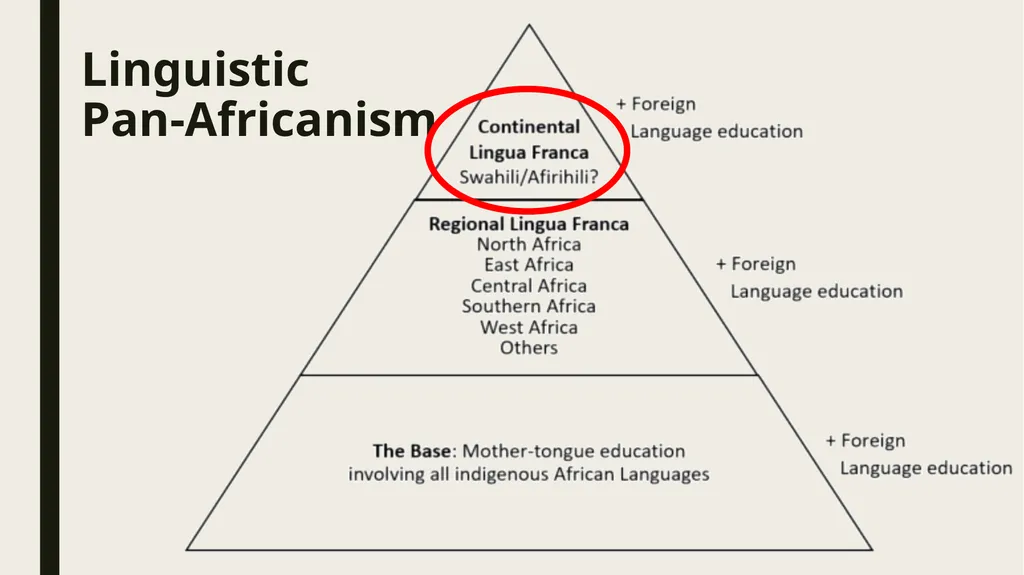
Continental Lingua Franca The apex of the diagram indicates that Africans should agree on a single continental lingua franca, and the best candidate so far is Swahili. So far, it is the most widespread indigenous African language. It is also the most international African language south of the Sahara as it is taught and broadcast in many parts of the world.
The African Union could have a policy statement that by the year 2050, ie in the middle of the 21st Century, a modernised form of Swahili called Afirihili or KiAfirihili should become the sole language of the African Union, not just only a co-official language with English, French, and Portuguese.
It should not only be taught in most universities in Africa, it should indeed be the medium of instruction in at least one university in each of the 55 African countries.<br>
The African Union could have a policy statement that by the year 2050, ie in the middle of the 21st Century, a modernised form of Swahili called Afirihili or KiAfirihili should become the sole language of the African Union, not just only a co-official language with English, French, and Portuguese.
It should not only be taught in most universities in Africa, it should indeed be the medium of instruction in at least one university in each of the 55 African countries.<br>
39
Afirihili Afirihili must not be thought of only as a linguistic touch-up of Swahili, but as a modernised form of Swahili that develops enough terminologies and concepts for the teaching of African history, culture, traditions, geographies, philosophies, and so on! It would be important for all African children from different parts of Africa sitting in the same classroom to learn about their traditional African heritages in a common African language, and not in English, French, or Portuguese.<br>
40
Linguistic
Pan-Africanism<br>
41
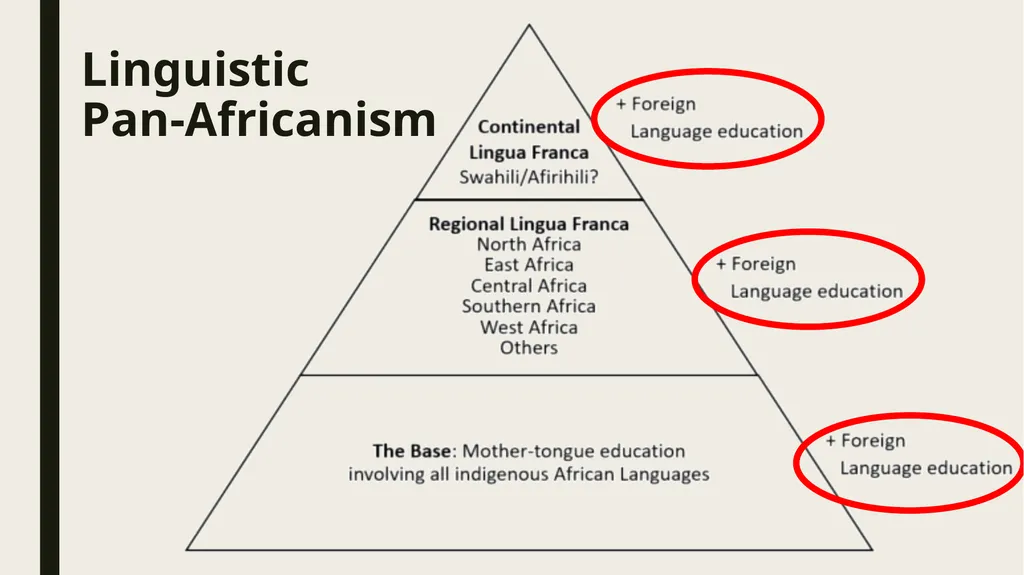
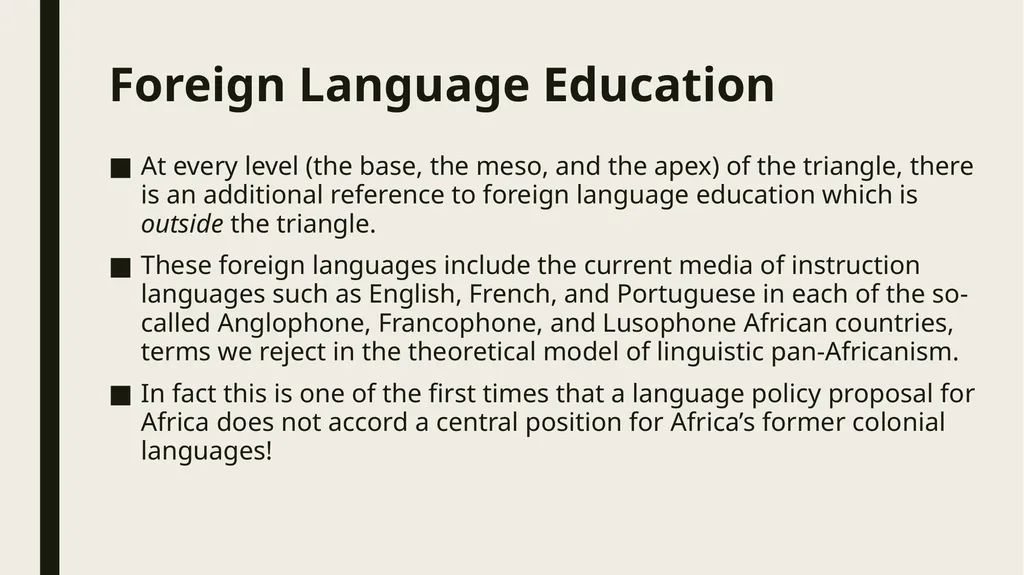
Foreign Language Education At every level (the base, the meso, and the apex) of the triangle, there is an additional reference to foreign language education which is outside the triangle.
These foreign languages include the current media of instruction languages such as English, French, and Portuguese in each of the so-called Anglophone, Francophone, and Lusophone African countries, terms we reject in the theoretical model of linguistic pan-Africanism.
In fact this is one of the first times that a language policy proposal for Africa does not accord a central position for Africa’s former colonial languages!<br>
These foreign languages include the current media of instruction languages such as English, French, and Portuguese in each of the so-called Anglophone, Francophone, and Lusophone African countries, terms we reject in the theoretical model of linguistic pan-Africanism.
In fact this is one of the first times that a language policy proposal for Africa does not accord a central position for Africa’s former colonial languages!<br>
42
4. The Language of Education and Development Discourse:
Localized Additive Triangualism 5. The Language Question in African Literature:
Afriphone Literature<br>
43
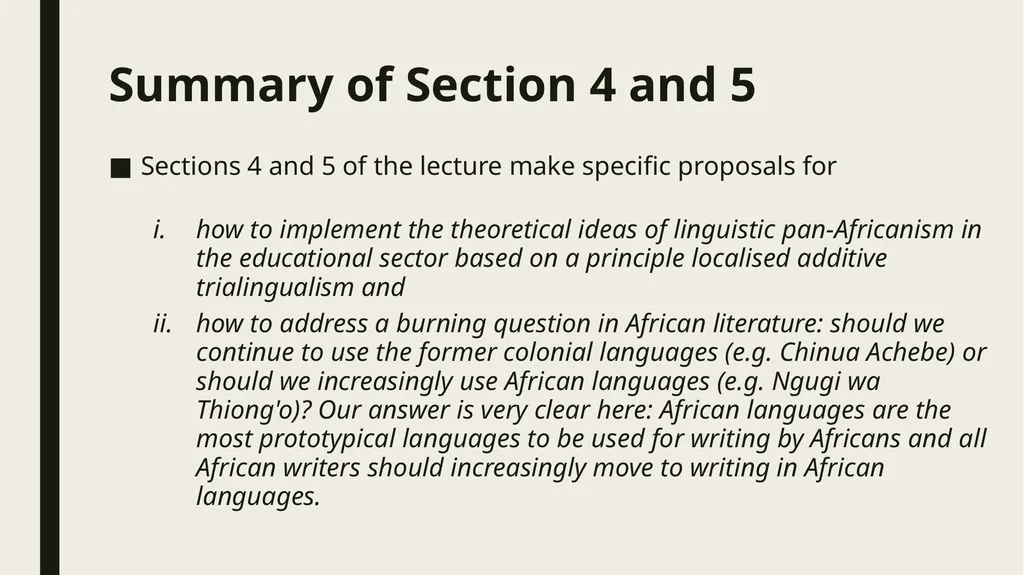
Summary of Section 4 and 5 Sections 4 and 5 of the lecture make specific proposals for
how to implement the theoretical ideas of linguistic pan-Africanism in the educational sector based on a principle localised additive trialingualism and
how to address a burning question in African literature: should we continue to use the former colonial languages (e.g. Chinua Achebe) or should we increasingly use African languages (e.g. Ngugi wa Thiong'o)? Our answer is very clear here: African languages are the most prototypical languages to be used for writing by Africans and all African writers should increasingly move to writing in African languages.<br>
how to implement the theoretical ideas of linguistic pan-Africanism in the educational sector based on a principle localised additive trialingualism and
how to address a burning question in African literature: should we continue to use the former colonial languages (e.g. Chinua Achebe) or should we increasingly use African languages (e.g. Ngugi wa Thiong'o)? Our answer is very clear here: African languages are the most prototypical languages to be used for writing by Africans and all African writers should increasingly move to writing in African languages.<br>
44
6. From Africa to the World: African Languages in the Global Context<br>
45
Linguistic Pan-Africanism and Global Future (I) We have already defined and explained the concept of global future as any event that can bring seismic changes to the world at large.
Examples of global futures – events and happenings that may have widespread effects on the world – include climate change, migration, robotics, space technology, and blockchains.
Maxim ‘our common future’: meaning that all human beings have a common future, have an interest in managing these current happenings that can have major impact on all of us, on a global future.
Scholars like Vijay Prashad (e.g. Prashad 2020), who argue that the idea of a common global future may indeed be rather idealistic and indeed goes to serve Western interests more than the interests of the Global South. We may, indeed, not have a common future with the West or Global North as a whole, as we, the people of the Global South, have not yet even secured our present.<br>
Examples of global futures – events and happenings that may have widespread effects on the world – include climate change, migration, robotics, space technology, and blockchains.
Maxim ‘our common future’: meaning that all human beings have a common future, have an interest in managing these current happenings that can have major impact on all of us, on a global future.
Scholars like Vijay Prashad (e.g. Prashad 2020), who argue that the idea of a common global future may indeed be rather idealistic and indeed goes to serve Western interests more than the interests of the Global South. We may, indeed, not have a common future with the West or Global North as a whole, as we, the people of the Global South, have not yet even secured our present.<br>
46
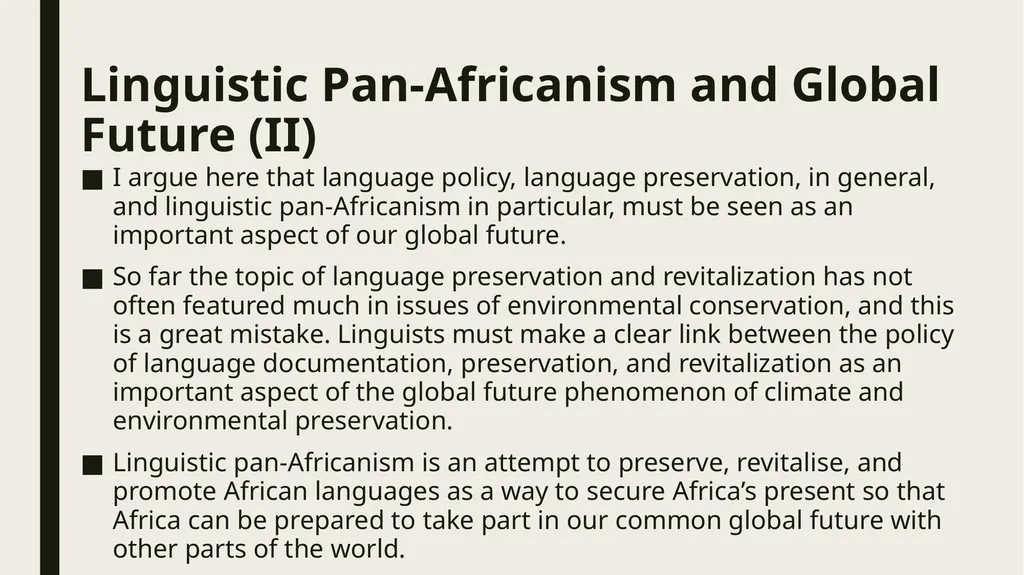
Linguistic Pan-Africanism and Global Future (II) I argue here that language policy, language preservation, in general, and linguistic pan-Africanism in particular, must be seen as an important aspect of our global future.
So far the topic of language preservation and revitalization has not often featured much in issues of environmental conservation, and this is a great mistake. Linguists must make a clear link between the policy of language documentation, preservation, and revitalization as an important aspect of the global future phenomenon of climate and environmental preservation.
Linguistic pan-Africanism is an attempt to preserve, revitalise, and promote African languages as a way to secure Africa’s present so that Africa can be prepared to take part in our common global future with other parts of the world.<br>
So far the topic of language preservation and revitalization has not often featured much in issues of environmental conservation, and this is a great mistake. Linguists must make a clear link between the policy of language documentation, preservation, and revitalization as an important aspect of the global future phenomenon of climate and environmental preservation.
Linguistic pan-Africanism is an attempt to preserve, revitalise, and promote African languages as a way to secure Africa’s present so that Africa can be prepared to take part in our common global future with other parts of the world.<br>
47
Strategies for Promoting African Languages Beyond Africa One aspect of the rise of nations and parts of the world is that they take their languages with them as they rise. Linguistic issues are an important part of the foreign policy of rising nations.
As Africa rises and as African voices become more prominent in the world, Africa must not showcase itself in the medium of only English, French and Portuguese; that is, in the medium of its former colonial languages.
Africa must go into the world in the medium of indigenous African languages. African culture and African soft power must be manifested in African languages.<br>
As Africa rises and as African voices become more prominent in the world, Africa must not showcase itself in the medium of only English, French and Portuguese; that is, in the medium of its former colonial languages.
Africa must go into the world in the medium of indigenous African languages. African culture and African soft power must be manifested in African languages.<br>
48
The Mandela Institutes In several papers (e.g. Bodomo 2009, 2015), I have proposed the establishment of African cultural institutes worldwide run, not by foreigners, but by the AU and / or the individual African polities. My proposal has been to call them Mandela Institutes, though of course we can reserve some of them for other Pan-African icons like Kwame Nkrumah, Thomas Sankara, Abdel Nasser, Mwalimu Julius Nyerere, or Tafawa Balewa.
These Mandela Institutes would be mandated to teach African languages and cultures worldwide with curricula designed by a coordinating body in Africa that produces curricula content for the teaching of these languages and the cultures associated with them.<br>
These Mandela Institutes would be mandated to teach African languages and cultures worldwide with curricula designed by a coordinating body in Africa that produces curricula content for the teaching of these languages and the cultures associated with them.<br>
49
Standardized Tests in African Languages A coordinating committee for creating standards for testing proficiency levels must be established.
A standardized test called Test of African Languages as a Foreign Language (TALaFoL) must be established.
The curriculum should be the same for all African languages, such that, for instance, we can have TALaFoL Afirihili, TALaFoL Hausa, TALaFoL Yoruba, TALaFoL Igbo, TALaFoL Akan, TALaFoL Dagaare, etc.
Of course, it might also be possible to find an African name for the test so that we avoid using only the acronym TALaFoL.
Funding should entirely be from Africa and its diaspora. We must reverse the trend where foreign bodies from places like Europe and China coming to invest in Africa create institutions for teaching us their languages to a situation in which we require them to learn our languages in order to ply their trade in Africa.<br>
A standardized test called Test of African Languages as a Foreign Language (TALaFoL) must be established.
The curriculum should be the same for all African languages, such that, for instance, we can have TALaFoL Afirihili, TALaFoL Hausa, TALaFoL Yoruba, TALaFoL Igbo, TALaFoL Akan, TALaFoL Dagaare, etc.
Of course, it might also be possible to find an African name for the test so that we avoid using only the acronym TALaFoL.
Funding should entirely be from Africa and its diaspora. We must reverse the trend where foreign bodies from places like Europe and China coming to invest in Africa create institutions for teaching us their languages to a situation in which we require them to learn our languages in order to ply their trade in Africa.<br>
50
African Diaspora to the Rescue I have had meetings with several AU bodies and advised them on several issues concerning the African diaspora. In one of these periodic African diaspora meetings, often facilitated by the AU, stakeholders must agree on a 5-year plan (say from 2025 to 2030) to encourage all second and subsequent generation African diaspora members to acquire a major African language by passing TALaFoL[Afirihili], TALaFoL[Hausa], TALaFol[Zulu], and so on.
This way, African languages would automatically become widespread all over the world.
As someone who has advised the AU and facilitated such diaspora meetings, it is my wish that one day, before 2050, we would be able to hold our meetings mainly in Afirihili.
One of the best strategies for promoting African languages worldwide is if Africa gets its diaspora members speaking, reading, and writing African languages.<br>
As someone who has advised the AU and facilitated such diaspora meetings, it is my wish that one day, before 2050, we would be able to hold our meetings mainly in Afirihili.
One of the best strategies for promoting African languages worldwide is if Africa gets its diaspora members speaking, reading, and writing African languages.<br>
51
7. Conclusion<br>
52
Conclusion (I) a) Definiton of key terminolgies: pan-Africanism, lingustic pan-Africanism, Global Future
b) Main theme of the lecture: to assure itself of a sustainable future, Africa must make use of its own indigenous languages as languages of development and evolve key indigenous lingua franca or languages of wider communication, with the ultimate goal of producing a continental lingua franca.
Theoretical and methodological underpinnings
Notion of types of pan-Africanism and focus on developing a theoretical model of linguistic pan-Africanism: The model emphasized the primacy of the mother tongue or language of cultural identity, the importance of evolving indigenous lingua franca, and the need for all Africans to speak one major lingua franca by the year 2050.<br>
Theoretical and methodological underpinnings
Notion of types of pan-Africanism and focus on developing a theoretical model of linguistic pan-Africanism: The model emphasized the primacy of the mother tongue or language of cultural identity, the importance of evolving indigenous lingua franca, and the need for all Africans to speak one major lingua franca by the year 2050.<br>
53
Conclusion (II) Analysis of how the theoretical model of pan-Africanism might to be illustrated with the language situation in the African country I know best, Ghana.
How might the theory of linguistic pan-Africanism play in a major debate on the language question in African literature?
Strategies needed to promote African languages worldwide.
a) Conclusion: summarising the main issues b) Recommendations c) Challenges<br>
How might the theory of linguistic pan-Africanism play in a major debate on the language question in African literature?
Strategies needed to promote African languages worldwide.
a) Conclusion: summarising the main issues b) Recommendations c) Challenges<br>
54
Recommendations: Ten Tenets of
Linguistic Pan-Africanism Secure the Base: Be literate in your language of identity - every African child should be given the opportunity to learn to speak, read, and write in their mother-tongue or L1 or any one of their languages of identity. This first tenet builds on wa Thiong’o’s (2016) writing about the importance of the mother tongue and beyond.
Evolve linguistic pan-African policies: Current national language policies are both nationalistic and Eurocentric but not pan-African enough. For instance, one of the most important national language policies in Africa, the South African language policy (Kamwangamalu 2004, Wright 2004), evolved under Mandela’s rule recognizes 11 languages including indigenous South African languages, Afrikaans, and English but not a single language beyond southern Africa. Every African child must be given the opportunity to speak, read, and write in at least three languages: their language of identity, one African language, and Swahili (along with one international non-African language as an added bonus, not as a compulsory requirement).<br>
Evolve linguistic pan-African policies: Current national language policies are both nationalistic and Eurocentric but not pan-African enough. For instance, one of the most important national language policies in Africa, the South African language policy (Kamwangamalu 2004, Wright 2004), evolved under Mandela’s rule recognizes 11 languages including indigenous South African languages, Afrikaans, and English but not a single language beyond southern Africa. Every African child must be given the opportunity to speak, read, and write in at least three languages: their language of identity, one African language, and Swahili (along with one international non-African language as an added bonus, not as a compulsory requirement).<br>
55
Recommendations: Ten Tenets of
Linguistic Pan-Africanism Language of literary expression: Every African writer should, first and foremost, endeavour to write in his or her language of identity or any other African language.
Regional pan-African lingua franca: Every political/economic region of Africa: North, Southern, East, West, and Central Africa should evolve one to three regional lingua franca: For instance: Arabic in the North, Swahili and Amharic in the East, Zulu in the South, Lingala in Central Africa, and Hausa, Bambara, and Wolof in West Africa.
African languages in the service of Africa: Knowledge of an African language besides one’s own is a requirement for serving in regional and continental level organizations.<br>
Regional pan-African lingua franca: Every political/economic region of Africa: North, Southern, East, West, and Central Africa should evolve one to three regional lingua franca: For instance: Arabic in the North, Swahili and Amharic in the East, Zulu in the South, Lingala in Central Africa, and Hausa, Bambara, and Wolof in West Africa.
African languages in the service of Africa: Knowledge of an African language besides one’s own is a requirement for serving in regional and continental level organizations.<br>
56
Recommendations: Ten Tenets of
Linguistic Pan-Africanism Avoid petty nationalism and eurocentrism in national language policy: All national language policies attempt to be nationalistic. In reality, most are Eurocentric, and few are pan-Africanist in orientation. It is time to start seeing cross-regional language learning. For instance, East Africans learning West African languages and vice versa, North Africans learning Southern African languages and vice versa.
Generously fund the African language agenda: Regional and Continental level institutions and charity organizations and individual Africans should dedicate sections of their running costs to funding prizes and research grants for the promotion of African languages and literatures. Scholarship schemes should be set up for foreign students to learn African languages.<br>
Generously fund the African language agenda: Regional and Continental level institutions and charity organizations and individual Africans should dedicate sections of their running costs to funding prizes and research grants for the promotion of African languages and literatures. Scholarship schemes should be set up for foreign students to learn African languages.<br>
57
Recommendations: Ten Tenets of
Linguistic Pan-Africanism Language of the diaspora: All diaspora Africans should be encouraged to learn to speak, read, and write Swahili – and eventually Afirihili- as it has the greatest potential of becoming the most widespread pan-African language.
Afirihili: African linguists must work towards developing Swahili, the most widespread pan-African language into an official pan-African language called Afirihili, with a large segment of vocabularies from many African languages being part of the new language.
African languages in the world: All foreign students who come to study in Africa, most people seeking permanent residence permits in Africa, must be made to pass standardized tests in an African language.<br>
Afirihili: African linguists must work towards developing Swahili, the most widespread pan-African language into an official pan-African language called Afirihili, with a large segment of vocabularies from many African languages being part of the new language.
African languages in the world: All foreign students who come to study in Africa, most people seeking permanent residence permits in Africa, must be made to pass standardized tests in an African language.<br>
58
Challenges (I) In preparing this lecture, a colleague who read through a preliminary version of the work, asked why I am writing a 100-page lecture that no one will act on. He asked me if I trust the AU and African governments that much to waste my time?
Well, my response is that as a scholar of African linguistics and literature and as an advocate for the promotion of the use of African languages, it is my duty, first, to contribute to the body of literature on how we can do this, and then, second, advocate and campaign for the AU and national and regional governments to act. Who knows what happens in the next five or 10 years? A new era may come in where new actors at the AU and within national and regional governments will be looking into the archives for solutions, for answers to the language in Africa.<br>
Well, my response is that as a scholar of African linguistics and literature and as an advocate for the promotion of the use of African languages, it is my duty, first, to contribute to the body of literature on how we can do this, and then, second, advocate and campaign for the AU and national and regional governments to act. Who knows what happens in the next five or 10 years? A new era may come in where new actors at the AU and within national and regional governments will be looking into the archives for solutions, for answers to the language in Africa.<br>
59
Challenges (II) Another challenge that has often been posed to me is whether I am not proposing an educational system in which children will learn too many languages.
Well, it is not asking too much to propose a pan-Africanist language policy involving additive trilingualism in an already hyper-diverse and multilingual continent like Africa.
Many Africans already speak three or more languages. So all we are asking is for them to learn to read and write in these languages.<br>
Well, it is not asking too much to propose a pan-Africanist language policy involving additive trilingualism in an already hyper-diverse and multilingual continent like Africa.
Many Africans already speak three or more languages. So all we are asking is for them to learn to read and write in these languages.<br>
60
Challenges (III) A third challenge is on the issue of resources. A question is always asked: Where do we get money to mount programmes in all these languages?
I would say it is a question of priority. A lot of money has been spent in teaching Africans how to read and write in the former colonial languages throughout Africa. If only we could spend even half of what we spend teaching English, French, and Portuguese in teaching African languages, there would be enough resources to go around in implementing our linguistic pan-Africanist model of localized additive trilingualism.<br>
I would say it is a question of priority. A lot of money has been spent in teaching Africans how to read and write in the former colonial languages throughout Africa. If only we could spend even half of what we spend teaching English, French, and Portuguese in teaching African languages, there would be enough resources to go around in implementing our linguistic pan-Africanist model of localized additive trilingualism.<br>
61
Acknowledgements I wish to acknowledge the following individuals and institutions without whom this lecture would not have been possible:
Akan translations: Victoria Ofori, Kofi Agyekum
Dagaare translations: Faustina Tantie, Mark Ali, Mary Bodomo, Sanortey
Hausa translations: Ahmed Amfani, Li Chunguang
Swahili translations: Mfilinge Nyalusi, Laurent Gabriel Ndijuye
Arabic translations: Aziza Benlamoudi
Amharic translations: Lemlem Fitwi
Academic comments and copy editing: Sam Mchombo, Paul Kerswill
Formatting and powerpoint preparation: Bettina Busch<br>
Akan translations: Victoria Ofori, Kofi Agyekum
Dagaare translations: Faustina Tantie, Mark Ali, Mary Bodomo, Sanortey
Hausa translations: Ahmed Amfani, Li Chunguang
Swahili translations: Mfilinge Nyalusi, Laurent Gabriel Ndijuye
Arabic translations: Aziza Benlamoudi
Amharic translations: Lemlem Fitwi
Academic comments and copy editing: Sam Mchombo, Paul Kerswill
Formatting and powerpoint preparation: Bettina Busch<br>
62
Barka, Akpe, Medaase, Nagode, Asante sana, Thank you!<br>
63
Abdul-Raheem, T. (ed.). 1996. Pan-Africanism: Politics, Economy and Social Change in the Twenty-first Century. New York: New York University Press.
Adegbija, E. 1994. Language Attitudes in Sub-Saharan Africa: A Sociolinguistic Overview. Clevedon, Philadelphia and Adelaide: Multilingual Matters.
Agyekum, K. (2018a). ‘Linguistic imperialism and language decolonisation in Africa through documentation and preservation.’ In Jason Kandybowicz, Travis Major, Harold Torrence& Phillip Duncan (eds.), African Linguistics in the prairie, pp 87-104. Berlin: Language Science Press. DOL 10: 5281/zenodo.1251718.
Akin Aina, T. 1993. Development Theory and Africa's lost decade. In: Changing Paradigms in Development - South, East and West, von Troil, Margareta (ed.).
Alexander, N. 2008. Creating the conditions for a counter-hegemonic strategy: African languages in the twenty-first century. in Globalization and language vitality: Perspectives from Africa, C.B. Vigouroux and S.S. Mufwene, 255-71. London: Continuum.
Ali, M. and Adams Bodomo. 2021. Ye Gorogor Yaa: Dagaare Folktales in Parallel Texts. LIT Verlag, Vienna, 241 pages.
Anyidoho, Kofi .1992. Language & Development Strategy in Pan-African Literary Experience. Research in African Literatures, vol. 23, no. 1, 45–63. Indiana University Press. http://www.jstor.org/stable/3819948.
Arcand, J. L., Guillaumont, P., & Guillaumont Jeanneney, S. 2000. How to make a tragedy: on the alleged effect of ethnicity on growth. Journal of International Development: The Journal of the Development Studies Association, 12(7), 925-938.
Arcand, J. L., & Grin, F. 2013. Language in Economic Development: Is English Special and is Linguistic Fragmentation Bad?. English and development: Policy, pedagogy and globalization, 17, 243.
Asante, S. K. B. and D. Chanaiwa. 1993. ‘Pan-Africanism and Regional Integration’, in A. A. Mazrui and C. Wondji (eds), UNESCO General History of Africa, vol. 8. Berkeley: University of California Press, 724–743.
Asmara Declaration. 2000. Against All Odds: African languages and Literatures into the 21st Century. Asmara, Eritrea.
Ayuk, H. (2014). What is African literature? [Online] Available: http://princehamilton.blogspot.co.at/2009/06/what-is-african-literature.html (June 6, 2014).
Balakrishnan, Sarah. 2016. Pan-African Legacies, Afropolitan Futures. Transition 120, 29-37.
Bamgbose, Ayo. 1991. Language and the nation: The language question in sub-Saharan Africa, Edinburgh: Edinburgh University Press. References<br>
Adegbija, E. 1994. Language Attitudes in Sub-Saharan Africa: A Sociolinguistic Overview. Clevedon, Philadelphia and Adelaide: Multilingual Matters.
Agyekum, K. (2018a). ‘Linguistic imperialism and language decolonisation in Africa through documentation and preservation.’ In Jason Kandybowicz, Travis Major, Harold Torrence& Phillip Duncan (eds.), African Linguistics in the prairie, pp 87-104. Berlin: Language Science Press. DOL 10: 5281/zenodo.1251718.
Akin Aina, T. 1993. Development Theory and Africa's lost decade. In: Changing Paradigms in Development - South, East and West, von Troil, Margareta (ed.).
Alexander, N. 2008. Creating the conditions for a counter-hegemonic strategy: African languages in the twenty-first century. in Globalization and language vitality: Perspectives from Africa, C.B. Vigouroux and S.S. Mufwene, 255-71. London: Continuum.
Ali, M. and Adams Bodomo. 2021. Ye Gorogor Yaa: Dagaare Folktales in Parallel Texts. LIT Verlag, Vienna, 241 pages.
Anyidoho, Kofi .1992. Language & Development Strategy in Pan-African Literary Experience. Research in African Literatures, vol. 23, no. 1, 45–63. Indiana University Press. http://www.jstor.org/stable/3819948.
Arcand, J. L., Guillaumont, P., & Guillaumont Jeanneney, S. 2000. How to make a tragedy: on the alleged effect of ethnicity on growth. Journal of International Development: The Journal of the Development Studies Association, 12(7), 925-938.
Arcand, J. L., & Grin, F. 2013. Language in Economic Development: Is English Special and is Linguistic Fragmentation Bad?. English and development: Policy, pedagogy and globalization, 17, 243.
Asante, S. K. B. and D. Chanaiwa. 1993. ‘Pan-Africanism and Regional Integration’, in A. A. Mazrui and C. Wondji (eds), UNESCO General History of Africa, vol. 8. Berkeley: University of California Press, 724–743.
Asmara Declaration. 2000. Against All Odds: African languages and Literatures into the 21st Century. Asmara, Eritrea.
Ayuk, H. (2014). What is African literature? [Online] Available: http://princehamilton.blogspot.co.at/2009/06/what-is-african-literature.html (June 6, 2014).
Balakrishnan, Sarah. 2016. Pan-African Legacies, Afropolitan Futures. Transition 120, 29-37.
Bamgbose, Ayo. 1991. Language and the nation: The language question in sub-Saharan Africa, Edinburgh: Edinburgh University Press. References<br>
64
Bamgbose, Ayo. 2014. The language factor in development goals. Journal of Multilingual and Multicultural Development, 35(7), 646-657, DOI: 10.1080/01434632.2014.908888.
Bangura, A. K. 2012. Pan-Africanism: An Exploration of Afro-Asian Connections. CBACC Occasional Monograph, No. 25.
Bangura, A. K. (2000). Measurable effects of multilingualism in Africa. International Journal of the Sociology of Language, 146, 111-117.
Barker, P. 1986. Peoples, Languages and Religion in Northern Ghana. Ghana Accra: Evangelical Committee.
Batibo, H. 2005. Language decline and death in Africa: Causes, consequences and challenges, Clevedon: Multilingual Matters.
Baugh, J. 1994. The Law, Linguistics, and Educational reform for African American language minority students, ms Stanford University.
Bodomo, A.B. 1994. Language, History and Culture in Northern Ghana: An Introduction to the Mabia Linguistic Group. Nordic Journal of African Studies 3(2).
Bodomo, A. B. 1995. Multilingualism and its Challenge to Educational Planning in Ghana, ms. Stanford University.
Bodomo, A. B. 1996. Linguistics, education and politics: An interplay on the study of Ghanaian languages. Languages of the World, vol. 10. Lincom Europa, München, Germany.
Bodomo, Adams. 1996. On Language and Development in Africa: The Case of Ghana. Nordic Journal of African Studies 5 (2), 31–51.
Bodomo, A. B. 2009. Africa-China relations: symmetry, soft power, and South Africa. The China Review: An Interdisciplinary Journal on Greater China, Vol. 9, No. 2 (Fall 2009), 169-178.
Bodomo, A. B. 2012. Africans in China: A Socio-Cultural Study and its Implications on Africa-China Relations, Cambria Press, NY, USA.
Bodomo, A. 2013. Lecture Notes on Language, Literacy, and Literature: The language question in African literary expression, Department of African Studies (Course no 140251), University of Vienna.
Bodomo, A. 2014. Survey Report on African Languages and Literatures, Unpublished manuscript, University of Vienna, Austria.
Bodomo, A. B. 2015. African soft power in China, in: African – East African Affairs. 2015, 2, p. 76-97.
Bodomo, A. B. 2016. Afriphone literature as a prototypical form of African literature: Insights from prototype theory. In: Advances in Language and Literary Studies. 7, 5, p. 262-267.<br>
Bangura, A. K. 2012. Pan-Africanism: An Exploration of Afro-Asian Connections. CBACC Occasional Monograph, No. 25.
Bangura, A. K. (2000). Measurable effects of multilingualism in Africa. International Journal of the Sociology of Language, 146, 111-117.
Barker, P. 1986. Peoples, Languages and Religion in Northern Ghana. Ghana Accra: Evangelical Committee.
Batibo, H. 2005. Language decline and death in Africa: Causes, consequences and challenges, Clevedon: Multilingual Matters.
Baugh, J. 1994. The Law, Linguistics, and Educational reform for African American language minority students, ms Stanford University.
Bodomo, A.B. 1994. Language, History and Culture in Northern Ghana: An Introduction to the Mabia Linguistic Group. Nordic Journal of African Studies 3(2).
Bodomo, A. B. 1995. Multilingualism and its Challenge to Educational Planning in Ghana, ms. Stanford University.
Bodomo, A. B. 1996. Linguistics, education and politics: An interplay on the study of Ghanaian languages. Languages of the World, vol. 10. Lincom Europa, München, Germany.
Bodomo, Adams. 1996. On Language and Development in Africa: The Case of Ghana. Nordic Journal of African Studies 5 (2), 31–51.
Bodomo, A. B. 2009. Africa-China relations: symmetry, soft power, and South Africa. The China Review: An Interdisciplinary Journal on Greater China, Vol. 9, No. 2 (Fall 2009), 169-178.
Bodomo, A. B. 2012. Africans in China: A Socio-Cultural Study and its Implications on Africa-China Relations, Cambria Press, NY, USA.
Bodomo, A. 2013. Lecture Notes on Language, Literacy, and Literature: The language question in African literary expression, Department of African Studies (Course no 140251), University of Vienna.
Bodomo, A. 2014. Survey Report on African Languages and Literatures, Unpublished manuscript, University of Vienna, Austria.
Bodomo, A. B. 2015. African soft power in China, in: African – East African Affairs. 2015, 2, p. 76-97.
Bodomo, A. B. 2016. Afriphone literature as a prototypical form of African literature: Insights from prototype theory. In: Advances in Language and Literary Studies. 7, 5, p. 262-267.<br>
65
Bodomo, Adams. 2017. African languages, linguistics, and literatures: exploring global interdisciplinary research trends in the humanities. Inaugural Lecture Monographs Series Vol. 1. Galda Verlag, Berlin, 50 pages.
Bodomo, Adams. 2017. The Globalization of Foreign Investment in Africa: The Role of Europe, China, and India, Emerald Publishing Limited, UK, 136 pages.
Bodomo, A. 2018. Tense and time-depth in the Mabia languages of West Africa: Testing the philosophy of linguistic relativity. Agwuele, A. & Bodomo, A. (eds.). The Routledge Handbook of African Linguistics. Abingdon/New York: Routledge, p. 438-449.
Bodomo, Adams. 2020. Identity packaging in Africa – China cross-cultural communication. In Tembe, Pausl and Vusi Gumede (eds) Cultures, Identities, and Ideologies in Africa – China Cooperation. Thabo Mbeki Institute and Africa World Press.
Bodomo, Adams. 2020. Historical and contemporary perspectives on inequalities and well-being of Africans in China, Asian Ethnicity DOI:10.1080/14631369.2020.1761246.
Bodomo A., Abubakari H. & Issah, S. 2020. Handbook of the Mabia Languages of West Africa. Galda Verlag, Berlin, Germany. 400 pages.
Bodomo, A.B. and Mugane, J. 1995. Language and development in sub-Saharan Africa. The case of Ghana and Kenya, ms. University of Trondheim, Norway and Stanford University, California.
Borso, Vittoria. (2017). "Bio-Politics and the Dynamic Multiciplity of Bíos: How Literature Challenges the Politics, Economics and Sciences of Life." Vortrag im Rahmen der internationalen Tagung “Biopoetics – Constructions of Life in Literature and Theory” an der Eötvös Loránd University Budapest, organisiert von der Association for General Studies of Literature, Budapest, 01.-02.06.2017.
Bresnan, Joan. 1990. African languages and syntactic theories. Studies in the Linguistic Sciences 20, 35-48.
Chumbow, B. S. 2009. Linguistic Diversity, Pluralism and National Development in Africa. Africa Development 34 (2), 21–45.
Davidson, B. 1994. The Search for Africa: A History in the Making. London: James Currey.
Degesys, Gediminas. 2014. Metamorphoses of Pan-Africanism Ideology in Researches of Civilization's and Cultural Identity. LOGOS-VILNIUS (78), 30-44.
Dolphyne, F.A. and Kropp-Dakubu, M.E. 1988. The Volta-Comoe Languages. In: The Languages of Ghana, M.E. Kropp-Dakubu (ed.).
Duthie, A. 1988. Ewe. In: The Languages of Ghana, M.E. Kropp-Dakubu (ed.).
Esedebe, O.P.P. 1982. Africanism: The Idea and the Movement, 1776–1963. Washington, DC: Howard University Press.
Fardon, R. and G. Furniss. 1994. African languages, development and the state. New York: Routledge.<br>
Bodomo, Adams. 2017. The Globalization of Foreign Investment in Africa: The Role of Europe, China, and India, Emerald Publishing Limited, UK, 136 pages.
Bodomo, A. 2018. Tense and time-depth in the Mabia languages of West Africa: Testing the philosophy of linguistic relativity. Agwuele, A. & Bodomo, A. (eds.). The Routledge Handbook of African Linguistics. Abingdon/New York: Routledge, p. 438-449.
Bodomo, Adams. 2020. Identity packaging in Africa – China cross-cultural communication. In Tembe, Pausl and Vusi Gumede (eds) Cultures, Identities, and Ideologies in Africa – China Cooperation. Thabo Mbeki Institute and Africa World Press.
Bodomo, Adams. 2020. Historical and contemporary perspectives on inequalities and well-being of Africans in China, Asian Ethnicity DOI:10.1080/14631369.2020.1761246.
Bodomo A., Abubakari H. & Issah, S. 2020. Handbook of the Mabia Languages of West Africa. Galda Verlag, Berlin, Germany. 400 pages.
Bodomo, A.B. and Mugane, J. 1995. Language and development in sub-Saharan Africa. The case of Ghana and Kenya, ms. University of Trondheim, Norway and Stanford University, California.
Borso, Vittoria. (2017). "Bio-Politics and the Dynamic Multiciplity of Bíos: How Literature Challenges the Politics, Economics and Sciences of Life." Vortrag im Rahmen der internationalen Tagung “Biopoetics – Constructions of Life in Literature and Theory” an der Eötvös Loránd University Budapest, organisiert von der Association for General Studies of Literature, Budapest, 01.-02.06.2017.
Bresnan, Joan. 1990. African languages and syntactic theories. Studies in the Linguistic Sciences 20, 35-48.
Chumbow, B. S. 2009. Linguistic Diversity, Pluralism and National Development in Africa. Africa Development 34 (2), 21–45.
Davidson, B. 1994. The Search for Africa: A History in the Making. London: James Currey.
Degesys, Gediminas. 2014. Metamorphoses of Pan-Africanism Ideology in Researches of Civilization's and Cultural Identity. LOGOS-VILNIUS (78), 30-44.
Dolphyne, F.A. and Kropp-Dakubu, M.E. 1988. The Volta-Comoe Languages. In: The Languages of Ghana, M.E. Kropp-Dakubu (ed.).
Duthie, A. 1988. Ewe. In: The Languages of Ghana, M.E. Kropp-Dakubu (ed.).
Esedebe, O.P.P. 1982. Africanism: The Idea and the Movement, 1776–1963. Washington, DC: Howard University Press.
Fardon, R. and G. Furniss. 1994. African languages, development and the state. New York: Routledge.<br>
66
Felix, Chinewe. 2002. Africa and the Challenges of Globalization: A Critical Appraisal of the Relevance of Pan-Africanism. Enugu State University of Science and Technology, Nigeria.
Fishman, J. A. (1966). Some contrasts between linguistically homogeneous and linguistically heterogeneous polities. Sociological inquiry, 36(2), 146-158.
Goldsmith, John. 1990. Autosegmental and metrical phonology. Oxford: basil Blackwell.
Grin, F. 2005. Linguistic human rights as a source of policy guidelines: A critical assessment. Journal of Sociolinguistics, 9(3): 448–60.
Guevara, Raul Diaz. 2013. Pan-Africanism: A Contorted Delirium or a Pseudonationalist Paradigm? Revivalist Critique. Sage open 3(2).
Gyekye, K. 1997. Tradition and Modernity: Philosophical Reflections On The African Experience. New York and Oxford: Oxford University Press.
Harding-Esch & Coleman 2017. Language and the Sustainable Development Goals Selected proceedings of the 12th Language and Development Conference Dakar, Senegal, 2017.
Hegel, G. W. F. 1956. The Philosophy of History, trans. J. H. Clarke (New York: Dover).
Henderson, Brent. 2011. African languages and syntactic theory: impacts and directions. In Eyamba G. Bokamba et al. (eds.), Selected Proceedings of the 40th Annual Conference on African Linguistics, 15-25. Somerville, MA: Cascadilla Proceedings Project.
Hurskainen, A. 1993. Knowledge or Prejudice? Bridging the Communication Gap between Center and Periphery. Nordic Journal African Studies 2(2): 23-41.
Hurskainen, Arvi. 2004. Swahili language manager: a storehouse for developing multiple computational applications. Nordic Journal of African Studies 13 (3): 363 – 397.
Kamwangamalu, Nkonko M. 2004. The Language Planning Situation in South Africa. Language Planning and Policy in Africa, Vol. 1. Ed. Richard B. Baldauf Jr and Robert B. Kaplan. Great Britain: Cromwell Press Ltd., 197-281.
Kamwangamalu, Nkonko. 2009. Reflections on the language policy balance sheet in Africa. Language Matters, 40:2, 133-144, DOI: 10.1080/10228190903188567.
Kamwangamalu, Nkonko M. 2010. Vernacularization, globalization, and language economics in non-English-speaking countries in Africa. Language Problems and Language Planning 34(1), 1-23.
Kamwangamalu, Nkonko M. “The Language Planning Situation in South Africa.” Language Planning and Policy in Africa, Vol. 1. Ed. Richard B. Baldauf Jr and Robert B. Kaplan. Great Britain: Cromwell Press Ltd., 2004. 197-281.
Kanneh, Kandiatu. 1998. African identities: Race, nation and culture in ethnography, Pan-Africanism and Black literatures. London: Routledge.<br>
Fishman, J. A. (1966). Some contrasts between linguistically homogeneous and linguistically heterogeneous polities. Sociological inquiry, 36(2), 146-158.
Goldsmith, John. 1990. Autosegmental and metrical phonology. Oxford: basil Blackwell.
Grin, F. 2005. Linguistic human rights as a source of policy guidelines: A critical assessment. Journal of Sociolinguistics, 9(3): 448–60.
Guevara, Raul Diaz. 2013. Pan-Africanism: A Contorted Delirium or a Pseudonationalist Paradigm? Revivalist Critique. Sage open 3(2).
Gyekye, K. 1997. Tradition and Modernity: Philosophical Reflections On The African Experience. New York and Oxford: Oxford University Press.
Harding-Esch & Coleman 2017. Language and the Sustainable Development Goals Selected proceedings of the 12th Language and Development Conference Dakar, Senegal, 2017.
Hegel, G. W. F. 1956. The Philosophy of History, trans. J. H. Clarke (New York: Dover).
Henderson, Brent. 2011. African languages and syntactic theory: impacts and directions. In Eyamba G. Bokamba et al. (eds.), Selected Proceedings of the 40th Annual Conference on African Linguistics, 15-25. Somerville, MA: Cascadilla Proceedings Project.
Hurskainen, A. 1993. Knowledge or Prejudice? Bridging the Communication Gap between Center and Periphery. Nordic Journal African Studies 2(2): 23-41.
Hurskainen, Arvi. 2004. Swahili language manager: a storehouse for developing multiple computational applications. Nordic Journal of African Studies 13 (3): 363 – 397.
Kamwangamalu, Nkonko M. 2004. The Language Planning Situation in South Africa. Language Planning and Policy in Africa, Vol. 1. Ed. Richard B. Baldauf Jr and Robert B. Kaplan. Great Britain: Cromwell Press Ltd., 197-281.
Kamwangamalu, Nkonko. 2009. Reflections on the language policy balance sheet in Africa. Language Matters, 40:2, 133-144, DOI: 10.1080/10228190903188567.
Kamwangamalu, Nkonko M. 2010. Vernacularization, globalization, and language economics in non-English-speaking countries in Africa. Language Problems and Language Planning 34(1), 1-23.
Kamwangamalu, Nkonko M. “The Language Planning Situation in South Africa.” Language Planning and Policy in Africa, Vol. 1. Ed. Richard B. Baldauf Jr and Robert B. Kaplan. Great Britain: Cromwell Press Ltd., 2004. 197-281.
Kanneh, Kandiatu. 1998. African identities: Race, nation and culture in ethnography, Pan-Africanism and Black literatures. London: Routledge.<br>
67
Kerswill, Paul & Edward Salifu Mahama. 2019. Ethnicity, conflict and language choice: the case of northern Ghana. In Matthew Evans, Lesley Jeffries & Jim O’Driscoll (eds.) Routledge Handbook of Language in Conflict. London: Routledge, pp. 339–360.
Khan, Mariama. 2014. Indigenous languages and Africa's development dilemma. Development in Practice 24 (5-6), 764-776.
Kodjo, E. and D. Chanaiwa. 1993. ‘Pan-Africanism and Liberation’, in A. Mazrui and C. Wondji (eds), UNESCO General History of Africa, vol. 8. Berkeley: University of California Press, 744–766.
Kourouma, A. (1991). Comments. In F. Osofisan, et al. (Eds.) Proceedings of the International Symposium on African Literatures, 2-7 May 1988, Lagos, Nigeria = Compte rendu du Colloque sur les litteratures africaines (pp. - ). Lagos: Centre for Black and African Arts and Civilization.
Kropp-Dakubu, M.E. (ed.) 1988.The Languages of Ghana. KPI Ltd. London.
Ladefoged, Peter and Ian Maddieson. 1996. The Sounds of the World's Languages. Blackwell Publishers.
Laitin, D. 1994. The Tower of Babel as a Coordination Game: Political Linguistics in Ghana. American Political Science Review 88(3): 622-634.
Lauwo, Monica Shank. 2021. Literacies and translanguaging in Africa: A critical review of sociocultural perspectives, Southern African Linguistics and Applied Language Studies, 39(2), 210-224, DOI: 10.2989/16073614.2021.1934051.
Leben, W. R. 1973. Suprasegmental Phonology. M.I.T. dissertation. Garland Press, 1980.
Legere, Karsten. 2021. Linguistic identity in and out of Africa. In: Ilaria Micheli, Flavia Aiello, Maddalena Toscano, Amelia Pensabene (eds.) 2021. Language and Identity. Theories and experiences in lexicography and linguistic policies in a global world (ATrA, Aree di transizione linguistiche e culturali in Africa, vol.7), pp. 18-34 Trieste: EUT - Edizioni Università di Trieste, ISBN 978-88-5511-267-3 (print), ISBN 978-88-5511-268-0 (online).
Lewis, M. Paul, Gary F. Simons & Charles D. Fennig. 2009. Ethnologue: Languages of the world. Vol. 16. SIL international Dallas, TX.
Marinotti, J. P. (2016) Final Report: Symposium on Language and the Sustainable Development Goals New York, 21-22 April 2016.
Mazrui, A.A. and Mazrui, A.M. 1998. The Power of Babel: Language and Governance in the African Experience. London: James Currey Ltd.
Mazrui, A. A. 2000. ‘Cultural Amnesia, Cultural Nostalgia and False Memory: Africa’s Identity Crisis Revisited’, African Philosophy 13 (2): 87–98.
Mchombo, Sam. 1997. Contributions of African languages to generative grammar. In Herbert, Robert K (ed.), African linguistics at the crossroads: papers from kwaluseni, 179-206. Koln: Rudiger Koppe Verlag.<br>
Khan, Mariama. 2014. Indigenous languages and Africa's development dilemma. Development in Practice 24 (5-6), 764-776.
Kodjo, E. and D. Chanaiwa. 1993. ‘Pan-Africanism and Liberation’, in A. Mazrui and C. Wondji (eds), UNESCO General History of Africa, vol. 8. Berkeley: University of California Press, 744–766.
Kourouma, A. (1991). Comments. In F. Osofisan, et al. (Eds.) Proceedings of the International Symposium on African Literatures, 2-7 May 1988, Lagos, Nigeria = Compte rendu du Colloque sur les litteratures africaines (pp. - ). Lagos: Centre for Black and African Arts and Civilization.
Kropp-Dakubu, M.E. (ed.) 1988.The Languages of Ghana. KPI Ltd. London.
Ladefoged, Peter and Ian Maddieson. 1996. The Sounds of the World's Languages. Blackwell Publishers.
Laitin, D. 1994. The Tower of Babel as a Coordination Game: Political Linguistics in Ghana. American Political Science Review 88(3): 622-634.
Lauwo, Monica Shank. 2021. Literacies and translanguaging in Africa: A critical review of sociocultural perspectives, Southern African Linguistics and Applied Language Studies, 39(2), 210-224, DOI: 10.2989/16073614.2021.1934051.
Leben, W. R. 1973. Suprasegmental Phonology. M.I.T. dissertation. Garland Press, 1980.
Legere, Karsten. 2021. Linguistic identity in and out of Africa. In: Ilaria Micheli, Flavia Aiello, Maddalena Toscano, Amelia Pensabene (eds.) 2021. Language and Identity. Theories and experiences in lexicography and linguistic policies in a global world (ATrA, Aree di transizione linguistiche e culturali in Africa, vol.7), pp. 18-34 Trieste: EUT - Edizioni Università di Trieste, ISBN 978-88-5511-267-3 (print), ISBN 978-88-5511-268-0 (online).
Lewis, M. Paul, Gary F. Simons & Charles D. Fennig. 2009. Ethnologue: Languages of the world. Vol. 16. SIL international Dallas, TX.
Marinotti, J. P. (2016) Final Report: Symposium on Language and the Sustainable Development Goals New York, 21-22 April 2016.
Mazrui, A.A. and Mazrui, A.M. 1998. The Power of Babel: Language and Governance in the African Experience. London: James Currey Ltd.
Mazrui, A. A. 2000. ‘Cultural Amnesia, Cultural Nostalgia and False Memory: Africa’s Identity Crisis Revisited’, African Philosophy 13 (2): 87–98.
Mchombo, Sam. 1997. Contributions of African languages to generative grammar. In Herbert, Robert K (ed.), African linguistics at the crossroads: papers from kwaluseni, 179-206. Koln: Rudiger Koppe Verlag.<br>
68
Mchombo, Sam. 2017. Politics of Language Choice in African Education: The Case of Kenya and Malawi. International Relations and Diplomacy, vol 5, No 4, pages 181 – 204.
Miyamoto, J. (2013). Introduction to Categorization Theory. [Online] Available: https://faculty.washington.edu/jmiyamot/p355/lec08-1.p355.spr14.pdf (June 6, 2014).
Mudimbe, V.Y. 1988. The invention of Africa, Bloomington: Indiana University Press.
Mungwini, Pascah. 2017. Pan-Africanism and Epistemologies of the South. Theoria 64 (153), 165-186.
Mutere, Malaika. 2012. Towards an Africa-centered and pan-African theory of communication: Ubuntu and the oral-aesthetic perspective. South African Journal for Communication Theory and Research 38(2), 147-163. https://doi-org.uaccess.univie.ac.at/10.1080/02500167.2012.717345.
Nantambu, K. 1998. ‘Pan-Africanism versus Pan-African Nationalism: An Afrocentric Analysis’, Journal of Black Studies 28, no. 5 (May): 561–574.
Ndhlovu, Finex. 2008. Language and African Development: Theoretical Reflections on the Place of Languages in African Studies. Nordic journal of African studies 17 (2), 137-151.
Ndhlovu, F. 2009. The Limitations of Language and Nationality as Prime markers of African Diaspora Identities in the State of Victoria. African Identities 7(1): 17–32.
Ndlovu-Gatsheni, Sabelo J. 2015. Decoloniality as the Future of Africa. History Compass 13(10), 485-496.
Nkrumah, K. 1964. Consciencism: Philosophy and Ideology for Decolonization and Development with Particular Reference to the African Revolution. New York: Modern Reader Paperbacks.
Nyamnjoh, F. B. and K. Shoro. 2010. ‘Language, Mobility, African Writers and Pan-Africanism’, African Communication Research 4(1): 35–62.
Nyawalo, Mich, 2017. Afro-futurism and the aesthetica of hope in Bekolo’s Les.
Onwudiwe, Ebere and Minabere Ibelema (eds.) 2002. Afro-Optimism: Perspectives on Africa's Advances. Praeger.
Organization of African Unity [OAU] 1986. Language plan of action for Africa. http://www.acalan.org/an/ouaplan.htm (accessed April 19, 2021).
Ouane, Adama. 2014. Vers un nouvel humanisme : la perspective africaine. Int Rev Educ 60, 379–389. https://doi-org.uaccess.univie.ac.at/10.1007/s11159-013-9396-7.
Patomaki, Heikki. 2016. Global Futures. Wiley Online Library. Available from: https://www.researchgate.net/publication/314465054_Global_futures [accessed Oct 27 2021].<br>
Miyamoto, J. (2013). Introduction to Categorization Theory. [Online] Available: https://faculty.washington.edu/jmiyamot/p355/lec08-1.p355.spr14.pdf (June 6, 2014).
Mudimbe, V.Y. 1988. The invention of Africa, Bloomington: Indiana University Press.
Mungwini, Pascah. 2017. Pan-Africanism and Epistemologies of the South. Theoria 64 (153), 165-186.
Mutere, Malaika. 2012. Towards an Africa-centered and pan-African theory of communication: Ubuntu and the oral-aesthetic perspective. South African Journal for Communication Theory and Research 38(2), 147-163. https://doi-org.uaccess.univie.ac.at/10.1080/02500167.2012.717345.
Nantambu, K. 1998. ‘Pan-Africanism versus Pan-African Nationalism: An Afrocentric Analysis’, Journal of Black Studies 28, no. 5 (May): 561–574.
Ndhlovu, Finex. 2008. Language and African Development: Theoretical Reflections on the Place of Languages in African Studies. Nordic journal of African studies 17 (2), 137-151.
Ndhlovu, F. 2009. The Limitations of Language and Nationality as Prime markers of African Diaspora Identities in the State of Victoria. African Identities 7(1): 17–32.
Ndlovu-Gatsheni, Sabelo J. 2015. Decoloniality as the Future of Africa. History Compass 13(10), 485-496.
Nkrumah, K. 1964. Consciencism: Philosophy and Ideology for Decolonization and Development with Particular Reference to the African Revolution. New York: Modern Reader Paperbacks.
Nyamnjoh, F. B. and K. Shoro. 2010. ‘Language, Mobility, African Writers and Pan-Africanism’, African Communication Research 4(1): 35–62.
Nyawalo, Mich, 2017. Afro-futurism and the aesthetica of hope in Bekolo’s Les.
Onwudiwe, Ebere and Minabere Ibelema (eds.) 2002. Afro-Optimism: Perspectives on Africa's Advances. Praeger.
Organization of African Unity [OAU] 1986. Language plan of action for Africa. http://www.acalan.org/an/ouaplan.htm (accessed April 19, 2021).
Ouane, Adama. 2014. Vers un nouvel humanisme : la perspective africaine. Int Rev Educ 60, 379–389. https://doi-org.uaccess.univie.ac.at/10.1007/s11159-013-9396-7.
Patomaki, Heikki. 2016. Global Futures. Wiley Online Library. Available from: https://www.researchgate.net/publication/314465054_Global_futures [accessed Oct 27 2021].<br>
69
Patomaki, Heikki. 2019. Repurposing the university in the 21st century: toward a progressive global vision. Globalizations 16 (5), 751-762. https://doi-org.uaccess.univie.ac.at/10.1080/14747731.2019.1578533.
Pattanayak, Debi. 1990. Multilingualism in India. Multilingual Matters, 136 pages.
Phaahla, P. 2010. Multilingualism in a global village: What is the future of a local language (e.g. Northern Sotho) in an increasingly globalized world? South African Journal of African Languages, 30:1, 52-65, DOI: 10.1080/02572117.2010.10587335.
Pondi, J. 1987. The OAU: From Political to Economic Pan-Africanism. SAIS Review 7(1), 199-212. doi:10.1353/sais.1987.0057.
Prah, K. 1993. Mother-Tongue for Scientific and Technological Development in Africa. German Foundation for International Development.
Prah, K.K. 1995. African languages for the mass education of Africans. Bonn: Education, Science and Documentation Center.
Prah, K.K. and H. Ochwada (ed.). 2005. ‘Historians, Nationalism and Pan-Africanism: Myths and Realities’, in T. Mkandawire (ed.), African Intellectuals: Rethinking Politics, Language, Gender and Development. Senegal: CODESRIA, 201.
Prah, K.K., 2011. ‘The language of development and the development of language in contemporary Africa: The challenge of African development in the context of current linguistic realities and dominant knowledge in applied linguistics’. Paper presented at the Annual Conference of the American Association for Applied Linguistics (AAAL), Chicago, Illinois.
Prashad, Vijay. 2020. Washington Bullets. LeftWord Books.
Ramose, M. B. 1991. ‘Self-determination in Decolonisation’, in W. Twining (ed.), Issues of Self-determination. Aberdeen: Aberdeen University Press, 25–32.
Ramose, M. B. 1999. African Philosophy through Ubuntu. Harare: Mond Books.
Ramose, M. B. 2015. ‘On the Contested Meaning of Philosophy’, South African Journal of Philosophy 34 (4): 551–558.
Rickford, J. 1995. Language, education and cultural diversity. In: Migration in Europe: Challenges and Opportunities (The Stanford Berlin Symposium on Transition in Europe), H. Donenbachen, K. Kramer and S. Baughman (eds.), pp. 70 -84. Berlin: Stanford Program in Berlin.
Rosch, E. (1977). Classification of Real-World Objects: Origins and Representations in Cognition. In P.N. Johnson-Laird, & P.C. Wason (Eds.), Thinking: Readings in Cognitive Science (pp. 212–222). Cambridge: University Press.
Roxburgh, T., Ellis, K., Johnson, J.A., Baldos, U.L., Hertel, T., Nootenboom, C., and Polasky, S. 2020. Global Futures: Assessing the global economic impacts of environmental change to support policy-making. Summary report, January 2020. https://www.wwf.org.uk/globalfutures.<br>
Pattanayak, Debi. 1990. Multilingualism in India. Multilingual Matters, 136 pages.
Phaahla, P. 2010. Multilingualism in a global village: What is the future of a local language (e.g. Northern Sotho) in an increasingly globalized world? South African Journal of African Languages, 30:1, 52-65, DOI: 10.1080/02572117.2010.10587335.
Pondi, J. 1987. The OAU: From Political to Economic Pan-Africanism. SAIS Review 7(1), 199-212. doi:10.1353/sais.1987.0057.
Prah, K. 1993. Mother-Tongue for Scientific and Technological Development in Africa. German Foundation for International Development.
Prah, K.K. 1995. African languages for the mass education of Africans. Bonn: Education, Science and Documentation Center.
Prah, K.K. and H. Ochwada (ed.). 2005. ‘Historians, Nationalism and Pan-Africanism: Myths and Realities’, in T. Mkandawire (ed.), African Intellectuals: Rethinking Politics, Language, Gender and Development. Senegal: CODESRIA, 201.
Prah, K.K., 2011. ‘The language of development and the development of language in contemporary Africa: The challenge of African development in the context of current linguistic realities and dominant knowledge in applied linguistics’. Paper presented at the Annual Conference of the American Association for Applied Linguistics (AAAL), Chicago, Illinois.
Prashad, Vijay. 2020. Washington Bullets. LeftWord Books.
Ramose, M. B. 1991. ‘Self-determination in Decolonisation’, in W. Twining (ed.), Issues of Self-determination. Aberdeen: Aberdeen University Press, 25–32.
Ramose, M. B. 1999. African Philosophy through Ubuntu. Harare: Mond Books.
Ramose, M. B. 2015. ‘On the Contested Meaning of Philosophy’, South African Journal of Philosophy 34 (4): 551–558.
Rickford, J. 1995. Language, education and cultural diversity. In: Migration in Europe: Challenges and Opportunities (The Stanford Berlin Symposium on Transition in Europe), H. Donenbachen, K. Kramer and S. Baughman (eds.), pp. 70 -84. Berlin: Stanford Program in Berlin.
Rosch, E. (1977). Classification of Real-World Objects: Origins and Representations in Cognition. In P.N. Johnson-Laird, & P.C. Wason (Eds.), Thinking: Readings in Cognitive Science (pp. 212–222). Cambridge: University Press.
Roxburgh, T., Ellis, K., Johnson, J.A., Baldos, U.L., Hertel, T., Nootenboom, C., and Polasky, S. 2020. Global Futures: Assessing the global economic impacts of environmental change to support policy-making. Summary report, January 2020. https://www.wwf.org.uk/globalfutures.<br>
70
Sapir, E. 1929. The Status of Linguistics as a Science. Language, vol. 5: 207-219.
de Saussure, F. (1916) 1959. Course in General Linguistics. New York: McGraw-Hill.
Sesanti, Simphiwe. 2017. Pan-African Linguistic and Cultural Unity. A Basis For pan-Africanism and the African Renaissance. Theoria 64(153), 10-21. https://doi-org.uaccess.univie.ac.at/10.3167/th.2017.6415303.
Shepperson, G. (1962). Pan-Africanism and “Pan-Africanism”: Some Historical Notes. Phylon (1960-), 23(4), 346–358. https://doi.org/10.2307/274158.
Shivji, I. 2011. ‘The Struggle to Covert Nationalism to Pan-Africanism: Taking Stock of 50 Years of Africanism’, Keynote Address to the 4th European Conference on African Studies, Uppsala, 15–18 June.
Sibanda, O. 2021. The Advent of the African Continental Free Trade Agreement as a Tool for Development. Foreign Trade Review, 56(2), 216–224. https://doi.org/10.1177/0015732521995171.
Simala , I.K. 2002 . Empowering indigenous African languages for sustainable development. in Speaking African: African languages for education and development, F. Owino, 45-53. Cape Town: The Centre for Advanced Studies of African Society.
Simala, I. K. 2003. Pan-Africanism and the Language Question: Re-reading African Cultural and Intellectual History. African Journal of International Affairs, vol 6 nos 1 and 2, pp 19 – 53.
Soske, Jon. 2015. The impossible concept: Settler liberalism, Pan-Africanism, and the language of non-racialism. African Historical Review 47 (2), 1-36. DOI10.1080/17532523.2015.1130188.
Stambach, Amy and Aikande Kwayu. 2017. Confucius Institutes in Africa, or How the Educational Spirit in Africa is Re-Rationalised Towards the East, Journal of Southern African Studies, 43:2, 411-424, DOI: 10.1080/03057070.2017.1298290.
Taylor, J. R. (2003). Linguistic Categorization. Oxford: University Press.
von Troil, M. (ed.) 1993. Changing Paradigms in Development - South, East and West. The Scandinavian Institute of African Studies.
Trudell, Barbara. 2009. Local-language literacy and sustainable development in Africa. International Journal of Educational Development 29 (1), 73-79.
Trudell, Barbara. 2010. Language, culture, development and politics: dimensions of local agency in language development in Africa, Journal of Multilingual and Multicultural Development, 31:4, 403-419, DOI: 10.1080/01434632.2010.497216.
Ugwuanyi, Lawrence Ogbo. 2017. Critiquing Sub-Saharan Pan-Africanism through an Appraisal of Postcolonial African Modernity. Theoria 63(153), 58-84. https://doi.org/10.3167/th.2017.6415305.<br>
de Saussure, F. (1916) 1959. Course in General Linguistics. New York: McGraw-Hill.
Sesanti, Simphiwe. 2017. Pan-African Linguistic and Cultural Unity. A Basis For pan-Africanism and the African Renaissance. Theoria 64(153), 10-21. https://doi-org.uaccess.univie.ac.at/10.3167/th.2017.6415303.
Shepperson, G. (1962). Pan-Africanism and “Pan-Africanism”: Some Historical Notes. Phylon (1960-), 23(4), 346–358. https://doi.org/10.2307/274158.
Shivji, I. 2011. ‘The Struggle to Covert Nationalism to Pan-Africanism: Taking Stock of 50 Years of Africanism’, Keynote Address to the 4th European Conference on African Studies, Uppsala, 15–18 June.
Sibanda, O. 2021. The Advent of the African Continental Free Trade Agreement as a Tool for Development. Foreign Trade Review, 56(2), 216–224. https://doi.org/10.1177/0015732521995171.
Simala , I.K. 2002 . Empowering indigenous African languages for sustainable development. in Speaking African: African languages for education and development, F. Owino, 45-53. Cape Town: The Centre for Advanced Studies of African Society.
Simala, I. K. 2003. Pan-Africanism and the Language Question: Re-reading African Cultural and Intellectual History. African Journal of International Affairs, vol 6 nos 1 and 2, pp 19 – 53.
Soske, Jon. 2015. The impossible concept: Settler liberalism, Pan-Africanism, and the language of non-racialism. African Historical Review 47 (2), 1-36. DOI10.1080/17532523.2015.1130188.
Stambach, Amy and Aikande Kwayu. 2017. Confucius Institutes in Africa, or How the Educational Spirit in Africa is Re-Rationalised Towards the East, Journal of Southern African Studies, 43:2, 411-424, DOI: 10.1080/03057070.2017.1298290.
Taylor, J. R. (2003). Linguistic Categorization. Oxford: University Press.
von Troil, M. (ed.) 1993. Changing Paradigms in Development - South, East and West. The Scandinavian Institute of African Studies.
Trudell, Barbara. 2009. Local-language literacy and sustainable development in Africa. International Journal of Educational Development 29 (1), 73-79.
Trudell, Barbara. 2010. Language, culture, development and politics: dimensions of local agency in language development in Africa, Journal of Multilingual and Multicultural Development, 31:4, 403-419, DOI: 10.1080/01434632.2010.497216.
Ugwuanyi, Lawrence Ogbo. 2017. Critiquing Sub-Saharan Pan-Africanism through an Appraisal of Postcolonial African Modernity. Theoria 63(153), 58-84. https://doi.org/10.3167/th.2017.6415305.<br>
71
Wa Thiong’o, N. 1986. Decolonising the Mind: The Politics of Language in African Literature. Oxford, Nairobi, Portsmouth: James Currey, EAEP, Heinemann.
Wa Thiong’o, N. 1993. Moving the Centre: The Struggle for Cultural Freedoms. Oxford, Nairobi, Portsmouth: James Currey, EAEP, Heinemann.
Wa Thiong'o, N. 2004. African Identities: Pan-Africanism in the Era of Globalization and Capitalist Fundamentalism. Macalester International 14, Article 9. Available at: http://digitalcommons.macalester.edu/macintl/vol14/iss1/9.
Wa Thiong’o, N. 2005. ‘Europhone or African Memory: The Challenge of Pan-Africanist Intellectual in the Era of Globalization’, in T. Mkandawire (ed.), African Intellectuals: Rethinking Politics, Language, Gender and Development. Senegal: CODESRIA, 162.
Wa Thiong’o, N. 2009. Something Torn and New: An African Renaissance. New York: Basic Civitas Books.
Wa Thiong’o, N. 2012. ‘Remembering Africa: Memory, Restoration and African Renaissance’, in H. Lauer and K. Anyidoho (eds), Reclaiming the Human Sciences and Humanities through African Perspectives, vol. 2. Accra: Sub-Saharan Publishers, 1519–1535.
Wa Thiong’o, N. 2016. Secure the Base. London, New York, Calcutta: Seagull Books.
Walters, R. W. 1993. Pan-Africanism in the African Diaspora: An Analysis of Modern Afrocentric Political Movements. Detroit, MI: Wayne State University Press.
Webb, V. and Kembo-Sure. 2000. African voices. Oxford: Oxford University Press.
Weitzberg, Keren. 2019. Living with Nkrumahism: Nation, State, and Pan-Africanism in Ghana. Canadian Journal of History-Annales Canadiennes D Histoire 54(1-2), 238-240.
Wiredu, K. 1980. Philosophy and an African culture. Cambridge: Cambridge University Press.
Wiredu, K. 1996. Cultural Universals and Particulars. Bloomington: Indiana University Press.
Wiredu, K. 1998. ‘Toward Decolonising African Philosophy and Religion’, African Studies Quarterly 1 (4): 17–46.
Wiredu, K. 2002. ‘The Moral Foundations of an African Culture’, in P. H. Coetzee and A. P. J. Roux (eds), Philosophy from Africa. Oxford: Oxford University Press, 287–296.
Wittgenstein, L. (2001). Philosophical Investigations (3rd ed.). Oxford: Blackwell.
Wolff, H. Ekkehard. 2016. Language and development in Africa: perceptions, ideologies and challenges. Cambridge University Press.
Woamck, Ytasha. 2013. Afrofuturism: The World of Black Sci-Fi and Fantasy Culture. Chicago, Illinois: Lawrence Hills Books.
Wright, L. 2004. Language and value: Towards accepting a richer linguistic ecology for South Africa. Language Problems and Language Planning, 28(2): 175–197.<br>
Wa Thiong’o, N. 1993. Moving the Centre: The Struggle for Cultural Freedoms. Oxford, Nairobi, Portsmouth: James Currey, EAEP, Heinemann.
Wa Thiong'o, N. 2004. African Identities: Pan-Africanism in the Era of Globalization and Capitalist Fundamentalism. Macalester International 14, Article 9. Available at: http://digitalcommons.macalester.edu/macintl/vol14/iss1/9.
Wa Thiong’o, N. 2005. ‘Europhone or African Memory: The Challenge of Pan-Africanist Intellectual in the Era of Globalization’, in T. Mkandawire (ed.), African Intellectuals: Rethinking Politics, Language, Gender and Development. Senegal: CODESRIA, 162.
Wa Thiong’o, N. 2009. Something Torn and New: An African Renaissance. New York: Basic Civitas Books.
Wa Thiong’o, N. 2012. ‘Remembering Africa: Memory, Restoration and African Renaissance’, in H. Lauer and K. Anyidoho (eds), Reclaiming the Human Sciences and Humanities through African Perspectives, vol. 2. Accra: Sub-Saharan Publishers, 1519–1535.
Wa Thiong’o, N. 2016. Secure the Base. London, New York, Calcutta: Seagull Books.
Walters, R. W. 1993. Pan-Africanism in the African Diaspora: An Analysis of Modern Afrocentric Political Movements. Detroit, MI: Wayne State University Press.
Webb, V. and Kembo-Sure. 2000. African voices. Oxford: Oxford University Press.
Weitzberg, Keren. 2019. Living with Nkrumahism: Nation, State, and Pan-Africanism in Ghana. Canadian Journal of History-Annales Canadiennes D Histoire 54(1-2), 238-240.
Wiredu, K. 1980. Philosophy and an African culture. Cambridge: Cambridge University Press.
Wiredu, K. 1996. Cultural Universals and Particulars. Bloomington: Indiana University Press.
Wiredu, K. 1998. ‘Toward Decolonising African Philosophy and Religion’, African Studies Quarterly 1 (4): 17–46.
Wiredu, K. 2002. ‘The Moral Foundations of an African Culture’, in P. H. Coetzee and A. P. J. Roux (eds), Philosophy from Africa. Oxford: Oxford University Press, 287–296.
Wittgenstein, L. (2001). Philosophical Investigations (3rd ed.). Oxford: Blackwell.
Wolff, H. Ekkehard. 2016. Language and development in Africa: perceptions, ideologies and challenges. Cambridge University Press.
Woamck, Ytasha. 2013. Afrofuturism: The World of Black Sci-Fi and Fantasy Culture. Chicago, Illinois: Lawrence Hills Books.
Wright, L. 2004. Language and value: Towards accepting a richer linguistic ecology for South Africa. Language Problems and Language Planning, 28(2): 175–197.<br>
72
Zack-Williams, Alfred. 2016. Pan-Africanism and Communism: The Communist International, Africa and the diaspora, 1919–1939, Review of African Political Economy, 43(150), 681-684, DOI: 10.1080/03056244.2016.1249707.
Zeleza P. T. 2002. ‘The Politics of Historical and Social Science Research in Africa’. Journal of Southern African Studies 28 (1): 9–23.
Zizwe Poe, D. 2003. Kwame Nkrumah’s Contribution to Pan-Africanism: An Afrocentric Analysis. London: Routeledge.<br>
Zeleza P. T. 2002. ‘The Politics of Historical and Social Science Research in Africa’. Journal of Southern African Studies 28 (1): 9–23.
Zizwe Poe, D. 2003. Kwame Nkrumah’s Contribution to Pan-Africanism: An Afrocentric Analysis. London: Routeledge.<br>