
Lived experience vs Expertise gained from lived
DP
Published · 13 slides · 0 views
1 / 1
Description
Lived experience vs Expertise gained from lived experience. History: Nothing about us without us! In the 1990s research witnessed a shift in the client working relationship with greater emphasis being placed on the rights and abilities of
Related Topics
Share
Embed code
Download this presentation From Below
"Lived experience vs Expertise gained from lived" is the property of its rightful owner. Permission is granted to download and print the materials on this website for personal, non-commercial use only, and to display it on your personal computer provided you do not modify the materials and that you retain all copyright notices contained in the materials. By downloading content from our website, you accept the terms of this agreement.
Presentation Transcript
01
Lived experience vs Expertise gained from lived experience.<br>
02
History: Nothing about us without us! In the 1990s research witnessed a shift in the client working relationship with greater emphasis being placed on the rights and abilities of participants to define and understand their own situation with such a participatory framework, researchers began to actively involve participants on defining the need, problem and understanding the situation (Howe,1992).
The recognition that those with lived experience possessed different knowledges and skills led to an increased willingness by researchers to see participants as active and equal partners.
Social care Community care legislation provided opportunities for participants to be involved at both and individual and collective level. As Evans & Fisher (1999,101) assert
‘users’' views of the quality of services and their participation in provided regular feedback on all aspects of social work is essential part of good practice.
There has been a redistribution of power between those conducting research and those being ‘researched’. This has resulted in the involved of participants in participatory approaches (participate in research projects) and emancipatory approaches (drive the research) as Evans and Fisher state (1999,p.101): ‘as users have become more empowered & experienced participation, there is a growing understanding of how they themselves can design and undertake such research’.<br>
The recognition that those with lived experience possessed different knowledges and skills led to an increased willingness by researchers to see participants as active and equal partners.
Social care Community care legislation provided opportunities for participants to be involved at both and individual and collective level. As Evans & Fisher (1999,101) assert
‘users’' views of the quality of services and their participation in provided regular feedback on all aspects of social work is essential part of good practice.
There has been a redistribution of power between those conducting research and those being ‘researched’. This has resulted in the involved of participants in participatory approaches (participate in research projects) and emancipatory approaches (drive the research) as Evans and Fisher state (1999,p.101): ‘as users have become more empowered & experienced participation, there is a growing understanding of how they themselves can design and undertake such research’.<br>
03
These participatory & emancipatory approaches have led to survivors becoming involved in each stage of the research process including: Identifying & prioritising research topics through, for example peer reviewing research proposals
Commissioning research and influencing research funding through, for example, peer reviewing grant applications
Developing and designing research projects
Managing research projects and programmes through, for example membership of research projects steering and advisory groups.
Undertaking research itself
Interpreting research findings
Disseminating the results of research
Providing training & support for other survivor researchers.<br>
Commissioning research and influencing research funding through, for example, peer reviewing grant applications
Developing and designing research projects
Managing research projects and programmes through, for example membership of research projects steering and advisory groups.
Undertaking research itself
Interpreting research findings
Disseminating the results of research
Providing training & support for other survivor researchers.<br>
04
Definition of Lived experience:
In research lived experience refers to a representation of the experiences and choices of a given person and the knowledge that they gain from such experiences. It is a category of qualitative research together with those that focus on society and culture and those that focus on language and communication.<br>
In research lived experience refers to a representation of the experiences and choices of a given person and the knowledge that they gain from such experiences. It is a category of qualitative research together with those that focus on society and culture and those that focus on language and communication.<br>
05
Barriers to involving Survivors with lived experience:
As researchers, policy makers and planners we need to use knowledge critically from research and practice to gain an understanding of the obstacles that might prevent Survivors from having a voice in evaluation and conducting research: some of the barriers include
People, such as those in poverty, not being aware that they have a right to a say about decisions that affect their own lives (cited in Carr, 2004, page 22)
People not wishing to associate themselves publicly with their illness/addiction and so becoming ‘socially invisible’ to policy makers and planners (Small & Rhodes, 2001)
Those living in poverty or experiencing multiple oppression, lacking support, education, self confidence, self esteem or the respect of other to make contributions.
People being denied the opportunity to exercise their right to have a say because of;
-lack of dedicated funding and resources
-lack of appropriate venues/ accessible facilities
-a lack of accessible information to inform decision making, for example in different languages.
People being stereotyped by professionals/researchers for example disproportionate participants from ethnic minority being at the forefront of research, research being conducted by mainly white researchers.<br>
As researchers, policy makers and planners we need to use knowledge critically from research and practice to gain an understanding of the obstacles that might prevent Survivors from having a voice in evaluation and conducting research: some of the barriers include
People, such as those in poverty, not being aware that they have a right to a say about decisions that affect their own lives (cited in Carr, 2004, page 22)
People not wishing to associate themselves publicly with their illness/addiction and so becoming ‘socially invisible’ to policy makers and planners (Small & Rhodes, 2001)
Those living in poverty or experiencing multiple oppression, lacking support, education, self confidence, self esteem or the respect of other to make contributions.
People being denied the opportunity to exercise their right to have a say because of;
-lack of dedicated funding and resources
-lack of appropriate venues/ accessible facilities
-a lack of accessible information to inform decision making, for example in different languages.
People being stereotyped by professionals/researchers for example disproportionate participants from ethnic minority being at the forefront of research, research being conducted by mainly white researchers.<br>
06
Barriers to involving Survivors with lived experience : Participation and change:
The individual level:
Professional attitudes and assumptions: assume control and power – consultation rather than involvement (Janzon & Law, 2003)
=
Know best attitudes
Fixed attitudes that are stereotypical, prejudiced and discriminatory
Marginalisation of survivors on the basis of their age, race etc.
Poor communication with survivors about why they are getting involved in research:
Lack of information about the reasons for their involvement, the nature, and specific effects
Over reliance on formal processes
Complaints procedures not publicised adequately (Crawford, 2003).<br>
The individual level:
Professional attitudes and assumptions: assume control and power – consultation rather than involvement (Janzon & Law, 2003)
=
Know best attitudes
Fixed attitudes that are stereotypical, prejudiced and discriminatory
Marginalisation of survivors on the basis of their age, race etc.
Poor communication with survivors about why they are getting involved in research:
Lack of information about the reasons for their involvement, the nature, and specific effects
Over reliance on formal processes
Complaints procedures not publicised adequately (Crawford, 2003).<br>
07
In Phenomenological research, lived experiences are the main object of the study, but the goal of such research is not always to understand individuals lived experiences as facts, but to determine the understandable meaning of such experience. In addition, lived experience is not reflecting on an experience while living through it but is recollective, where experience is reflected on after it has passed through or lived through.
As peer researchers with lived experience is important to consider when to share your lived experience, where to share it and how to share. There should never be an expectation to share it though these can sometimes be ‘automated responses’ because often we may think that is the only expertise we have.<br>
As peer researchers with lived experience is important to consider when to share your lived experience, where to share it and how to share. There should never be an expectation to share it though these can sometimes be ‘automated responses’ because often we may think that is the only expertise we have.<br>
08
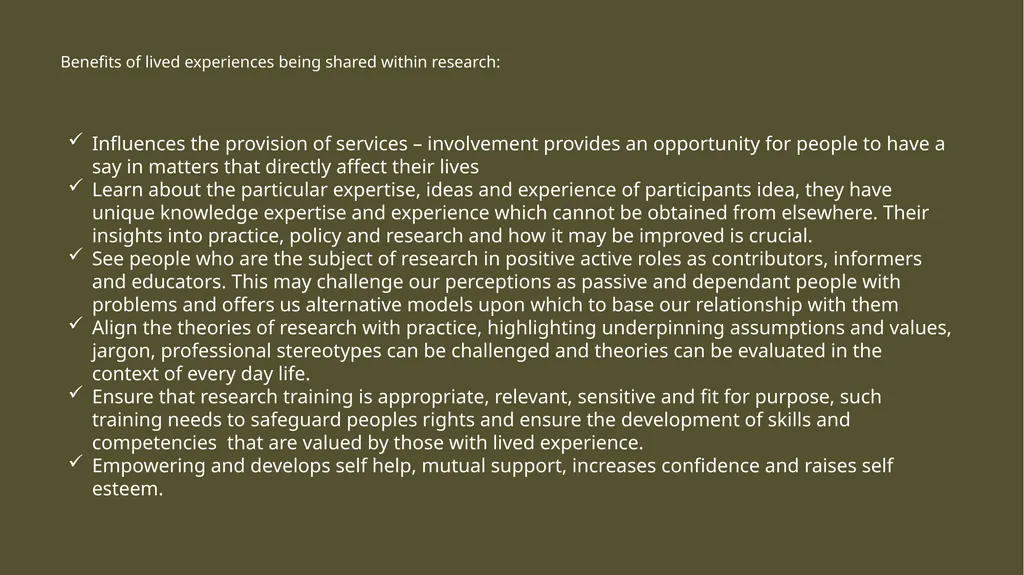
Benefits of lived experiences being shared within research: Influences the provision of services – involvement provides an opportunity for people to have a say in matters that directly affect their lives
Learn about the particular expertise, ideas and experience of participants idea, they have unique knowledge expertise and experience which cannot be obtained from elsewhere. Their insights into practice, policy and research and how it may be improved is crucial.
See people who are the subject of research in positive active roles as contributors, informers and educators. This may challenge our perceptions as passive and dependant people with problems and offers us alternative models upon which to base our relationship with them
Align the theories of research with practice, highlighting underpinning assumptions and values, jargon, professional stereotypes can be challenged and theories can be evaluated in the context of every day life.
Ensure that research training is appropriate, relevant, sensitive and fit for purpose, such training needs to safeguard peoples rights and ensure the development of skills and competencies that are valued by those with lived experience.
Empowering and develops self help, mutual support, increases confidence and raises self esteem.<br>
Learn about the particular expertise, ideas and experience of participants idea, they have unique knowledge expertise and experience which cannot be obtained from elsewhere. Their insights into practice, policy and research and how it may be improved is crucial.
See people who are the subject of research in positive active roles as contributors, informers and educators. This may challenge our perceptions as passive and dependant people with problems and offers us alternative models upon which to base our relationship with them
Align the theories of research with practice, highlighting underpinning assumptions and values, jargon, professional stereotypes can be challenged and theories can be evaluated in the context of every day life.
Ensure that research training is appropriate, relevant, sensitive and fit for purpose, such training needs to safeguard peoples rights and ensure the development of skills and competencies that are valued by those with lived experience.
Empowering and develops self help, mutual support, increases confidence and raises self esteem.<br>
09
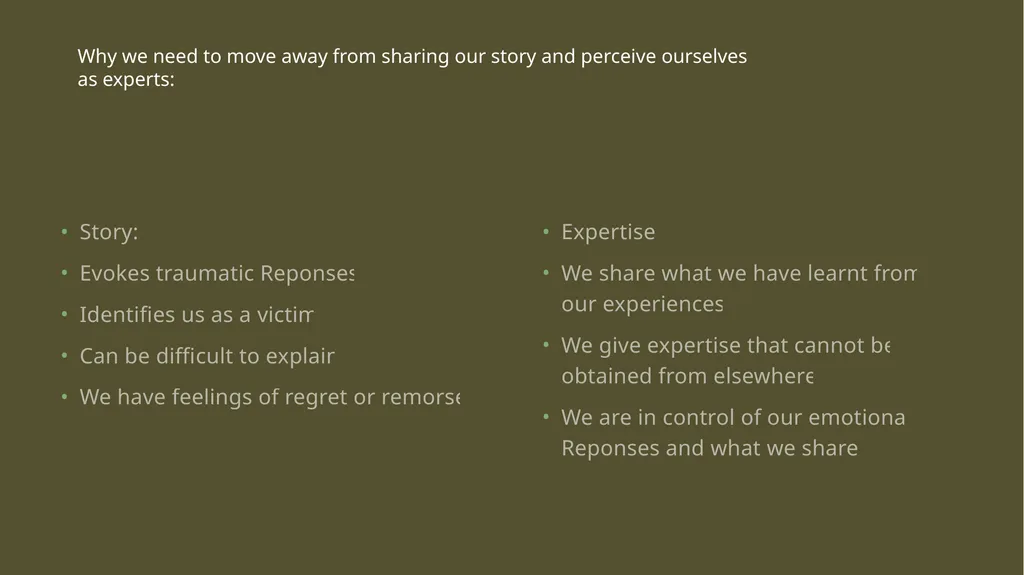
Why we need to move away from sharing our story and perceive ourselves as experts: Story:
Evokes traumatic Reponses
Identifies us as a victim
Can be difficult to explain
We have feelings of regret or remorse Expertise
We share what we have learnt from our experiences
We give expertise that cannot be obtained from elsewhere
We are in control of our emotional Reponses and what we share.<br>
Evokes traumatic Reponses
Identifies us as a victim
Can be difficult to explain
We have feelings of regret or remorse Expertise
We share what we have learnt from our experiences
We give expertise that cannot be obtained from elsewhere
We are in control of our emotional Reponses and what we share.<br>
10
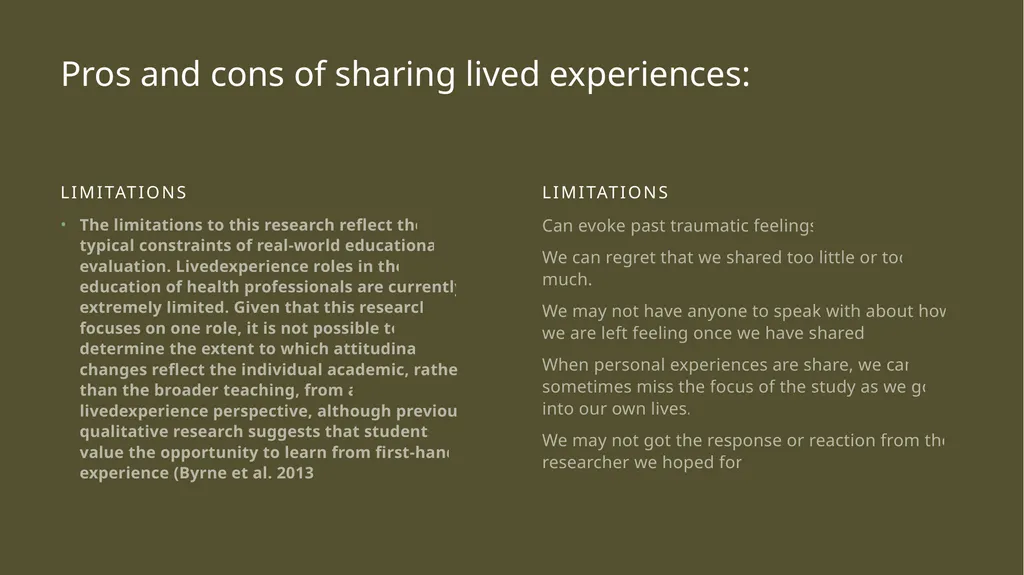
Pros and cons of sharing lived experiences: Limitations The limitations to this research reflect the typical constraints of real-world educational evaluation. Livedexperience roles in the education of health professionals are currently extremely limited. Given that this research focuses on one role, it is not possible to determine the extent to which attitudinal changes reflect the individual academic, rather than the broader teaching, from a livedexperience perspective, although previous qualitative research suggests that students value the opportunity to learn from first-hand experience (Byrne et al. 2013; Limitations Can evoke past traumatic feelings
We can regret that we shared too little or too much.
We may not have anyone to speak with about how we are left feeling once we have shared.
When personal experiences are share, we can sometimes miss the focus of the study as we go into our own lives.
We may not got the response or reaction from the researcher we hoped for.<br>
We can regret that we shared too little or too much.
We may not have anyone to speak with about how we are left feeling once we have shared.
When personal experiences are share, we can sometimes miss the focus of the study as we go into our own lives.
We may not got the response or reaction from the researcher we hoped for.<br>
11
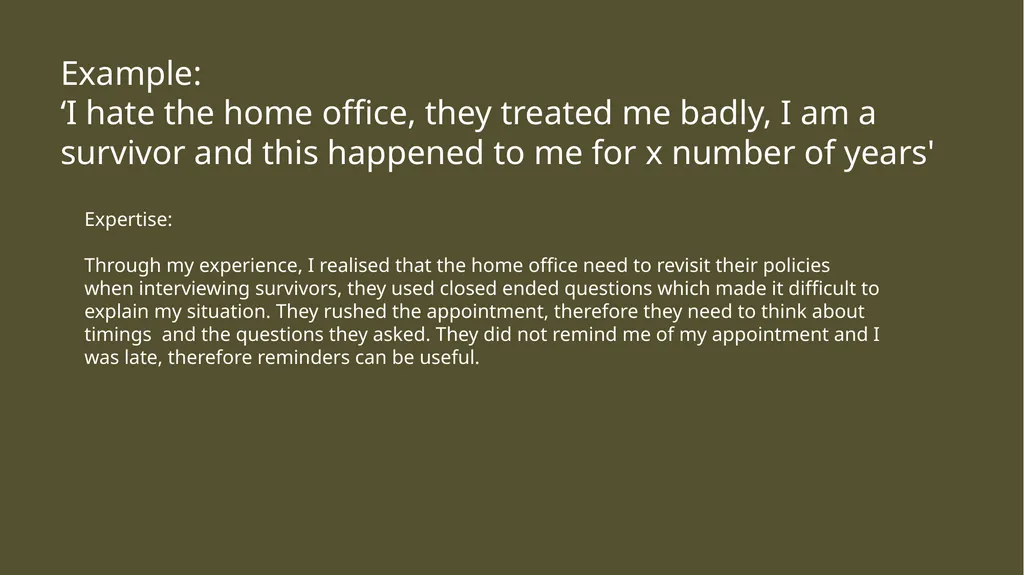
Example:
‘I hate the home office, they treated me badly, I am a survivor and this happened to me for x number of years' Expertise:
Through my experience, I realised that the home office need to revisit their policies when interviewing survivors, they used closed ended questions which made it difficult to explain my situation. They rushed the appointment, therefore they need to think about timings and the questions they asked. They did not remind me of my appointment and I was late, therefore reminders can be useful.<br>
Through my experience, I realised that the home office need to revisit their policies when interviewing survivors, they used closed ended questions which made it difficult to explain my situation. They rushed the appointment, therefore they need to think about timings and the questions they asked. They did not remind me of my appointment and I was late, therefore reminders can be useful.<br>
12
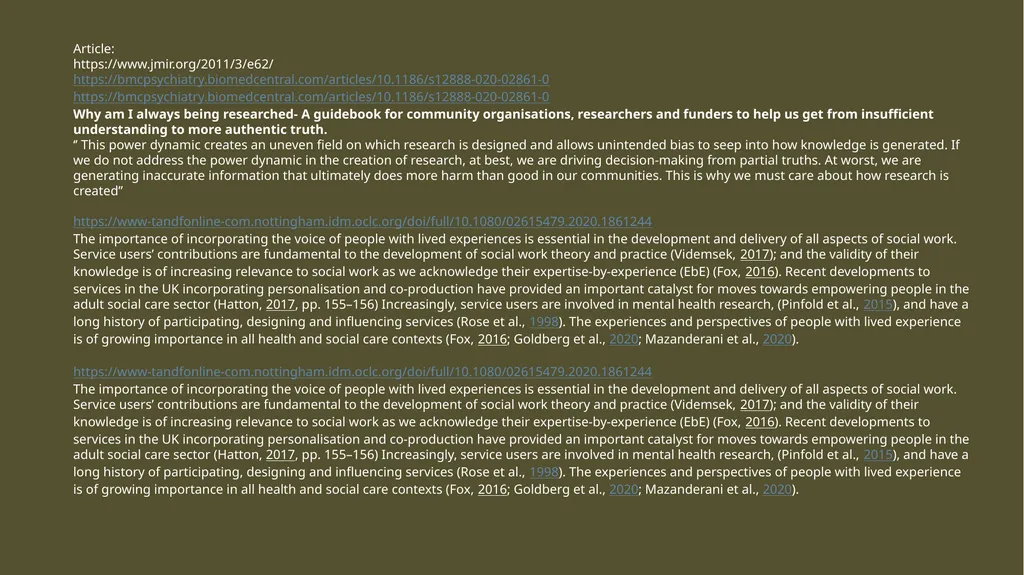
Article:
https://www.jmir.org/2011/3/e62/
https://bmcpsychiatry.biomedcentral.com/articles/10.1186/s12888-020-02861-0
https://bmcpsychiatry.biomedcentral.com/articles/10.1186/s12888-020-02861-0
Why am I always being researched- A guidebook for community organisations, researchers and funders to help us get from insufficient understanding to more authentic truth.
‘’ This power dynamic creates an uneven field on which research is designed and allows unintended bias to seep into how knowledge is generated. If we do not address the power dynamic in the creation of research, at best, we are driving decision-making from partial truths. At worst, we are generating inaccurate information that ultimately does more harm than good in our communities. This is why we must care about how research is created’’
https://www-tandfonline-com.nottingham.idm.oclc.org/doi/full/10.1080/02615479.2020.1861244
The importance of incorporating the voice of people with lived experiences is essential in the development and delivery of all aspects of social work. Service users’ contributions are fundamental to the development of social work theory and practice (Videmsek, 2017); and the validity of their knowledge is of increasing relevance to social work as we acknowledge their expertise-by-experience (EbE) (Fox, 2016). Recent developments to services in the UK incorporating personalisation and co-production have provided an important catalyst for moves towards empowering people in the adult social care sector (Hatton, 2017, pp. 155–156) Increasingly, service users are involved in mental health research, (Pinfold et al., 2015), and have a long history of participating, designing and influencing services (Rose et al., 1998). The experiences and perspectives of people with lived experience is of growing importance in all health and social care contexts (Fox, 2016; Goldberg et al., 2020; Mazanderani et al., 2020).
https://www-tandfonline-com.nottingham.idm.oclc.org/doi/full/10.1080/02615479.2020.1861244
The importance of incorporating the voice of people with lived experiences is essential in the development and delivery of all aspects of social work. Service users’ contributions are fundamental to the development of social work theory and practice (Videmsek, 2017); and the validity of their knowledge is of increasing relevance to social work as we acknowledge their expertise-by-experience (EbE) (Fox, 2016). Recent developments to services in the UK incorporating personalisation and co-production have provided an important catalyst for moves towards empowering people in the adult social care sector (Hatton, 2017, pp. 155–156) Increasingly, service users are involved in mental health research, (Pinfold et al., 2015), and have a long history of participating, designing and influencing services (Rose et al., 1998). The experiences and perspectives of people with lived experience is of growing importance in all health and social care contexts (Fox, 2016; Goldberg et al., 2020; Mazanderani et al., 2020).<br>
https://www.jmir.org/2011/3/e62/
https://bmcpsychiatry.biomedcentral.com/articles/10.1186/s12888-020-02861-0
https://bmcpsychiatry.biomedcentral.com/articles/10.1186/s12888-020-02861-0
Why am I always being researched- A guidebook for community organisations, researchers and funders to help us get from insufficient understanding to more authentic truth.
‘’ This power dynamic creates an uneven field on which research is designed and allows unintended bias to seep into how knowledge is generated. If we do not address the power dynamic in the creation of research, at best, we are driving decision-making from partial truths. At worst, we are generating inaccurate information that ultimately does more harm than good in our communities. This is why we must care about how research is created’’
https://www-tandfonline-com.nottingham.idm.oclc.org/doi/full/10.1080/02615479.2020.1861244
The importance of incorporating the voice of people with lived experiences is essential in the development and delivery of all aspects of social work. Service users’ contributions are fundamental to the development of social work theory and practice (Videmsek, 2017); and the validity of their knowledge is of increasing relevance to social work as we acknowledge their expertise-by-experience (EbE) (Fox, 2016). Recent developments to services in the UK incorporating personalisation and co-production have provided an important catalyst for moves towards empowering people in the adult social care sector (Hatton, 2017, pp. 155–156) Increasingly, service users are involved in mental health research, (Pinfold et al., 2015), and have a long history of participating, designing and influencing services (Rose et al., 1998). The experiences and perspectives of people with lived experience is of growing importance in all health and social care contexts (Fox, 2016; Goldberg et al., 2020; Mazanderani et al., 2020).
https://www-tandfonline-com.nottingham.idm.oclc.org/doi/full/10.1080/02615479.2020.1861244
The importance of incorporating the voice of people with lived experiences is essential in the development and delivery of all aspects of social work. Service users’ contributions are fundamental to the development of social work theory and practice (Videmsek, 2017); and the validity of their knowledge is of increasing relevance to social work as we acknowledge their expertise-by-experience (EbE) (Fox, 2016). Recent developments to services in the UK incorporating personalisation and co-production have provided an important catalyst for moves towards empowering people in the adult social care sector (Hatton, 2017, pp. 155–156) Increasingly, service users are involved in mental health research, (Pinfold et al., 2015), and have a long history of participating, designing and influencing services (Rose et al., 1998). The experiences and perspectives of people with lived experience is of growing importance in all health and social care contexts (Fox, 2016; Goldberg et al., 2020; Mazanderani et al., 2020).<br>
13
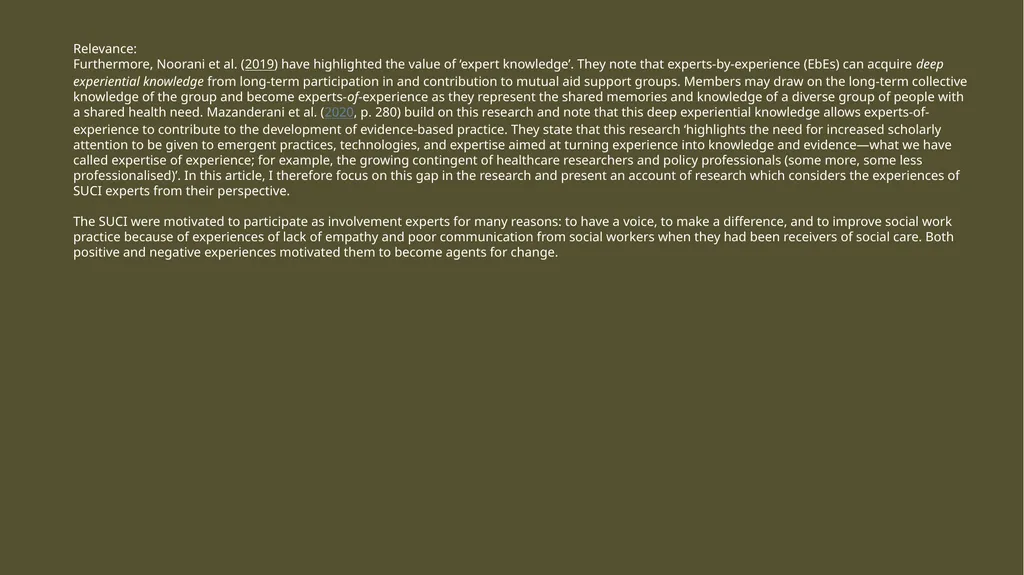
Relevance:
Furthermore, Noorani et al. (2019) have highlighted the value of ‘expert knowledge’. They note that experts-by-experience (EbEs) can acquire deep experiential knowledge from long-term participation in and contribution to mutual aid support groups. Members may draw on the long-term collective knowledge of the group and become experts-of-experience as they represent the shared memories and knowledge of a diverse group of people with a shared health need. Mazanderani et al. (2020, p. 280) build on this research and note that this deep experiential knowledge allows experts-of-experience to contribute to the development of evidence-based practice. They state that this research ‘highlights the need for increased scholarly attention to be given to emergent practices, technologies, and expertise aimed at turning experience into knowledge and evidence—what we have called expertise of experience; for example, the growing contingent of healthcare researchers and policy professionals (some more, some less professionalised)’. In this article, I therefore focus on this gap in the research and present an account of research which considers the experiences of SUCI experts from their perspective.
The SUCI were motivated to participate as involvement experts for many reasons: to have a voice, to make a difference, and to improve social work practice because of experiences of lack of empathy and poor communication from social workers when they had been receivers of social care. Both positive and negative experiences motivated them to become agents for change.<br>
Furthermore, Noorani et al. (2019) have highlighted the value of ‘expert knowledge’. They note that experts-by-experience (EbEs) can acquire deep experiential knowledge from long-term participation in and contribution to mutual aid support groups. Members may draw on the long-term collective knowledge of the group and become experts-of-experience as they represent the shared memories and knowledge of a diverse group of people with a shared health need. Mazanderani et al. (2020, p. 280) build on this research and note that this deep experiential knowledge allows experts-of-experience to contribute to the development of evidence-based practice. They state that this research ‘highlights the need for increased scholarly attention to be given to emergent practices, technologies, and expertise aimed at turning experience into knowledge and evidence—what we have called expertise of experience; for example, the growing contingent of healthcare researchers and policy professionals (some more, some less professionalised)’. In this article, I therefore focus on this gap in the research and present an account of research which considers the experiences of SUCI experts from their perspective.
The SUCI were motivated to participate as involvement experts for many reasons: to have a voice, to make a difference, and to improve social work practice because of experiences of lack of empathy and poor communication from social workers when they had been receivers of social care. Both positive and negative experiences motivated them to become agents for change.<br>