Living things and their habitats Changing environments: seasonal changes and changes due to human activity Year 4 Age 8-9 For parents Thank you for supporting your childs learning in science. Before the session: Please read slide 2 so you
"Living things and their habitats Changing" is the property of its rightful owner. Permission is granted to
download and print the materials on this website for personal, non-commercial use only, and to display it
on your personal computer provided you do not modify the materials and that you retain all copyright
notices contained in the materials. By downloading content from our website, you accept the terms of this
agreement.
Presentation Transcript
01
Living things and their habitats Changing environments: seasonal changes and changes due to human activity Year 4
Age 8-9 For parents
Thank you for supporting your child’s learning in science.
Before the session:
Please read slide 2 so you know what your child is learning and what you need to get ready.
As an alternative to lined paper, slide 5 may be printed for your child to record on.
During the session:
Share the learning intentions on slide 2.
Support your child with the main activities on slides 3 to 6, as needed.
Slide 7 is a further, optional activity.
Slide 8 has a glossary of key terms.
Reviewing with your child:
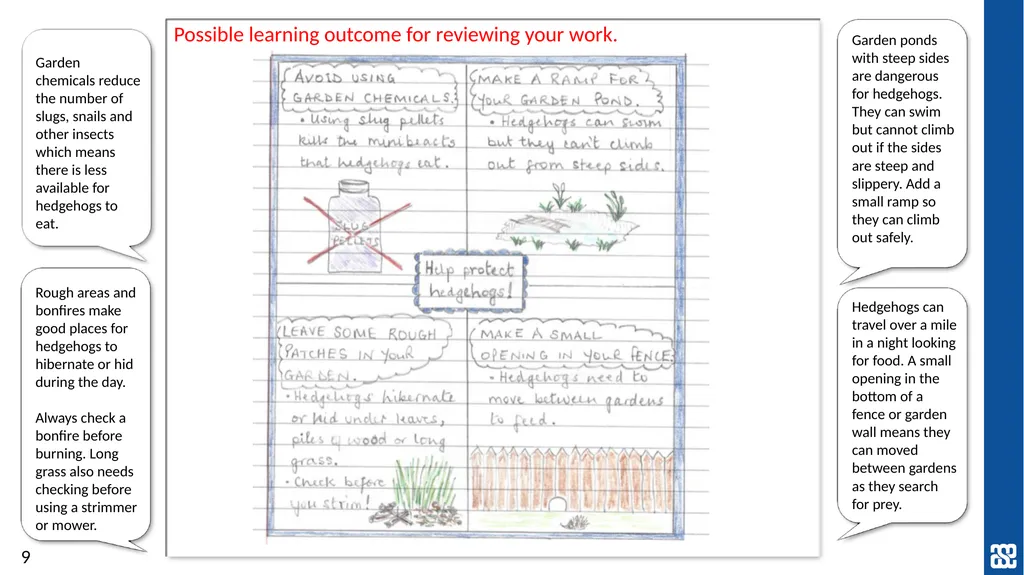
Slide 9 gives an idea of what your child may produce.<br>
02
Key Learning
Environments change with the seasons.
Living things may change their behaviour in different seasons. Some animals may hibernate.
Humans can cause the environment to change. This can be in a good way or in a bad way. There can be a positive or a negative human impact. Activities (pages 3-6): 30 - 40 mins
Use paper, a ruler and a pencil.
Alternatively, print page 6 as a worksheet.
Find out more… (page 7): 20 mins
You may like to find out more about water voles and their habitats. I can…
Describe how hedgehogs change their behaviour in different seasons.
Make a campaign poster for helping to protect hedgehogs and their habitats. Living things and their habitats Changing environments: seasonal changes and changes due to human activity Logo for section to sit inside roundel 2<br>
03
The hedgehog is one of the animals featured in the ‘food chain game’ you played last lesson.
Can you remember some of the food hedgehogs like to eat? Hedgehogs are omnivores, although they prefer minibeasts such as insects, slugs, snails and worms to berries!
Do you think they eat the same food all year round?
Talk or think about how the changing seasons might affect hedgehogs. 3 Explore, review, think, talk…. What do you already know about hedgehogs? (5 minutes) Logo for section to sit inside roundel 3<br>
04
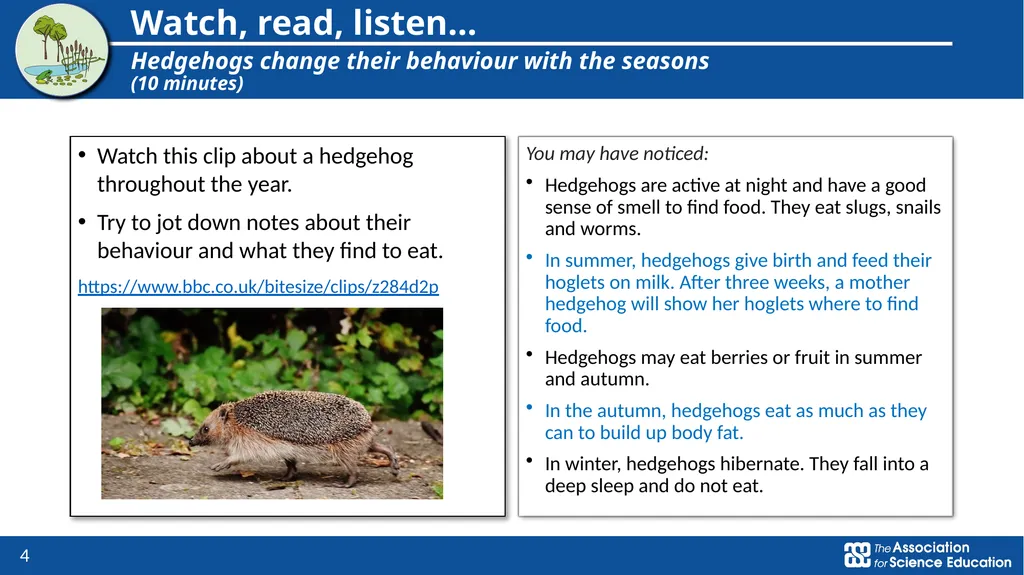
Watch this clip about a hedgehog throughout the year.
Try to jot down notes about their behaviour and what they find to eat.
https://www.bbc.co.uk/bitesize/clips/z284d2p You may have noticed:
Hedgehogs are active at night and have a good sense of smell to find food. They eat slugs, snails and worms.
In summer, hedgehogs give birth and feed their hoglets on milk. After three weeks, a mother hedgehog will show her hoglets where to find food.
Hedgehogs may eat berries or fruit in summer and autumn.
In the autumn, hedgehogs eat as much as they can to build up body fat.
In winter, hedgehogs hibernate. They fall into a deep sleep and do not eat. Watch, read, listen… Hedgehogs change their behaviour with the seasons (10 minutes) Logo for section to sit inside roundel 4<br>
05
It is estimated there were 30 million hedgehogs in the UK in the 1950s.
A recent survey suggests there are now between 1 and 1.5 million hedgehogs.
Can you think of reasons why hedgehog numbers have fallen? Organisations such as People’s Trust for Endangered Species (PTES) and the British Hedgehog Preservation Society campaign for the protection of hedgehogs and their habitats.
Find out about their work:
https://ptes.org/campaigns/hedgehogs/
https://www.britishhedgehogs.org.uk/
Design a campaign poster to support making gardens more ‘hedgehog friendly’. You may like to look at the ideas on the next slide to help you. Hedgehogs under threat – human impact Design a campaign poster to support making gardens more ‘hedgehog friendly’ (page 5-6: 30 minutes) Logo for section to sit inside roundel 4<br>
06
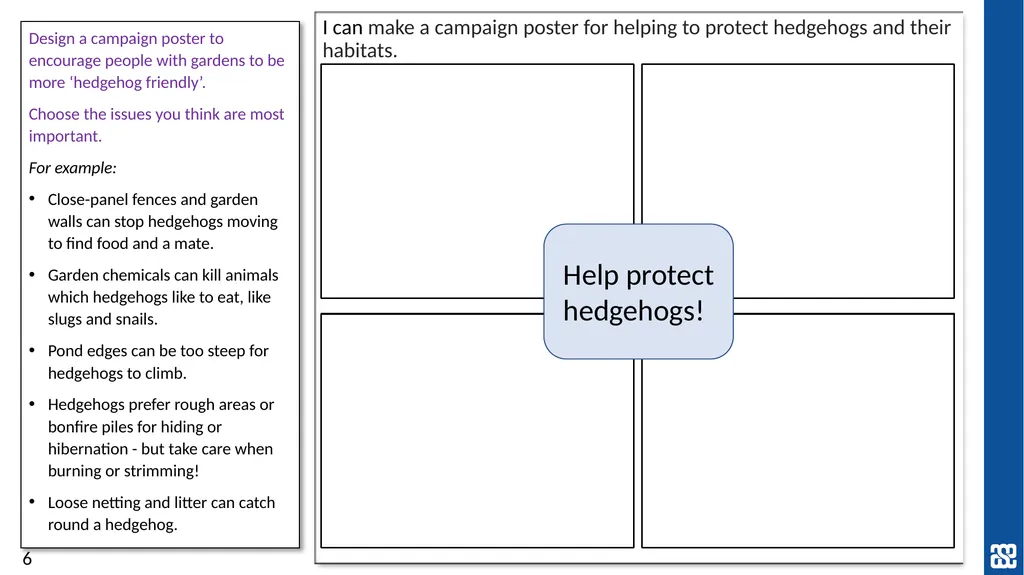
Design a campaign poster to encourage people with gardens to be more ‘hedgehog friendly’.
Choose the issues you think are most important.
For example:
Close-panel fences and garden walls can stop hedgehogs moving to find food and a mate.
Garden chemicals can kill animals which hedgehogs like to eat, like slugs and snails.
Pond edges can be too steep for hedgehogs to climb.
Hedgehogs prefer rough areas or bonfire piles for hiding or hibernation - but take care when burning or strimming!
Loose netting and litter can catch round a hedgehog. I can make a campaign poster for helping to protect hedgehogs and their habitats. 6<br>
07
You may like to find out more about other habitats in the UK which have been threatened by human activity.
For example, the water vole habitat:
https://www.bbc.co.uk/bitesize/clips/z2ynvcw Organisations such as the Wildlife Trusts in the UK are involved with protecting water vole habitats.
https://www.wildlifetrusts.org/wildlife-and-wild-places/saving-species/water-voles
The website has a variety of short clips and information about work going on across the UK. Find out more about threatened habitats Explore other habitats in the UK which are threatened by human activity Logo for section to sit inside roundel 7<br>
08
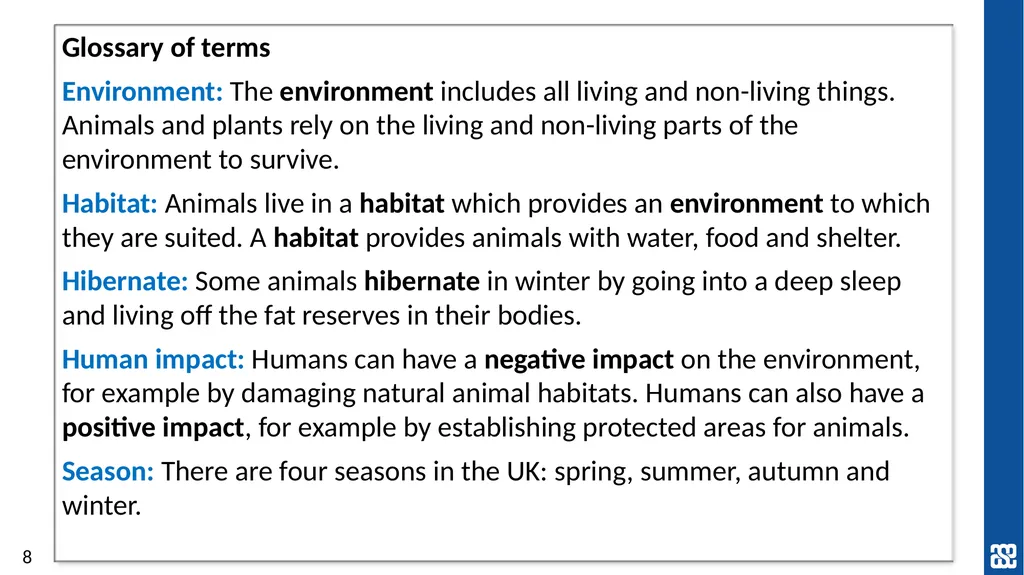
Glossary of terms
Environment: The environment includes all living and non-living things. Animals and plants rely on the living and non-living parts of the environment to survive.
Habitat: Animals live in a habitat which provides an environment to which they are suited. A habitat provides animals with water, food and shelter.
Hibernate: Some animals hibernate in winter by going into a deep sleep and living off the fat reserves in their bodies.
Human impact: Humans can have a negative impact on the environment, for example by damaging natural animal habitats. Humans can also have a positive impact, for example by establishing protected areas for animals.
Season: There are four seasons in the UK: spring, summer, autumn and winter. 8<br>
09
Possible learning outcome for reviewing your work. 9<br>