Local Government Learning Outcomes Participants will be able to: Discuss the different roles of local government Understand participatory planning Understand integrated approach to urban development Explain and use holistic human settlement
"Local Government Learning Outcomes Participants" is the property of its rightful owner. Permission is granted to
download and print the materials on this website for personal, non-commercial use only, and to display it
on your personal computer provided you do not modify the materials and that you retain all copyright
notices contained in the materials. By downloading content from our website, you accept the terms of this
agreement.
Presentation Transcript
01
Local Government<br>
02
Learning Outcomes Participants will be able to:
Discuss the different roles of local government
Understand participatory planning
Understand integrated approach to urban development
Explain and use holistic human settlement strategies 2<br>
03
Structure of the Module Overview of local governments in Africa and the urban challenges and opportunities to which local governments need to respond
Two key approaches to responding to these challenges: participatory planning and an integrated approach to urban development
Holistic human settlement strategies
Mobilizing financial resources and partnerships 3<br>
04
Urban Growth in Africa ‘Unlike urbanization in some parts of the world, rapid urban population growth in Africa (with the possible exception of North Africa and South Africa) is largely taking place in countries and regions where there has not been rapid industrialization and economic development. This has resulted in urbanization in Africa taking on a different form to urbanization in many other parts of the world.’
>>Questions:
What is the different form of urban growth in Africa, which is so different from that in industrialized countries?
What kinds of challenge does it entail? 4<br>
05
An Optimistic Viewpoint ‘Some people who study urban development have seen this transformation of the African city as a cultural rebirth, as the genuine Africanization of the African city. They argue that African cities have become creative centres where new forms of culture and new types of community associations are emerging.’
>>Question:
What is you response to this; is it a valid or a romantic view? 5<br>
06
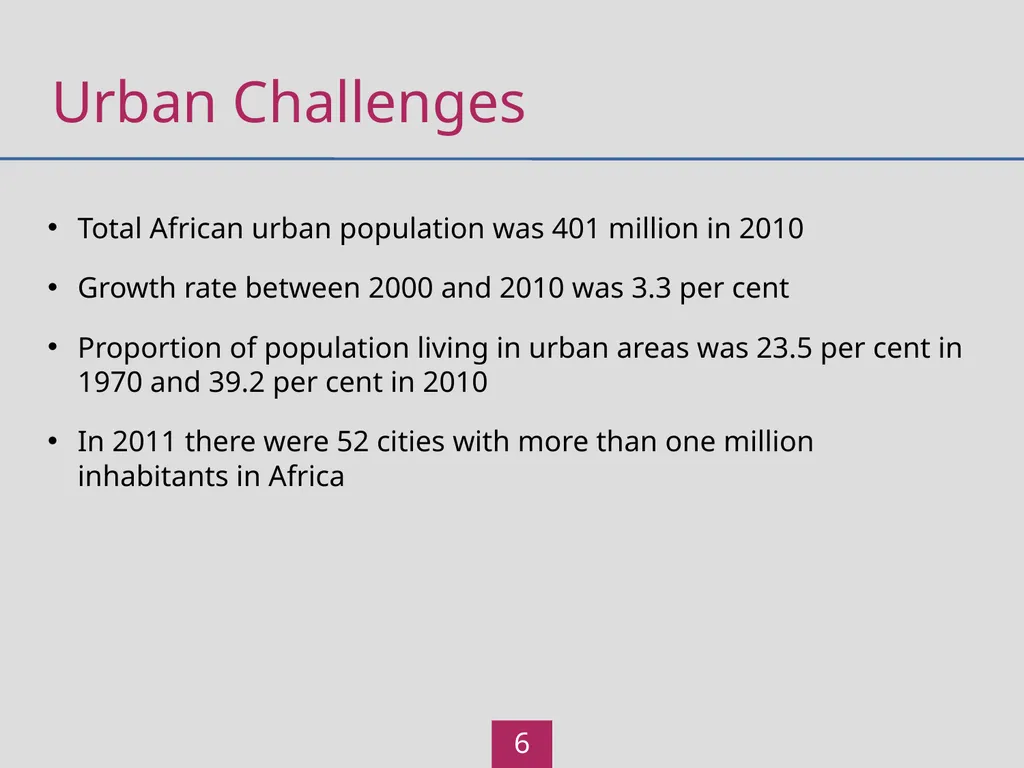
Urban Challenges Total African urban population was 401 million in 2010
Growth rate between 2000 and 2010 was 3.3 per cent
Proportion of population living in urban areas was 23.5 per cent in 1970 and 39.2 per cent in 2010
In 2011 there were 52 cities with more than one million inhabitants in Africa 6<br>
07
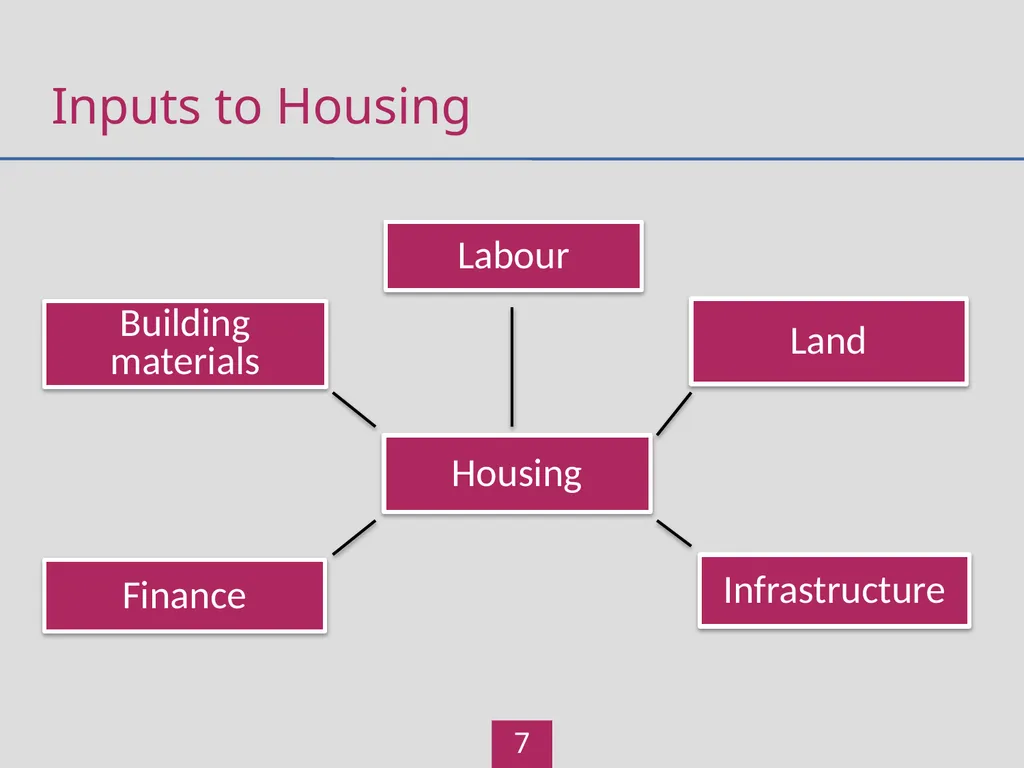
Inputs to Housing 7<br>
08
Challenges ‘Local governments in Africa generally have severe capacity and resources constraints, for example in terms of staff and finances, and they face major challenges in fulfilling their role.’
>>Questions:
What is the situation in your own country?
How effective are they in attempting to overcome these challenges? 8<br>
09
Transformation of Local Government ‘There has also been significant transformation of local government in Africa in recent decades, with an emphasis on decentralization, combined with corporatisation/privatisation and partnerships with various actors, including communities.’
>>Questions:
What is the situation in your own country?
What is the level of engagement with key stakeholders, such as civil society?
What is the level of decentralization? 9<br>
10
Local Government Functions ‘While all local government bodies have at least some responsibility for functions such as urban planning and refuse collection, only some local government bodies have responsibility for important functions such as water supply, roads and electricity.’
>>Questions:
What is the situation in your own country?
Has a diagnostic study been carried out to decide which functions are best carried out at local and central levels?
Are the local authorities involved in the provision of housing for the poor and in urban planning? 10<br>
11
Public-private Model of Urban Management There has been a shift to privatization and public-private partnerships
In some countries public services have been privatized and projects are structured as public-private partnerships
>>Questions:
What functions do central and local governments, private sector and NGOs play in this model?
What is the balance between them in your country?
Are there any potential risks? 11<br>
12
Participatory Planning ‘How can local government address the challenges of improving inadequate living conditions and building on the creativity of communities?’
‘It is important that interventions are planned in a participatory way, and that an integrated approach to urban development is adopted.’
Questions:
How do you understand participatory approaches in urban development initiatives?
Can you think of examples in the context of housing for the urban poor? 12<br>
13
Preconditions for Successful Community Participation Undertaking civic and human rights education and training programmes (Through what channels?)
Establishing regular and broad-based consultative mechanisms (In what formats?)
Establishing agenda-setting participatory mechanisms (In what formats?) 13<br>
14
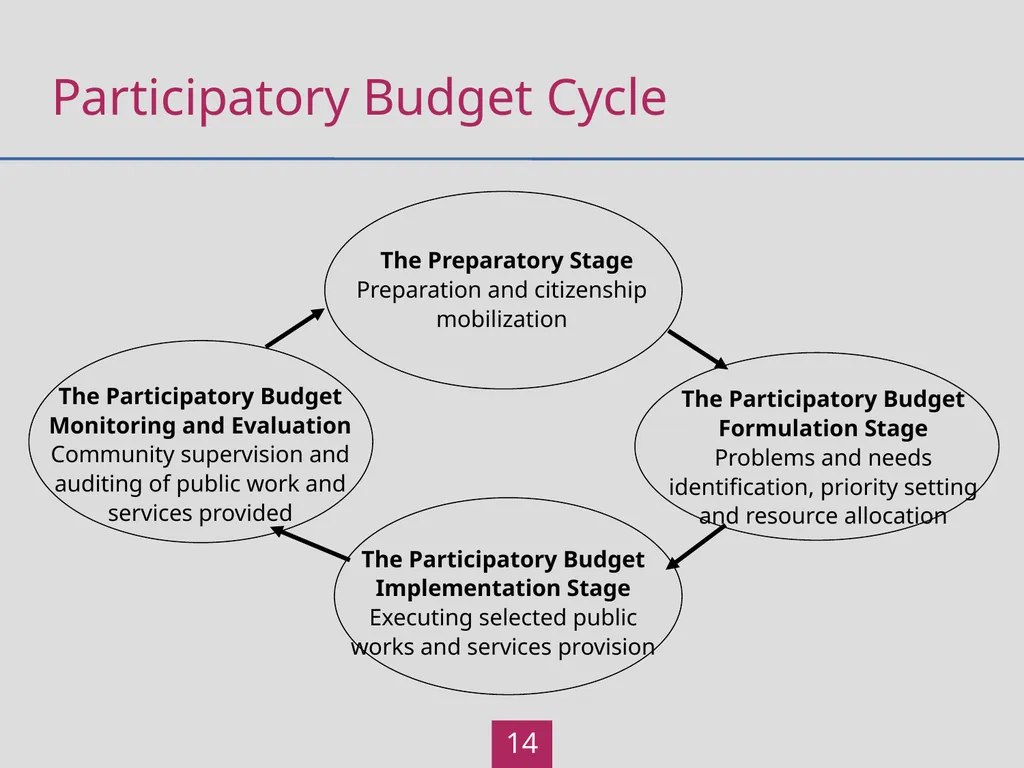
Participatory Budget Cycle 14<br>
15
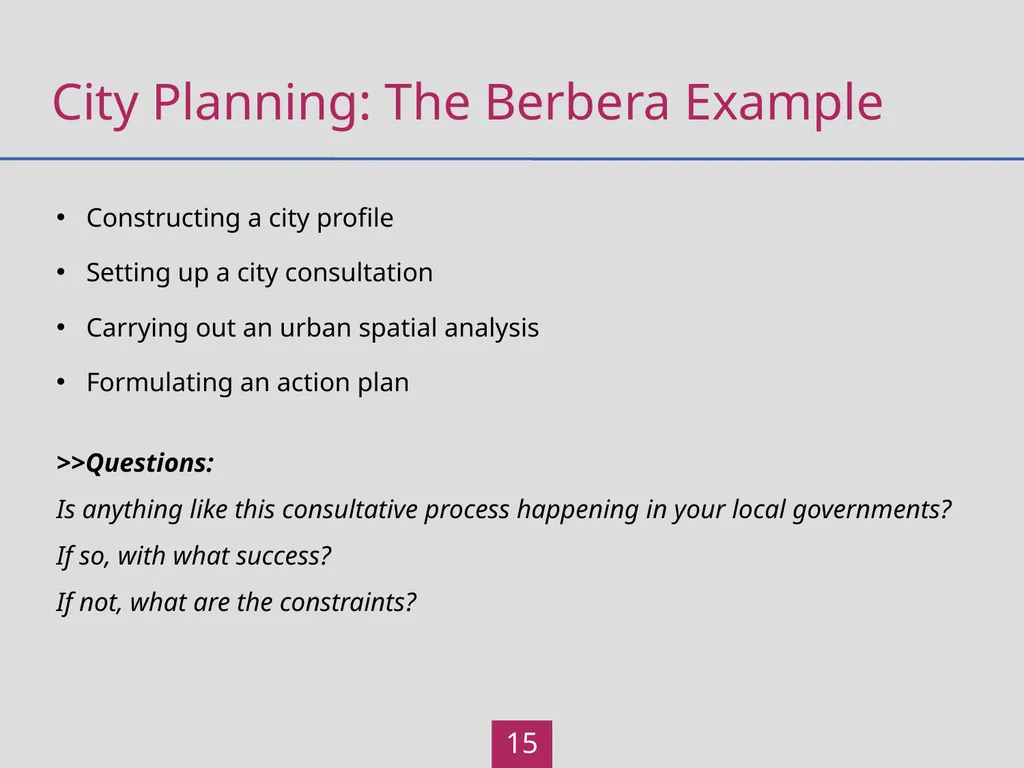
City Planning: The Berbera Example Constructing a city profile
Setting up a city consultation
Carrying out an urban spatial analysis
Formulating an action plan
>>Questions:
Is anything like this consultative process happening in your local governments?
If so, with what success?
If not, what are the constraints? 15<br>
16
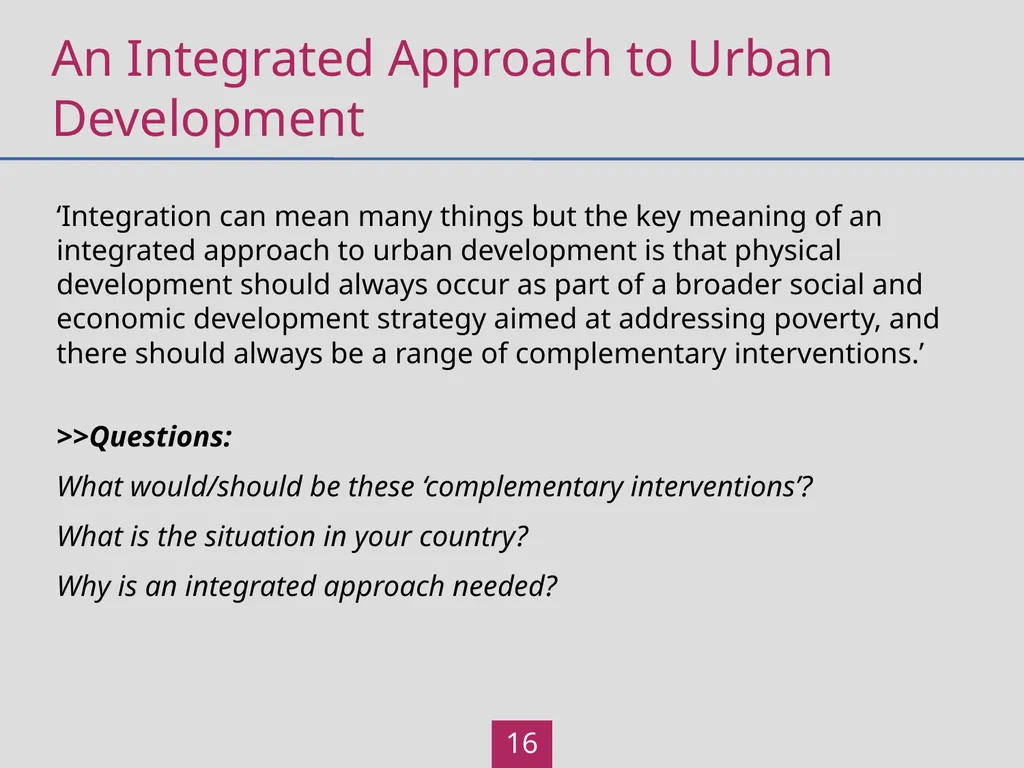
An Integrated Approach to Urban Development ‘Integration can mean many things but the key meaning of an integrated approach to urban development is that physical development should always occur as part of a broader social and economic development strategy aimed at addressing poverty, and there should always be a range of complementary interventions.’
>>Questions:
What would/should be these ‘complementary interventions’?
What is the situation in your country?
Why is an integrated approach needed? 16<br>
17
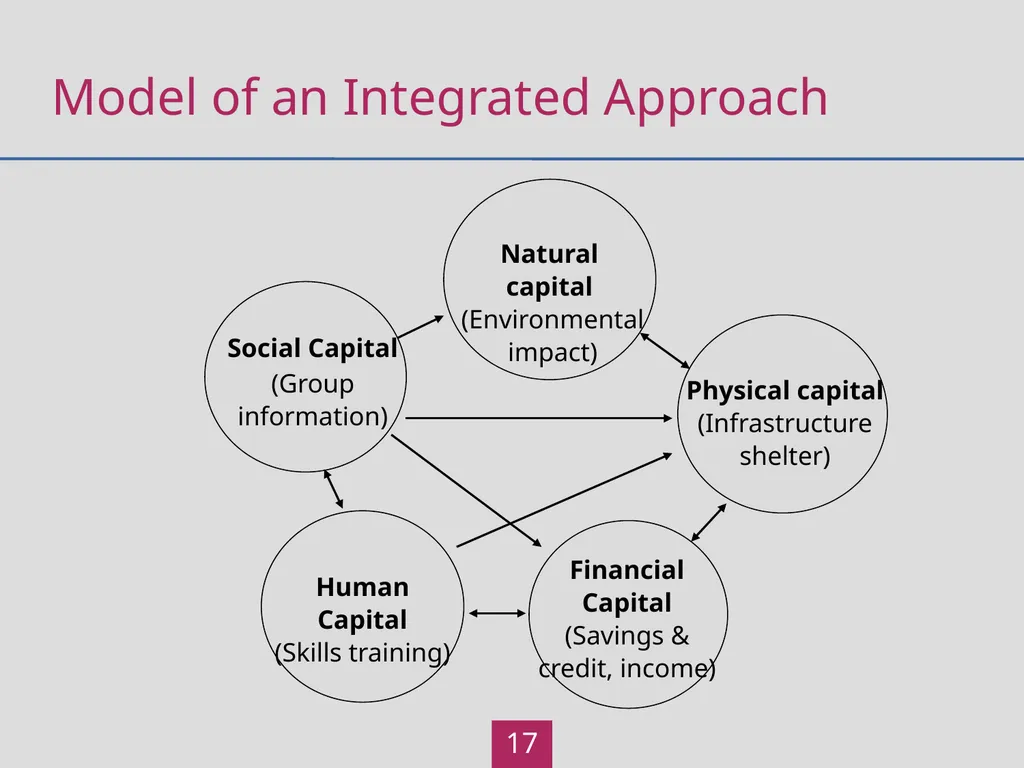
Model of an Integrated Approach 17 Social Capital
(Group information) Natural capital
(Environmental impact) Physical capital
(Infrastructure shelter) Human Capital
(Skills training) Financial Capital
(Savings & credit, income)<br>
18
Local Government Holistic Human Settlement Strategies Need to include:
Spatial/transport planning and land use management
Ensuring access to land
Ensuring access to basic infrastructure and services
Facilitating community-based production of housing
>>Questions:
Do these types of strategies exist in your local governments?
Where they developed in a participatory way?
Can you think of other elements for the strategies? 18<br>
19
Mobilizing Financial Resources Direct user charges: for example, for water provision
Transfers from central government: unconditional or conditional
Property tax: needs a land information system
Development charges: on developers, for financing infrastructure made necessary by the development
Loans: from municipal loan funds or from financial institutions
>>Questions:
What other ways do local governments have for raising funds?
What are the advantages and disadvantages of the different methods? 19<br>
20
Partnerships With private sector: to deliver and fund public sector services
With community organizations: as a way of mobilizing additional capacity and resources
>>Questions:
What are the advantages or disadvantages of such partnerships with local governments?
To what extent are such partnerships in your country following the guidelines set out in the Guide? 20<br>
21
Conclusions Local government has been transformed by decentralization, privatization, and partnerships
Participatory planning and integrated approach to urban development are key approaches to responding to challenges urbanization poses
Local governments should use holistic human settlement strategies
In order to do so, financial resources and capacity for delivery need to be mobilized 21<br>