
Logic & Critical Reasoning Informal Fallacy Guide
LS
Published · 48 slides · 0 views
1 / 1
Description
Logic Critical Reasoning Informal Fallacy Guide Evaluating Arguments The primary task of critical thinking is to identify arguments and to evaluate them. There are two basic ways of evaluating arguments. One technique is to evaluate the
Related Topics
Share
Embed code
Download this presentation From Below
"Logic & Critical Reasoning Informal Fallacy Guide" is the property of its rightful owner. Permission is granted to download and print the materials on this website for personal, non-commercial use only, and to display it on your personal computer provided you do not modify the materials and that you retain all copyright notices contained in the materials. By downloading content from our website, you accept the terms of this agreement.
Presentation Transcript
01
Logic & Critical Reasoning Informal Fallacy Guide<br>
02
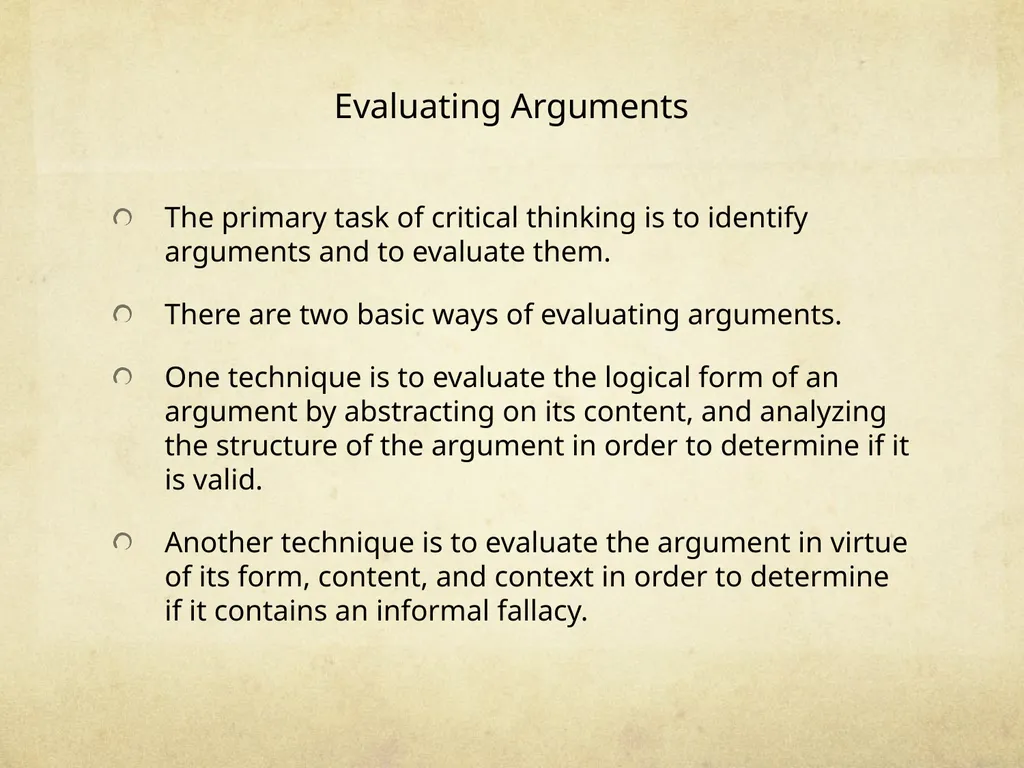
Evaluating Arguments The primary task of critical thinking is to identify arguments and to evaluate them.
There are two basic ways of evaluating arguments.
One technique is to evaluate the logical form of an argument by abstracting on its content, and analyzing the structure of the argument in order to determine if it is valid.
Another technique is to evaluate the argument in virtue of its form, content, and context in order to determine if it contains an informal fallacy.<br>
There are two basic ways of evaluating arguments.
One technique is to evaluate the logical form of an argument by abstracting on its content, and analyzing the structure of the argument in order to determine if it is valid.
Another technique is to evaluate the argument in virtue of its form, content, and context in order to determine if it contains an informal fallacy.<br>
03
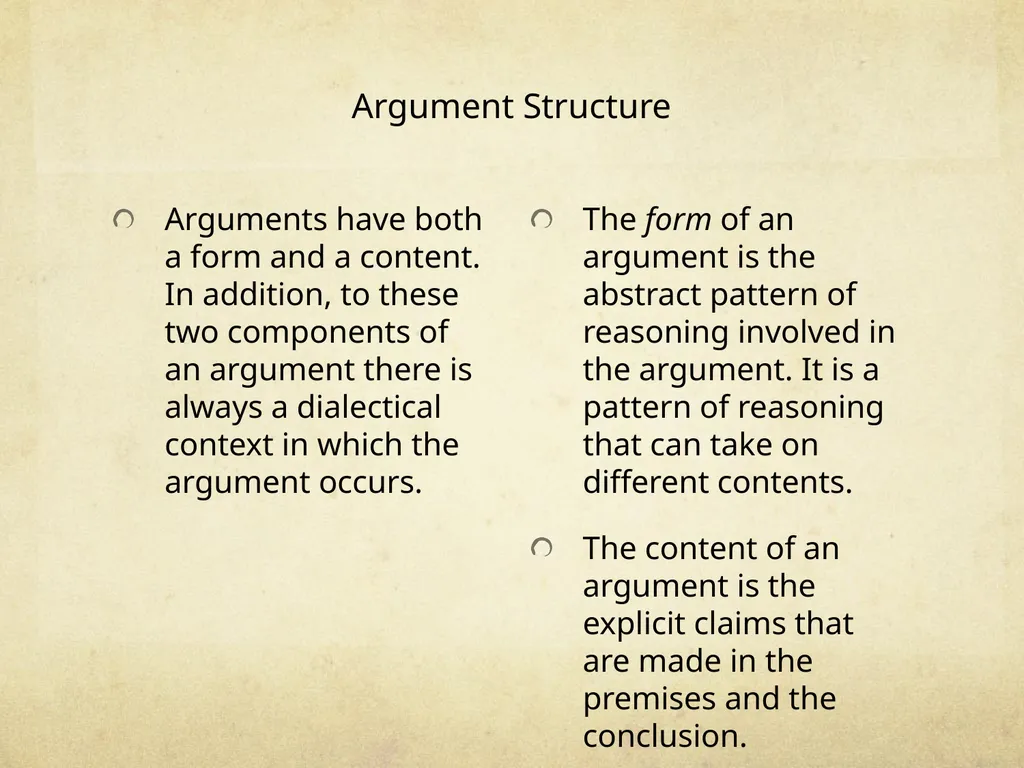
Argument Structure Arguments have both a form and a content. In addition, to these two components of an argument there is always a dialectical context in which the argument occurs. The form of an argument is the abstract pattern of reasoning involved in the argument. It is a pattern of reasoning that can take on different contents.
The content of an argument is the explicit claims that are made in the premises and the conclusion.<br>
The content of an argument is the explicit claims that are made in the premises and the conclusion.<br>
04
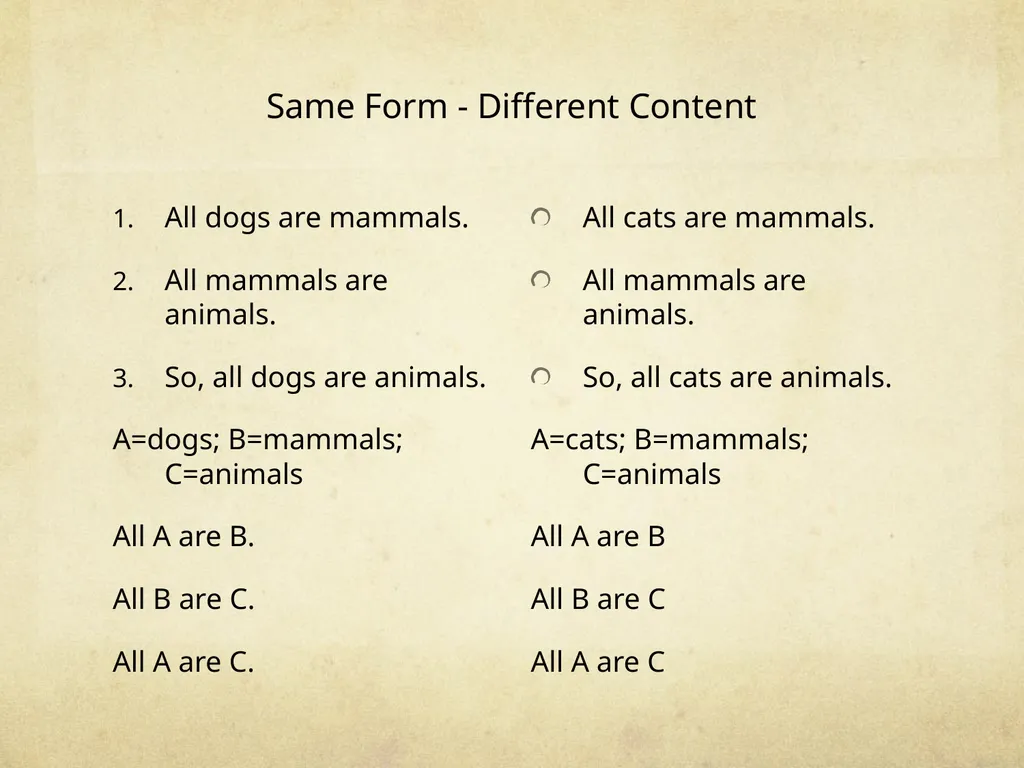
Same Form - Different Content All dogs are mammals.
All mammals are animals.
So, all dogs are animals.
A=dogs; B=mammals; C=animals
All A are B.
All B are C.
All A are C. All cats are mammals.
All mammals are animals.
So, all cats are animals.
A=cats; B=mammals; C=animals
All A are B
All B are C
All A are C<br>
All mammals are animals.
So, all dogs are animals.
A=dogs; B=mammals; C=animals
All A are B.
All B are C.
All A are C. All cats are mammals.
All mammals are animals.
So, all cats are animals.
A=cats; B=mammals; C=animals
All A are B
All B are C
All A are C<br>
05
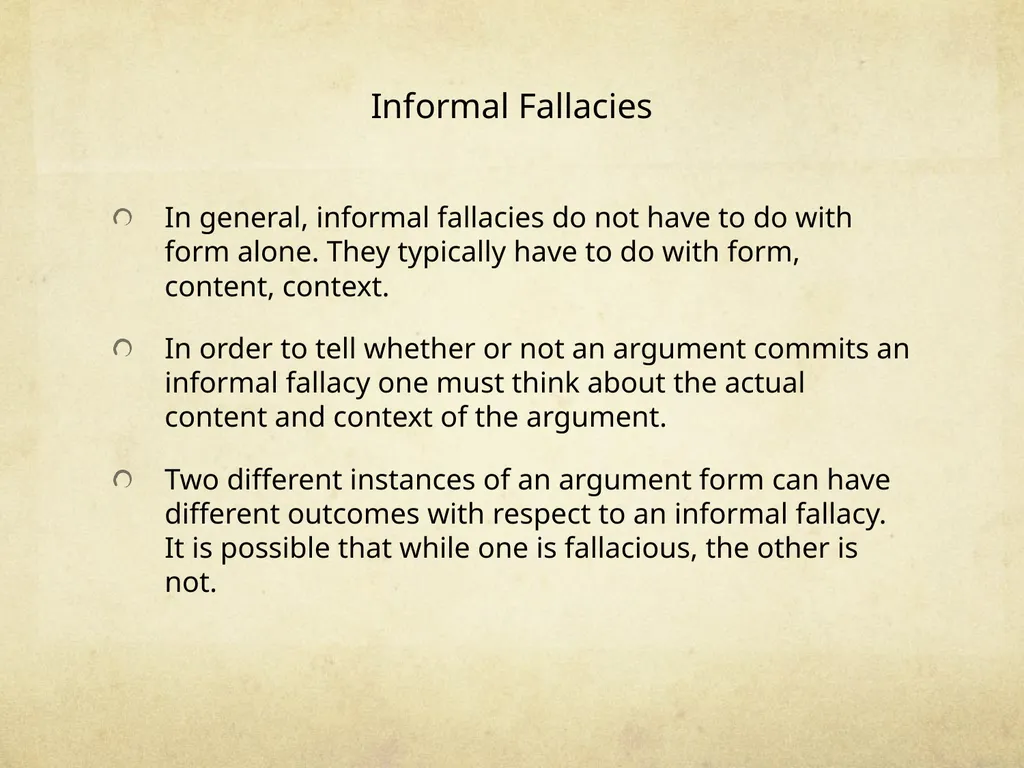
Informal Fallacies In general, informal fallacies do not have to do with form alone. They typically have to do with form, content, context.
In order to tell whether or not an argument commits an informal fallacy one must think about the actual content and context of the argument.
Two different instances of an argument form can have different outcomes with respect to an informal fallacy. It is possible that while one is fallacious, the other is not.<br>
In order to tell whether or not an argument commits an informal fallacy one must think about the actual content and context of the argument.
Two different instances of an argument form can have different outcomes with respect to an informal fallacy. It is possible that while one is fallacious, the other is not.<br>
06
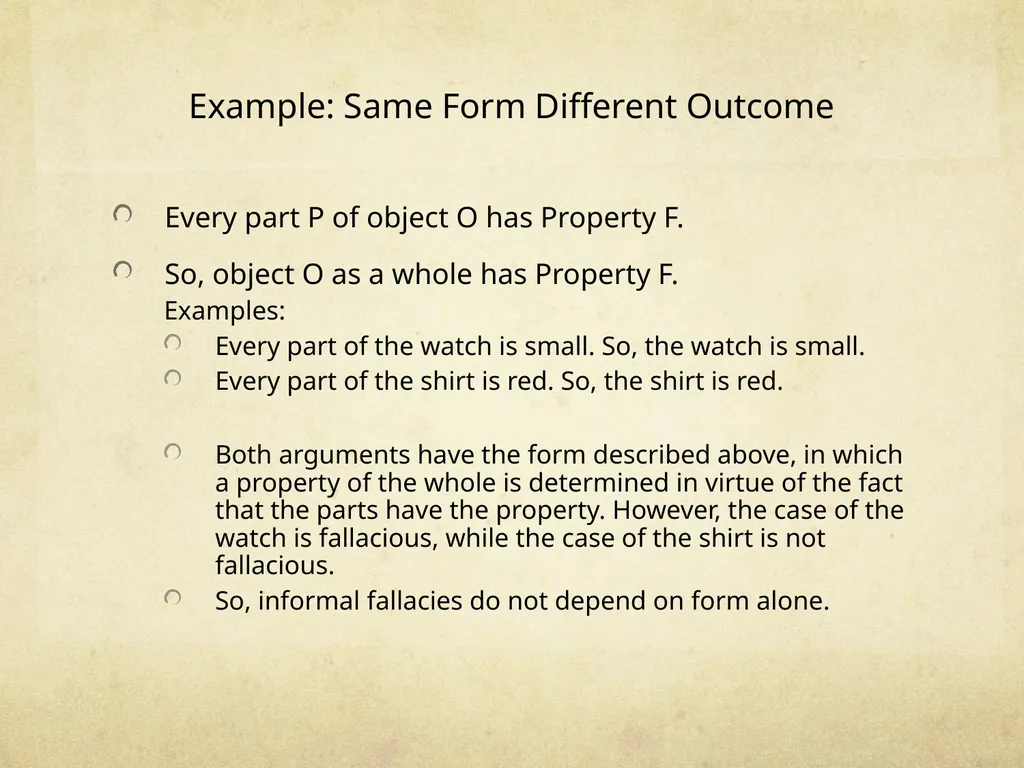
Example: Same Form Different Outcome Every part P of object O has Property F.
So, object O as a whole has Property F.
Examples:
Every part of the watch is small. So, the watch is small.
Every part of the shirt is red. So, the shirt is red.
Both arguments have the form described above, in which a property of the whole is determined in virtue of the fact that the parts have the property. However, the case of the watch is fallacious, while the case of the shirt is not fallacious.
So, informal fallacies do not depend on form alone.<br>
So, object O as a whole has Property F.
Examples:
Every part of the watch is small. So, the watch is small.
Every part of the shirt is red. So, the shirt is red.
Both arguments have the form described above, in which a property of the whole is determined in virtue of the fact that the parts have the property. However, the case of the watch is fallacious, while the case of the shirt is not fallacious.
So, informal fallacies do not depend on form alone.<br>
07
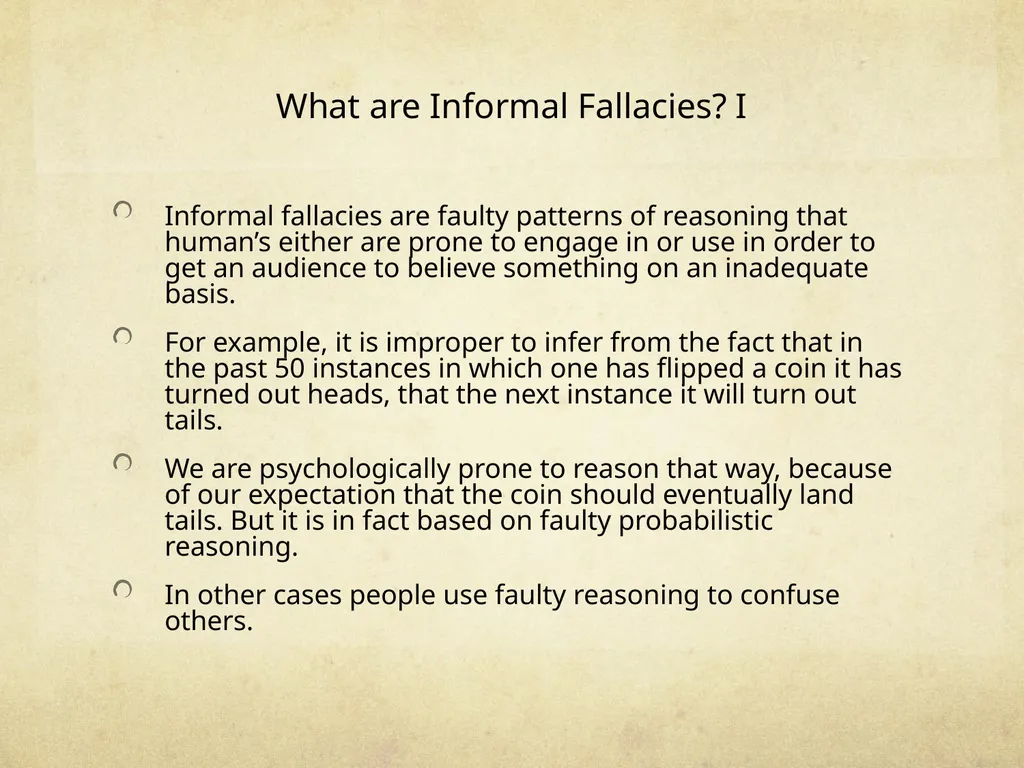
What are Informal Fallacies? I Informal fallacies are faulty patterns of reasoning that human’s either are prone to engage in or use in order to get an audience to believe something on an inadequate basis.
For example, it is improper to infer from the fact that in the past 50 instances in which one has flipped a coin it has turned out heads, that the next instance it will turn out tails.
We are psychologically prone to reason that way, because of our expectation that the coin should eventually land tails. But it is in fact based on faulty probabilistic reasoning.
In other cases people use faulty reasoning to confuse others.<br>
For example, it is improper to infer from the fact that in the past 50 instances in which one has flipped a coin it has turned out heads, that the next instance it will turn out tails.
We are psychologically prone to reason that way, because of our expectation that the coin should eventually land tails. But it is in fact based on faulty probabilistic reasoning.
In other cases people use faulty reasoning to confuse others.<br>
08
What are Informal Fallacies? II Often when one wants to convince someone of something it maybe easy to do so by engaging in a kind of faulty reasoning that will confuse the person into believing something they ought not to believe or by appealing to something that is inappropriate.
For example, one could say “you ought to vote for Jim, you wouldn’t want to get a broken leg.” Here the arguer appeals to force as a way to convince someone to vote for Jim.
However, we all recognize that force is not a legitimate reason why one should vote for someone. Rather, one should vote on the basis of the merits of the candidate.<br>
For example, one could say “you ought to vote for Jim, you wouldn’t want to get a broken leg.” Here the arguer appeals to force as a way to convince someone to vote for Jim.
However, we all recognize that force is not a legitimate reason why one should vote for someone. Rather, one should vote on the basis of the merits of the candidate.<br>
09
What are Informal Fallacies? III There are different kinds of informal fallacies:
Fallacies of relevance.
Fallacies weak induction.
Fallacies of presumption, ambiguity, and grammatical analogy.
However, there is no general theory of all the ways in which one can reason fallaciously.
A piece of reasoning can contain more than one fallacy.
Sometimes it is hard to determine what fallacies a passage contains because there is not enough information about the context.<br>
Fallacies of relevance.
Fallacies weak induction.
Fallacies of presumption, ambiguity, and grammatical analogy.
However, there is no general theory of all the ways in which one can reason fallaciously.
A piece of reasoning can contain more than one fallacy.
Sometimes it is hard to determine what fallacies a passage contains because there is not enough information about the context.<br>
10
Fallacies of Relevance Fallacies of relevance contain premises that are logically irrelevant to the conclusion, but are psychologically persuasive in some sense or other.
To say that the premises are logically irrelevant to the conclusion is to say that they do not support the conclusion. They appear to be irrelevant. The conclusion could be true or false, while the premises are false or true.
In locating a fallacy of relevance it is common to feel as if the premises intuitively do not support the conclusion.<br>
To say that the premises are logically irrelevant to the conclusion is to say that they do not support the conclusion. They appear to be irrelevant. The conclusion could be true or false, while the premises are false or true.
In locating a fallacy of relevance it is common to feel as if the premises intuitively do not support the conclusion.<br>
11
Fallacies of Relevance: Appeal to Force The fallacy of appeal to force occurs whenever the arguer attempts to get the audience to believe a conclusion or do something on the basis of a threat of harm or force.
Example:
You should vote for Jim because you wouldn’t want to come home and find your family murdered.
Threats can be both psychological and physical.
The appeal to force can occur between equals or non-equals in social hierarchies.<br>
Example:
You should vote for Jim because you wouldn’t want to come home and find your family murdered.
Threats can be both psychological and physical.
The appeal to force can occur between equals or non-equals in social hierarchies.<br>
12
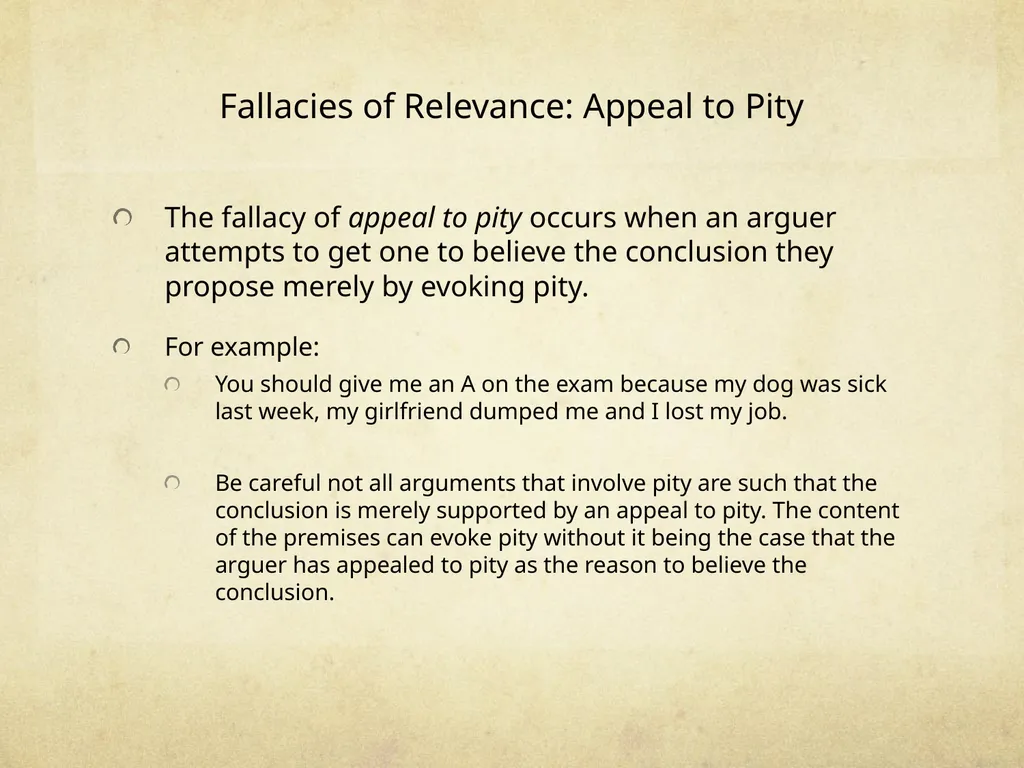
Fallacies of Relevance: Appeal to Pity The fallacy of appeal to pity occurs when an arguer attempts to get one to believe the conclusion they propose merely by evoking pity.
For example:
You should give me an A on the exam because my dog was sick last week, my girlfriend dumped me and I lost my job.
Be careful not all arguments that involve pity are such that the conclusion is merely supported by an appeal to pity. The content of the premises can evoke pity without it being the case that the arguer has appealed to pity as the reason to believe the conclusion.<br>
For example:
You should give me an A on the exam because my dog was sick last week, my girlfriend dumped me and I lost my job.
Be careful not all arguments that involve pity are such that the conclusion is merely supported by an appeal to pity. The content of the premises can evoke pity without it being the case that the arguer has appealed to pity as the reason to believe the conclusion.<br>
13
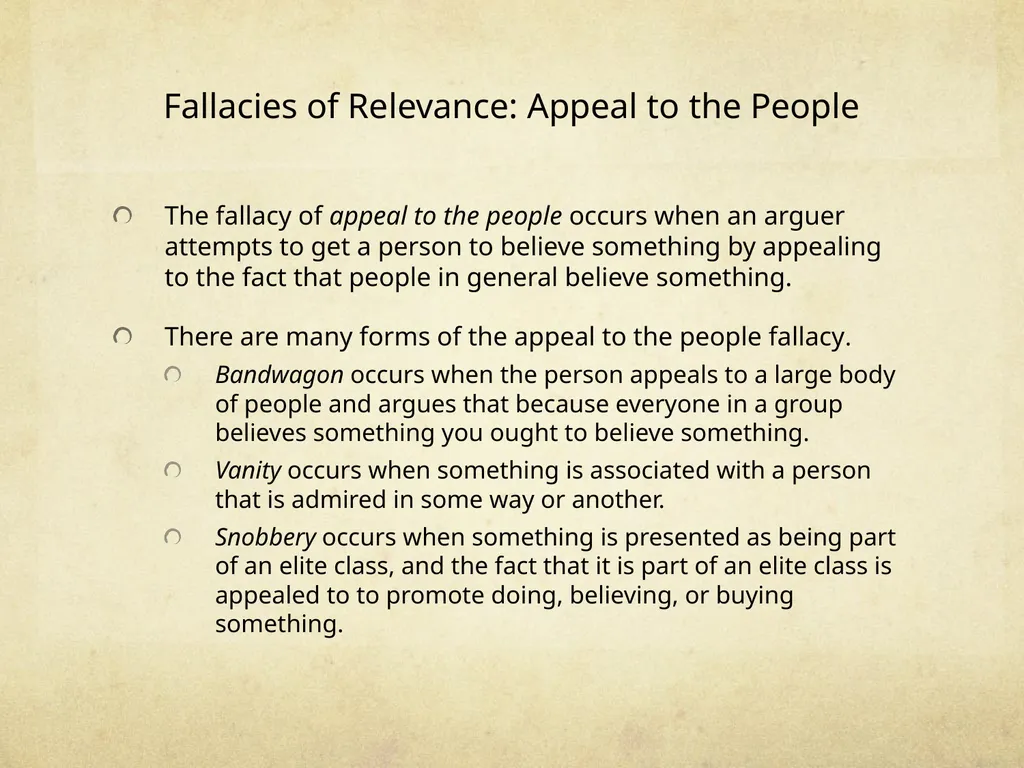
Fallacies of Relevance: Appeal to the People The fallacy of appeal to the people occurs when an arguer attempts to get a person to believe something by appealing to the fact that people in general believe something.
There are many forms of the appeal to the people fallacy.
Bandwagon occurs when the person appeals to a large body of people and argues that because everyone in a group believes something you ought to believe something.
Vanity occurs when something is associated with a person that is admired in some way or another.
Snobbery occurs when something is presented as being part of an elite class, and the fact that it is part of an elite class is appealed to to promote doing, believing, or buying something.<br>
There are many forms of the appeal to the people fallacy.
Bandwagon occurs when the person appeals to a large body of people and argues that because everyone in a group believes something you ought to believe something.
Vanity occurs when something is associated with a person that is admired in some way or another.
Snobbery occurs when something is presented as being part of an elite class, and the fact that it is part of an elite class is appealed to to promote doing, believing, or buying something.<br>
14
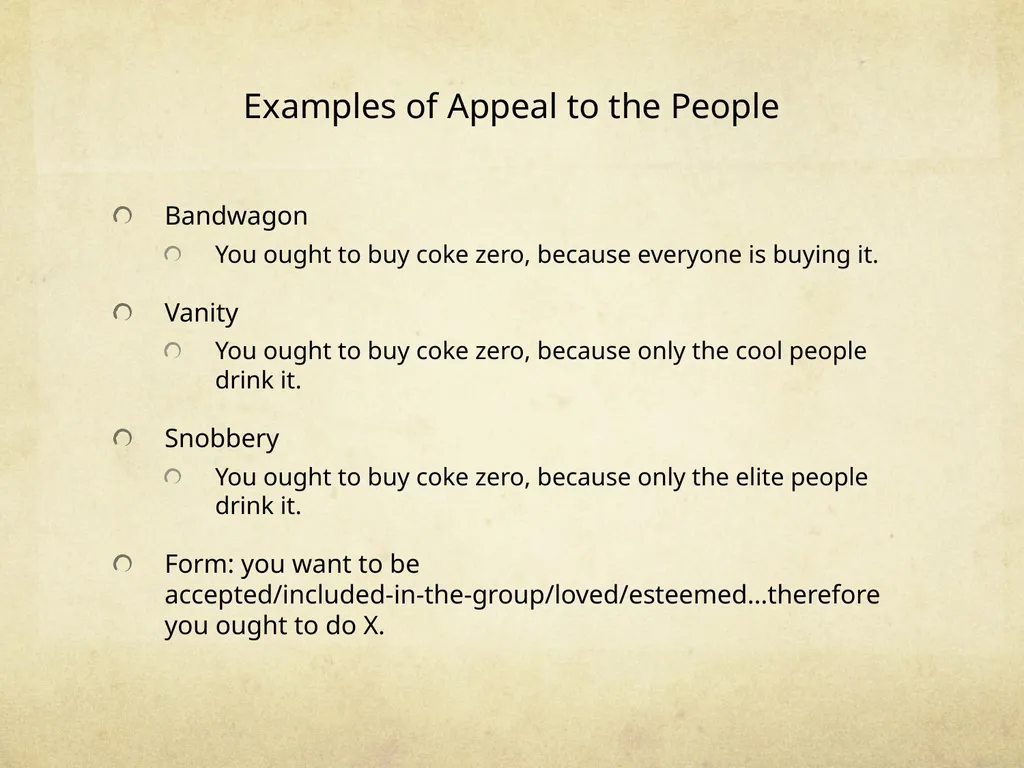
Examples of Appeal to the People Bandwagon
You ought to buy coke zero, because everyone is buying it.
Vanity
You ought to buy coke zero, because only the cool people drink it.
Snobbery
You ought to buy coke zero, because only the elite people drink it.
Form: you want to be accepted/included-in-the-group/loved/esteemed…therefore you ought to do X.<br>
You ought to buy coke zero, because everyone is buying it.
Vanity
You ought to buy coke zero, because only the cool people drink it.
Snobbery
You ought to buy coke zero, because only the elite people drink it.
Form: you want to be accepted/included-in-the-group/loved/esteemed…therefore you ought to do X.<br>
15
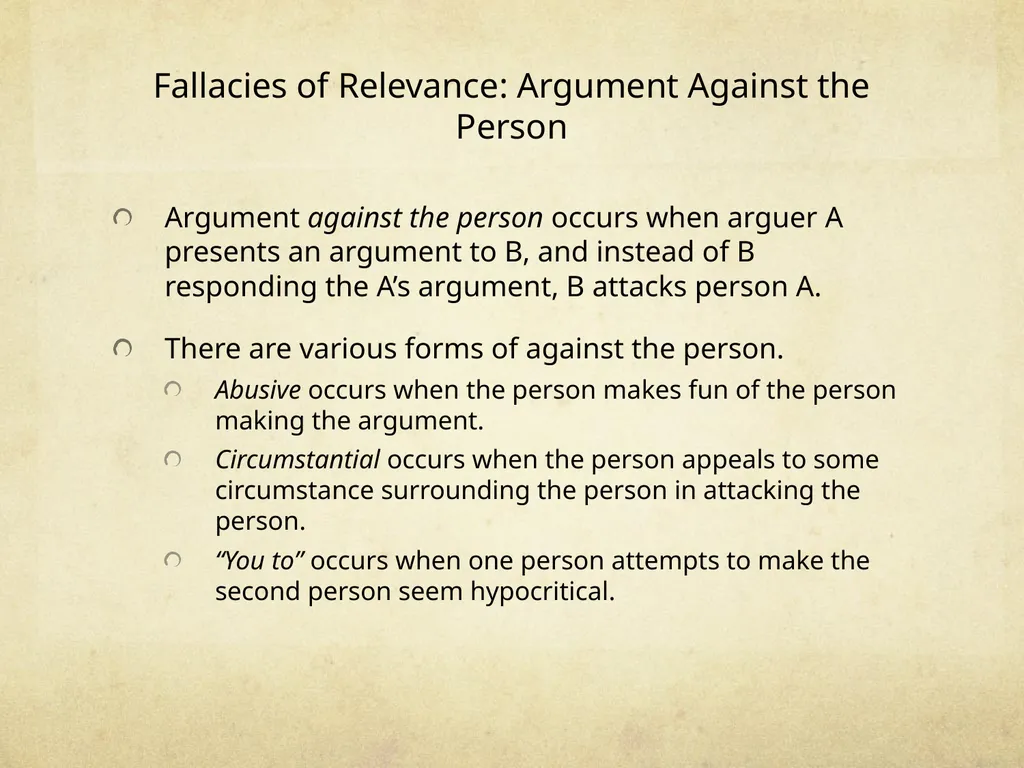
Fallacies of Relevance: Argument Against the Person Argument against the person occurs when arguer A presents an argument to B, and instead of B responding the A’s argument, B attacks person A.
There are various forms of against the person.
Abusive occurs when the person makes fun of the person making the argument.
Circumstantial occurs when the person appeals to some circumstance surrounding the person in attacking the person.
“You to” occurs when one person attempts to make the second person seem hypocritical.<br>
There are various forms of against the person.
Abusive occurs when the person makes fun of the person making the argument.
Circumstantial occurs when the person appeals to some circumstance surrounding the person in attacking the person.
“You to” occurs when one person attempts to make the second person seem hypocritical.<br>
16
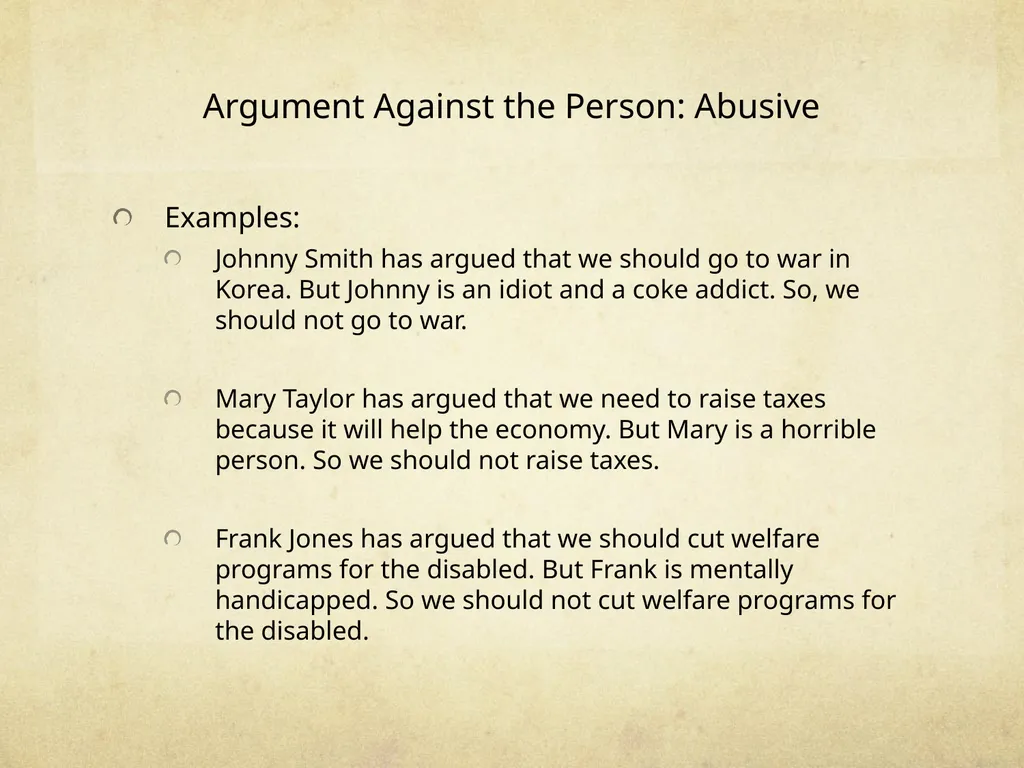
Argument Against the Person: Abusive Examples:
Johnny Smith has argued that we should go to war in Korea. But Johnny is an idiot and a coke addict. So, we should not go to war.
Mary Taylor has argued that we need to raise taxes because it will help the economy. But Mary is a horrible person. So we should not raise taxes.
Frank Jones has argued that we should cut welfare programs for the disabled. But Frank is mentally handicapped. So we should not cut welfare programs for the disabled.<br>
Johnny Smith has argued that we should go to war in Korea. But Johnny is an idiot and a coke addict. So, we should not go to war.
Mary Taylor has argued that we need to raise taxes because it will help the economy. But Mary is a horrible person. So we should not raise taxes.
Frank Jones has argued that we should cut welfare programs for the disabled. But Frank is mentally handicapped. So we should not cut welfare programs for the disabled.<br>
17
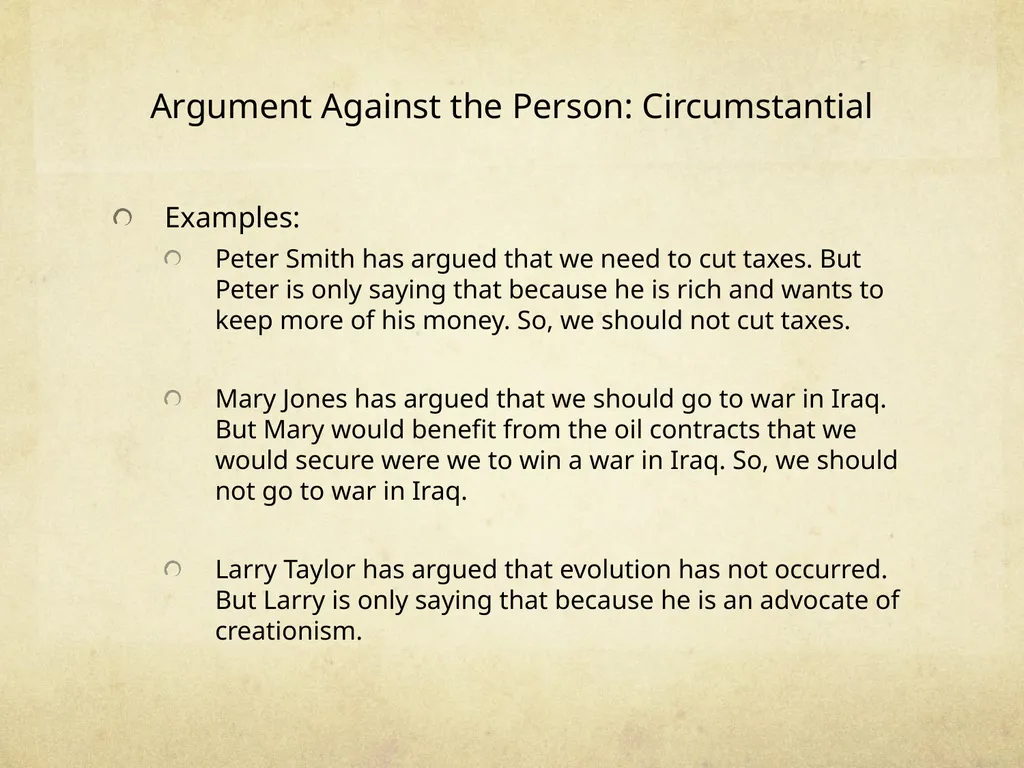
Argument Against the Person: Circumstantial Examples:
Peter Smith has argued that we need to cut taxes. But Peter is only saying that because he is rich and wants to keep more of his money. So, we should not cut taxes.
Mary Jones has argued that we should go to war in Iraq. But Mary would benefit from the oil contracts that we would secure were we to win a war in Iraq. So, we should not go to war in Iraq.
Larry Taylor has argued that evolution has not occurred. But Larry is only saying that because he is an advocate of creationism.<br>
Peter Smith has argued that we need to cut taxes. But Peter is only saying that because he is rich and wants to keep more of his money. So, we should not cut taxes.
Mary Jones has argued that we should go to war in Iraq. But Mary would benefit from the oil contracts that we would secure were we to win a war in Iraq. So, we should not go to war in Iraq.
Larry Taylor has argued that evolution has not occurred. But Larry is only saying that because he is an advocate of creationism.<br>
18
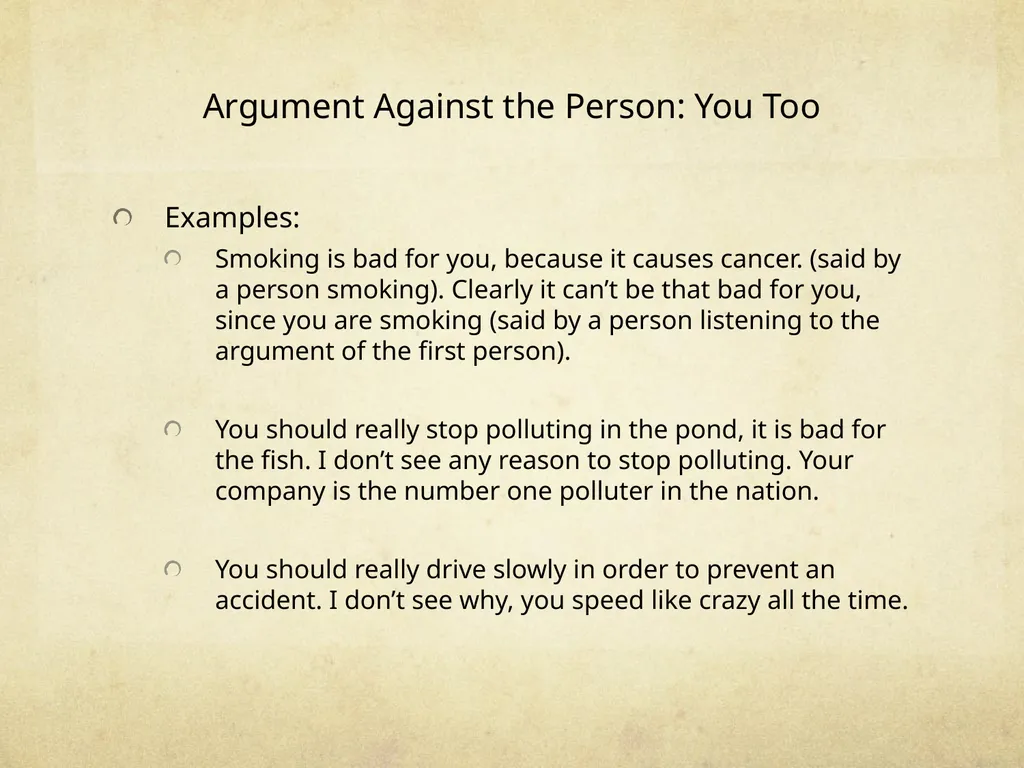
Argument Against the Person: You Too Examples:
Smoking is bad for you, because it causes cancer. (said by a person smoking). Clearly it can’t be that bad for you, since you are smoking (said by a person listening to the argument of the first person).
You should really stop polluting in the pond, it is bad for the fish. I don’t see any reason to stop polluting. Your company is the number one polluter in the nation.
You should really drive slowly in order to prevent an accident. I don’t see why, you speed like crazy all the time.<br>
Smoking is bad for you, because it causes cancer. (said by a person smoking). Clearly it can’t be that bad for you, since you are smoking (said by a person listening to the argument of the first person).
You should really stop polluting in the pond, it is bad for the fish. I don’t see any reason to stop polluting. Your company is the number one polluter in the nation.
You should really drive slowly in order to prevent an accident. I don’t see why, you speed like crazy all the time.<br>
19
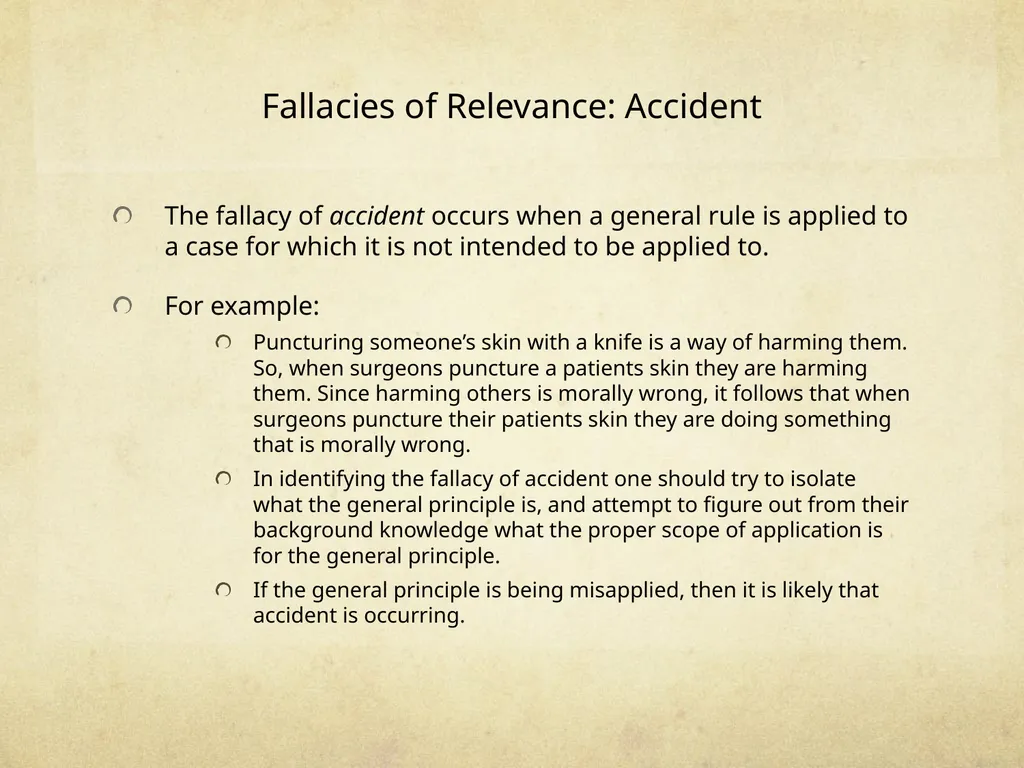
Fallacies of Relevance: Accident The fallacy of accident occurs when a general rule is applied to a case for which it is not intended to be applied to.
For example:
Puncturing someone’s skin with a knife is a way of harming them. So, when surgeons puncture a patients skin they are harming them. Since harming others is morally wrong, it follows that when surgeons puncture their patients skin they are doing something that is morally wrong.
In identifying the fallacy of accident one should try to isolate what the general principle is, and attempt to figure out from their background knowledge what the proper scope of application is for the general principle.
If the general principle is being misapplied, then it is likely that accident is occurring.<br>
For example:
Puncturing someone’s skin with a knife is a way of harming them. So, when surgeons puncture a patients skin they are harming them. Since harming others is morally wrong, it follows that when surgeons puncture their patients skin they are doing something that is morally wrong.
In identifying the fallacy of accident one should try to isolate what the general principle is, and attempt to figure out from their background knowledge what the proper scope of application is for the general principle.
If the general principle is being misapplied, then it is likely that accident is occurring.<br>
20
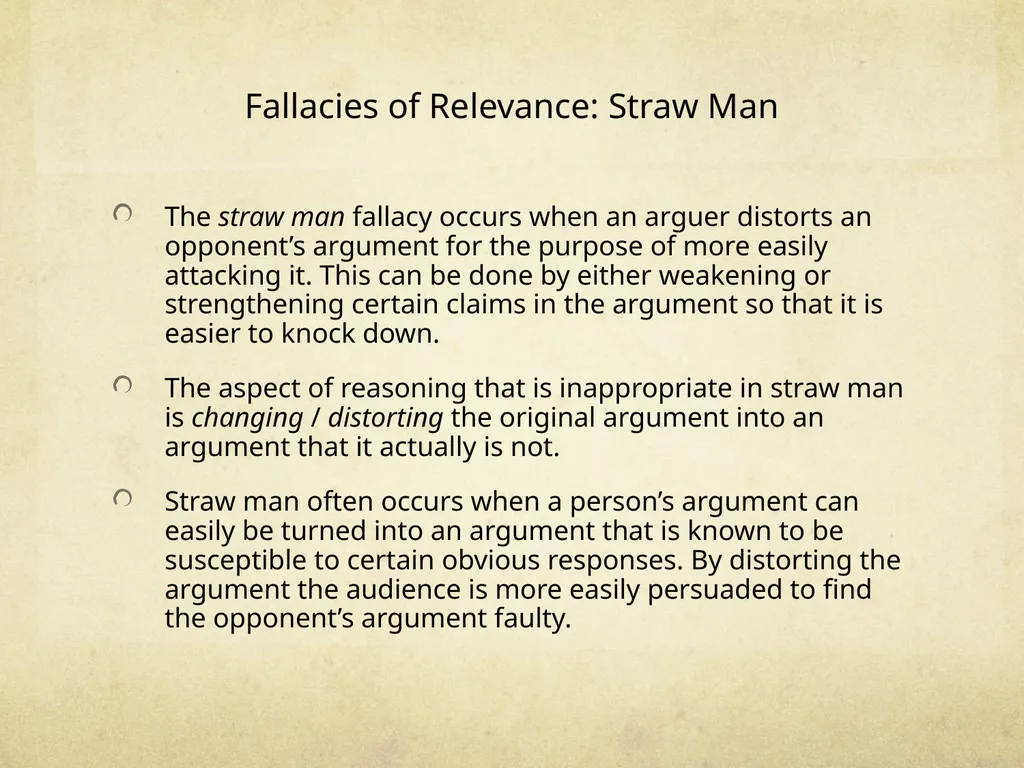
Fallacies of Relevance: Straw Man The straw man fallacy occurs when an arguer distorts an opponent’s argument for the purpose of more easily attacking it. This can be done by either weakening or strengthening certain claims in the argument so that it is easier to knock down.
The aspect of reasoning that is inappropriate in straw man is changing / distorting the original argument into an argument that it actually is not.
Straw man often occurs when a person’s argument can easily be turned into an argument that is known to be susceptible to certain obvious responses. By distorting the argument the audience is more easily persuaded to find the opponent’s argument faulty.<br>
The aspect of reasoning that is inappropriate in straw man is changing / distorting the original argument into an argument that it actually is not.
Straw man often occurs when a person’s argument can easily be turned into an argument that is known to be susceptible to certain obvious responses. By distorting the argument the audience is more easily persuaded to find the opponent’s argument faulty.<br>
21
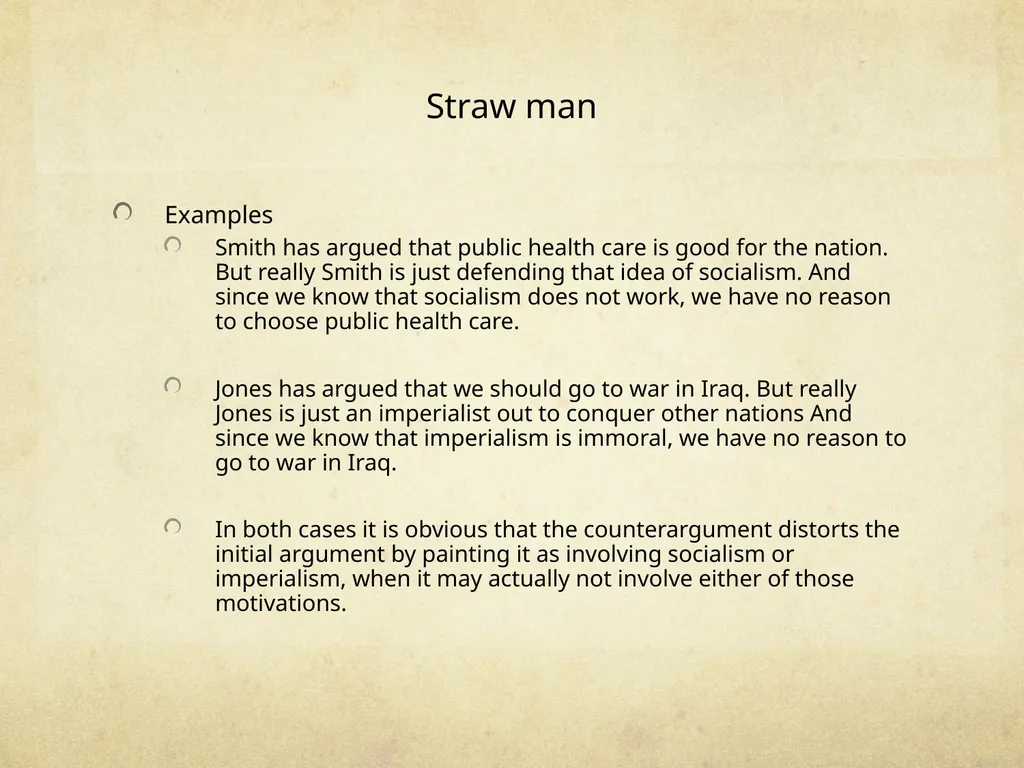
Straw man Examples
Smith has argued that public health care is good for the nation. But really Smith is just defending that idea of socialism. And since we know that socialism does not work, we have no reason to choose public health care.
Jones has argued that we should go to war in Iraq. But really Jones is just an imperialist out to conquer other nations And since we know that imperialism is immoral, we have no reason to go to war in Iraq.
In both cases it is obvious that the counterargument distorts the initial argument by painting it as involving socialism or imperialism, when it may actually not involve either of those motivations.<br>
Smith has argued that public health care is good for the nation. But really Smith is just defending that idea of socialism. And since we know that socialism does not work, we have no reason to choose public health care.
Jones has argued that we should go to war in Iraq. But really Jones is just an imperialist out to conquer other nations And since we know that imperialism is immoral, we have no reason to go to war in Iraq.
In both cases it is obvious that the counterargument distorts the initial argument by painting it as involving socialism or imperialism, when it may actually not involve either of those motivations.<br>
22
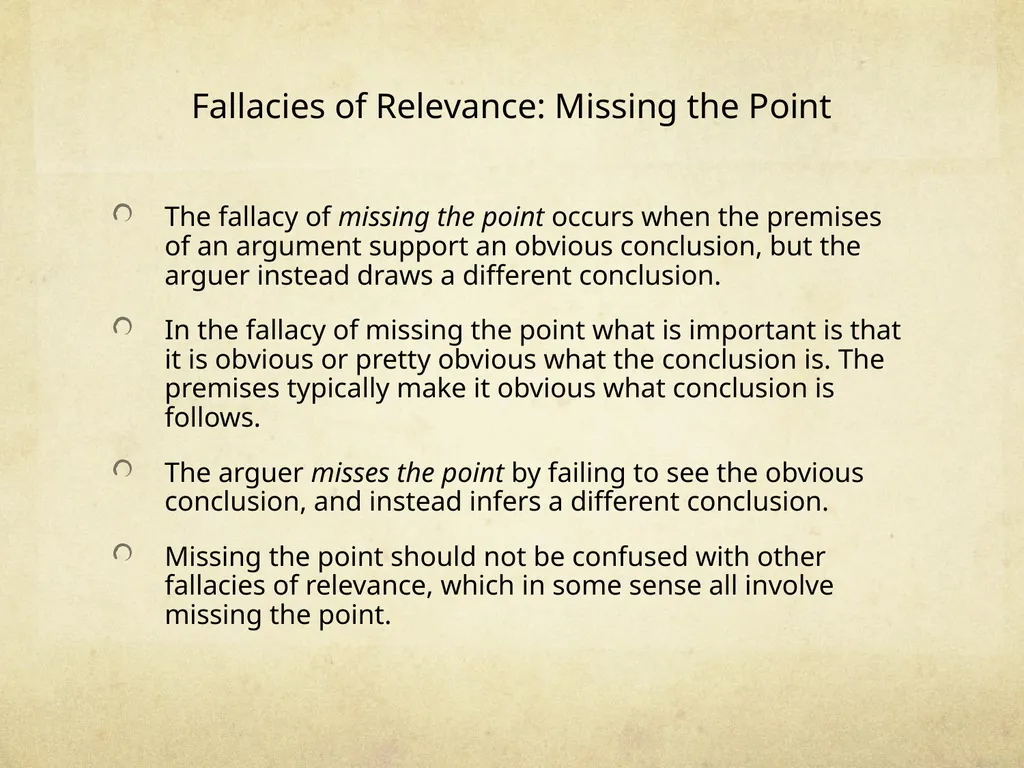
Fallacies of Relevance: Missing the Point The fallacy of missing the point occurs when the premises of an argument support an obvious conclusion, but the arguer instead draws a different conclusion.
In the fallacy of missing the point what is important is that it is obvious or pretty obvious what the conclusion is. The premises typically make it obvious what conclusion is follows.
The arguer misses the point by failing to see the obvious conclusion, and instead infers a different conclusion.
Missing the point should not be confused with other fallacies of relevance, which in some sense all involve missing the point.<br>
In the fallacy of missing the point what is important is that it is obvious or pretty obvious what the conclusion is. The premises typically make it obvious what conclusion is follows.
The arguer misses the point by failing to see the obvious conclusion, and instead infers a different conclusion.
Missing the point should not be confused with other fallacies of relevance, which in some sense all involve missing the point.<br>
23
Missing the Point Examples:
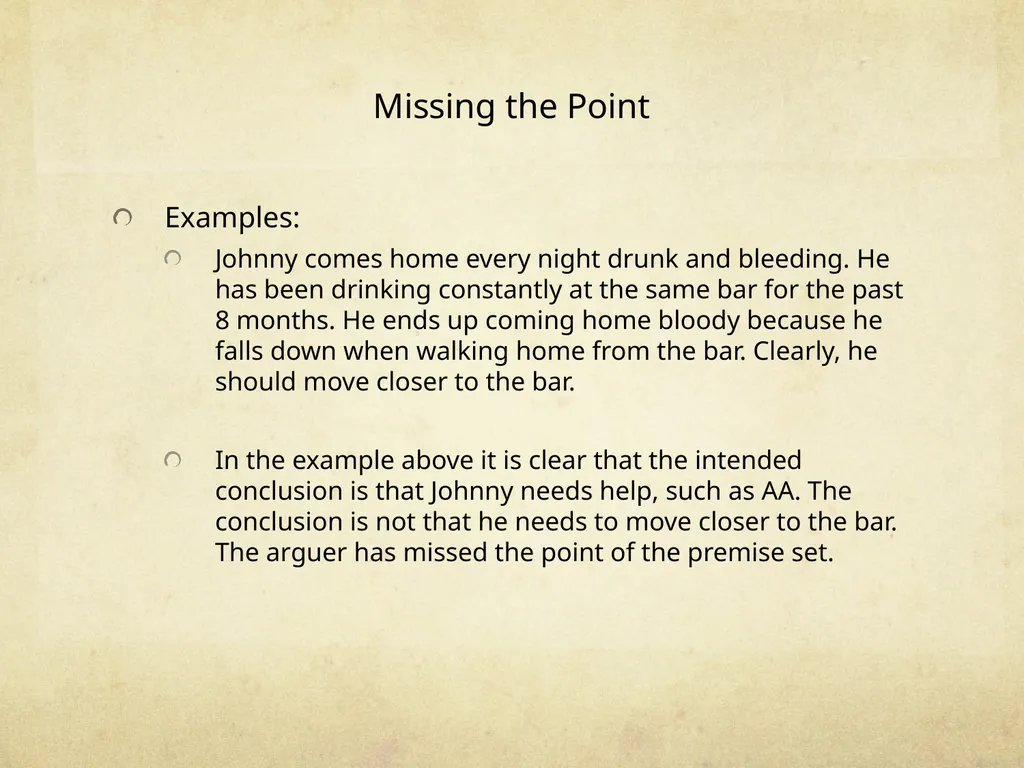
Johnny comes home every night drunk and bleeding. He has been drinking constantly at the same bar for the past 8 months. He ends up coming home bloody because he falls down when walking home from the bar. Clearly, he should move closer to the bar.
In the example above it is clear that the intended conclusion is that Johnny needs help, such as AA. The conclusion is not that he needs to move closer to the bar. The arguer has missed the point of the premise set.<br>
Johnny comes home every night drunk and bleeding. He has been drinking constantly at the same bar for the past 8 months. He ends up coming home bloody because he falls down when walking home from the bar. Clearly, he should move closer to the bar.
In the example above it is clear that the intended conclusion is that Johnny needs help, such as AA. The conclusion is not that he needs to move closer to the bar. The arguer has missed the point of the premise set.<br>
24
Fallacies of Relevance: Red Herring The fallacy of red herring occurs when the arguer shifts topics or diverts attention from the central issue introduced. The arguer then goes on to draw some conclusion, or no conclusion, but pretends to have won the argument or established a conclusion.
In identifying red herring one should look carefully for the topic to be debated, and then attempt to discern if the topic has been shifted to a distinct topic.
Red herring and straw man are often hard to tease apart, since both involve a shift of some kind. In red herring the important point is that one shifts in order to divert attention to another issue.<br>
In identifying red herring one should look carefully for the topic to be debated, and then attempt to discern if the topic has been shifted to a distinct topic.
Red herring and straw man are often hard to tease apart, since both involve a shift of some kind. In red herring the important point is that one shifts in order to divert attention to another issue.<br>
25
Red Herring Examples
Public health care is really a bad idea. Socialism is all about giving people things they don’t deserve. But everybody should work for an pay for what they deserve. Health care is a service. So, socialism is a bad idea.
War in Iraq is a bad idea. Imperialism is about taking over countries merely for the purpose of taking their resources in an unjust manner. And when you take a countries resources in an unjust manner you are being immoral. So, imperialism is immoral.<br>
Public health care is really a bad idea. Socialism is all about giving people things they don’t deserve. But everybody should work for an pay for what they deserve. Health care is a service. So, socialism is a bad idea.
War in Iraq is a bad idea. Imperialism is about taking over countries merely for the purpose of taking their resources in an unjust manner. And when you take a countries resources in an unjust manner you are being immoral. So, imperialism is immoral.<br>
26
Fallacies of Weak Induction: Appeal to Unqualified Authority The fallacy of appeal to unqualified authority occurs when one appeals to an unqualified authority in order to support some position.
For example:
Samson paints are the best quality paints for the outdoors, because Brad Pitt says so.
Samson paints are the best quality paints for the outdoors, because leading authority on paints and materials John Smith says so.
In the first case we have appeal to unqualified authority because the actor Brad Pitt is not a qualified authority on paints. In the second case we don’t have a fallacy because the person appealed to is an authority.<br>
For example:
Samson paints are the best quality paints for the outdoors, because Brad Pitt says so.
Samson paints are the best quality paints for the outdoors, because leading authority on paints and materials John Smith says so.
In the first case we have appeal to unqualified authority because the actor Brad Pitt is not a qualified authority on paints. In the second case we don’t have a fallacy because the person appealed to is an authority.<br>
27
Fallacies of Weak Induction: Appeal to Ignorance The fallacy of appeal to ignorance occurs when a person infers that something does not exist because there is no evidence that it does exist.
Example:
There are no craters on the far side of the moon, since no one has ever seen any.
The fact that no one has seen any does not prove that there aren’t any. The absence of evidence is not the same as evidence of the absence.
Sometimes appeals to ignorance-like arguments make sense. For example: All research into a cure for cancer has yielded no result, so there probably is no cure for cancer.<br>
Example:
There are no craters on the far side of the moon, since no one has ever seen any.
The fact that no one has seen any does not prove that there aren’t any. The absence of evidence is not the same as evidence of the absence.
Sometimes appeals to ignorance-like arguments make sense. For example: All research into a cure for cancer has yielded no result, so there probably is no cure for cancer.<br>
28
Fallacies of Weak Induction: Hasty Generalization Hasty generalization is a fallacy that affects inductive generalizations. A hasty generalization occurs when an arguer generalizes from a poor sample size.
Example:
13 kids at Rosemont High were found to be using cocaine. So, all the kids in that school are drug addicts.
Clearly 13 is too low of a number to draw that kind of conclusion.
In hasty generalization one must carefully think about what amount of the population would need to be adequately investigated for the purposes of drawing the generalization that the arguer draws.<br>
Example:
13 kids at Rosemont High were found to be using cocaine. So, all the kids in that school are drug addicts.
Clearly 13 is too low of a number to draw that kind of conclusion.
In hasty generalization one must carefully think about what amount of the population would need to be adequately investigated for the purposes of drawing the generalization that the arguer draws.<br>
29
Fallacies of Weak Induction: Slippery Slope The fallacy of slippery slope occurs when an arguers maintains that if we choose one course of action we will be led through a chain of consequences to an unacceptable consequence. And because the consequence is not acceptable we should not choose the immediate course of action.
The error in slippery slope depends on the chain of consequences. If the chain of consequences really will occur and it is reasonable to think so, then the argument is not a slippery slope.
However, if it is questionable whether the consequences would occur, then the argument does commit slippery slope.<br>
The error in slippery slope depends on the chain of consequences. If the chain of consequences really will occur and it is reasonable to think so, then the argument is not a slippery slope.
However, if it is questionable whether the consequences would occur, then the argument does commit slippery slope.<br>
30
Slippery Slope Examples:
We cannot afford to give the SJSU staff a pay raise. If we give them a pay raise, then they will have no incentive to work hard. If they have no incentive to work hard, they will eventually work less, and take more vacations. If they take more vacations, we will eventually not have a functioning university. Since we need a functioning university, we cannot give the staff a pay raise.
We cannot give into the Animal rights movement at all. If we say that there are codes for animal testing, soon there will be codes for everything including restrictions on what meat can be sold, and when meat can be eaten. Soon we will be forced to eat only synthetic foods, since eating always involves killing.<br>
We cannot afford to give the SJSU staff a pay raise. If we give them a pay raise, then they will have no incentive to work hard. If they have no incentive to work hard, they will eventually work less, and take more vacations. If they take more vacations, we will eventually not have a functioning university. Since we need a functioning university, we cannot give the staff a pay raise.
We cannot give into the Animal rights movement at all. If we say that there are codes for animal testing, soon there will be codes for everything including restrictions on what meat can be sold, and when meat can be eaten. Soon we will be forced to eat only synthetic foods, since eating always involves killing.<br>
31
Fallacies of Weak Induction: Weak Analogy The fallacy of weak analogy occurs in arguments by analogy where one tries to establish from the fact that A has P and B is like A, that B has P.
Whenever one identifies an argument by analogy, one should question whether the analogy is good. When the analogy is obviously weak, we have weak analogy.
Determining when an analogy is weak depends on context. One has to pay attention to the content of the analogy, and the context in which it is said.
Accident is often confused with weak analogy. Be careful!<br>
Whenever one identifies an argument by analogy, one should question whether the analogy is good. When the analogy is obviously weak, we have weak analogy.
Determining when an analogy is weak depends on context. One has to pay attention to the content of the analogy, and the context in which it is said.
Accident is often confused with weak analogy. Be careful!<br>
32
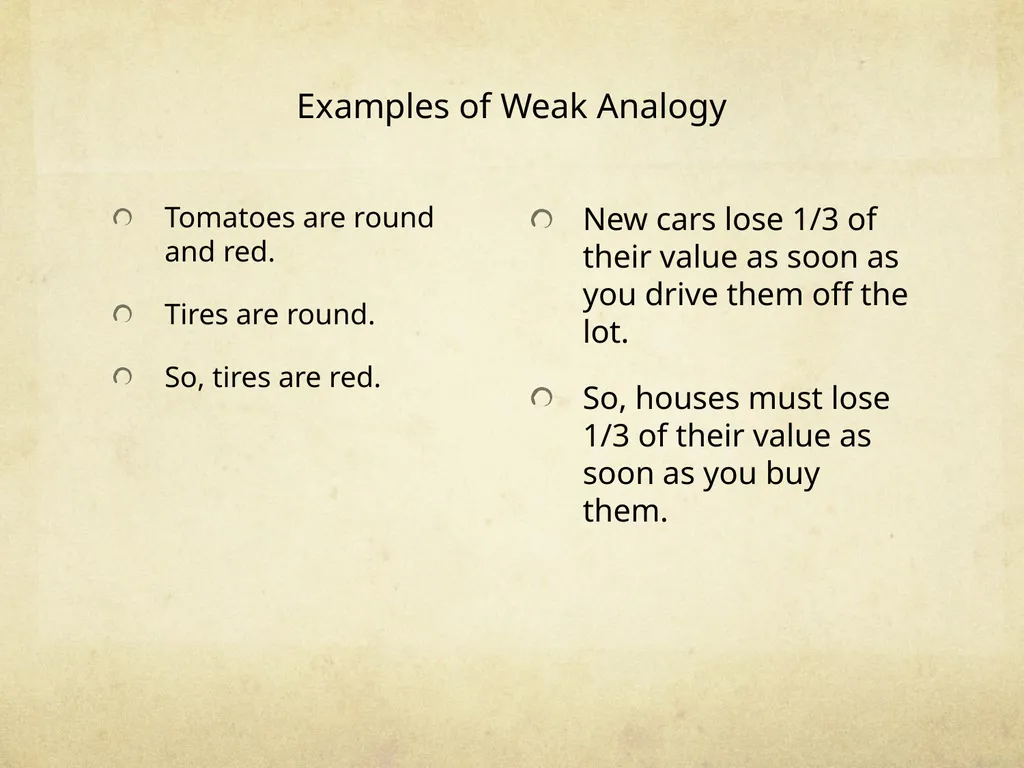
Examples of Weak Analogy Tomatoes are round and red.
Tires are round.
So, tires are red. New cars lose 1/3 of their value as soon as you drive them off the lot.
So, houses must lose 1/3 of their value as soon as you buy them.<br>
Tires are round.
So, tires are red. New cars lose 1/3 of their value as soon as you drive them off the lot.
So, houses must lose 1/3 of their value as soon as you buy them.<br>
33
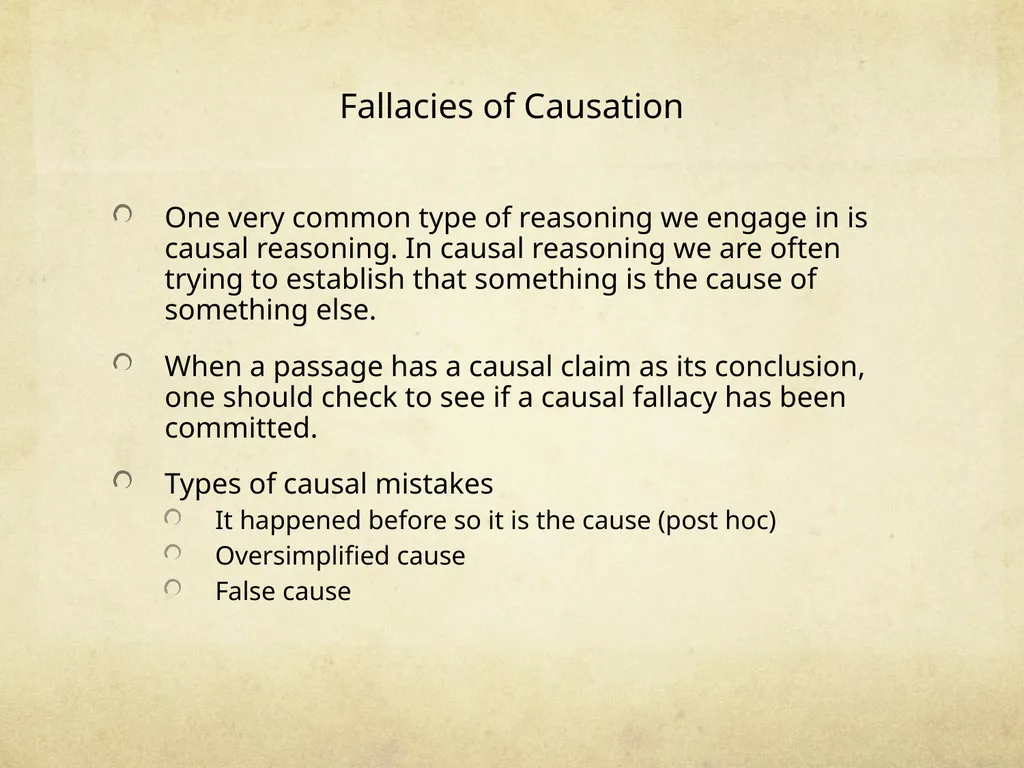
Fallacies of Causation One very common type of reasoning we engage in is causal reasoning. In causal reasoning we are often trying to establish that something is the cause of something else.
When a passage has a causal claim as its conclusion, one should check to see if a causal fallacy has been committed.
Types of causal mistakes
It happened before so it is the cause (post hoc)
Oversimplified cause
False cause<br>
When a passage has a causal claim as its conclusion, one should check to see if a causal fallacy has been committed.
Types of causal mistakes
It happened before so it is the cause (post hoc)
Oversimplified cause
False cause<br>
34
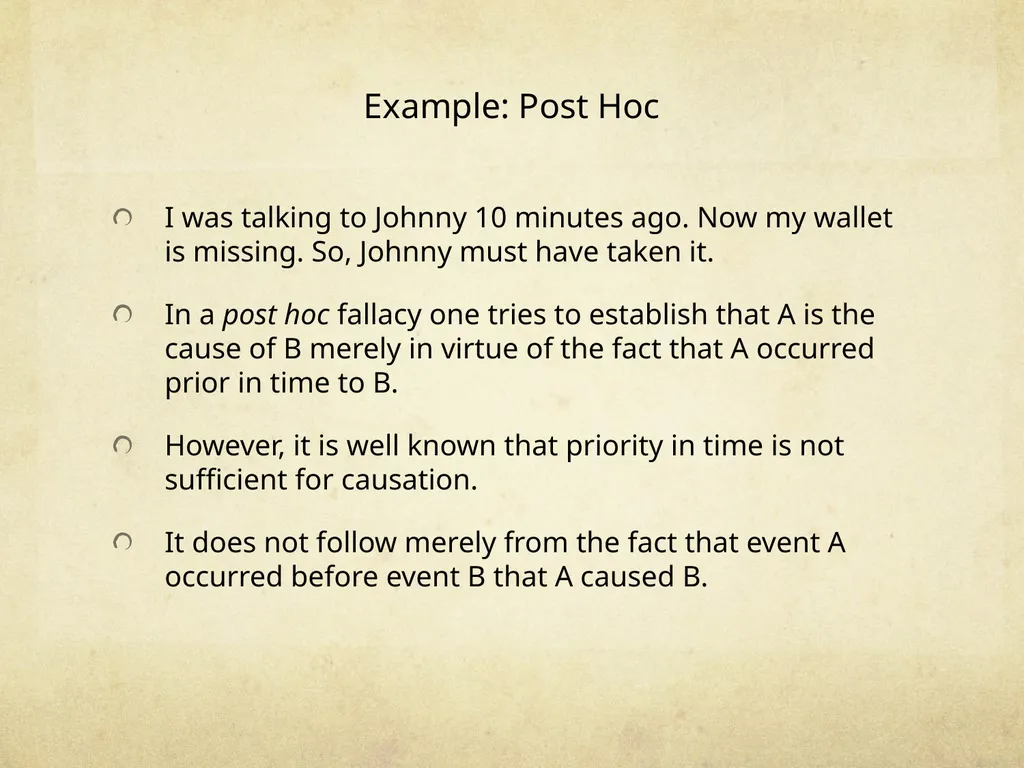
Example: Post Hoc I was talking to Johnny 10 minutes ago. Now my wallet is missing. So, Johnny must have taken it.
In a post hoc fallacy one tries to establish that A is the cause of B merely in virtue of the fact that A occurred prior in time to B.
However, it is well known that priority in time is not sufficient for causation.
It does not follow merely from the fact that event A occurred before event B that A caused B.<br>
In a post hoc fallacy one tries to establish that A is the cause of B merely in virtue of the fact that A occurred prior in time to B.
However, it is well known that priority in time is not sufficient for causation.
It does not follow merely from the fact that event A occurred before event B that A caused B.<br>
35
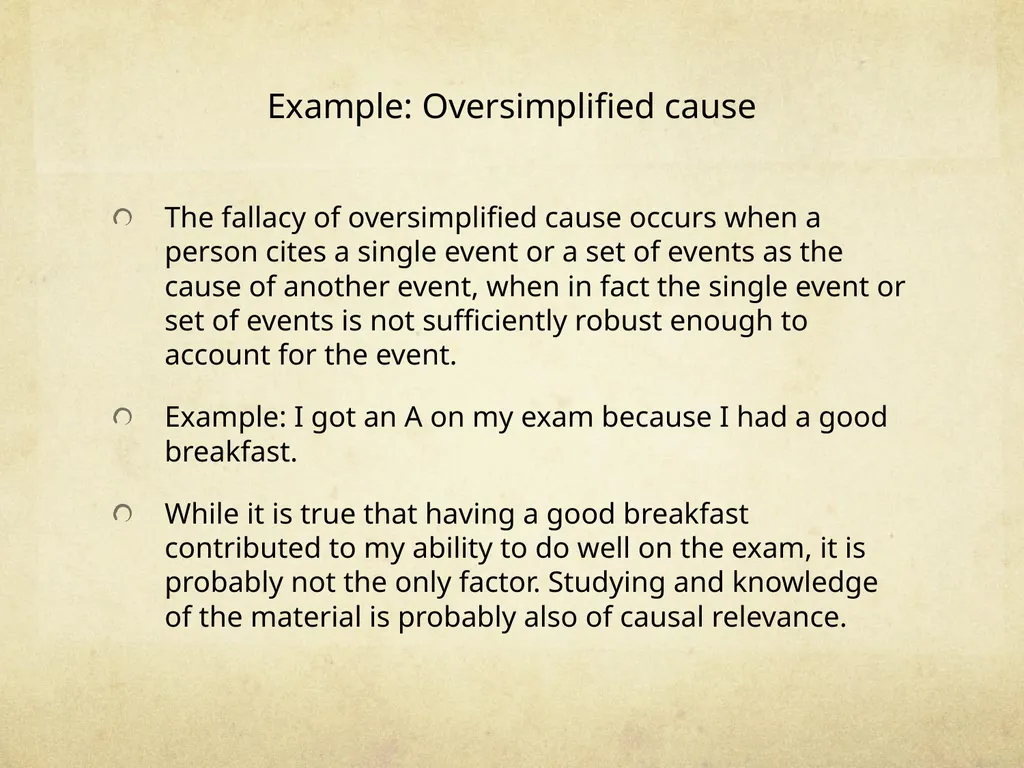
Example: Oversimplified cause The fallacy of oversimplified cause occurs when a person cites a single event or a set of events as the cause of another event, when in fact the single event or set of events is not sufficiently robust enough to account for the event.
Example: I got an A on my exam because I had a good breakfast.
While it is true that having a good breakfast contributed to my ability to do well on the exam, it is probably not the only factor. Studying and knowledge of the material is probably also of causal relevance.<br>
Example: I got an A on my exam because I had a good breakfast.
While it is true that having a good breakfast contributed to my ability to do well on the exam, it is probably not the only factor. Studying and knowledge of the material is probably also of causal relevance.<br>
36
Example: False Cause The fallacy of false cause occurs when a person cites something as the sole cause of an event, when in fact it is known to not be the cause of the event or of events of that kind.
The T.V. turned on because the water boiled.
Although there may be some weird wiring going on in the house, it is probably not the case that water boiling in the kitchen was the cause of the T.V. turning on.
False cause is more specific than over simplified cause because in the later an insufficient number of causal factors are cited, while in the former something that is not causally relevant is cited.<br>
The T.V. turned on because the water boiled.
Although there may be some weird wiring going on in the house, it is probably not the case that water boiling in the kitchen was the cause of the T.V. turning on.
False cause is more specific than over simplified cause because in the later an insufficient number of causal factors are cited, while in the former something that is not causally relevant is cited.<br>
37
Fallacies of Presumption: Begging the Question The fallacy of begging the question occurs whenever the arguer creates the illusion that inadequate premises provide adequate support for a conclusion. This can happen in three ways.
A controversial premise is involved. One premise is such that were an opponent of the argument to believe it, they would automatically believe the conclusion.
The arguer has restated the conclusion in the premises in a slightly different way.
The arguer has reasoned in a circle. Providing no support for the conclusion other than the conclusion itself.<br>
A controversial premise is involved. One premise is such that were an opponent of the argument to believe it, they would automatically believe the conclusion.
The arguer has restated the conclusion in the premises in a slightly different way.
The arguer has reasoned in a circle. Providing no support for the conclusion other than the conclusion itself.<br>
38
Begging the Question: Controversial Premise In the controversial premise version of begging the question usually the topic is controversial, and a premise is highly controversial.
For example:
Abortion is murder. So, abortion is morally wrong.
Marriage is between a man and a woman. So, gay-marriage is wrong.
In both cases the premise is controversial. The whole debate in the case of abortion is over whether abortion is murder, and the whole debate in the case of gay-marriage is over whether marriage is between a man and a woman. So, to cite these premises is to beg the question since they are controversial, and add no further support for the conclusion.<br>
For example:
Abortion is murder. So, abortion is morally wrong.
Marriage is between a man and a woman. So, gay-marriage is wrong.
In both cases the premise is controversial. The whole debate in the case of abortion is over whether abortion is murder, and the whole debate in the case of gay-marriage is over whether marriage is between a man and a woman. So, to cite these premises is to beg the question since they are controversial, and add no further support for the conclusion.<br>
39
Begging the Question: Circular Reasoning In some cases of begging the question we get circular reasoning. Here are two cases.
Anand has black hair. So, Anand has black hair.
Anand is a bachelor. So, Anand is an unmarried male.
In the first case we repeat the exact same sentence. And in the second case we say something that is synonymous. How can the premises of each of these arguments support their conclusions. These arguments make us want to ask, “How do you know?” the premises are inadequate for the conclusion.<br>
Anand has black hair. So, Anand has black hair.
Anand is a bachelor. So, Anand is an unmarried male.
In the first case we repeat the exact same sentence. And in the second case we say something that is synonymous. How can the premises of each of these arguments support their conclusions. These arguments make us want to ask, “How do you know?” the premises are inadequate for the conclusion.<br>
40
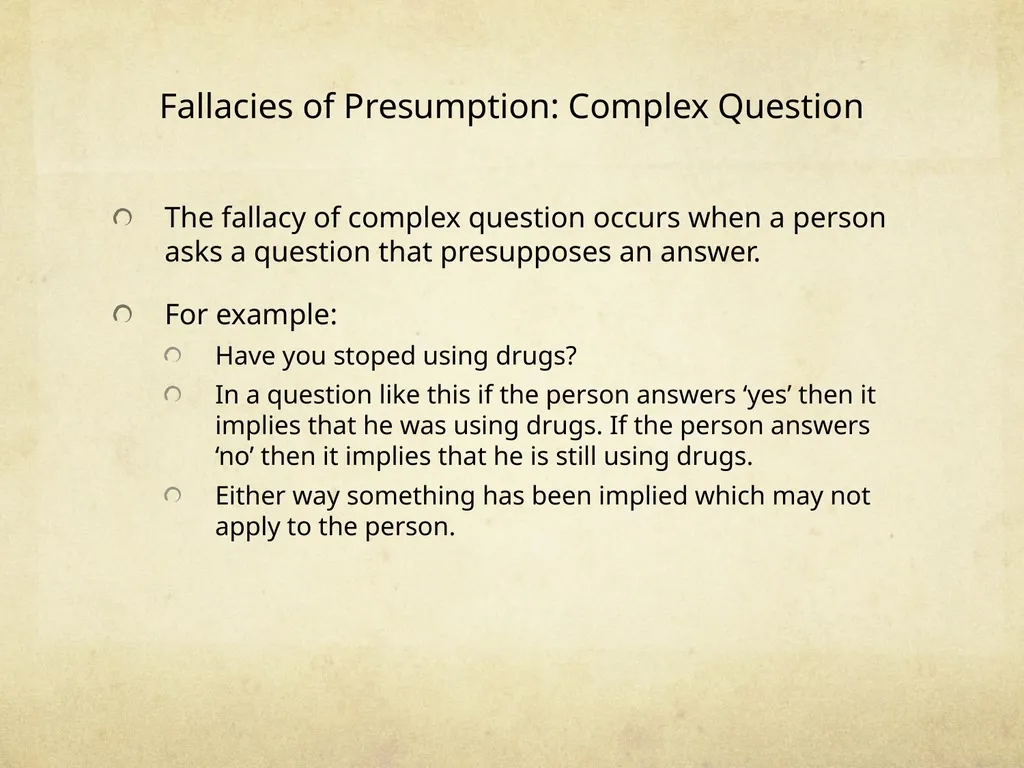
Fallacies of Presumption: Complex Question The fallacy of complex question occurs when a person asks a question that presupposes an answer.
For example:
Have you stoped using drugs?
In a question like this if the person answers ‘yes’ then it implies that he was using drugs. If the person answers ‘no’ then it implies that he is still using drugs.
Either way something has been implied which may not apply to the person.<br>
For example:
Have you stoped using drugs?
In a question like this if the person answers ‘yes’ then it implies that he was using drugs. If the person answers ‘no’ then it implies that he is still using drugs.
Either way something has been implied which may not apply to the person.<br>
41
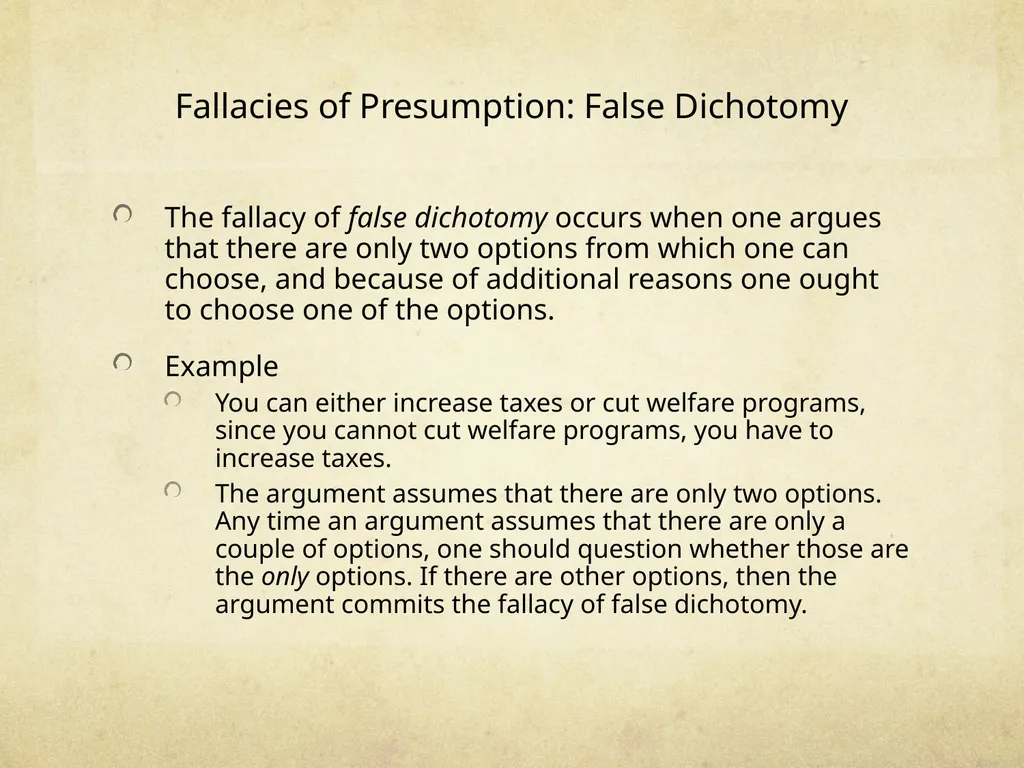
Fallacies of Presumption: False Dichotomy The fallacy of false dichotomy occurs when one argues that there are only two options from which one can choose, and because of additional reasons one ought to choose one of the options.
Example
You can either increase taxes or cut welfare programs, since you cannot cut welfare programs, you have to increase taxes.
The argument assumes that there are only two options. Any time an argument assumes that there are only a couple of options, one should question whether those are the only options. If there are other options, then the argument commits the fallacy of false dichotomy.<br>
Example
You can either increase taxes or cut welfare programs, since you cannot cut welfare programs, you have to increase taxes.
The argument assumes that there are only two options. Any time an argument assumes that there are only a couple of options, one should question whether those are the only options. If there are other options, then the argument commits the fallacy of false dichotomy.<br>
42
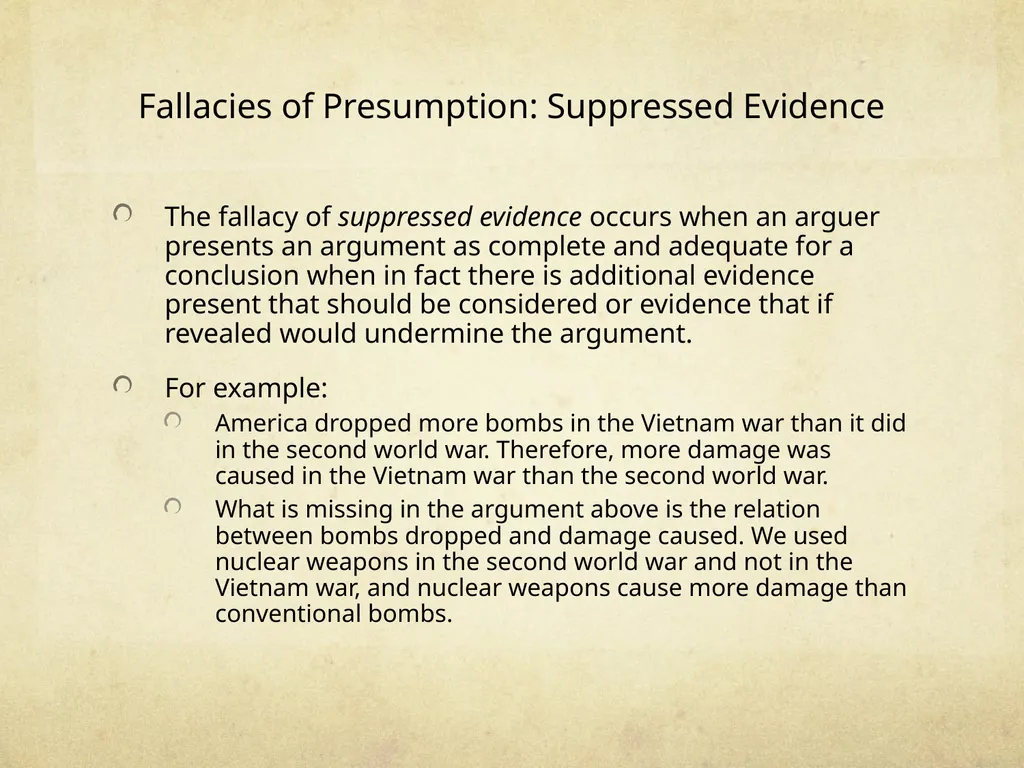
Fallacies of Presumption: Suppressed Evidence The fallacy of suppressed evidence occurs when an arguer presents an argument as complete and adequate for a conclusion when in fact there is additional evidence present that should be considered or evidence that if revealed would undermine the argument.
For example:
America dropped more bombs in the Vietnam war than it did in the second world war. Therefore, more damage was caused in the Vietnam war than the second world war.
What is missing in the argument above is the relation between bombs dropped and damage caused. We used nuclear weapons in the second world war and not in the Vietnam war, and nuclear weapons cause more damage than conventional bombs.<br>
For example:
America dropped more bombs in the Vietnam war than it did in the second world war. Therefore, more damage was caused in the Vietnam war than the second world war.
What is missing in the argument above is the relation between bombs dropped and damage caused. We used nuclear weapons in the second world war and not in the Vietnam war, and nuclear weapons cause more damage than conventional bombs.<br>
43
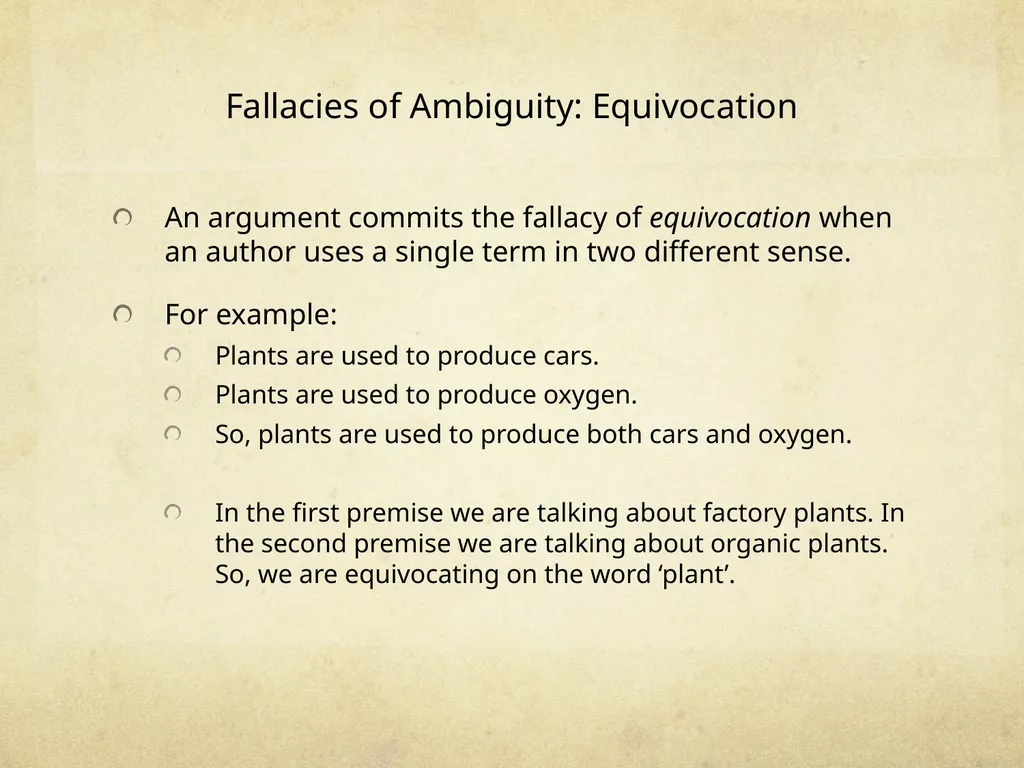
Fallacies of Ambiguity: Equivocation An argument commits the fallacy of equivocation when an author uses a single term in two different sense.
For example:
Plants are used to produce cars.
Plants are used to produce oxygen.
So, plants are used to produce both cars and oxygen.
In the first premise we are talking about factory plants. In the second premise we are talking about organic plants. So, we are equivocating on the word ‘plant’.<br>
For example:
Plants are used to produce cars.
Plants are used to produce oxygen.
So, plants are used to produce both cars and oxygen.
In the first premise we are talking about factory plants. In the second premise we are talking about organic plants. So, we are equivocating on the word ‘plant’.<br>
44
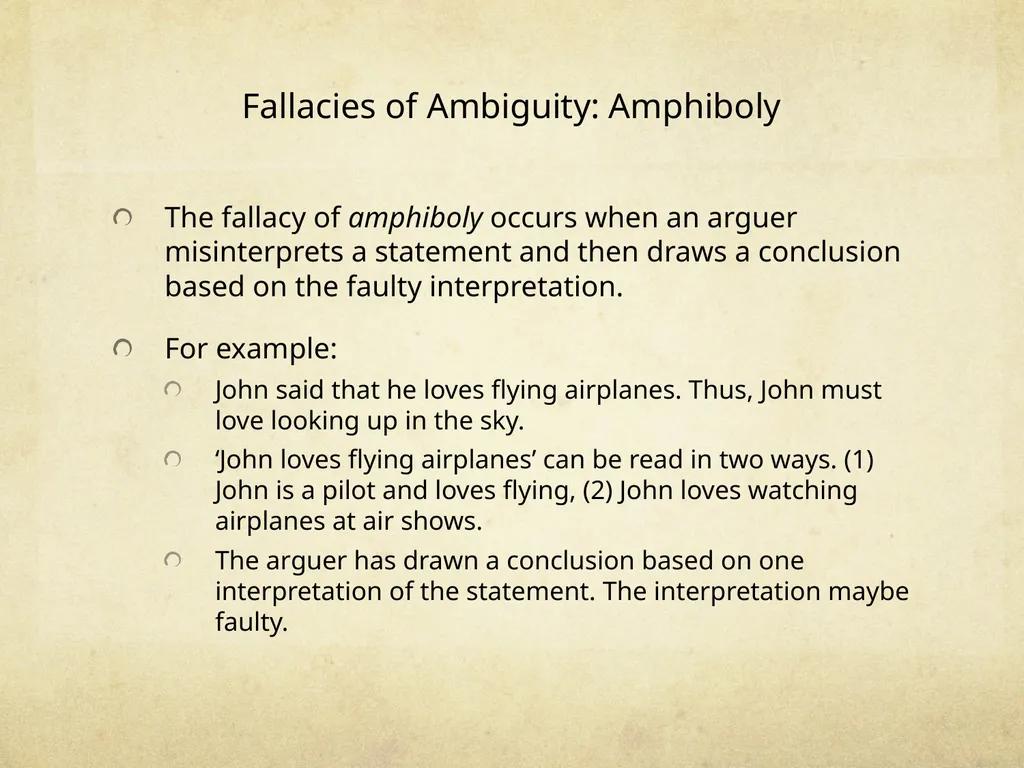
Fallacies of Ambiguity: Amphiboly The fallacy of amphiboly occurs when an arguer misinterprets a statement and then draws a conclusion based on the faulty interpretation.
For example:
John said that he loves flying airplanes. Thus, John must love looking up in the sky.
‘John loves flying airplanes’ can be read in two ways. (1) John is a pilot and loves flying, (2) John loves watching airplanes at air shows.
The arguer has drawn a conclusion based on one interpretation of the statement. The interpretation maybe faulty.<br>
For example:
John said that he loves flying airplanes. Thus, John must love looking up in the sky.
‘John loves flying airplanes’ can be read in two ways. (1) John is a pilot and loves flying, (2) John loves watching airplanes at air shows.
The arguer has drawn a conclusion based on one interpretation of the statement. The interpretation maybe faulty.<br>
45
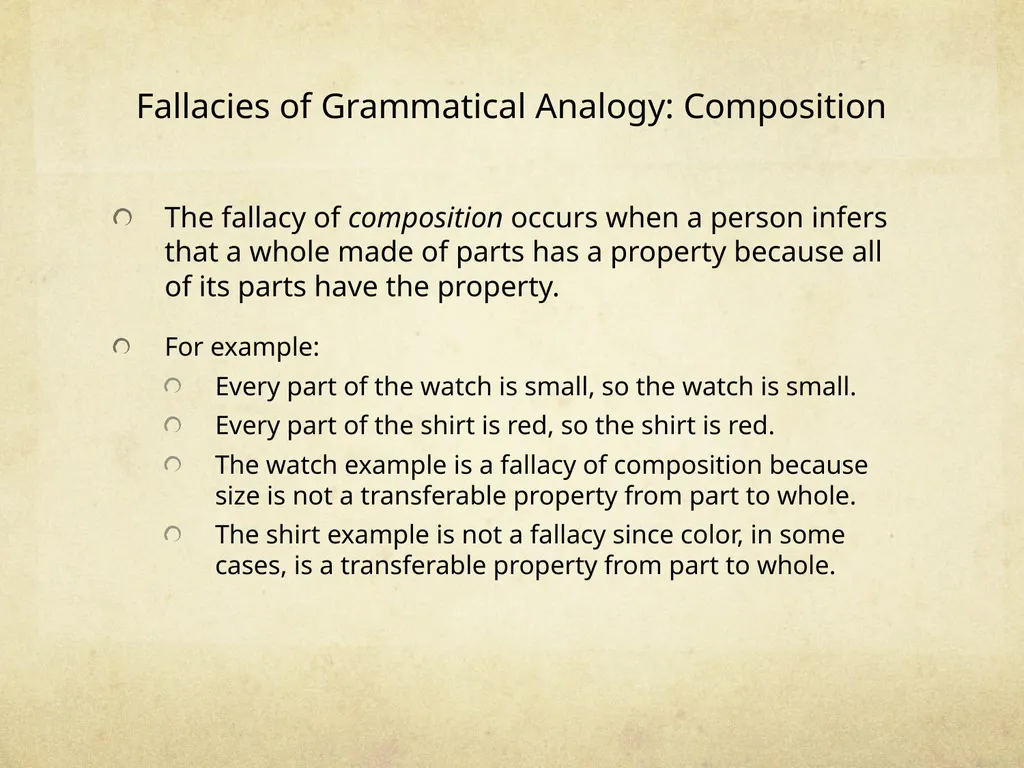
Fallacies of Grammatical Analogy: Composition The fallacy of composition occurs when a person infers that a whole made of parts has a property because all of its parts have the property.
For example:
Every part of the watch is small, so the watch is small.
Every part of the shirt is red, so the shirt is red.
The watch example is a fallacy of composition because size is not a transferable property from part to whole.
The shirt example is not a fallacy since color, in some cases, is a transferable property from part to whole.<br>
For example:
Every part of the watch is small, so the watch is small.
Every part of the shirt is red, so the shirt is red.
The watch example is a fallacy of composition because size is not a transferable property from part to whole.
The shirt example is not a fallacy since color, in some cases, is a transferable property from part to whole.<br>
46
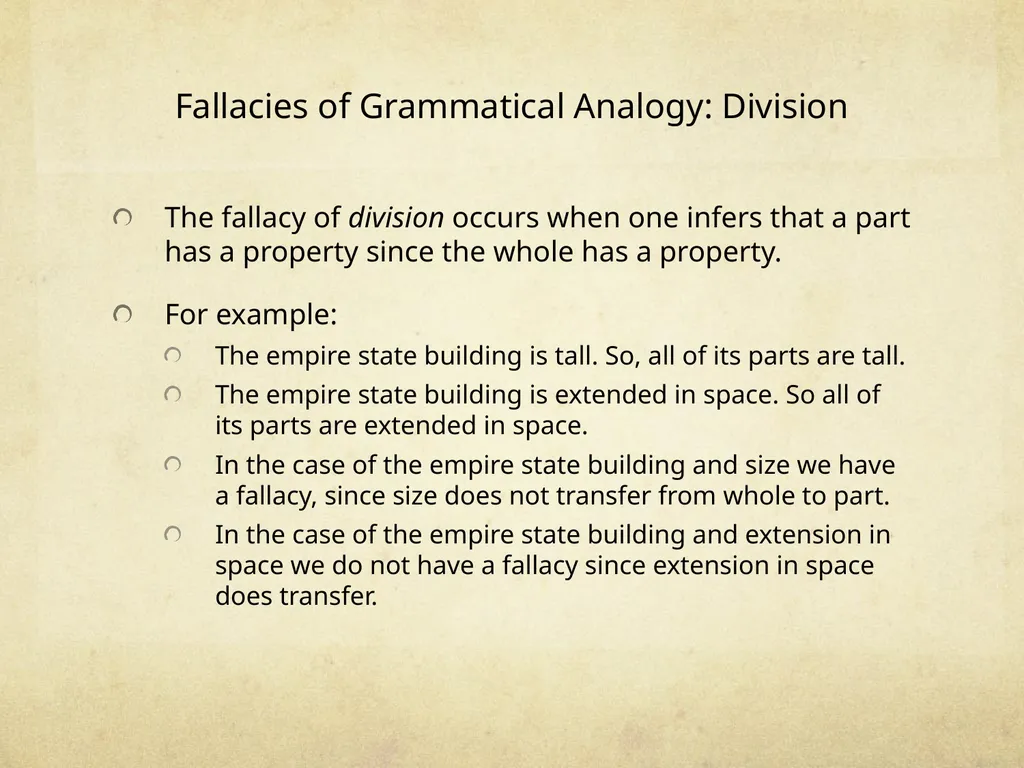
Fallacies of Grammatical Analogy: Division The fallacy of division occurs when one infers that a part has a property since the whole has a property.
For example:
The empire state building is tall. So, all of its parts are tall.
The empire state building is extended in space. So all of its parts are extended in space.
In the case of the empire state building and size we have a fallacy, since size does not transfer from whole to part.
In the case of the empire state building and extension in space we do not have a fallacy since extension in space does transfer.<br>
For example:
The empire state building is tall. So, all of its parts are tall.
The empire state building is extended in space. So all of its parts are extended in space.
In the case of the empire state building and size we have a fallacy, since size does not transfer from whole to part.
In the case of the empire state building and extension in space we do not have a fallacy since extension in space does transfer.<br>
47
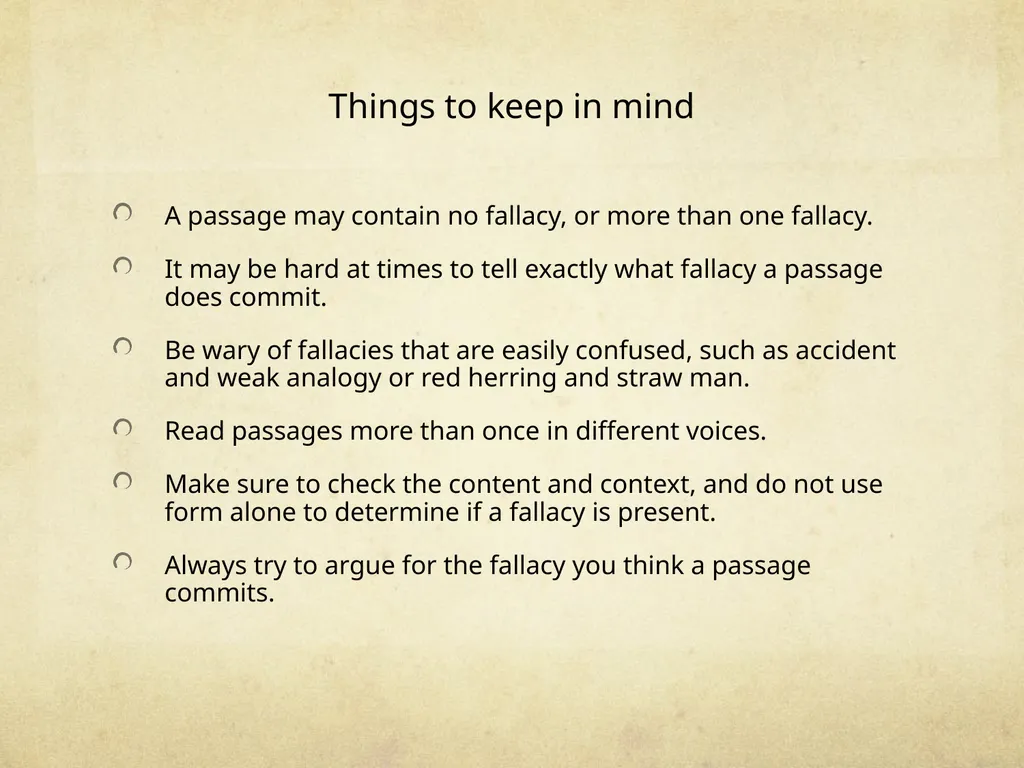
Things to keep in mind A passage may contain no fallacy, or more than one fallacy.
It may be hard at times to tell exactly what fallacy a passage does commit.
Be wary of fallacies that are easily confused, such as accident and weak analogy or red herring and straw man.
Read passages more than once in different voices.
Make sure to check the content and context, and do not use form alone to determine if a fallacy is present.
Always try to argue for the fallacy you think a passage commits.<br>
It may be hard at times to tell exactly what fallacy a passage does commit.
Be wary of fallacies that are easily confused, such as accident and weak analogy or red herring and straw man.
Read passages more than once in different voices.
Make sure to check the content and context, and do not use form alone to determine if a fallacy is present.
Always try to argue for the fallacy you think a passage commits.<br>
48
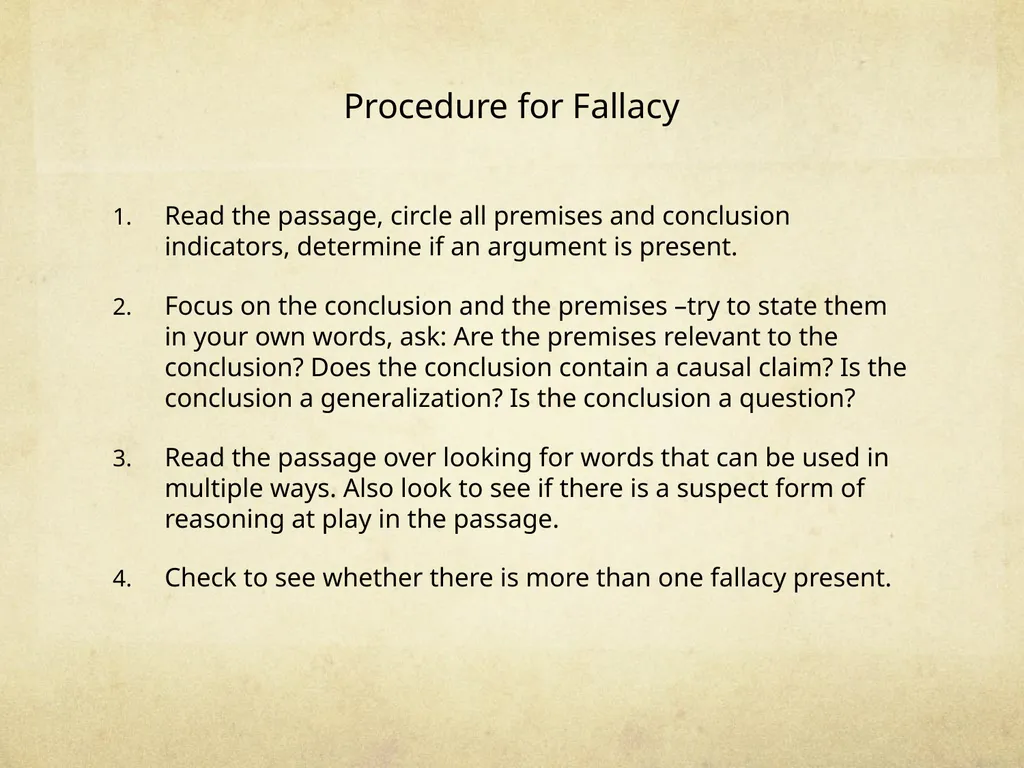
Procedure for Fallacy Read the passage, circle all premises and conclusion indicators, determine if an argument is present.
Focus on the conclusion and the premises –try to state them in your own words, ask: Are the premises relevant to the conclusion? Does the conclusion contain a causal claim? Is the conclusion a generalization? Is the conclusion a question?
Read the passage over looking for words that can be used in multiple ways. Also look to see if there is a suspect form of reasoning at play in the passage.
Check to see whether there is more than one fallacy present.<br>
Focus on the conclusion and the premises –try to state them in your own words, ask: Are the premises relevant to the conclusion? Does the conclusion contain a causal claim? Is the conclusion a generalization? Is the conclusion a question?
Read the passage over looking for words that can be used in multiple ways. Also look to see if there is a suspect form of reasoning at play in the passage.
Check to see whether there is more than one fallacy present.<br>