London – William Blake Objectives: To explore the
Description: London William Blake Objectives: To explore the context of Blakes London To analyse how Blakes choice of language shows his attitudes towards London Challenge question: What is Blakes message? London by William Blake Learning
Related Topics
Download Presentation
"London – William Blake Objectives: To explore the" is the property of its rightful owner. Permission is granted to download and print the materials on this website for personal, non-commercial use only, and to display it on your personal computer provided you do not modify the materials and that you retain all copyright notices contained in the materials. By downloading content from our website, you accept the terms of this agreement.
Presentation Transcript
slide1. London – William Blake Objectives:
To explore the context of Blake’s London
To analyse how Blake’s choice of language shows his attitudes towards London
Challenge question: What is Blake’s message?<br>
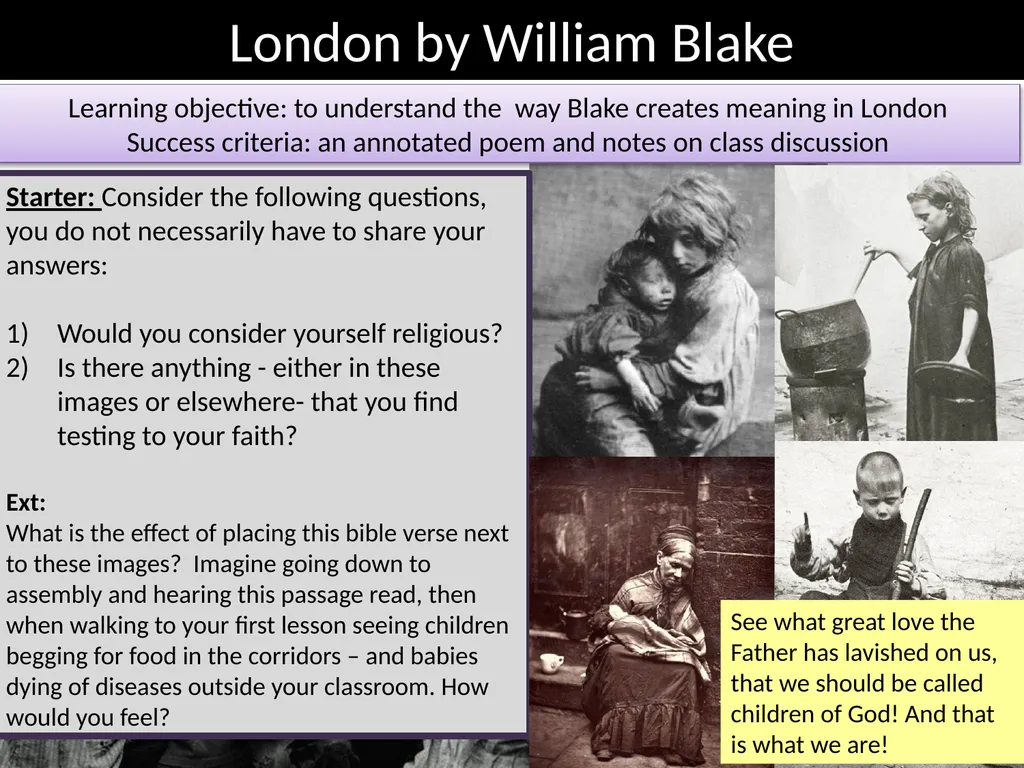
slide2. London by William Blake Learning objective: to understand the way Blake creates meaning in London
Success criteria: an annotated poem and notes on class discussion Starter: Consider the following questions, you do not necessarily have to share your answers:
Would you consider yourself religious?
Is there anything - either in these images or elsewhere- that you find testing to your faith?
Ext:
What is the effect of placing this bible verse next to these images? Imagine going down to assembly and hearing this passage read, then when walking to your first lesson seeing children begging for food in the corridors – and babies dying of diseases outside your classroom. How would you feel? See what great love the Father has lavished on us, that we should be called children of God! And that is what we are!<br>
slide3. ‘Men and women stood cooking their supper — scraps of bread and cold potatoes they had begged, stolen or picked up during the day. Hungry children held out plates and received blows and kicks from their parents when they came too near.’ Dead animals littered the streets. Excrement and rubbish often blocked the drains. Diseases such as diphtheria, cholera and measles flourished. Of every 1,000 children born in early 18th-century London, almost half died before the age of 2. Malnutrition, maternal ignorance, bad water, dirty food, poor hygiene and overcrowding all contributed to this extremely high mortality rate. And if an infant did survive, it then faced the perils of childhood - namely malnourishment and ongoing abuse. Many poor children were dispatched to crowded, backbreaking "workhouses“. 1700s London: Could you maintain your faith in these circumstances? Both read the Bible day and night, but thou read black where I read white.<br>
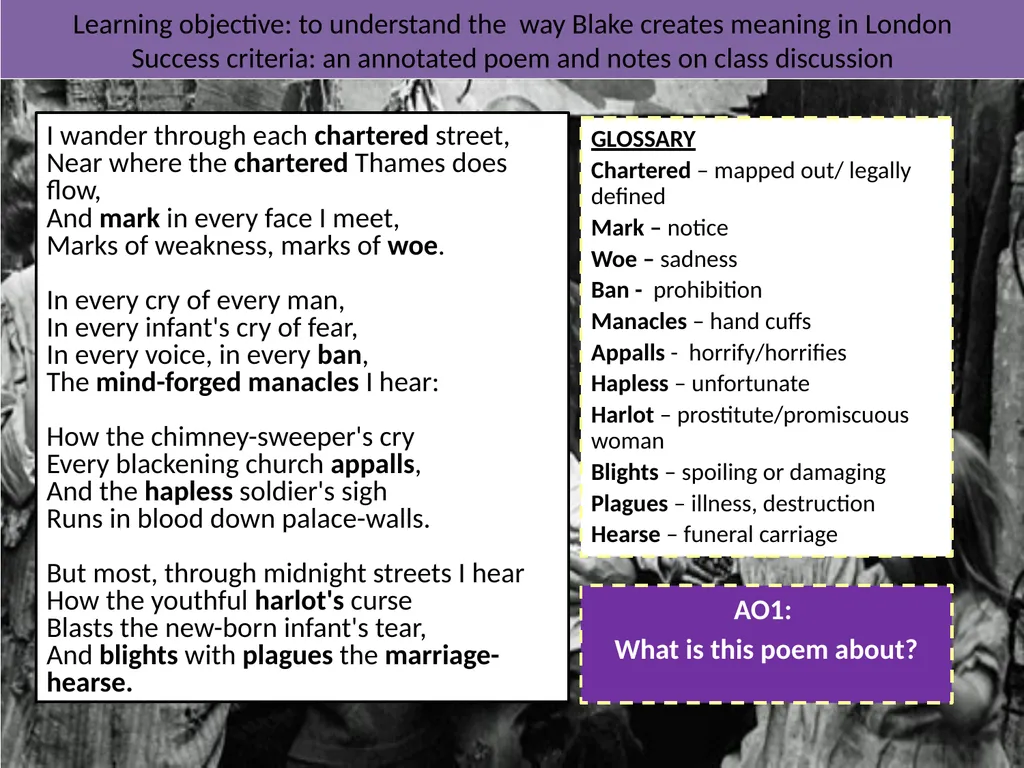
slide4. I wander through each chartered street,Near where the chartered Thames does flow,And mark in every face I meet,Marks of weakness, marks of woe.In every cry of every man,In every infant's cry of fear,In every voice, in every ban,The mind-forged manacles I hear:How the chimney-sweeper's cryEvery blackening church appalls,And the hapless soldier's sighRuns in blood down palace-walls.But most, through midnight streets I hearHow the youthful harlot's curseBlasts the new-born infant's tear,And blights with plagues the marriage-hearse. GLOSSARY
Chartered – mapped out/ legally defined
Mark – notice
Woe – sadness
Ban - prohibition
Manacles – hand cuffs
Appalls - horrify/horrifies
Hapless – unfortunate
Harlot – prostitute/promiscuous woman
Blights – spoiling or damaging
Plagues – illness, destruction
Hearse – funeral carriage AO1:
What is this poem about? Learning objective: to understand the way Blake creates meaning in London
Success criteria: an annotated poem and notes on class discussion<br>
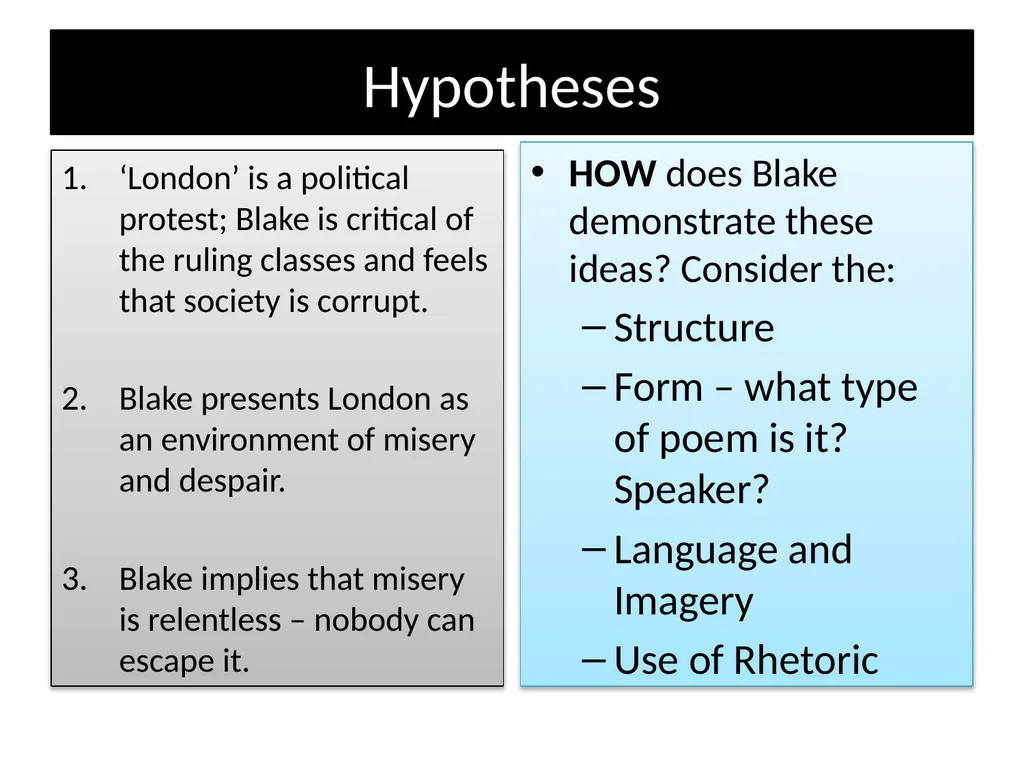
slide5. Hypotheses ‘London’ is a political protest; Blake is critical of the ruling classes and feels that society is corrupt.
Blake presents London as an environment of misery and despair.
Blake implies that misery is relentless – nobody can escape it. HOW does Blake demonstrate these ideas? Consider the:
Structure
Form – what type of poem is it? Speaker?
Language and Imagery
Use of Rhetoric<br>
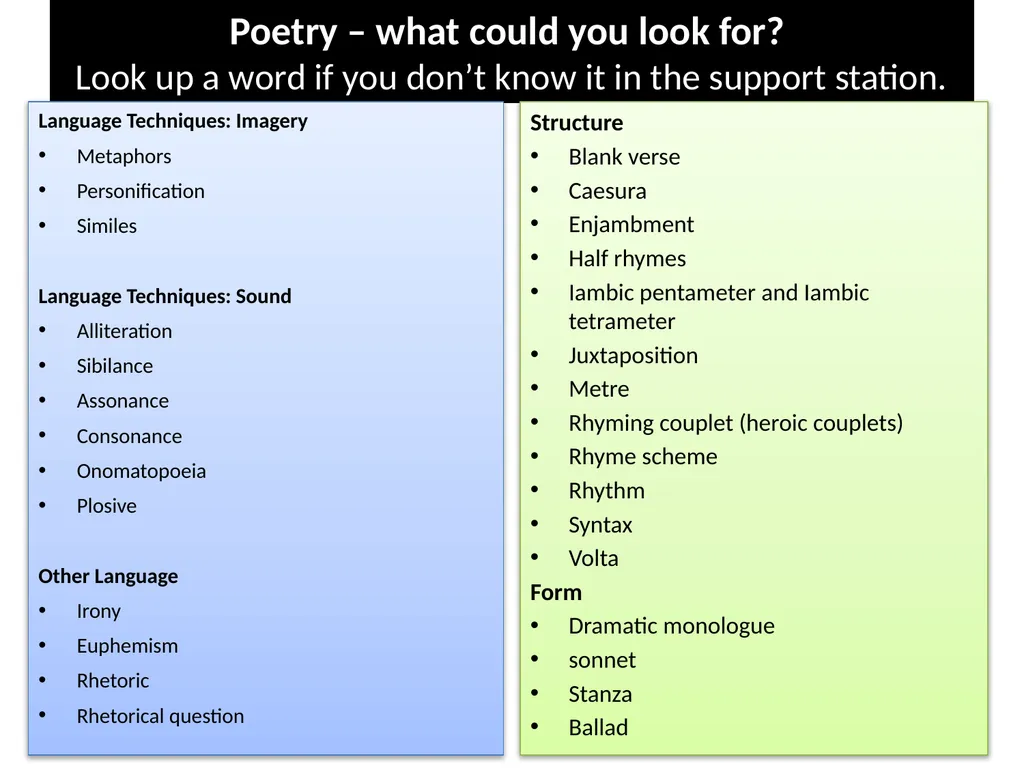
slide6. Poetry – what could you look for? Look up a word if you don’t know it in the support station. Language Techniques: Imagery
Metaphors
Personification
Similes
Language Techniques: Sound
Alliteration
Sibilance
Assonance
Consonance
Onomatopoeia
Plosive
Other Language
Irony
Euphemism
Rhetoric
Rhetorical question Structure
Blank verse
Caesura
Enjambment
Half rhymes
Iambic pentameter and Iambic tetrameter
Juxtaposition
Metre
Rhyming couplet (heroic couplets)
Rhyme scheme
Rhythm
Syntax
Volta
Form
Dramatic monologue
sonnet
Stanza
Ballad<br>

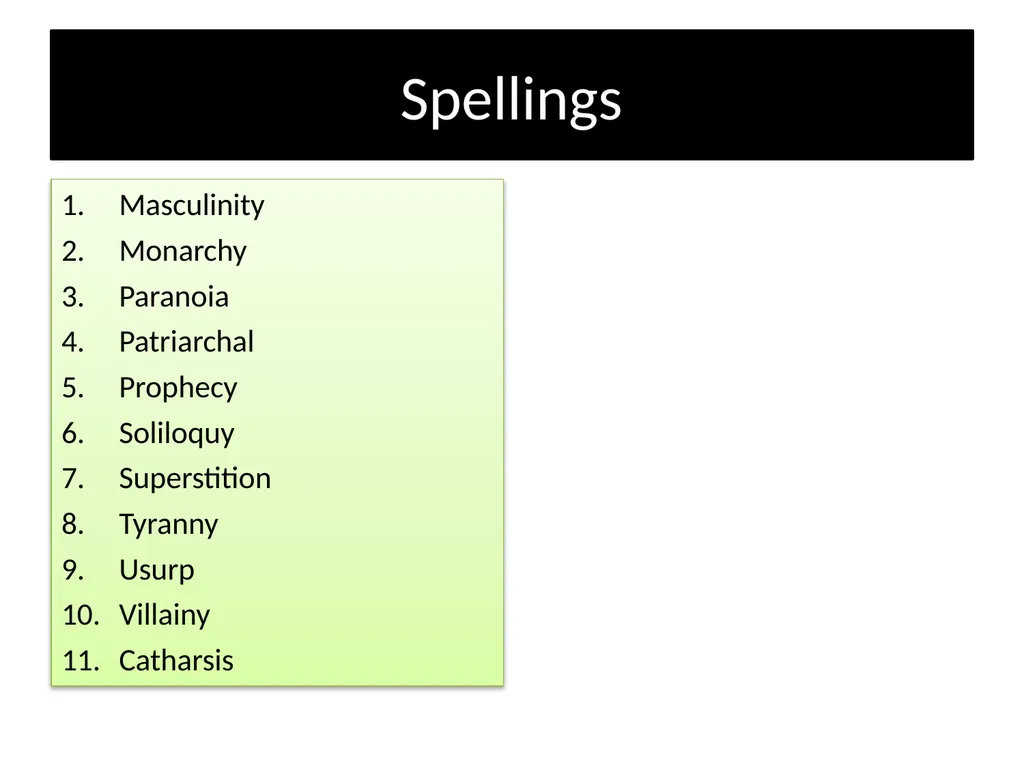
slide7. Spellings Masculinity
Monarchy
Paranoia
Patriarchal
Prophecy
Soliloquy
Superstition
Tyranny
Usurp
Villainy
Catharsis<br>
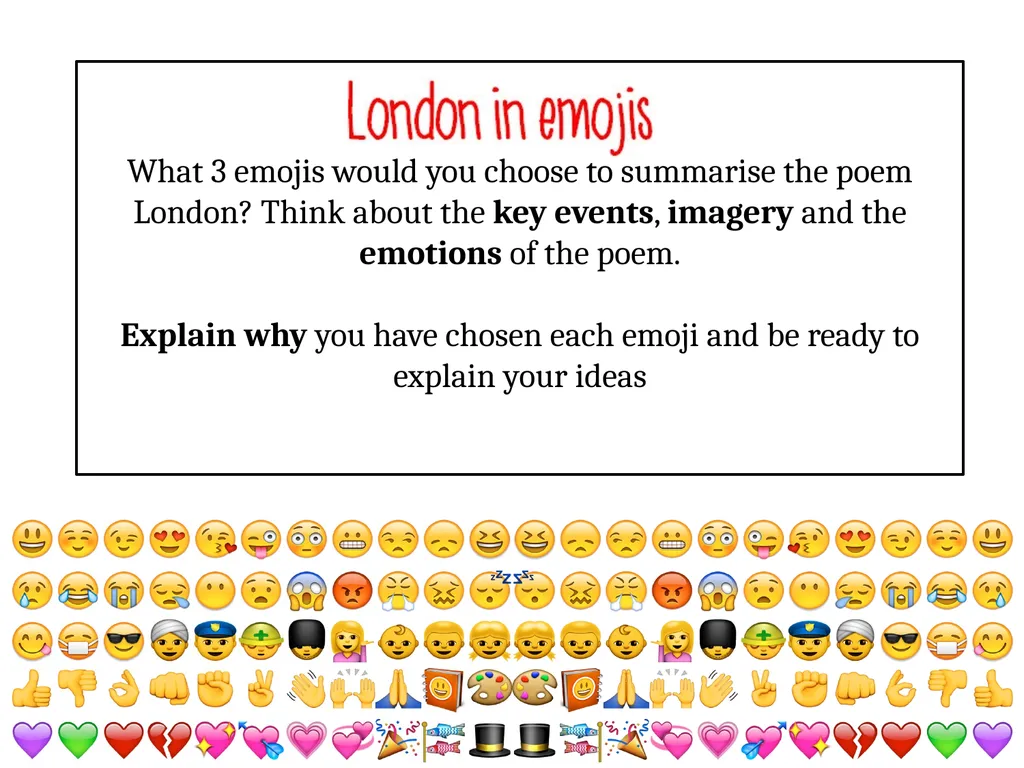
slide8. What 3 emojis would you choose to summarise the poem London? Think about the key events, imagery and the emotions of the poem.
Explain why you have chosen each emoji and be ready to explain your ideas<br>
To explore the context of Blake’s London
To analyse how Blake’s choice of language shows his attitudes towards London
Challenge question: What is Blake’s message?<br>
slide2. London by William Blake Learning objective: to understand the way Blake creates meaning in London
Success criteria: an annotated poem and notes on class discussion Starter: Consider the following questions, you do not necessarily have to share your answers:
Would you consider yourself religious?
Is there anything - either in these images or elsewhere- that you find testing to your faith?
Ext:
What is the effect of placing this bible verse next to these images? Imagine going down to assembly and hearing this passage read, then when walking to your first lesson seeing children begging for food in the corridors – and babies dying of diseases outside your classroom. How would you feel? See what great love the Father has lavished on us, that we should be called children of God! And that is what we are!<br>
slide3. ‘Men and women stood cooking their supper — scraps of bread and cold potatoes they had begged, stolen or picked up during the day. Hungry children held out plates and received blows and kicks from their parents when they came too near.’ Dead animals littered the streets. Excrement and rubbish often blocked the drains. Diseases such as diphtheria, cholera and measles flourished. Of every 1,000 children born in early 18th-century London, almost half died before the age of 2. Malnutrition, maternal ignorance, bad water, dirty food, poor hygiene and overcrowding all contributed to this extremely high mortality rate. And if an infant did survive, it then faced the perils of childhood - namely malnourishment and ongoing abuse. Many poor children were dispatched to crowded, backbreaking "workhouses“. 1700s London: Could you maintain your faith in these circumstances? Both read the Bible day and night, but thou read black where I read white.<br>
slide4. I wander through each chartered street,Near where the chartered Thames does flow,And mark in every face I meet,Marks of weakness, marks of woe.In every cry of every man,In every infant's cry of fear,In every voice, in every ban,The mind-forged manacles I hear:How the chimney-sweeper's cryEvery blackening church appalls,And the hapless soldier's sighRuns in blood down palace-walls.But most, through midnight streets I hearHow the youthful harlot's curseBlasts the new-born infant's tear,And blights with plagues the marriage-hearse. GLOSSARY
Chartered – mapped out/ legally defined
Mark – notice
Woe – sadness
Ban - prohibition
Manacles – hand cuffs
Appalls - horrify/horrifies
Hapless – unfortunate
Harlot – prostitute/promiscuous woman
Blights – spoiling or damaging
Plagues – illness, destruction
Hearse – funeral carriage AO1:
What is this poem about? Learning objective: to understand the way Blake creates meaning in London
Success criteria: an annotated poem and notes on class discussion<br>
slide5. Hypotheses ‘London’ is a political protest; Blake is critical of the ruling classes and feels that society is corrupt.
Blake presents London as an environment of misery and despair.
Blake implies that misery is relentless – nobody can escape it. HOW does Blake demonstrate these ideas? Consider the:
Structure
Form – what type of poem is it? Speaker?
Language and Imagery
Use of Rhetoric<br>
slide6. Poetry – what could you look for? Look up a word if you don’t know it in the support station. Language Techniques: Imagery
Metaphors
Personification
Similes
Language Techniques: Sound
Alliteration
Sibilance
Assonance
Consonance
Onomatopoeia
Plosive
Other Language
Irony
Euphemism
Rhetoric
Rhetorical question Structure
Blank verse
Caesura
Enjambment
Half rhymes
Iambic pentameter and Iambic tetrameter
Juxtaposition
Metre
Rhyming couplet (heroic couplets)
Rhyme scheme
Rhythm
Syntax
Volta
Form
Dramatic monologue
sonnet
Stanza
Ballad<br>
slide7. Spellings Masculinity
Monarchy
Paranoia
Patriarchal
Prophecy
Soliloquy
Superstition
Tyranny
Usurp
Villainy
Catharsis<br>
slide8. What 3 emojis would you choose to summarise the poem London? Think about the key events, imagery and the emotions of the poem.
Explain why you have chosen each emoji and be ready to explain your ideas<br>