Lunch & Learn Webinar: CAPR 70-1 Overview Civil
Description: Lunch Learn Webinar: CAPR 70-1 Overview Civil Air Patrol One Civil Air Patrol, excelling in service to our nation and our members! John Moose Desmarais Director of Operations National Headquarters Presenter Rules of Engagement Members
Related Topics
Download Presentation
"Lunch & Learn Webinar: CAPR 70-1 Overview Civil" is the property of its rightful owner. Permission is granted to download and print the materials on this website for personal, non-commercial use only, and to display it on your personal computer provided you do not modify the materials and that you retain all copyright notices contained in the materials. By downloading content from our website, you accept the terms of this agreement.
Presentation Transcript
slide1. Lunch & Learn Webinar: CAPR 70-1 Overview Civil Air Patrol One Civil Air Patrol, excelling in service to our nation and our members!<br>
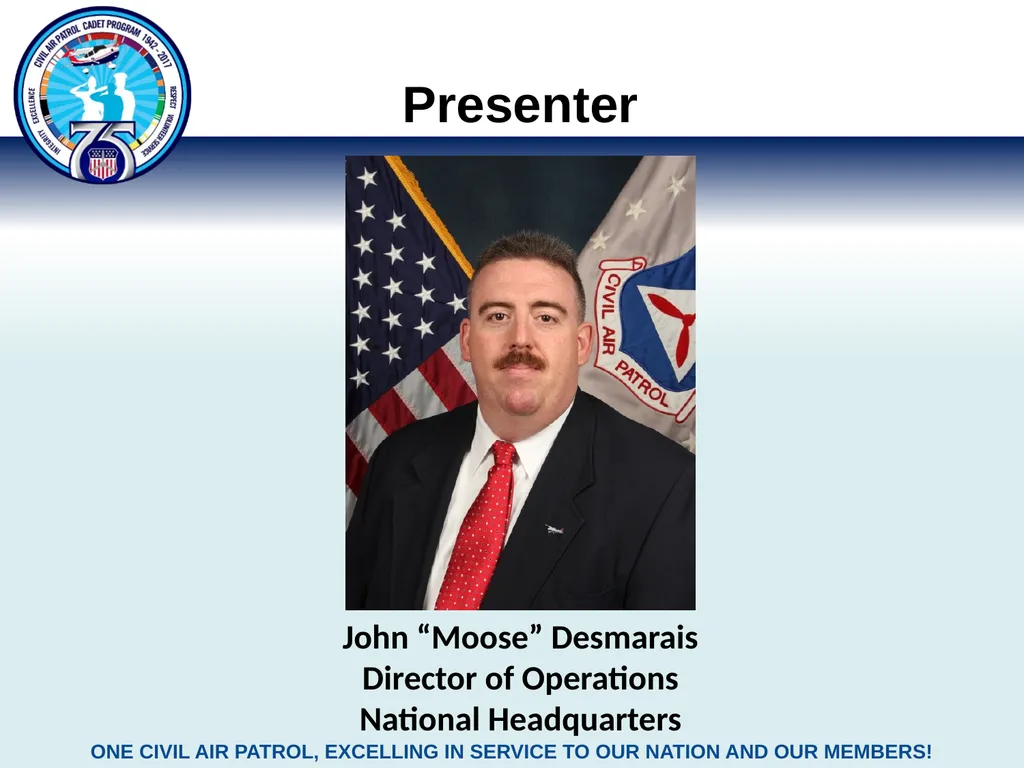
slide2. John “Moose” Desmarais
Director of Operations
National Headquarters Presenter<br>
slide3. Rules of Engagement Members in the field will be in listen only mode. We have several hundred members signed up, so having everyone with an open microphone is not supportable.
We will try to answer questions throughout the webinar though. Just type your questions, and we will either answer you directly via text or provide a voice answer to your question.
The webinar itself, questions, and chat log are being recorded, so please remain respectful.
Time is limited…focus on the topic <br>
slide4. Overview The writers did their best to:
Format the regulation logically
Take full advantage of technology to help mobile users with hyperlinks and bookmarks throughout the document
Avoid restating existing FAA requirements unless emphasis was desired by leadership
Consider limitations and opportunities while also recognizing and addressing critical areas of risk to CAP flight operations<br>
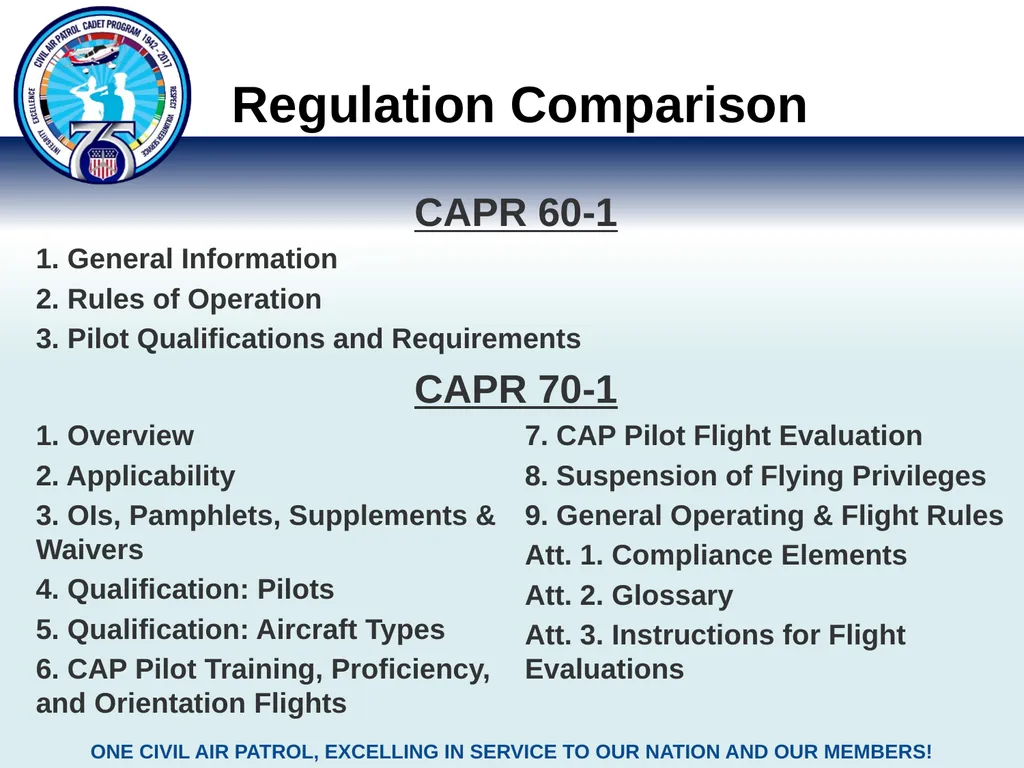
slide5. Regulation Comparison CAPR 60-1
1. General Information
2. Rules of Operation
3. Pilot Qualifications and Requirements 1. Overview
2. Applicability
3. OIs, Pamphlets, Supplements & Waivers
4. Qualification: Pilots
5. Qualification: Aircraft Types
6. CAP Pilot Training, Proficiency, and Orientation Flights
7. CAP Pilot Flight Evaluation
8. Suspension of Flying Privileges
9. General Operating & Flight Rules
Att. 1. Compliance Elements
Att. 2. Glossary
Att. 3. Instructions for Flight Evaluations CAPR 70-1<br>
slide6. Sections 1 through 3 This regulation focuses on the overall flying operations, not mission specific flying issues
70-1 and 14 CFR applies to CAP members flying
Not CAP-USAF
Not maintenance personnel
All Operating Instructions, Pamphlets, Supplements and Waivers must be coordinated through the chain of command and CAP-USAF for final approval by CAP/DO
Why? Can’t risk AFAM status from misinterpretation
Wing Level and Higher Only<br>
slide7. Section 4 Pilot qualifications have really not changed
Considers external experience where possible and not require extra flight evaluations
Adding an instrument rating
Instrument competency checks
Mission Pilot qualifications referred to CAPR 60-3 … Expect an ICL to it before December 4th.
Introduces the new Flight Release Officer Qualifications
FROs must have flying experience (pilot or aircrew)
SFROs must also be Senior Pilots & hold an instrument airplane rating (need not be current)<br>
slide8. Section 5 CAP specific aircraft qualifications requirements for pilots beyond those found in 14 CFR
High Performance Aircraft - Now allows for cadets to continue on if they trained in high performance aircraft
Complex Aircraft
Gliders
Balloons<br>
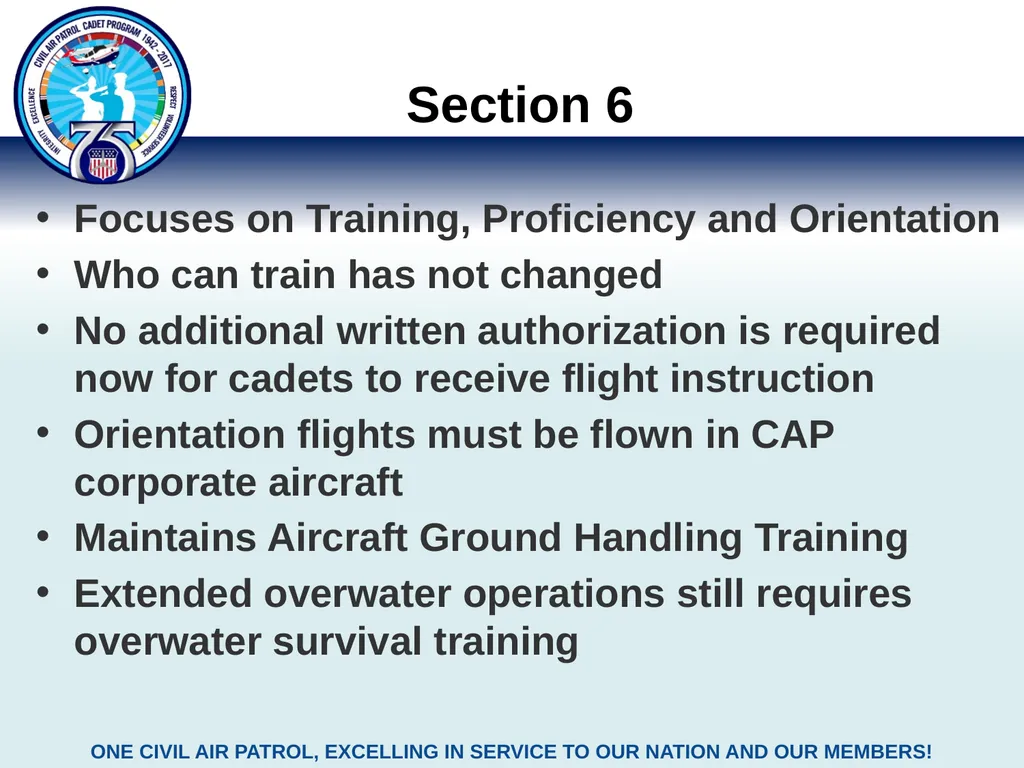
slide9. Section 6 Focuses on Training, Proficiency and Orientation
Who can train has not changed
No additional written authorization is required now for cadets to receive flight instruction
Orientation flights must be flown in CAP corporate aircraft
Maintains Aircraft Ground Handling Training
Extended overwater operations still requires overwater survival training<br>
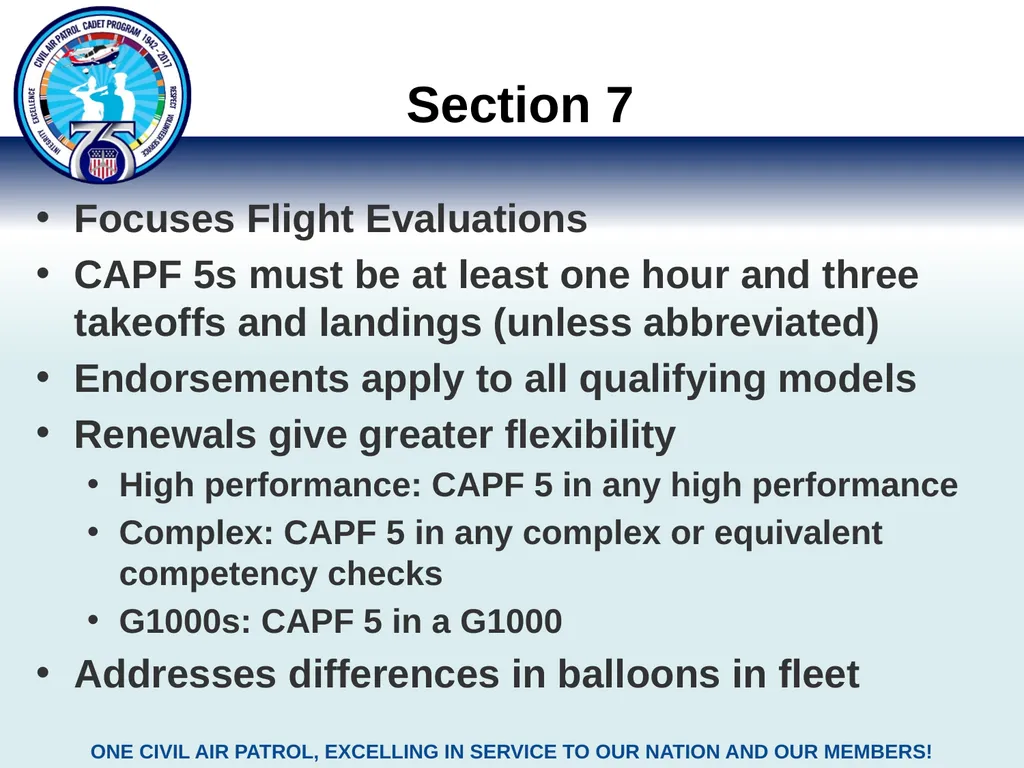
slide10. Section 7 Focuses Flight Evaluations
CAPF 5s must be at least one hour and three takeoffs and landings (unless abbreviated)
Endorsements apply to all qualifying models
Renewals give greater flexibility
High performance: CAPF 5 in any high performance
Complex: CAPF 5 in any complex or equivalent competency checks
G1000s: CAPF 5 in a G1000
Addresses differences in balloons in fleet<br>
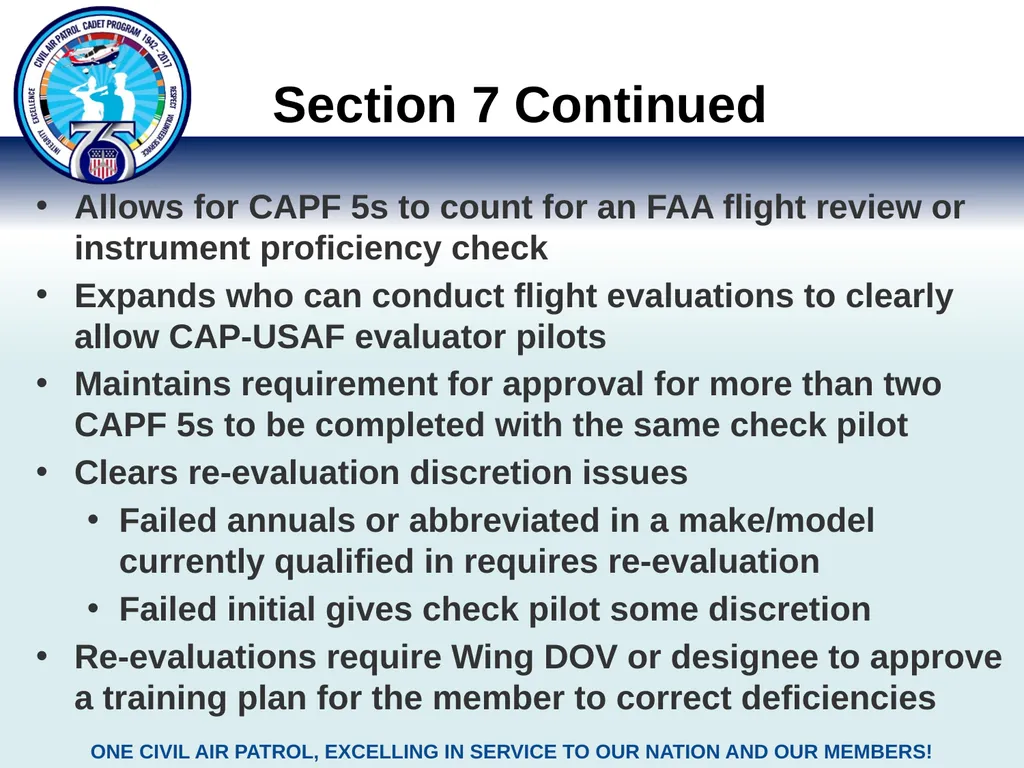
slide11. Section 7 Continued Allows for CAPF 5s to count for an FAA flight review or instrument proficiency check
Expands who can conduct flight evaluations to clearly allow CAP-USAF evaluator pilots
Maintains requirement for approval for more than two CAPF 5s to be completed with the same check pilot
Clears re-evaluation discretion issues
Failed annuals or abbreviated in a make/model currently qualified in requires re-evaluation
Failed initial gives check pilot some discretion
Re-evaluations require Wing DOV or designee to approve a training plan for the member to correct deficiencies<br>
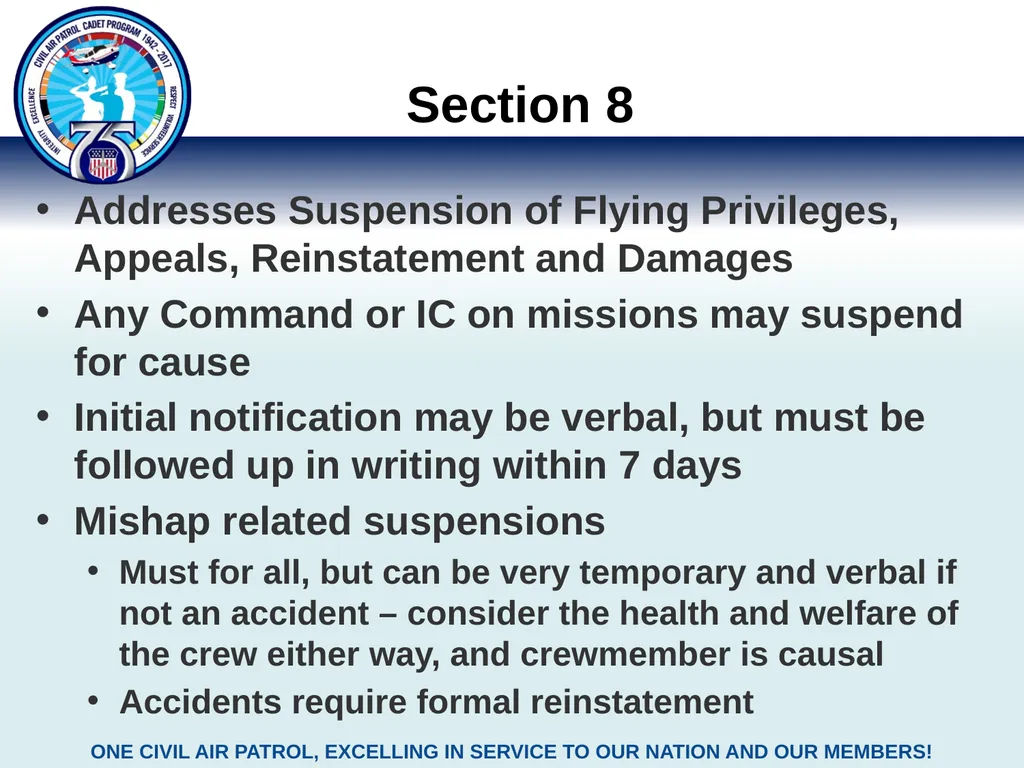
slide12. Section 8 Addresses Suspension of Flying Privileges, Appeals, Reinstatement and Damages
Any Command or IC on missions may suspend for cause
Initial notification may be verbal, but must be followed up in writing within 7 days
Mishap related suspensions
Must for all, but can be very temporary and verbal if not an accident – consider the health and welfare of the crew either way, and crewmember is causal
Accidents require formal reinstatement<br>
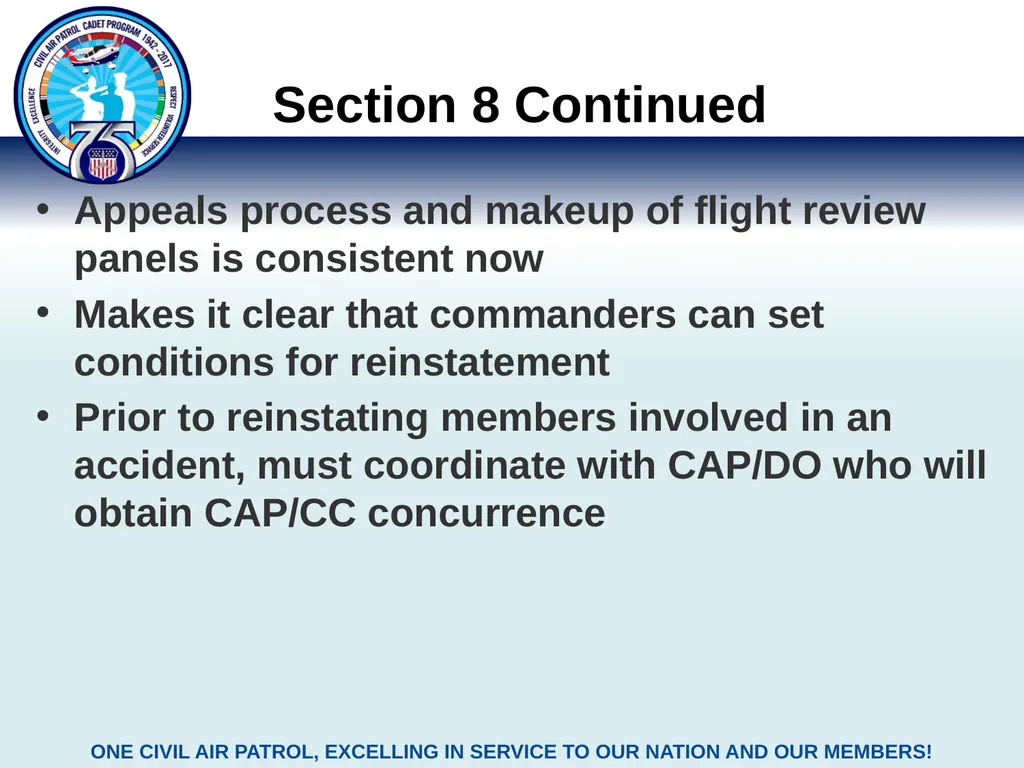
slide13. Section 8 Continued Appeals process and makeup of flight review panels is consistent now
Makes it clear that commanders can set conditions for reinstatement
Prior to reinstating members involved in an accident, must coordinate with CAP/DO who will obtain CAP/CC concurrence<br>
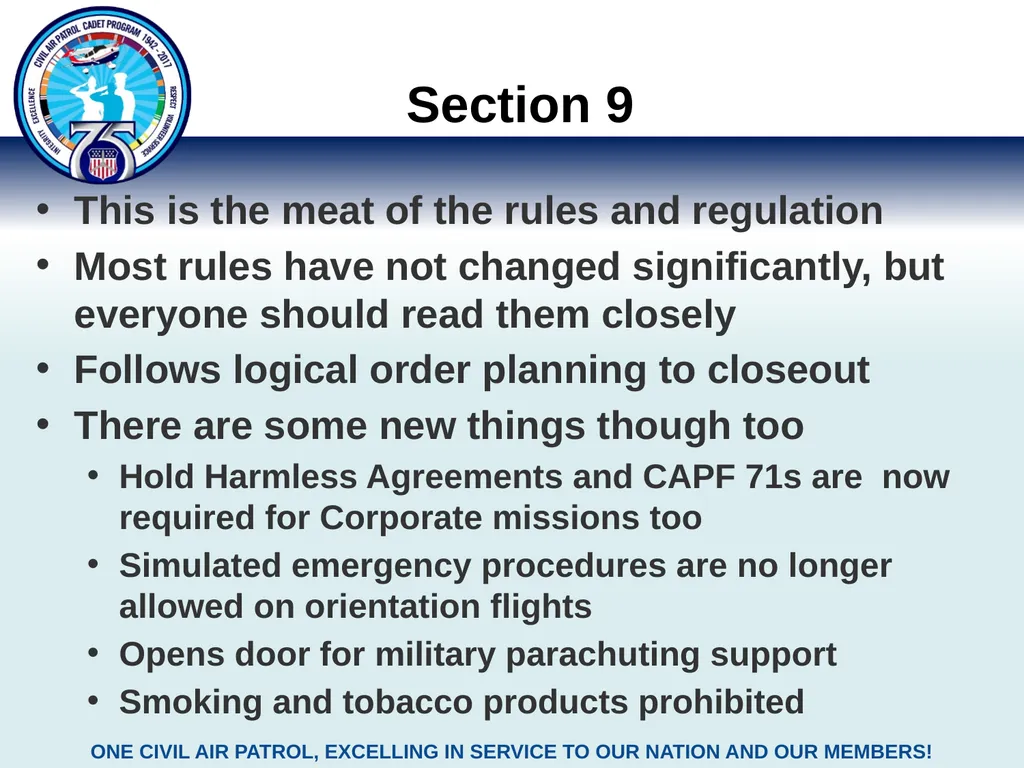
slide14. Section 9 This is the meat of the rules and regulation
Most rules have not changed significantly, but everyone should read them closely
Follows logical order planning to closeout
There are some new things though too
Hold Harmless Agreements and CAPF 71s are now required for Corporate missions too
Simulated emergency procedures are no longer allowed on orientation flights
Opens door for military parachuting support
Smoking and tobacco products prohibited<br>
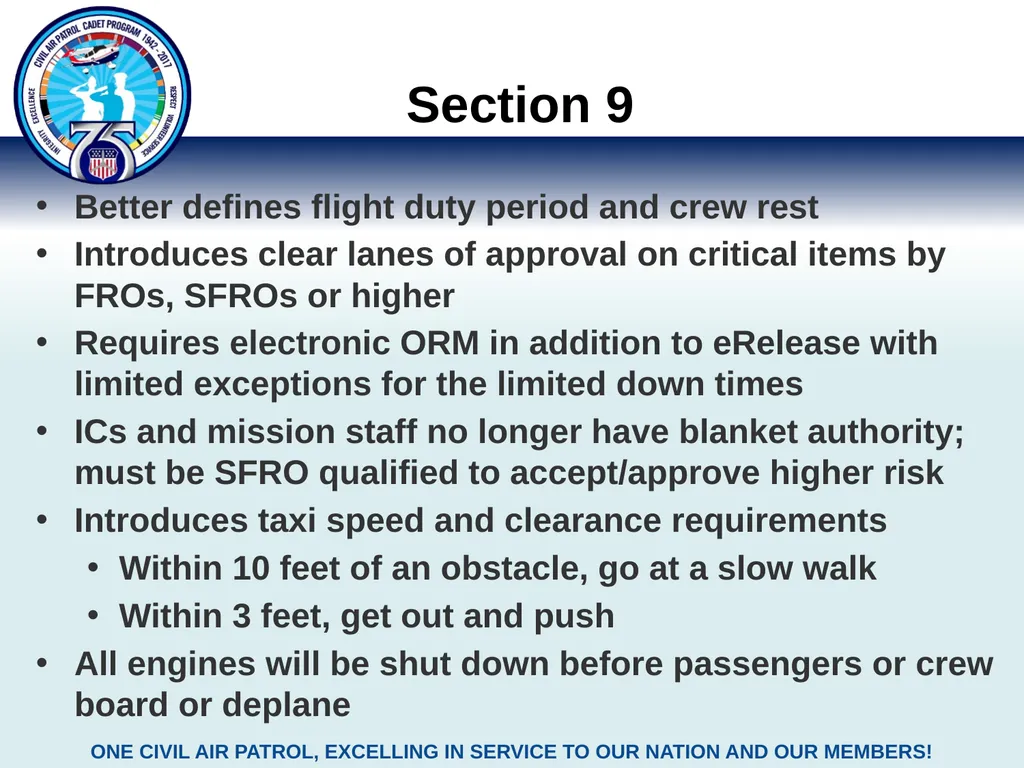
slide15. Section 9 Better defines flight duty period and crew rest
Introduces clear lanes of approval on critical items by FROs, SFROs or higher
Requires electronic ORM in addition to eRelease with limited exceptions for the limited down times
ICs and mission staff no longer have blanket authority; must be SFRO qualified to accept/approve higher risk
Introduces taxi speed and clearance requirements
Within 10 feet of an obstacle, go at a slow walk
Within 3 feet, get out and push
All engines will be shut down before passengers or crew board or deplane<br>
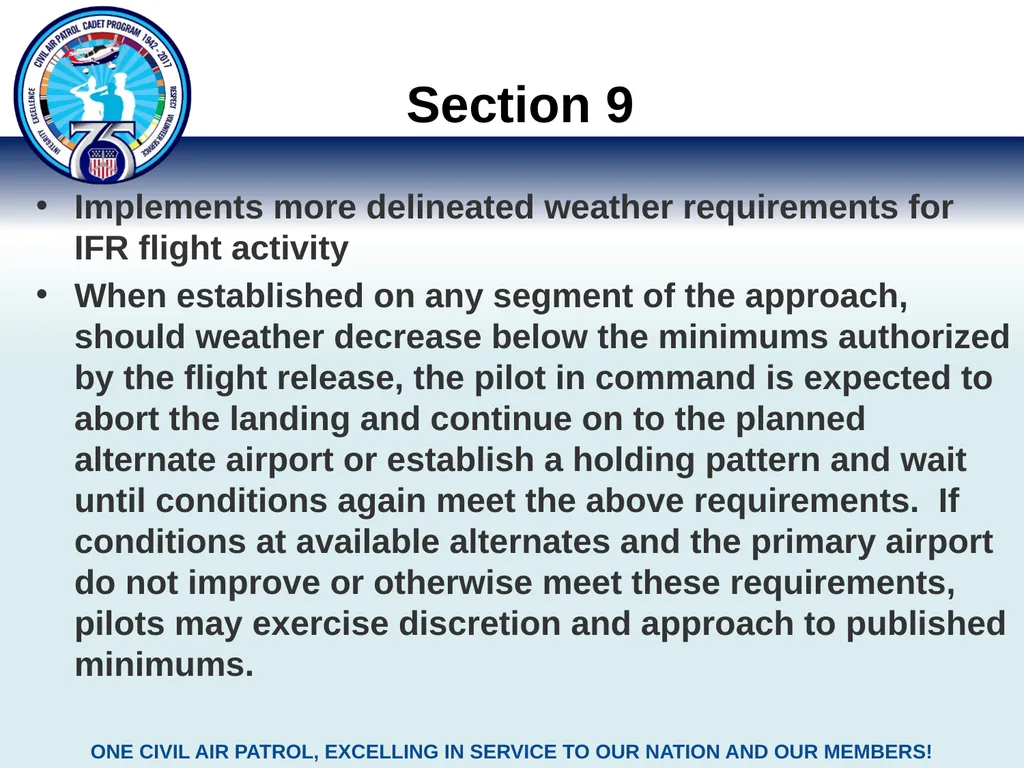
slide16. Section 9 Implements more delineated weather requirements for IFR flight activity
When established on any segment of the approach, should weather decrease below the minimums authorized by the flight release, the pilot in command is expected to abort the landing and continue on to the planned alternate airport or establish a holding pattern and wait until conditions again meet the above requirements. If conditions at available alternates and the primary airport do not improve or otherwise meet these requirements, pilots may exercise discretion and approach to published minimums.<br>
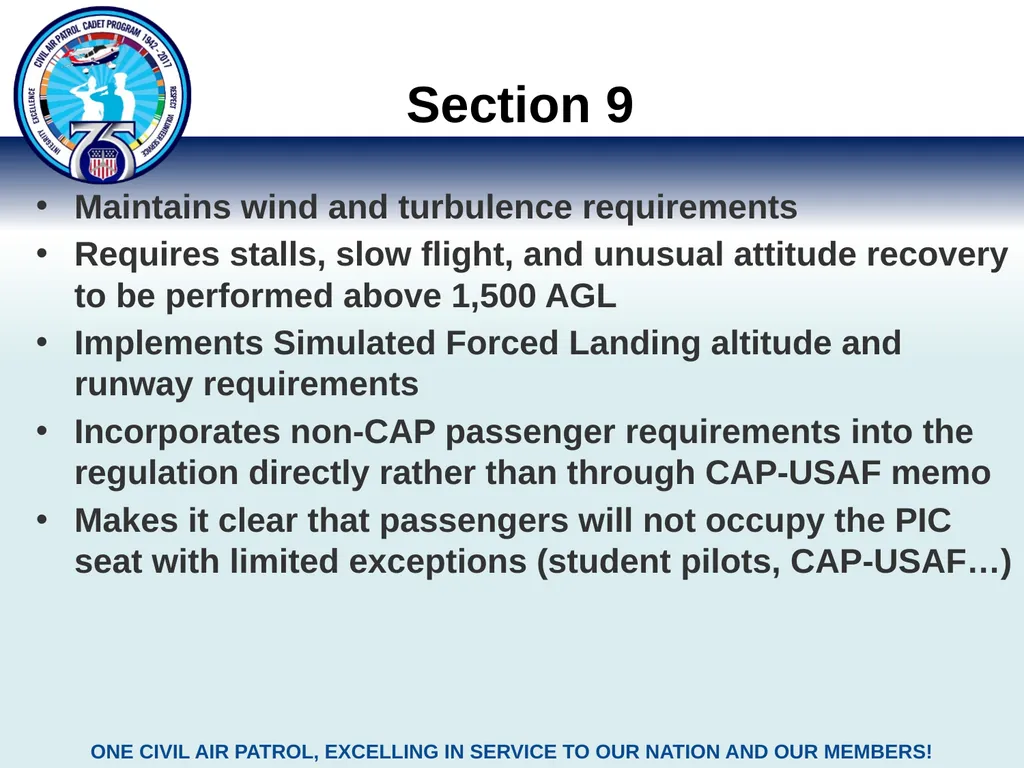
slide17. Section 9 Maintains wind and turbulence requirements
Requires stalls, slow flight, and unusual attitude recovery to be performed above 1,500 AGL
Implements Simulated Forced Landing altitude and runway requirements
Incorporates non-CAP passenger requirements into the regulation directly rather than through CAP-USAF memo
Makes it clear that passengers will not occupy the PIC seat with limited exceptions (student pilots, CAP-USAF…)<br>
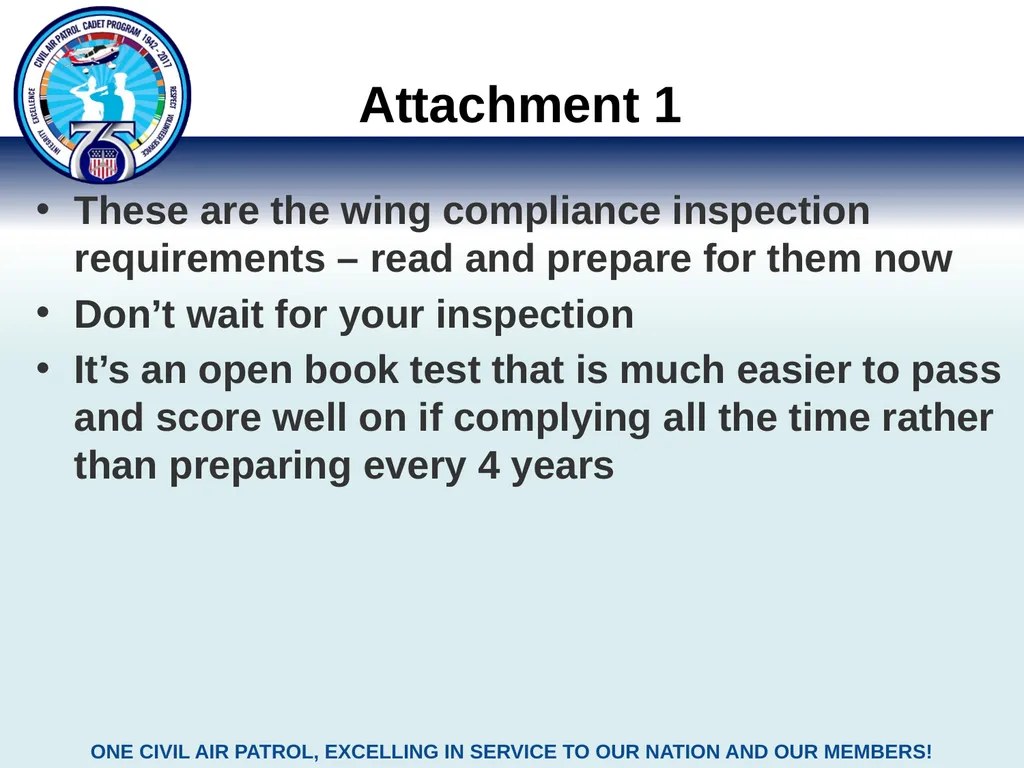
slide18. Attachment 1 These are the wing compliance inspection requirements – read and prepare for them now
Don’t wait for your inspection
It’s an open book test that is much easier to pass and score well on if complying all the time rather than preparing every 4 years<br>
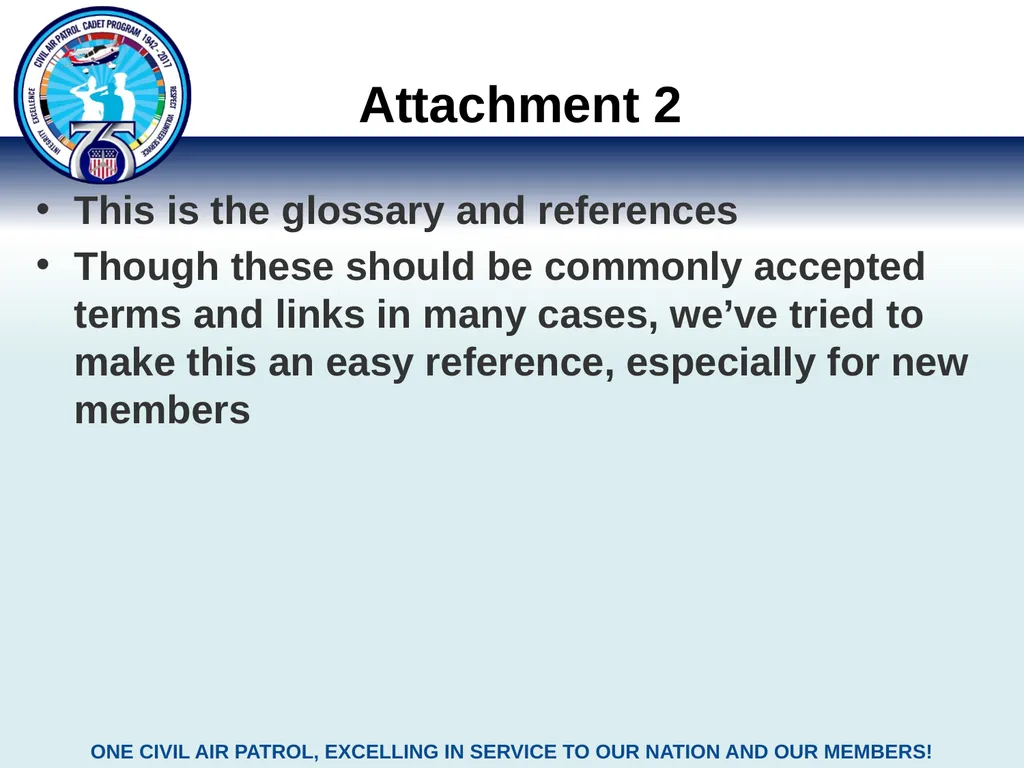
slide19. Attachment 2 This is the glossary and references
Though these should be commonly accepted terms and links in many cases, we’ve tried to make this an easy reference, especially for new members<br>
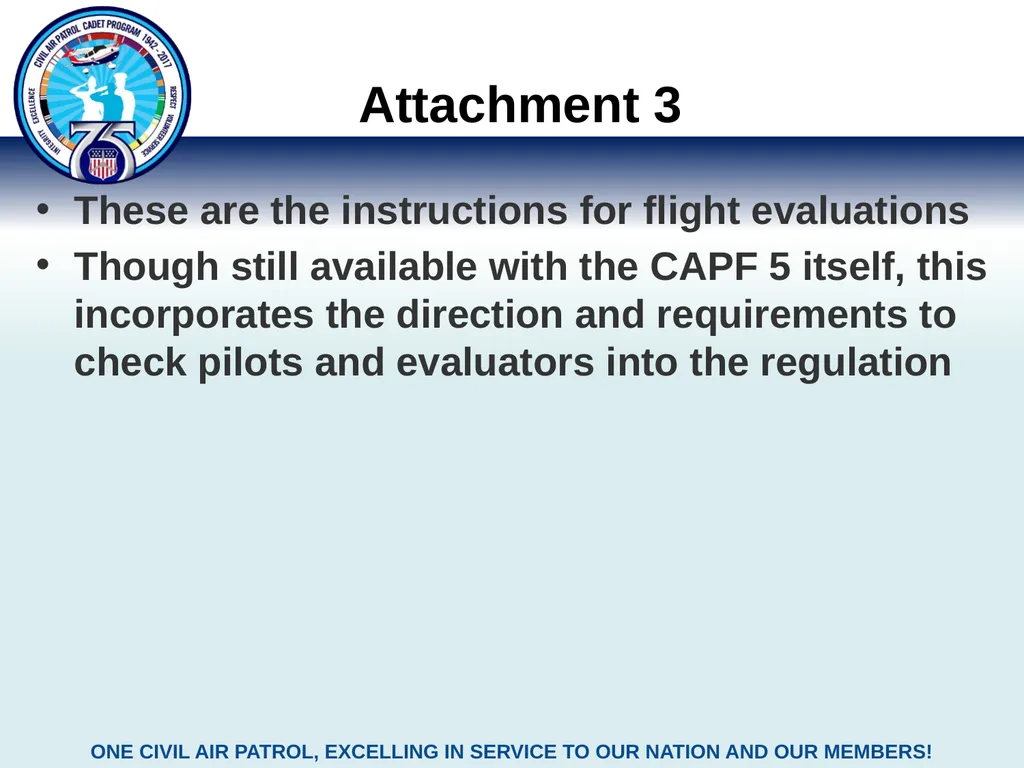
slide20. Attachment 3 These are the instructions for flight evaluations
Though still available with the CAPF 5 itself, this incorporates the direction and requirements to check pilots and evaluators into the regulation<br>
slide21. QUESTIONS?dov@capnhq.gov<br>
slide22. Future Lunch & Learn Webinars Changes to the ORM Process
9 November 2017
11:00 to 11:30 Central
https://attendee.gotowebinar.com/register/25359517785397763
Changes to the Flight Release Process
16 November 2017
11:00 to 11:30 Central
https://attendee.gotowebinar.com/register/5076746833230198275<br>

slide2. John “Moose” Desmarais
Director of Operations
National Headquarters Presenter<br>
slide3. Rules of Engagement Members in the field will be in listen only mode. We have several hundred members signed up, so having everyone with an open microphone is not supportable.
We will try to answer questions throughout the webinar though. Just type your questions, and we will either answer you directly via text or provide a voice answer to your question.
The webinar itself, questions, and chat log are being recorded, so please remain respectful.
Time is limited…focus on the topic <br>
slide4. Overview The writers did their best to:
Format the regulation logically
Take full advantage of technology to help mobile users with hyperlinks and bookmarks throughout the document
Avoid restating existing FAA requirements unless emphasis was desired by leadership
Consider limitations and opportunities while also recognizing and addressing critical areas of risk to CAP flight operations<br>
slide5. Regulation Comparison CAPR 60-1
1. General Information
2. Rules of Operation
3. Pilot Qualifications and Requirements 1. Overview
2. Applicability
3. OIs, Pamphlets, Supplements & Waivers
4. Qualification: Pilots
5. Qualification: Aircraft Types
6. CAP Pilot Training, Proficiency, and Orientation Flights
7. CAP Pilot Flight Evaluation
8. Suspension of Flying Privileges
9. General Operating & Flight Rules
Att. 1. Compliance Elements
Att. 2. Glossary
Att. 3. Instructions for Flight Evaluations CAPR 70-1<br>
slide6. Sections 1 through 3 This regulation focuses on the overall flying operations, not mission specific flying issues
70-1 and 14 CFR applies to CAP members flying
Not CAP-USAF
Not maintenance personnel
All Operating Instructions, Pamphlets, Supplements and Waivers must be coordinated through the chain of command and CAP-USAF for final approval by CAP/DO
Why? Can’t risk AFAM status from misinterpretation
Wing Level and Higher Only<br>
slide7. Section 4 Pilot qualifications have really not changed
Considers external experience where possible and not require extra flight evaluations
Adding an instrument rating
Instrument competency checks
Mission Pilot qualifications referred to CAPR 60-3 … Expect an ICL to it before December 4th.
Introduces the new Flight Release Officer Qualifications
FROs must have flying experience (pilot or aircrew)
SFROs must also be Senior Pilots & hold an instrument airplane rating (need not be current)<br>
slide8. Section 5 CAP specific aircraft qualifications requirements for pilots beyond those found in 14 CFR
High Performance Aircraft - Now allows for cadets to continue on if they trained in high performance aircraft
Complex Aircraft
Gliders
Balloons<br>
slide9. Section 6 Focuses on Training, Proficiency and Orientation
Who can train has not changed
No additional written authorization is required now for cadets to receive flight instruction
Orientation flights must be flown in CAP corporate aircraft
Maintains Aircraft Ground Handling Training
Extended overwater operations still requires overwater survival training<br>
slide10. Section 7 Focuses Flight Evaluations
CAPF 5s must be at least one hour and three takeoffs and landings (unless abbreviated)
Endorsements apply to all qualifying models
Renewals give greater flexibility
High performance: CAPF 5 in any high performance
Complex: CAPF 5 in any complex or equivalent competency checks
G1000s: CAPF 5 in a G1000
Addresses differences in balloons in fleet<br>
slide11. Section 7 Continued Allows for CAPF 5s to count for an FAA flight review or instrument proficiency check
Expands who can conduct flight evaluations to clearly allow CAP-USAF evaluator pilots
Maintains requirement for approval for more than two CAPF 5s to be completed with the same check pilot
Clears re-evaluation discretion issues
Failed annuals or abbreviated in a make/model currently qualified in requires re-evaluation
Failed initial gives check pilot some discretion
Re-evaluations require Wing DOV or designee to approve a training plan for the member to correct deficiencies<br>
slide12. Section 8 Addresses Suspension of Flying Privileges, Appeals, Reinstatement and Damages
Any Command or IC on missions may suspend for cause
Initial notification may be verbal, but must be followed up in writing within 7 days
Mishap related suspensions
Must for all, but can be very temporary and verbal if not an accident – consider the health and welfare of the crew either way, and crewmember is causal
Accidents require formal reinstatement<br>
slide13. Section 8 Continued Appeals process and makeup of flight review panels is consistent now
Makes it clear that commanders can set conditions for reinstatement
Prior to reinstating members involved in an accident, must coordinate with CAP/DO who will obtain CAP/CC concurrence<br>
slide14. Section 9 This is the meat of the rules and regulation
Most rules have not changed significantly, but everyone should read them closely
Follows logical order planning to closeout
There are some new things though too
Hold Harmless Agreements and CAPF 71s are now required for Corporate missions too
Simulated emergency procedures are no longer allowed on orientation flights
Opens door for military parachuting support
Smoking and tobacco products prohibited<br>
slide15. Section 9 Better defines flight duty period and crew rest
Introduces clear lanes of approval on critical items by FROs, SFROs or higher
Requires electronic ORM in addition to eRelease with limited exceptions for the limited down times
ICs and mission staff no longer have blanket authority; must be SFRO qualified to accept/approve higher risk
Introduces taxi speed and clearance requirements
Within 10 feet of an obstacle, go at a slow walk
Within 3 feet, get out and push
All engines will be shut down before passengers or crew board or deplane<br>
slide16. Section 9 Implements more delineated weather requirements for IFR flight activity
When established on any segment of the approach, should weather decrease below the minimums authorized by the flight release, the pilot in command is expected to abort the landing and continue on to the planned alternate airport or establish a holding pattern and wait until conditions again meet the above requirements. If conditions at available alternates and the primary airport do not improve or otherwise meet these requirements, pilots may exercise discretion and approach to published minimums.<br>
slide17. Section 9 Maintains wind and turbulence requirements
Requires stalls, slow flight, and unusual attitude recovery to be performed above 1,500 AGL
Implements Simulated Forced Landing altitude and runway requirements
Incorporates non-CAP passenger requirements into the regulation directly rather than through CAP-USAF memo
Makes it clear that passengers will not occupy the PIC seat with limited exceptions (student pilots, CAP-USAF…)<br>
slide18. Attachment 1 These are the wing compliance inspection requirements – read and prepare for them now
Don’t wait for your inspection
It’s an open book test that is much easier to pass and score well on if complying all the time rather than preparing every 4 years<br>
slide19. Attachment 2 This is the glossary and references
Though these should be commonly accepted terms and links in many cases, we’ve tried to make this an easy reference, especially for new members<br>
slide20. Attachment 3 These are the instructions for flight evaluations
Though still available with the CAPF 5 itself, this incorporates the direction and requirements to check pilots and evaluators into the regulation<br>
slide21. QUESTIONS?dov@capnhq.gov<br>
slide22. Future Lunch & Learn Webinars Changes to the ORM Process
9 November 2017
11:00 to 11:30 Central
https://attendee.gotowebinar.com/register/25359517785397763
Changes to the Flight Release Process
16 November 2017
11:00 to 11:30 Central
https://attendee.gotowebinar.com/register/5076746833230198275<br>