
Making Things Clearer: Crafting, Evaluating, and
Description: Making Things Clearer: Crafting, Evaluating, and Revising Effective Accommodations Language David J. Thomas, Ph.D., M.A. Assistant Professor, Interdisciplinary Studies and Academic Support Programs Director, Office of Educational
Related Topics
Download Presentation
"Making Things Clearer: Crafting, Evaluating, and" is the property of its rightful owner. Permission is granted to download and print the materials on this website for personal, non-commercial use only, and to display it on your personal computer provided you do not modify the materials and that you retain all copyright notices contained in the materials. By downloading content from our website, you accept the terms of this agreement.
Presentation Transcript
slide1. Making Things Clearer: Crafting, Evaluating, and Revising Effective Accommodations Language David J. Thomas, Ph.D., M.A.
Assistant Professor, Interdisciplinary Studies and Academic Support Programs
Director, Office of Educational Accessibility
West Chester University of Pennsylvania<br>
slide2. Conference Civility Statement We ask you to join us in creating a culture that reflects…
Access and Inclusion
and
Civility and Respect
…this week and in all aspects of our organization.<br>
slide3. Group Discussion Guidelines All discussion is welcome. This is an interactive workshop.
Take space, make space. Notice and acknowledge the power dynamics in the room.
Speak one at a time with an ear to listening rather than responding.
Wait for the microphone before speaking to ensure everyone is able to access the conversation.
Don’t be afraid of using the wrong language; it’s most important to engage in authentic dialogue.
Acknowledge and respect each other and the validity of your varied experiences.<br>
slide4. Slide 4 Learning Goal 1
Identify and craft clear, concise, and precise accommodations using the principles of effective composition. Examine a set of ambiguously written accommodations, identify where there is room for misinterpretation, and propose ways to more effectively communicate the intended meaning of the accommodation.
Learning Goal 2
Incorporate input and feedback from a variety of constituencies in the revision of accommodations language.<br>
slide5. Brief Agenda (some) fundamentals of effective composition
workshopping accommodations language - individual exercise and group discussion
establishing a process for the regular review of all accommodations language
soliciting and collecting continual input and feedback
evaluating the quality and utility of feedback
incorporating feedback into accommodations revisions
workshopping accommodations language - small group exercise and group discussion
conclusion<br>
slide6. (Some) Fundamentals of Effective Composition Clarity
Conciseness
Precision<br>
slide7. Clarity Avoid overly complicated language
Don’t assume knowledge or an interpretation as a given
”Choose your words deliberately, construct your sentences carefully, and use grammar properly”
Get straight to the point in a way your audience can easily (and reliably) comprehend (and interpret)<br>
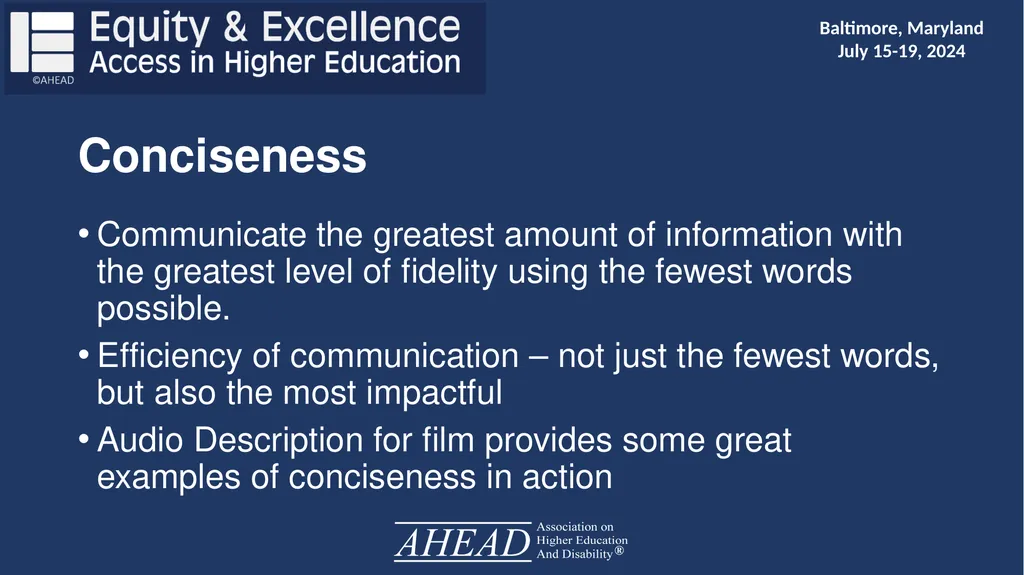
slide8. Conciseness Communicate the greatest amount of information with the greatest level of fidelity using the fewest words possible.
Efficiency of communication – not just the fewest words, but also the most impactful
Audio Description for film provides some great examples of conciseness in action<br>
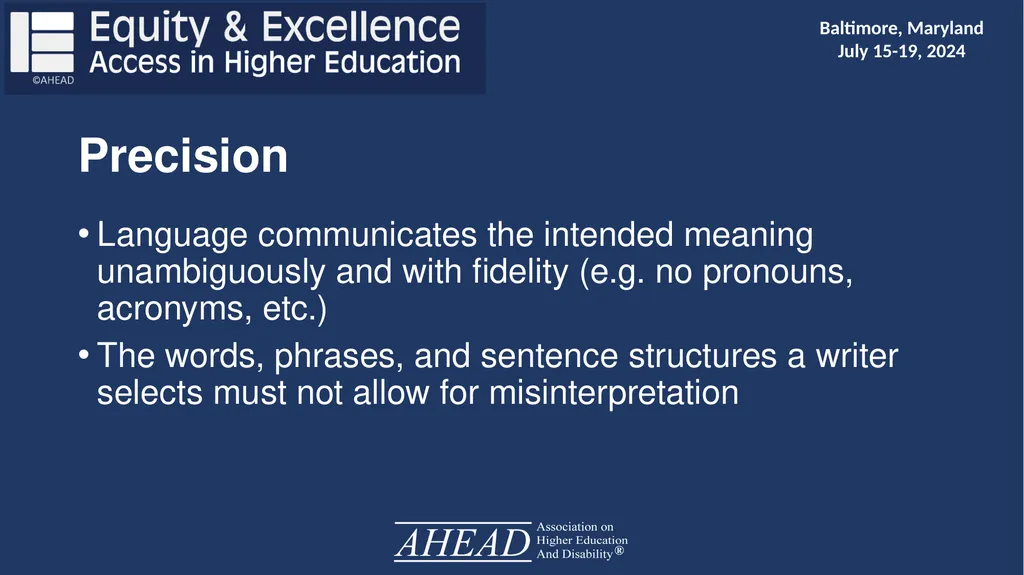
slide9. Precision Language communicates the intended meaning unambiguously and with fidelity (e.g. no pronouns, acronyms, etc.)
The words, phrases, and sentence structures a writer selects must not allow for misinterpretation<br>
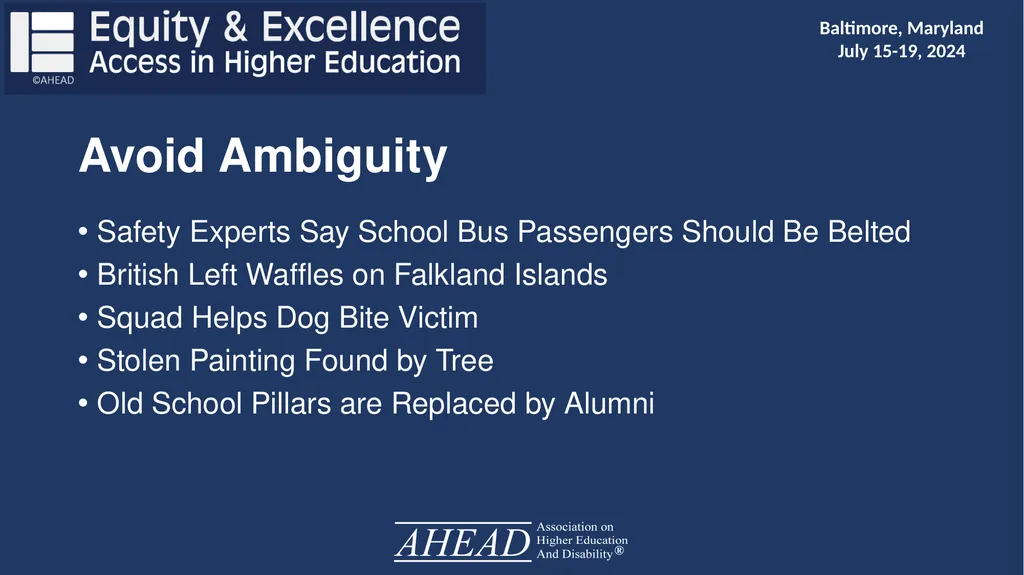
slide10. Avoid Ambiguity Safety Experts Say School Bus Passengers Should Be Belted
British Left Waffles on Falkland Islands
Squad Helps Dog Bite Victim
Stolen Painting Found by Tree
Old School Pillars are Replaced by Alumni<br>
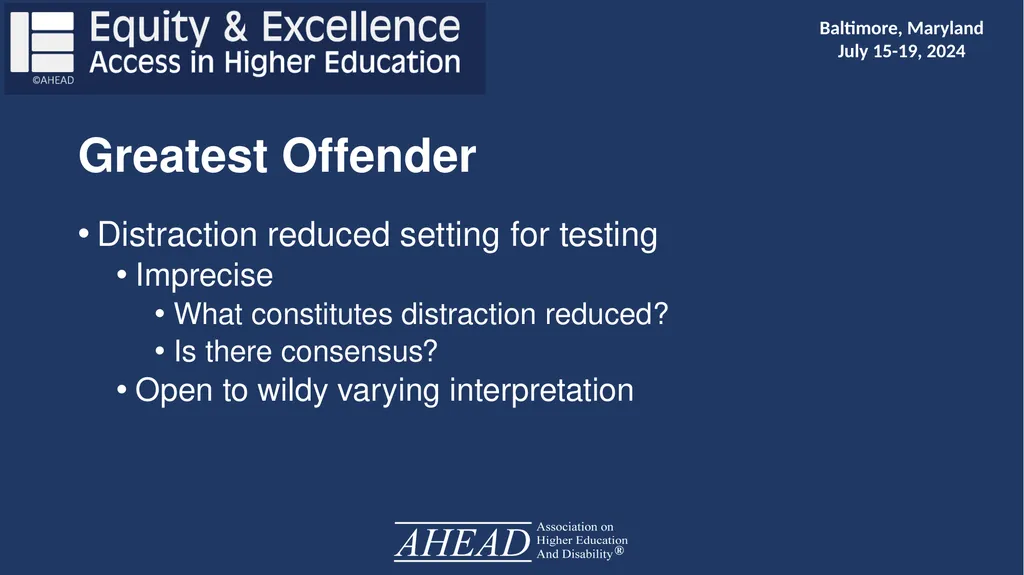
slide11. Greatest Offender Distraction reduced setting for testing
Imprecise
What constitutes distraction reduced?
Is there consensus?
Open to wildy varying interpretation<br>
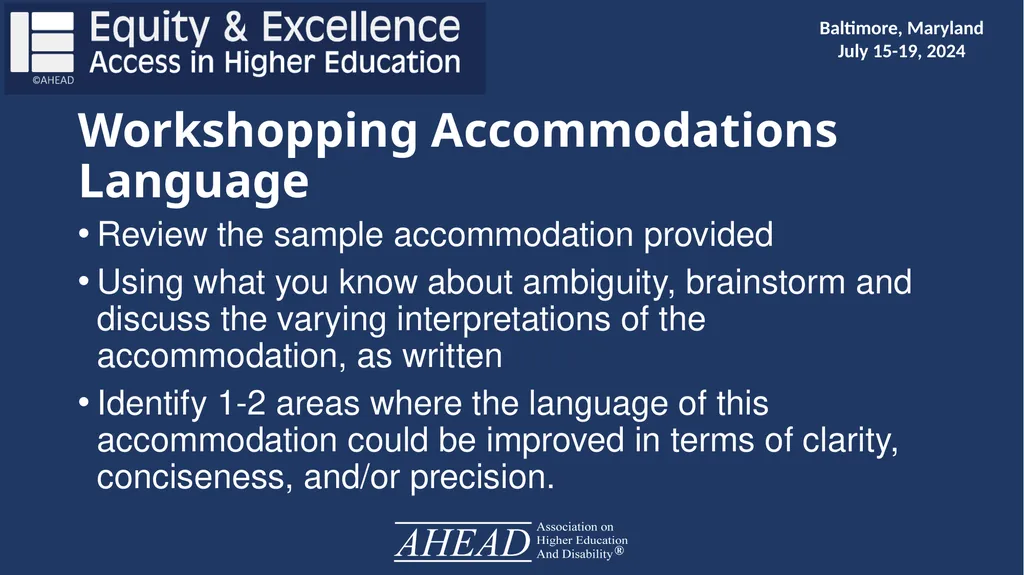
slide12. Workshopping Accommodations Language Review the sample accommodation provided
Using what you know about ambiguity, brainstorm and discuss the varying interpretations of the accommodation, as written
Identify 1-2 areas where the language of this accommodation could be improved in terms of clarity, conciseness, and/or precision.<br>
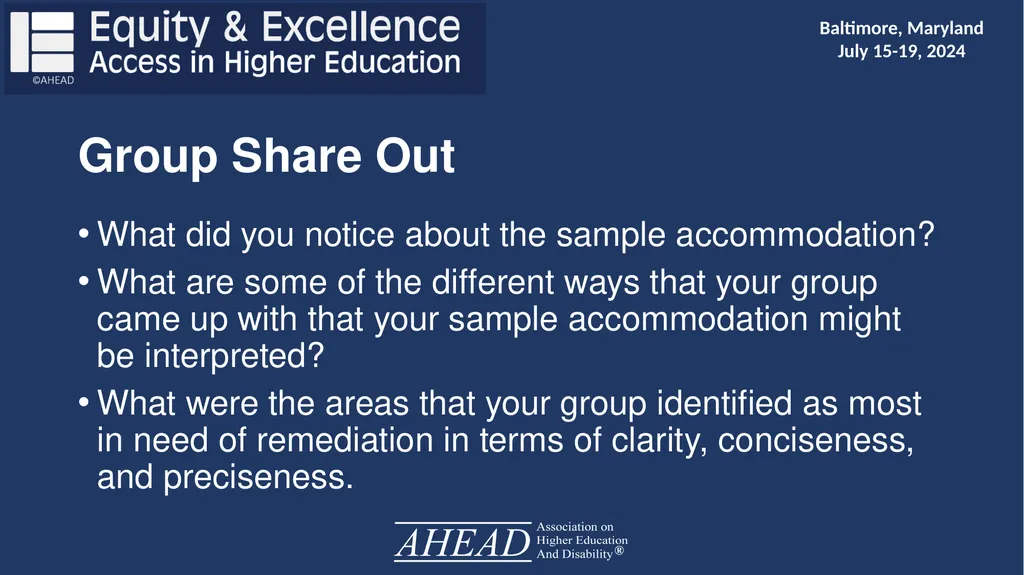
slide13. Group Share Out What did you notice about the sample accommodation?
What are some of the different ways that your group came up with that your sample accommodation might be interpreted?
What were the areas that your group identified as most in need of remediation in terms of clarity, conciseness, and preciseness.<br>
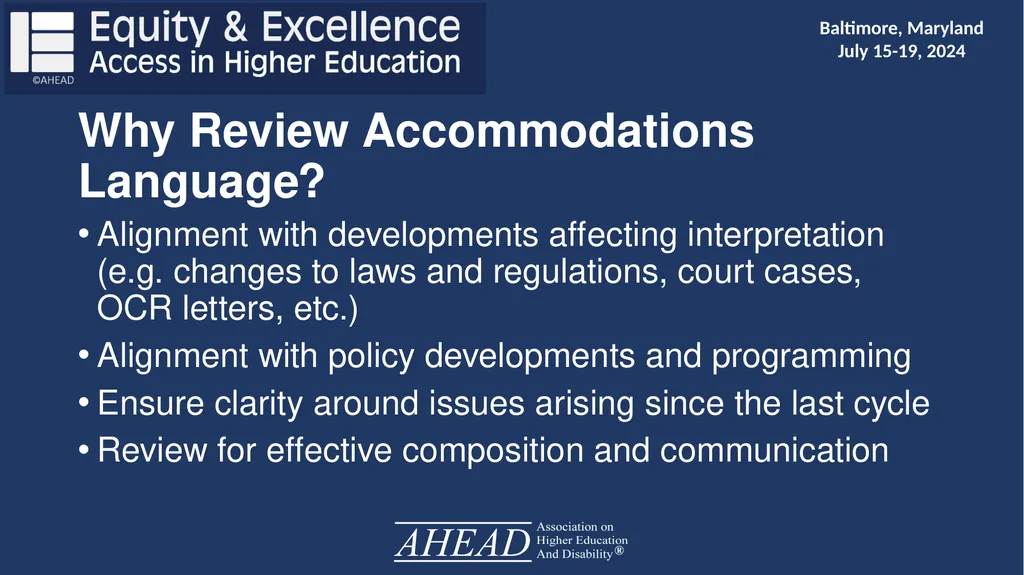
slide14. Why Review Accommodations Language? Alignment with developments affecting interpretation (e.g. changes to laws and regulations, court cases, OCR letters, etc.)
Alignment with policy developments and programming
Ensure clarity around issues arising since the last cycle
Review for effective composition and communication<br>
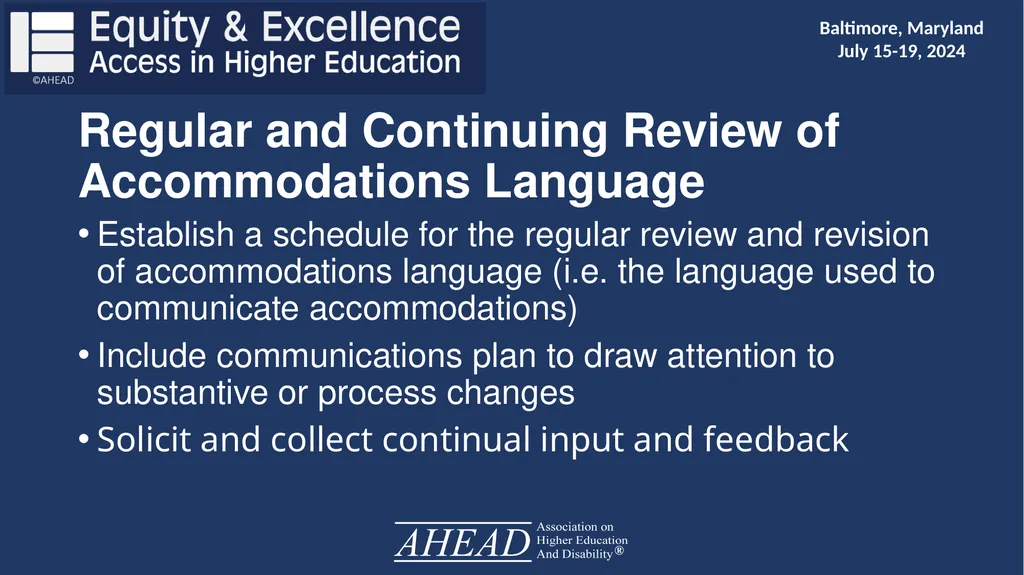
slide15. Regular and Continuing Review of Accommodations Language Establish a schedule for the regular review and revision of accommodations language (i.e. the language used to communicate accommodations)
Include communications plan to draw attention to substantive or process changes
Solicit and collect continual input and feedback<br>
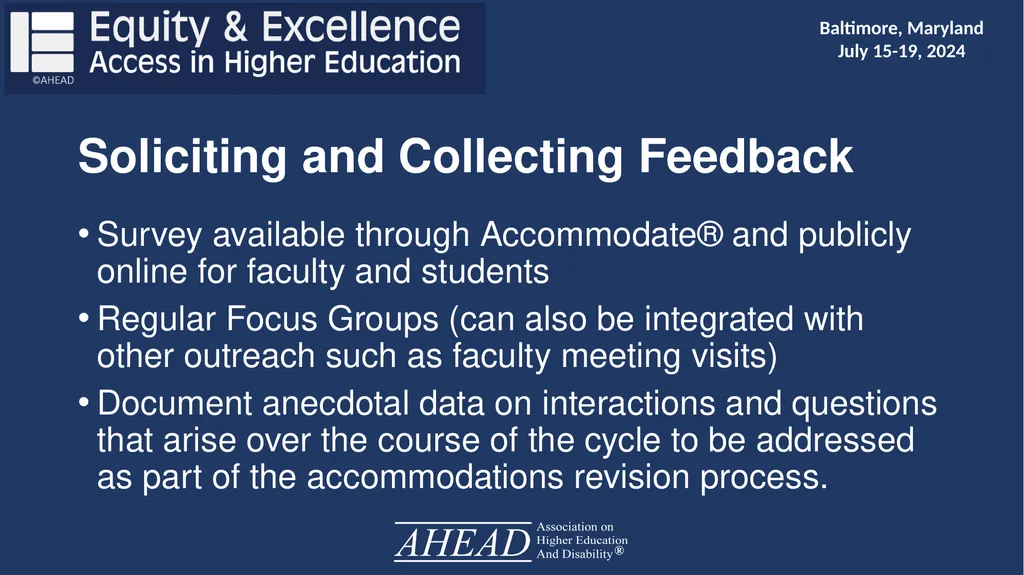
slide16. Soliciting and Collecting Feedback Survey available through Accommodate® and publicly online for faculty and students
Regular Focus Groups (can also be integrated with other outreach such as faculty meeting visits)
Document anecdotal data on interactions and questions that arise over the course of the cycle to be addressed as part of the accommodations revision process.<br>
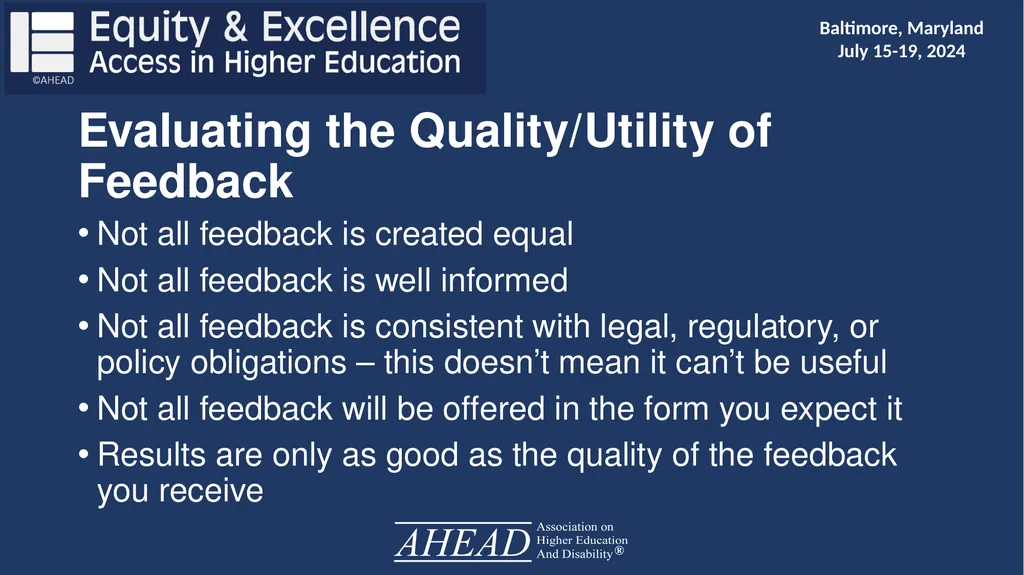
slide17. Evaluating the Quality/Utility of Feedback Not all feedback is created equal
Not all feedback is well informed
Not all feedback is consistent with legal, regulatory, or policy obligations – this doesn’t mean it can’t be useful
Not all feedback will be offered in the form you expect it
Results are only as good as the quality of the feedback you receive<br>
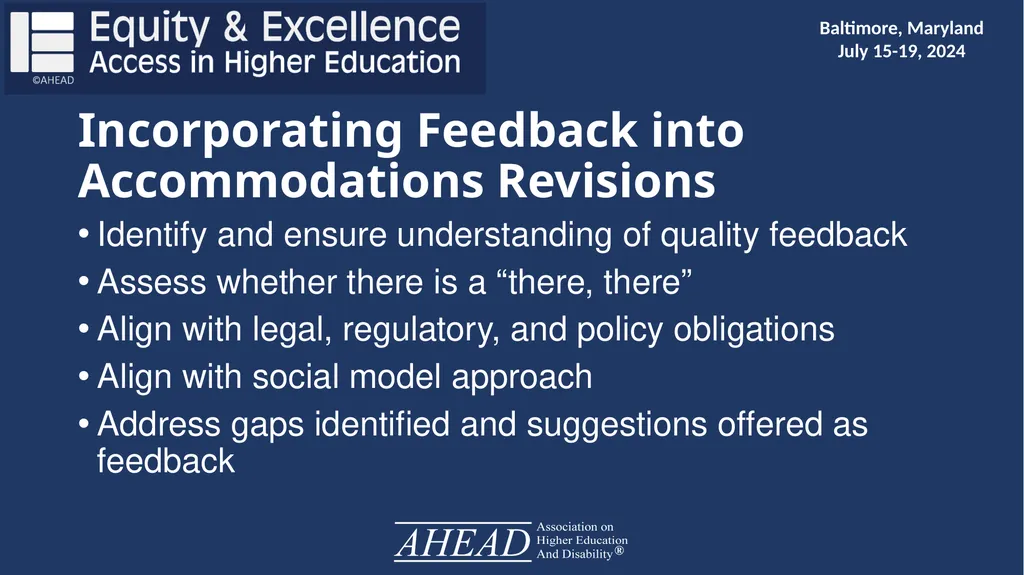
slide18. Incorporating Feedback into Accommodations Revisions Identify and ensure understanding of quality feedback
Assess whether there is a “there, there”
Align with legal, regulatory, and policy obligations
Align with social model approach
Address gaps identified and suggestions offered as feedback<br>
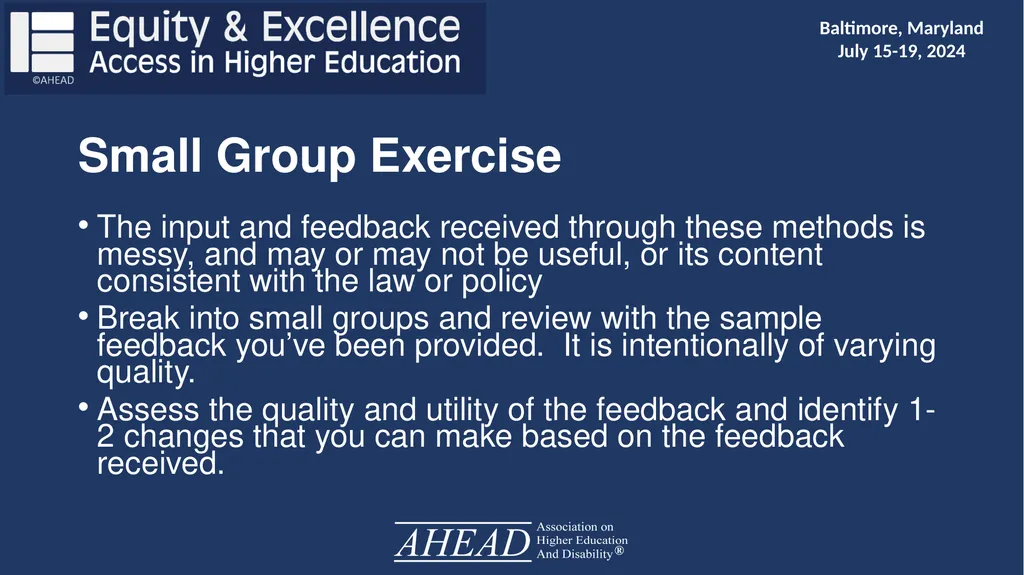
slide19. Small Group Exercise The input and feedback received through these methods is messy, and may or may not be useful, or its content consistent with the law or policy
Break into small groups and review with the sample feedback you’ve been provided. It is intentionally of varying quality.
Assess the quality and utility of the feedback and identify 1-2 changes that you can make based on the feedback received.<br>
slide20. Group Share Out What did you notice about the sample feedback?
What were some of the characteristics that made feedback useful?
What was one of the ways you were able to incorporate feedback in your process?<br>
slide21. Takeaways Please feel free to offer any takeaways or suggestions that you would like to share with your colleagues
Share your contact information with at least one of your new friends! Our community is our best resource!<br>
slide22. Thank you for attending!<br>
slide23. Presenter Information David J. Thomas, Ph.D., M.A.
Assistant Professor, Interdisciplinary Studies and Academic Support Programs Director, Office of Educational Accessibility
West Chester University of Pennsylvania dthomas3@wcupa.edu<br>
slide2. Conference Civility Statement We ask you to join us in creating a culture that reflects…
Access and Inclusion
and
Civility and Respect
…this week and in all aspects of our organization.<br>
slide3. Group Discussion Guidelines All discussion is welcome. This is an interactive workshop.
Take space, make space. Notice and acknowledge the power dynamics in the room.
Speak one at a time with an ear to listening rather than responding.
Wait for the microphone before speaking to ensure everyone is able to access the conversation.
Don’t be afraid of using the wrong language; it’s most important to engage in authentic dialogue.
Acknowledge and respect each other and the validity of your varied experiences.<br>
slide4. Slide 4 Learning Goal 1
Identify and craft clear, concise, and precise accommodations using the principles of effective composition. Examine a set of ambiguously written accommodations, identify where there is room for misinterpretation, and propose ways to more effectively communicate the intended meaning of the accommodation.
Learning Goal 2
Incorporate input and feedback from a variety of constituencies in the revision of accommodations language.<br>
slide5. Brief Agenda (some) fundamentals of effective composition
workshopping accommodations language - individual exercise and group discussion
establishing a process for the regular review of all accommodations language
soliciting and collecting continual input and feedback
evaluating the quality and utility of feedback
incorporating feedback into accommodations revisions
workshopping accommodations language - small group exercise and group discussion
conclusion<br>
slide6. (Some) Fundamentals of Effective Composition Clarity
Conciseness
Precision<br>
slide7. Clarity Avoid overly complicated language
Don’t assume knowledge or an interpretation as a given
”Choose your words deliberately, construct your sentences carefully, and use grammar properly”
Get straight to the point in a way your audience can easily (and reliably) comprehend (and interpret)<br>
slide8. Conciseness Communicate the greatest amount of information with the greatest level of fidelity using the fewest words possible.
Efficiency of communication – not just the fewest words, but also the most impactful
Audio Description for film provides some great examples of conciseness in action<br>
slide9. Precision Language communicates the intended meaning unambiguously and with fidelity (e.g. no pronouns, acronyms, etc.)
The words, phrases, and sentence structures a writer selects must not allow for misinterpretation<br>
slide10. Avoid Ambiguity Safety Experts Say School Bus Passengers Should Be Belted
British Left Waffles on Falkland Islands
Squad Helps Dog Bite Victim
Stolen Painting Found by Tree
Old School Pillars are Replaced by Alumni<br>
slide11. Greatest Offender Distraction reduced setting for testing
Imprecise
What constitutes distraction reduced?
Is there consensus?
Open to wildy varying interpretation<br>
slide12. Workshopping Accommodations Language Review the sample accommodation provided
Using what you know about ambiguity, brainstorm and discuss the varying interpretations of the accommodation, as written
Identify 1-2 areas where the language of this accommodation could be improved in terms of clarity, conciseness, and/or precision.<br>
slide13. Group Share Out What did you notice about the sample accommodation?
What are some of the different ways that your group came up with that your sample accommodation might be interpreted?
What were the areas that your group identified as most in need of remediation in terms of clarity, conciseness, and preciseness.<br>
slide14. Why Review Accommodations Language? Alignment with developments affecting interpretation (e.g. changes to laws and regulations, court cases, OCR letters, etc.)
Alignment with policy developments and programming
Ensure clarity around issues arising since the last cycle
Review for effective composition and communication<br>
slide15. Regular and Continuing Review of Accommodations Language Establish a schedule for the regular review and revision of accommodations language (i.e. the language used to communicate accommodations)
Include communications plan to draw attention to substantive or process changes
Solicit and collect continual input and feedback<br>
slide16. Soliciting and Collecting Feedback Survey available through Accommodate® and publicly online for faculty and students
Regular Focus Groups (can also be integrated with other outreach such as faculty meeting visits)
Document anecdotal data on interactions and questions that arise over the course of the cycle to be addressed as part of the accommodations revision process.<br>
slide17. Evaluating the Quality/Utility of Feedback Not all feedback is created equal
Not all feedback is well informed
Not all feedback is consistent with legal, regulatory, or policy obligations – this doesn’t mean it can’t be useful
Not all feedback will be offered in the form you expect it
Results are only as good as the quality of the feedback you receive<br>
slide18. Incorporating Feedback into Accommodations Revisions Identify and ensure understanding of quality feedback
Assess whether there is a “there, there”
Align with legal, regulatory, and policy obligations
Align with social model approach
Address gaps identified and suggestions offered as feedback<br>
slide19. Small Group Exercise The input and feedback received through these methods is messy, and may or may not be useful, or its content consistent with the law or policy
Break into small groups and review with the sample feedback you’ve been provided. It is intentionally of varying quality.
Assess the quality and utility of the feedback and identify 1-2 changes that you can make based on the feedback received.<br>
slide20. Group Share Out What did you notice about the sample feedback?
What were some of the characteristics that made feedback useful?
What was one of the ways you were able to incorporate feedback in your process?<br>
slide21. Takeaways Please feel free to offer any takeaways or suggestions that you would like to share with your colleagues
Share your contact information with at least one of your new friends! Our community is our best resource!<br>
slide22. Thank you for attending!<br>
slide23. Presenter Information David J. Thomas, Ph.D., M.A.
Assistant Professor, Interdisciplinary Studies and Academic Support Programs Director, Office of Educational Accessibility
West Chester University of Pennsylvania dthomas3@wcupa.edu<br>