
Managing DRAM Latency Divergence in Irregular
Description: Managing DRAM Latency Divergence in Irregular GPGPU Applications Niladrish Chatterjee Mike OConnor Gabriel H. Loh Nuwan Jayasena Rajeev Balasubramonian Irregular GPGPU Applications Conventional GPGPU workloads access vector or matrix-based
Related Topics
Download Presentation
"Managing DRAM Latency Divergence in Irregular" is the property of its rightful owner. Permission is granted to download and print the materials on this website for personal, non-commercial use only, and to display it on your personal computer provided you do not modify the materials and that you retain all copyright notices contained in the materials. By downloading content from our website, you accept the terms of this agreement.
Presentation Transcript
slide1. Managing DRAM Latency Divergence in Irregular GPGPU Applications Niladrish Chatterjee
Mike O’Connor
Gabriel H. Loh
Nuwan Jayasena
Rajeev Balasubramonian<br>
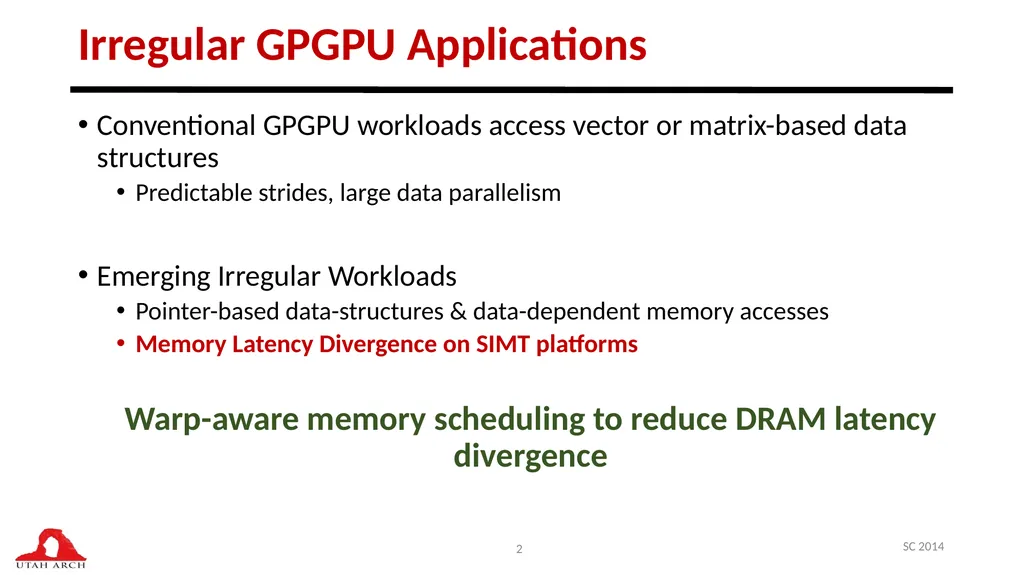
slide2. Irregular GPGPU Applications Conventional GPGPU workloads access vector or matrix-based data structures
Predictable strides, large data parallelism
Emerging Irregular Workloads
Pointer-based data-structures & data-dependent memory accesses
Memory Latency Divergence on SIMT platforms
Warp-aware memory scheduling to reduce DRAM latency divergence SC 2014 2<br>
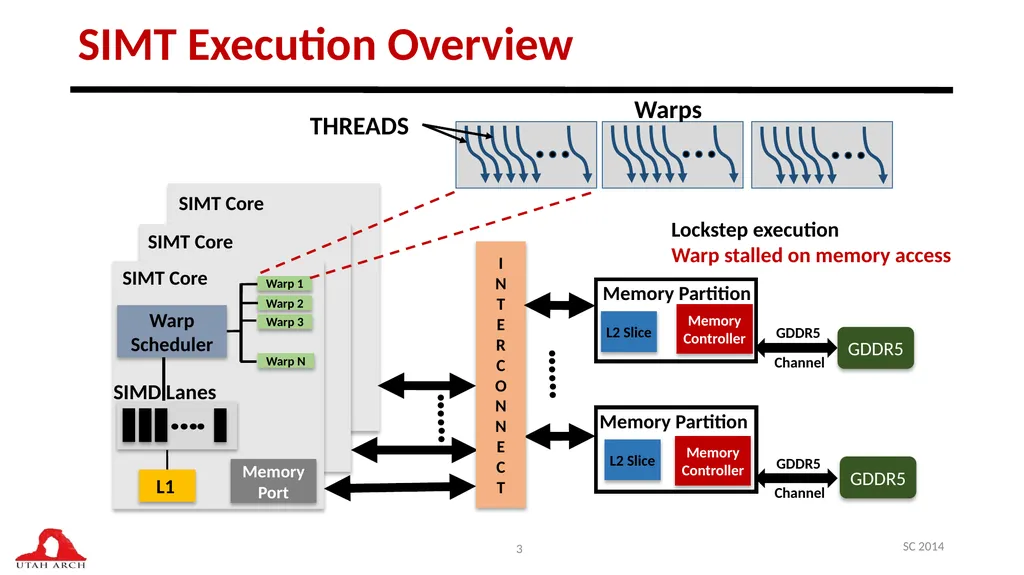
slide3. SIMT Execution Overview SC 2014 3 GDDR5 Channel L1 Warp 1 Warp Scheduler SIMD Lanes Memory Port Warp 2 Warp 3 Warp N SIMT Core SIMT Core SIMT Core I
N
T
E
R
C
O
N
N
E
C
T L2 Slice Memory Controller GDDR5 Channel Memory Partition THREADS Memory Partition Warps GDDR5 GDDR5 L2 Slice Memory Controller Lockstep execution
Warp stalled on memory access<br>
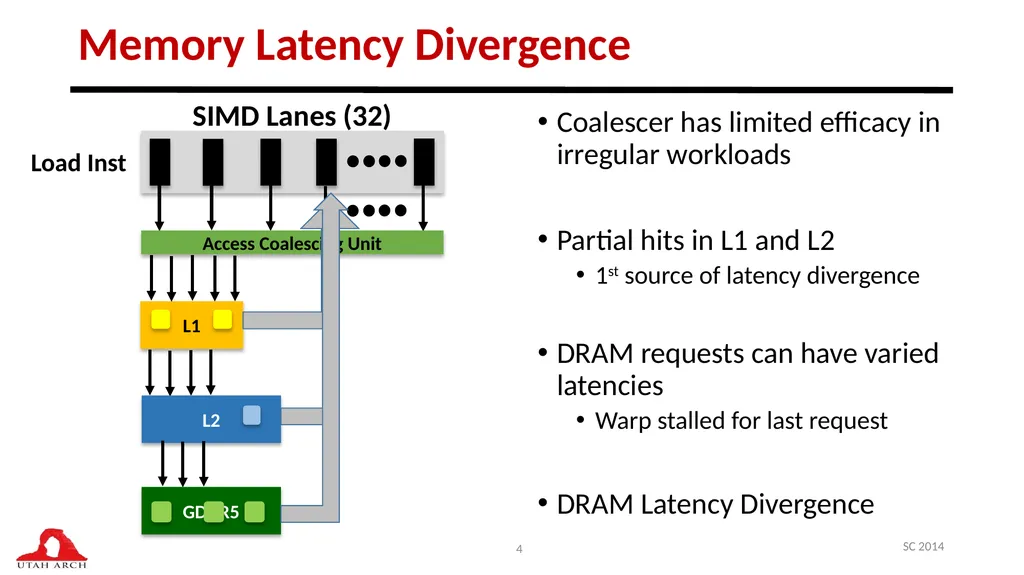
slide4. Memory Latency Divergence Coalescer has limited efficacy in irregular workloads
Partial hits in L1 and L2
1st source of latency divergence
DRAM requests can have varied latencies
Warp stalled for last request
DRAM Latency Divergence Load Inst SIMD Lanes (32) Access Coalescing Unit L1 L2 GDDR5 SC 2014 4<br>
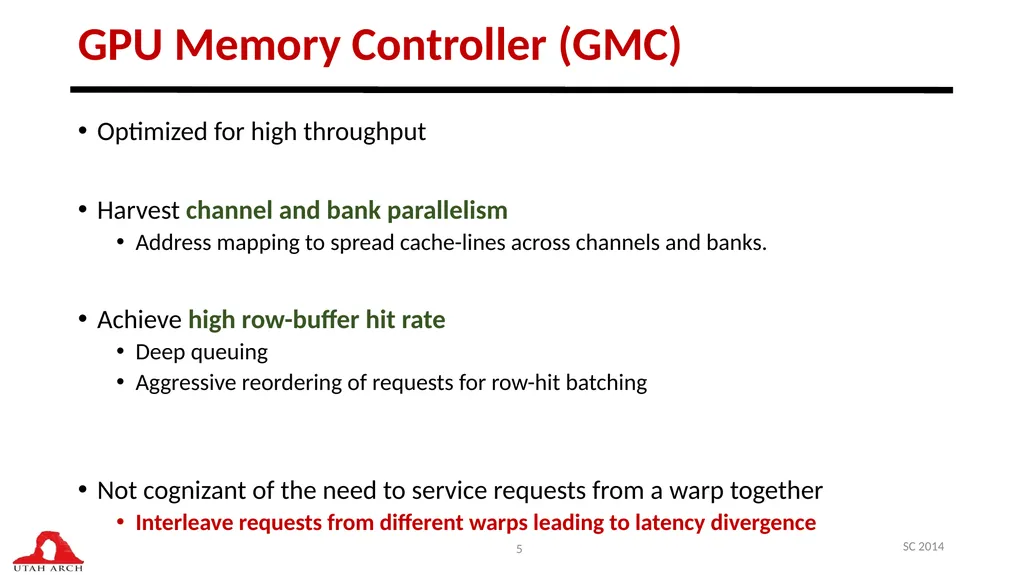
slide5. GPU Memory Controller (GMC) SC 2014 5 Optimized for high throughput
Harvest channel and bank parallelism
Address mapping to spread cache-lines across channels and banks.
Achieve high row-buffer hit rate
Deep queuing
Aggressive reordering of requests for row-hit batching
Not cognizant of the need to service requests from a warp together
Interleave requests from different warps leading to latency divergence<br>
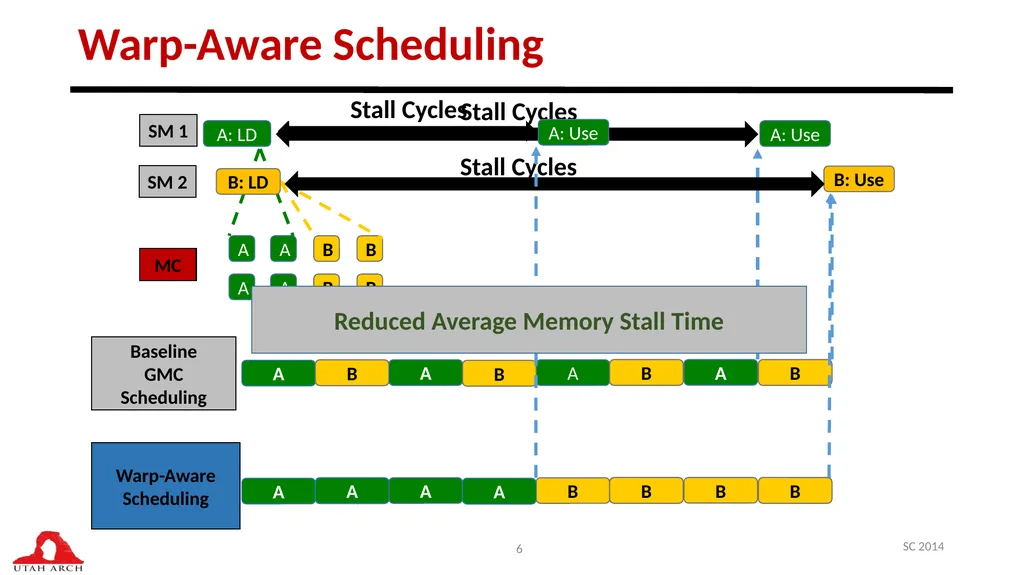
slide6. Warp-Aware Scheduling SC 2014 6 SM 1 SM 2 A: LD A A A A B B B B MC A: Use Baseline
GMC Scheduling A B A A A B: Use B B B Stall Cycles Stall Cycles Warp-Aware Scheduling A A A B B A B B A: Use Stall Cycles B: LD Reduced Average Memory Stall Time<br>
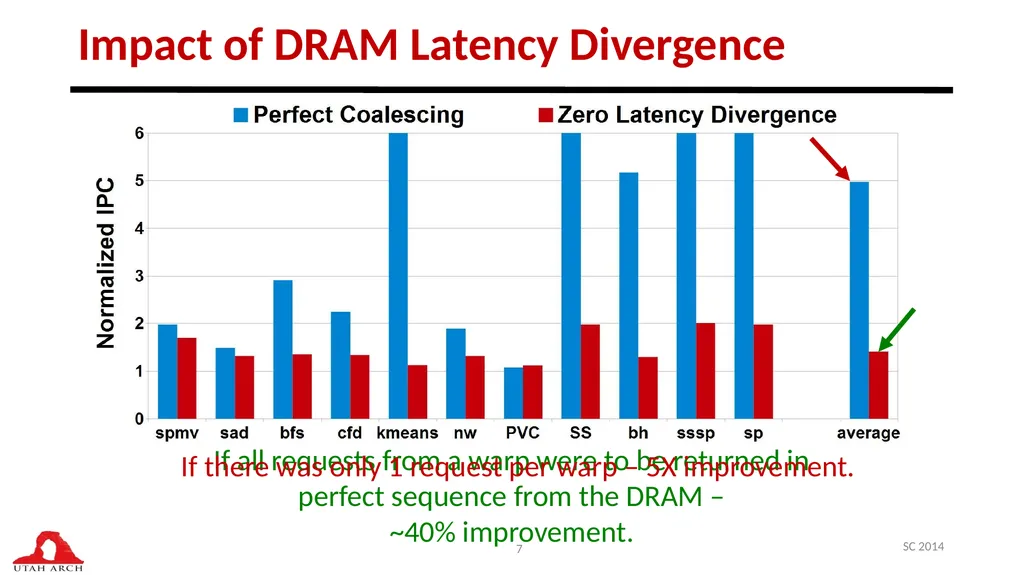
slide7. Impact of DRAM Latency Divergence SC 2014 7 If all requests from a warp were to be returned in perfect sequence from the DRAM –
~40% improvement. If there was only 1 request per warp – 5X improvement.<br>
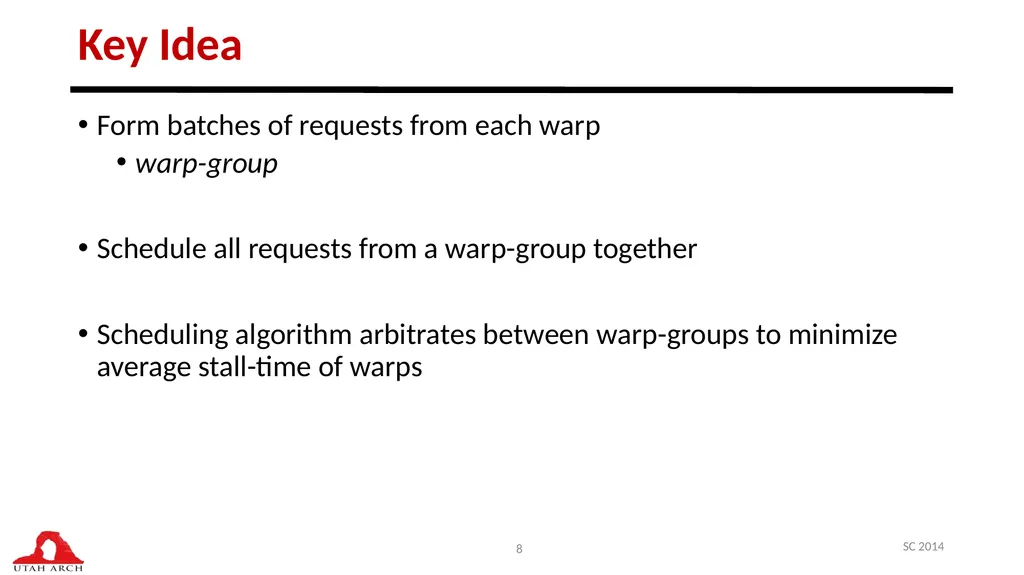
slide8. Key Idea Form batches of requests from each warp
warp-group
Schedule all requests from a warp-group together
Scheduling algorithm arbitrates between warp-groups to minimize average stall-time of warps SC 2014 8<br>
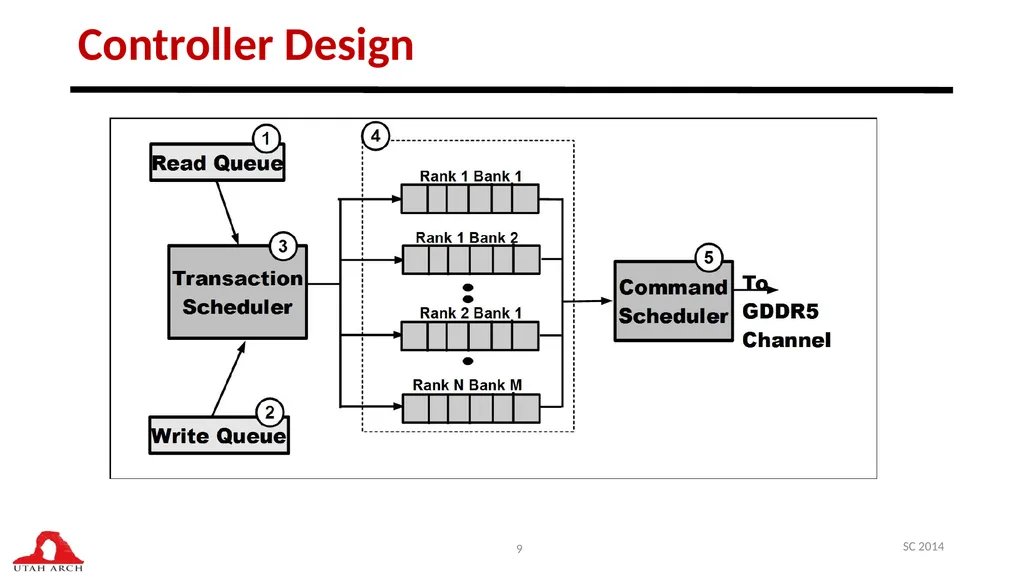
slide9. Controller Design SC 2014 9<br>
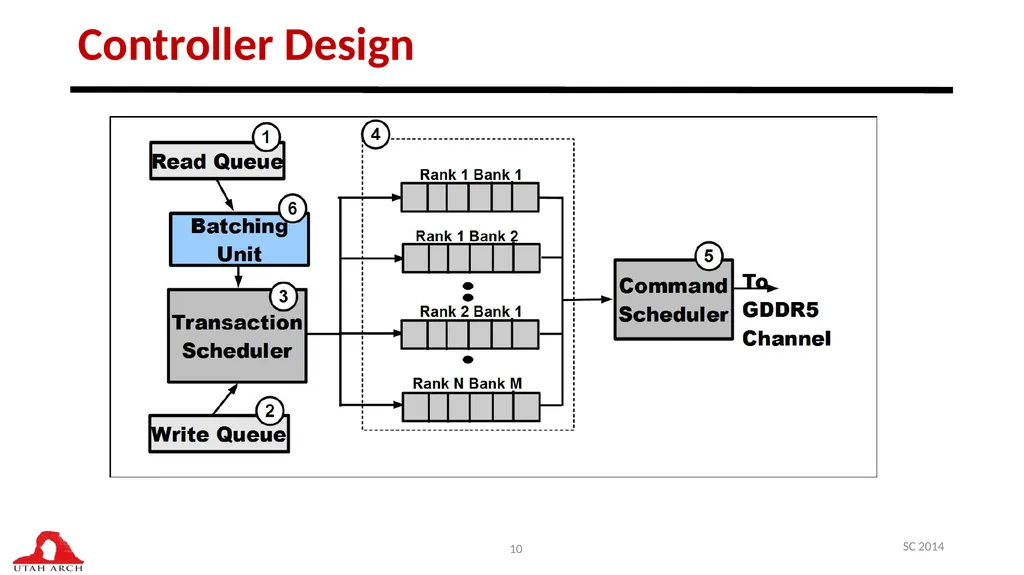
slide10. Controller Design SC 2014 10<br>
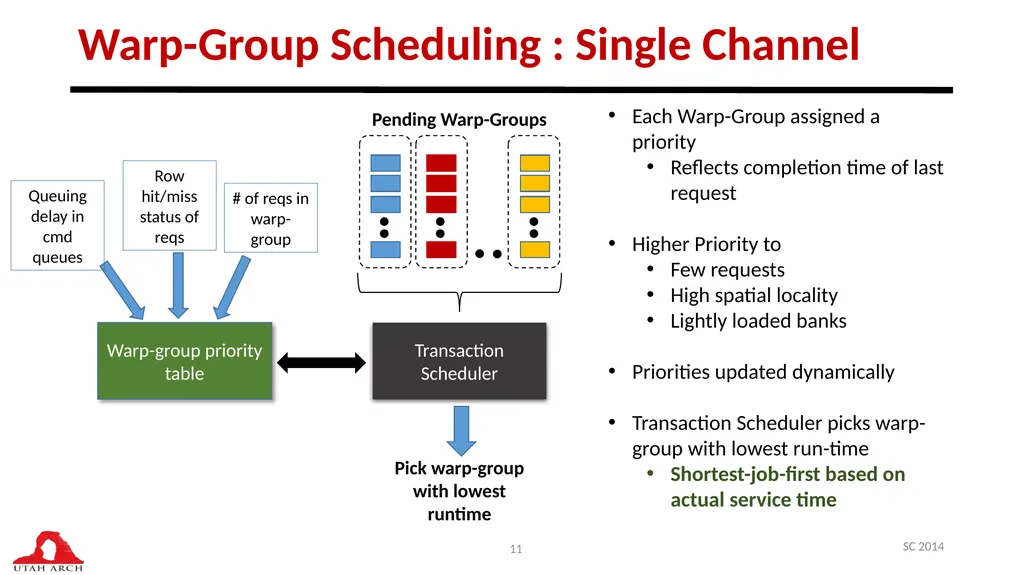
slide11. Warp-Group Scheduling : Single Channel SC 2014 11 Pending Warp-Groups Warp-group priority table Transaction Scheduler # of reqs in warp-group Row hit/miss status of reqs Queuing delay in cmd queues Pick warp-group with lowest runtime Each Warp-Group assigned a priority
Reflects completion time of last request
Higher Priority to
Few requests
High spatial locality
Lightly loaded banks
Priorities updated dynamically
Transaction Scheduler picks warp-group with lowest run-time
Shortest-job-first based on actual service time<br>
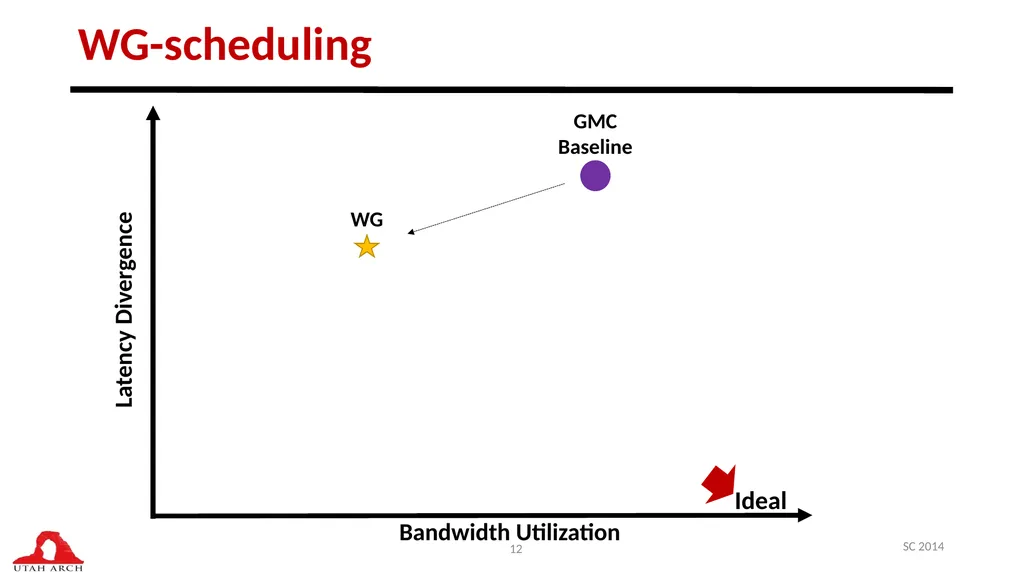
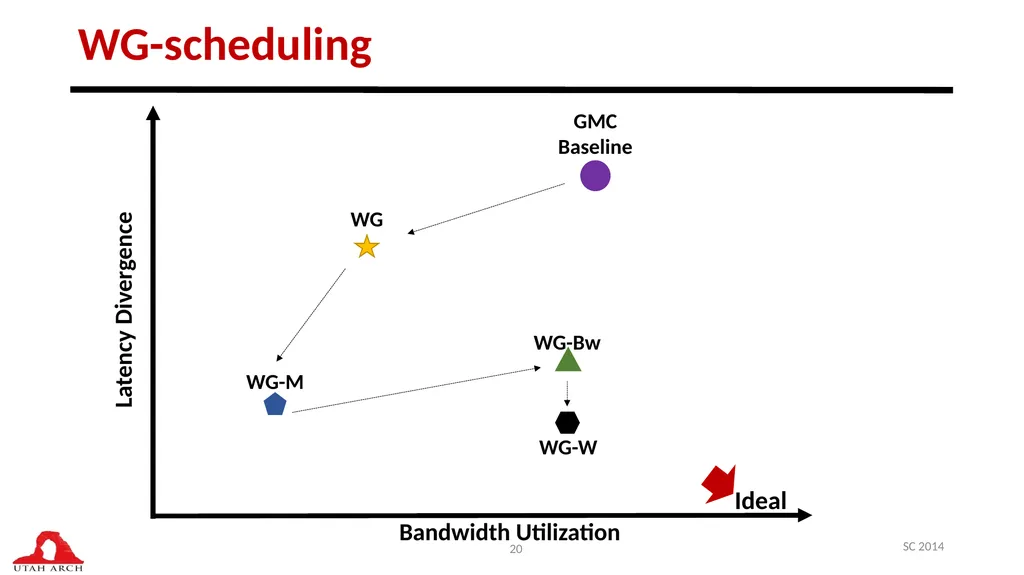
slide12. WG-scheduling SC 2014 12 Latency Divergence Ideal Bandwidth Utilization GMC Baseline WG<br>
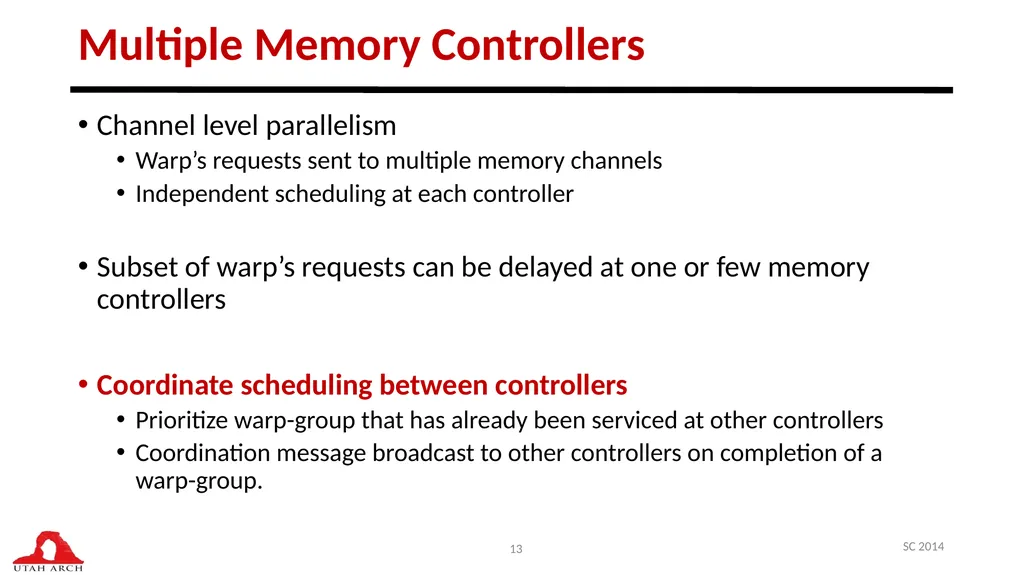
slide13. Multiple Memory Controllers Channel level parallelism
Warp’s requests sent to multiple memory channels
Independent scheduling at each controller
Subset of warp’s requests can be delayed at one or few memory controllers
Coordinate scheduling between controllers
Prioritize warp-group that has already been serviced at other controllers
Coordination message broadcast to other controllers on completion of a warp-group. SC 2014 13<br>
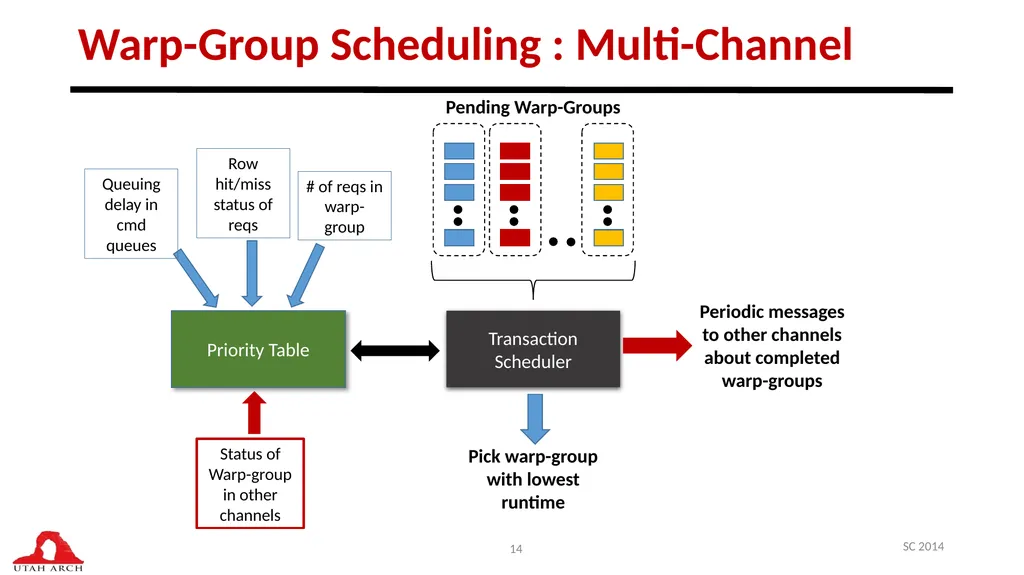
slide14. Warp-Group Scheduling : Multi-Channel SC 2014 14 Pending Warp-Groups Priority Table Transaction Scheduler # of reqs in warp-group Row hit/miss status of reqs Queuing delay in cmd queues Pick warp-group with lowest runtime Status of Warp-group in other channels Periodic messages to other channels about completed warp-groups<br>
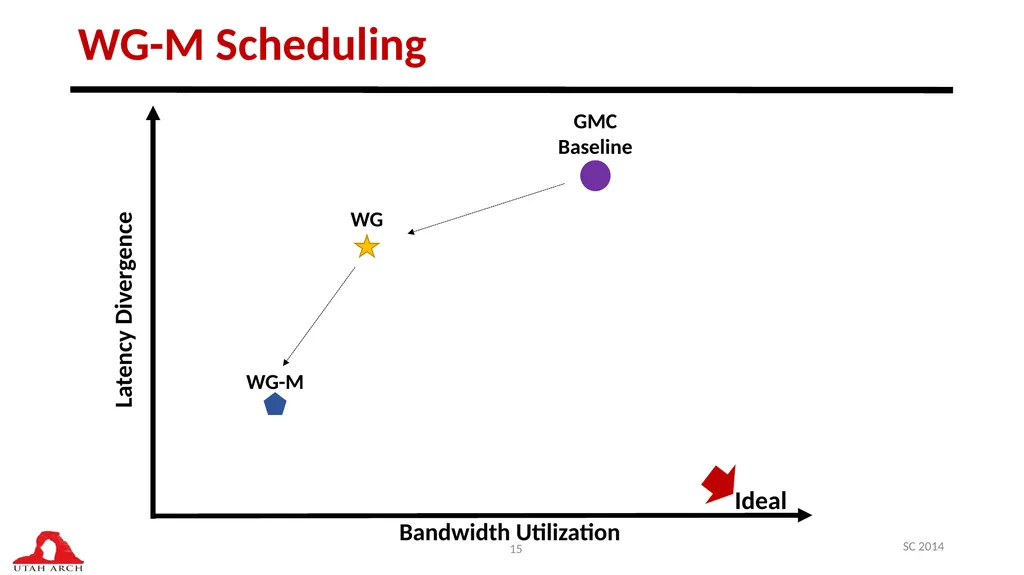
slide15. WG-M Scheduling SC 2014 15 Latency Divergence Ideal Bandwidth Utilization GMC Baseline WG WG-M<br>
slide16. Bandwidth-Aware Warp-Group Scheduling Warp-group scheduling negatively affects bandwidth utilization
Reduced row-hit rate
Conflicting objectives
Issue row-miss request from current warp-group
Issue row-hit requests to maintain bus utilization
Activate and Precharge idle cycles
Hidden by row-hits in other banks
Delay row-miss request to find the right slot SC 2014 16<br>
slide17. Bandwidth-Aware Warp-Group Scheduling SC 2014 17 The minimum number of row-hits needed in other banks to overlap (tRTP+tRP+tRCD)
Determined by GDDR timing parameters
Minimum efficient row burst (MERB)
Stored in a ROM looked up by Transaction Scheduler
More banks with pending row-hits
smaller MERB
Schedule row-miss after MERB row-hits have been issued to bank<br>
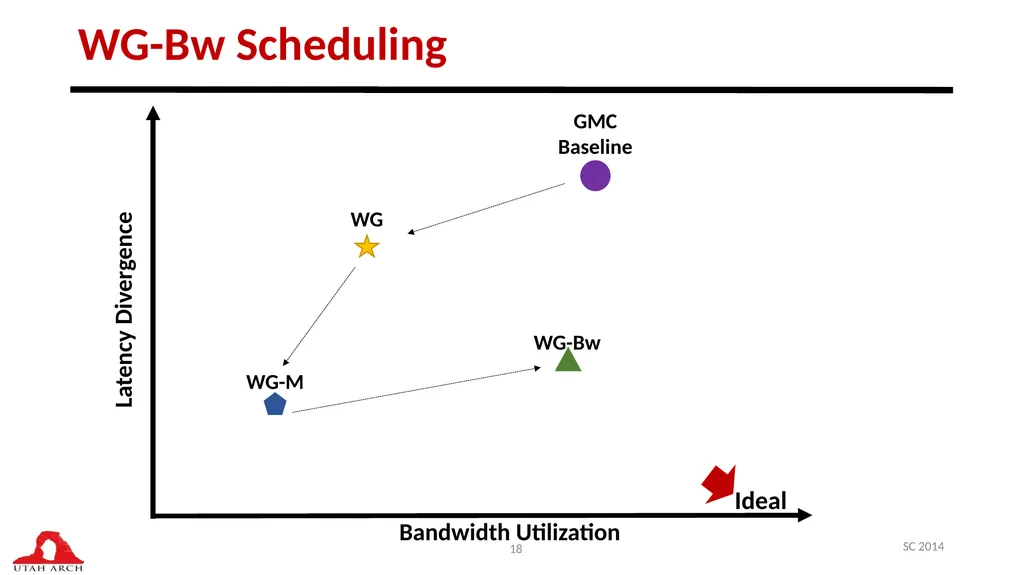
slide18. WG-Bw Scheduling SC 2014 18 Latency Divergence Ideal Bandwidth Utilization GMC Baseline WG WG-M WG-Bw<br>
slide19. Warp-Aware Write Draining Writes drained in batches
starts at High_Watermark
Can stall small warp-groups
When WQ reaches a threshold (lower than High_Watermark)
Drain singleton warp-groups only
Reduce write-induced latency SC 2014 19<br>
slide20. WG-scheduling SC 2014 20 Latency Divergence Ideal Bandwidth Utilization GMC Baseline WG WG-M WG-Bw WG-W<br>
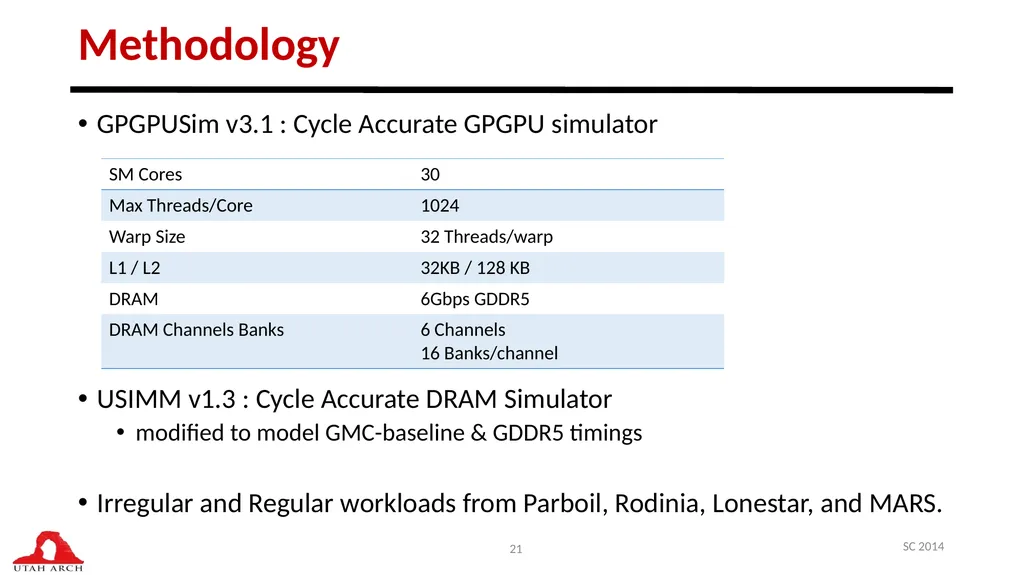
slide21. Methodology GPGPUSim v3.1 : Cycle Accurate GPGPU simulator
USIMM v1.3 : Cycle Accurate DRAM Simulator
modified to model GMC-baseline & GDDR5 timings
Irregular and Regular workloads from Parboil, Rodinia, Lonestar, and MARS. SC 2014 21<br>
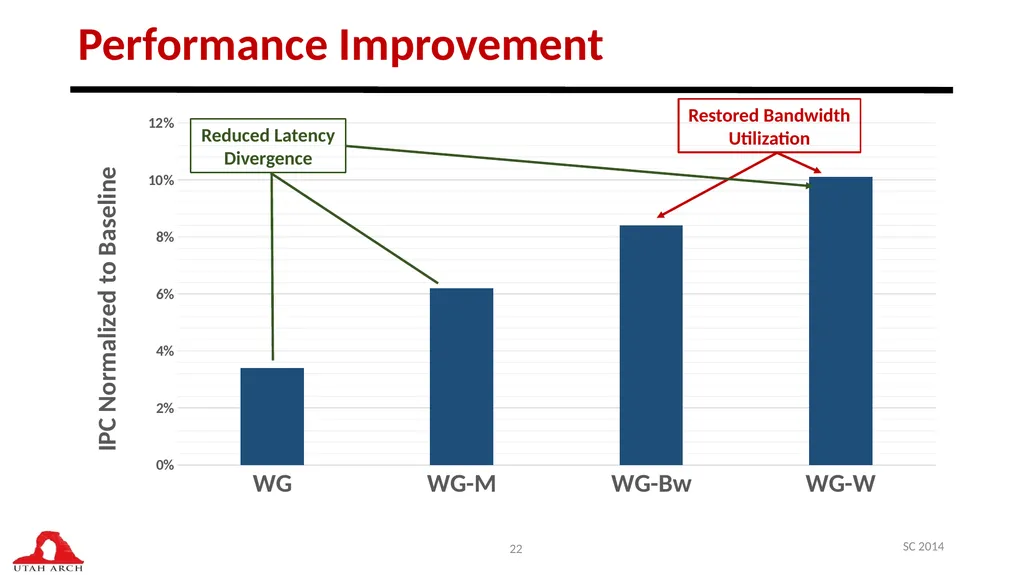
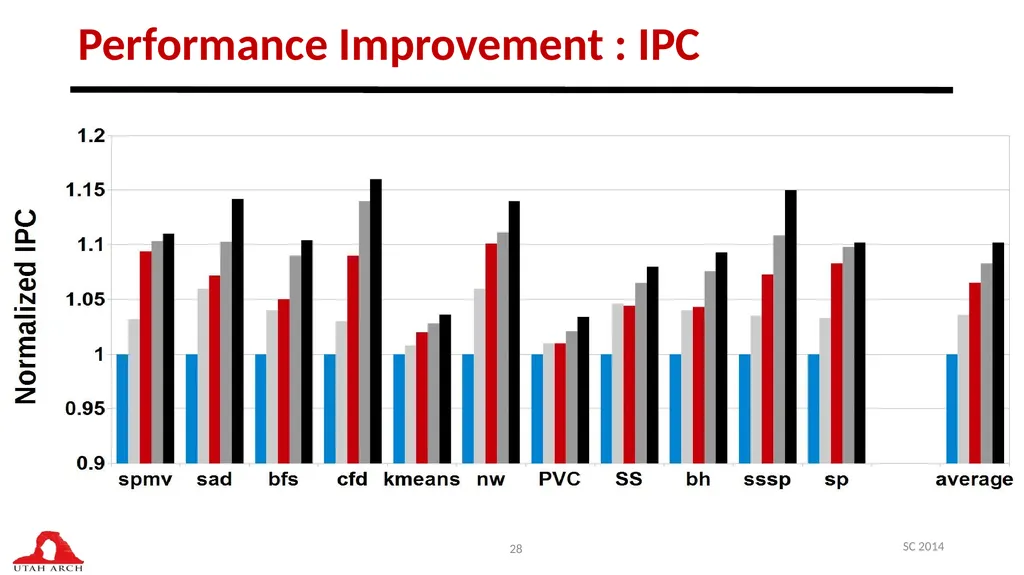
slide22. Performance Improvement SC 2014 22 Reduced Latency Divergence Restored Bandwidth Utilization<br>
slide23. Impact on Regular Workloads SC 2014 23 Effective coalescing
High spatial locality in warp-group
WG scheduling works similar to GMC-baseline
No performance loss
WG-Bw and WG-W provide
Minor benefits<br>
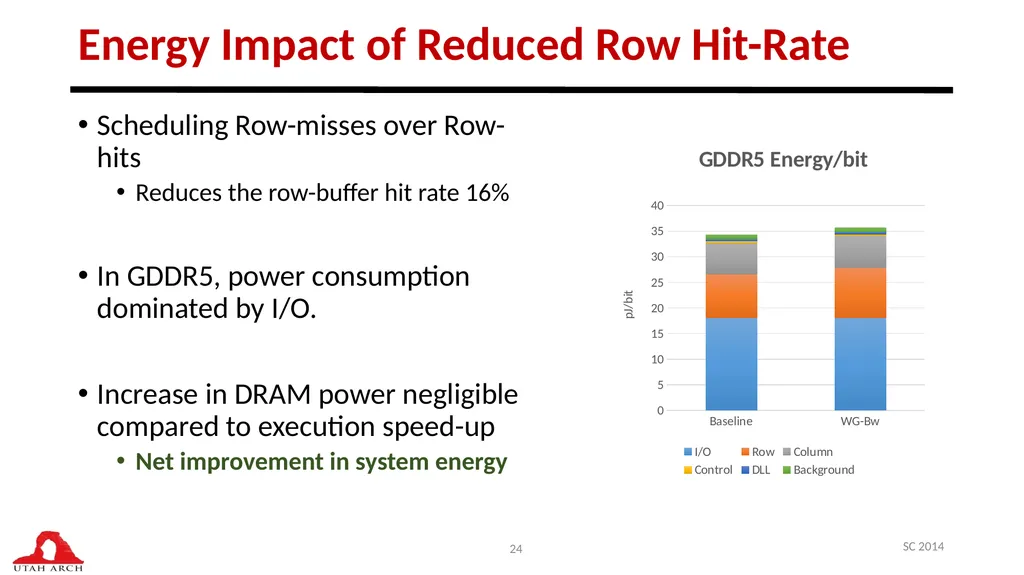
slide24. Energy Impact of Reduced Row Hit-Rate Scheduling Row-misses over Row-hits
Reduces the row-buffer hit rate 16%
In GDDR5, power consumption dominated by I/O.
Increase in DRAM power negligible compared to execution speed-up
Net improvement in system energy SC 2014 24<br>
slide25. Conclusions Irregular applications place new demands on the GPU’s memory system
Memory scheduling can alleviate the issues caused by latency divergence
Carefully orchestrating the scheduling of commands can help regain the bandwidth lost by warp-aware scheduling
Future techniques must also include the cache-hierarchy in reducing latency divergence SC 2014 25<br>
slide26. Thanks ! SC 2014 26<br>
slide27. Backup Slides SC 2014 27<br>
slide28. Performance Improvement : IPC SC 2014 28<br>
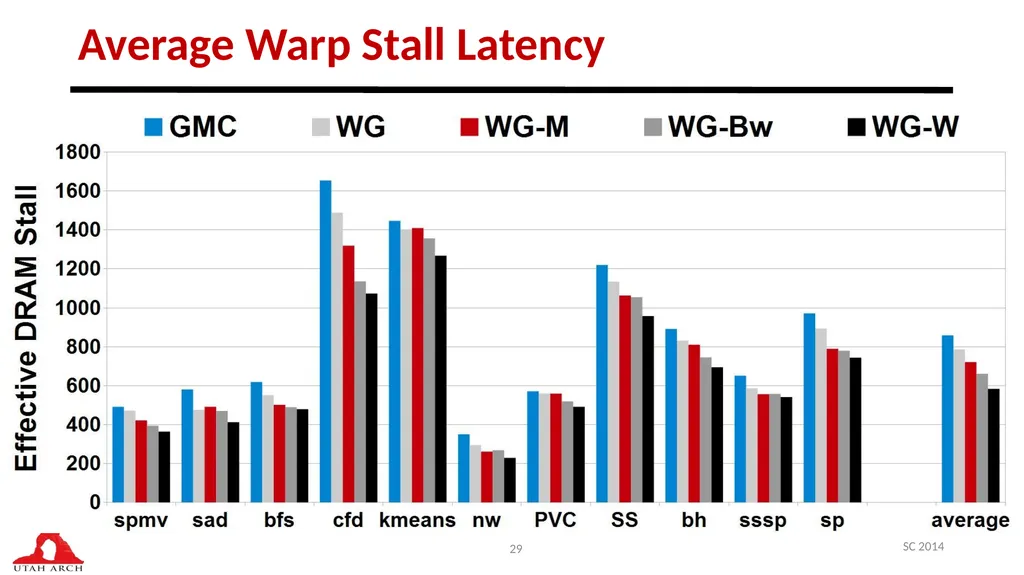
slide29. Average Warp Stall Latency SC 2014 29<br>
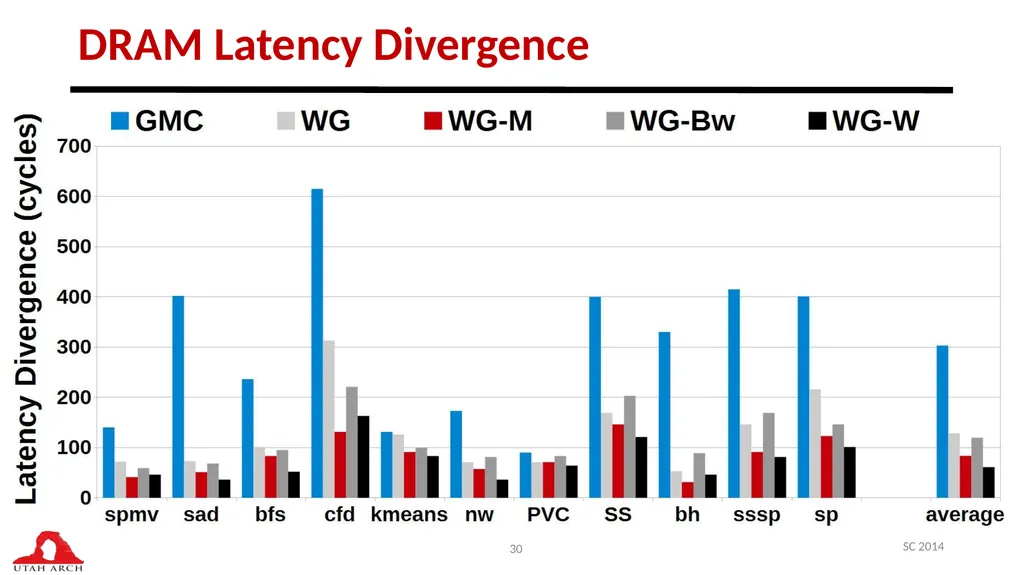
slide30. DRAM Latency Divergence SC 2014 30<br>
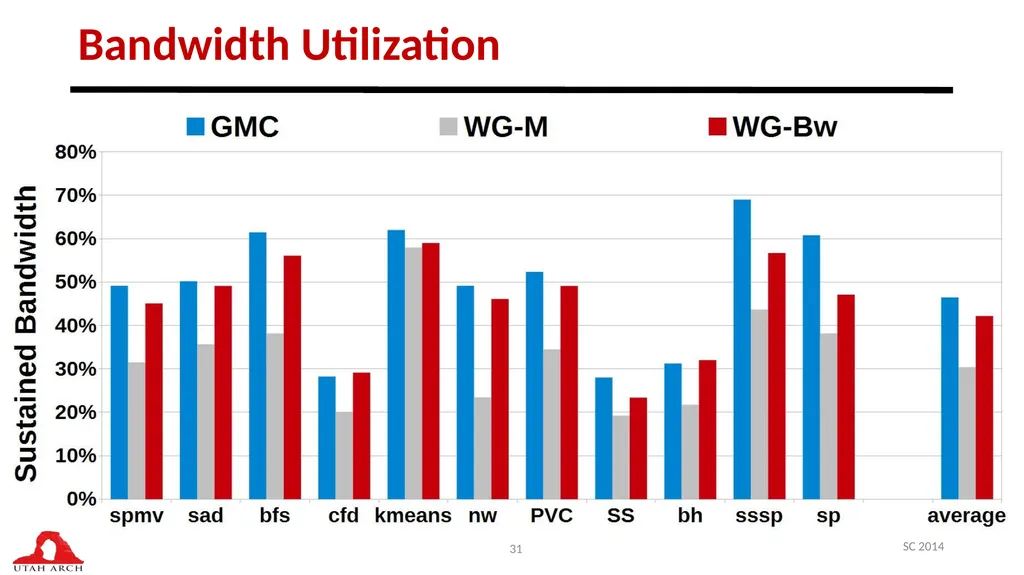
slide31. Bandwidth Utilization SC 2014 31<br>
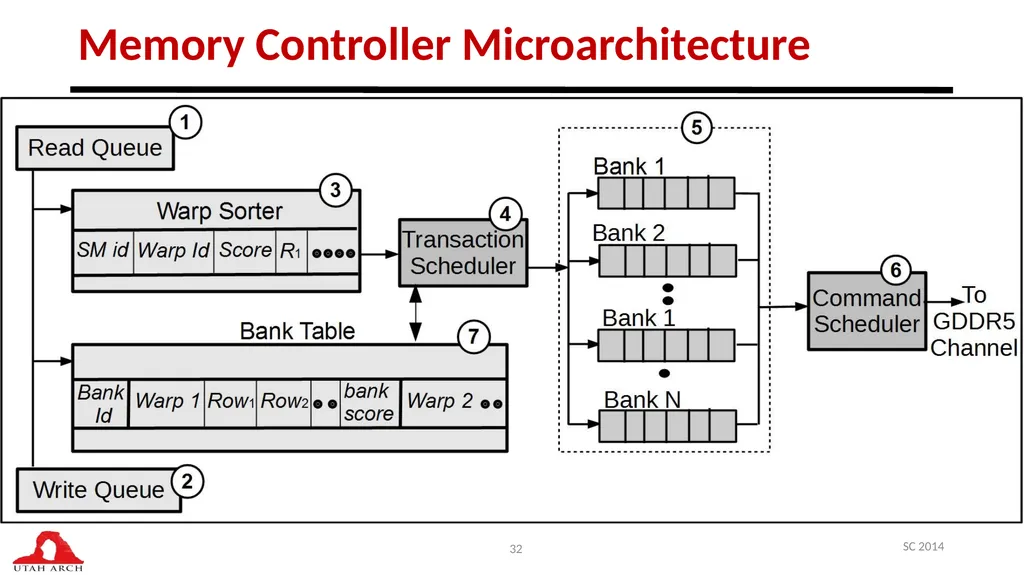
slide32. Memory Controller Microarchitecture SC 2014 32<br>
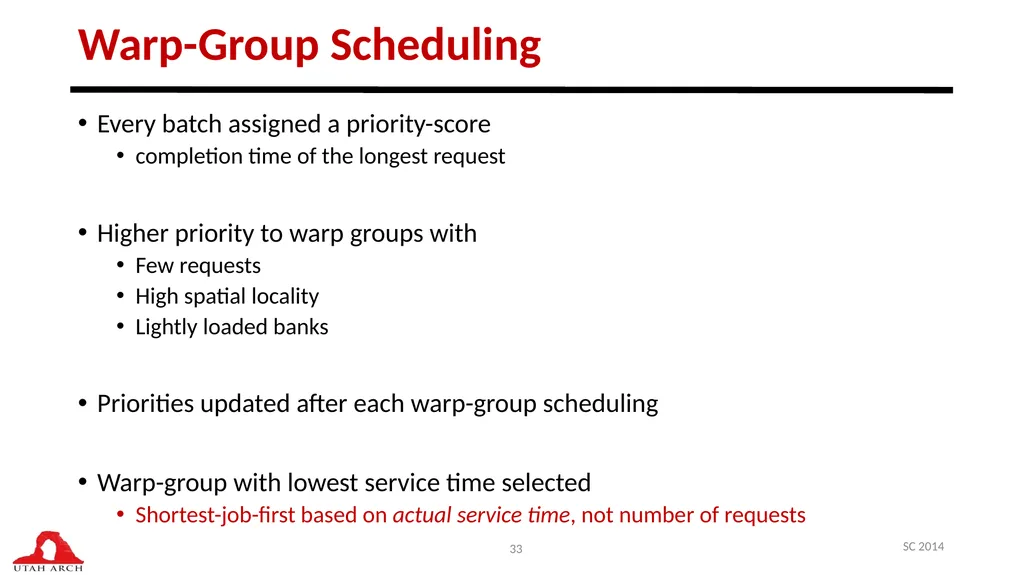
slide33. Warp-Group Scheduling Every batch assigned a priority-score
completion time of the longest request
Higher priority to warp groups with
Few requests
High spatial locality
Lightly loaded banks
Priorities updated after each warp-group scheduling
Warp-group with lowest service time selected
Shortest-job-first based on actual service time, not number of requests SC 2014 33<br>
Mike O’Connor
Gabriel H. Loh
Nuwan Jayasena
Rajeev Balasubramonian<br>
slide2. Irregular GPGPU Applications Conventional GPGPU workloads access vector or matrix-based data structures
Predictable strides, large data parallelism
Emerging Irregular Workloads
Pointer-based data-structures & data-dependent memory accesses
Memory Latency Divergence on SIMT platforms
Warp-aware memory scheduling to reduce DRAM latency divergence SC 2014 2<br>
slide3. SIMT Execution Overview SC 2014 3 GDDR5 Channel L1 Warp 1 Warp Scheduler SIMD Lanes Memory Port Warp 2 Warp 3 Warp N SIMT Core SIMT Core SIMT Core I
N
T
E
R
C
O
N
N
E
C
T L2 Slice Memory Controller GDDR5 Channel Memory Partition THREADS Memory Partition Warps GDDR5 GDDR5 L2 Slice Memory Controller Lockstep execution
Warp stalled on memory access<br>
slide4. Memory Latency Divergence Coalescer has limited efficacy in irregular workloads
Partial hits in L1 and L2
1st source of latency divergence
DRAM requests can have varied latencies
Warp stalled for last request
DRAM Latency Divergence Load Inst SIMD Lanes (32) Access Coalescing Unit L1 L2 GDDR5 SC 2014 4<br>
slide5. GPU Memory Controller (GMC) SC 2014 5 Optimized for high throughput
Harvest channel and bank parallelism
Address mapping to spread cache-lines across channels and banks.
Achieve high row-buffer hit rate
Deep queuing
Aggressive reordering of requests for row-hit batching
Not cognizant of the need to service requests from a warp together
Interleave requests from different warps leading to latency divergence<br>
slide6. Warp-Aware Scheduling SC 2014 6 SM 1 SM 2 A: LD A A A A B B B B MC A: Use Baseline
GMC Scheduling A B A A A B: Use B B B Stall Cycles Stall Cycles Warp-Aware Scheduling A A A B B A B B A: Use Stall Cycles B: LD Reduced Average Memory Stall Time<br>
slide7. Impact of DRAM Latency Divergence SC 2014 7 If all requests from a warp were to be returned in perfect sequence from the DRAM –
~40% improvement. If there was only 1 request per warp – 5X improvement.<br>
slide8. Key Idea Form batches of requests from each warp
warp-group
Schedule all requests from a warp-group together
Scheduling algorithm arbitrates between warp-groups to minimize average stall-time of warps SC 2014 8<br>
slide9. Controller Design SC 2014 9<br>
slide10. Controller Design SC 2014 10<br>
slide11. Warp-Group Scheduling : Single Channel SC 2014 11 Pending Warp-Groups Warp-group priority table Transaction Scheduler # of reqs in warp-group Row hit/miss status of reqs Queuing delay in cmd queues Pick warp-group with lowest runtime Each Warp-Group assigned a priority
Reflects completion time of last request
Higher Priority to
Few requests
High spatial locality
Lightly loaded banks
Priorities updated dynamically
Transaction Scheduler picks warp-group with lowest run-time
Shortest-job-first based on actual service time<br>
slide12. WG-scheduling SC 2014 12 Latency Divergence Ideal Bandwidth Utilization GMC Baseline WG<br>
slide13. Multiple Memory Controllers Channel level parallelism
Warp’s requests sent to multiple memory channels
Independent scheduling at each controller
Subset of warp’s requests can be delayed at one or few memory controllers
Coordinate scheduling between controllers
Prioritize warp-group that has already been serviced at other controllers
Coordination message broadcast to other controllers on completion of a warp-group. SC 2014 13<br>
slide14. Warp-Group Scheduling : Multi-Channel SC 2014 14 Pending Warp-Groups Priority Table Transaction Scheduler # of reqs in warp-group Row hit/miss status of reqs Queuing delay in cmd queues Pick warp-group with lowest runtime Status of Warp-group in other channels Periodic messages to other channels about completed warp-groups<br>
slide15. WG-M Scheduling SC 2014 15 Latency Divergence Ideal Bandwidth Utilization GMC Baseline WG WG-M<br>
slide16. Bandwidth-Aware Warp-Group Scheduling Warp-group scheduling negatively affects bandwidth utilization
Reduced row-hit rate
Conflicting objectives
Issue row-miss request from current warp-group
Issue row-hit requests to maintain bus utilization
Activate and Precharge idle cycles
Hidden by row-hits in other banks
Delay row-miss request to find the right slot SC 2014 16<br>
slide17. Bandwidth-Aware Warp-Group Scheduling SC 2014 17 The minimum number of row-hits needed in other banks to overlap (tRTP+tRP+tRCD)
Determined by GDDR timing parameters
Minimum efficient row burst (MERB)
Stored in a ROM looked up by Transaction Scheduler
More banks with pending row-hits
smaller MERB
Schedule row-miss after MERB row-hits have been issued to bank<br>
slide18. WG-Bw Scheduling SC 2014 18 Latency Divergence Ideal Bandwidth Utilization GMC Baseline WG WG-M WG-Bw<br>
slide19. Warp-Aware Write Draining Writes drained in batches
starts at High_Watermark
Can stall small warp-groups
When WQ reaches a threshold (lower than High_Watermark)
Drain singleton warp-groups only
Reduce write-induced latency SC 2014 19<br>
slide20. WG-scheduling SC 2014 20 Latency Divergence Ideal Bandwidth Utilization GMC Baseline WG WG-M WG-Bw WG-W<br>
slide21. Methodology GPGPUSim v3.1 : Cycle Accurate GPGPU simulator
USIMM v1.3 : Cycle Accurate DRAM Simulator
modified to model GMC-baseline & GDDR5 timings
Irregular and Regular workloads from Parboil, Rodinia, Lonestar, and MARS. SC 2014 21<br>
slide22. Performance Improvement SC 2014 22 Reduced Latency Divergence Restored Bandwidth Utilization<br>
slide23. Impact on Regular Workloads SC 2014 23 Effective coalescing
High spatial locality in warp-group
WG scheduling works similar to GMC-baseline
No performance loss
WG-Bw and WG-W provide
Minor benefits<br>
slide24. Energy Impact of Reduced Row Hit-Rate Scheduling Row-misses over Row-hits
Reduces the row-buffer hit rate 16%
In GDDR5, power consumption dominated by I/O.
Increase in DRAM power negligible compared to execution speed-up
Net improvement in system energy SC 2014 24<br>
slide25. Conclusions Irregular applications place new demands on the GPU’s memory system
Memory scheduling can alleviate the issues caused by latency divergence
Carefully orchestrating the scheduling of commands can help regain the bandwidth lost by warp-aware scheduling
Future techniques must also include the cache-hierarchy in reducing latency divergence SC 2014 25<br>
slide26. Thanks ! SC 2014 26<br>
slide27. Backup Slides SC 2014 27<br>
slide28. Performance Improvement : IPC SC 2014 28<br>
slide29. Average Warp Stall Latency SC 2014 29<br>
slide30. DRAM Latency Divergence SC 2014 30<br>
slide31. Bandwidth Utilization SC 2014 31<br>
slide32. Memory Controller Microarchitecture SC 2014 32<br>
slide33. Warp-Group Scheduling Every batch assigned a priority-score
completion time of the longest request
Higher priority to warp groups with
Few requests
High spatial locality
Lightly loaded banks
Priorities updated after each warp-group scheduling
Warp-group with lowest service time selected
Shortest-job-first based on actual service time, not number of requests SC 2014 33<br>