Mandibular molars Dr Vinothkumar Sengottaiyan MDS Lecturer, department of Prosthodontics Faculty of dentistry, Tishk International University. Overview of mandibular molars Themandibular molars are larger than any other mandibular teeth.
"Mandibular molars Dr Vinothkumar Sengottaiyan MDS" is the property of its rightful owner. Permission is granted to
download and print the materials on this website for personal, non-commercial use only, and to display it
on your personal computer provided you do not modify the materials and that you retain all copyright
notices contained in the materials. By downloading content from our website, you accept the terms of this
agreement.
Presentation Transcript
01
Mandibular molars Dr Vinothkumar Sengottaiyan MDS
Lecturer, department of Prosthodontics
Faculty of dentistry, Tishk International University.<br>
02
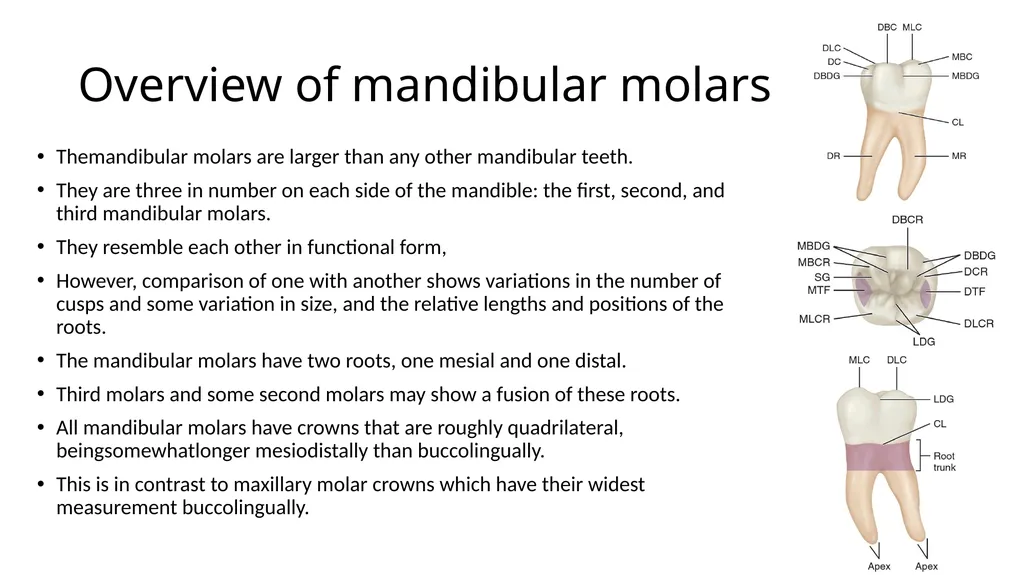
Overview of mandibular molars Themandibular molars are larger than any other mandibular teeth.
They are three in number on each side of the mandible: the first, second, and third mandibular molars.
They resemble each other in functional form,
However, comparison of one with another shows variations in the number of cusps and some variation in size, and the relative lengths and positions of the roots.
The mandibular molars have two roots, one mesial and one distal.
Third molars and some second molars may show a fusion of these roots.
All mandibular molars have crowns that are roughly quadrilateral, beingsomewhatlonger mesiodistally than buccolingually.
This is in contrast to maxillary molar crowns which have their widest measurement buccolingually.<br>
03
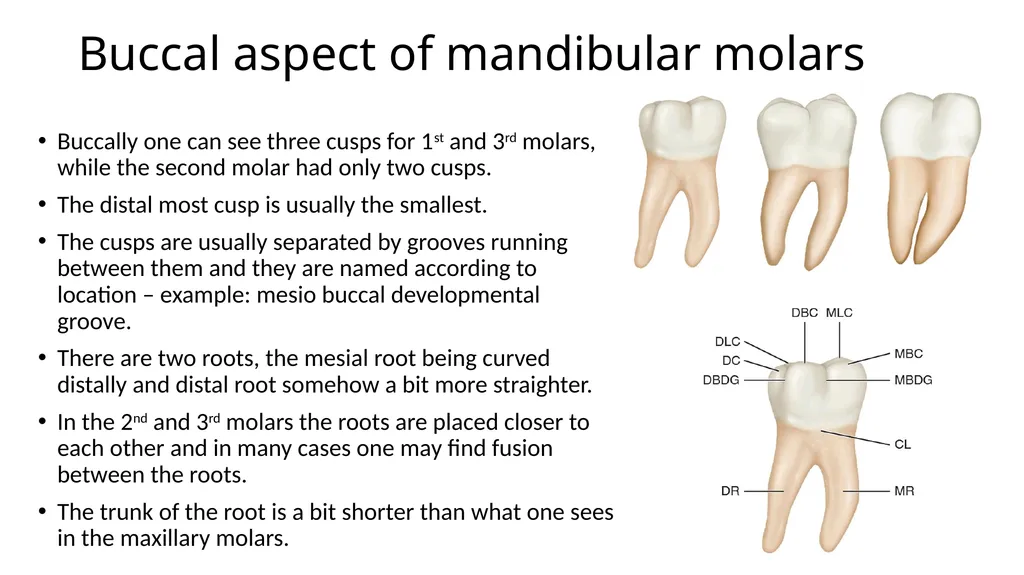
Buccal aspect of mandibular molars Buccally one can see three cusps for 1st and 3rd molars, while the second molar had only two cusps.
The distal most cusp is usually the smallest.
The cusps are usually separated by grooves running between them and they are named according to location – example: mesio buccal developmental groove.
There are two roots, the mesial root being curved distally and distal root somehow a bit more straighter.
In the 2nd and 3rd molars the roots are placed closer to each other and in many cases one may find fusion between the roots.
The trunk of the root is a bit shorter than what one sees in the maxillary molars.<br>
04
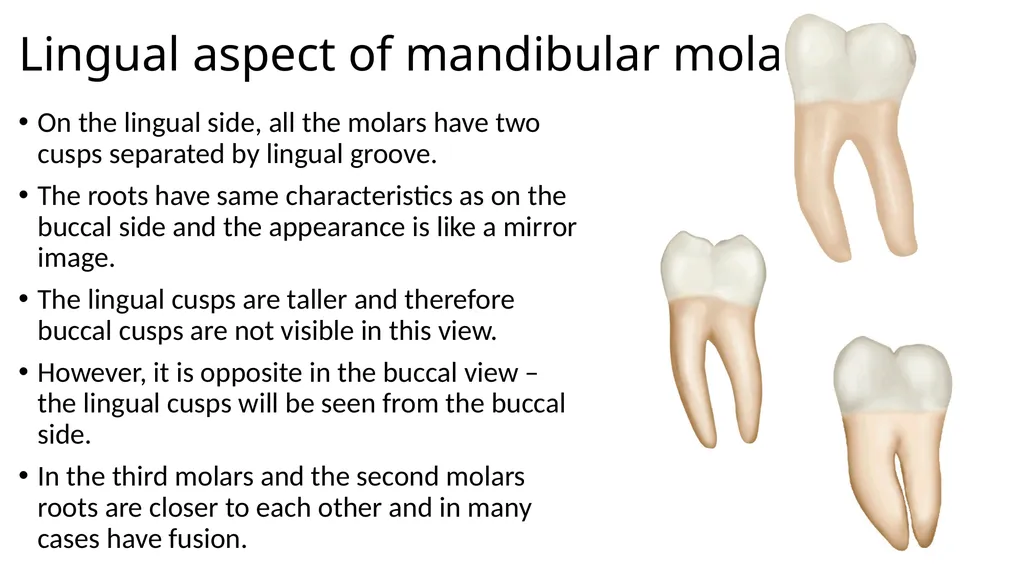
Lingual aspect of mandibular molars On the lingual side, all the molars have two cusps separated by lingual groove.
The roots have same characteristics as on the buccal side and the appearance is like a mirror image.
The lingual cusps are taller and therefore buccal cusps are not visible in this view.
However, it is opposite in the buccal view – the lingual cusps will be seen from the buccal side.
In the third molars and the second molars roots are closer to each other and in many cases have fusion.<br>
05
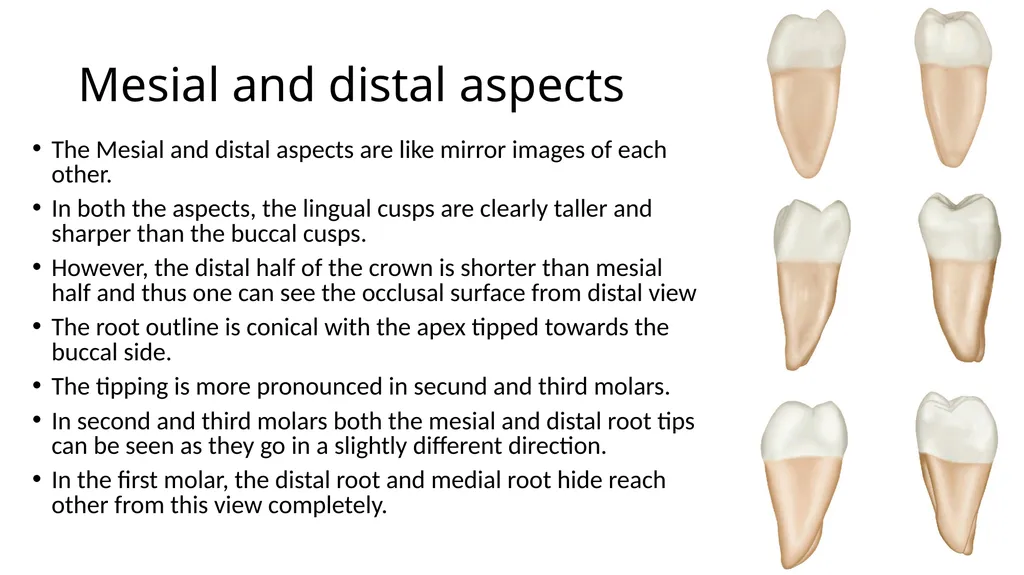
Mesial and distal aspects The Mesial and distal aspects are like mirror images of each other.
In both the aspects, the lingual cusps are clearly taller and sharper than the buccal cusps.
However, the distal half of the crown is shorter than mesial half and thus one can see the occlusal surface from distal view
The root outline is conical with the apex tipped towards the buccal side.
The tipping is more pronounced in secund and third molars.
In second and third molars both the mesial and distal root tips can be seen as they go in a slightly different direction.
In the first molar, the distal root and medial root hide reach other from this view completely.<br>
06
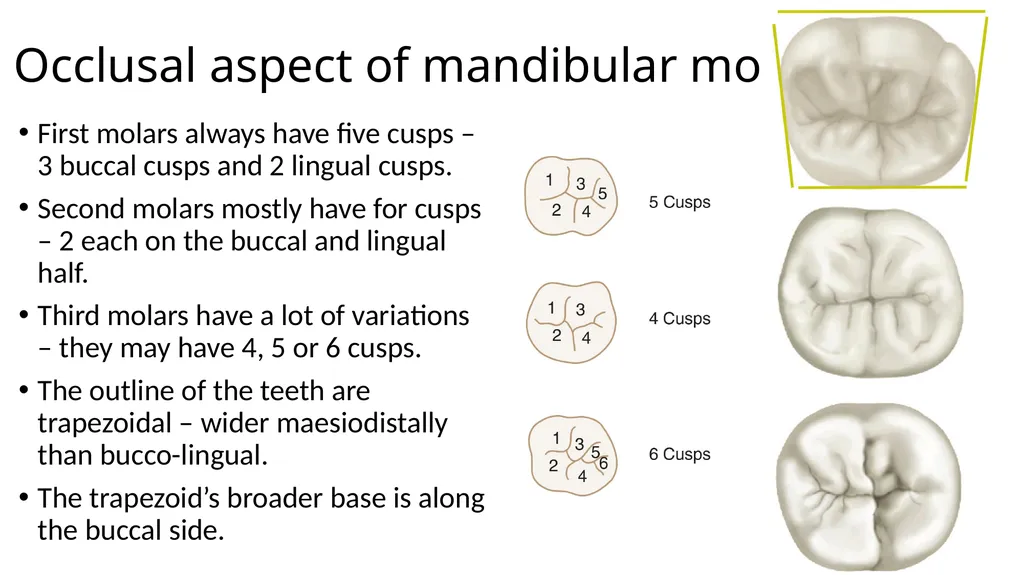
Occlusal aspect of mandibular molars First molars always have five cusps – 3 buccal cusps and 2 lingual cusps.
Second molars mostly have for cusps – 2 each on the buccal and lingual half.
Third molars have a lot of variations – they may have 4, 5 or 6 cusps.
The outline of the teeth are trapezoidal – wider maesiodistally than bucco-lingual.
The trapezoid’s broader base is along the buccal side.<br>