
MapReduce Simplified Data Processing on Large
LD
Published · 30 slides · 0 views
1 / 1
Description
MapReduce Simplified Data Processing on Large Clusters by Jeffrey Dean and Sanjay Ghemawa Presented by Jon Logan Outline Problem Statement Motivation An Example Program MapReduce vs Hadoop GFS HDFS MapReduce Fundamentals Example Code
Related Topics
Share
Embed code
Download this presentation From Below
"MapReduce Simplified Data Processing on Large" is the property of its rightful owner. Permission is granted to download and print the materials on this website for personal, non-commercial use only, and to display it on your personal computer provided you do not modify the materials and that you retain all copyright notices contained in the materials. By downloading content from our website, you accept the terms of this agreement.
Presentation Transcript
01
MapReduce Simplified Data Processing on Large Clusters
by Jeffrey Dean and Sanjay Ghemawa
Presented by Jon Logan<br>
by Jeffrey Dean and Sanjay Ghemawa
Presented by Jon Logan<br>
02
Outline Problem Statement / Motivation
An Example Program
MapReduce vs Hadoop
GFS / HDFS
MapReduce Fundamentals
Example Code
Workflows
Conclusion / Questions<br>
An Example Program
MapReduce vs Hadoop
GFS / HDFS
MapReduce Fundamentals
Example Code
Workflows
Conclusion / Questions<br>
03
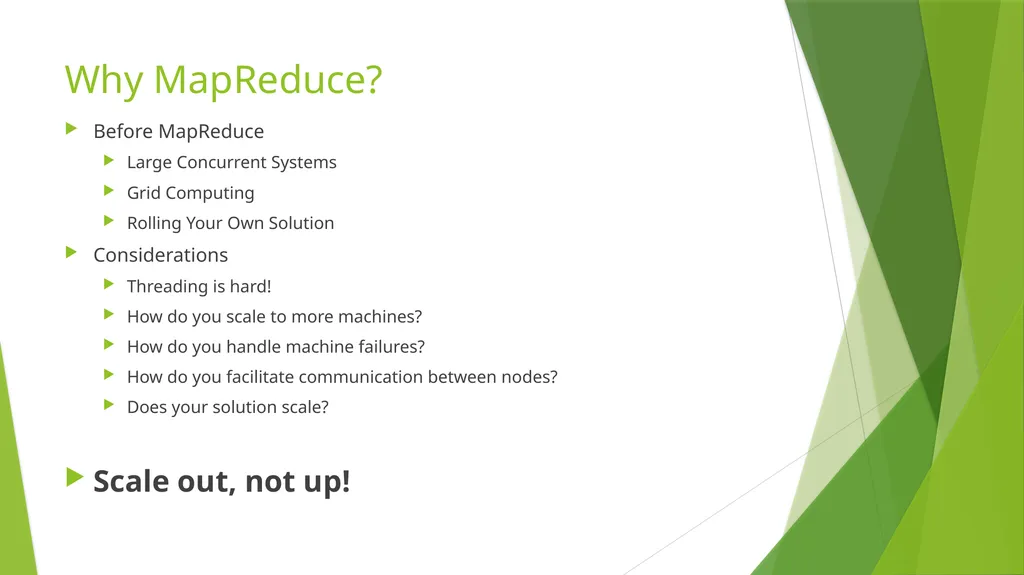
Why MapReduce? Before MapReduce
Large Concurrent Systems
Grid Computing
Rolling Your Own Solution
Considerations
Threading is hard!
How do you scale to more machines?
How do you handle machine failures?
How do you facilitate communication between nodes?
Does your solution scale?
Scale out, not up!<br>
Large Concurrent Systems
Grid Computing
Rolling Your Own Solution
Considerations
Threading is hard!
How do you scale to more machines?
How do you handle machine failures?
How do you facilitate communication between nodes?
Does your solution scale?
Scale out, not up!<br>
04
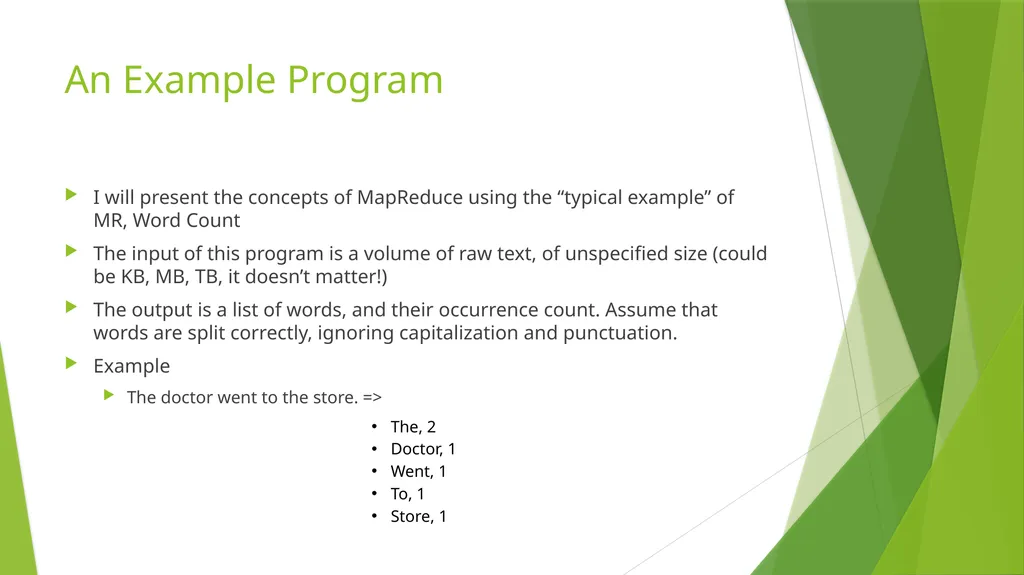
An Example Program I will present the concepts of MapReduce using the “typical example” of MR, Word Count
The input of this program is a volume of raw text, of unspecified size (could be KB, MB, TB, it doesn’t matter!)
The output is a list of words, and their occurrence count. Assume that words are split correctly, ignoring capitalization and punctuation.
Example
The doctor went to the store. =>
The, 2
Doctor, 1
Went, 1
To, 1
Store, 1<br>
The input of this program is a volume of raw text, of unspecified size (could be KB, MB, TB, it doesn’t matter!)
The output is a list of words, and their occurrence count. Assume that words are split correctly, ignoring capitalization and punctuation.
Example
The doctor went to the store. =>
The, 2
Doctor, 1
Went, 1
To, 1
Store, 1<br>
05
Map? Reduce? Mappers read in data from the filesystem, and output (typically) modified data
Reducers collect all of the mappers output on the keys, and output (typically) reduced data
The outputted data is written to disk
All data is in terms of key value pairs<br>
Reducers collect all of the mappers output on the keys, and output (typically) reduced data
The outputted data is written to disk
All data is in terms of key value pairs<br>
06
Outline Problem Statement / Motivation
An Example Program
MapReduce vs Hadoop
GFS / HDFS
MapReduce Fundamentals
Example Code
Workflows
Conclusion / Questions<br>
An Example Program
MapReduce vs Hadoop
GFS / HDFS
MapReduce Fundamentals
Example Code
Workflows
Conclusion / Questions<br>
07
MapReduce vs Hadoop The paper is written by two researchers at Google, and describes their programming paradigm
Unless you work at Google, or use Google App Engine, you won’t use it!
Open Source implementation is Hadoop MapReduce
Not developed by Google
Started by Yahoo
Google’s implementation (at least the one described) is written in C++
Hadoop is written in Java<br>
Unless you work at Google, or use Google App Engine, you won’t use it!
Open Source implementation is Hadoop MapReduce
Not developed by Google
Started by Yahoo
Google’s implementation (at least the one described) is written in C++
Hadoop is written in Java<br>
08
GFS/HDFS This is not a GFS/HDFS presentation! (But the following presentation is)
A few concepts are key to MapReduce though:
Google File System (GFS) and Hadoop Distributed File System (HDFS) are essentially distributed filesystems
Are fault tolerant through replication
Allows data to be local to computation<br>
A few concepts are key to MapReduce though:
Google File System (GFS) and Hadoop Distributed File System (HDFS) are essentially distributed filesystems
Are fault tolerant through replication
Allows data to be local to computation<br>
09
Outline Problem Statement / Motivation
An Example Program
MapReduce vs Hadoop
GFS / HDFS
MapReduce Fundamentals
Example Code
Workflows
Conclusion / Questions<br>
An Example Program
MapReduce vs Hadoop
GFS / HDFS
MapReduce Fundamentals
Example Code
Workflows
Conclusion / Questions<br>
10
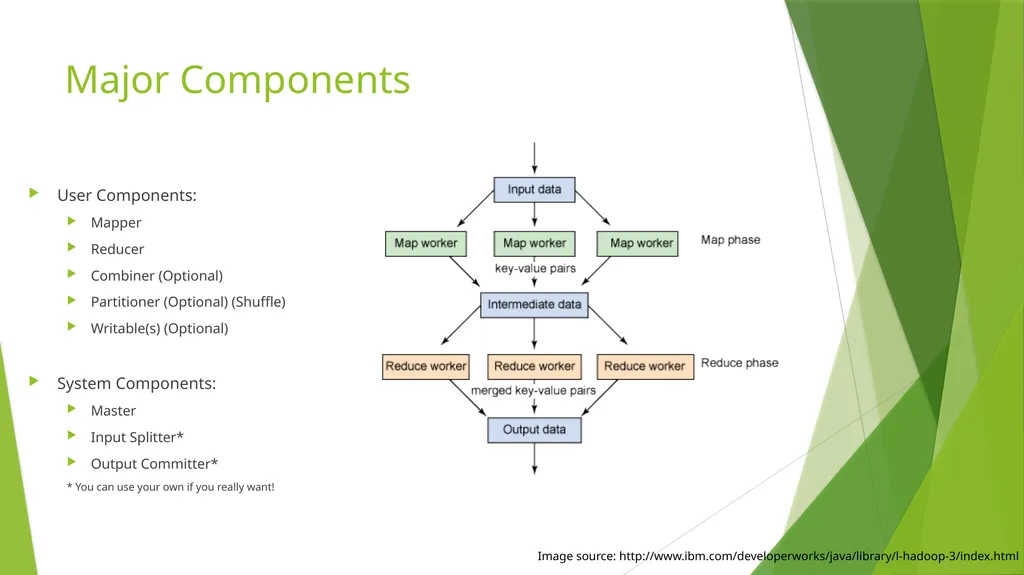
Major Components User Components:
Mapper
Reducer
Combiner (Optional)
Partitioner (Optional) (Shuffle)
Writable(s) (Optional)
System Components:
Master
Input Splitter*
Output Committer*
* You can use your own if you really want! Image source: http://www.ibm.com/developerworks/java/library/l-hadoop-3/index.html<br>
Mapper
Reducer
Combiner (Optional)
Partitioner (Optional) (Shuffle)
Writable(s) (Optional)
System Components:
Master
Input Splitter*
Output Committer*
* You can use your own if you really want! Image source: http://www.ibm.com/developerworks/java/library/l-hadoop-3/index.html<br>
11
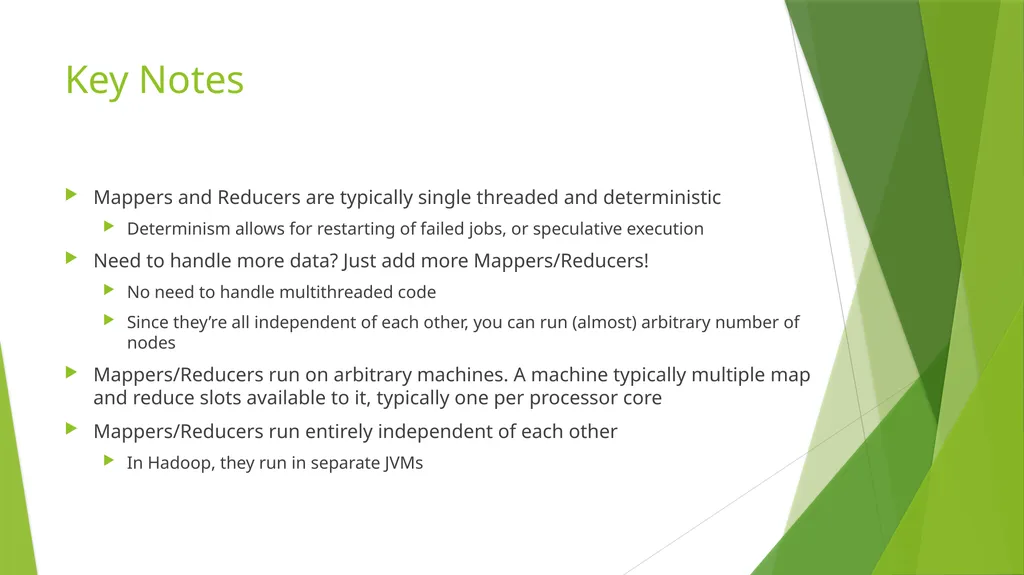
Key Notes Mappers and Reducers are typically single threaded and deterministic
Determinism allows for restarting of failed jobs, or speculative execution
Need to handle more data? Just add more Mappers/Reducers!
No need to handle multithreaded code
Since they’re all independent of each other, you can run (almost) arbitrary number of nodes
Mappers/Reducers run on arbitrary machines. A machine typically multiple map and reduce slots available to it, typically one per processor core
Mappers/Reducers run entirely independent of each other
In Hadoop, they run in separate JVMs<br>
Determinism allows for restarting of failed jobs, or speculative execution
Need to handle more data? Just add more Mappers/Reducers!
No need to handle multithreaded code
Since they’re all independent of each other, you can run (almost) arbitrary number of nodes
Mappers/Reducers run on arbitrary machines. A machine typically multiple map and reduce slots available to it, typically one per processor core
Mappers/Reducers run entirely independent of each other
In Hadoop, they run in separate JVMs<br>
12
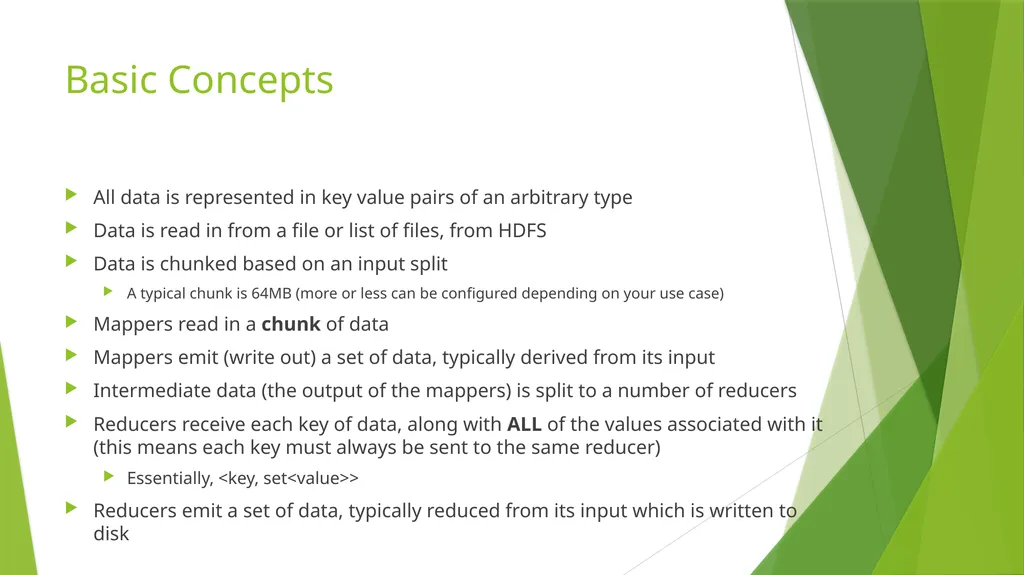
Basic Concepts All data is represented in key value pairs of an arbitrary type
Data is read in from a file or list of files, from HDFS
Data is chunked based on an input split
A typical chunk is 64MB (more or less can be configured depending on your use case)
Mappers read in a chunk of data
Mappers emit (write out) a set of data, typically derived from its input
Intermediate data (the output of the mappers) is split to a number of reducers
Reducers receive each key of data, along with ALL of the values associated with it (this means each key must always be sent to the same reducer)
Essentially, <key, set<value>>
Reducers emit a set of data, typically reduced from its input which is written to disk<br>
Data is read in from a file or list of files, from HDFS
Data is chunked based on an input split
A typical chunk is 64MB (more or less can be configured depending on your use case)
Mappers read in a chunk of data
Mappers emit (write out) a set of data, typically derived from its input
Intermediate data (the output of the mappers) is split to a number of reducers
Reducers receive each key of data, along with ALL of the values associated with it (this means each key must always be sent to the same reducer)
Essentially, <key, set<value>>
Reducers emit a set of data, typically reduced from its input which is written to disk<br>
13
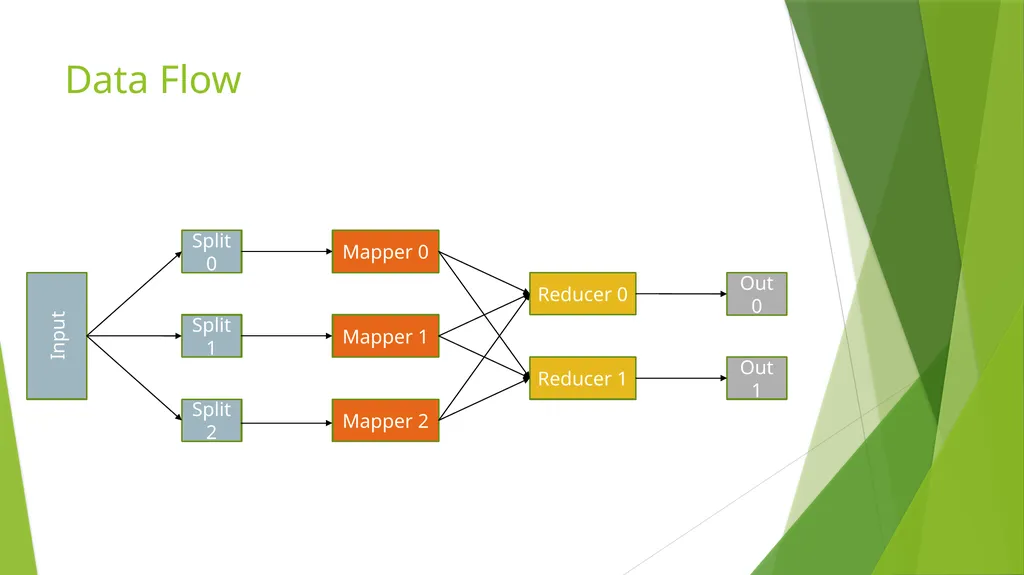
Data Flow Mapper 2 Mapper 0 Mapper 1 Reducer 0 Reducer 1 Out 0 Out 1 Input Split 2 Split 1 Split 0<br>
14
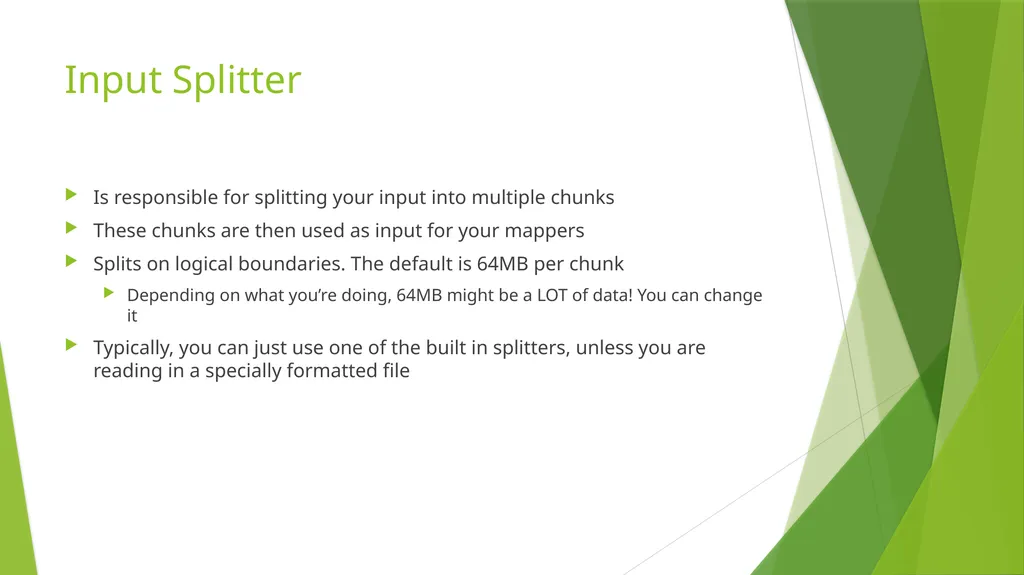
Input Splitter Is responsible for splitting your input into multiple chunks
These chunks are then used as input for your mappers
Splits on logical boundaries. The default is 64MB per chunk
Depending on what you’re doing, 64MB might be a LOT of data! You can change it
Typically, you can just use one of the built in splitters, unless you are reading in a specially formatted file<br>
These chunks are then used as input for your mappers
Splits on logical boundaries. The default is 64MB per chunk
Depending on what you’re doing, 64MB might be a LOT of data! You can change it
Typically, you can just use one of the built in splitters, unless you are reading in a specially formatted file<br>
15
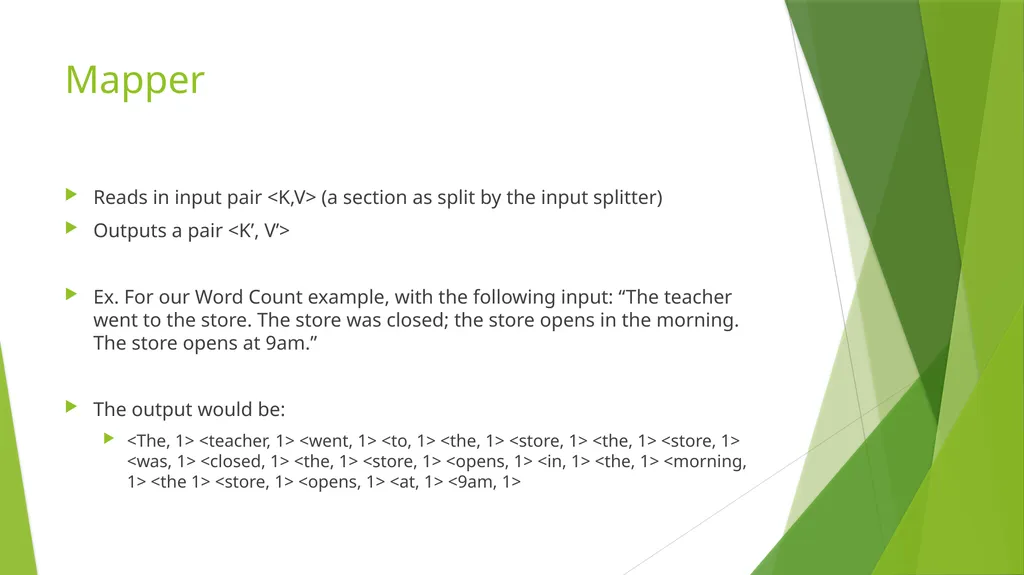
Mapper Reads in input pair <K,V> (a section as split by the input splitter)
Outputs a pair <K’, V’>
Ex. For our Word Count example, with the following input: “The teacher went to the store. The store was closed; the store opens in the morning. The store opens at 9am.”
The output would be:
<The, 1> <teacher, 1> <went, 1> <to, 1> <the, 1> <store, 1> <the, 1> <store, 1> <was, 1> <closed, 1> <the, 1> <store, 1> <opens, 1> <in, 1> <the, 1> <morning, 1> <the 1> <store, 1> <opens, 1> <at, 1> <9am, 1><br>
Outputs a pair <K’, V’>
Ex. For our Word Count example, with the following input: “The teacher went to the store. The store was closed; the store opens in the morning. The store opens at 9am.”
The output would be:
<The, 1> <teacher, 1> <went, 1> <to, 1> <the, 1> <store, 1> <the, 1> <store, 1> <was, 1> <closed, 1> <the, 1> <store, 1> <opens, 1> <in, 1> <the, 1> <morning, 1> <the 1> <store, 1> <opens, 1> <at, 1> <9am, 1><br>
16
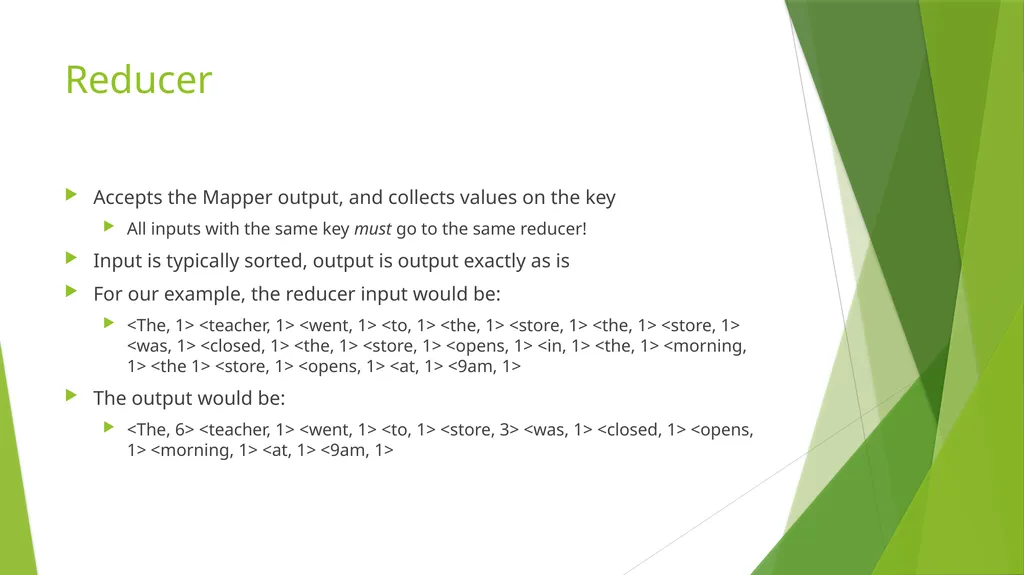
Reducer Accepts the Mapper output, and collects values on the key
All inputs with the same key must go to the same reducer!
Input is typically sorted, output is output exactly as is
For our example, the reducer input would be:
<The, 1> <teacher, 1> <went, 1> <to, 1> <the, 1> <store, 1> <the, 1> <store, 1> <was, 1> <closed, 1> <the, 1> <store, 1> <opens, 1> <in, 1> <the, 1> <morning, 1> <the 1> <store, 1> <opens, 1> <at, 1> <9am, 1>
The output would be:
<The, 6> <teacher, 1> <went, 1> <to, 1> <store, 3> <was, 1> <closed, 1> <opens, 1> <morning, 1> <at, 1> <9am, 1><br>
All inputs with the same key must go to the same reducer!
Input is typically sorted, output is output exactly as is
For our example, the reducer input would be:
<The, 1> <teacher, 1> <went, 1> <to, 1> <the, 1> <store, 1> <the, 1> <store, 1> <was, 1> <closed, 1> <the, 1> <store, 1> <opens, 1> <in, 1> <the, 1> <morning, 1> <the 1> <store, 1> <opens, 1> <at, 1> <9am, 1>
The output would be:
<The, 6> <teacher, 1> <went, 1> <to, 1> <store, 3> <was, 1> <closed, 1> <opens, 1> <morning, 1> <at, 1> <9am, 1><br>
17
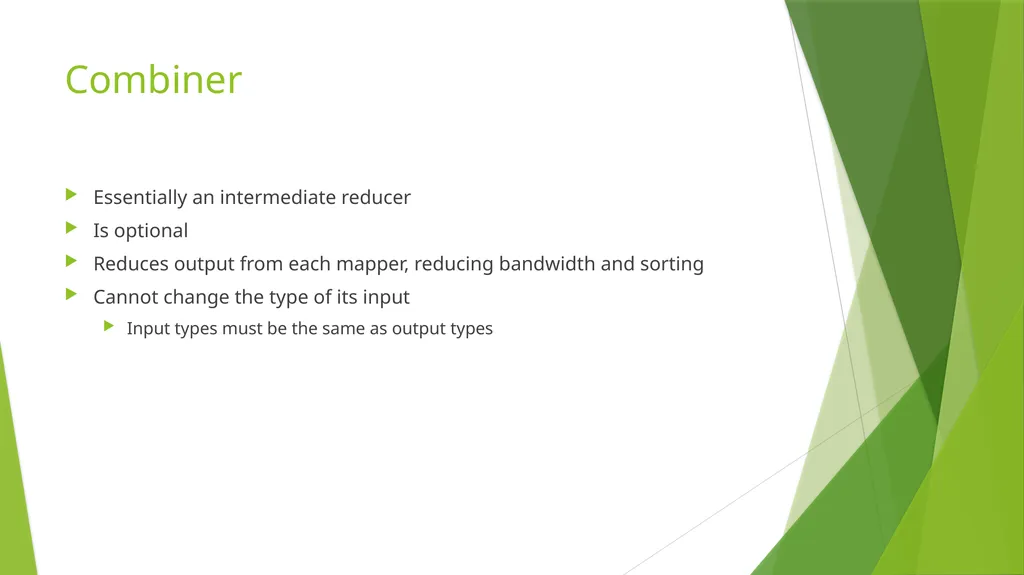
Combiner Essentially an intermediate reducer
Is optional
Reduces output from each mapper, reducing bandwidth and sorting
Cannot change the type of its input
Input types must be the same as output types<br>
Is optional
Reduces output from each mapper, reducing bandwidth and sorting
Cannot change the type of its input
Input types must be the same as output types<br>
18
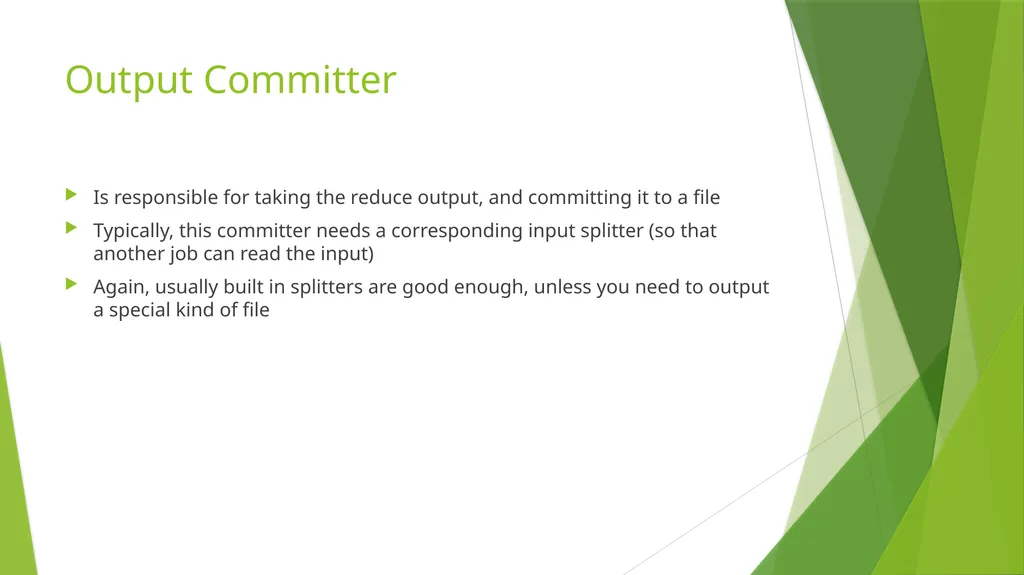
Output Committer Is responsible for taking the reduce output, and committing it to a file
Typically, this committer needs a corresponding input splitter (so that another job can read the input)
Again, usually built in splitters are good enough, unless you need to output a special kind of file<br>
Typically, this committer needs a corresponding input splitter (so that another job can read the input)
Again, usually built in splitters are good enough, unless you need to output a special kind of file<br>
19
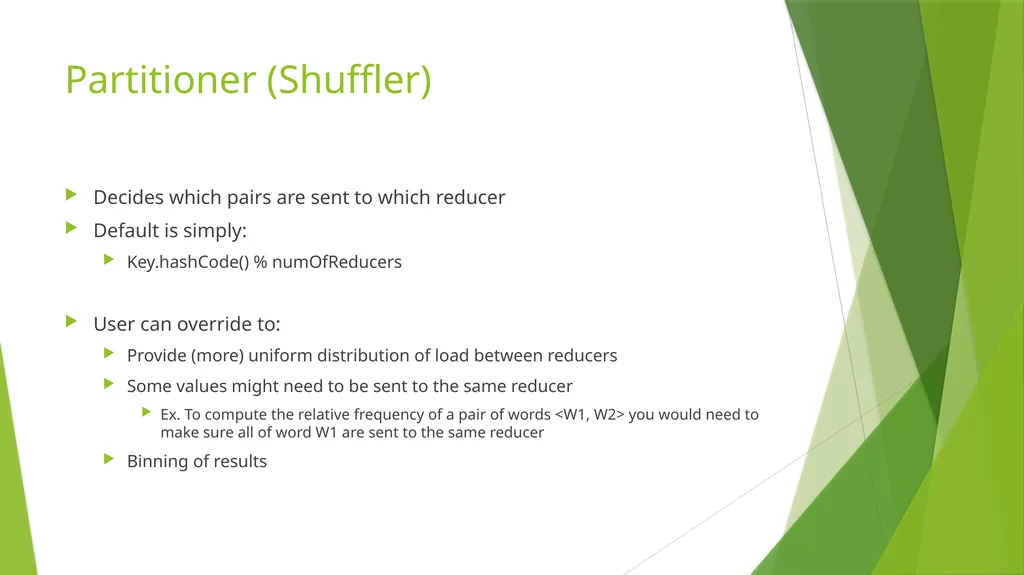
Partitioner (Shuffler) Decides which pairs are sent to which reducer
Default is simply:
Key.hashCode() % numOfReducers
User can override to:
Provide (more) uniform distribution of load between reducers
Some values might need to be sent to the same reducer
Ex. To compute the relative frequency of a pair of words <W1, W2> you would need to make sure all of word W1 are sent to the same reducer
Binning of results<br>
Default is simply:
Key.hashCode() % numOfReducers
User can override to:
Provide (more) uniform distribution of load between reducers
Some values might need to be sent to the same reducer
Ex. To compute the relative frequency of a pair of words <W1, W2> you would need to make sure all of word W1 are sent to the same reducer
Binning of results<br>
20
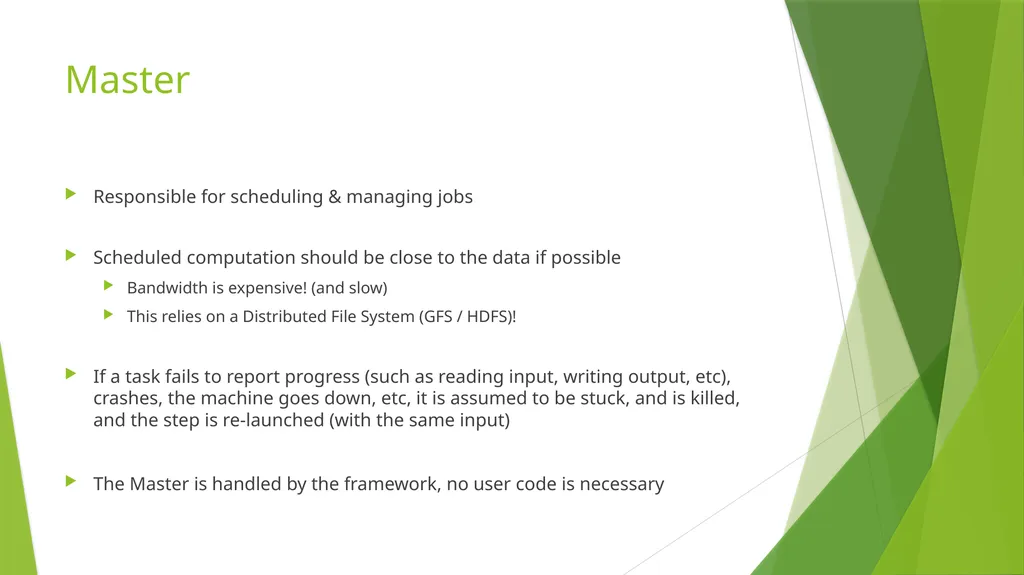
Master Responsible for scheduling & managing jobs
Scheduled computation should be close to the data if possible
Bandwidth is expensive! (and slow)
This relies on a Distributed File System (GFS / HDFS)!
If a task fails to report progress (such as reading input, writing output, etc), crashes, the machine goes down, etc, it is assumed to be stuck, and is killed, and the step is re-launched (with the same input)
The Master is handled by the framework, no user code is necessary<br>
Scheduled computation should be close to the data if possible
Bandwidth is expensive! (and slow)
This relies on a Distributed File System (GFS / HDFS)!
If a task fails to report progress (such as reading input, writing output, etc), crashes, the machine goes down, etc, it is assumed to be stuck, and is killed, and the step is re-launched (with the same input)
The Master is handled by the framework, no user code is necessary<br>
21
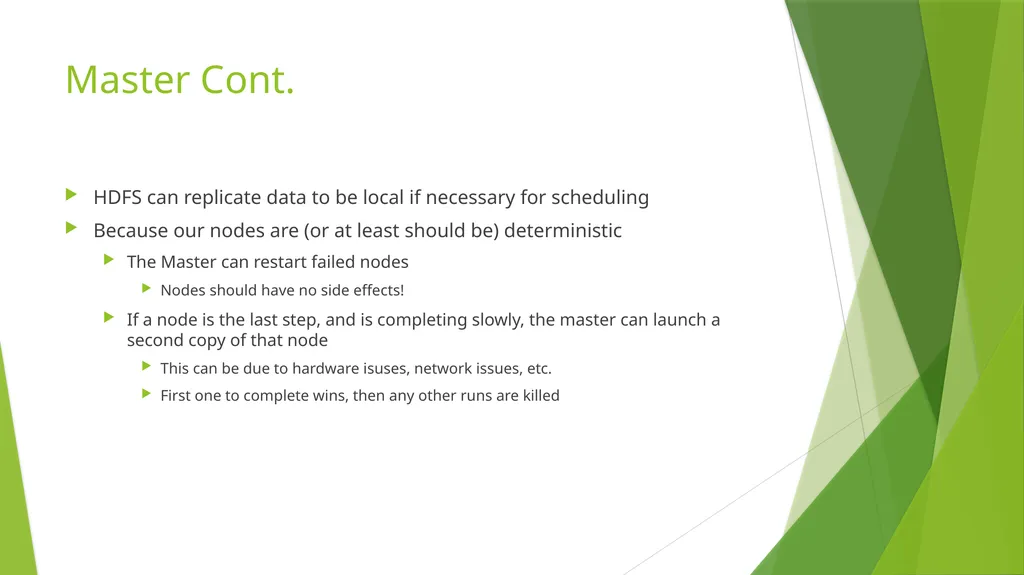
Master Cont. HDFS can replicate data to be local if necessary for scheduling
Because our nodes are (or at least should be) deterministic
The Master can restart failed nodes
Nodes should have no side effects!
If a node is the last step, and is completing slowly, the master can launch a second copy of that node
This can be due to hardware isuses, network issues, etc.
First one to complete wins, then any other runs are killed<br>
Because our nodes are (or at least should be) deterministic
The Master can restart failed nodes
Nodes should have no side effects!
If a node is the last step, and is completing slowly, the master can launch a second copy of that node
This can be due to hardware isuses, network issues, etc.
First one to complete wins, then any other runs are killed<br>
22
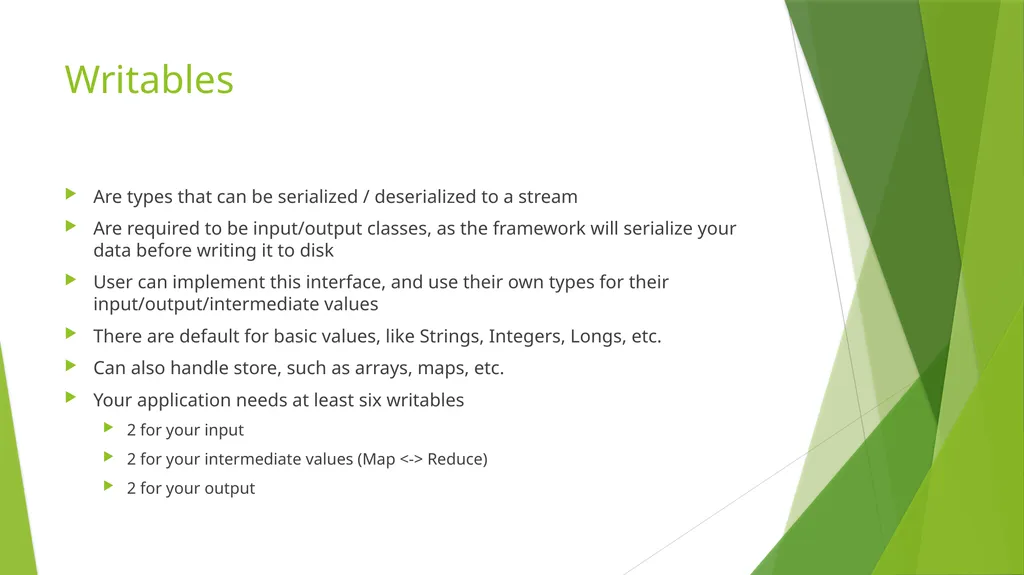
Writables Are types that can be serialized / deserialized to a stream
Are required to be input/output classes, as the framework will serialize your data before writing it to disk
User can implement this interface, and use their own types for their input/output/intermediate values
There are default for basic values, like Strings, Integers, Longs, etc.
Can also handle store, such as arrays, maps, etc.
Your application needs at least six writables
2 for your input
2 for your intermediate values (Map <-> Reduce)
2 for your output<br>
Are required to be input/output classes, as the framework will serialize your data before writing it to disk
User can implement this interface, and use their own types for their input/output/intermediate values
There are default for basic values, like Strings, Integers, Longs, etc.
Can also handle store, such as arrays, maps, etc.
Your application needs at least six writables
2 for your input
2 for your intermediate values (Map <-> Reduce)
2 for your output<br>
23
Outline Problem Statement / Motivation
An Example Program
MapReduce vs Hadoop
GFS / HDFS
MapReduce Fundamentals
Example Code
Workflows
Conclusion / Questions<br>
An Example Program
MapReduce vs Hadoop
GFS / HDFS
MapReduce Fundamentals
Example Code
Workflows
Conclusion / Questions<br>
24
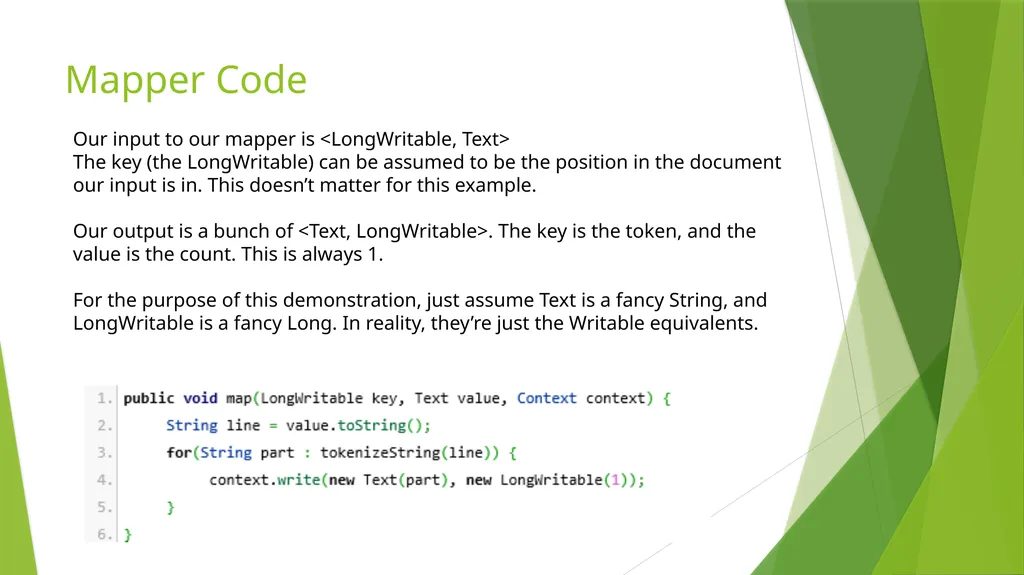
Mapper Code Our input to our mapper is <LongWritable, Text>
The key (the LongWritable) can be assumed to be the position in the document our input is in. This doesn’t matter for this example.
Our output is a bunch of <Text, LongWritable>. The key is the token, and the value is the count. This is always 1.
For the purpose of this demonstration, just assume Text is a fancy String, and LongWritable is a fancy Long. In reality, they’re just the Writable equivalents.<br>
The key (the LongWritable) can be assumed to be the position in the document our input is in. This doesn’t matter for this example.
Our output is a bunch of <Text, LongWritable>. The key is the token, and the value is the count. This is always 1.
For the purpose of this demonstration, just assume Text is a fancy String, and LongWritable is a fancy Long. In reality, they’re just the Writable equivalents.<br>
25
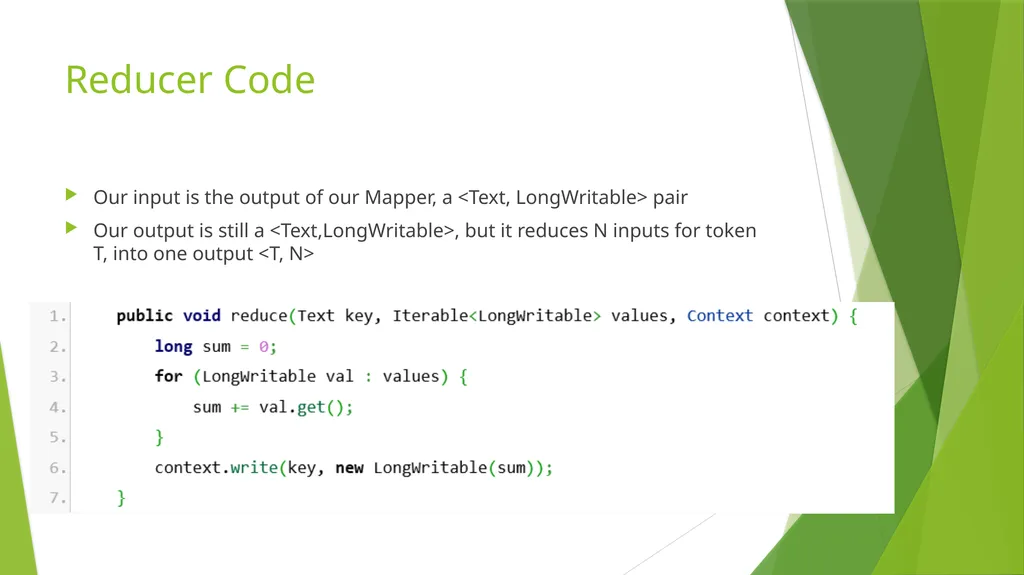
Reducer Code Our input is the output of our Mapper, a <Text, LongWritable> pair
Our output is still a <Text,LongWritable>, but it reduces N inputs for token T, into one output <T, N><br>
Our output is still a <Text,LongWritable>, but it reduces N inputs for token T, into one output <T, N><br>
26
Combiner Code Do we need a combiner?
No, but it reduces bandwidth.
Our reducer can actually be our combiner in this case though!<br>
No, but it reduces bandwidth.
Our reducer can actually be our combiner in this case though!<br>
27
That’s it! All that is needed to run the above code is an extremely simple runner class.
Simply specifies which components to use, and your input/output directories<br>
Simply specifies which components to use, and your input/output directories<br>
28
Workflows Sometimes you need multiple steps to express your design
MapReduce does not directly allow for this, but there are solutions that do
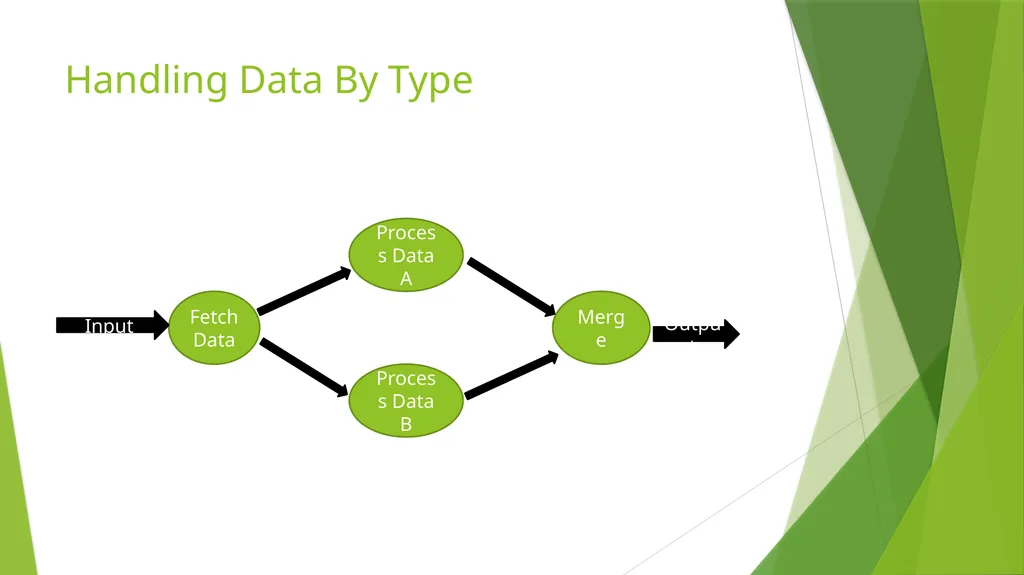
Hadoop YARN allows for a Directed Acyclic Graph of nodes
Oozie also allows for a graph of nodes<br>
MapReduce does not directly allow for this, but there are solutions that do
Hadoop YARN allows for a Directed Acyclic Graph of nodes
Oozie also allows for a graph of nodes<br>
29
Handling Data By Type Fetch Data Process Data A Process Data B Merge Input Output<br>
30
Conclusion MapReduce provides a simple way to scale your application
Scales out to more machines, rather than scaling up
Effortlessly scale from a single machine to thousands
Fault tolerant & High performance
If you can fit your use case to its paradigm, scaling is handled by the framework<br>
Scales out to more machines, rather than scaling up
Effortlessly scale from a single machine to thousands
Fault tolerant & High performance
If you can fit your use case to its paradigm, scaling is handled by the framework<br>