
Meal Support Training for Caregivers CONTRIBUTORS:
GB
Published · 56 slides · 0 views
1 / 1



Description
Meal Support Training for Caregivers CONTRIBUTORS: Kashika Arora, BA, PMHS II, SCH, Cynthia Flynn, PhD, Clinical Psychologist, SCHUW, Lisa Holman, MS, RD, CD, Clinical Dietitian, SCH, Laura Hooper, MS, RD, CD, Clinical Dietitian, SCH,
Related Topics
Share
Embed code
Download this presentation From Below
"Meal Support Training for Caregivers CONTRIBUTORS:" is the property of its rightful owner. Permission is granted to download and print the materials on this website for personal, non-commercial use only, and to display it on your personal computer provided you do not modify the materials and that you retain all copyright notices contained in the materials. By downloading content from our website, you accept the terms of this agreement.
Presentation Transcript
01
Meal Support Training
for Caregivers CONTRIBUTORS: Kashika Arora, BA, PMHS II, SCH, Cynthia Flynn, PhD, Clinical Psychologist, SCH/UW, Lisa Holman, MS, RD, CD, Clinical Dietitian, SCH, Laura Hooper, MS, RD, CD, Clinical Dietitian, SCH, Angela Werfelmann Wood, MPS LMHC, ATR, SCH, Bertrand Wicholas, MD, Psychiatrist, Private Practice/UW.<br>
for Caregivers CONTRIBUTORS: Kashika Arora, BA, PMHS II, SCH, Cynthia Flynn, PhD, Clinical Psychologist, SCH/UW, Lisa Holman, MS, RD, CD, Clinical Dietitian, SCH, Laura Hooper, MS, RD, CD, Clinical Dietitian, SCH, Angela Werfelmann Wood, MPS LMHC, ATR, SCH, Bertrand Wicholas, MD, Psychiatrist, Private Practice/UW.<br>
02
Please introduce yourself:
Your name.
How old is your child?
Is your child at home? In the hospital? On the medical floor or the PBMU?
What brings you to this group, and what are you hoping to get out of it? Welcome<br>
Your name.
How old is your child?
Is your child at home? In the hospital? On the medical floor or the PBMU?
What brings you to this group, and what are you hoping to get out of it? Welcome<br>
03
Eating Disorder Treatment Basics
Providing Meal Support
Preparing for meal time
During the meal time
After meals
Debriefing
Review and Reminders What We’ll Review Today<br>
Providing Meal Support
Preparing for meal time
During the meal time
After meals
Debriefing
Review and Reminders What We’ll Review Today<br>
04
Eating Disorder Treatment Basics<br>
05
Biologically-based mental health disorders with serious medical consequences
Have no clear cause but are likely due to a complex interaction of multiple factors
Are not caused by families, but caregivers are crucial to recovery Eating Disorders<br>
Have no clear cause but are likely due to a complex interaction of multiple factors
Are not caused by families, but caregivers are crucial to recovery Eating Disorders<br>
06
Recovery begins with normalizing eating
Food and rest are the medicine
Child is expected to complete 100% of their meals
Caregivers take control of refeeding
Caregivers need to be united on treatment and expectations
Important to separate your child from the eating disorder Family-Based Treatment Approach to Recovery<br>
Food and rest are the medicine
Child is expected to complete 100% of their meals
Caregivers take control of refeeding
Caregivers need to be united on treatment and expectations
Important to separate your child from the eating disorder Family-Based Treatment Approach to Recovery<br>
07
Caregivers must present a “united front” against the eating disorder
Caregivers need to agree on meal choices and portions before each meal and snack
Agree on meal expectations, time cues, and coaching
Disagreements between caregivers should be resolved away from youth Caregiver Expectations<br>
Caregivers need to agree on meal choices and portions before each meal and snack
Agree on meal expectations, time cues, and coaching
Disagreements between caregivers should be resolved away from youth Caregiver Expectations<br>
08
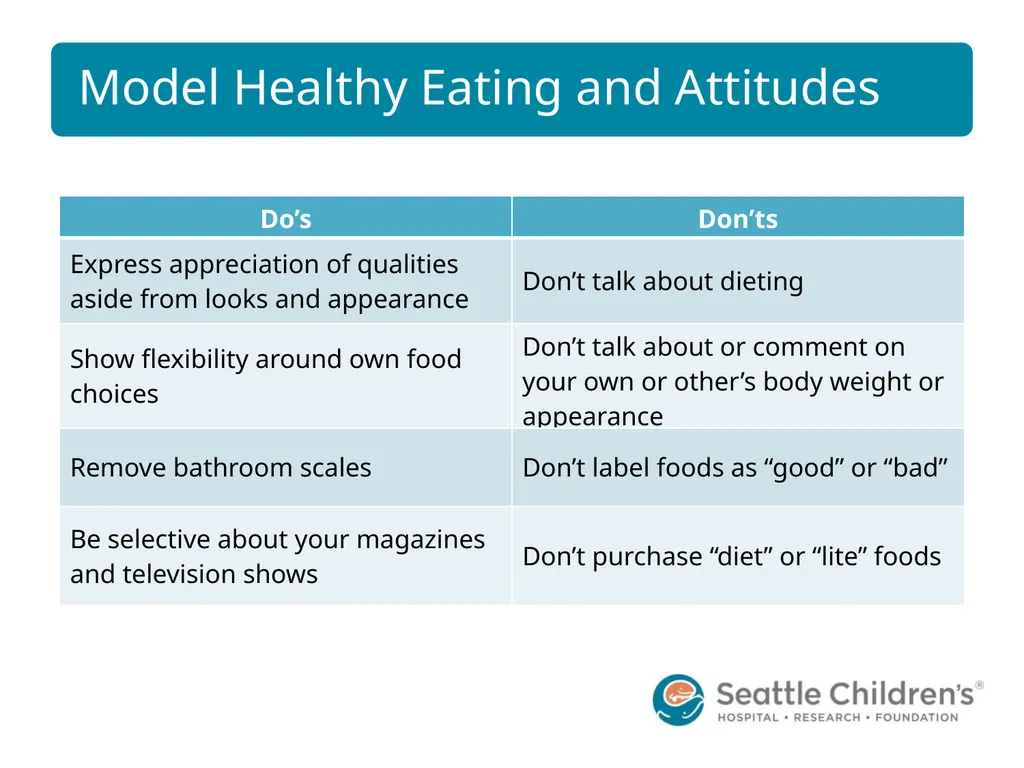
Model Healthy Eating and Attitudes<br>
09
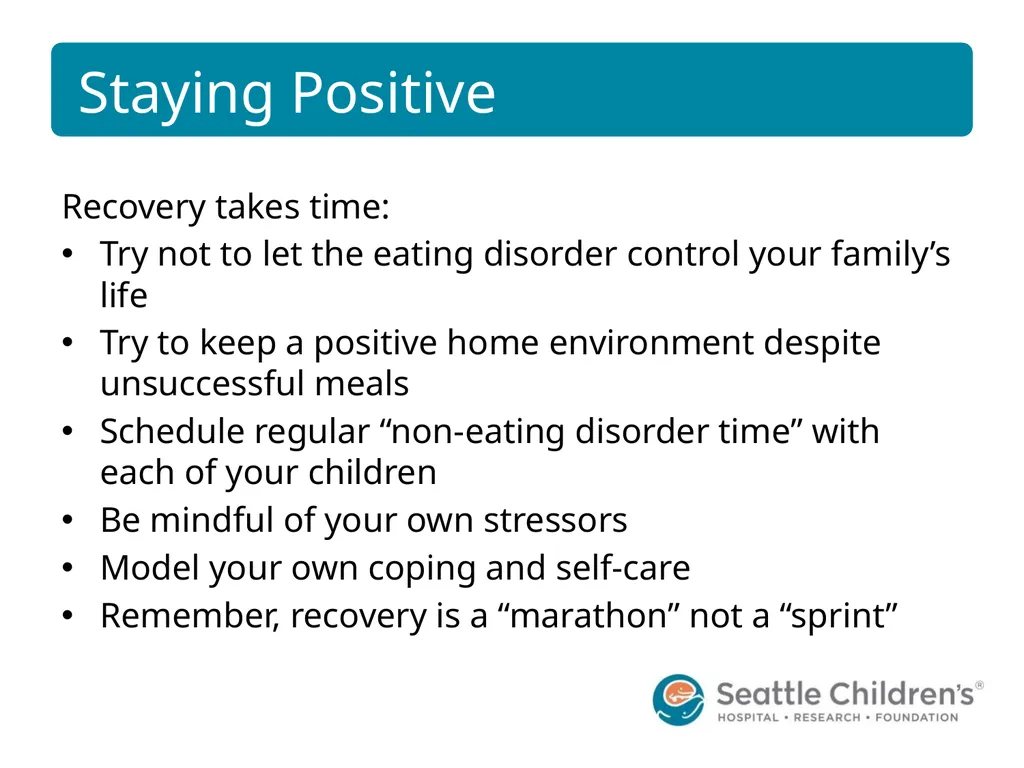
Recovery takes time:
Try not to let the eating disorder control your family’s life
Try to keep a positive home environment despite unsuccessful meals
Schedule regular “non-eating disorder time” with each of your children
Be mindful of your own stressors
Model your own coping and self-care
Remember, recovery is a “marathon” not a “sprint” Staying Positive<br>
Try not to let the eating disorder control your family’s life
Try to keep a positive home environment despite unsuccessful meals
Schedule regular “non-eating disorder time” with each of your children
Be mindful of your own stressors
Model your own coping and self-care
Remember, recovery is a “marathon” not a “sprint” Staying Positive<br>
10
Preparing for the
Meal Time<br>
Meal Time<br>
11
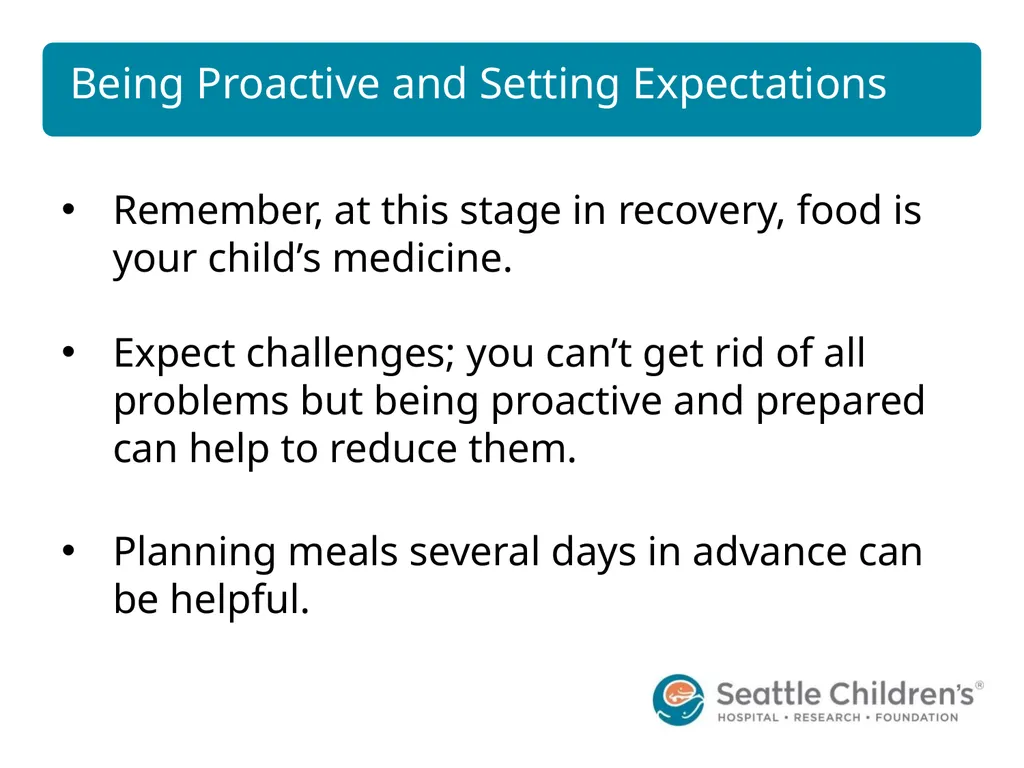
Remember, at this stage in recovery, food is your child’s medicine.
Expect challenges; you can’t get rid of all problems but being proactive and prepared can help to reduce them.
Planning meals several days in advance can be helpful. Being Proactive and Setting Expectations<br>
Expect challenges; you can’t get rid of all problems but being proactive and prepared can help to reduce them.
Planning meals several days in advance can be helpful. Being Proactive and Setting Expectations<br>
12
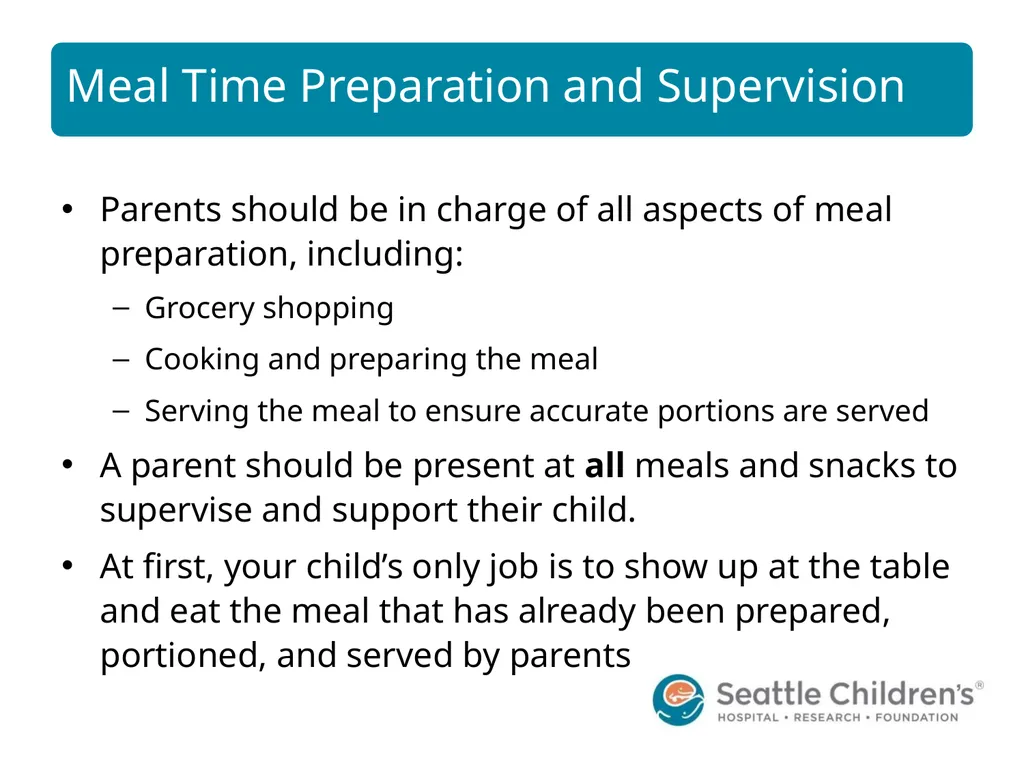
Parents should be in charge of all aspects of meal preparation, including:
Grocery shopping
Cooking and preparing the meal
Serving the meal to ensure accurate portions are served
A parent should be present at all meals and snacks to supervise and support their child.
At first, your child’s only job is to show up at the table and eat the meal that has already been prepared, portioned, and served by parents. Meal Time Preparation and Supervision<br>
Grocery shopping
Cooking and preparing the meal
Serving the meal to ensure accurate portions are served
A parent should be present at all meals and snacks to supervise and support their child.
At first, your child’s only job is to show up at the table and eat the meal that has already been prepared, portioned, and served by parents. Meal Time Preparation and Supervision<br>
13
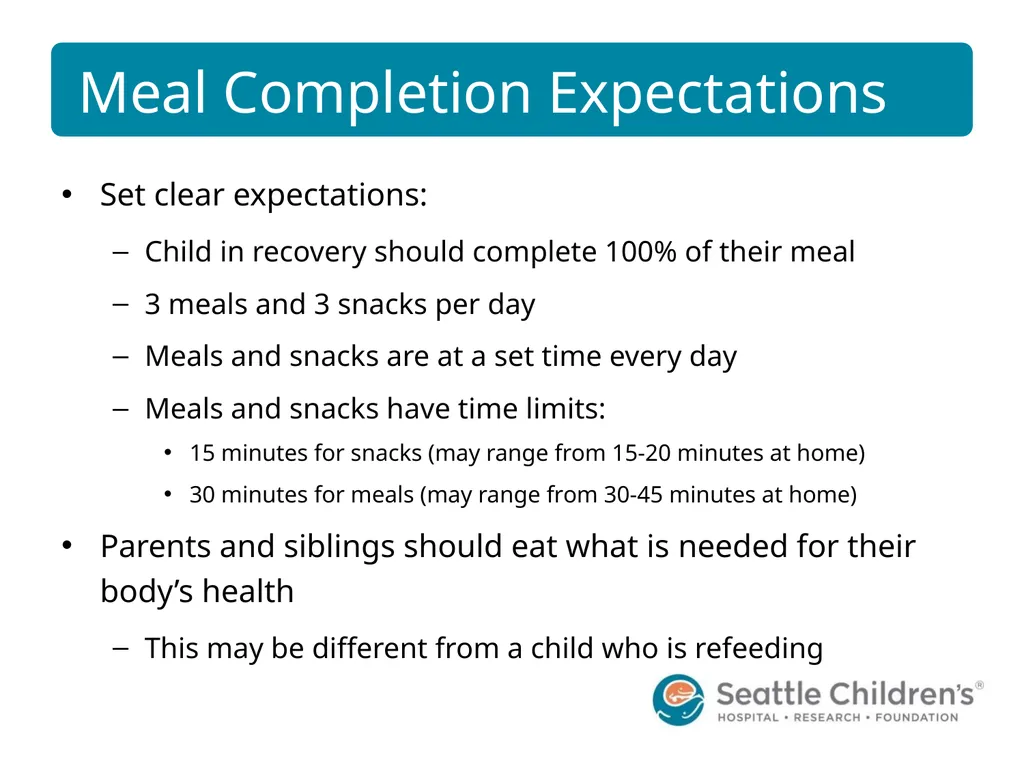
Set clear expectations:
Child in recovery should complete 100% of their meal
3 meals and 3 snacks per day
Meals and snacks are at a set time every day
Meals and snacks have time limits:
15 minutes for snacks (may range from 15-20 minutes at home)
30 minutes for meals (may range from 30-45 minutes at home)
Parents and siblings should eat what is needed for their body’s health
This may be different from a child who is refeeding Meal Completion Expectations<br>
Child in recovery should complete 100% of their meal
3 meals and 3 snacks per day
Meals and snacks are at a set time every day
Meals and snacks have time limits:
15 minutes for snacks (may range from 15-20 minutes at home)
30 minutes for meals (may range from 30-45 minutes at home)
Parents and siblings should eat what is needed for their body’s health
This may be different from a child who is refeeding Meal Completion Expectations<br>
14
It is important to discuss meal support rules and expectations before starting meal support.
Be sure to include these expectations in your discussion:
Start by reminding your child that their priority should be recovery and re-nourishing their body
Parents will prepare, portion, and serve meals and snacks
Your child is expected to complete 100% of their meals
Reiterate the time limits for meals
Review the plan for addressing dysfunctional eating behaviors at the table
Discuss and decide on the distraction techniques your child can use during meal times: music, playing a game, doing a puzzle Introducing the Meal Support Plan to Your Child<br>
Be sure to include these expectations in your discussion:
Start by reminding your child that their priority should be recovery and re-nourishing their body
Parents will prepare, portion, and serve meals and snacks
Your child is expected to complete 100% of their meals
Reiterate the time limits for meals
Review the plan for addressing dysfunctional eating behaviors at the table
Discuss and decide on the distraction techniques your child can use during meal times: music, playing a game, doing a puzzle Introducing the Meal Support Plan to Your Child<br>
15
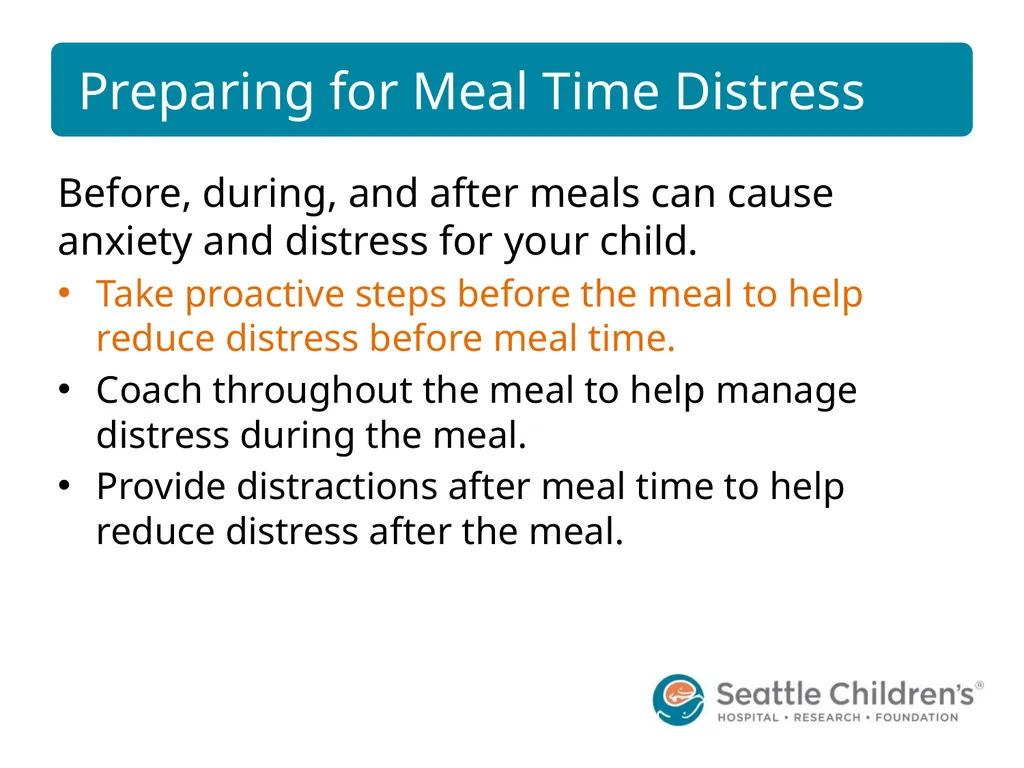
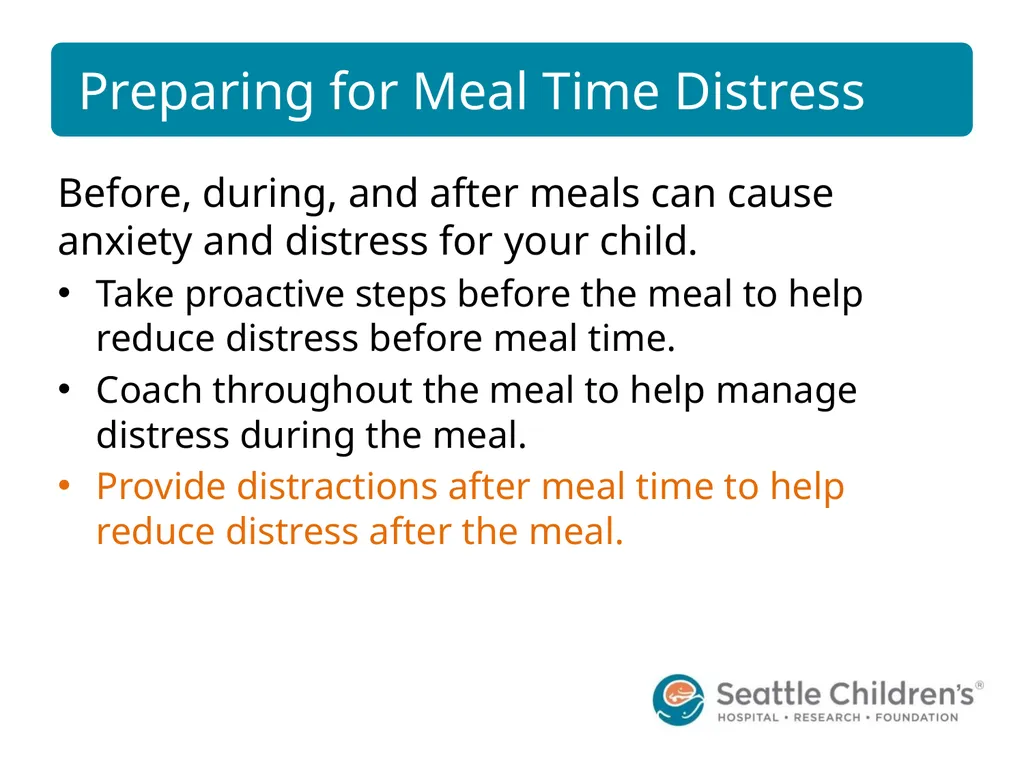
Before, during, and after meals can cause anxiety and distress for your child.
Take proactive steps before the meal to help reduce distress before meal time.
Coach throughout the meal to help manage distress during the meal.
Provide distractions after meal time to help reduce distress after the meal. Preparing for Meal Time Distress<br>
Take proactive steps before the meal to help reduce distress before meal time.
Coach throughout the meal to help manage distress during the meal.
Provide distractions after meal time to help reduce distress after the meal. Preparing for Meal Time Distress<br>
16
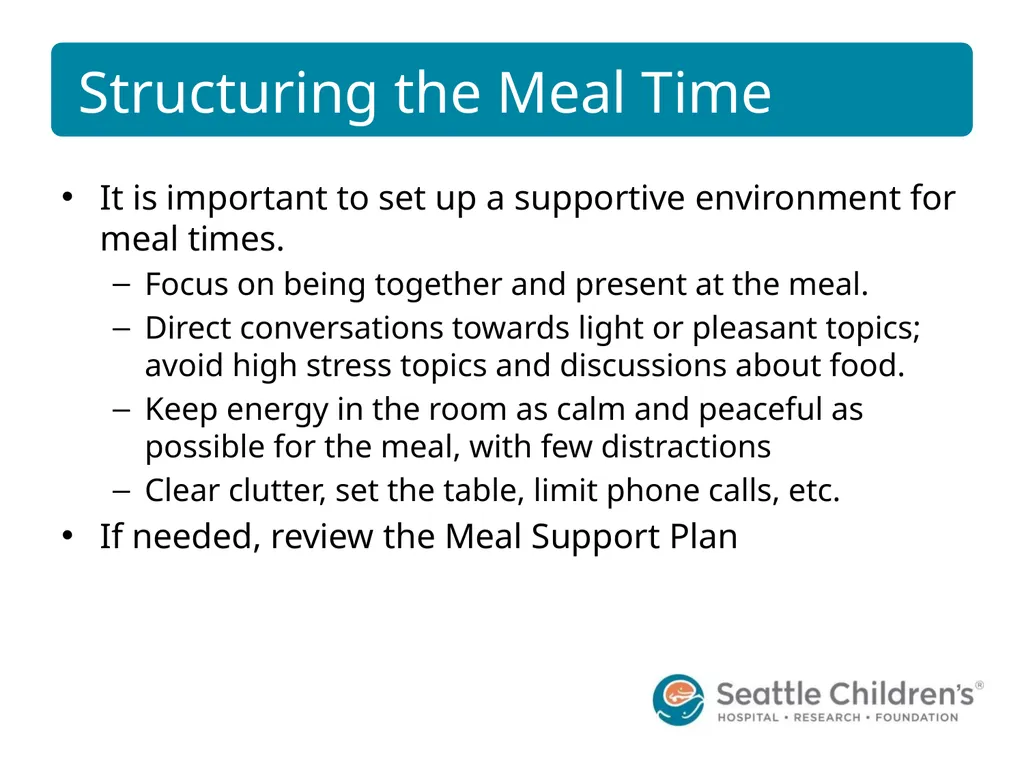
It is important to set up a supportive environment for meal times.
Focus on being together and present at the meal.
Direct conversations towards light or pleasant topics; avoid high stress topics and discussions about food.
Keep energy in the room as calm and peaceful as possible for the meal, with few distractions
Clear clutter, set the table, limit phone calls, etc.
If needed, review the Meal Support Plan Structuring the Meal Time<br>
Focus on being together and present at the meal.
Direct conversations towards light or pleasant topics; avoid high stress topics and discussions about food.
Keep energy in the room as calm and peaceful as possible for the meal, with few distractions
Clear clutter, set the table, limit phone calls, etc.
If needed, review the Meal Support Plan Structuring the Meal Time<br>
17
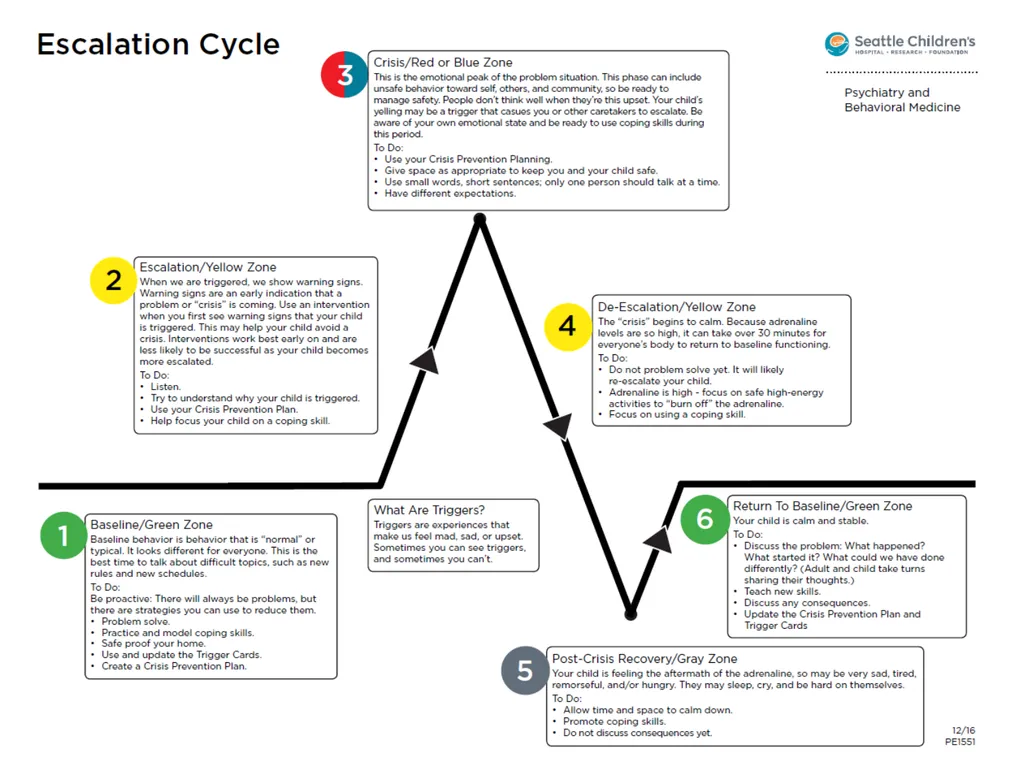
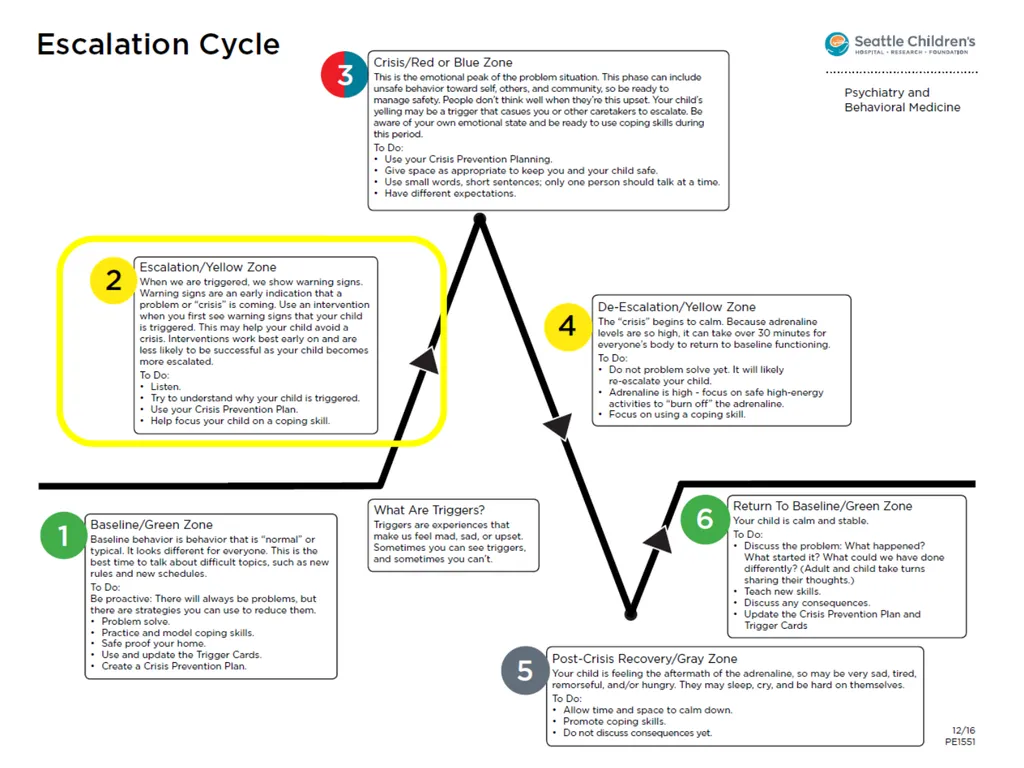
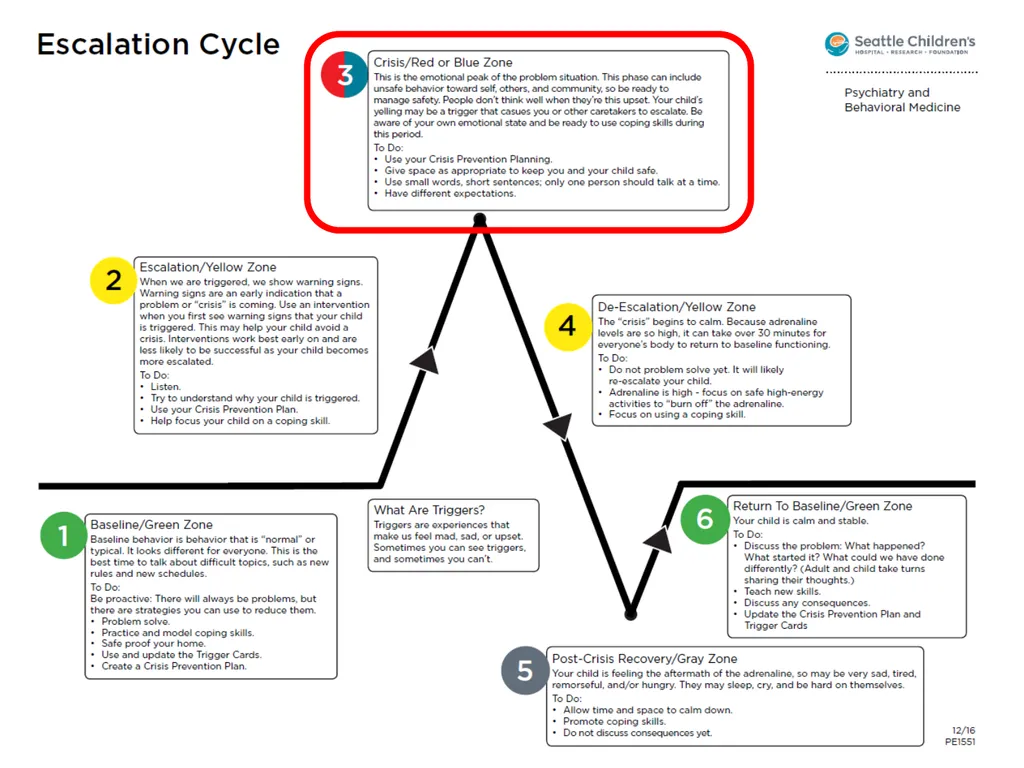
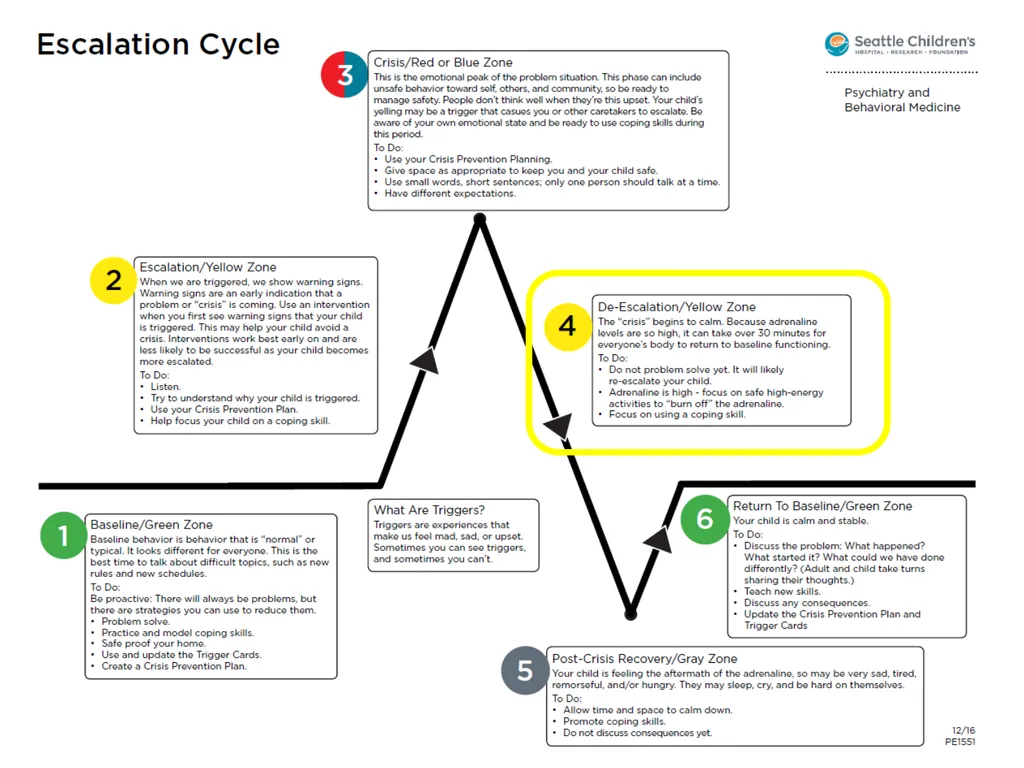
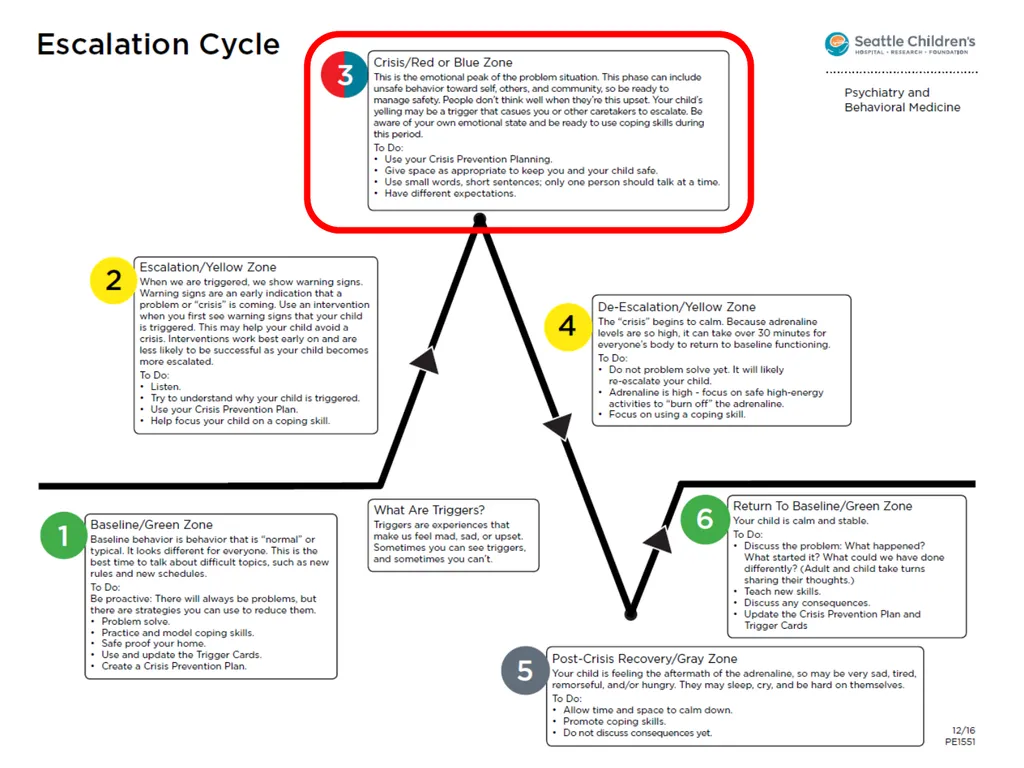
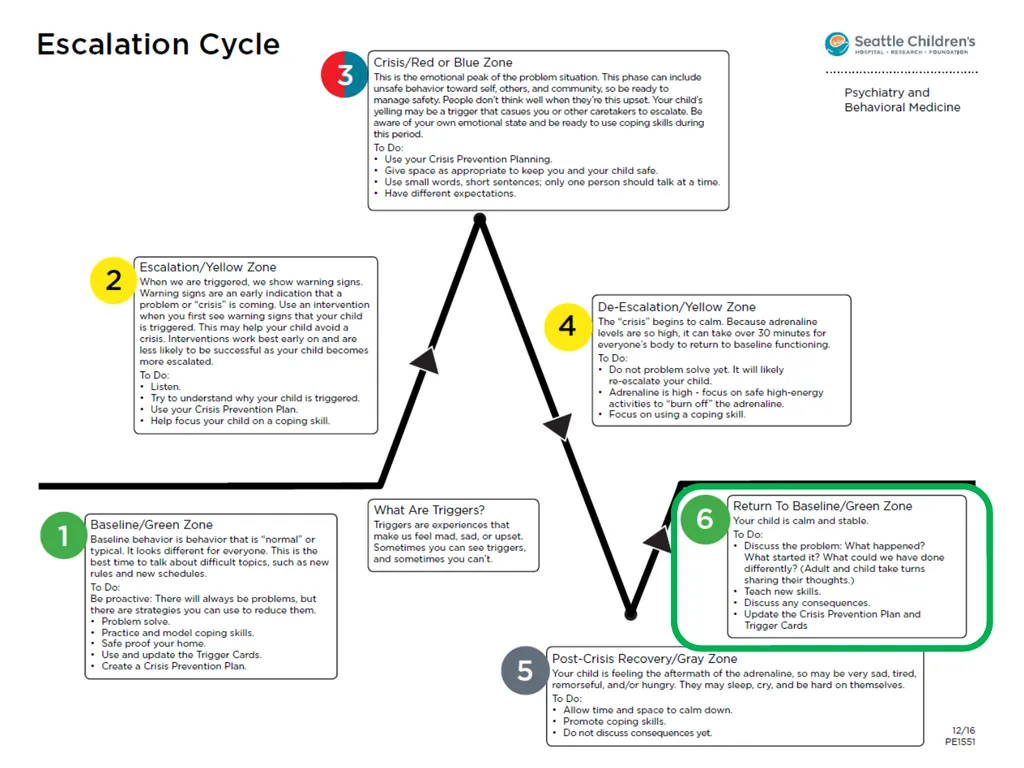
The Escalation Cycle is a general model that we use to discuss what happens when individuals experience strong emotions or become distressed.
Today we are going to use it as a way to talk about managing distress around meal times. Be Mindful of the Escalation Cycle<br>
Today we are going to use it as a way to talk about managing distress around meal times. Be Mindful of the Escalation Cycle<br>
18
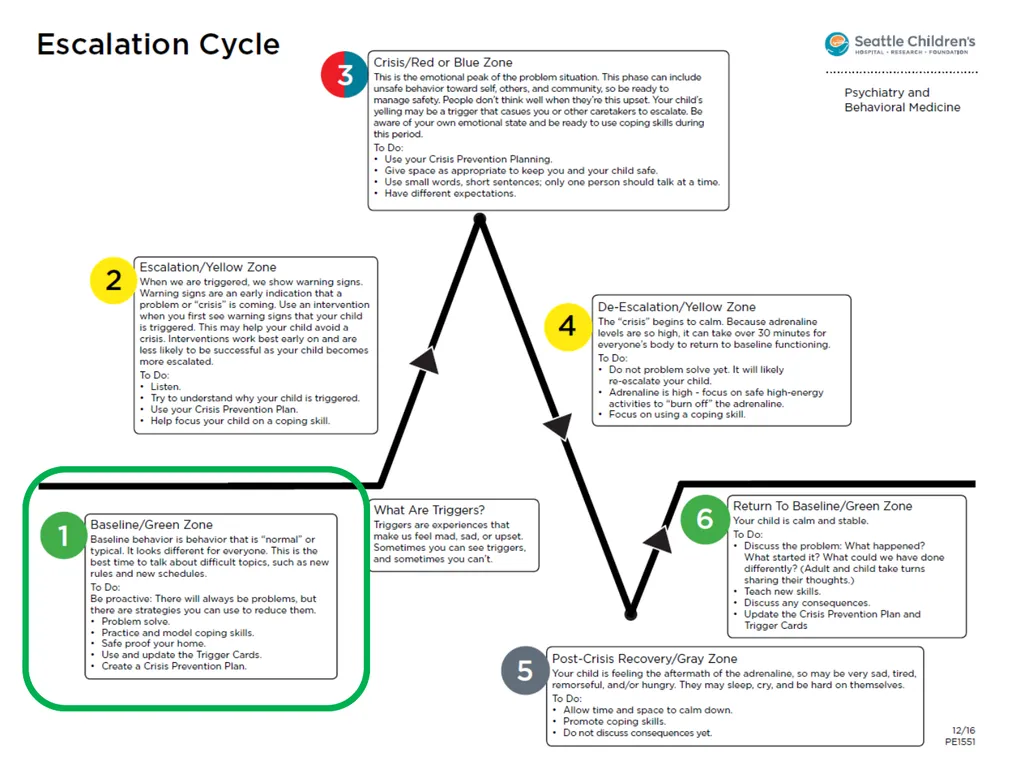
Baseline is the time to have hard conversations, set new expectations, or discuss a change in rules.
It is best to set expectations about meal support while everyone is at baseline. Baseline: Be Proactive<br>
It is best to set expectations about meal support while everyone is at baseline. Baseline: Be Proactive<br>
19
Parents are preparing dinner. While mom is making the garlic bread, the daughter protests that her mom has put too much butter on the bread and refuses to eat it. Instead, she insists on making her own garlic bread with olive oil.
How would you handle the situation? Practice Scenario<br>
How would you handle the situation? Practice Scenario<br>
20
During the Meal Time<br>
21
Before, during, and after meals can cause anxiety and distress for your child.
Take proactive steps before the meal to help reduce distress before meal time.
Coach throughout the meal to help manage distress during the meal.
Provide distractions after meal time to help reduce distress after the meal. Preparing for Meal Time Distress<br>
Take proactive steps before the meal to help reduce distress before meal time.
Coach throughout the meal to help manage distress during the meal.
Provide distractions after meal time to help reduce distress after the meal. Preparing for Meal Time Distress<br>
22
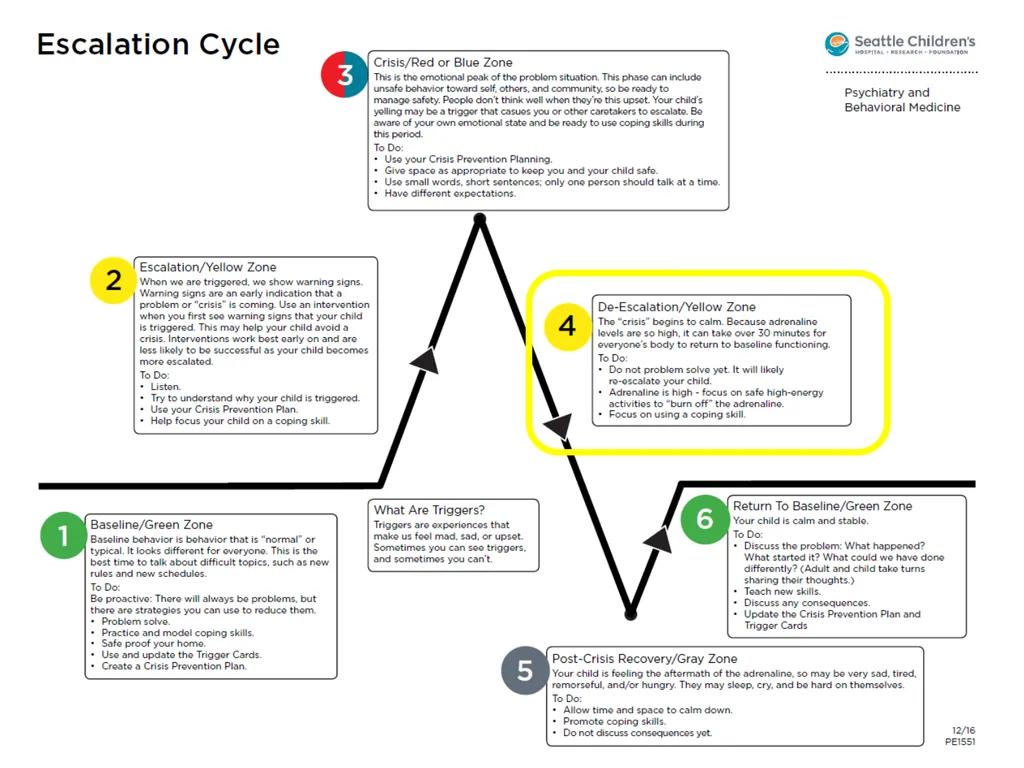
A child struggling with an eating disorder may be triggered and escalate before, during, or after a meal.
At meal time, your child may be in escalation, crisis, or de-escalation.
There are interventions caregivers can take to help their child through the Escalation Cycle safely. Escalation Cycle<br>
At meal time, your child may be in escalation, crisis, or de-escalation.
There are interventions caregivers can take to help their child through the Escalation Cycle safely. Escalation Cycle<br>
23
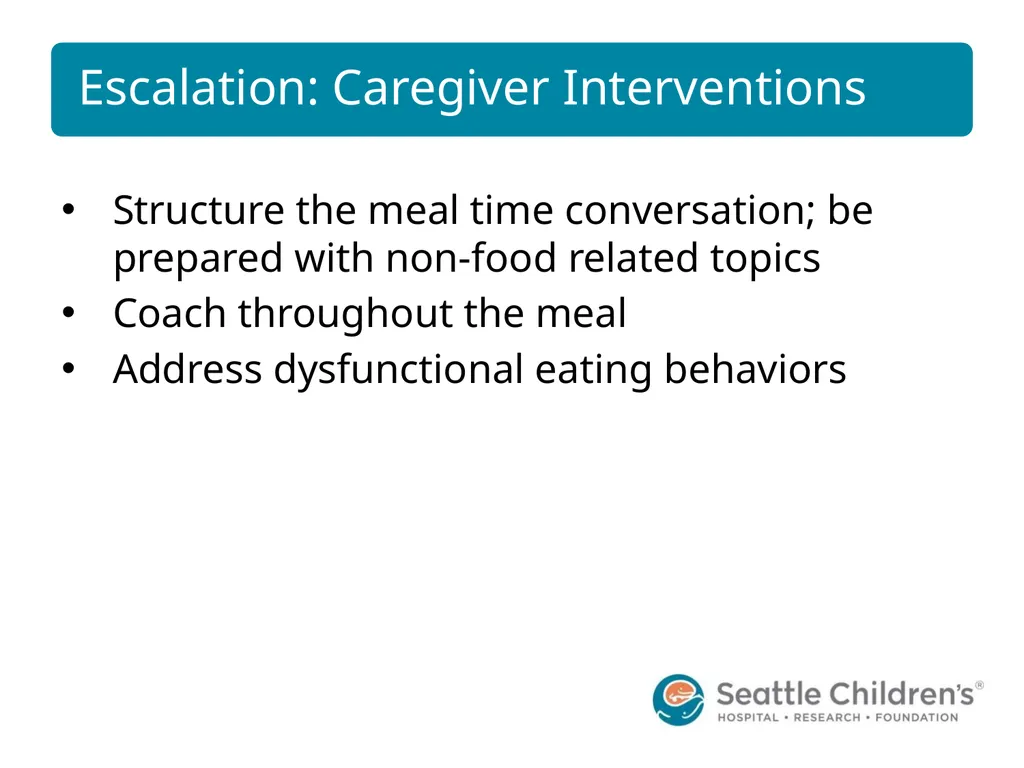
Structure the meal time conversation; be prepared with non-food related topics
Coach throughout the meal
Address dysfunctional eating behaviors Escalation: Caregiver Interventions<br>
Coach throughout the meal
Address dysfunctional eating behaviors Escalation: Caregiver Interventions<br>
24
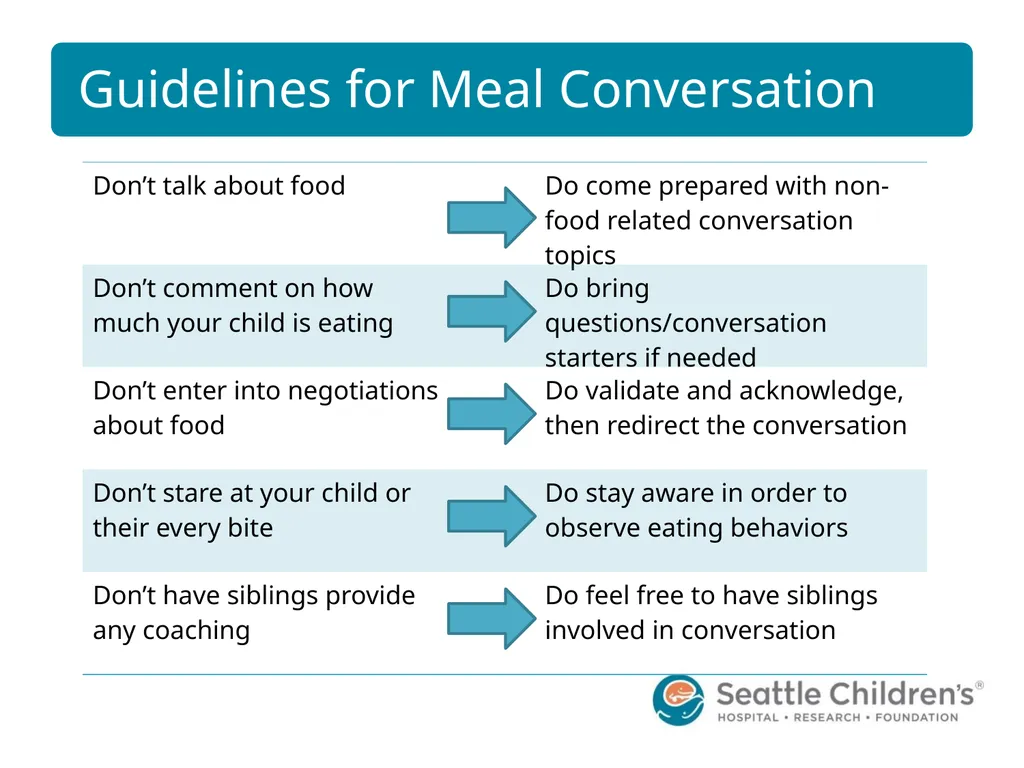
Guidelines for Meal Conversation<br>
25
Use coaching to address eating-disordered behaviors and encourage meal completion
Keep all coaching short and to the point:
“I know you can do this.”
“It’s ok to eat.”
“You are doing a good job so far, let’s keep going.”
“I see you are taking small bites, please take larger bites.”
“It’s important to give your body the fuel it needs.”
“We are half way through the meal and you have eaten less than half your meal, try taking larger bites so you can complete everything.”
Then keep going with conversation unrelated to the meal The Importance of Coaching<br>
Keep all coaching short and to the point:
“I know you can do this.”
“It’s ok to eat.”
“You are doing a good job so far, let’s keep going.”
“I see you are taking small bites, please take larger bites.”
“It’s important to give your body the fuel it needs.”
“We are half way through the meal and you have eaten less than half your meal, try taking larger bites so you can complete everything.”
Then keep going with conversation unrelated to the meal The Importance of Coaching<br>
26
Your child may exhibit some eating behaviors that are not functional or healthy during the meal time.
Some examples are:
Taking small bites
Dropping food
Smearing food on napkins or table
Cutting food up in small pieces Dysfunctional Eating Behaviors<br>
Some examples are:
Taking small bites
Dropping food
Smearing food on napkins or table
Cutting food up in small pieces Dysfunctional Eating Behaviors<br>
27
Address dysfunctional behaviors as they occur.
Focus on positive, action-oriented statements:
“Please take bigger bites”
“Please, pick that up from your lap”
“Please, roll up your sleeves so food doesn’t get on your shirt”
“Stop crumbling your bread”
Replace food that was dropped on floor or hidden**
“I’m giving you another piece of chicken to make up for the pieces that fell on the ground” Dysfunctional Eating Behaviors **This will look different depending on if your child is at home or in the hospital. Please discuss any questions/concerns with your providers.<br>
Focus on positive, action-oriented statements:
“Please take bigger bites”
“Please, pick that up from your lap”
“Please, roll up your sleeves so food doesn’t get on your shirt”
“Stop crumbling your bread”
Replace food that was dropped on floor or hidden**
“I’m giving you another piece of chicken to make up for the pieces that fell on the ground” Dysfunctional Eating Behaviors **This will look different depending on if your child is at home or in the hospital. Please discuss any questions/concerns with your providers.<br>
28
Parents notice several dysfunctional eating behaviors at the dinner table.
Daughter is cutting the food up into tiny pieces and taking tiny bites.
Daughter seems to be crumbling her bagel and small pieces are falling on her lap.
How would you address these behaviors during the meal? Practice Scenario<br>
Daughter is cutting the food up into tiny pieces and taking tiny bites.
Daughter seems to be crumbling her bagel and small pieces are falling on her lap.
How would you address these behaviors during the meal? Practice Scenario<br>
29
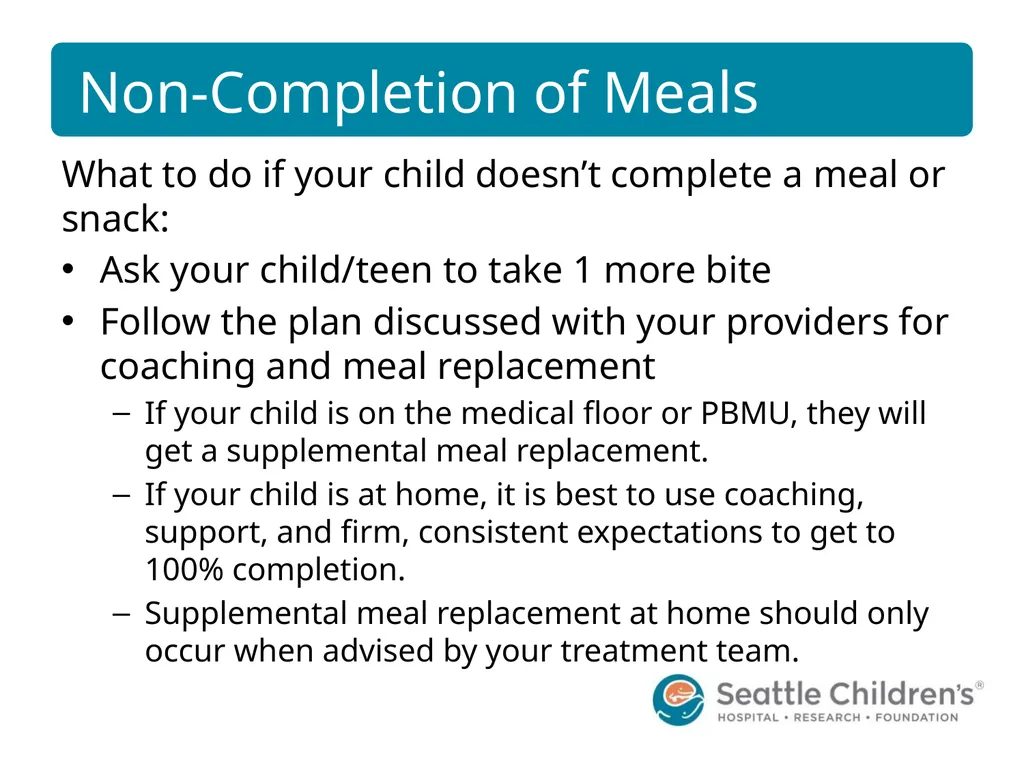
What to do if your child doesn’t complete a meal or snack:
Ask your child/teen to take 1 more bite
Follow the plan discussed with your providers for coaching and meal replacement
If your child is on the medical floor or PBMU, they will get a supplemental meal replacement.
If your child is at home, it is best to use coaching, support, and firm, consistent expectations to get to 100% completion.
Supplemental meal replacement at home should only occur when advised by your treatment team. Non-Completion of Meals<br>
Ask your child/teen to take 1 more bite
Follow the plan discussed with your providers for coaching and meal replacement
If your child is on the medical floor or PBMU, they will get a supplemental meal replacement.
If your child is at home, it is best to use coaching, support, and firm, consistent expectations to get to 100% completion.
Supplemental meal replacement at home should only occur when advised by your treatment team. Non-Completion of Meals<br>
30
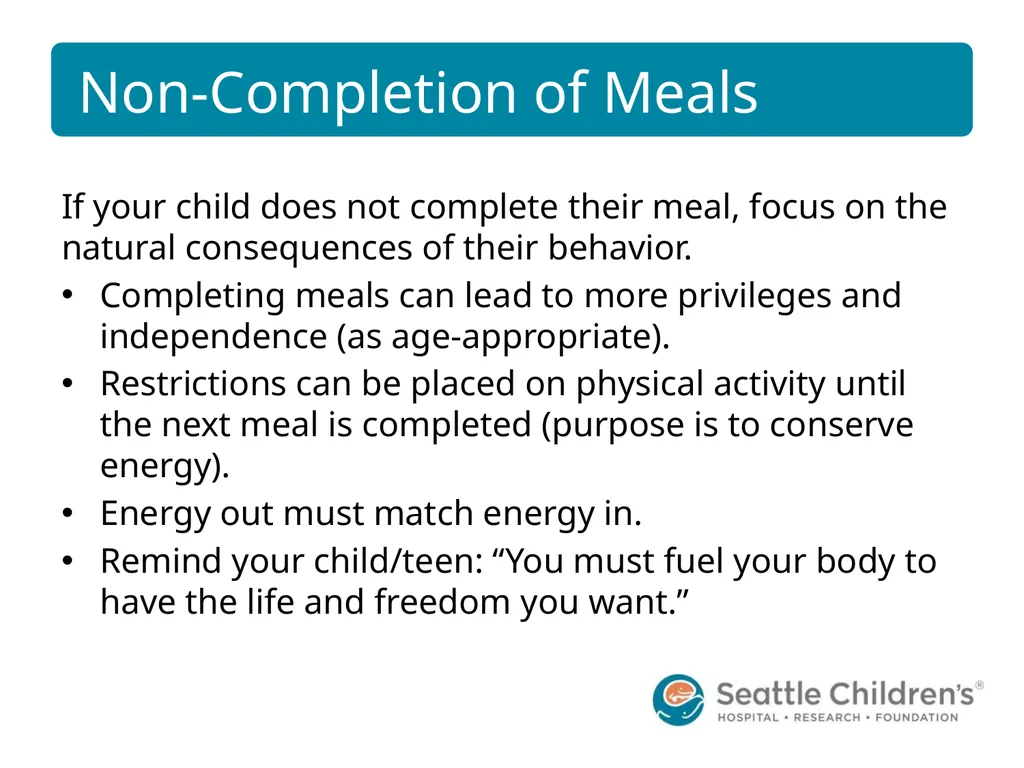
If your child does not complete their meal, focus on the natural consequences of their behavior.
Completing meals can lead to more privileges and independence (as age-appropriate).
Restrictions can be placed on physical activity until the next meal is completed (purpose is to conserve energy).
Energy out must match energy in.
Remind your child/teen: “You must fuel your body to have the life and freedom you want.” Non-Completion of Meals<br>
Completing meals can lead to more privileges and independence (as age-appropriate).
Restrictions can be placed on physical activity until the next meal is completed (purpose is to conserve energy).
Energy out must match energy in.
Remind your child/teen: “You must fuel your body to have the life and freedom you want.” Non-Completion of Meals<br>
31
After Meals<br>
32
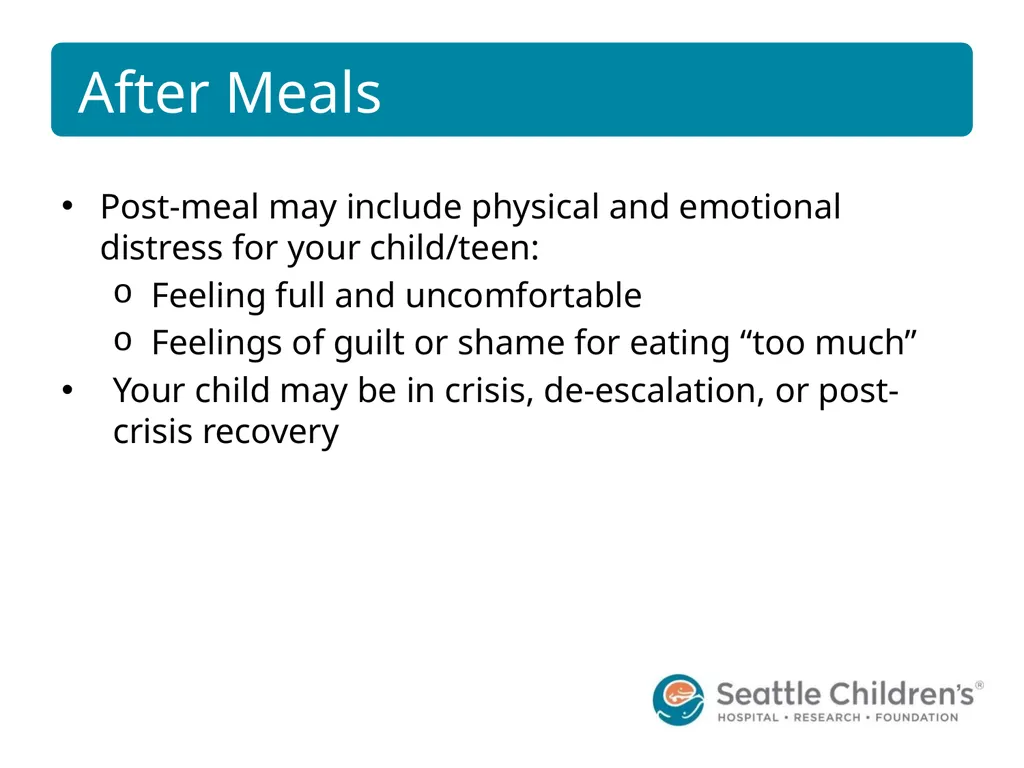
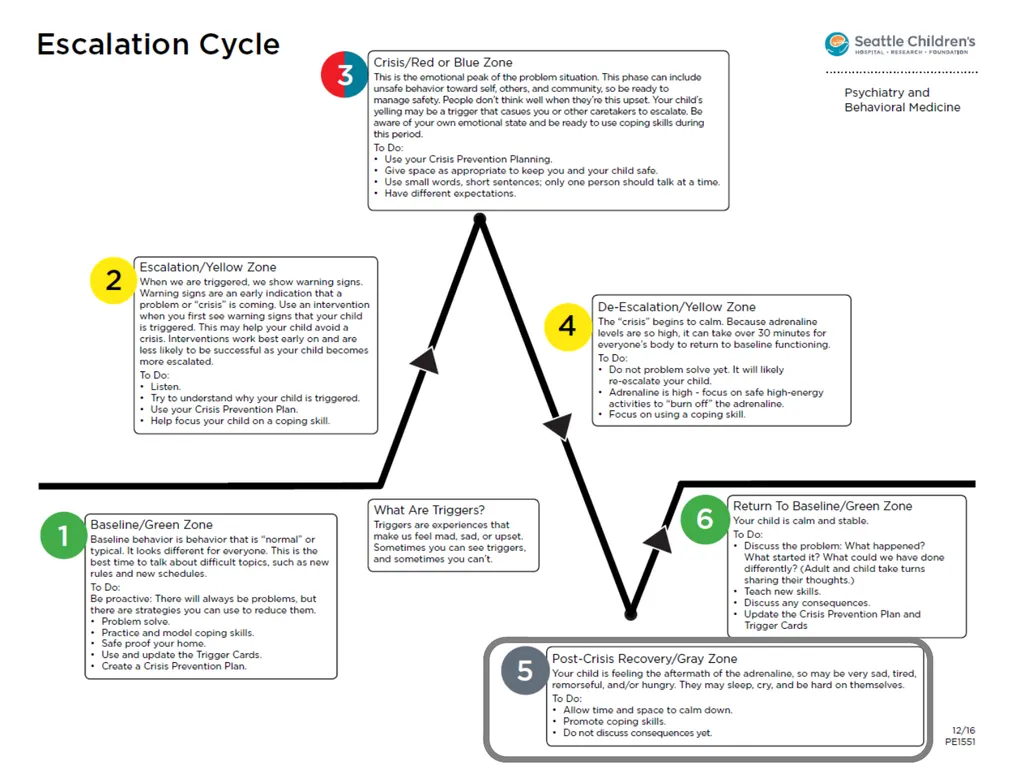
Post-meal may include physical and emotional distress for your child/teen:
Feeling full and uncomfortable
Feelings of guilt or shame for eating “too much”
Your child may be in crisis, de-escalation, or post-crisis recovery After Meals<br>
Feeling full and uncomfortable
Feelings of guilt or shame for eating “too much”
Your child may be in crisis, de-escalation, or post-crisis recovery After Meals<br>
33
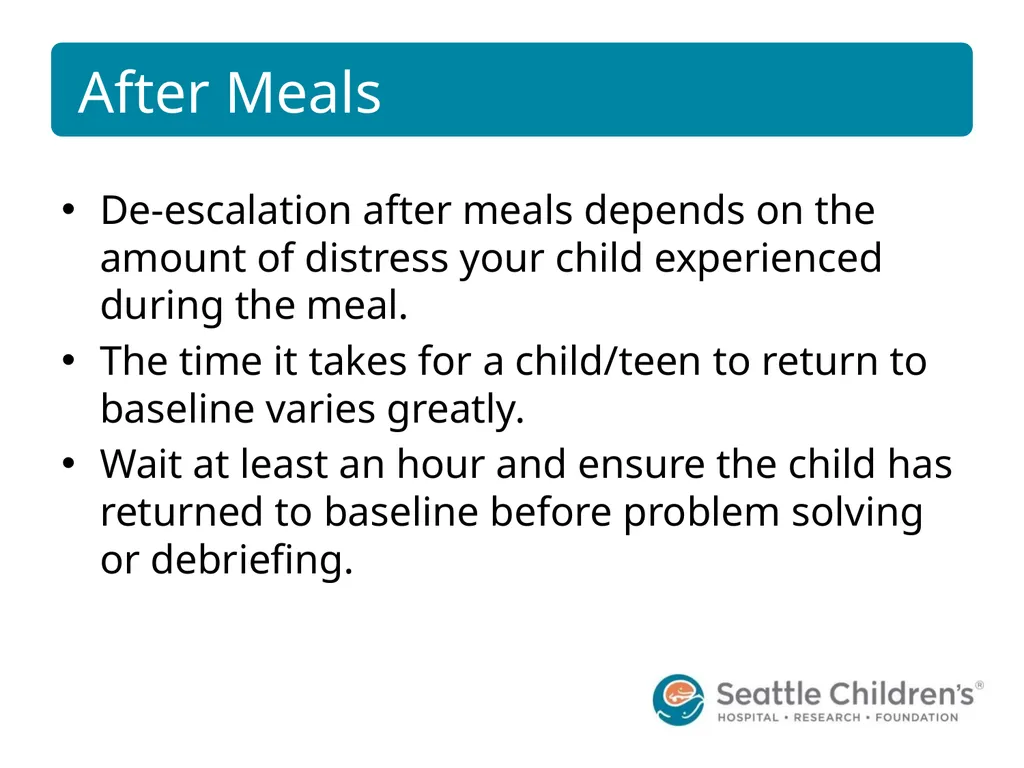
De-escalation after meals depends on the amount of distress your child experienced during the meal.
The time it takes for a child/teen to return to baseline varies greatly.
Wait at least an hour and ensure the child has returned to baseline before problem solving or debriefing. After Meals<br>
The time it takes for a child/teen to return to baseline varies greatly.
Wait at least an hour and ensure the child has returned to baseline before problem solving or debriefing. After Meals<br>
34
Before, during, and after meals can cause anxiety and distress for your child.
Take proactive steps before the meal to help reduce distress before meal time.
Coach throughout the meal to help manage distress during the meal.
Provide distractions after meal time to help reduce distress after the meal. Preparing for Meal Time Distress<br>
Take proactive steps before the meal to help reduce distress before meal time.
Coach throughout the meal to help manage distress during the meal.
Provide distractions after meal time to help reduce distress after the meal. Preparing for Meal Time Distress<br>
35
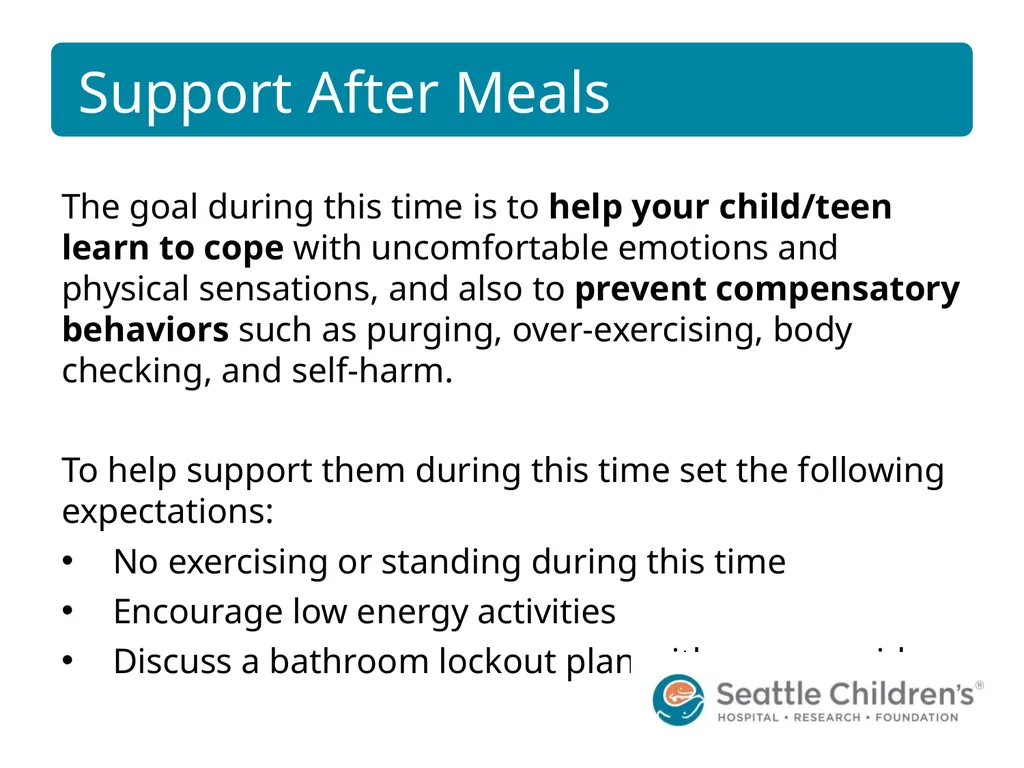
The goal during this time is to help your child/teen learn to cope with uncomfortable emotions and physical sensations, and also to prevent compensatory behaviors such as purging, over-exercising, body checking, and self-harm.
To help support them during this time set the following expectations:
No exercising or standing during this time
Encourage low energy activities
Discuss a bathroom lockout plan with your providers Support After Meals<br>
To help support them during this time set the following expectations:
No exercising or standing during this time
Encourage low energy activities
Discuss a bathroom lockout plan with your providers Support After Meals<br>
36
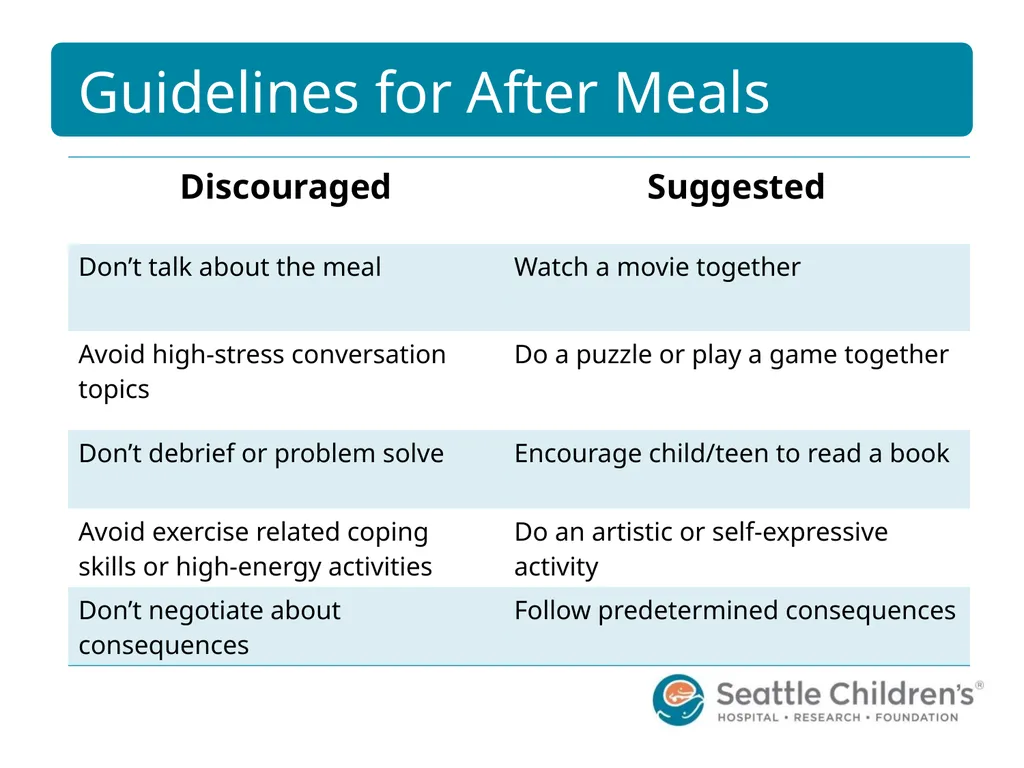
Guidelines for After Meals<br>
37
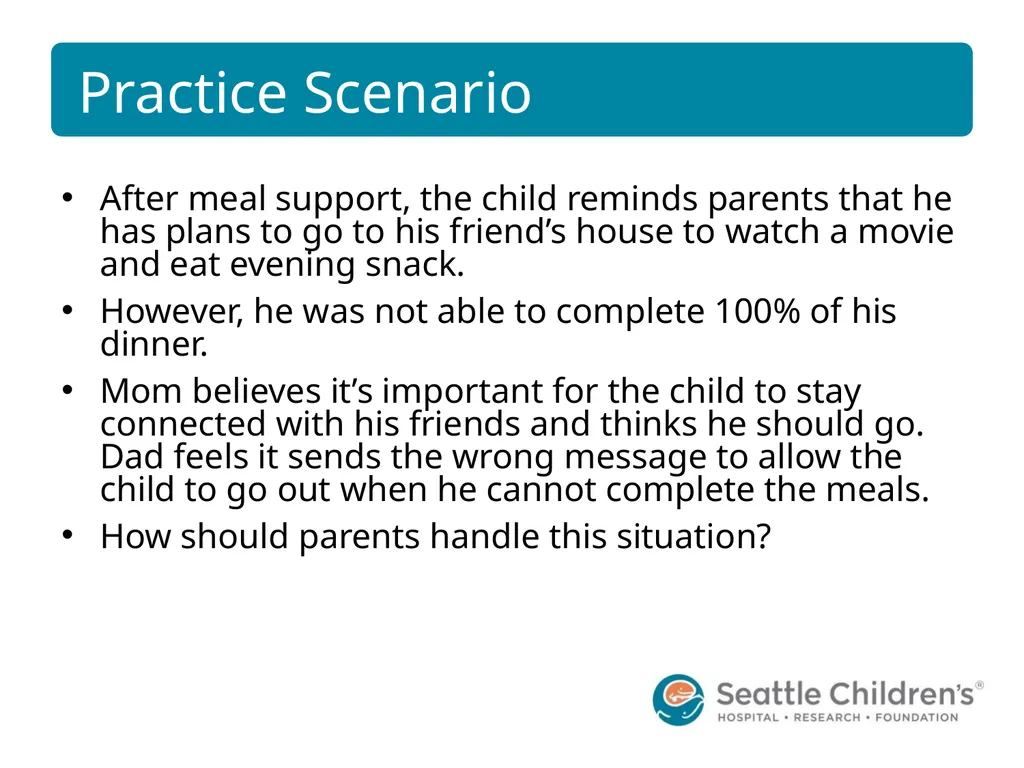
After meal support, the child reminds parents that he has plans to go to his friend’s house to watch a movie and eat evening snack.
However, he was not able to complete 100% of his dinner.
Mom believes it’s important for the child to stay connected with his friends and thinks he should go. Dad feels it sends the wrong message to allow the child to go out when he cannot complete the meals.
How should parents handle this situation? Practice Scenario<br>
However, he was not able to complete 100% of his dinner.
Mom believes it’s important for the child to stay connected with his friends and thinks he should go. Dad feels it sends the wrong message to allow the child to go out when he cannot complete the meals.
How should parents handle this situation? Practice Scenario<br>
38
Debriefing<br>
39
Debriefing should take place once everyone is at their baseline – this might be an hour or more after meal.
Limit debrief to half an hour maximum. Debriefing Set Up<br>
Limit debrief to half an hour maximum. Debriefing Set Up<br>
40
Debriefing the meal is important so that the meal is a learning experience.
Not all meals require debriefing
Debrief after hard meals
Debrief after the first meal that goes well in a series of hard meals (want to know what went well)
This is when we all are able to learn new coping skills, problem solve and talk about natural consequences.
If your child/teen starts to escalate during the conversation, pause debrief and encourage them to use coping skills. Return to debrief after returning to baseline. Value of Debriefing<br>
Not all meals require debriefing
Debrief after hard meals
Debrief after the first meal that goes well in a series of hard meals (want to know what went well)
This is when we all are able to learn new coping skills, problem solve and talk about natural consequences.
If your child/teen starts to escalate during the conversation, pause debrief and encourage them to use coping skills. Return to debrief after returning to baseline. Value of Debriefing<br>
41
Discuss:
What worked well?
What didn’t work?
Identify possible triggers for distress
Develop plan for addressing problem behaviors at next meal
Discuss natural consequences, if needed How to Debrief the Meal<br>
What worked well?
What didn’t work?
Identify possible triggers for distress
Develop plan for addressing problem behaviors at next meal
Discuss natural consequences, if needed How to Debrief the Meal<br>
42
The meal was completed about 30 minutes ago and your child appears to be calm. It was a difficult meal support where they smeared food and didn’t talk throughout the meal.
You decide to sit down with your child to review how things went and what could go better next time. During the conversation your child talks about how you shouldn’t have given them butter.
What would you do in this situation? Practice Scenario<br>
You decide to sit down with your child to review how things went and what could go better next time. During the conversation your child talks about how you shouldn’t have given them butter.
What would you do in this situation? Practice Scenario<br>
43
Review and Reminders<br>
44
Eating Disorders are biologically-based mental health disorders with serious medical consequences.
Eating Disorders are not caused by families, but caregivers are crucial to recovery.
The first priority in treatment is to normalize eating and restore healthy weight.
There are no “good” or “bad” foods.
Caregivers need to be united and take control of the child/teen’s eating.
It is important to separate the eating disorder from your child. Review<br>
Eating Disorders are not caused by families, but caregivers are crucial to recovery.
The first priority in treatment is to normalize eating and restore healthy weight.
There are no “good” or “bad” foods.
Caregivers need to be united and take control of the child/teen’s eating.
It is important to separate the eating disorder from your child. Review<br>
45
Validate and support your child.
Don’t negotiate with the eating disorder.
Planning ahead of time helps meals go more smoothly.
Keep trying; be consistent.
View “failures” as learning opportunities.
Each new meal is a new opportunity to start over and try again.
Discuss meal support issues with your providers
Take care of yourselves! Practice self-care and access support.
Try to stay positive, recovery is possible! Reminders<br>
Don’t negotiate with the eating disorder.
Planning ahead of time helps meals go more smoothly.
Keep trying; be consistent.
View “failures” as learning opportunities.
Each new meal is a new opportunity to start over and try again.
Discuss meal support issues with your providers
Take care of yourselves! Practice self-care and access support.
Try to stay positive, recovery is possible! Reminders<br>
46
The Escalation Cycle: an overview of the different stages of an escalation cycle and suggested interventions.
School Meal Support: background and frequently asked questions about how educators can work with families to provide support for eating at school.
Supportive Tips and Phrases: some examples of things families can do and say to support recovery.
Printout of Class Slides Handouts<br>
School Meal Support: background and frequently asked questions about how educators can work with families to provide support for eating at school.
Supportive Tips and Phrases: some examples of things families can do and say to support recovery.
Printout of Class Slides Handouts<br>
47
Questions?
Thank You!<br>
Thank You!<br>