
Measurements and Instruments (ET-314) 1 Ammar



Description: Measurements and Instruments (ET-314) 1 Ammar Naseer Lecturer University of Engineering Technology, Lahore KSK Campus Electrical Technology email: ammaruet.edu.pk Topic 6 Industrial Instruments Outline Introduction Classification of
Related Topics
Download Presentation
"Measurements and Instruments (ET-314) 1 Ammar" is the property of its rightful owner. Permission is granted to download and print the materials on this website for personal, non-commercial use only, and to display it on your personal computer provided you do not modify the materials and that you retain all copyright notices contained in the materials. By downloading content from our website, you accept the terms of this agreement.
Presentation Transcript
slide1. Measurements and Instruments (ET-314) 1 Ammar Naseer
Lecturer
University of Engineering & Technology, Lahore
KSK Campus Electrical Technology
email: ammar@uet.edu.pk Topic 6
Industrial Instruments<br>
slide2. Outline Introduction
Classification of sensor
Type of Measuremen
Contact Temperature Sensors
Bimetallic Strip
Filled-bulb temperature sensors
Class i and V
Class III
Class II
Resistance Temperature Detector
2-wire RTD
3-wire RTD
4-wire RTD 2<br>
slide3. Outline Temperature Sensor
Thermistor
Thermocouple
Reference junction compensation
Types
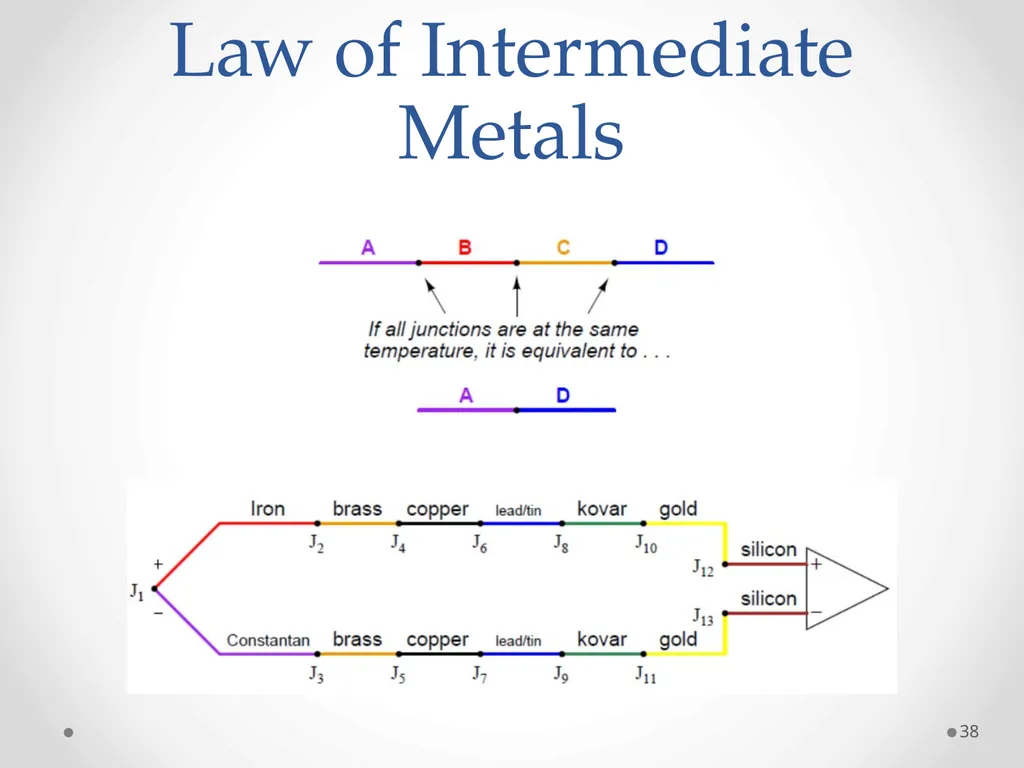
Law of Intermediate Metals
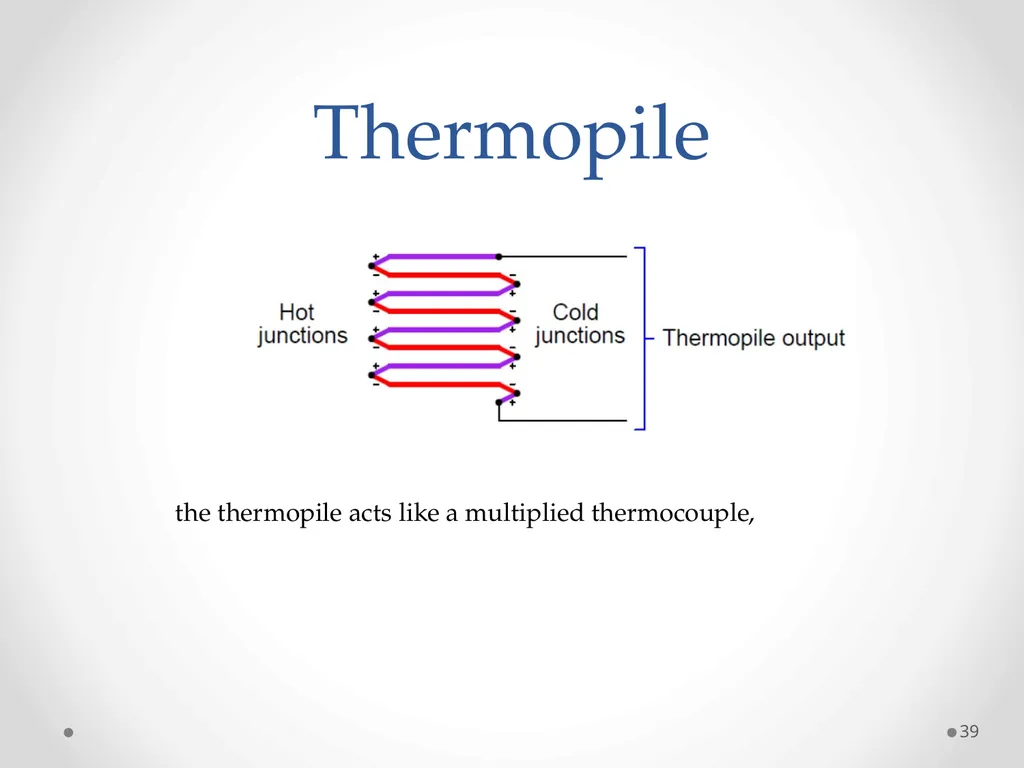
Thermopile
Non-Contact Temperature Sensor
Pyrometer
Field of view
Thermal Imaging 3<br>
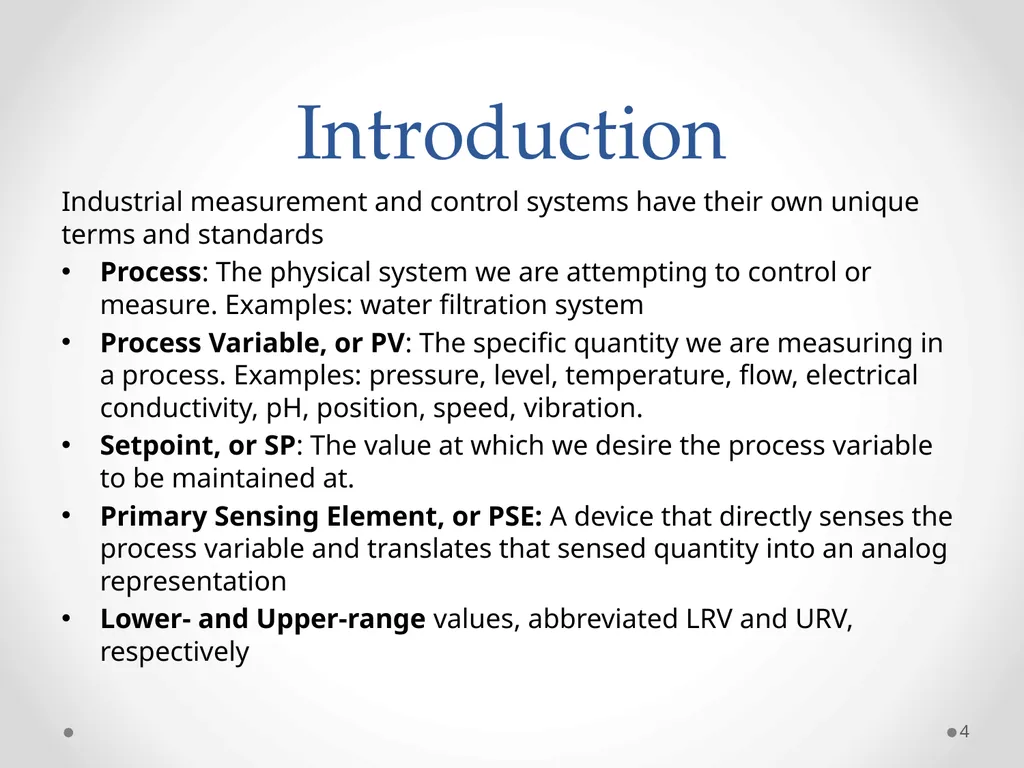
slide4. Introduction Industrial measurement and control systems have their own unique terms and standards
Process: The physical system we are attempting to control or measure. Examples: water filtration system
Process Variable, or PV: The specific quantity we are measuring in a process. Examples: pressure, level, temperature, flow, electrical conductivity, pH, position, speed, vibration.
Setpoint, or SP: The value at which we desire the process variable to be maintained at.
Primary Sensing Element, or PSE: A device that directly senses the process variable and translates that sensed quantity into an analog representation
Lower- and Upper-range values, abbreviated LRV and URV, respectively 4<br>
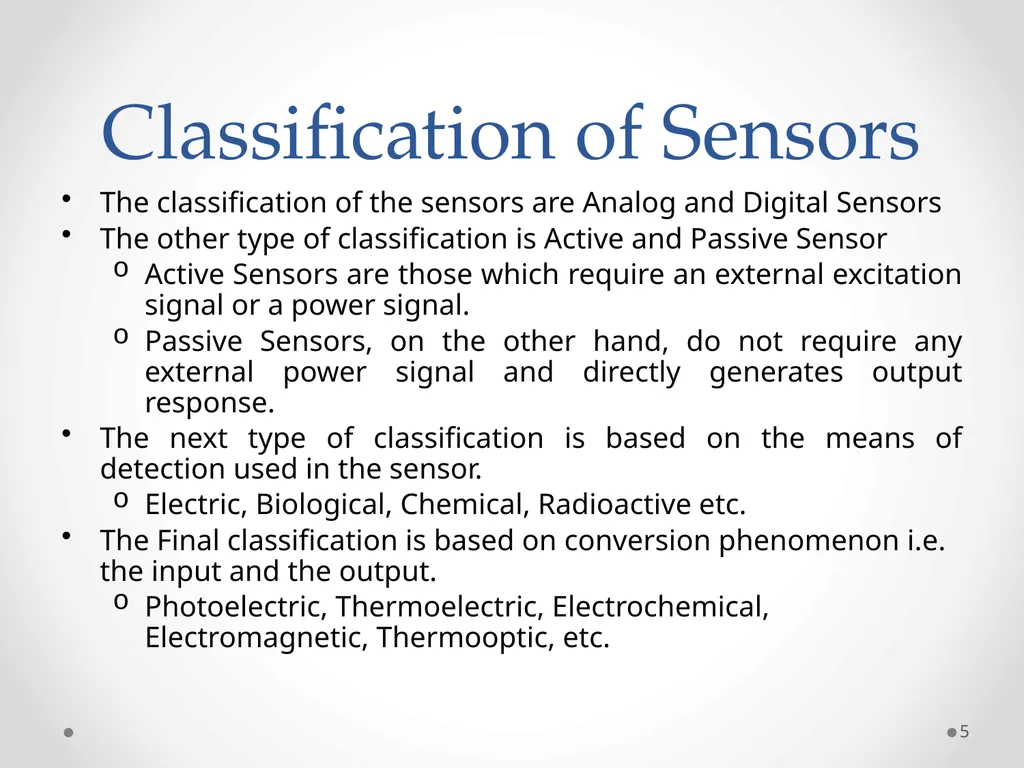
slide5. Classification of Sensors The classification of the sensors are Analog and Digital Sensors
The other type of classification is Active and Passive Sensor
Active Sensors are those which require an external excitation signal or a power signal.
Passive Sensors, on the other hand, do not require any external power signal and directly generates output response.
The next type of classification is based on the means of detection used in the sensor.
Electric, Biological, Chemical, Radioactive etc.
The Final classification is based on conversion phenomenon i.e. the input and the output.
Photoelectric, Thermoelectric, Electrochemical, Electromagnetic, Thermooptic, etc. 5<br>
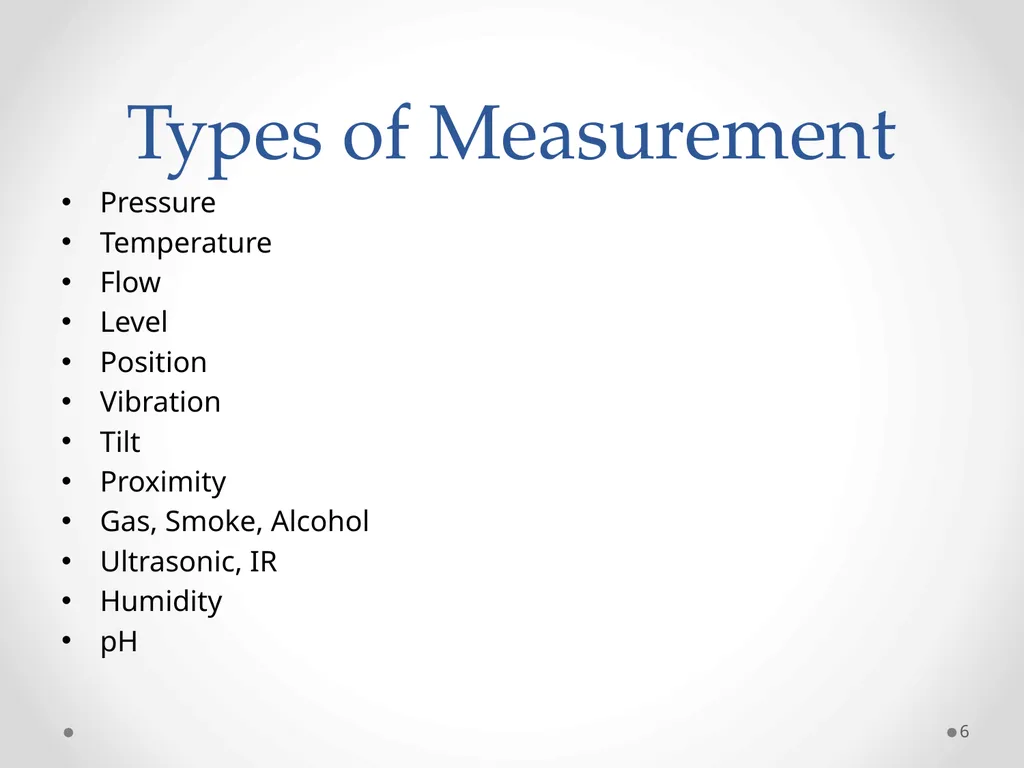
slide6. Types of Measurement Pressure
Temperature
Flow
Level
Position
Vibration
Tilt
Proximity
Gas, Smoke, Alcohol
Ultrasonic, IR
Humidity
pH 6<br>
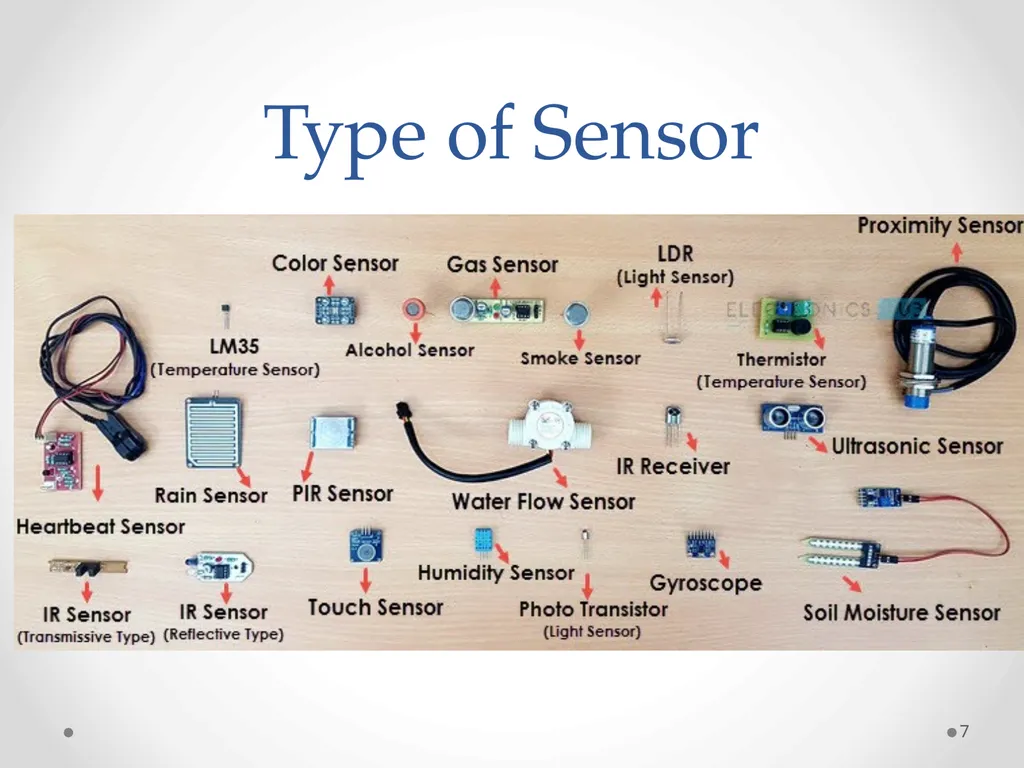
slide7. Type of Sensor 7<br>
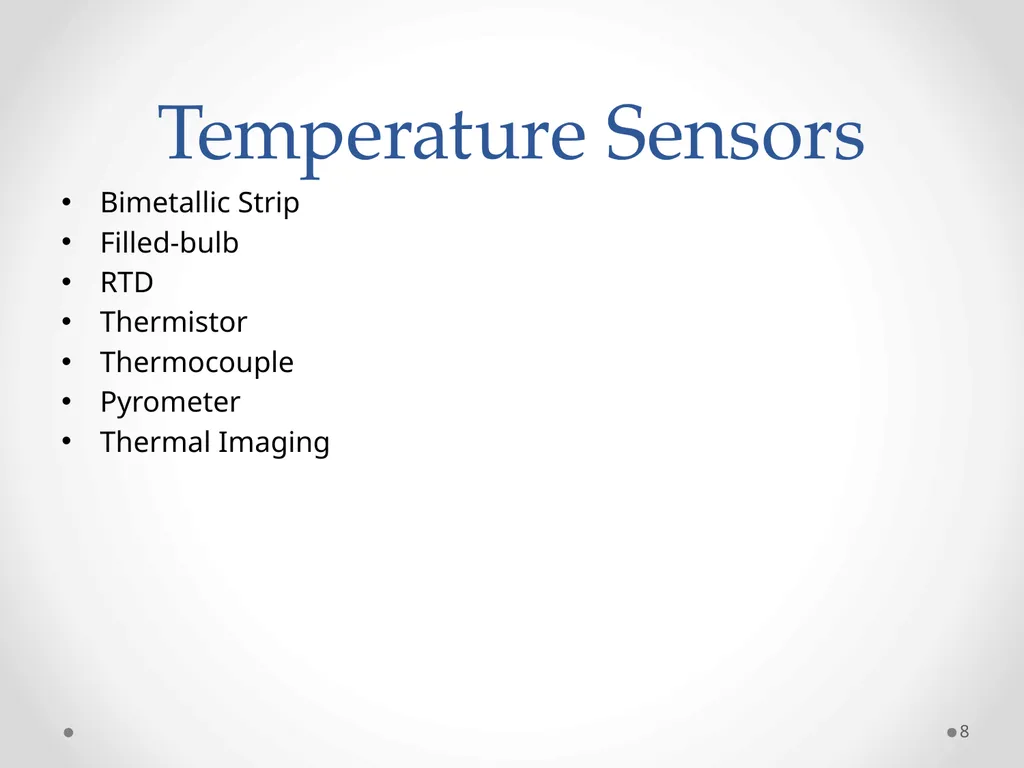
slide8. Temperature Sensors Bimetallic Strip
Filled-bulb
RTD
Thermistor
Thermocouple
Pyrometer
Thermal Imaging 8<br>
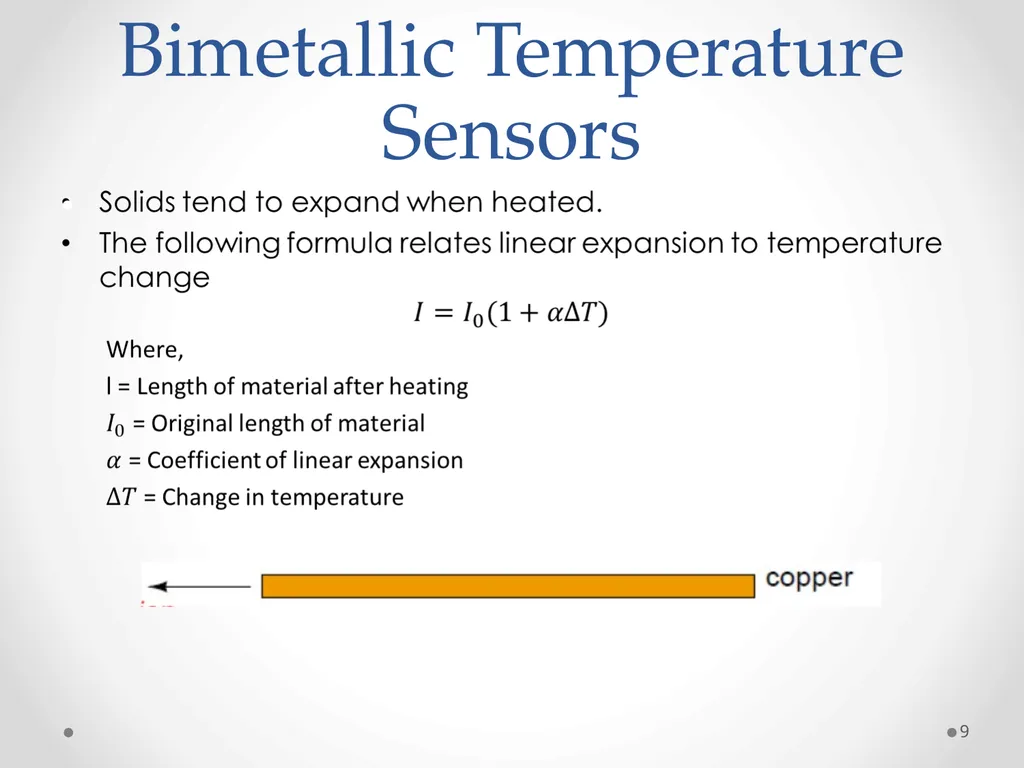
slide9. Bimetallic Temperature Sensors 9<br>
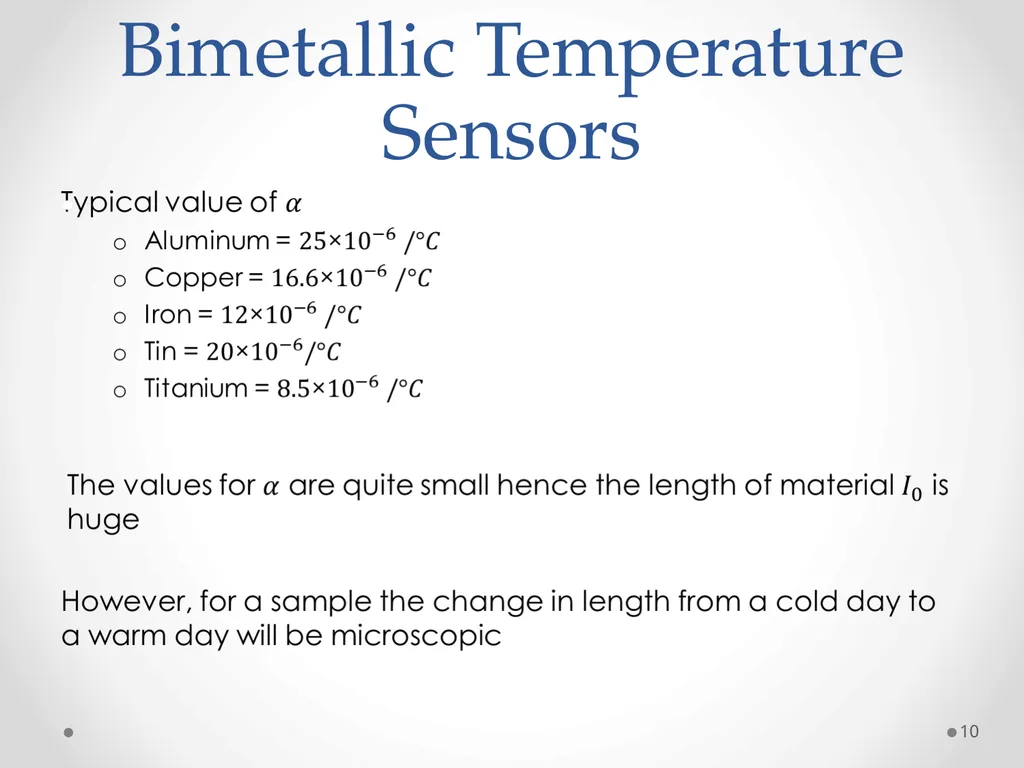
slide10. 10 Bimetallic Temperature Sensors<br>
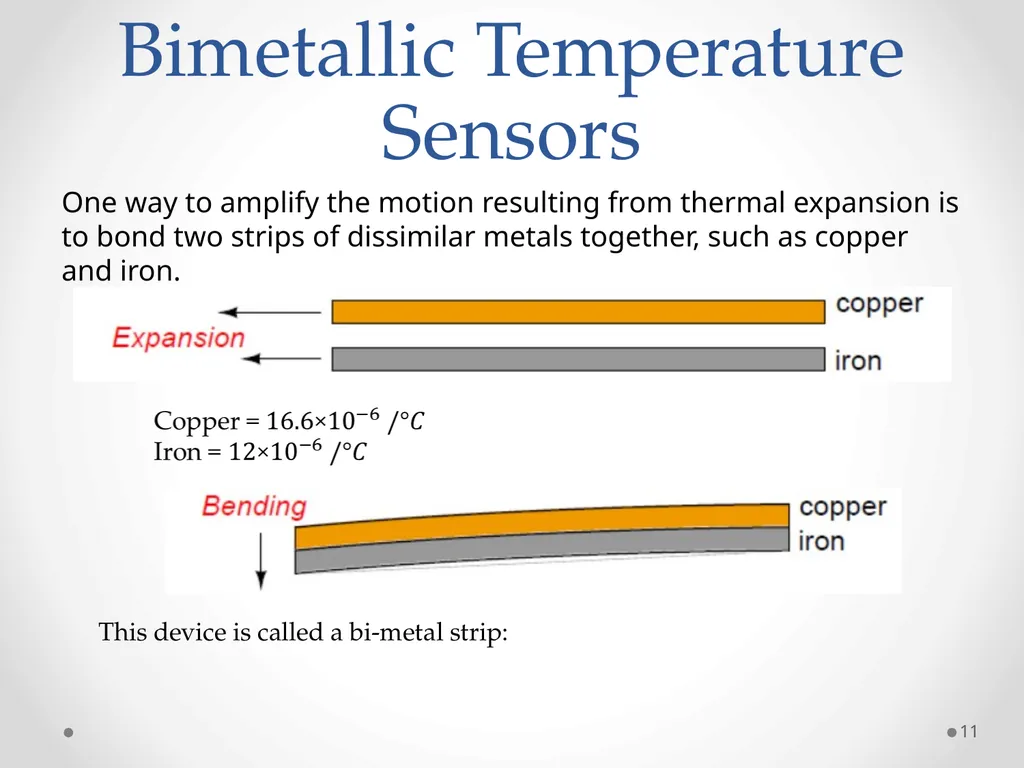
slide11. One way to amplify the motion resulting from thermal expansion is to bond two strips of dissimilar metals together, such as copper and iron. 11 Bimetallic Temperature Sensors This device is called a bi-metal strip:<br>
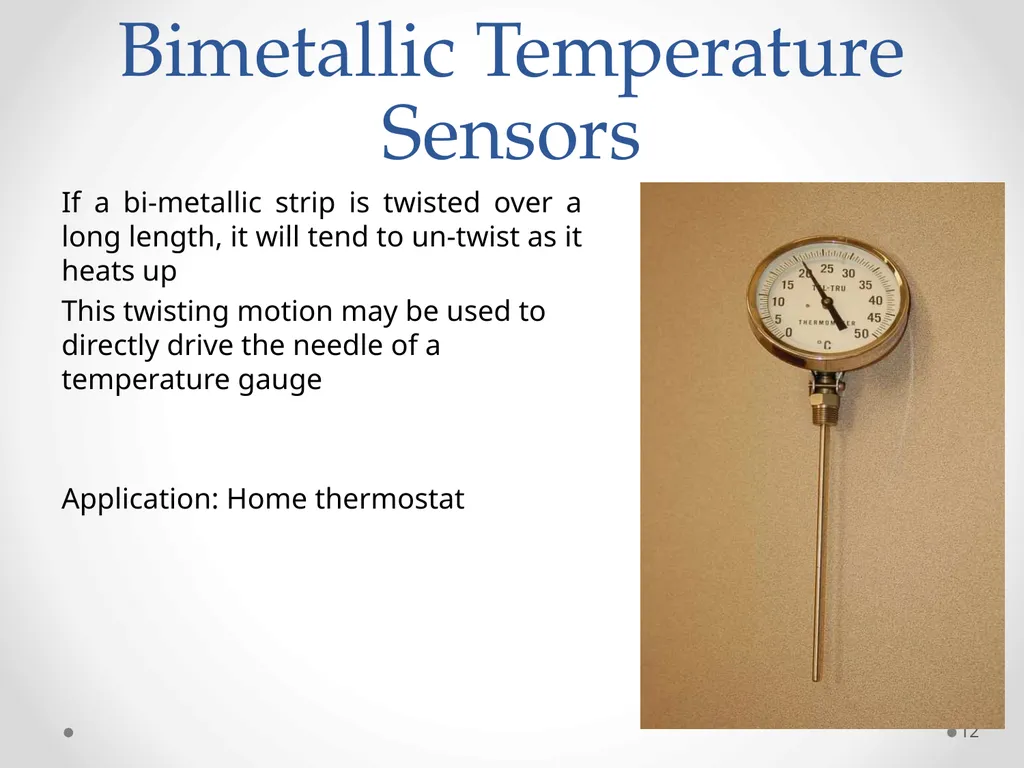
slide12. Bimetallic Temperature Sensors If a bi-metallic strip is twisted over a long length, it will tend to un-twist as it heats up
This twisting motion may be used to directly drive the needle of a temperature gauge
Application: Home thermostat 12<br>
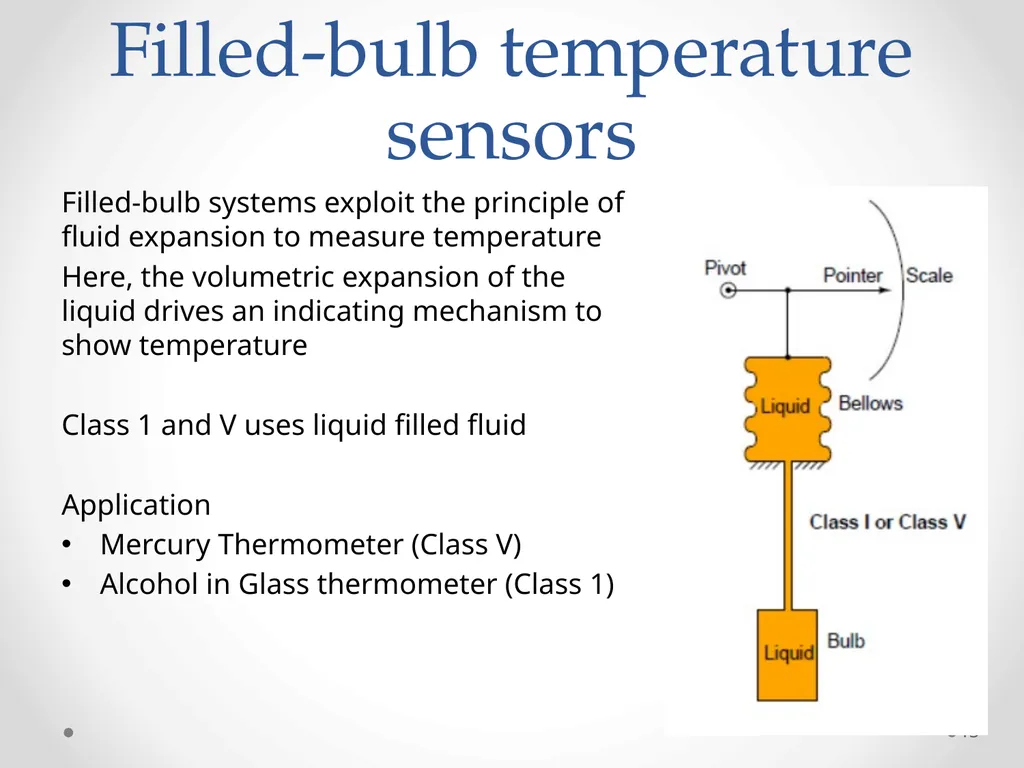
slide13. Filled-bulb temperature sensors Filled-bulb systems exploit the principle of fluid expansion to measure temperature
Here, the volumetric expansion of the liquid drives an indicating mechanism to show temperature
Class 1 and V uses liquid filled fluid
Application
Mercury Thermometer (Class V)
Alcohol in Glass thermometer (Class 1) 13<br>
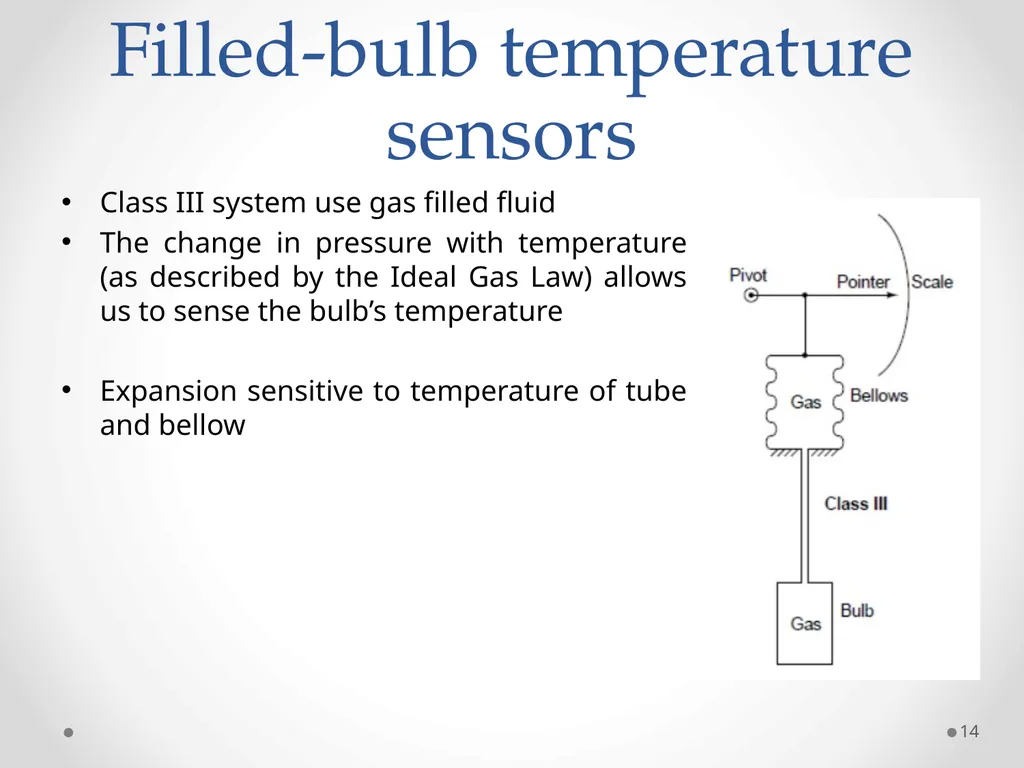
slide14. Filled-bulb temperature sensors Class III system use gas filled fluid
The change in pressure with temperature (as described by the Ideal Gas Law) allows us to sense the bulb’s temperature
Expansion sensitive to temperature of tube and bellow 14<br>
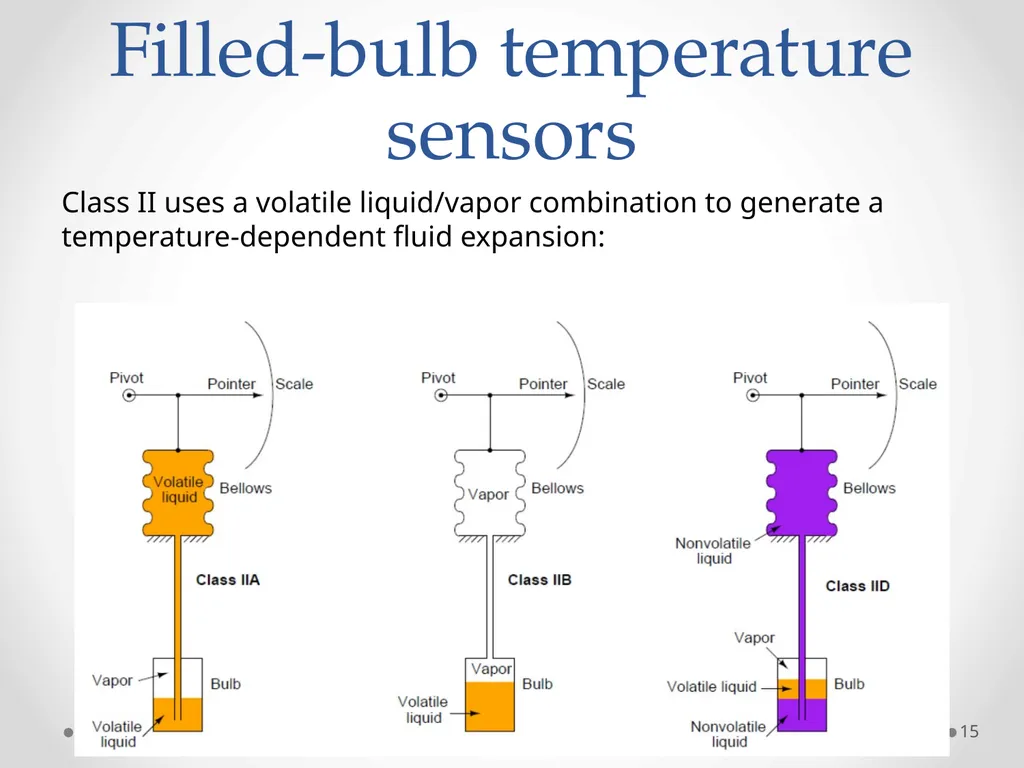
slide15. Filled-bulb temperature sensors Class II uses a volatile liquid/vapor combination to generate a temperature-dependent fluid expansion: 15<br>
slide16. Drawback of Filled bulb Temperature indication varies somewhat as the indicator temperature changes due to expansion and contraction of metals
Compensation exist for this effect (for example, a bi-metal spring inside the indicator mechanism to automatically offset the indication as ambient temperature changes) 16<br>
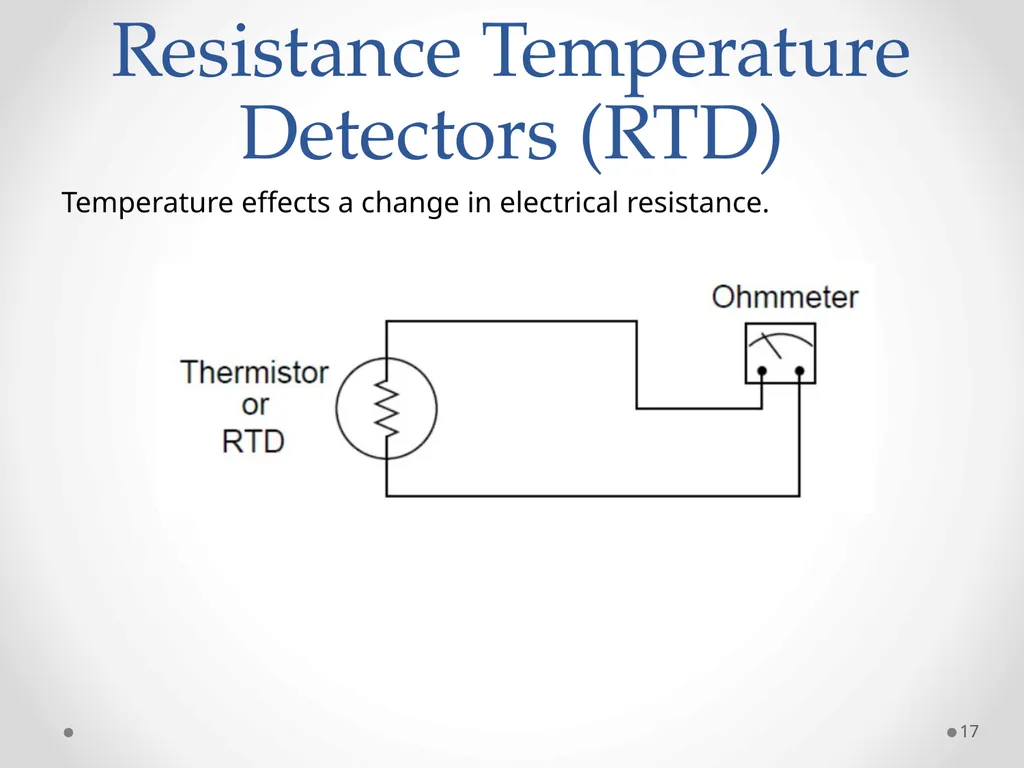
slide17. Resistance Temperature Detectors (RTD) Temperature effects a change in electrical resistance. 17<br>
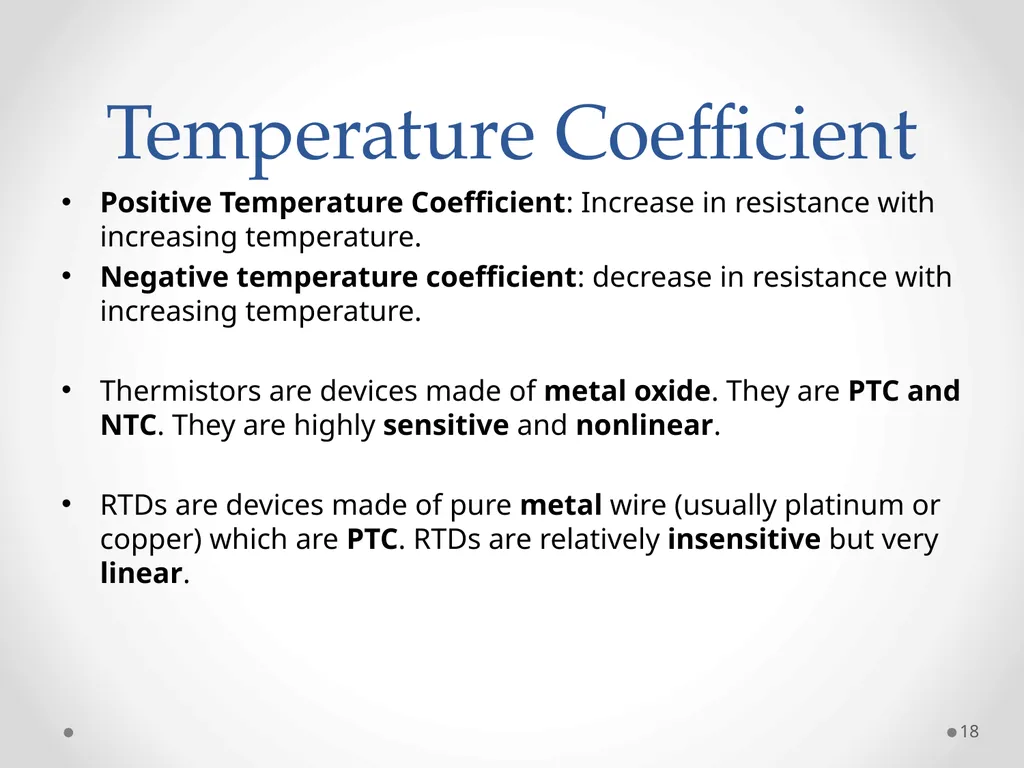
slide18. Temperature Coefficient Positive Temperature Coefficient: Increase in resistance with increasing temperature.
Negative temperature coefficient: decrease in resistance with increasing temperature.
Thermistors are devices made of metal oxide. They are PTC and NTC. They are highly sensitive and nonlinear.
RTDs are devices made of pure metal wire (usually platinum or copper) which are PTC. RTDs are relatively insensitive but very linear. 18<br>
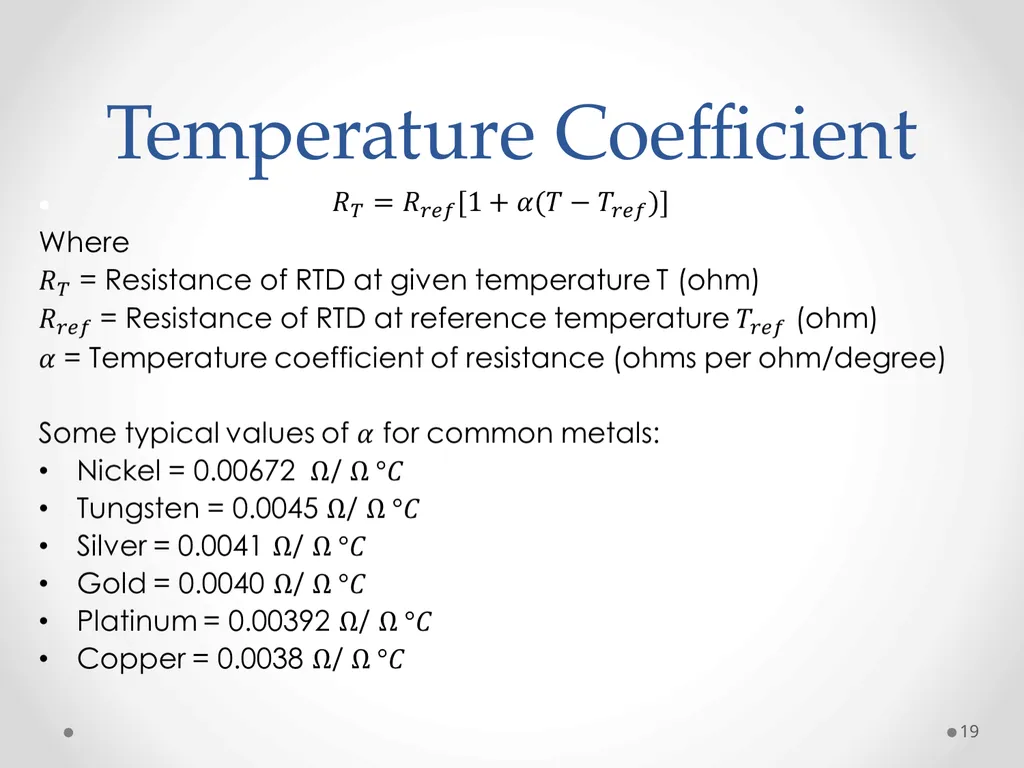
slide19. Temperature Coefficient 19<br>
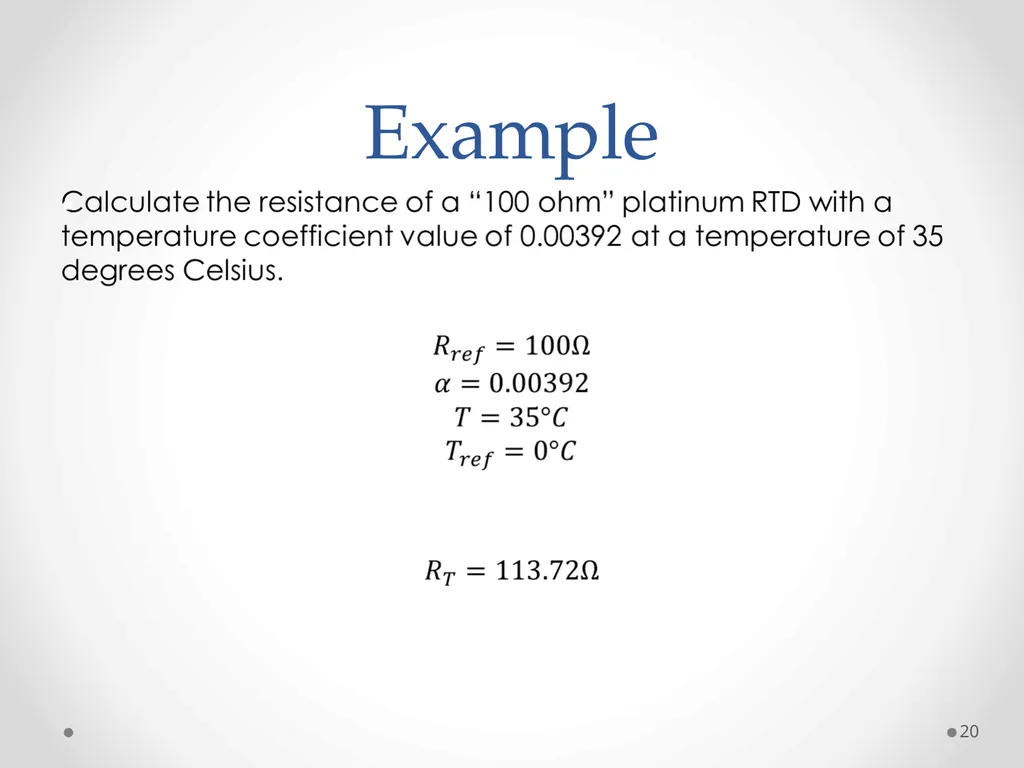
slide20. Example 20<br>
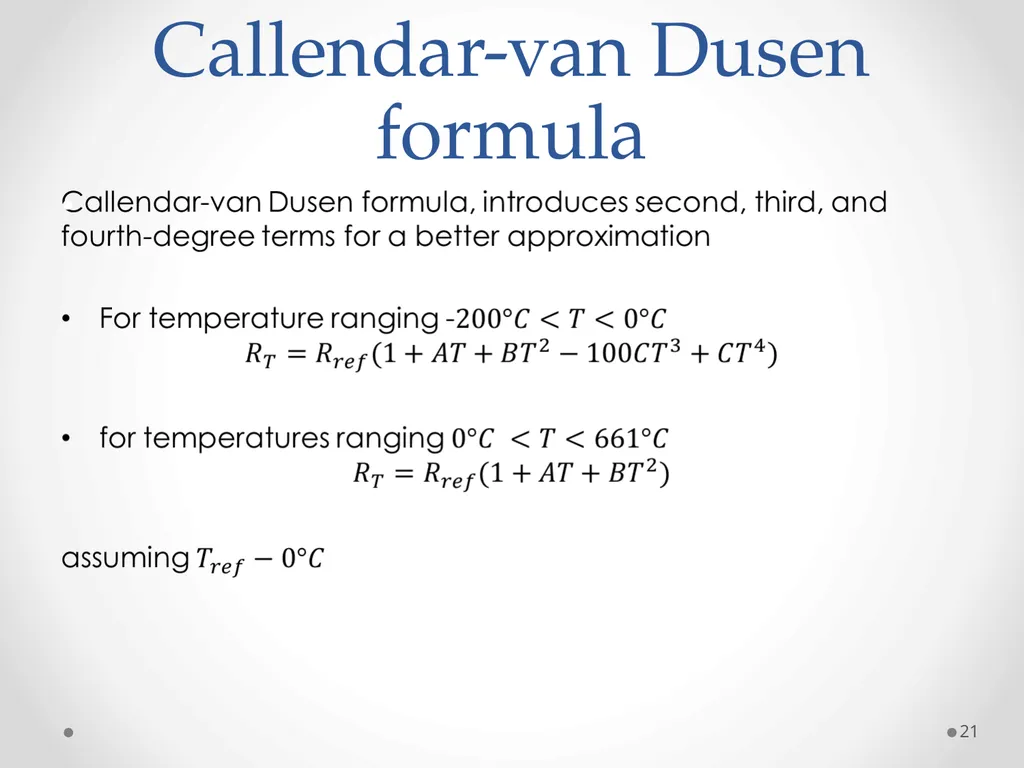
slide21. Callendar-van Dusen formula 21<br>
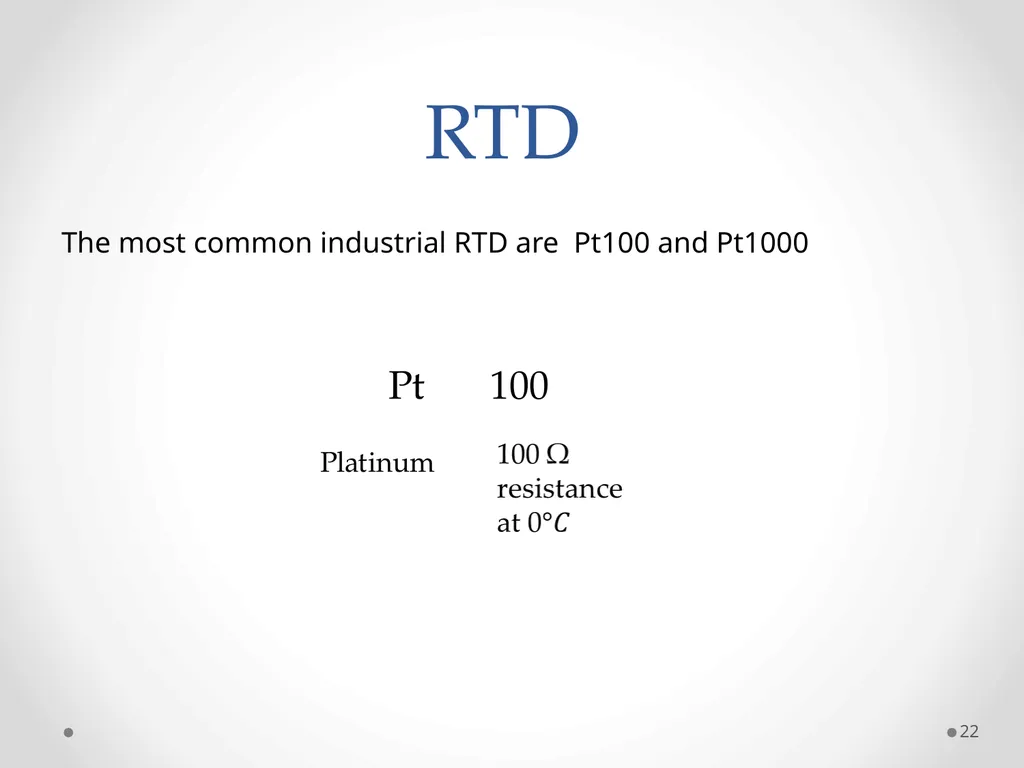
slide22. RTD The most common industrial RTD are Pt100 and Pt1000 22 Pt Platinum 100<br>
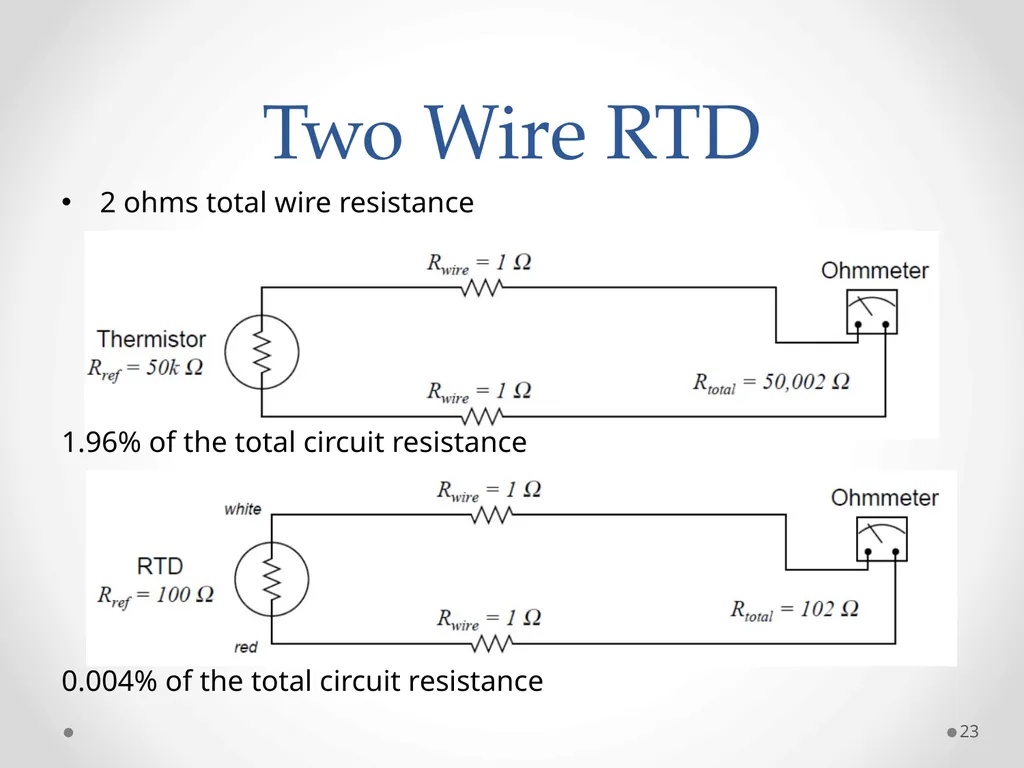
slide23. Two Wire RTD 2 ohms total wire resistance
1.96% of the total circuit resistance
0.004% of the total circuit resistance 23<br>
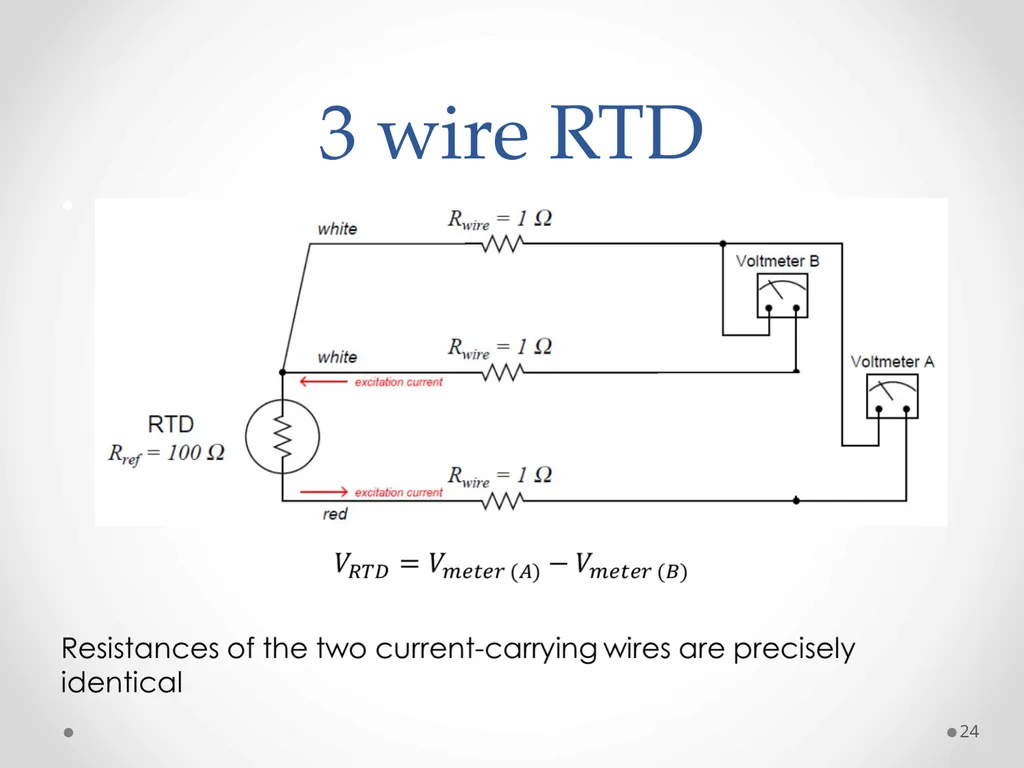
slide24. 3 wire RTD 24<br>
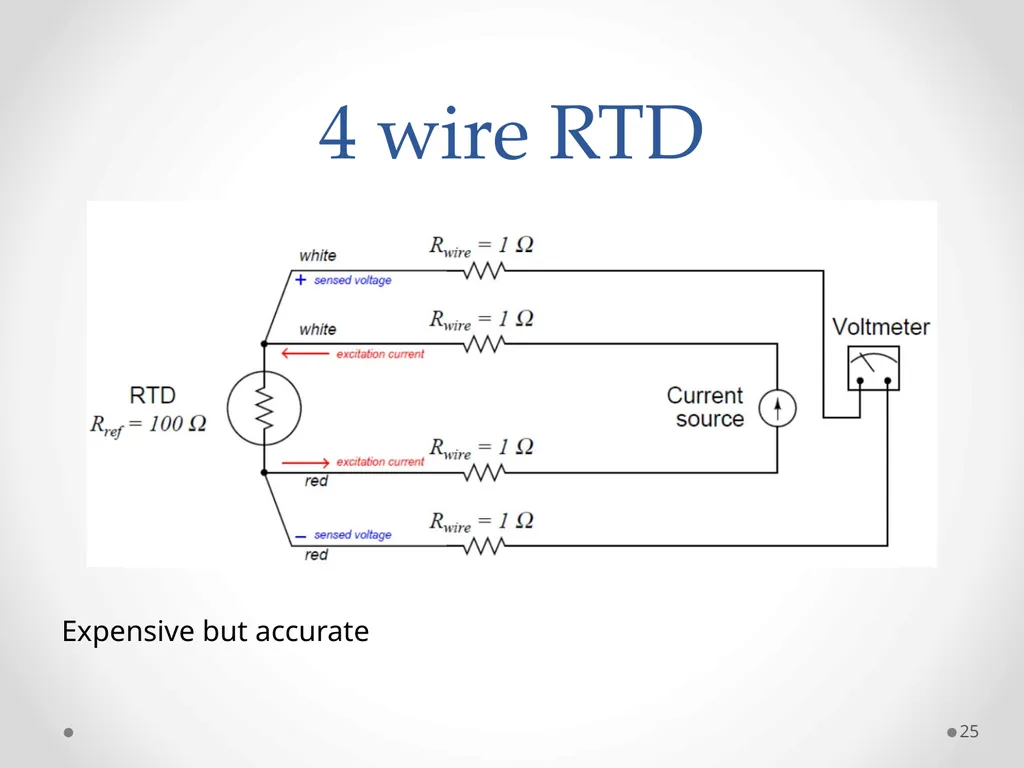
slide25. 4 wire RTD Expensive but accurate 25<br>
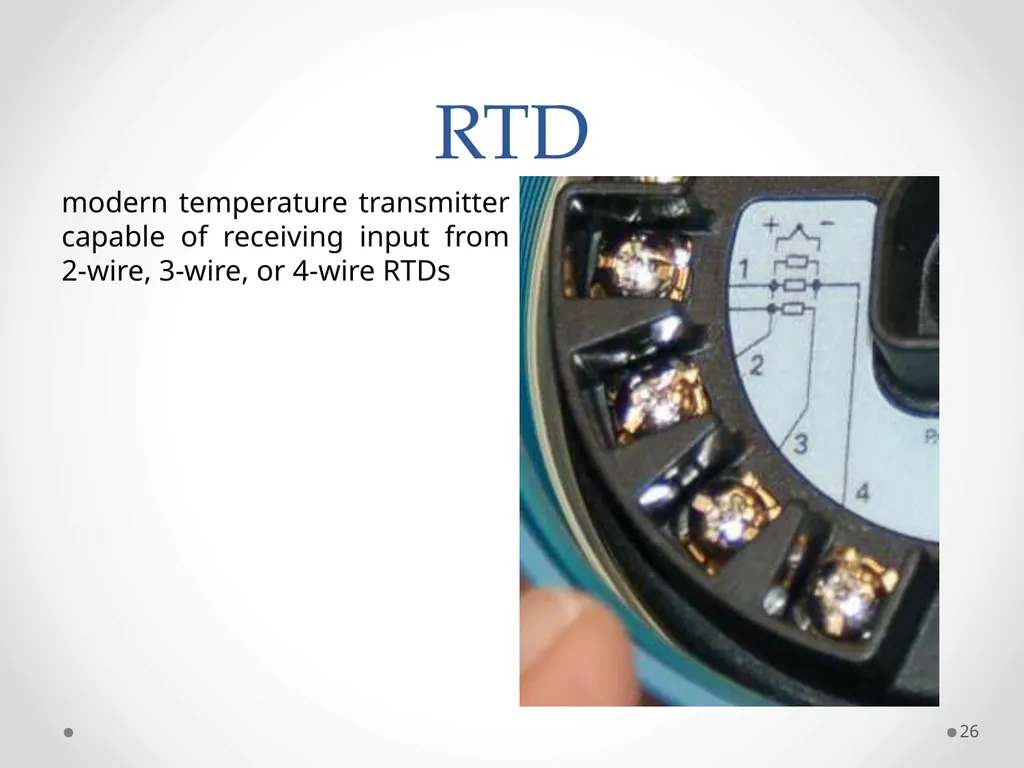
slide26. RTD modern temperature transmitter capable of receiving input from 2-wire, 3-wire, or 4-wire RTDs 26<br>
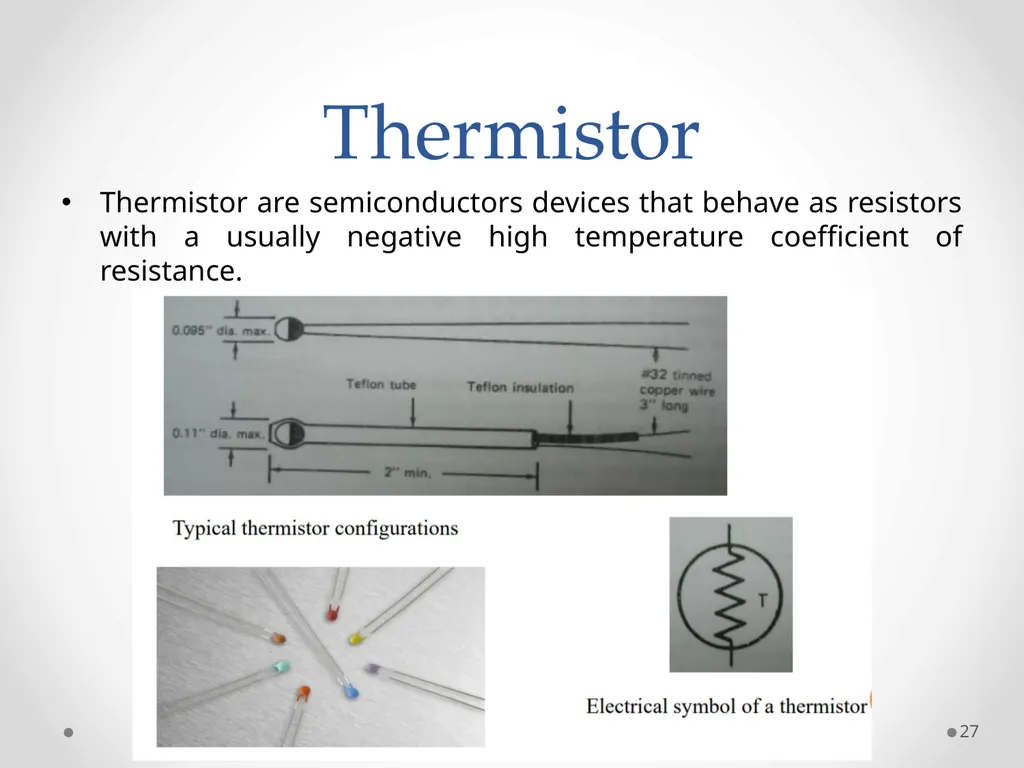
slide27. Thermistor Thermistor are semiconductors devices that behave as resistors with a usually negative high temperature coefficient of resistance. 27<br>
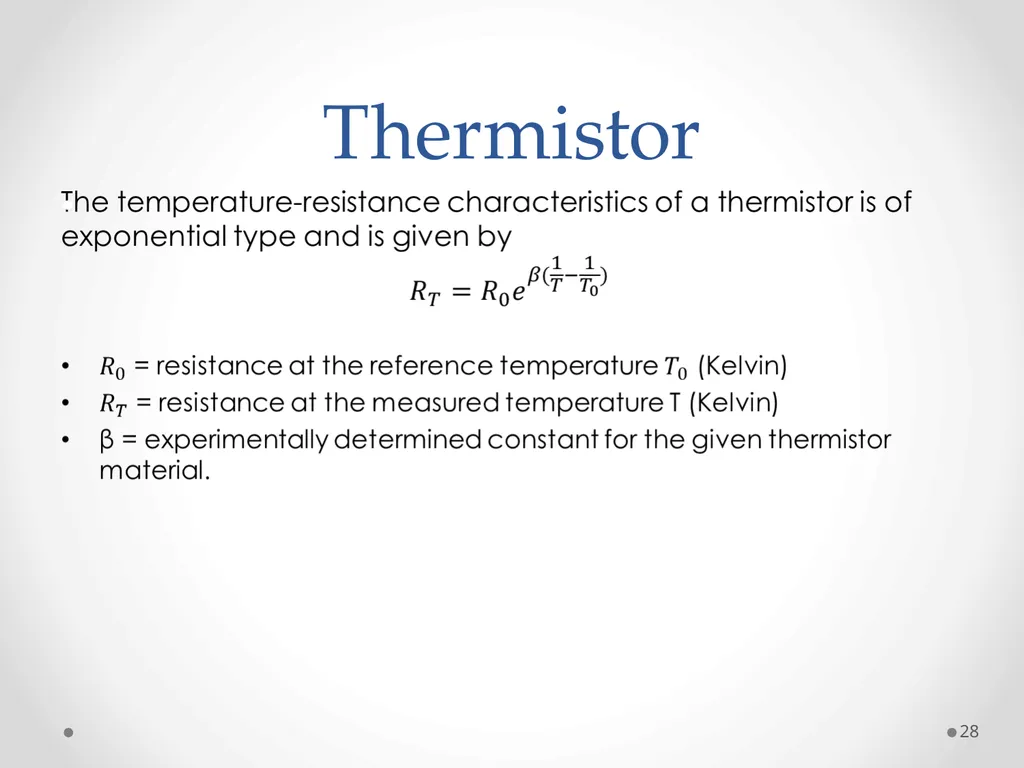
slide28. Thermistor 28<br>
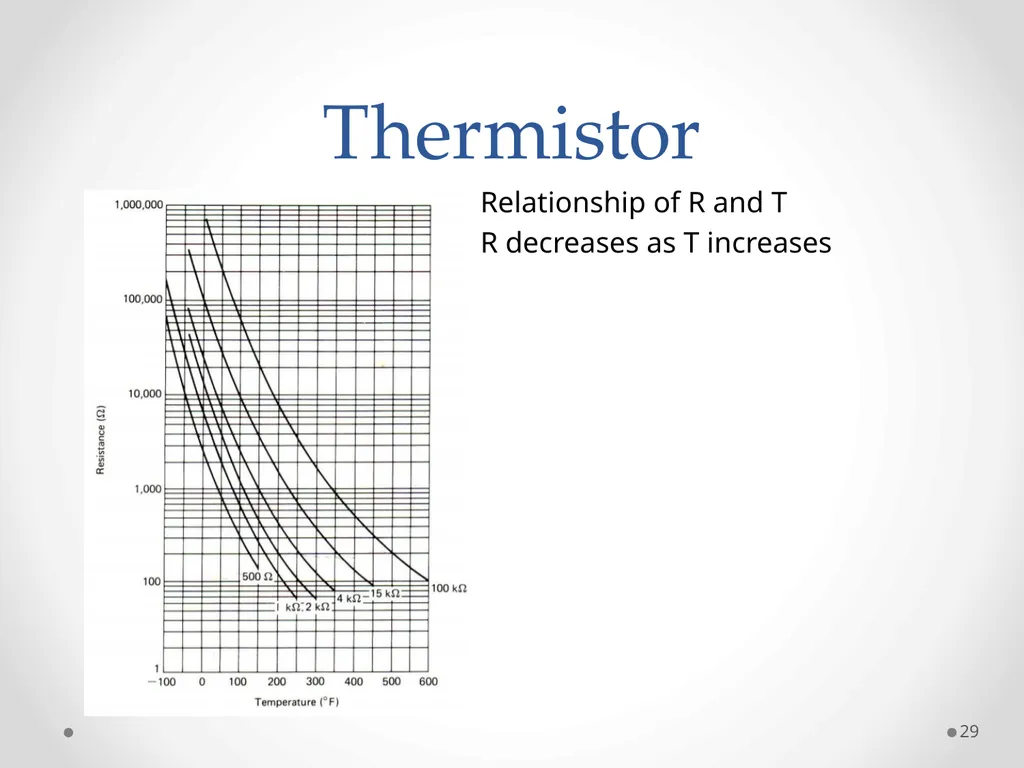
slide29. Thermistor Relationship of R and T
R decreases as T increases 29<br>
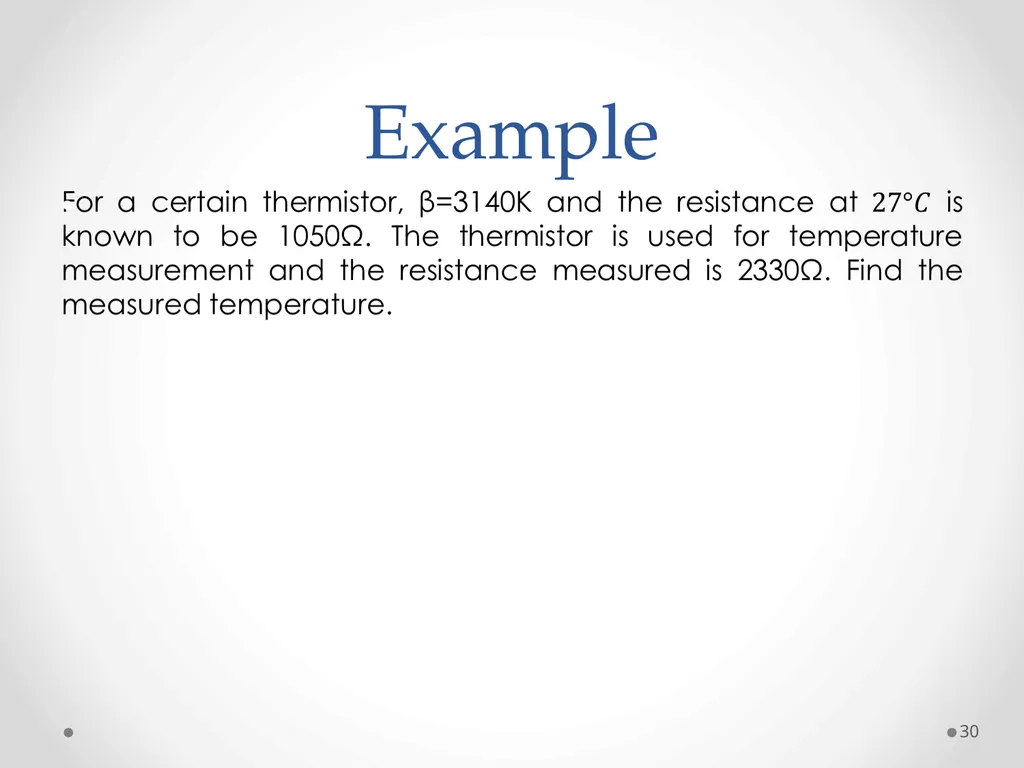
slide30. Example 30<br>
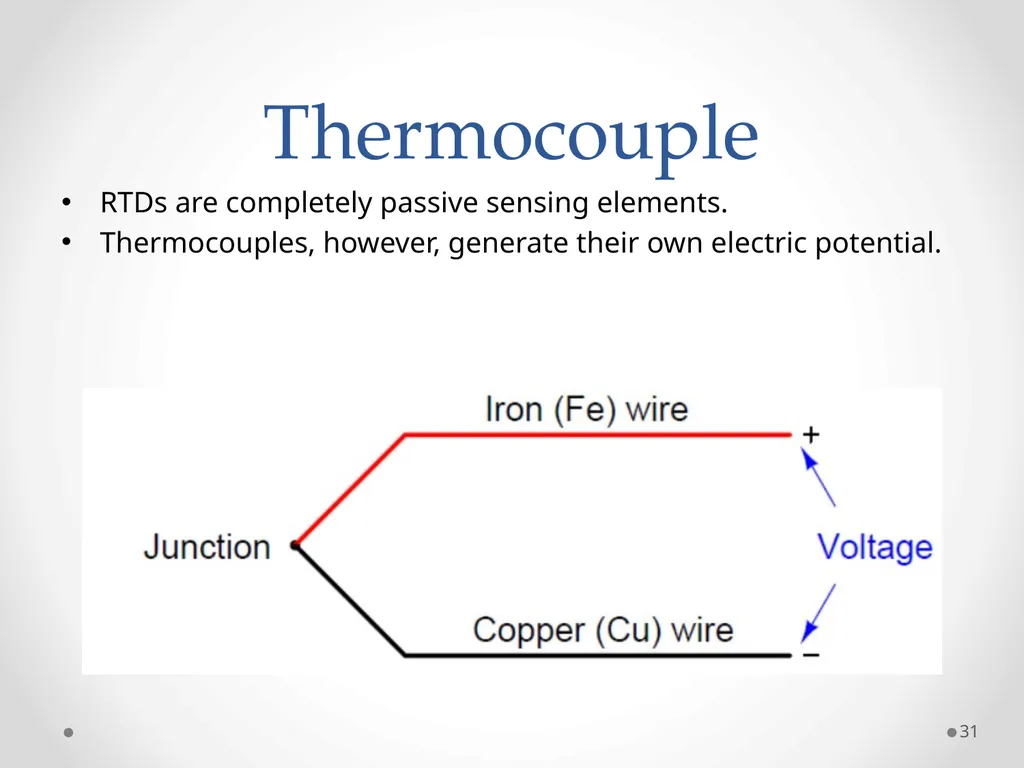
slide31. Thermocouple RTDs are completely passive sensing elements.
Thermocouples, however, generate their own electric potential. 31<br>
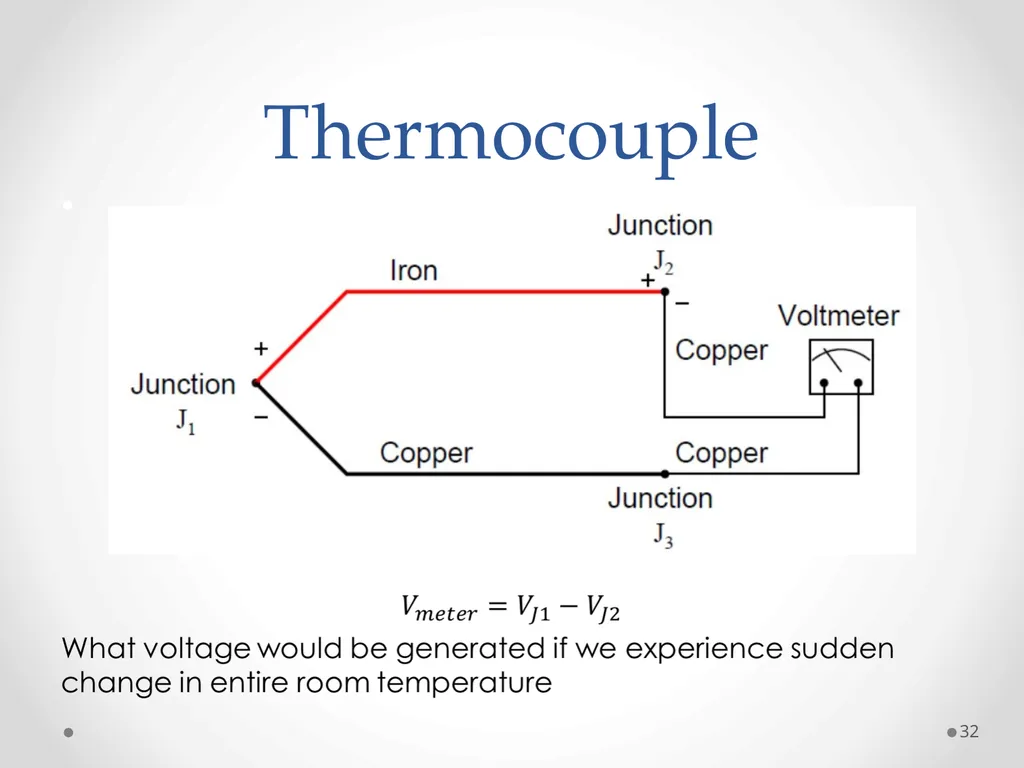
slide32. Thermocouple 32<br>
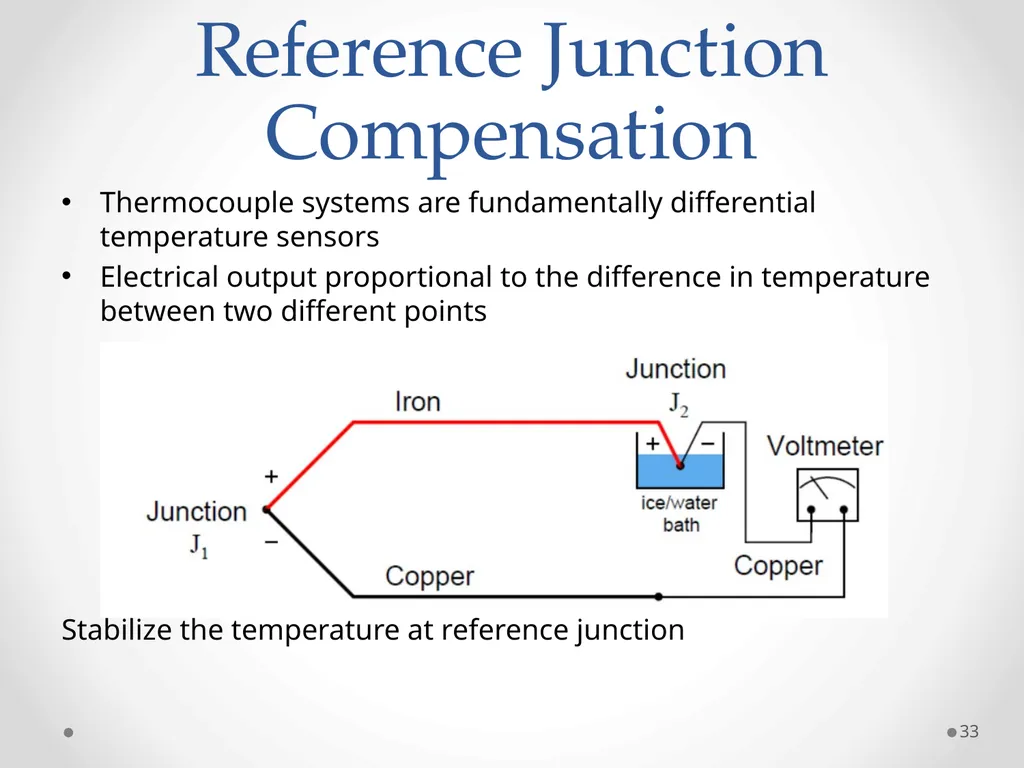
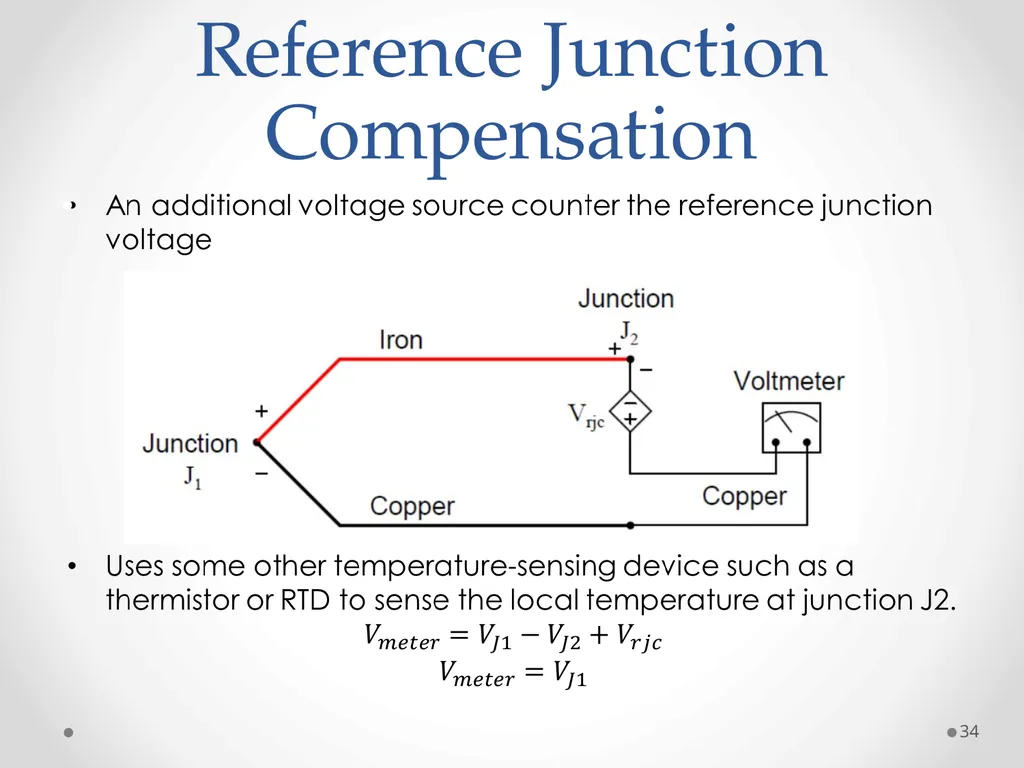
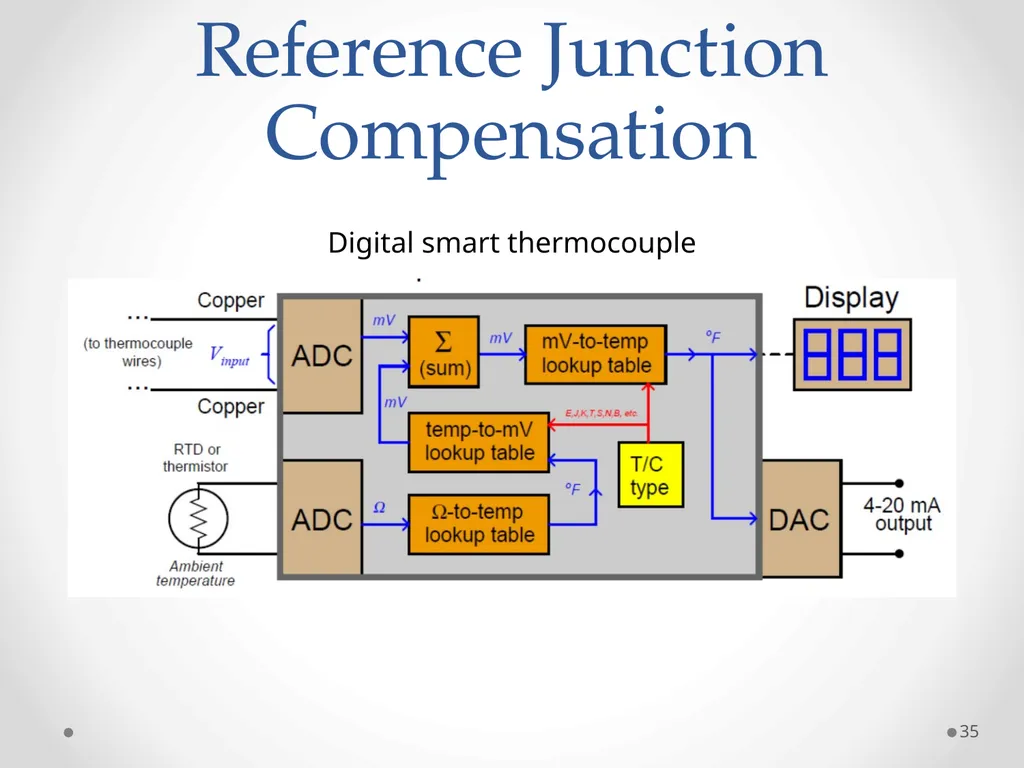
slide33. Reference Junction Compensation Thermocouple systems are fundamentally differential temperature sensors
Electrical output proportional to the difference in temperature between two different points
Stabilize the temperature at reference junction 33<br>
slide34. Reference Junction Compensation 34<br>
slide35. Reference Junction Compensation Digital smart thermocouple 35<br>
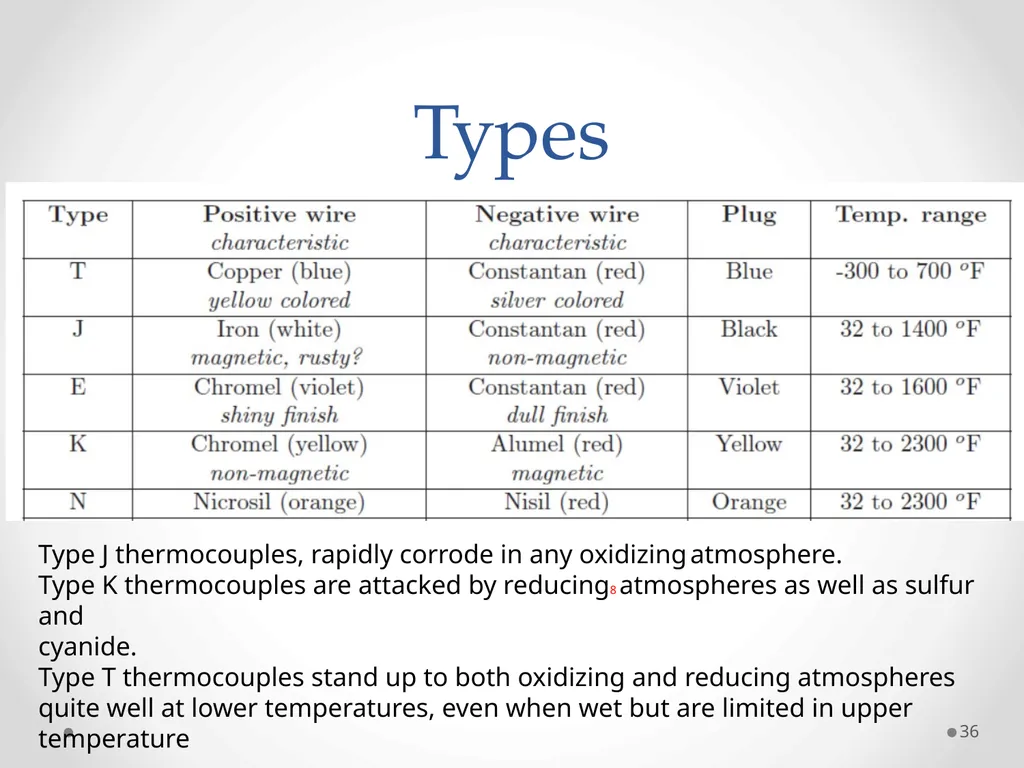
slide36. Types 36 Type J thermocouples, rapidly corrode in any oxidizing atmosphere.
Type K thermocouples are attacked by reducing8 atmospheres as well as sulfur and
cyanide.
Type T thermocouples stand up to both oxidizing and reducing atmospheres quite well at lower temperatures, even when wet but are limited in upper temperature<br>
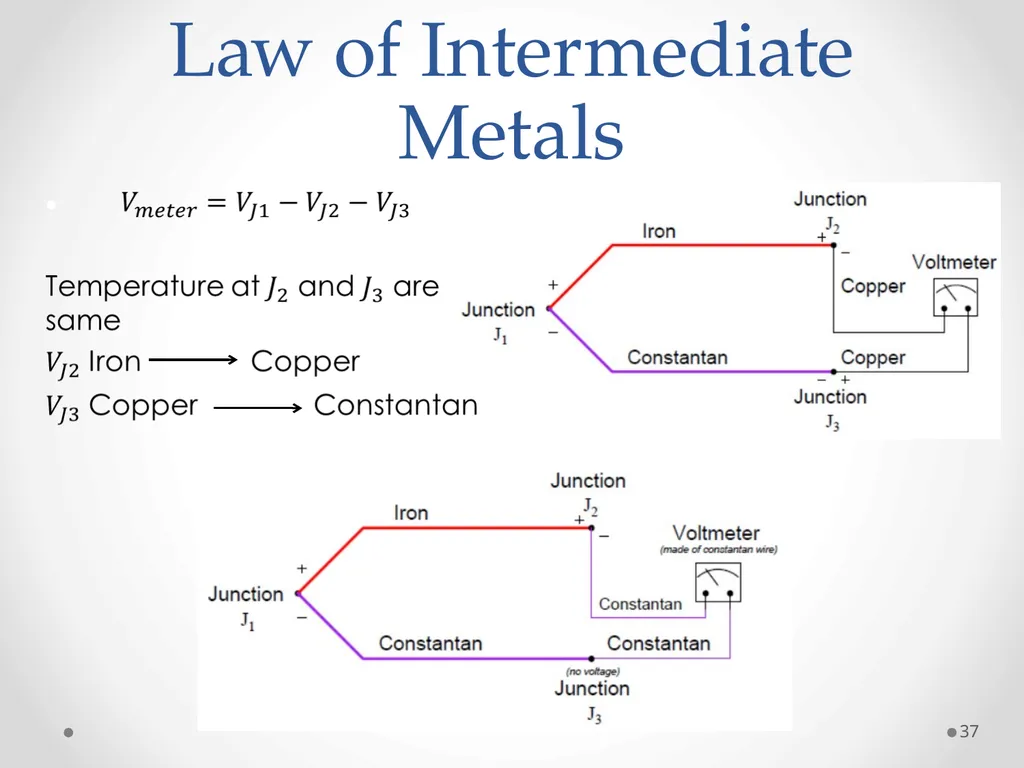
slide37. Law of Intermediate Metals 37<br>
slide38. Law of Intermediate Metals 38<br>
slide39. Thermopile 39 the thermopile acts like a multiplied thermocouple,<br>
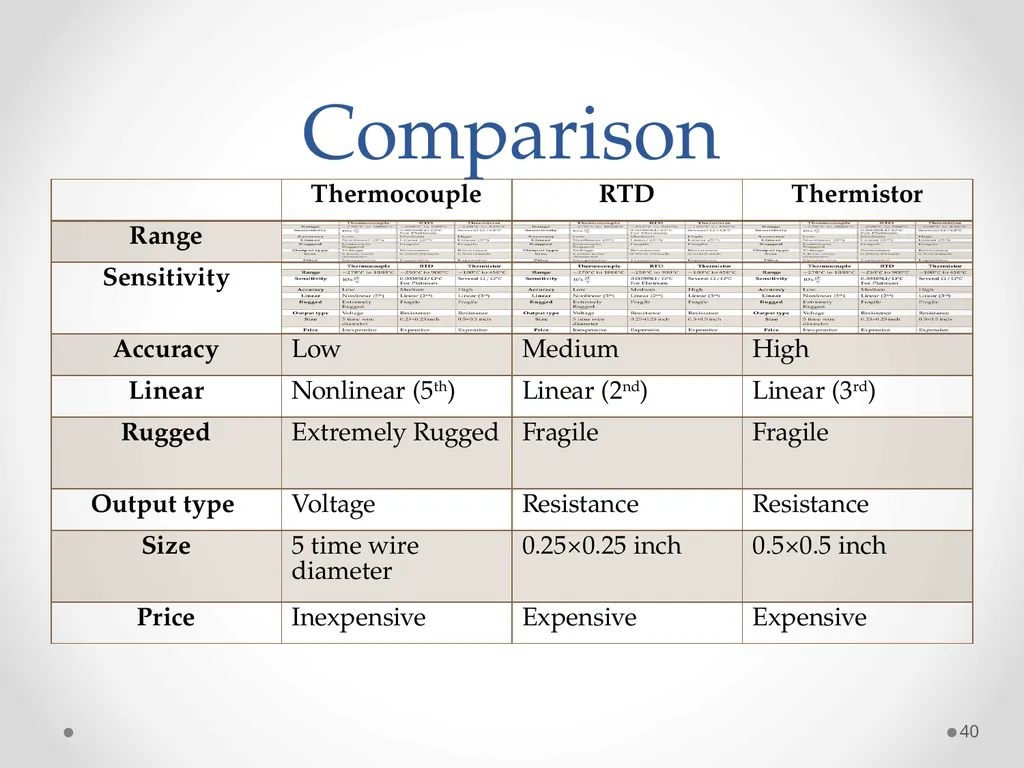
slide40. Comparison 40<br>
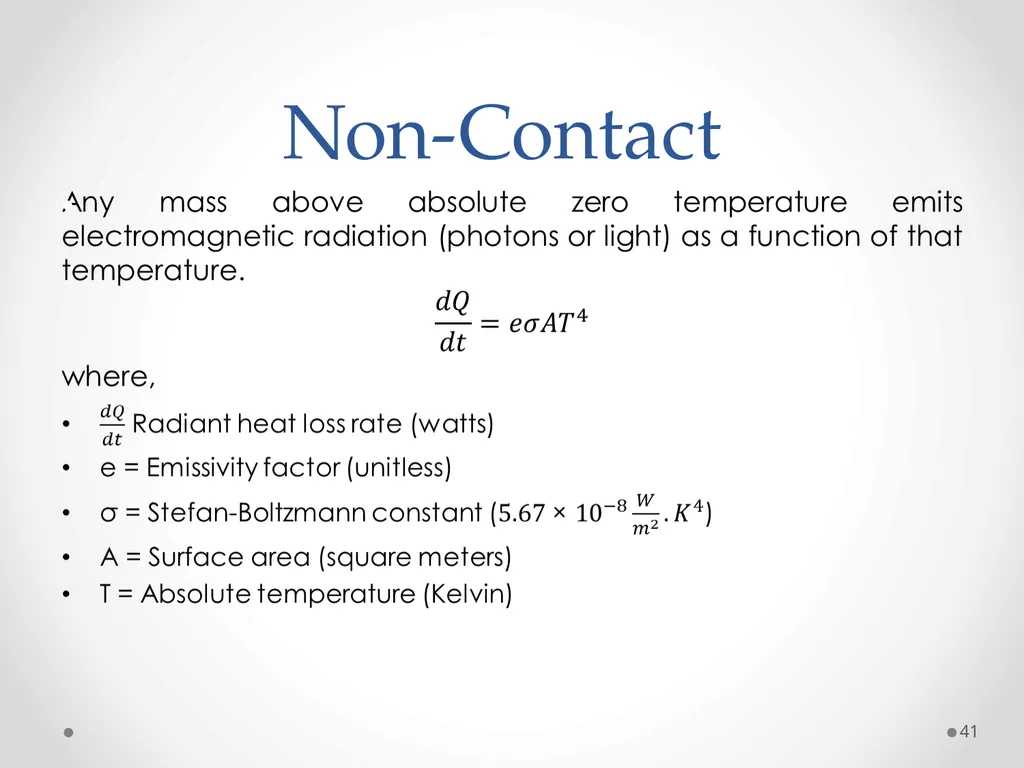
slide41. Non-Contact 41<br>
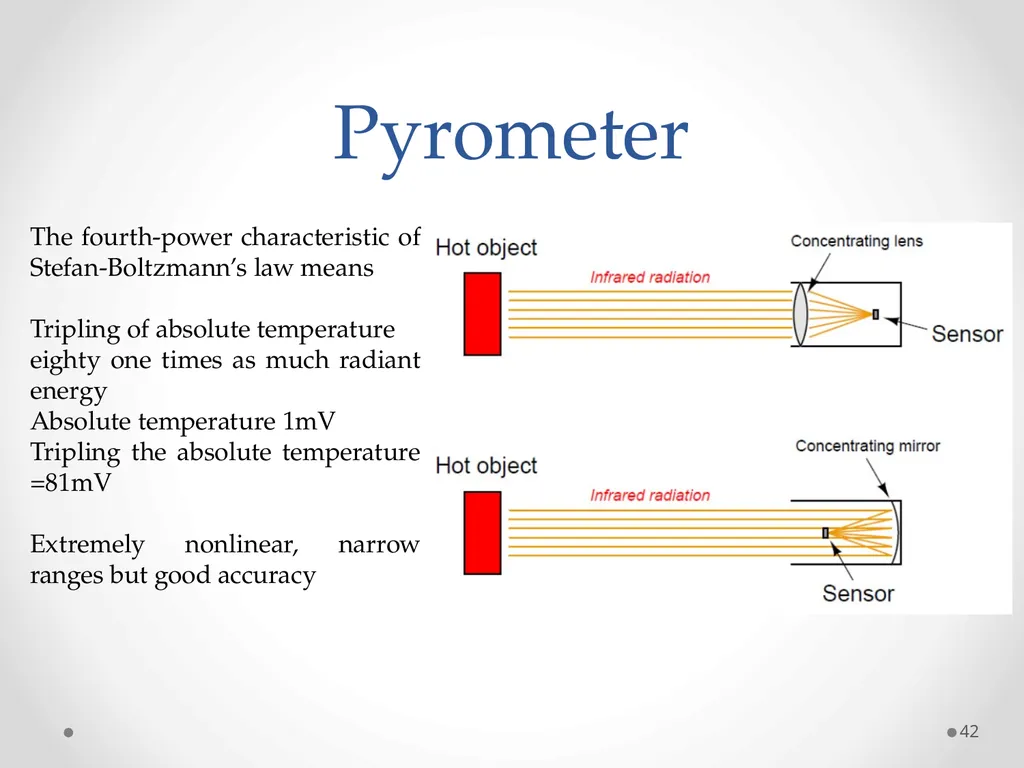
slide42. Pyrometer 42 The fourth-power characteristic of Stefan-Boltzmann’s law means
Tripling of absolute temperature
eighty one times as much radiant energy
Absolute temperature 1mV
Tripling the absolute temperature =81mV
Extremely nonlinear, narrow ranges but good accuracy<br>
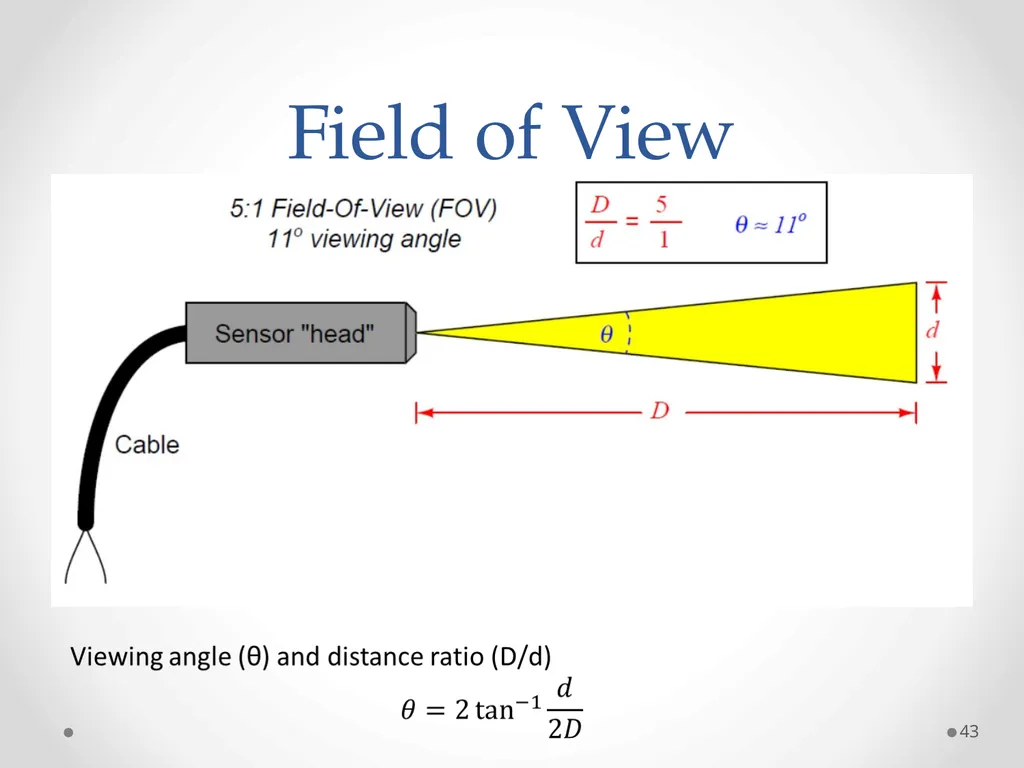
slide43. Field of View 43<br>
slide44. Thermal Imaging 44 Thermal Imaging sensors provides a graphic display of objects in its view according to their temperatures by detecting infrared radiation
For thermal Imaging relative differences in temperature is detect rather than specific temperature values.
Application
Detecting hot spot of elevated potential (power line insulators)
performing “energy audits” of buildings<br>
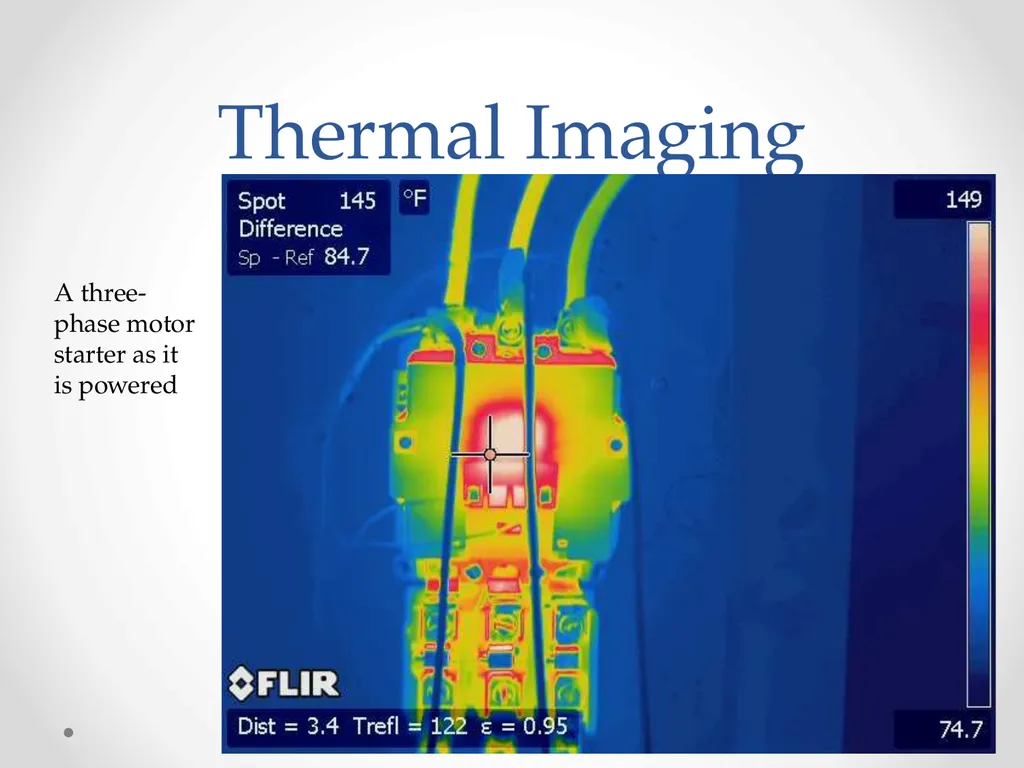
slide45. Thermal Imaging 45 A three-phase motor starter as it is powered<br>
slide46. End of Topic 6 46 To download this lecture visit
http://ammaruet.weebly.com/<br>
Lecturer
University of Engineering & Technology, Lahore
KSK Campus Electrical Technology
email: ammar@uet.edu.pk Topic 6
Industrial Instruments<br>
slide2. Outline Introduction
Classification of sensor
Type of Measuremen
Contact Temperature Sensors
Bimetallic Strip
Filled-bulb temperature sensors
Class i and V
Class III
Class II
Resistance Temperature Detector
2-wire RTD
3-wire RTD
4-wire RTD 2<br>
slide3. Outline Temperature Sensor
Thermistor
Thermocouple
Reference junction compensation
Types
Law of Intermediate Metals
Thermopile
Non-Contact Temperature Sensor
Pyrometer
Field of view
Thermal Imaging 3<br>
slide4. Introduction Industrial measurement and control systems have their own unique terms and standards
Process: The physical system we are attempting to control or measure. Examples: water filtration system
Process Variable, or PV: The specific quantity we are measuring in a process. Examples: pressure, level, temperature, flow, electrical conductivity, pH, position, speed, vibration.
Setpoint, or SP: The value at which we desire the process variable to be maintained at.
Primary Sensing Element, or PSE: A device that directly senses the process variable and translates that sensed quantity into an analog representation
Lower- and Upper-range values, abbreviated LRV and URV, respectively 4<br>
slide5. Classification of Sensors The classification of the sensors are Analog and Digital Sensors
The other type of classification is Active and Passive Sensor
Active Sensors are those which require an external excitation signal or a power signal.
Passive Sensors, on the other hand, do not require any external power signal and directly generates output response.
The next type of classification is based on the means of detection used in the sensor.
Electric, Biological, Chemical, Radioactive etc.
The Final classification is based on conversion phenomenon i.e. the input and the output.
Photoelectric, Thermoelectric, Electrochemical, Electromagnetic, Thermooptic, etc. 5<br>
slide6. Types of Measurement Pressure
Temperature
Flow
Level
Position
Vibration
Tilt
Proximity
Gas, Smoke, Alcohol
Ultrasonic, IR
Humidity
pH 6<br>
slide7. Type of Sensor 7<br>
slide8. Temperature Sensors Bimetallic Strip
Filled-bulb
RTD
Thermistor
Thermocouple
Pyrometer
Thermal Imaging 8<br>
slide9. Bimetallic Temperature Sensors 9<br>
slide10. 10 Bimetallic Temperature Sensors<br>
slide11. One way to amplify the motion resulting from thermal expansion is to bond two strips of dissimilar metals together, such as copper and iron. 11 Bimetallic Temperature Sensors This device is called a bi-metal strip:<br>
slide12. Bimetallic Temperature Sensors If a bi-metallic strip is twisted over a long length, it will tend to un-twist as it heats up
This twisting motion may be used to directly drive the needle of a temperature gauge
Application: Home thermostat 12<br>
slide13. Filled-bulb temperature sensors Filled-bulb systems exploit the principle of fluid expansion to measure temperature
Here, the volumetric expansion of the liquid drives an indicating mechanism to show temperature
Class 1 and V uses liquid filled fluid
Application
Mercury Thermometer (Class V)
Alcohol in Glass thermometer (Class 1) 13<br>
slide14. Filled-bulb temperature sensors Class III system use gas filled fluid
The change in pressure with temperature (as described by the Ideal Gas Law) allows us to sense the bulb’s temperature
Expansion sensitive to temperature of tube and bellow 14<br>
slide15. Filled-bulb temperature sensors Class II uses a volatile liquid/vapor combination to generate a temperature-dependent fluid expansion: 15<br>
slide16. Drawback of Filled bulb Temperature indication varies somewhat as the indicator temperature changes due to expansion and contraction of metals
Compensation exist for this effect (for example, a bi-metal spring inside the indicator mechanism to automatically offset the indication as ambient temperature changes) 16<br>
slide17. Resistance Temperature Detectors (RTD) Temperature effects a change in electrical resistance. 17<br>
slide18. Temperature Coefficient Positive Temperature Coefficient: Increase in resistance with increasing temperature.
Negative temperature coefficient: decrease in resistance with increasing temperature.
Thermistors are devices made of metal oxide. They are PTC and NTC. They are highly sensitive and nonlinear.
RTDs are devices made of pure metal wire (usually platinum or copper) which are PTC. RTDs are relatively insensitive but very linear. 18<br>
slide19. Temperature Coefficient 19<br>
slide20. Example 20<br>
slide21. Callendar-van Dusen formula 21<br>
slide22. RTD The most common industrial RTD are Pt100 and Pt1000 22 Pt Platinum 100<br>
slide23. Two Wire RTD 2 ohms total wire resistance
1.96% of the total circuit resistance
0.004% of the total circuit resistance 23<br>
slide24. 3 wire RTD 24<br>
slide25. 4 wire RTD Expensive but accurate 25<br>
slide26. RTD modern temperature transmitter capable of receiving input from 2-wire, 3-wire, or 4-wire RTDs 26<br>
slide27. Thermistor Thermistor are semiconductors devices that behave as resistors with a usually negative high temperature coefficient of resistance. 27<br>
slide28. Thermistor 28<br>
slide29. Thermistor Relationship of R and T
R decreases as T increases 29<br>
slide30. Example 30<br>
slide31. Thermocouple RTDs are completely passive sensing elements.
Thermocouples, however, generate their own electric potential. 31<br>
slide32. Thermocouple 32<br>
slide33. Reference Junction Compensation Thermocouple systems are fundamentally differential temperature sensors
Electrical output proportional to the difference in temperature between two different points
Stabilize the temperature at reference junction 33<br>
slide34. Reference Junction Compensation 34<br>
slide35. Reference Junction Compensation Digital smart thermocouple 35<br>
slide36. Types 36 Type J thermocouples, rapidly corrode in any oxidizing atmosphere.
Type K thermocouples are attacked by reducing8 atmospheres as well as sulfur and
cyanide.
Type T thermocouples stand up to both oxidizing and reducing atmospheres quite well at lower temperatures, even when wet but are limited in upper temperature<br>
slide37. Law of Intermediate Metals 37<br>
slide38. Law of Intermediate Metals 38<br>
slide39. Thermopile 39 the thermopile acts like a multiplied thermocouple,<br>
slide40. Comparison 40<br>
slide41. Non-Contact 41<br>
slide42. Pyrometer 42 The fourth-power characteristic of Stefan-Boltzmann’s law means
Tripling of absolute temperature
eighty one times as much radiant energy
Absolute temperature 1mV
Tripling the absolute temperature =81mV
Extremely nonlinear, narrow ranges but good accuracy<br>
slide43. Field of View 43<br>
slide44. Thermal Imaging 44 Thermal Imaging sensors provides a graphic display of objects in its view according to their temperatures by detecting infrared radiation
For thermal Imaging relative differences in temperature is detect rather than specific temperature values.
Application
Detecting hot spot of elevated potential (power line insulators)
performing “energy audits” of buildings<br>
slide45. Thermal Imaging 45 A three-phase motor starter as it is powered<br>
slide46. End of Topic 6 46 To download this lecture visit
http://ammaruet.weebly.com/<br>