Measuring Educator Effectiveness for Music
Description: Measuring Educator Effectiveness for Music Teachers A Pennsylvania Perspective Created by O David Deitz for 2012-2013 PMEA Mentoring Program Webinar Series (there are still a lot of questions to be asked and answered!) ? Big Idea: An
Related Topics
Download Presentation
"Measuring Educator Effectiveness for Music" is the property of its rightful owner. Permission is granted to download and print the materials on this website for personal, non-commercial use only, and to display it on your personal computer provided you do not modify the materials and that you retain all copyright notices contained in the materials. By downloading content from our website, you accept the terms of this agreement.
Presentation Transcript
slide1. Measuring Educator Effectiveness for Music Teachers A Pennsylvania Perspective Created by O David Deitz for 2012-2013 PMEA Mentoring Program Webinar Series<br>
slide2. (there are still a lot of questions to be asked and answered!) ?<br>
slide3. Big Idea: An effective teacher in every classroom.<br>
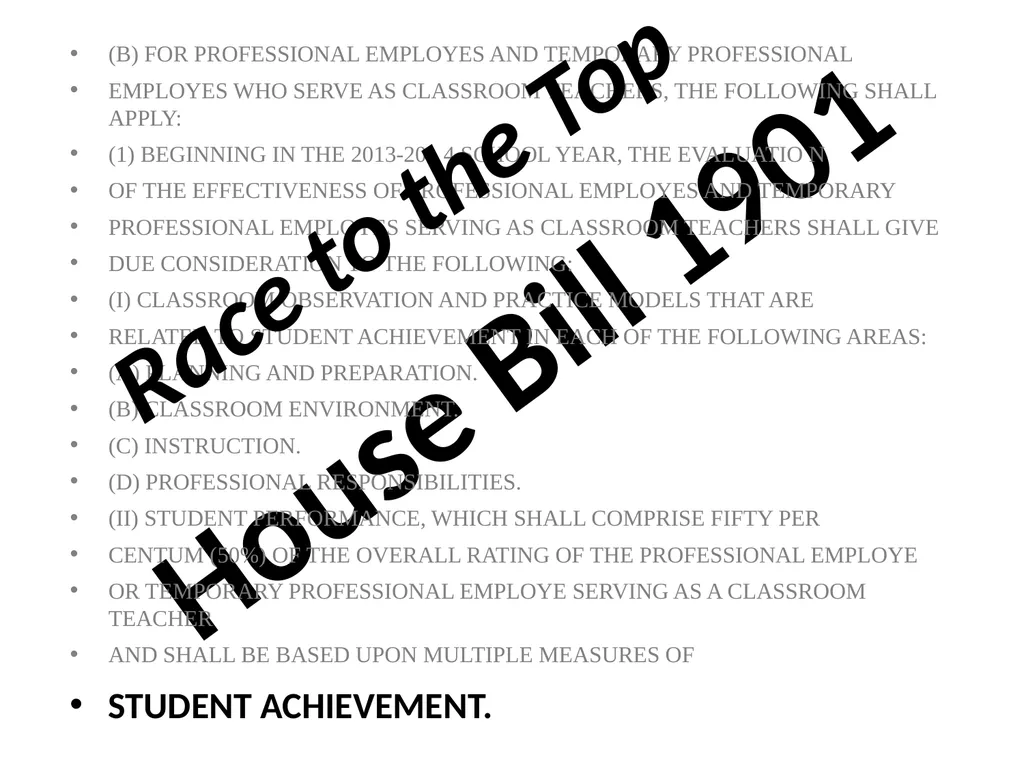
slide4. House Bill 1901 (B) FOR PROFESSIONAL EMPLOYES AND TEMPORARY PROFESSIONAL
EMPLOYES WHO SERVE AS CLASSROOM TEACHERS, THE FOLLOWING SHALL APPLY:
(1) BEGINNING IN THE 2013-201 4 SCHOOL YEAR, THE EVALUATIO N
OF THE EFFECTIVENESS OF PROFESSIONAL EMPLOYES AND TEMPORARY
PROFESSIONAL EMPLOYES SERVING AS CLASSROOM TEACHERS SHALL GIVE
DUE CONSIDERATION TO THE FOLLOWING:
(I) CLASSROOM OBSERVATION AND PRACTICE MODELS THAT ARE
RELATED TO STUDENT ACHIEVEMENT IN EACH OF THE FOLLOWING AREAS:
(A) PLANNING AND PREPARATION.
(B) CLASSROOM ENVIRONMENT.
(C) INSTRUCTION.
(D) PROFESSIONAL RESPONSIBILITIES.
(II) STUDENT PERFORMANCE, WHICH SHALL COMPRISE FIFTY PER
CENTUM (50%) OF THE OVERALL RATING OF THE PROFESSIONAL EMPLOYE
OR TEMPORARY PROFESSIONAL EMPLOYE SERVING AS A CLASSROOM TEACHER
AND SHALL BE BASED UPON MULTIPLE MEASURES OF
STUDENT ACHIEVEMENT. Race to the Top<br>
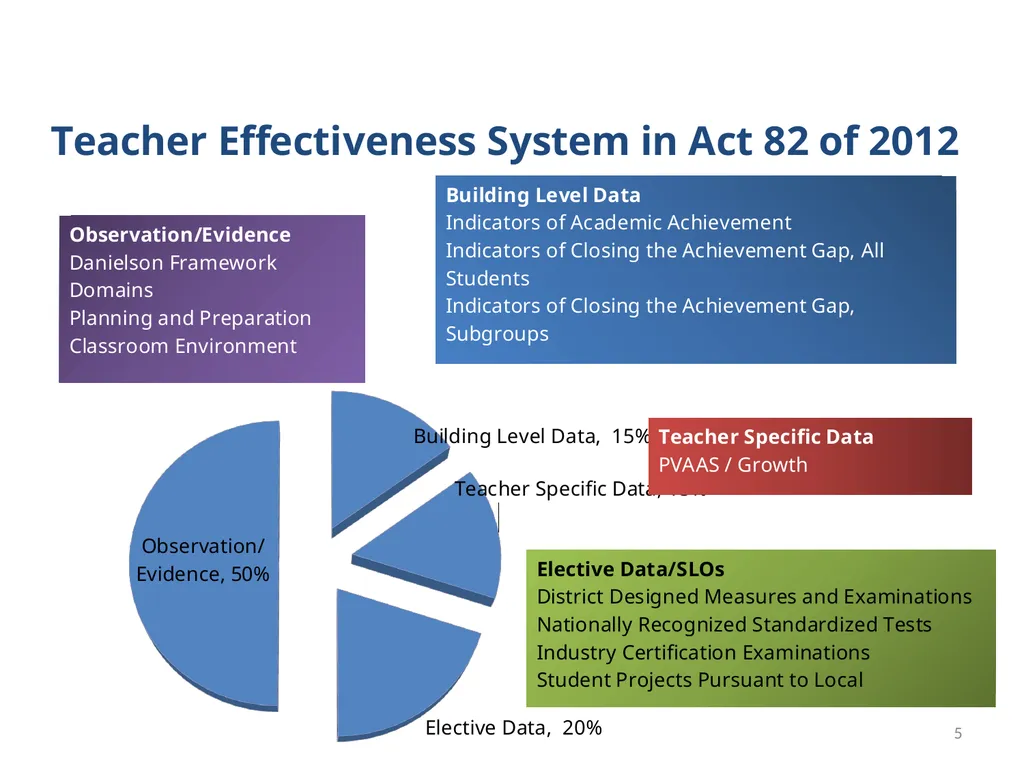
slide5. 5<br>
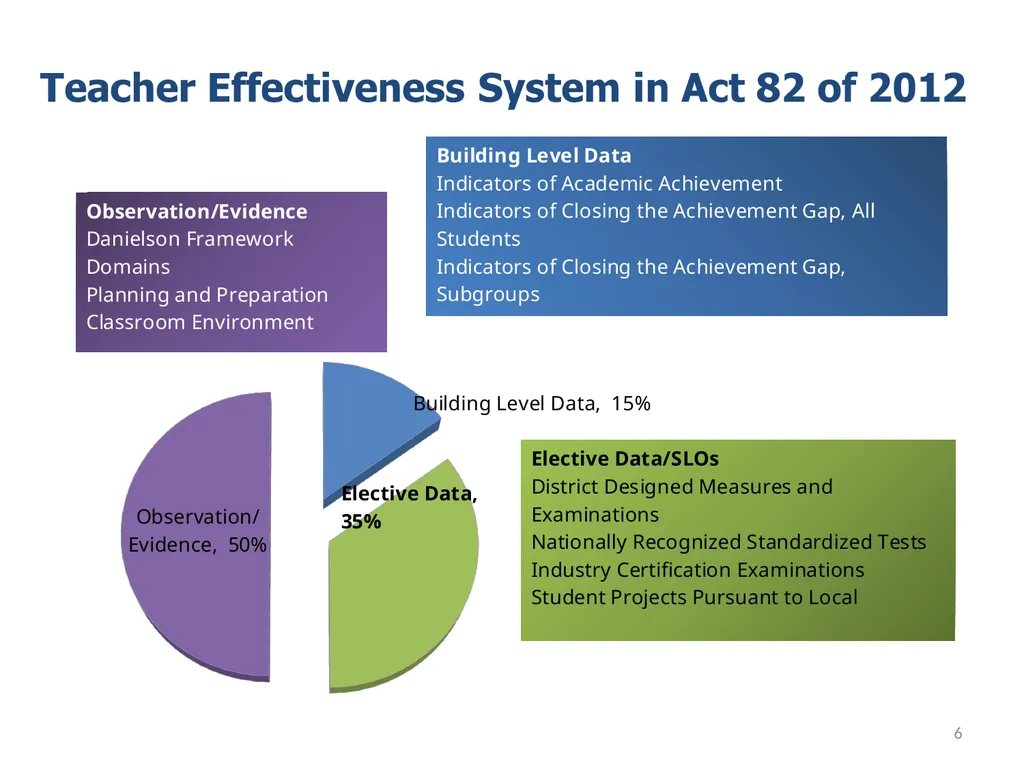
slide6. 6<br>
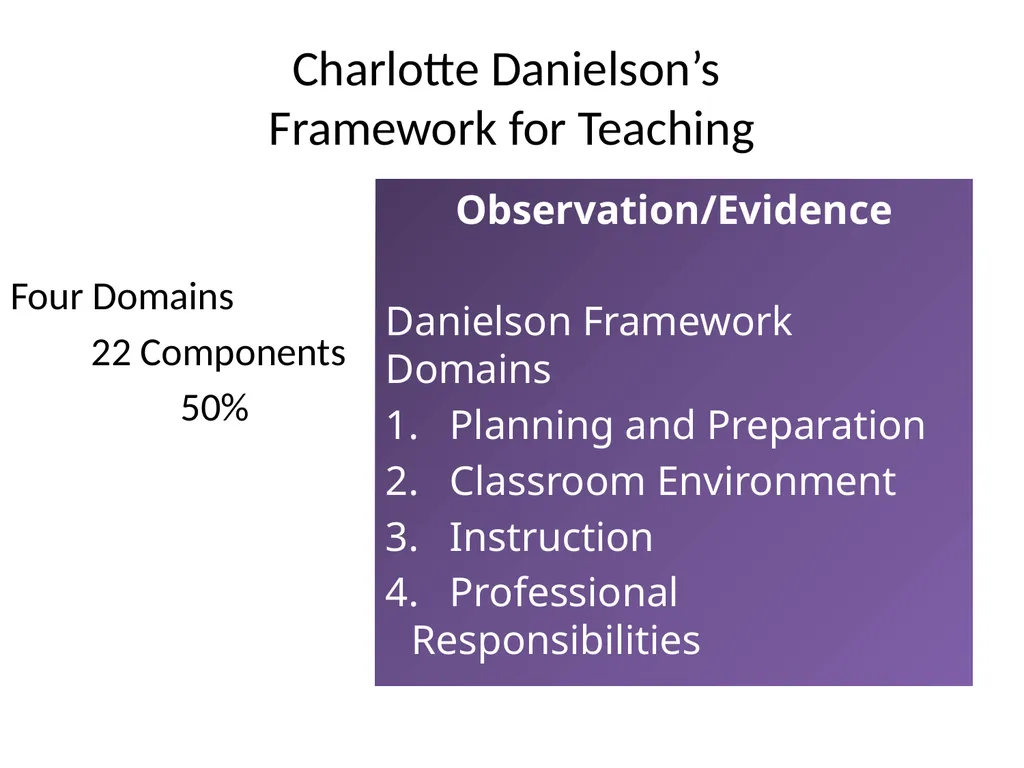
slide7. Charlotte Danielson’s Framework for Teaching Four Domains
22 Components
50% Observation/Evidence
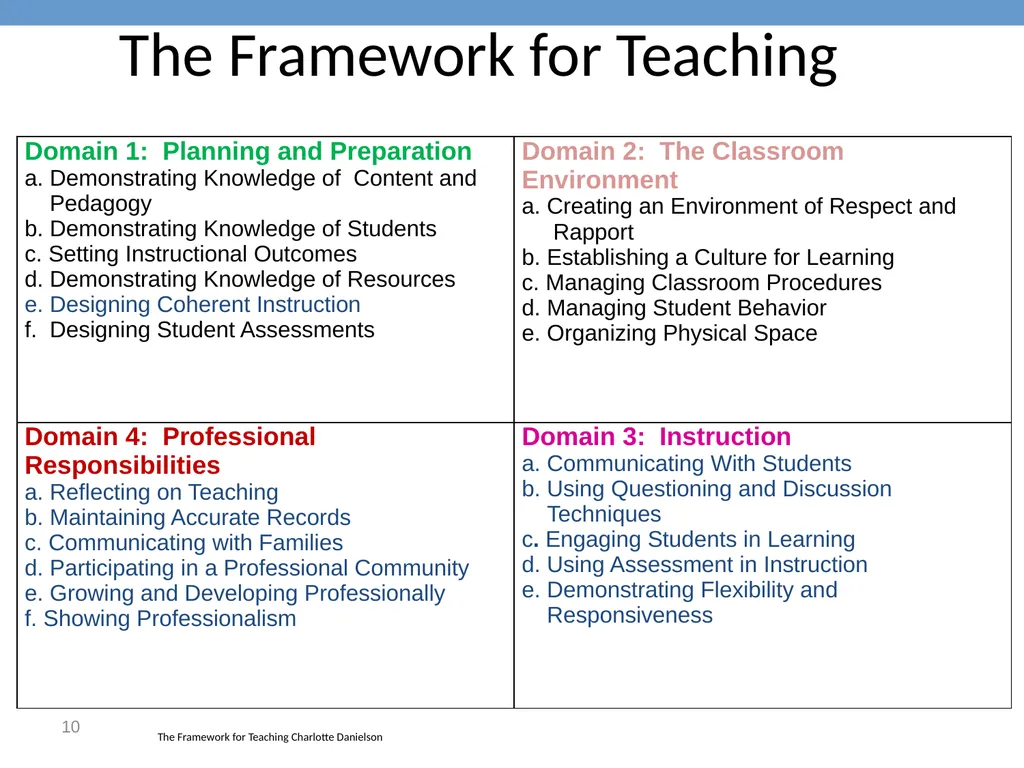
Danielson Framework Domains
Planning and Preparation
Classroom Environment
Instruction
Professional Responsibilities<br>
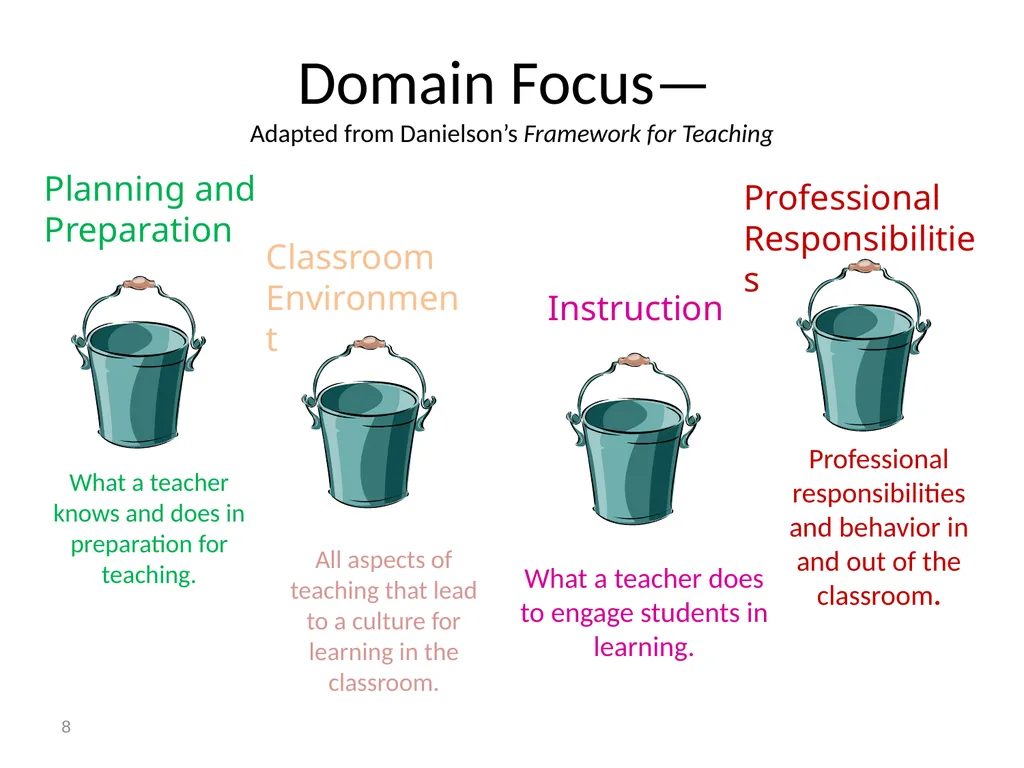
slide8. 8 Domain Focus— Adapted from Danielson’s Framework for Teaching 8 Planning and Preparation Classroom
Environment Instruction Professional
Responsibilities What a teacher knows and does in preparation for teaching. All aspects of teaching that lead to a culture for learning in the classroom. Professional responsibilities and behavior in and out of the classroom. What a teacher does to engage students in learning.<br>
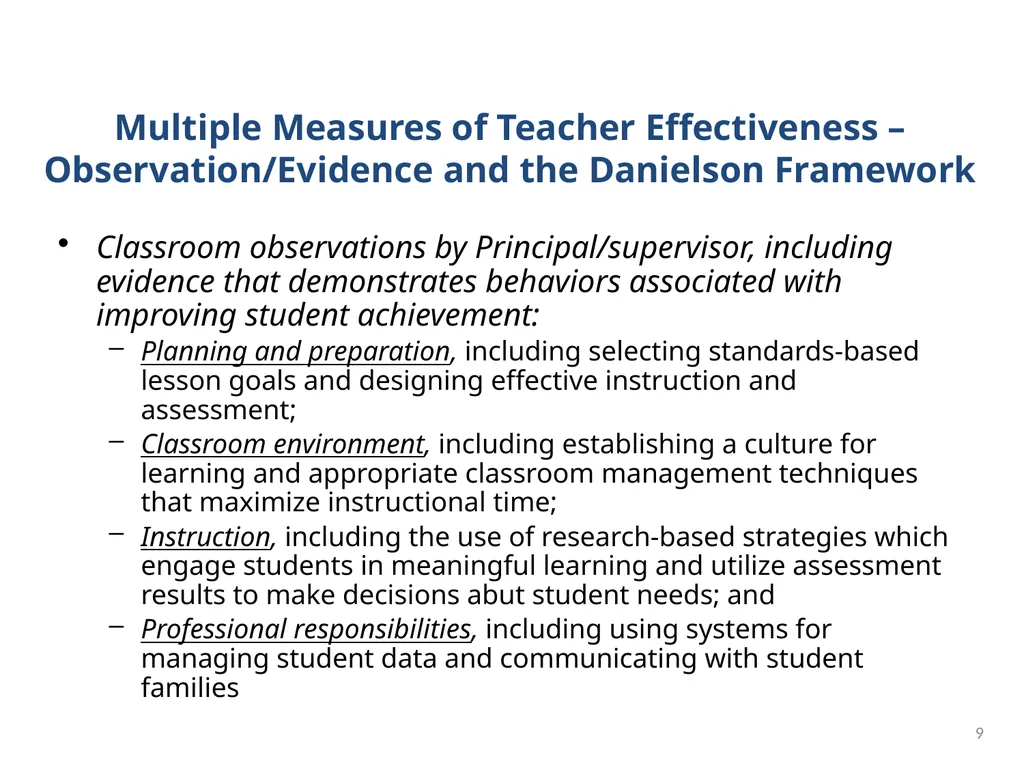
slide9. Multiple Measures of Teacher Effectiveness – Observation/Evidence and the Danielson Framework Classroom observations by Principal/supervisor, including evidence that demonstrates behaviors associated with improving student achievement:
Planning and preparation, including selecting standards-based lesson goals and designing effective instruction and assessment;
Classroom environment, including establishing a culture for learning and appropriate classroom management techniques that maximize instructional time;
Instruction, including the use of research-based strategies which engage students in meaningful learning and utilize assessment results to make decisions abut student needs; and
Professional responsibilities, including using systems for managing student data and communicating with student families 9<br>
slide10. 10 10 The Framework for Teaching The Framework for Teaching Charlotte Danielson<br>
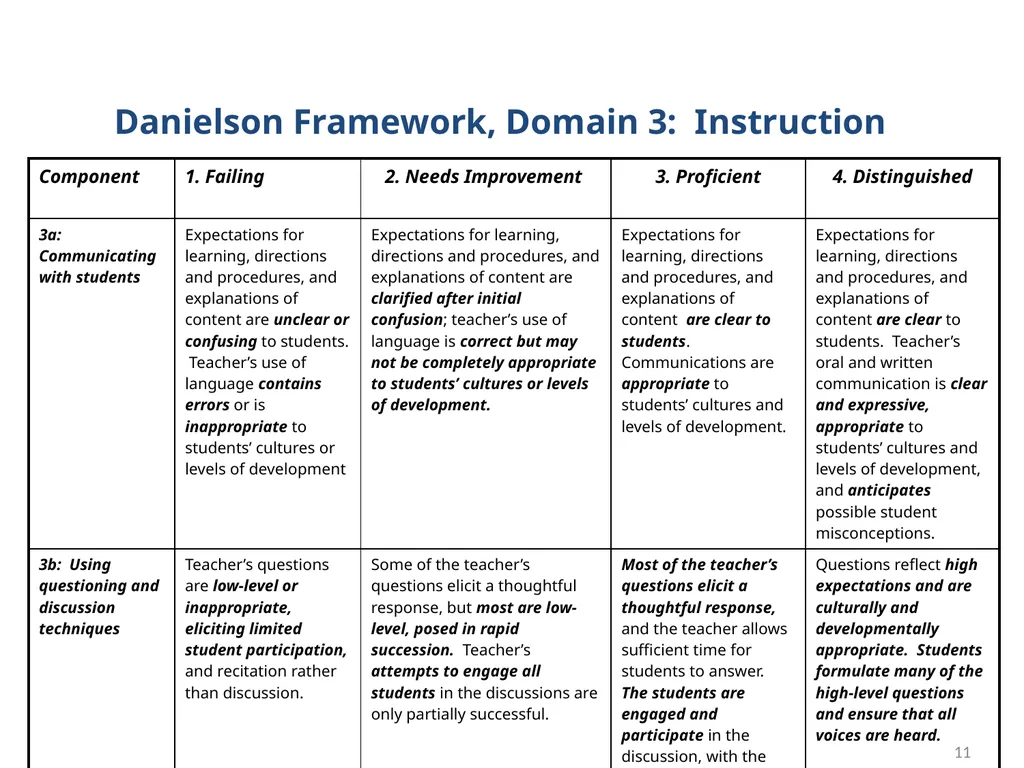
slide11. Danielson Framework, Domain 3: Instruction 11<br>
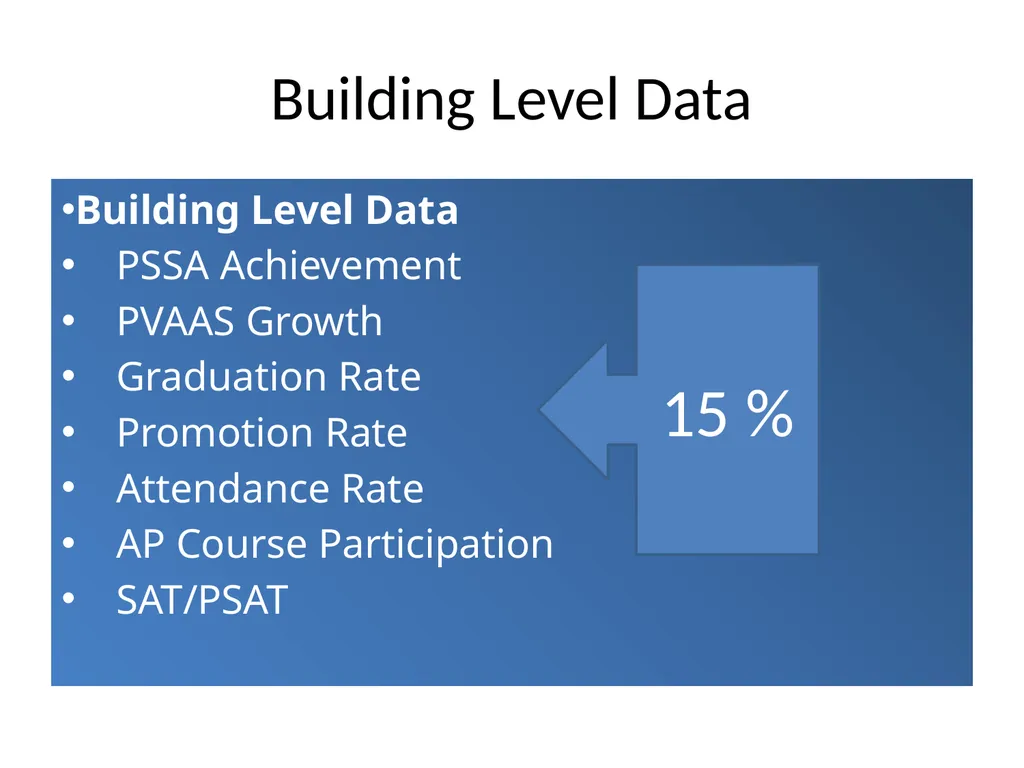
slide12. Building Level Data Building Level Data
PSSA Achievement
PVAAS Growth
Graduation Rate
Promotion Rate
Attendance Rate
AP Course Participation
SAT/PSAT Building Level Data
PSSA Achievement
PVAAS Growth
Graduation Rate
Promotion Rate
Attendance Rate
AP Course Participation
SAT/PSAT 15 %<br>
slide13. Teacher Specific/Elective Data Teacher Specific Data
PSSA Achievement
PVAAS Growth
IEP Growth
Locally Developed District Rubrics Elective Data/SLOs
District Designed Measures and Examinations
Nationally Recognized Standardized Tests
Industry Certification Examinations
Student Projects Pursuant to Local Requirements
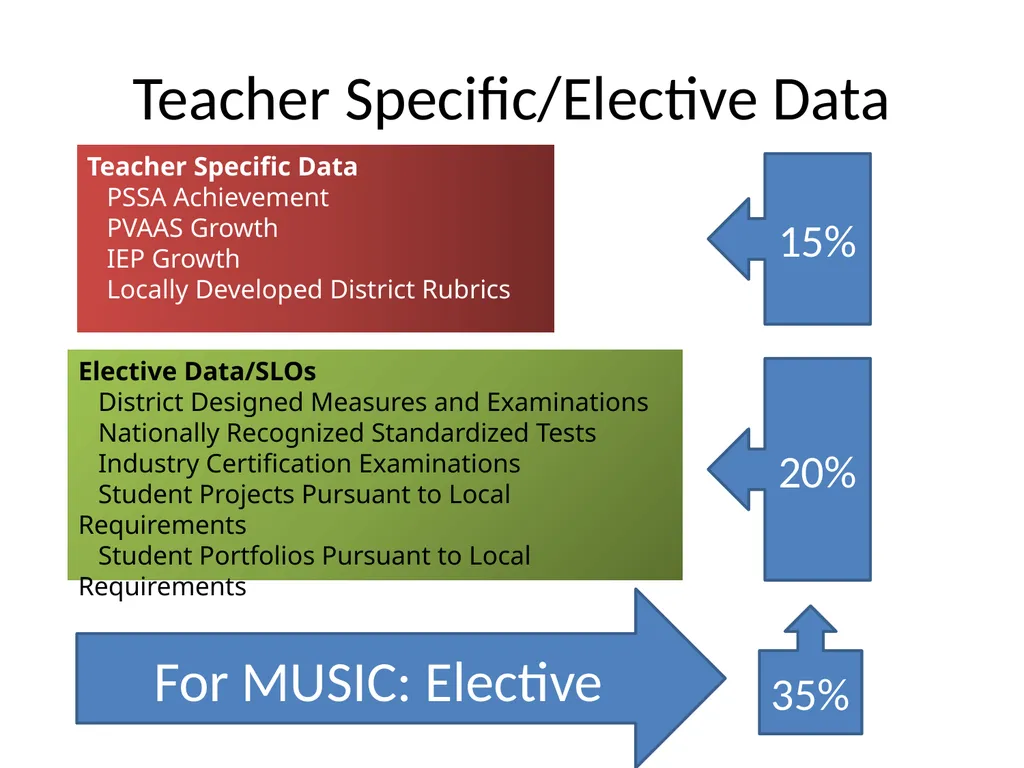
Student Portfolios Pursuant to Local Requirements 15% 20% 35% For MUSIC: Elective<br>
slide14. What are some ways to develop evidence of student achievement in non-tested grades and subjects?<br>
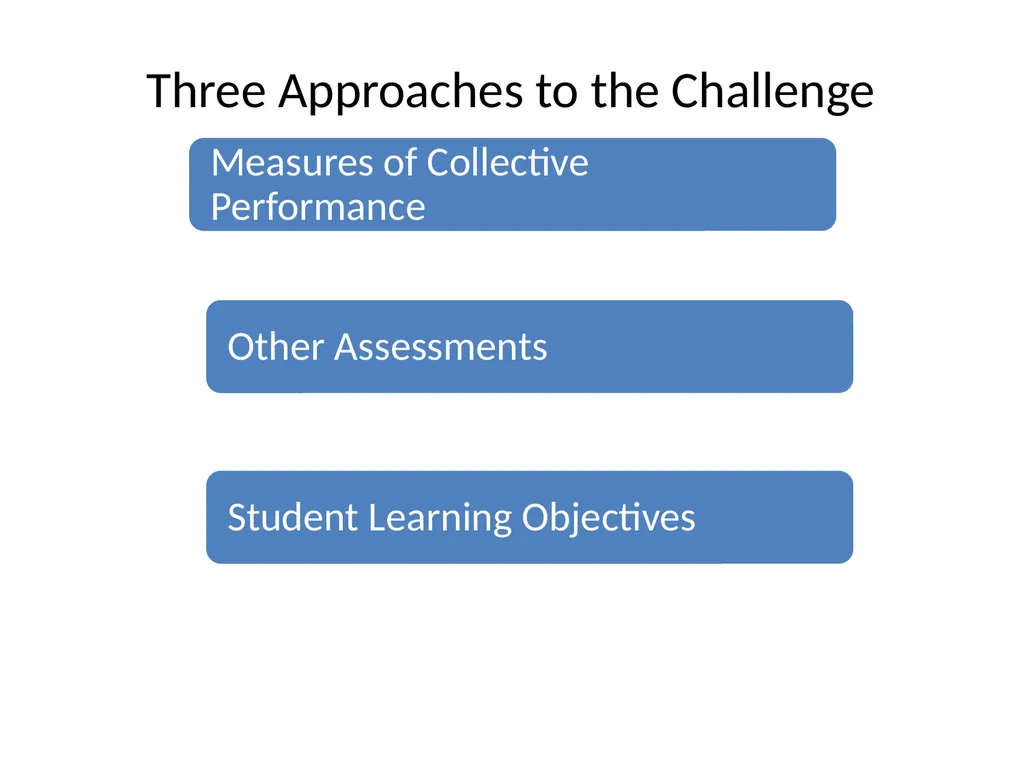
slide15. Three Approaches to the Challenge<br>
slide19. What are other states/schools using for non-tested grades and subjects?<br>
slide20. What is PA planning to do? Student Learning Objectives with Model Assessments<br>
slide21. Why this approach? The “other assessment” approach causes narrowing of curriculum and is not financially sustainable.
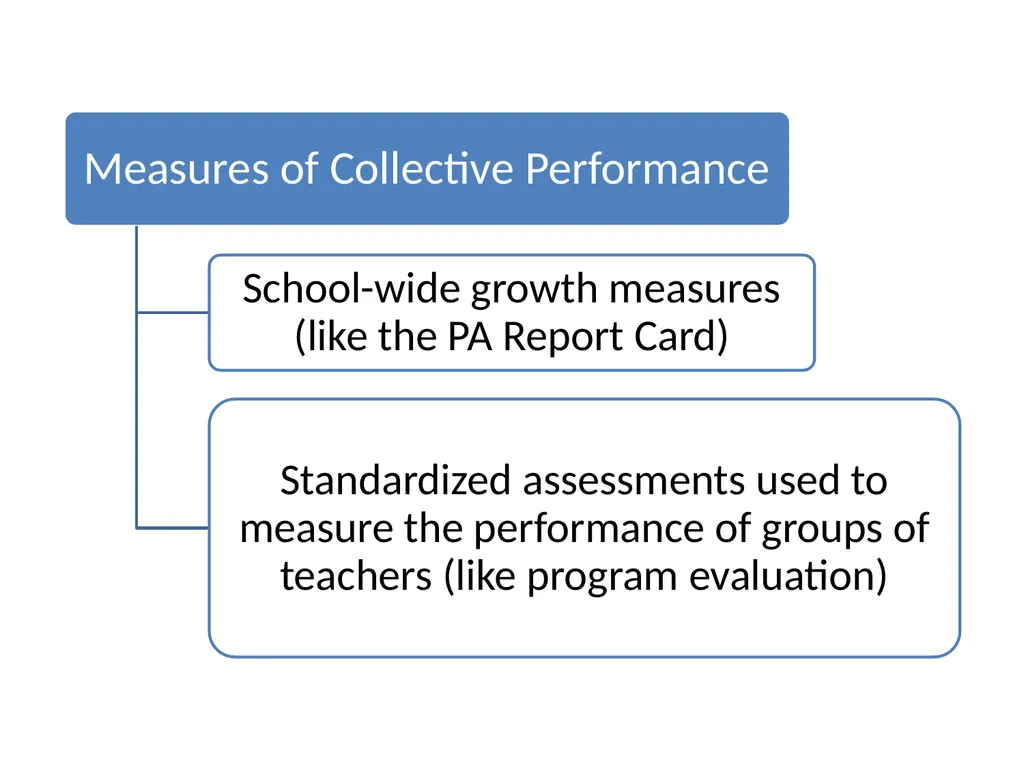
The “measures of collective performance” are already included in the formula (required by Race to the Top) and do not offer NTGS teachers an opportunity to be evaluated on what they actually teach.
SLOs that don’t describe the assessment protocol tend to lack a true learning focus.<br>
slide22. SLO Concepts Student achievement can be measured in ways that reflect authentic learning of content standards.
Educator effectiveness can be measured through use of student achievement measures.<br>
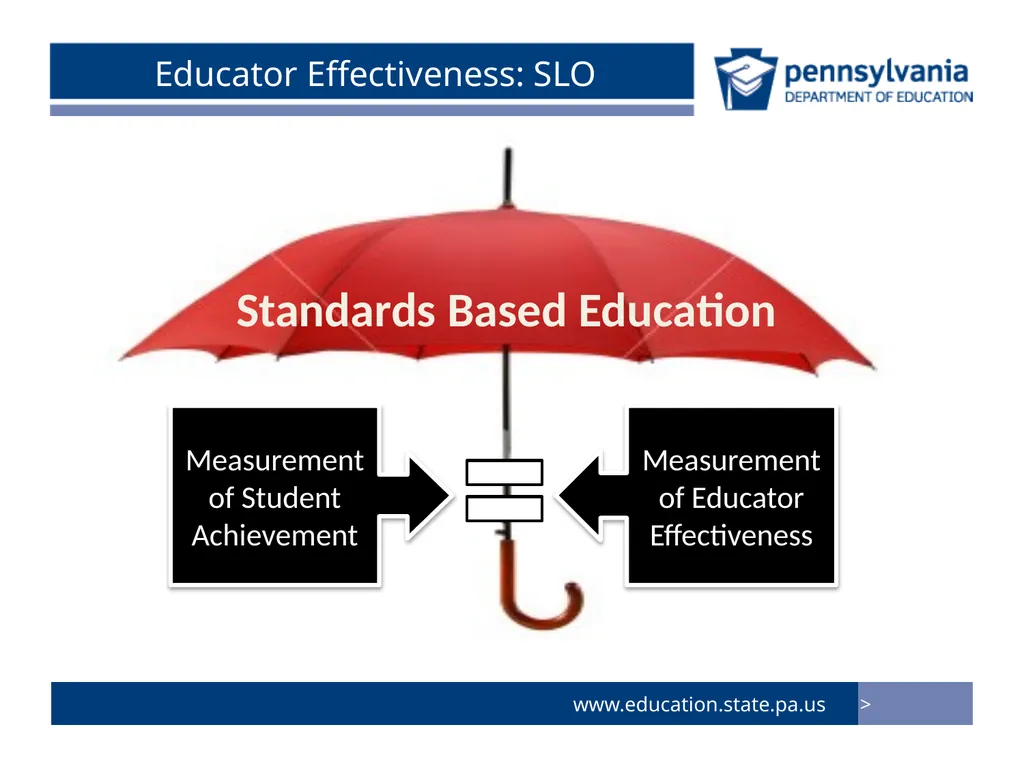
slide23. Standards Based Education Measurement of Student Achievement Measurement of Educator Effectiveness<br>
slide24. What knowledge and skills might be needed to develop an SLO?<br>
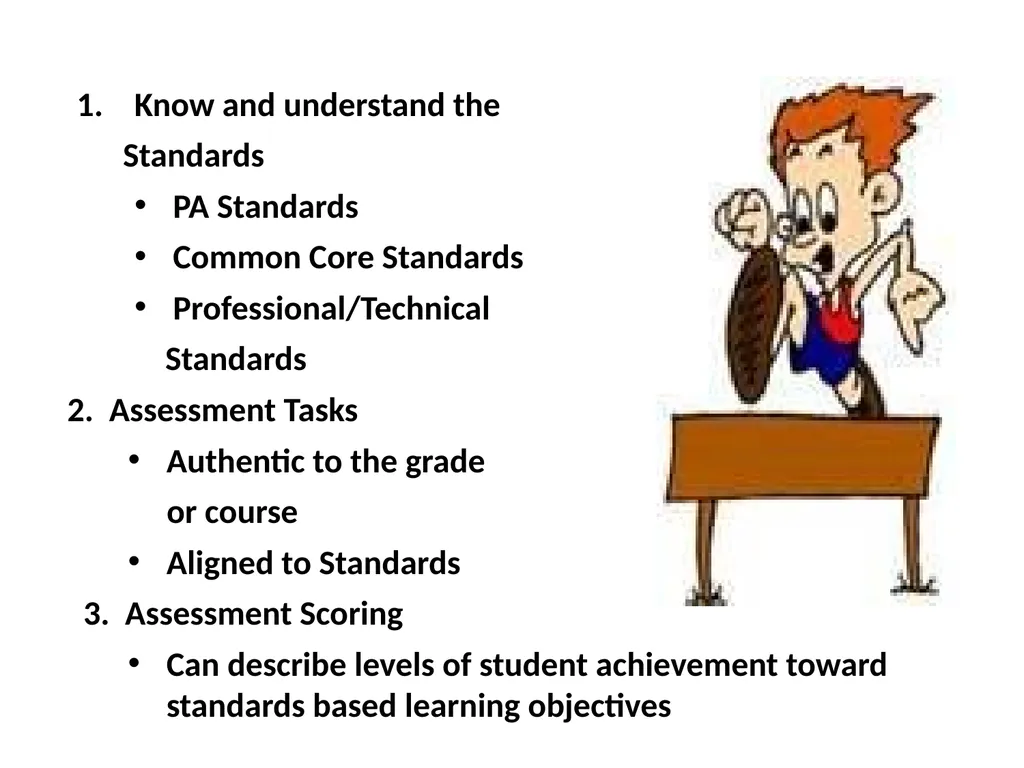
slide25. Know and understand the
Standards
PA Standards
Common Core Standards
Professional/Technical
Standards
2. Assessment Tasks
Authentic to the grade
or course
Aligned to Standards
3. Assessment Scoring
Can describe levels of student achievement toward standards based learning objectives<br>
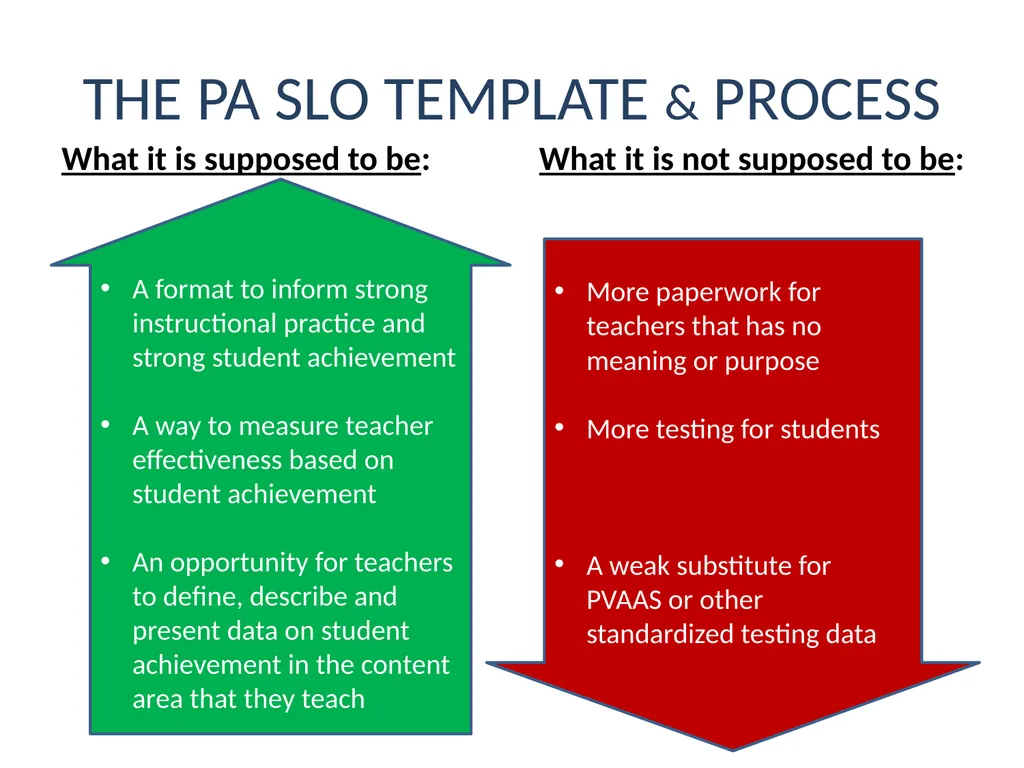
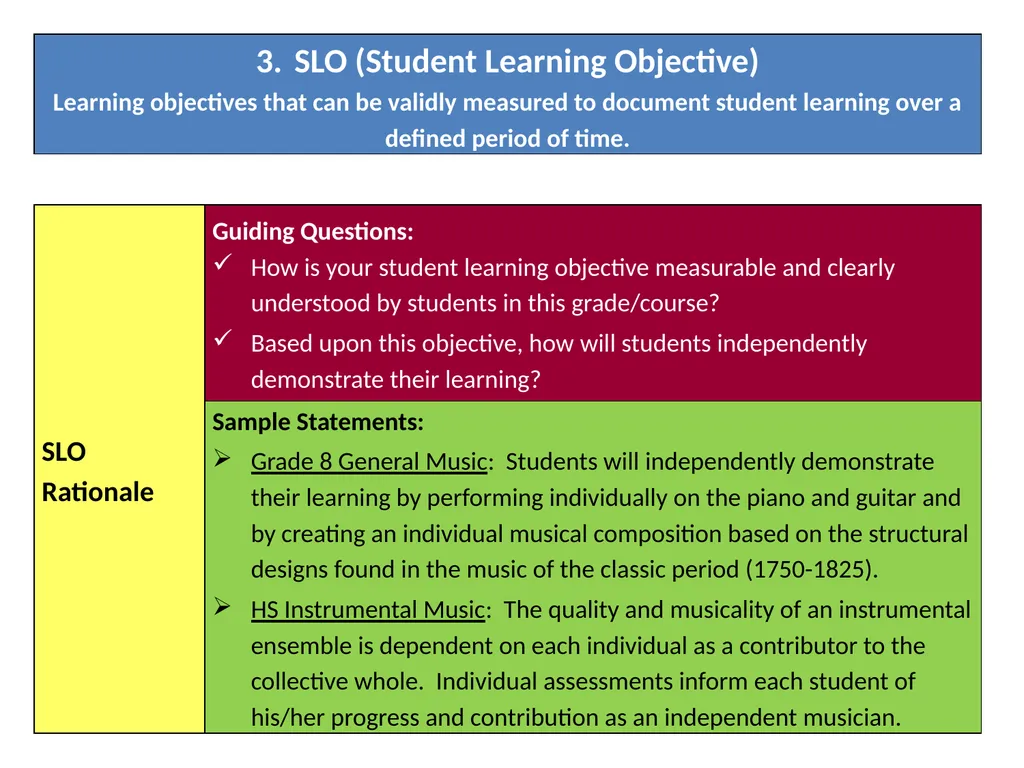
slide26. THE PA SLO TEMPLATE & PROCESS What it is supposed to be: What it is not supposed to be: More paperwork for teachers that has no meaning or purpose
More testing for students
A weak substitute for PVAAS or other standardized testing data More paperwork for teachers that has no meaning or purpose
More testing for students
A weak substitute for PVAAS or other standardized testing data A format to inform strong instructional practice and strong student achievement
A way to measure teacher effectiveness based on student achievement
An opportunity for teachers to define, describe and present data on student achievement in the content area that they teach<br>
slide27. PA Educator Challenge To develop and implement an appropriately
rigorous measure of teacher effectiveness based
on student achievement in your content area
through the use of the PA SLO Template.<br>
slide28. The Approach Provide a method for teachers to write SLOs.
Provide a method for teachers to design assessments appropriate to the SLO.
Provide piloted and peer-reviewed models on the PDE SAS website.
Provide professional development appropriate to SLO development. The Methodology:
AN SLO TEMPLATE<br>
slide29. STUDENT LEARNING OBJECTIVE TEMPLATE
A format to provide a measure of teacher effectiveness based on student achievement of content standards, as applicable to
the “Elective Data” portion of the Teacher Effectiveness System
in Act 82 (HB 1901).<br>
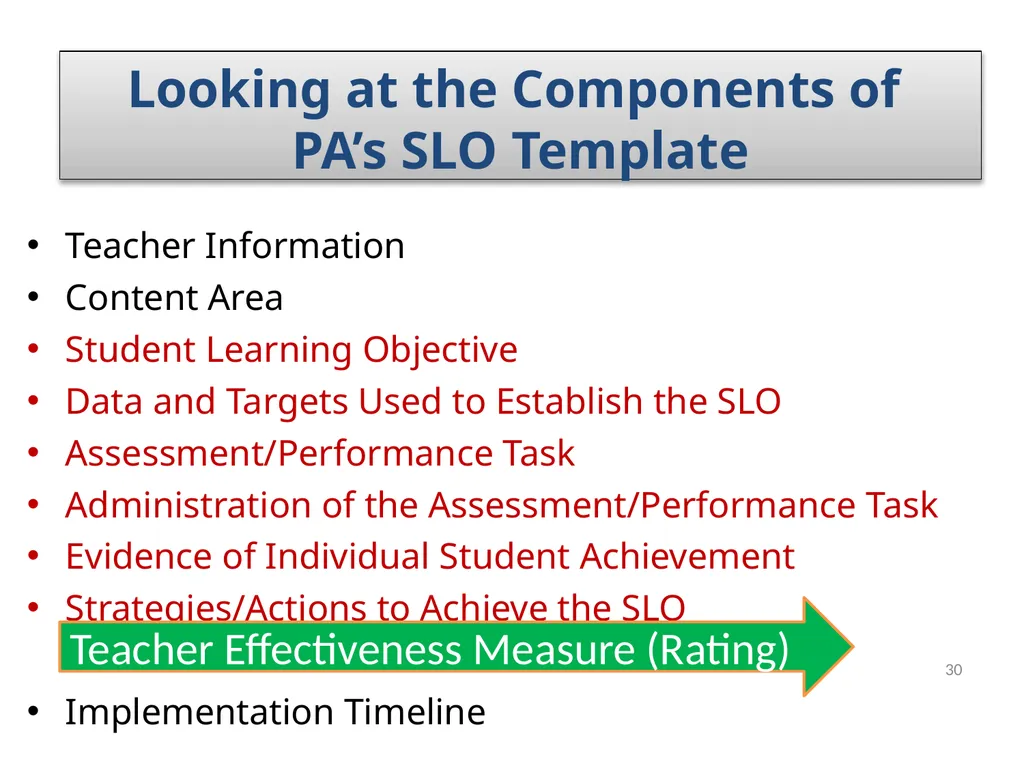
slide30. Looking at the Components of PA’s SLO Template Teacher Information
Content Area
Student Learning Objective
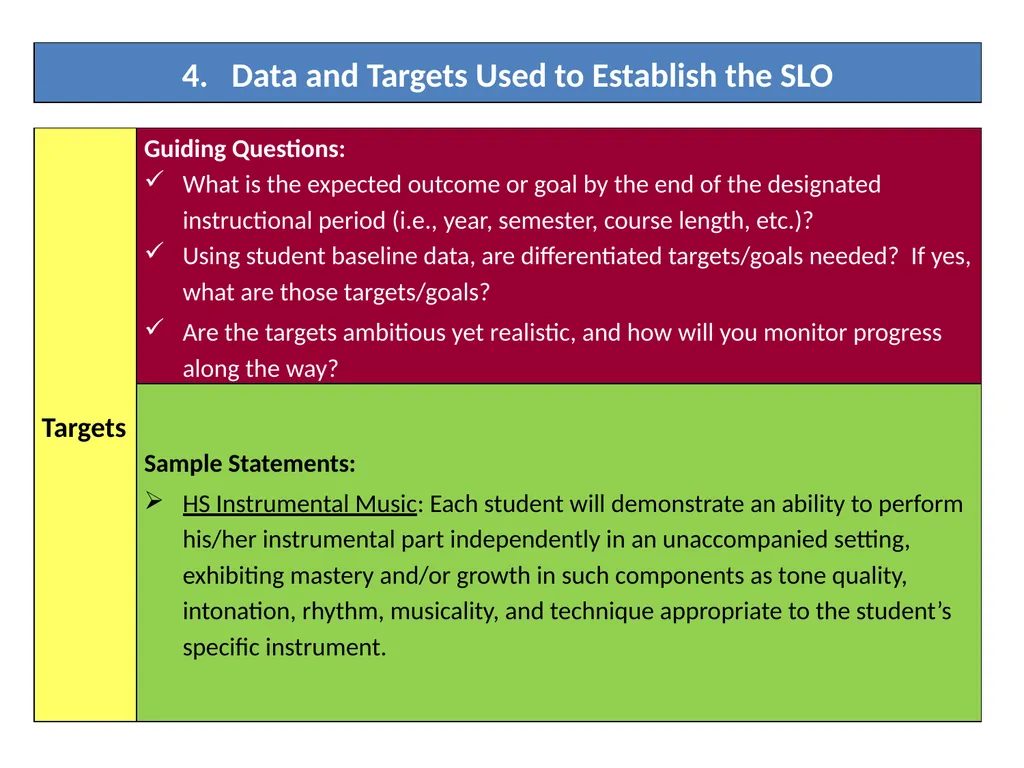
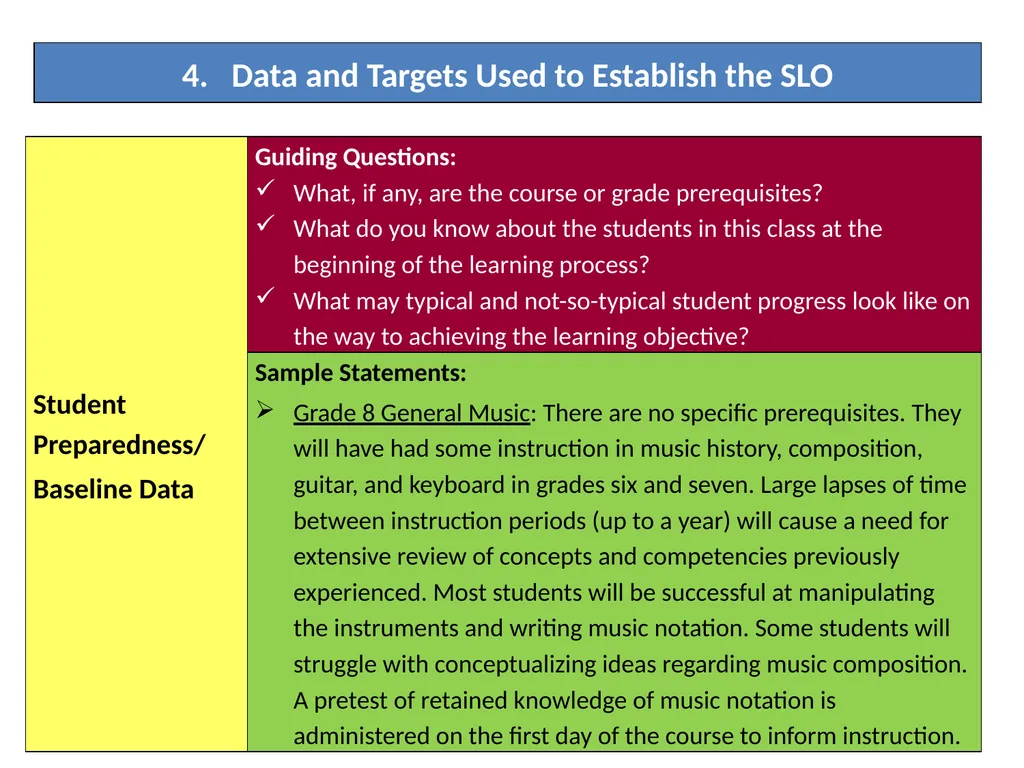
Data and Targets Used to Establish the SLO
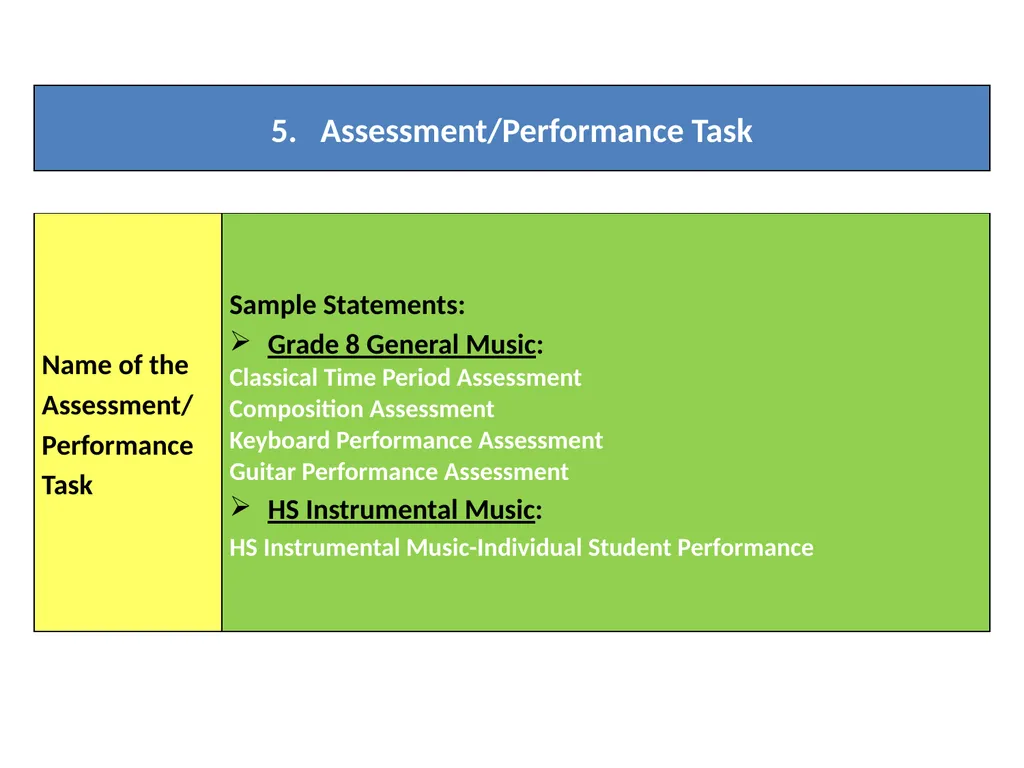
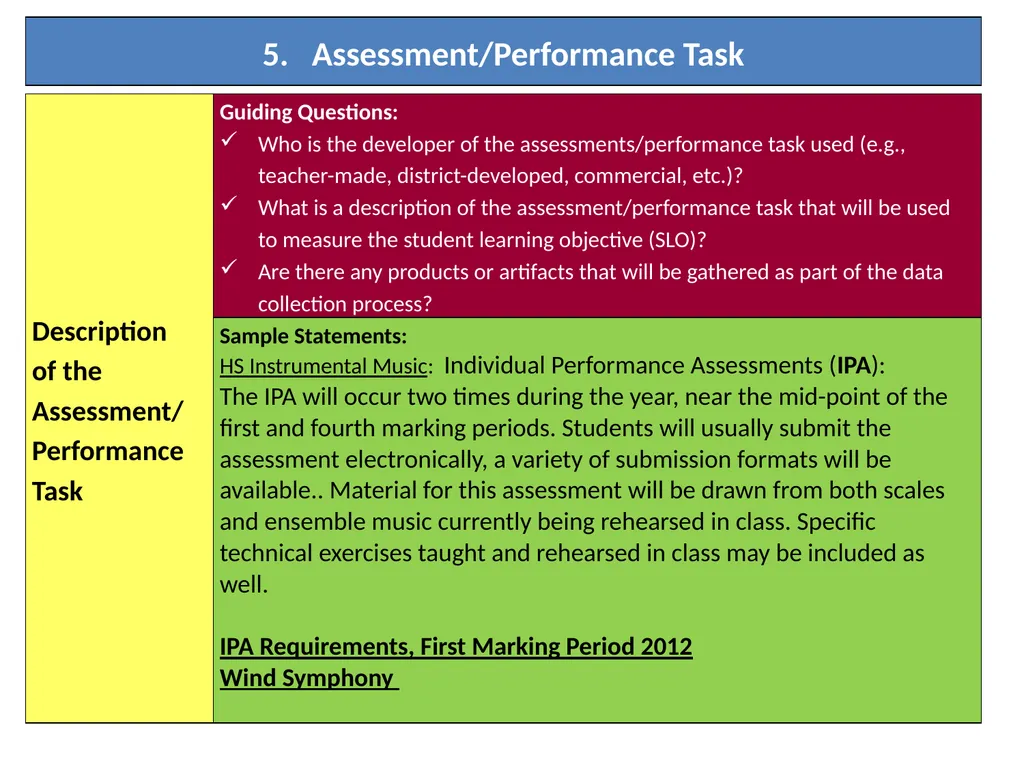
Assessment/Performance Task
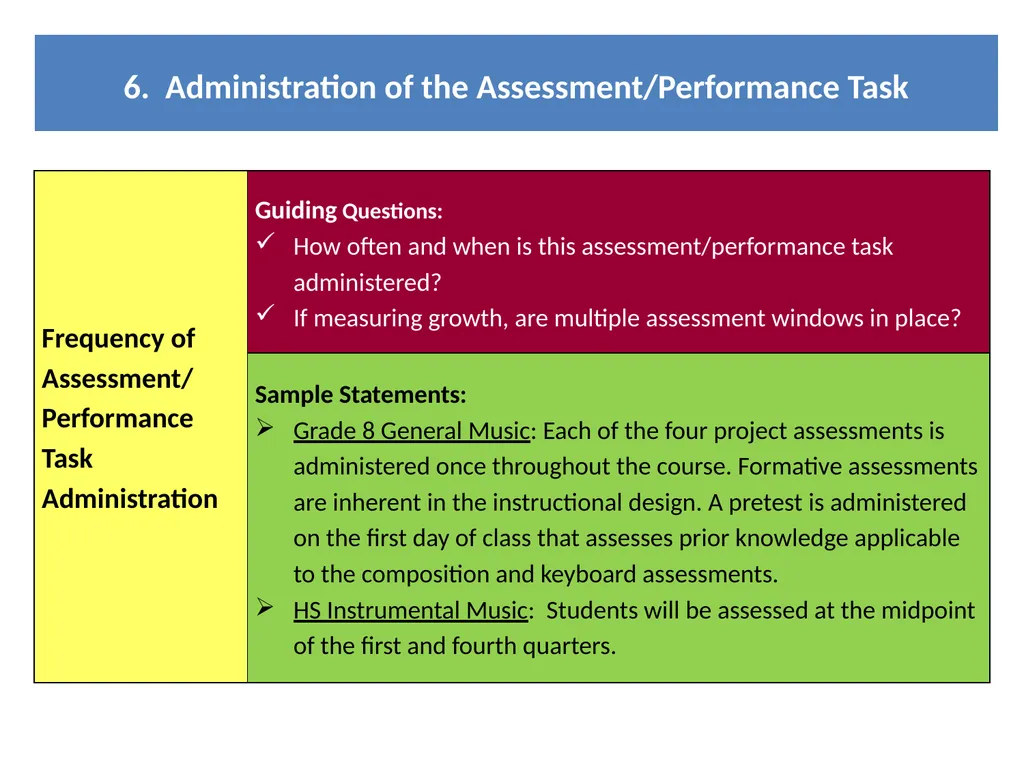
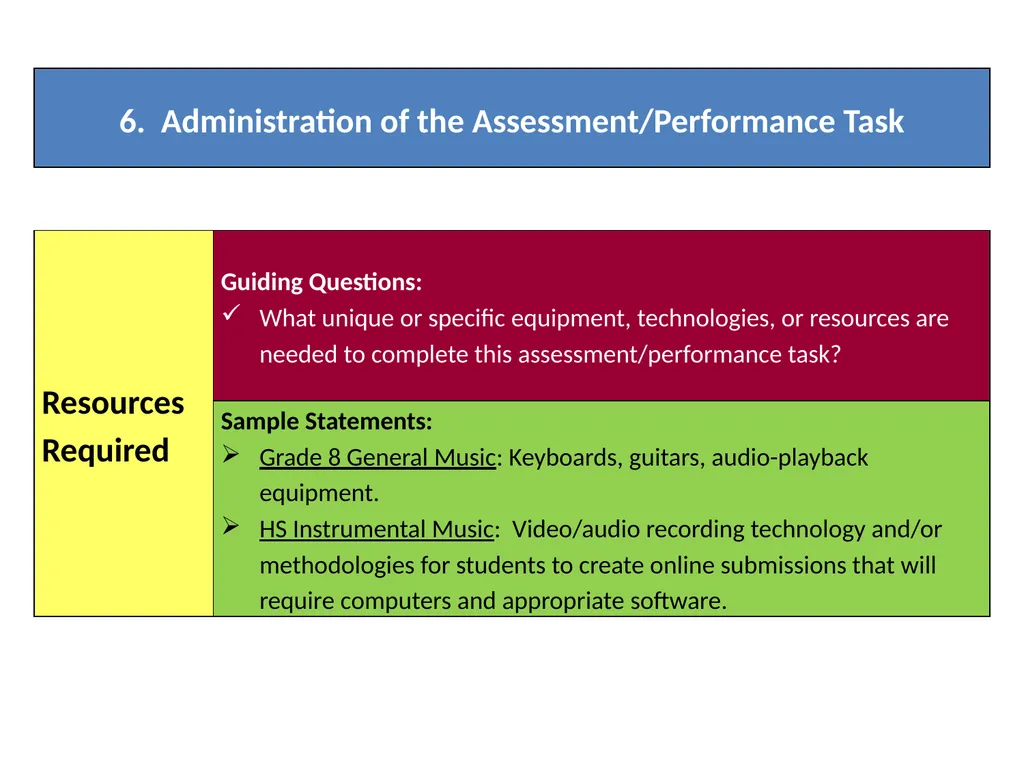
Administration of the Assessment/Performance Task
Evidence of Individual Student Achievement
Strategies/Actions to Achieve the SLO
Implementation Timeline 30 Teacher Effectiveness Measure (Rating)<br>
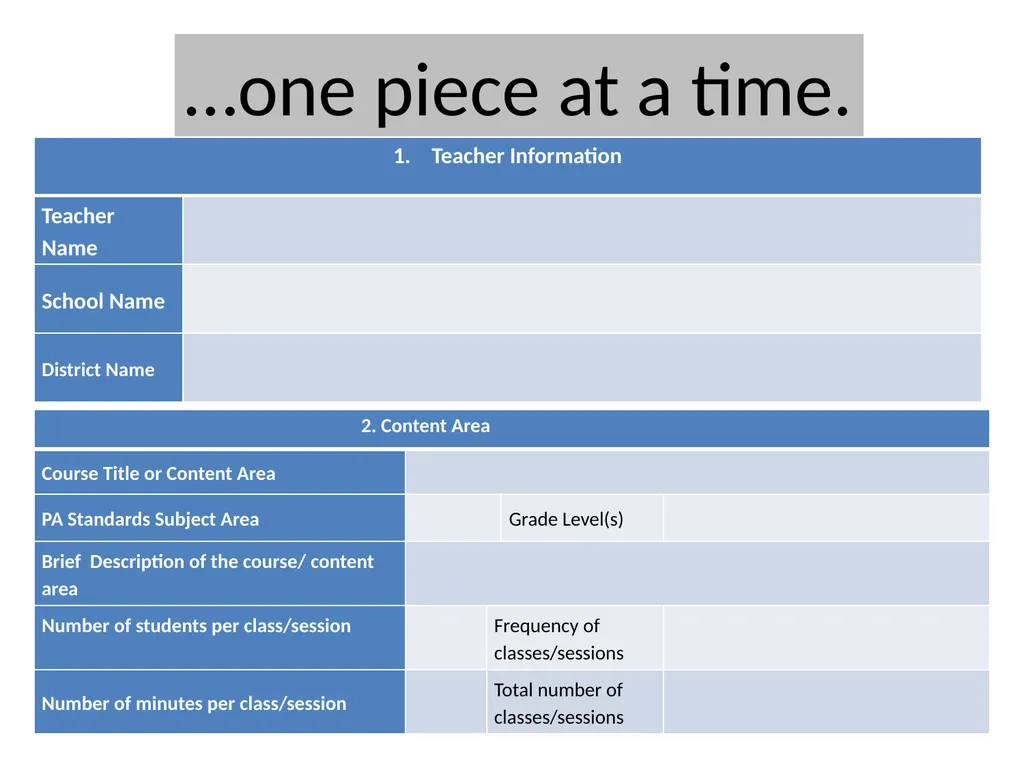
slide31. …one piece at a time.<br>
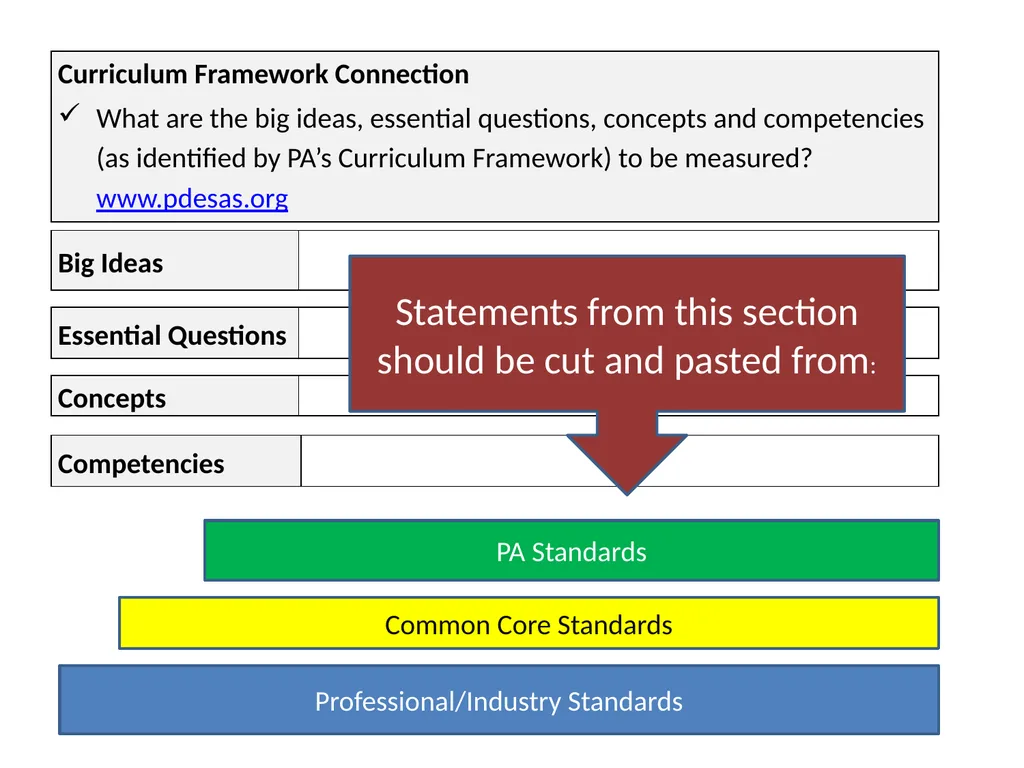
slide36. Professional/Industry Standards Common Core Standards PA Standards Statements from this section should be cut and pasted from:<br>
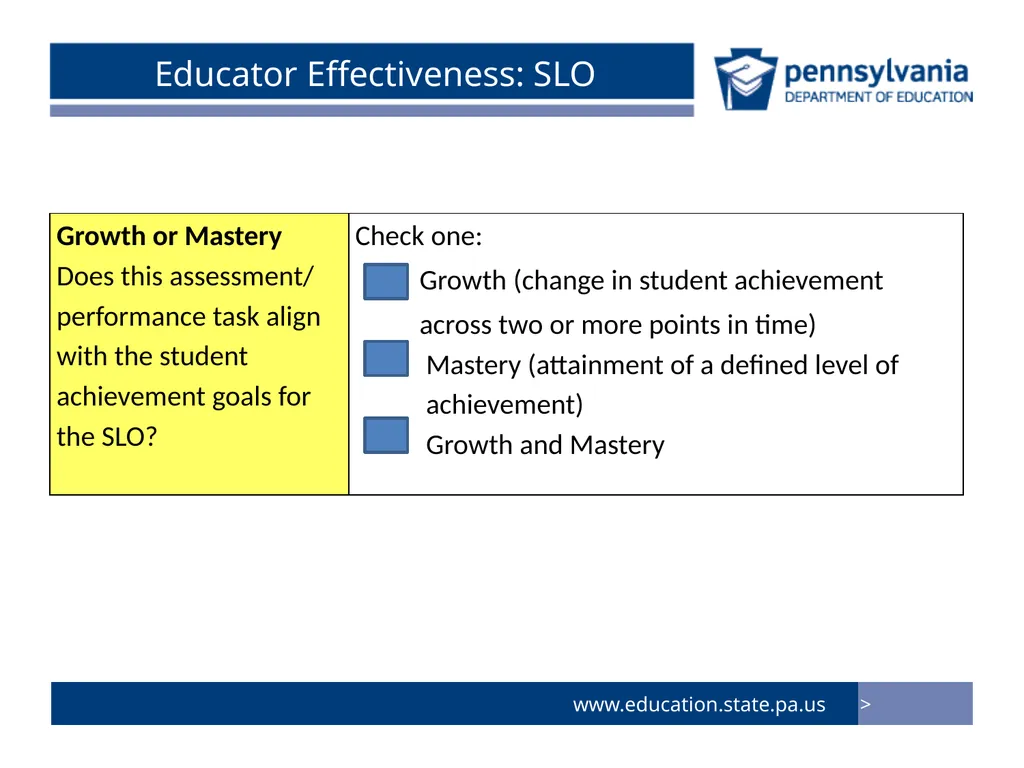
slide41. > www.education.state.pa.us Educator Effectiveness: SLO<br>
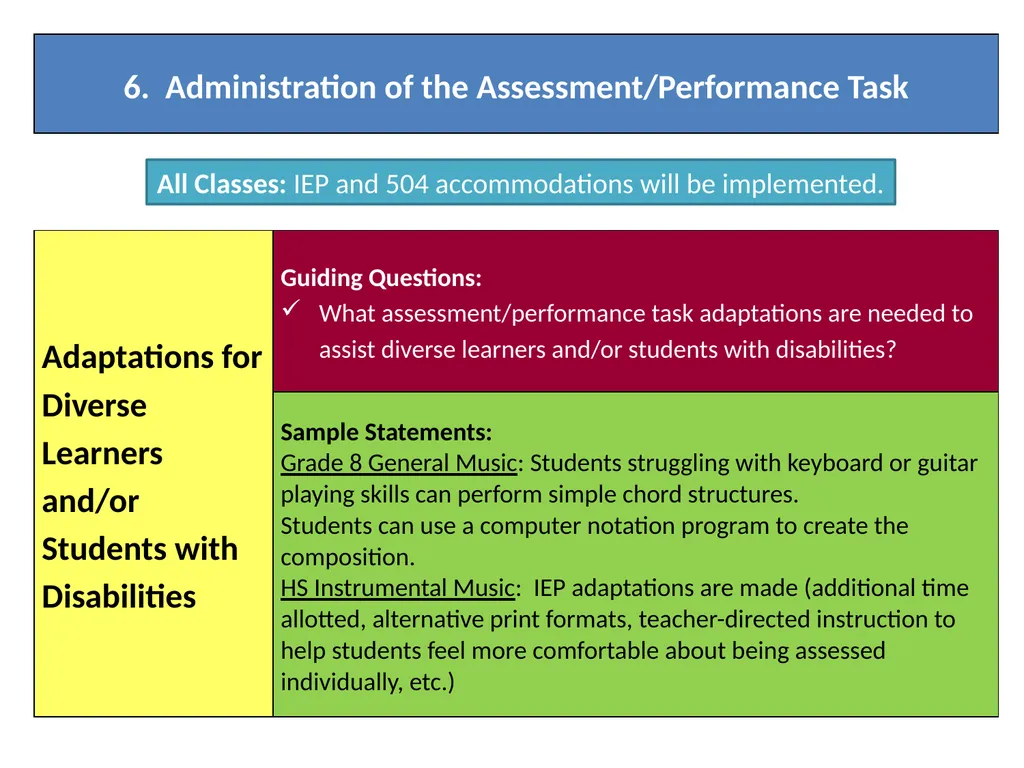
slide44. All Classes: IEP and 504 accommodations will be implemented.<br>
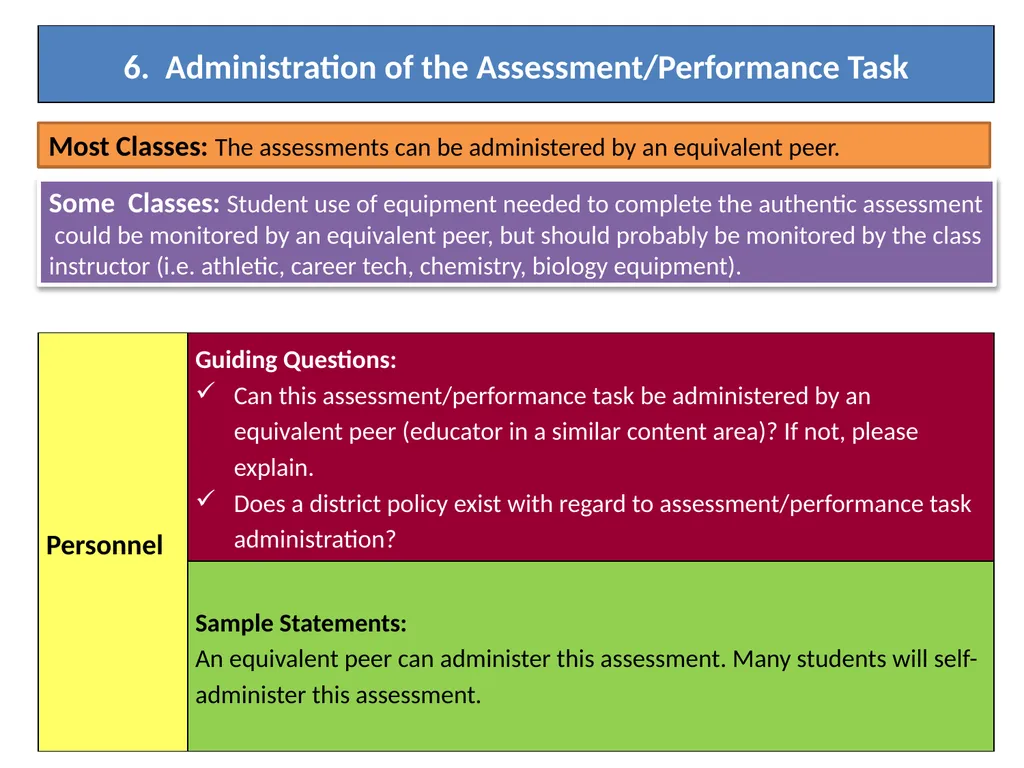
slide45. Most Classes: The assessments can be administered by an equivalent peer. Some Classes: Student use of equipment needed to complete the authentic assessment could be monitored by an equivalent peer, but should probably be monitored by the class instructor (i.e. athletic, career tech, chemistry, biology equipment).<br>
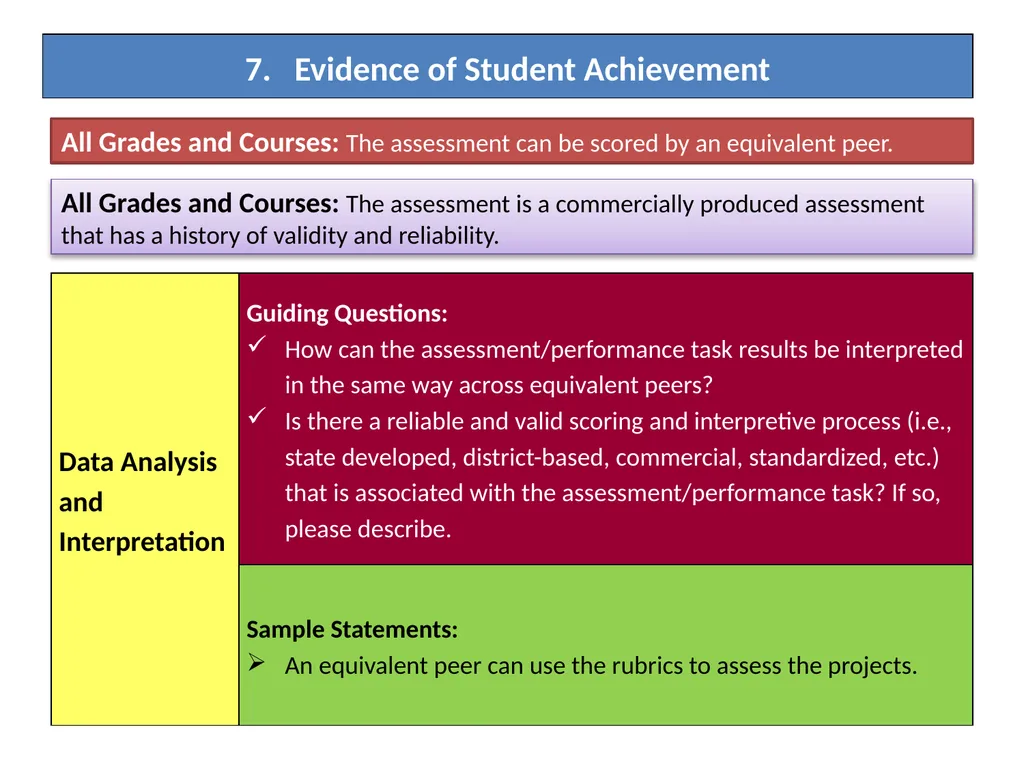
slide51. All Grades and Courses: The assessment can be scored by an equivalent peer. All Grades and Courses: The assessment is a commercially produced assessment that has a history of validity and reliability.<br>
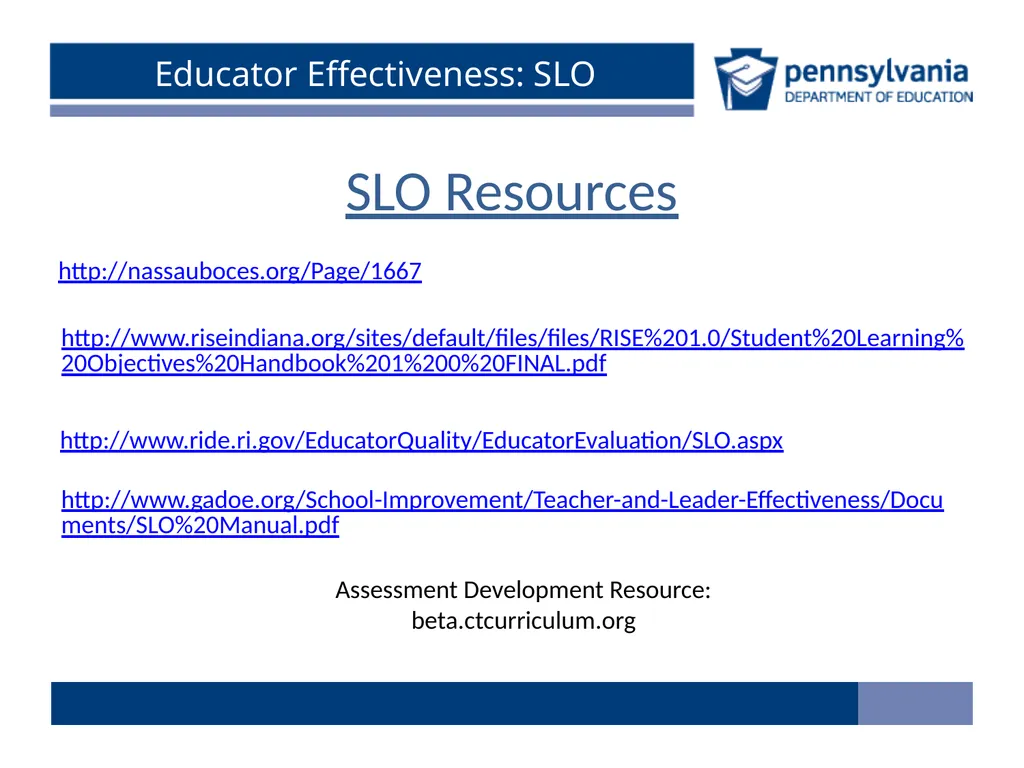
slide54. SLO Resources http://nassauboces.org/Page/1667 http://www.riseindiana.org/sites/default/files/files/RISE%201.0/Student%20Learning%20Objectives%20Handbook%201%200%20FINAL.pdf http://www.ride.ri.gov/EducatorQuality/EducatorEvaluation/SLO.aspx http://www.gadoe.org/School-Improvement/Teacher-and-Leader-Effectiveness/Documents/SLO%20Manual.pdf Assessment Development Resource:
beta.ctcurriculum.org<br>
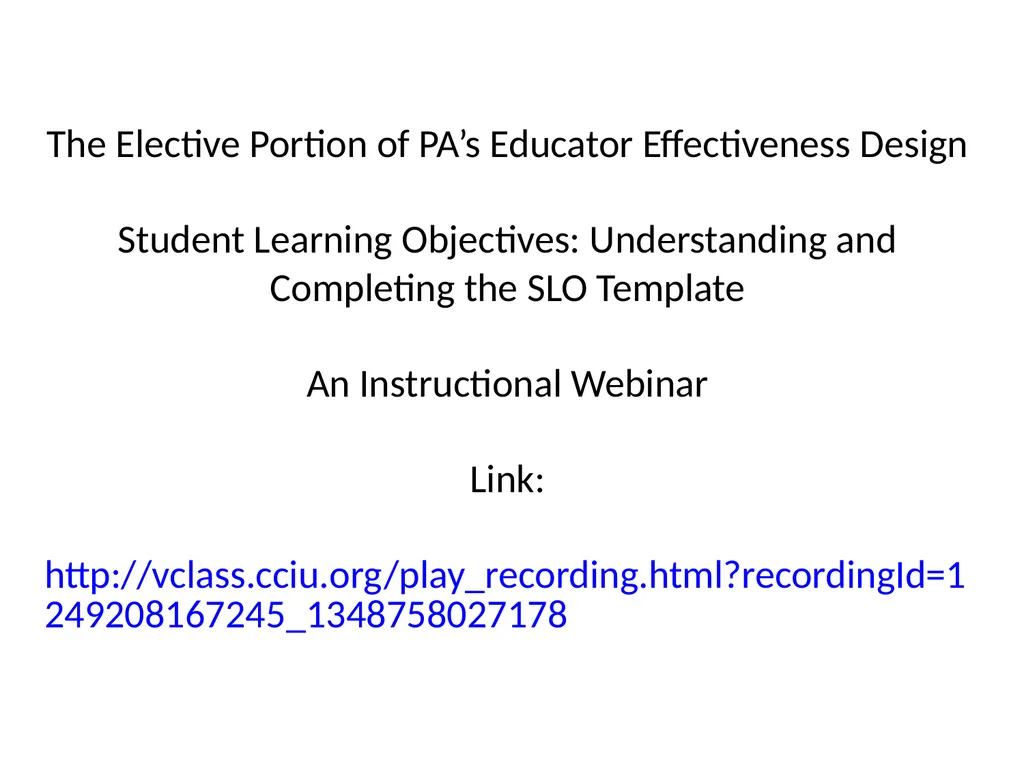
slide55. The Elective Portion of PA’s Educator Effectiveness Design
Student Learning Objectives: Understanding and Completing the SLO Template
An Instructional Webinar
Link:
http://vclass.cciu.org/play_recording.html?recordingId=1249208167245_1348758027178<br>
slide56. Contact:
O. David Deitz
SLO Project Lead, Educator Effectiveness
oddeitz@comcast.net
THANK YOU!<br>

slide2. (there are still a lot of questions to be asked and answered!) ?<br>
slide3. Big Idea: An effective teacher in every classroom.<br>
slide4. House Bill 1901 (B) FOR PROFESSIONAL EMPLOYES AND TEMPORARY PROFESSIONAL
EMPLOYES WHO SERVE AS CLASSROOM TEACHERS, THE FOLLOWING SHALL APPLY:
(1) BEGINNING IN THE 2013-201 4 SCHOOL YEAR, THE EVALUATIO N
OF THE EFFECTIVENESS OF PROFESSIONAL EMPLOYES AND TEMPORARY
PROFESSIONAL EMPLOYES SERVING AS CLASSROOM TEACHERS SHALL GIVE
DUE CONSIDERATION TO THE FOLLOWING:
(I) CLASSROOM OBSERVATION AND PRACTICE MODELS THAT ARE
RELATED TO STUDENT ACHIEVEMENT IN EACH OF THE FOLLOWING AREAS:
(A) PLANNING AND PREPARATION.
(B) CLASSROOM ENVIRONMENT.
(C) INSTRUCTION.
(D) PROFESSIONAL RESPONSIBILITIES.
(II) STUDENT PERFORMANCE, WHICH SHALL COMPRISE FIFTY PER
CENTUM (50%) OF THE OVERALL RATING OF THE PROFESSIONAL EMPLOYE
OR TEMPORARY PROFESSIONAL EMPLOYE SERVING AS A CLASSROOM TEACHER
AND SHALL BE BASED UPON MULTIPLE MEASURES OF
STUDENT ACHIEVEMENT. Race to the Top<br>
slide5. 5<br>
slide6. 6<br>
slide7. Charlotte Danielson’s Framework for Teaching Four Domains
22 Components
50% Observation/Evidence
Danielson Framework Domains
Planning and Preparation
Classroom Environment
Instruction
Professional Responsibilities<br>
slide8. 8 Domain Focus— Adapted from Danielson’s Framework for Teaching 8 Planning and Preparation Classroom
Environment Instruction Professional
Responsibilities What a teacher knows and does in preparation for teaching. All aspects of teaching that lead to a culture for learning in the classroom. Professional responsibilities and behavior in and out of the classroom. What a teacher does to engage students in learning.<br>
slide9. Multiple Measures of Teacher Effectiveness – Observation/Evidence and the Danielson Framework Classroom observations by Principal/supervisor, including evidence that demonstrates behaviors associated with improving student achievement:
Planning and preparation, including selecting standards-based lesson goals and designing effective instruction and assessment;
Classroom environment, including establishing a culture for learning and appropriate classroom management techniques that maximize instructional time;
Instruction, including the use of research-based strategies which engage students in meaningful learning and utilize assessment results to make decisions abut student needs; and
Professional responsibilities, including using systems for managing student data and communicating with student families 9<br>
slide10. 10 10 The Framework for Teaching The Framework for Teaching Charlotte Danielson<br>
slide11. Danielson Framework, Domain 3: Instruction 11<br>
slide12. Building Level Data Building Level Data
PSSA Achievement
PVAAS Growth
Graduation Rate
Promotion Rate
Attendance Rate
AP Course Participation
SAT/PSAT Building Level Data
PSSA Achievement
PVAAS Growth
Graduation Rate
Promotion Rate
Attendance Rate
AP Course Participation
SAT/PSAT 15 %<br>
slide13. Teacher Specific/Elective Data Teacher Specific Data
PSSA Achievement
PVAAS Growth
IEP Growth
Locally Developed District Rubrics Elective Data/SLOs
District Designed Measures and Examinations
Nationally Recognized Standardized Tests
Industry Certification Examinations
Student Projects Pursuant to Local Requirements
Student Portfolios Pursuant to Local Requirements 15% 20% 35% For MUSIC: Elective<br>
slide14. What are some ways to develop evidence of student achievement in non-tested grades and subjects?<br>
slide15. Three Approaches to the Challenge<br>
slide19. What are other states/schools using for non-tested grades and subjects?<br>
slide20. What is PA planning to do? Student Learning Objectives with Model Assessments<br>
slide21. Why this approach? The “other assessment” approach causes narrowing of curriculum and is not financially sustainable.
The “measures of collective performance” are already included in the formula (required by Race to the Top) and do not offer NTGS teachers an opportunity to be evaluated on what they actually teach.
SLOs that don’t describe the assessment protocol tend to lack a true learning focus.<br>
slide22. SLO Concepts Student achievement can be measured in ways that reflect authentic learning of content standards.
Educator effectiveness can be measured through use of student achievement measures.<br>
slide23. Standards Based Education Measurement of Student Achievement Measurement of Educator Effectiveness<br>
slide24. What knowledge and skills might be needed to develop an SLO?<br>
slide25. Know and understand the
Standards
PA Standards
Common Core Standards
Professional/Technical
Standards
2. Assessment Tasks
Authentic to the grade
or course
Aligned to Standards
3. Assessment Scoring
Can describe levels of student achievement toward standards based learning objectives<br>
slide26. THE PA SLO TEMPLATE & PROCESS What it is supposed to be: What it is not supposed to be: More paperwork for teachers that has no meaning or purpose
More testing for students
A weak substitute for PVAAS or other standardized testing data More paperwork for teachers that has no meaning or purpose
More testing for students
A weak substitute for PVAAS or other standardized testing data A format to inform strong instructional practice and strong student achievement
A way to measure teacher effectiveness based on student achievement
An opportunity for teachers to define, describe and present data on student achievement in the content area that they teach<br>
slide27. PA Educator Challenge To develop and implement an appropriately
rigorous measure of teacher effectiveness based
on student achievement in your content area
through the use of the PA SLO Template.<br>
slide28. The Approach Provide a method for teachers to write SLOs.
Provide a method for teachers to design assessments appropriate to the SLO.
Provide piloted and peer-reviewed models on the PDE SAS website.
Provide professional development appropriate to SLO development. The Methodology:
AN SLO TEMPLATE<br>
slide29. STUDENT LEARNING OBJECTIVE TEMPLATE
A format to provide a measure of teacher effectiveness based on student achievement of content standards, as applicable to
the “Elective Data” portion of the Teacher Effectiveness System
in Act 82 (HB 1901).<br>
slide30. Looking at the Components of PA’s SLO Template Teacher Information
Content Area
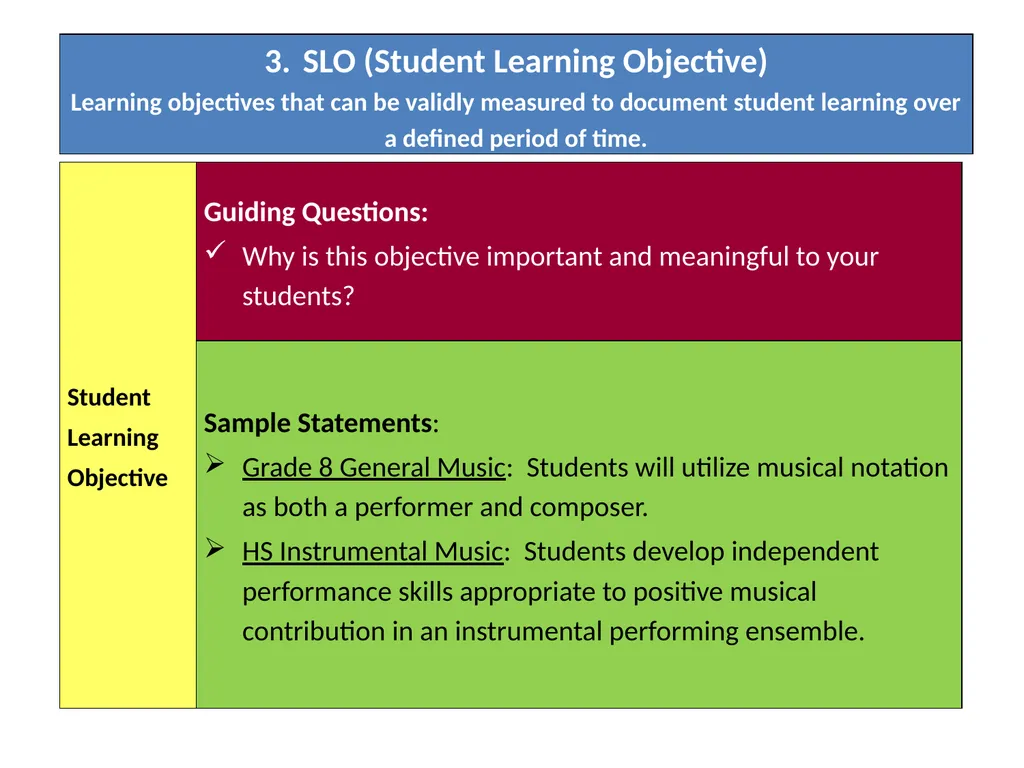
Student Learning Objective
Data and Targets Used to Establish the SLO
Assessment/Performance Task
Administration of the Assessment/Performance Task
Evidence of Individual Student Achievement
Strategies/Actions to Achieve the SLO
Implementation Timeline 30 Teacher Effectiveness Measure (Rating)<br>
slide31. …one piece at a time.<br>
slide36. Professional/Industry Standards Common Core Standards PA Standards Statements from this section should be cut and pasted from:<br>
slide41. > www.education.state.pa.us Educator Effectiveness: SLO<br>
slide44. All Classes: IEP and 504 accommodations will be implemented.<br>
slide45. Most Classes: The assessments can be administered by an equivalent peer. Some Classes: Student use of equipment needed to complete the authentic assessment could be monitored by an equivalent peer, but should probably be monitored by the class instructor (i.e. athletic, career tech, chemistry, biology equipment).<br>
slide51. All Grades and Courses: The assessment can be scored by an equivalent peer. All Grades and Courses: The assessment is a commercially produced assessment that has a history of validity and reliability.<br>
slide54. SLO Resources http://nassauboces.org/Page/1667 http://www.riseindiana.org/sites/default/files/files/RISE%201.0/Student%20Learning%20Objectives%20Handbook%201%200%20FINAL.pdf http://www.ride.ri.gov/EducatorQuality/EducatorEvaluation/SLO.aspx http://www.gadoe.org/School-Improvement/Teacher-and-Leader-Effectiveness/Documents/SLO%20Manual.pdf Assessment Development Resource:
beta.ctcurriculum.org<br>
slide55. The Elective Portion of PA’s Educator Effectiveness Design
Student Learning Objectives: Understanding and Completing the SLO Template
An Instructional Webinar
Link:
http://vclass.cciu.org/play_recording.html?recordingId=1249208167245_1348758027178<br>
slide56. Contact:
O. David Deitz
SLO Project Lead, Educator Effectiveness
oddeitz@comcast.net
THANK YOU!<br>