Mediating the Syllabus: Student Success Through Shared Governance Madelyn Fox-Defago, Ph.D. Lecturer, English Dept. Why Wont They Read the Syllabus? Why Wont They Read the Syllabus? Because many dont understand what a syllabus actually
"Mediating the Syllabus: Student Success Through" is the property of its rightful owner. Permission is granted to
download and print the materials on this website for personal, non-commercial use only, and to display it
on your personal computer provided you do not modify the materials and that you retain all copyright
notices contained in the materials. By downloading content from our website, you accept the terms of this
agreement.
Presentation Transcript
01
Mediating the Syllabus: Student Success Through Shared Governance Madelyn Fox-Defago, Ph.D.
Lecturer, English Dept.<br>
02
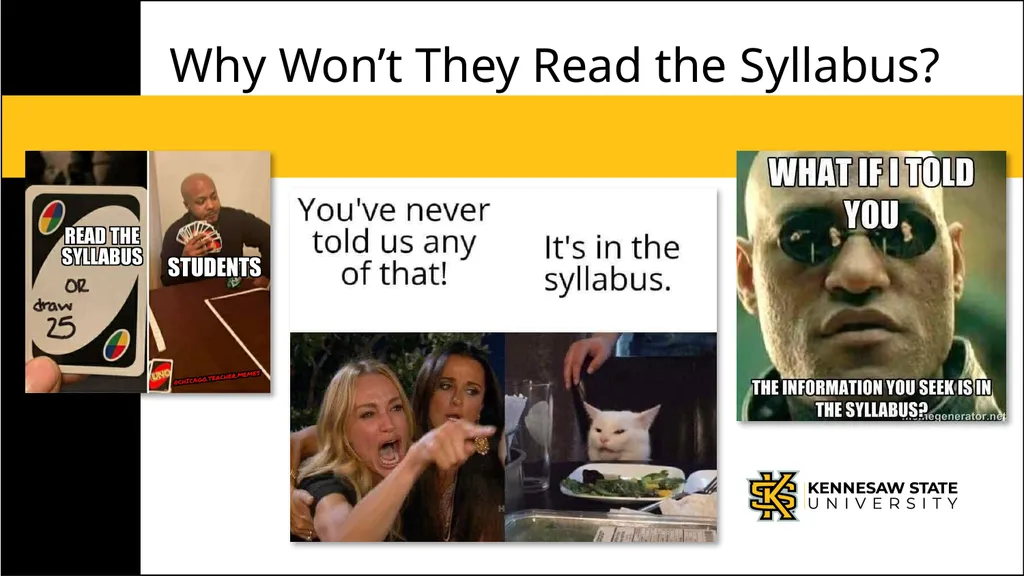
Why Won’t They Read the Syllabus?<br>
03
Why Won’t They Read the Syllabus? Because many don’t understand what a syllabus actually is.<br>
04
What Do They Think a Syllabus Is? Just a formality—arbitrary information from KSU
A set of requirements and barriers to getting the grade they want
Rules their professor designed to “catch” students when they mess up
Which therefore doesn’t apply to them because they’re a good student—a syllabus is just there to catch the “bad” students<br>
05
What We Want Them to Understand A syllabus is a framework and guide for how to be successful in this course.
It’s written for them, not for us.
It applies to and has valuable information for all students.<br>
06
Mediating Through Shared Governance Have students help design course policies to empower and engage them, while also demonstrating the role of a syllabus. They will know and, more importantly, understand the policies because they’re helping write and revise them.
They are given the power to push back on and negotiate any policies they feel are unfair, fostering cooperation and trust.<br>
07
Real-Life Examples Communication policy—reasonable response time
Late work policy—minor assignments
Deadlines—Friday work for 33% hybrid course<br>
08
Thoughts So Far?<br>
09
Syllabus Co-Creation Don’t: Don’t agree to any policies you’re not comfortable enforcing or that don’t align with your teaching philosophy
Don’t sacrifice academic rigor
Don’t feel like you have to hand over your entire course design—you get to pick and choose which items are up for negotiation Do: Think about which aspects of your course are negotiable, and to what extent
Set boundaries when needed
Encourage debate and conversation about the why behind specific policies—from both perspectives<br>
10
Step 1: Syllabus Inventory Identify which of your current policies are hard or soft
Hard policies are set in stone and not open to negotiation
Soft policies have room for negotiation—how much room is up to you<br>
11
Hard Policies Examples: Required materials, program objectives, major assignment genres, etc.
You must provide a rationale not only for the policy itself, but for why it’s non-negotiable, based on your expertise, research in learning science, and/or student success initiatives.
If you’re having trouble identifying a rationale, consider moving it to the soft policy list.<br>
12
Soft Policies Examples: Attendance, late work and deadlines, technology use, etc.
You’ll need to identify the baseline expectations for students that you have or need to maintain
Again, these should be based on research in learning science and/or your expertise as an instructor, and you should provide that rationale to students.<br>
13
Step 2: Implementation To do this effectively will require devoting more time to “syllabus days” than you normally would.
You’ll need ample time for students to propose, discuss, revise, and finalize the policies, but—
You can figure out creative ways to do this that also help you cover content/course objectives, and
The payoff in improved engagement and student-teacher interactions is worth the investment.<br>
14
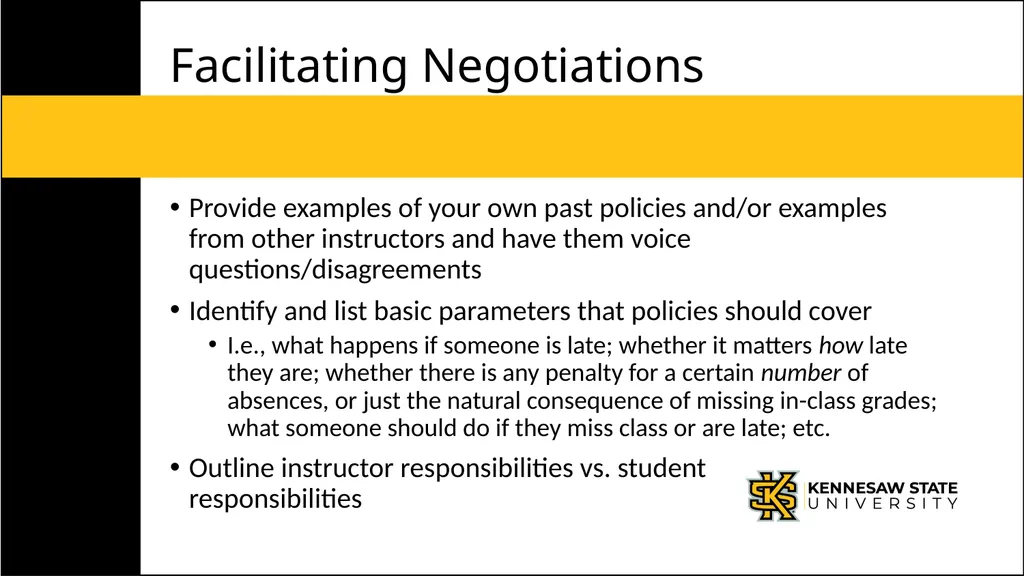
Facilitating Negotiations Provide examples of your own past policies and/or examples from other instructors and have them voice questions/disagreements
Identify and list basic parameters that policies should cover
I.e., what happens if someone is late; whether it matters how late they are; whether there is any penalty for a certain number of absences, or just the natural consequence of missing in-class grades; what someone should do if they miss class or are late; etc.
Outline instructor responsibilities vs. student responsibilities<br>
15
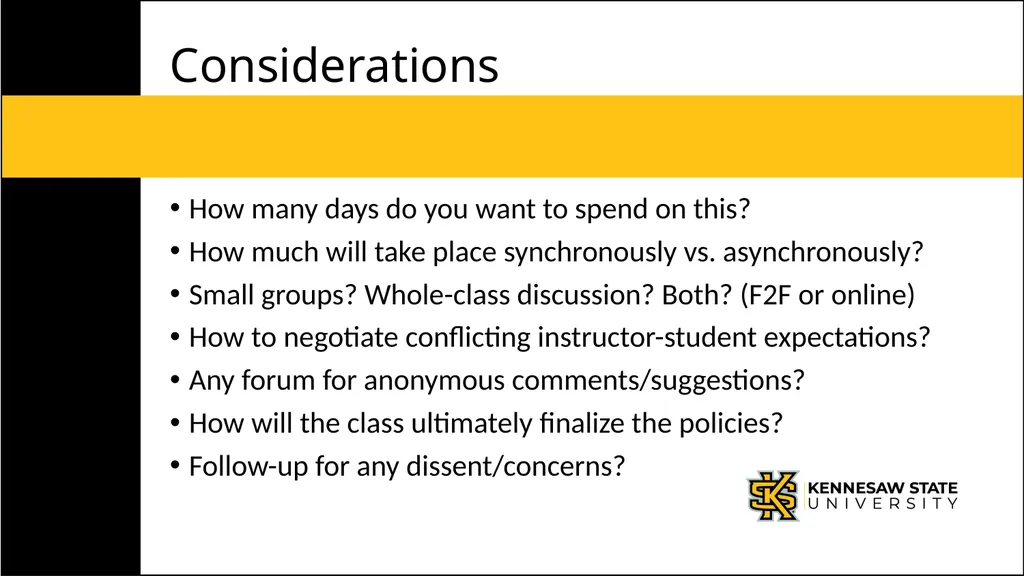
Considerations How many days do you want to spend on this?
How much will take place synchronously vs. asynchronously?
Small groups? Whole-class discussion? Both? (F2F or online)
How to negotiate conflicting instructor-student expectations?
Any forum for anonymous comments/suggestions?
How will the class ultimately finalize the policies?
Follow-up for any dissent/concerns?<br>
16
Ideas for Implementation?<br>
17
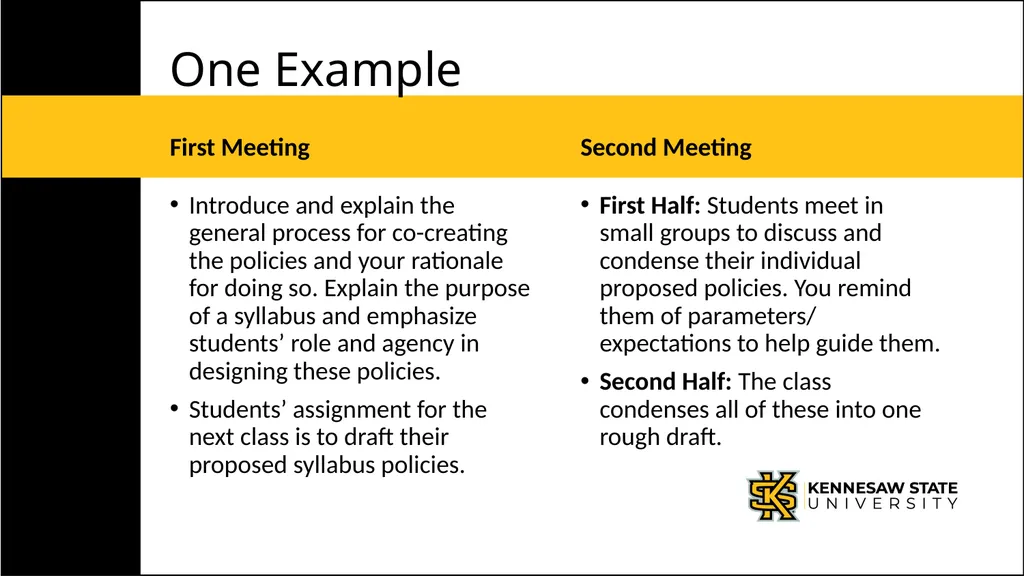
One Example First Meeting Introduce and explain the general process for co-creating the policies and your rationale for doing so. Explain the purpose of a syllabus and emphasize students’ role and agency in designing these policies.
Students’ assignment for the next class is to draft their proposed syllabus policies. Second Meeting First Half: Students meet in small groups to discuss and condense their individual proposed policies. You remind them of parameters/ expectations to help guide them.
Second Half: The class condenses all of these into one rough draft.<br>
18
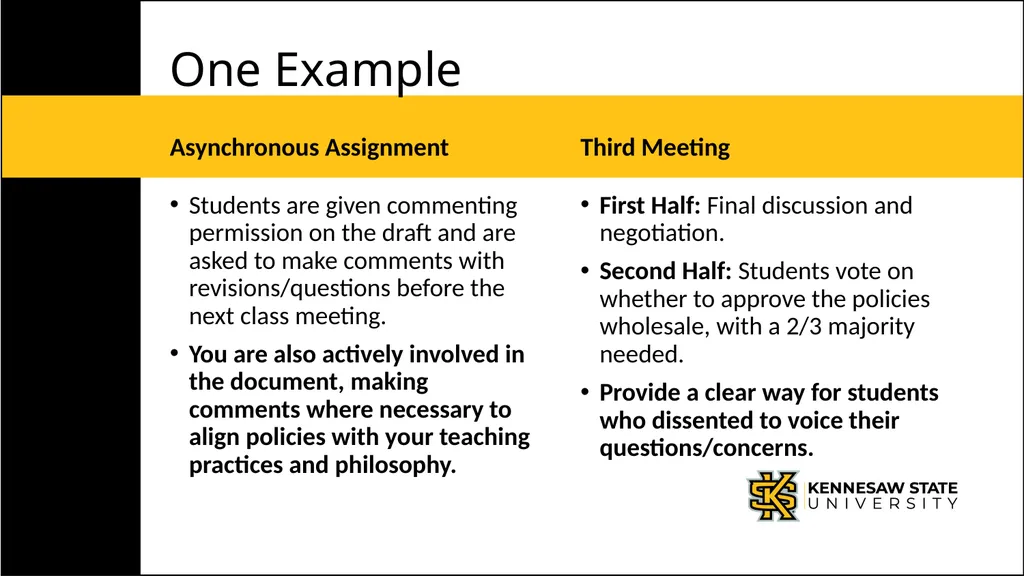
One Example Asynchronous Assignment Students are given commenting permission on the draft and are asked to make comments with revisions/questions before the next class meeting.
You are also actively involved in the document, making comments where necessary to align policies with your teaching practices and philosophy. Third Meeting First Half: Final discussion and negotiation.
Second Half: Students vote on whether to approve the policies wholesale, with a 2/3 majority needed.
Provide a clear way for students who dissented to voice their questions/concerns.<br>