
Medical Marijuana Update Workplace Issues/ Update
Description: Medical Marijuana Update Workplace Issues Update Arkansas Environmental Federation Convention 1 Walter G. Wright wwrightmwlaw.com Arkansas Environmental Energy and Water Log Blog http:www.mitchellwilliamslaw.comblog Three combined
Related Topics
Download Presentation
"Medical Marijuana Update Workplace Issues/ Update" is the property of its rightful owner. Permission is granted to download and print the materials on this website for personal, non-commercial use only, and to display it on your personal computer provided you do not modify the materials and that you retain all copyright notices contained in the materials. By downloading content from our website, you accept the terms of this agreement.
Presentation Transcript
slide1. Medical Marijuana Update
Workplace Issues/ Update
Arkansas Environmental Federation Convention 1 Walter G. Wright wwright@mwlaw.com<br>
slide2. Arkansas Environmental Energy and Water Log Blog
http://www.mitchellwilliamslaw.com/blog
Three combined posts every business day addressing federal/Arkansas legislation, regulation, administrative/judicial decisions and personnel transitions 2<br>
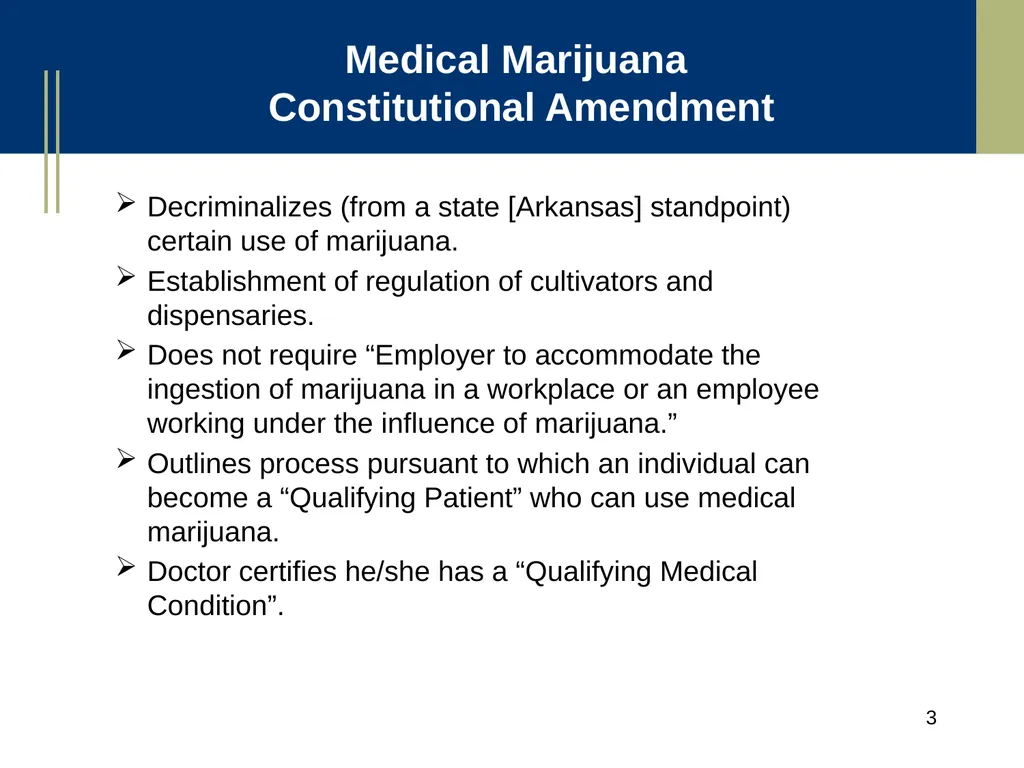
slide3. Medical Marijuana
Constitutional Amendment Decriminalizes (from a state [Arkansas] standpoint) certain use of marijuana.
Establishment of regulation of cultivators and dispensaries.
Does not require “Employer to accommodate the ingestion of marijuana in a workplace or an employee working under the influence of marijuana.”
Outlines process pursuant to which an individual can become a “Qualifying Patient” who can use medical marijuana.
Doctor certifies he/she has a “Qualifying Medical Condition”. 3<br>
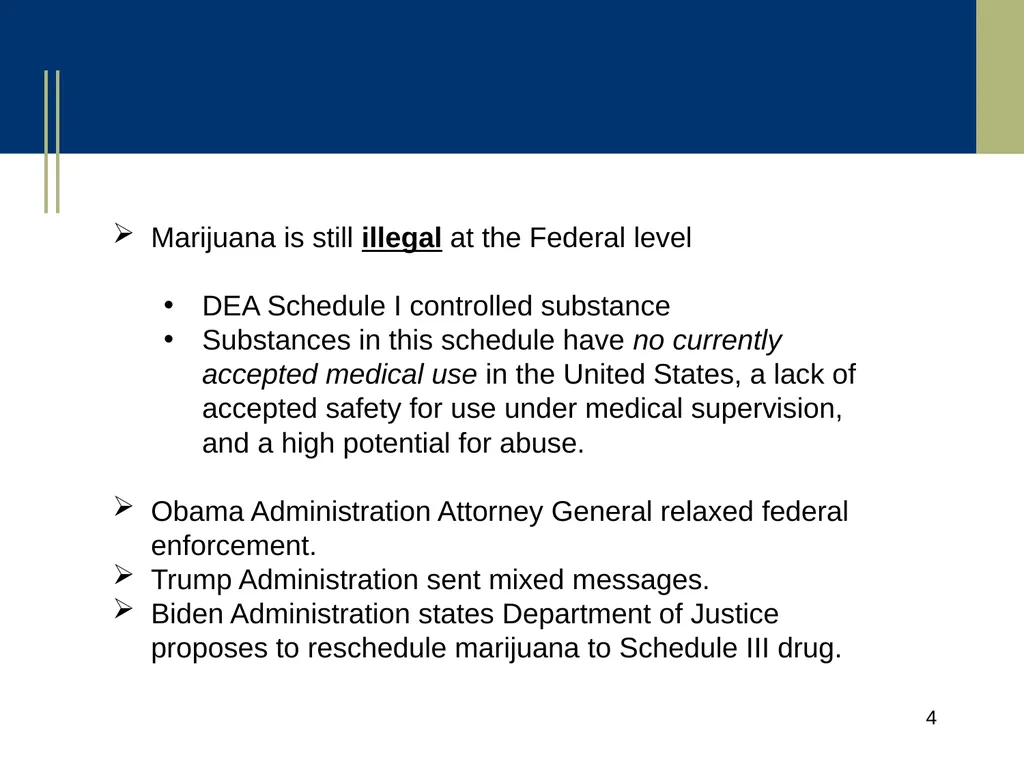
slide4. Marijuana is still illegal at the Federal level
DEA Schedule I controlled substance
Substances in this schedule have no currently accepted medical use in the United States, a lack of accepted safety for use under medical supervision, and a high potential for abuse.
Obama Administration Attorney General relaxed federal enforcement.
Trump Administration sent mixed messages.
Biden Administration states Department of Justice proposes to reschedule marijuana to Schedule III drug. 4<br>
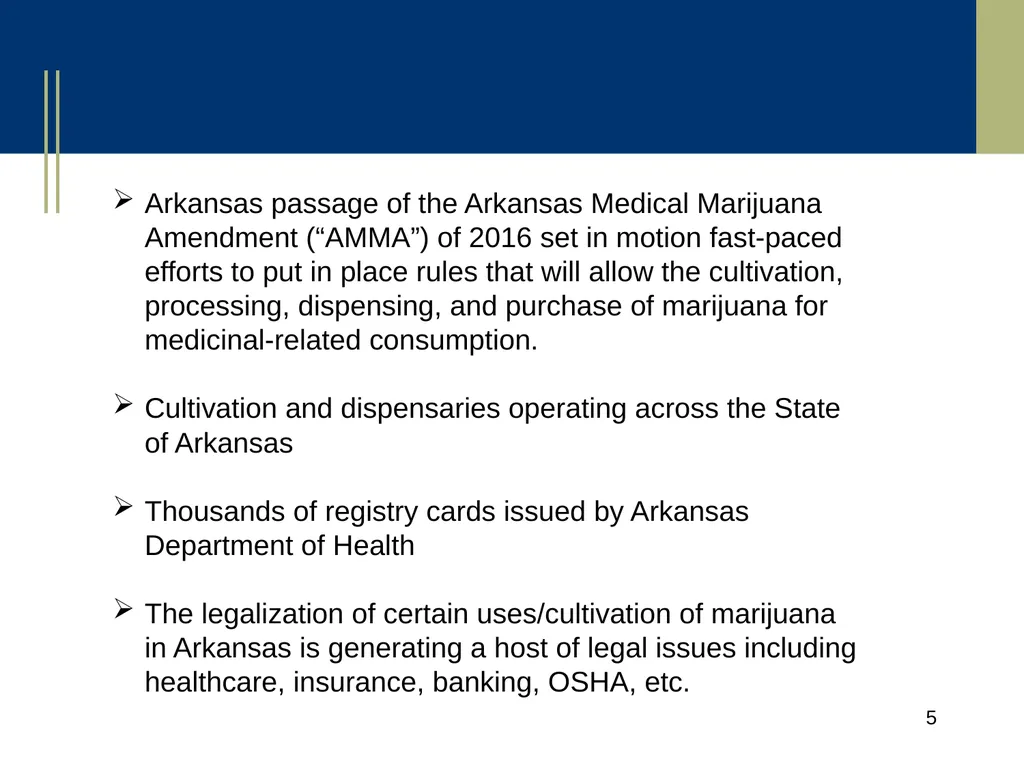
slide5. Arkansas passage of the Arkansas Medical Marijuana Amendment (“AMMA”) of 2016 set in motion fast-paced efforts to put in place rules that will allow the cultivation, processing, dispensing, and purchase of marijuana for medicinal-related consumption.
Cultivation and dispensaries operating across the State of Arkansas
Thousands of registry cards issued by Arkansas Department of Health
The legalization of certain uses/cultivation of marijuana in Arkansas is generating a host of legal issues including healthcare, insurance, banking, OSHA, etc. 5<br>
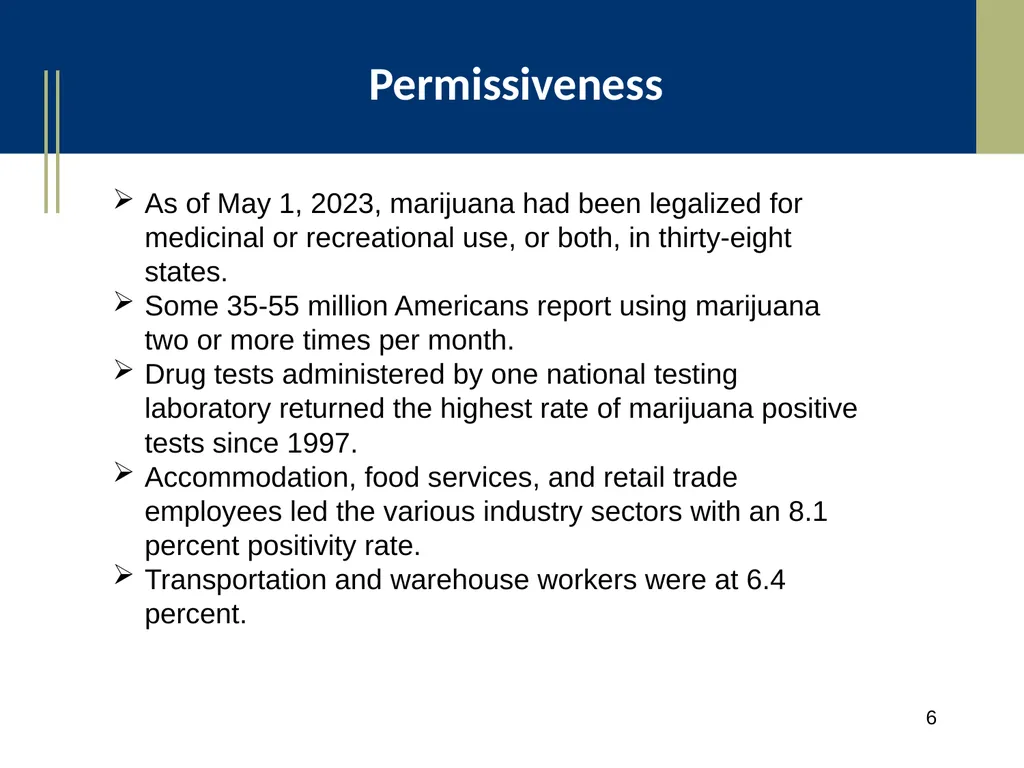
slide6. Permissiveness As of May 1, 2023, marijuana had been legalized for medicinal or recreational use, or both, in thirty-eight states.
Some 35-55 million Americans report using marijuana two or more times per month.
Drug tests administered by one national testing laboratory returned the highest rate of marijuana positive tests since 1997.
Accommodation, food services, and retail trade employees led the various industry sectors with an 8.1 percent positivity rate.
Transportation and warehouse workers were at 6.4 percent. 6<br>
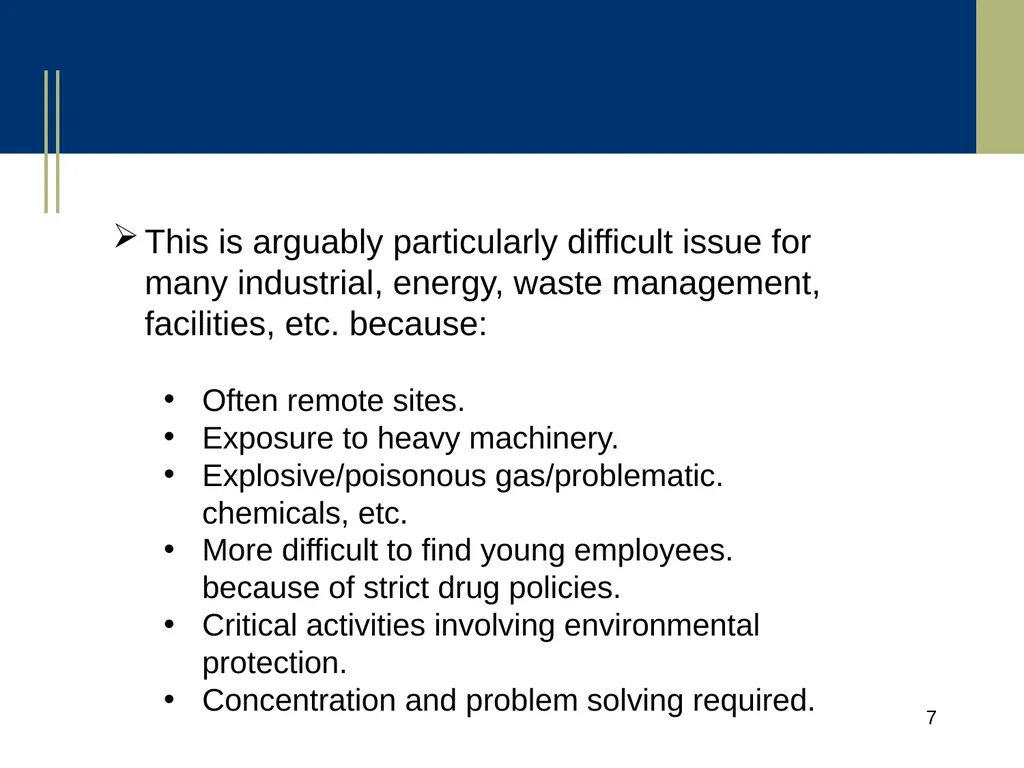
slide7. This is arguably particularly difficult issue for many industrial, energy, waste management, facilities, etc. because:
Often remote sites.
Exposure to heavy machinery.
Explosive/poisonous gas/problematic. chemicals, etc.
More difficult to find young employees. because of strict drug policies.
Critical activities involving environmental protection.
Concentration and problem solving required. 7<br>
slide8. Medical Marijuana Other laws create further confusion
Federal American Disabilities Act.
Federal Drug Free Workplace Act of 1988.
State Workers’ Compensation laws.
Federal Department of Transportation Regulations.
How does legalization impact the workplace?
Impact employer policies? 8<br>
slide9. Employer Issues Costs of drug-testing applicants, employees
Increased management training costs
Increased need for supervision, oversight 9<br>
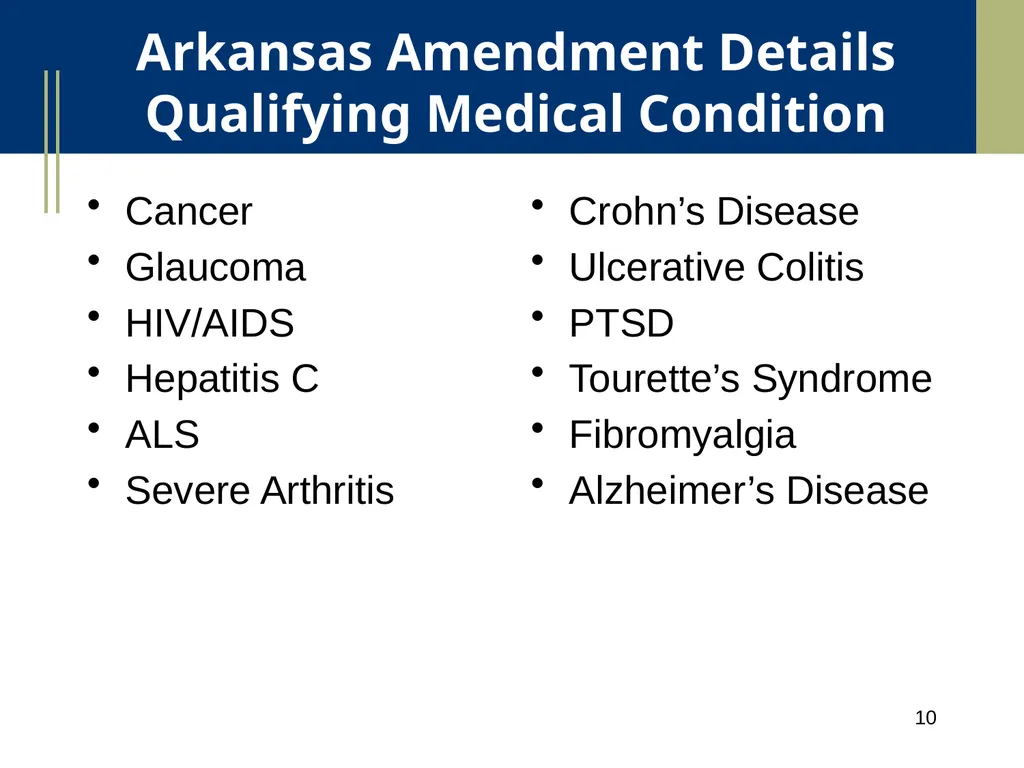
slide10. Arkansas Amendment Details Qualifying Medical Condition Cancer
Glaucoma
HIV/AIDS
Hepatitis C
ALS
Severe Arthritis Crohn’s Disease
Ulcerative Colitis
PTSD
Tourette’s Syndrome
Fibromyalgia
Alzheimer’s Disease 10<br>
slide11. Arkansas Amendment Details Qualifying Medical Condition (cont.) Also includes chronic or debilitating diseases
with enumerated severe symptoms including:
Intractable Pain.
Severe Nausea.
Severe Muscle Spasms.
Seizures. 11<br>
slide12. Next Steps If a physician provides a written certification of a qualifying condition, the qualifying patient can use the certification to obtain a registry identification card from the Arkansas Department of Health.
Once the Qualifying Patient Obtains a Registry Identification Card, he/she can purchase and possess up to 2.5 ounces of marijuana without threat of criminal prosecution or adverse state actions. 12<br>
slide13. Arkansas Amendment Non-Discrimination Provision Some job applicants and employees may produce a medical marijuana registry ID card approved by the Arkansas Department of Health in response to a failed drug test. 13<br>
slide14. Arkansas Amendment Non-Discrimination Provision (Cont.) Non-compliance with the Arkansas Medical Marijuana Amendment of 2016 (AMMA) can pose significant risks for an employer. It includes a non-discrimination provision directed at employers. The provision provides that:
“An employer shall not discriminate against an applicant or employee in hiring, termination, or any term or condition of employment, or otherwise penalize an applicant or employee, based upon the applicant’s or employee’s past or present status as a qualifying patient or designated caregiver.” 14<br>
slide15. Arkansas Medical Marijuana Act Non-Discrimination Provision (Cont.) Damages under the AMMA for an employment discrimination claim based on an applicant’s or employee’s past or present status as a qualifying patient or designated caregiver is capped in accordance with the statutory caps in the Arkansas Civil Rights Act.
Liability for back pay is limited to no more than two years prior to the filing of an action and the period within in which an applicant or employee can bring such an action is one year from when the alleged discrimination occurred. 15<br>
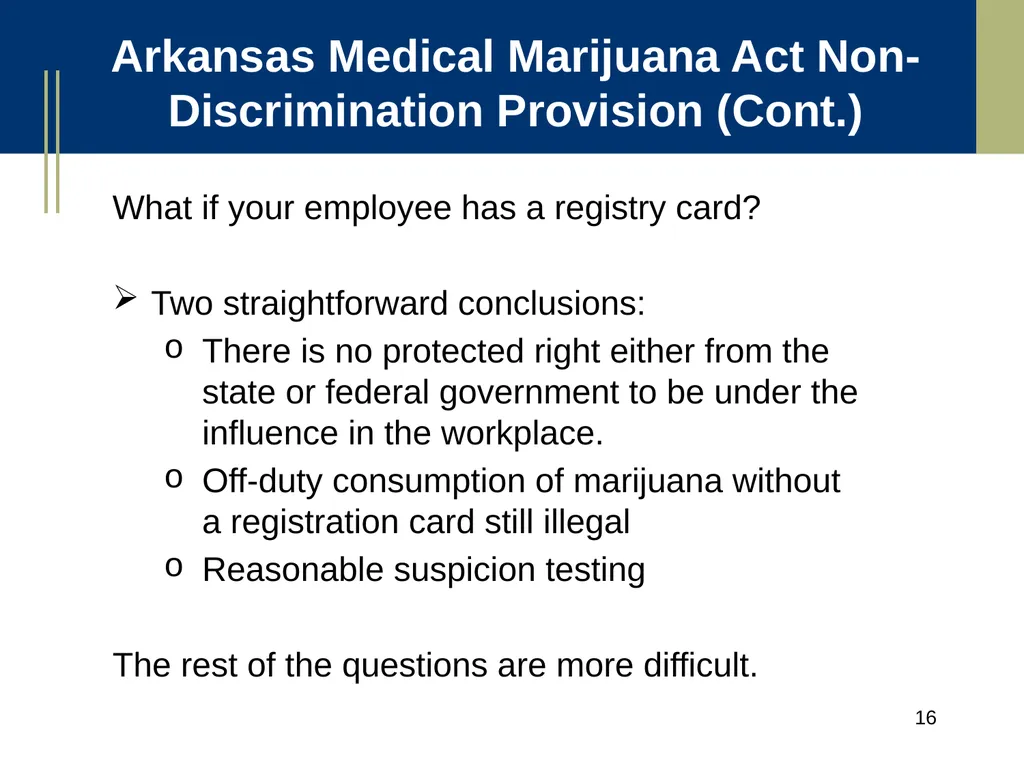
slide16. Arkansas Medical Marijuana Act Non-Discrimination Provision (Cont.) What if your employee has a registry card?
Two straightforward conclusions:
There is no protected right either from the state or federal government to be under the influence in the workplace.
Off-duty consumption of marijuana without a registration card still illegal
Reasonable suspicion testing
The rest of the questions are more difficult. 16<br>
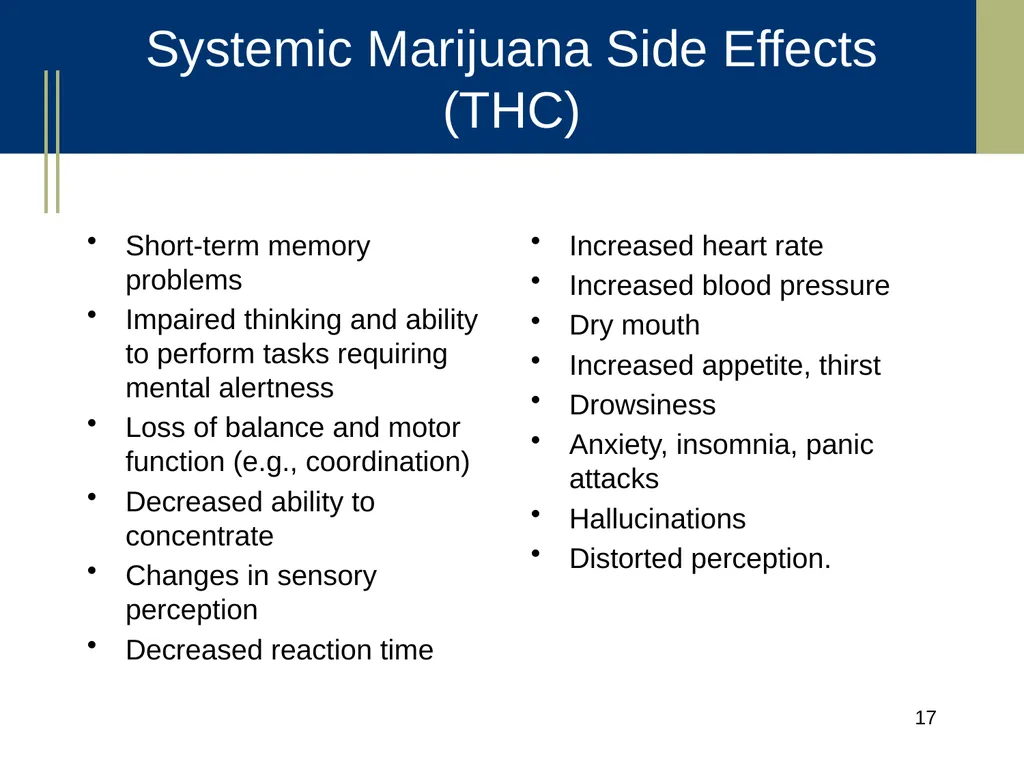
slide17. Systemic Marijuana Side Effects (THC) Short-term memory problems
Impaired thinking and ability to perform tasks requiring mental alertness
Loss of balance and motor function (e.g., coordination)
Decreased ability to concentrate
Changes in sensory perception
Decreased reaction time Increased heart rate
Increased blood pressure
Dry mouth
Increased appetite, thirst
Drowsiness
Anxiety, insomnia, panic attacks
Hallucinations
Distorted perception. 17<br>
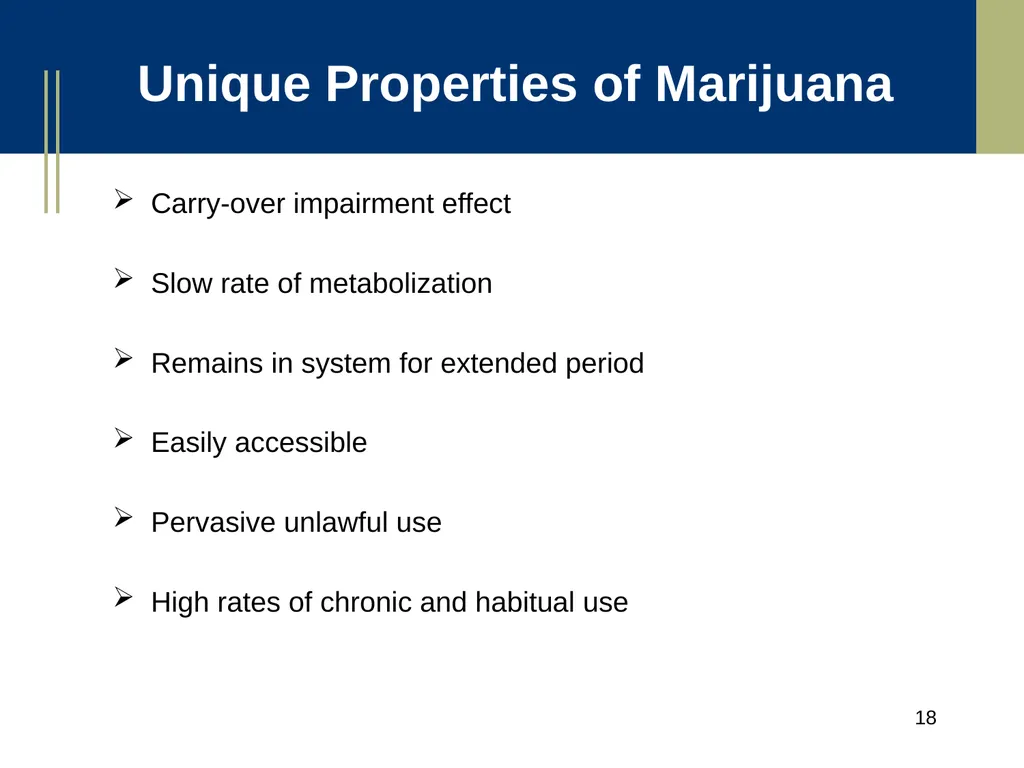
slide18. Unique Properties of Marijuana Carry-over impairment effect
Slow rate of metabolization
Remains in system for extended period
Easily accessible
Pervasive unlawful use
High rates of chronic and habitual use 18<br>
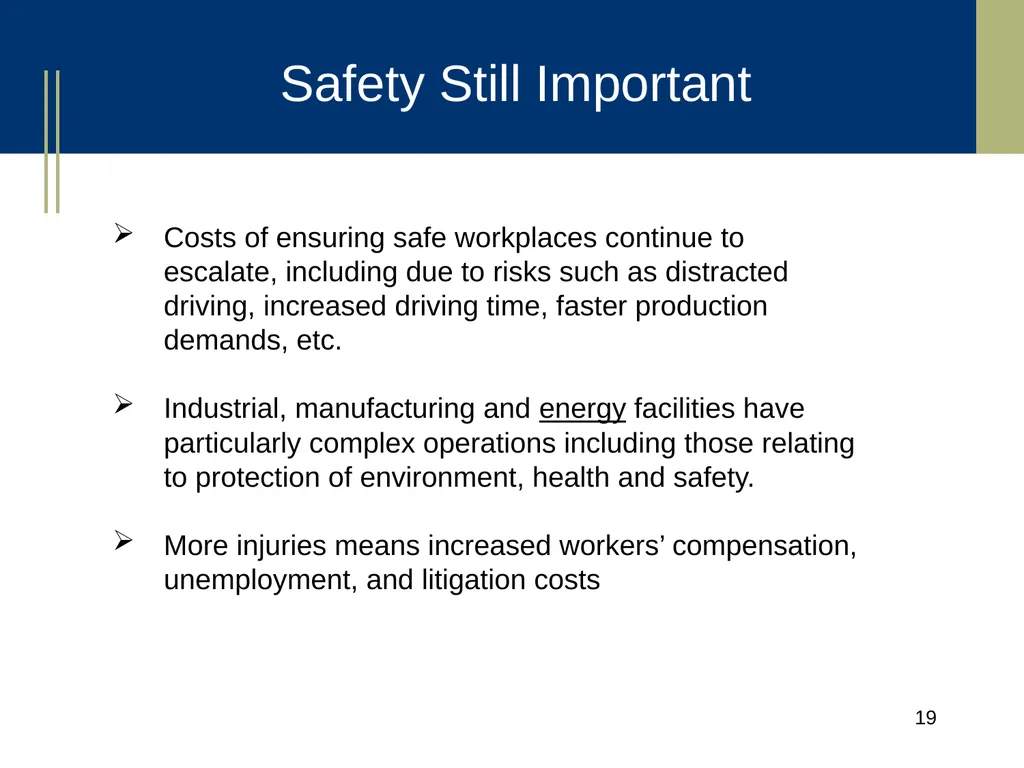
slide19. Safety Still Important Costs of ensuring safe workplaces continue to escalate, including due to risks such as distracted driving, increased driving time, faster production demands, etc.
Industrial, manufacturing and energy facilities have particularly complex operations including those relating to protection of environment, health and safety.
More injuries means increased workers’ compensation, unemployment, and litigation costs 19<br>
slide20. The Arkansas Amendment Employer Issues/Suggestions Create Written Job Descriptions which Designate Safety Sensitive Positions within your Organization?
The AMMA permits employers to “exclude a qualifying patient from being employed in or performing a safety sensitive position based on the employer’s good faith belief that the qualifying patient was engaged in the current use of marijuana.”
Safety sensitive position is defined as “any position designated in writing by the employer as a safety sensitive position in which a person performing the position while under the influence of marijuana may constitute a threat to health or safety. 20<br>
slide21. The Arkansas Amendment Employer Issues/Suggestions Creating written job descriptions which designate certain jobs as “safety sensitive positions” permits employers to exclude job applicants and employees with medical marijuana registry ID cards from those positions.
What are safety sensitive positions at your facility or company?
Shape your policies around specific job tasks that would not be allowed to perform. 21<br>
slide22. Safety Sensitive? The extent of an employer’s ability to designate a job as safety-sensitive was in 2023 examined in the case of Prinsen v. Domtar Paper Co., No. 4:22-cv-04076, 2023 U.S. Dist., LEXIS 16187 (W.D. Ark. Jan. 31, 2023).
An Arkansas court addressed in the opinion if the Amendment granted an ability to designate all jobs at a location safety-sensitive. Even in the case where all jobs were designated as safety sensitive regardless of their duties.
All mill jobs were listed as safety-sensitive.
Employee argued job not safety-sensitive as contemplated under the Amendment.
An employee failed a drug test as a medical marijuana patient and was terminated.
Justification was safety-sensitive status.
Court rejected the argument that the employee’s termination was a violation of the Amendment because the job was not really safety-sensitive.
Court holds language of the Amendment explicitly permits an employer to designate a position as safety-sensitive. It stated a universal categorization for all positions did not violate Arkansas law.
Very broad interpretation – will other Arkansas courts similarly rule? 22<br>
slide23. Key Questions Faced by Arkansas Employers Do employers continue to enforce their traditional substance-abuse policies, or adopt a new approach for dealing with employees who test positive for marijuana in the workplace?
Does the Americans with Disabilities Act (ADA) protect employees who claim discrimination based upon their use of marijuana for a disabling medical condition? 23<br>
slide24. Key Questions Faced by Arkansas Employers (Cont.) Do employers violate the Occupational Safety and Health Administration’s (OSHA’s) General Duty Clause by allowing employees who use marijuana to perform safety-sensitive jobs, and thereby create a workplace hazard that OSHA standards seek to eliminate?
Do the Department of Transportation’s (DOT’s) substance-abuse regulations trump state marijuana laws? (Yes) 24<br>
slide25. Key Questions Faced by Arkansas Employers (Cont.) Heightened level of concern when claimant returns to a safety-sensitive occupation, such as driving or construction, while subject to potential adverse cognitive and psychological effects of marijuana?
Quantification of the amount of marijuana consumed by claimant is not available through urine medication testing, thereby limiting ability to determine if he or she has consumed prescribed dose, or is in fact acutely intoxicated 25<br>
slide26. Key Questions Faced by Arkansas Employers (Cont.) Can an employer ban the use of marijuana by an employee if it is permitted by state law - and if the employee has a prescription? 26<br>
slide27. Employer Suggestions Treat all employees who perform “hazardous duty” the same whether white or blue collar… hazard of driving in a company car on sales call is different from operating a forklift.
Publish policy requiring employees who have hazardous duty jobs to report to HR or company medical department if they are taking medication (including prescription opioids and MMJ) that may affect ability to safely perform job.
If employee reports being on such medication, consult with his/her health care provider and – if needed – remove from job until safe to return (move to vacant safe position if feasible). 27<br>
slide28. What Should Employers Do? Establish a Drug Free Workplace
Note: qualified medical marijuana users can still be employed
Make jobs with specific safety sensitive tasks or related to public health
Have a way of tracking job performance
Have an action plan for how you will respond to an employee who is a medical marijuana user 28<br>
slide29. The Arkansas Amendment Employer Issues/Suggestions (cont.) Review and Update Your Employee Handbooks, and Drug Testing Policies and Practices?
Some employers use employee handbooks to provide definitive guidance on workplace policies or rules.
Revise your employee handbook to address the use of marijuana in the workplace.
Employee handbooks should make clear that employees are not permitted to possess, smoke, ingest, or engage in the use of marijuana while on the employer’s premises during the hours of employment. 29<br>
slide30. The Arkansas Amendment Employer Issues/Suggestions (cont.) Employees should not be permitted to be under the influence of marijuana while on an employer’s premises or during the hours of employment.
Modify definition of “under the influence” to comply with Amendment. 30<br>
slide31. “Zero Tolerance” Policies - Federal Department of Transportation
Federal law requires DOT Agencies to implement drug testing of safety-sensitive transportation employees in the aviation, trucking (including school bus drivers, and certain limousine and van drivers), railroads, mass transit, and pipelines industries
Arkansas law does not trump federal statutes. 31<br>
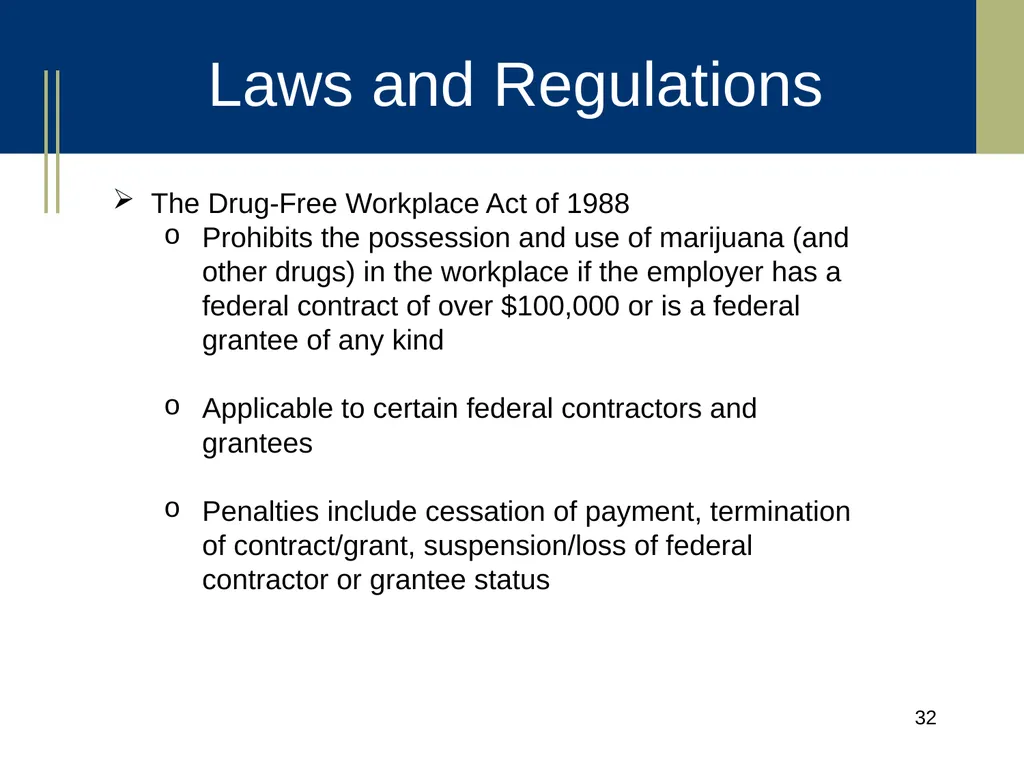
slide32. Laws and Regulations The Drug-Free Workplace Act of 1988
Prohibits the possession and use of marijuana (and other drugs) in the workplace if the employer has a federal contract of over $100,000 or is a federal grantee of any kind
Applicable to certain federal contractors and grantees
Penalties include cessation of payment, termination of contract/grant, suspension/loss of federal contractor or grantee status 32<br>
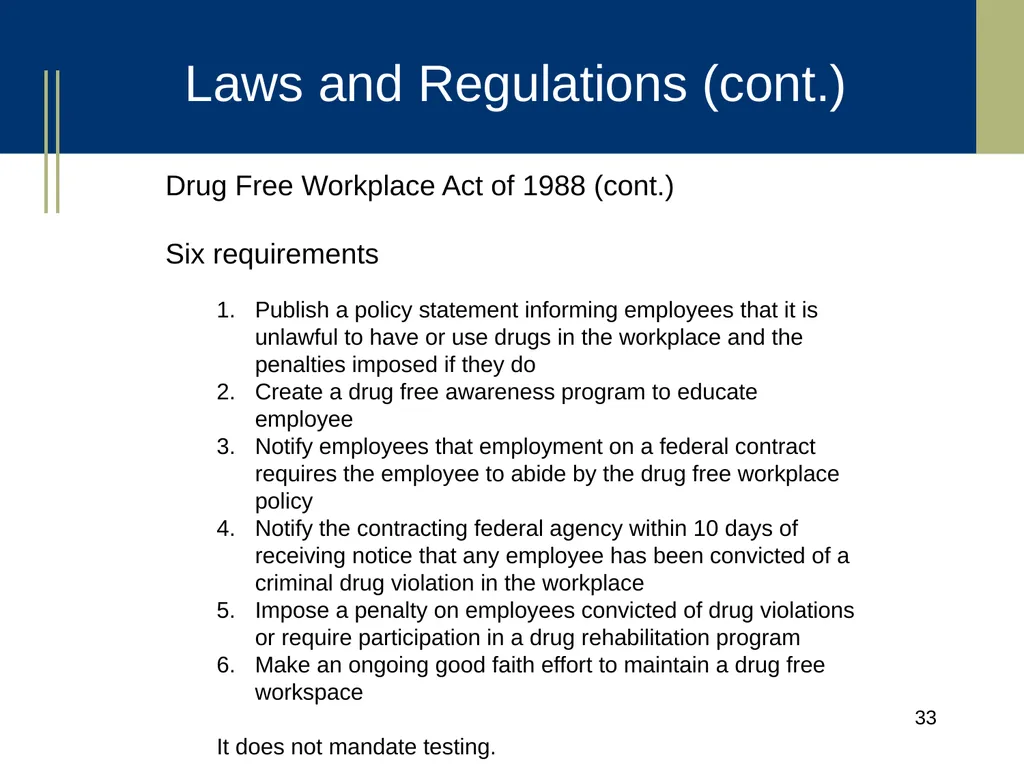
slide33. Laws and Regulations (cont.) Drug Free Workplace Act of 1988 (cont.)
Six requirements
Publish a policy statement informing employees that it is unlawful to have or use drugs in the workplace and the penalties imposed if they do
Create a drug free awareness program to educate employee
Notify employees that employment on a federal contract requires the employee to abide by the drug free workplace policy
Notify the contracting federal agency within 10 days of receiving notice that any employee has been convicted of a criminal drug violation in the workplace
Impose a penalty on employees convicted of drug violations or require participation in a drug rehabilitation program
Make an ongoing good faith effort to maintain a drug free workspace
It does not mandate testing. 33<br>
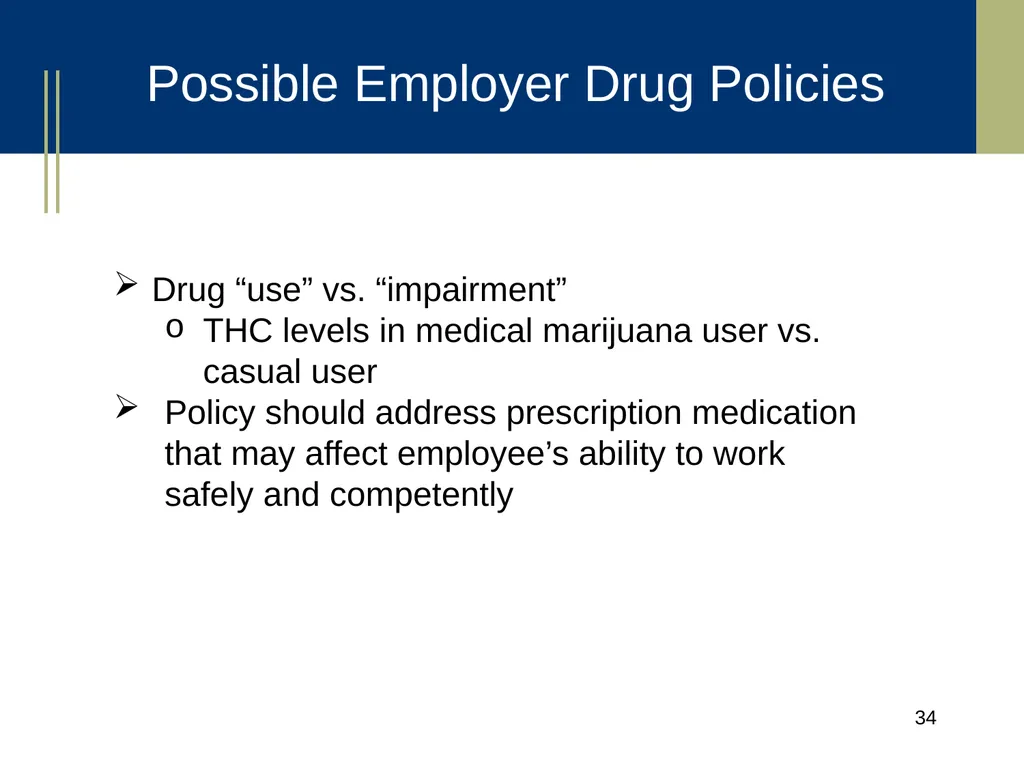
slide34. Possible Employer Drug Policies Drug “use” vs. “impairment”
THC levels in medical marijuana user vs. casual user
Policy should address prescription medication that may affect employee’s ability to work safely and competently 34<br>
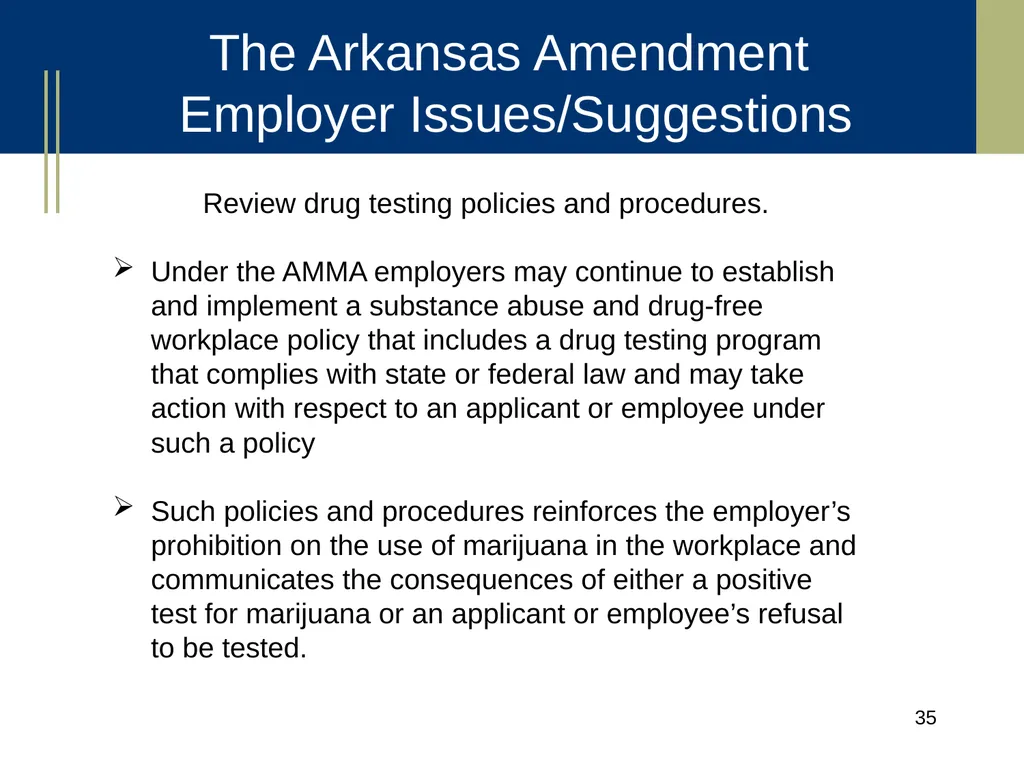
slide35. The Arkansas Amendment Employer Issues/Suggestions Review drug testing policies and procedures.
Under the AMMA employers may continue to establish and implement a substance abuse and drug-free workplace policy that includes a drug testing program that complies with state or federal law and may take action with respect to an applicant or employee under such a policy
Such policies and procedures reinforces the employer’s prohibition on the use of marijuana in the workplace and communicates the consequences of either a positive test for marijuana or an applicant or employee’s refusal to be tested. 35<br>
slide36. The Arkansas Amendment Employer Issues/Suggestions (cont.) Train Managers and Supervisors to Identify Employees Under the Influence with a Good Faith Belief Sufficient to Support the Administration of a Drug Test
Employers may only act against an employee so long as they have a good faith belief that the employee possessed, smoked, ingested, or otherwise used marijuana, or was under the influence of marijuana, while on the premises of the employer or during the hours of employment. 36<br>
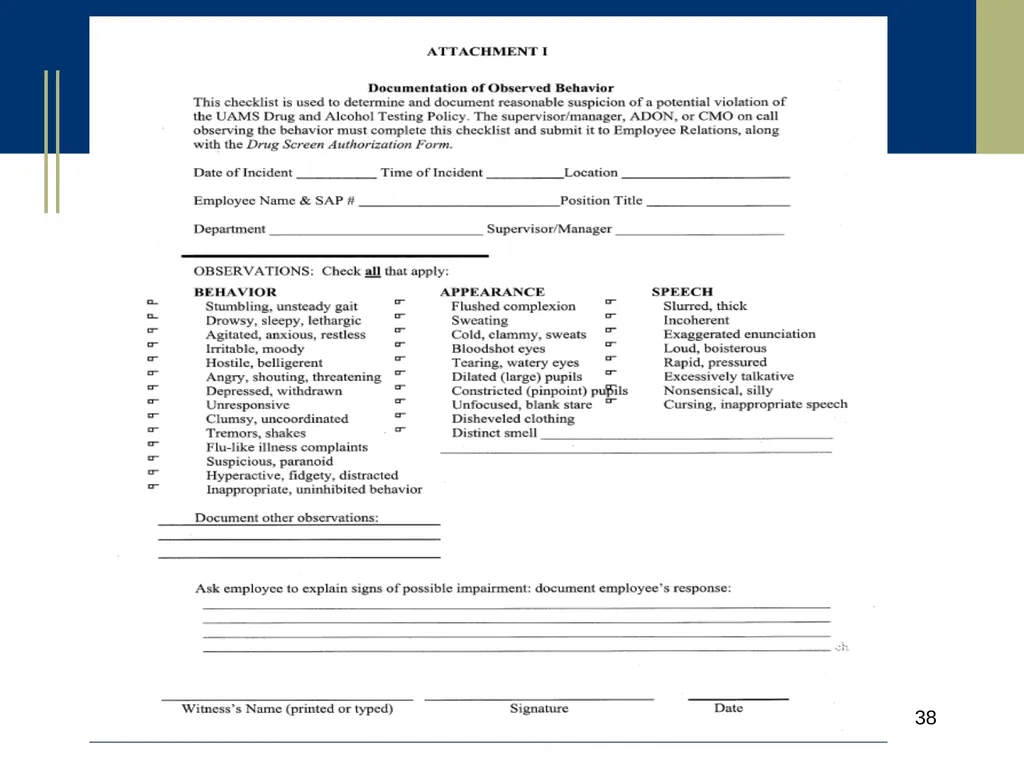
slide37. The Arkansas Amendment Employer Issues/Suggestions (cont.) Businesses should also train their frontline supervisors and managers to identify when an employee may be under the influence of marijuana during their hours of employment.
The observation of these physical symptoms supports the administration of a drug test, which if positive supports the employer taking action against the employee assuming the proper policies are included in the employer’s handbook. 37<br>
slide38. 38<br>
slide39. The Arkansas Amendment Employer Issues/Suggestions (cont.) Employers must demonstrate they have the necessary “good faith belief” to warrant the administration of a drug test before taking action against the employee.
Managers and supervisors should not rely on a good faith belief alone to support taking action against an employee.
The observations of the manager or supervisor should be used to support the administration of a subsequent drug test. 39<br>
slide40. The Arkansas Amendment Employer Issues/Suggestions (cont.) “Good faith belief” means a reasonable reliance on fact and can be based on observed conduct, behavior or appearance, information reported by a person believed to be reliable, or written, electronic or verbal statements from the employee or other persons.
A manager or supervisor deciding whether to administer a drug test to an employee must be able to identify not only the source of the information on which he or she is acting, but also why their reliance on the information is reasonable. 40<br>
slide41. Drug Testing Recommendations Institute policy that requires employees to disclose use of medications that may impair their ability to work if this request is job-related and consistent with business necessity.
If an employee tests positive for marijuana, confirm that employee is prescribed marijuana. 41<br>
slide42. Update DOT
Use still prohibited by U.S. DOT for CDL drivers (DOT states because state Medical Review Officer conducting driver tests will not issue a negative test result simply because the THC detected in a urine sample was from legal marijuana or CBD oil.)
State blessing of medical marijuana not a valid exception for positive testing result.
Underr Federation Motor Carrier Safety regulations a person is not physically qualified to drive a CDL if he or she uses any Schedule I controlled substance such as marijuana (49 C.F.R. § 391.11(b)(4). 42<br>
slide43. U.S. Department of Transportation DOT has said it will maintain authority to conduct testing of CDL drivers and safety-sensitive personnel.
Policy change allowing saliva drug testing as an alternative to urine-based tests.
Urine tests can be problematic in part because THC metabolites can show up for weeks or months after consumption.
Could improve the effectiveness of testing?
Some federal agencies such as Secret Service, ATF, EPA, FBI, OPM are treating past use more leniently. 43<br>
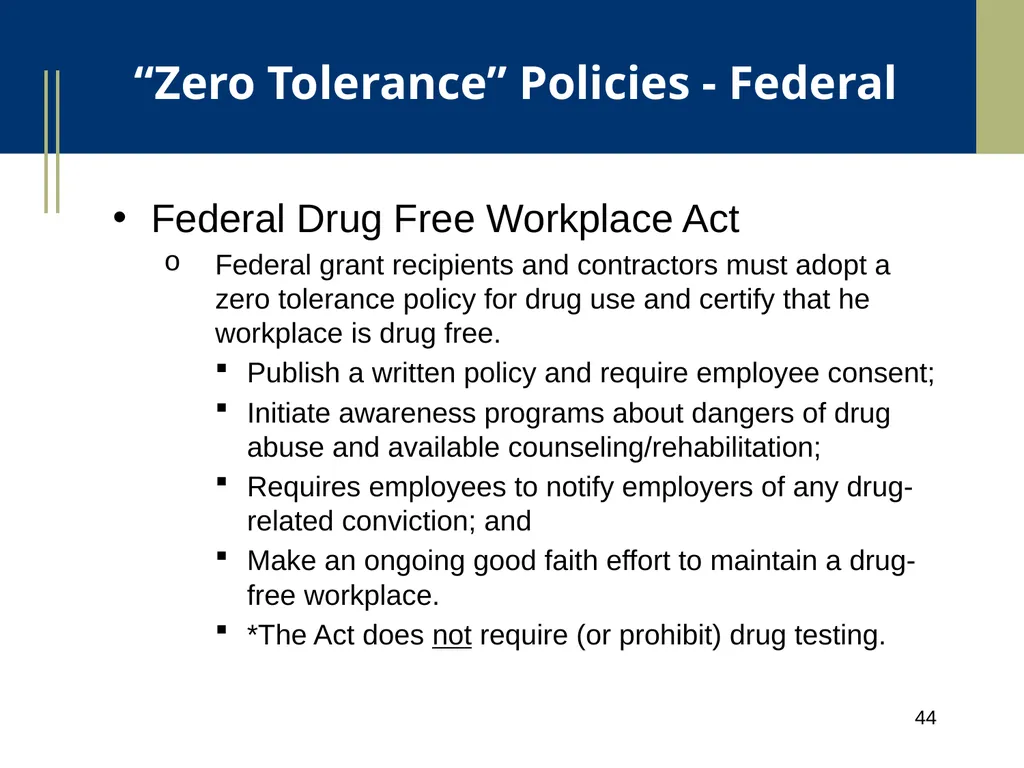
slide44. “Zero Tolerance” Policies - Federal Federal Drug Free Workplace Act
Federal grant recipients and contractors must adopt a zero tolerance policy for drug use and certify that he workplace is drug free.
Publish a written policy and require employee consent;
Initiate awareness programs about dangers of drug abuse and available counseling/rehabilitation;
Requires employees to notify employers of any drug-related conviction; and
Make an ongoing good faith effort to maintain a drug-free workplace.
*The Act does not require (or prohibit) drug testing. 44<br>
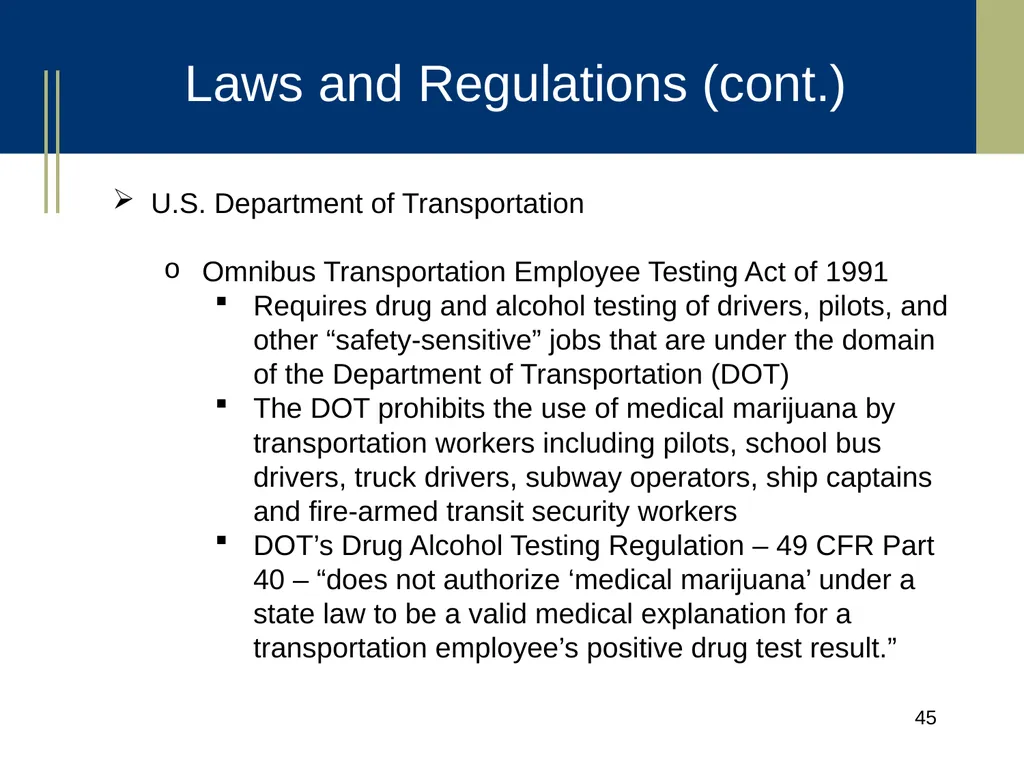
slide45. Laws and Regulations (cont.) U.S. Department of Transportation
Omnibus Transportation Employee Testing Act of 1991
Requires drug and alcohol testing of drivers, pilots, and other “safety-sensitive” jobs that are under the domain of the Department of Transportation (DOT)
The DOT prohibits the use of medical marijuana by transportation workers including pilots, school bus drivers, truck drivers, subway operators, ship captains and fire-armed transit security workers
DOT’s Drug Alcohol Testing Regulation – 49 CFR Part 40 – “does not authorize ‘medical marijuana’ under a state law to be a valid medical explanation for a transportation employee’s positive drug test result.” 45<br>
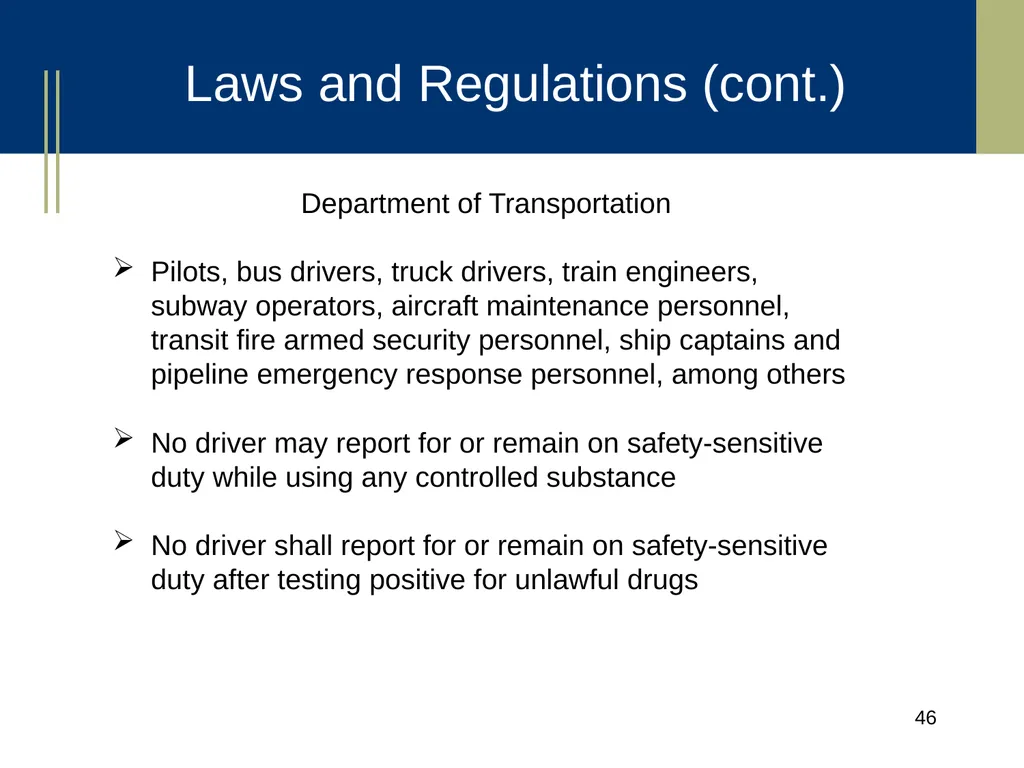
slide46. Laws and Regulations (cont.) Department of Transportation
Pilots, bus drivers, truck drivers, train engineers, subway operators, aircraft maintenance personnel, transit fire armed security personnel, ship captains and pipeline emergency response personnel, among others
No driver may report for or remain on safety-sensitive duty while using any controlled substance
No driver shall report for or remain on safety-sensitive duty after testing positive for unlawful drugs 46<br>
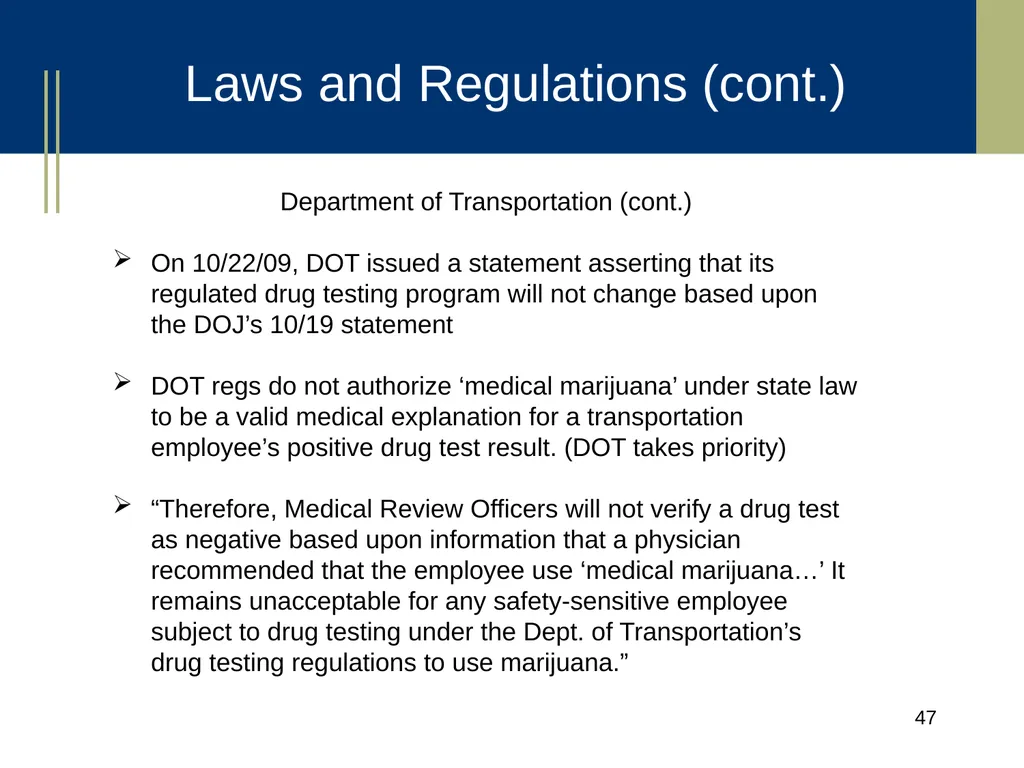
slide47. Laws and Regulations (cont.) Department of Transportation (cont.)
On 10/22/09, DOT issued a statement asserting that its regulated drug testing program will not change based upon the DOJ’s 10/19 statement
DOT regs do not authorize ‘medical marijuana’ under state law to be a valid medical explanation for a transportation employee’s positive drug test result. (DOT takes priority)
“Therefore, Medical Review Officers will not verify a drug test as negative based upon information that a physician recommended that the employee use ‘medical marijuana…’ It remains unacceptable for any safety-sensitive employee subject to drug testing under the Dept. of Transportation’s drug testing regulations to use marijuana.” 47<br>
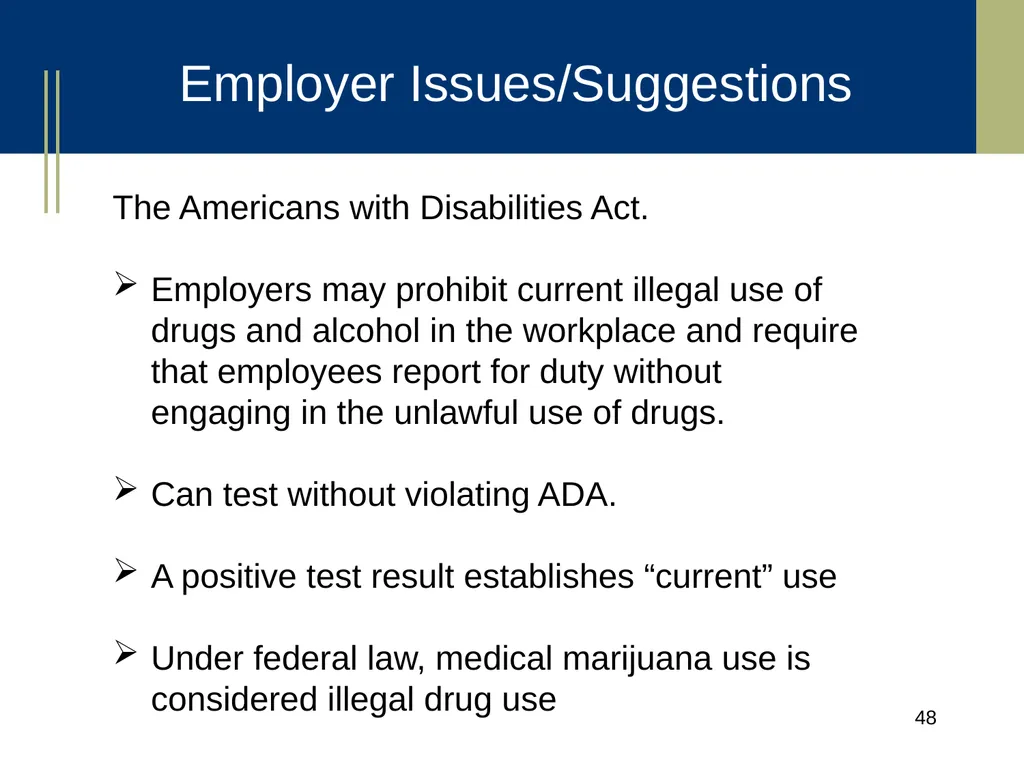
slide48. Employer Issues/Suggestions The Americans with Disabilities Act.
Employers may prohibit current illegal use of drugs and alcohol in the workplace and require that employees report for duty without engaging in the unlawful use of drugs.
Can test without violating ADA.
A positive test result establishes “current” use
Under federal law, medical marijuana use is considered illegal drug use 48<br>
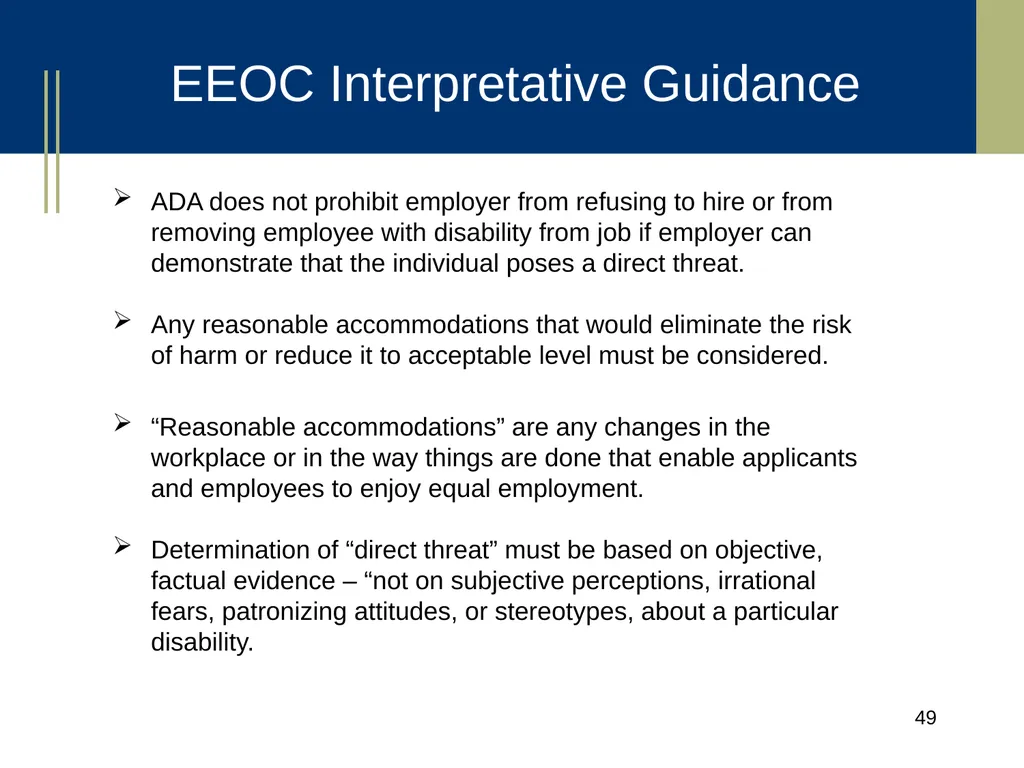
slide49. EEOC Interpretative Guidance ADA does not prohibit employer from refusing to hire or from removing employee with disability from job if employer can demonstrate that the individual poses a direct threat.
Any reasonable accommodations that would eliminate the risk of harm or reduce it to acceptable level must be considered.
“Reasonable accommodations” are any changes in the workplace or in the way things are done that enable applicants and employees to enjoy equal employment.
Determination of “direct threat” must be based on objective, factual evidence – “not on subjective perceptions, irrational fears, patronizing attitudes, or stereotypes, about a particular disability. 49<br>
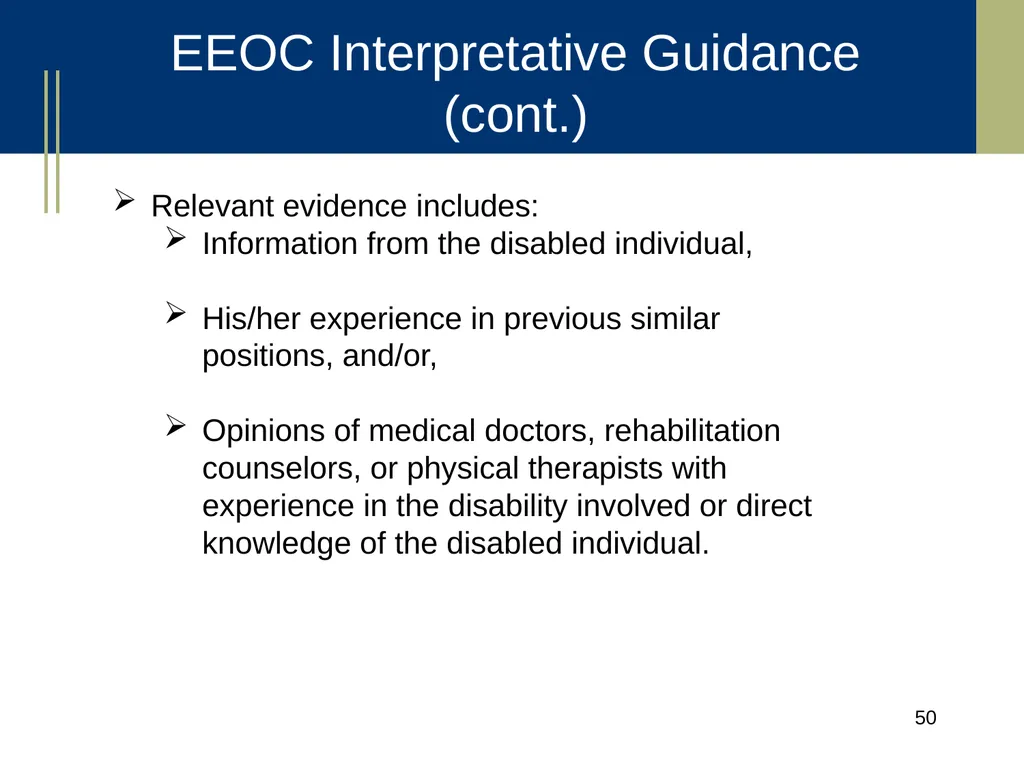
slide50. EEOC Interpretative Guidance (cont.) Relevant evidence includes:
Information from the disabled individual,
His/her experience in previous similar positions, and/or,
Opinions of medical doctors, rehabilitation counselors, or physical therapists with experience in the disability involved or direct knowledge of the disabled individual. 50<br>
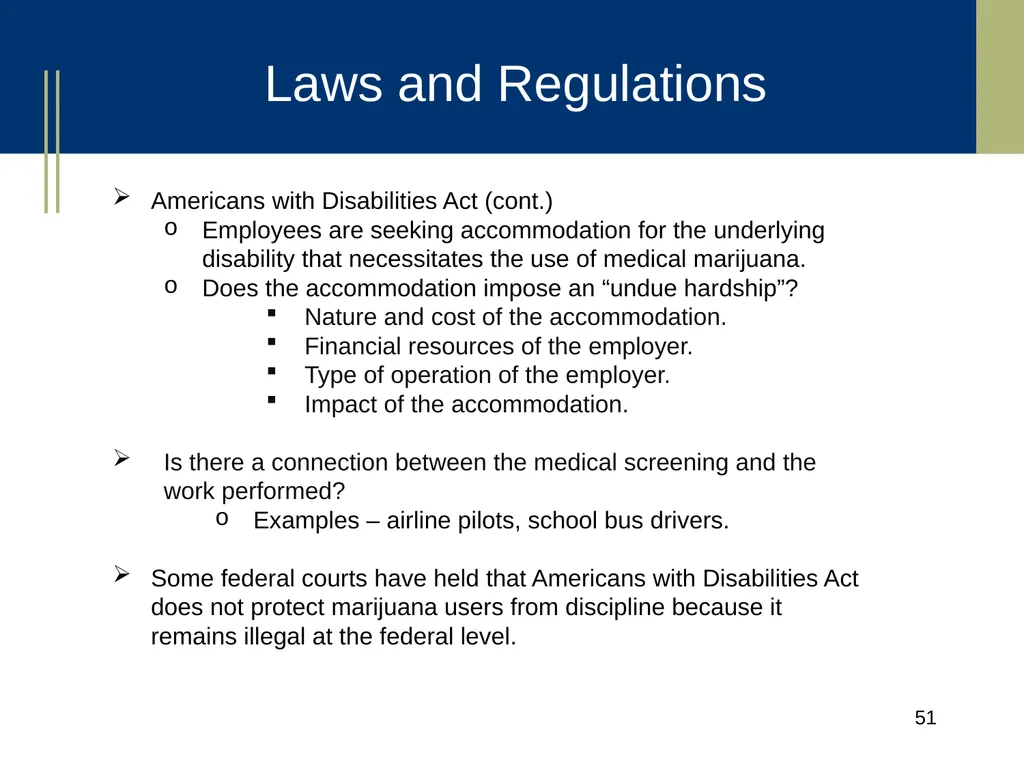
slide51. Laws and Regulations Americans with Disabilities Act (cont.)
Employees are seeking accommodation for the underlying disability that necessitates the use of medical marijuana.
Does the accommodation impose an “undue hardship”?
Nature and cost of the accommodation.
Financial resources of the employer.
Type of operation of the employer.
Impact of the accommodation.
Is there a connection between the medical screening and the work performed?
Examples – airline pilots, school bus drivers.
Some federal courts have held that Americans with Disabilities Act does not protect marijuana users from discipline because it remains illegal at the federal level. 51<br>
slide52. Employer Issues/Suggestions (cont.) Health Coverage Issues?
Some states with medical marijuana laws expressly do not require health insurance providers to reimburse for medical marijuana
Arkansas Amendment does not require a governmental medical assistance program or private health insurer to cover medical marijuana unless federal law requires it. 52<br>
slide53. Laws and Regulations (cont.) Occupational Safety and Health Administration (OSHA)
General Duty Clause
Maintain workplaces that are free from hazards likely to cause death or serious physical harm to employees
Impairment caused by marijuana could be considered a hazard and a possible violation of OSHA
Does legalization have the potential to increase injury and citation risks?
OSHA allows an employer to drug test an employee who reports a work-related injury or illness if the employer has “objectively reasonable” basis for testing. 53<br>
slide54. Laws and Regulations (cont.) OSHA-Post-Accident Drug Testing
Employers may conduct post-incident drug testing if there is a reasonable possibility that employee drug use could have contributed to the reported injury or illness.
However, if employee drug use could not have contributed to the injury or illness, post-incident drug testing would likely only discourage reporting without contributing to the employer’s understanding of why the injury occurred.
Drug testing under these conditions could constitute prohibited retaliation.
Testing consistently reduces chances of OSHA retaliation claim 54<br>
Workplace Issues/ Update
Arkansas Environmental Federation Convention 1 Walter G. Wright wwright@mwlaw.com<br>
slide2. Arkansas Environmental Energy and Water Log Blog
http://www.mitchellwilliamslaw.com/blog
Three combined posts every business day addressing federal/Arkansas legislation, regulation, administrative/judicial decisions and personnel transitions 2<br>
slide3. Medical Marijuana
Constitutional Amendment Decriminalizes (from a state [Arkansas] standpoint) certain use of marijuana.
Establishment of regulation of cultivators and dispensaries.
Does not require “Employer to accommodate the ingestion of marijuana in a workplace or an employee working under the influence of marijuana.”
Outlines process pursuant to which an individual can become a “Qualifying Patient” who can use medical marijuana.
Doctor certifies he/she has a “Qualifying Medical Condition”. 3<br>
slide4. Marijuana is still illegal at the Federal level
DEA Schedule I controlled substance
Substances in this schedule have no currently accepted medical use in the United States, a lack of accepted safety for use under medical supervision, and a high potential for abuse.
Obama Administration Attorney General relaxed federal enforcement.
Trump Administration sent mixed messages.
Biden Administration states Department of Justice proposes to reschedule marijuana to Schedule III drug. 4<br>
slide5. Arkansas passage of the Arkansas Medical Marijuana Amendment (“AMMA”) of 2016 set in motion fast-paced efforts to put in place rules that will allow the cultivation, processing, dispensing, and purchase of marijuana for medicinal-related consumption.
Cultivation and dispensaries operating across the State of Arkansas
Thousands of registry cards issued by Arkansas Department of Health
The legalization of certain uses/cultivation of marijuana in Arkansas is generating a host of legal issues including healthcare, insurance, banking, OSHA, etc. 5<br>
slide6. Permissiveness As of May 1, 2023, marijuana had been legalized for medicinal or recreational use, or both, in thirty-eight states.
Some 35-55 million Americans report using marijuana two or more times per month.
Drug tests administered by one national testing laboratory returned the highest rate of marijuana positive tests since 1997.
Accommodation, food services, and retail trade employees led the various industry sectors with an 8.1 percent positivity rate.
Transportation and warehouse workers were at 6.4 percent. 6<br>
slide7. This is arguably particularly difficult issue for many industrial, energy, waste management, facilities, etc. because:
Often remote sites.
Exposure to heavy machinery.
Explosive/poisonous gas/problematic. chemicals, etc.
More difficult to find young employees. because of strict drug policies.
Critical activities involving environmental protection.
Concentration and problem solving required. 7<br>
slide8. Medical Marijuana Other laws create further confusion
Federal American Disabilities Act.
Federal Drug Free Workplace Act of 1988.
State Workers’ Compensation laws.
Federal Department of Transportation Regulations.
How does legalization impact the workplace?
Impact employer policies? 8<br>
slide9. Employer Issues Costs of drug-testing applicants, employees
Increased management training costs
Increased need for supervision, oversight 9<br>
slide10. Arkansas Amendment Details Qualifying Medical Condition Cancer
Glaucoma
HIV/AIDS
Hepatitis C
ALS
Severe Arthritis Crohn’s Disease
Ulcerative Colitis
PTSD
Tourette’s Syndrome
Fibromyalgia
Alzheimer’s Disease 10<br>
slide11. Arkansas Amendment Details Qualifying Medical Condition (cont.) Also includes chronic or debilitating diseases
with enumerated severe symptoms including:
Intractable Pain.
Severe Nausea.
Severe Muscle Spasms.
Seizures. 11<br>
slide12. Next Steps If a physician provides a written certification of a qualifying condition, the qualifying patient can use the certification to obtain a registry identification card from the Arkansas Department of Health.
Once the Qualifying Patient Obtains a Registry Identification Card, he/she can purchase and possess up to 2.5 ounces of marijuana without threat of criminal prosecution or adverse state actions. 12<br>
slide13. Arkansas Amendment Non-Discrimination Provision Some job applicants and employees may produce a medical marijuana registry ID card approved by the Arkansas Department of Health in response to a failed drug test. 13<br>
slide14. Arkansas Amendment Non-Discrimination Provision (Cont.) Non-compliance with the Arkansas Medical Marijuana Amendment of 2016 (AMMA) can pose significant risks for an employer. It includes a non-discrimination provision directed at employers. The provision provides that:
“An employer shall not discriminate against an applicant or employee in hiring, termination, or any term or condition of employment, or otherwise penalize an applicant or employee, based upon the applicant’s or employee’s past or present status as a qualifying patient or designated caregiver.” 14<br>
slide15. Arkansas Medical Marijuana Act Non-Discrimination Provision (Cont.) Damages under the AMMA for an employment discrimination claim based on an applicant’s or employee’s past or present status as a qualifying patient or designated caregiver is capped in accordance with the statutory caps in the Arkansas Civil Rights Act.
Liability for back pay is limited to no more than two years prior to the filing of an action and the period within in which an applicant or employee can bring such an action is one year from when the alleged discrimination occurred. 15<br>
slide16. Arkansas Medical Marijuana Act Non-Discrimination Provision (Cont.) What if your employee has a registry card?
Two straightforward conclusions:
There is no protected right either from the state or federal government to be under the influence in the workplace.
Off-duty consumption of marijuana without a registration card still illegal
Reasonable suspicion testing
The rest of the questions are more difficult. 16<br>
slide17. Systemic Marijuana Side Effects (THC) Short-term memory problems
Impaired thinking and ability to perform tasks requiring mental alertness
Loss of balance and motor function (e.g., coordination)
Decreased ability to concentrate
Changes in sensory perception
Decreased reaction time Increased heart rate
Increased blood pressure
Dry mouth
Increased appetite, thirst
Drowsiness
Anxiety, insomnia, panic attacks
Hallucinations
Distorted perception. 17<br>
slide18. Unique Properties of Marijuana Carry-over impairment effect
Slow rate of metabolization
Remains in system for extended period
Easily accessible
Pervasive unlawful use
High rates of chronic and habitual use 18<br>
slide19. Safety Still Important Costs of ensuring safe workplaces continue to escalate, including due to risks such as distracted driving, increased driving time, faster production demands, etc.
Industrial, manufacturing and energy facilities have particularly complex operations including those relating to protection of environment, health and safety.
More injuries means increased workers’ compensation, unemployment, and litigation costs 19<br>
slide20. The Arkansas Amendment Employer Issues/Suggestions Create Written Job Descriptions which Designate Safety Sensitive Positions within your Organization?
The AMMA permits employers to “exclude a qualifying patient from being employed in or performing a safety sensitive position based on the employer’s good faith belief that the qualifying patient was engaged in the current use of marijuana.”
Safety sensitive position is defined as “any position designated in writing by the employer as a safety sensitive position in which a person performing the position while under the influence of marijuana may constitute a threat to health or safety. 20<br>
slide21. The Arkansas Amendment Employer Issues/Suggestions Creating written job descriptions which designate certain jobs as “safety sensitive positions” permits employers to exclude job applicants and employees with medical marijuana registry ID cards from those positions.
What are safety sensitive positions at your facility or company?
Shape your policies around specific job tasks that would not be allowed to perform. 21<br>
slide22. Safety Sensitive? The extent of an employer’s ability to designate a job as safety-sensitive was in 2023 examined in the case of Prinsen v. Domtar Paper Co., No. 4:22-cv-04076, 2023 U.S. Dist., LEXIS 16187 (W.D. Ark. Jan. 31, 2023).
An Arkansas court addressed in the opinion if the Amendment granted an ability to designate all jobs at a location safety-sensitive. Even in the case where all jobs were designated as safety sensitive regardless of their duties.
All mill jobs were listed as safety-sensitive.
Employee argued job not safety-sensitive as contemplated under the Amendment.
An employee failed a drug test as a medical marijuana patient and was terminated.
Justification was safety-sensitive status.
Court rejected the argument that the employee’s termination was a violation of the Amendment because the job was not really safety-sensitive.
Court holds language of the Amendment explicitly permits an employer to designate a position as safety-sensitive. It stated a universal categorization for all positions did not violate Arkansas law.
Very broad interpretation – will other Arkansas courts similarly rule? 22<br>
slide23. Key Questions Faced by Arkansas Employers Do employers continue to enforce their traditional substance-abuse policies, or adopt a new approach for dealing with employees who test positive for marijuana in the workplace?
Does the Americans with Disabilities Act (ADA) protect employees who claim discrimination based upon their use of marijuana for a disabling medical condition? 23<br>
slide24. Key Questions Faced by Arkansas Employers (Cont.) Do employers violate the Occupational Safety and Health Administration’s (OSHA’s) General Duty Clause by allowing employees who use marijuana to perform safety-sensitive jobs, and thereby create a workplace hazard that OSHA standards seek to eliminate?
Do the Department of Transportation’s (DOT’s) substance-abuse regulations trump state marijuana laws? (Yes) 24<br>
slide25. Key Questions Faced by Arkansas Employers (Cont.) Heightened level of concern when claimant returns to a safety-sensitive occupation, such as driving or construction, while subject to potential adverse cognitive and psychological effects of marijuana?
Quantification of the amount of marijuana consumed by claimant is not available through urine medication testing, thereby limiting ability to determine if he or she has consumed prescribed dose, or is in fact acutely intoxicated 25<br>
slide26. Key Questions Faced by Arkansas Employers (Cont.) Can an employer ban the use of marijuana by an employee if it is permitted by state law - and if the employee has a prescription? 26<br>
slide27. Employer Suggestions Treat all employees who perform “hazardous duty” the same whether white or blue collar… hazard of driving in a company car on sales call is different from operating a forklift.
Publish policy requiring employees who have hazardous duty jobs to report to HR or company medical department if they are taking medication (including prescription opioids and MMJ) that may affect ability to safely perform job.
If employee reports being on such medication, consult with his/her health care provider and – if needed – remove from job until safe to return (move to vacant safe position if feasible). 27<br>
slide28. What Should Employers Do? Establish a Drug Free Workplace
Note: qualified medical marijuana users can still be employed
Make jobs with specific safety sensitive tasks or related to public health
Have a way of tracking job performance
Have an action plan for how you will respond to an employee who is a medical marijuana user 28<br>
slide29. The Arkansas Amendment Employer Issues/Suggestions (cont.) Review and Update Your Employee Handbooks, and Drug Testing Policies and Practices?
Some employers use employee handbooks to provide definitive guidance on workplace policies or rules.
Revise your employee handbook to address the use of marijuana in the workplace.
Employee handbooks should make clear that employees are not permitted to possess, smoke, ingest, or engage in the use of marijuana while on the employer’s premises during the hours of employment. 29<br>
slide30. The Arkansas Amendment Employer Issues/Suggestions (cont.) Employees should not be permitted to be under the influence of marijuana while on an employer’s premises or during the hours of employment.
Modify definition of “under the influence” to comply with Amendment. 30<br>
slide31. “Zero Tolerance” Policies - Federal Department of Transportation
Federal law requires DOT Agencies to implement drug testing of safety-sensitive transportation employees in the aviation, trucking (including school bus drivers, and certain limousine and van drivers), railroads, mass transit, and pipelines industries
Arkansas law does not trump federal statutes. 31<br>
slide32. Laws and Regulations The Drug-Free Workplace Act of 1988
Prohibits the possession and use of marijuana (and other drugs) in the workplace if the employer has a federal contract of over $100,000 or is a federal grantee of any kind
Applicable to certain federal contractors and grantees
Penalties include cessation of payment, termination of contract/grant, suspension/loss of federal contractor or grantee status 32<br>
slide33. Laws and Regulations (cont.) Drug Free Workplace Act of 1988 (cont.)
Six requirements
Publish a policy statement informing employees that it is unlawful to have or use drugs in the workplace and the penalties imposed if they do
Create a drug free awareness program to educate employee
Notify employees that employment on a federal contract requires the employee to abide by the drug free workplace policy
Notify the contracting federal agency within 10 days of receiving notice that any employee has been convicted of a criminal drug violation in the workplace
Impose a penalty on employees convicted of drug violations or require participation in a drug rehabilitation program
Make an ongoing good faith effort to maintain a drug free workspace
It does not mandate testing. 33<br>
slide34. Possible Employer Drug Policies Drug “use” vs. “impairment”
THC levels in medical marijuana user vs. casual user
Policy should address prescription medication that may affect employee’s ability to work safely and competently 34<br>
slide35. The Arkansas Amendment Employer Issues/Suggestions Review drug testing policies and procedures.
Under the AMMA employers may continue to establish and implement a substance abuse and drug-free workplace policy that includes a drug testing program that complies with state or federal law and may take action with respect to an applicant or employee under such a policy
Such policies and procedures reinforces the employer’s prohibition on the use of marijuana in the workplace and communicates the consequences of either a positive test for marijuana or an applicant or employee’s refusal to be tested. 35<br>
slide36. The Arkansas Amendment Employer Issues/Suggestions (cont.) Train Managers and Supervisors to Identify Employees Under the Influence with a Good Faith Belief Sufficient to Support the Administration of a Drug Test
Employers may only act against an employee so long as they have a good faith belief that the employee possessed, smoked, ingested, or otherwise used marijuana, or was under the influence of marijuana, while on the premises of the employer or during the hours of employment. 36<br>
slide37. The Arkansas Amendment Employer Issues/Suggestions (cont.) Businesses should also train their frontline supervisors and managers to identify when an employee may be under the influence of marijuana during their hours of employment.
The observation of these physical symptoms supports the administration of a drug test, which if positive supports the employer taking action against the employee assuming the proper policies are included in the employer’s handbook. 37<br>
slide38. 38<br>
slide39. The Arkansas Amendment Employer Issues/Suggestions (cont.) Employers must demonstrate they have the necessary “good faith belief” to warrant the administration of a drug test before taking action against the employee.
Managers and supervisors should not rely on a good faith belief alone to support taking action against an employee.
The observations of the manager or supervisor should be used to support the administration of a subsequent drug test. 39<br>
slide40. The Arkansas Amendment Employer Issues/Suggestions (cont.) “Good faith belief” means a reasonable reliance on fact and can be based on observed conduct, behavior or appearance, information reported by a person believed to be reliable, or written, electronic or verbal statements from the employee or other persons.
A manager or supervisor deciding whether to administer a drug test to an employee must be able to identify not only the source of the information on which he or she is acting, but also why their reliance on the information is reasonable. 40<br>
slide41. Drug Testing Recommendations Institute policy that requires employees to disclose use of medications that may impair their ability to work if this request is job-related and consistent with business necessity.
If an employee tests positive for marijuana, confirm that employee is prescribed marijuana. 41<br>
slide42. Update DOT
Use still prohibited by U.S. DOT for CDL drivers (DOT states because state Medical Review Officer conducting driver tests will not issue a negative test result simply because the THC detected in a urine sample was from legal marijuana or CBD oil.)
State blessing of medical marijuana not a valid exception for positive testing result.
Underr Federation Motor Carrier Safety regulations a person is not physically qualified to drive a CDL if he or she uses any Schedule I controlled substance such as marijuana (49 C.F.R. § 391.11(b)(4). 42<br>
slide43. U.S. Department of Transportation DOT has said it will maintain authority to conduct testing of CDL drivers and safety-sensitive personnel.
Policy change allowing saliva drug testing as an alternative to urine-based tests.
Urine tests can be problematic in part because THC metabolites can show up for weeks or months after consumption.
Could improve the effectiveness of testing?
Some federal agencies such as Secret Service, ATF, EPA, FBI, OPM are treating past use more leniently. 43<br>
slide44. “Zero Tolerance” Policies - Federal Federal Drug Free Workplace Act
Federal grant recipients and contractors must adopt a zero tolerance policy for drug use and certify that he workplace is drug free.
Publish a written policy and require employee consent;
Initiate awareness programs about dangers of drug abuse and available counseling/rehabilitation;
Requires employees to notify employers of any drug-related conviction; and
Make an ongoing good faith effort to maintain a drug-free workplace.
*The Act does not require (or prohibit) drug testing. 44<br>
slide45. Laws and Regulations (cont.) U.S. Department of Transportation
Omnibus Transportation Employee Testing Act of 1991
Requires drug and alcohol testing of drivers, pilots, and other “safety-sensitive” jobs that are under the domain of the Department of Transportation (DOT)
The DOT prohibits the use of medical marijuana by transportation workers including pilots, school bus drivers, truck drivers, subway operators, ship captains and fire-armed transit security workers
DOT’s Drug Alcohol Testing Regulation – 49 CFR Part 40 – “does not authorize ‘medical marijuana’ under a state law to be a valid medical explanation for a transportation employee’s positive drug test result.” 45<br>
slide46. Laws and Regulations (cont.) Department of Transportation
Pilots, bus drivers, truck drivers, train engineers, subway operators, aircraft maintenance personnel, transit fire armed security personnel, ship captains and pipeline emergency response personnel, among others
No driver may report for or remain on safety-sensitive duty while using any controlled substance
No driver shall report for or remain on safety-sensitive duty after testing positive for unlawful drugs 46<br>
slide47. Laws and Regulations (cont.) Department of Transportation (cont.)
On 10/22/09, DOT issued a statement asserting that its regulated drug testing program will not change based upon the DOJ’s 10/19 statement
DOT regs do not authorize ‘medical marijuana’ under state law to be a valid medical explanation for a transportation employee’s positive drug test result. (DOT takes priority)
“Therefore, Medical Review Officers will not verify a drug test as negative based upon information that a physician recommended that the employee use ‘medical marijuana…’ It remains unacceptable for any safety-sensitive employee subject to drug testing under the Dept. of Transportation’s drug testing regulations to use marijuana.” 47<br>
slide48. Employer Issues/Suggestions The Americans with Disabilities Act.
Employers may prohibit current illegal use of drugs and alcohol in the workplace and require that employees report for duty without engaging in the unlawful use of drugs.
Can test without violating ADA.
A positive test result establishes “current” use
Under federal law, medical marijuana use is considered illegal drug use 48<br>
slide49. EEOC Interpretative Guidance ADA does not prohibit employer from refusing to hire or from removing employee with disability from job if employer can demonstrate that the individual poses a direct threat.
Any reasonable accommodations that would eliminate the risk of harm or reduce it to acceptable level must be considered.
“Reasonable accommodations” are any changes in the workplace or in the way things are done that enable applicants and employees to enjoy equal employment.
Determination of “direct threat” must be based on objective, factual evidence – “not on subjective perceptions, irrational fears, patronizing attitudes, or stereotypes, about a particular disability. 49<br>
slide50. EEOC Interpretative Guidance (cont.) Relevant evidence includes:
Information from the disabled individual,
His/her experience in previous similar positions, and/or,
Opinions of medical doctors, rehabilitation counselors, or physical therapists with experience in the disability involved or direct knowledge of the disabled individual. 50<br>
slide51. Laws and Regulations Americans with Disabilities Act (cont.)
Employees are seeking accommodation for the underlying disability that necessitates the use of medical marijuana.
Does the accommodation impose an “undue hardship”?
Nature and cost of the accommodation.
Financial resources of the employer.
Type of operation of the employer.
Impact of the accommodation.
Is there a connection between the medical screening and the work performed?
Examples – airline pilots, school bus drivers.
Some federal courts have held that Americans with Disabilities Act does not protect marijuana users from discipline because it remains illegal at the federal level. 51<br>
slide52. Employer Issues/Suggestions (cont.) Health Coverage Issues?
Some states with medical marijuana laws expressly do not require health insurance providers to reimburse for medical marijuana
Arkansas Amendment does not require a governmental medical assistance program or private health insurer to cover medical marijuana unless federal law requires it. 52<br>
slide53. Laws and Regulations (cont.) Occupational Safety and Health Administration (OSHA)
General Duty Clause
Maintain workplaces that are free from hazards likely to cause death or serious physical harm to employees
Impairment caused by marijuana could be considered a hazard and a possible violation of OSHA
Does legalization have the potential to increase injury and citation risks?
OSHA allows an employer to drug test an employee who reports a work-related injury or illness if the employer has “objectively reasonable” basis for testing. 53<br>
slide54. Laws and Regulations (cont.) OSHA-Post-Accident Drug Testing
Employers may conduct post-incident drug testing if there is a reasonable possibility that employee drug use could have contributed to the reported injury or illness.
However, if employee drug use could not have contributed to the injury or illness, post-incident drug testing would likely only discourage reporting without contributing to the employer’s understanding of why the injury occurred.
Drug testing under these conditions could constitute prohibited retaliation.
Testing consistently reduces chances of OSHA retaliation claim 54<br>