
Member Status Accreditation Framework Background
KB
Published · 12 slides · 0 views

1 / 1


Description
Member Status Accreditation Framework Background The IGPM has been created to support the development and career progression of the General Practice Management community and provide a governing body through which managers can become
Related Topics
Download this presentation From Below
"Member Status Accreditation Framework Background" is the property of its rightful owner. Permission is granted to download and print the materials on this website for personal, non-commercial use only, and to display it on your personal computer provided you do not modify the materials and that you retain all copyright notices contained in the materials. By downloading content from our website, you accept the terms of this agreement.
Share
Embed code
Presentation Transcript
01
Member Status Accreditation Framework<br>
02
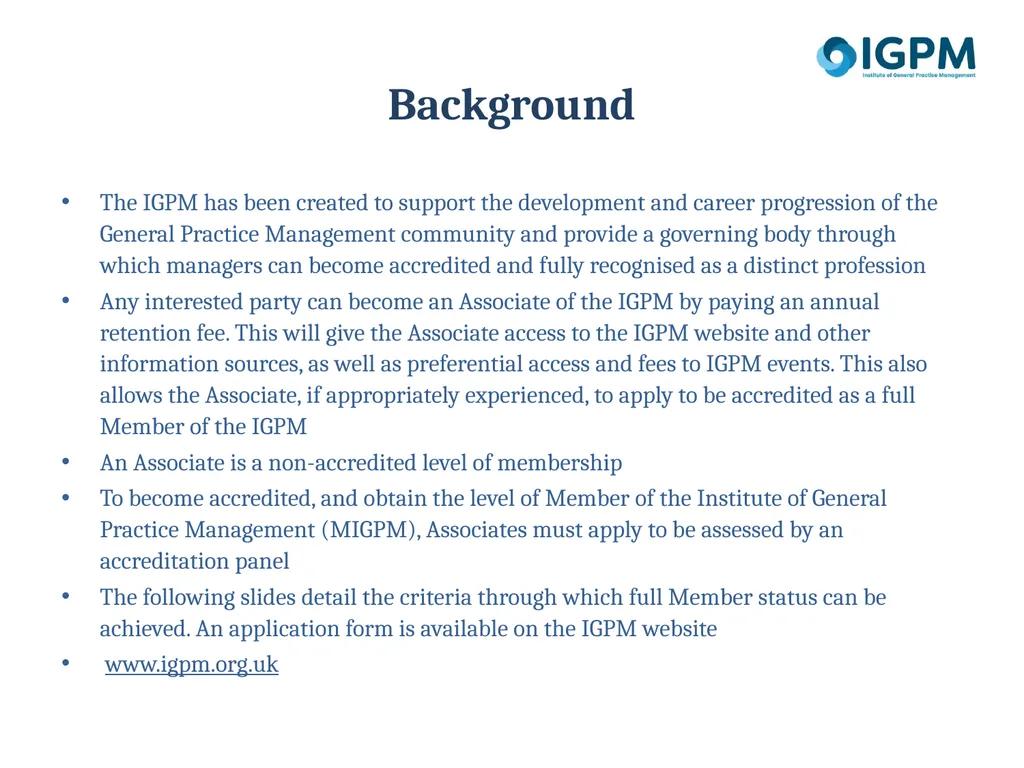
Background The IGPM has been created to support the development and career progression of the General Practice Management community and provide a governing body through which managers can become accredited and fully recognised as a distinct profession
Any interested party can become an Associate of the IGPM by paying an annual retention fee. This will give the Associate access to the IGPM website and other information sources, as well as preferential access and fees to IGPM events. This also allows the Associate, if appropriately experienced, to apply to be accredited as a full Member of the IGPM
An Associate is a non-accredited level of membership
To become accredited, and obtain the level of Member of the Institute of General Practice Management (MIGPM), Associates must apply to be assessed by an accreditation panel
The following slides detail the criteria through which full Member status can be achieved. An application form is available on the IGPM website
www.igpm.org.uk<br>
Any interested party can become an Associate of the IGPM by paying an annual retention fee. This will give the Associate access to the IGPM website and other information sources, as well as preferential access and fees to IGPM events. This also allows the Associate, if appropriately experienced, to apply to be accredited as a full Member of the IGPM
An Associate is a non-accredited level of membership
To become accredited, and obtain the level of Member of the Institute of General Practice Management (MIGPM), Associates must apply to be assessed by an accreditation panel
The following slides detail the criteria through which full Member status can be achieved. An application form is available on the IGPM website
www.igpm.org.uk<br>
03
Full Membership Accreditation Framework Applicants for the award of Member of the Institute of General Practice Management (MIGPM) must demonstrate the required proficiency as detailed in the following accreditation framework
Comprehensive evidence is required to be able to advance your application
Your application cannot progress and the awarding panel cannot review the application without all necessary supporting evidence being supplied. In these circumstances the application would be declined
Evidence needs to be supplied in each of 10 domains and the awarding panel must be satisfied that the required aggregated standard level has been reached across all of these domains<br>
Comprehensive evidence is required to be able to advance your application
Your application cannot progress and the awarding panel cannot review the application without all necessary supporting evidence being supplied. In these circumstances the application would be declined
Evidence needs to be supplied in each of 10 domains and the awarding panel must be satisfied that the required aggregated standard level has been reached across all of these domains<br>
04
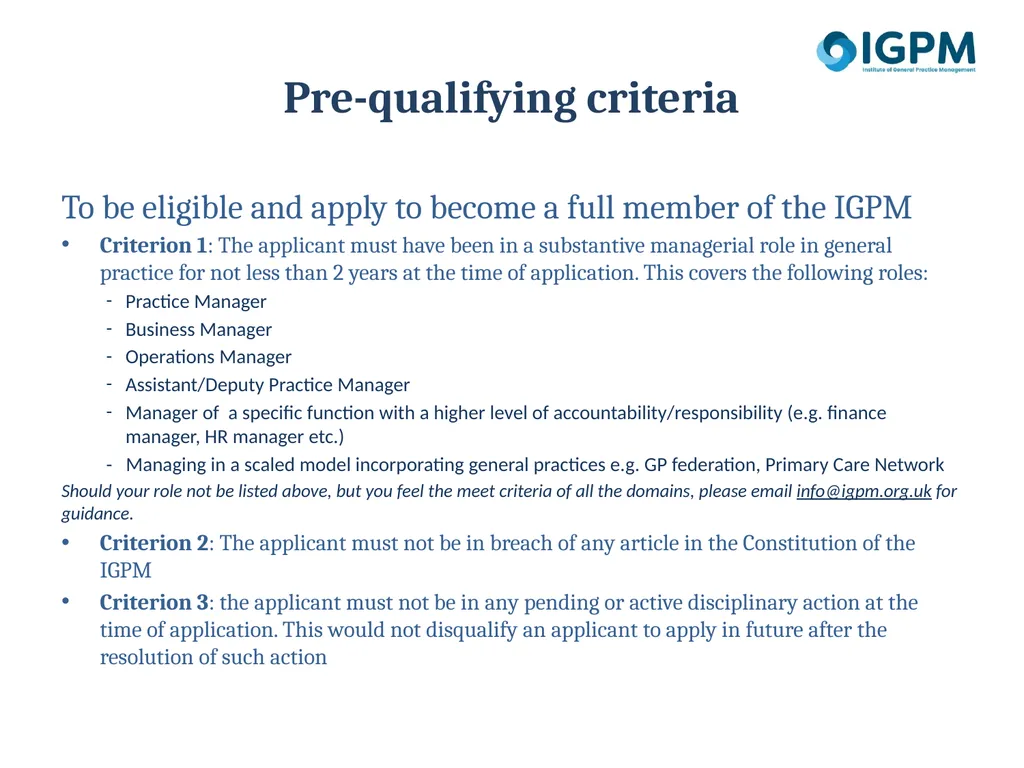
Pre-qualifying criteria To be eligible and apply to become a full member of the IGPM
Criterion 1: The applicant must have been in a substantive managerial role in general practice for not less than 2 years at the time of application. This covers the following roles:
Practice Manager
Business Manager
Operations Manager
Assistant/Deputy Practice Manager
Manager of a specific function with a higher level of accountability/responsibility (e.g. finance manager, HR manager etc.)
- Managing in a scaled model incorporating general practices e.g. GP federation, Primary Care Network
Should your role not be listed above, but you feel the meet criteria of all the domains, please email info@igpm.org.uk for guidance.
Criterion 2: The applicant must not be in breach of any article in the Constitution of the IGPM
Criterion 3: the applicant must not be in any pending or active disciplinary action at the time of application. This would not disqualify an applicant to apply in future after the resolution of such action<br>
Criterion 1: The applicant must have been in a substantive managerial role in general practice for not less than 2 years at the time of application. This covers the following roles:
Practice Manager
Business Manager
Operations Manager
Assistant/Deputy Practice Manager
Manager of a specific function with a higher level of accountability/responsibility (e.g. finance manager, HR manager etc.)
- Managing in a scaled model incorporating general practices e.g. GP federation, Primary Care Network
Should your role not be listed above, but you feel the meet criteria of all the domains, please email info@igpm.org.uk for guidance.
Criterion 2: The applicant must not be in breach of any article in the Constitution of the IGPM
Criterion 3: the applicant must not be in any pending or active disciplinary action at the time of application. This would not disqualify an applicant to apply in future after the resolution of such action<br>
05
Supporting testimonials Two written testimonials are required for all applications. These will be mainly references relating to character, skills and competencies of the applicant and these endorsements should be supplied from two of the following options:
An employer or senior work colleague. This should ideally be from a person who is named as one of the providers of the contract for the general practice in which you work
A peer working in general practice management
A clinician or manager working outside of the practice in which you manage but has a local, regional or national leadership role<br>
An employer or senior work colleague. This should ideally be from a person who is named as one of the providers of the contract for the general practice in which you work
A peer working in general practice management
A clinician or manager working outside of the practice in which you manage but has a local, regional or national leadership role<br>
06
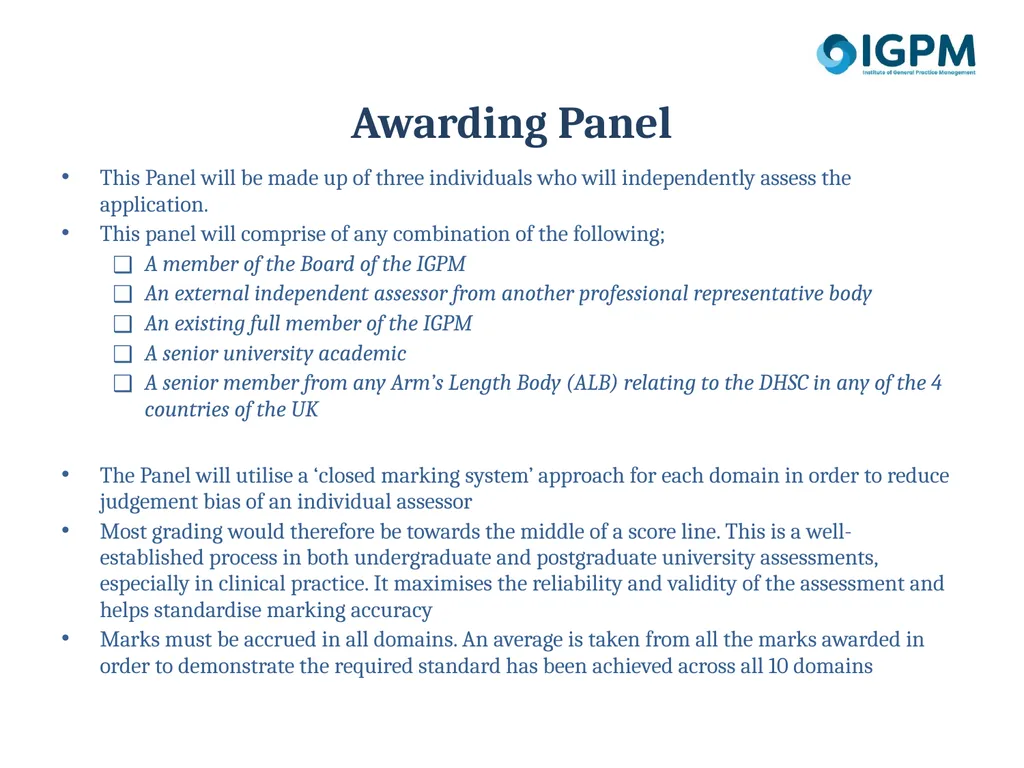
Awarding Panel This Panel will be made up of three individuals who will independently assess the application.
This panel will comprise of any combination of the following;
A member of the Board of the IGPM
An external independent assessor from another professional representative body
An existing full member of the IGPM
A senior university academic
A senior member from any Arm’s Length Body (ALB) relating to the DHSC in any of the 4 countries of the UK
The Panel will utilise a ‘closed marking system’ approach for each domain in order to reduce judgement bias of an individual assessor
Most grading would therefore be towards the middle of a score line. This is a well- established process in both undergraduate and postgraduate university assessments, especially in clinical practice. It maximises the reliability and validity of the assessment and helps standardise marking accuracy
Marks must be accrued in all domains. An average is taken from all the marks awarded in order to demonstrate the required standard has been achieved across all 10 domains<br>
This panel will comprise of any combination of the following;
A member of the Board of the IGPM
An external independent assessor from another professional representative body
An existing full member of the IGPM
A senior university academic
A senior member from any Arm’s Length Body (ALB) relating to the DHSC in any of the 4 countries of the UK
The Panel will utilise a ‘closed marking system’ approach for each domain in order to reduce judgement bias of an individual assessor
Most grading would therefore be towards the middle of a score line. This is a well- established process in both undergraduate and postgraduate university assessments, especially in clinical practice. It maximises the reliability and validity of the assessment and helps standardise marking accuracy
Marks must be accrued in all domains. An average is taken from all the marks awarded in order to demonstrate the required standard has been achieved across all 10 domains<br>
07
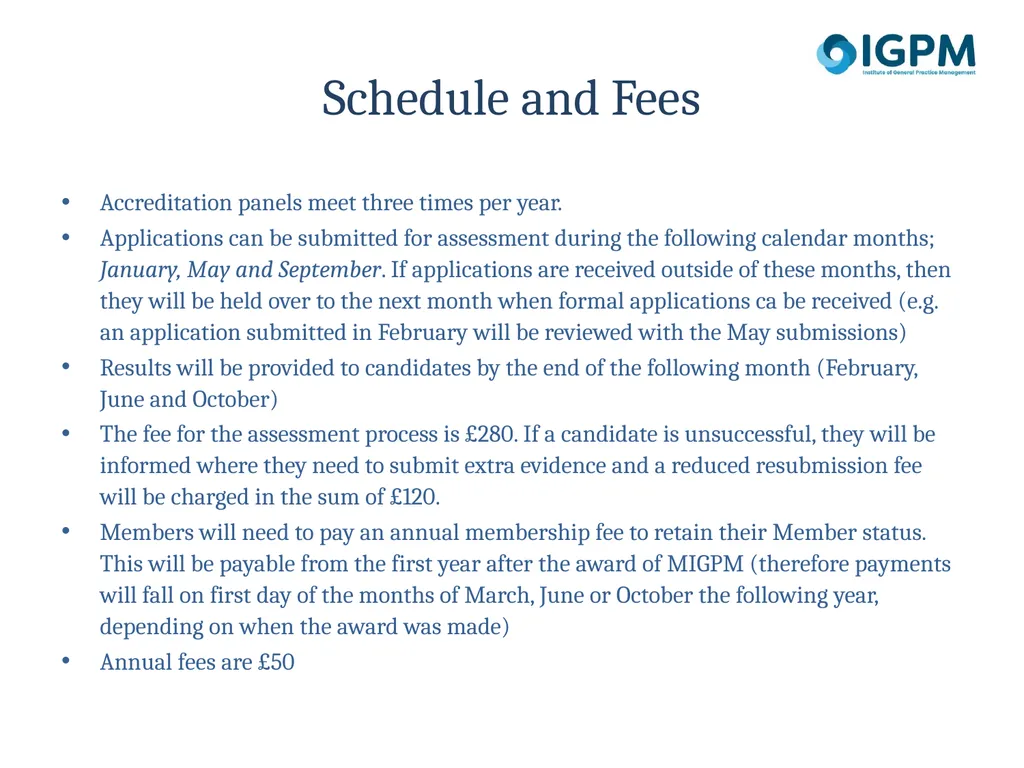
Schedule and Fees Accreditation panels meet three times per year.
Applications can be submitted for assessment during the following calendar months; January, May and September. If applications are received outside of these months, then they will be held over to the next month when formal applications ca be received (e.g. an application submitted in February will be reviewed with the May submissions)
Results will be provided to candidates by the end of the following month (February, June and October)
The fee for the assessment process is £280. If a candidate is unsuccessful, they will be informed where they need to submit extra evidence and a reduced resubmission fee will be charged in the sum of £120.
Members will need to pay an annual membership fee to retain their Member status. This will be payable from the first year after the award of MIGPM (therefore payments will fall on first day of the months of March, June or October the following year, depending on when the award was made)
Annual fees are £50<br>
Applications can be submitted for assessment during the following calendar months; January, May and September. If applications are received outside of these months, then they will be held over to the next month when formal applications ca be received (e.g. an application submitted in February will be reviewed with the May submissions)
Results will be provided to candidates by the end of the following month (February, June and October)
The fee for the assessment process is £280. If a candidate is unsuccessful, they will be informed where they need to submit extra evidence and a reduced resubmission fee will be charged in the sum of £120.
Members will need to pay an annual membership fee to retain their Member status. This will be payable from the first year after the award of MIGPM (therefore payments will fall on first day of the months of March, June or October the following year, depending on when the award was made)
Annual fees are £50<br>
08
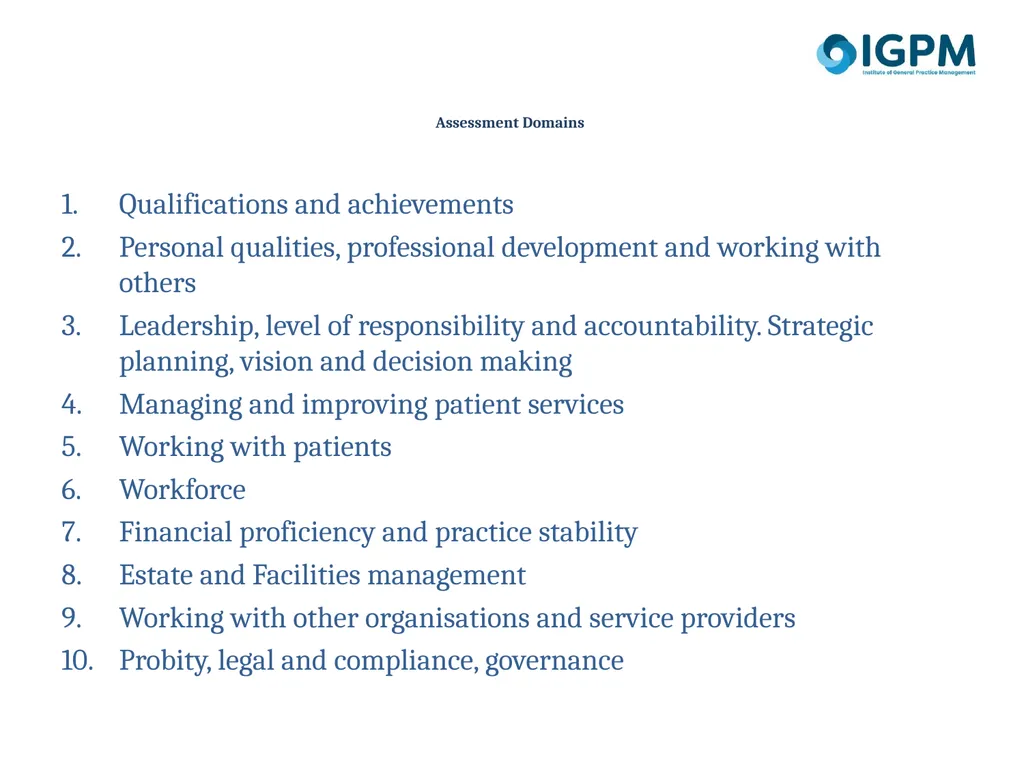
Assessment Domains Qualifications and achievements
Personal qualities, professional development and working with others
Leadership, level of responsibility and accountability. Strategic planning, vision and decision making
Managing and improving patient services
Working with patients
Workforce
Financial proficiency and practice stability
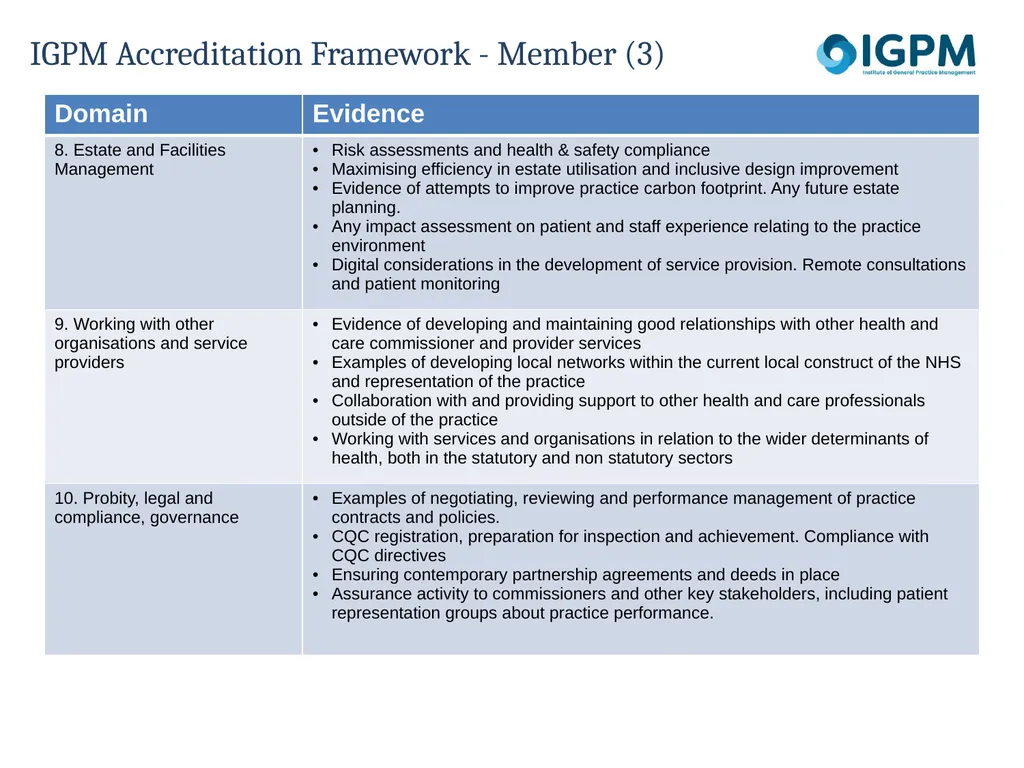
Estate and Facilities management
Working with other organisations and service providers
Probity, legal and compliance, governance<br>
Personal qualities, professional development and working with others
Leadership, level of responsibility and accountability. Strategic planning, vision and decision making
Managing and improving patient services
Working with patients
Workforce
Financial proficiency and practice stability
Estate and Facilities management
Working with other organisations and service providers
Probity, legal and compliance, governance<br>
09
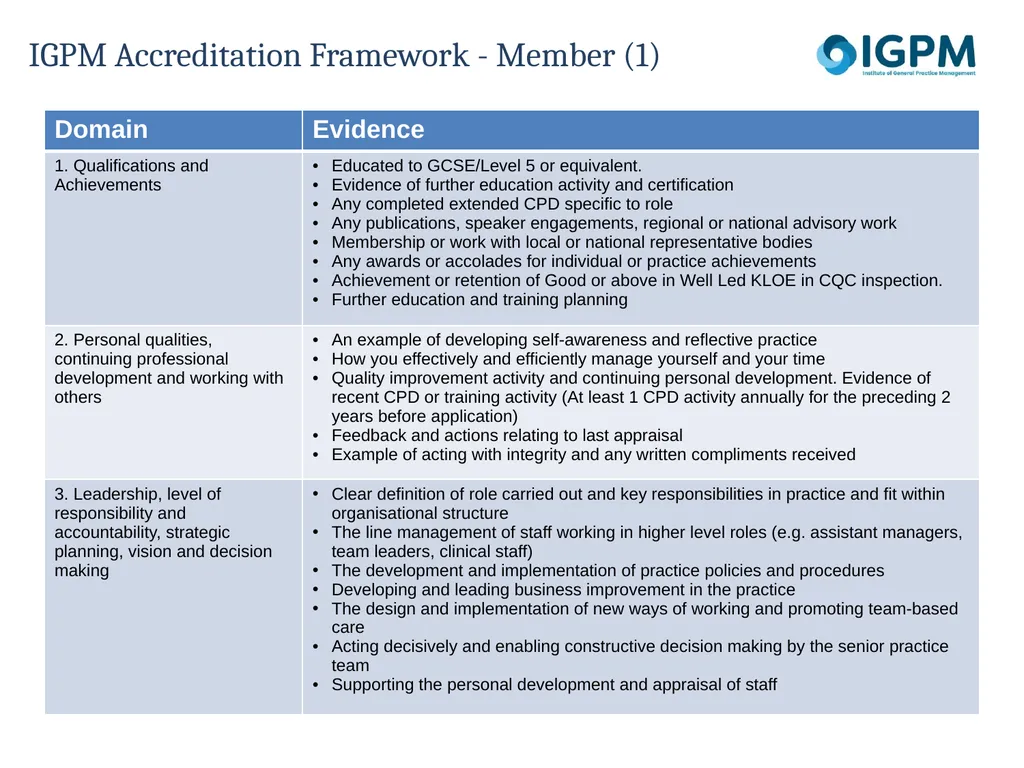
IGPM Accreditation Framework - Member (1)<br>
10
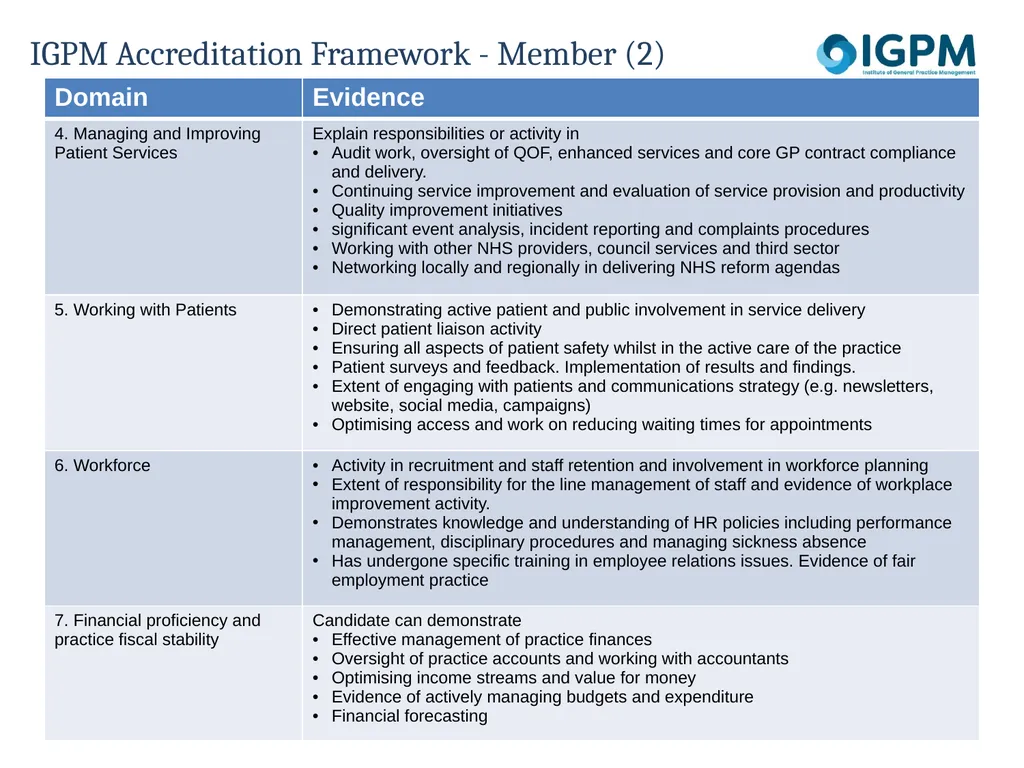
IGPM Accreditation Framework - Member (2)<br>
11
IGPM Accreditation Framework - Member (3)<br>
12
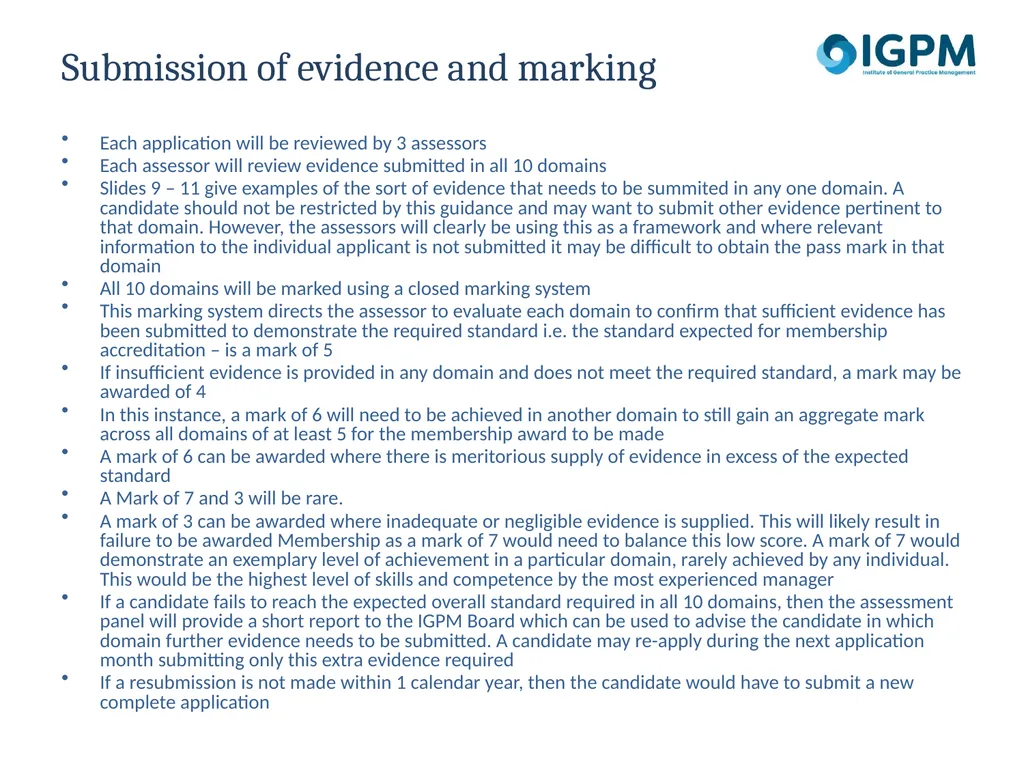
Submission of evidence and marking Each application will be reviewed by 3 assessors
Each assessor will review evidence submitted in all 10 domains
Slides 9 – 11 give examples of the sort of evidence that needs to be summited in any one domain. A candidate should not be restricted by this guidance and may want to submit other evidence pertinent to that domain. However, the assessors will clearly be using this as a framework and where relevant information to the individual applicant is not submitted it may be difficult to obtain the pass mark in that domain
All 10 domains will be marked using a closed marking system
This marking system directs the assessor to evaluate each domain to confirm that sufficient evidence has been submitted to demonstrate the required standard i.e. the standard expected for membership accreditation – is a mark of 5
If insufficient evidence is provided in any domain and does not meet the required standard, a mark may be awarded of 4
In this instance, a mark of 6 will need to be achieved in another domain to still gain an aggregate mark across all domains of at least 5 for the membership award to be made
A mark of 6 can be awarded where there is meritorious supply of evidence in excess of the expected standard
A Mark of 7 and 3 will be rare.
A mark of 3 can be awarded where inadequate or negligible evidence is supplied. This will likely result in failure to be awarded Membership as a mark of 7 would need to balance this low score. A mark of 7 would demonstrate an exemplary level of achievement in a particular domain, rarely achieved by any individual. This would be the highest level of skills and competence by the most experienced manager
If a candidate fails to reach the expected overall standard required in all 10 domains, then the assessment panel will provide a short report to the IGPM Board which can be used to advise the candidate in which domain further evidence needs to be submitted. A candidate may re-apply during the next application month submitting only this extra evidence required
If a resubmission is not made within 1 calendar year, then the candidate would have to submit a new complete application<br>
Each assessor will review evidence submitted in all 10 domains
Slides 9 – 11 give examples of the sort of evidence that needs to be summited in any one domain. A candidate should not be restricted by this guidance and may want to submit other evidence pertinent to that domain. However, the assessors will clearly be using this as a framework and where relevant information to the individual applicant is not submitted it may be difficult to obtain the pass mark in that domain
All 10 domains will be marked using a closed marking system
This marking system directs the assessor to evaluate each domain to confirm that sufficient evidence has been submitted to demonstrate the required standard i.e. the standard expected for membership accreditation – is a mark of 5
If insufficient evidence is provided in any domain and does not meet the required standard, a mark may be awarded of 4
In this instance, a mark of 6 will need to be achieved in another domain to still gain an aggregate mark across all domains of at least 5 for the membership award to be made
A mark of 6 can be awarded where there is meritorious supply of evidence in excess of the expected standard
A Mark of 7 and 3 will be rare.
A mark of 3 can be awarded where inadequate or negligible evidence is supplied. This will likely result in failure to be awarded Membership as a mark of 7 would need to balance this low score. A mark of 7 would demonstrate an exemplary level of achievement in a particular domain, rarely achieved by any individual. This would be the highest level of skills and competence by the most experienced manager
If a candidate fails to reach the expected overall standard required in all 10 domains, then the assessment panel will provide a short report to the IGPM Board which can be used to advise the candidate in which domain further evidence needs to be submitted. A candidate may re-apply during the next application month submitting only this extra evidence required
If a resubmission is not made within 1 calendar year, then the candidate would have to submit a new complete application<br>