
MEMO INTRODUCTION The Tetra Tech Team (TT Team) is
PT
Published · 26 slides · 0 views

1 / 1

Description
MEMO INTRODUCTION The Tetra Tech Team (TT Team) is providing the Hawaiʻi State Department of Health, Office of Solid Waste Management (DOHOSWM) herein with an issue statement and description of potential solutions evaluated for
Related Topics
Share
Embed code
Download this presentation From Below
"MEMO INTRODUCTION The Tetra Tech Team (TT Team) is" is the property of its rightful owner. Permission is granted to download and print the materials on this website for personal, non-commercial use only, and to display it on your personal computer provided you do not modify the materials and that you retain all copyright notices contained in the materials. By downloading content from our website, you accept the terms of this agreement.
Presentation Transcript
01
MEMO INTRODUCTION
The Tetra Tech Team (TT Team) is providing the Hawaiʻi State Department of Health, Office of Solid Waste Management (DOH/OSWM) herein with an issue statement and description of potential solutions evaluated for construction and demolition (C&D) debris inclusion in an update to the Statewide Integrated Solid Waste Management Plan (ISWMP). According to Hawaiʻi Revised Statutes (HRS) Chapter 342G Section 29, OSWM must convene a state integrated solid waste management task force (Task Force) and incorporate their comments to revise and update the materials contained in the previous state ISWMP. A Task Force consisting of county, industry and non-profit representatives, and members of the public was formed, and a meeting will be held on January 25, 2024, to discuss and receive input on how to manage C&D debris.
Hawaiʻi has rules and regulations currently in place to manage C&D debris on the various islands including:
Hawai‘i Revised Statutes (HRS) §196-9 HRS §107-28
HRS §107-25
However, more can be done to manage C&D debris now and, in the future, as well as the potential problems with illegal dumping, C&D debris diversion, contamination, and the need for additional C&D debris processing infrastructure. This memorandum will present potential solutions relating to the management of C&D debris across
the state. Once the Task Force meeting is held, additional feedback on potential Extended Producer Responsibility (EPR) legislation, government programs and subsidies, free market solutions, less wasteful alternatives, and public education components will be sought, as applicable.
ISSUE STATEMENT
Construction and Demolition Debris
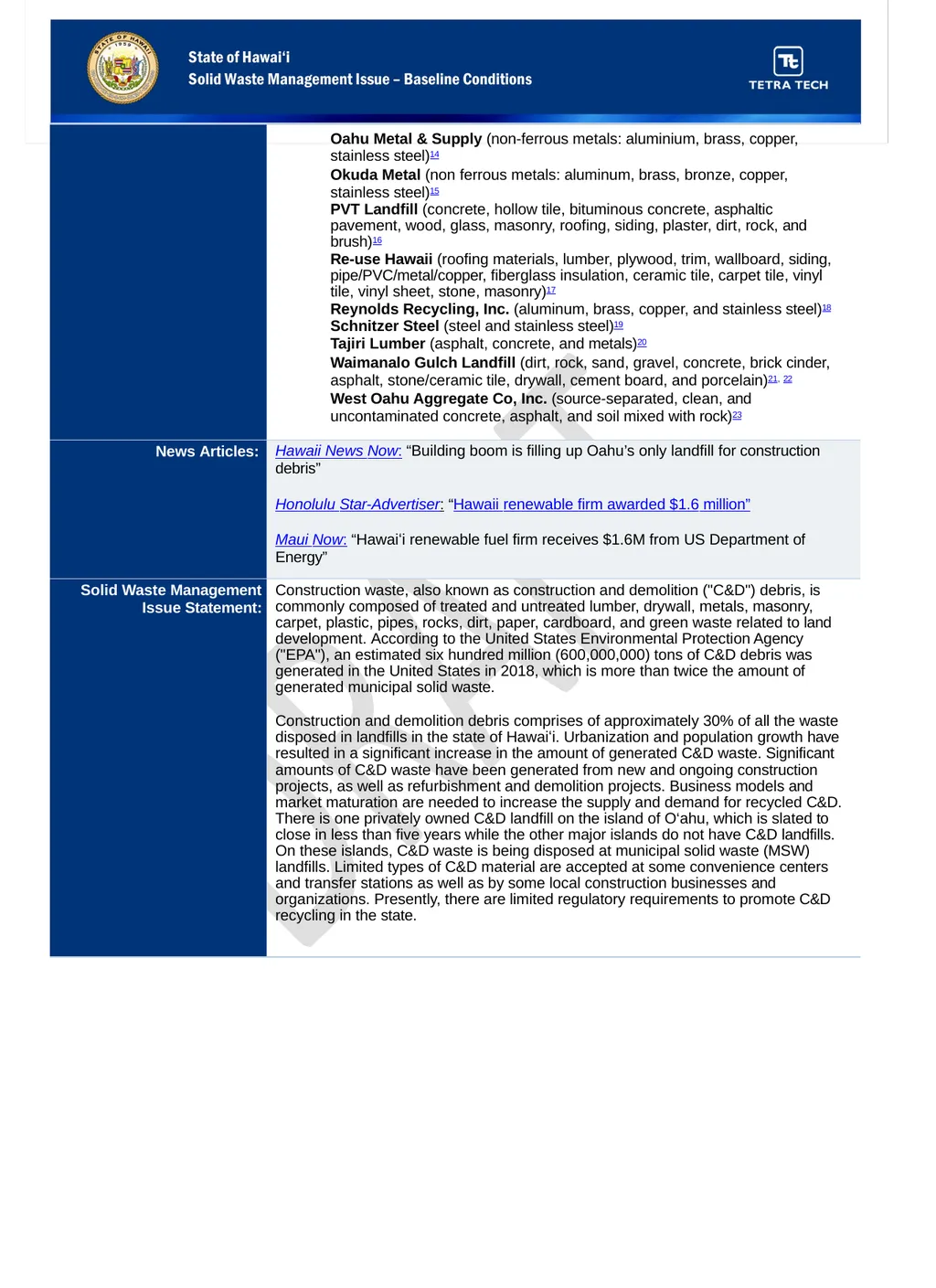
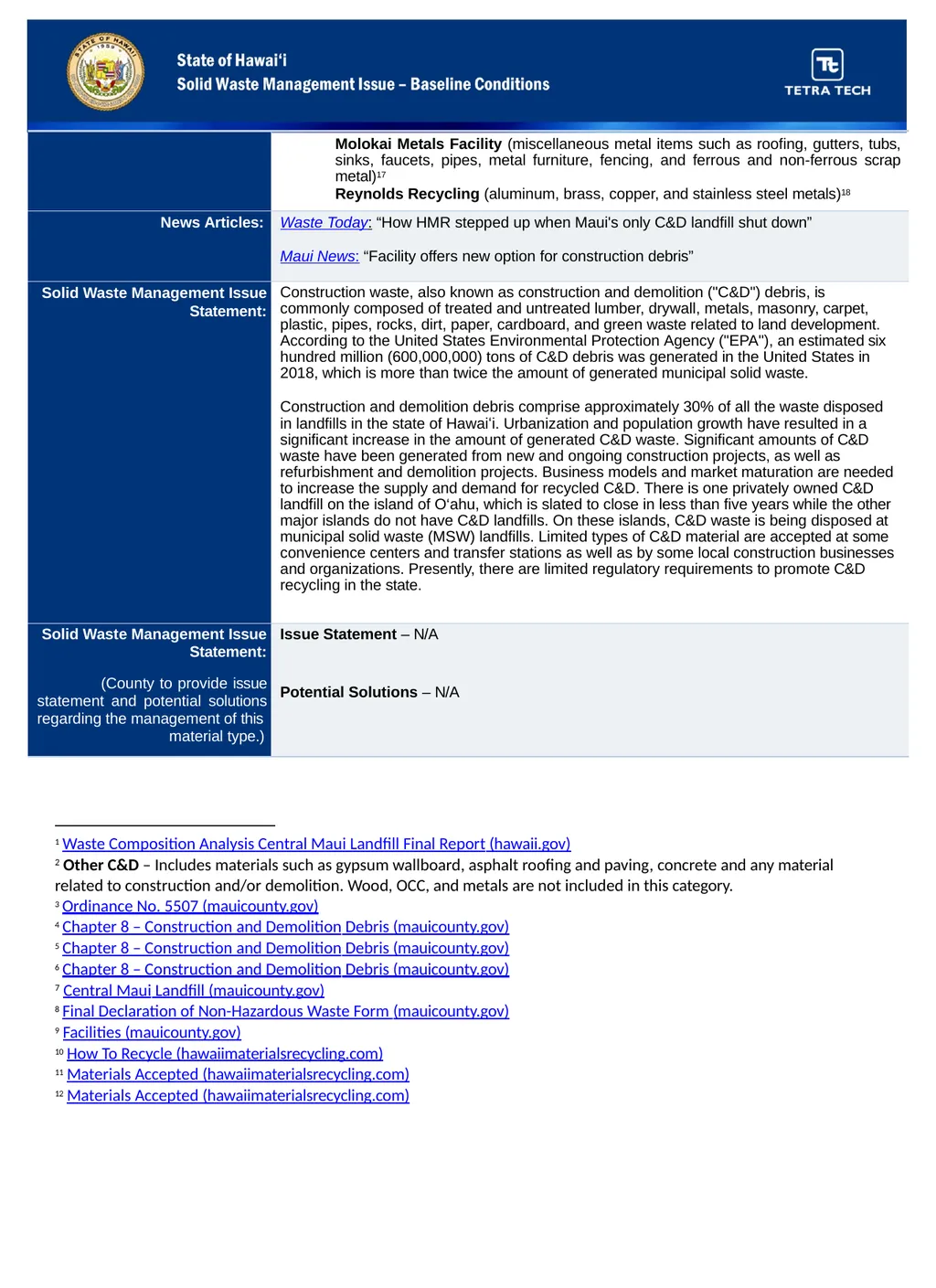
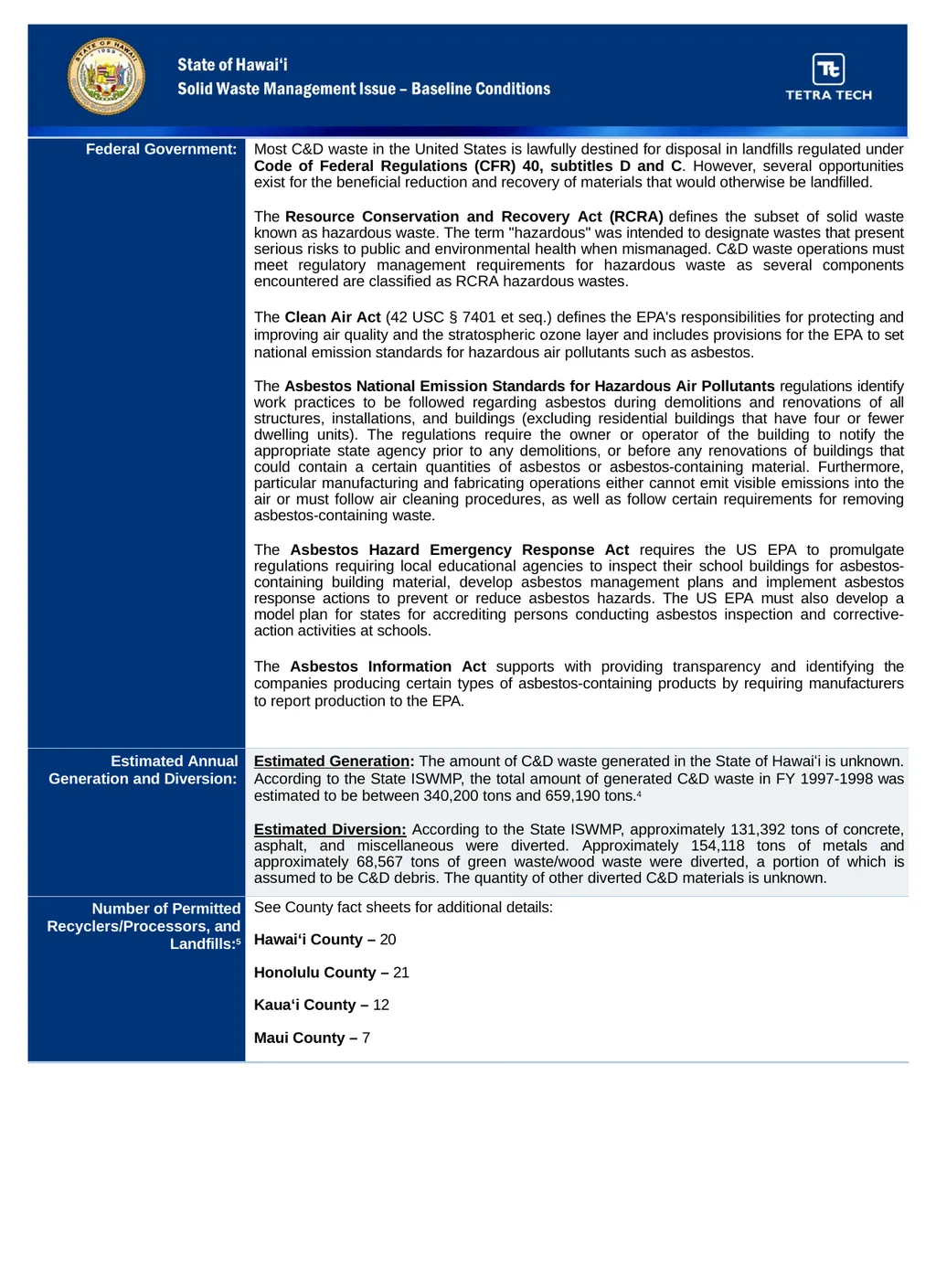
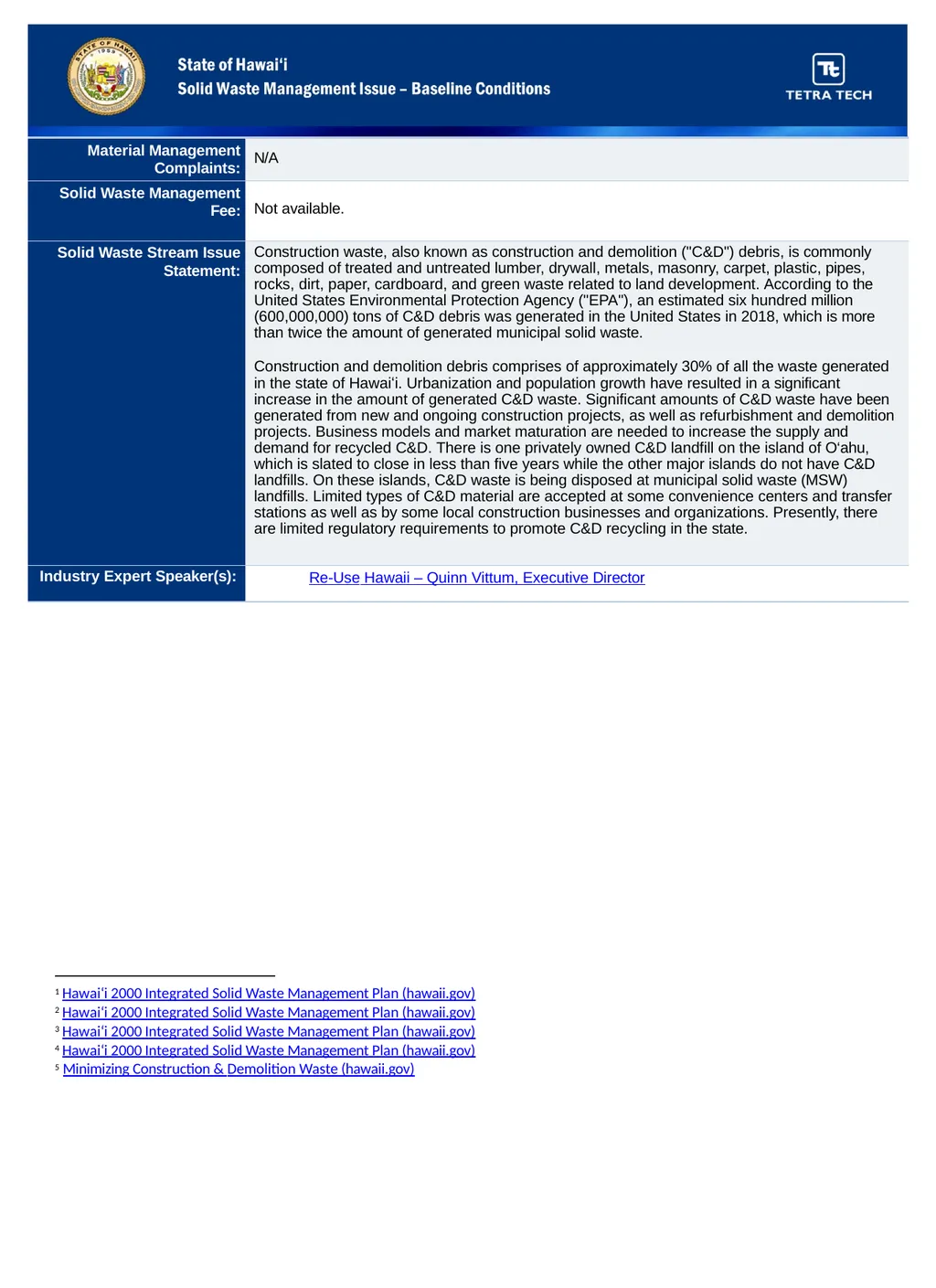
Construction waste, also known as construction and demolition ("C&D") debris, is commonly composed of treated and untreated lumber, drywall, metals, masonry, carpet, plastic, pipes, rocks, dirt, paper, cardboard, and green waste related to land development. According to the United States Environmental Protection Agency (US EPA), an estimated six hundred million (600,000,000) tons of C&D debris was generated in the United States in 2018, which is more than twice the amount of generated municipal solid waste.
Tetra Tech 21700 Copley Drive, Suite 200 Diamond Bar, CA 91765
Tel 909.960.7777<br>
02
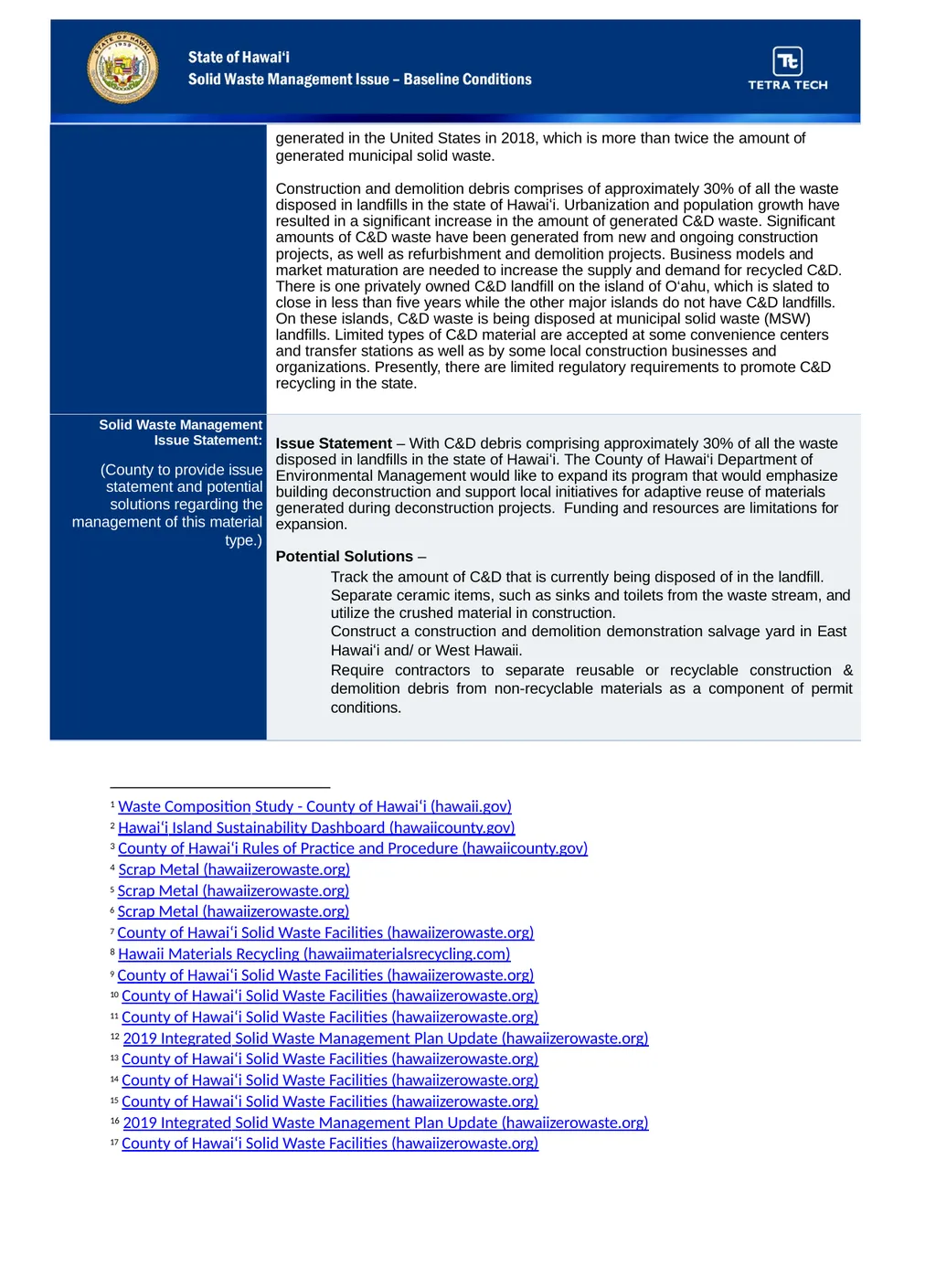
HAWAIʻI ISWMP UPDATE – C&D POTENTIAL SOLUTIONS FILE: 197-2022-0127 | JANUARY 5, 2024 | 2 Hawaii ISWMP Update_C&D_Potential Solutions Memo_010524.docx Construction and demolition debris comprises approximately 30 percent of all the waste disposed of in landfills in the state of Hawaiʻi. Urbanization and population growth have resulted in a significant increase in the amount of generated C&D waste. Significant amounts of C&D waste have been generated from new and ongoing construction projects, as well as refurbishment and demolition projects. Business models and market maturation are needed to increase the supply and demand for recycled C&D. There is one privately owned C&D landfill on the island of O‘ahu, which is slated to close in less than five years while the other major islands do not have C&D landfills. On these islands, C&D waste is being disposed at municipal solid waste (MSW) landfills. Limited types of C&D material are accepted at some convenience centers and transfer stations as well as by some local construction businesses and organizations. Presently, there are limited regulatory requirements to promote C&D recycling in the state. 3.0 POTENTIAL SOLUTION CATEGORIES There are many strategies to more effectively manage waste. The US EPA has categorized and prioritized these strategies from the most effective option to the least effective option. According to HRS 342G-2, solid waste management practices to be considered by the DOH (in order of priority) are source reduction, recycling and bioconversion, and landfill and incineration. The differences between the US EPA’s waste management hierarchy and solid waste management priorities identified in HRS 342G-2 are minimal. As seen in Figure 3-1, the US EPA’s waste management hierarchy includes energy recovery (e.g., incineration, which is referenced in HRS 342-G) as a solid waste management approach to be considered. The US EPA Waste Management Hierarchy also identifies reuse as an option, which is not explicitly identified in HRS 342G-2.
The 3R’s must be considered in order to effectively manage waste, starting with the most effective: Reducing waste means purchasing less and minimizing the amount of waste we produce, therefore disposing of less. There are many ways to reduce consumption such as better planning and preparation when we shop, or by evaluating if we can go without the product(s). Waste reduction can also be achieved by redesigning materials, products, and services to be less resource intensive.
Reusing items slows the process of purchasing new items and disposing of old items. We can reuse materials that were meant to be disposed of, giving them a second life, or we can choose materials that are intended to be reused, making sure to take good care of them and extending their lifespan.
Recycling keeps valuable materials in the materials economy and prevents the environmentally harmful extraction process of raw materials, which benefits both the economy and the planet.
The potential solutions relating to the management of C&D debris across the state were developed in consideration with potential EPR legislation, government programs and subsidies, free market solutions, less wasteful alternatives, and public education components, which were previously described in the Tires Potential Solutions memorandum. Figure 3-1: US EPA Waste Management Hierarchy<br>
03
HAWAIʻI ISWMP UPDATE – C&D POTENTIAL SOLUTIONS FILE: 197-2022-0127 | JANUARY 5, 2024 | Hawaii ISWMP Update_C&D_Potential Solutions Memo_010524.docx POTENTIAL SOLUTIONS FOR C&D
Potential Solutions to Consider
This section presents potential solutions that could be considered for management of C&D debris. These potential solutions were identified through benchmarking other states with C&D management programs. The DOH is seeking input from the Task Force and industry representatives, taking into consideration the solution categories identified in Section 3. These include:
Status Quo – Existing C&D debris management options are limited for each of the Counties and the State.
Outreach and Education – The US EPA has publicly accessible educational resources, including a design for deconstruction manual and a residential deconstruction manual. The manuals provide guidance on designing buildings to facilitate the deconstruction of buildings to reduce the disposal of reusable C&D materials. The US EPA’s Deconstruction Rapid Assessment Tool aids in the prioritization of structures for deconstruction and salvage, and in decision-making for time allocation and resources.
The City of San Antonio held its first-ever Certified Deconstruction Contractor training in October 2019, and now offers the training every year. The training is a five-day, hands-on field course, which includes two virtual sessions on permitting and introductory business operations. The training focuses on transferring essential skills for hands‐on deconstruction, including:
Proper tools and worksite organization;
Assessment of materials for reuse and material conditions;
Methods for removing material in a manner that allows it to be reused (i.e., siding, framing, flooring, windows & doors, porch elements, and fixtures)
Site preparation and material storage/organization; and
Introduction to business operations for deconstruction and salvage.
The County of San Mateo Office of Sustainability also offers free deconstruction trainings from the ReUse Institute. Participants who graduate from the program receive certificates and are eligible to be listed in the company’s database of available deconstruction workers. The training is a 12-day course ranging from classroom instruction to field training, including deconstructing a house. The County has also developed a construction, deconstruction, and demolition guide that contains information related to deconstruction, salvage and reuse, City C&D recycling requirements, hazardous and universal waste, frequently asked questions, and a list of haulers and C&D sorting facilities, including associated acceptable materials.
Build San Antonio Green hosts their annual Solar Fest, a free community festival with a variety of engaging educational activities focusing on energy and water conservation, solar energy, electric vehicles, and the city’s local resiliency efforts. In November 2019, the Office of Historic Preservation (OHP) hosted a booth for creative upcycling of building materials and featured a family-friendly holiday activity for creating ornaments from salvaged wood. In addition, Sally the Salvaged Turkey was pardoned from the landfill by Mayor Ron Nirenberg. Sally was created from salvaged materials by OHP staff, including reclaimed lumber, door handles, knobs, and hinges. Sally became a mascot for the opportunity that can be found in reclaimed building materials. As part of the pardoning, the mayor read a declaration highlighting the City’s recently adopted Climate Action and Adaptation Plan as well as the City’s ongoing deconstruction and salvage initiative.
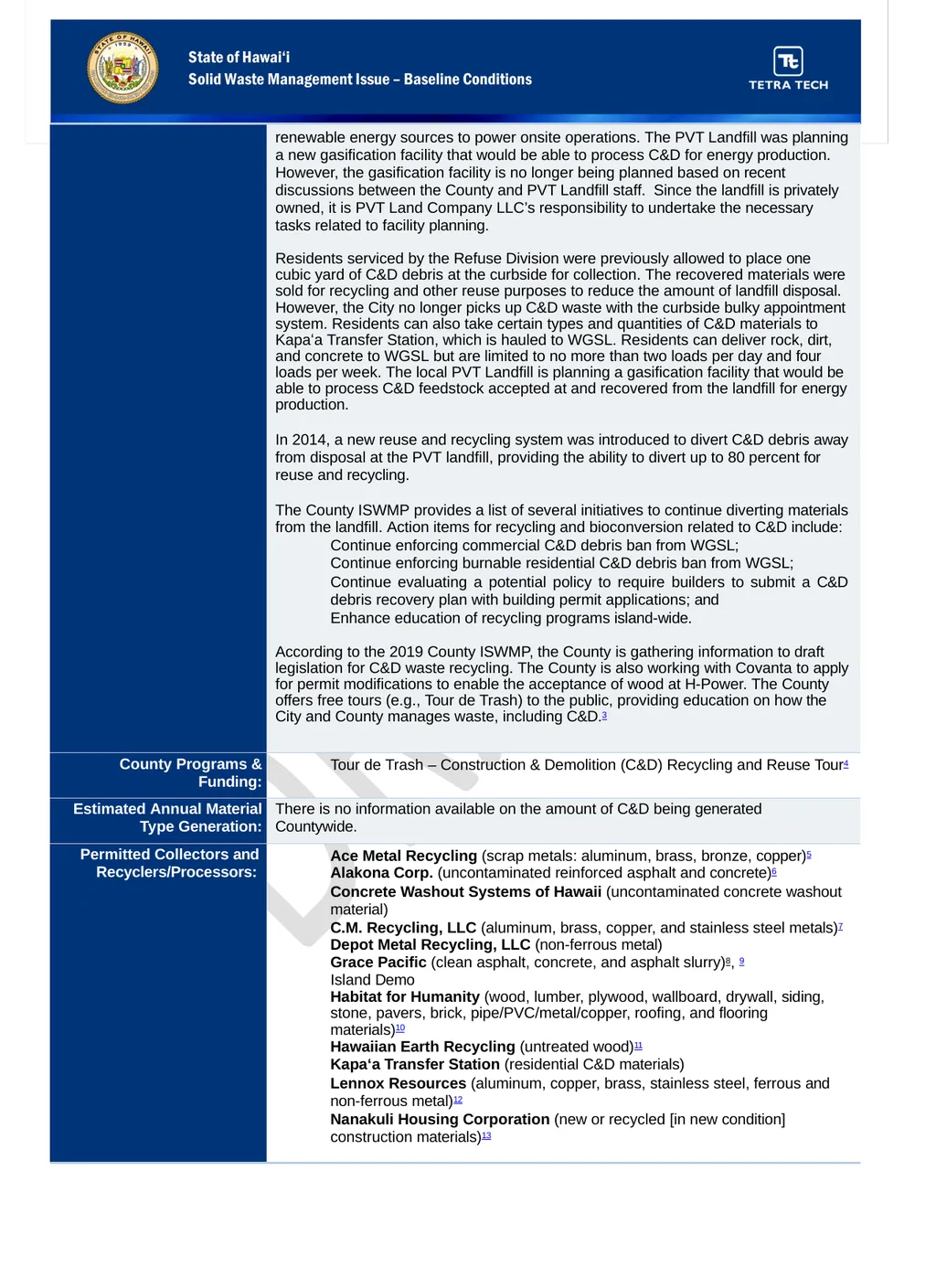
The City & County of Honolulu offer free tours (“Tour de Trash”) to educate the public on solid waste management and implementation of sustainable practices. A C&D Recycling tour was scheduled for Fall 2023, highlighting construction companies that are implementing ways to create less waste, reuse
3<br>
04
HAWAIʻI ISWMP UPDATE – C&D POTENTIAL SOLUTIONS FILE: 197-2022-0127 | JANUARY 5, 2024 | Hawaii ISWMP Update_C&D_Potential Solutions Memo_010524.docx construction debris, and create reusable products for the industry. A Reuse Tour was also scheduled for Fall 2023, featuring organizations that reduce waste at the source, including businesses that deconstruct or accept construction materials and tools for refurbishing, reusing, or selling. Although both tours were canceled for Fall 2023, there are opportunities to host additional tours in the future.
Resource Reduction Alternatives – The US EPA defines deconstruction as “the process of carefully dismantling buildings to salvage components for reuse and recycling.” Deconstruction has many benefits, including:
Maximized recovery of materials.
Conservation of finite, old-growth forest resources.
Employment and job training opportunities (i.e., manufacturing jobs, or jobs to reprocess salvaged materials).
Diversion of demolition debris bound for disposal.
Preservation of resources through reuse.
In addition to deconstruction, prefabricated and modular construction methods can reduce material waste, energy consumption, and construction time. These methods often involve assembling components off-site and minimizes on-site disruption.
Bamboo is a renewable resource that grows much faster than traditional hardwoods, making it desirable material for sustainable architectural design and construction. Bamboo can also be a suitable improved alternative to conventional concrete and steel as it has a high strength to weight ratio and can be carved and molded. It is lightweight, durable, and versatile, making it an excellent alternative for various construction applications.
Green roofs are another alternative to conventional roofing materials and provide several benefits, including reduced temperatures and as a result, reduced energy consumption by lowering the demand for air- conditioning in buildings. Additional benefits that green roofs offer include the reduction and filtration of stormwater runoff; absorption/filtration of CO2 and pollutants, and in some cases, can serve as recreational green space for the community.
Hempcrete is a construction building material that consists of hemp shives, aggregate, water, and a type of binder to act as non-load-bearing walls, insulators, finishing plasters, and blocks. Hempcrete is supported by a frame as it does not have the requisite strength for constructing foundation. It has low mechanical properties and low thermal conductivity, making it ideal for insulation material. Hempcrete's low density material make it suitable for use in earthquake-prone areas as it is resistant to cracking under movement. Although hempcrete is not known for its strength, it provides a high vapor permeability that allows for better control of temperature in buildings. Hempcrete also continually stores CO2 throughout its lifecycle, creating environmental benefits.
Cork is a renewable resource that is harvested from the bark of cork oak trees, which naturally regenerate after harvesting. It can be used as insulation material, flooring, wall coverings, and exterior wall cladding. Cork is extremely waterproof, resistant to abrasion, and acts as a fire retardant. When used internally, the cork regulates humidity. As exterior wall cladding, the cork’s impermeability protects buildings against the elements for a significantly carbon negative material.
Mycelium, the root structure of fungi, can be used to replace construction materials. Mycelium-based products create biodegradable and lightweight construction materials for flooring, wall covering panels, and insulation.
Rammed earth construction involves the compression of natural raw materials such as earth, chalk, lime, or gravel to create durable walls. It has a high thermal mass, allowing heat absorption and storage and
4<br>
05
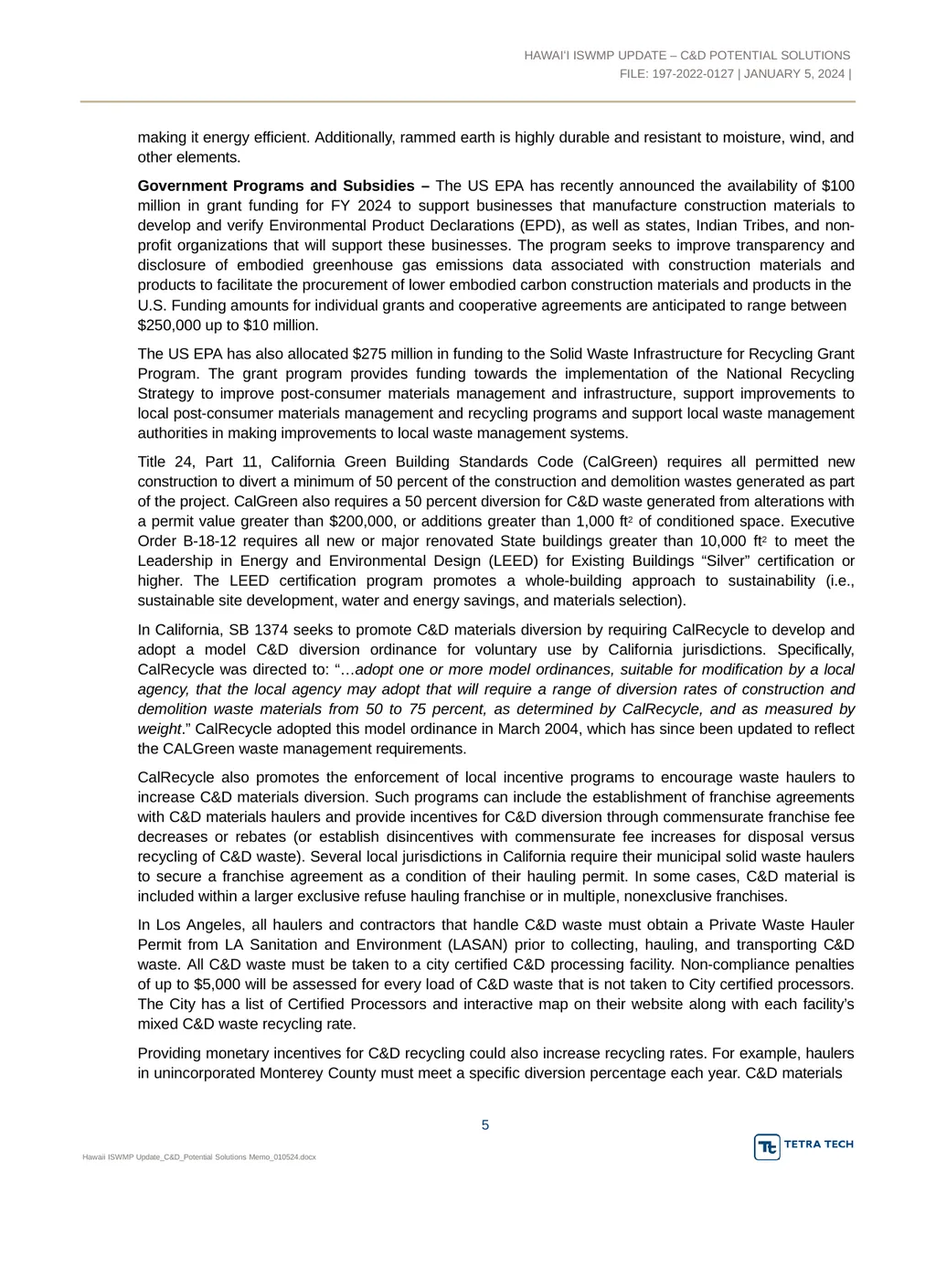
HAWAIʻI ISWMP UPDATE – C&D POTENTIAL SOLUTIONS FILE: 197-2022-0127 | JANUARY 5, 2024 | Hawaii ISWMP Update_C&D_Potential Solutions Memo_010524.docx making it energy efficient. Additionally, rammed earth is highly durable and resistant to moisture, wind, and other elements.
Government Programs and Subsidies – The US EPA has recently announced the availability of $100 million in grant funding for FY 2024 to support businesses that manufacture construction materials to develop and verify Environmental Product Declarations (EPD), as well as states, Indian Tribes, and non- profit organizations that will support these businesses. The program seeks to improve transparency and disclosure of embodied greenhouse gas emissions data associated with construction materials and products to facilitate the procurement of lower embodied carbon construction materials and products in the
U.S. Funding amounts for individual grants and cooperative agreements are anticipated to range between
$250,000 up to $10 million.
The US EPA has also allocated $275 million in funding to the Solid Waste Infrastructure for Recycling Grant Program. The grant program provides funding towards the implementation of the National Recycling Strategy to improve post-consumer materials management and infrastructure, support improvements to local post-consumer materials management and recycling programs and support local waste management authorities in making improvements to local waste management systems.
Title 24, Part 11, California Green Building Standards Code (CalGreen) requires all permitted new construction to divert a minimum of 50 percent of the construction and demolition wastes generated as part of the project. CalGreen also requires a 50 percent diversion for C&D waste generated from alterations with a permit value greater than $200,000, or additions greater than 1,000 ft2 of conditioned space. Executive Order B-18-12 requires all new or major renovated State buildings greater than 10,000 ft2 to meet the Leadership in Energy and Environmental Design (LEED) for Existing Buildings “Silver” certification or higher. The LEED certification program promotes a whole-building approach to sustainability (i.e., sustainable site development, water and energy savings, and materials selection).
In California, SB 1374 seeks to promote C&D materials diversion by requiring CalRecycle to develop and adopt a model C&D diversion ordinance for voluntary use by California jurisdictions. Specifically, CalRecycle was directed to: “…adopt one or more model ordinances, suitable for modification by a local agency, that the local agency may adopt that will require a range of diversion rates of construction and demolition waste materials from 50 to 75 percent, as determined by CalRecycle, and as measured by weight.” CalRecycle adopted this model ordinance in March 2004, which has since been updated to reflect the CALGreen waste management requirements.
CalRecycle also promotes the enforcement of local incentive programs to encourage waste haulers to increase C&D materials diversion. Such programs can include the establishment of franchise agreements with C&D materials haulers and provide incentives for C&D diversion through commensurate franchise fee decreases or rebates (or establish disincentives with commensurate fee increases for disposal versus recycling of C&D waste). Several local jurisdictions in California require their municipal solid waste haulers to secure a franchise agreement as a condition of their hauling permit. In some cases, C&D material is included within a larger exclusive refuse hauling franchise or in multiple, nonexclusive franchises.
In Los Angeles, all haulers and contractors that handle C&D waste must obtain a Private Waste Hauler Permit from LA Sanitation and Environment (LASAN) prior to collecting, hauling, and transporting C&D waste. All C&D waste must be taken to a city certified C&D processing facility. Non-compliance penalties of up to $5,000 will be assessed for every load of C&D waste that is not taken to City certified processors. The City has a list of Certified Processors and interactive map on their website along with each facility’s mixed C&D waste recycling rate.
Providing monetary incentives for C&D recycling could also increase recycling rates. For example, haulers in unincorporated Monterey County must meet a specific diversion percentage each year. C&D materials
5<br>
06
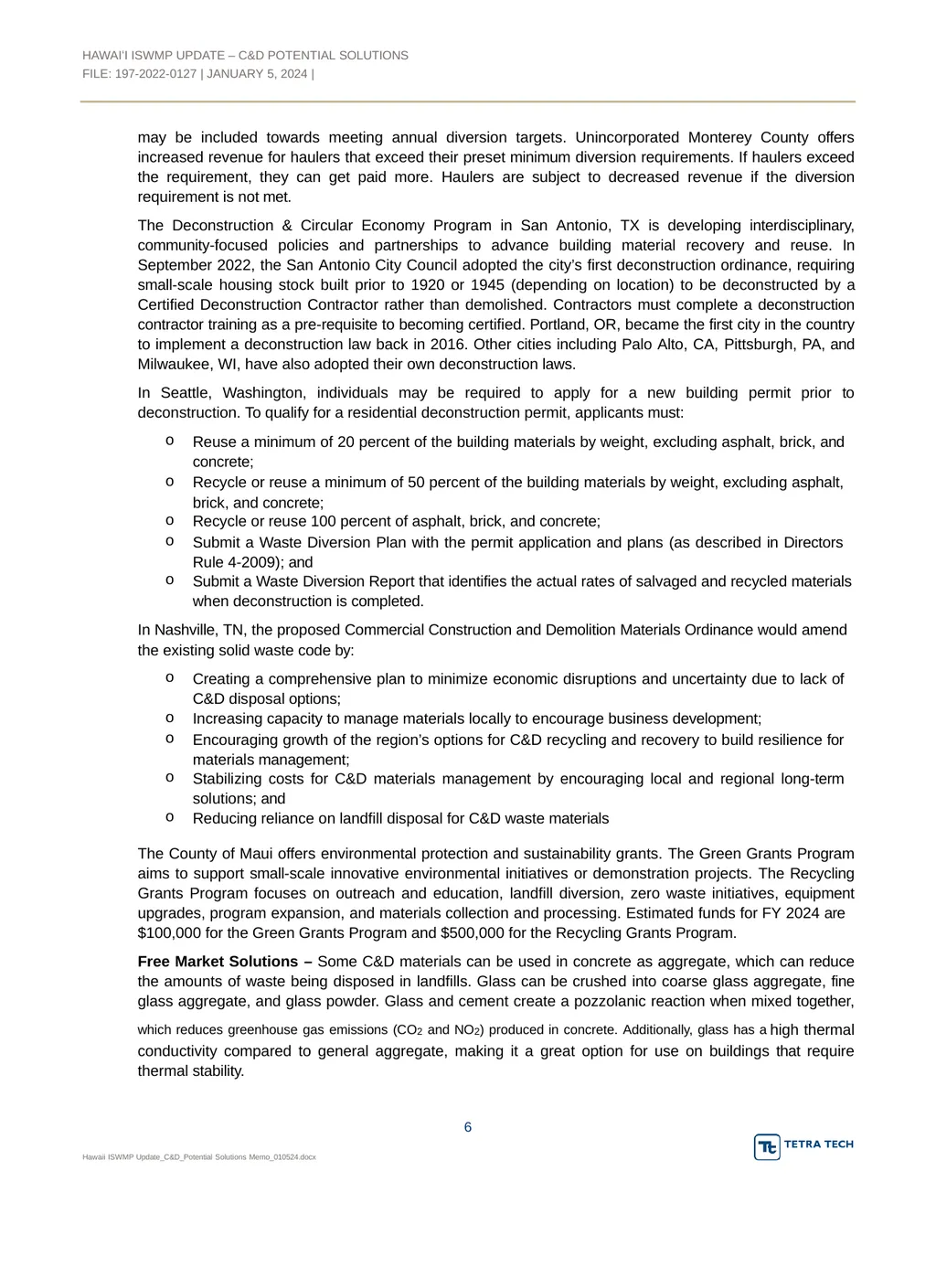
HAWAIʻI ISWMP UPDATE – C&D POTENTIAL SOLUTIONS FILE: 197-2022-0127 | JANUARY 5, 2024 | 6 Hawaii ISWMP Update_C&D_Potential Solutions Memo_010524.docx may be included towards meeting annual diversion targets. Unincorporated Monterey County offers increased revenue for haulers that exceed their preset minimum diversion requirements. If haulers exceed the requirement, they can get paid more. Haulers are subject to decreased revenue if the diversion requirement is not met.
The Deconstruction & Circular Economy Program in San Antonio, TX is developing interdisciplinary, community-focused policies and partnerships to advance building material recovery and reuse. In September 2022, the San Antonio City Council adopted the city’s first deconstruction ordinance, requiring small-scale housing stock built prior to 1920 or 1945 (depending on location) to be deconstructed by a Certified Deconstruction Contractor rather than demolished. Contractors must complete a deconstruction contractor training as a pre-requisite to becoming certified. Portland, OR, became the first city in the country to implement a deconstruction law back in 2016. Other cities including Palo Alto, CA, Pittsburgh, PA, and Milwaukee, WI, have also adopted their own deconstruction laws.
In Seattle, Washington, individuals may be required to apply for a new building permit prior to deconstruction. To qualify for a residential deconstruction permit, applicants must:
Reuse a minimum of 20 percent of the building materials by weight, excluding asphalt, brick, and concrete;
Recycle or reuse a minimum of 50 percent of the building materials by weight, excluding asphalt, brick, and concrete;
Recycle or reuse 100 percent of asphalt, brick, and concrete;
Submit a Waste Diversion Plan with the permit application and plans (as described in Directors Rule 4-2009); and
Submit a Waste Diversion Report that identifies the actual rates of salvaged and recycled materials
when deconstruction is completed.
In Nashville, TN, the proposed Commercial Construction and Demolition Materials Ordinance would amend the existing solid waste code by:
Creating a comprehensive plan to minimize economic disruptions and uncertainty due to lack of C&D disposal options;
Increasing capacity to manage materials locally to encourage business development;
Encouraging growth of the region’s options for C&D recycling and recovery to build resilience for materials management;
Stabilizing costs for C&D materials management by encouraging local and regional long-term
solutions; and
Reducing reliance on landfill disposal for C&D waste materials
The County of Maui offers environmental protection and sustainability grants. The Green Grants Program aims to support small-scale innovative environmental initiatives or demonstration projects. The Recycling Grants Program focuses on outreach and education, landfill diversion, zero waste initiatives, equipment upgrades, program expansion, and materials collection and processing. Estimated funds for FY 2024 are
$100,000 for the Green Grants Program and $500,000 for the Recycling Grants Program.
Free Market Solutions – Some C&D materials can be used in concrete as aggregate, which can reduce the amounts of waste being disposed in landfills. Glass can be crushed into coarse glass aggregate, fine glass aggregate, and glass powder. Glass and cement create a pozzolanic reaction when mixed together, which reduces greenhouse gas emissions (CO2 and NO2) produced in concrete. Additionally, glass has a high thermal conductivity compared to general aggregate, making it a great option for use on buildings that require thermal stability.<br>
07
HAWAIʻI ISWMP UPDATE – C&D POTENTIAL SOLUTIONS FILE: 197-2022-0127 | JANUARY 5, 2024 | 7 Hawaii ISWMP Update_C&D_Potential Solutions Memo_010524.docx The use of ceramics as coarse grains increases concrete’s compressive strength. It must be noted that ceramics vary in properties due to different manufacturing process and other variables. This can affect their effectiveness in concrete and should therefore be tested prior to use. Fired and clay bricks as sand can also be economical and practical in concrete production.
Concrete and asphalt are also viable recyclable materials that can be processed into as an aggregate. These end products can be used in roadways, foundations, parking structures, etc. Untreated wood materials can also be recycled into engineered-wood products such as furniture, as well as mulch, compost, and other products. Treated wood such as plywood, painted wood, and particle board can be used for biomass fuel. Metals such as aluminum, steel, copper, and brass are also valuable commodities to recycle.<br>
Concrete and asphalt are also viable recyclable materials that can be processed into as an aggregate. These end products can be used in roadways, foundations, parking structures, etc. Untreated wood materials can also be recycled into engineered-wood products such as furniture, as well as mulch, compost, and other products. Treated wood such as plywood, painted wood, and particle board can be used for biomass fuel. Metals such as aluminum, steel, copper, and brass are also valuable commodities to recycle.<br>
08
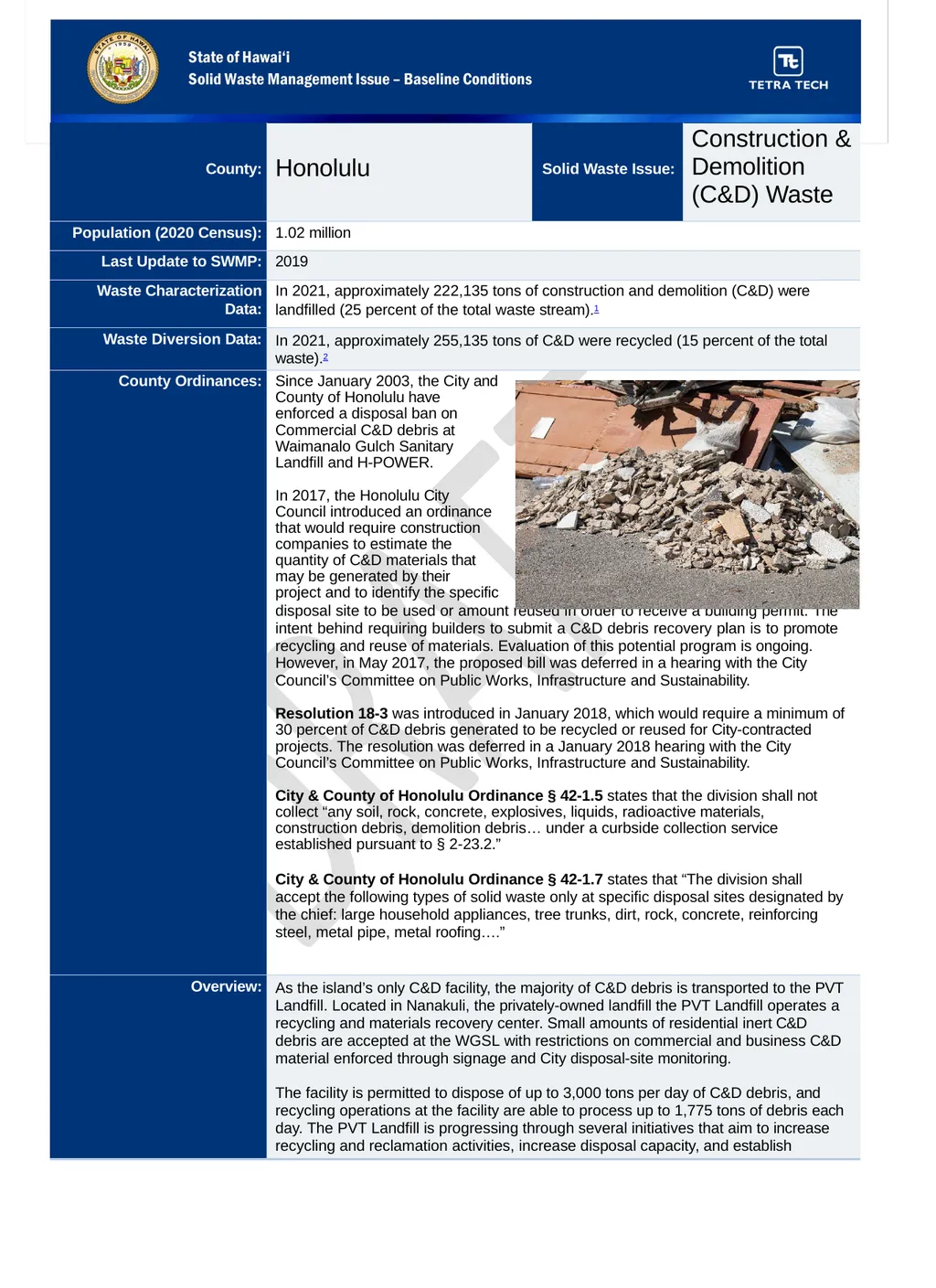
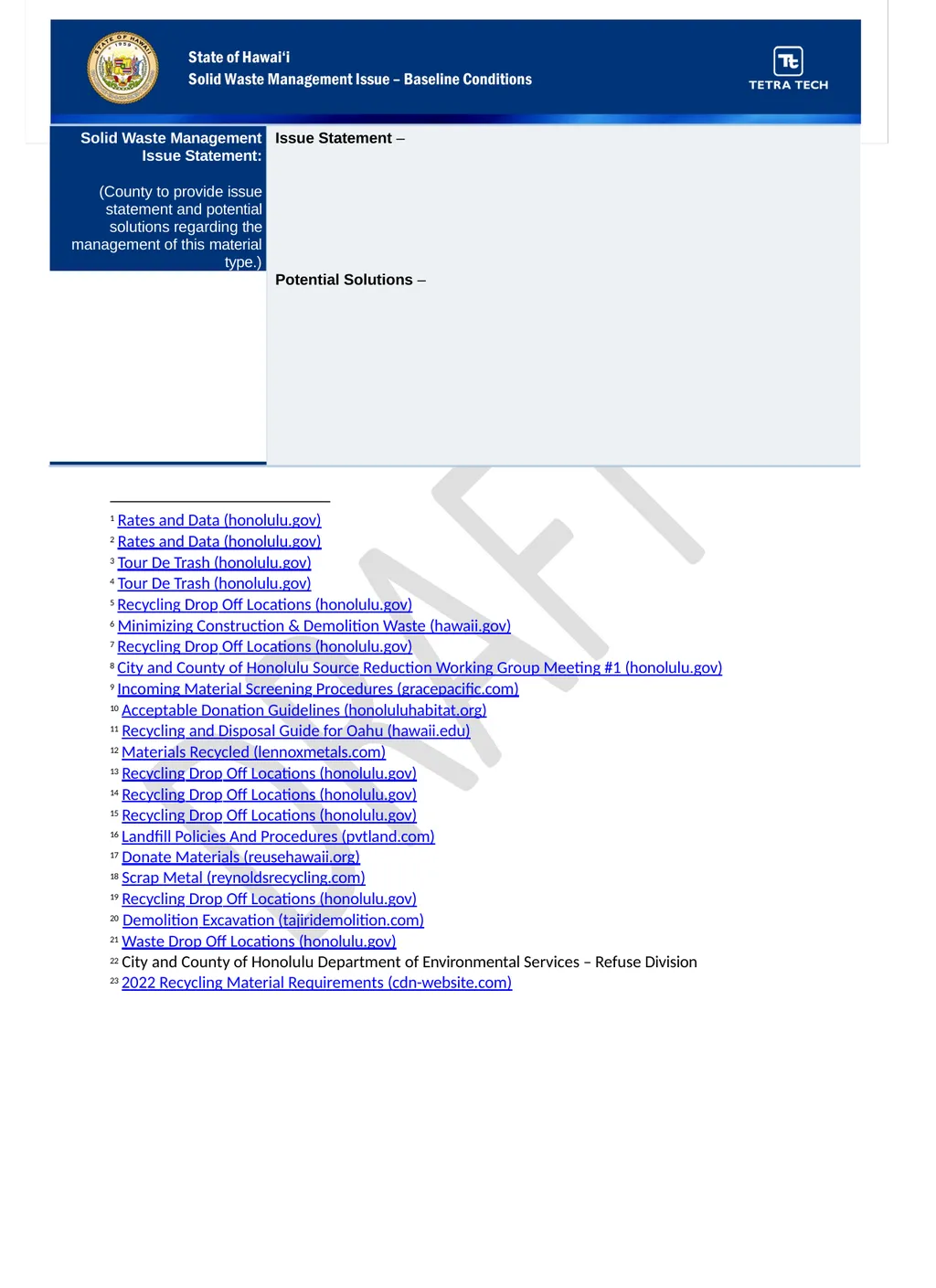
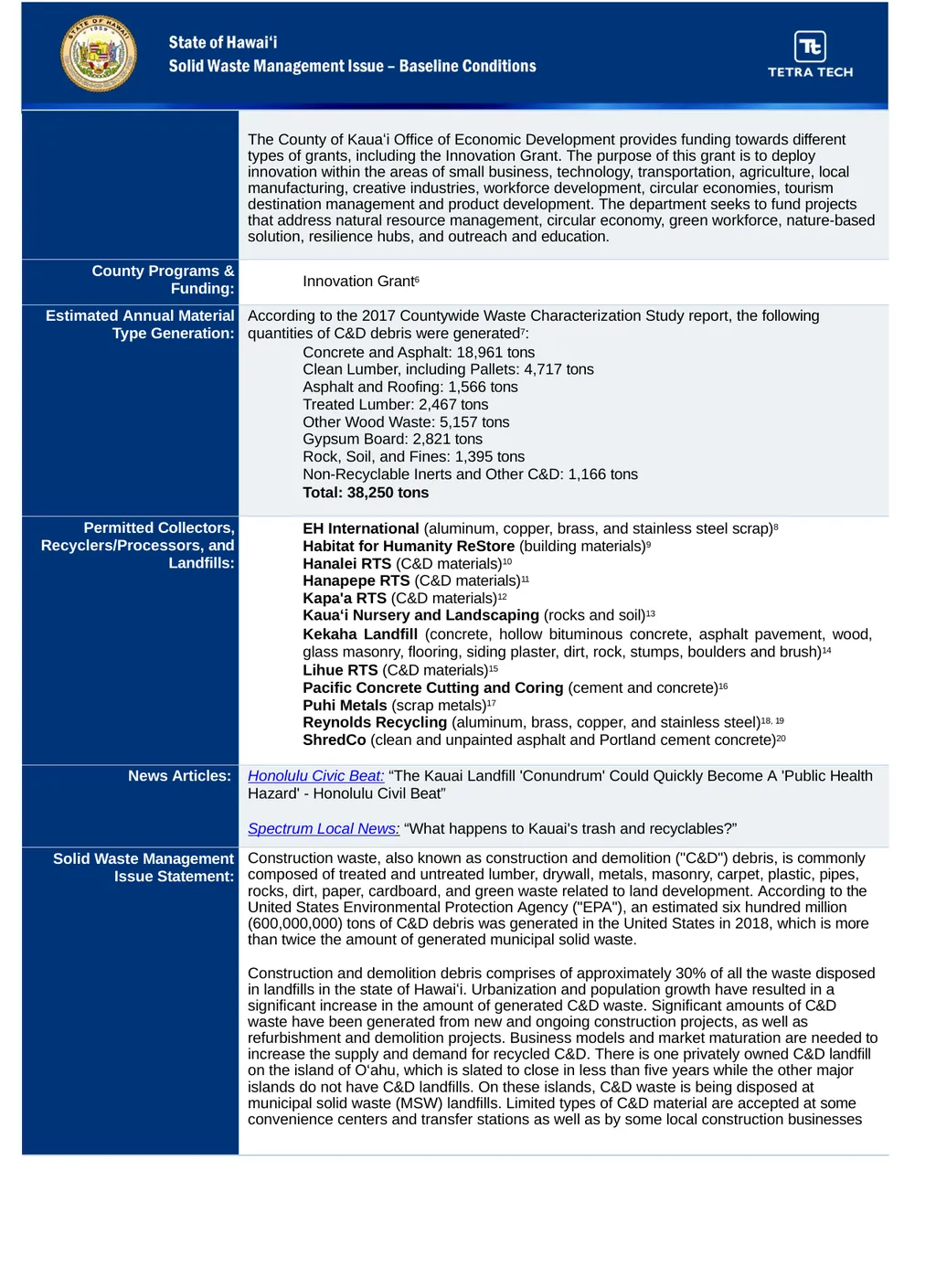
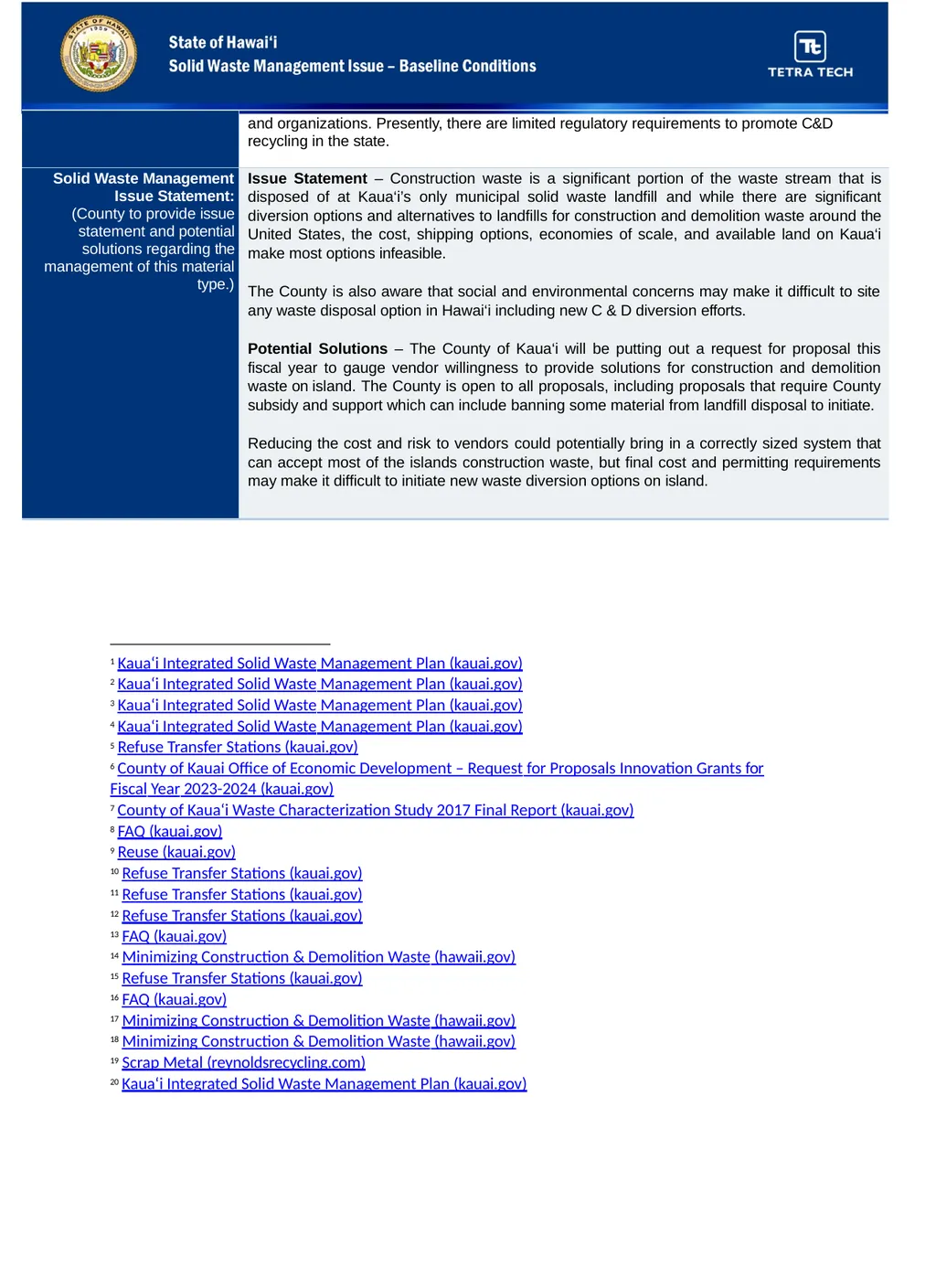
Solid Waste Management
Issue Statement:
(County to provide issue statement and potential solutions regarding the management of this material
type.) Issue Statement – Potential Solutions – 1 Rates and Data (honolulu.gov)
2 Rates and Data (honolulu.gov)
3 Tour De Trash (honolulu.gov)
4 Tour De Trash (honolulu.gov)
5 Recycling Drop Off Locations (honolulu.gov)
6 Minimizing Construction & Demolition Waste (hawaii.gov)
7 Recycling Drop Off Locations (honolulu.gov)
8 City and County of Honolulu Source Reduction Working Group Meeting #1 (honolulu.gov)
9 Incoming Material Screening Procedures (gracepacific.com)
10 Acceptable Donation Guidelines (honoluluhabitat.org)
11 Recycling and Disposal Guide for Oahu (hawaii.edu)
12 Materials Recycled (lennoxmetals.com)
13 Recycling Drop Off Locations (honolulu.gov)
14 Recycling Drop Off Locations (honolulu.gov)
15 Recycling Drop Off Locations (honolulu.gov)
16 Landfill Policies And Procedures (pvtland.com)
17 Donate Materials (reusehawaii.org)
18 Scrap Metal (reynoldsrecycling.com)
19 Recycling Drop Off Locations (honolulu.gov)
20 Demolition Excavation (tajiridemolition.com)
21 Waste Drop Off Locations (honolulu.gov)
22 City and County of Honolulu Department of Environmental Services – Refuse Division
23 2022 Recycling Material Requirements (cdn-website.com)<br>
09
1 Kaua‘i Integrated Solid Waste Management Plan (kauai.gov)
2 Kaua‘i Integrated Solid Waste Management Plan (kauai.gov)
3 Kaua‘i Integrated Solid Waste Management Plan (kauai.gov)
4 Kaua‘i Integrated Solid Waste Management Plan (kauai.gov)
5 Refuse Transfer Stations (kauai.gov)
6 County of Kauai Office of Economic Development – Request for Proposals Innovation Grants for Fiscal Year 2023-2024 (kauai.gov)
7 County of Kaua‘i Waste Characterization Study 2017 Final Report (kauai.gov)
8 FAQ (kauai.gov)
9 Reuse (kauai.gov)
10 Refuse Transfer Stations (kauai.gov)
11 Refuse Transfer Stations (kauai.gov)
12 Refuse Transfer Stations (kauai.gov)
13 FAQ (kauai.gov)
14 Minimizing Construction & Demolition Waste (hawaii.gov)
15 Refuse Transfer Stations (kauai.gov)
16 FAQ (kauai.gov)
17 Minimizing Construction & Demolition Waste (hawaii.gov)
18 Minimizing Construction & Demolition Waste (hawaii.gov)
19 Scrap Metal (reynoldsrecycling.com)
20 Kaua‘i Integrated Solid Waste Management Plan (kauai.gov)<br>
10
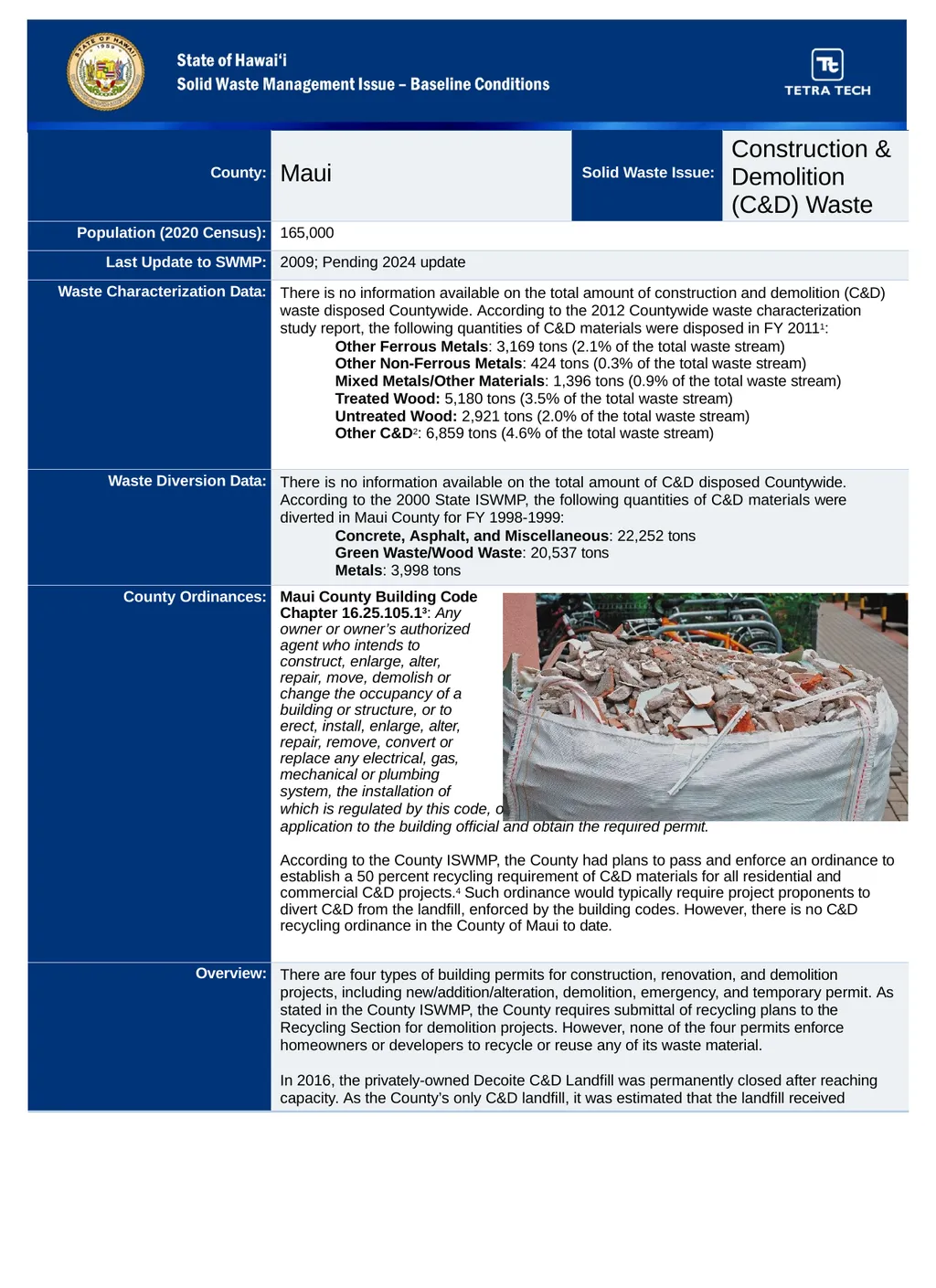
1 Waste Composition Analysis Central Maui Landfill Final Report (hawaii.gov)
2 Other C&D – Includes materials such as gypsum wallboard, asphalt roofing and paving, concrete and any material related to construction and/or demolition. Wood, OCC, and metals are not included in this category.
3 Ordinance No. 5507 (mauicounty.gov)
4 Chapter 8 – Construction and Demolition Debris (mauicounty.gov)
5 Chapter 8 – Construction and Demolition Debris (mauicounty.gov)
6 Chapter 8 – Construction and Demolition Debris (mauicounty.gov)
7 Central Maui Landfill (mauicounty.gov)
8 Final Declaration of Non-Hazardous Waste Form (mauicounty.gov)
9 Facilities (mauicounty.gov)
10 How To Recycle (hawaiimaterialsrecycling.com)
11 Materials Accepted (hawaiimaterialsrecycling.com)
12 Materials Accepted (hawaiimaterialsrecycling.com)<br>
11
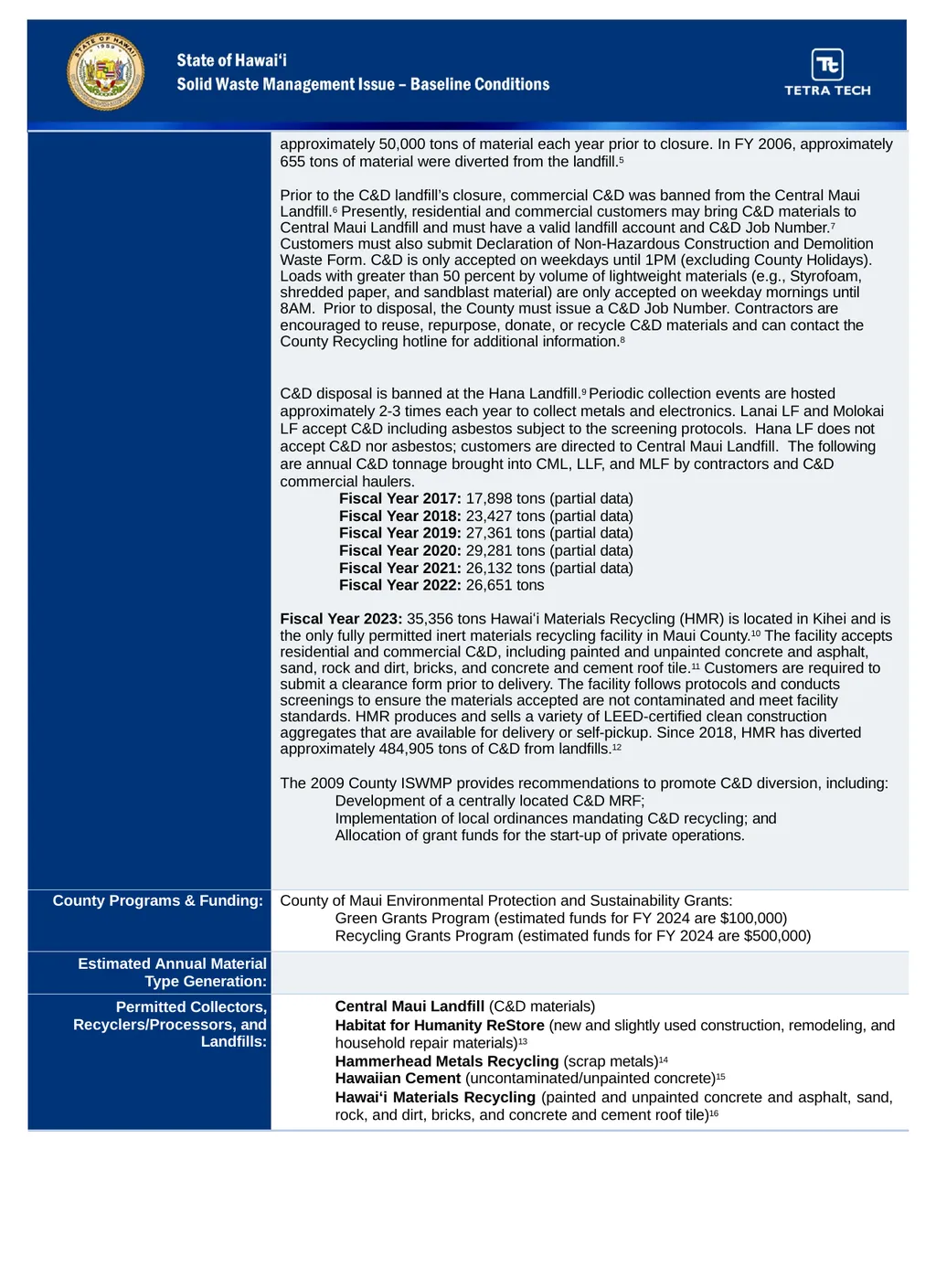
13 Resource Directory (mauicounty.gov)
14 Resource Directory (mauicounty.gov)
15 Minimizing Construction & Demolition Waste (hawaii.gov)
16 Accepted Material (hawaiimaterialsrecycling.com)
17 Resource Directory (mauicounty.gov)
18 Scrap Metal (reynoldsrecycling.com)<br>
14 Resource Directory (mauicounty.gov)
15 Minimizing Construction & Demolition Waste (hawaii.gov)
16 Accepted Material (hawaiimaterialsrecycling.com)
17 Resource Directory (mauicounty.gov)
18 Scrap Metal (reynoldsrecycling.com)<br>
12
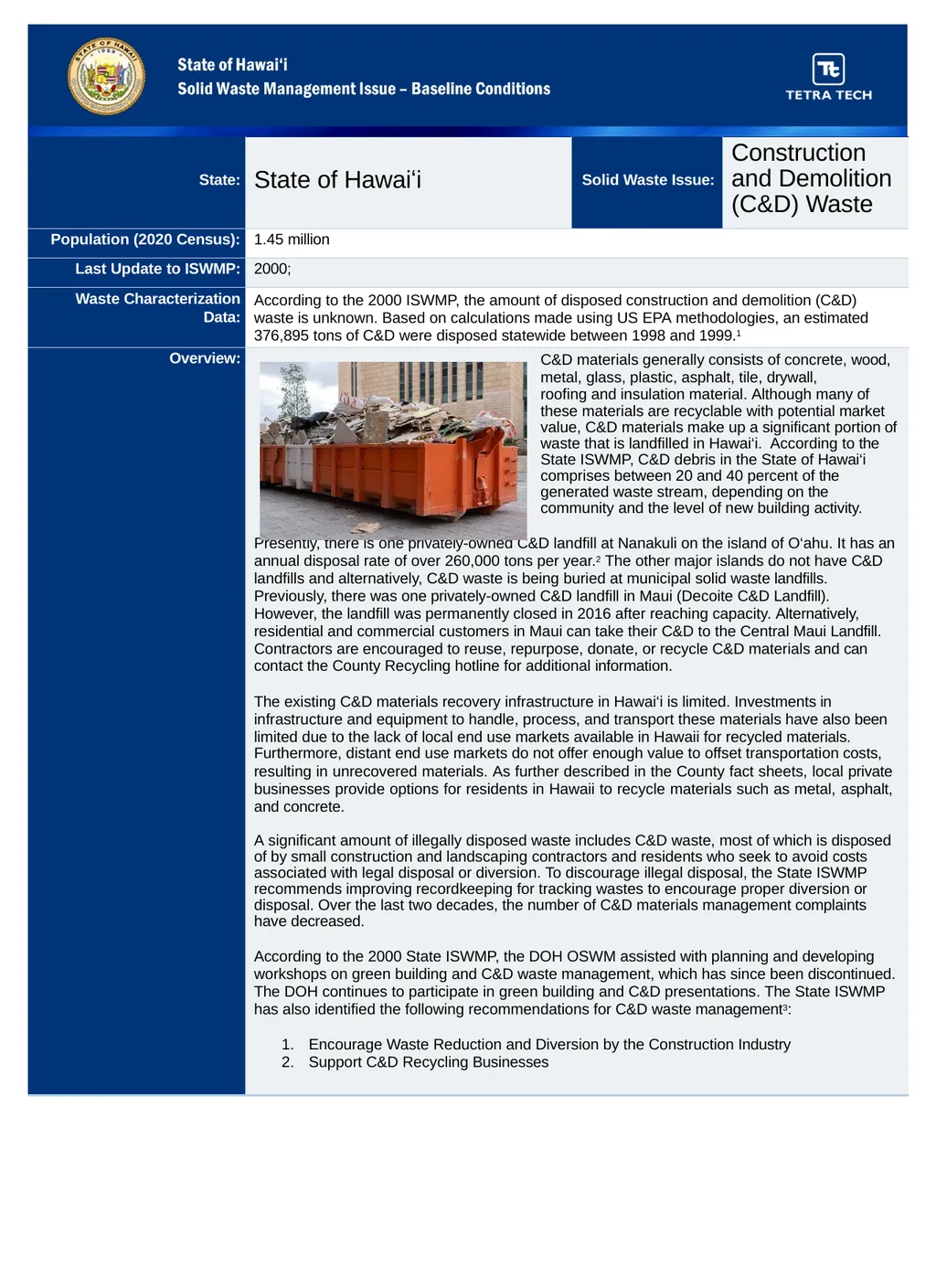
1 Hawaiʻi 2000 Integrated Solid Waste Management Plan (hawaii.gov)
2 Hawaiʻi 2000 Integrated Solid Waste Management Plan (hawaii.gov)
3 Hawaiʻi 2000 Integrated Solid Waste Management Plan (hawaii.gov)
4 Hawaiʻi 2000 Integrated Solid Waste Management Plan (hawaii.gov)
5 Minimizing Construction & Demolition Waste (hawaii.gov)<br>
2 Hawaiʻi 2000 Integrated Solid Waste Management Plan (hawaii.gov)
3 Hawaiʻi 2000 Integrated Solid Waste Management Plan (hawaii.gov)
4 Hawaiʻi 2000 Integrated Solid Waste Management Plan (hawaii.gov)
5 Minimizing Construction & Demolition Waste (hawaii.gov)<br>
13
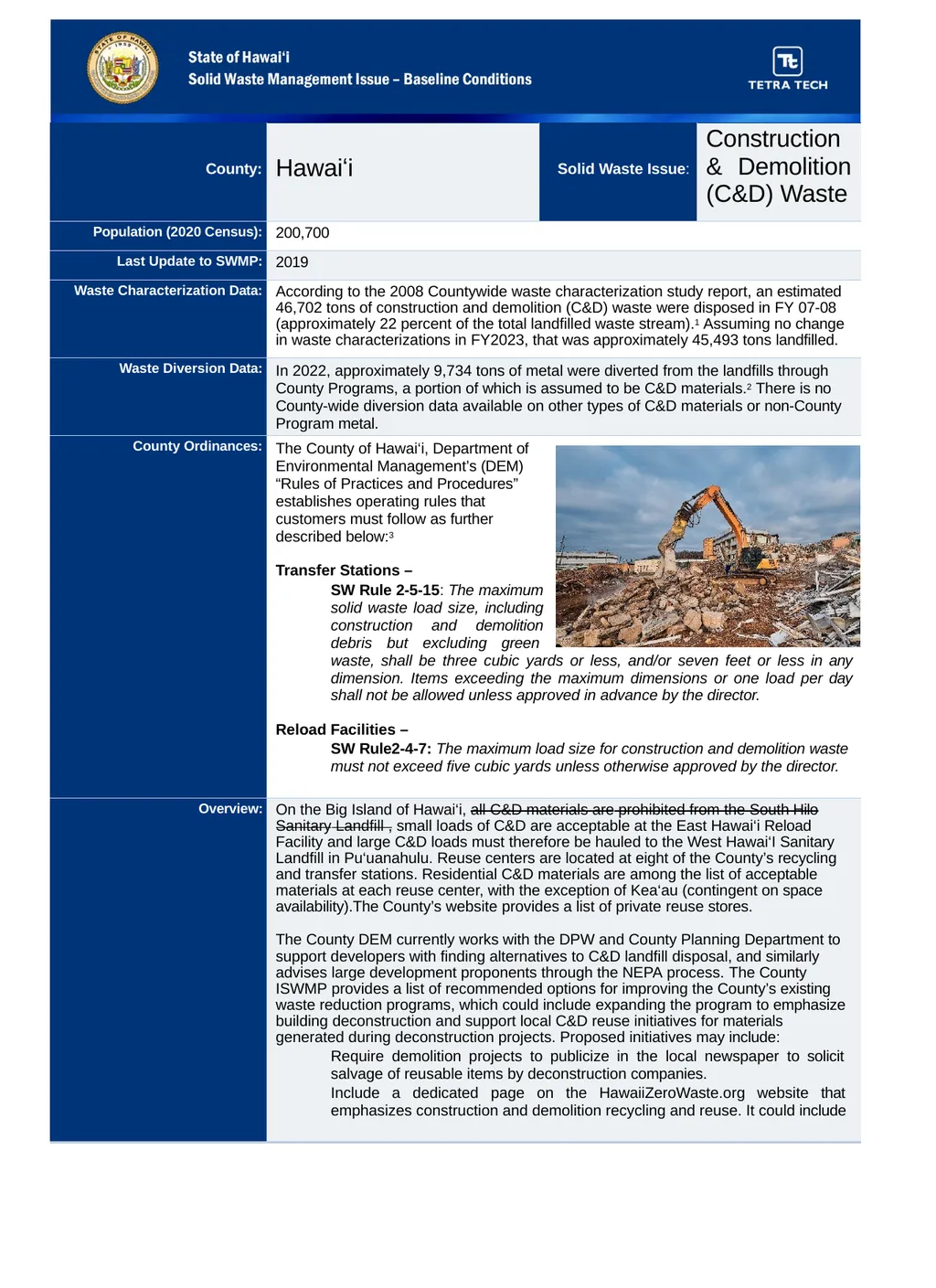
1 Waste Composition Study - County of Hawai‘i (hawaii.gov)
2 Hawaiʻi Island Sustainability Dashboard (hawaiicounty.gov)
3 County of Hawai‘i Rules of Practice and Procedure (hawaiicounty.gov)
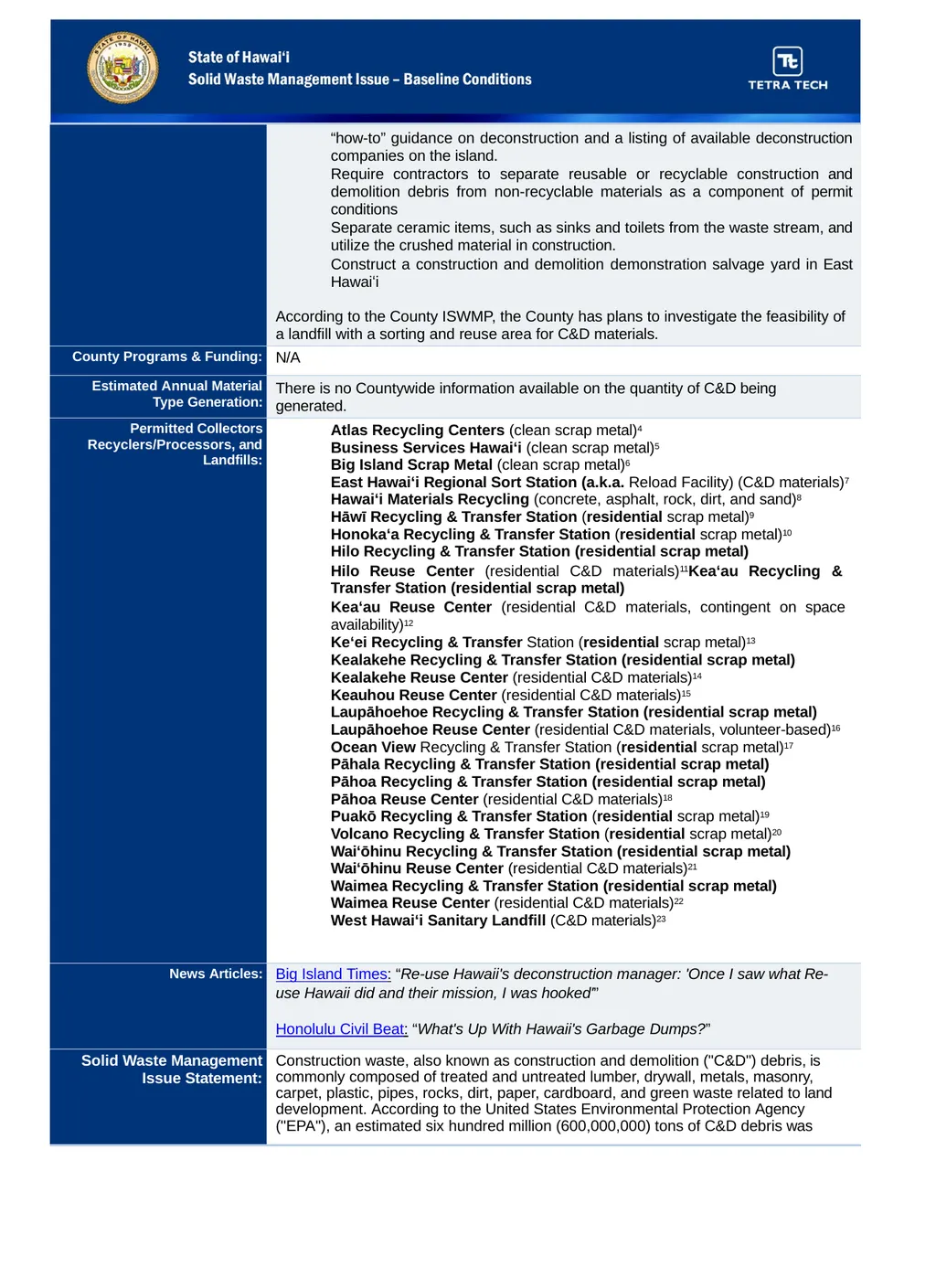
4 Scrap Metal (hawaiizerowaste.org)
5 Scrap Metal (hawaiizerowaste.org)
6 Scrap Metal (hawaiizerowaste.org)
7 County of Hawai‘i Solid Waste Facilities (hawaiizerowaste.org)
8 Hawaii Materials Recycling (hawaiimaterialsrecycling.com)
9 County of Hawai‘i Solid Waste Facilities (hawaiizerowaste.org)
10 County of Hawai‘i Solid Waste Facilities (hawaiizerowaste.org)
11 County of Hawai‘i Solid Waste Facilities (hawaiizerowaste.org)
12 2019 Integrated Solid Waste Management Plan Update (hawaiizerowaste.org)
13 County of Hawai‘i Solid Waste Facilities (hawaiizerowaste.org)
14 County of Hawai‘i Solid Waste Facilities (hawaiizerowaste.org)
15 County of Hawai‘i Solid Waste Facilities (hawaiizerowaste.org)
16 2019 Integrated Solid Waste Management Plan Update (hawaiizerowaste.org)
17 County of Hawai‘i Solid Waste Facilities (hawaiizerowaste.org)<br>
14
18 County of Hawai‘i Solid Waste Facilities (hawaiizerowaste.org)
19 County of Hawai‘i Solid Waste Facilities (hawaiizerowaste.org)
20 County of Hawai‘i Solid Waste Facilities (hawaiizerowaste.org)
21 County of Hawai‘i Solid Waste Facilities (hawaiizerowaste.org)
22 County of Hawai‘i Solid Waste Facilities (hawaiizerowaste.org)
23 County of Hawai‘i Solid Waste Facilities (hawaiizerowaste.org)<br>