
Microfinance: Building Better Products through



Description: Microfinance: Building Better Products through Randomized Evaluations Dean Karlan Yale University, Innovations for Poverty Action (IPA), Grupo de Análisis para el Desarrollo (GRADE), Financial Access Initiative (FAI) 1 How do we Reach 1
Related Topics
Download Presentation
"Microfinance: Building Better Products through" is the property of its rightful owner. Permission is granted to download and print the materials on this website for personal, non-commercial use only, and to display it on your personal computer provided you do not modify the materials and that you retain all copyright notices contained in the materials. By downloading content from our website, you accept the terms of this agreement.
Presentation Transcript
slide1. Microfinance:
Building Better Products through Randomized Evaluations Dean Karlan
Yale University,
Innovations for Poverty Action (IPA),
Grupo de Análisis para el Desarrollo (GRADE),
Financial Access Initiative (FAI) 1<br>
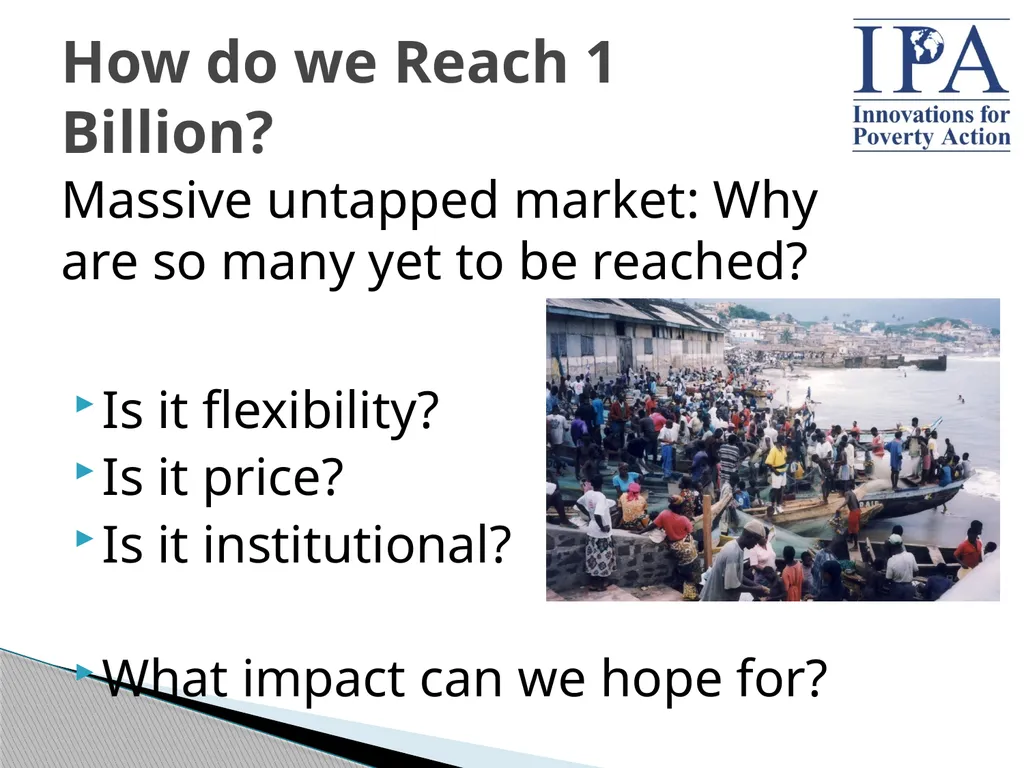
slide2. How do we Reach 1 Billion? Is it flexibility?
Is it price?
Is it institutional?
What impact can we hope for? Massive untapped market: Why are so many yet to be reached?<br>
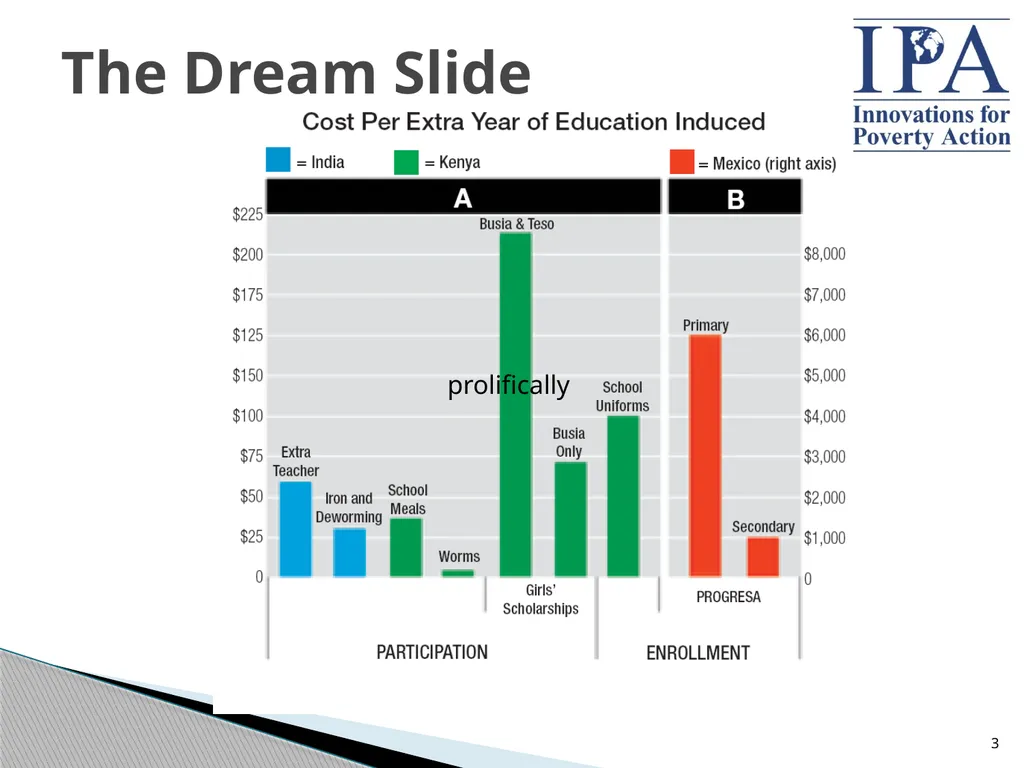
slide3. 3 prolifically The Dream Slide<br>
slide4. 1. Impact of finance (versus no finance)
2. How to do microfinance better 4 Two types of studies<br>
slide5. Key questions:
Flexibility and price
Market failures
Four examples
Group versus individual liability
Credit with education
Credit scoring
Savings product design
Theme: Making the research speak to the practitioner. Plan 5<br>
slide6. Why despite our best efforts are so many not reached?
Is it flexibility?
Is it price?
Is it institutional (organization structure, financing, human resource policy, etc.)?
Can we rule out lack of impact? Flexibility? Price? 6<br>
slide7. Cash flows do not match cash flow needs in many cases.
Farmers
Fluctuation in income
Is it fear?
Afraid of not having money to repay (irony: this is a GREAT client! she is so trustworthy that she won’t even take out a loan due to her fear of going into default!)
Lack entrepreneurial skills to expand business
Fears peer punishment
What product designs can alleviate these concerns? Savings? Insurance? Is It Flexibility? 7<br>
slide8. Strikingly little evidence on price.
The “old” line: price does not matter
Recent work challenges this:
Dehejia, Montgomery & Morduch from Bangladesh
Karlan and Zinman from South Africa
Clearly, elasticity of demand depends on a lot:
Competition
Business opportunities
Financial literacy
Framing of offer (this can matter more than price) Is It Price? 8<br>
slide9. Market Failures Three basic questions for understanding credit markets and formulating policy:
Are there market failures, and can we specify more precisely what is happening (adverse selection, moral hazard, etc.)?
“Observing Unobservables” with Zinman finds evidence of both
What innovations can solve these market failures?
Joint liability?
“Group versus individual liability” with Xavier Gine finds no difference
Credit bureaus?
work by deJanvry, McIntosh and Sadoulet in Guatemala
Dynamic incentives? Working, and in progress
Better screening? Credit scoring?
Can other non-credit interventions matter?
Teaching Entrepreneurship, with Martin Valdivia, GRADE-Peru
What is the welfare improvement from solving these market failures?
Little data on this… earlier work from Bangladesh (Pitt & Khandker) and India (Burgess & Pande) say yes, but identification and micro-data always a severe challenge.<br>
slide10. Group/Individual Liability, Philippines and Bolivia
Joint work with Xavier Giné, World Bank
Credit with Education, Peru
Joint work with Martin Valdivia, GRADE
Credit Scoring, South Africa and Philippines
Joint with Jonathan Zinman
Savings Product Design
Peru, India and the Philippines
Joint with Sendhil Mullainathan and Jonathan Zinman Four Examples 10<br>
slide11. Microfinance is typically seen as a solution to credit market failures faced by the poor
Group liability, a feature found in many micro loans, is perceived as a key innovation that has contributed to this success
e.g.: Grameen, FINCA, Accion Group versus Individual Liability 11<br>
slide12. Yet, in recent years, many micro-lenders have expanded rapidly using individual liability
In turn, this has motivated other lenders that were using group liability to shift to individual liability Motivation 12<br>
slide13. Green Bank of Caraga in the Philippines
170 joint liability Grameen-style centers
80 randomly assigned to convert to individual liability centers, but weekly meetings remained intact (“treatment”)
90 randomly assigned to remain as-is, under joint liability Group versus Individual Liability 13<br>
slide14. Screening
future study (a little here)
Monitoring + Enforcement
this study removed these peer incentives
Note: we have not eliminated shame or reputation protection from process Group versus Individual Liability 14<br>
slide15. Outcomes:
No change in repayment
No change in savings
No change in allocation of time by credit officers
Higher client retention
Higher number of new members joined
Current paper has one year results
2.5 year results showing same Main Results 15<br>
slide16. Evidence of monitoring effects
Both baseline and new clients in converted centers remember less about other members’ defaults
Evidence of selection effects
New clients in converted centers are less likely to predict defaults of other members correctly.
Social network
Mostly no change. Some small evidence of fewer side-loans (insurance?) in converted centers.
Less money spent on parties (but no change in prob of a party) Auxiliary Results 16<br>
slide17. Evidence of mechanisms of screening & monitoring.
But they do not add up and lead to default!
Why?
Perhaps not enough time (2.5 yrs showing the same)
Perhaps simply not economically significant Conclusion 17<br>
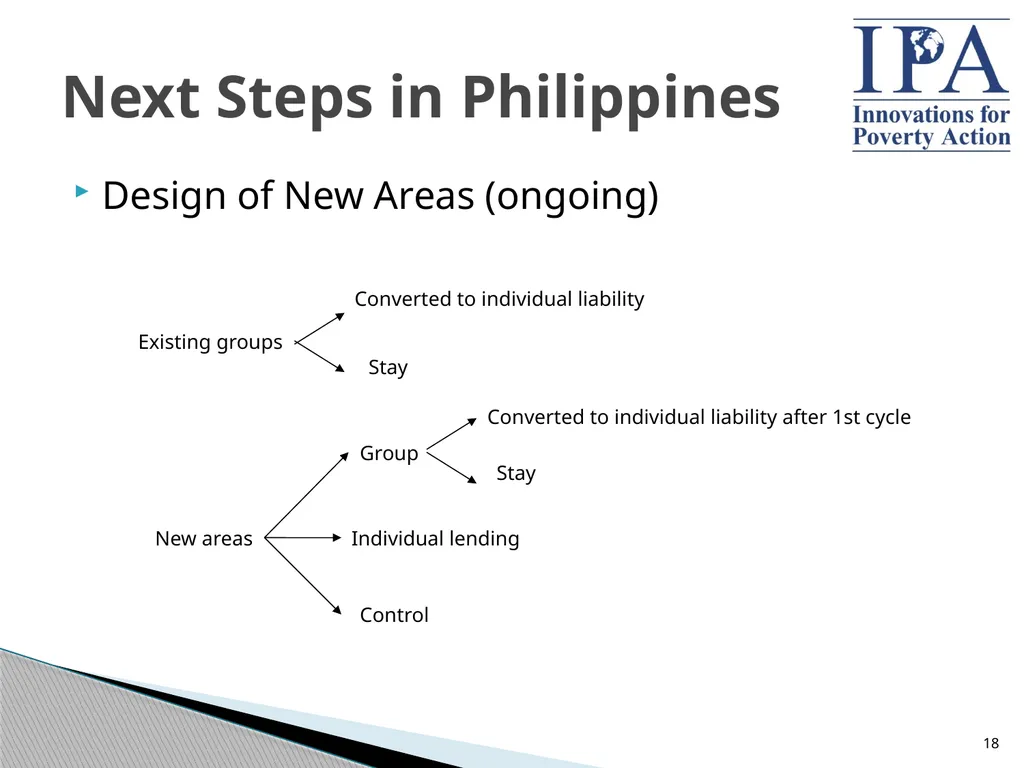
slide18. Design of New Areas (ongoing) Next Steps in Philippines Stay New areas Group Individual lending Converted to individual liability after 1st cycle Stay Control Existing groups Converted to individual liability 18<br>
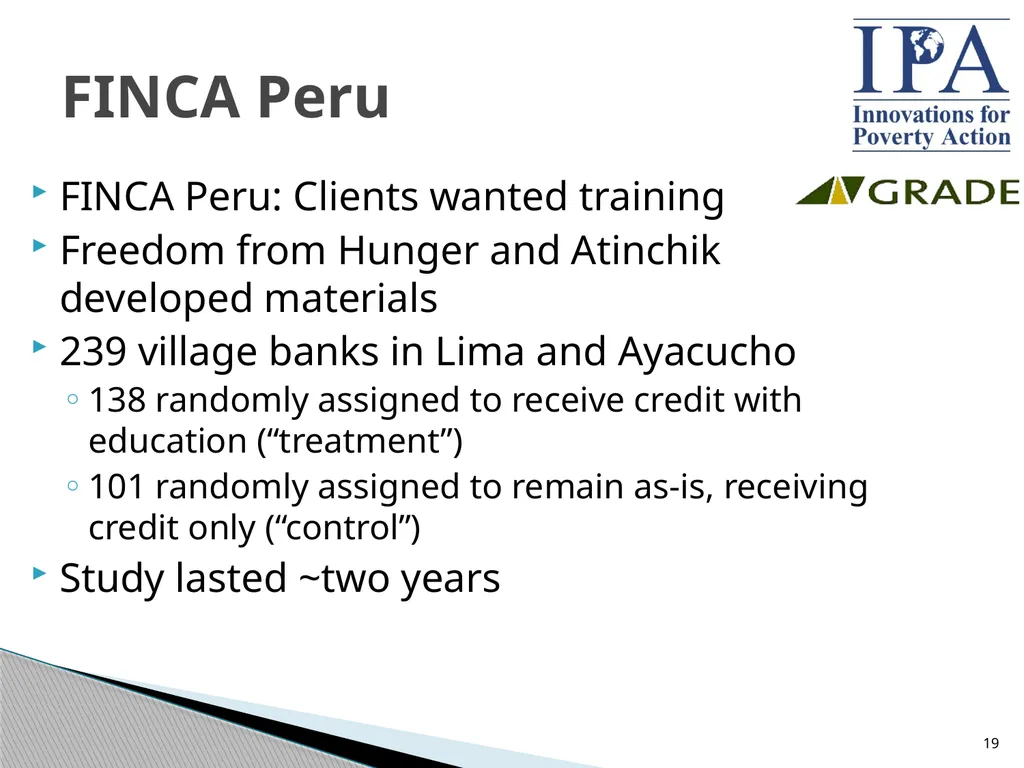
slide19. FINCA Peru: Clients wanted training
Freedom from Hunger and Atinchik developed materials
239 village banks in Lima and Ayacucho
138 randomly assigned to receive credit with education (“treatment”)
101 randomly assigned to remain as-is, receiving credit only (“control”)
Study lasted ~two years FINCA Peru 19<br>
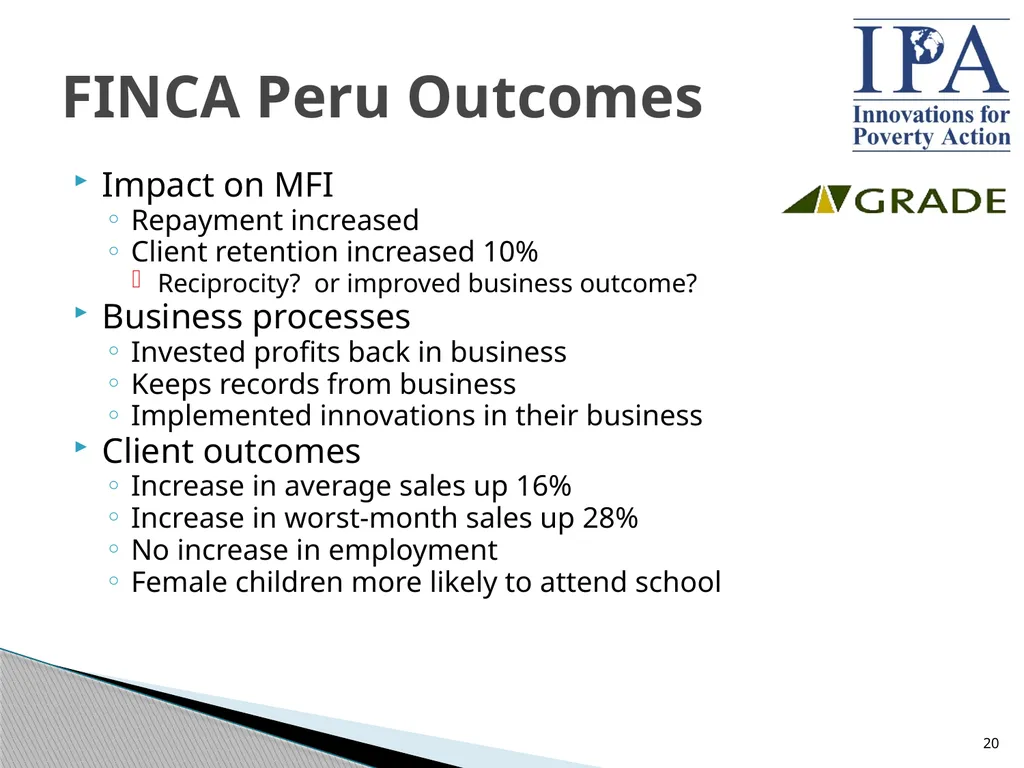
slide20. Impact on MFI
Repayment increased
Client retention increased 10%
Reciprocity? or improved business outcome?
Business processes
Invested profits back in business
Keeps records from business
Implemented innovations in their business
Client outcomes
Increase in average sales up 16%
Increase in worst-month sales up 28%
No increase in employment
Female children more likely to attend school FINCA Peru Outcomes 20<br>
slide21. Win-win
More efficient screening, arguably better decision-making (needs testing)
Study impact on marginal borrowers!
Implementing this in Philippines, and potentially Peru
Looking for more places: replication critical Credit Scoring 21<br>
slide22. Is screening too rigorous?
What is the impact of lending to those not being reached currently?
Lender uses credit scoring + subjective decision-making by branch manager
Unrejected in real-time rejected clients
Surveyed them 6-12 months later
Credit reports collected 2 years later
Profitable for lender to lend to them South Africa Experiment 22<br>
slide23. Positive impact on employment, wages and hunger
7 percentage point reduction in poverty level
Remember: CONSUMER lending Impact 23<br>
slide24. Example of replication
Prior study in Philippines (SEED)
Commitment to not withdraw can help increase savings
New studies: How do we get people to deposit!
Peru, India and the Philippines Behavioral Savings 24<br>
slide25. Series of ideas from psychology & economics:
Attention (reminders)
Mental accounting (puzzles, photos, framing, goals)
Gains versus losses
Incentives (i-rate, bonuses)
Habit formation (timing of deposits/reminders)
Goal:
Tease out crucial mechanisms
Generate evidence from multiple settings Behavioral Savings 25<br>
slide26. Price (interest rates)
Credit bureaus
de Janvry, McIntosh & Sadoulet in Guatemala
Loan terms and frequency
Field and Pande in India
Loan size
Mexico, Philippines
Links to formal insurance
Hospitalization, health, life, rainfall, cattle insurance
Returns to capital
McKenzie and Woodruff in Sri Lanka and Mexico Laundry List 26<br>
slide27. Ethics and Resources (some more serious thoughts…) Are all interventions unambiguously good? If not, is it ethical to intervene in the lives of the poor without knowing your impact?
Is it ethical to spend resources on treatments that are not proven (and that could have been spent elsewhere)?
Let’s not underestimate the power, and thus the responsibility, we have. We must know what works and what does not.<br>
slide28. What proportion of a budget should one spend on monitoring and evaluation?
MUST separate monitoring from evaluation
Different denominators.
Remember why you do both:
Monitoring: check operational and institutional efficiency
Evaluation: know how to spend future money
Monitoring: Think % of project expenses
Evaluation: Think % of future expenses 28 Core Impact Studies: Resource Question<br>
slide29. Thank you! www.poverty-action.org www.financialaccess.org www.povertyactionlab.org dean.karlan@yale.edu 29<br>
Yale University,
Innovations for Poverty Action (IPA),
Grupo de Análisis para el Desarrollo (GRADE),
Financial Access Initiative (FAI) 1<br>
slide2. How do we Reach 1 Billion? Is it flexibility?
Is it price?
Is it institutional?
What impact can we hope for? Massive untapped market: Why are so many yet to be reached?<br>
slide3. 3 prolifically The Dream Slide<br>
slide4. 1. Impact of finance (versus no finance)
2. How to do microfinance better 4 Two types of studies<br>
slide5. Key questions:
Flexibility and price
Market failures
Four examples
Group versus individual liability
Credit with education
Credit scoring
Savings product design
Theme: Making the research speak to the practitioner. Plan 5<br>
slide6. Why despite our best efforts are so many not reached?
Is it flexibility?
Is it price?
Is it institutional (organization structure, financing, human resource policy, etc.)?
Can we rule out lack of impact? Flexibility? Price? 6<br>
slide7. Cash flows do not match cash flow needs in many cases.
Farmers
Fluctuation in income
Is it fear?
Afraid of not having money to repay (irony: this is a GREAT client! she is so trustworthy that she won’t even take out a loan due to her fear of going into default!)
Lack entrepreneurial skills to expand business
Fears peer punishment
What product designs can alleviate these concerns? Savings? Insurance? Is It Flexibility? 7<br>
slide8. Strikingly little evidence on price.
The “old” line: price does not matter
Recent work challenges this:
Dehejia, Montgomery & Morduch from Bangladesh
Karlan and Zinman from South Africa
Clearly, elasticity of demand depends on a lot:
Competition
Business opportunities
Financial literacy
Framing of offer (this can matter more than price) Is It Price? 8<br>
slide9. Market Failures Three basic questions for understanding credit markets and formulating policy:
Are there market failures, and can we specify more precisely what is happening (adverse selection, moral hazard, etc.)?
“Observing Unobservables” with Zinman finds evidence of both
What innovations can solve these market failures?
Joint liability?
“Group versus individual liability” with Xavier Gine finds no difference
Credit bureaus?
work by deJanvry, McIntosh and Sadoulet in Guatemala
Dynamic incentives? Working, and in progress
Better screening? Credit scoring?
Can other non-credit interventions matter?
Teaching Entrepreneurship, with Martin Valdivia, GRADE-Peru
What is the welfare improvement from solving these market failures?
Little data on this… earlier work from Bangladesh (Pitt & Khandker) and India (Burgess & Pande) say yes, but identification and micro-data always a severe challenge.<br>
slide10. Group/Individual Liability, Philippines and Bolivia
Joint work with Xavier Giné, World Bank
Credit with Education, Peru
Joint work with Martin Valdivia, GRADE
Credit Scoring, South Africa and Philippines
Joint with Jonathan Zinman
Savings Product Design
Peru, India and the Philippines
Joint with Sendhil Mullainathan and Jonathan Zinman Four Examples 10<br>
slide11. Microfinance is typically seen as a solution to credit market failures faced by the poor
Group liability, a feature found in many micro loans, is perceived as a key innovation that has contributed to this success
e.g.: Grameen, FINCA, Accion Group versus Individual Liability 11<br>
slide12. Yet, in recent years, many micro-lenders have expanded rapidly using individual liability
In turn, this has motivated other lenders that were using group liability to shift to individual liability Motivation 12<br>
slide13. Green Bank of Caraga in the Philippines
170 joint liability Grameen-style centers
80 randomly assigned to convert to individual liability centers, but weekly meetings remained intact (“treatment”)
90 randomly assigned to remain as-is, under joint liability Group versus Individual Liability 13<br>
slide14. Screening
future study (a little here)
Monitoring + Enforcement
this study removed these peer incentives
Note: we have not eliminated shame or reputation protection from process Group versus Individual Liability 14<br>
slide15. Outcomes:
No change in repayment
No change in savings
No change in allocation of time by credit officers
Higher client retention
Higher number of new members joined
Current paper has one year results
2.5 year results showing same Main Results 15<br>
slide16. Evidence of monitoring effects
Both baseline and new clients in converted centers remember less about other members’ defaults
Evidence of selection effects
New clients in converted centers are less likely to predict defaults of other members correctly.
Social network
Mostly no change. Some small evidence of fewer side-loans (insurance?) in converted centers.
Less money spent on parties (but no change in prob of a party) Auxiliary Results 16<br>
slide17. Evidence of mechanisms of screening & monitoring.
But they do not add up and lead to default!
Why?
Perhaps not enough time (2.5 yrs showing the same)
Perhaps simply not economically significant Conclusion 17<br>
slide18. Design of New Areas (ongoing) Next Steps in Philippines Stay New areas Group Individual lending Converted to individual liability after 1st cycle Stay Control Existing groups Converted to individual liability 18<br>
slide19. FINCA Peru: Clients wanted training
Freedom from Hunger and Atinchik developed materials
239 village banks in Lima and Ayacucho
138 randomly assigned to receive credit with education (“treatment”)
101 randomly assigned to remain as-is, receiving credit only (“control”)
Study lasted ~two years FINCA Peru 19<br>
slide20. Impact on MFI
Repayment increased
Client retention increased 10%
Reciprocity? or improved business outcome?
Business processes
Invested profits back in business
Keeps records from business
Implemented innovations in their business
Client outcomes
Increase in average sales up 16%
Increase in worst-month sales up 28%
No increase in employment
Female children more likely to attend school FINCA Peru Outcomes 20<br>
slide21. Win-win
More efficient screening, arguably better decision-making (needs testing)
Study impact on marginal borrowers!
Implementing this in Philippines, and potentially Peru
Looking for more places: replication critical Credit Scoring 21<br>
slide22. Is screening too rigorous?
What is the impact of lending to those not being reached currently?
Lender uses credit scoring + subjective decision-making by branch manager
Unrejected in real-time rejected clients
Surveyed them 6-12 months later
Credit reports collected 2 years later
Profitable for lender to lend to them South Africa Experiment 22<br>
slide23. Positive impact on employment, wages and hunger
7 percentage point reduction in poverty level
Remember: CONSUMER lending Impact 23<br>
slide24. Example of replication
Prior study in Philippines (SEED)
Commitment to not withdraw can help increase savings
New studies: How do we get people to deposit!
Peru, India and the Philippines Behavioral Savings 24<br>
slide25. Series of ideas from psychology & economics:
Attention (reminders)
Mental accounting (puzzles, photos, framing, goals)
Gains versus losses
Incentives (i-rate, bonuses)
Habit formation (timing of deposits/reminders)
Goal:
Tease out crucial mechanisms
Generate evidence from multiple settings Behavioral Savings 25<br>
slide26. Price (interest rates)
Credit bureaus
de Janvry, McIntosh & Sadoulet in Guatemala
Loan terms and frequency
Field and Pande in India
Loan size
Mexico, Philippines
Links to formal insurance
Hospitalization, health, life, rainfall, cattle insurance
Returns to capital
McKenzie and Woodruff in Sri Lanka and Mexico Laundry List 26<br>
slide27. Ethics and Resources (some more serious thoughts…) Are all interventions unambiguously good? If not, is it ethical to intervene in the lives of the poor without knowing your impact?
Is it ethical to spend resources on treatments that are not proven (and that could have been spent elsewhere)?
Let’s not underestimate the power, and thus the responsibility, we have. We must know what works and what does not.<br>
slide28. What proportion of a budget should one spend on monitoring and evaluation?
MUST separate monitoring from evaluation
Different denominators.
Remember why you do both:
Monitoring: check operational and institutional efficiency
Evaluation: know how to spend future money
Monitoring: Think % of project expenses
Evaluation: Think % of future expenses 28 Core Impact Studies: Resource Question<br>
slide29. Thank you! www.poverty-action.org www.financialaccess.org www.povertyactionlab.org dean.karlan@yale.edu 29<br>