Model Law on Virtual Assets Law Ministers’ Meeting
Description: Model Law on Virtual Assets Law Ministers Meeting March 2024 Presentation for the Commonwealth of Nations Advancements in blockchain and distributed ledger technology have had a revolutionary impact across sectors, of which finance is the
Related Topics
Download Presentation
"Model Law on Virtual Assets Law Ministers’ Meeting" is the property of its rightful owner. Permission is granted to download and print the materials on this website for personal, non-commercial use only, and to display it on your personal computer provided you do not modify the materials and that you retain all copyright notices contained in the materials. By downloading content from our website, you accept the terms of this agreement.
Presentation Transcript
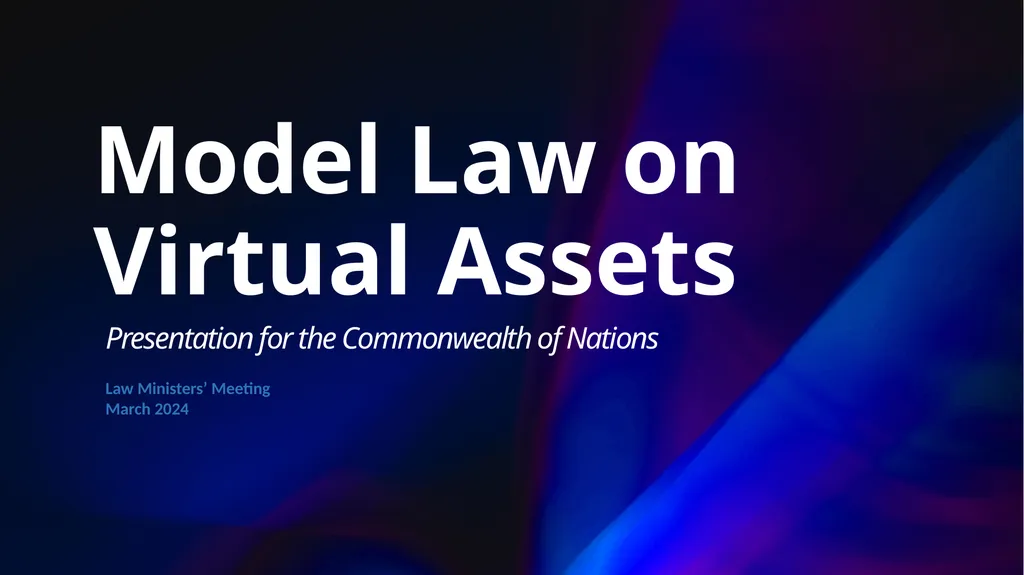
slide1. Model Law on Virtual Assets Law Ministers’ Meeting
March 2024 Presentation for the Commonwealth of Nations<br>
slide2. Advancements in blockchain and distributed ledger technology have had a revolutionary impact across sectors, of which finance is the most notable. The efficiency, transparency and security of distributed databases has metamorphosed the way we transact and interact with people and systems. Like any technology, this technology has also resulted in concerns relating to financial security and market integrity.
This has necessitated the creation of robust regulatory frameworks in financial, prudential and anti-money laundering and countering the financing of terrorism (AML/CFT) spheres across the globe.
Regulation of these technologies is particularly important for Commonwealth countries because there has been a large upswing in the adoption of Virtual Assets. Some of the Commonwealth countries in the top 20 ranked countries in the recent “Geography of Cryptocurrency” report by Chainalysis were India, Pakistan, Nigeria, Canada, Bangladesh and the United Kingdom.
International bodies, such as the Financial Stability Board, the Financial Action Task Force (FATF), and the International Organization of Securities Commissions (IOSCO) have all called for the regulation of Virtual Assets and Virtual Asset Service Providers (VASP). INTRODUCTION<br>
slide3. This Model Law shall be based on the following guiding principles:
Principle-Based
Protection-Focused
Balanced and Proportionate
Comprehensive
Flexible and Adaptable PRINCIPLES<br>
slide4. PART I OF THE LAW:OBJECTS AND INTERPRETATION<br>
slide5. A crucial step of this legislative journey - before full customisation and implementation of the Model Law by each Commonwealth member country - is having Commonwealth member countries agree on the purpose and scope of the Model Law.
It will then be important to align definitions of key terms to ensure the industry has legal certainty and clarity. Definition of Virtual Assets, Virtual Asset Service Providers and the delineation of the scope of the Model Law is of prime importance.
Commonwealth member countries will be able to trust that the governing rules across the Commonwealth will be uniform, and of the highest standard. In this regard, the scope and purpose of this Model Law, as well as the way forward and the exclusions in the Model Law will be fundamental.
Commonwealth member countries may decide which regulatory authority in their respective jurisdictions is best suited to take on the roles envisaged in the Model Law SCOPE AND DEFINITIONS<br>
slide6. Virtual Asset Service Providers or VASP means a Legal Person that, as a business, conducts one or more of the following activities or operations for or on behalf of another Person:
exchange between Virtual Assets and Fiat Currencies;
exchange between one or more forms of Virtual Assets;
transfer of Virtual Assets;
safekeeping and/or administration of Virtual Assets or instruments enabling control over Virtual Assets;
participation in, and provision of, financial services related to an Issuer’s offer and/or sale of a Virtual Asset. DEFINITION OF VASPs<br>
slide7. The objects of the Model Law are to provide for the:
legal basis for the establishment of VASPs and Issuers of Initial Virtual Asset Offerings in the [Jurisdiction];
regulation of VASPs and Issuers of Initial Virtual Asset Offerings by the Regulatory Authority;
registration or licensing of VASPs; and
regulation of any other matters ancillary or connected to Virtual Assets and VASPs.
Notably, the Model Law does not seek to regulate Virtual Assets, but VASPs and Issuers of, Virtual Assets. This is because it may not be practicable to regulate Virtual Assets themselves. OBJECTS OF THE ACT<br>
slide8. PART II OF THE LAW :REGULATORY AUTHORITY<br>
slide9. The Model Law provides enabling provisions for the Commonwealth member countries to regulate emerging products and services with the Virtual Assets sector. This may include Decentralised Finance, Decentralised Autonomous Organisations, Stablecoins, among others. The aim of these provisions is to allow Commonwealth member countries to decide the extent to which they may regulate the Virtual Assets sector, given their market readiness and regulatory preparedness.
The Model Law has been drafted with enabling provisions. Commonwealth member countries may include any additional powers to allow the Regulatory Authority to perform its functions. For example, given the inherent transnational nature of the Virtual Assets industry, FATF expects countries to rapidly provide the widest possible range of international cooperation in relation to money laundering, predicate offences, and terrorist financing relating to Virtual Assets. Accordingly, the Commonwealth member countries may add a legal basis for exchanging information with their foreign counterparts through an explicit power under this Section. POWERS<br>
slide10. PART III OF THE LAW :LICENSING OR REGISTRATION<br>
slide11. The definition of a VASP at present includes the activities set out at above from (a) to (e). While (a), (b) and (c) may be provided by Virtual Assets broker-dealers and exchanges, (d) may be provided by Virtual Assets custodians, and (e) may allow an Issuer of Virtual Asset Offerings to offer their Virtual Assets for sale for the first time.
As the ecosystem evolves, Commonwealth member countries may seek to also regulate other activities related to Virtual Assets, such as Virtual Assets collective investment funds, decentralised finance platforms, among others. Section 8 (1)(f) above provides an enabling framework for this. Notably, this residual provision is not included in the definition of a VASP in the definitions.
Further, Commonwealth member countries may by way of delegated legislation explain the scope of activities undertaken under each of the above. They may also specify additional obligations for each of the activities above, beyond those envisaged under Section 16 below, which is applicable to each VASP. LICENSING / REGISTRATION OF VASPs<br>
slide12. A VASP licence issued by the Regulatory Authority shall be in the form specified by the Regulatory Authority and state the following:
the name and address of the VASP;
the fact that the VASP licence has been issued;
the services that may be provided by way of the licence;
the licence number; and
the time period for which the licence is valid.
A VASP shall prominently display its licence on or at all places where it provides its services as a VASP, including physical business premises and online. LICENSING / REGISTRATION OF VASPs<br>
slide13. PART IV OF THE LAW :PREVENTION OF ML/TF<br>
slide14. Relevant FATF AML/CFT Requirements Keep Records (R11) UN and National Sanctions for TF/PF (R6/R7) Oversight, P&Ps, Internal Controls, training & audit (R18) Up-to-date Risk Assessments (R1) Risk-Based Customer Due Diligence (R10) Politically Exposed Persons (R12) Reliance on Third Parties (R17) Wire Transfer and ‘Travel Rule’ (R16) Suspicious Transaction Reports (R20) Correspondent Relationships (R13) New Technologies (R15) Implementation of AML/CFT obligations must respect data protection and privacy rules Licensing/registration, sectoral and entity-level risk assessments and risk-based supervision of preventive measures, through outreach, offsite/onsite inspections, and regulatory sanctions for non-compliance including remedial plans, large fines, license suspension/revocation and criminal penalties – applicable to company, directors and senior management INCORPORATING FATF STANDARDS<br>
slide15. R.16 (Wire Transfers) – FATF Travel RuleRequirements for VASPs REQUIRED ACTIONS
Required information must be obtained and a record retained
Screen to confirm that originator/ beneficiary are not subject to sanctions
Monitor transactions and report suspicions
Obligations apply equally to VASPs and FIs engaging in VA transfers for customers
Must be applied to all VA transfers of USD/EUR 1,000 or more
No expectation that TR information is submitted to individuals who are not obliged entities (e.g., “unhosted” wallets) DATA REQUIREMENTS
Originating VASPs must
obtain and hold required and accurate originator information and required beneficiary information on VA transfers
Submit the information to the beneficiary VASP or FI immediately and securely
make available to authorities upon request
Beneficiary VASPs must
obtain and hold required originator information and required and accurate beneficiary information on VA transfers
make available to authorities upon request TRAVEL RULE<br>
slide16. Risk Assessment (R.1) VASPs must assess their own ML/TF risks relating to customers, countries or geographic areas; and products, services, transactions or delivery channels.
This includes documenting the risk assessment, considering all relevant risk factors, keeping the assessment up to date, and providing risk information to authorities as necessary.
In order to mitigate the identified risks, VASPs must have policies, controls and procedures approved by senior management RISK ASSESSMENT<br>
slide17. VASPs must undertake customer due diligence (CDD) to identify their clients
When conducting designated business activities
Must identify the “true” person behind the client – if the client is acting on behalf of someone else of if the client is a company – the beneficial owner, nature of business and ownership structure
Must understand why the client is using the product or service (purpose and intended nature)
Ensure CDD is up to date and the client’s transactions make sense in comparison
Must also conduct CDD for occasional transactions over USD/EUR 1 000
Designated threshold for financial institutions is USD/EUR 15 000 CUSTOMER DUE DILIGENCE<br>
slide18. PART V OF THE LAWINITIAL VIRTUAL ASSETS OFFERING<br>
slide19. A Legal Person shall not offer for issue a Virtual Asset to the public unless the Person has made publicly available online, and easily accessible, a White paper. This Whitepaper should describe the name of the Legal Person responsible for issue of the Virtual Assets, including its country of registration and contact information, among others. The White paper should be drafted in a fair, clear, concise and effective manner.
VASPs should also be responsible for ensuring White papers are robust and should not offer liquidity/secondary market services for Virtual Assets with being satisfied with the contents of the White paper.
Notably, a VASP, if offering for sale a Virtual Asset, should conduct due diligence on the Virtual Asset and its Issuer, taking into account the requirements of a White paper set out in the section titled “Initial Virtual Asset Offerings”. SUPERVISION AND ENFORCEMENT<br>
slide20. PART VI & VII OF THE LAW :SUPERVISION, ENFORCEMENT AND MISCELLANEOUS<br>
slide21. All VASPs and issuers shall be subject to investigation and/or examination by the Regulatory Authority at any time or in any way deemed necessary by the Regulatory Authority .
The Regulatory Authority may, in its sole and absolute discretion, take enforcement action such as issuing reprimands, suspending license, imposing fines, etc.
There may be a range of proportionate and dissuasive sanctions, whether criminal, civil or administrative, available to deal with VASPs that fail to comply with AML/CFT requirements. FATF recommends that such sanctions should be applicable not only to VASPs, but also to their directors and senior management. SUPERVISION AND ENFORCEMENT<br>
slide22. WAY FORWARD<br>
slide23. Commonwealth member countries may, depending upon their market maturity and regulatory readiness, customise this Model Law for the peculiar dynamics of their economies. This may be done by way of extensive and delegated legislation, such as implementing regulations, guidance, circulars, rules, FAQs, among others. For example, the licensing application procedure, relevant timelines (and clock-stops, if any), administrative fees, offences and penalties for non-compliance may be detailed in delegated legislation.
While this Model Law may only focus on Virtual Assets, there may be a need to amend other applicable laws to align them with the respective Virtual Assets laws. This may include, inter alia, amendments to the applicable AML/CFT laws. NEXT STEPS<br>
March 2024 Presentation for the Commonwealth of Nations<br>
slide2. Advancements in blockchain and distributed ledger technology have had a revolutionary impact across sectors, of which finance is the most notable. The efficiency, transparency and security of distributed databases has metamorphosed the way we transact and interact with people and systems. Like any technology, this technology has also resulted in concerns relating to financial security and market integrity.
This has necessitated the creation of robust regulatory frameworks in financial, prudential and anti-money laundering and countering the financing of terrorism (AML/CFT) spheres across the globe.
Regulation of these technologies is particularly important for Commonwealth countries because there has been a large upswing in the adoption of Virtual Assets. Some of the Commonwealth countries in the top 20 ranked countries in the recent “Geography of Cryptocurrency” report by Chainalysis were India, Pakistan, Nigeria, Canada, Bangladesh and the United Kingdom.
International bodies, such as the Financial Stability Board, the Financial Action Task Force (FATF), and the International Organization of Securities Commissions (IOSCO) have all called for the regulation of Virtual Assets and Virtual Asset Service Providers (VASP). INTRODUCTION<br>
slide3. This Model Law shall be based on the following guiding principles:
Principle-Based
Protection-Focused
Balanced and Proportionate
Comprehensive
Flexible and Adaptable PRINCIPLES<br>
slide4. PART I OF THE LAW:OBJECTS AND INTERPRETATION<br>
slide5. A crucial step of this legislative journey - before full customisation and implementation of the Model Law by each Commonwealth member country - is having Commonwealth member countries agree on the purpose and scope of the Model Law.
It will then be important to align definitions of key terms to ensure the industry has legal certainty and clarity. Definition of Virtual Assets, Virtual Asset Service Providers and the delineation of the scope of the Model Law is of prime importance.
Commonwealth member countries will be able to trust that the governing rules across the Commonwealth will be uniform, and of the highest standard. In this regard, the scope and purpose of this Model Law, as well as the way forward and the exclusions in the Model Law will be fundamental.
Commonwealth member countries may decide which regulatory authority in their respective jurisdictions is best suited to take on the roles envisaged in the Model Law SCOPE AND DEFINITIONS<br>
slide6. Virtual Asset Service Providers or VASP means a Legal Person that, as a business, conducts one or more of the following activities or operations for or on behalf of another Person:
exchange between Virtual Assets and Fiat Currencies;
exchange between one or more forms of Virtual Assets;
transfer of Virtual Assets;
safekeeping and/or administration of Virtual Assets or instruments enabling control over Virtual Assets;
participation in, and provision of, financial services related to an Issuer’s offer and/or sale of a Virtual Asset. DEFINITION OF VASPs<br>
slide7. The objects of the Model Law are to provide for the:
legal basis for the establishment of VASPs and Issuers of Initial Virtual Asset Offerings in the [Jurisdiction];
regulation of VASPs and Issuers of Initial Virtual Asset Offerings by the Regulatory Authority;
registration or licensing of VASPs; and
regulation of any other matters ancillary or connected to Virtual Assets and VASPs.
Notably, the Model Law does not seek to regulate Virtual Assets, but VASPs and Issuers of, Virtual Assets. This is because it may not be practicable to regulate Virtual Assets themselves. OBJECTS OF THE ACT<br>
slide8. PART II OF THE LAW :REGULATORY AUTHORITY<br>
slide9. The Model Law provides enabling provisions for the Commonwealth member countries to regulate emerging products and services with the Virtual Assets sector. This may include Decentralised Finance, Decentralised Autonomous Organisations, Stablecoins, among others. The aim of these provisions is to allow Commonwealth member countries to decide the extent to which they may regulate the Virtual Assets sector, given their market readiness and regulatory preparedness.
The Model Law has been drafted with enabling provisions. Commonwealth member countries may include any additional powers to allow the Regulatory Authority to perform its functions. For example, given the inherent transnational nature of the Virtual Assets industry, FATF expects countries to rapidly provide the widest possible range of international cooperation in relation to money laundering, predicate offences, and terrorist financing relating to Virtual Assets. Accordingly, the Commonwealth member countries may add a legal basis for exchanging information with their foreign counterparts through an explicit power under this Section. POWERS<br>
slide10. PART III OF THE LAW :LICENSING OR REGISTRATION<br>
slide11. The definition of a VASP at present includes the activities set out at above from (a) to (e). While (a), (b) and (c) may be provided by Virtual Assets broker-dealers and exchanges, (d) may be provided by Virtual Assets custodians, and (e) may allow an Issuer of Virtual Asset Offerings to offer their Virtual Assets for sale for the first time.
As the ecosystem evolves, Commonwealth member countries may seek to also regulate other activities related to Virtual Assets, such as Virtual Assets collective investment funds, decentralised finance platforms, among others. Section 8 (1)(f) above provides an enabling framework for this. Notably, this residual provision is not included in the definition of a VASP in the definitions.
Further, Commonwealth member countries may by way of delegated legislation explain the scope of activities undertaken under each of the above. They may also specify additional obligations for each of the activities above, beyond those envisaged under Section 16 below, which is applicable to each VASP. LICENSING / REGISTRATION OF VASPs<br>
slide12. A VASP licence issued by the Regulatory Authority shall be in the form specified by the Regulatory Authority and state the following:
the name and address of the VASP;
the fact that the VASP licence has been issued;
the services that may be provided by way of the licence;
the licence number; and
the time period for which the licence is valid.
A VASP shall prominently display its licence on or at all places where it provides its services as a VASP, including physical business premises and online. LICENSING / REGISTRATION OF VASPs<br>
slide13. PART IV OF THE LAW :PREVENTION OF ML/TF<br>
slide14. Relevant FATF AML/CFT Requirements Keep Records (R11) UN and National Sanctions for TF/PF (R6/R7) Oversight, P&Ps, Internal Controls, training & audit (R18) Up-to-date Risk Assessments (R1) Risk-Based Customer Due Diligence (R10) Politically Exposed Persons (R12) Reliance on Third Parties (R17) Wire Transfer and ‘Travel Rule’ (R16) Suspicious Transaction Reports (R20) Correspondent Relationships (R13) New Technologies (R15) Implementation of AML/CFT obligations must respect data protection and privacy rules Licensing/registration, sectoral and entity-level risk assessments and risk-based supervision of preventive measures, through outreach, offsite/onsite inspections, and regulatory sanctions for non-compliance including remedial plans, large fines, license suspension/revocation and criminal penalties – applicable to company, directors and senior management INCORPORATING FATF STANDARDS<br>
slide15. R.16 (Wire Transfers) – FATF Travel RuleRequirements for VASPs REQUIRED ACTIONS
Required information must be obtained and a record retained
Screen to confirm that originator/ beneficiary are not subject to sanctions
Monitor transactions and report suspicions
Obligations apply equally to VASPs and FIs engaging in VA transfers for customers
Must be applied to all VA transfers of USD/EUR 1,000 or more
No expectation that TR information is submitted to individuals who are not obliged entities (e.g., “unhosted” wallets) DATA REQUIREMENTS
Originating VASPs must
obtain and hold required and accurate originator information and required beneficiary information on VA transfers
Submit the information to the beneficiary VASP or FI immediately and securely
make available to authorities upon request
Beneficiary VASPs must
obtain and hold required originator information and required and accurate beneficiary information on VA transfers
make available to authorities upon request TRAVEL RULE<br>
slide16. Risk Assessment (R.1) VASPs must assess their own ML/TF risks relating to customers, countries or geographic areas; and products, services, transactions or delivery channels.
This includes documenting the risk assessment, considering all relevant risk factors, keeping the assessment up to date, and providing risk information to authorities as necessary.
In order to mitigate the identified risks, VASPs must have policies, controls and procedures approved by senior management RISK ASSESSMENT<br>
slide17. VASPs must undertake customer due diligence (CDD) to identify their clients
When conducting designated business activities
Must identify the “true” person behind the client – if the client is acting on behalf of someone else of if the client is a company – the beneficial owner, nature of business and ownership structure
Must understand why the client is using the product or service (purpose and intended nature)
Ensure CDD is up to date and the client’s transactions make sense in comparison
Must also conduct CDD for occasional transactions over USD/EUR 1 000
Designated threshold for financial institutions is USD/EUR 15 000 CUSTOMER DUE DILIGENCE<br>
slide18. PART V OF THE LAWINITIAL VIRTUAL ASSETS OFFERING<br>
slide19. A Legal Person shall not offer for issue a Virtual Asset to the public unless the Person has made publicly available online, and easily accessible, a White paper. This Whitepaper should describe the name of the Legal Person responsible for issue of the Virtual Assets, including its country of registration and contact information, among others. The White paper should be drafted in a fair, clear, concise and effective manner.
VASPs should also be responsible for ensuring White papers are robust and should not offer liquidity/secondary market services for Virtual Assets with being satisfied with the contents of the White paper.
Notably, a VASP, if offering for sale a Virtual Asset, should conduct due diligence on the Virtual Asset and its Issuer, taking into account the requirements of a White paper set out in the section titled “Initial Virtual Asset Offerings”. SUPERVISION AND ENFORCEMENT<br>
slide20. PART VI & VII OF THE LAW :SUPERVISION, ENFORCEMENT AND MISCELLANEOUS<br>
slide21. All VASPs and issuers shall be subject to investigation and/or examination by the Regulatory Authority at any time or in any way deemed necessary by the Regulatory Authority .
The Regulatory Authority may, in its sole and absolute discretion, take enforcement action such as issuing reprimands, suspending license, imposing fines, etc.
There may be a range of proportionate and dissuasive sanctions, whether criminal, civil or administrative, available to deal with VASPs that fail to comply with AML/CFT requirements. FATF recommends that such sanctions should be applicable not only to VASPs, but also to their directors and senior management. SUPERVISION AND ENFORCEMENT<br>
slide22. WAY FORWARD<br>
slide23. Commonwealth member countries may, depending upon their market maturity and regulatory readiness, customise this Model Law for the peculiar dynamics of their economies. This may be done by way of extensive and delegated legislation, such as implementing regulations, guidance, circulars, rules, FAQs, among others. For example, the licensing application procedure, relevant timelines (and clock-stops, if any), administrative fees, offences and penalties for non-compliance may be detailed in delegated legislation.
While this Model Law may only focus on Virtual Assets, there may be a need to amend other applicable laws to align them with the respective Virtual Assets laws. This may include, inter alia, amendments to the applicable AML/CFT laws. NEXT STEPS<br>