Modelling Dispositions Alex Carruth Durham
Description: Modelling Dispositions Alex Carruth Durham Emergence Project Durham University Dispositions (or Capacities, Tendencies, Causal Powers) Dispositions (or Capacities, Tendencies, Causal Powers) The featuresproperties in virtue of which
Related Topics
Download Presentation
"Modelling Dispositions Alex Carruth Durham" is the property of its rightful owner. Permission is granted to download and print the materials on this website for personal, non-commercial use only, and to display it on your personal computer provided you do not modify the materials and that you retain all copyright notices contained in the materials. By downloading content from our website, you accept the terms of this agreement.
Presentation Transcript
slide1. Modelling Dispositions Alex Carruth
Durham Emergence Project
Durham University<br>
slide2. Dispositions (or Capacities, Tendencies, Causal Powers…)<br>
slide3. Dispositions (or Capacities, Tendencies, Causal Powers…)
The features/properties in virtue of which things engage in particular causal interactions<br>
slide4. Dispositions (or Capacities, Tendencies, Causal Powers…)
The features/properties in virtue of which things engage in particular causal interactions
Canonical examples:
Fragility, Solubility<br>
slide5. Dispositions (or Capacities, Tendencies, Causal Powers…)
The features/properties in virtue of which things engage in particular causal interactions
Canonical examples:
Fragility, Solubility
But also:
Mass, Charge<br>
slide6. The Conditional Analysis (CA) Traditionally dominant account of dispositions<br>
slide7. The Conditional Analysis (CA) Traditionally dominant account of dispositions
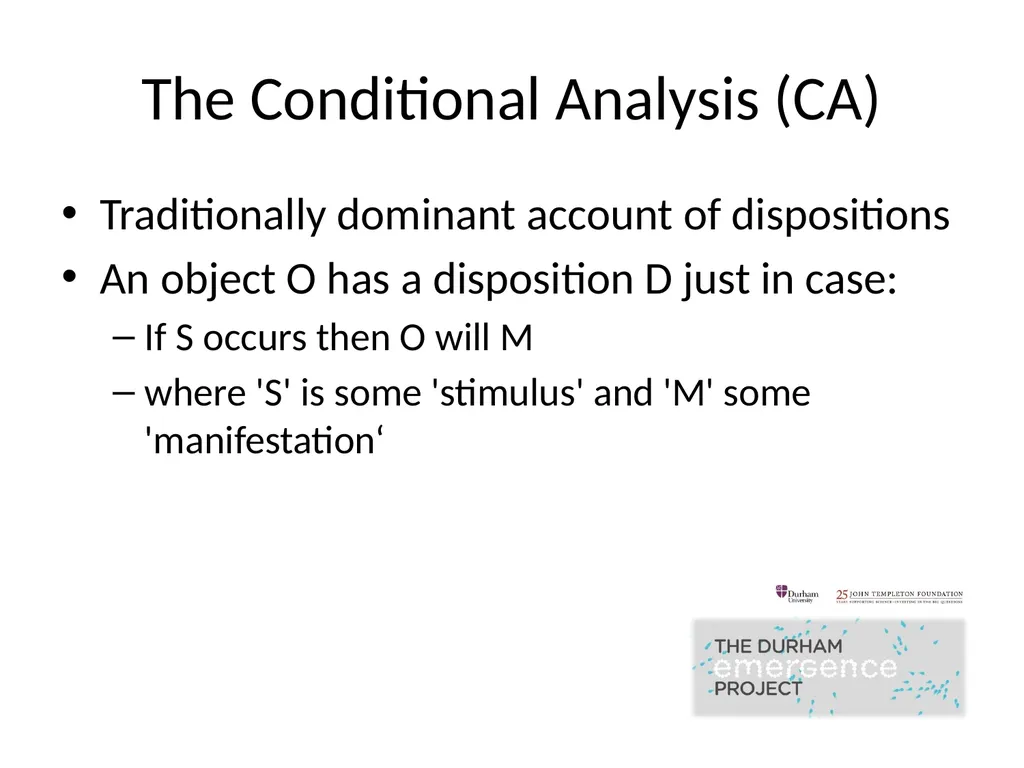
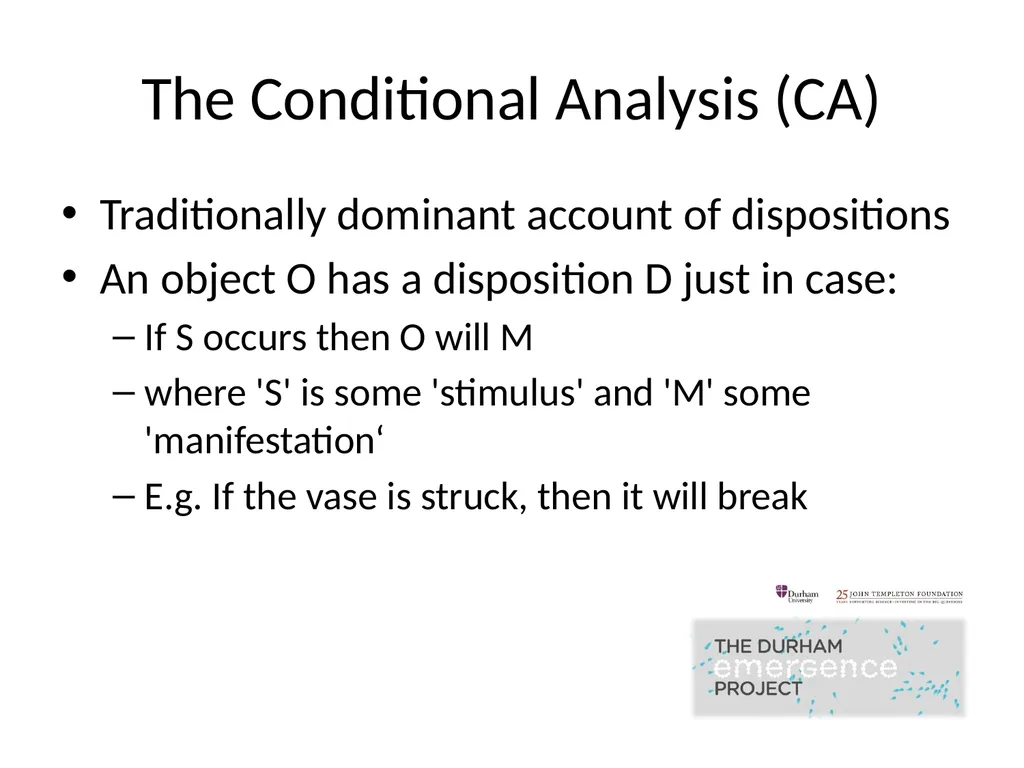
An object O has a disposition D just in case:
If S occurs then O will M
where 'S' is some 'stimulus' and 'M' some 'manifestation‘<br>
slide8. The Conditional Analysis (CA) Traditionally dominant account of dispositions
An object O has a disposition D just in case:
If S occurs then O will M
where 'S' is some 'stimulus' and 'M' some 'manifestation‘
E.g. If the vase is struck, then it will break<br>
slide9. The Conditional Analysis (CA) Traditionally dominant account of dispositions
An object O has a disposition D just in case:
If S occurs then O will M
where 'S' is some 'stimulus' and 'M' some 'manifestation‘
E.g. If the vase is struck, then it will break
Relationally capture a disposition’s nature:
D(s,m)<br>
slide10. Single- vs. Multi-track Dispositions Debate over the number and variety of manifestations associated with a single disposition<br>
slide11. Single- vs. Multi-track Dispositions Debate over the number and variety of manifestations associated with a single disposition
Quantitative multi-tracking vs. Qualitative multi-tracking<br>
slide12. Single- vs. Multi-track Dispositions Debate over the number and variety of manifestations associated with a single disposition
Quantitative multi-tracking vs. Qualitative multi-tracking
If multi-tracking is right, the simple way that the CA models dispositions cannot be correct<br>
slide13. Single- vs. Multi-track Dispositions Debate over the number and variety of manifestations associated with a single disposition
Quantitative multi-tracking vs. Qualitative multi-tracking
If multi-tracking is right, the simple way that the CA models dispositions cannot be correct
Going to be more complex<br>
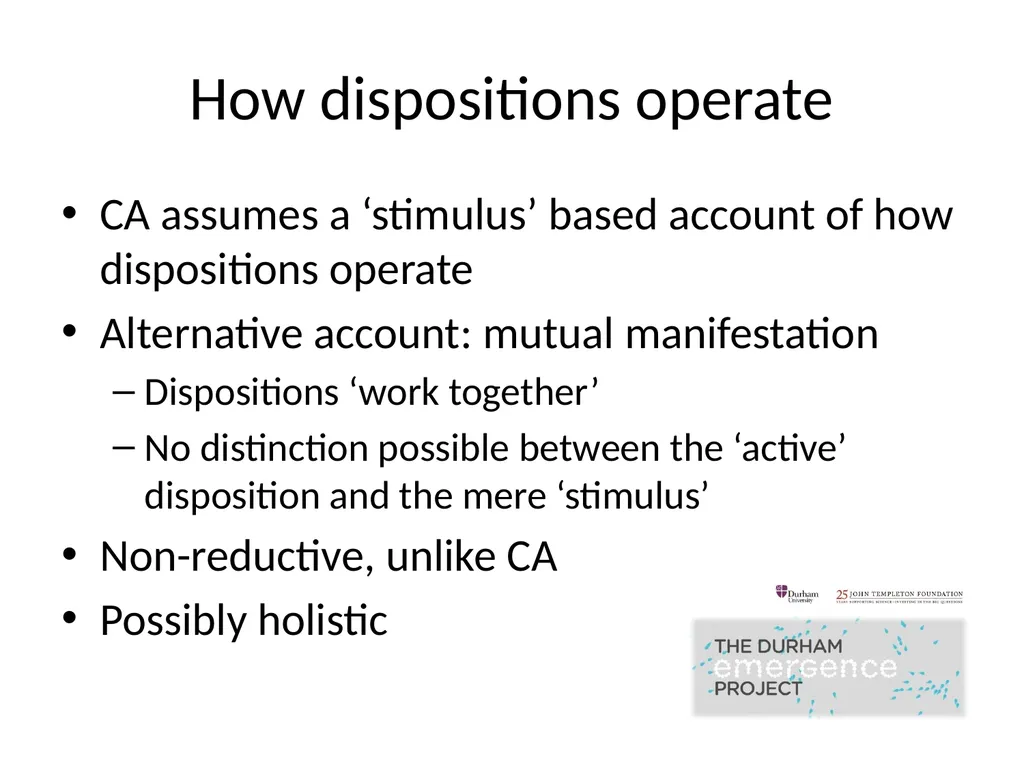
slide14. How dispositions operate CA assumes a ‘stimulus’ based account of how dispositions operate<br>
slide15. How dispositions operate CA assumes a ‘stimulus’ based account of how dispositions operate
Alternative account: mutual manifestation
Dispositions ‘work together’
No distinction possible between the ‘active’ disposition and the mere ‘stimulus’<br>
slide16. How dispositions operate CA assumes a ‘stimulus’ based account of how dispositions operate
Alternative account: mutual manifestation
Dispositions ‘work together’
No distinction possible between the ‘active’ disposition and the mere ‘stimulus’
Non-reductive, unlike CA<br>
slide17. How dispositions operate CA assumes a ‘stimulus’ based account of how dispositions operate
Alternative account: mutual manifestation
Dispositions ‘work together’
No distinction possible between the ‘active’ disposition and the mere ‘stimulus’
Non-reductive, unlike CA
Possibly holistic<br>
slide18. Four accounts of dispositions Single-track, stimulus-manifestation (the CA)
D(s,m)<br>
slide19. Four accounts of dispositions Single-track, stimulus-manifestation (the CA)
D(s,m)
Multi-track, stimulus-manifestation
D{(s1,m1), (s2,m2),…,(sn,mn)}<br>
slide20. Four accounts of dispositions Single-track, stimulus-manifestation (the CA)
D(s,m)
Multi-track, stimulus-manifestation
D{(s1,m1), (s2,m2),…,(sn,mn)}
Single-track, mutual-manifestation
D1(D2,m1)<br>
slide21. Four accounts of dispositions Single-track, stimulus-manifestation (the CA)
D(s,m)
Multi-track, stimulus-manifestation
D{(s1,m1), (s2,m2),…,(sn,mn)}
Single-track, mutual-manifestation
D1(D2,m1)
Multi-track, mutual-manifestation
D1{(D2,m1),(D3,m2),...,(Dn,mn)}<br>
slide22. How to react? Monism?
if so, which account?<br>
slide23. How to react? Monism?
if so, which account?
Pluralism?
greater cost/complexity?<br>
slide24. How to react? Monism?
if so, which account?
Pluralism?
greater cost/complexity?
Pragmatism?
different responses for different tasks/contexts<br>

slide25. Thanks!<br>
Durham Emergence Project
Durham University<br>
slide2. Dispositions (or Capacities, Tendencies, Causal Powers…)<br>
slide3. Dispositions (or Capacities, Tendencies, Causal Powers…)
The features/properties in virtue of which things engage in particular causal interactions<br>
slide4. Dispositions (or Capacities, Tendencies, Causal Powers…)
The features/properties in virtue of which things engage in particular causal interactions
Canonical examples:
Fragility, Solubility<br>
slide5. Dispositions (or Capacities, Tendencies, Causal Powers…)
The features/properties in virtue of which things engage in particular causal interactions
Canonical examples:
Fragility, Solubility
But also:
Mass, Charge<br>
slide6. The Conditional Analysis (CA) Traditionally dominant account of dispositions<br>
slide7. The Conditional Analysis (CA) Traditionally dominant account of dispositions
An object O has a disposition D just in case:
If S occurs then O will M
where 'S' is some 'stimulus' and 'M' some 'manifestation‘<br>
slide8. The Conditional Analysis (CA) Traditionally dominant account of dispositions
An object O has a disposition D just in case:
If S occurs then O will M
where 'S' is some 'stimulus' and 'M' some 'manifestation‘
E.g. If the vase is struck, then it will break<br>
slide9. The Conditional Analysis (CA) Traditionally dominant account of dispositions
An object O has a disposition D just in case:
If S occurs then O will M
where 'S' is some 'stimulus' and 'M' some 'manifestation‘
E.g. If the vase is struck, then it will break
Relationally capture a disposition’s nature:
D(s,m)<br>
slide10. Single- vs. Multi-track Dispositions Debate over the number and variety of manifestations associated with a single disposition<br>
slide11. Single- vs. Multi-track Dispositions Debate over the number and variety of manifestations associated with a single disposition
Quantitative multi-tracking vs. Qualitative multi-tracking<br>
slide12. Single- vs. Multi-track Dispositions Debate over the number and variety of manifestations associated with a single disposition
Quantitative multi-tracking vs. Qualitative multi-tracking
If multi-tracking is right, the simple way that the CA models dispositions cannot be correct<br>
slide13. Single- vs. Multi-track Dispositions Debate over the number and variety of manifestations associated with a single disposition
Quantitative multi-tracking vs. Qualitative multi-tracking
If multi-tracking is right, the simple way that the CA models dispositions cannot be correct
Going to be more complex<br>
slide14. How dispositions operate CA assumes a ‘stimulus’ based account of how dispositions operate<br>
slide15. How dispositions operate CA assumes a ‘stimulus’ based account of how dispositions operate
Alternative account: mutual manifestation
Dispositions ‘work together’
No distinction possible between the ‘active’ disposition and the mere ‘stimulus’<br>
slide16. How dispositions operate CA assumes a ‘stimulus’ based account of how dispositions operate
Alternative account: mutual manifestation
Dispositions ‘work together’
No distinction possible between the ‘active’ disposition and the mere ‘stimulus’
Non-reductive, unlike CA<br>
slide17. How dispositions operate CA assumes a ‘stimulus’ based account of how dispositions operate
Alternative account: mutual manifestation
Dispositions ‘work together’
No distinction possible between the ‘active’ disposition and the mere ‘stimulus’
Non-reductive, unlike CA
Possibly holistic<br>
slide18. Four accounts of dispositions Single-track, stimulus-manifestation (the CA)
D(s,m)<br>
slide19. Four accounts of dispositions Single-track, stimulus-manifestation (the CA)
D(s,m)
Multi-track, stimulus-manifestation
D{(s1,m1), (s2,m2),…,(sn,mn)}<br>
slide20. Four accounts of dispositions Single-track, stimulus-manifestation (the CA)
D(s,m)
Multi-track, stimulus-manifestation
D{(s1,m1), (s2,m2),…,(sn,mn)}
Single-track, mutual-manifestation
D1(D2,m1)<br>
slide21. Four accounts of dispositions Single-track, stimulus-manifestation (the CA)
D(s,m)
Multi-track, stimulus-manifestation
D{(s1,m1), (s2,m2),…,(sn,mn)}
Single-track, mutual-manifestation
D1(D2,m1)
Multi-track, mutual-manifestation
D1{(D2,m1),(D3,m2),...,(Dn,mn)}<br>
slide22. How to react? Monism?
if so, which account?<br>
slide23. How to react? Monism?
if so, which account?
Pluralism?
greater cost/complexity?<br>
slide24. How to react? Monism?
if so, which account?
Pluralism?
greater cost/complexity?
Pragmatism?
different responses for different tasks/contexts<br>
slide25. Thanks!<br>