
Module 1: GLOBAL POLICY CONTEXT FOR CLIMATE CHANGE
OM
Published · 32 slides · 0 views
1 / 1



Description
Module 1: GLOBAL POLICY CONTEXT FOR CLIMATE CHANGE ADAPTATION Integrating Adaptation and Agriculture in National and Sectoral Monitoring and Evaluation (ME) Frameworks Objective Understand key international and national policy frameworks
Related Topics
Download this presentation From Below
"Module 1: GLOBAL POLICY CONTEXT FOR CLIMATE CHANGE" is the property of its rightful owner. Permission is granted to download and print the materials on this website for personal, non-commercial use only, and to display it on your personal computer provided you do not modify the materials and that you retain all copyright notices contained in the materials. By downloading content from our website, you accept the terms of this agreement.
Share
Embed code
Presentation Transcript
01
Module 1: GLOBAL POLICY CONTEXT FOR CLIMATE CHANGE ADAPTATION Integrating Adaptation and Agriculture in National and Sectoral Monitoring and Evaluation (M&E) Frameworks<br>
02
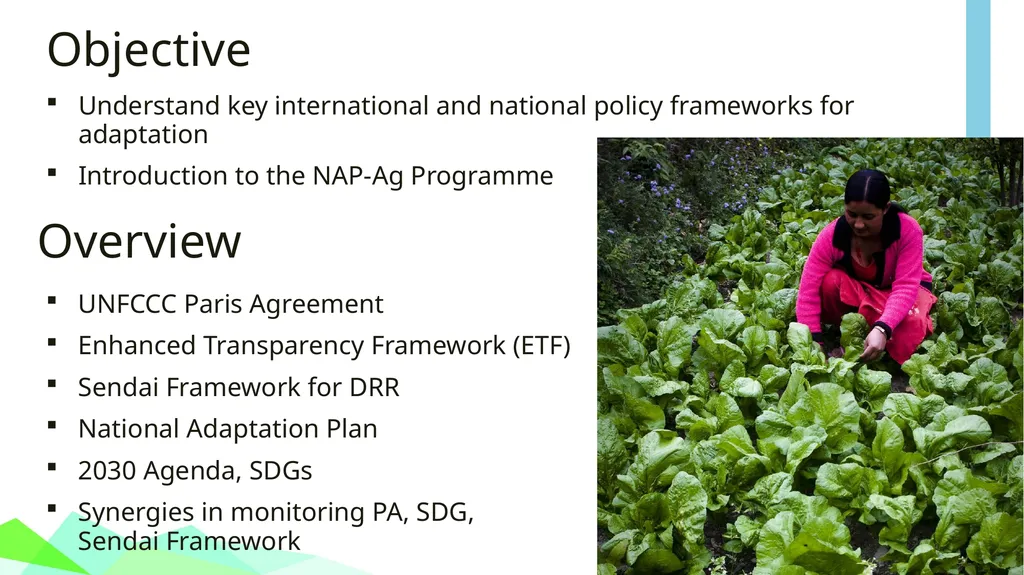
Objective Understand key international and national policy frameworks for adaptation
Introduction to the NAP-Ag Programme Overview UNFCCC Paris Agreement
Enhanced Transparency Framework (ETF)
Sendai Framework for DRR
National Adaptation Plan
2030 Agenda, SDGs
Synergies in monitoring PA, SDG, Sendai Framework<br>
Introduction to the NAP-Ag Programme Overview UNFCCC Paris Agreement
Enhanced Transparency Framework (ETF)
Sendai Framework for DRR
National Adaptation Plan
2030 Agenda, SDGs
Synergies in monitoring PA, SDG, Sendai Framework<br>
03
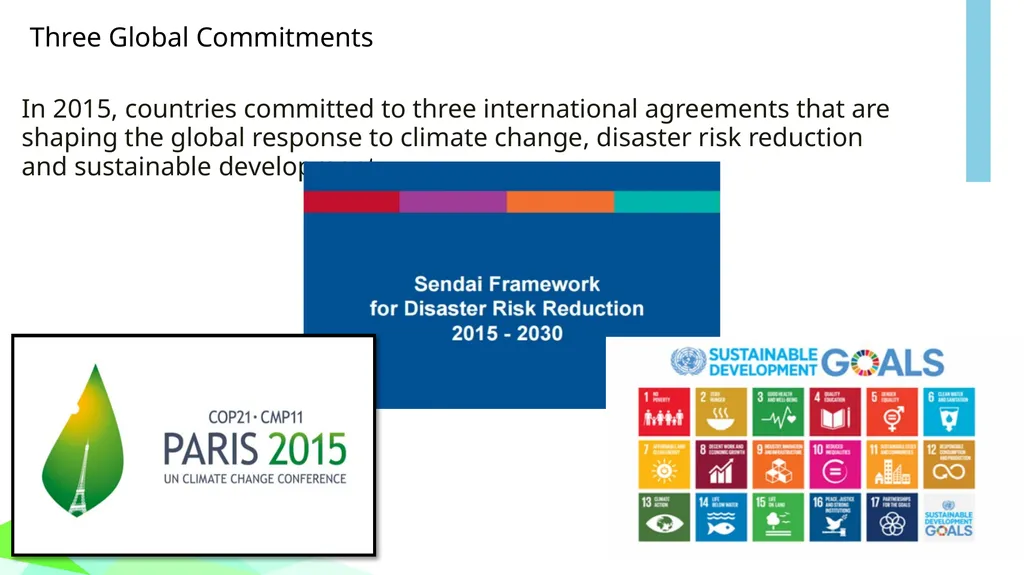
Three Global Commitments In 2015, countries committed to three international agreements that are shaping the global response to climate change, disaster risk reduction and sustainable development<br>
04
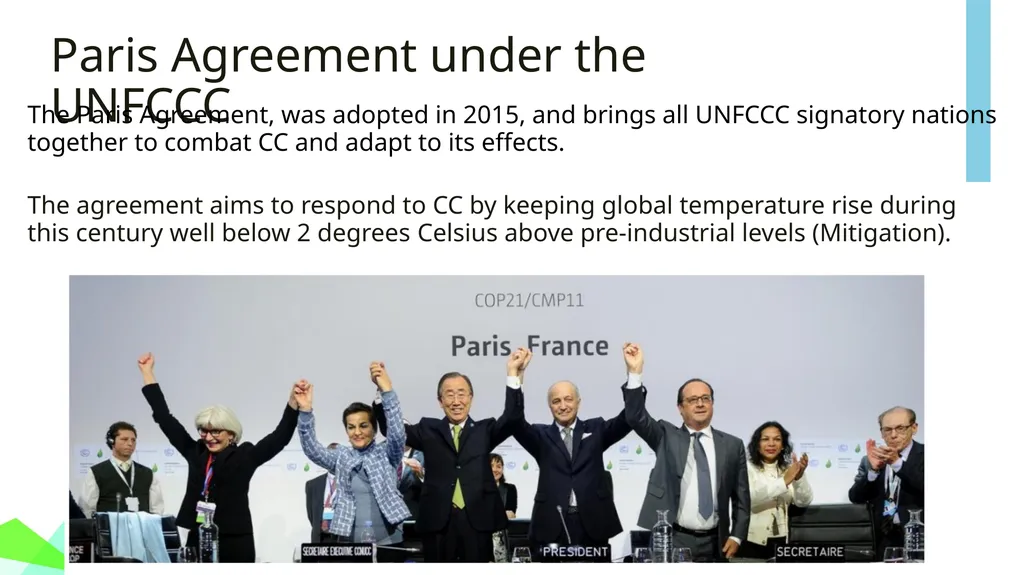
Paris Agreement under the UNFCCC The Paris Agreement, was adopted in 2015, and brings all UNFCCC signatory nations together to combat CC and adapt to its effects.
The agreement aims to respond to CC by keeping global temperature rise during this century well below 2 degrees Celsius above pre-industrial levels (Mitigation).<br>
The agreement aims to respond to CC by keeping global temperature rise during this century well below 2 degrees Celsius above pre-industrial levels (Mitigation).<br>
05
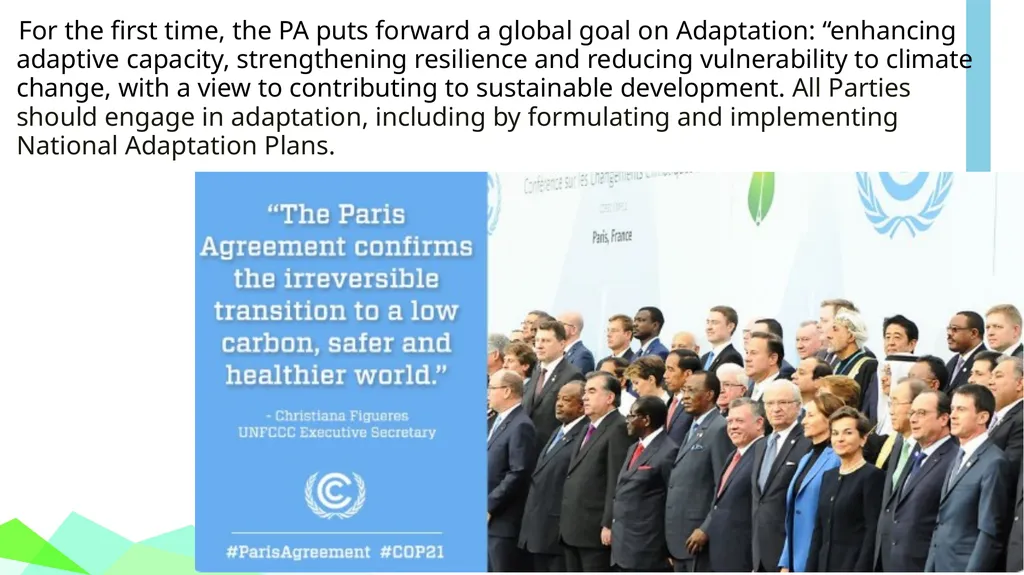
For the first time, the PA puts forward a global goal on Adaptation: “enhancing adaptive capacity, strengthening resilience and reducing vulnerability to climate change, with a view to contributing to sustainable development. All Parties should engage in adaptation, including by formulating and implementing National Adaptation Plans.<br>
06
NDCs and adaptation NDCs cornerstone of the Paris Agreement
102 countries have included adaptation and sometimes NAP in their NDCs
Of the developing countries that include adaptation in NDCs, 93% mention adaptation areas and/ or actions in the context of the agriculture sector:
crops and livestock (97%);
forests (88%); and
fisheries and aquaculture (64%)
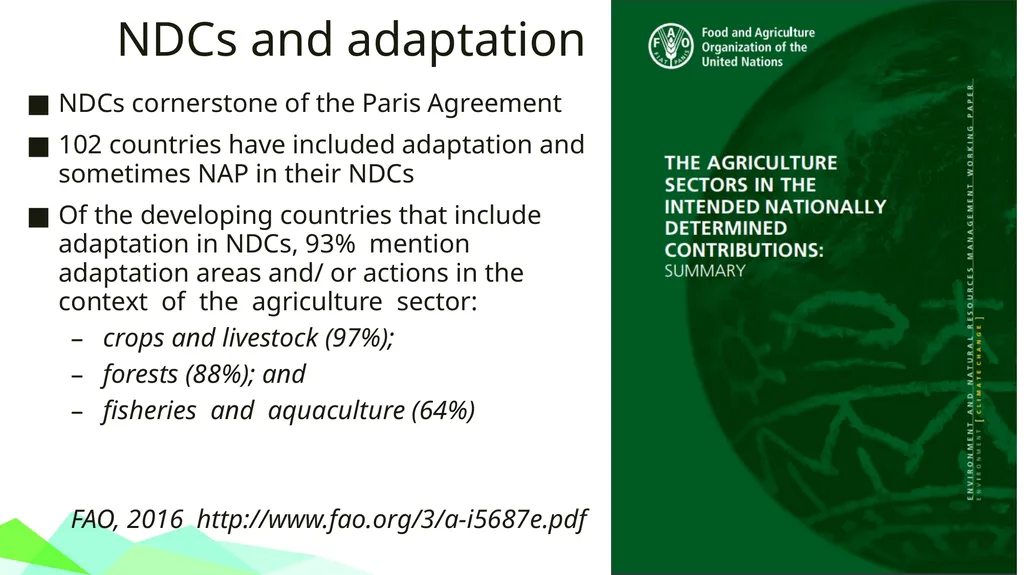
FAO, 2016 http://www.fao.org/3/a-i5687e.pdf<br>
102 countries have included adaptation and sometimes NAP in their NDCs
Of the developing countries that include adaptation in NDCs, 93% mention adaptation areas and/ or actions in the context of the agriculture sector:
crops and livestock (97%);
forests (88%); and
fisheries and aquaculture (64%)
FAO, 2016 http://www.fao.org/3/a-i5687e.pdf<br>
07
UNFCCC: The Paris Agreement and M&E According to FAO, most countries emphasize the importance of monitoring and evaluating the impact of their proposed strategies. Where countries plan to introduce M&E for specific regions or sectors, they often express the intention to scale these measures up to the national level in the long run. (FAO 2016. The agriculture sectors in the INDC). The Paris Agreement states that: each Party shall, as appropriate, engage in adaptation planning processes and the implementation of actions, including the development or enhancement of relevant plans, policies and/or contributions, which may include […], (d) monitoring and evaluating and learning from adaptation plans, policies, programmes and actions (Decision 1/CP.21. Art.7.9.) Global NDC commitment for M&E<br>
08
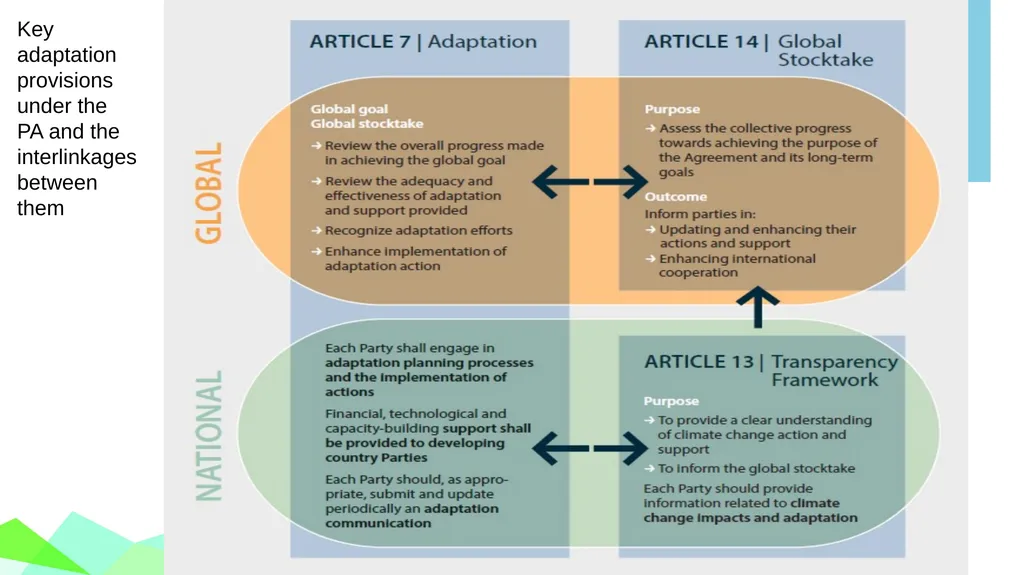
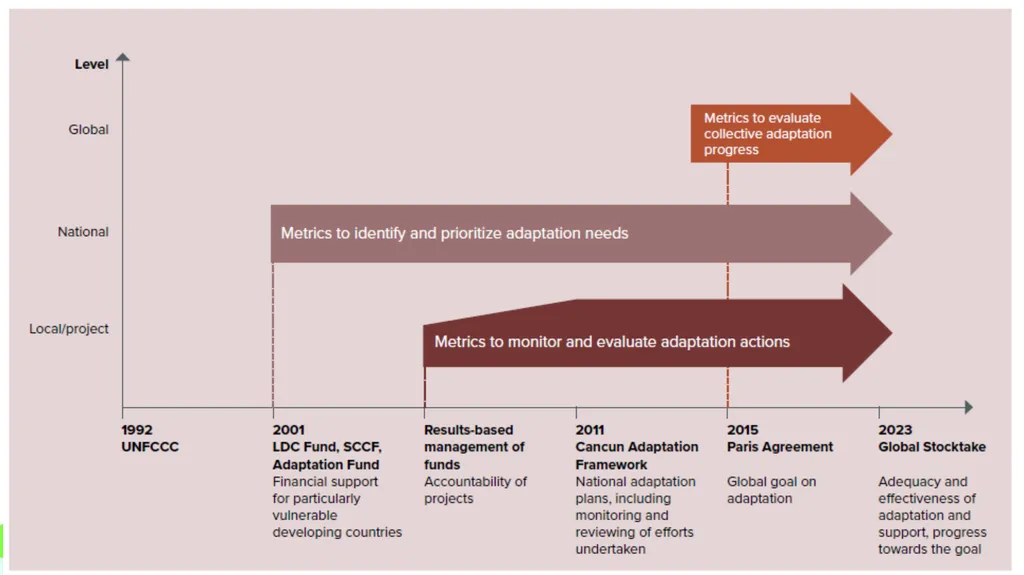
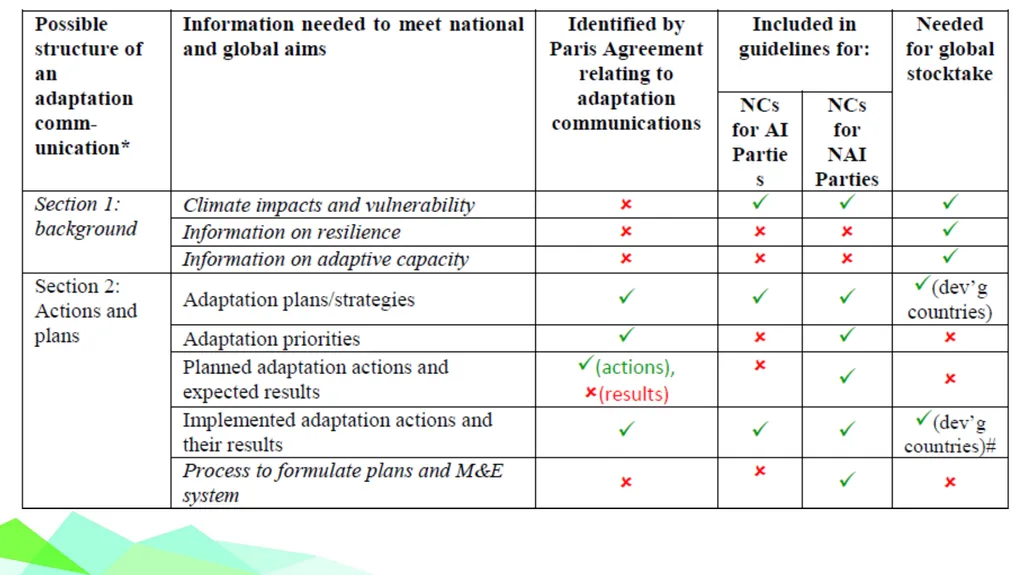
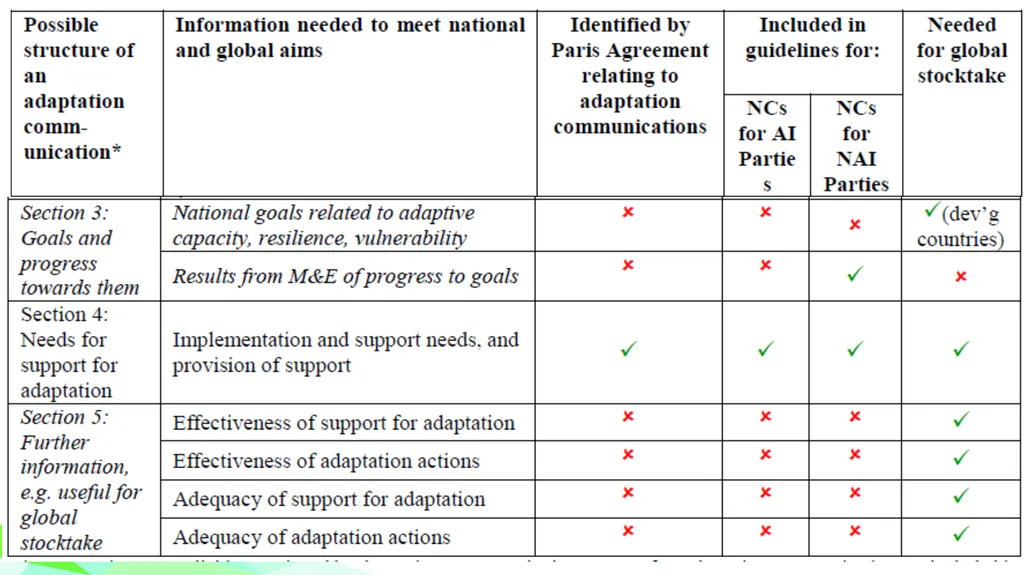
Key adaptation provisions under the PA and the interlinkages between them<br>
09
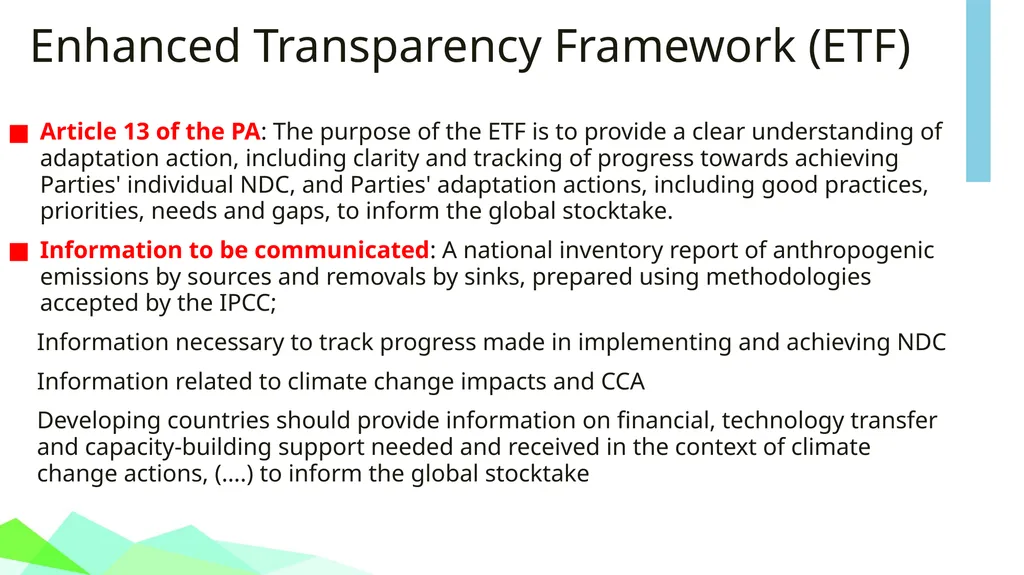
Enhanced Transparency Framework (ETF) Article 13 of the PA: The purpose of the ETF is to provide a clear understanding of adaptation action, including clarity and tracking of progress towards achieving Parties' individual NDC, and Parties' adaptation actions, including good practices, priorities, needs and gaps, to inform the global stocktake.
Information to be communicated: A national inventory report of anthropogenic emissions by sources and removals by sinks, prepared using methodologies accepted by the IPCC;
Information necessary to track progress made in implementing and achieving NDC
Information related to climate change impacts and CCA
Developing countries should provide information on financial, technology transfer and capacity-building support needed and received in the context of climate change actions, (….) to inform the global stocktake<br>
Information to be communicated: A national inventory report of anthropogenic emissions by sources and removals by sinks, prepared using methodologies accepted by the IPCC;
Information necessary to track progress made in implementing and achieving NDC
Information related to climate change impacts and CCA
Developing countries should provide information on financial, technology transfer and capacity-building support needed and received in the context of climate change actions, (….) to inform the global stocktake<br>
10
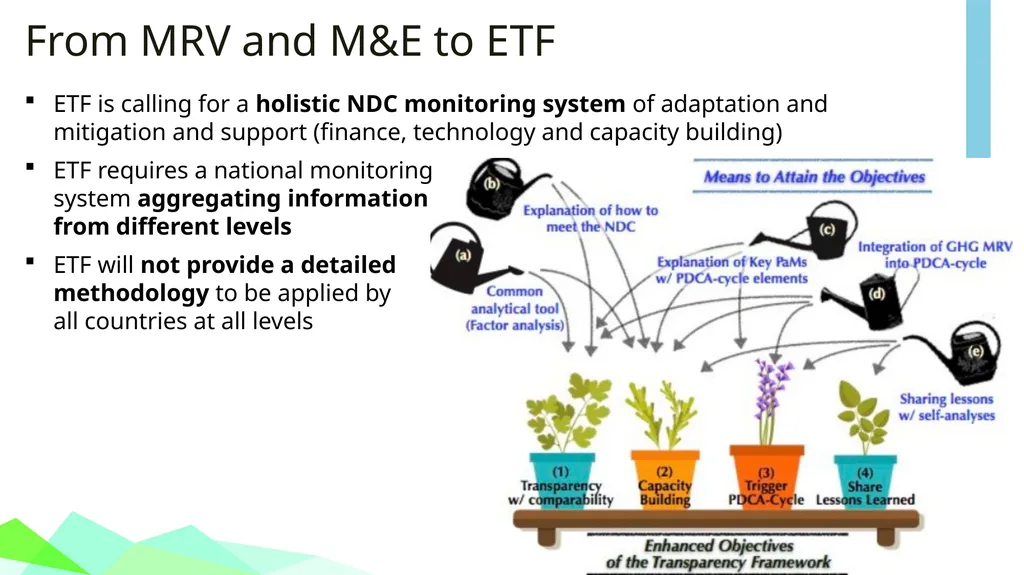
From MRV and M&E to ETF ETF is calling for a holistic NDC monitoring system of adaptation and mitigation and support (finance, technology and capacity building)
ETF requires a national monitoring system aggregating information from different levels
ETF will not provide a detailed methodology to be applied by all countries at all levels<br>
ETF requires a national monitoring system aggregating information from different levels
ETF will not provide a detailed methodology to be applied by all countries at all levels<br>
11
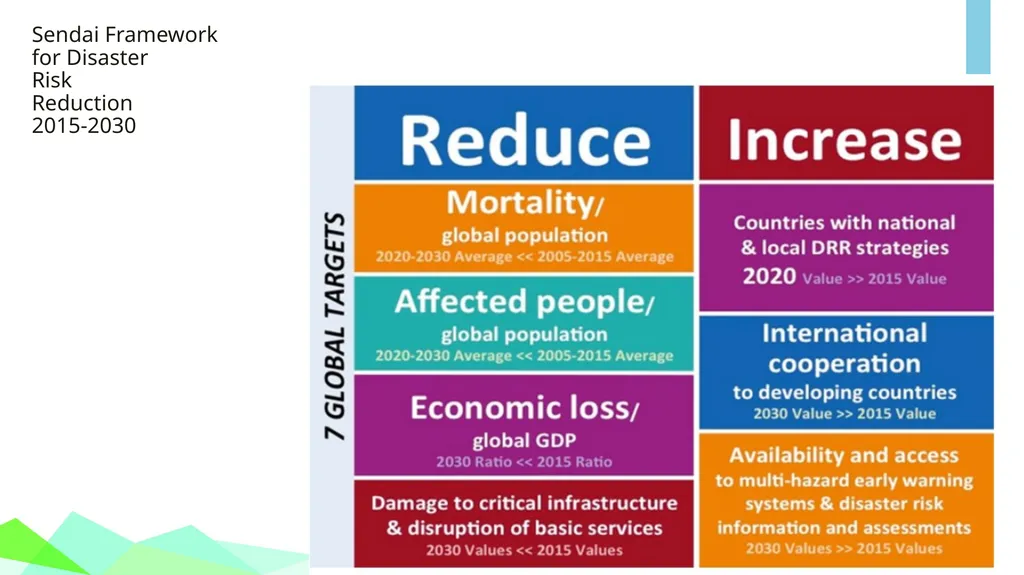
Sendai Framework
for Disaster
Risk
Reduction
2015-2030<br>
12
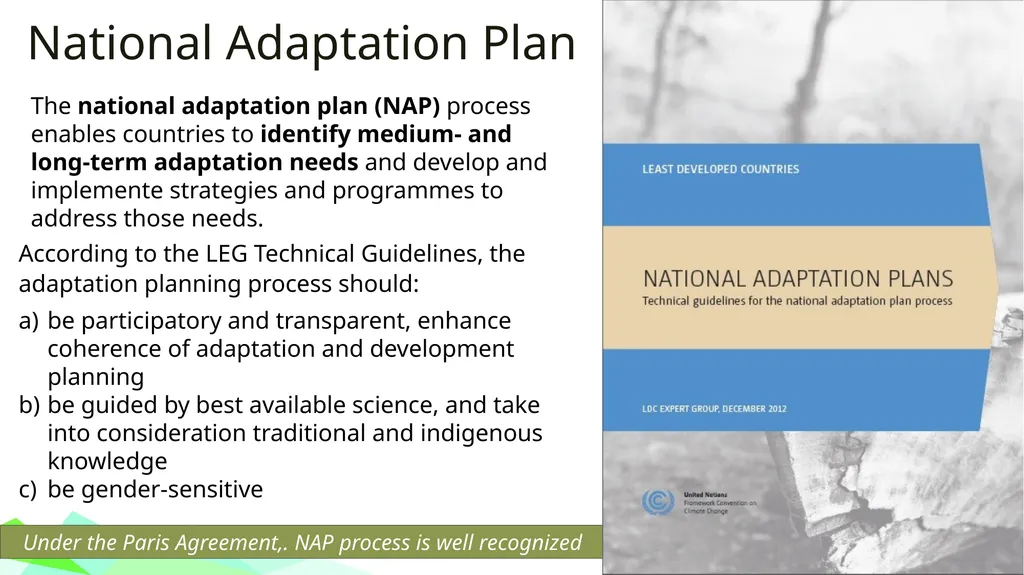
National Adaptation Plan The national adaptation plan (NAP) process enables countries to identify medium- and long-term adaptation needs and develop and implemente strategies and programmes to address those needs. Under the Paris Agreement,. NAP process is well recognized According to the LEG Technical Guidelines, the adaptation planning process should:
be participatory and transparent, enhance coherence of adaptation and development planning
be guided by best available science, and take into consideration traditional and indigenous knowledge
be gender-sensitive<br>
be participatory and transparent, enhance coherence of adaptation and development planning
be guided by best available science, and take into consideration traditional and indigenous knowledge
be gender-sensitive<br>
13
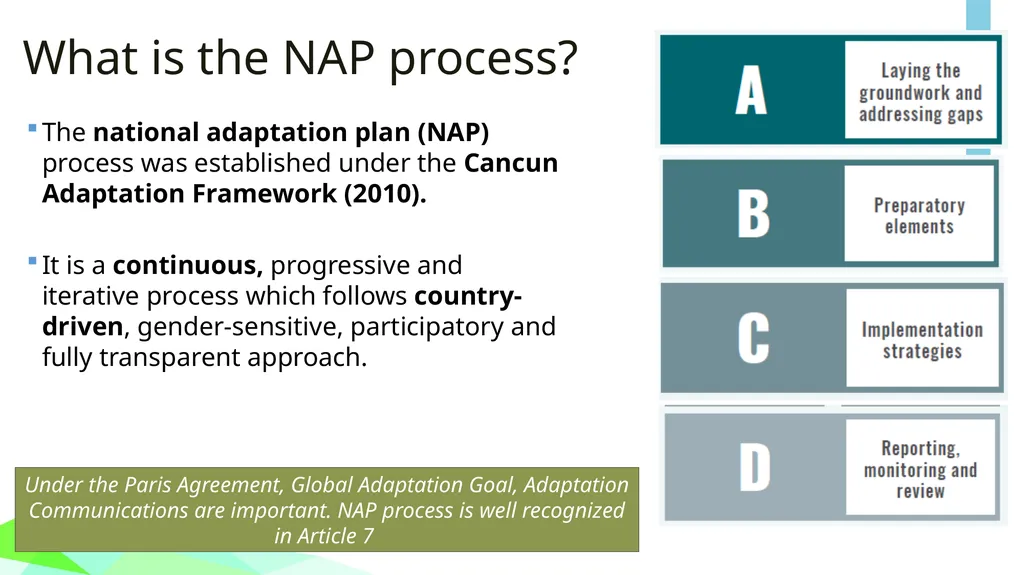
What is the NAP process? The national adaptation plan (NAP) process was established under the Cancun Adaptation Framework (2010).
It is a continuous, progressive and iterative process which follows country-driven, gender-sensitive, participatory and fully transparent approach. Under the Paris Agreement, Global Adaptation Goal, Adaptation Communications are important. NAP process is well recognized in Article 7<br>
It is a continuous, progressive and iterative process which follows country-driven, gender-sensitive, participatory and fully transparent approach. Under the Paris Agreement, Global Adaptation Goal, Adaptation Communications are important. NAP process is well recognized in Article 7<br>
14
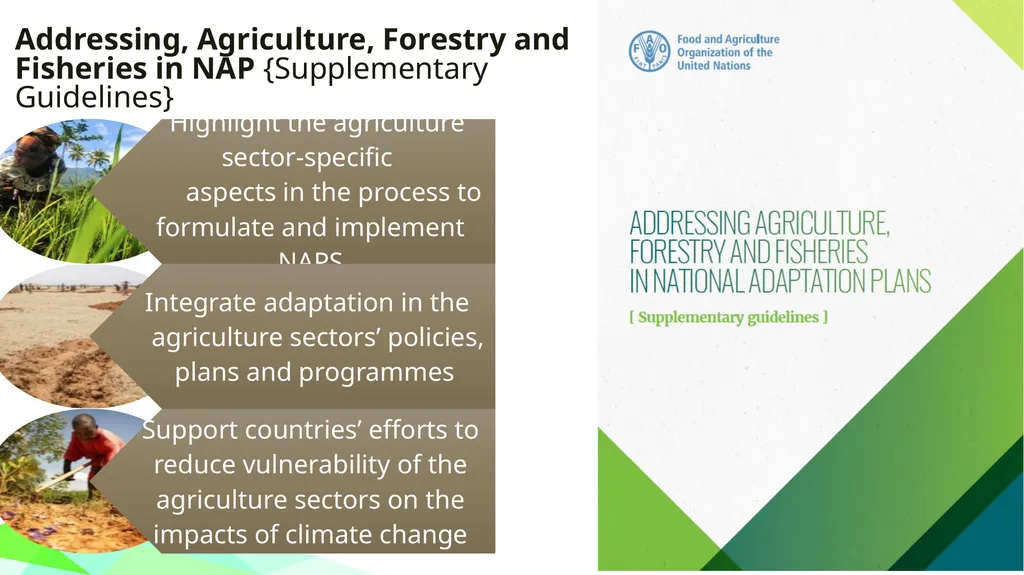
Addressing, Agriculture, Forestry and Fisheries in NAP {Supplementary Guidelines}<br>
15
2030 Agenda for Sustainable Development<br>
16
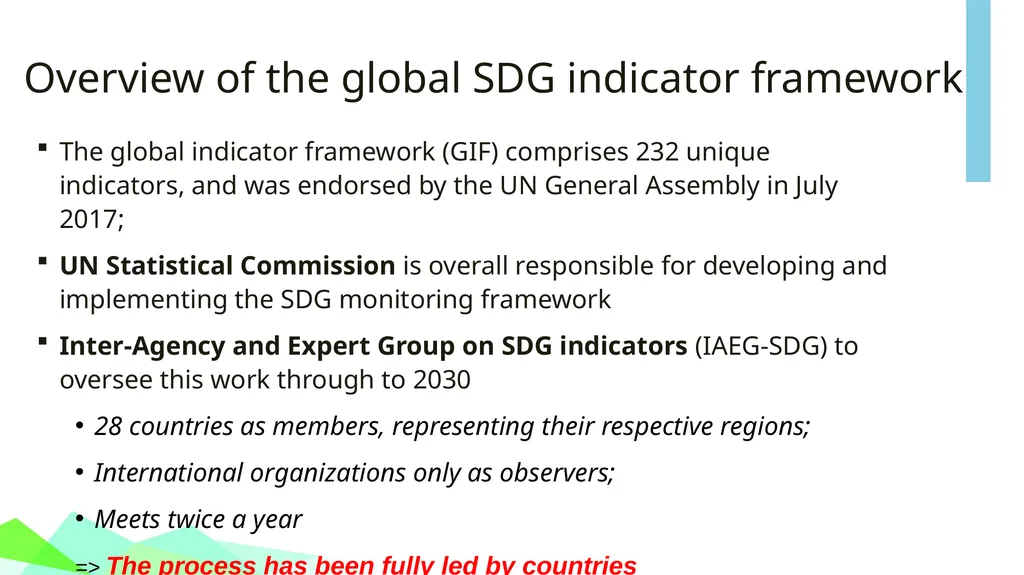
Overview of the global SDG indicator framework The global indicator framework (GIF) comprises 232 unique indicators, and was endorsed by the UN General Assembly in July 2017;
UN Statistical Commission is overall responsible for developing and implementing the SDG monitoring framework
Inter-Agency and Expert Group on SDG indicators (IAEG-SDG) to oversee this work through to 2030
28 countries as members, representing their respective regions;
International organizations only as observers;
Meets twice a year
=> The process has been fully led by countries<br>
UN Statistical Commission is overall responsible for developing and implementing the SDG monitoring framework
Inter-Agency and Expert Group on SDG indicators (IAEG-SDG) to oversee this work through to 2030
28 countries as members, representing their respective regions;
International organizations only as observers;
Meets twice a year
=> The process has been fully led by countries<br>
17
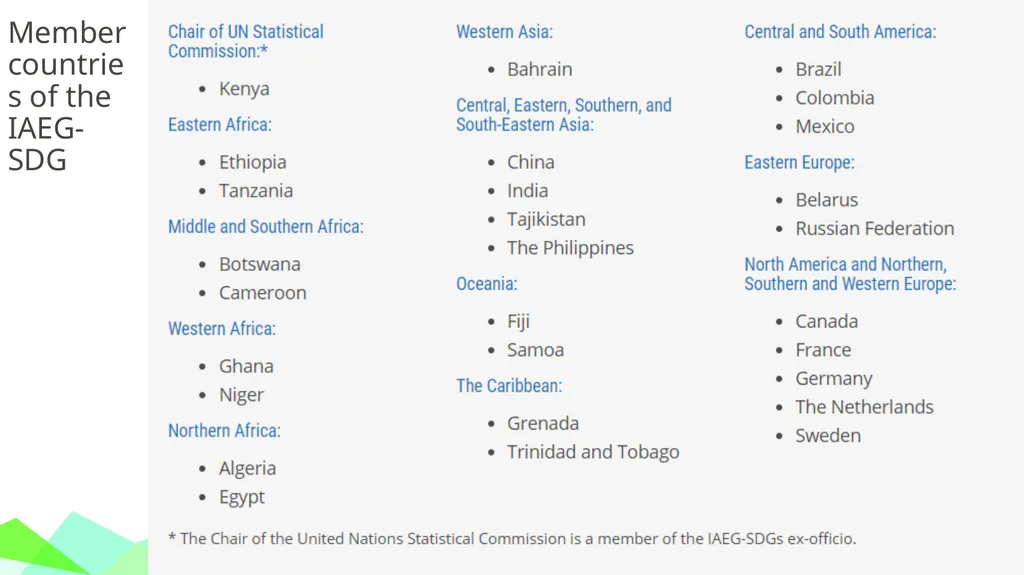
Member countries of the IAEG-SDG<br>
18
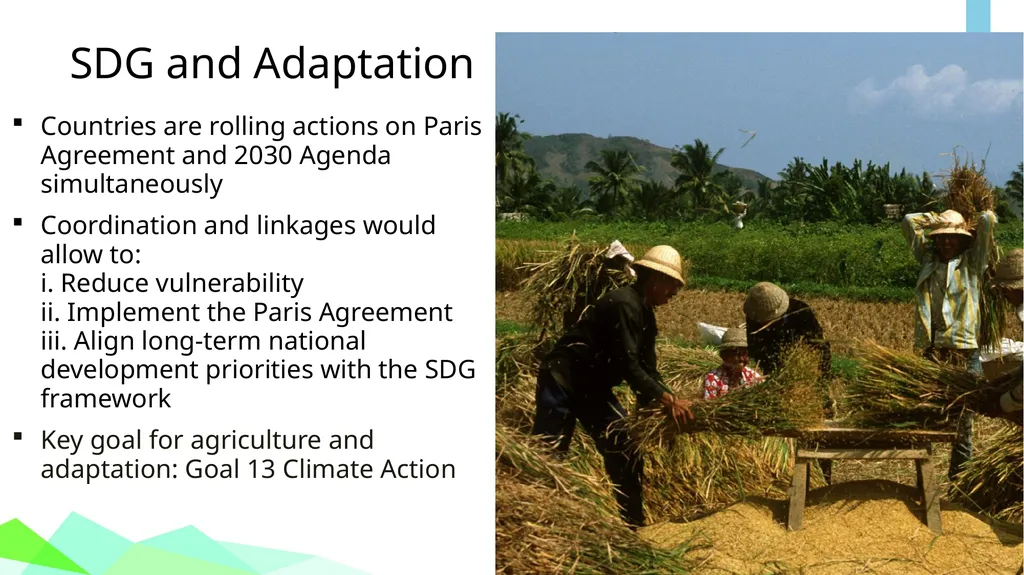
Countries are rolling actions on Paris Agreement and 2030 Agenda simultaneously
Coordination and linkages would allow to: i. Reduce vulnerability ii. Implement the Paris Agreement iii. Align long-term national development priorities with the SDG framework
Key goal for agriculture and adaptation: Goal 13 Climate Action SDG and Adaptation<br>
Coordination and linkages would allow to: i. Reduce vulnerability ii. Implement the Paris Agreement iii. Align long-term national development priorities with the SDG framework
Key goal for agriculture and adaptation: Goal 13 Climate Action SDG and Adaptation<br>
19
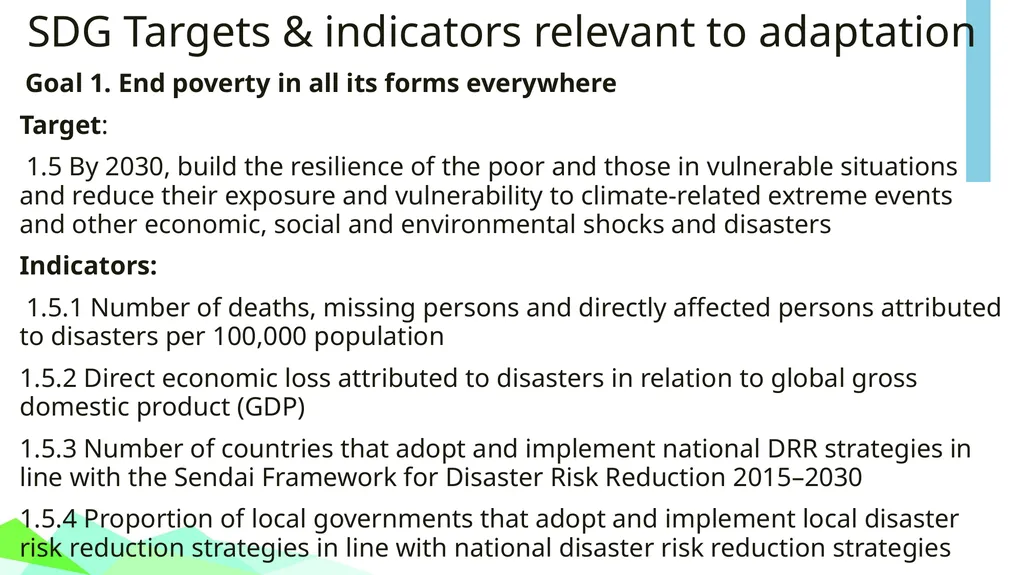
SDG Targets & indicators relevant to adaptation Goal 1. End poverty in all its forms everywhere
Target:
1.5 By 2030, build the resilience of the poor and those in vulnerable situations and reduce their exposure and vulnerability to climate-related extreme events and other economic, social and environmental shocks and disasters
Indicators:
1.5.1 Number of deaths, missing persons and directly affected persons attributed to disasters per 100,000 population
1.5.2 Direct economic loss attributed to disasters in relation to global gross domestic product (GDP)
1.5.3 Number of countries that adopt and implement national DRR strategies in line with the Sendai Framework for Disaster Risk Reduction 2015–2030
1.5.4 Proportion of local governments that adopt and implement local disaster risk reduction strategies in line with national disaster risk reduction strategies<br>
Target:
1.5 By 2030, build the resilience of the poor and those in vulnerable situations and reduce their exposure and vulnerability to climate-related extreme events and other economic, social and environmental shocks and disasters
Indicators:
1.5.1 Number of deaths, missing persons and directly affected persons attributed to disasters per 100,000 population
1.5.2 Direct economic loss attributed to disasters in relation to global gross domestic product (GDP)
1.5.3 Number of countries that adopt and implement national DRR strategies in line with the Sendai Framework for Disaster Risk Reduction 2015–2030
1.5.4 Proportion of local governments that adopt and implement local disaster risk reduction strategies in line with national disaster risk reduction strategies<br>
20
Goal 13. Take urgent action to combat climate change and its impacts
Targets:
13.1 Strengthen resilience and adaptive capacity to climate-related hazards and natural disasters in all countries
13.2 Integrate climate change measures into national policies, strategies and planning
13.3 Improve education, awareness-raising and human and institutional capacity on climate change mitigation, adaptation, impact reduction and early warning
13.a Implement the commitment undertaken by developed-country parties to the UNFCCC to a goal of mobilizing jointly $100 billion annually by 2020 from all sources to address the needs of developing countries in the context of meaningful mitigation actions and transparency on implementation and fully operationalize the Green Climate Fund through its capitalization as soon as possible
13.b Promote mechanisms for raising capacity for effective climate change-related planning and management in least developed countries and small island developing States, including focusing on women, youth and local and marginalized communities<br>
Targets:
13.1 Strengthen resilience and adaptive capacity to climate-related hazards and natural disasters in all countries
13.2 Integrate climate change measures into national policies, strategies and planning
13.3 Improve education, awareness-raising and human and institutional capacity on climate change mitigation, adaptation, impact reduction and early warning
13.a Implement the commitment undertaken by developed-country parties to the UNFCCC to a goal of mobilizing jointly $100 billion annually by 2020 from all sources to address the needs of developing countries in the context of meaningful mitigation actions and transparency on implementation and fully operationalize the Green Climate Fund through its capitalization as soon as possible
13.b Promote mechanisms for raising capacity for effective climate change-related planning and management in least developed countries and small island developing States, including focusing on women, youth and local and marginalized communities<br>
21
Goal 14. Conserve and sustainably use the oceans, seas and marine resources for sustainable development
Target:
14.2 By 2020, sustainably manage and protect marine and coastal ecosystems to avoid significant adverse impacts, including by strengthening their resilience, and take action for their restoration in order to achieve healthy and productive oceans
Indicator:
14.2.1 Proportion of national exclusive economic zones managed using ecosystem-based approaches<br>
Target:
14.2 By 2020, sustainably manage and protect marine and coastal ecosystems to avoid significant adverse impacts, including by strengthening their resilience, and take action for their restoration in order to achieve healthy and productive oceans
Indicator:
14.2.1 Proportion of national exclusive economic zones managed using ecosystem-based approaches<br>
22
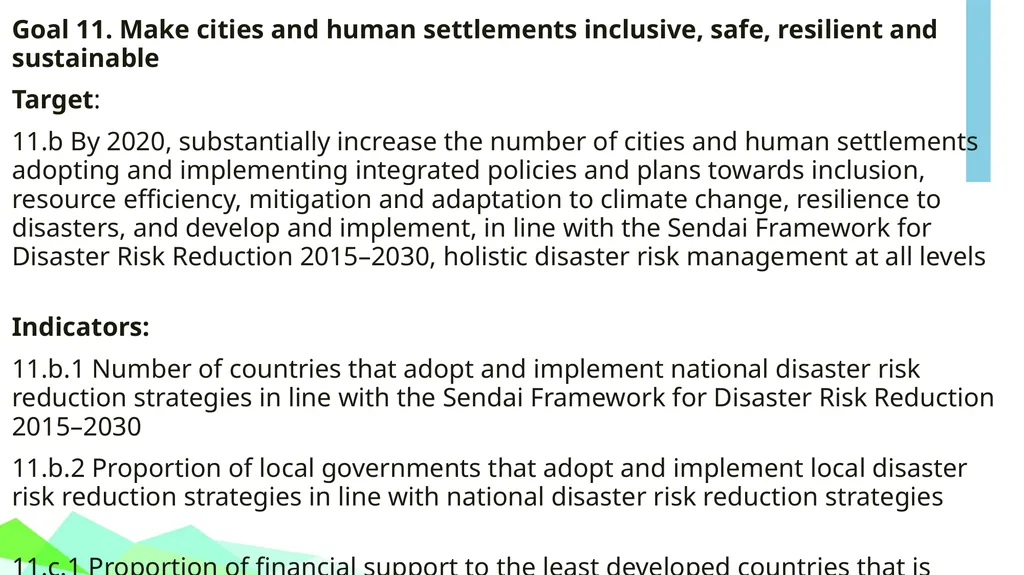
Goal 11. Make cities and human settlements inclusive, safe, resilient and sustainable
Target:
11.b By 2020, substantially increase the number of cities and human settlements adopting and implementing integrated policies and plans towards inclusion, resource efficiency, mitigation and adaptation to climate change, resilience to disasters, and develop and implement, in line with the Sendai Framework for Disaster Risk Reduction 2015–2030, holistic disaster risk management at all levels
Indicators:
11.b.1 Number of countries that adopt and implement national disaster risk reduction strategies in line with the Sendai Framework for Disaster Risk Reduction 2015–2030
11.b.2 Proportion of local governments that adopt and implement local disaster risk reduction strategies in line with national disaster risk reduction strategies
11.c.1 Proportion of financial support to the least developed countries that is allocated to the construction and retrofitting of sustainable, resilient and resource-efficient buildings utilizing local materials<br>
Target:
11.b By 2020, substantially increase the number of cities and human settlements adopting and implementing integrated policies and plans towards inclusion, resource efficiency, mitigation and adaptation to climate change, resilience to disasters, and develop and implement, in line with the Sendai Framework for Disaster Risk Reduction 2015–2030, holistic disaster risk management at all levels
Indicators:
11.b.1 Number of countries that adopt and implement national disaster risk reduction strategies in line with the Sendai Framework for Disaster Risk Reduction 2015–2030
11.b.2 Proportion of local governments that adopt and implement local disaster risk reduction strategies in line with national disaster risk reduction strategies
11.c.1 Proportion of financial support to the least developed countries that is allocated to the construction and retrofitting of sustainable, resilient and resource-efficient buildings utilizing local materials<br>
23
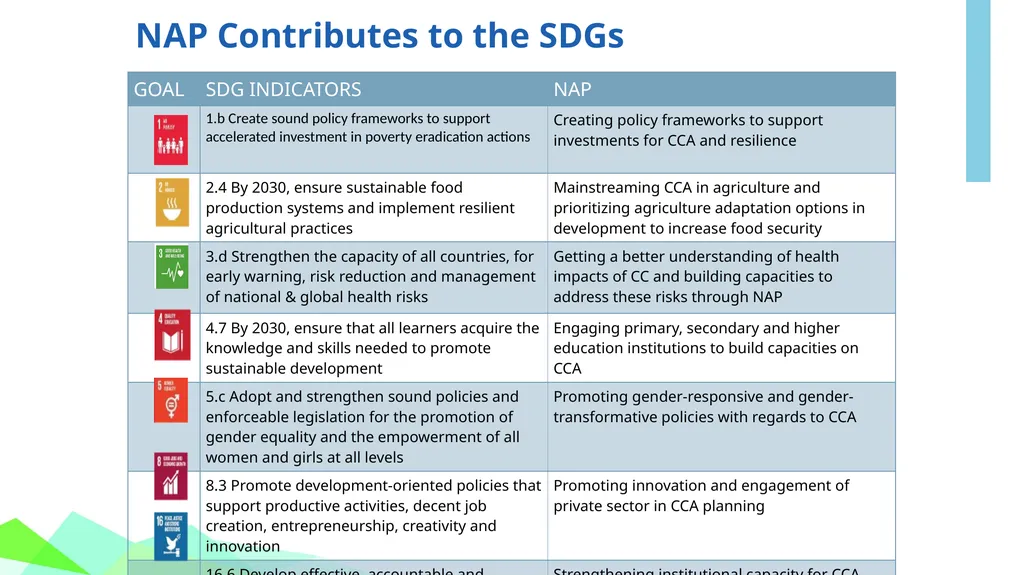
NAP Contributes to the SDGs<br>
24
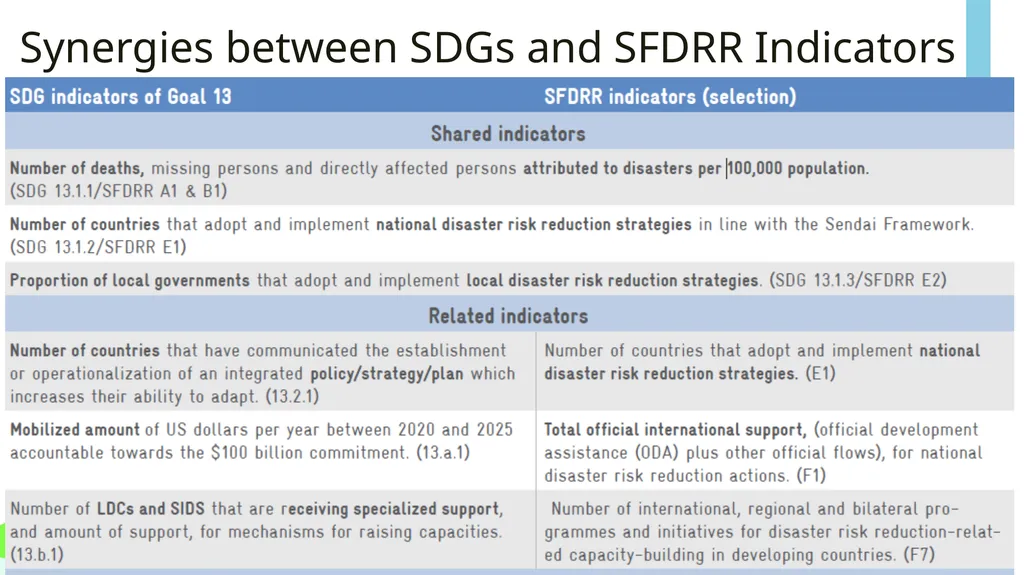
Synergies between SDGs and SFDRR Indicators<br>
25
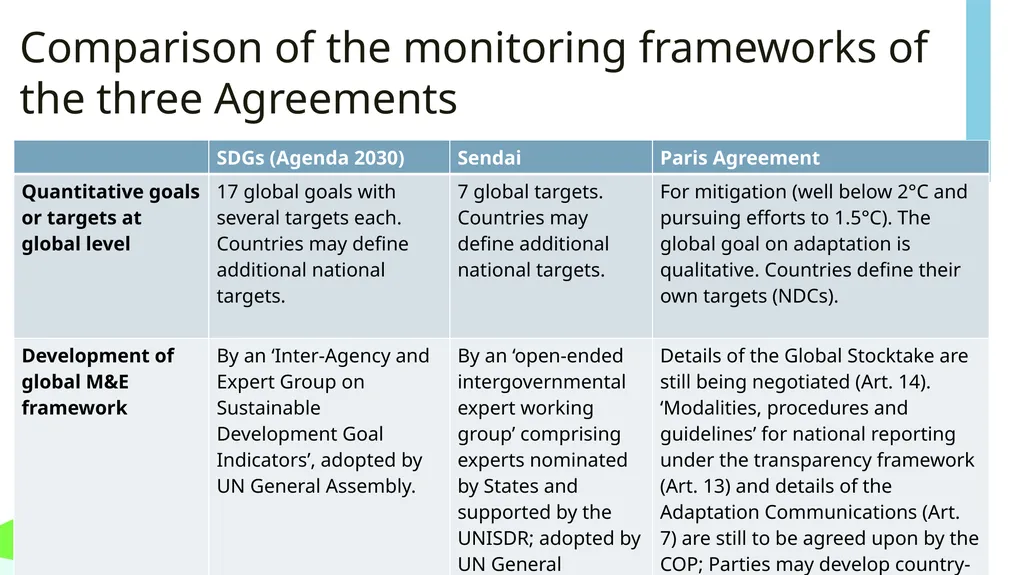
Comparison of the monitoring frameworks of the three Agreements<br>
26
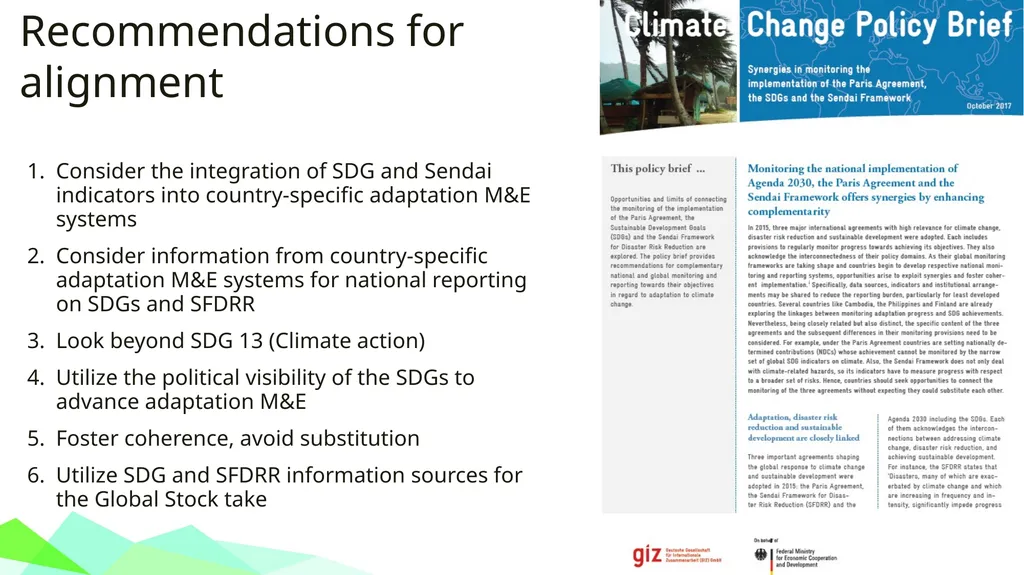
Recommendations for
alignment Consider the integration of SDG and Sendai indicators into country-specific adaptation M&E systems
Consider information from country-specific adaptation M&E systems for national reporting on SDGs and SFDRR
Look beyond SDG 13 (Climate action)
Utilize the political visibility of the SDGs to advance adaptation M&E
Foster coherence, avoid substitution
Utilize SDG and SFDRR information sources for the Global Stock take<br>
Consider information from country-specific adaptation M&E systems for national reporting on SDGs and SFDRR
Look beyond SDG 13 (Climate action)
Utilize the political visibility of the SDGs to advance adaptation M&E
Foster coherence, avoid substitution
Utilize SDG and SFDRR information sources for the Global Stock take<br>