
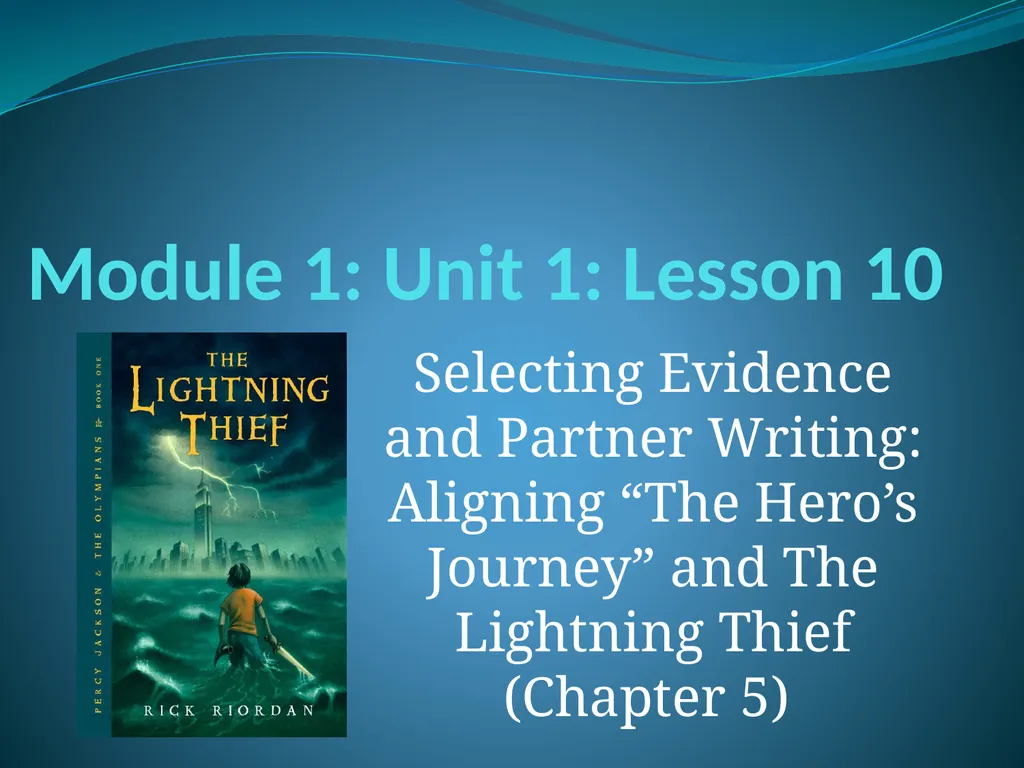
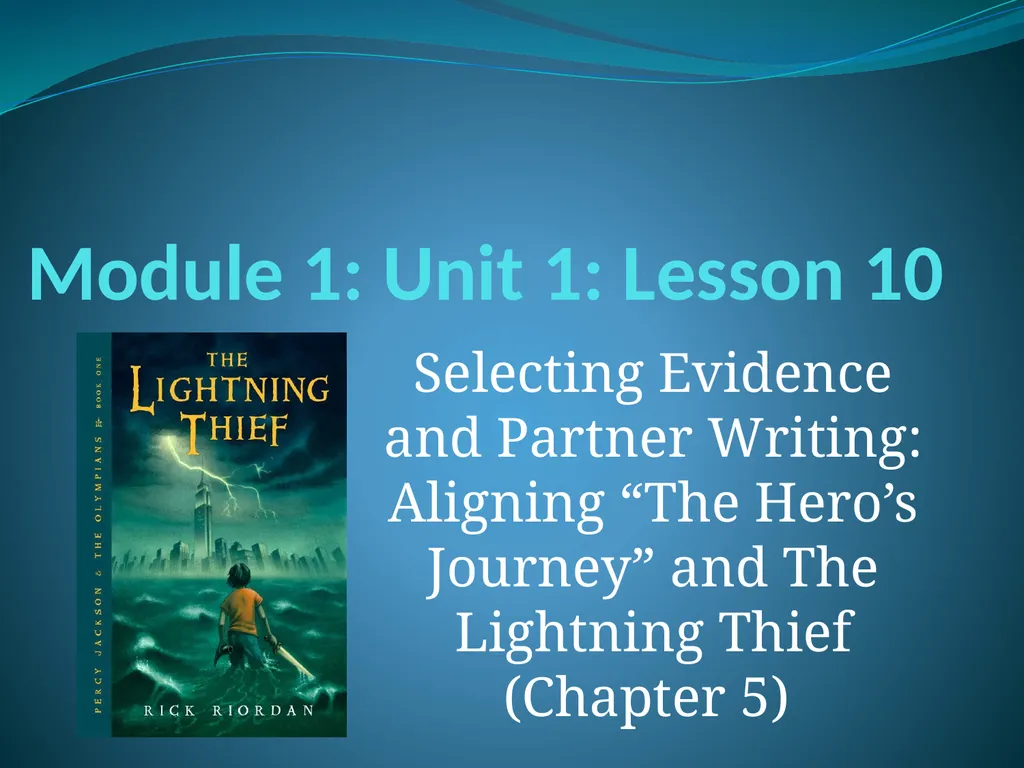
Module 1: Unit 1: Lesson 10 Selecting Evidence and
NS
Published · 20 slides · 0 views
1 / 1
Description
Module 1: Unit 1: Lesson 10 Selecting Evidence and Partner Writing: Aligning The Heros Journey and The Lightning Thief (Chapter 5) Teaching Notes Review Carousel Brainstorm protocol (Appendix 1). In advance: Prepare the four quotes on
Related Topics
Share
Embed code
Download this presentation From Below
"Module 1: Unit 1: Lesson 10 Selecting Evidence and" is the property of its rightful owner. Permission is granted to download and print the materials on this website for personal, non-commercial use only, and to display it on your personal computer provided you do not modify the materials and that you retain all copyright notices contained in the materials. By downloading content from our website, you accept the terms of this agreement.
Presentation Transcript
01
Module 1: Unit 1: Lesson 10 Selecting Evidence and Partner Writing: Aligning “The Hero’s Journey” and The Lightning Thief (Chapter 5)<br>
02
Teaching Notes • Review Carousel Brainstorm protocol (Appendix 1).
In advance: Prepare the four quotes on the Carousel of Quotes handout on chart paper around the room (one chart per quote). Consider making two charts with the exact same quote, so there are eight charts total.
In this lesson students begin to practice analyzing the text in writing. This is an initial low-stakes writing task. Note that the focus of this unit has primarily been on close reading. The writing here is intended to address W.6.9 more broadly, rather than all the specific aspects of W.6.2. Unit 2 devotes much more time to heavily scaffolding students’ writing (W.6.2). Here, the goal is more to “write about your reading.” The lesson reviews and reinforces work with paragraph writing that many students may have had in previous grades, and serves as a scaffold for their End of Unit Assessment in Lesson 13.
In Work Time C, students write on their own, but have a partner to think with. In advance: Place students in writing partnerships. It is easier for students to plan and write in pairs than in their usual triads. They will be doing this with a writing partner. Consider strategic writing partnerships that will support students in this process<br>
In advance: Prepare the four quotes on the Carousel of Quotes handout on chart paper around the room (one chart per quote). Consider making two charts with the exact same quote, so there are eight charts total.
In this lesson students begin to practice analyzing the text in writing. This is an initial low-stakes writing task. Note that the focus of this unit has primarily been on close reading. The writing here is intended to address W.6.9 more broadly, rather than all the specific aspects of W.6.2. Unit 2 devotes much more time to heavily scaffolding students’ writing (W.6.2). Here, the goal is more to “write about your reading.” The lesson reviews and reinforces work with paragraph writing that many students may have had in previous grades, and serves as a scaffold for their End of Unit Assessment in Lesson 13.
In Work Time C, students write on their own, but have a partner to think with. In advance: Place students in writing partnerships. It is easier for students to plan and write in pairs than in their usual triads. They will be doing this with a writing partner. Consider strategic writing partnerships that will support students in this process<br>
03
Materials Carousel of Quotes: Connecting The Lightning Thief and the “The Hero’s Journey” (one per student)
Carousel of Quotes: Connecting The Lightning Thief and the “The Hero’s Journey” (for Teacher Reference)
Chart paper for Quote Charts (four or eight pieces)
Markers (one per triad, different colors)
Selecting Evidence from “The Hero’s Journey” (one per student)
Partner Writing: Using Evidence from Two Texts (one per student)
Writing with Evidence anchor chart (co-created with students during Lesson 8)
Homework: Purpose for Reading—Chapter 6 (one per student)<br>
Carousel of Quotes: Connecting The Lightning Thief and the “The Hero’s Journey” (for Teacher Reference)
Chart paper for Quote Charts (four or eight pieces)
Markers (one per triad, different colors)
Selecting Evidence from “The Hero’s Journey” (one per student)
Partner Writing: Using Evidence from Two Texts (one per student)
Writing with Evidence anchor chart (co-created with students during Lesson 8)
Homework: Purpose for Reading—Chapter 6 (one per student)<br>
04
Vocabulary hero’s journey
Align
Archetype
Claim
meadow (58),
satyr (59)
recoil (60)
archery (62)
metaphysical (67)<br>
Align
Archetype
Claim
meadow (58),
satyr (59)
recoil (60)
archery (62)
metaphysical (67)<br>
05
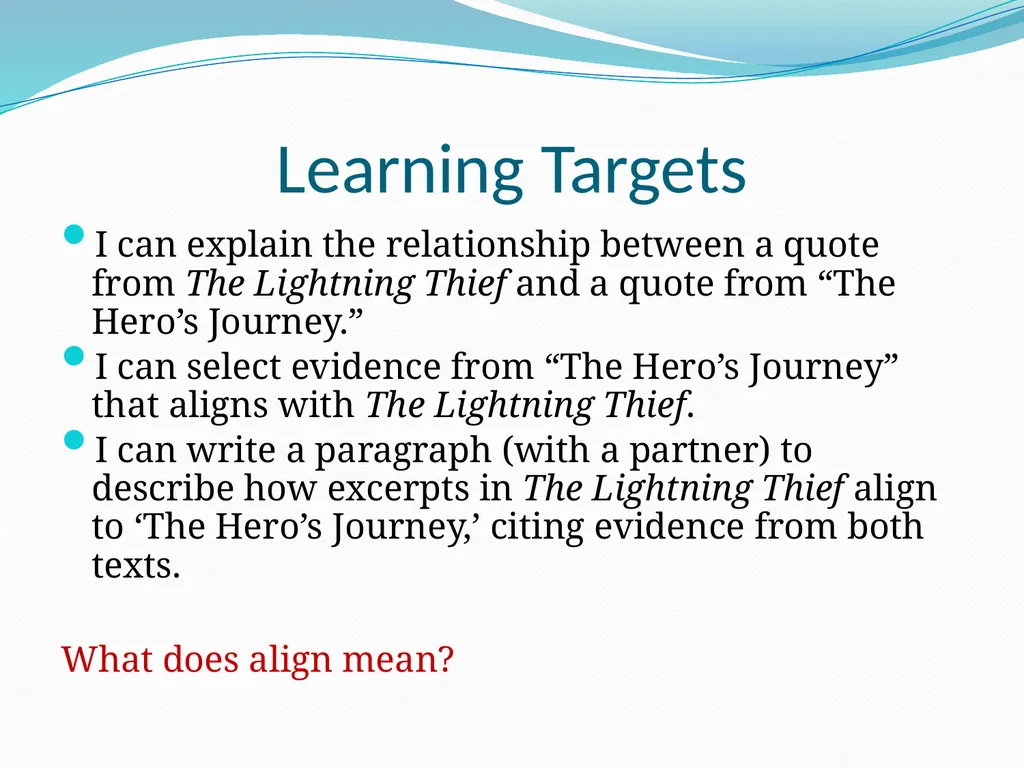
Learning Targets I can explain the relationship between a quote from The Lightning Thief and a quote from “The Hero’s Journey.”
I can select evidence from “The Hero’s Journey” that aligns with The Lightning Thief.
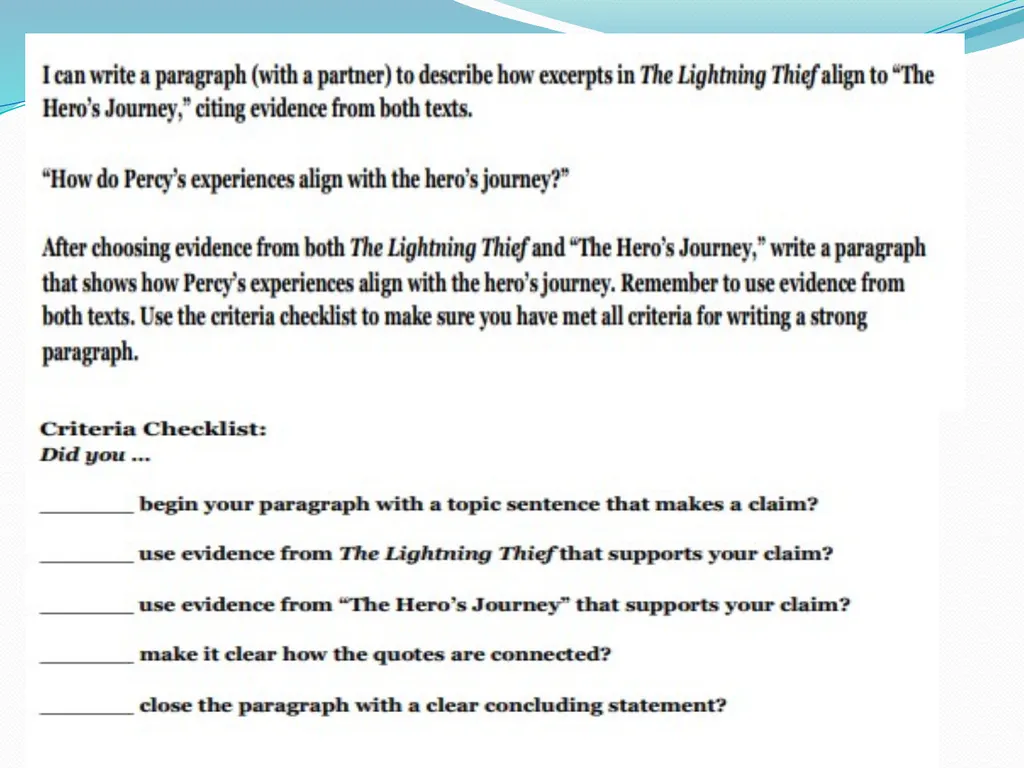
I can write a paragraph (with a partner) to describe how excerpts in The Lightning Thief align to ‘The Hero’s Journey,’ citing evidence from both texts.
What does align mean?<br>
I can select evidence from “The Hero’s Journey” that aligns with The Lightning Thief.
I can write a paragraph (with a partner) to describe how excerpts in The Lightning Thief align to ‘The Hero’s Journey,’ citing evidence from both texts.
What does align mean?<br>
06
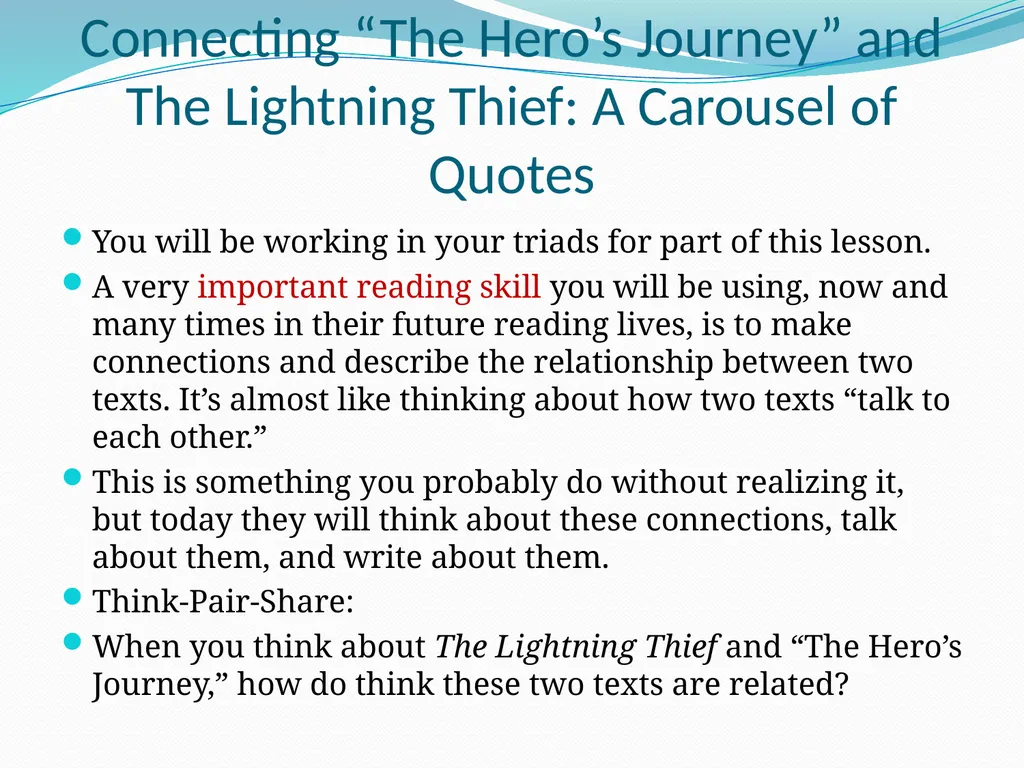
Connecting “The Hero’s Journey” and The Lightning Thief: A Carousel of Quotes You will be working in your triads for part of this lesson.
A very important reading skill you will be using, now and many times in their future reading lives, is to make connections and describe the relationship between two texts. It’s almost like thinking about how two texts “talk to each other.”
This is something you probably do without realizing it, but today they will think about these connections, talk about them, and write about them.
Think-Pair-Share:
When you think about The Lightning Thief and “The Hero’s Journey,” how do think these two texts are related?<br>
A very important reading skill you will be using, now and many times in their future reading lives, is to make connections and describe the relationship between two texts. It’s almost like thinking about how two texts “talk to each other.”
This is something you probably do without realizing it, but today they will think about these connections, talk about them, and write about them.
Think-Pair-Share:
When you think about The Lightning Thief and “The Hero’s Journey,” how do think these two texts are related?<br>
07
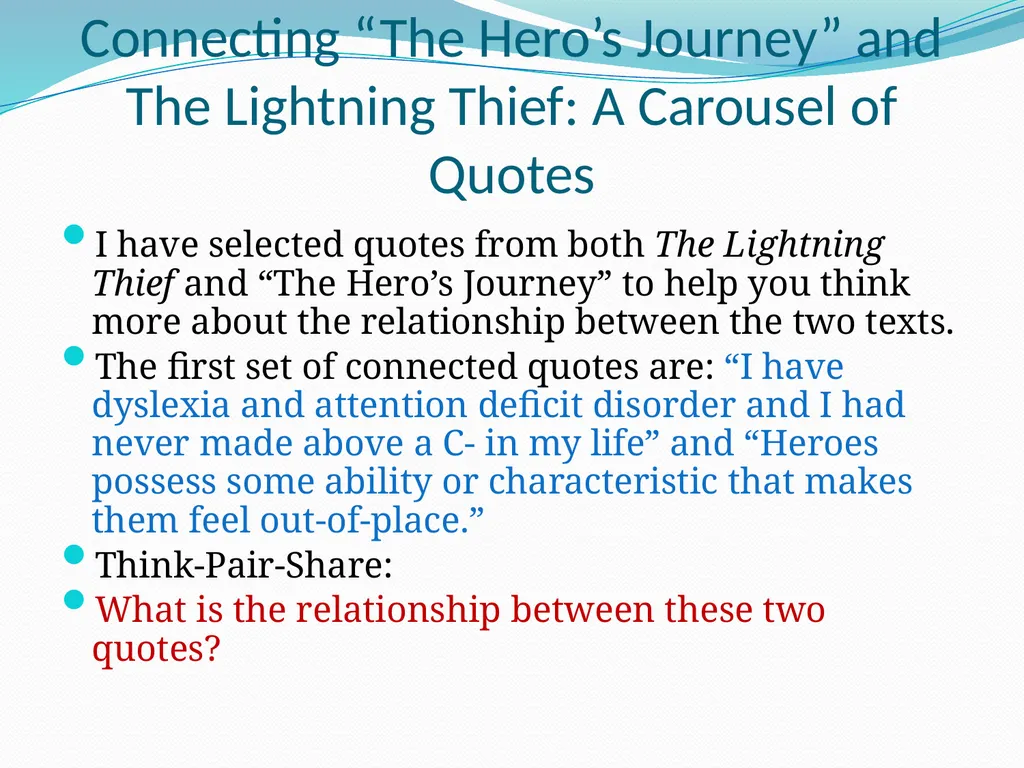
Connecting “The Hero’s Journey” and The Lightning Thief: A Carousel of Quotes I have selected quotes from both The Lightning Thief and “The Hero’s Journey” to help you think more about the relationship between the two texts.
The first set of connected quotes are: “I have dyslexia and attention deficit disorder and I had never made above a C- in my life” and “Heroes possess some ability or characteristic that makes them feel out-of-place.”
Think-Pair-Share:
What is the relationship between these two quotes?<br>
The first set of connected quotes are: “I have dyslexia and attention deficit disorder and I had never made above a C- in my life” and “Heroes possess some ability or characteristic that makes them feel out-of-place.”
Think-Pair-Share:
What is the relationship between these two quotes?<br>
08
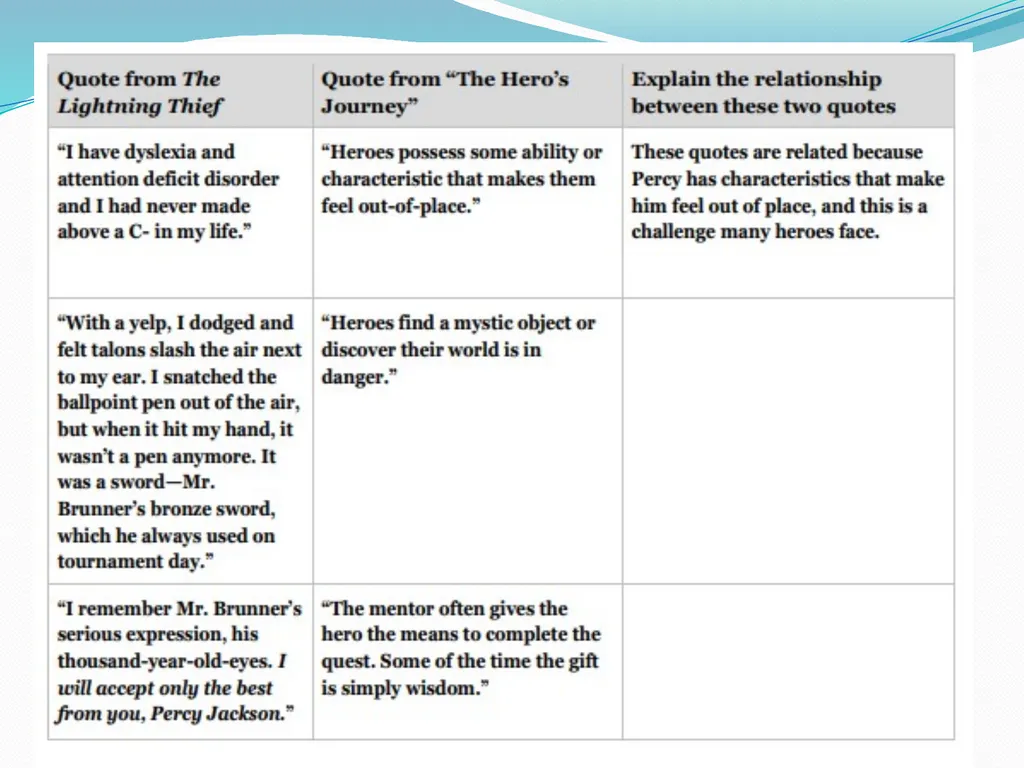
Connecting “The Hero’s Journey” and The Lightning Thief: A Carousel of Quotes Distribute the Carousel of Quotes: Connecting The Lightning Thief and ‘The Hero’s Journey’ recording form.
You will have a few minutes to silently read these quotes, think about them, and jot down their initial ideas about the relationships between them.<br>
You will have a few minutes to silently read these quotes, think about them, and jot down their initial ideas about the relationships between them.<br>
09
Connecting “The Hero’s Journey” and The Lightning Thief: A Carousel of Quotes Now that you have read and thought independently, I would like for you to discuss your thinking with your triads.
Look at the quote charts hanging around the room. There are two sets…one set on each side of the room.
Tell students that these charts have the same quotes as their recording forms.
Distribute markers to each triad and assign each triad a starting point.<br>
Look at the quote charts hanging around the room. There are two sets…one set on each side of the room.
Tell students that these charts have the same quotes as their recording forms.
Distribute markers to each triad and assign each triad a starting point.<br>
10
Connecting “The Hero’s Journey” and The Lightning Thief: A Carousel of Quotes Directions:
At each chart, let a different member of your triad read the two quotes aloud.
Give each person a chance to share their thinking from their recording forms.
Discuss the relationship between these quotes.
Using your triad marker, use the space below the quotes to write the relationship between them.
Move to the next chart with a new pair of quotes.
You will have 6 to 7 minutes for this part of the activity. I will set a timer for 1.30 per chart.<br>
At each chart, let a different member of your triad read the two quotes aloud.
Give each person a chance to share their thinking from their recording forms.
Discuss the relationship between these quotes.
Using your triad marker, use the space below the quotes to write the relationship between them.
Move to the next chart with a new pair of quotes.
You will have 6 to 7 minutes for this part of the activity. I will set a timer for 1.30 per chart.<br>
11
Connecting “The Hero’s Journey” and The Lightning Thief: A Carousel of Quotes What is the most important connection between Percy’s experiences and “The Hero’s Journey?”
Why?<br>
Why?<br>
12
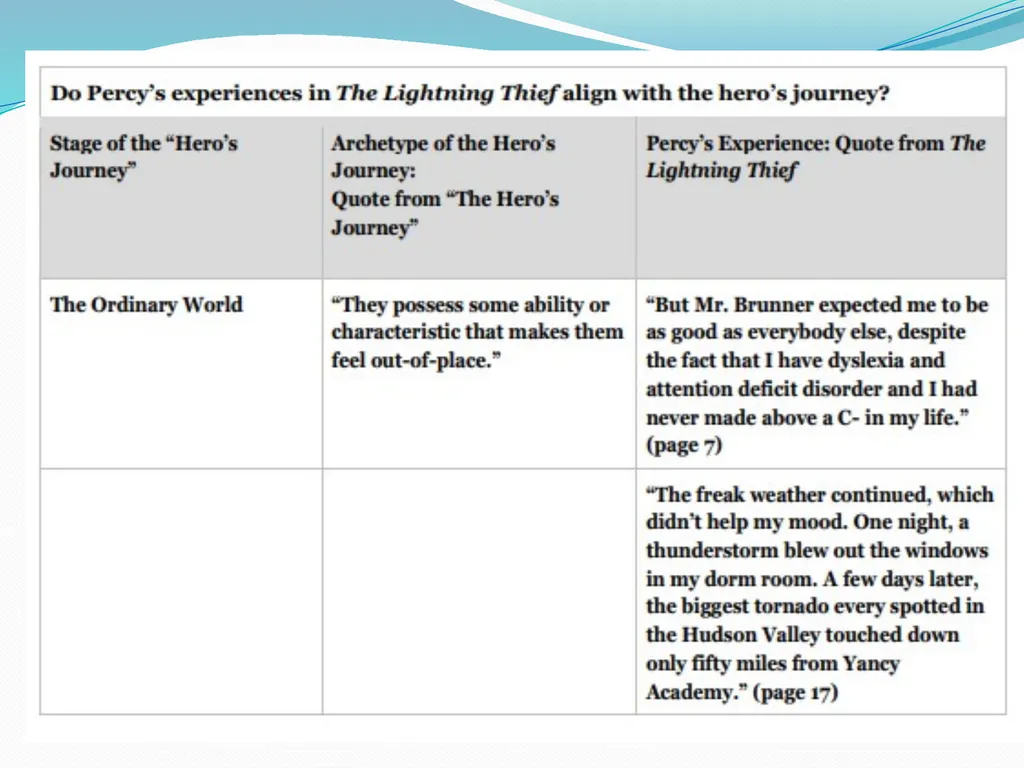
Independently Selecting Relevant Evidence in Informational Texts: Aligning Percy’s Experiences with the Hero’s Journey Tell students that I have created a graphic organizer similar to the one from their Carousel of Quotes.
This is the Selecting Evidence from “The Hero’s Journey” recording form.
I have already pulled excerpts and quotes from The Lightning Thief in order to get you started. However, unlike in the Carousel of Quotes, you will be responsible for finding a quote from “The Hero’s Journey.”<br>
This is the Selecting Evidence from “The Hero’s Journey” recording form.
I have already pulled excerpts and quotes from The Lightning Thief in order to get you started. However, unlike in the Carousel of Quotes, you will be responsible for finding a quote from “The Hero’s Journey.”<br>
13
Independently Selecting Relevant Evidence in Informational Texts: Aligning Percy’s Experiences with the Hero’s Journey Directions:
Read the excerpt from The Lightning Thief.
Think: Does this excerpt align with the archetype of “The Hero’s Journey?”
Go back to “The Hero’s Journey” to confirm your thinking and gather evidence.
Discuss your findings with your triad.
If Percy’s experience does align, complete the graphic organizer with the stage of The Hero’s Journey Percy is at, as well as the quote from “The Hero’s Journey” that is your evidence.<br>
Read the excerpt from The Lightning Thief.
Think: Does this excerpt align with the archetype of “The Hero’s Journey?”
Go back to “The Hero’s Journey” to confirm your thinking and gather evidence.
Discuss your findings with your triad.
If Percy’s experience does align, complete the graphic organizer with the stage of The Hero’s Journey Percy is at, as well as the quote from “The Hero’s Journey” that is your evidence.<br>
14
Independently Selecting Relevant Evidence in Informational Texts: Aligning Percy’s Experiences with the Hero’s Journey You will have about 10 minutes to work in your triads.
What are the triad expectations?
How do Percy’s experiences align with the hero’s journey?
Share your connections with the class.<br>
What are the triad expectations?
How do Percy’s experiences align with the hero’s journey?
Share your connections with the class.<br>
15
Partner Writing: Using Evidence from Two Texts Distribute Partner Writing: Using Evidence from Two Texts.
You are now going to use the evidence you just collected to do some writing.
You will make a claim about Percy based on evidence from the text.
The important work you did studying the model paragraph in Lesson 8 will help with your writing.
Look at the Writing with Evidence anchor chart. Review the criteria you helped to create when writing with evidence.
You have already collected the necessary evidence for writing a paragraph that answers the question: How do Percy’s experiences align with the hero’s journey?
Think-Pair-Share:
We decided that a strong paragraph begins with a topic sentence, and that a topic sentence tells what the paragraph is going to be about.
What would be an example of a strong topic sentence for the paragraph we are going to write today?<br>
You are now going to use the evidence you just collected to do some writing.
You will make a claim about Percy based on evidence from the text.
The important work you did studying the model paragraph in Lesson 8 will help with your writing.
Look at the Writing with Evidence anchor chart. Review the criteria you helped to create when writing with evidence.
You have already collected the necessary evidence for writing a paragraph that answers the question: How do Percy’s experiences align with the hero’s journey?
Think-Pair-Share:
We decided that a strong paragraph begins with a topic sentence, and that a topic sentence tells what the paragraph is going to be about.
What would be an example of a strong topic sentence for the paragraph we are going to write today?<br>
16
Partner Writing: Using Evidence from Two Texts Directions:
With your partner, study the model paragraph and the criteria from Lesson 8.
Together, choose one stage of the hero’s journey from the Selecting Evidence from “The Hero’s Journey” recording form that you want to use in your writing.
On your own, draft a paragraph using evidence from both texts.
After finishing the paragraph, trade papers. Review the criteria again. Did your partner meet each part of the criteria?
After 7 to 8 minutes of writing, remember to trade your writing and complete the criteria checklist at the bottom of their Partner Writing: Using Evidence from Two Texts recording form.
I will collect these writing samples as a formative assessment.<br>
With your partner, study the model paragraph and the criteria from Lesson 8.
Together, choose one stage of the hero’s journey from the Selecting Evidence from “The Hero’s Journey” recording form that you want to use in your writing.
On your own, draft a paragraph using evidence from both texts.
After finishing the paragraph, trade papers. Review the criteria again. Did your partner meet each part of the criteria?
After 7 to 8 minutes of writing, remember to trade your writing and complete the criteria checklist at the bottom of their Partner Writing: Using Evidence from Two Texts recording form.
I will collect these writing samples as a formative assessment.<br>
17
Reflecting on the Learning Targets I can write a paragraph (with a partner) to describe how excerpts in The Lightning Thief align to “The Hero’s Journey,” citing evidence from both texts.
I would like a “fist to five” on this target. Remember that a fist means that they struggled meeting the learning target, five means that they really understood and accomplished, three means they struggled a little but they are getting there, and they can use any number in between.
Think-Pair-Share:
What was most difficult about this learning target?<br>
I would like a “fist to five” on this target. Remember that a fist means that they struggled meeting the learning target, five means that they really understood and accomplished, three means they struggled a little but they are getting there, and they can use any number in between.
Think-Pair-Share:
What was most difficult about this learning target?<br>
18
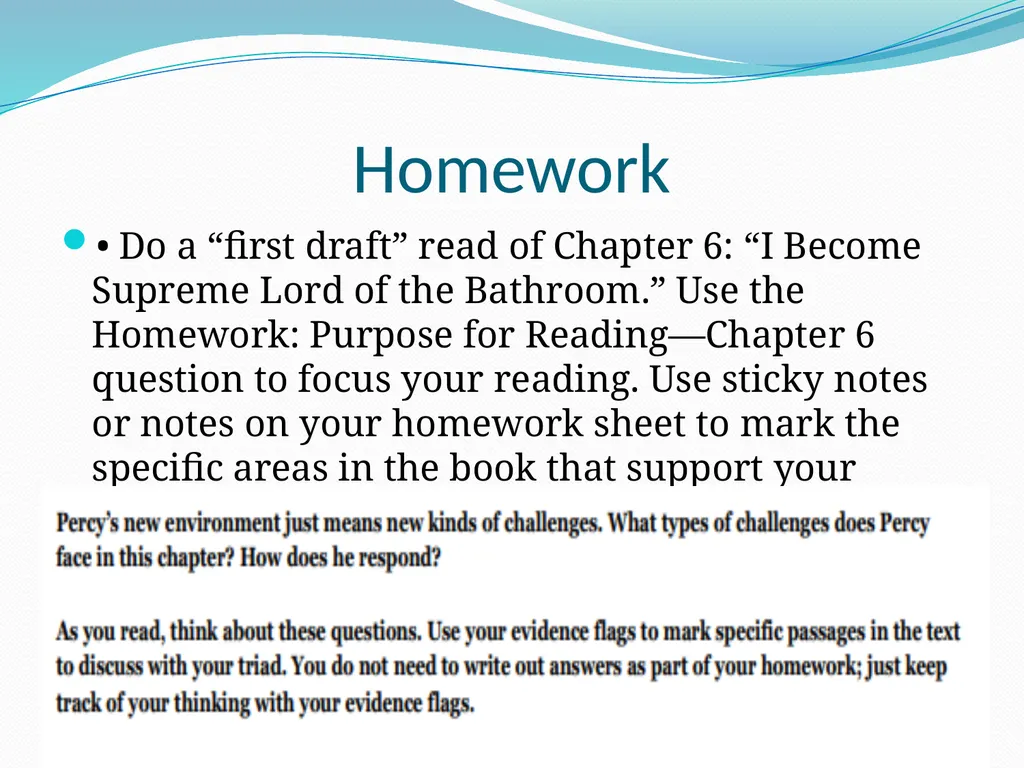
Homework • Do a “first draft” read of Chapter 6: “I Become Supreme Lord of the Bathroom.” Use the Homework: Purpose for Reading—Chapter 6 question to focus your reading. Use sticky notes or notes on your homework sheet to mark the specific areas in the book that support your answer.<br>