
Module 1 – young children and trauma What is
MS
Published · 51 slides · 0 views

1 / 1


Description
Module 1 young children and trauma What is trauma? Trauma is the emotional, psychological and physiological residue left over from heightened stress that accompanies experience of threat, violence and life changing events Source:
Related Topics
Share
Embed code
Download this presentation From Below
"Module 1 – young children and trauma What is" is the property of its rightful owner. Permission is granted to download and print the materials on this website for personal, non-commercial use only, and to display it on your personal computer provided you do not modify the materials and that you retain all copyright notices contained in the materials. By downloading content from our website, you accept the terms of this agreement.
Presentation Transcript
01
Module 1 – young children and trauma<br>
02
What is trauma? Trauma is the emotional, psychological and physiological residue left over from heightened stress that accompanies experience of threat, violence and life changing events
Source: Australian Childhood Foundation, Making Space for Learning: Trauma Informed Practice in Schools, 2010, <www.childhood.org.au>
A more overwhelming event than a person would ordinarily be expected to encounter
Source: American Academy of Child and Adolescent Psychiatry, <www.aacap.org>.<br>
Source: Australian Childhood Foundation, Making Space for Learning: Trauma Informed Practice in Schools, 2010, <www.childhood.org.au>
A more overwhelming event than a person would ordinarily be expected to encounter
Source: American Academy of Child and Adolescent Psychiatry, <www.aacap.org>.<br>
03
How do children react following trauma? Every child reacts to trauma differently
Reaction will depend on:
Developmental level
Premorbid functioning
Previous life experiences
Level of exposure to the trauma
Parental reactions
Subsequent changes in living situation
The majority of children are resilient
Source: Centre of National Research on Disability and Rehabilitation Medicine,2011, Childhood Trauma Reactions, www.uq.edu.au<br>
Reaction will depend on:
Developmental level
Premorbid functioning
Previous life experiences
Level of exposure to the trauma
Parental reactions
Subsequent changes in living situation
The majority of children are resilient
Source: Centre of National Research on Disability and Rehabilitation Medicine,2011, Childhood Trauma Reactions, www.uq.edu.au<br>
04
Types of trauma Complex trauma
Family violence
Medical trauma
Natural disasters
Community and school violence Neglect
Physical abuse
Sexual abuse
Traumatic grief
Refugee and war zone trauma
Source: Adapted from The National Child Traumatic Stress Network, www.nctsn.org.<br>
Family violence
Medical trauma
Natural disasters
Community and school violence Neglect
Physical abuse
Sexual abuse
Traumatic grief
Refugee and war zone trauma
Source: Adapted from The National Child Traumatic Stress Network, www.nctsn.org.<br>
05
Complex trauma Exposure to multiple or prolonged traumatic events
Typically involves simultaneous or sequential occurrences of child maltreatment, including psychological maltreatment, neglect, physical and sexual abuse and family violence, that are chronic and begin in early childhood and occur within the primary caregiving system<br>
Typically involves simultaneous or sequential occurrences of child maltreatment, including psychological maltreatment, neglect, physical and sexual abuse and family violence, that are chronic and begin in early childhood and occur within the primary caregiving system<br>
06
Family violence Actual or threatened physical or sexual violence or emotional abuse<br>
07
Medical trauma Reactions to pain, injury and serious illness or to invasive medical procedures (such as surgery) or treatments (such as burn care)<br>
08
Natural disasters Occurrences where local, state and/or national agencies and disaster relief services are called into action e.g. fires, floods<br>
09
Community and school violence trauma Predatory violence (robbery) and violence that comes from personal conflicts between people who are not known to the child (shootings, stabbings, beatings)
Fights at school, threats to or injury of child<br>
Fights at school, threats to or injury of child<br>
10
Neglect Neglect can mean a parent or caregiver not providing:
food
shelter
clothing
access to medical and health treatment
Neglect can mean:
exposing a child to dangerous environments
poor supervision
putting a child in the care of someone incapable of caring for the child
abandoning a child or expelling a child from home<br>
food
shelter
clothing
access to medical and health treatment
Neglect can mean:
exposing a child to dangerous environments
poor supervision
putting a child in the care of someone incapable of caring for the child
abandoning a child or expelling a child from home<br>
11
Physical abuse Causing or attempting to cause physical pain or injury (punching, kicking, hitting, burning or harming a child in other ways)
Can consist of a single incident or multiple incidents<br>
Can consist of a single incident or multiple incidents<br>
12
Sexual abuse Includes a wide range of sexual behaviours that take place between a child and an older person
Behaviours include:
sexual kissing
touching
fondling of genitals
intercourse
flashing
verbal pressure for sex
sexual exploitation e.g. prostitution
exposure to pornography<br>
Behaviours include:
sexual kissing
touching
fondling of genitals
intercourse
flashing
verbal pressure for sex
sexual exploitation e.g. prostitution
exposure to pornography<br>
13
Refugee or war zone trauma Exposure to war, political violence or torture
Can be the result of living in a region affected by bombing, shooting or looting as well as forced displacement to a new home due to political reasons<br>
Can be the result of living in a region affected by bombing, shooting or looting as well as forced displacement to a new home due to political reasons<br>
14
Traumatic grief Death of a family member or someone important to the child
May be sudden and unexpected (e.g. accident) or anticipated (e.g. illness or other natural causes)<br>
May be sudden and unexpected (e.g. accident) or anticipated (e.g. illness or other natural causes)<br>
15
The effect of trauma on children Children who experience horrible external events may experience emotional harm or psychic trauma. Left untreated, all but the mildest of childhood trauma can have an impact on the child
Source: American Academy of Child and Adolescent Psychiatry, Your Child – Childhood Trauma and Its Effects, <www.aacap.org>.
It is important to remember that abuse, neglect and other trauma have different impacts on different children − and that while we have to take seriously the negative impacts of trauma we cannot underestimate the strength of human resilience
Source: Child Safety Commissioner, 2009, From isolation to connection: a guide to understanding and working with traumatised children and young people, <www.kids.vic.gov>.<br>
Source: American Academy of Child and Adolescent Psychiatry, Your Child – Childhood Trauma and Its Effects, <www.aacap.org>.
It is important to remember that abuse, neglect and other trauma have different impacts on different children − and that while we have to take seriously the negative impacts of trauma we cannot underestimate the strength of human resilience
Source: Child Safety Commissioner, 2009, From isolation to connection: a guide to understanding and working with traumatised children and young people, <www.kids.vic.gov>.<br>
16
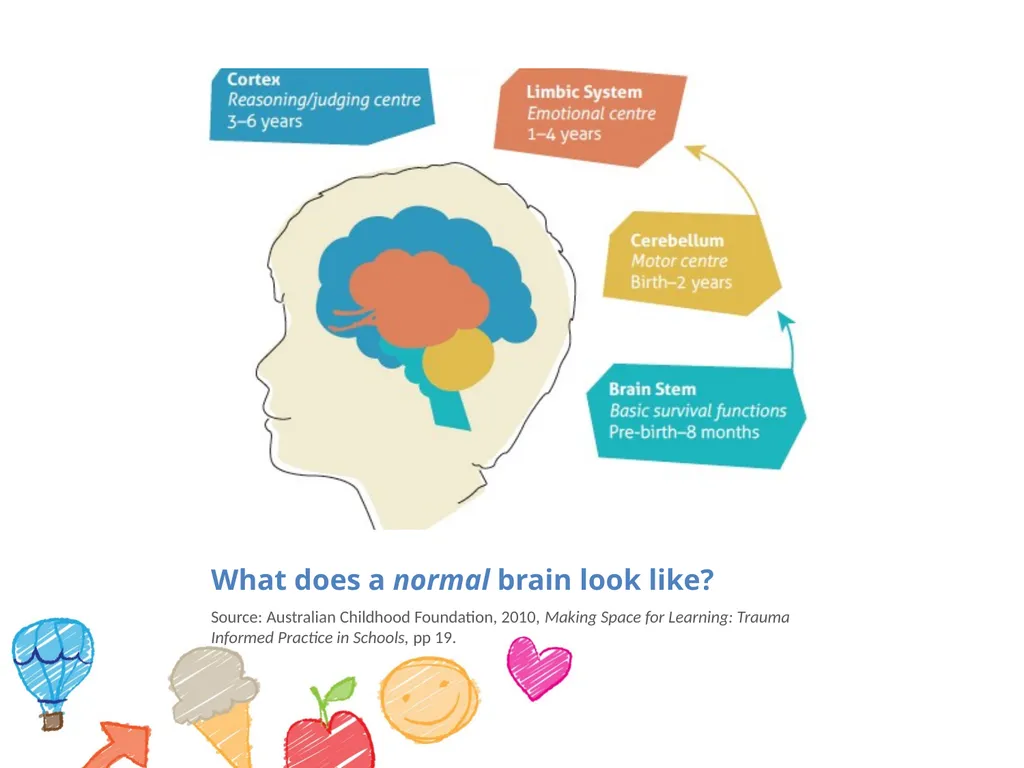
What does a normal brain look like? Source: Australian Childhood Foundation, 2010, Making Space for Learning: Trauma Informed Practice in Schools, pp 19.<br>
17
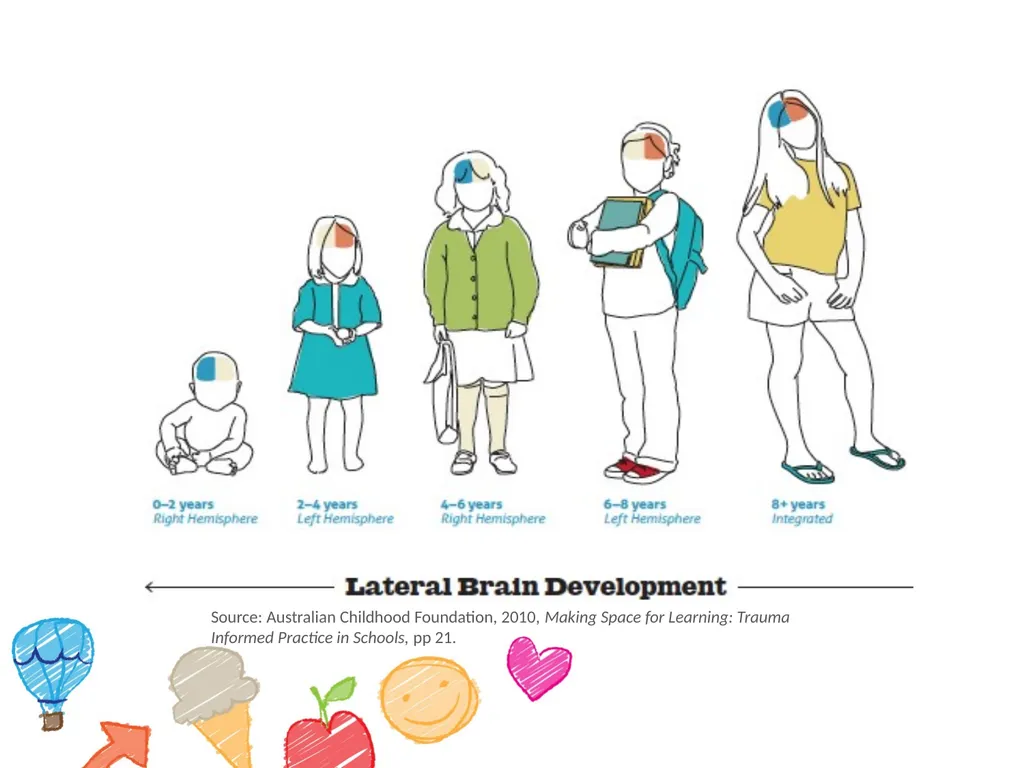
Source: Australian Childhood Foundation, 2010, Making Space for Learning: Trauma Informed Practice in Schools, pp 21.<br>
18
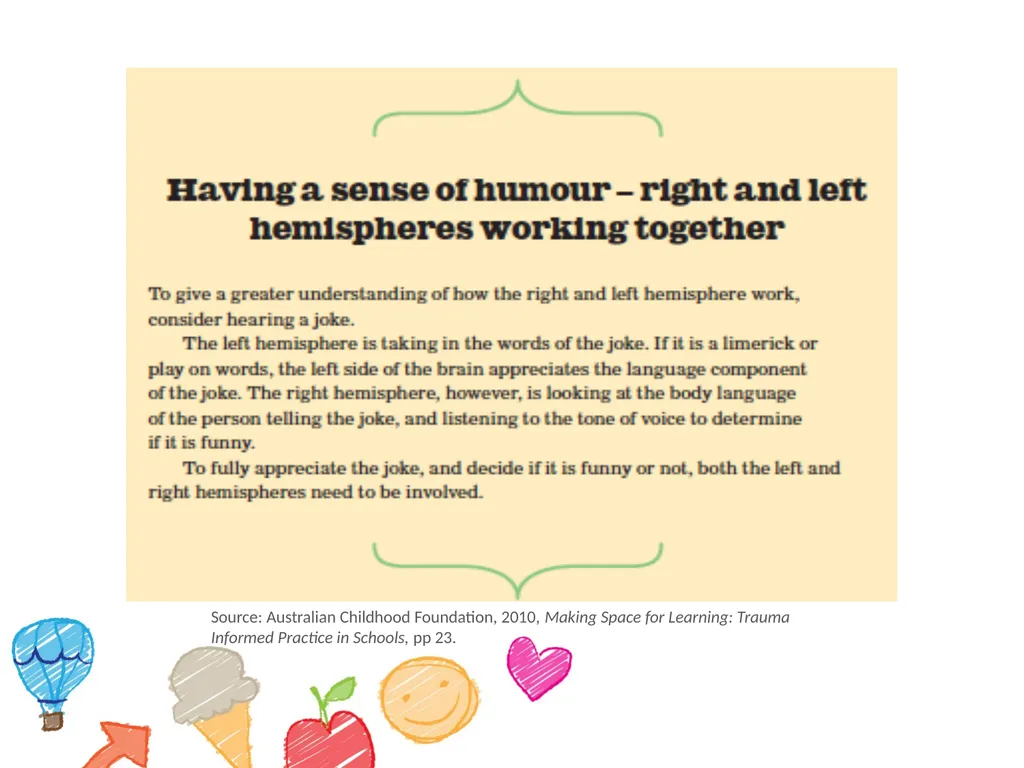
Source: Australian Childhood Foundation, 2010, Making Space for Learning: Trauma Informed Practice in Schools, pp 23.<br>
19
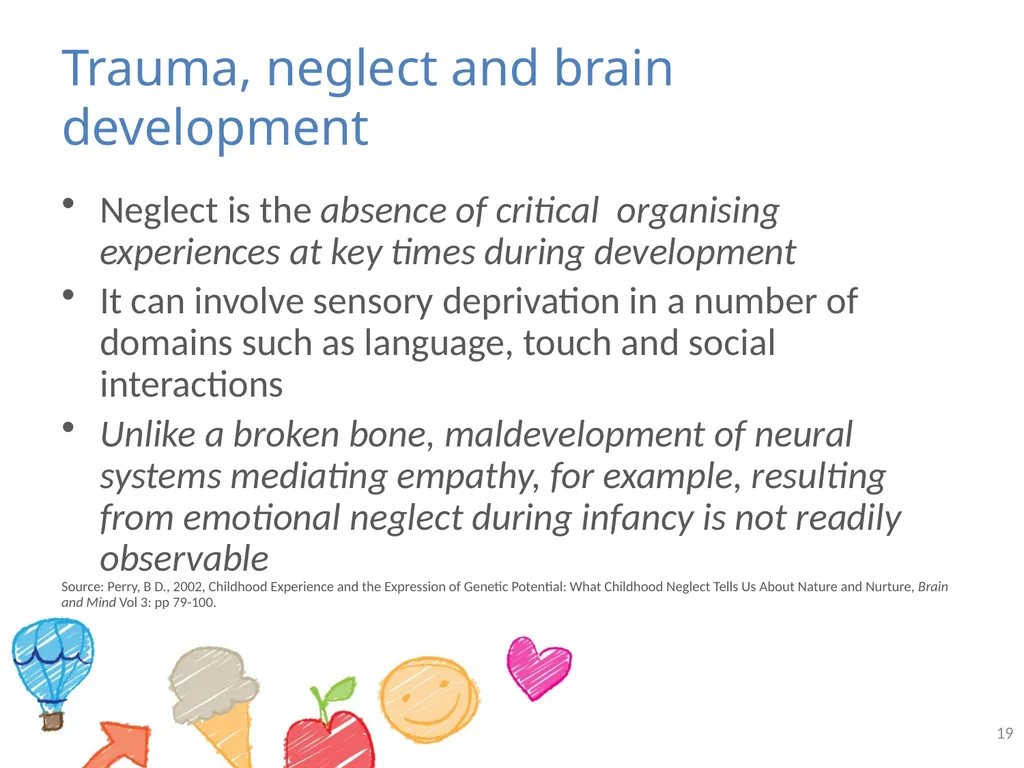
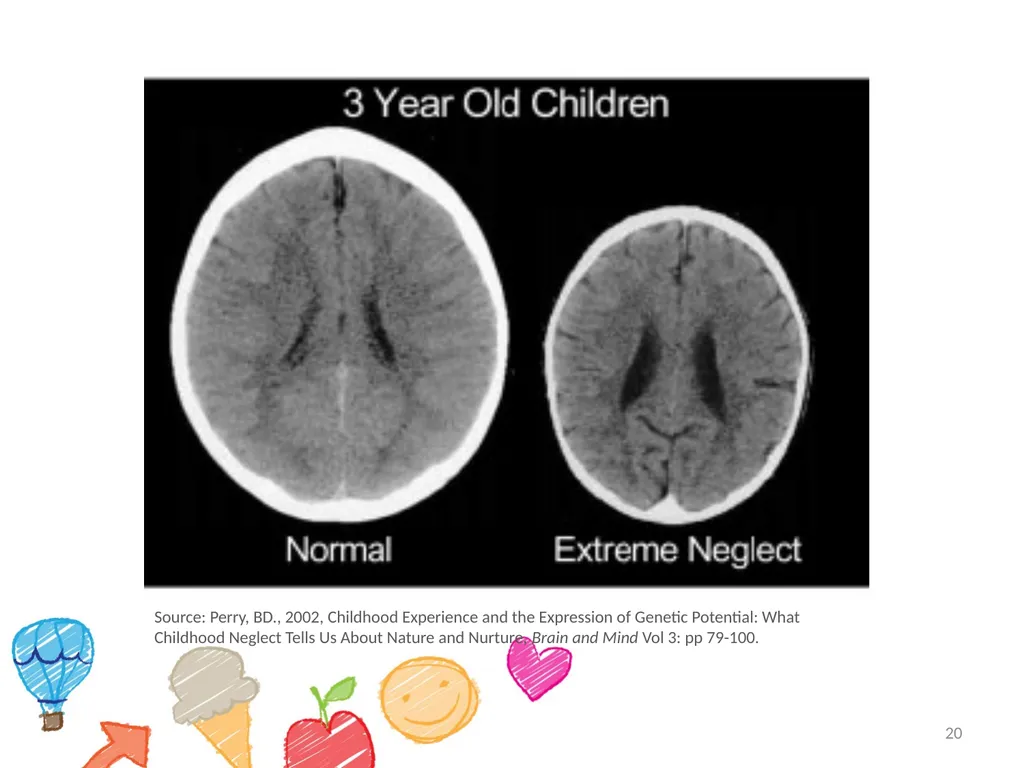
Trauma, neglect and brain development Neglect is the absence of critical organising experiences at key times during development
It can involve sensory deprivation in a number of domains such as language, touch and social interactions
Unlike a broken bone, maldevelopment of neural systems mediating empathy, for example, resulting from emotional neglect during infancy is not readily observable
Source: Perry, B D., 2002, Childhood Experience and the Expression of Genetic Potential: What Childhood Neglect Tells Us About Nature and Nurture, Brain and Mind Vol 3: pp 79-100. 19<br>
It can involve sensory deprivation in a number of domains such as language, touch and social interactions
Unlike a broken bone, maldevelopment of neural systems mediating empathy, for example, resulting from emotional neglect during infancy is not readily observable
Source: Perry, B D., 2002, Childhood Experience and the Expression of Genetic Potential: What Childhood Neglect Tells Us About Nature and Nurture, Brain and Mind Vol 3: pp 79-100. 19<br>
20
Source: Perry, BD., 2002, Childhood Experience and the Expression of Genetic Potential: What Childhood Neglect Tells Us About Nature and Nurture, Brain and Mind Vol 3: pp 79-100. 20<br>
21
The impact of trauma on children Source: Child Safety Commissioner, 2009, From isolation to connection: a guide to understanding and working with traumatised children and young people, <www.kids.vic.gov>. 21<br>
22
Intergenerational impact Traumas reverberate down the generations and show as problems such as substance abuse, mental illness, family violence, child abuse and neglect
Often accompanied by poverty, isolation and physical illness
Problems often found together and often make each other worse<br>
Often accompanied by poverty, isolation and physical illness
Problems often found together and often make each other worse<br>
23
Families and communities impact Trauma experienced by one person will usually have a ripple effect on other family members, extended family and friends<br>
24
The impact of environment Poverty, poor housing, lack of access to clean water or nutritious food
Discrimination and racism
Abuse and neglect<br>
Discrimination and racism
Abuse and neglect<br>
25
The impact of Placement disruption Children who are removed from home and are separated from their parents due to abuse and/or neglect have to undergo massive internal reorganisation e.g. new home, new school, new culture<br>
26
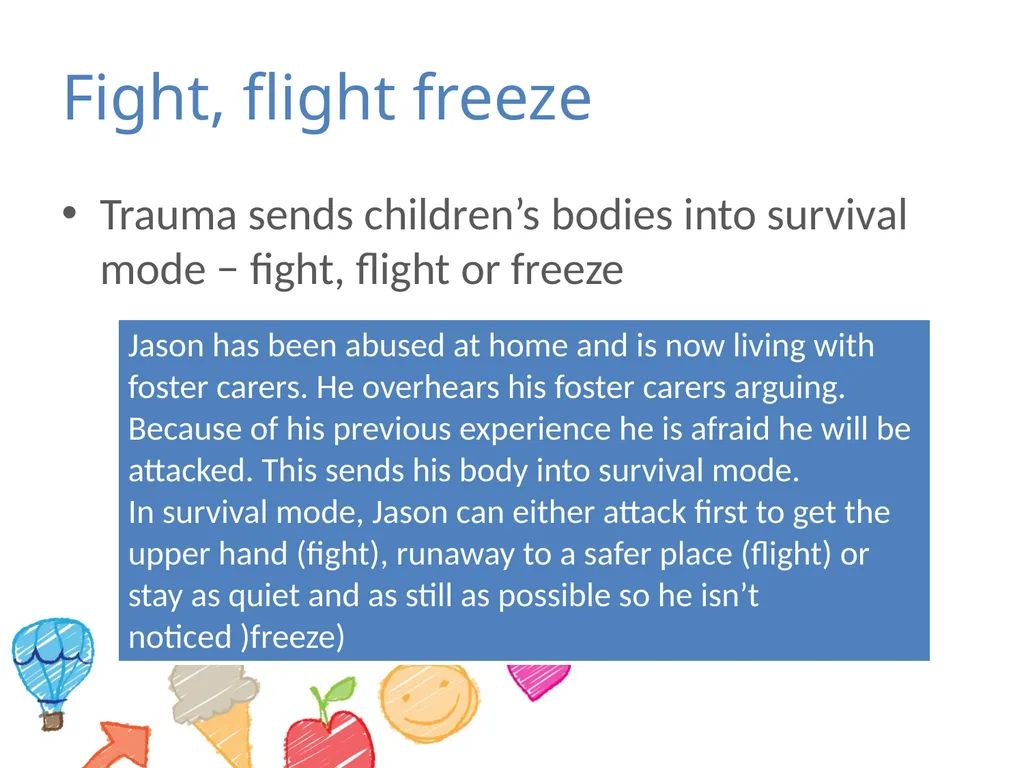
Fight, flight freeze Trauma sends children’s bodies into survival mode − fight, flight or freeze<br>
27
Trauma impact 0-12 months (cont.) Neurobiology of brain and central nervous system altered by switch on alarm response
Behavioural changes
Regression in recently acquired developmental gains
Hyperarousal, hypervigilance and hyperactivity<br>
Behavioural changes
Regression in recently acquired developmental gains
Hyperarousal, hypervigilance and hyperactivity<br>
28
Trauma impact 0-12 months (cont.) Sleep disruption
Loss of acquired motor skills
Lowered stress threshold
Lowered immune system
Fear response to reminders of trauma
Mood and personality changes<br>
Loss of acquired motor skills
Lowered stress threshold
Lowered immune system
Fear response to reminders of trauma
Mood and personality changes<br>
29
Trauma impact 0-12 months (cont.) Loss of, or reduced capacity to attune with caregiver
Loss of, or reduced capacity to manage emotional states or self-soothe
Insecure, anxious or disorganised attachment behaviour
Heightened anxiety when separated from primary parent/carer<br>
Loss of, or reduced capacity to manage emotional states or self-soothe
Insecure, anxious or disorganised attachment behaviour
Heightened anxiety when separated from primary parent/carer<br>
30
Trauma impact 0-12 months (cont.) Indiscriminate relating
Reduced capacity to feel emotions − can appear numb
Cognitive delays and memory difficulties
Loss of acquired communication skills<br>
Reduced capacity to feel emotions − can appear numb
Cognitive delays and memory difficulties
Loss of acquired communication skills<br>
31
Trauma impact 12 months-3 years As for 0 − 12 months
Increased resistance to parental direction
Memory fro trauma may be evident in behaviour, language or play<br>
Increased resistance to parental direction
Memory fro trauma may be evident in behaviour, language or play<br>
32
Trauma impact 3-5 years (cont.) Behavioural changes
Hyperarousal, hypervigilance, hyperactivity
Loss of toileting and eating skills
Regression in recently acquired developmental gains
Sleep disturbances, night terrors<br>
Hyperarousal, hypervigilance, hyperactivity
Loss of toileting and eating skills
Regression in recently acquired developmental gains
Sleep disturbances, night terrors<br>
33
Trauma impact 3-5 years (cont.) Enuresis and encopresis
Delayed gross motor and visual-perceptual skills
Fear of trauma recurring
Mood and personality changes
Loss of, or reduced capacity to manage emotional states or self-soothe<br>
Delayed gross motor and visual-perceptual skills
Fear of trauma recurring
Mood and personality changes
Loss of, or reduced capacity to manage emotional states or self-soothe<br>
34
Trauma impact 3-5 years (cont.) Increased need for control
Fear of separation
Loss of self-esteem and self-confidence
Confusion about trauma evident in play … magical explanations and unclear understanding of causes of bad events
Speech, cognitive and auditory processing delays<br>
Fear of separation
Loss of self-esteem and self-confidence
Confusion about trauma evident in play … magical explanations and unclear understanding of causes of bad events
Speech, cognitive and auditory processing delays<br>
35
Trauma impact 3-5 years (cont.) Vulnerable to anniversary reactions set off by seasonal reminders, holidays and other events
Memory of intrusive visual images from traumatic event may be demonstrated/recalled in words and play
At the older end of this range, children are more likely to have lasting, accurate verbal and pictorial memory for central events of the trauma<br>
Memory of intrusive visual images from traumatic event may be demonstrated/recalled in words and play
At the older end of this range, children are more likely to have lasting, accurate verbal and pictorial memory for central events of the trauma<br>
36
Trauma impact 5-7 years Behavioural change
Increased tension, irritability, reactivity and inability to relax
Sleep disturbances, nightmares, night terrors, difficulty falling or staying asleep
Regression of behaviour
Lack of eye contact<br>
Increased tension, irritability, reactivity and inability to relax
Sleep disturbances, nightmares, night terrors, difficulty falling or staying asleep
Regression of behaviour
Lack of eye contact<br>
37
Trauma impact 5-7 years (cont.) spacey, easily distracted or hyperactive behaviour
Toileting accidents/enuresis or smearing of faeces
Eating disturbances
Bodily aches and pains − no apparent reason
Accident proneness<br>
Toileting accidents/enuresis or smearing of faeces
Eating disturbances
Bodily aches and pains − no apparent reason
Accident proneness<br>
38
Trauma impact 5-7 years (cont.) Absconding/truanting from school
Firelighting, hurting animals
Obvious anxiety, fearfulness and loss of self-esteem
Specific fears
Efforts to distance from feelings of shame, guilt, humiliation<br>
Firelighting, hurting animals
Obvious anxiety, fearfulness and loss of self-esteem
Specific fears
Efforts to distance from feelings of shame, guilt, humiliation<br>
39
Trauma impact 5-7 years (cont.) Reduced capacity to feel emotions − may appear numb or apathetic
frozen watchfulness
Vulnerable to anniversary reactions caused by seasonal events, holidays
Repeated retelling of traumatic event
Withdrawal, depressed affect<br>
frozen watchfulness
Vulnerable to anniversary reactions caused by seasonal events, holidays
Repeated retelling of traumatic event
Withdrawal, depressed affect<br>
40
Trauma impact 5-7 years (cont.) blanking out or loss of concentration when under stress at school with lowering of performance
Explicit, aggressive, exploitive, sexualised relating/engagement with other children
Sexualised behaviour towards adults
Sexualised drawing<br>
Explicit, aggressive, exploitive, sexualised relating/engagement with other children
Sexualised behaviour towards adults
Sexualised drawing<br>
41
Trauma impact 5-7 years Cont.) Verbally describes experiences of sexual abuse, pointing to body parts and telling about the game they played
Excessive concern or preoccupation with private parts and adult sexual behaviour
Verbal or behavioural indications of age-inappropriate knowledge of adult sexual behaviour
Running away from home<br>
Excessive concern or preoccupation with private parts and adult sexual behaviour
Verbal or behavioural indications of age-inappropriate knowledge of adult sexual behaviour
Running away from home<br>
42
Trauma impact 7-9 years Changes in behaviour
Hyperarousal, hypervigilance, hyperactivity
Regression in recently acquired developmental gains
Sleep disturbances due to intrusive imagery
Enuresis and encopresis<br>
Hyperarousal, hypervigilance, hyperactivity
Regression in recently acquired developmental gains
Sleep disturbances due to intrusive imagery
Enuresis and encopresis<br>
43
Trauma impact 7-9 years (cont.) Eating disturbances
Loss of concentration and memory
Post-traumatic re-enactments of traumatic event that may occur secretly and involve siblings or playmates
Trauma driven acting out, risk taking behaviour<br>
Loss of concentration and memory
Post-traumatic re-enactments of traumatic event that may occur secretly and involve siblings or playmates
Trauma driven acting out, risk taking behaviour<br>
44
Trauma impact 7-9 years (cont.) Flight into driven activity or retreat from others to manage inner turmoil
Loss of interest in previously pleasurable activities
Fear of trauma recurring
Mood or personality changes
Loss of, or reduced capacity to manage emotional states or self-soothe<br>
Loss of interest in previously pleasurable activities
Fear of trauma recurring
Mood or personality changes
Loss of, or reduced capacity to manage emotional states or self-soothe<br>
45
Trauma impact 7-9 years (cont.) Increased self-focusing and withdrawal
Concern about personal responsibility for trauma
Wish for revenge and action oriented response to trauma
May experience acute distress encountering any reminder of trauma<br>
Concern about personal responsibility for trauma
Wish for revenge and action oriented response to trauma
May experience acute distress encountering any reminder of trauma<br>
46
Trauma impact 7-9 years (cont.) Lowered self-esteem
Increased anxiety or depression
Fearful of closeness and love
Likely to have detailed, long-term and sensory memory for traumatic event − sometimes the memory is fragmented or repressed
Speech or cognitive delays<br>
Increased anxiety or depression
Fearful of closeness and love
Likely to have detailed, long-term and sensory memory for traumatic event − sometimes the memory is fragmented or repressed
Speech or cognitive delays<br>
47
Trauma impact 7-9 years (cont.) Factual accurate memory may be embellished by elements of fear or wish − perception of duration may be distorted
Intrusion of unwanted visual images and traumatic reactions disrupt concentration and create anxiety often without parent awareness
Vulnerable to flashbacks of recall and anniversary reactions to reminders of trauma<br>
Intrusion of unwanted visual images and traumatic reactions disrupt concentration and create anxiety often without parent awareness
Vulnerable to flashbacks of recall and anniversary reactions to reminders of trauma<br>
48
What can I do? Make sure the abuse or other trauma has stopped
Begin to build a relationship, by being honest, reliable and doing what you say you will do
Understand trauma
Help them feel safe through nurture, structure and support
Use boundaries and logical consequences
Stay calm and well-regulated − even as you set limits on aggression − to avoid power battles<br>
Begin to build a relationship, by being honest, reliable and doing what you say you will do
Understand trauma
Help them feel safe through nurture, structure and support
Use boundaries and logical consequences
Stay calm and well-regulated − even as you set limits on aggression − to avoid power battles<br>
49
What can I do? Understand your own traumas, so you can reflect on your own feelings and reactions
Co-regulate with the child: use your calm to soothe and help them calm
Don’t take their behaviour personally
Use discipline without shaming
Engage with family members and carers
Adapted from: Child Safety Commissioner, 2009, From isolation to connection: a guide to understanding and working with traumatised children and young people, www.kids.vic.gov.<br>
Co-regulate with the child: use your calm to soothe and help them calm
Don’t take their behaviour personally
Use discipline without shaming
Engage with family members and carers
Adapted from: Child Safety Commissioner, 2009, From isolation to connection: a guide to understanding and working with traumatised children and young people, www.kids.vic.gov.<br>
50
References and resources Australian Child and Adolescent Trauma, Loss and Grief Network, 2012, How children and young people experience and react to traumatic events, ANU College of Medicine, Biology and Environment.
Child Welfare Information Gateway, 2009, Understanding the Effects of Maltreatment on Brain Development, US Department of Health and Human Services.
Department of Education, Manitoba, Classroom Behavioural Strategies and Interventions, <www.edu.gov.mb.ca>.
Department of Human Services Victoria, Child development and trauma specialist practice resource.
The Help Guide, August 2012, Healing Emotional and Psychological Trauma, <www.helpguide.org>.<br>
Child Welfare Information Gateway, 2009, Understanding the Effects of Maltreatment on Brain Development, US Department of Health and Human Services.
Department of Education, Manitoba, Classroom Behavioural Strategies and Interventions, <www.edu.gov.mb.ca>.
Department of Human Services Victoria, Child development and trauma specialist practice resource.
The Help Guide, August 2012, Healing Emotional and Psychological Trauma, <www.helpguide.org>.<br>