Module 2 TENDER AND ITS PROCESS Subject Name: Quantity Surveying and Contract Management Subject Code: 18CV71 Name of the Faculty: Sushma.MAmrutha Dhiraj K S School of Engineering and Management, Bangalore-560109 Contract Management
"Module 2 TENDER AND ITS PROCESS Subject Name:" is the property of its rightful owner. Permission is granted to
download and print the materials on this website for personal, non-commercial use only, and to display it
on your personal computer provided you do not modify the materials and that you retain all copyright
notices contained in the materials. By downloading content from our website, you accept the terms of this
agreement.
Presentation Transcript
01
Module 2 TENDER AND ITS PROCESS Subject Name: Quantity Surveying and Contract Management Subject Code: 18CV71 Name of the Faculty: Sushma.M/Amrutha Dhiraj K S School of Engineering and Management, Bangalore-560109<br>
02
Contract Management -Tender and its Process: Invitation to tender
Prequalification, administrative approval & Technical sanction
Bid submission and Evaluation process
Contract Formulation: Award of contract, letter of intent, letter of acceptance and notice to proceed
Features / elements of standard Tender document (source: PWD / CPWD / International Competitive Bidding – NHAI / NHEPC / NPC)
Law of Contract as per Indian Contract act 1872
Types of Contract, Entire contract, Lump sum contract, Item rate, % rate, Cost plus with Target, Labour, EPC and BOT, Sub Contracting
Contract Forms : FIDIC contract Forms , CPWD , NHAI , NTPC , NHEPC Module 2 Syllabus<br>
03
Introduction A civil engineering may be called upon to design and carry out construction of large variety of works such as residential buildings, roads, bridges, railways, dams, docks, airports, power stations, water supply and drainage, tunnels, etc.
Scope of civil engineer is therefore large.<br>
04
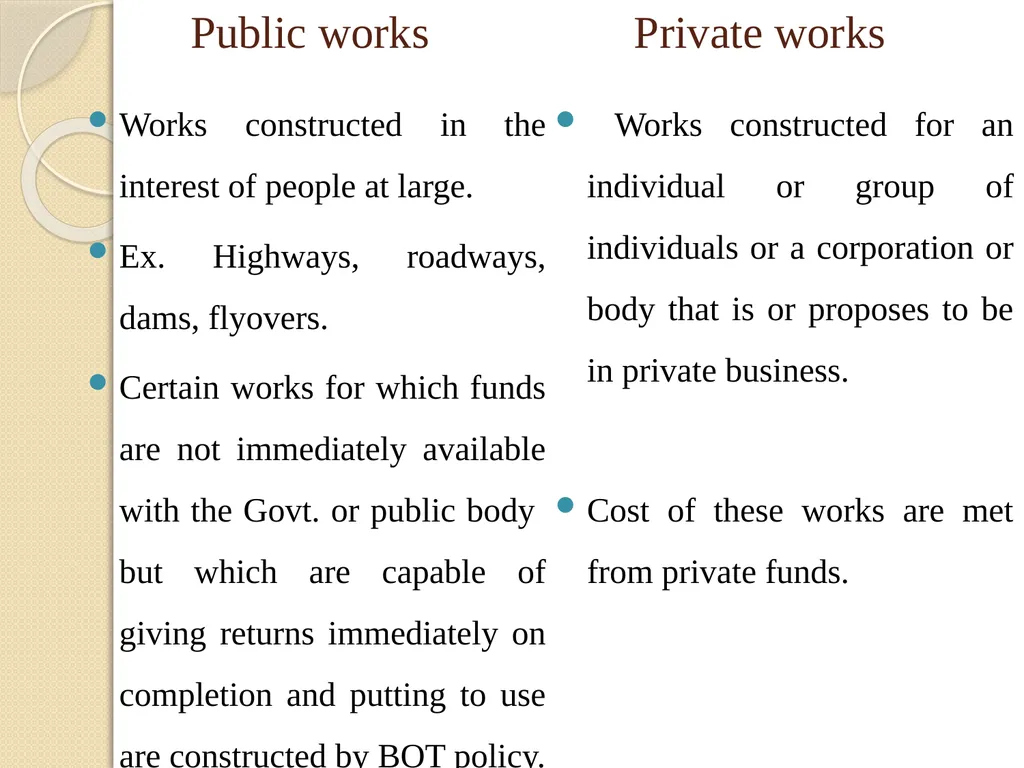
Public works Private works Works constructed in the interest of people at large.
Ex. Highways, roadways, dams, flyovers.
Certain works for which funds are not immediately available with the Govt. or public body but which are capable of giving returns immediately on completion and putting to use are constructed by BOT policy.
Works constructed for an individual or group of individuals or a corporation or body that is or proposes to be in private business.
Cost of these works are met from private funds.<br>
05
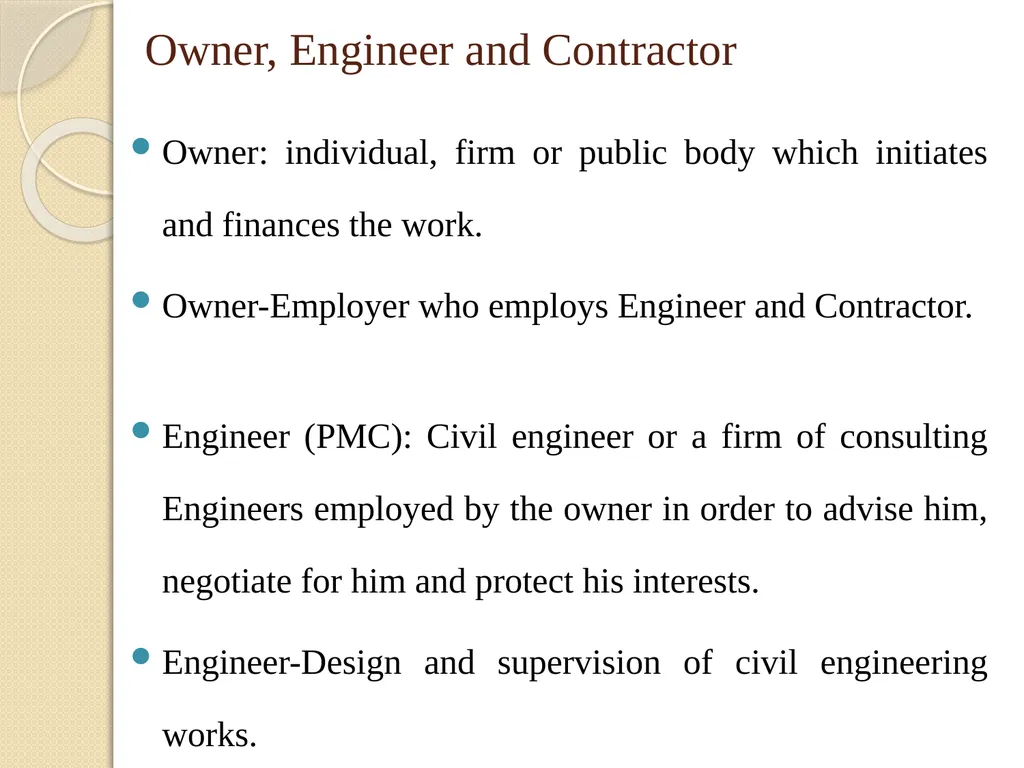
Owner, Engineer and Contractor Owner: individual, firm or public body which initiates and finances the work.
Owner-Employer who employs Engineer and Contractor.
Engineer (PMC): Civil engineer or a firm of consulting Engineers employed by the owner in order to advise him, negotiate for him and protect his interests.
Engineer-Design and supervision of civil engineering works.<br>
06
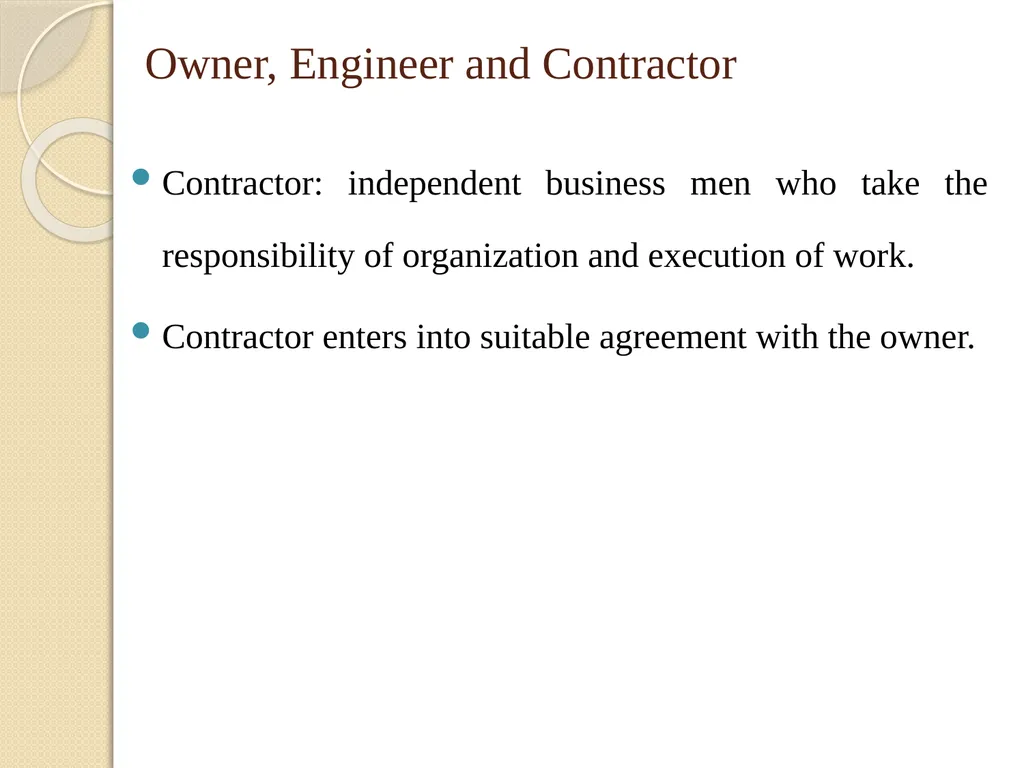
Owner, Engineer and Contractor Contractor: independent business men who take the responsibility of organization and execution of work.
Contractor enters into suitable agreement with the owner.<br>
07
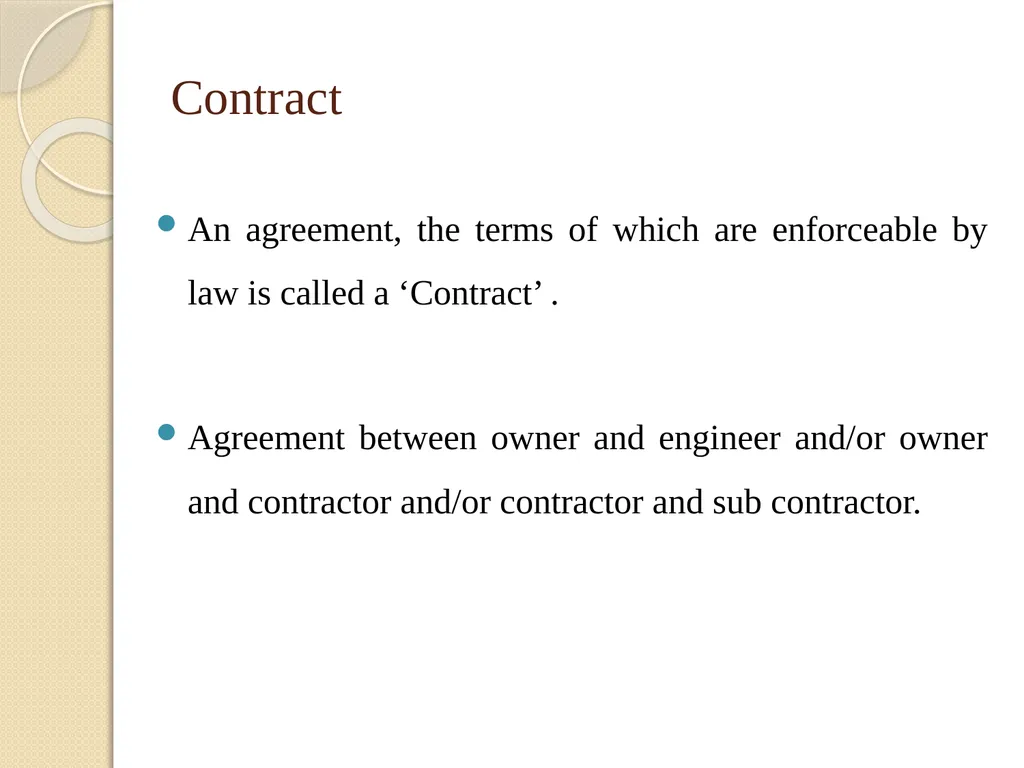
Contract An agreement, the terms of which are enforceable by law is called a ‘Contract’ .
Agreement between owner and engineer and/or owner and contractor and/or contractor and sub contractor.<br>
08
Development of a Project - Stages Owner employs engineer to investigate and plan the project.
Engineering carries out preliminary investigations, prepares approximate estimate of cost and determines financial feasibility of the project.
Engineer recommends project as technically and financially feasible and owner gives his consent to go ahead.
Engineer undertakes detailed investigation and makes all the documents containing data ready to enable contractors to bid on the job (contract documents).<br>
09
In case the owner is government, the detailed plans and estimates have to be checked and approved by a competent authority.
When all is set for the construction of the project, contractors are invited to bid for the job.
The contractors after making all the business arrangements, submit their offers known as ‘tenders’.
The Engineer scrutinizes the proposals and selects a particular tenderer who enters into an agreement (the ‘contract’) with the owner.<br>
10
The contractor sets his organization into motion to carry out project in an efficient and economic way
All parties to the contract must have knowledge of the law of contracts and the conduct of business
Knowledge in latest developments in methods of contract management and organization and procedure adopted by Govt. departments in execution of a project is also essential<br>
11
Tender
• Tender is an offer in writing to execute some specified work or to supply the materials at certain rates, within a fixed time under the certain conditions of agreements between the contractor and department or owner of any party.
• The construction work is usually done by contract. Sealed tenders are invited and the work is usually awarded to the lowest tender.
• While inviting tenders, the bill of quantities (BOQ), specifications, conditions of contract, plans and drawings are supplied to the contractors who quote their rates.<br>
12
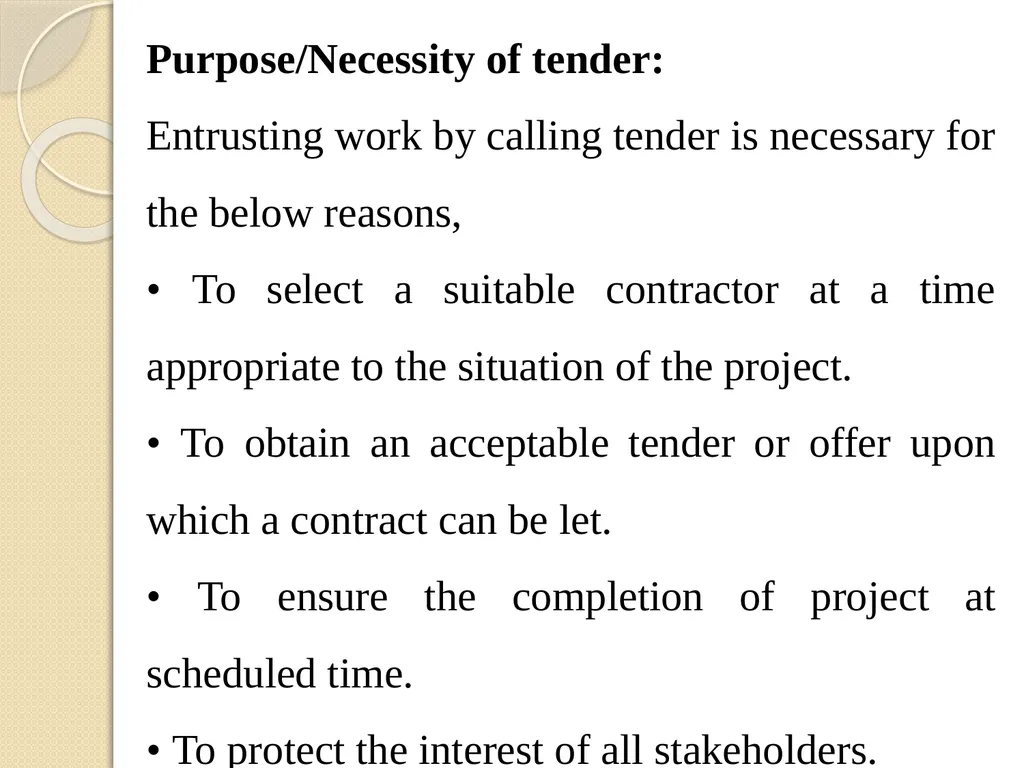
Purpose/Necessity of tender:
Entrusting work by calling tender is necessary for the below reasons,
• To select a suitable contractor at a time appropriate to the situation of the project.
• To obtain an acceptable tender or offer upon which a contract can be let.
• To ensure the completion of project at scheduled time.
• To protect the interest of all stakeholders.<br>
13
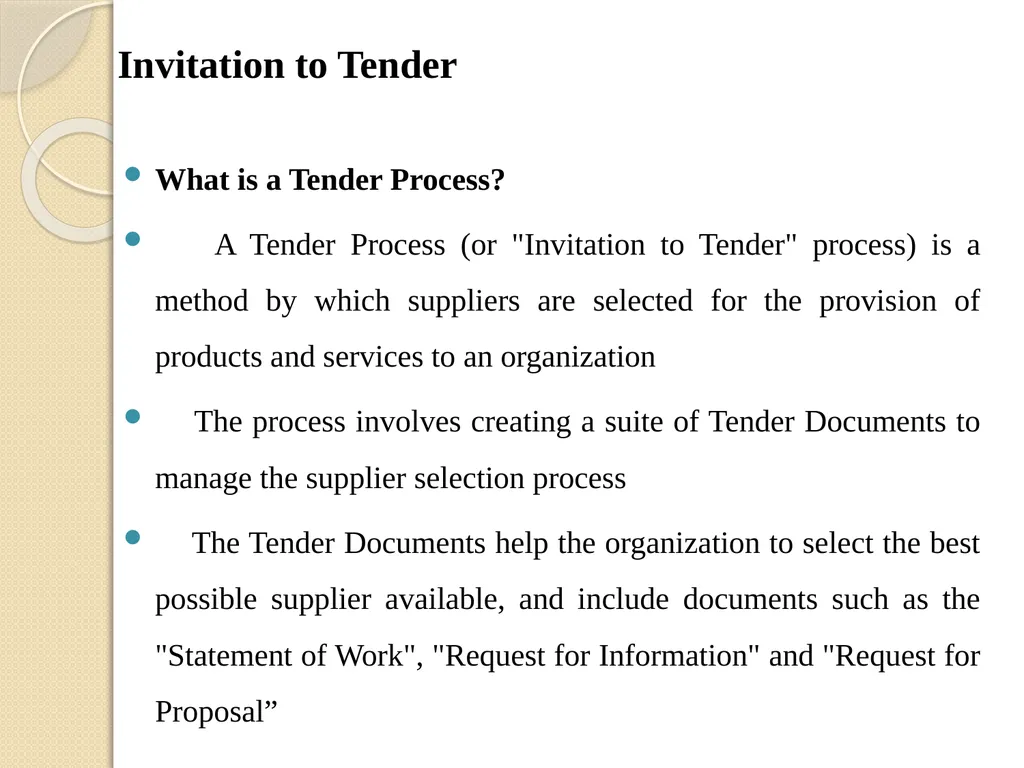
Invitation to Tender What is a Tender Process?
A Tender Process (or "Invitation to Tender" process) is a method by which suppliers are selected for the provision of products and services to an organization
The process involves creating a suite of Tender Documents to manage the supplier selection process
The Tender Documents help the organization to select the best possible supplier available, and include documents such as the "Statement of Work", "Request for Information" and "Request for Proposal”<br>
14
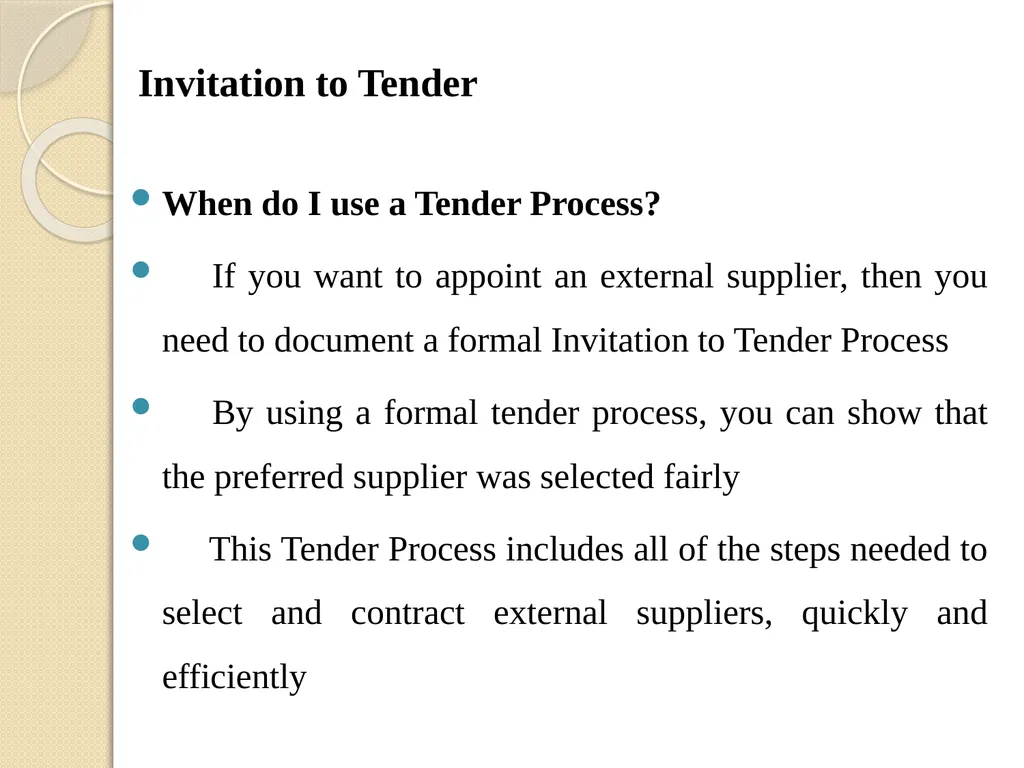
When do I use a Tender Process?
If you want to appoint an external supplier, then you need to document a formal Invitation to Tender Process
By using a formal tender process, you can show that the preferred supplier was selected fairly
This Tender Process includes all of the steps needed to select and contract external suppliers, quickly and efficiently Invitation to Tender<br>
15
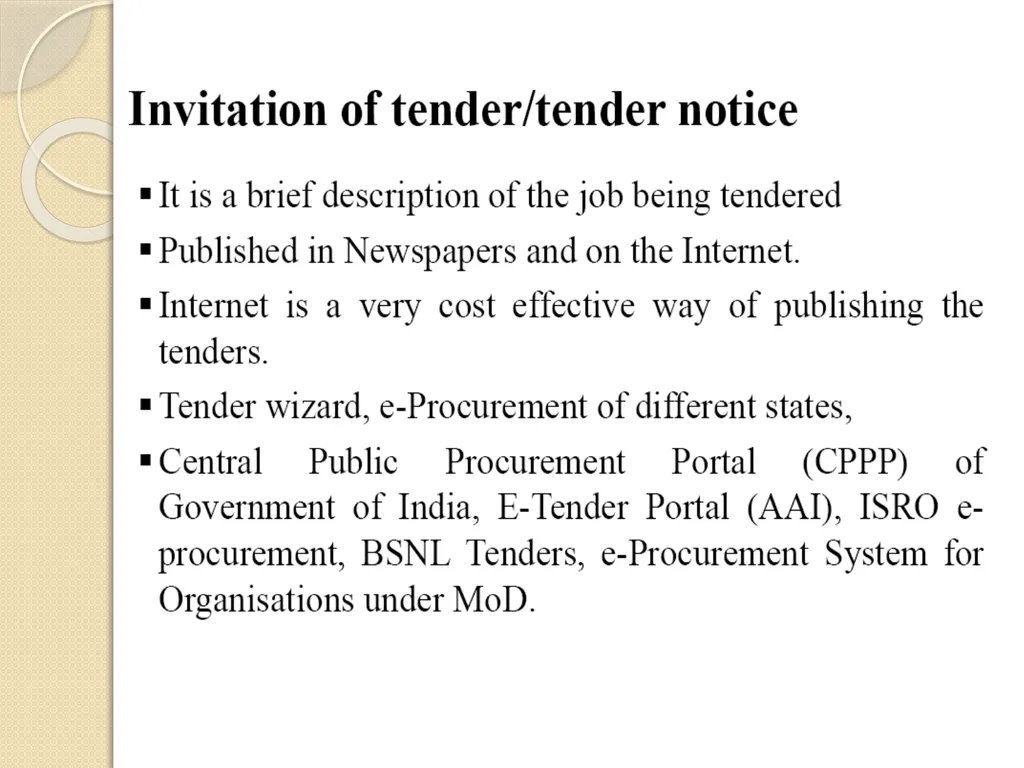
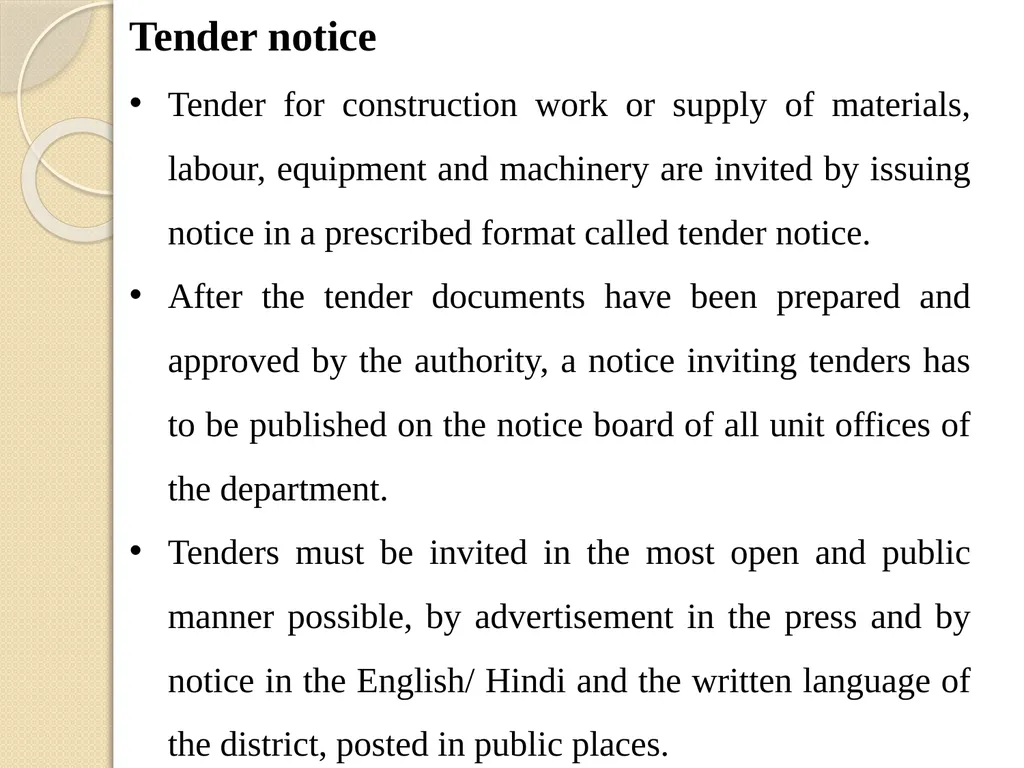
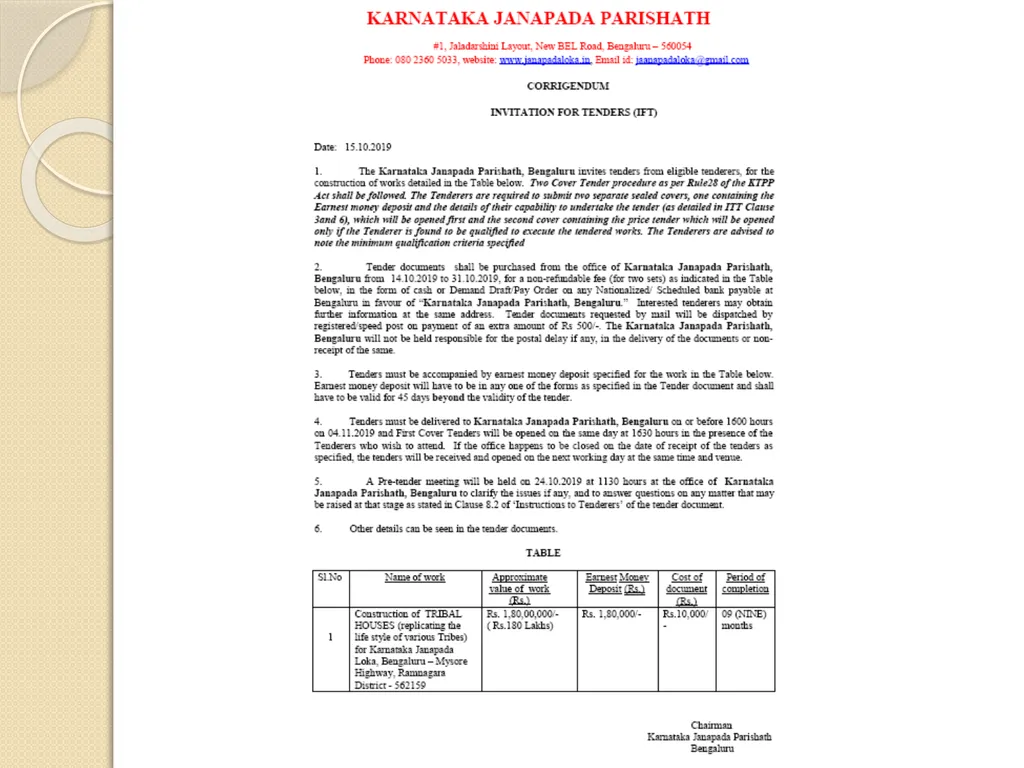
Tender notice
Tender for construction work or supply of materials, labour, equipment and machinery are invited by issuing notice in a prescribed format called tender notice.
After the tender documents have been prepared and approved by the authority, a notice inviting tenders has to be published on the notice board of all unit offices of the department.
Tenders must be invited in the most open and public manner possible, by advertisement in the press and by notice in the English/ Hindi and the written language of the district, posted in public places.<br>
16
The following particulars are written in the tender notice.
Mode of submitting the tender
Form in which tender has to be submitted
Name of the authority inviting the tender
Nature of the work and its location
Estimated cost of the work
Time Limit or period of completion
Availability of data and forms
Earnest money required along with the tender
Security deposit to be paid by the selected contractor Information in Tender notice<br>
17
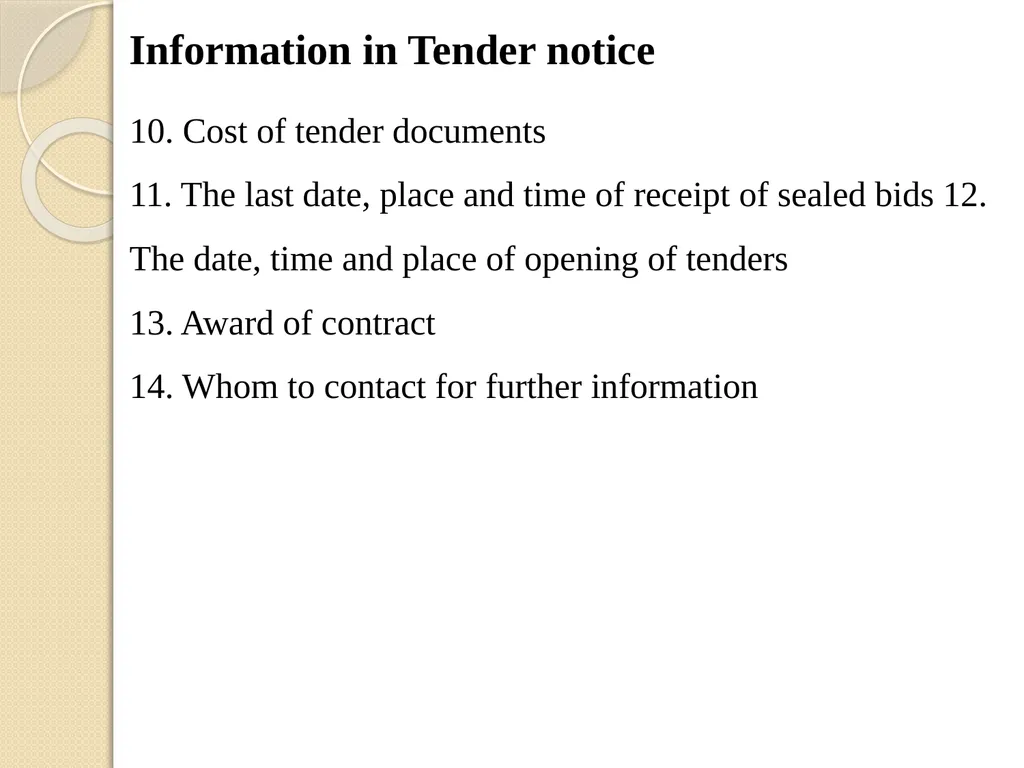
10. Cost of tender documents
11. The last date, place and time of receipt of sealed bids 12. The date, time and place of opening of tenders
13. Award of contract
14. Whom to contact for further information Information in Tender notice<br>