
Module 4: R2P in Practice – Responding to the
Description: Module 4: R2P in Practice Responding to the Threat of Mass Atrocity Crimes GLOBAL CENTRE FOR THE RESPONSIBILITY TO PROTECT Phase 2 Analysis GLOBAL CENTRE FOR THE RESPONSIBILITY TO PROTECT Phase 2 Analysis: Articulating the Risk
Related Topics
Download Presentation
"Module 4: R2P in Practice – Responding to the" is the property of its rightful owner. Permission is granted to download and print the materials on this website for personal, non-commercial use only, and to display it on your personal computer provided you do not modify the materials and that you retain all copyright notices contained in the materials. By downloading content from our website, you accept the terms of this agreement.
Presentation Transcript
slide1. Module 4: R2P in Practice –
Responding to the Threat of Mass Atrocity Crimes GLOBAL CENTRE FOR THE RESPONSIBILITY TO PROTECT<br>
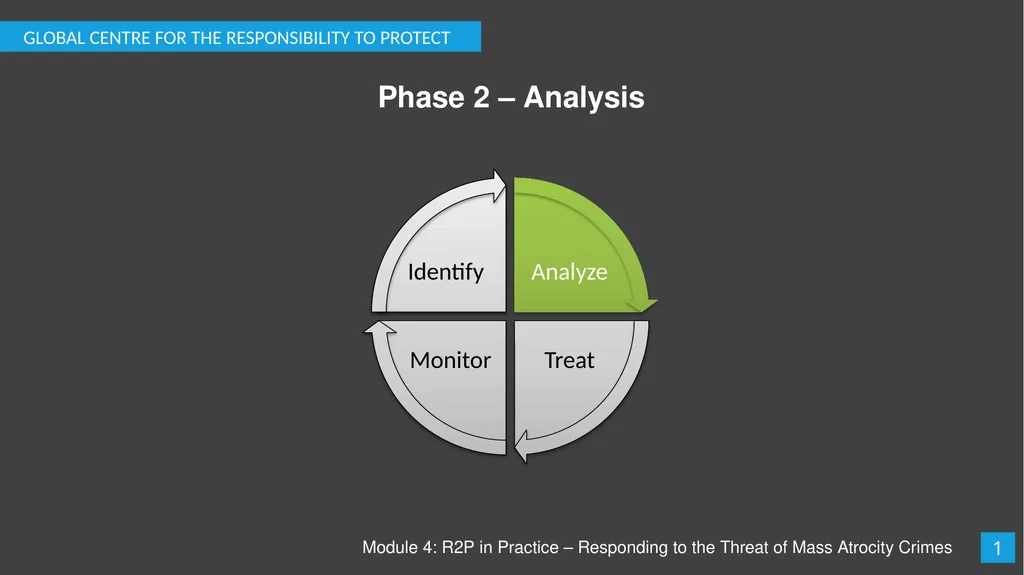
slide2. Phase 2 – Analysis GLOBAL CENTRE FOR THE RESPONSIBILITY TO PROTECT<br>
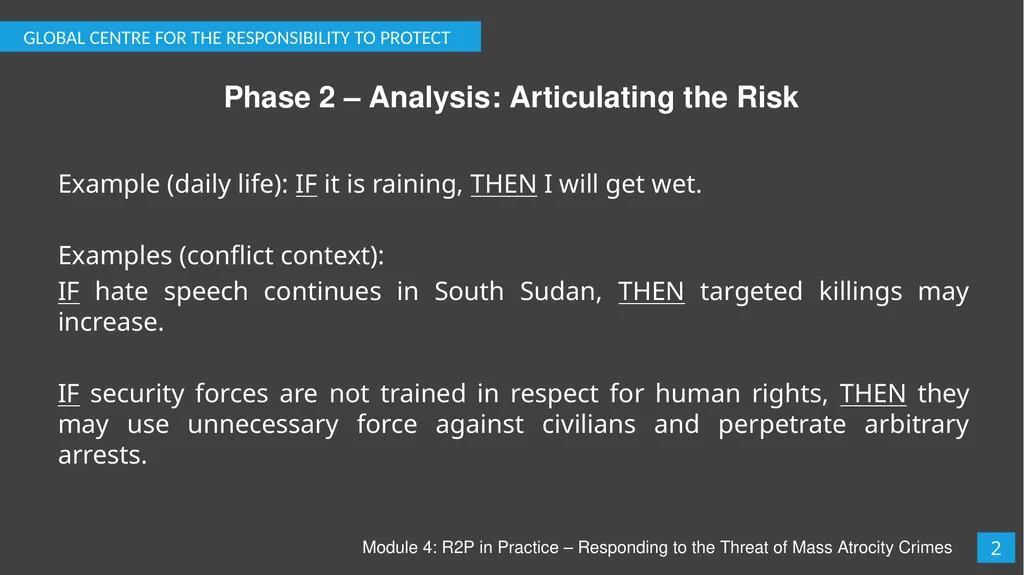
slide3. Phase 2 – Analysis: Articulating the Risk Example (daily life): IF it is raining, THEN I will get wet.
Examples (conflict context):
IF hate speech continues in South Sudan, THEN targeted killings may increase.
IF security forces are not trained in respect for human rights, THEN they may use unnecessary force against civilians and perpetrate arbitrary arrests. GLOBAL CENTRE FOR THE RESPONSIBILITY TO PROTECT<br>
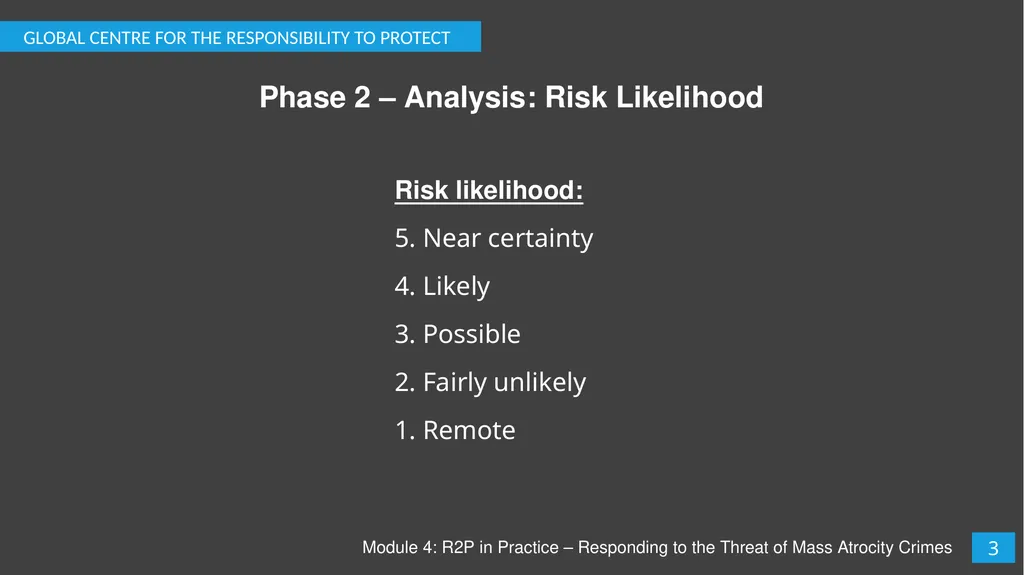
slide4. Phase 2 – Analysis: Risk Likelihood Risk likelihood:
5. Near certainty
4. Likely
3. Possible
2. Fairly unlikely
1. Remote GLOBAL CENTRE FOR THE RESPONSIBILITY TO PROTECT<br>
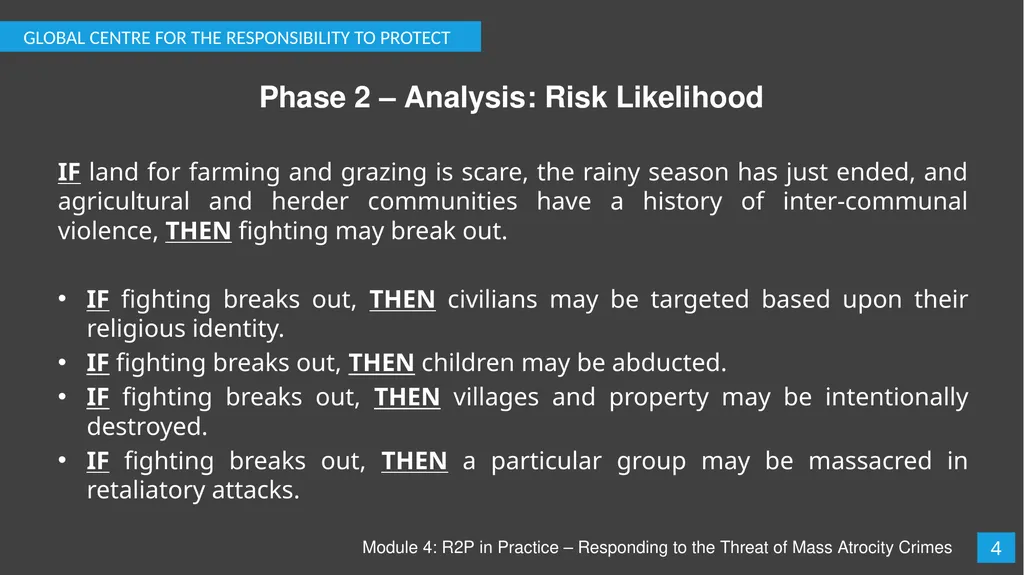
slide5. Phase 2 – Analysis: Risk Likelihood IF land for farming and grazing is scare, the rainy season has just ended, and agricultural and herder communities have a history of inter-communal violence, THEN fighting may break out.
IF fighting breaks out, THEN civilians may be targeted based upon their religious identity.
IF fighting breaks out, THEN children may be abducted.
IF fighting breaks out, THEN villages and property may be intentionally destroyed.
IF fighting breaks out, THEN a particular group may be massacred in retaliatory attacks. GLOBAL CENTRE FOR THE RESPONSIBILITY TO PROTECT<br>
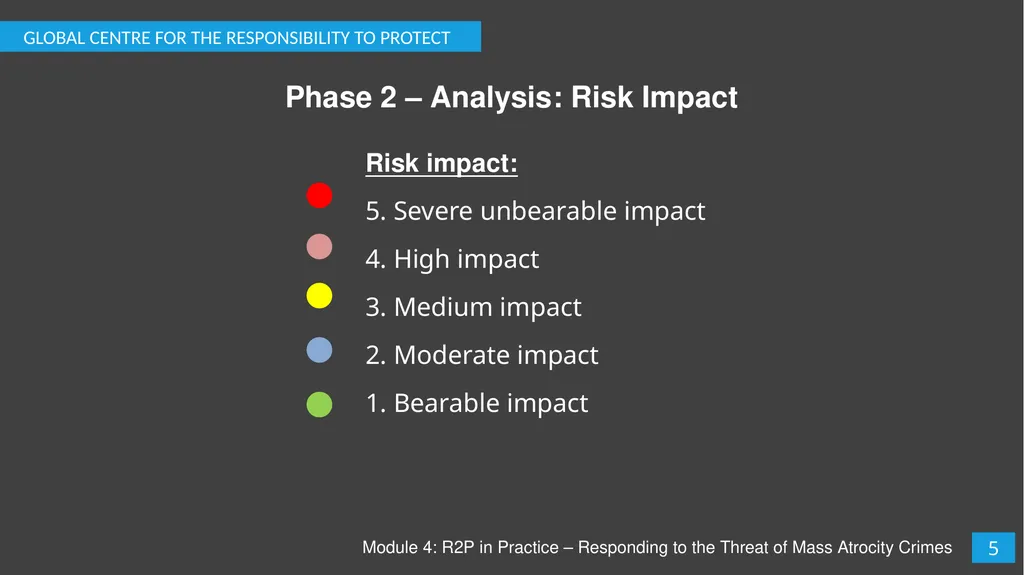
slide6. Phase 2 – Analysis: Risk Impact Risk impact:
5. Severe unbearable impact
4. High impact
3. Medium impact
2. Moderate impact
1. Bearable impact GLOBAL CENTRE FOR THE RESPONSIBILITY TO PROTECT<br>
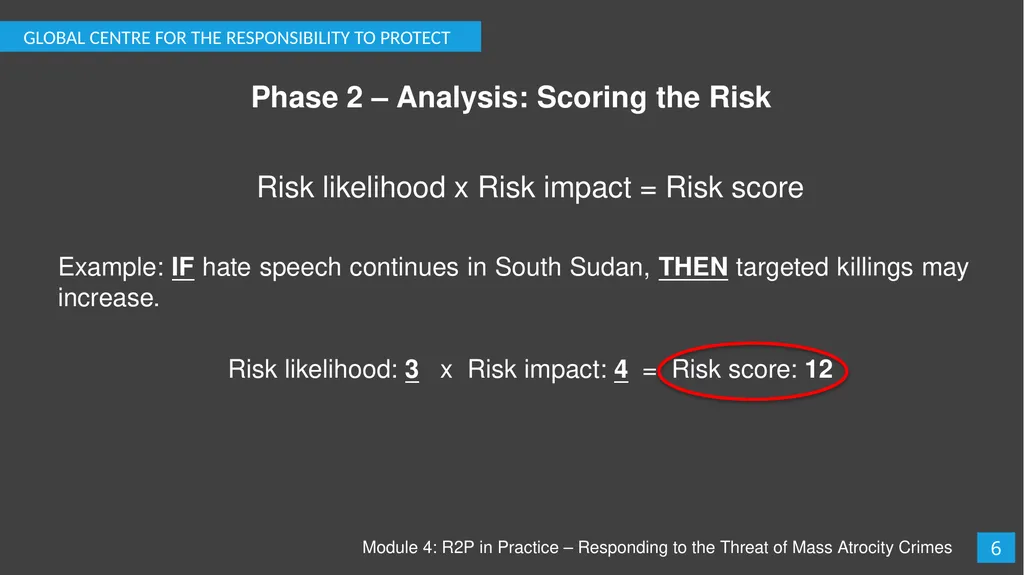
slide7. Phase 2 – Analysis: Scoring the Risk Risk likelihood x Risk impact = Risk score
Example: IF hate speech continues in South Sudan, THEN targeted killings may increase.
Risk likelihood: 3 x Risk impact: 4 = Risk score: 12 GLOBAL CENTRE FOR THE RESPONSIBILITY TO PROTECT<br>
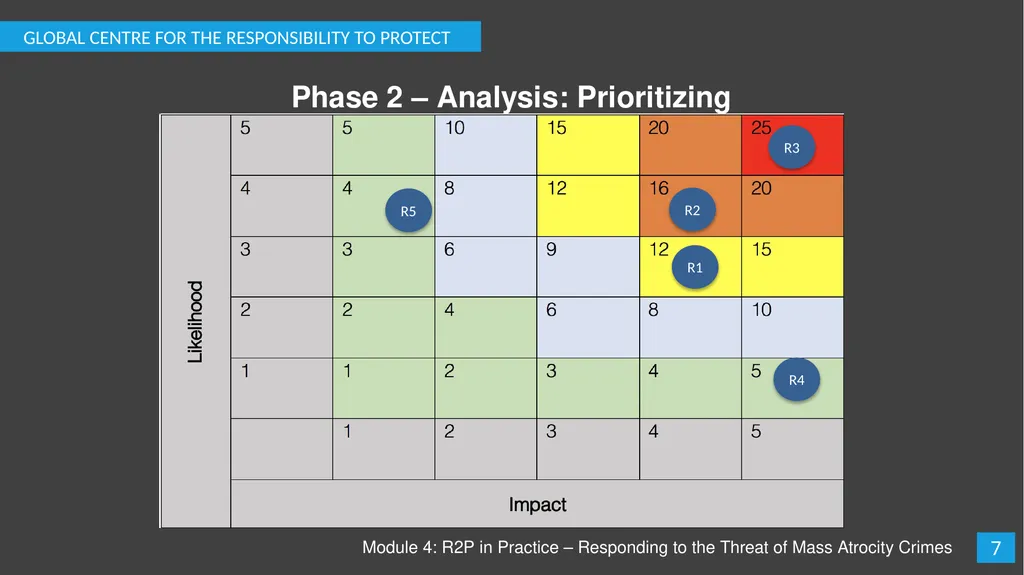
slide8. Phase 2 – Analysis: Prioritizing R1 R2 R3 R4 R5 GLOBAL CENTRE FOR THE RESPONSIBILITY TO PROTECT<br>
slide9. Module 4 Activity: Conducting a risk assessment GLOBAL CENTRE FOR THE RESPONSIBILITY TO PROTECT<br>
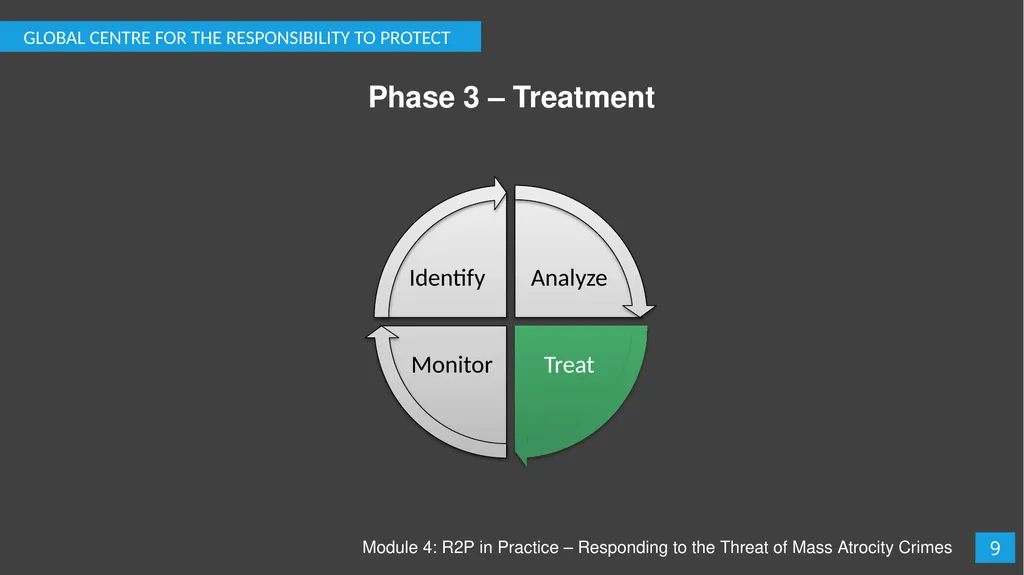
slide10. Phase 3 – Treatment GLOBAL CENTRE FOR THE RESPONSIBILITY TO PROTECT<br>
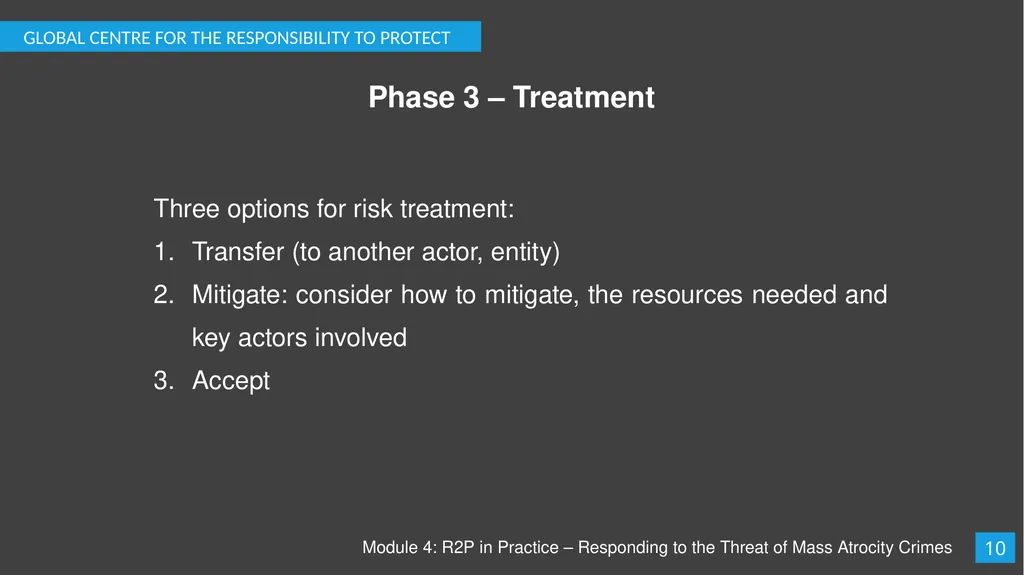
slide11. Phase 3 – Treatment Three options for risk treatment:
Transfer (to another actor, entity)
Mitigate: consider how to mitigate, the resources needed and key actors involved
Accept GLOBAL CENTRE FOR THE RESPONSIBILITY TO PROTECT<br>
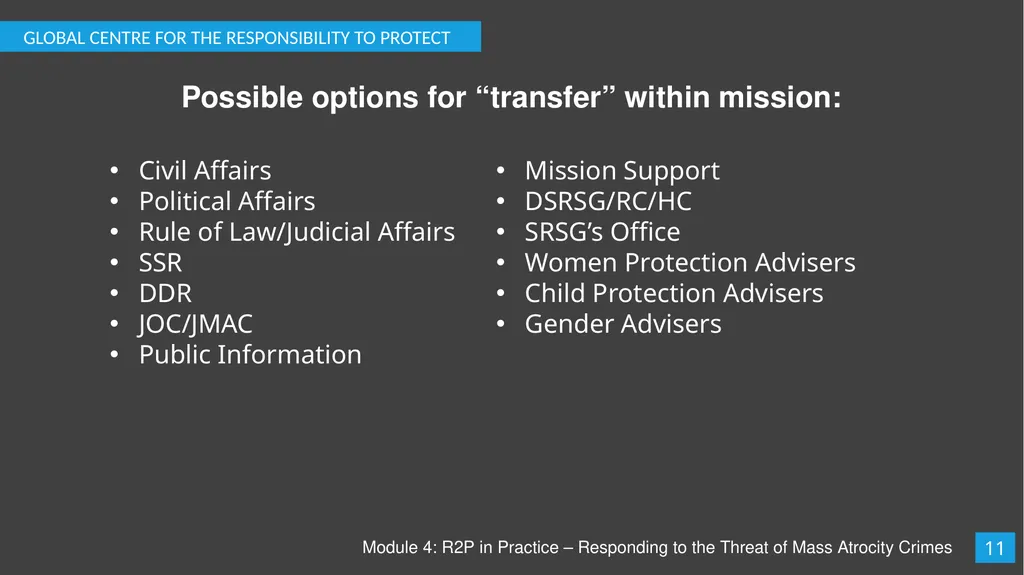
slide12. Possible options for “transfer” within mission: Civil Affairs
Political Affairs
Rule of Law/Judicial Affairs
SSR
DDR
JOC/JMAC
Public Information
Mission Support
DSRSG/RC/HC
SRSG’s Office
Women Protection Advisers
Child Protection Advisers
Gender Advisers GLOBAL CENTRE FOR THE RESPONSIBILITY TO PROTECT<br>
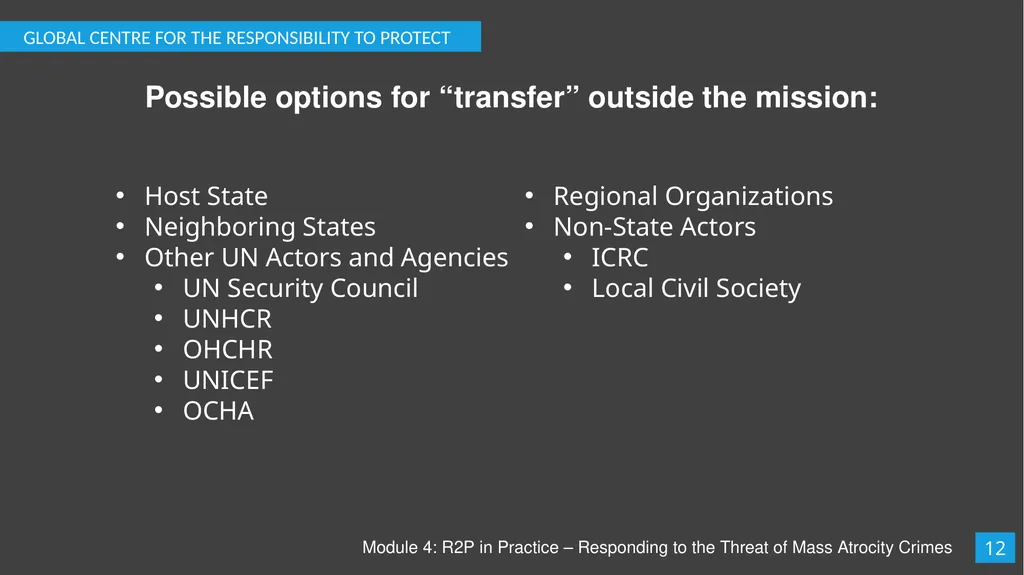
slide13. Possible options for “transfer” outside the mission: Host State
Neighboring States
Other UN Actors and Agencies
UN Security Council
UNHCR
OHCHR
UNICEF
OCHA
Regional Organizations
Non-State Actors
ICRC
Local Civil Society GLOBAL CENTRE FOR THE RESPONSIBILITY TO PROTECT<br>
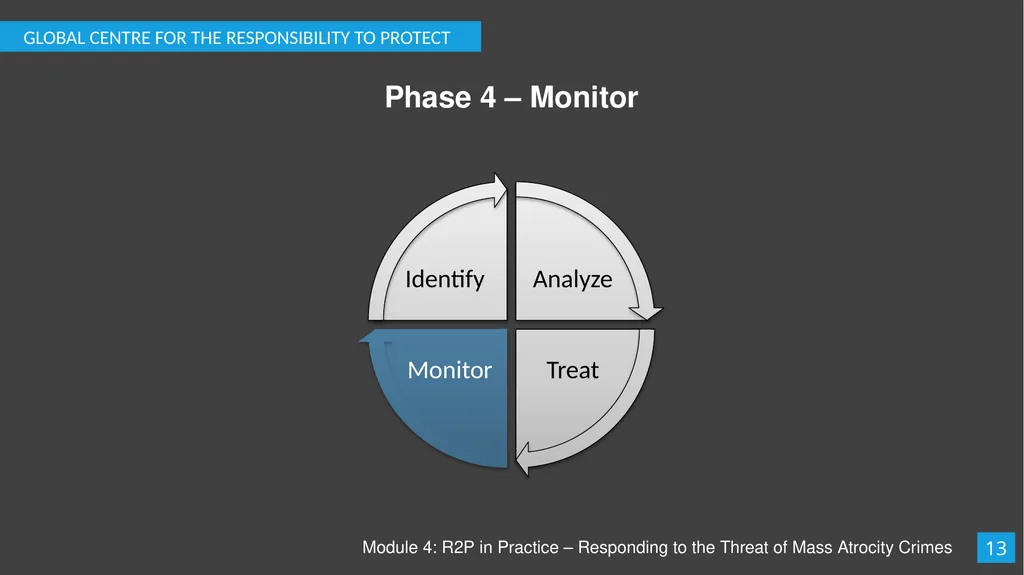
slide14. Phase 4 – Monitor GLOBAL CENTRE FOR THE RESPONSIBILITY TO PROTECT<br>
slide15. Module 4 Activity: Developing tactical responses to risks GLOBAL CENTRE FOR THE RESPONSIBILITY TO PROTECT<br>
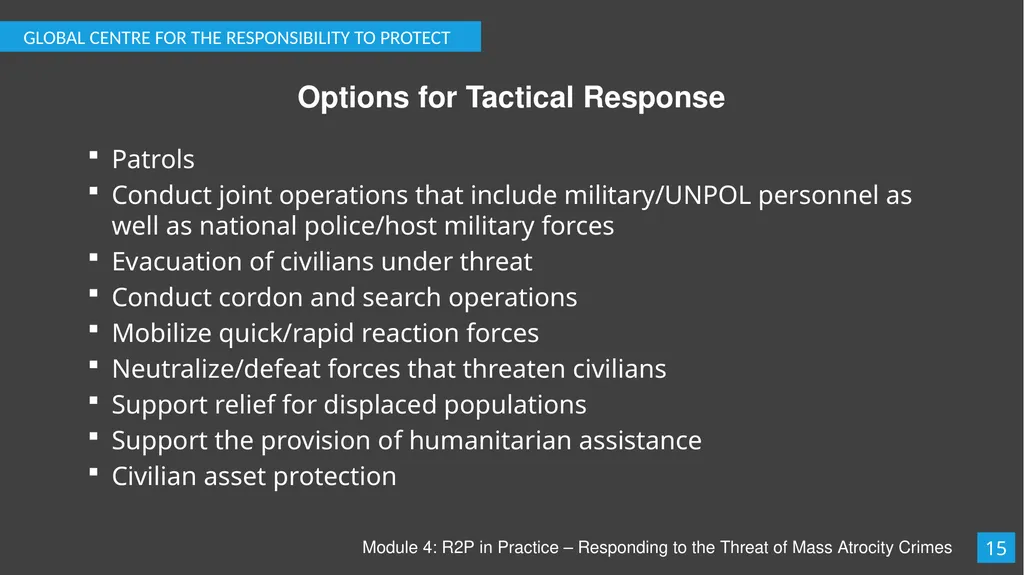
slide16. Options for Tactical Response Patrols
Conduct joint operations that include military/UNPOL personnel as well as national police/host military forces
Evacuation of civilians under threat
Conduct cordon and search operations
Mobilize quick/rapid reaction forces
Neutralize/defeat forces that threaten civilians
Support relief for displaced populations
Support the provision of humanitarian assistance
Civilian asset protection GLOBAL CENTRE FOR THE RESPONSIBILITY TO PROTECT<br>
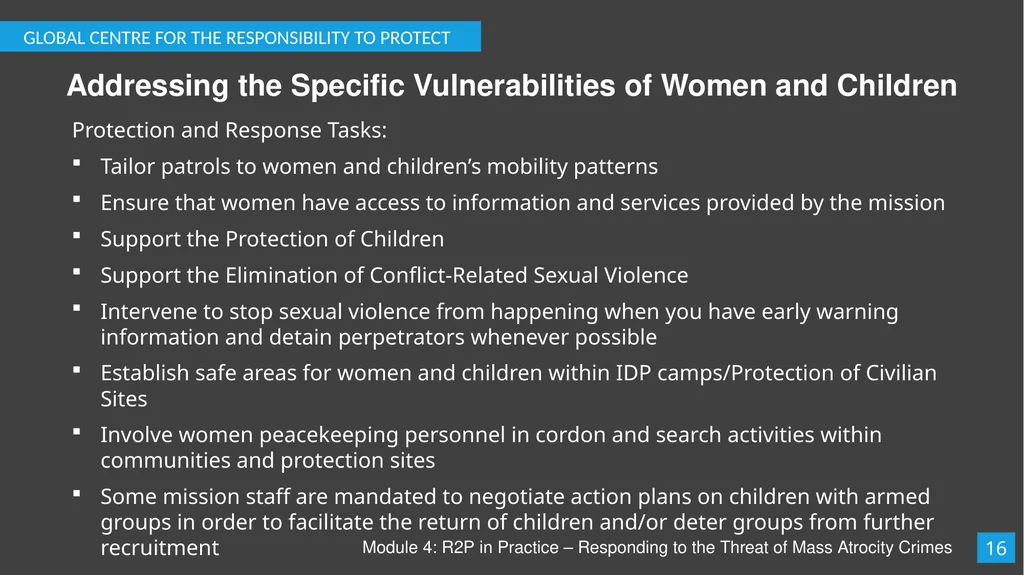
slide17. Protection and Response Tasks:
Tailor patrols to women and children’s mobility patterns
Ensure that women have access to information and services provided by the mission
Support the Protection of Children
Support the Elimination of Conflict-Related Sexual Violence
Intervene to stop sexual violence from happening when you have early warning information and detain perpetrators whenever possible
Establish safe areas for women and children within IDP camps/Protection of Civilian Sites
Involve women peacekeeping personnel in cordon and search activities within communities and protection sites
Some mission staff are mandated to negotiate action plans on children with armed groups in order to facilitate the return of children and/or deter groups from further recruitment Addressing the Specific Vulnerabilities of Women and Children GLOBAL CENTRE FOR THE RESPONSIBILITY TO PROTECT<br>
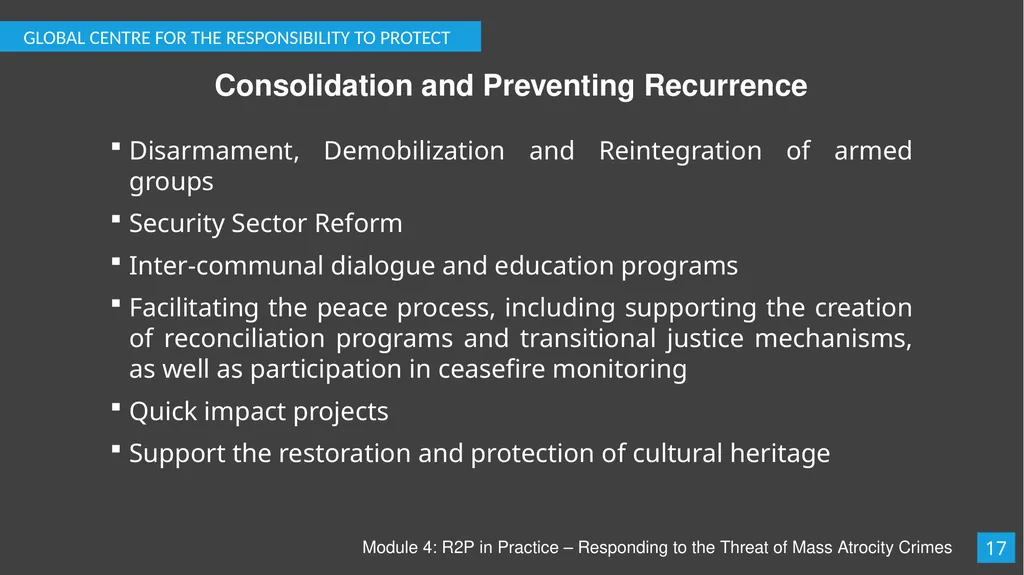
slide18. Consolidation and Preventing Recurrence Disarmament, Demobilization and Reintegration of armed groups
Security Sector Reform
Inter-communal dialogue and education programs
Facilitating the peace process, including supporting the creation of reconciliation programs and transitional justice mechanisms, as well as participation in ceasefire monitoring
Quick impact projects
Support the restoration and protection of cultural heritage GLOBAL CENTRE FOR THE RESPONSIBILITY TO PROTECT<br>
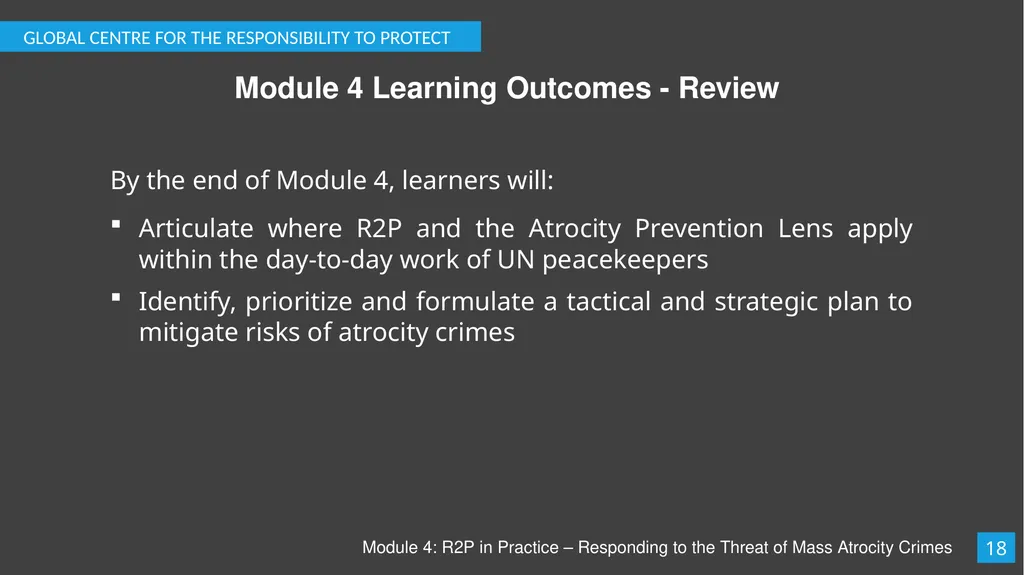
slide19. Module 4 Learning Outcomes - Review By the end of Module 4, learners will:
Articulate where R2P and the Atrocity Prevention Lens apply within the day-to-day work of UN peacekeepers
Identify, prioritize and formulate a tactical and strategic plan to mitigate risks of atrocity crimes GLOBAL CENTRE FOR THE RESPONSIBILITY TO PROTECT<br>
slide2. Phase 2 – Analysis GLOBAL CENTRE FOR THE RESPONSIBILITY TO PROTECT<br>
slide3. Phase 2 – Analysis: Articulating the Risk Example (daily life): IF it is raining, THEN I will get wet.
Examples (conflict context):
IF hate speech continues in South Sudan, THEN targeted killings may increase.
IF security forces are not trained in respect for human rights, THEN they may use unnecessary force against civilians and perpetrate arbitrary arrests. GLOBAL CENTRE FOR THE RESPONSIBILITY TO PROTECT<br>
slide4. Phase 2 – Analysis: Risk Likelihood Risk likelihood:
5. Near certainty
4. Likely
3. Possible
2. Fairly unlikely
1. Remote GLOBAL CENTRE FOR THE RESPONSIBILITY TO PROTECT<br>
slide5. Phase 2 – Analysis: Risk Likelihood IF land for farming and grazing is scare, the rainy season has just ended, and agricultural and herder communities have a history of inter-communal violence, THEN fighting may break out.
IF fighting breaks out, THEN civilians may be targeted based upon their religious identity.
IF fighting breaks out, THEN children may be abducted.
IF fighting breaks out, THEN villages and property may be intentionally destroyed.
IF fighting breaks out, THEN a particular group may be massacred in retaliatory attacks. GLOBAL CENTRE FOR THE RESPONSIBILITY TO PROTECT<br>
slide6. Phase 2 – Analysis: Risk Impact Risk impact:
5. Severe unbearable impact
4. High impact
3. Medium impact
2. Moderate impact
1. Bearable impact GLOBAL CENTRE FOR THE RESPONSIBILITY TO PROTECT<br>
slide7. Phase 2 – Analysis: Scoring the Risk Risk likelihood x Risk impact = Risk score
Example: IF hate speech continues in South Sudan, THEN targeted killings may increase.
Risk likelihood: 3 x Risk impact: 4 = Risk score: 12 GLOBAL CENTRE FOR THE RESPONSIBILITY TO PROTECT<br>
slide8. Phase 2 – Analysis: Prioritizing R1 R2 R3 R4 R5 GLOBAL CENTRE FOR THE RESPONSIBILITY TO PROTECT<br>
slide9. Module 4 Activity: Conducting a risk assessment GLOBAL CENTRE FOR THE RESPONSIBILITY TO PROTECT<br>
slide10. Phase 3 – Treatment GLOBAL CENTRE FOR THE RESPONSIBILITY TO PROTECT<br>
slide11. Phase 3 – Treatment Three options for risk treatment:
Transfer (to another actor, entity)
Mitigate: consider how to mitigate, the resources needed and key actors involved
Accept GLOBAL CENTRE FOR THE RESPONSIBILITY TO PROTECT<br>
slide12. Possible options for “transfer” within mission: Civil Affairs
Political Affairs
Rule of Law/Judicial Affairs
SSR
DDR
JOC/JMAC
Public Information
Mission Support
DSRSG/RC/HC
SRSG’s Office
Women Protection Advisers
Child Protection Advisers
Gender Advisers GLOBAL CENTRE FOR THE RESPONSIBILITY TO PROTECT<br>
slide13. Possible options for “transfer” outside the mission: Host State
Neighboring States
Other UN Actors and Agencies
UN Security Council
UNHCR
OHCHR
UNICEF
OCHA
Regional Organizations
Non-State Actors
ICRC
Local Civil Society GLOBAL CENTRE FOR THE RESPONSIBILITY TO PROTECT<br>
slide14. Phase 4 – Monitor GLOBAL CENTRE FOR THE RESPONSIBILITY TO PROTECT<br>
slide15. Module 4 Activity: Developing tactical responses to risks GLOBAL CENTRE FOR THE RESPONSIBILITY TO PROTECT<br>
slide16. Options for Tactical Response Patrols
Conduct joint operations that include military/UNPOL personnel as well as national police/host military forces
Evacuation of civilians under threat
Conduct cordon and search operations
Mobilize quick/rapid reaction forces
Neutralize/defeat forces that threaten civilians
Support relief for displaced populations
Support the provision of humanitarian assistance
Civilian asset protection GLOBAL CENTRE FOR THE RESPONSIBILITY TO PROTECT<br>
slide17. Protection and Response Tasks:
Tailor patrols to women and children’s mobility patterns
Ensure that women have access to information and services provided by the mission
Support the Protection of Children
Support the Elimination of Conflict-Related Sexual Violence
Intervene to stop sexual violence from happening when you have early warning information and detain perpetrators whenever possible
Establish safe areas for women and children within IDP camps/Protection of Civilian Sites
Involve women peacekeeping personnel in cordon and search activities within communities and protection sites
Some mission staff are mandated to negotiate action plans on children with armed groups in order to facilitate the return of children and/or deter groups from further recruitment Addressing the Specific Vulnerabilities of Women and Children GLOBAL CENTRE FOR THE RESPONSIBILITY TO PROTECT<br>
slide18. Consolidation and Preventing Recurrence Disarmament, Demobilization and Reintegration of armed groups
Security Sector Reform
Inter-communal dialogue and education programs
Facilitating the peace process, including supporting the creation of reconciliation programs and transitional justice mechanisms, as well as participation in ceasefire monitoring
Quick impact projects
Support the restoration and protection of cultural heritage GLOBAL CENTRE FOR THE RESPONSIBILITY TO PROTECT<br>
slide19. Module 4 Learning Outcomes - Review By the end of Module 4, learners will:
Articulate where R2P and the Atrocity Prevention Lens apply within the day-to-day work of UN peacekeepers
Identify, prioritize and formulate a tactical and strategic plan to mitigate risks of atrocity crimes GLOBAL CENTRE FOR THE RESPONSIBILITY TO PROTECT<br>