
Module 6: Fire Fighting Foam Principles Objective
DJ
Published · 39 slides · 0 views
1 / 1

Description
Module 6: Fire Fighting Foam Principles Objective Upon the completion of this module, participants should be able to develop firefighting strategies foam-use tactics for controlling fighting fires associated with flammable liquid
Related Topics
Share
Embed code
Download this presentation From Below
"Module 6: Fire Fighting Foam Principles Objective" is the property of its rightful owner. Permission is granted to download and print the materials on this website for personal, non-commercial use only, and to display it on your personal computer provided you do not modify the materials and that you retain all copyright notices contained in the materials. By downloading content from our website, you accept the terms of this agreement.
Presentation Transcript
01
Module 6:
Fire Fighting Foam Principles<br>
Fire Fighting Foam Principles<br>
02
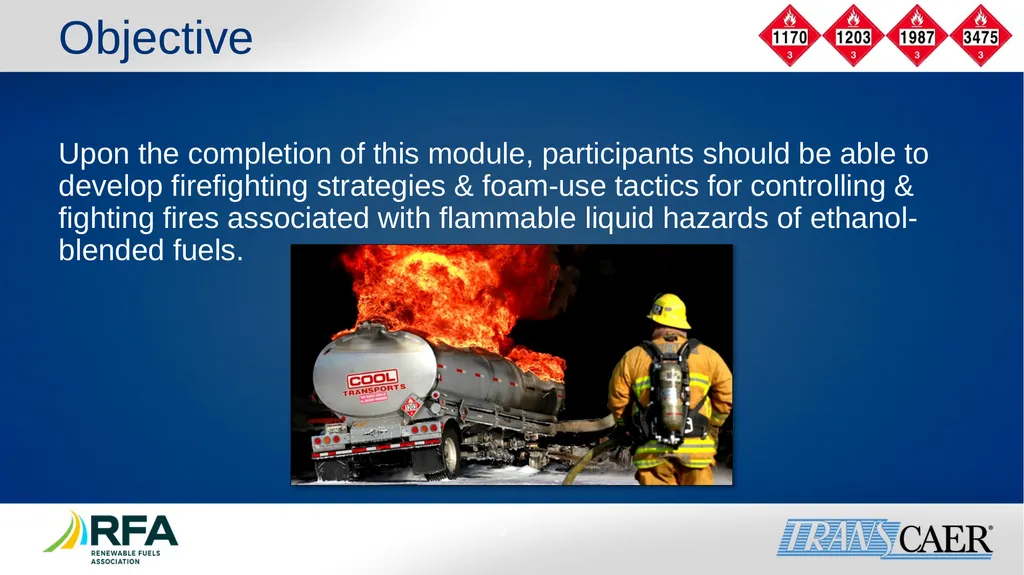
Objective Upon the completion of this module, participants should be able to develop firefighting strategies & foam-use tactics for controlling & fighting fires associated with flammable liquid hazards of ethanol-blended fuels.<br>
03
Introduction Emergency responders need to be prepared for
incidents associated with flammable liquids
Ethanol-blended fuels have similarities to other flammable liquids but also present unique burn characteristics
Hazards associated with production, storage, & transportation by cargo tank trucks & rail tank cars carrying these products require special considerations<br>
Ethanol-blended fuels have similarities to other flammable liquids but also present unique burn characteristics
Hazards associated with production, storage, & transportation by cargo tank trucks & rail tank cars carrying these products require special considerations<br>
04
Basic Foam Principles What is foam?
“…foam a stable aggregation of bubbles of lower density than oil or water.” (NFPA 11 version 2016)
What is foam concentrate?
“…a concentrated liquid foaming agent as received from the manufacturer.” (NFPA 11 version 2016)
What is alcohol resistant foam concentrate?
“…a concentrate used for fighting fires on water soluble materials and other fuels destructive to regular….foams.” (NFPA 11 version 2016)<br>
“…foam a stable aggregation of bubbles of lower density than oil or water.” (NFPA 11 version 2016)
What is foam concentrate?
“…a concentrated liquid foaming agent as received from the manufacturer.” (NFPA 11 version 2016)
What is alcohol resistant foam concentrate?
“…a concentrate used for fighting fires on water soluble materials and other fuels destructive to regular….foams.” (NFPA 11 version 2016)<br>
05
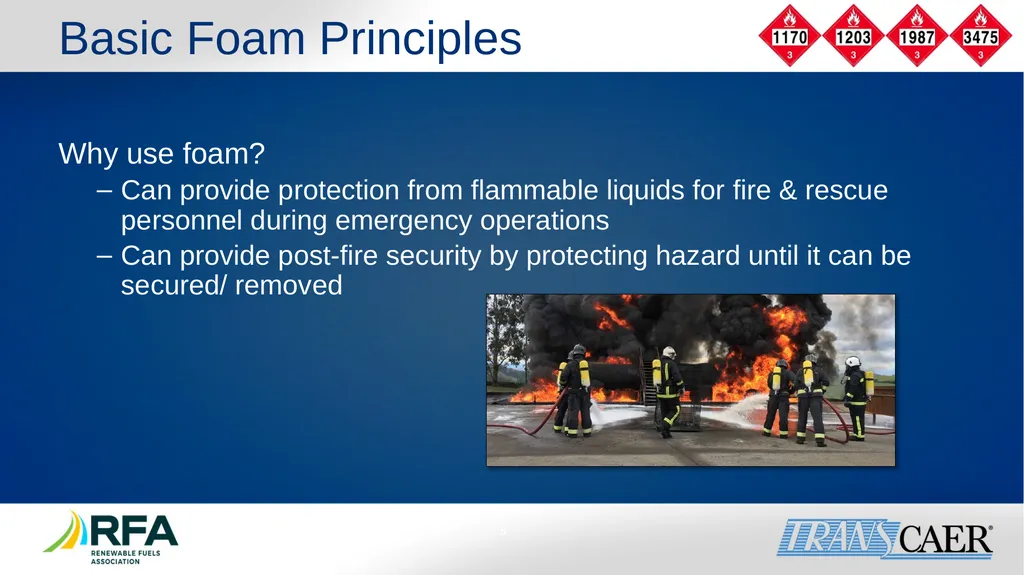
Basic Foam Principles Why use foam?
Can provide protection from flammable liquids for fire & rescue personnel during emergency operations
Can provide post-fire security by protecting hazard until it can be secured/ removed<br>
Can provide protection from flammable liquids for fire & rescue personnel during emergency operations
Can provide post-fire security by protecting hazard until it can be secured/ removed<br>
06
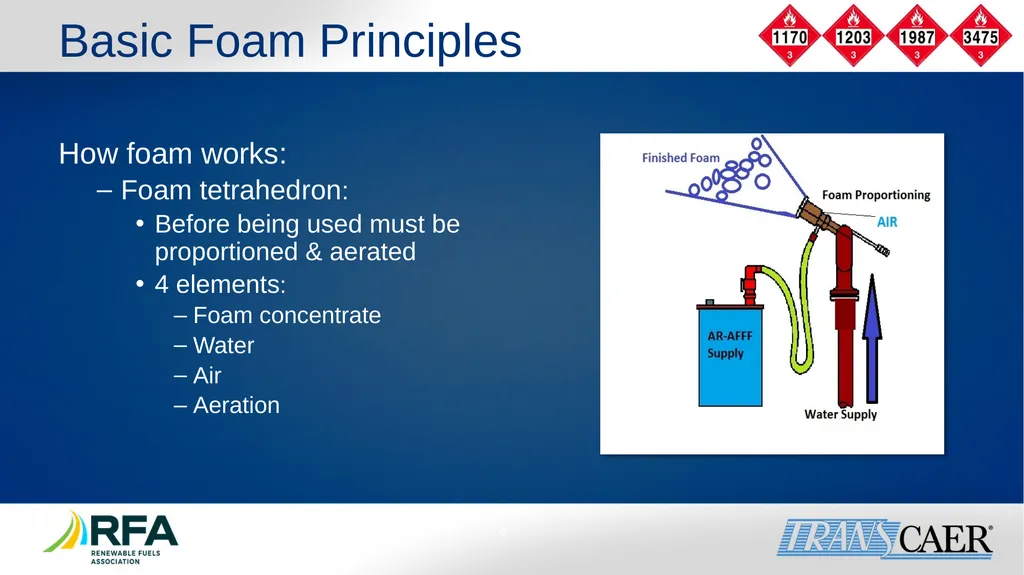
Basic Foam Principles How foam works:
Foam tetrahedron:
Before being used must be proportioned & aerated
4 elements:
Foam concentrate
Water
Air
Aeration<br>
Foam tetrahedron:
Before being used must be proportioned & aerated
4 elements:
Foam concentrate
Water
Air
Aeration<br>
07
Basic Foam Principles What is foam effective on?
Effective at suppressing vapors & extinguishing Class B fires
Not effective on pressurized flammable gases
Not effective on combustible metals
2 categories of Class B products:
Hydrocarbons
Foams listed such as AFFF
Polar solvents
AR-AFFF
Never mix foam concentrates from different manufactures together<br>
Effective at suppressing vapors & extinguishing Class B fires
Not effective on pressurized flammable gases
Not effective on combustible metals
2 categories of Class B products:
Hydrocarbons
Foams listed such as AFFF
Polar solvents
AR-AFFF
Never mix foam concentrates from different manufactures together<br>
08
Basic Foam Principles Types of foam:
Protein foam
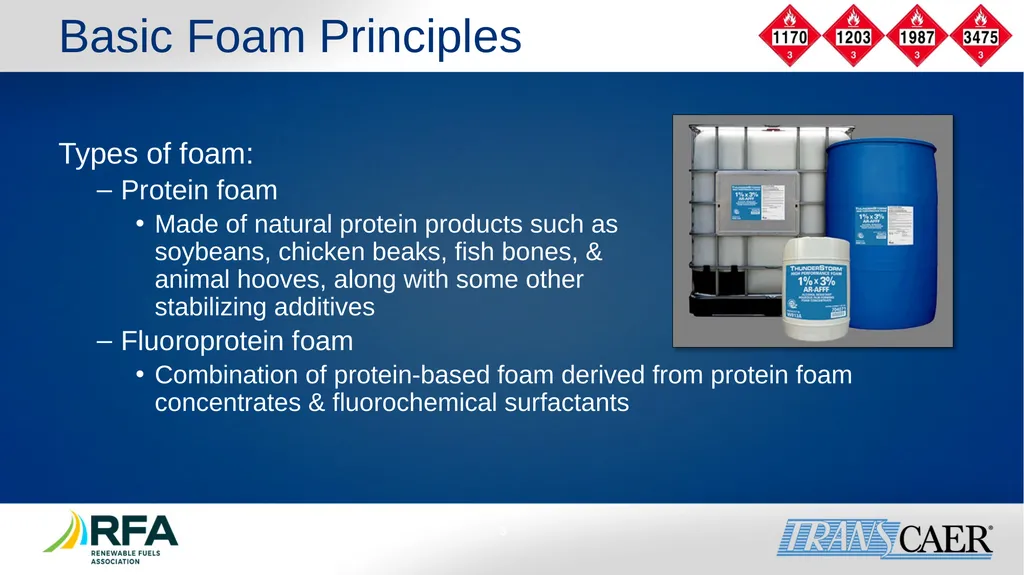
Made of natural protein products such as soybeans, chicken beaks, fish bones, & animal hooves, along with some other stabilizing additives
Fluoroprotein foam
Combination of protein-based foam derived from protein foam concentrates & fluorochemical surfactants<br>
Protein foam
Made of natural protein products such as soybeans, chicken beaks, fish bones, & animal hooves, along with some other stabilizing additives
Fluoroprotein foam
Combination of protein-based foam derived from protein foam concentrates & fluorochemical surfactants<br>
09
Types of foam:
Aqueous Film Forming Foam (AFFF)
Synthetic foam consisting of fluorochemical & hydrocarbon surfactants combined with high boiling point solvents & water
Film Forming Fluoroprotein Foam (FFFP)
Based on fluoroprotein foam technology with AFFF capabilities
Capabilities of AFFF with the heat resistance of fluoroprotein foam
Alcohol-Resistant Aqueous Film-Forming Foam (AR-AFFF, ATC)
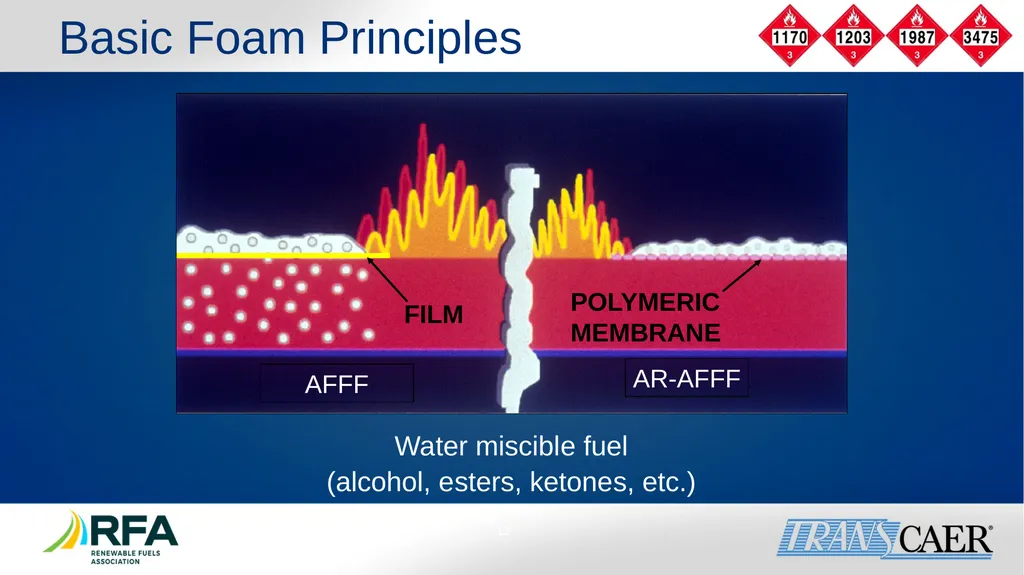
When applied to a polar solvent fuel, AR foams will often create a polymeric membrane rather than a film over the fuel Basic Foam Principles<br>
Aqueous Film Forming Foam (AFFF)
Synthetic foam consisting of fluorochemical & hydrocarbon surfactants combined with high boiling point solvents & water
Film Forming Fluoroprotein Foam (FFFP)
Based on fluoroprotein foam technology with AFFF capabilities
Capabilities of AFFF with the heat resistance of fluoroprotein foam
Alcohol-Resistant Aqueous Film-Forming Foam (AR-AFFF, ATC)
When applied to a polar solvent fuel, AR foams will often create a polymeric membrane rather than a film over the fuel Basic Foam Principles<br>
10
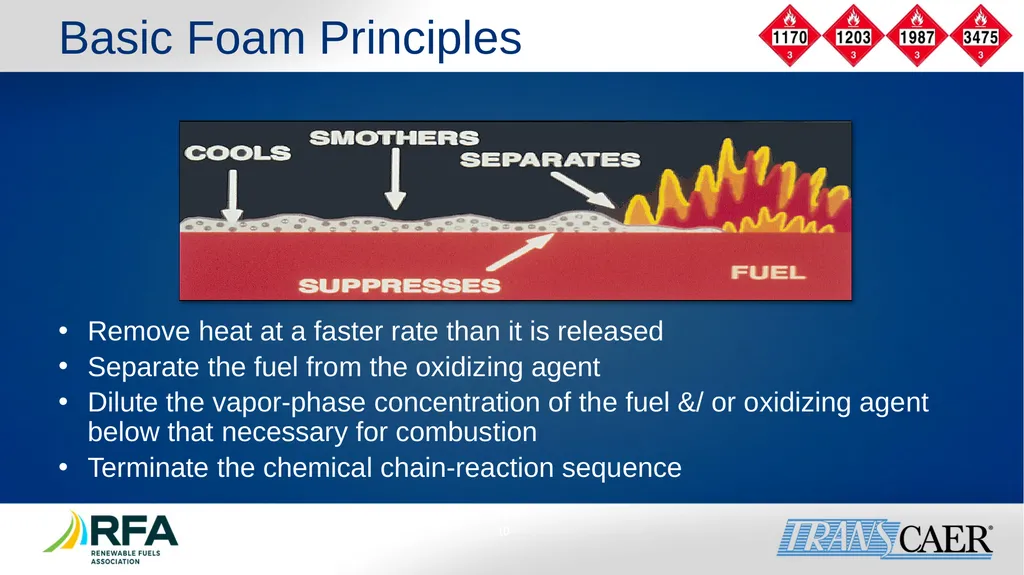
Remove heat at a faster rate than it is released
Separate the fuel from the oxidizing agent
Dilute the vapor-phase concentration of the fuel &/ or oxidizing agent below that necessary for combustion
Terminate the chemical chain-reaction sequence Basic Foam Principles<br>
Separate the fuel from the oxidizing agent
Dilute the vapor-phase concentration of the fuel &/ or oxidizing agent below that necessary for combustion
Terminate the chemical chain-reaction sequence Basic Foam Principles<br>
11
AFFF
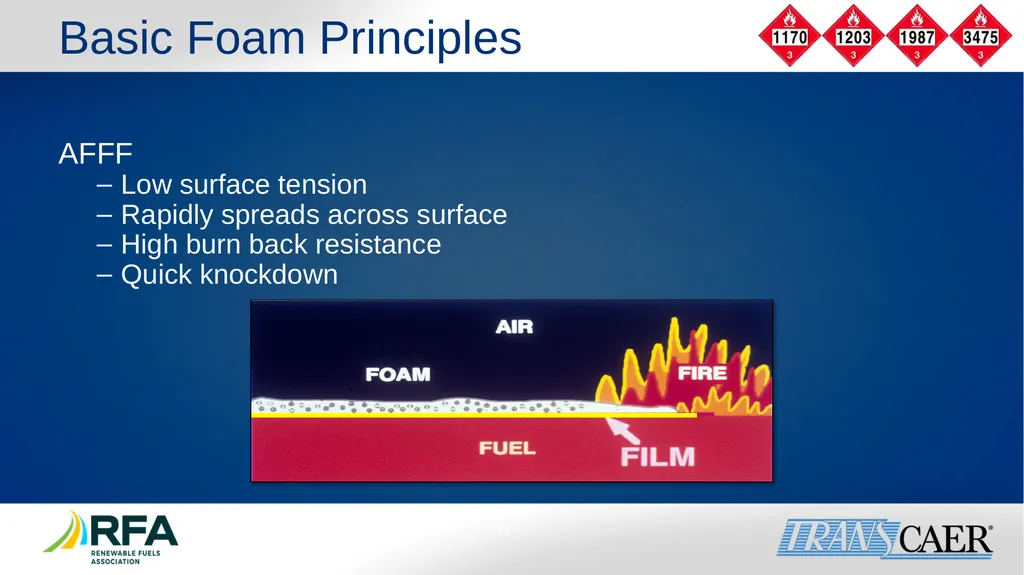
Low surface tension
Rapidly spreads across surface
High burn back resistance
Quick knockdown Basic Foam Principles<br>
Low surface tension
Rapidly spreads across surface
High burn back resistance
Quick knockdown Basic Foam Principles<br>
12
Water miscible fuel
(alcohol, esters, ketones, etc.) Basic Foam Principles FILM POLYMERIC MEMBRANE<br>
(alcohol, esters, ketones, etc.) Basic Foam Principles FILM POLYMERIC MEMBRANE<br>
13
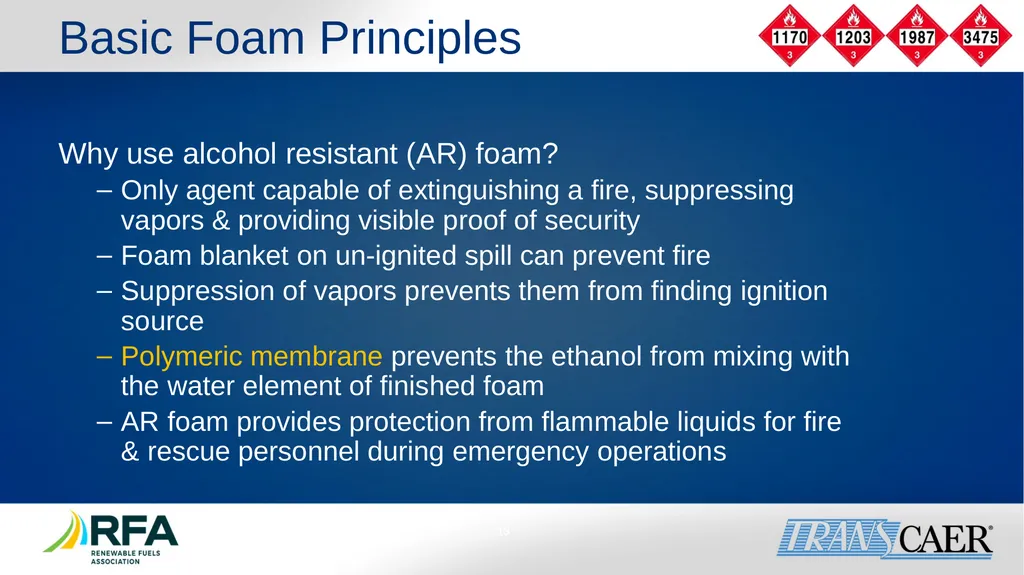
Why use alcohol resistant (AR) foam?
Only agent capable of extinguishing a fire, suppressing vapors & providing visible proof of security
Foam blanket on un-ignited spill can prevent fire
Suppression of vapors prevents them from finding ignition source
Polymeric membrane prevents the ethanol from mixing with the water element of finished foam
AR foam provides protection from flammable liquids for fire & rescue personnel during emergency operations Basic Foam Principles<br>
Only agent capable of extinguishing a fire, suppressing vapors & providing visible proof of security
Foam blanket on un-ignited spill can prevent fire
Suppression of vapors prevents them from finding ignition source
Polymeric membrane prevents the ethanol from mixing with the water element of finished foam
AR foam provides protection from flammable liquids for fire & rescue personnel during emergency operations Basic Foam Principles<br>
14
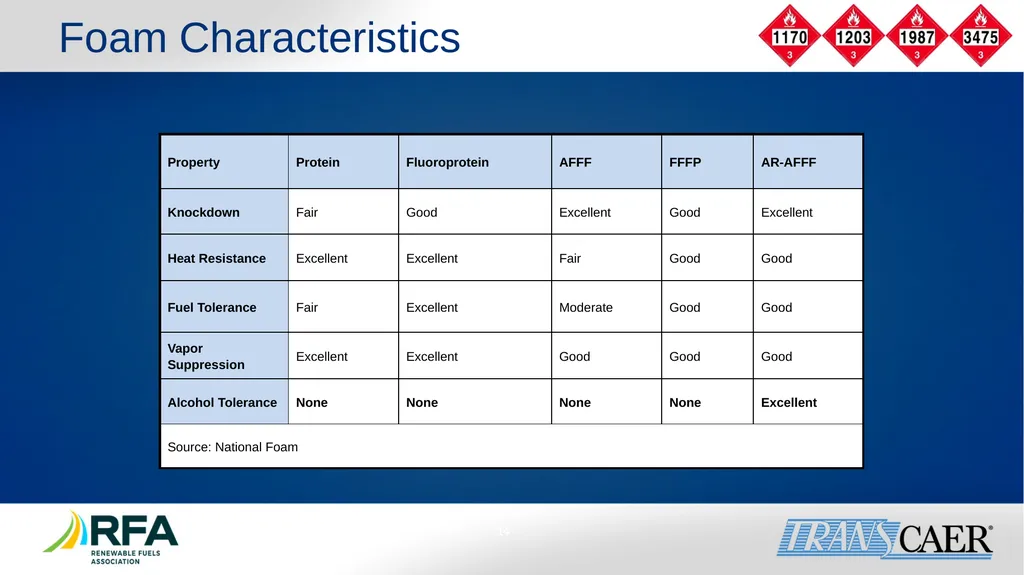
Foam Characteristics<br>
15
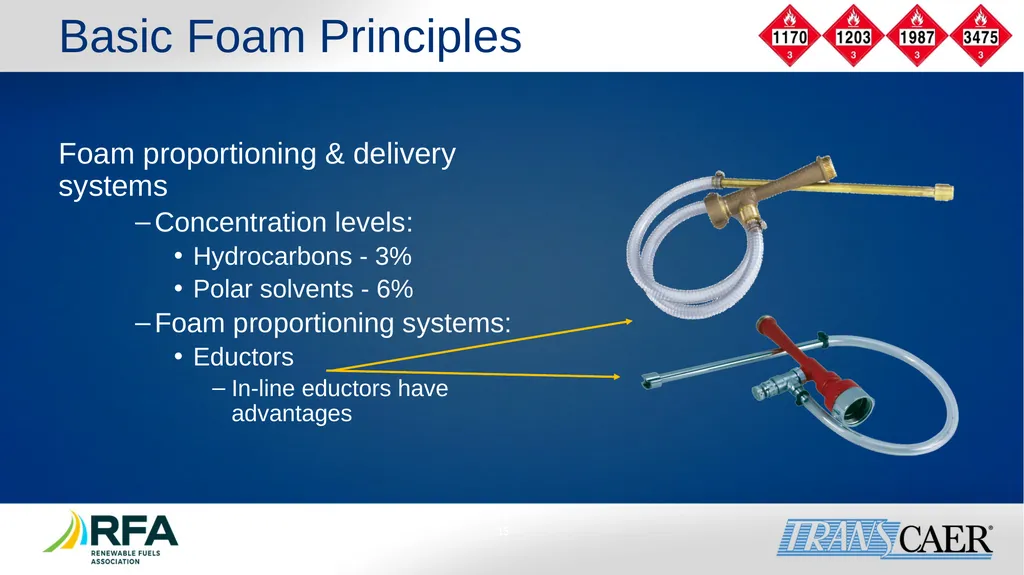
Basic Foam Principles Foam proportioning & delivery systems
Concentration levels:
Hydrocarbons - 3%
Polar solvents - 6%
Foam proportioning systems:
Eductors
In-line eductors have advantages<br>
Concentration levels:
Hydrocarbons - 3%
Polar solvents - 6%
Foam proportioning systems:
Eductors
In-line eductors have advantages<br>
16
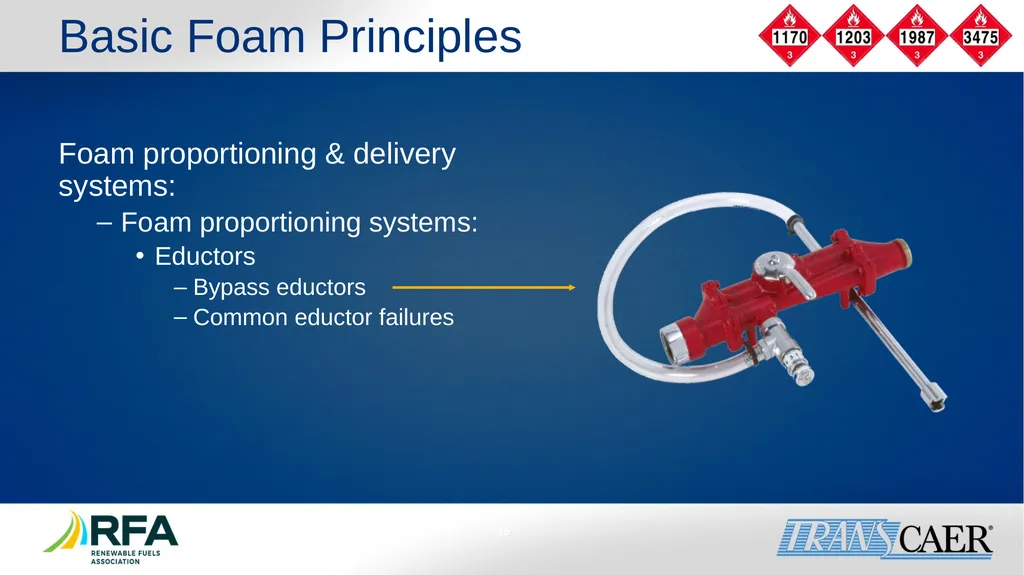
Basic Foam Principles Foam proportioning & delivery systems:
Foam proportioning systems:
Eductors
Bypass eductors
Common eductor failures<br>
Foam proportioning systems:
Eductors
Bypass eductors
Common eductor failures<br>
17
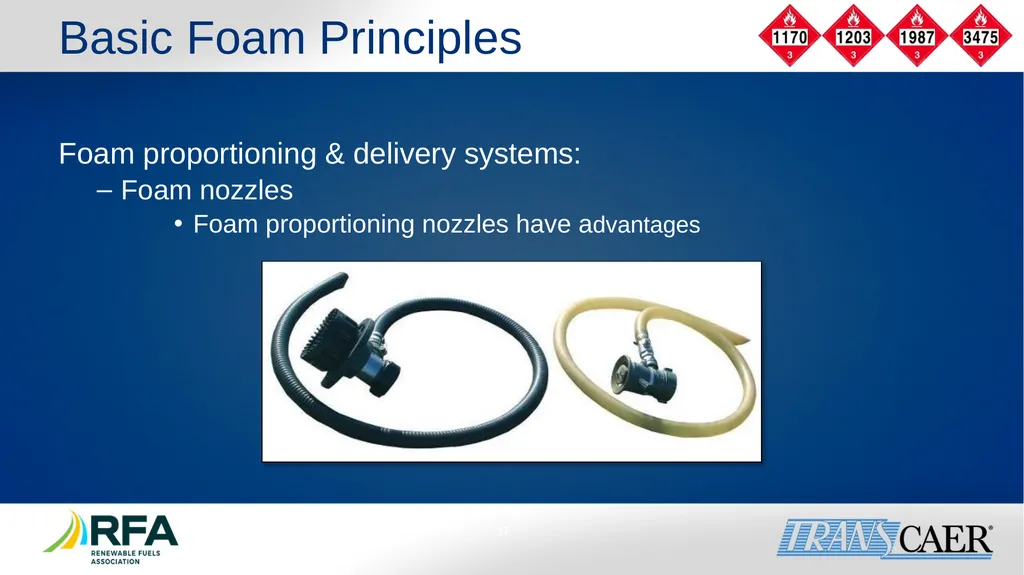
Basic Foam Principles Foam proportioning & delivery systems:
Foam nozzles
Foam proportioning nozzles have advantages<br>
Foam nozzles
Foam proportioning nozzles have advantages<br>
18
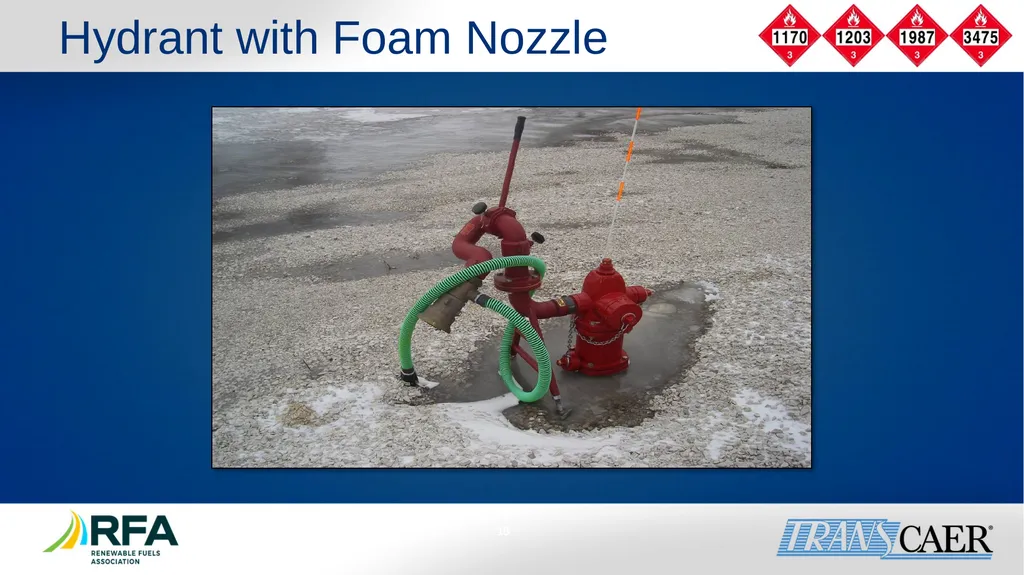
Hydrant with Foam Nozzle<br>
19
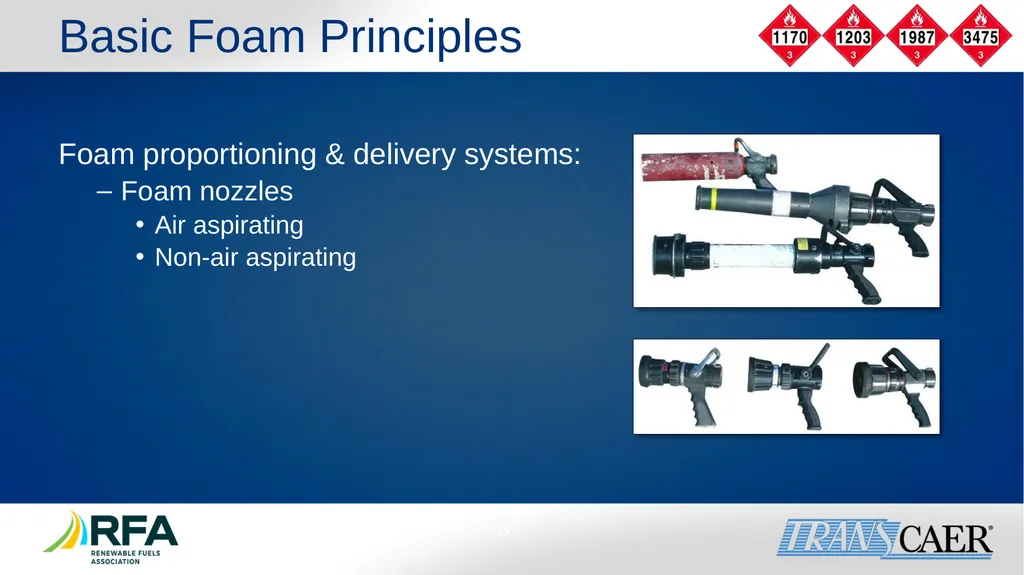
Basic Foam Principles Foam proportioning & delivery systems:
Foam nozzles
Air aspirating
Non-air aspirating<br>
Foam nozzles
Air aspirating
Non-air aspirating<br>
20
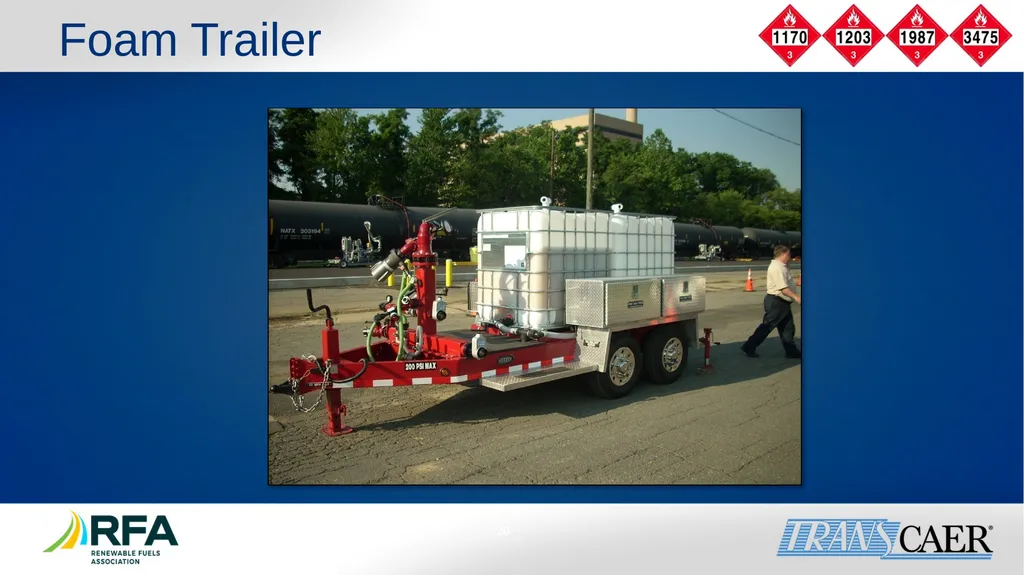
Foam Trailer<br>
21
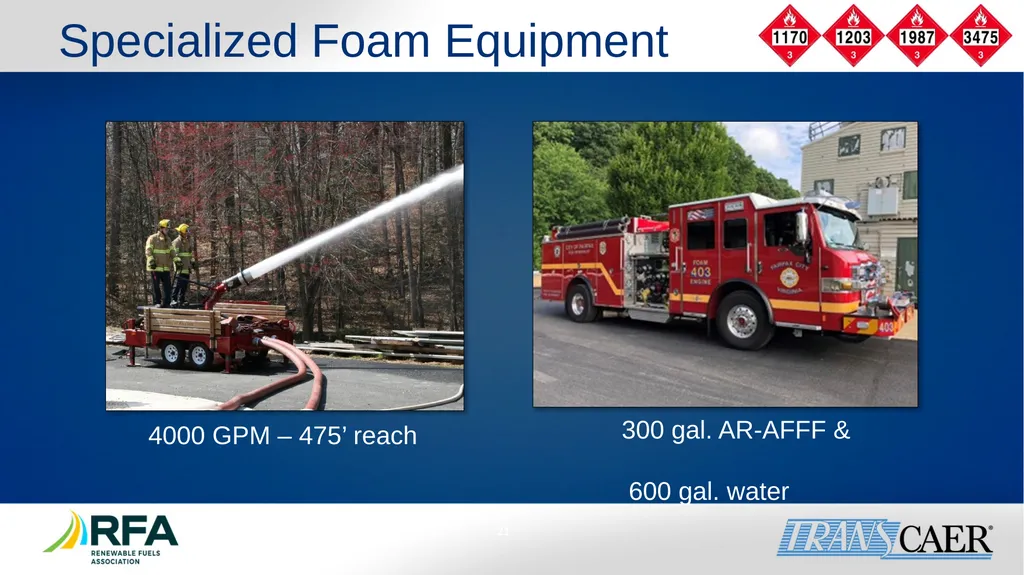
Specialized Foam Equipment 4000 GPM – 475’ reach 300 gal. AR-AFFF & 600 gal. water<br>
22
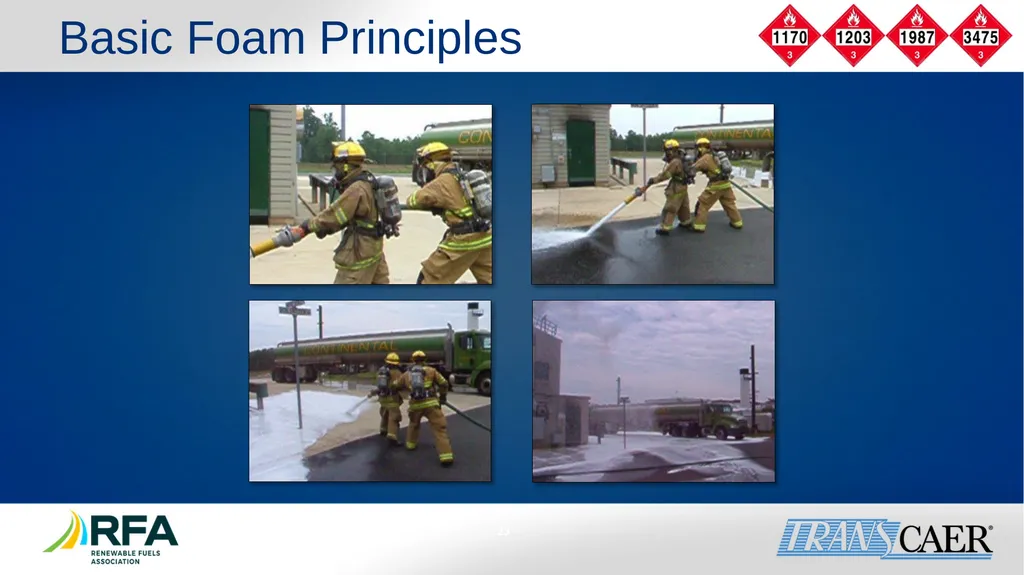
Basic Foam Principles Application techniques:
Never plunge foam directly into the fuel
Bounce-off:
Effective if there is an object in/ behind spill area
Bank-in:
Particularly effective with non-air aspirating fog nozzles
Rain-down:
An alternative application technique is the rain-down method. The nozzle is elevated and the foam is allowed to fall over the spill as gently as possible<br>
Never plunge foam directly into the fuel
Bounce-off:
Effective if there is an object in/ behind spill area
Bank-in:
Particularly effective with non-air aspirating fog nozzles
Rain-down:
An alternative application technique is the rain-down method. The nozzle is elevated and the foam is allowed to fall over the spill as gently as possible<br>
23
Basic Foam Principles<br>
24
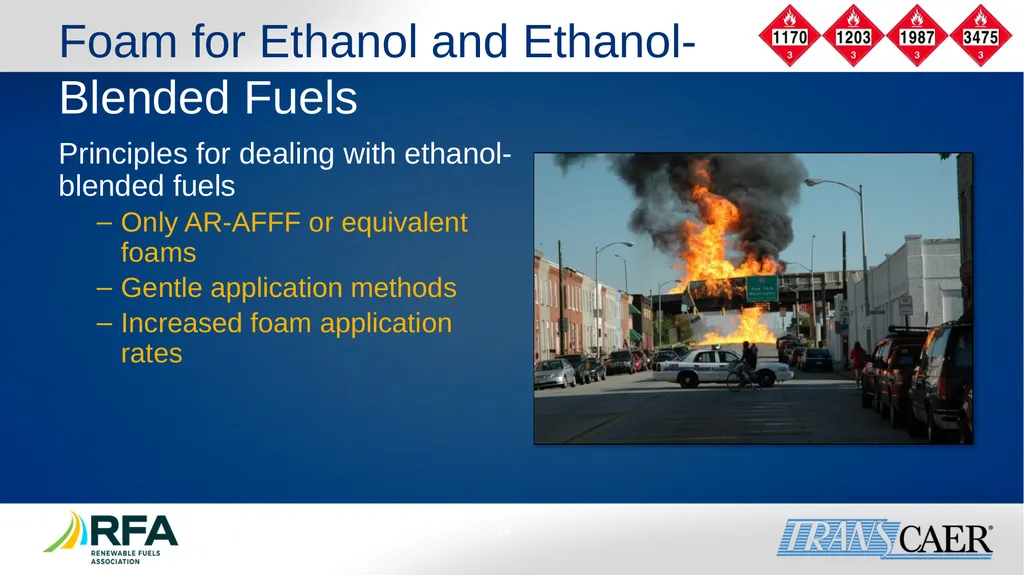
Principles for dealing with ethanol-blended fuels
Only AR-AFFF or equivalent foams
Gentle application methods
Increased foam application rates Foam for Ethanol and Ethanol--Blended Fuels<br>
Only AR-AFFF or equivalent foams
Gentle application methods
Increased foam application rates Foam for Ethanol and Ethanol--Blended Fuels<br>
25
Foam for Ethanol and Ethanol-Blended Fuels AR foams
Use of Type II application techniques:
Foam is applied indirectly to fire through fixed or semi-fixed foam chambers
Use of Type III application techniques:
Portable monitors & hand lines
Effective only when deflected off surfaces
Best option may be to protect surrounding exposures<br>
Use of Type II application techniques:
Foam is applied indirectly to fire through fixed or semi-fixed foam chambers
Use of Type III application techniques:
Portable monitors & hand lines
Effective only when deflected off surfaces
Best option may be to protect surrounding exposures<br>
26
Foam Recommendations for Fire Departments Consider converting to AR foam concentrates
Ensure foam is UL certified to meet NFPA standards
Develop means of having cache of AR foam readily available:
Mutual aid resources maybe available<br>
Ensure foam is UL certified to meet NFPA standards
Develop means of having cache of AR foam readily available:
Mutual aid resources maybe available<br>
27
Foam Application Rates Foam application with portable application devices may require higher rates
Application device types whether portable or stationary have operational set points
Foam application rates vary by manufacturer
Ethanol-blended fuels require higher flow rate of foam to extinguish fires, suppress vapors & increase emergency responder safety
Flow rates start at 2 gpm foam/ 10 sqft of AR type foam (0.2 gpm/ sqft) for any ethanol-blended fuel incident<br>
Application device types whether portable or stationary have operational set points
Foam application rates vary by manufacturer
Ethanol-blended fuels require higher flow rate of foam to extinguish fires, suppress vapors & increase emergency responder safety
Flow rates start at 2 gpm foam/ 10 sqft of AR type foam (0.2 gpm/ sqft) for any ethanol-blended fuel incident<br>
28
Alcohol Resistant Foam Facts Ensure all AR-AFFF foam supplies meet UL-162 testing certifications & so indicated in documentation & stamped on containers
Effective on both alcohol & hydrocarbon fires
Some have quicker knockdown abilities & longer foam retention times than protein-based hydrocarbon foams
Foam can stratify; must have maintenance program for re-agitation
Foam delivery systems such as foam tanks & totes cannot be shaken & remixed easily<br>
Effective on both alcohol & hydrocarbon fires
Some have quicker knockdown abilities & longer foam retention times than protein-based hydrocarbon foams
Foam can stratify; must have maintenance program for re-agitation
Foam delivery systems such as foam tanks & totes cannot be shaken & remixed easily<br>
29
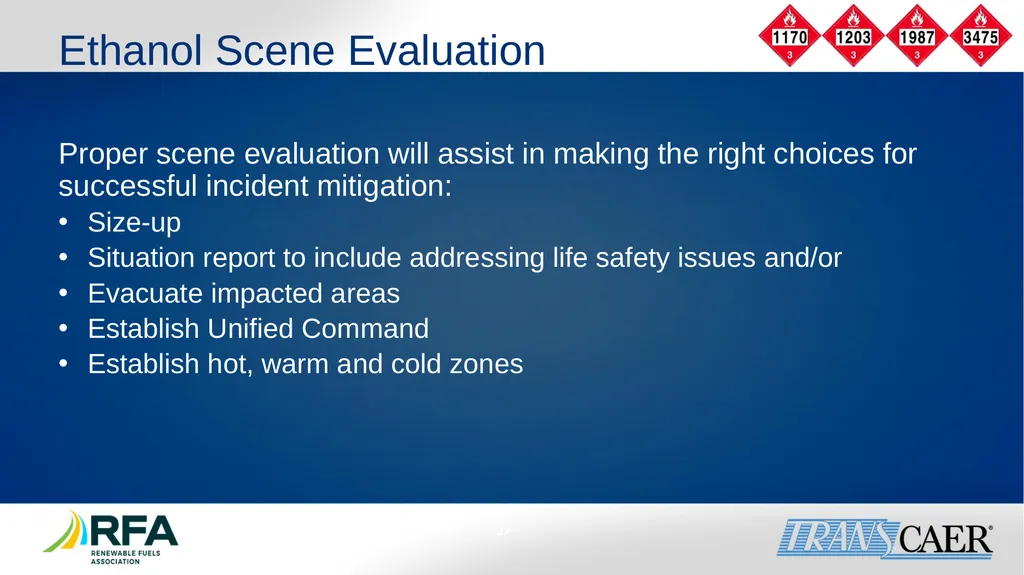
Ethanol Scene Evaluation Proper scene evaluation will assist in making the right choices for successful incident mitigation:
Size-up
Situation report to include addressing life safety issues and/or
Evacuate impacted areas
Establish Unified Command
Establish hot, warm and cold zones<br>
Size-up
Situation report to include addressing life safety issues and/or
Evacuate impacted areas
Establish Unified Command
Establish hot, warm and cold zones<br>
30
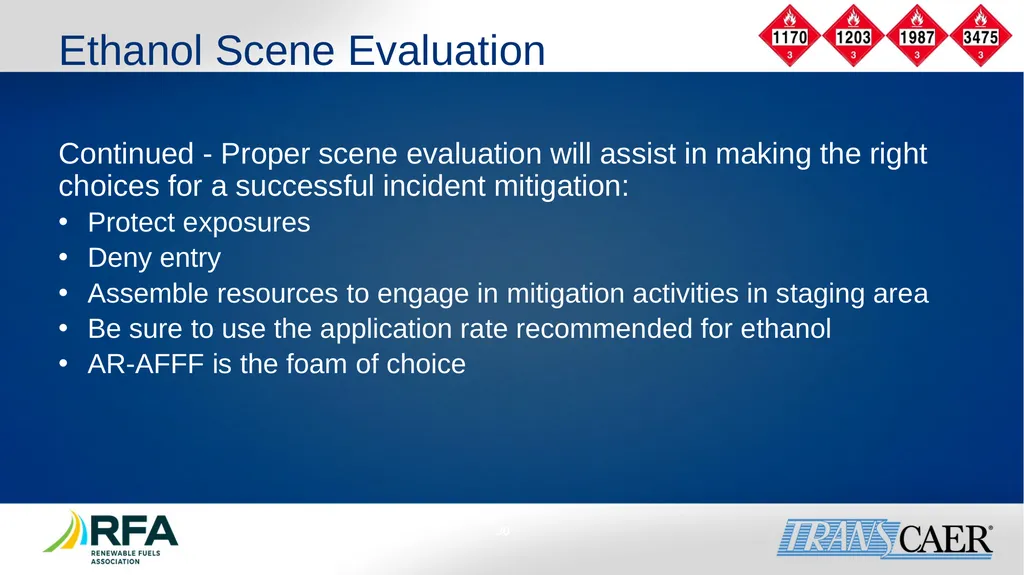
Ethanol Scene Evaluation Continued - Proper scene evaluation will assist in making the right choices for a successful incident mitigation:
Protect exposures
Deny entry
Assemble resources to engage in mitigation activities in staging area
Be sure to use the application rate recommended for ethanol
AR-AFFF is the foam of choice<br>
Protect exposures
Deny entry
Assemble resources to engage in mitigation activities in staging area
Be sure to use the application rate recommended for ethanol
AR-AFFF is the foam of choice<br>
31
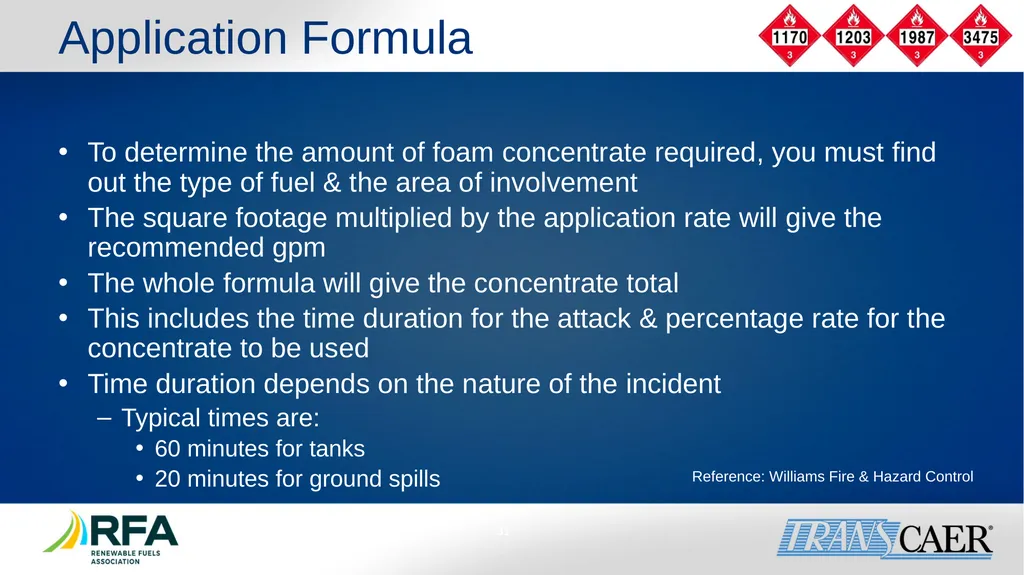
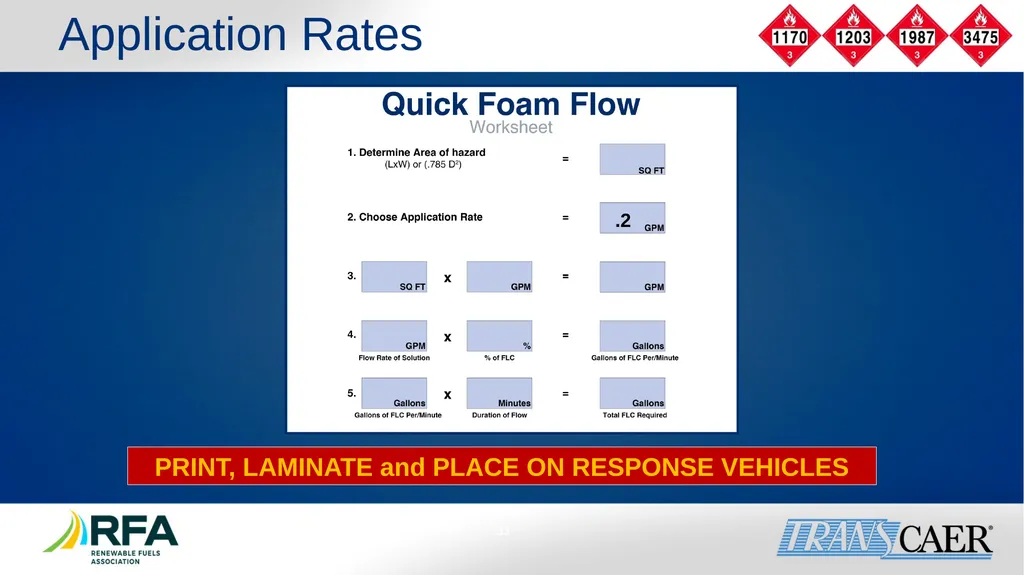
To determine the amount of foam concentrate required, you must find out the type of fuel & the area of involvement
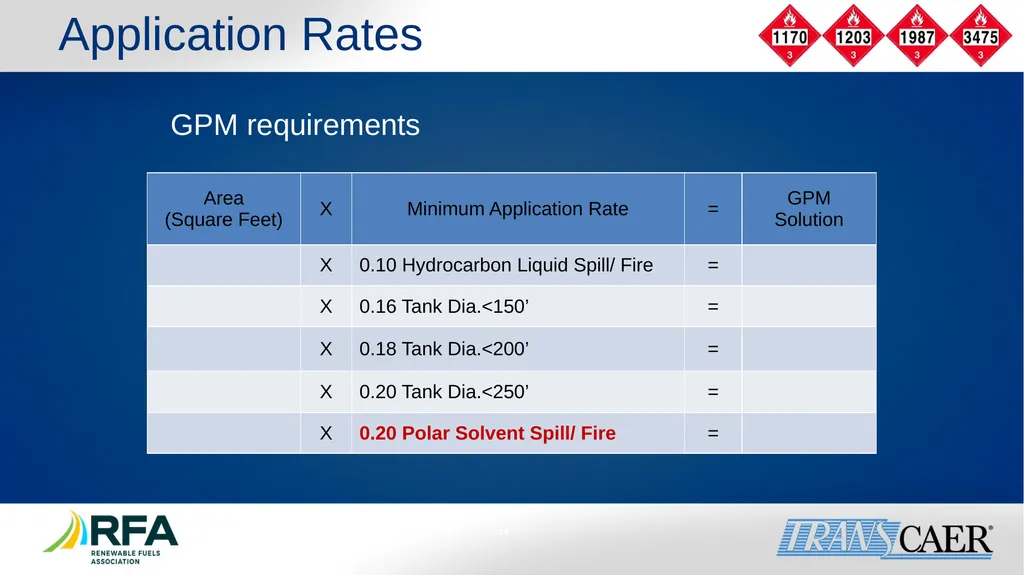
The square footage multiplied by the application rate will give the recommended gpm
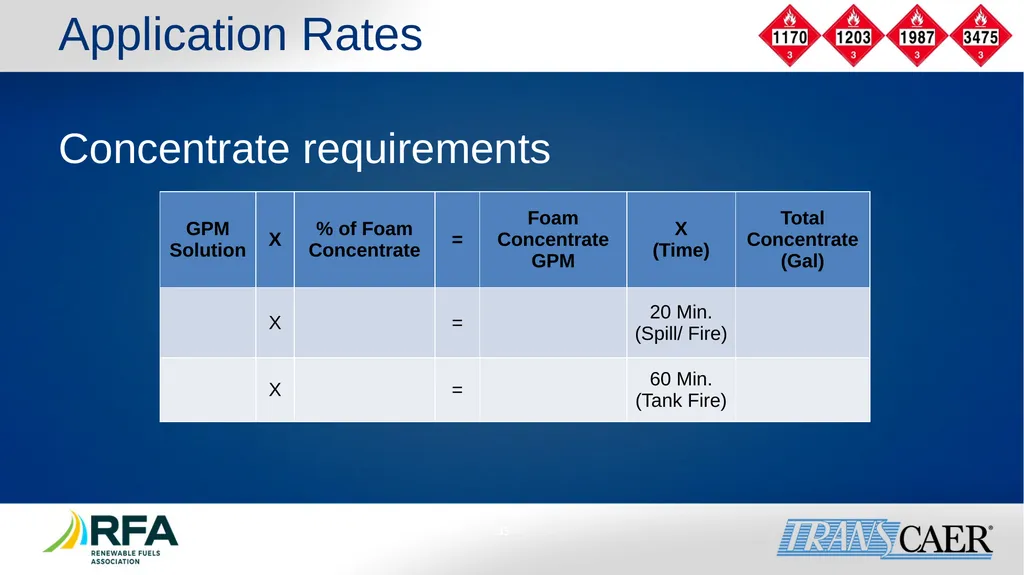
The whole formula will give the concentrate total
This includes the time duration for the attack & percentage rate for the concentrate to be used
Time duration depends on the nature of the incident
Typical times are:
60 minutes for tanks
20 minutes for ground spills Application Formula Reference: Williams Fire & Hazard Control<br>
The square footage multiplied by the application rate will give the recommended gpm
The whole formula will give the concentrate total
This includes the time duration for the attack & percentage rate for the concentrate to be used
Time duration depends on the nature of the incident
Typical times are:
60 minutes for tanks
20 minutes for ground spills Application Formula Reference: Williams Fire & Hazard Control<br>
32
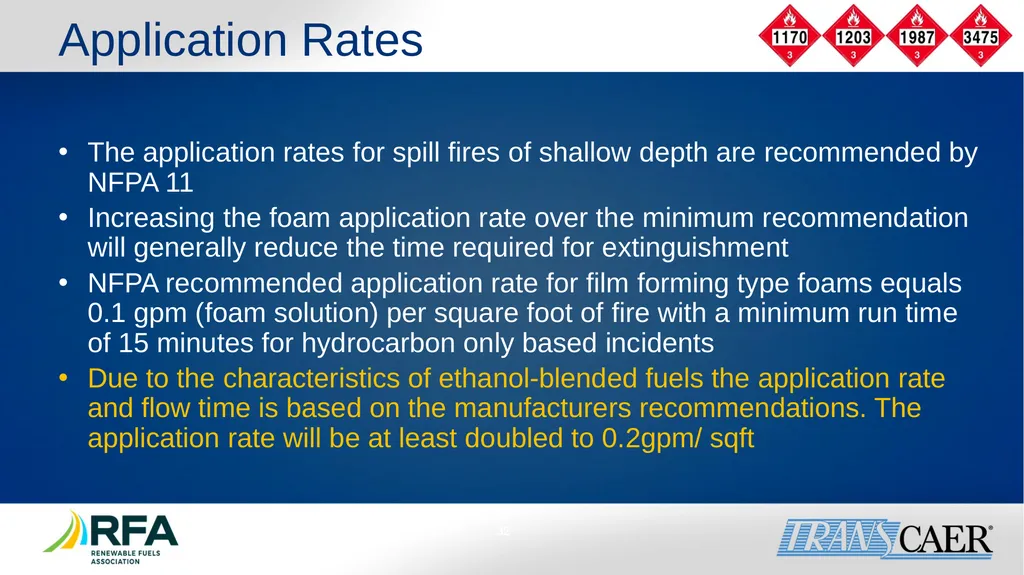
Application Rates The application rates for spill fires of shallow depth are recommended by NFPA 11
Increasing the foam application rate over the minimum recommendation will generally reduce the time required for extinguishment
NFPA recommended application rate for film forming type foams equals 0.1 gpm (foam solution) per square foot of fire with a minimum run time of 15 minutes for hydrocarbon only based incidents
Due to the characteristics of ethanol-blended fuels the application rate and flow time is based on the manufacturers recommendations. The application rate will be at least doubled to 0.2gpm/ sqft<br>
Increasing the foam application rate over the minimum recommendation will generally reduce the time required for extinguishment
NFPA recommended application rate for film forming type foams equals 0.1 gpm (foam solution) per square foot of fire with a minimum run time of 15 minutes for hydrocarbon only based incidents
Due to the characteristics of ethanol-blended fuels the application rate and flow time is based on the manufacturers recommendations. The application rate will be at least doubled to 0.2gpm/ sqft<br>
33
Application Rates PRINT, LAMINATE and PLACE ON RESPONSE VEHICLES .2<br>
34
Application Rates GPM requirements<br>
35
Concentrate requirements Application Rates<br>
36
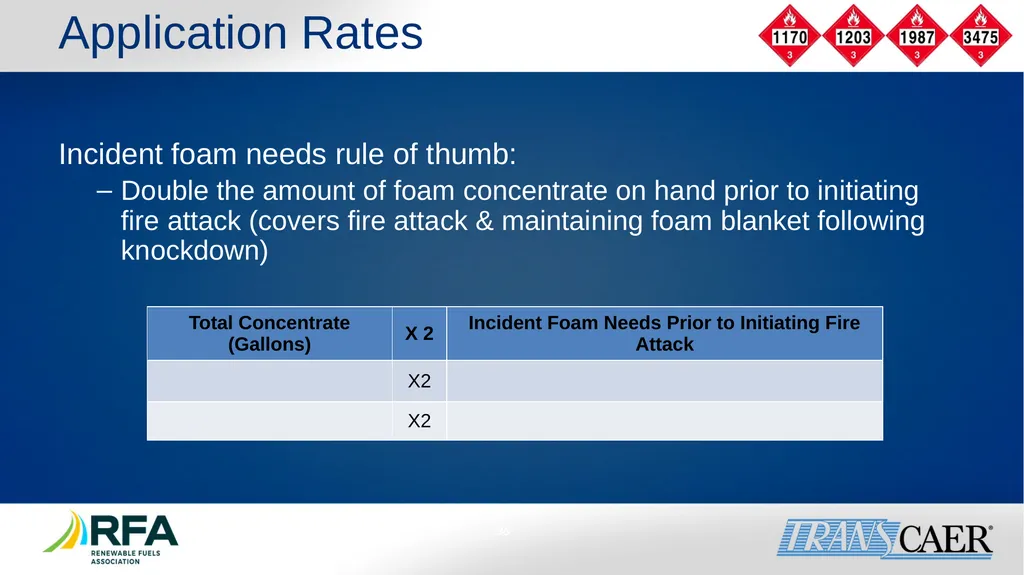
Application Rates Incident foam needs rule of thumb:
Double the amount of foam concentrate on hand prior to initiating fire attack (covers fire attack & maintaining foam blanket following knockdown)<br>
Double the amount of foam concentrate on hand prior to initiating fire attack (covers fire attack & maintaining foam blanket following knockdown)<br>
37
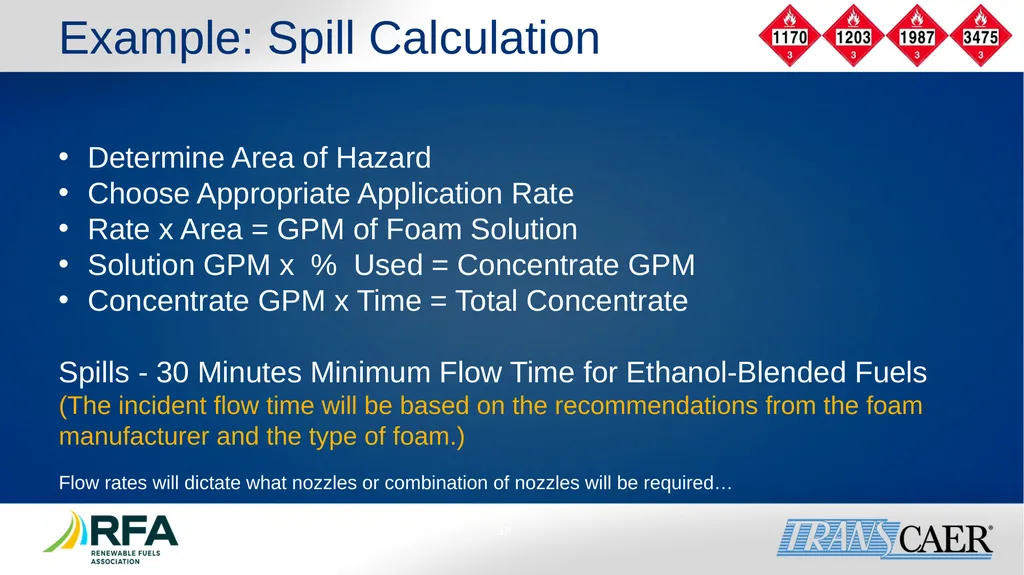
Determine Area of Hazard
Choose Appropriate Application Rate
Rate x Area = GPM of Foam Solution
Solution GPM x % Used = Concentrate GPM
Concentrate GPM x Time = Total Concentrate
Spills - 30 Minutes Minimum Flow Time for Ethanol-Blended Fuels
(The incident flow time will be based on the recommendations from the foam manufacturer and the type of foam.)
Flow rates will dictate what nozzles or combination of nozzles will be required… Example: Spill Calculation<br>
Choose Appropriate Application Rate
Rate x Area = GPM of Foam Solution
Solution GPM x % Used = Concentrate GPM
Concentrate GPM x Time = Total Concentrate
Spills - 30 Minutes Minimum Flow Time for Ethanol-Blended Fuels
(The incident flow time will be based on the recommendations from the foam manufacturer and the type of foam.)
Flow rates will dictate what nozzles or combination of nozzles will be required… Example: Spill Calculation<br>
38
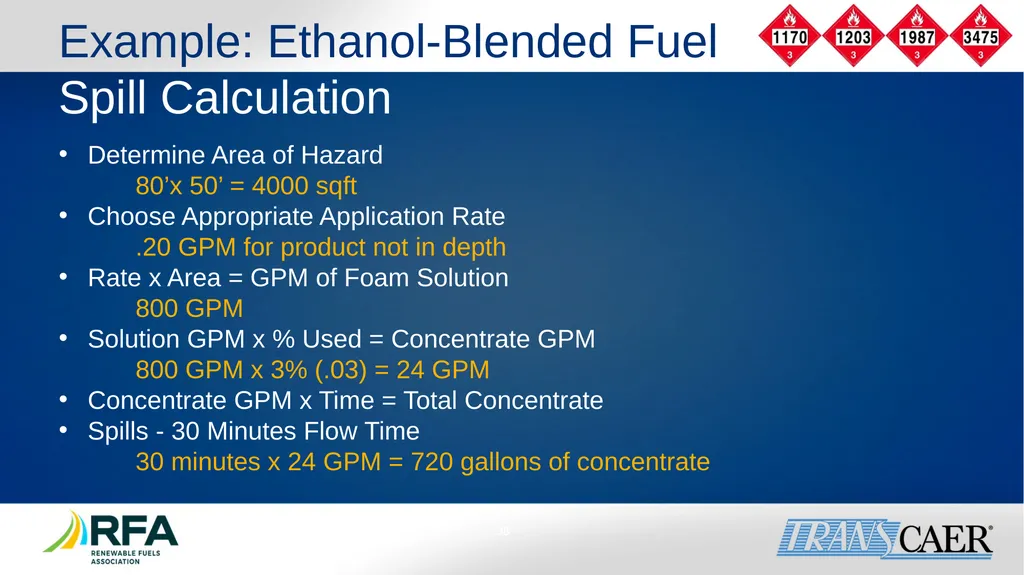
Example: Ethanol-Blended Fuel
Spill Calculation Determine Area of Hazard
80’x 50’ = 4000 sqft
Choose Appropriate Application Rate
.20 GPM for product not in depth
Rate x Area = GPM of Foam Solution
800 GPM
Solution GPM x % Used = Concentrate GPM
800 GPM x 3% (.03) = 24 GPM
Concentrate GPM x Time = Total Concentrate
Spills - 30 Minutes Flow Time
30 minutes x 24 GPM = 720 gallons of concentrate<br>
80’x 50’ = 4000 sqft
Choose Appropriate Application Rate
.20 GPM for product not in depth
Rate x Area = GPM of Foam Solution
800 GPM
Solution GPM x % Used = Concentrate GPM
800 GPM x 3% (.03) = 24 GPM
Concentrate GPM x Time = Total Concentrate
Spills - 30 Minutes Flow Time
30 minutes x 24 GPM = 720 gallons of concentrate<br>
39
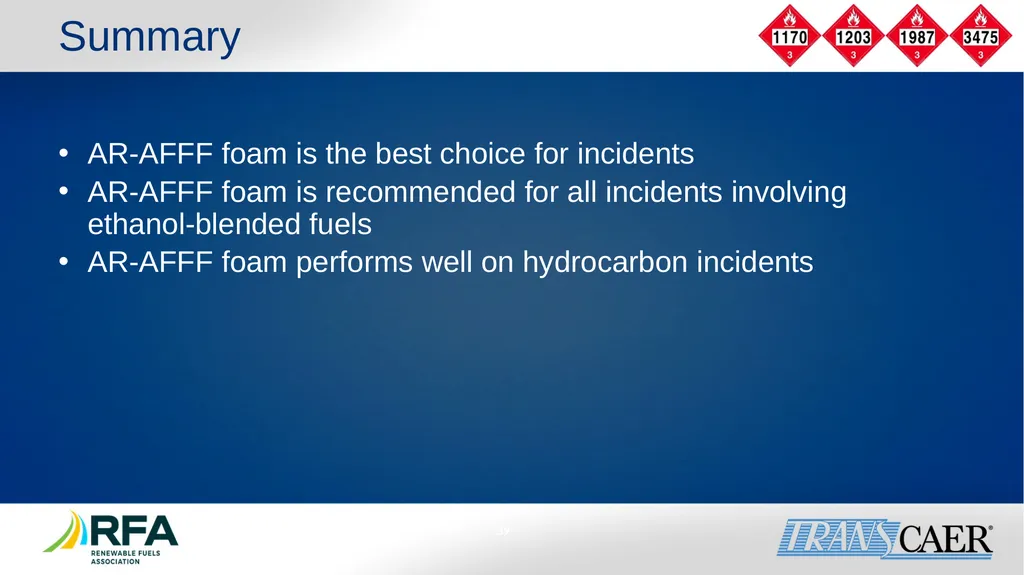
Summary AR-AFFF foam is the best choice for incidents
AR-AFFF foam is recommended for all incidents involving ethanol-blended fuels
AR-AFFF foam performs well on hydrocarbon incidents<br>
AR-AFFF foam is recommended for all incidents involving ethanol-blended fuels
AR-AFFF foam performs well on hydrocarbon incidents<br>