MODULE 6: RHIS Data Demand and Use ROUTINE HEALTH INFORMATION SYSTEMS A Curriculum on Basic Concepts and Practice Introduction 1 The complete RHIS curriculum is available here: https:www.measureevaluation.orgour-work
"MODULE 6: RHIS Data Demand and Use ROUTINE HEALTH" is the property of its rightful owner. Permission is granted to
download and print the materials on this website for personal, non-commercial use only, and to display it
on your personal computer provided you do not modify the materials and that you retain all copyright
notices contained in the materials. By downloading content from our website, you accept the terms of this
agreement.
Presentation Transcript
01
MODULE 6:
RHIS Data Demand and Use ROUTINE HEALTH INFORMATION SYSTEMS
A Curriculum on Basic Concepts and Practice Introduction 1 The complete RHIS curriculum is available here: https://www.measureevaluation.org/our-work/ routine-health-information-systems/rhis-curriculum<br>
02
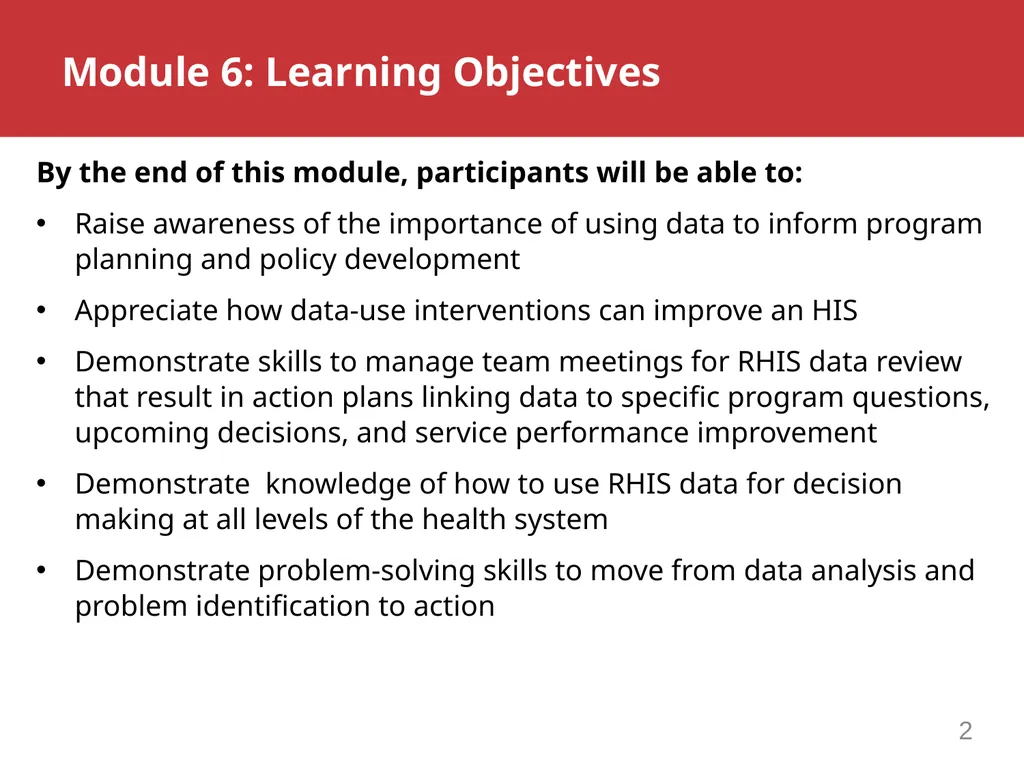
Module 6: Learning Objectives By the end of this module, participants will be able to:
Raise awareness of the importance of using data to inform program planning and policy development
Appreciate how data-use interventions can improve an HIS
Demonstrate skills to manage team meetings for RHIS data review that result in action plans linking data to specific program questions, upcoming decisions, and service performance improvement
Demonstrate knowledge of how to use RHIS data for decision making at all levels of the health system
Demonstrate problem-solving skills to move from data analysis and problem identification to action 2<br>
03
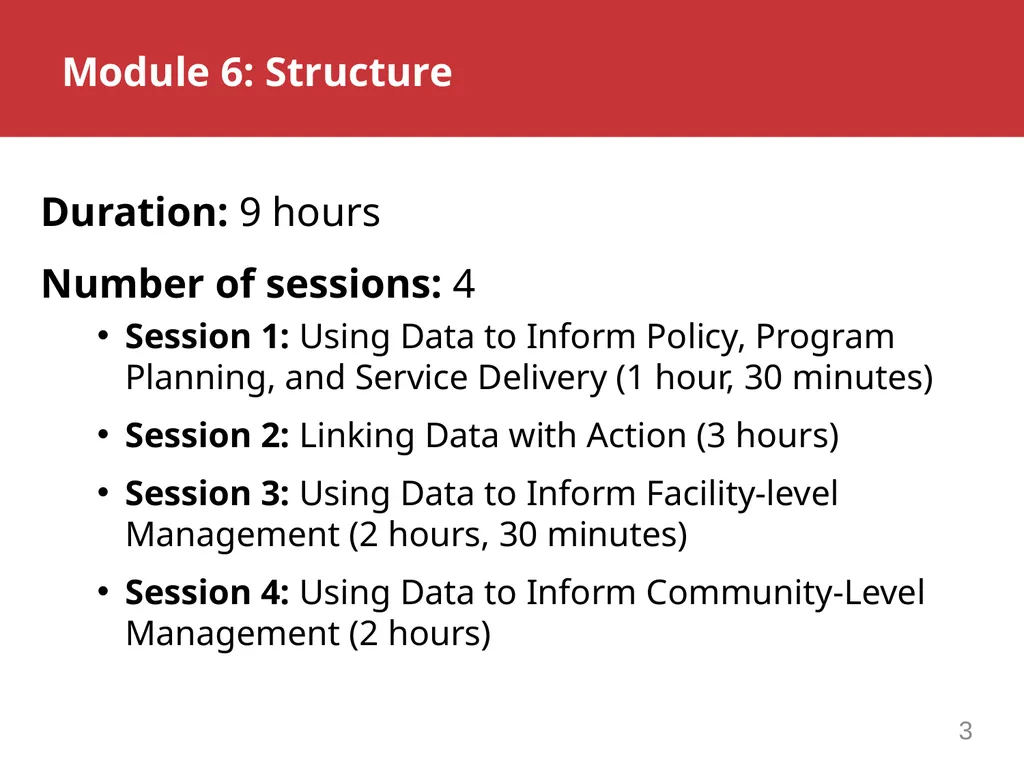
Module 6: Structure Duration: 9 hours
Number of sessions: 4
Session 1: Using Data to Inform Policy, Program Planning, and Service Delivery (1 hour, 30 minutes)
Session 2: Linking Data with Action (3 hours)
Session 3: Using Data to Inform Facility-level Management (2 hours, 30 minutes)
Session 4: Using Data to Inform Community-Level Management (2 hours) 3<br>
04
Module 6: Suggested References Chewicha, K. & Azim, T. (2013). Community health information system for family-centered health care: Scale-up in Southern Nations, Nationalities and People’s Region (SNNPR) Ethiopia. Ethiopia Ministry of Health Quarterly Health Bulletin, 5(1):49-53. Retrieved from http://www.cpc.unc.edu/measure/resources/publications/ja-13-161
Judice, N. (2009). Seven steps to use routine information to improve HIV/AIDS programs: A guide for HIV/AIDS program managers and providers. Chapel Hill, NC, USA: MEASURE Evaluation, University of North Carolina. Retrieved from http://www.cpc.unc.edu/measure/our-work/data-demand-and-use/7-steps-to-improve-hiv-aids-programs
LaFond, A., et al. (2003). Using data to improve service delivery: a self-evaluation approach. Retrieved from http://www.cpc.unc.edu/measure/resources/publications/sr-03-12/ 4<br>
05
Module 6: Suggested References Marsh, D. (2000). Population-based community health information systems. In T. Lippeveld, R. Sauerborn, & C. Bodart. (Eds.), Design and implementation of health information systems (pp. 146–175). Geneva, Switzerland: World Health Organization. Retrieved from http://apps.who.int/iris/handle/10665/42289
MEASURE Evaluation. (2011). Tools for data demand and use in the health sector: Framework for linking data with action. Chapel Hill, NC, USA: MEASURE Evaluation, University of North Carolina. Retrieved from http://www.cpc.unc.edu/measure/resources/publications/ms-11-46-b 5<br>
06
ROUTINE HEALTH INFORMATION SYSTEMS
A Curriculum on Basic Concepts and Practice This presentation was produced with the support of the United States Agency for International Development (USAID) under the terms of MEASURE Evaluation cooperative agreement AID-OAA-L-14-00004. MEASURE Evaluation is implemented by the Carolina Population Center, University of North Carolina at Chapel Hill in partnership with ICF International; John Snow, Inc.; Management Sciences for Health; Palladium; and Tulane University. The views expressed in this presentation do not necessarily reflect the views of USAID or the United States government. 6<br>