Module 9 – Storing Information Training Materials
Description: Module 9 Storing Information Training Materials on the International Protocol Institute for International Criminal Investigations 2015 INTERNATIONAL PROTOCOL, PART 2 MODULE 9 PAGES 68-70 Training Materials on the International Protocol
Related Topics
Download Presentation
"Module 9 – Storing Information Training Materials" is the property of its rightful owner. Permission is granted to download and print the materials on this website for personal, non-commercial use only, and to display it on your personal computer provided you do not modify the materials and that you retain all copyright notices contained in the materials. By downloading content from our website, you accept the terms of this agreement.
Presentation Transcript
slide1. Module 9 – Storing Information Training Materials on the International Protocol
© Institute for International Criminal Investigations 2015 INTERNATIONAL PROTOCOL,
PART 2 MODULE 9
PAGES 68-70<br>
slide2. Training Materials on the International Protocol
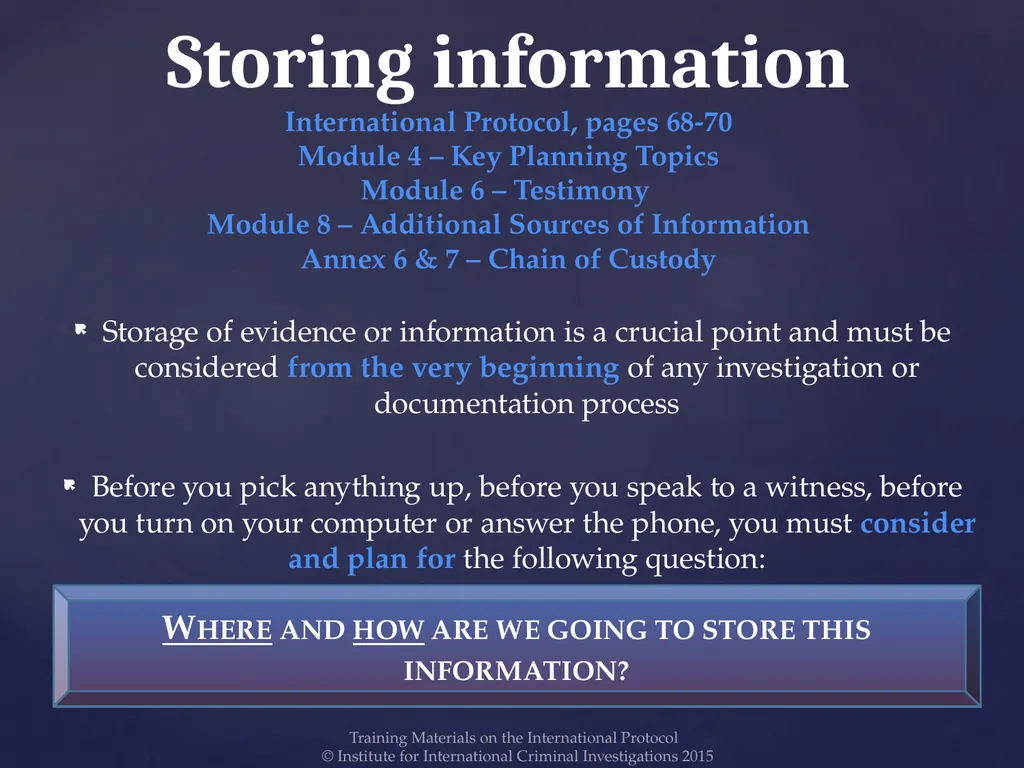
© Institute for International Criminal Investigations 2015 Storage of evidence or information is a crucial point and must be considered from the very beginning of any investigation or documentation process
Before you pick anything up, before you speak to a witness, before you turn on your computer or answer the phone, you must consider and plan for the following question: Storing informationInternational Protocol, pages 68-70Module 4 – Key Planning TopicsModule 6 – Testimony Module 8 – Additional Sources of InformationAnnex 6 & 7 – Chain of Custody Where and how are we going to store this information?<br>
slide3. Training Materials on the International Protocol
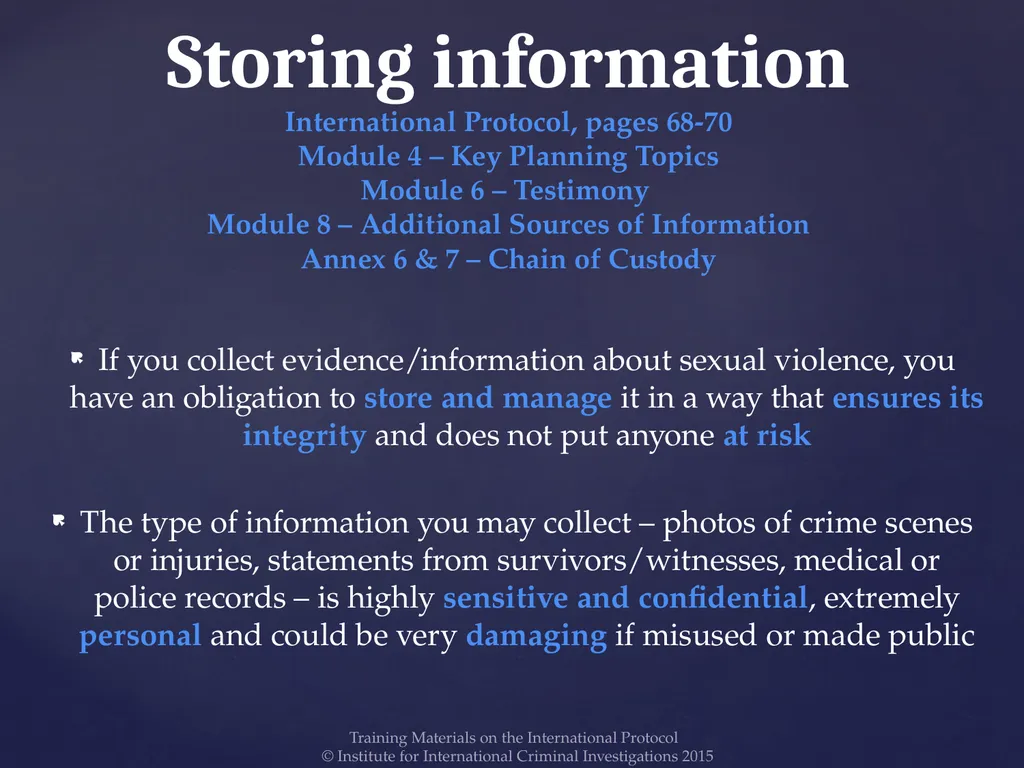
© Institute for International Criminal Investigations 2015 If you collect evidence/information about sexual violence, you have an obligation to store and manage it in a way that ensures its integrity and does not put anyone at risk
The type of information you may collect – photos of crime scenes or injuries, statements from survivors/witnesses, medical or police records – is highly sensitive and confidential, extremely personal and could be very damaging if misused or made public Storing informationInternational Protocol, pages 68-70Module 4 – Key Planning TopicsModule 6 – Testimony Module 8 – Additional Sources of InformationAnnex 6 & 7 – Chain of Custody<br>
slide4. Training Materials on the International Protocol
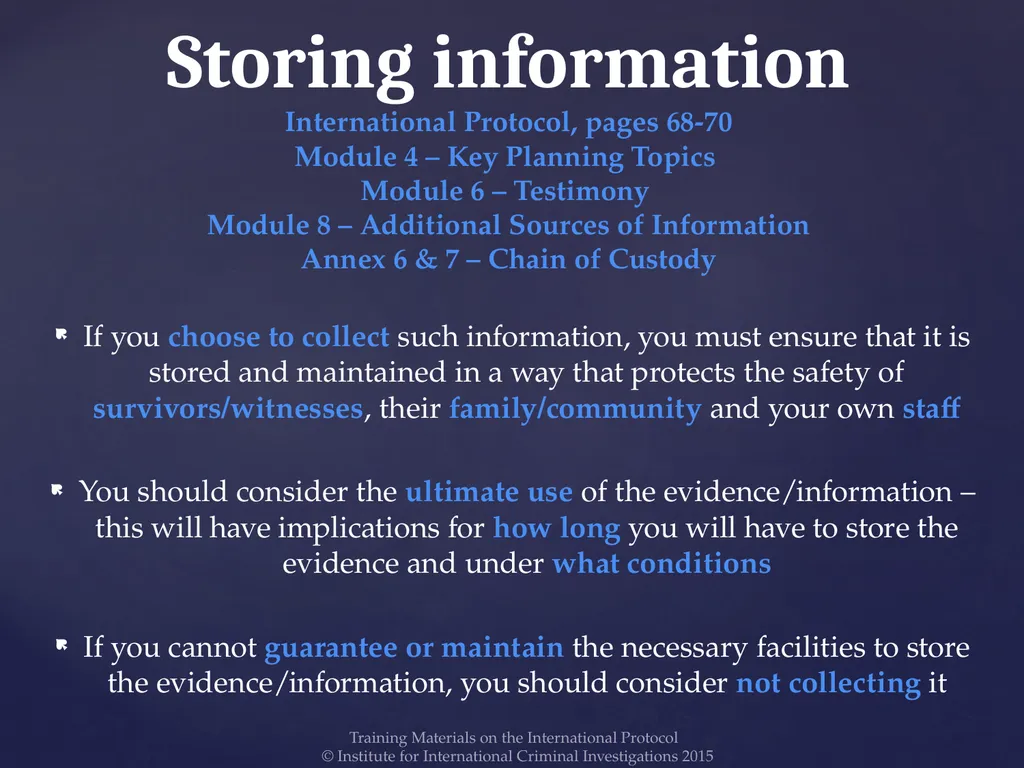
© Institute for International Criminal Investigations 2015 If you choose to collect such information, you must ensure that it is stored and maintained in a way that protects the safety of survivors/witnesses, their family/community and your own staff
You should consider the ultimate use of the evidence/information – this will have implications for how long you will have to store the evidence and under what conditions
If you cannot guarantee or maintain the necessary facilities to store the evidence/information, you should consider not collecting it Storing informationInternational Protocol, pages 68-70Module 4 – Key Planning Topics Module 6 – Testimony Module 8 – Additional Sources of InformationAnnex 6 & 7 – Chain of Custody<br>
slide5. Training Materials on the International Protocol
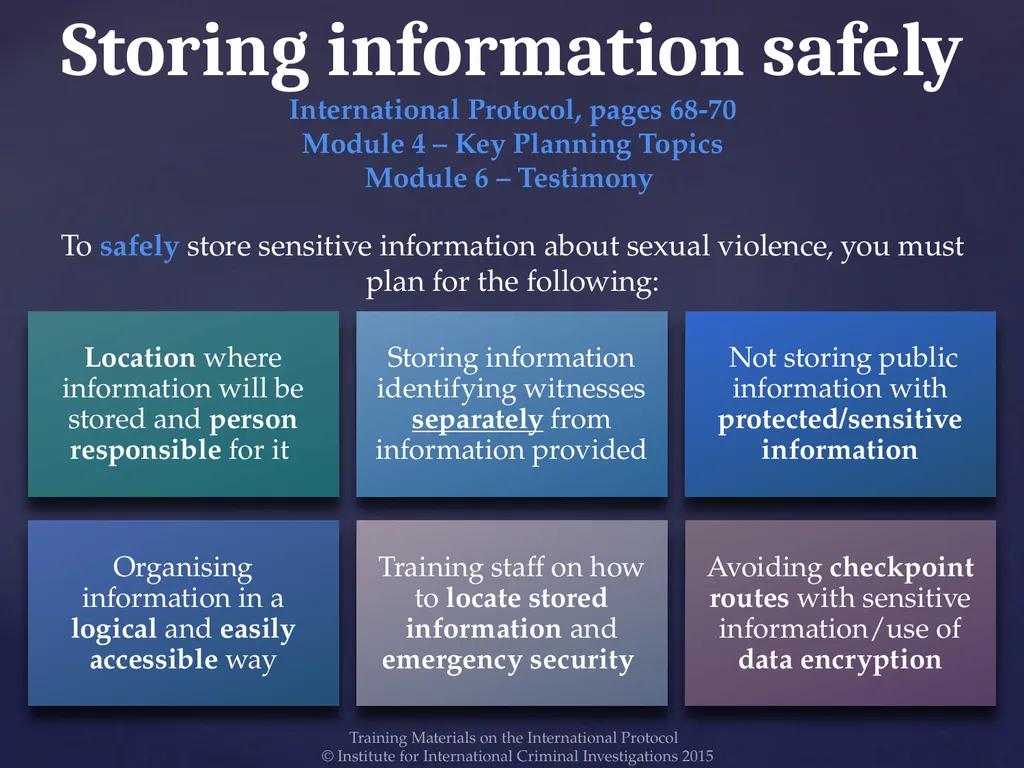
© Institute for International Criminal Investigations 2015 To safely store sensitive information about sexual violence, you must plan for the following: Storing information safelyInternational Protocol, pages 68-70Module 4 – Key Planning TopicsModule 6 – Testimony<br>
slide6. Storing documents or physical informationInternational Protocol, page 69Module 3 – Preliminary ConsiderationsModule 8 – Additional Sources of Information Training Materials on the International Protocol
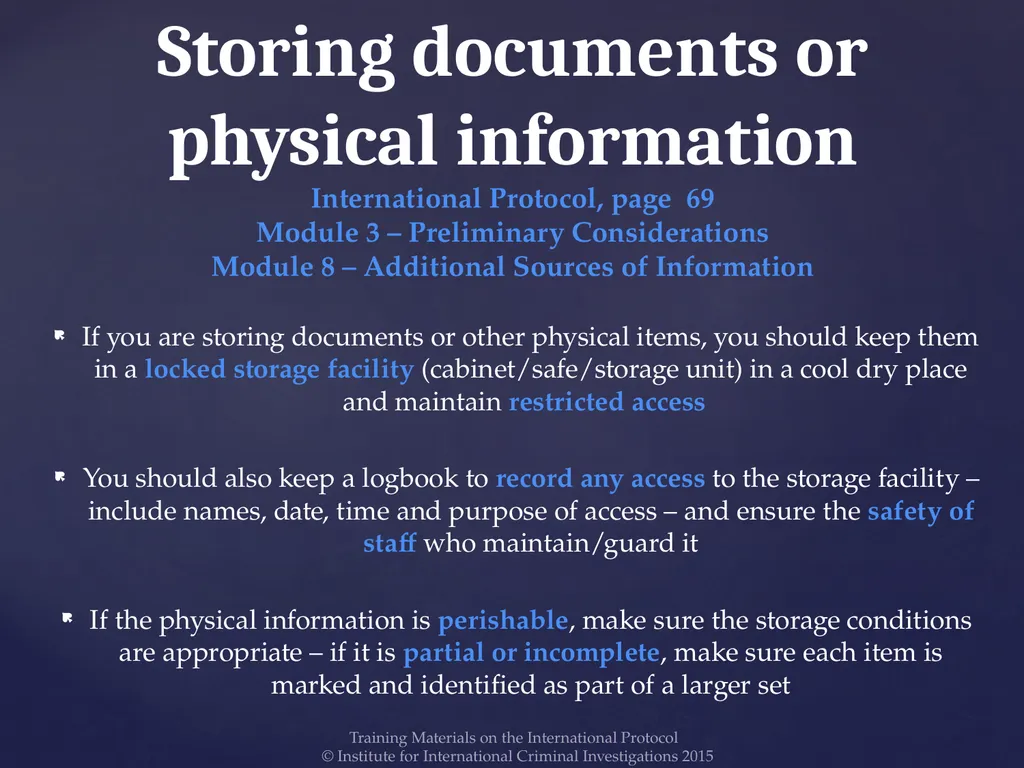
© Institute for International Criminal Investigations 2015 If you are storing documents or other physical items, you should keep them in a locked storage facility (cabinet/safe/storage unit) in a cool dry place and maintain restricted access
You should also keep a logbook to record any access to the storage facility – include names, date, time and purpose of access – and ensure the safety of staff who maintain/guard it
If the physical information is perishable, make sure the storage conditions are appropriate – if it is partial or incomplete, make sure each item is marked and identified as part of a larger set<br>
slide7. Storing audio-visual informationInternational Protocol, page 69Module 7 – Interviewing Module 8 – Additional Sources of InformationAnnex 6 & 7 – Chain of Custody Training Materials on the International Protocol
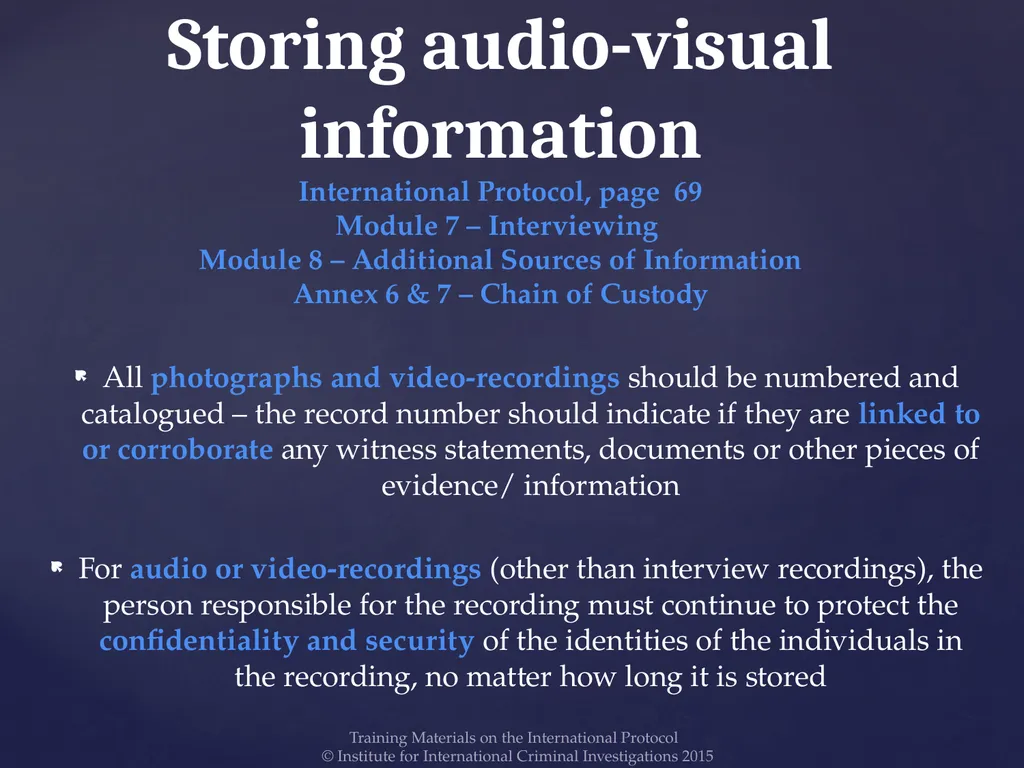
© Institute for International Criminal Investigations 2015 All photographs and video-recordings should be numbered and catalogued – the record number should indicate if they are linked to or corroborate any witness statements, documents or other pieces of evidence/ information
For audio or video-recordings (other than interview recordings), the person responsible for the recording must continue to protect the confidentiality and security of the identities of the individuals in the recording, no matter how long it is stored<br>
slide8. Training Materials on the International Protocol
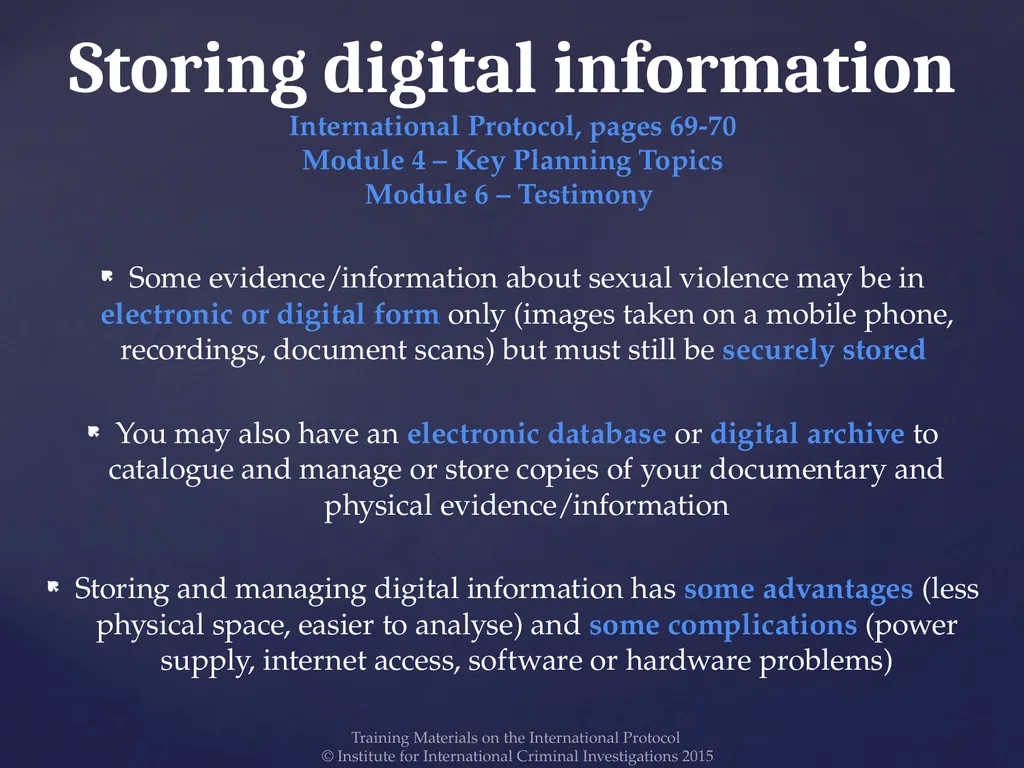
© Institute for International Criminal Investigations 2015 Some evidence/information about sexual violence may be in electronic or digital form only (images taken on a mobile phone, recordings, document scans) but must still be securely stored
You may also have an electronic database or digital archive to catalogue and manage or store copies of your documentary and physical evidence/information
Storing and managing digital information has some advantages (less physical space, easier to analyse) and some complications (power supply, internet access, software or hardware problems) Storing digital informationInternational Protocol, pages 69-70Module 4 – Key Planning TopicsModule 6 – Testimony<br>
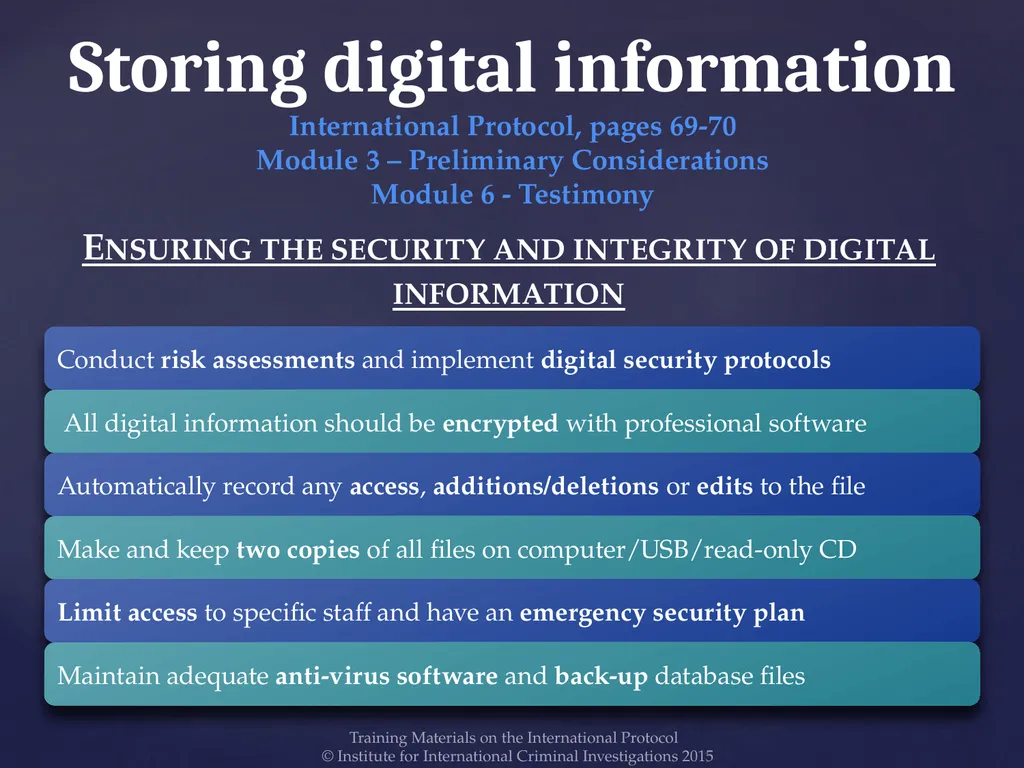
slide9. Ensuring the security and integrity of digital information Training Materials on the International Protocol
© Institute for International Criminal Investigations 2015 Storing digital informationInternational Protocol, pages 69-70Module 3 – Preliminary Considerations
Module 6 - Testimony<br>
slide10. Training Materials on the International Protocol
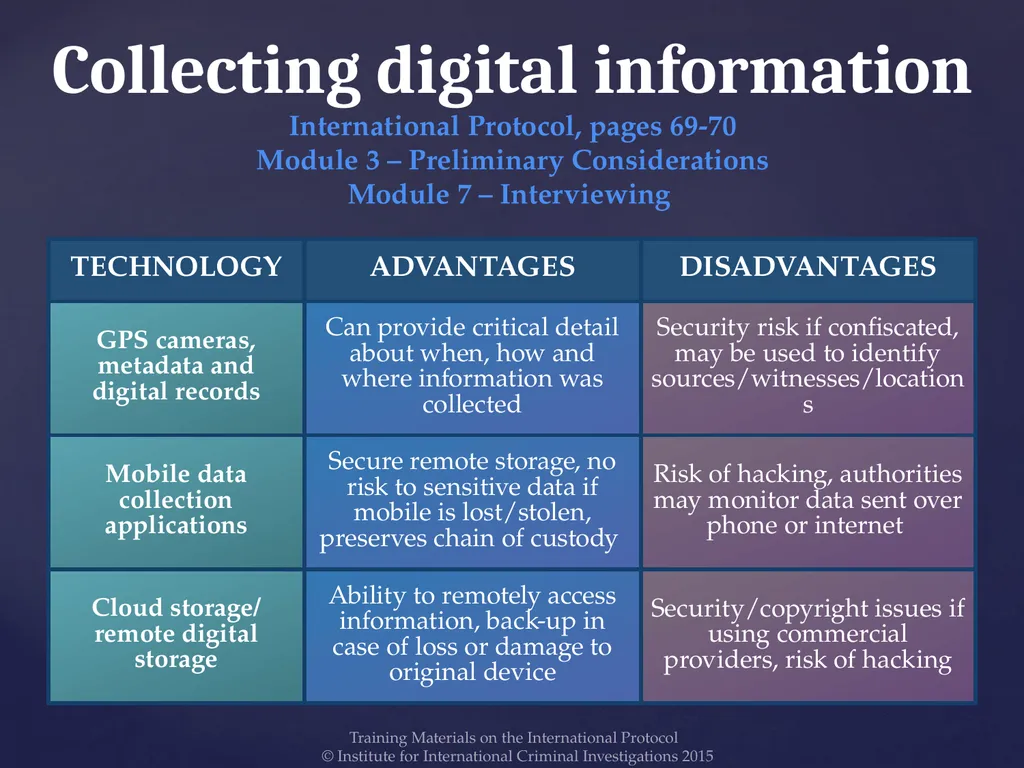
© Institute for International Criminal Investigations 2015 Collecting digital informationInternational Protocol, pages 69-70Module 3 – Preliminary Considerations
Module 7 – Interviewing<br>
slide11. Training Materials on the International Protocol
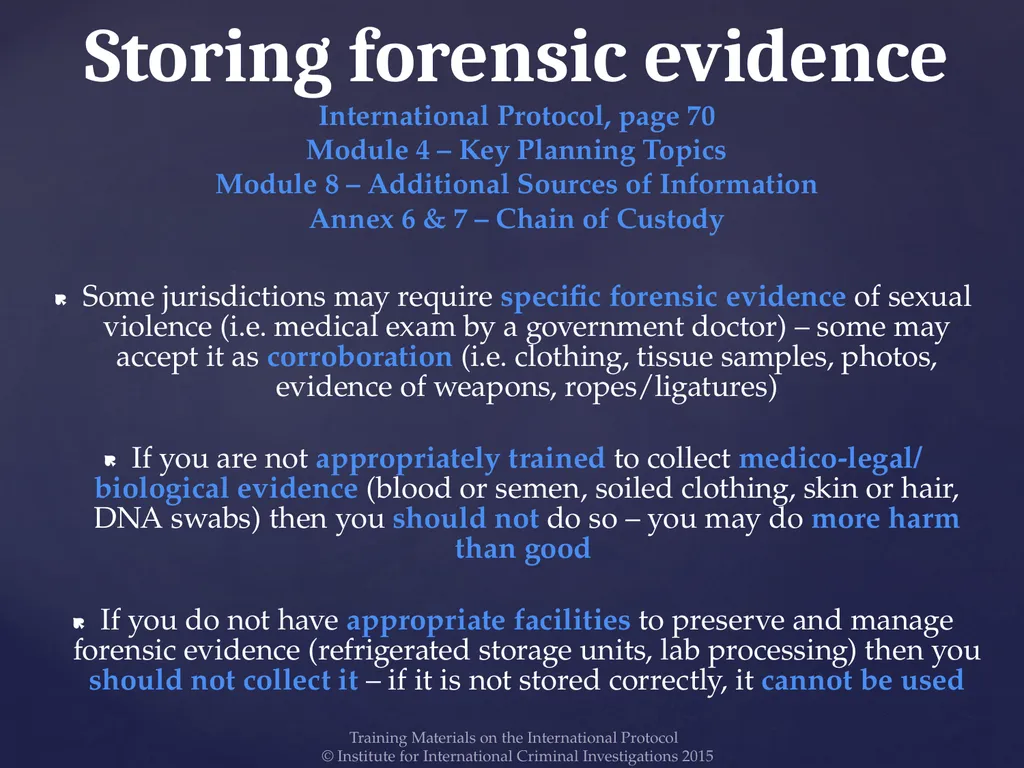
© Institute for International Criminal Investigations 2015 Some jurisdictions may require specific forensic evidence of sexual violence (i.e. medical exam by a government doctor) – some may accept it as corroboration (i.e. clothing, tissue samples, photos, evidence of weapons, ropes/ligatures)
If you are not appropriately trained to collect medico-legal/ biological evidence (blood or semen, soiled clothing, skin or hair, DNA swabs) then you should not do so – you may do more harm than good
If you do not have appropriate facilities to preserve and manage forensic evidence (refrigerated storage units, lab processing) then you should not collect it – if it is not stored correctly, it cannot be used Storing forensic evidenceInternational Protocol, page 70Module 4 – Key Planning TopicsModule 8 – Additional Sources of InformationAnnex 6 & 7 – Chain of Custody<br>
slide12. Training Materials on the International Protocol
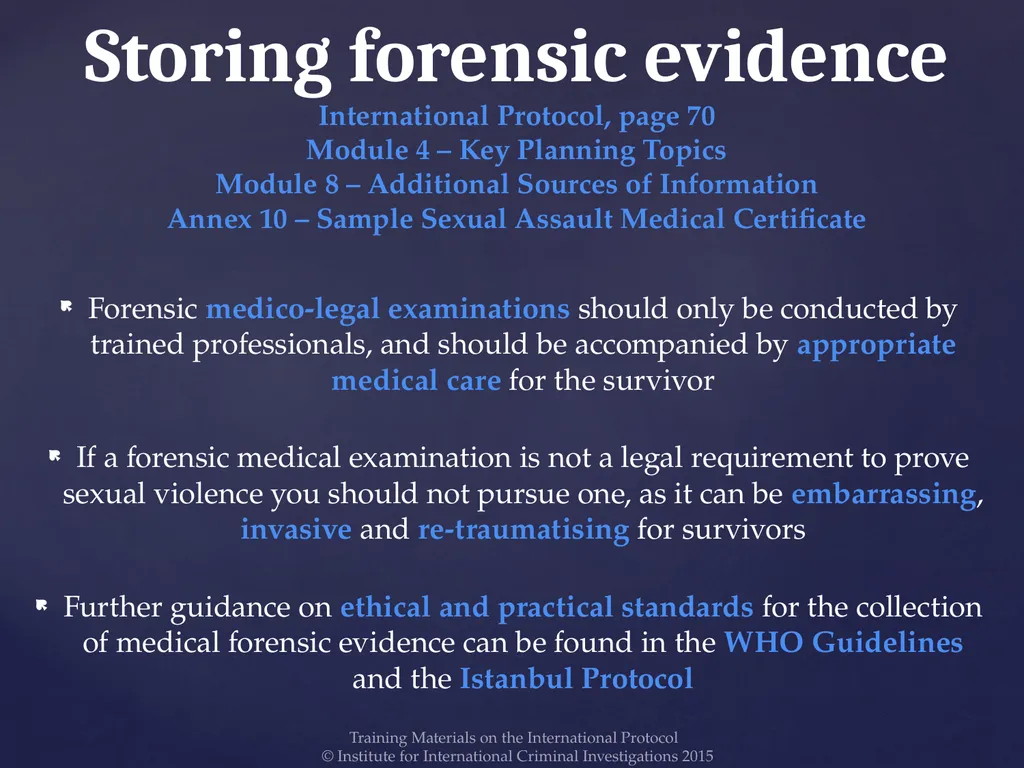
© Institute for International Criminal Investigations 2015 Forensic medico-legal examinations should only be conducted by trained professionals, and should be accompanied by appropriate medical care for the survivor
If a forensic medical examination is not a legal requirement to prove sexual violence you should not pursue one, as it can be embarrassing, invasive and re-traumatising for survivors
Further guidance on ethical and practical standards for the collection of medical forensic evidence can be found in the WHO Guidelines and the Istanbul Protocol Storing forensic evidenceInternational Protocol, page 70Module 4 – Key Planning TopicsModule 8 – Additional Sources of InformationAnnex 10 – Sample Sexual Assault Medical Certificate<br>

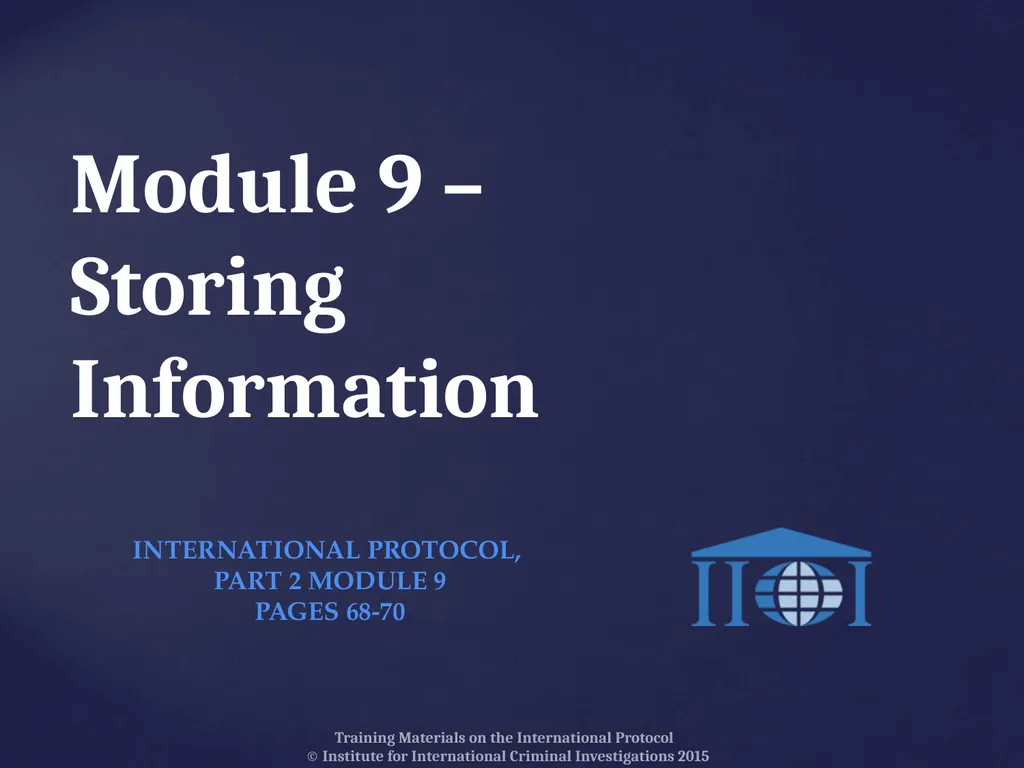
slide13. Relevant factors for storing forensic evidence include: Training Materials on the International Protocol
© Institute for International Criminal Investigations 2015 Storing forensic evidenceInternational Protocol, page 70Module 4 – Key Planning TopicsModule 8 – Additional Sources of InformationAnnex 6 & 7 – Chain of Custody<br>
© Institute for International Criminal Investigations 2015 INTERNATIONAL PROTOCOL,
PART 2 MODULE 9
PAGES 68-70<br>
slide2. Training Materials on the International Protocol
© Institute for International Criminal Investigations 2015 Storage of evidence or information is a crucial point and must be considered from the very beginning of any investigation or documentation process
Before you pick anything up, before you speak to a witness, before you turn on your computer or answer the phone, you must consider and plan for the following question: Storing informationInternational Protocol, pages 68-70Module 4 – Key Planning TopicsModule 6 – Testimony Module 8 – Additional Sources of InformationAnnex 6 & 7 – Chain of Custody Where and how are we going to store this information?<br>
slide3. Training Materials on the International Protocol
© Institute for International Criminal Investigations 2015 If you collect evidence/information about sexual violence, you have an obligation to store and manage it in a way that ensures its integrity and does not put anyone at risk
The type of information you may collect – photos of crime scenes or injuries, statements from survivors/witnesses, medical or police records – is highly sensitive and confidential, extremely personal and could be very damaging if misused or made public Storing informationInternational Protocol, pages 68-70Module 4 – Key Planning TopicsModule 6 – Testimony Module 8 – Additional Sources of InformationAnnex 6 & 7 – Chain of Custody<br>
slide4. Training Materials on the International Protocol
© Institute for International Criminal Investigations 2015 If you choose to collect such information, you must ensure that it is stored and maintained in a way that protects the safety of survivors/witnesses, their family/community and your own staff
You should consider the ultimate use of the evidence/information – this will have implications for how long you will have to store the evidence and under what conditions
If you cannot guarantee or maintain the necessary facilities to store the evidence/information, you should consider not collecting it Storing informationInternational Protocol, pages 68-70Module 4 – Key Planning Topics Module 6 – Testimony Module 8 – Additional Sources of InformationAnnex 6 & 7 – Chain of Custody<br>
slide5. Training Materials on the International Protocol
© Institute for International Criminal Investigations 2015 To safely store sensitive information about sexual violence, you must plan for the following: Storing information safelyInternational Protocol, pages 68-70Module 4 – Key Planning TopicsModule 6 – Testimony<br>
slide6. Storing documents or physical informationInternational Protocol, page 69Module 3 – Preliminary ConsiderationsModule 8 – Additional Sources of Information Training Materials on the International Protocol
© Institute for International Criminal Investigations 2015 If you are storing documents or other physical items, you should keep them in a locked storage facility (cabinet/safe/storage unit) in a cool dry place and maintain restricted access
You should also keep a logbook to record any access to the storage facility – include names, date, time and purpose of access – and ensure the safety of staff who maintain/guard it
If the physical information is perishable, make sure the storage conditions are appropriate – if it is partial or incomplete, make sure each item is marked and identified as part of a larger set<br>
slide7. Storing audio-visual informationInternational Protocol, page 69Module 7 – Interviewing Module 8 – Additional Sources of InformationAnnex 6 & 7 – Chain of Custody Training Materials on the International Protocol
© Institute for International Criminal Investigations 2015 All photographs and video-recordings should be numbered and catalogued – the record number should indicate if they are linked to or corroborate any witness statements, documents or other pieces of evidence/ information
For audio or video-recordings (other than interview recordings), the person responsible for the recording must continue to protect the confidentiality and security of the identities of the individuals in the recording, no matter how long it is stored<br>
slide8. Training Materials on the International Protocol
© Institute for International Criminal Investigations 2015 Some evidence/information about sexual violence may be in electronic or digital form only (images taken on a mobile phone, recordings, document scans) but must still be securely stored
You may also have an electronic database or digital archive to catalogue and manage or store copies of your documentary and physical evidence/information
Storing and managing digital information has some advantages (less physical space, easier to analyse) and some complications (power supply, internet access, software or hardware problems) Storing digital informationInternational Protocol, pages 69-70Module 4 – Key Planning TopicsModule 6 – Testimony<br>
slide9. Ensuring the security and integrity of digital information Training Materials on the International Protocol
© Institute for International Criminal Investigations 2015 Storing digital informationInternational Protocol, pages 69-70Module 3 – Preliminary Considerations
Module 6 - Testimony<br>
slide10. Training Materials on the International Protocol
© Institute for International Criminal Investigations 2015 Collecting digital informationInternational Protocol, pages 69-70Module 3 – Preliminary Considerations
Module 7 – Interviewing<br>
slide11. Training Materials on the International Protocol
© Institute for International Criminal Investigations 2015 Some jurisdictions may require specific forensic evidence of sexual violence (i.e. medical exam by a government doctor) – some may accept it as corroboration (i.e. clothing, tissue samples, photos, evidence of weapons, ropes/ligatures)
If you are not appropriately trained to collect medico-legal/ biological evidence (blood or semen, soiled clothing, skin or hair, DNA swabs) then you should not do so – you may do more harm than good
If you do not have appropriate facilities to preserve and manage forensic evidence (refrigerated storage units, lab processing) then you should not collect it – if it is not stored correctly, it cannot be used Storing forensic evidenceInternational Protocol, page 70Module 4 – Key Planning TopicsModule 8 – Additional Sources of InformationAnnex 6 & 7 – Chain of Custody<br>
slide12. Training Materials on the International Protocol
© Institute for International Criminal Investigations 2015 Forensic medico-legal examinations should only be conducted by trained professionals, and should be accompanied by appropriate medical care for the survivor
If a forensic medical examination is not a legal requirement to prove sexual violence you should not pursue one, as it can be embarrassing, invasive and re-traumatising for survivors
Further guidance on ethical and practical standards for the collection of medical forensic evidence can be found in the WHO Guidelines and the Istanbul Protocol Storing forensic evidenceInternational Protocol, page 70Module 4 – Key Planning TopicsModule 8 – Additional Sources of InformationAnnex 10 – Sample Sexual Assault Medical Certificate<br>
slide13. Relevant factors for storing forensic evidence include: Training Materials on the International Protocol
© Institute for International Criminal Investigations 2015 Storing forensic evidenceInternational Protocol, page 70Module 4 – Key Planning TopicsModule 8 – Additional Sources of InformationAnnex 6 & 7 – Chain of Custody<br>