
Molecular biology first lecture Introduction and
PT
Published · 19 slides · 0 views

1 / 1


Description
Molecular biology first lecture Introduction and brief history References : 1-Essential of molecular biology by George M. Malacinski 4th edition 2-Second references: Molecular biology (principles and practice) An Introduction to Genetic
Related Topics
Share
Embed code
Download this presentation From Below
"Molecular biology first lecture Introduction and" is the property of its rightful owner. Permission is granted to download and print the materials on this website for personal, non-commercial use only, and to display it on your personal computer provided you do not modify the materials and that you retain all copyright notices contained in the materials. By downloading content from our website, you accept the terms of this agreement.
Presentation Transcript
01
Molecular biology
first lecture
Introduction and brief history References :
1-Essential of molecular biology by George M. Malacinski 4th edition
2-Second references: Molecular biology (principles and practice)
An Introduction to Genetic Analysis. 7th edition. Dr Nadal Abdulameer Ali<br>
1-Essential of molecular biology by George M. Malacinski 4th edition
2-Second references: Molecular biology (principles and practice)
An Introduction to Genetic Analysis. 7th edition. Dr Nadal Abdulameer Ali<br>
02
Identification of molecular biology :
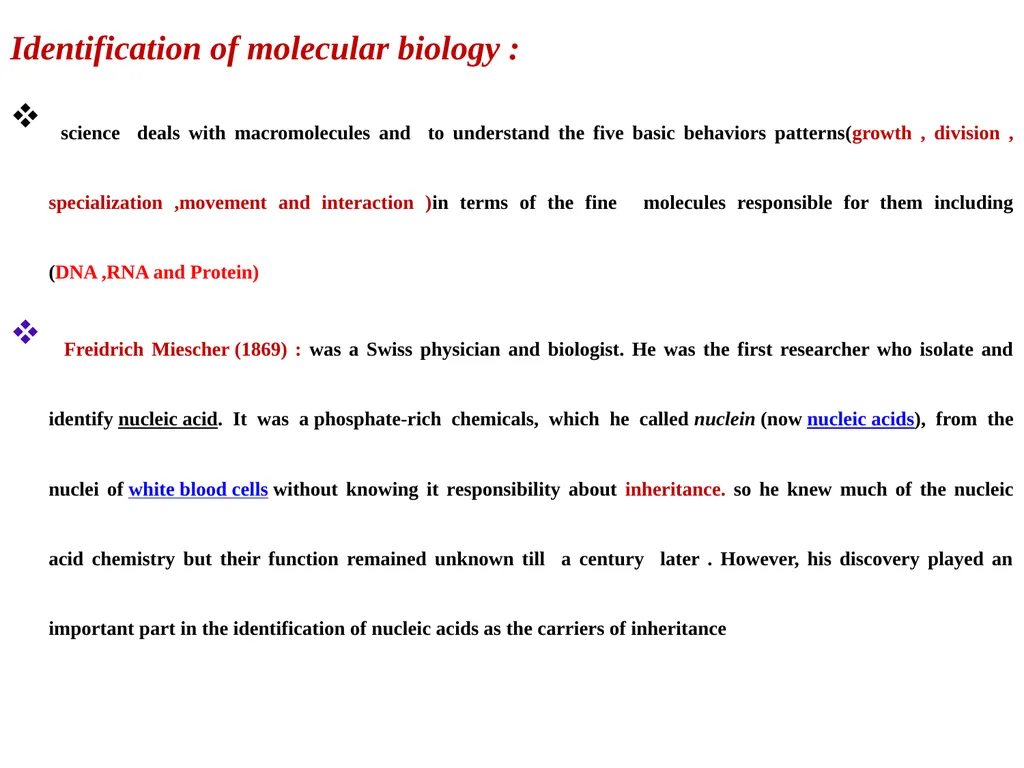
science deals with macromolecules and to understand the five basic behaviors patterns(growth , division , specialization ,movement and interaction )in terms of the fine molecules responsible for them including (DNA ,RNA and Protein)
Freidrich Miescher (1869) : was a Swiss physician and biologist. He was the first researcher who isolate and identify nucleic acid. It was a phosphate-rich chemicals, which he called nuclein (now nucleic acids), from the nuclei of white blood cells without knowing it responsibility about inheritance. so he knew much of the nucleic acid chemistry but their function remained unknown till a century later . However, his discovery played an important part in the identification of nucleic acids as the carriers of inheritance<br>
science deals with macromolecules and to understand the five basic behaviors patterns(growth , division , specialization ,movement and interaction )in terms of the fine molecules responsible for them including (DNA ,RNA and Protein)
Freidrich Miescher (1869) : was a Swiss physician and biologist. He was the first researcher who isolate and identify nucleic acid. It was a phosphate-rich chemicals, which he called nuclein (now nucleic acids), from the nuclei of white blood cells without knowing it responsibility about inheritance. so he knew much of the nucleic acid chemistry but their function remained unknown till a century later . However, his discovery played an important part in the identification of nucleic acids as the carriers of inheritance<br>
03
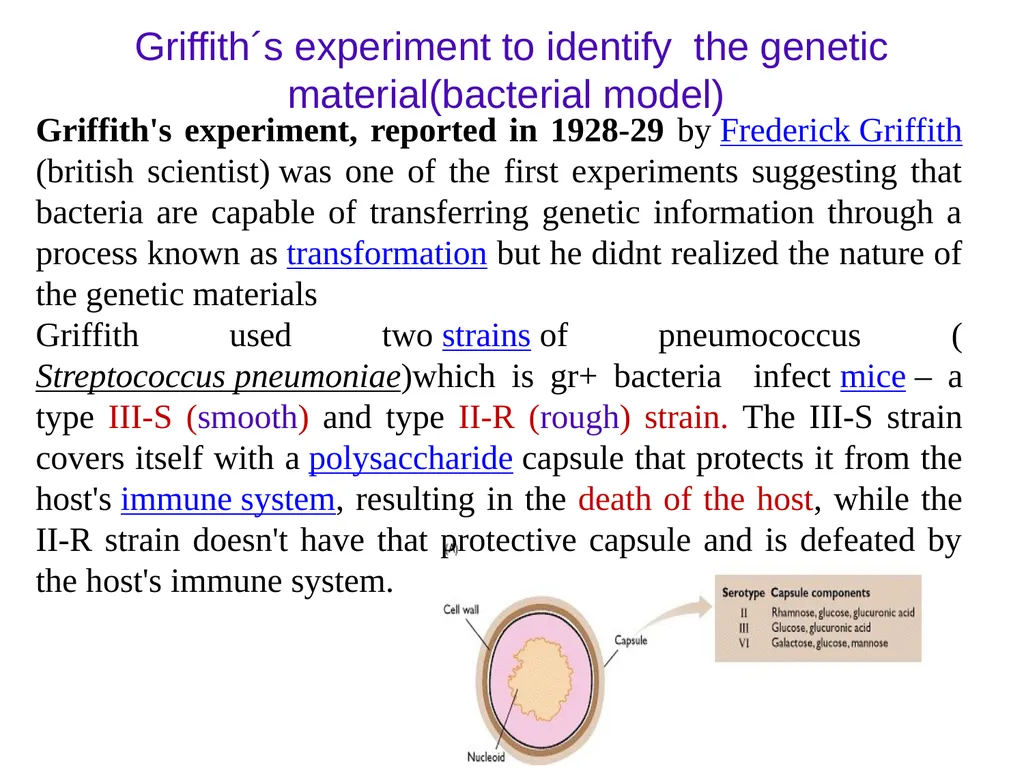
Griffith´s experiment to identify the genetic material(bacterial model) Griffith's experiment, reported in 1928-29 by Frederick Griffith(british scientist) was one of the first experiments suggesting that bacteria are capable of transferring genetic information through a process known as transformation but he didnt realized the nature of the genetic materials
Griffith used two strains of pneumococcus (Streptococcus pneumoniae)which is gr+ bacteria infect mice – a type III-S (smooth) and type II-R (rough) strain. The III-S strain covers itself with a polysaccharide capsule that protects it from the host's immune system, resulting in the death of the host, while the II-R strain doesn't have that protective capsule and is defeated by the host's immune system.<br>
Griffith used two strains of pneumococcus (Streptococcus pneumoniae)which is gr+ bacteria infect mice – a type III-S (smooth) and type II-R (rough) strain. The III-S strain covers itself with a polysaccharide capsule that protects it from the host's immune system, resulting in the death of the host, while the II-R strain doesn't have that protective capsule and is defeated by the host's immune system.<br>
04
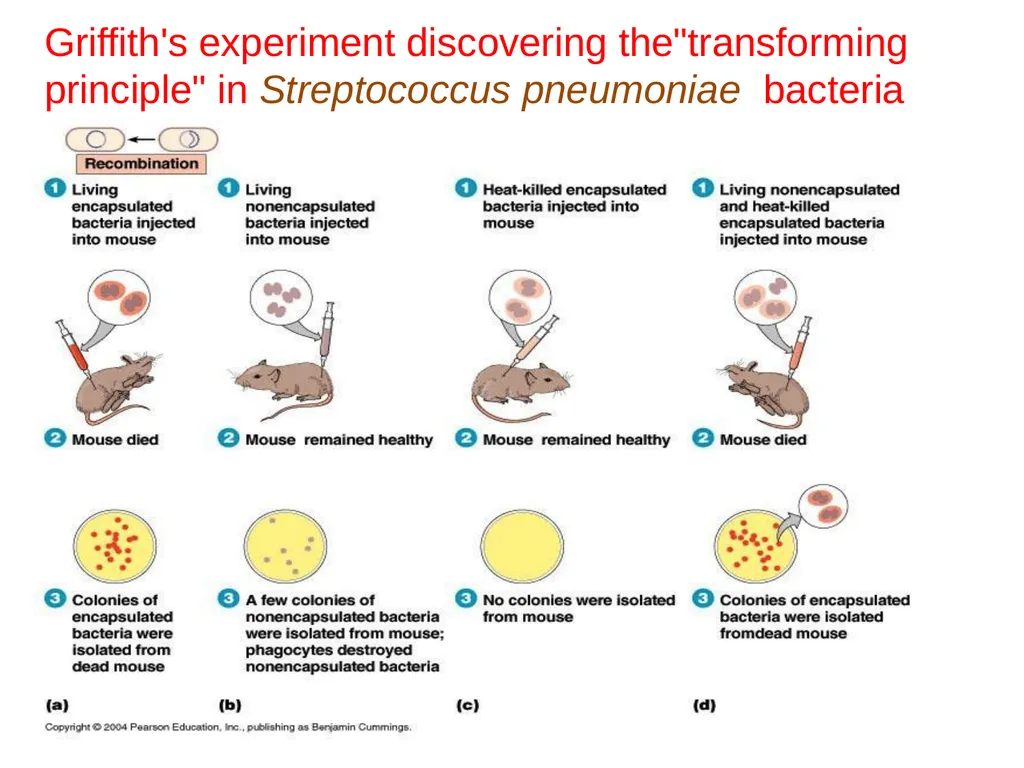
Griffith's experiment discovering the"transforming principle" in Streptococcus pneumoniae bacteria<br>
05
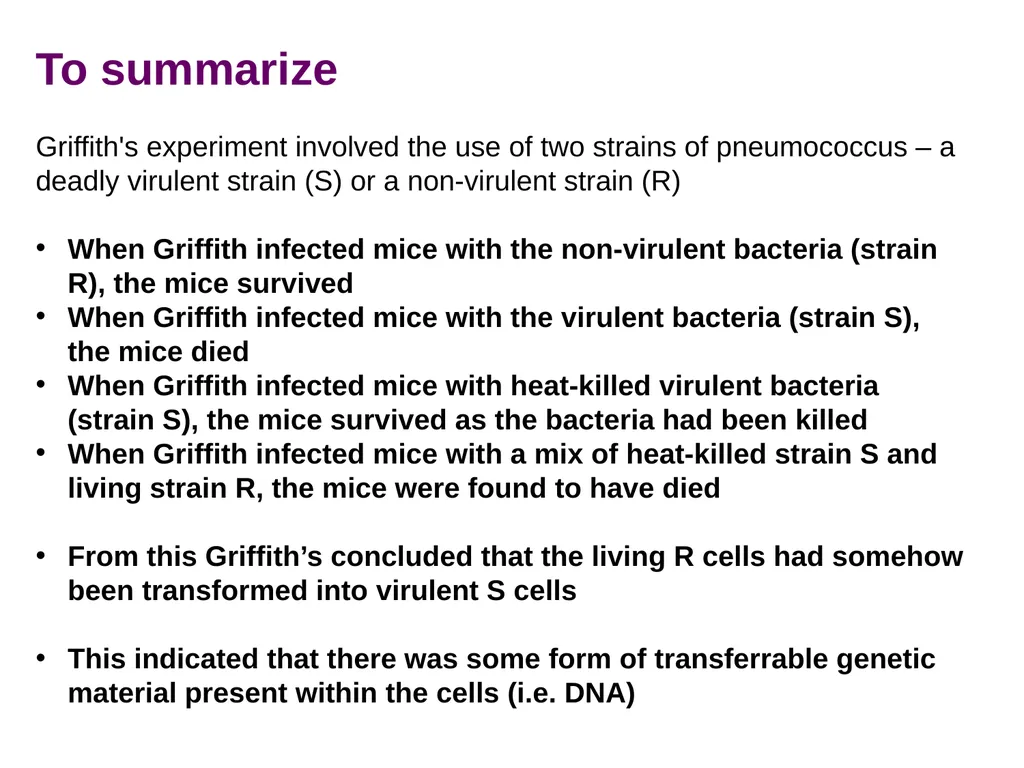
To summarize
Griffith's experiment involved the use of two strains of pneumococcus – a deadly virulent strain (S) or a non-virulent strain (R)
When Griffith infected mice with the non-virulent bacteria (strain R), the mice survived
When Griffith infected mice with the virulent bacteria (strain S), the mice died
When Griffith infected mice with heat-killed virulent bacteria (strain S), the mice survived as the bacteria had been killed
When Griffith infected mice with a mix of heat-killed strain S and living strain R, the mice were found to have died
From this Griffith’s concluded that the living R cells had somehow been transformed into virulent S cells
This indicated that there was some form of transferrable genetic material present within the cells (i.e. DNA)<br>
Griffith's experiment involved the use of two strains of pneumococcus – a deadly virulent strain (S) or a non-virulent strain (R)
When Griffith infected mice with the non-virulent bacteria (strain R), the mice survived
When Griffith infected mice with the virulent bacteria (strain S), the mice died
When Griffith infected mice with heat-killed virulent bacteria (strain S), the mice survived as the bacteria had been killed
When Griffith infected mice with a mix of heat-killed strain S and living strain R, the mice were found to have died
From this Griffith’s concluded that the living R cells had somehow been transformed into virulent S cells
This indicated that there was some form of transferrable genetic material present within the cells (i.e. DNA)<br>
06
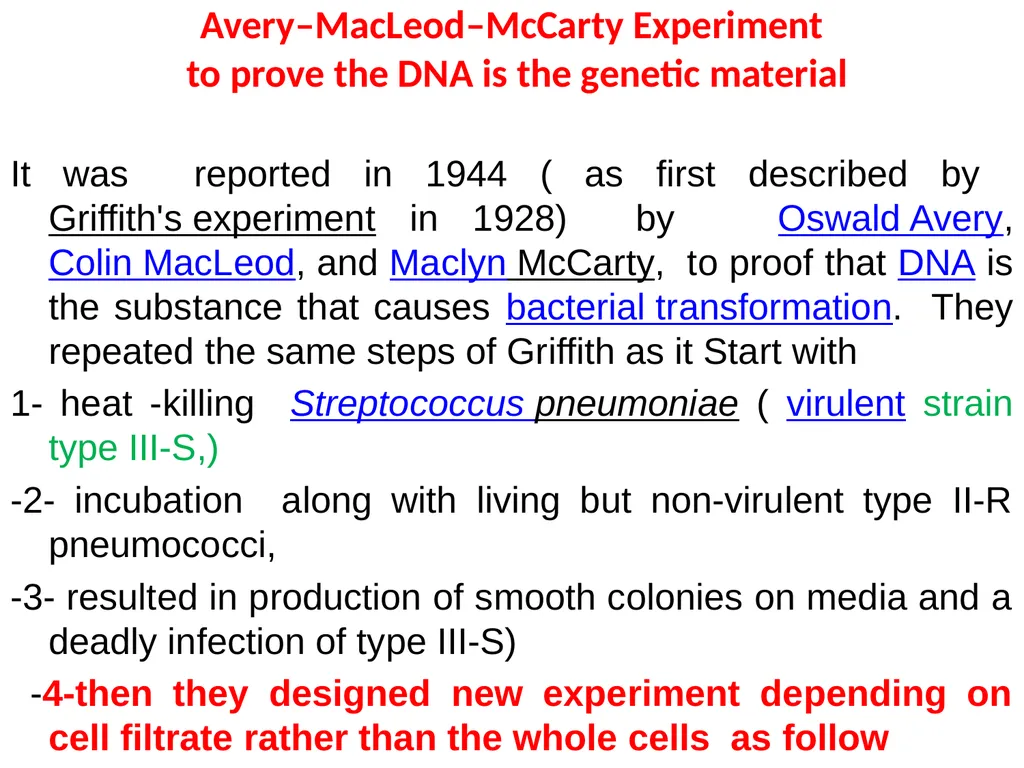
Avery–MacLeod–McCarty Experiment
to prove the DNA is the genetic material It was reported in 1944 ( as first described by Griffith's experiment in 1928) by Oswald Avery, Colin MacLeod, and Maclyn McCarty, to proof that DNA is the substance that causes bacterial transformation. They repeated the same steps of Griffith as it Start with
1- heat -killing Streptococcus pneumoniae ( virulent strain type III-S,)
-2- incubation along with living but non-virulent type II-R pneumococci,
-3- resulted in production of smooth colonies on media and a deadly infection of type III-S)
-4-then they designed new experiment depending on cell filtrate rather than the whole cells as follow<br>
1- heat -killing Streptococcus pneumoniae ( virulent strain type III-S,)
-2- incubation along with living but non-virulent type II-R pneumococci,
-3- resulted in production of smooth colonies on media and a deadly infection of type III-S)
-4-then they designed new experiment depending on cell filtrate rather than the whole cells as follow<br>
07
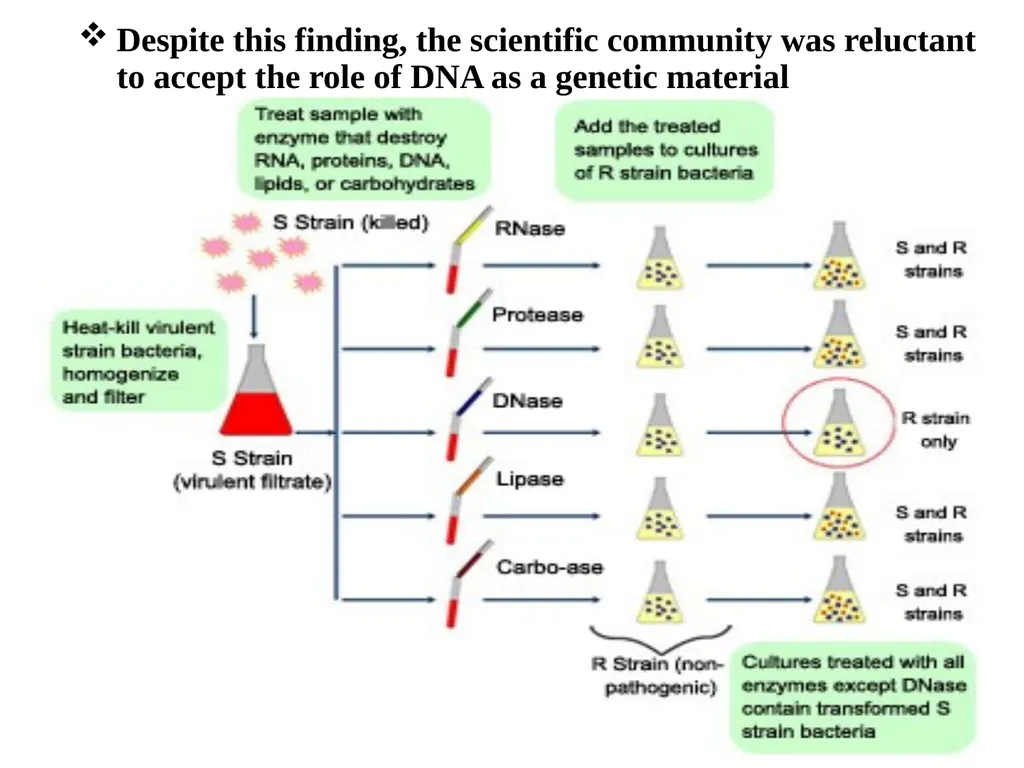
Avery and his colleagues started to prove DNA is the genetic material responsible for heredity by transformation process تحول وراثي
1-They start with distraction cells of virulence s strain to release the genetic material out side the cell then they took the extract and subjected to centrifuge to get rid from all intact cells
2-They incubated the extract with R strain in cooled condition(4 cº) with the addition of CaCL2 then transfer to 42 cº (heat shock)
The results showed that the R strain convert to S strain after culturing on agar media.
They repeat the experiment by using only the DNA they notice the R strain converted to →S strain
In the second experiment they used polysaccharide instead of DNA the result was differ cos the R didn’t transform to S
Finally they treat cell filtrate of S strain with protease and ribonuclease and deoxyribonuclease
the process succeed with the first two enzymes but is inactivated by treatment with the third one.<br>
1-They start with distraction cells of virulence s strain to release the genetic material out side the cell then they took the extract and subjected to centrifuge to get rid from all intact cells
2-They incubated the extract with R strain in cooled condition(4 cº) with the addition of CaCL2 then transfer to 42 cº (heat shock)
The results showed that the R strain convert to S strain after culturing on agar media.
They repeat the experiment by using only the DNA they notice the R strain converted to →S strain
In the second experiment they used polysaccharide instead of DNA the result was differ cos the R didn’t transform to S
Finally they treat cell filtrate of S strain with protease and ribonuclease and deoxyribonuclease
the process succeed with the first two enzymes but is inactivated by treatment with the third one.<br>
08
Despite this finding, the scientific community was reluctant to accept the role of DNA as a genetic material<br>
09
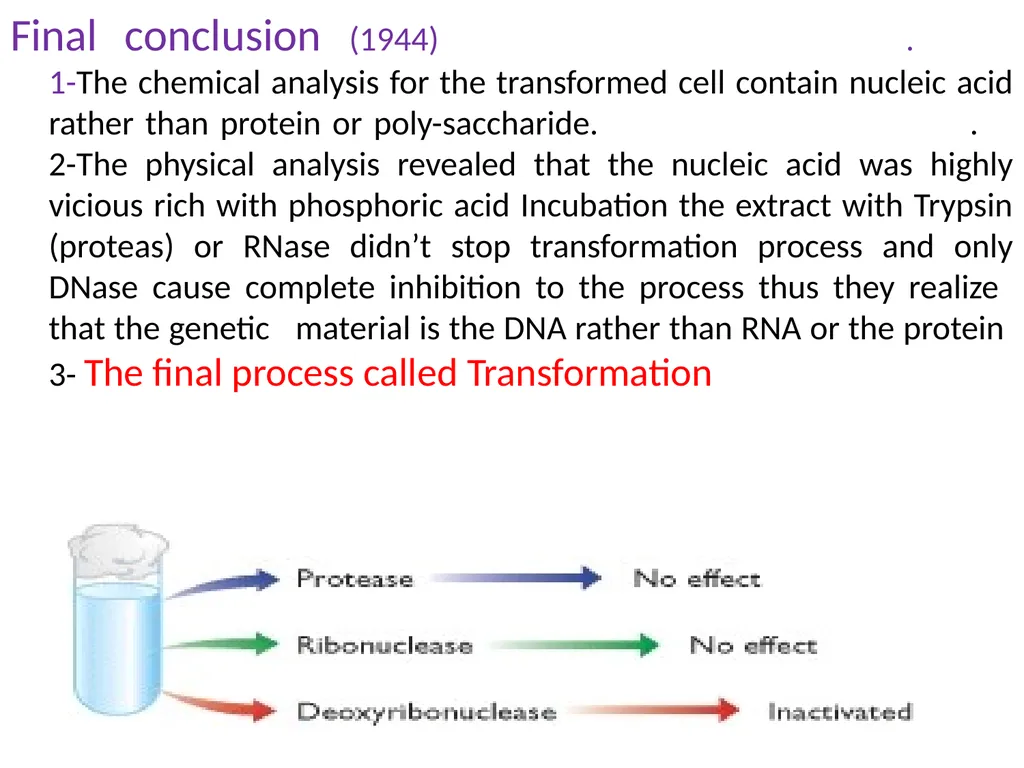
Final conclusion (1944) .
1-The chemical analysis for the transformed cell contain nucleic acid rather than protein or poly-saccharide. .
2-The physical analysis revealed that the nucleic acid was highly vicious rich with phosphoric acid Incubation the extract with Trypsin (proteas) or RNase didn’t stop transformation process and only DNase cause complete inhibition to the process thus they realize that the genetic material is the DNA rather than RNA or the protein
3- The final process called Transformation<br>
10
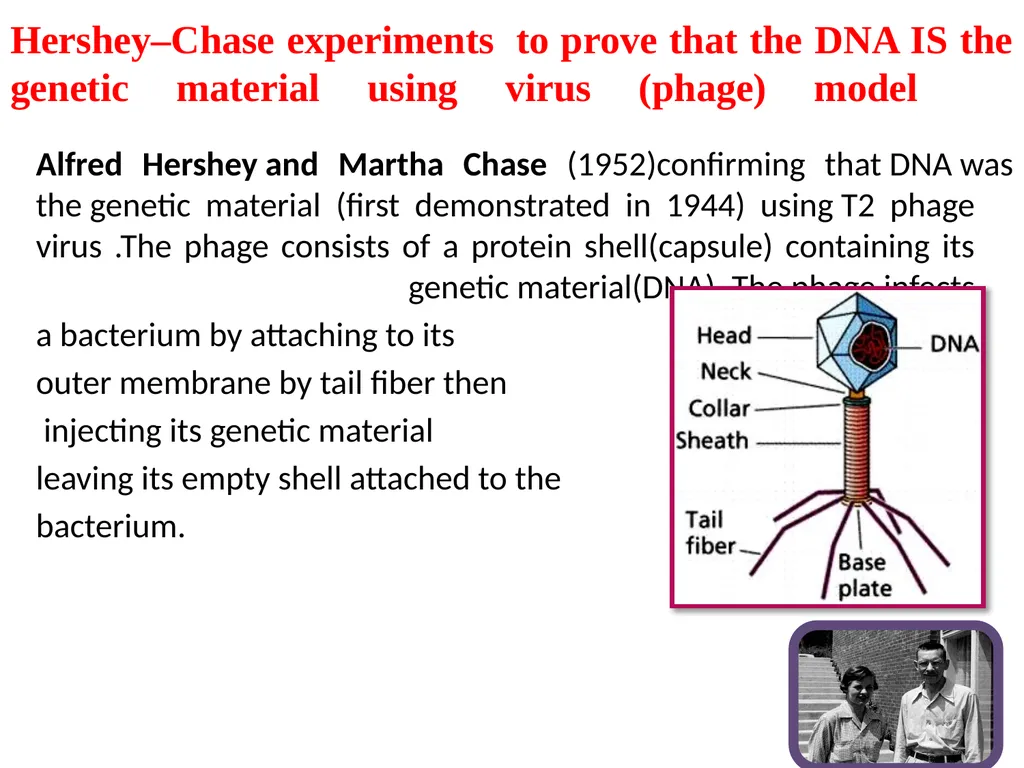
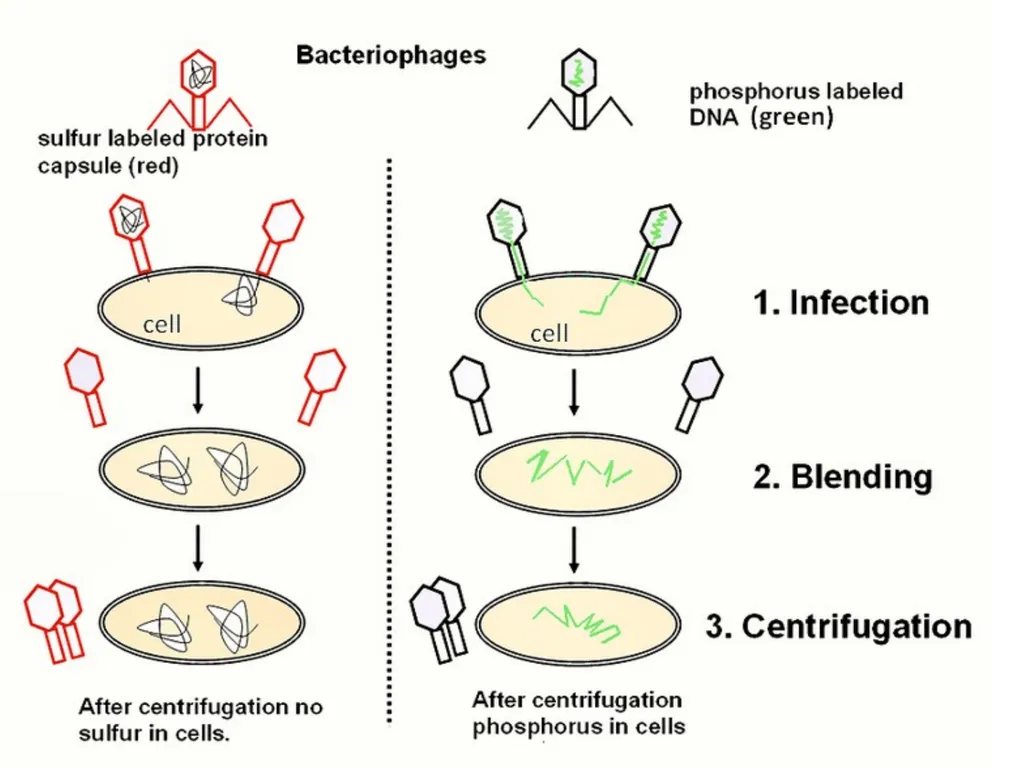
Hershey–Chase experiments to prove that the DNA IS the genetic material using virus (phage) model Alfred Hershey and Martha Chase (1952)confirming that DNA was the genetic material (first demonstrated in 1944) using T2 phage virus .The phage consists of a protein shell(capsule) containing its genetic material(DNA). The phage infects
a bacterium by attaching to its
outer membrane by tail fiber then
injecting its genetic material
leaving its empty shell attached to the
bacterium.<br>
a bacterium by attaching to its
outer membrane by tail fiber then
injecting its genetic material
leaving its empty shell attached to the
bacterium.<br>
11
ERPIREMENT:
They depend on the differences between protein & DNA chemical structure (DNA contains :C, H,O,N and Ph while protein :C,H.O.N,S)
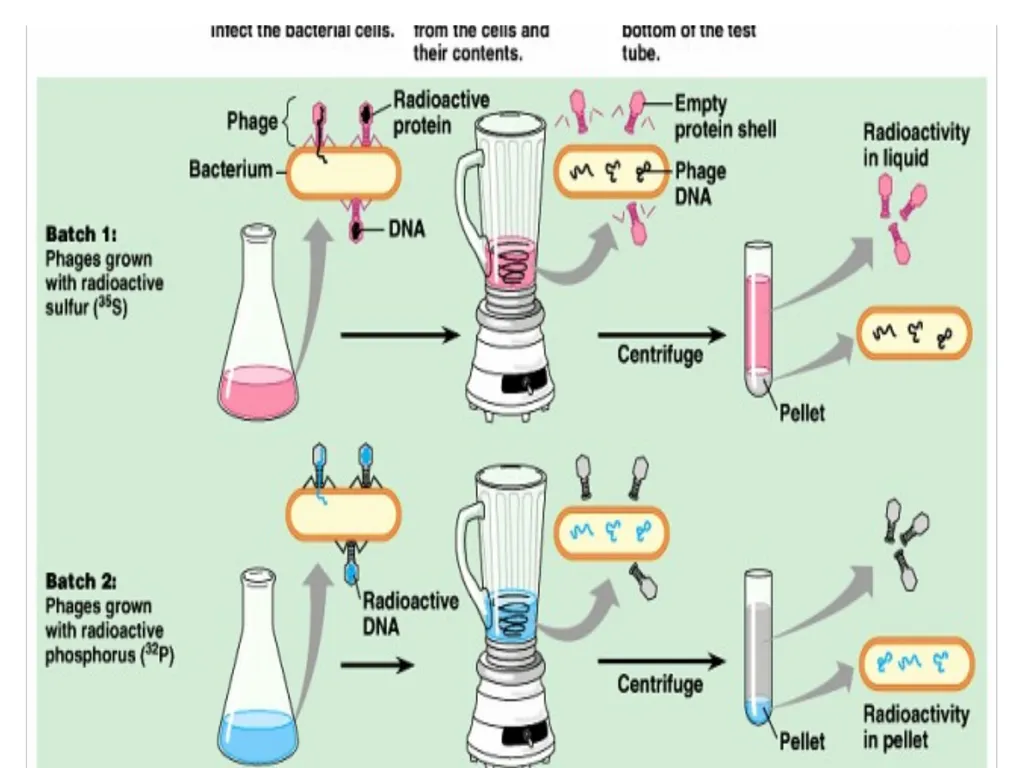
In their first set of experiments, Hershey and Chase labeled the DNA of phages with radioactive Phosphorus- P32 (the element phosphorus is present in DNA but not present in any of the 20 amino acids from which proteins are made). They allowed the phages to infect E. coli, and through several elegant experiments were able to observe the transfer of P32 labeled phage DNA into the cytoplasm of the bacterium<br>
They depend on the differences between protein & DNA chemical structure (DNA contains :C, H,O,N and Ph while protein :C,H.O.N,S)
In their first set of experiments, Hershey and Chase labeled the DNA of phages with radioactive Phosphorus- P32 (the element phosphorus is present in DNA but not present in any of the 20 amino acids from which proteins are made). They allowed the phages to infect E. coli, and through several elegant experiments were able to observe the transfer of P32 labeled phage DNA into the cytoplasm of the bacterium<br>
12
In their second set of experiments, they labeled the phages with radioactive Sulfur-35 (Sulfur is present in the amino acids cysteine and methionine, but not in DNA). Following infection of E. coli they then sheared the viral protein shells off of infected cells using a high-speed blender and separated the cells and viral coats by using a centrifuge.
After separation, the radioactive S35 tracer was observed in the protein shells, but not in the infected bacteria, supporting the hypothesis that the genetic material which infects the bacteria was DNA and not protein.
Hershey shared the 1969 Nobel Prize in Physiology or Medicine for his “discoveries concerning the genetic structure of viruses.”<br>
After separation, the radioactive S35 tracer was observed in the protein shells, but not in the infected bacteria, supporting the hypothesis that the genetic material which infects the bacteria was DNA and not protein.
Hershey shared the 1969 Nobel Prize in Physiology or Medicine for his “discoveries concerning the genetic structure of viruses.”<br>
13
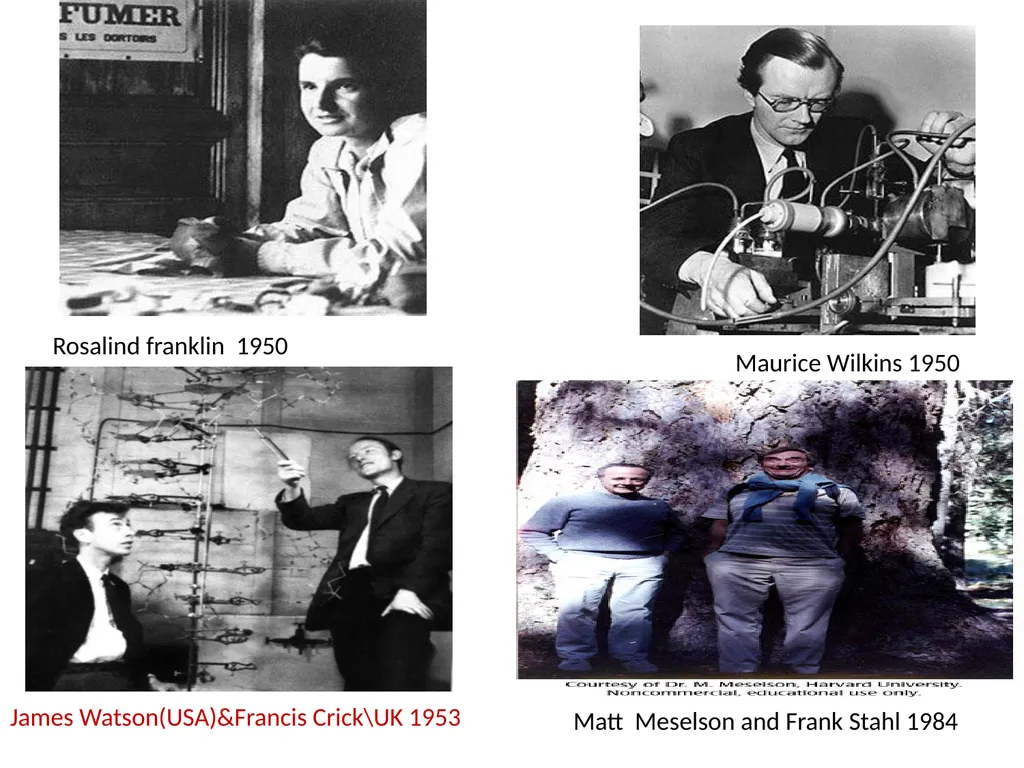
Another important findings in molecular biology science 1950 Rosalind franklin& Maurice Wilkins(using X-ray crystallographic equipment to solve the DNA problem at King's College\London to determine the 3 dimensional structure of the DNA or protein, according to this, A- DNA & B- DNA were described
(1953)James Watson (USA) &Francis Crick\UK discovered DNA molecule (will be discussed latter ) depending on franklin Wilkins X-ray model .they won the 1962 Nobel Prize in Medicine for their discovery of the structure of DNA. This was one of the most significant scientific discoveries of the 20th century
Francis Crick in 1958 established the theory of central dogma of molecular biology that is to say the genetic information follow from
DNA→RNA→PROTEIN<br>
(1953)James Watson (USA) &Francis Crick\UK discovered DNA molecule (will be discussed latter ) depending on franklin Wilkins X-ray model .they won the 1962 Nobel Prize in Medicine for their discovery of the structure of DNA. This was one of the most significant scientific discoveries of the 20th century
Francis Crick in 1958 established the theory of central dogma of molecular biology that is to say the genetic information follow from
DNA→RNA→PROTEIN<br>
14
Rosalind franklin 1950 Maurice Wilkins 1950 James Watson(USA)&Francis Crick\UK 1953 Matt Meselson and Frank Stahl 1984<br>
15
1977 Frederick Sanger (95years) :is a British biochemist who was twice awarded the Nobel Prize for Chemistry, the only person to have been so. In 1958 he was awarded a Nobel prize in chemistry "for his work on the structure of proteins, especially that of insulin". In 1980, Walter Gilbertand Sanger shared half of the chemistry prize "for their contributions concerning the determination of base sequences in nucleic acids".
1983 Kary Mullis American chemist start synthesis a desired DNA sequence and to copy it using polymerase chain reaction ( PCR Technique discussed latter ), a technique which would allow a small strand of DNA to be copied almost an infinite number of times. This has created revolutions in biochemistry, molecular biology, genetics, medicine and forensics.<br>
1983 Kary Mullis American chemist start synthesis a desired DNA sequence and to copy it using polymerase chain reaction ( PCR Technique discussed latter ), a technique which would allow a small strand of DNA to be copied almost an infinite number of times. This has created revolutions in biochemistry, molecular biology, genetics, medicine and forensics.<br>
16
Kary mullis receiving his Nobel price Frederick Sanger August 13, 1918 (age 95), United Kingdom Sir Martin Evans Bioscience school cardiff university Nobel price 2007<br>
17
biological system as experimental models Bacteria :Prokaryotes unicellular free living cells .only one single chromosome not enclosed inside nucleus but it is free within the cytoplasm called nucleoid .the size of Escherichia coli(E.coli) is about 4,639,221 base pair (bp زوج قاعدة)or 4.6 Kbp (كيلو زوج قاعة نتروجينة) .it represent the best model to be used for many reason like easily to be cultured , relatively simple in their needs , short generation time (20 min for E.coli),best growth temperature 37cº so it complete DNA replication ,RNA transcription and Protein synthesis within few minutes
Bacteriophage : they represent the simplest form of life These infect the bacteria(there are animal ,plant human viruses) .unlike the bacteria, they are not free living (completely inert )once they enter the host they start replication depending on the machines of the host cell .it now used as cloning vector
Yeast: another experimental model but for Eukaryotic cell thus it contains chromosomes within a true nucleus surrounded with nuclear membrane .great deal of early biochemical research was carried out specially fermentation process ..now for molecular biologist, mutant strains of yeast often used to discover genes that control growth ,division ,and cell behavior.
Animal and plant cell : also could be used as a model in genetic experiments<br>
Bacteriophage : they represent the simplest form of life These infect the bacteria(there are animal ,plant human viruses) .unlike the bacteria, they are not free living (completely inert )once they enter the host they start replication depending on the machines of the host cell .it now used as cloning vector
Yeast: another experimental model but for Eukaryotic cell thus it contains chromosomes within a true nucleus surrounded with nuclear membrane .great deal of early biochemical research was carried out specially fermentation process ..now for molecular biologist, mutant strains of yeast often used to discover genes that control growth ,division ,and cell behavior.
Animal and plant cell : also could be used as a model in genetic experiments<br>