
Momentum Physics Unit 4 Credits Slides created by
LD
Published · 39 slides · 0 views

1 / 1

Description
Momentum Physics Unit 4 Credits Slides created by Richard Wright, Andrews Academy rwrightandrews.edu This Slideshow was developed to accompany the textbook OpenStax High School Physics Available for free at
Related Topics
Share
Embed code
Download this presentation From Below
"Momentum Physics Unit 4 Credits Slides created by" is the property of its rightful owner. Permission is granted to download and print the materials on this website for personal, non-commercial use only, and to display it on your personal computer provided you do not modify the materials and that you retain all copyright notices contained in the materials. By downloading content from our website, you accept the terms of this agreement.
Presentation Transcript
01
Momentum Physics
Unit 4<br>
Unit 4<br>
02
Credits Slides created by
Richard Wright, Andrews Academy
rwright@andrews.edu This Slideshow was developed to accompany the textbook
OpenStax High School Physics
Available for free at https://openstax.org/details/books/physics
By Paul Peter Urone and Roger Hinrichs
2020 edition
Some examples and diagrams are taken from the OpenStax College Physics, Physics, and Cutnell & Johnson Physics 6th ed.<br>
03
04-01 Impulse and Momentum In this lesson you will…
• Define impulse and linear momentum.
• Explain the relationship between momentum and force.
• Describe effects of impulses in everyday life.<br>
• Define impulse and linear momentum.
• Explain the relationship between momentum and force.
• Describe effects of impulses in everyday life.<br>
04
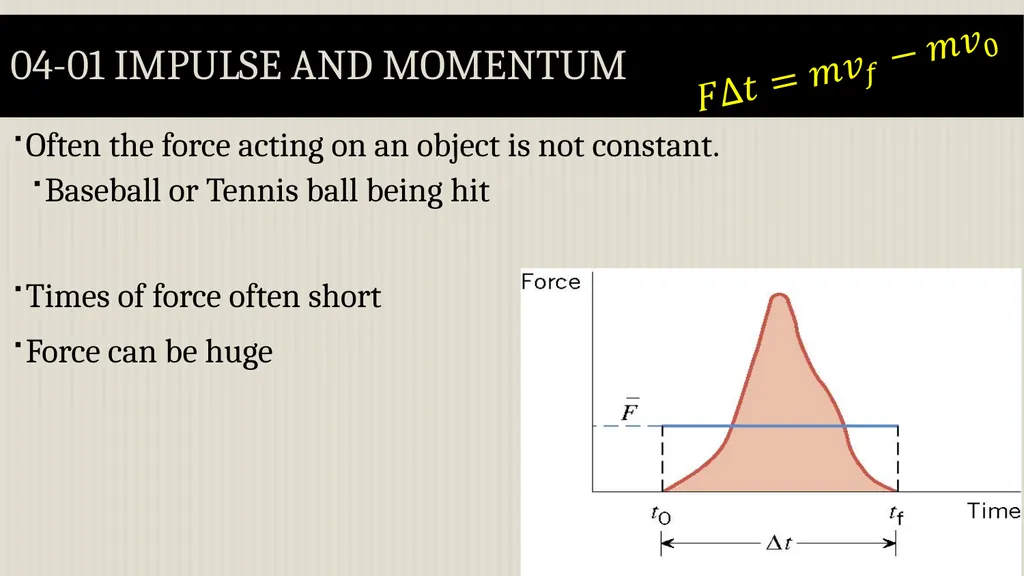
04-01 Impulse and Momentum Often the force acting on an object is not constant.
Baseball or Tennis ball being hit
Times of force often short
Force can be huge<br>
Baseball or Tennis ball being hit
Times of force often short
Force can be huge<br>
05
04-01 Impulse and Momentum To hit a ball well
Both size of force and time of contact are important
Bring both these together in concept of impulse<br>
Both size of force and time of contact are important
Bring both these together in concept of impulse<br>
06
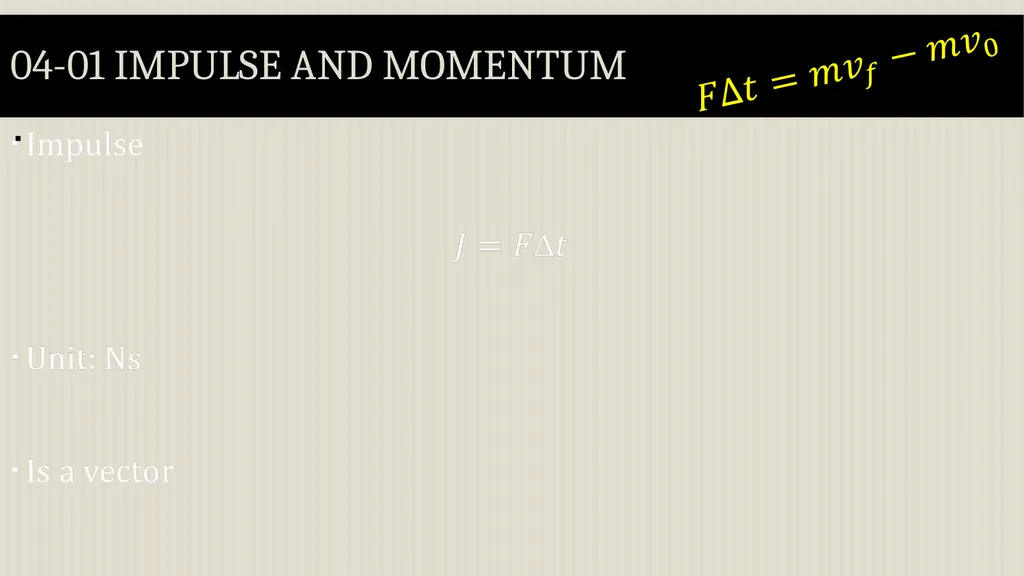
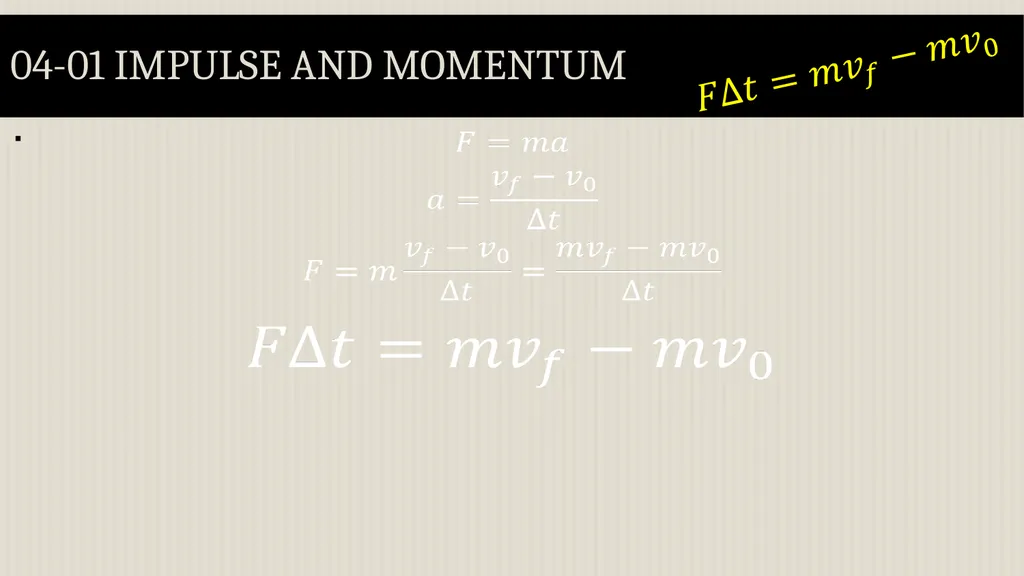
04-01 Impulse and Momentum<br>
07
04-01 Impulse and Momentum Object responds to amount of impulse
Large impulse Large response higher vf
Large mass less velocity
Both mass and velocity play role in how responds to impulse<br>
Large impulse Large response higher vf
Large mass less velocity
Both mass and velocity play role in how responds to impulse<br>
08
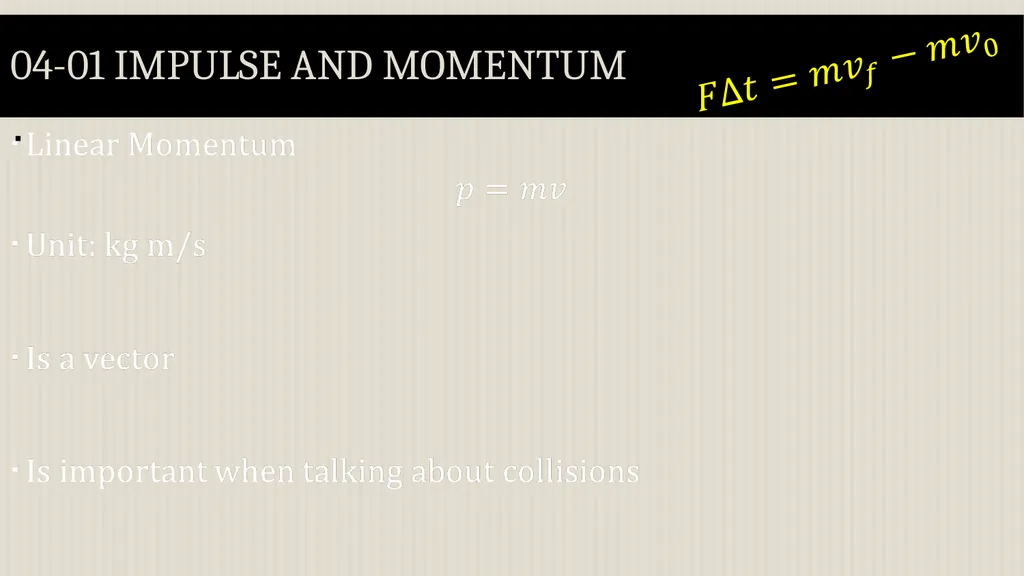
04-01 Impulse and Momentum<br>
09
04-01 Impulse and Momentum<br>
10
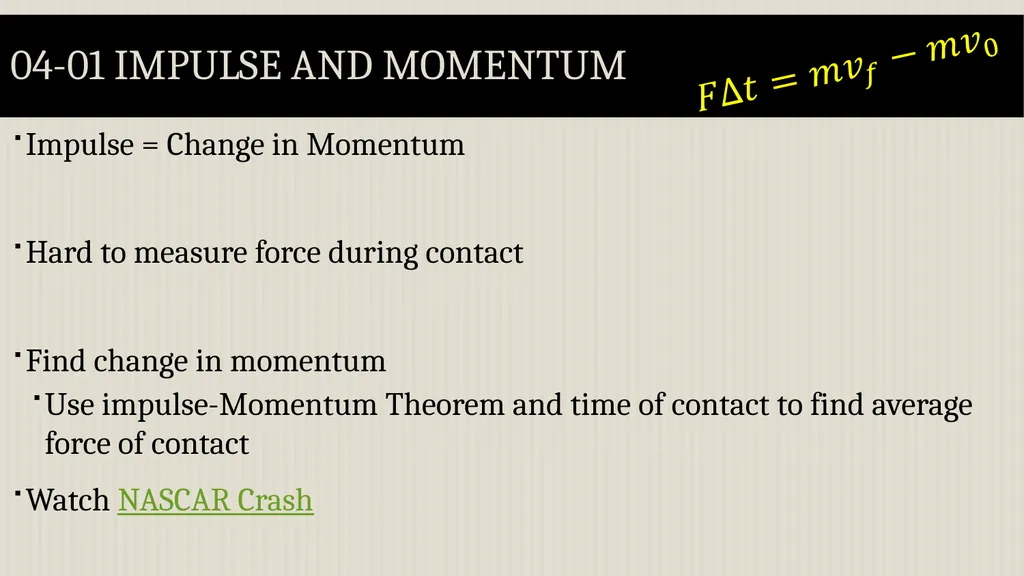
04-01 Impulse and Momentum Impulse = Change in Momentum
Hard to measure force during contact
Find change in momentum
Use impulse-Momentum Theorem and time of contact to find average force of contact
Watch NASCAR Crash<br>
Hard to measure force during contact
Find change in momentum
Use impulse-Momentum Theorem and time of contact to find average force of contact
Watch NASCAR Crash<br>
11
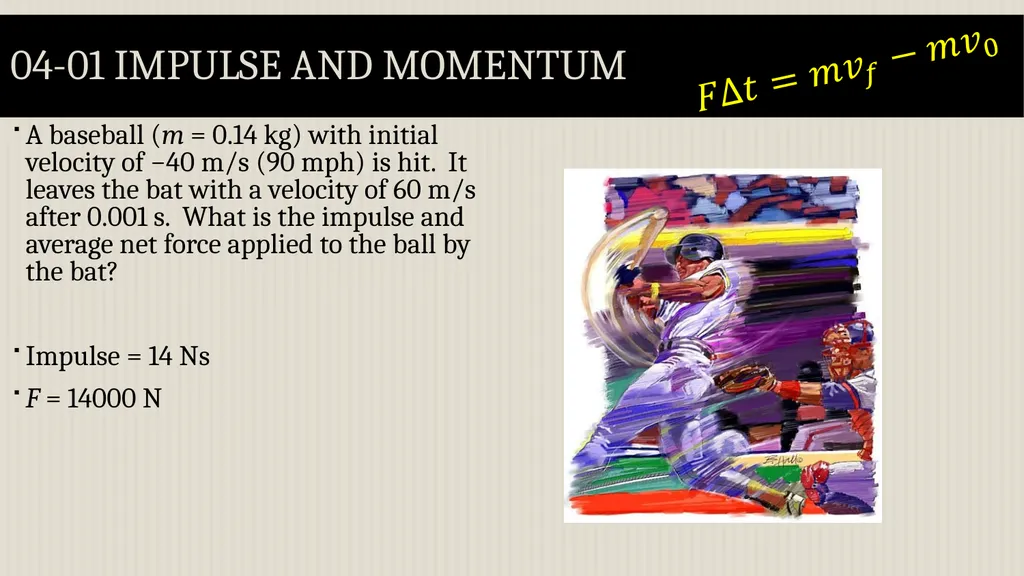
04-01 Impulse and Momentum A baseball (m = 0.14 kg) with initial velocity of −40 m/s (90 mph) is hit. It leaves the bat with a velocity of 60 m/s after 0.001 s. What is the impulse and average net force applied to the ball by the bat?
Impulse = 14 Ns
F = 14000 N<br>
Impulse = 14 Ns
F = 14000 N<br>
12
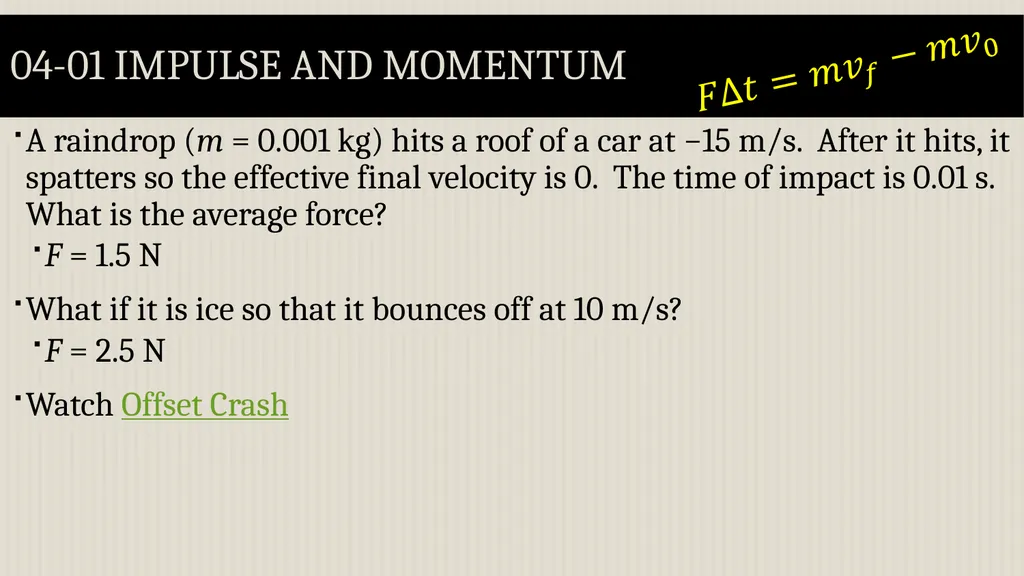
04-01 Impulse and Momentum A raindrop (m = 0.001 kg) hits a roof of a car at −15 m/s. After it hits, it spatters so the effective final velocity is 0. The time of impact is 0.01 s. What is the average force?
F = 1.5 N
What if it is ice so that it bounces off at 10 m/s?
F = 2.5 N
Watch Offset Crash<br>
F = 1.5 N
What if it is ice so that it bounces off at 10 m/s?
F = 2.5 N
Watch Offset Crash<br>
13
04-02 Conservation of Momentum In this lesson you will…
• Describe the principle of conservation of momentum.
• Derive an expression for the conservation of momentum.
• Explain conservation of momentum with examples.<br>
• Describe the principle of conservation of momentum.
• Derive an expression for the conservation of momentum.
• Explain conservation of momentum with examples.<br>
14
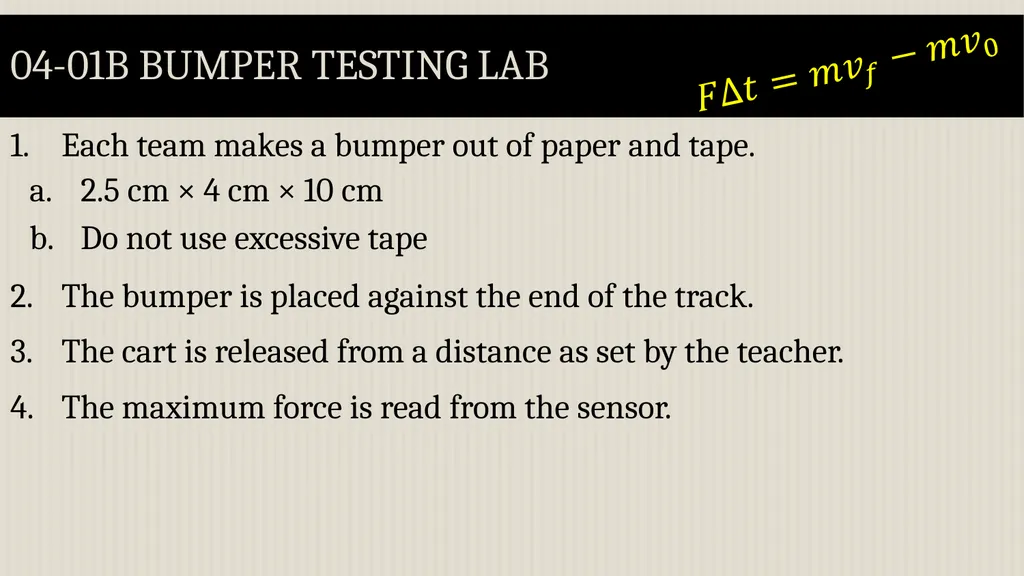
04-01b Bumper Testing Lab Each team makes a bumper out of paper and tape.
2.5 cm × 4 cm × 10 cm
Do not use excessive tape
The bumper is placed against the end of the track.
The cart is released from a distance as set by the teacher.
The maximum force is read from the sensor.<br>
2.5 cm × 4 cm × 10 cm
Do not use excessive tape
The bumper is placed against the end of the track.
The cart is released from a distance as set by the teacher.
The maximum force is read from the sensor.<br>
15
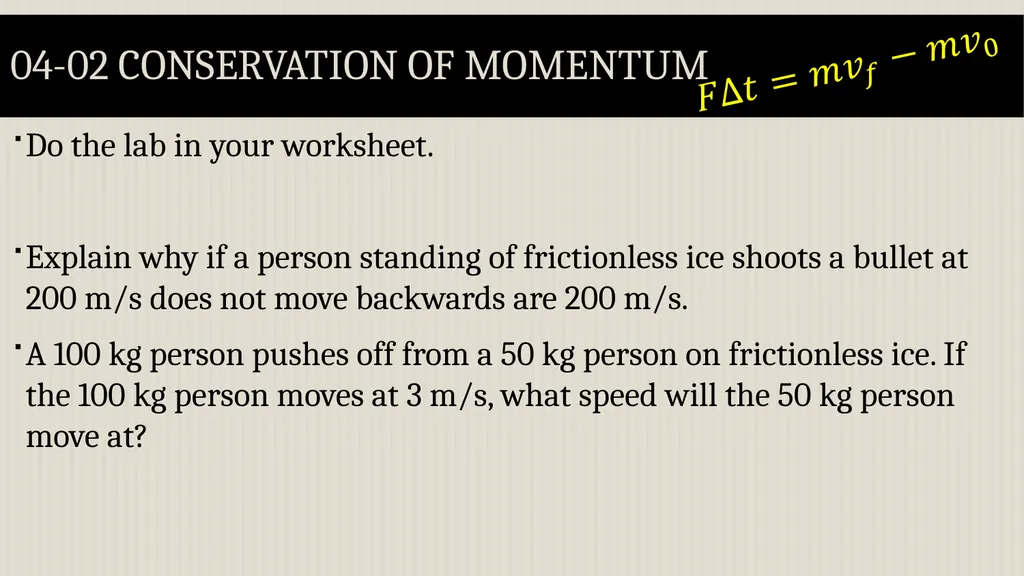
04-02 Conservation of Momentum Do the lab in your worksheet.
Explain why if a person standing of frictionless ice shoots a bullet at 200 m/s does not move backwards are 200 m/s.
A 100 kg person pushes off from a 50 kg person on frictionless ice. If the 100 kg person moves at 3 m/s, what speed will the 50 kg person move at?<br>
Explain why if a person standing of frictionless ice shoots a bullet at 200 m/s does not move backwards are 200 m/s.
A 100 kg person pushes off from a 50 kg person on frictionless ice. If the 100 kg person moves at 3 m/s, what speed will the 50 kg person move at?<br>
16
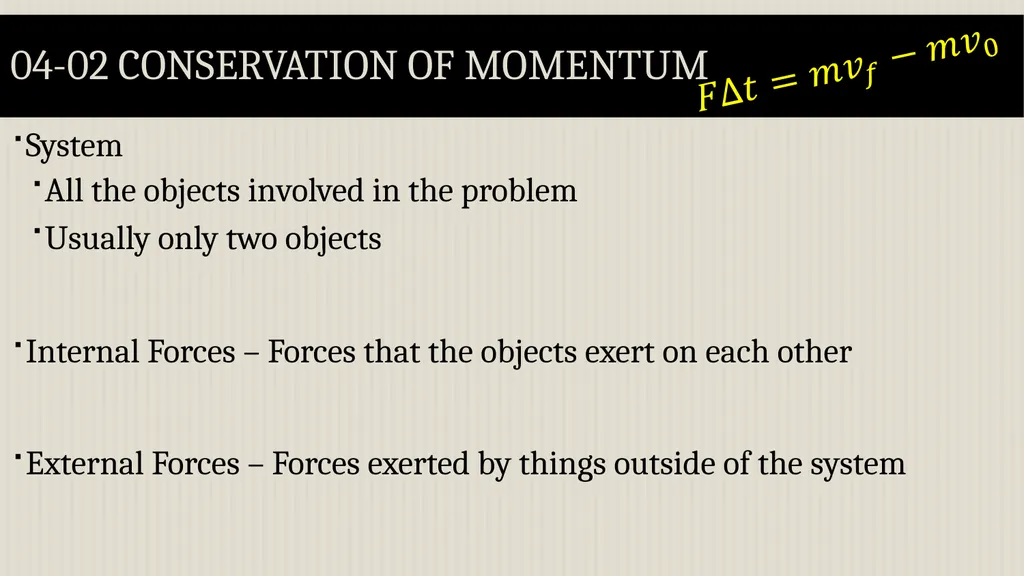
04-02 Conservation of Momentum System
All the objects involved in the problem
Usually only two objects
Internal Forces – Forces that the objects exert on each other
External Forces – Forces exerted by things outside of the system<br>
All the objects involved in the problem
Usually only two objects
Internal Forces – Forces that the objects exert on each other
External Forces – Forces exerted by things outside of the system<br>
17
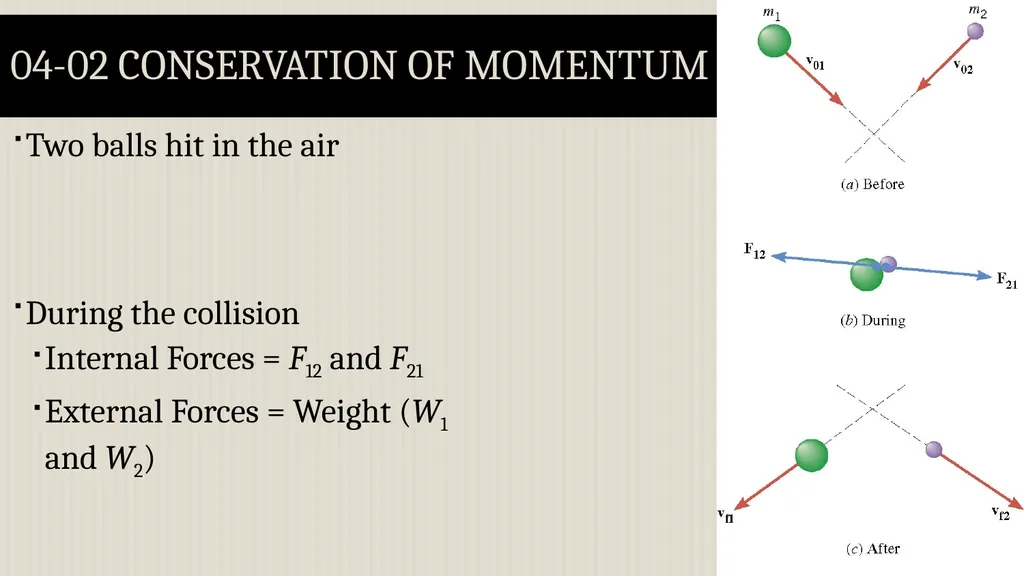
04-02 Conservation of Momentum Two balls hit in the air
During the collision
Internal Forces = F12 and F21
External Forces = Weight (W1 and W2)<br>
During the collision
Internal Forces = F12 and F21
External Forces = Weight (W1 and W2)<br>
18
04-02 Conservation of Momentum<br>
19
04-02 Conservation of Momentum<br>
20
04-02 Conservation of Momentum<br>
21
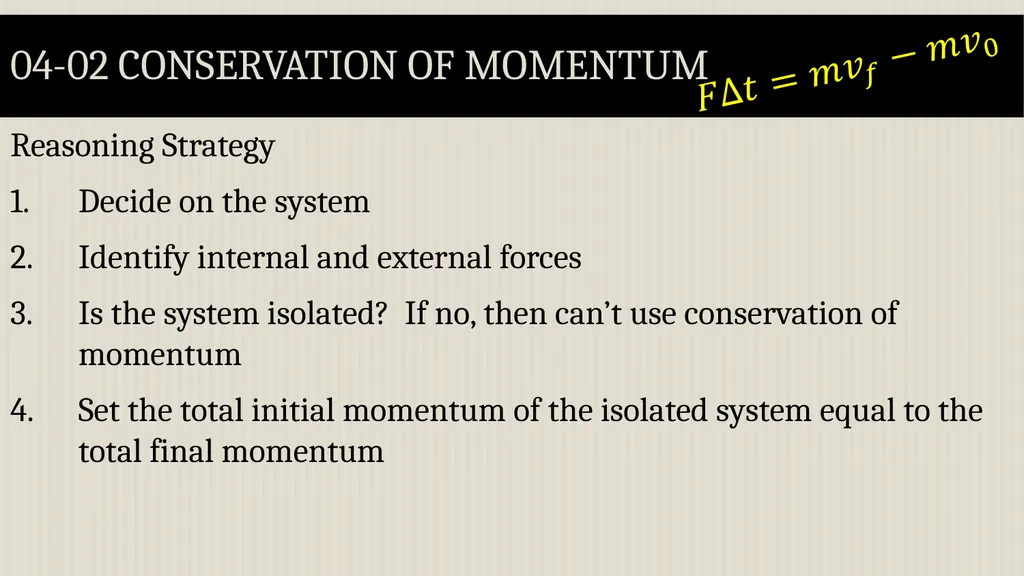
04-02 Conservation of Momentum Reasoning Strategy
Decide on the system
Identify internal and external forces
Is the system isolated? If no, then can’t use conservation of momentum
Set the total initial momentum of the isolated system equal to the total final momentum<br>
Decide on the system
Identify internal and external forces
Is the system isolated? If no, then can’t use conservation of momentum
Set the total initial momentum of the isolated system equal to the total final momentum<br>
22
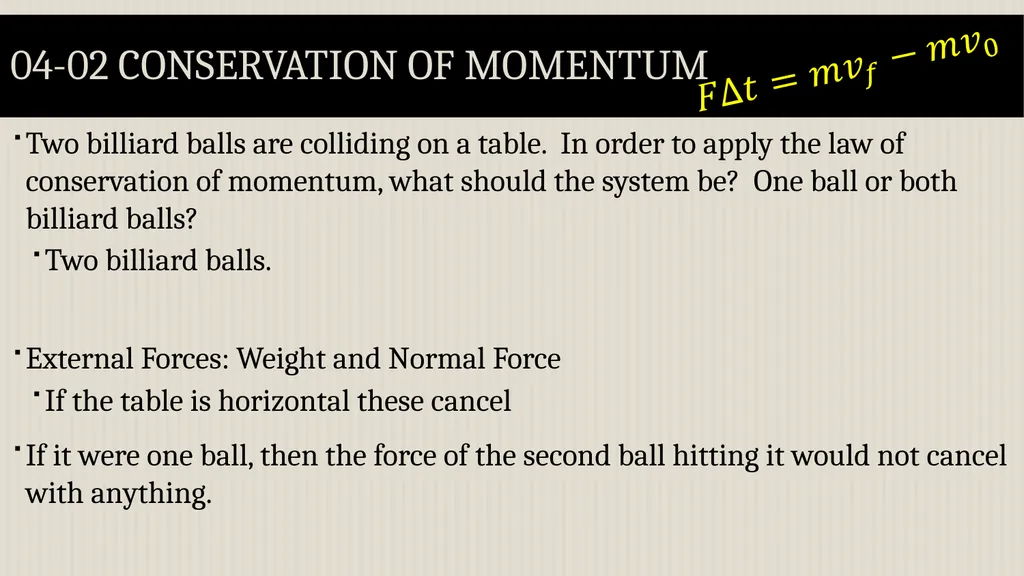
04-02 Conservation of Momentum Two billiard balls are colliding on a table. In order to apply the law of conservation of momentum, what should the system be? One ball or both billiard balls?
Two billiard balls.
External Forces: Weight and Normal Force
If the table is horizontal these cancel
If it were one ball, then the force of the second ball hitting it would not cancel with anything.<br>
Two billiard balls.
External Forces: Weight and Normal Force
If the table is horizontal these cancel
If it were one ball, then the force of the second ball hitting it would not cancel with anything.<br>
23
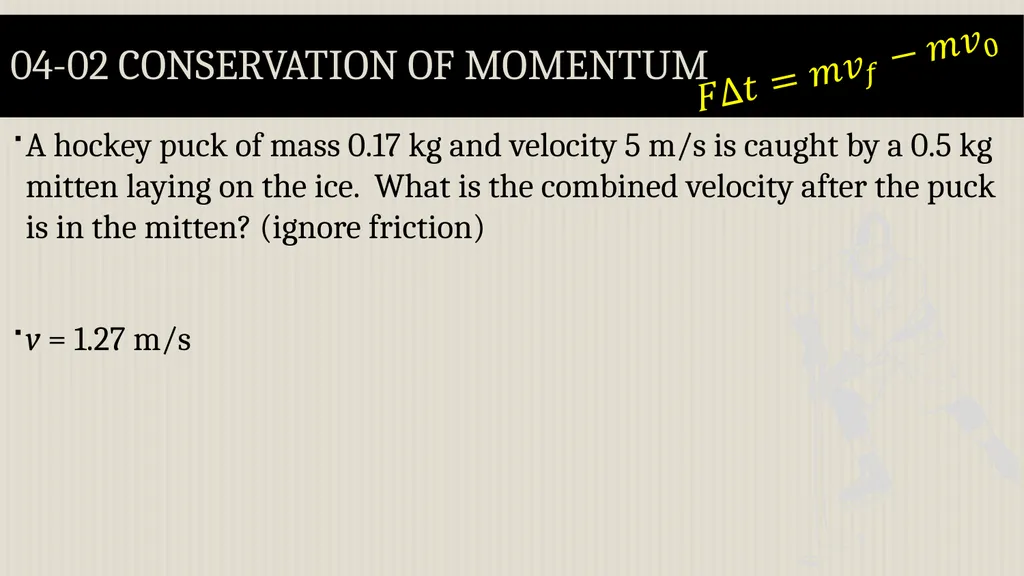
04-02 Conservation of Momentum A hockey puck of mass 0.17 kg and velocity 5 m/s is caught by a 0.5 kg mitten laying on the ice. What is the combined velocity after the puck is in the mitten? (ignore friction)
v = 1.27 m/s<br>
v = 1.27 m/s<br>
24
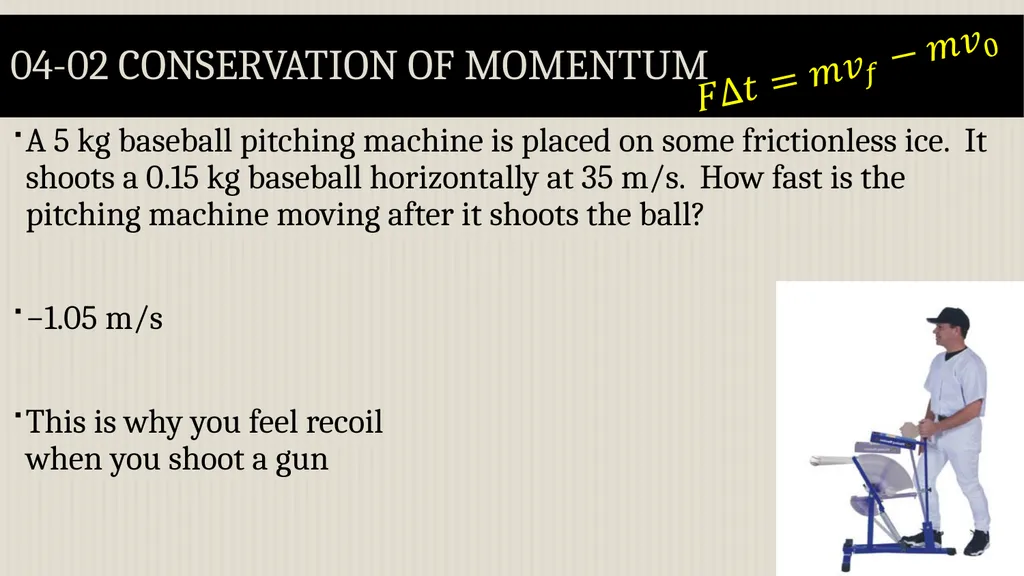
04-02 Conservation of Momentum A 5 kg baseball pitching machine is placed on some frictionless ice. It shoots a 0.15 kg baseball horizontally at 35 m/s. How fast is the pitching machine moving after it shoots the ball?
−1.05 m/s
This is why you feel recoil when you shoot a gun<br>
−1.05 m/s
This is why you feel recoil when you shoot a gun<br>
25
04-03 Elastic and Inelastic Collisions In this lesson you will…
• Describe an elastic collision of two objects in one dimension.
• Determine the final velocities in an elastic collision given masses and initial velocities.
• Define inelastic collision.
• Explain perfectly inelastic collision.<br>
• Describe an elastic collision of two objects in one dimension.
• Determine the final velocities in an elastic collision given masses and initial velocities.
• Define inelastic collision.
• Explain perfectly inelastic collision.<br>
26
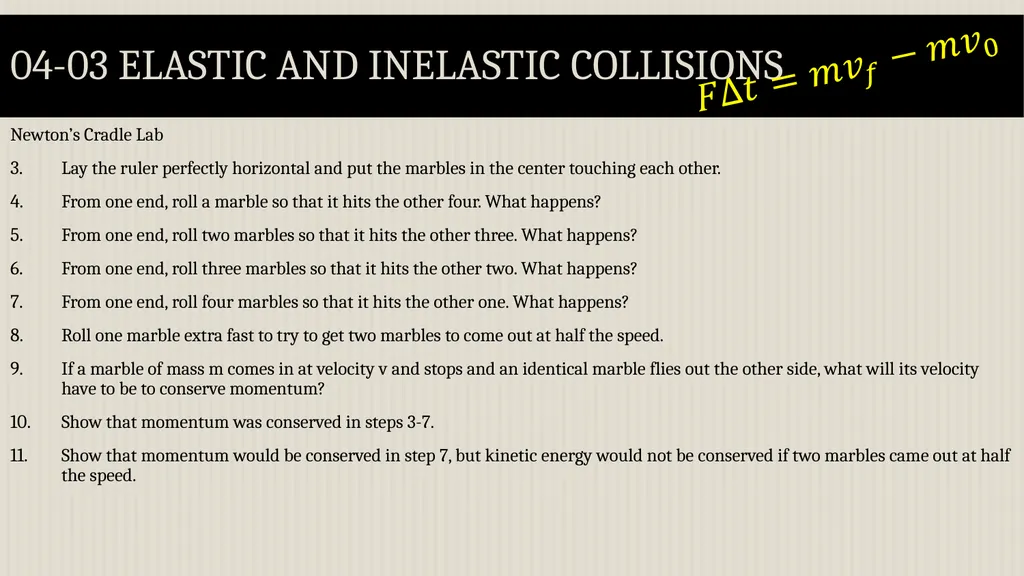
04-03 Elastic and Inelastic Collisions Newton’s Cradle Lab
Lay the ruler perfectly horizontal and put the marbles in the center touching each other.
From one end, roll a marble so that it hits the other four. What happens?
From one end, roll two marbles so that it hits the other three. What happens?
From one end, roll three marbles so that it hits the other two. What happens?
From one end, roll four marbles so that it hits the other one. What happens?
Roll one marble extra fast to try to get two marbles to come out at half the speed.
If a marble of mass m comes in at velocity v and stops and an identical marble flies out the other side, what will its velocity have to be to conserve momentum?
Show that momentum was conserved in steps 3-7.
Show that momentum would be conserved in step 7, but kinetic energy would not be conserved if two marbles came out at half the speed.<br>
27
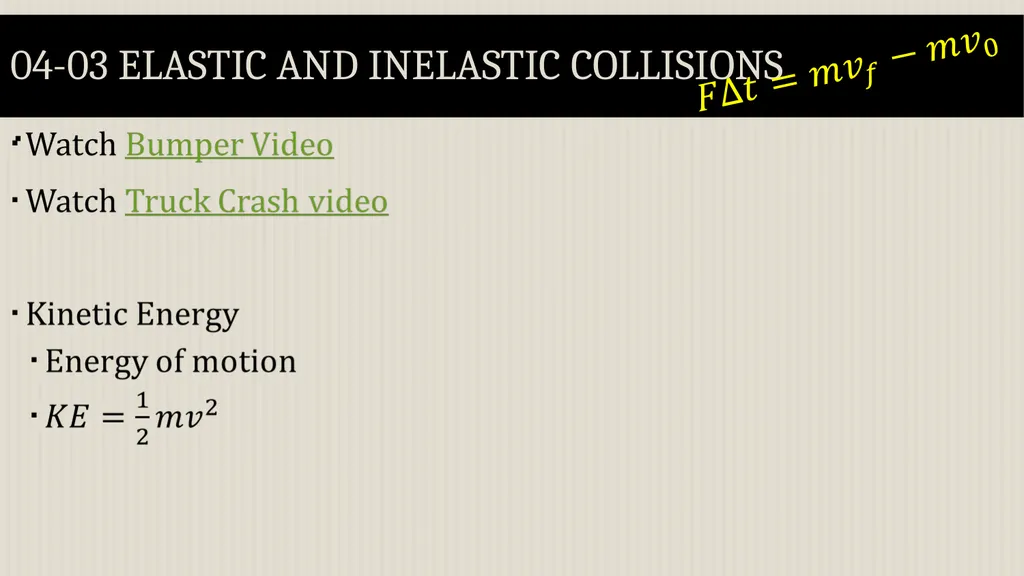
04-03 Elastic and Inelastic Collisions<br>
28
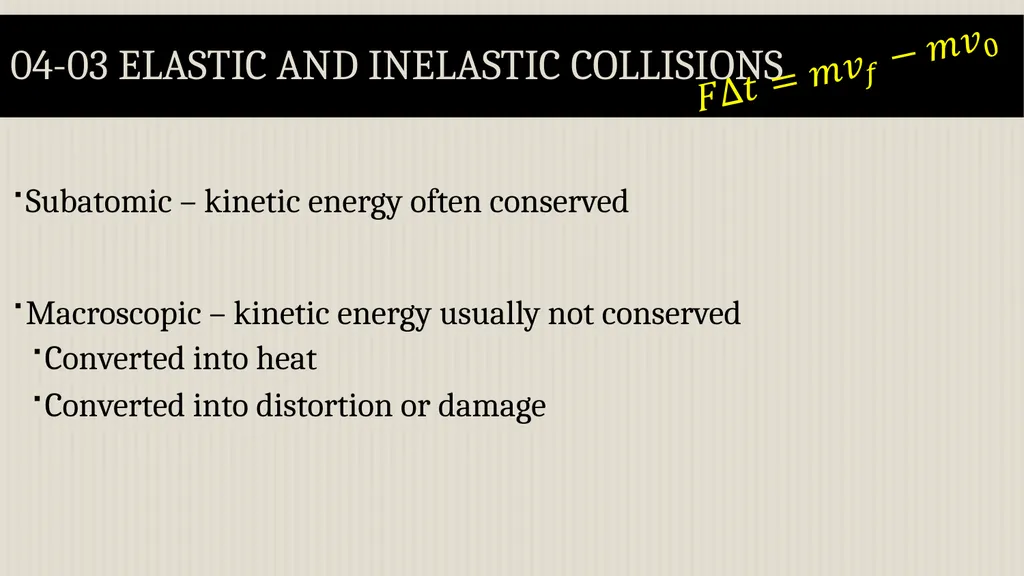
04-03 Elastic and Inelastic Collisions Subatomic – kinetic energy often conserved
Macroscopic – kinetic energy usually not conserved
Converted into heat
Converted into distortion or damage<br>
Macroscopic – kinetic energy usually not conserved
Converted into heat
Converted into distortion or damage<br>
29
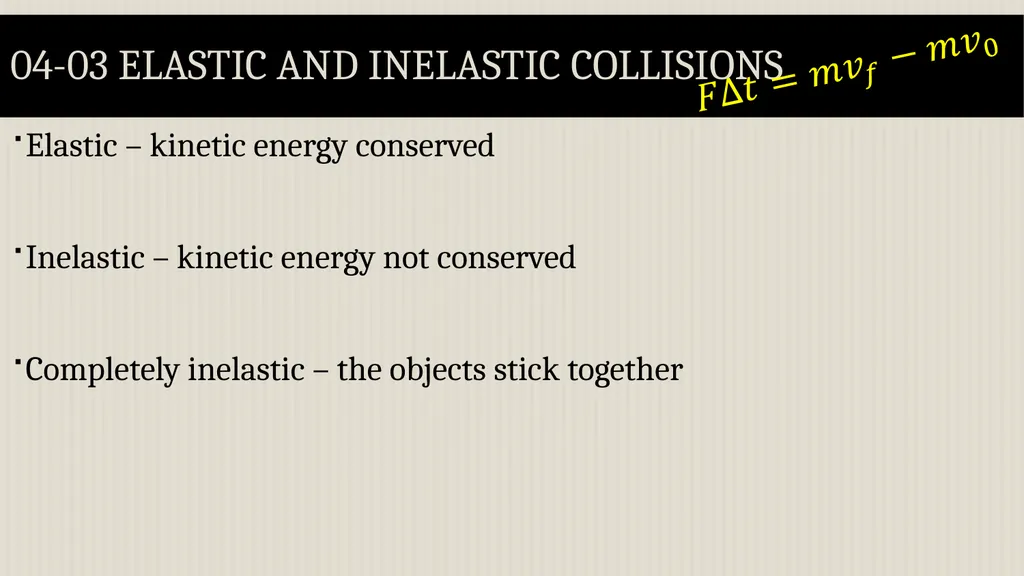
04-03 Elastic and Inelastic Collisions Elastic – kinetic energy conserved
Inelastic – kinetic energy not conserved
Completely inelastic – the objects stick together<br>
Inelastic – kinetic energy not conserved
Completely inelastic – the objects stick together<br>
30
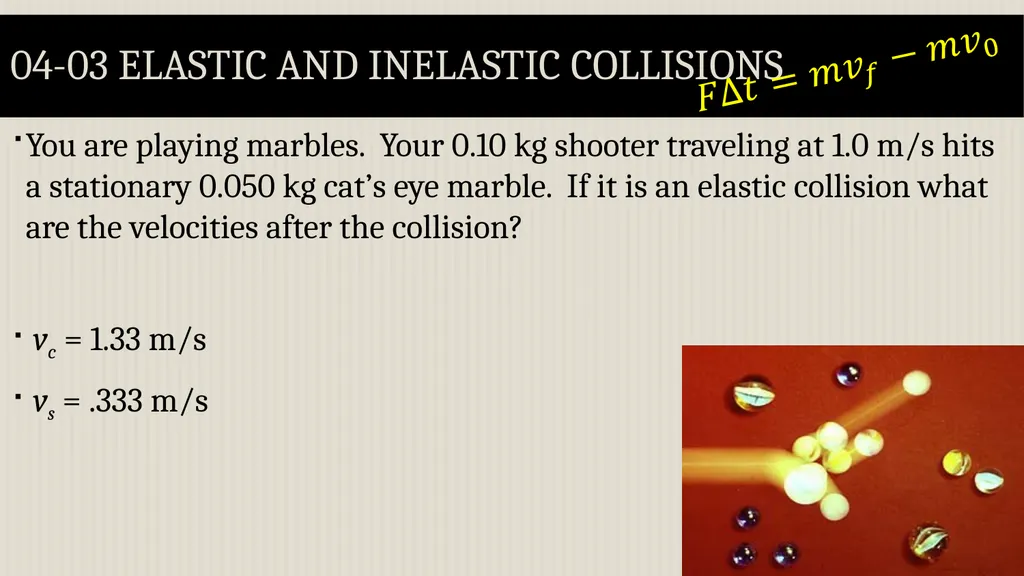
04-03 Elastic and Inelastic Collisions You are playing marbles. Your 0.10 kg shooter traveling at 1.0 m/s hits a stationary 0.050 kg cat’s eye marble. If it is an elastic collision what are the velocities after the collision?
vc = 1.33 m/s
vs = .333 m/s<br>
vc = 1.33 m/s
vs = .333 m/s<br>
31
04-03 Elastic and Inelastic Collisions A ballistic pendulum can be used to determine the muzzle velocity of a gun. A .01 kg bullet is fired into a 3 kg block of wood. The block is attached with a thin .5m wire and swings to an angle of 40°. How fast was the bullet traveling when it left the gun?
v = 455 m/s<br>
v = 455 m/s<br>
32
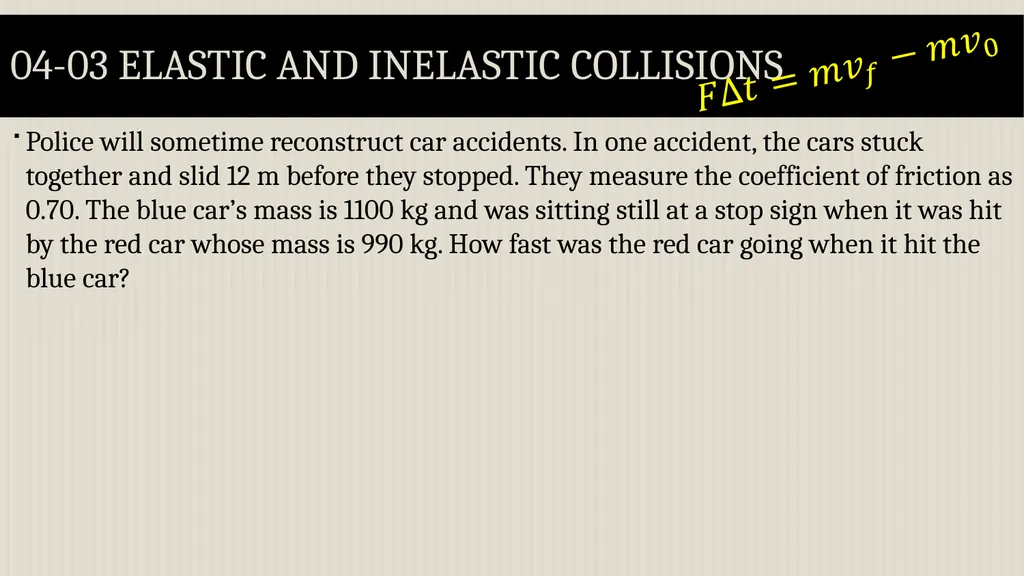
04-03 Elastic and Inelastic Collisions Police will sometime reconstruct car accidents. In one accident, the cars stuck together and slid 12 m before they stopped. They measure the coefficient of friction as 0.70. The blue car’s mass is 1100 kg and was sitting still at a stop sign when it was hit by the red car whose mass is 990 kg. How fast was the red car going when it hit the blue car?<br>
33
04-03 Elastic and Inelastic Collisions Watch Child Seat video
Watch Reducing Risk video<br>
Watch Reducing Risk video<br>
34
04-04 Angular Momentum In this lesson you will…
• Understand the analogy between angular momentum and linear momentum.
• Observe the relationship between torque and angular momentum.
• Apply the law of conservation of angular momentum.<br>
• Understand the analogy between angular momentum and linear momentum.
• Observe the relationship between torque and angular momentum.
• Apply the law of conservation of angular momentum.<br>
35
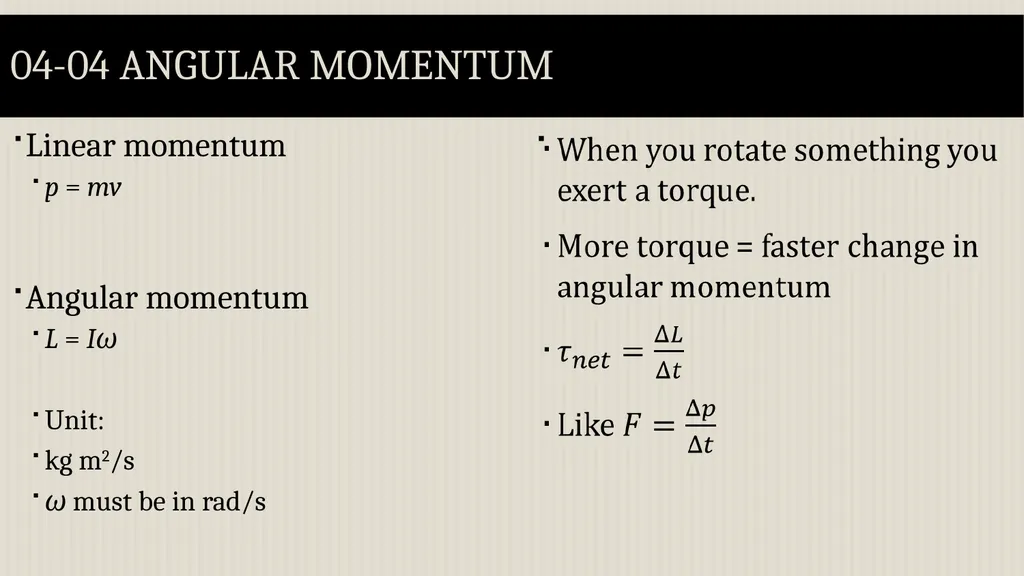
04-04 Angular Momentum Linear momentum
p = mv
Angular momentum
L = Iω
Unit:
kg m2/s
ω must be in rad/s<br>
p = mv
Angular momentum
L = Iω
Unit:
kg m2/s
ω must be in rad/s<br>
36
04-04 Angular Momentum<br>
37
04-04 Angular Momentum<br>
38
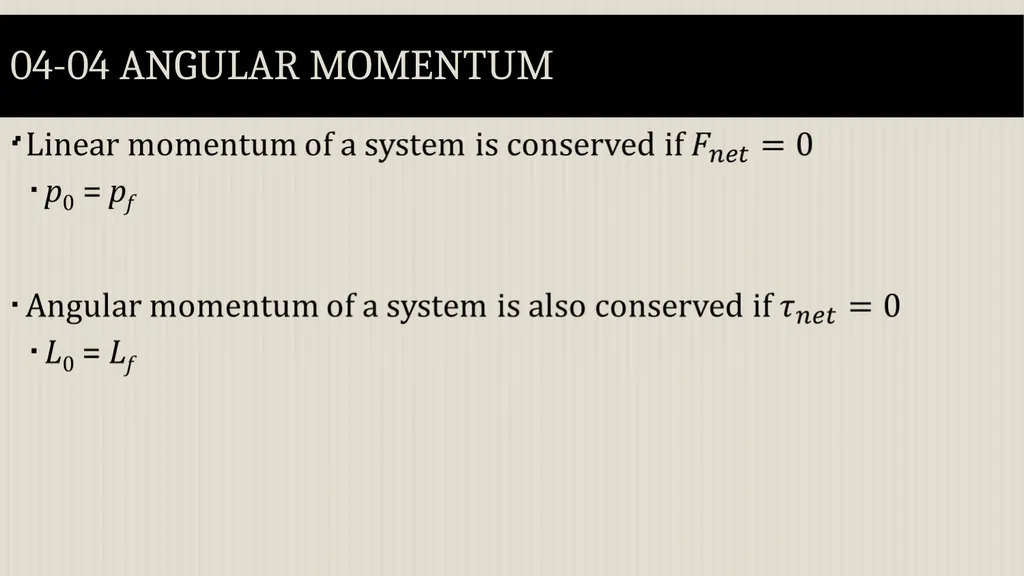
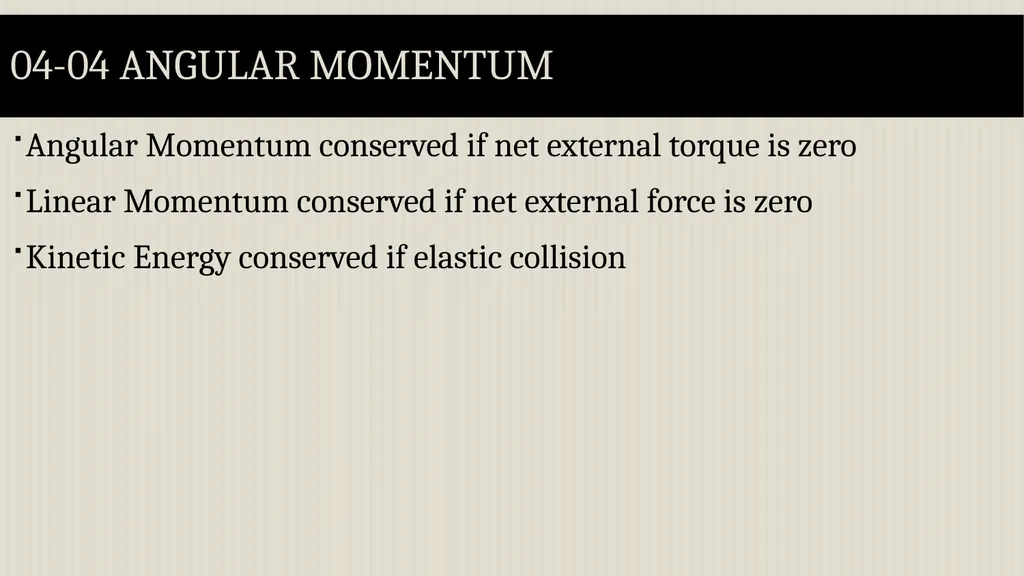
04-04 Angular Momentum Angular Momentum conserved if net external torque is zero
Linear Momentum conserved if net external force is zero
Kinetic Energy conserved if elastic collision<br>
Linear Momentum conserved if net external force is zero
Kinetic Energy conserved if elastic collision<br>
39
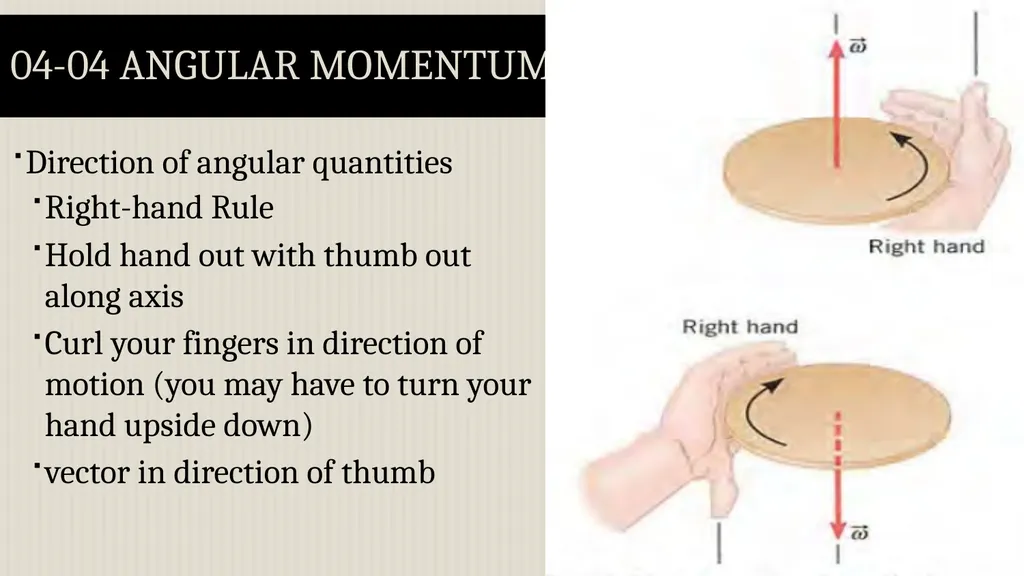
04-04 Angular Momentum Direction of angular quantities
Right-hand Rule
Hold hand out with thumb out along axis
Curl your fingers in direction of motion (you may have to turn your hand upside down)
vector in direction of thumb<br>
Right-hand Rule
Hold hand out with thumb out along axis
Curl your fingers in direction of motion (you may have to turn your hand upside down)
vector in direction of thumb<br>
40
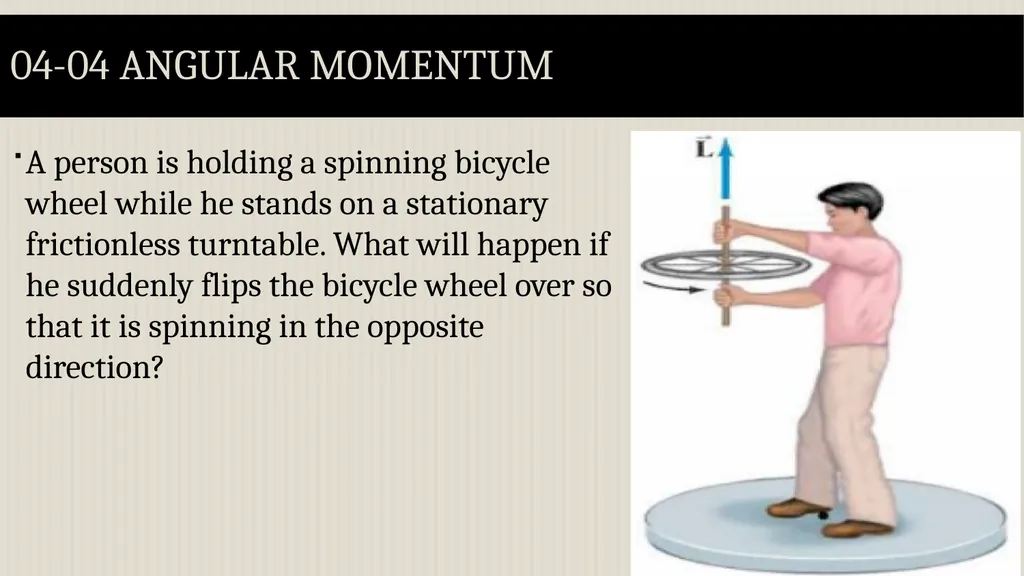
04-04 Angular Momentum A person is holding a spinning bicycle wheel while he stands on a stationary frictionless turntable. What will happen if he suddenly flips the bicycle wheel over so that it is spinning in the opposite direction?<br>
41
04-04 Angular Momentum Gyroscopes
Two forces acting on a spinning gyroscope. The torque produced is perpendicular to the angular momentum, thus the direction of the torque is changed, but not its magnitude. The gyroscope precesses around a vertical axis, since the torque is always horizontal and perpendicular to L .
If the gyroscope is not spinning, it acquires angular momentum in the direction of the torque ( L = ΔL ), and it rotates around a horizontal axis, falling over just as we would expect.<br>