
Energy Physics Unit 06 Credits Slides created by
CB
Published · 55 slides · 0 views

1 / 1
Description
Energy Physics Unit 06 Credits Slides created by Richard Wright, Andrews Academy rwrightandrews.edu This Slideshow was developed to accompany the textbook OpenStax High School Physics Available for free at
Related Topics
Share
Embed code
Download this presentation From Below
"Energy Physics Unit 06 Credits Slides created by" is the property of its rightful owner. Permission is granted to download and print the materials on this website for personal, non-commercial use only, and to display it on your personal computer provided you do not modify the materials and that you retain all copyright notices contained in the materials. By downloading content from our website, you accept the terms of this agreement.
Presentation Transcript
01
Energy Physics
Unit 06<br>
Unit 06<br>
02
Credits Slides created by
Richard Wright, Andrews Academy
rwright@andrews.edu This Slideshow was developed to accompany the textbook
OpenStax High School Physics
Available for free at https://openstax.org/details/books/physics
By Paul Peter Urone and Roger Hinrichs
2020 edition
Some examples and diagrams are taken from the OpenStax College Physics, Physics, and Cutnell & Johnson Physics 6th ed.<br>
Richard Wright, Andrews Academy
rwright@andrews.edu This Slideshow was developed to accompany the textbook
OpenStax High School Physics
Available for free at https://openstax.org/details/books/physics
By Paul Peter Urone and Roger Hinrichs
2020 edition
Some examples and diagrams are taken from the OpenStax College Physics, Physics, and Cutnell & Johnson Physics 6th ed.<br>
03
6-01 Work and Power In this lesson you will…
Define work.
Define power.<br>
Define work.
Define power.<br>
04
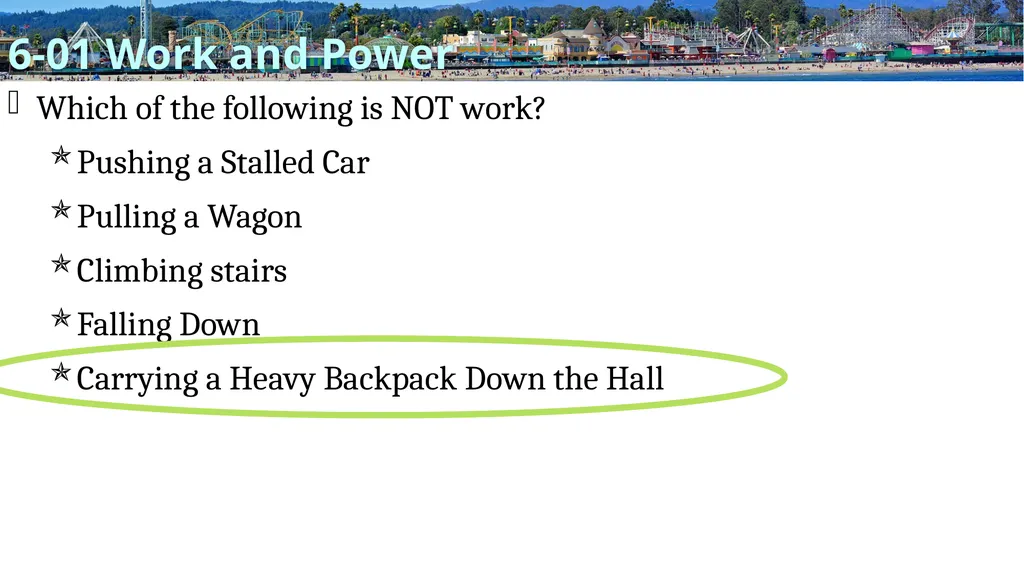
6-01 Work and Power Which of the following is NOT work?
Pushing a Stalled Car
Pulling a Wagon
Climbing stairs
Falling Down
Carrying a Heavy Backpack Down the Hall<br>
Pushing a Stalled Car
Pulling a Wagon
Climbing stairs
Falling Down
Carrying a Heavy Backpack Down the Hall<br>
05
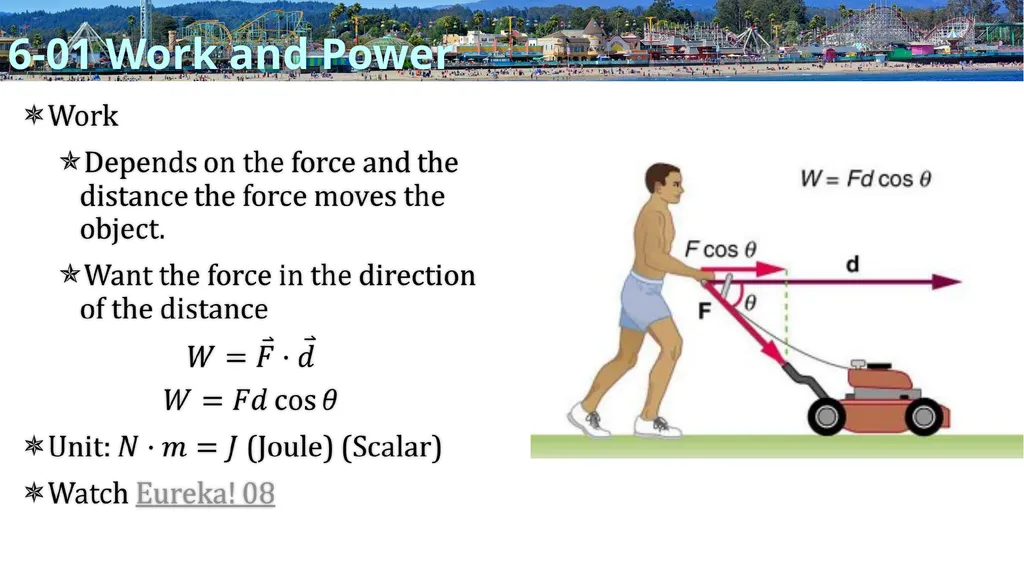
6-01 Work and Power<br>
06
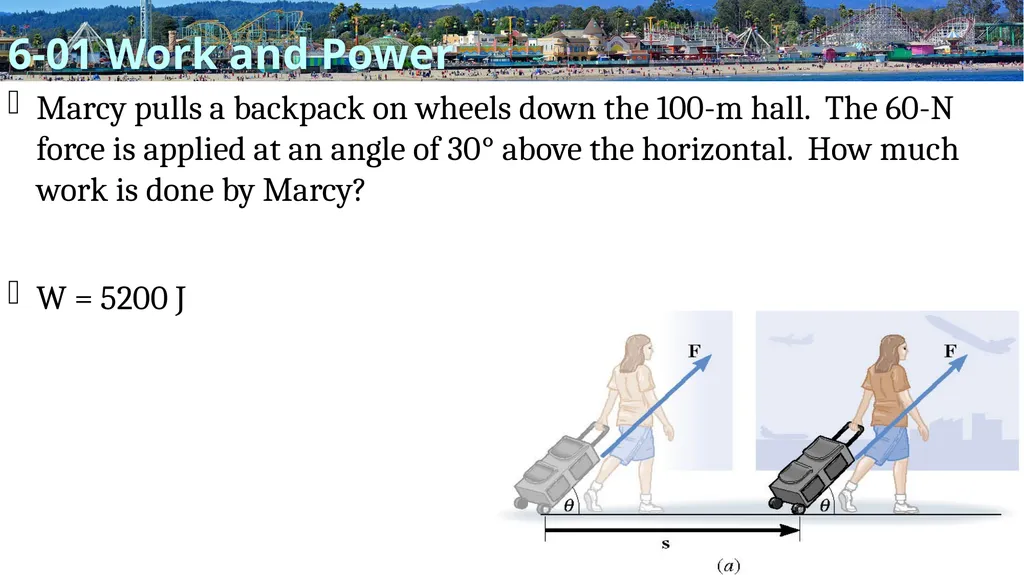
6-01 Work and Power Marcy pulls a backpack on wheels down the 100-m hall. The 60-N force is applied at an angle of 30° above the horizontal. How much work is done by Marcy?
W = 5200 J<br>
W = 5200 J<br>
07
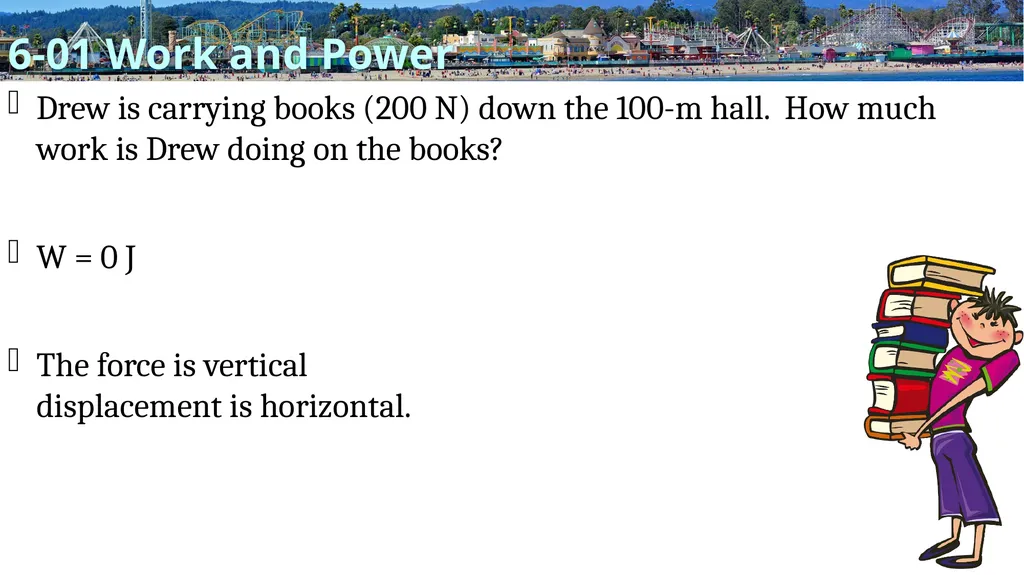
6-01 Work and Power Drew is carrying books (200 N) down the 100-m hall. How much work is Drew doing on the books?
W = 0 J
The force is vertical displacement is horizontal.<br>
W = 0 J
The force is vertical displacement is horizontal.<br>
08
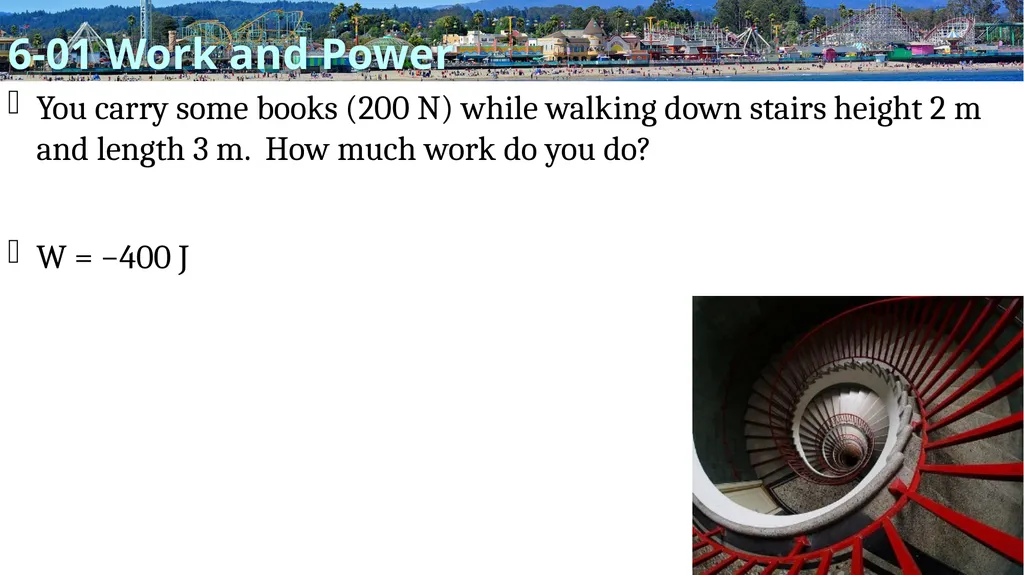
6-01 Work and Power You carry some books (200 N) while walking down stairs height 2 m and length 3 m. How much work do you do?
W = −400 J<br>
W = −400 J<br>
09
6-01 Work and Power A suitcase is hanging straight down from your hand as you ride an escalator. Your hand exerts a force on the suitcase, and this force does work. Which one of the following is correct?
The W is negative when you ride up and positive when you ride down
The W is positive when you ride up and negative when you ride down
The W is positive
The W is negative<br>
The W is negative when you ride up and positive when you ride down
The W is positive when you ride up and negative when you ride down
The W is positive
The W is negative<br>
10
6-01 Work and the Work-Energy Theorem Do work means W = Fd
F = ma
So work by a net force gives an object some acceleration
Acceleration means the velocity changes<br>
F = ma
So work by a net force gives an object some acceleration
Acceleration means the velocity changes<br>
11
6-01 Work and the Work-Energy Theorem<br>
12
6-01 Work and the Work-Energy Theorem<br>
13
6-01 Work and the Work-Energy Theorem A 0.075-kg arrow is fired horizontally. The bowstring exerts a force on the arrow over a distance of 0.90 m. The arrow leaves the bow at 40 m/s. What average force does the bow apply to arrow?<br>
14
6-02 Power In this lesson you will…
Define work.
Define power.<br>
Define work.
Define power.<br>
15
6-01 Work and Power Two cars with the same mass do the same amount of work to get to 100 km/h.
Which car is better
Takes 8.0 s
Takes 6.2 s
Sometimes the time taken to do the work is important<br>
Which car is better
Takes 8.0 s
Takes 6.2 s
Sometimes the time taken to do the work is important<br>
16
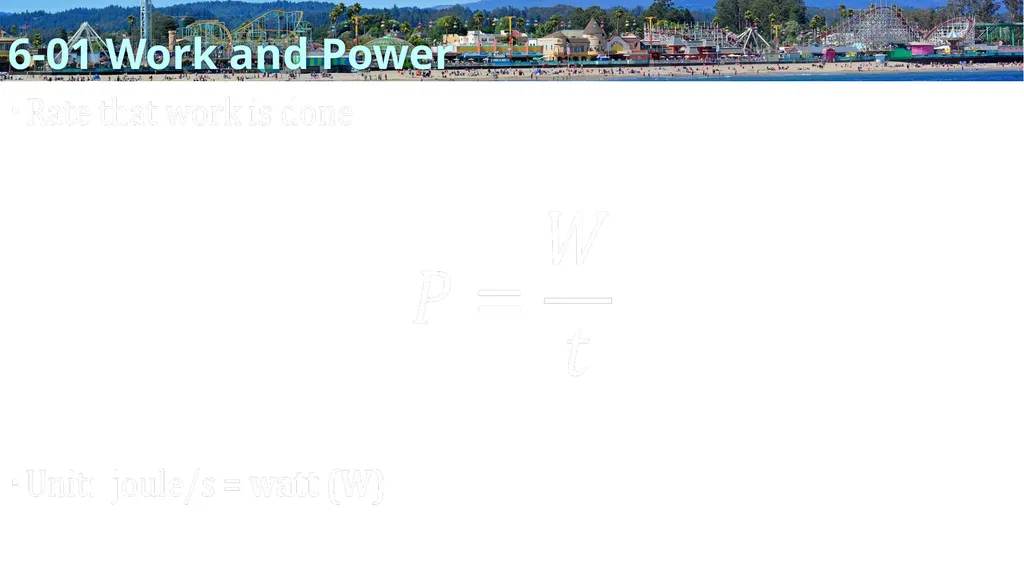
6-01 Work and Power<br>
17
6-01 Work and Power Since work changes the amount of energy in an object
Power is the rate that energy is changing<br>
Power is the rate that energy is changing<br>
18
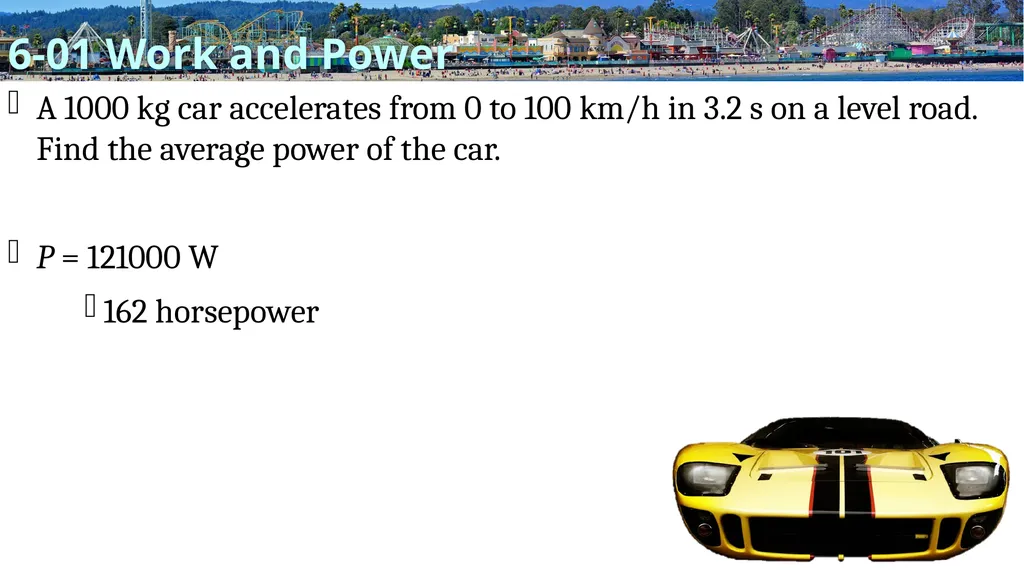
6-01 Work and Power A 1000 kg car accelerates from 0 to 100 km/h in 3.2 s on a level road. Find the average power of the car.
P = 121000 W
162 horsepower<br>
P = 121000 W
162 horsepower<br>
19
6-01 Work and Power Electrical Energy
Often measured in kWh because Pt = W
If it costs $0.10 per kWh, how much will it cost to run a 1000 W microwave for 2 minutes?<br>
Often measured in kWh because Pt = W
If it costs $0.10 per kWh, how much will it cost to run a 1000 W microwave for 2 minutes?<br>
20
6-01 Practice Work Power through these problems.
Read
OpenStax College Physics 2e 7.2-7.4
OR
OpenStax High School Physics 9.2<br>
Read
OpenStax College Physics 2e 7.2-7.4
OR
OpenStax High School Physics 9.2<br>
21
6-02 Types of Energy In this lesson you will…
Find kinetic energy.
Find potential energy.<br>
Find kinetic energy.
Find potential energy.<br>
22
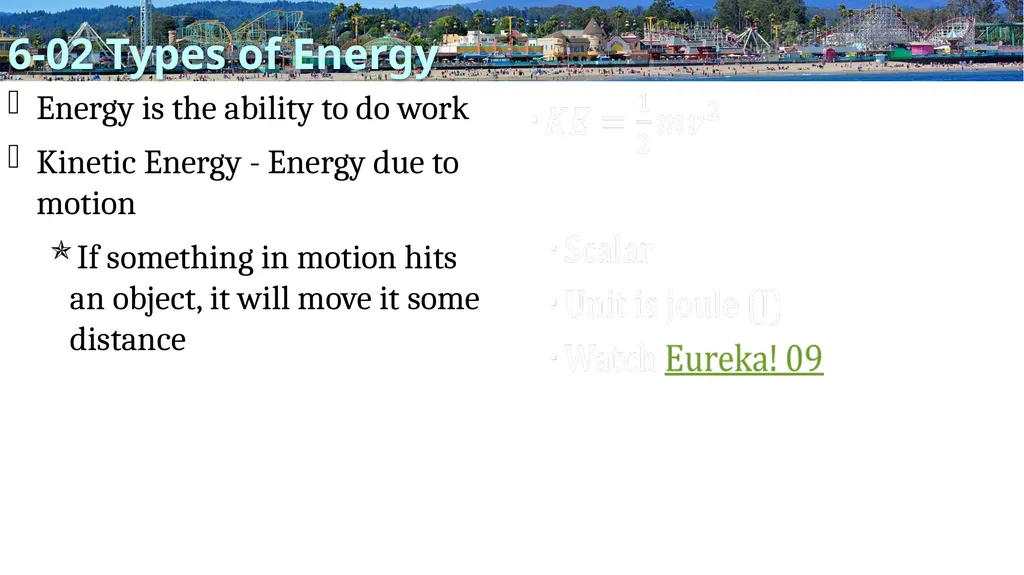
6-02 Types of Energy Energy is the ability to do work
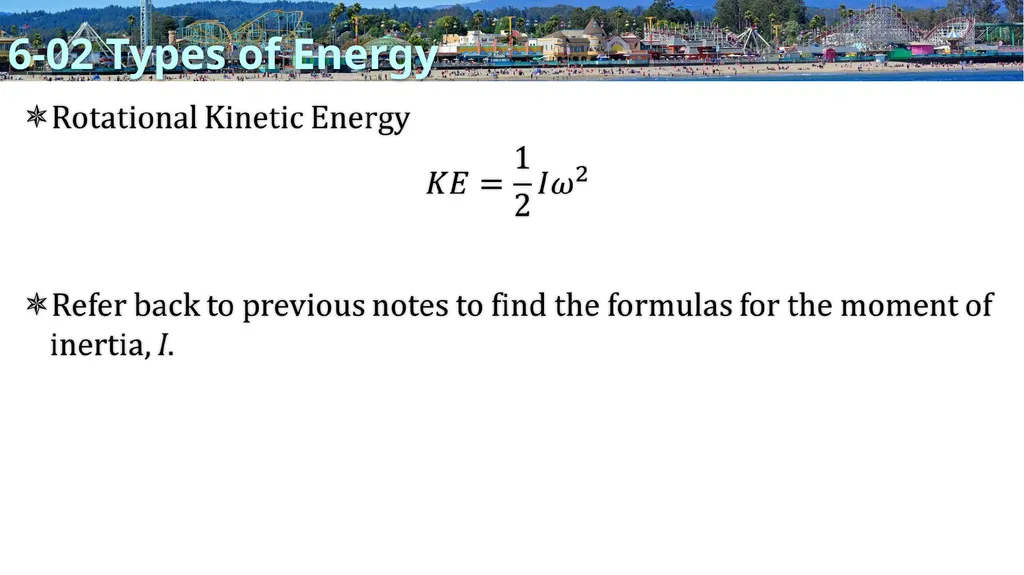
Kinetic Energy - Energy due to motion
If something in motion hits an object, it will move it some distance<br>
Kinetic Energy - Energy due to motion
If something in motion hits an object, it will move it some distance<br>
23
6-02 Types of Energy<br>
24
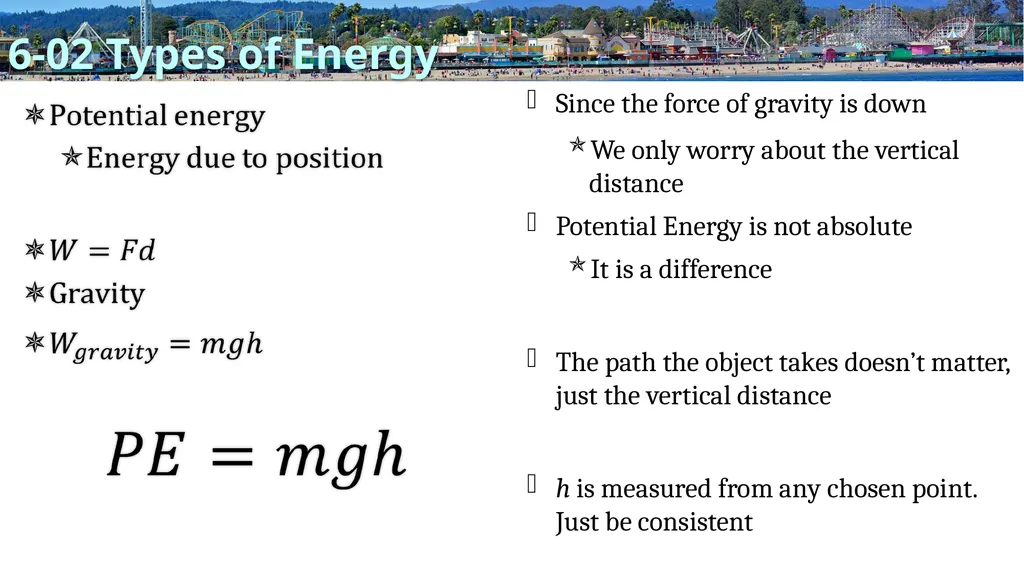
6-02 Types of Energy Since the force of gravity is down
We only worry about the vertical distance
Potential Energy is not absolute
It is a difference
The path the object takes doesn’t matter, just the vertical distance
h is measured from any chosen point. Just be consistent<br>
We only worry about the vertical distance
Potential Energy is not absolute
It is a difference
The path the object takes doesn’t matter, just the vertical distance
h is measured from any chosen point. Just be consistent<br>
25
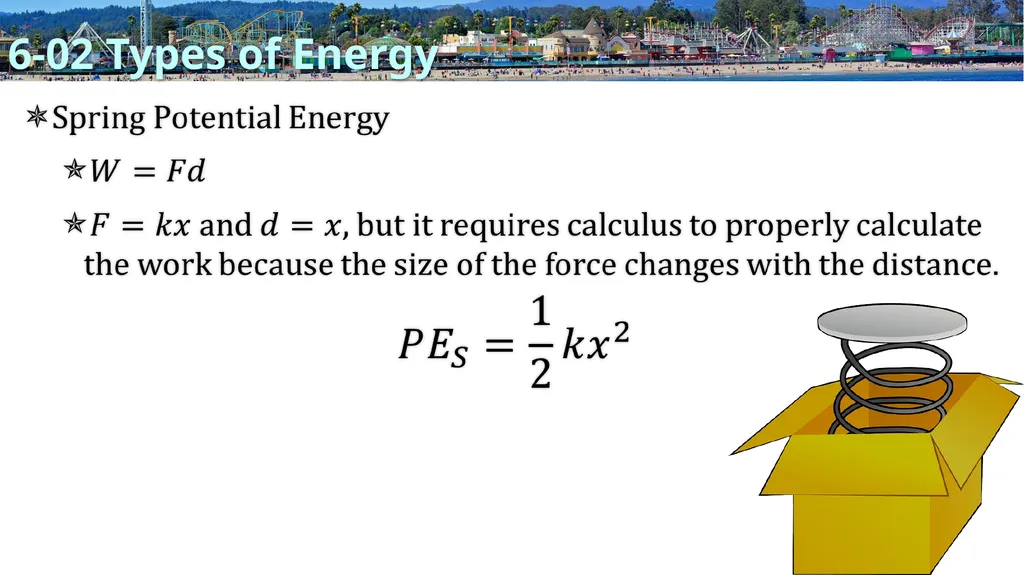
6-02 Types of Energy<br>
26
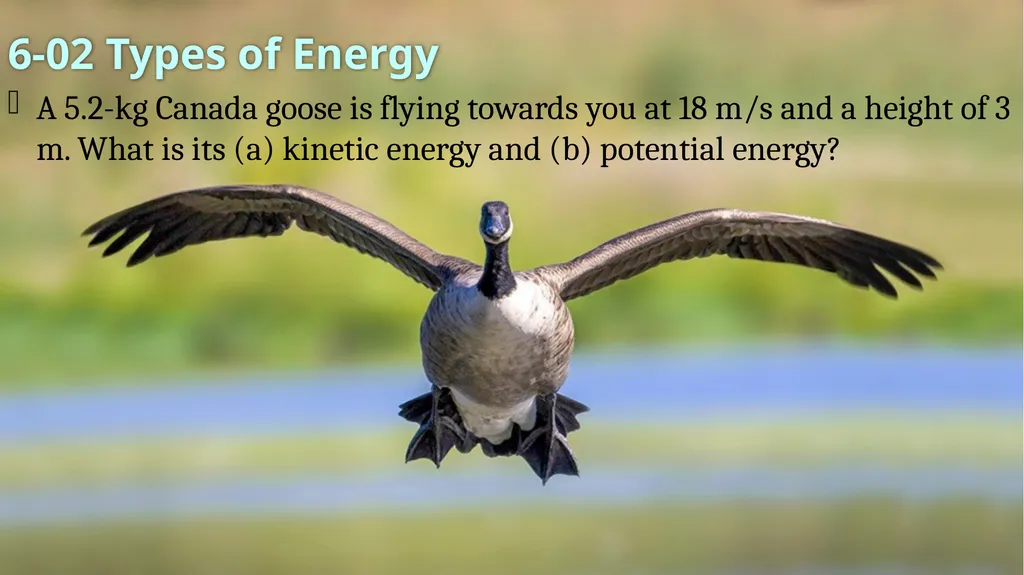
6-02 Types of Energy A 5.2-kg Canada goose is flying towards you at 18 m/s and a height of 3 m. What is its (a) kinetic energy and (b) potential energy?<br>
27
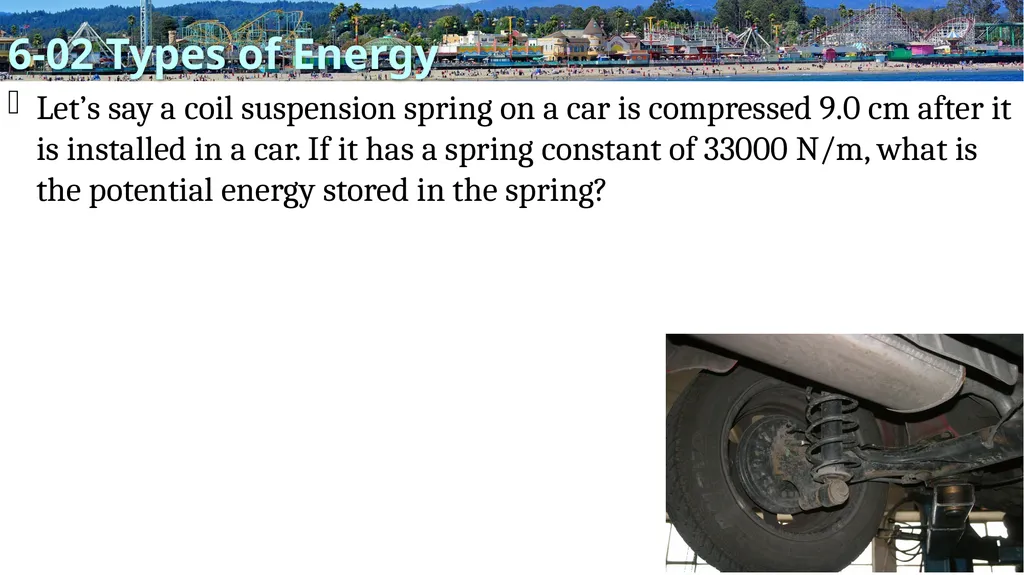
6-02 Types of Energy Let’s say a coil suspension spring on a car is compressed 9.0 cm after it is installed in a car. If it has a spring constant of 33000 N/m, what is the potential energy stored in the spring? This Photo by Unknown Author is licensed under CC BY-SA<br>
28
6-02 Practice Work Increase your potential while practicing with these problems.
Read
OpenStax College Physics 2e 7.4
OR
OpenStax High School Physics 9.2<br>
Read
OpenStax College Physics 2e 7.4
OR
OpenStax High School Physics 9.2<br>
29
6-03 Mechanical Energy Conservation In this lesson you will…
Convert energy from one form to another<br>
Convert energy from one form to another<br>
30
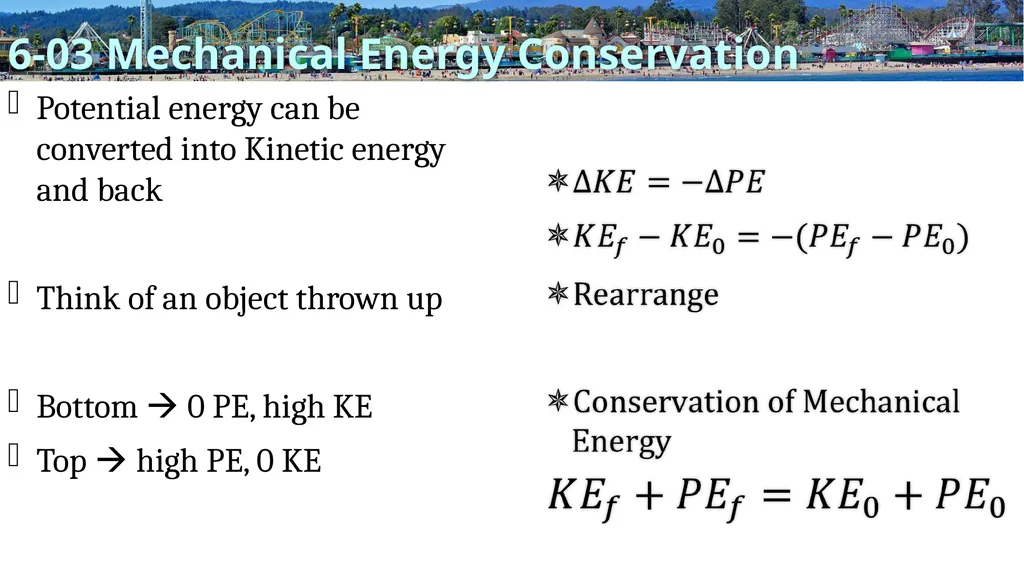
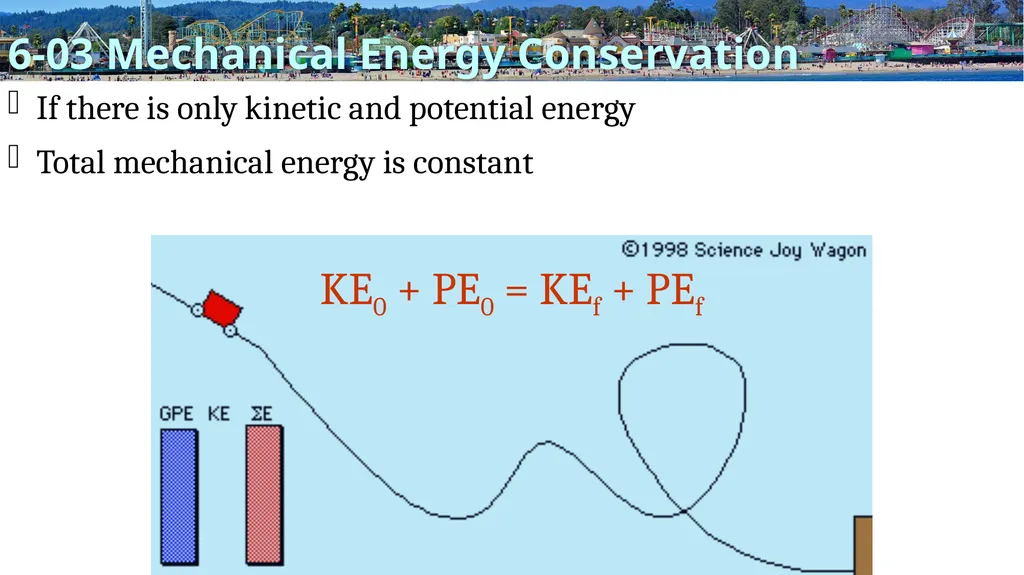
6-03 Mechanical Energy Conservation Potential energy can be converted into Kinetic energy and back
Think of an object thrown up
Bottom 0 PE, high KE
Top high PE, 0 KE<br>
Think of an object thrown up
Bottom 0 PE, high KE
Top high PE, 0 KE<br>
31
6-03 Mechanical Energy Conservation If there is only kinetic and potential energy
Total mechanical energy is constant KE0 + PE0 = KEf + PEf<br>
Total mechanical energy is constant KE0 + PE0 = KEf + PEf<br>
32
6-03 Mechanical Energy Conservation<br>
33
6-03 Mechanical Energy Conservation<br>
34
6-03 Mechanical Energy Conservation A 1500-kg car is driven off a 50-m cliff during a movie stunt. If it was going 20 m/s as it went off the cliff, how fast is it going as it hits the ground?<br>
35
6-03 Practice Work Don’t try to conserve energy. Actually do the work.
Read
OpenStax College Physics 2e 7.5-7.6
OR
OpenStax High School Physics 9.2<br>
Read
OpenStax College Physics 2e 7.5-7.6
OR
OpenStax High School Physics 9.2<br>
36
6-04 Work and Conservation of Energy In this lesson you will…
Convert energy from one form to another with work<br>
Convert energy from one form to another with work<br>
37
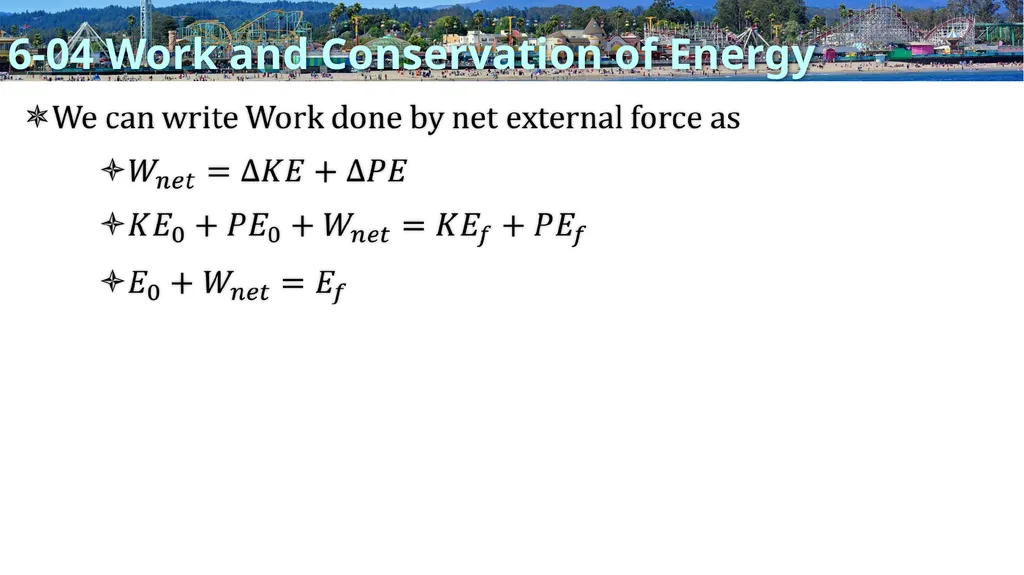
6-04 Work and Conservation of Energy<br>
38
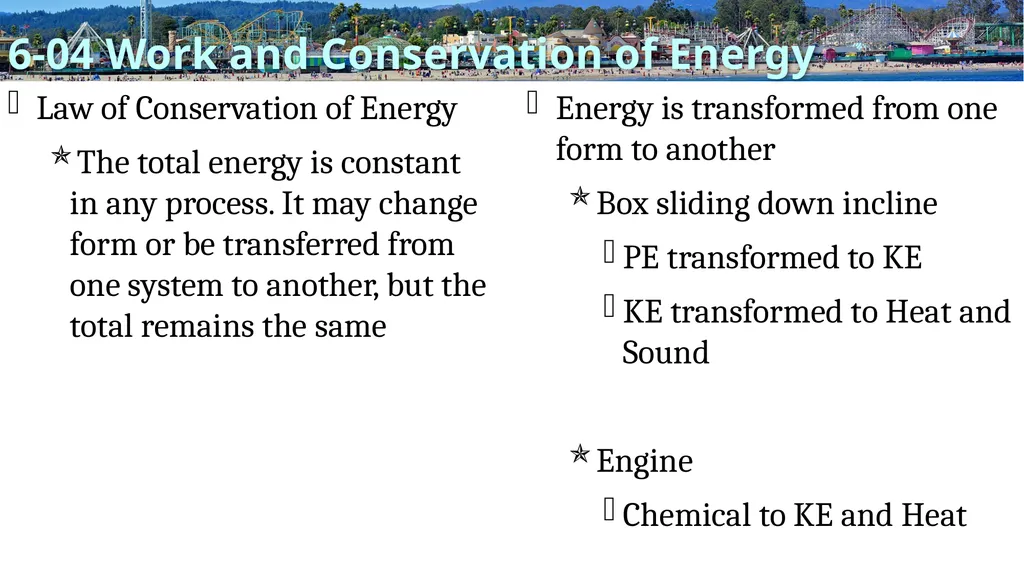
6-04 Work and Conservation of Energy Law of Conservation of Energy
The total energy is constant in any process. It may change form or be transferred from one system to another, but the total remains the same Energy is transformed from one form to another
Box sliding down incline
PE transformed to KE
KE transformed to Heat and Sound
Engine
Chemical to KE and Heat<br>
The total energy is constant in any process. It may change form or be transferred from one system to another, but the total remains the same Energy is transformed from one form to another
Box sliding down incline
PE transformed to KE
KE transformed to Heat and Sound
Engine
Chemical to KE and Heat<br>
39
6-04 Work and Conservation of Energy A rocket starts on the ground at rest. Its final speed is 500 m/s and height is 5000 m. If the mass of the rocket stays approximately 200 kg. Find the work done by the rocket engine.
W = 3.48 x 10⁷ J<br>
W = 3.48 x 10⁷ J<br>
40
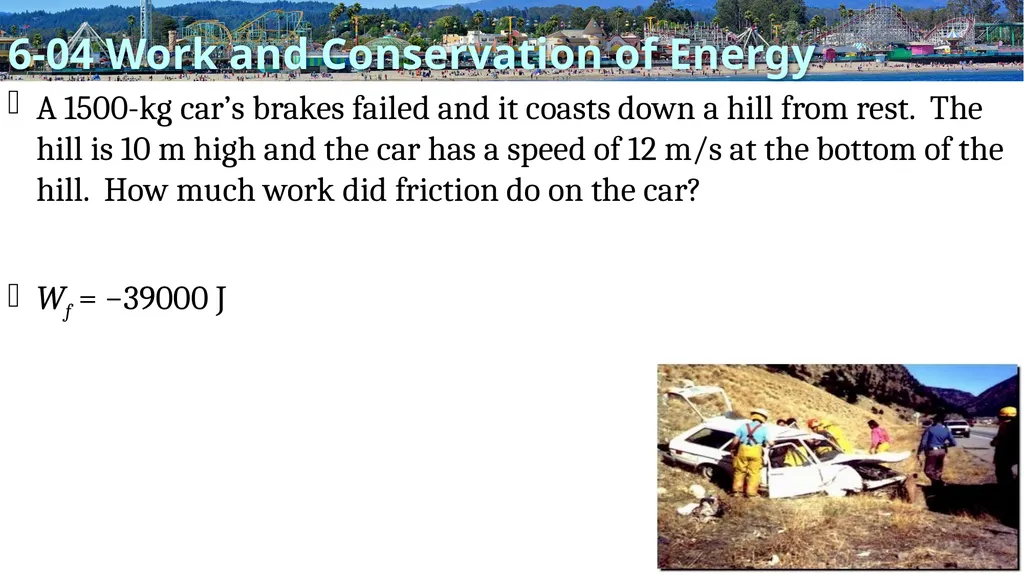
6-04 Work and Conservation of Energy A 1500-kg car’s brakes failed and it coasts down a hill from rest. The hill is 10 m high and the car has a speed of 12 m/s at the bottom of the hill. How much work did friction do on the car?
Wf = −39000 J<br>
Wf = −39000 J<br>
41
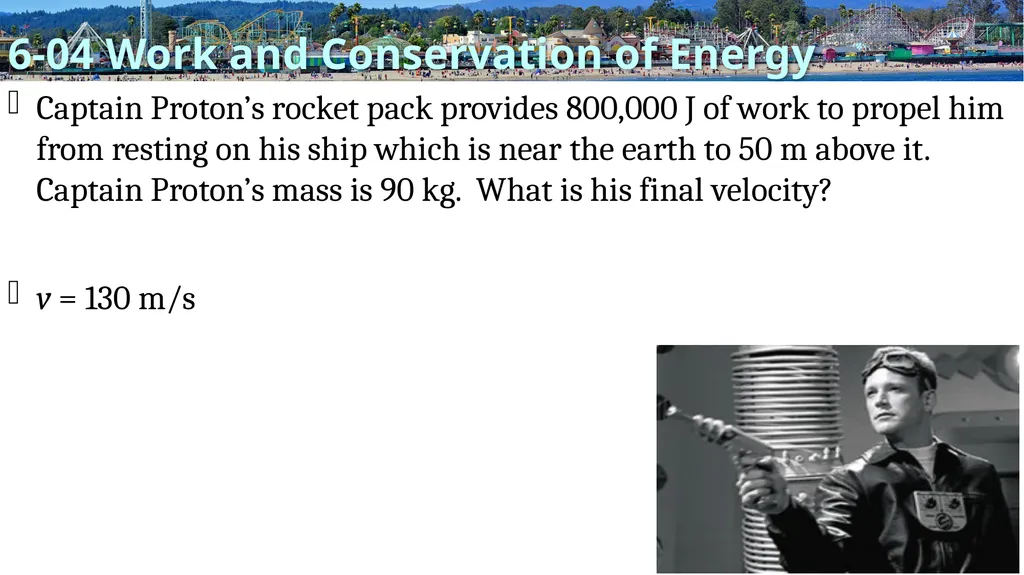
6-04 Work and Conservation of Energy Captain Proton’s rocket pack provides 800,000 J of work to propel him from resting on his ship which is near the earth to 50 m above it. Captain Proton’s mass is 90 kg. What is his final velocity?
v = 130 m/s<br>
v = 130 m/s<br>
42
6-04 Practice Work How much work do you do while you convert energy into solutions.
Read
OpenStax College Physics 2e 9.5
OR
OpenStax High School Physics 9.3<br>
Read
OpenStax College Physics 2e 9.5
OR
OpenStax High School Physics 9.3<br>
43
6-05 Simple Machines In this lesson you will…
Solve problems involving simple machines.<br>
Solve problems involving simple machines.<br>
44
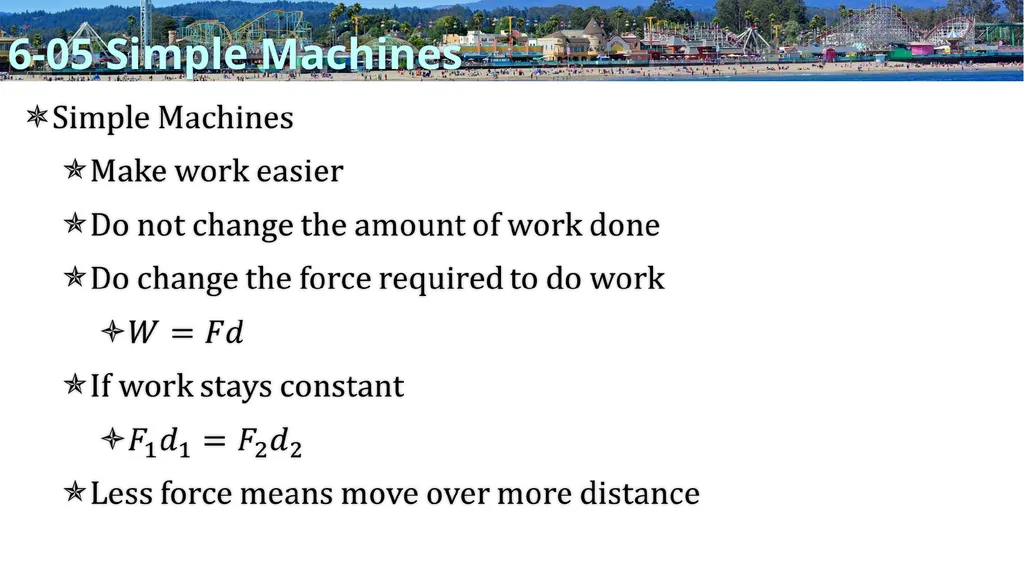
6-05 Simple Machines<br>
45
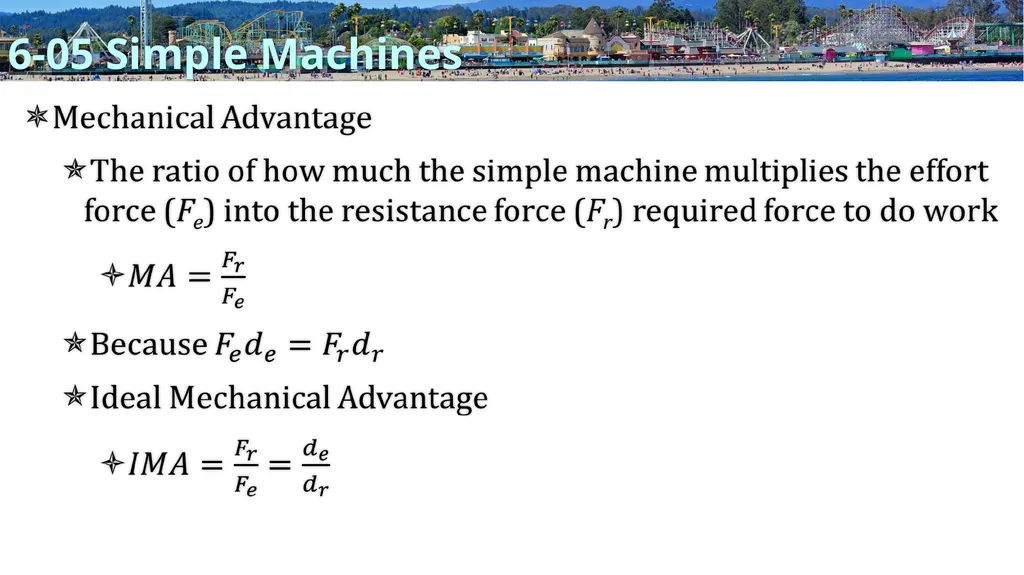
6-05 Simple Machines<br>
46
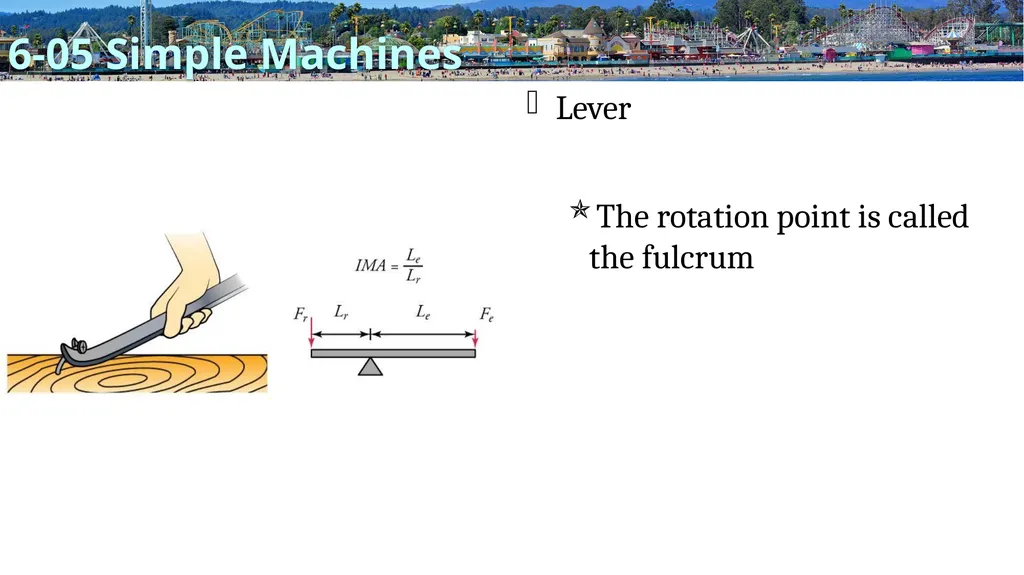
6-05 Simple Machines Lever
The rotation point is called the fulcrum<br>
The rotation point is called the fulcrum<br>
47
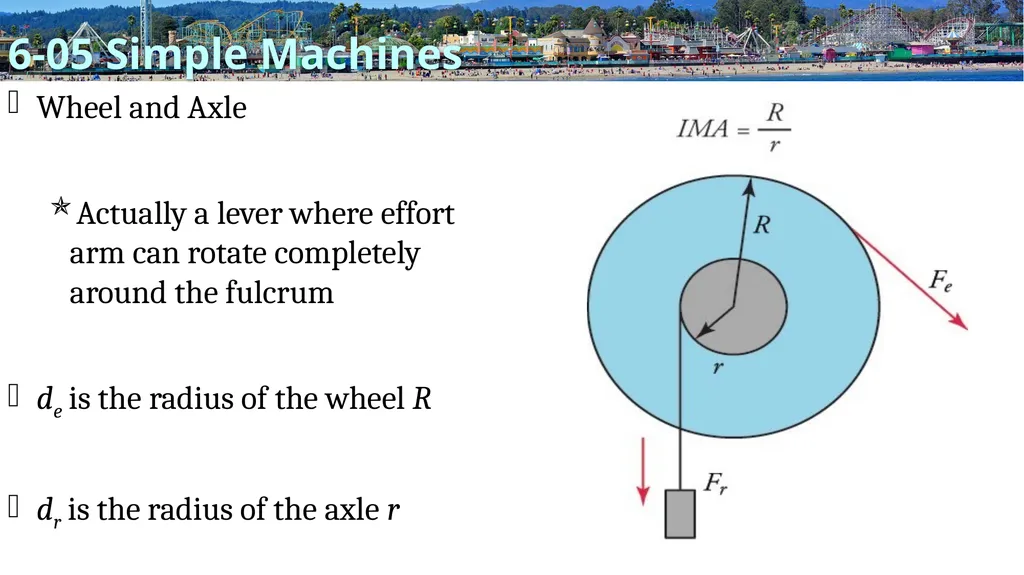
6-05 Simple Machines Wheel and Axle
Actually a lever where effort arm can rotate completely around the fulcrum
de is the radius of the wheel R
dr is the radius of the axle r<br>
Actually a lever where effort arm can rotate completely around the fulcrum
de is the radius of the wheel R
dr is the radius of the axle r<br>
48
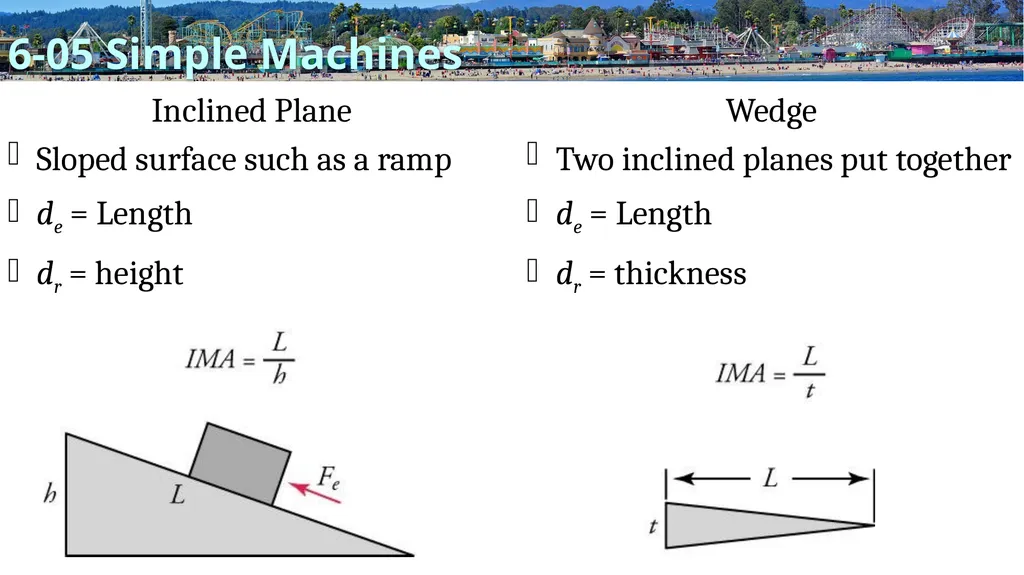
6-05 Simple Machines Inclined Plane Sloped surface such as a ramp
de = Length
dr = height Wedge Two inclined planes put together
de = Length
dr = thickness<br>
de = Length
dr = height Wedge Two inclined planes put together
de = Length
dr = thickness<br>
49
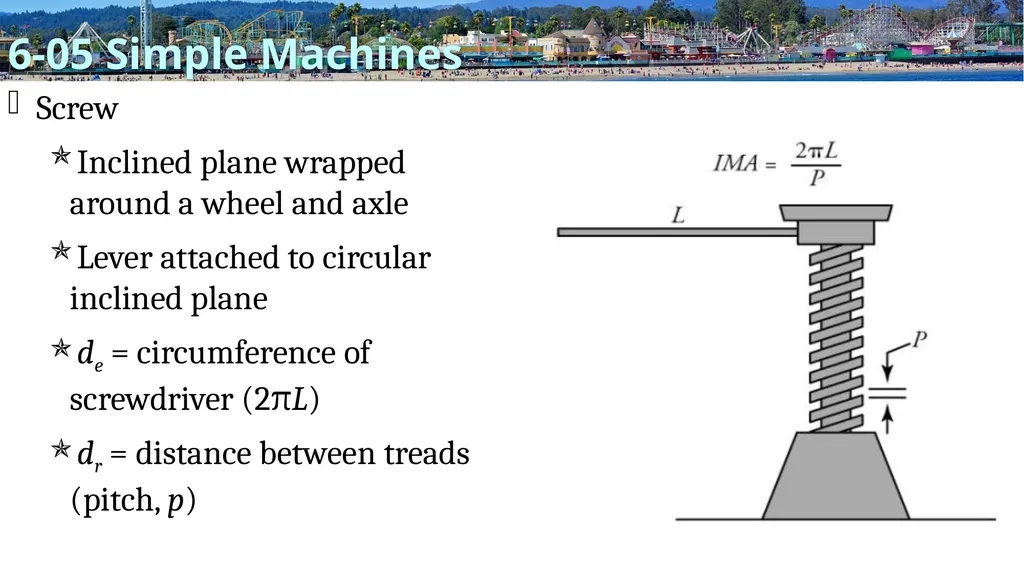
6-05 Simple Machines Screw
Inclined plane wrapped around a wheel and axle
Lever attached to circular inclined plane
de = circumference of screwdriver (2πL)
dr = distance between treads (pitch, p)<br>
Inclined plane wrapped around a wheel and axle
Lever attached to circular inclined plane
de = circumference of screwdriver (2πL)
dr = distance between treads (pitch, p)<br>
50
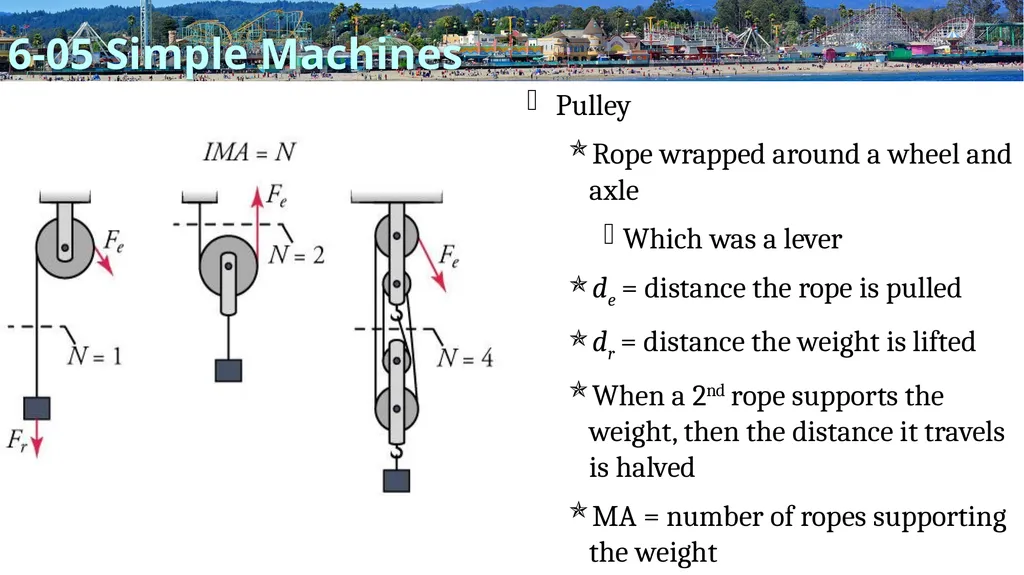
6-05 Simple Machines Pulley
Rope wrapped around a wheel and axle
Which was a lever
de = distance the rope is pulled
dr = distance the weight is lifted
When a 2nd rope supports the weight, then the distance it travels is halved
MA = number of ropes supporting the weight<br>
Rope wrapped around a wheel and axle
Which was a lever
de = distance the rope is pulled
dr = distance the weight is lifted
When a 2nd rope supports the weight, then the distance it travels is halved
MA = number of ropes supporting the weight<br>
51
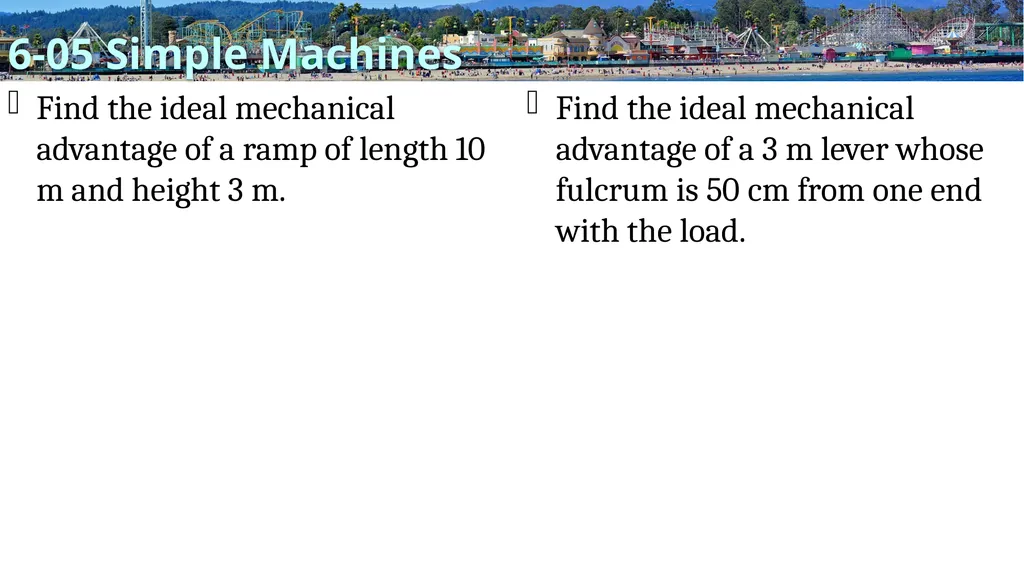
6-05 Simple Machines Find the ideal mechanical advantage of a ramp of length 10 m and height 3 m. Find the ideal mechanical advantage of a 3 m lever whose fulcrum is 50 cm from one end with the load.<br>
52
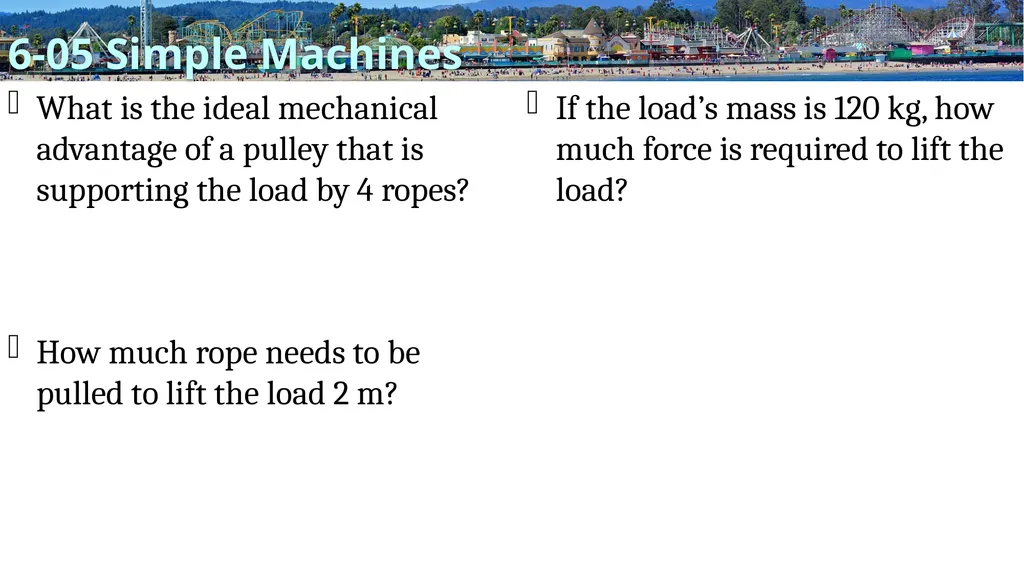
6-05 Simple Machines What is the ideal mechanical advantage of a pulley that is supporting the load by 4 ropes?
How much rope needs to be pulled to lift the load 2 m? If the load’s mass is 120 kg, how much force is required to lift the load?<br>
How much rope needs to be pulled to lift the load 2 m? If the load’s mass is 120 kg, how much force is required to lift the load?<br>
53
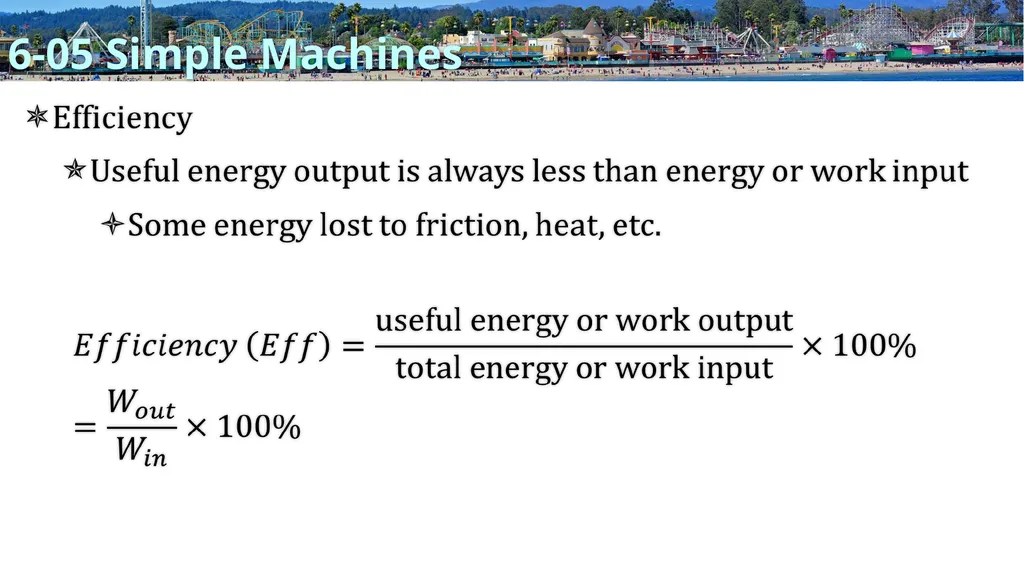
6-05 Simple Machines<br>
54
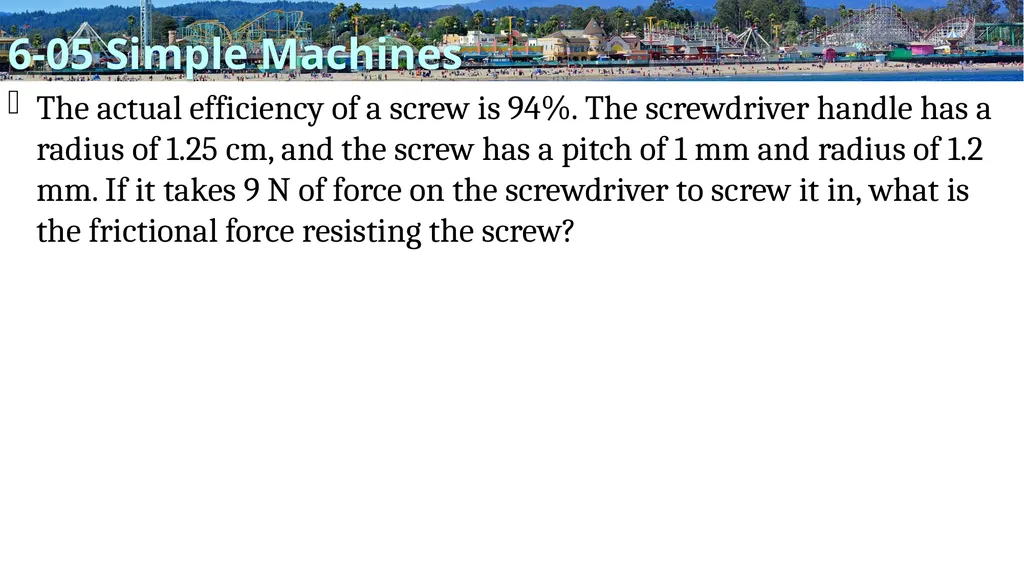
6-05 Simple Machines The actual efficiency of a screw is 94%. The screwdriver handle has a radius of 1.25 cm, and the screw has a pitch of 1 mm and radius of 1.2 mm. If it takes 9 N of force on the screwdriver to screw it in, what is the frictional force resisting the screw?<br>
55
6-05 Practice Work What simple machines do you use to do homework? (Your pencil is a lever…)
Read
OpenStax College Physics 2e 7.8-7.9
OR
Not in OpenStax High School Physics<br>
Read
OpenStax College Physics 2e 7.8-7.9
OR
Not in OpenStax High School Physics<br>
56
06-06 Energy in Humans and the World In this lesson you will…
See how the human body uses energy.
See where the world gets its energy from.
Explore a way to store energy.<br>
See how the human body uses energy.
See where the world gets its energy from.
Explore a way to store energy.<br>
57
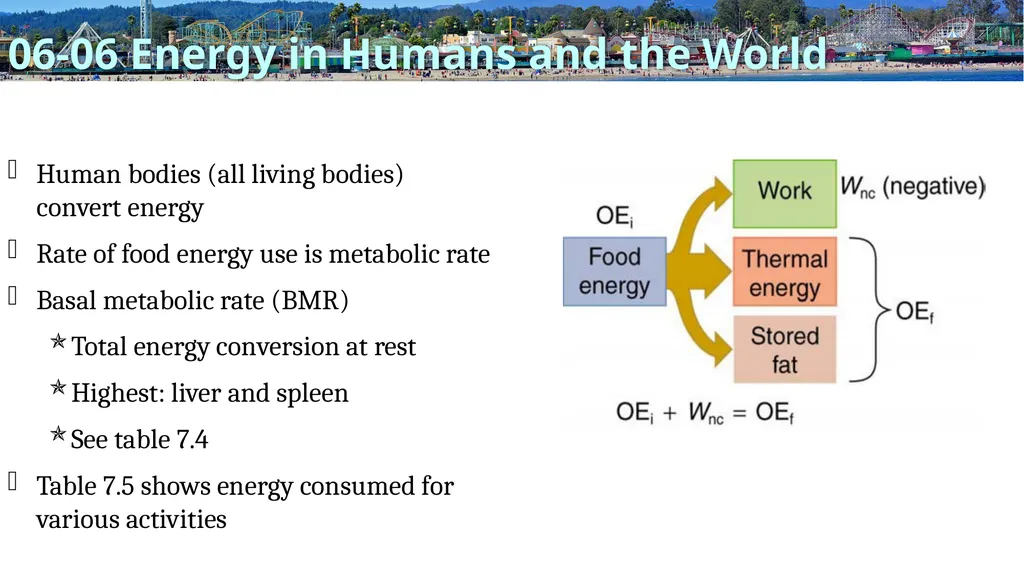
06-06 Energy in Humans and the World Human bodies (all living bodies) convert energy
Rate of food energy use is metabolic rate
Basal metabolic rate (BMR)
Total energy conversion at rest
Highest: liver and spleen
See table 7.4
Table 7.5 shows energy consumed for various activities<br>
Rate of food energy use is metabolic rate
Basal metabolic rate (BMR)
Total energy conversion at rest
Highest: liver and spleen
See table 7.4
Table 7.5 shows energy consumed for various activities<br>
58
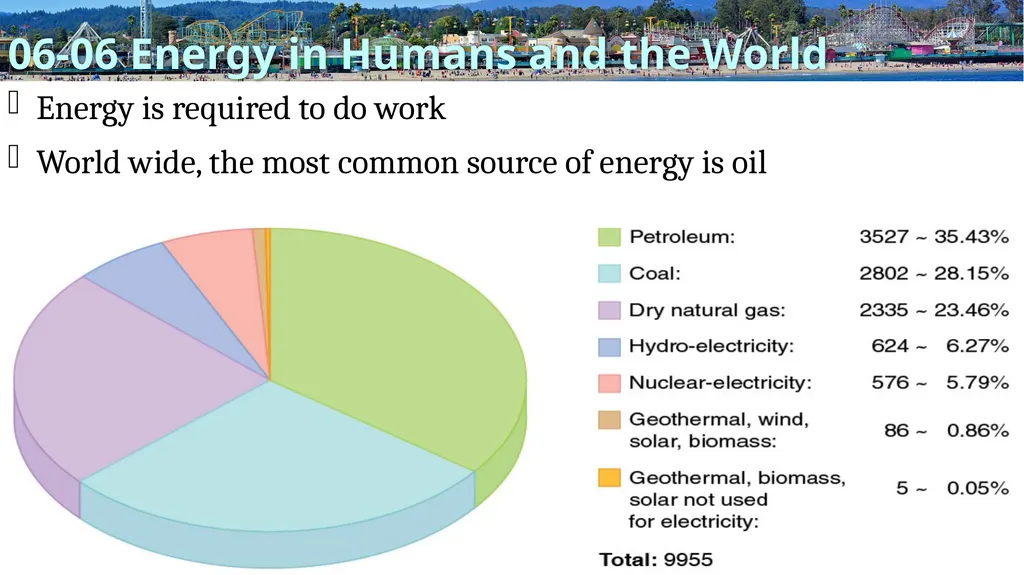
06-06 Energy in Humans and the World Energy is required to do work
World wide, the most common source of energy is oil<br>
World wide, the most common source of energy is oil<br>
59
06-06 Energy in Humans and the World USA has 4.5% of world population, but uses 24% of world’s oil
World energy consumption continues to increase quickly
Growing economies in China and India
Fossil Fuels are very polluting
Many countries trying to develop renewable energy like wind and solar
Generally, higher energy use per capita = better standard of living<br>
World energy consumption continues to increase quickly
Growing economies in China and India
Fossil Fuels are very polluting
Many countries trying to develop renewable energy like wind and solar
Generally, higher energy use per capita = better standard of living<br>
60
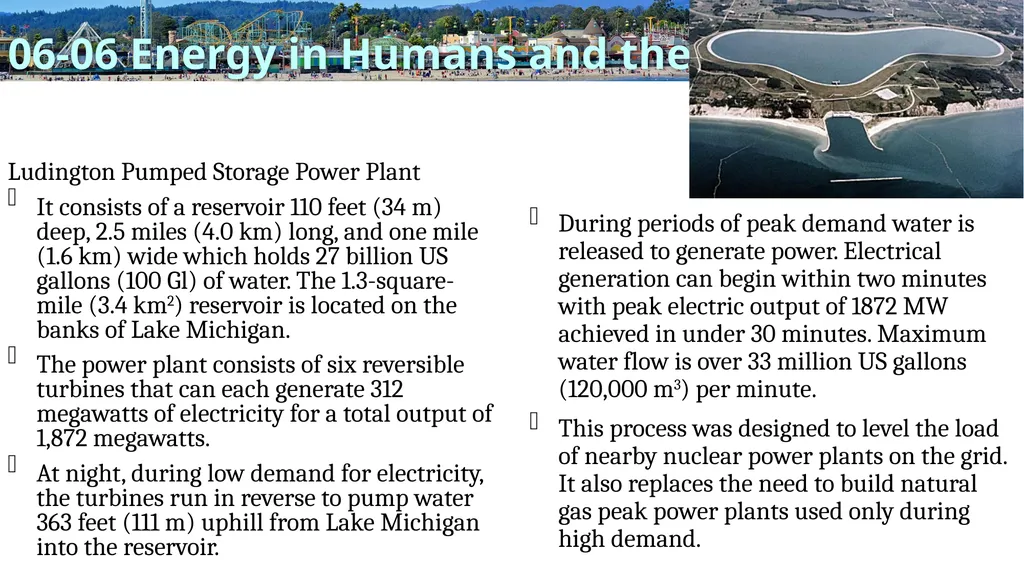
06-06 Energy in Humans and the World Ludington Pumped Storage Power Plant
It consists of a reservoir 110 feet (34 m) deep, 2.5 miles (4.0 km) long, and one mile (1.6 km) wide which holds 27 billion US gallons (100 Gl) of water. The 1.3-square-mile (3.4 km2) reservoir is located on the banks of Lake Michigan.
The power plant consists of six reversible turbines that can each generate 312 megawatts of electricity for a total output of 1,872 megawatts.
At night, during low demand for electricity, the turbines run in reverse to pump water 363 feet (111 m) uphill from Lake Michigan into the reservoir. During periods of peak demand water is released to generate power. Electrical generation can begin within two minutes with peak electric output of 1872 MW achieved in under 30 minutes. Maximum water flow is over 33 million US gallons (120,000 m3) per minute.
This process was designed to level the load of nearby nuclear power plants on the grid. It also replaces the need to build natural gas peak power plants used only during high demand.<br>
It consists of a reservoir 110 feet (34 m) deep, 2.5 miles (4.0 km) long, and one mile (1.6 km) wide which holds 27 billion US gallons (100 Gl) of water. The 1.3-square-mile (3.4 km2) reservoir is located on the banks of Lake Michigan.
The power plant consists of six reversible turbines that can each generate 312 megawatts of electricity for a total output of 1,872 megawatts.
At night, during low demand for electricity, the turbines run in reverse to pump water 363 feet (111 m) uphill from Lake Michigan into the reservoir. During periods of peak demand water is released to generate power. Electrical generation can begin within two minutes with peak electric output of 1872 MW achieved in under 30 minutes. Maximum water flow is over 33 million US gallons (120,000 m3) per minute.
This process was designed to level the load of nearby nuclear power plants on the grid. It also replaces the need to build natural gas peak power plants used only during high demand.<br>
61
6-06 Practice Work Energy is what makes the world go ‘round.<br>