
Forces Physics Unit 2 Credits Slides created by
LO
Published · 48 slides · 0 views

1 / 1



Description
Forces Physics Unit 2 Credits Slides created by Richard Wright, Andrews Academy rwrightandrews.edu This Slideshow was developed to accompany the textbook OpenStax High School Physics Available for free at
Related Topics
Share
Embed code
Download this presentation From Below
"Forces Physics Unit 2 Credits Slides created by" is the property of its rightful owner. Permission is granted to download and print the materials on this website for personal, non-commercial use only, and to display it on your personal computer provided you do not modify the materials and that you retain all copyright notices contained in the materials. By downloading content from our website, you accept the terms of this agreement.
Presentation Transcript
01
Forces Physics
Unit 2<br>
Unit 2<br>
02
Credits Slides created by
Richard Wright, Andrews Academy
rwright@andrews.edu This Slideshow was developed to accompany the textbook
OpenStax High School Physics
Available for free at https://openstax.org/details/books/physics
By Paul Peter Urone and Roger Hinrichs
2020 edition
Some examples and diagrams are taken from the OpenStax College Physics, Physics, and Cutnell & Johnson Physics 6th ed.<br>
Richard Wright, Andrews Academy
rwright@andrews.edu This Slideshow was developed to accompany the textbook
OpenStax High School Physics
Available for free at https://openstax.org/details/books/physics
By Paul Peter Urone and Roger Hinrichs
2020 edition
Some examples and diagrams are taken from the OpenStax College Physics, Physics, and Cutnell & Johnson Physics 6th ed.<br>
03
2-01 Newton’s Laws of Motion After this lesson you will…
Know Newton’s Laws of Motion
Draw a freebody diagram
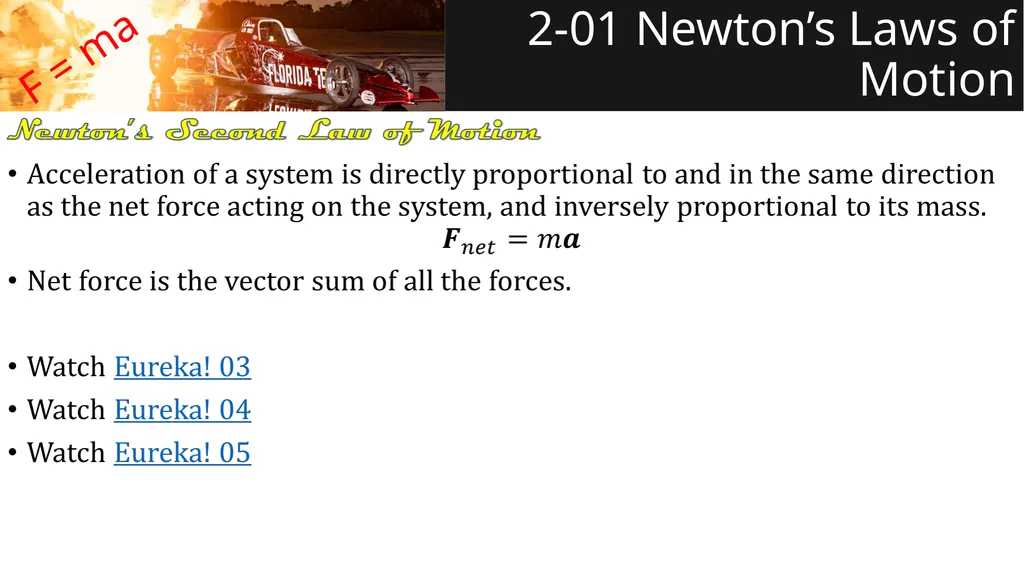
Apply Newton’s Second Law of Motion F = ma<br>
Know Newton’s Laws of Motion
Draw a freebody diagram
Apply Newton’s Second Law of Motion F = ma<br>
04
2-01 Newton’s Laws of Motion Kinematics
How things move
Dynamics
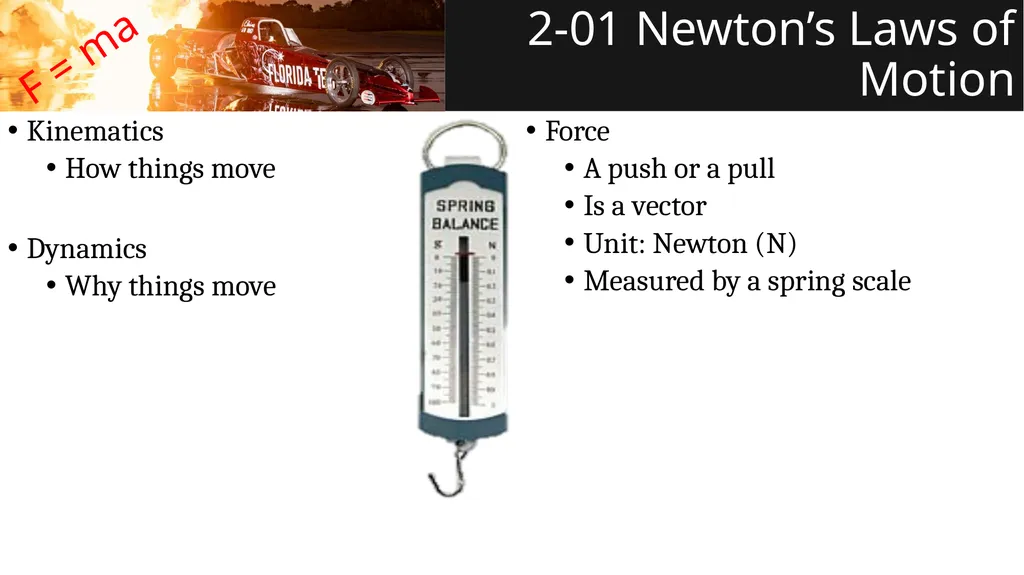
Why things move Force
A push or a pull
Is a vector
Unit: Newton (N)
Measured by a spring scale F = ma<br>
How things move
Dynamics
Why things move Force
A push or a pull
Is a vector
Unit: Newton (N)
Measured by a spring scale F = ma<br>
05
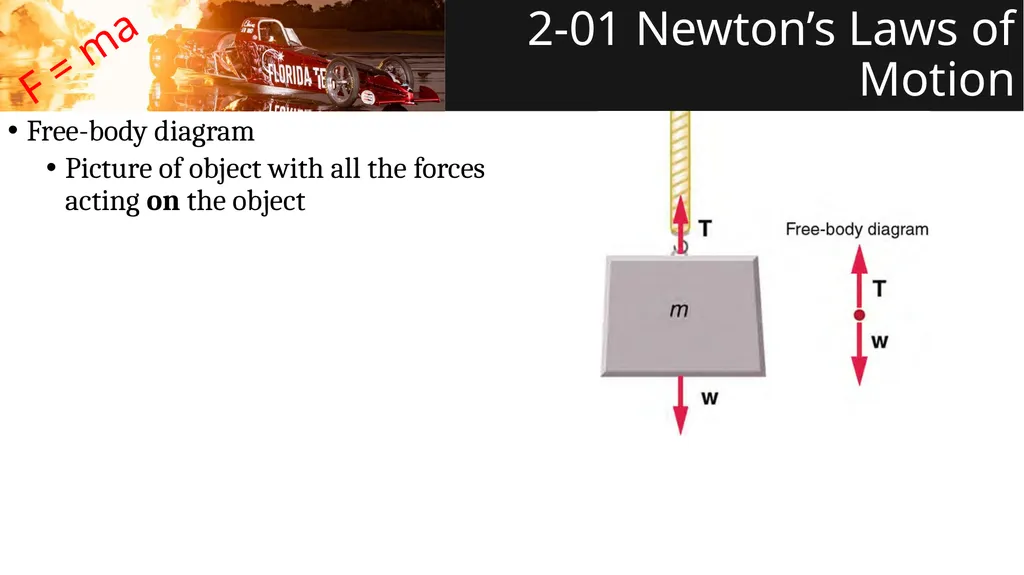
2-01 Newton’s Laws of Motion Free-body diagram
Picture of object with all the forces acting on the object F = ma<br>
Picture of object with all the forces acting on the object F = ma<br>
06
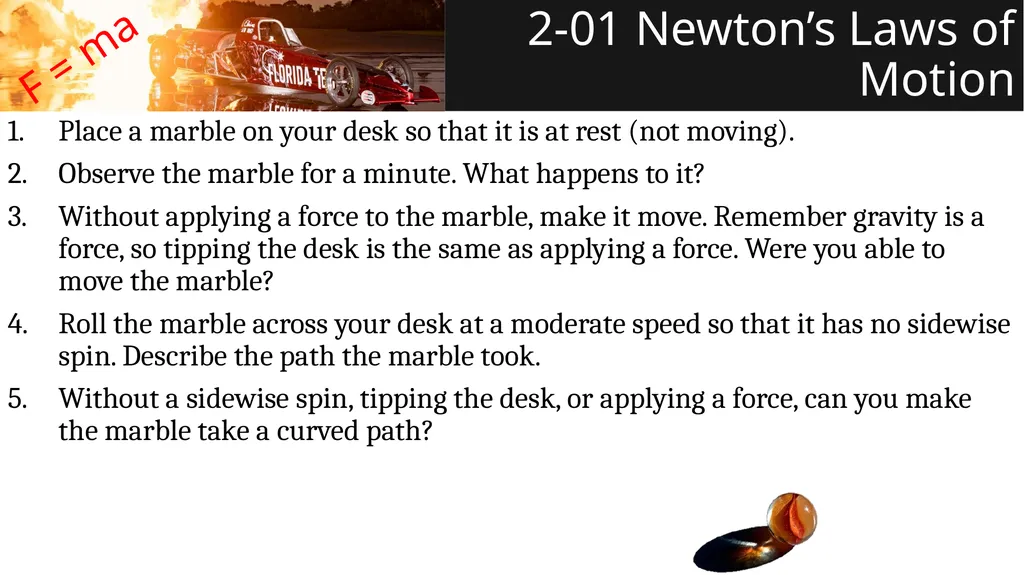
2-01 Newton’s Laws of Motion Place a marble on your desk so that it is at rest (not moving).
Observe the marble for a minute. What happens to it?
Without applying a force to the marble, make it move. Remember gravity is a force, so tipping the desk is the same as applying a force. Were you able to move the marble?
Roll the marble across your desk at a moderate speed so that it has no sidewise spin. Describe the path the marble took.
Without a sidewise spin, tipping the desk, or applying a force, can you make the marble take a curved path? F = ma<br>
Observe the marble for a minute. What happens to it?
Without applying a force to the marble, make it move. Remember gravity is a force, so tipping the desk is the same as applying a force. Were you able to move the marble?
Roll the marble across your desk at a moderate speed so that it has no sidewise spin. Describe the path the marble took.
Without a sidewise spin, tipping the desk, or applying a force, can you make the marble take a curved path? F = ma<br>
07
2-01 Newton’s Laws of Motion Newton’s First Law of Motion
A body at rest remains at rest, or, if in motion, remains in motion at a constant velocity unless acted on by a net external force.
Inertia
Property of objects to remain in constant motion or rest.
Mass is a measure of inertia
Watch Eureka! 01
Watch Eureka! 02 F = ma<br>
A body at rest remains at rest, or, if in motion, remains in motion at a constant velocity unless acted on by a net external force.
Inertia
Property of objects to remain in constant motion or rest.
Mass is a measure of inertia
Watch Eureka! 01
Watch Eureka! 02 F = ma<br>
08
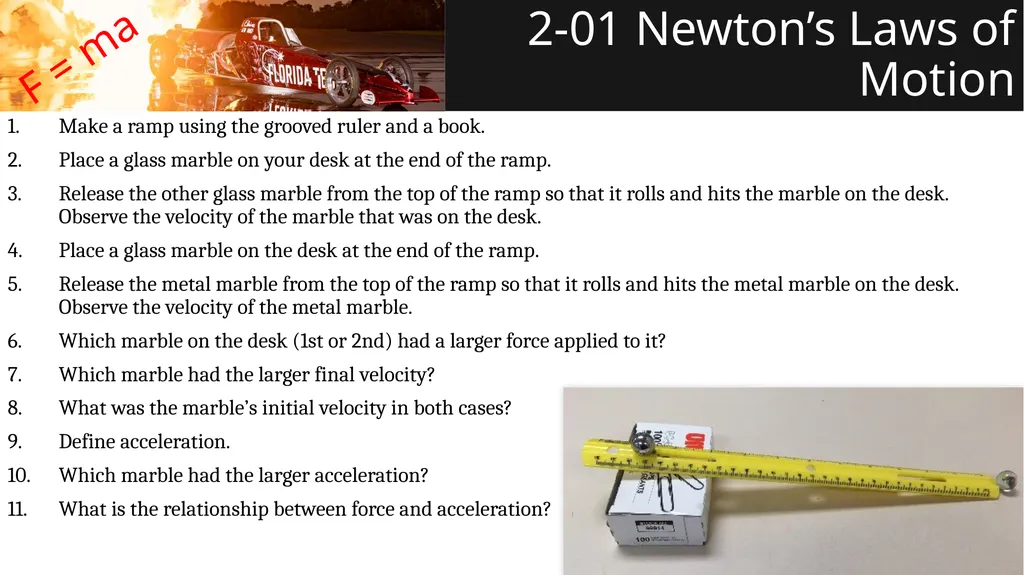
2-01 Newton’s Laws of Motion Make a ramp using the grooved ruler and a book.
Place a glass marble on your desk at the end of the ramp.
Release the other glass marble from the top of the ramp so that it rolls and hits the marble on the desk. Observe the velocity of the marble that was on the desk.
Place a glass marble on the desk at the end of the ramp.
Release the metal marble from the top of the ramp so that it rolls and hits the metal marble on the desk. Observe the velocity of the metal marble.
Which marble on the desk (1st or 2nd) had a larger force applied to it?
Which marble had the larger final velocity?
What was the marble’s initial velocity in both cases?
Define acceleration.
Which marble had the larger acceleration?
What is the relationship between force and acceleration? F = ma<br>
Place a glass marble on your desk at the end of the ramp.
Release the other glass marble from the top of the ramp so that it rolls and hits the marble on the desk. Observe the velocity of the marble that was on the desk.
Place a glass marble on the desk at the end of the ramp.
Release the metal marble from the top of the ramp so that it rolls and hits the metal marble on the desk. Observe the velocity of the metal marble.
Which marble on the desk (1st or 2nd) had a larger force applied to it?
Which marble had the larger final velocity?
What was the marble’s initial velocity in both cases?
Define acceleration.
Which marble had the larger acceleration?
What is the relationship between force and acceleration? F = ma<br>
09
2-01 Newton’s Laws of Motion Place a glass marble on your desk at the end of the ramp.
Release the other glass marble from the top of the ramp so that it rolls and hits the marble on the desk. Observe the velocity of the marble that was on the desk.
Place a metal marble on the desk at the end of the ramp.
Release the glass marble from the top of the ramp so that it rolls and hits the metal marble on the desk. Observe the velocity of the metal marble.
Which marble on the desk (glass or metal) had a larger force applied to it?
Which marble had the larger final velocity?
Which marble had the larger acceleration?
Which marble had more mass?
What is the relationship between mass and acceleration? F = ma<br>
Release the other glass marble from the top of the ramp so that it rolls and hits the marble on the desk. Observe the velocity of the marble that was on the desk.
Place a metal marble on the desk at the end of the ramp.
Release the glass marble from the top of the ramp so that it rolls and hits the metal marble on the desk. Observe the velocity of the metal marble.
Which marble on the desk (glass or metal) had a larger force applied to it?
Which marble had the larger final velocity?
Which marble had the larger acceleration?
Which marble had more mass?
What is the relationship between mass and acceleration? F = ma<br>
10
2-01 Newton’s Laws of Motion F = ma<br>
11
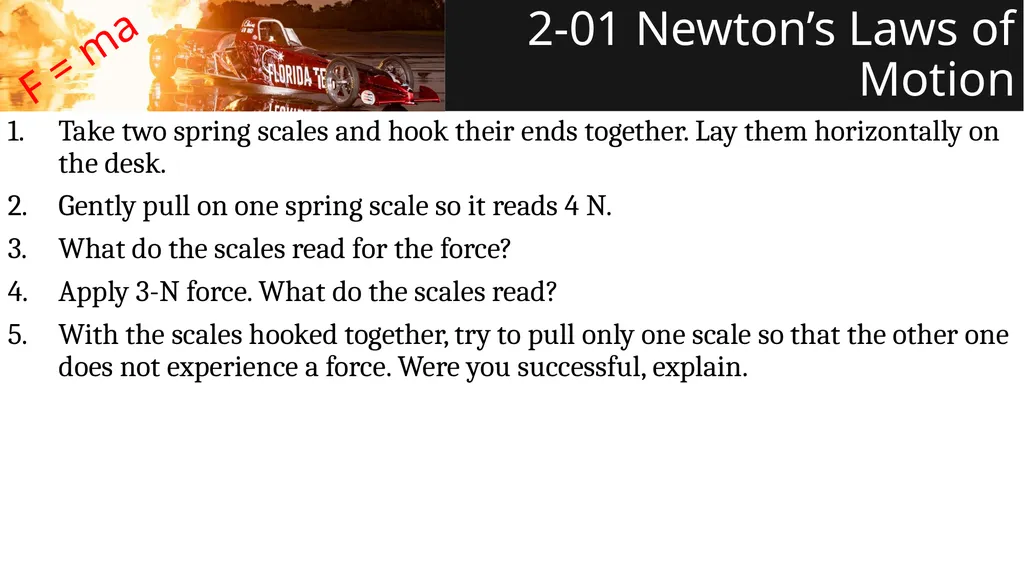
2-01 Newton’s Laws of Motion Take two spring scales and hook their ends together. Lay them horizontally on the desk.
Gently pull on one spring scale so it reads 4 N.
What do the scales read for the force?
Apply 3-N force. What do the scales read?
With the scales hooked together, try to pull only one scale so that the other one does not experience a force. Were you successful, explain. F = ma<br>
Gently pull on one spring scale so it reads 4 N.
What do the scales read for the force?
Apply 3-N force. What do the scales read?
With the scales hooked together, try to pull only one scale so that the other one does not experience a force. Were you successful, explain. F = ma<br>
12
2-01 Newton’s Laws of Motion Newton’s Third Law of Motion
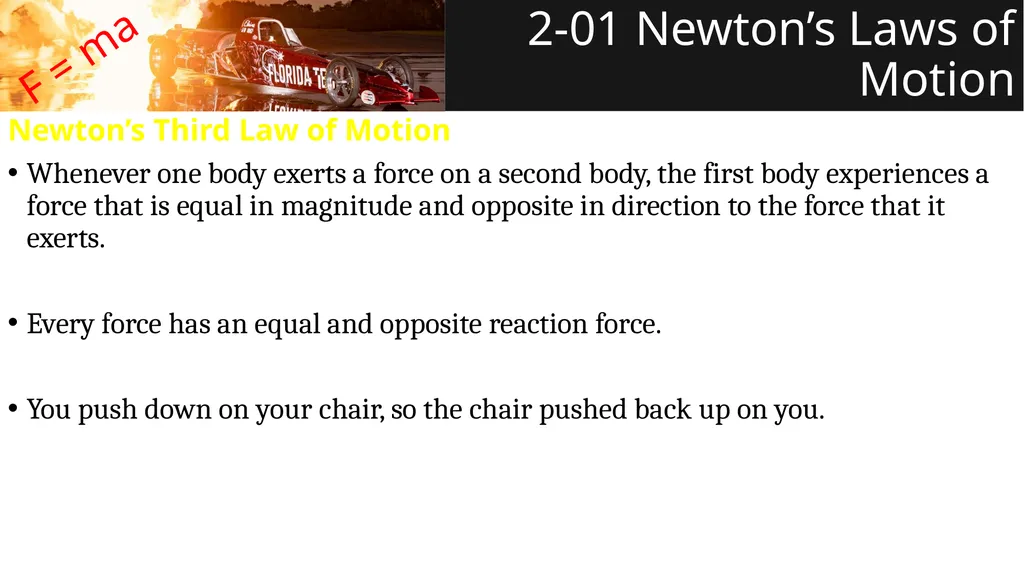
Whenever one body exerts a force on a second body, the first body experiences a force that is equal in magnitude and opposite in direction to the force that it exerts.
Every force has an equal and opposite reaction force.
You push down on your chair, so the chair pushed back up on you. F = ma<br>
Whenever one body exerts a force on a second body, the first body experiences a force that is equal in magnitude and opposite in direction to the force that it exerts.
Every force has an equal and opposite reaction force.
You push down on your chair, so the chair pushed back up on you. F = ma<br>
13
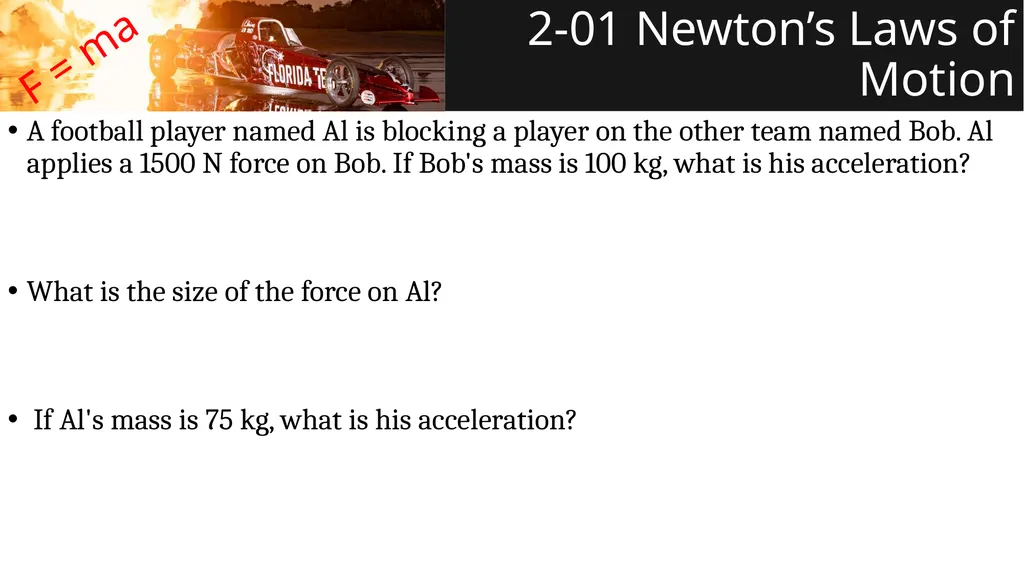
2-01 Newton’s Laws of Motion A football player named Al is blocking a player on the other team named Bob. Al applies a 1500 N force on Bob. If Bob's mass is 100 kg, what is his acceleration?
What is the size of the force on Al?
If Al's mass is 75 kg, what is his acceleration? F = ma<br>
What is the size of the force on Al?
If Al's mass is 75 kg, what is his acceleration? F = ma<br>
14
2-01 Newton’s Laws of Motion A 0.046 kg golf ball hit by a driver can accelerate from rest to 67 m/s in 1 ms while the driver is in contact with the ball. How much average force does the golf ball experience? F = ma<br>
15
2-02 Weight and Normal Force After this lesson you will…
Apply Newton’s Laws with weight and normal force
Solve force problems on inclined planes F = ma<br>
Apply Newton’s Laws with weight and normal force
Solve force problems on inclined planes F = ma<br>
16
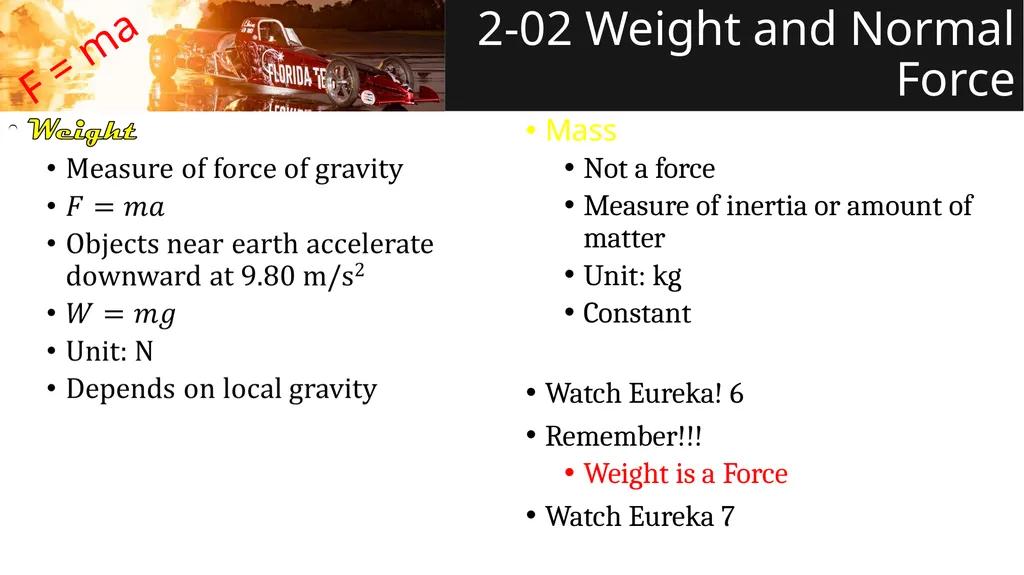
2-02 Weight and Normal Force Mass
Not a force
Measure of inertia or amount of matter
Unit: kg
Constant
Watch Eureka! 6
Remember!!!
Weight is a Force
Watch Eureka 7 F = ma<br>
Not a force
Measure of inertia or amount of matter
Unit: kg
Constant
Watch Eureka! 6
Remember!!!
Weight is a Force
Watch Eureka 7 F = ma<br>
17
2-02 Weight and Normal Force F = ma<br>
18
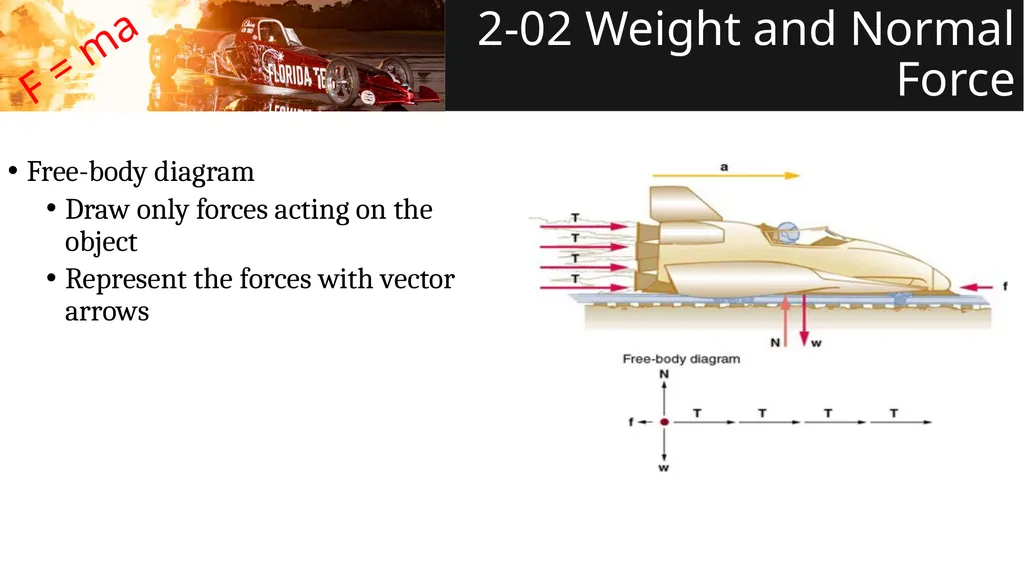
2-02 Weight and Normal Force Free-body diagram
Draw only forces acting on the object
Represent the forces with vector arrows F = ma<br>
Draw only forces acting on the object
Represent the forces with vector arrows F = ma<br>
19
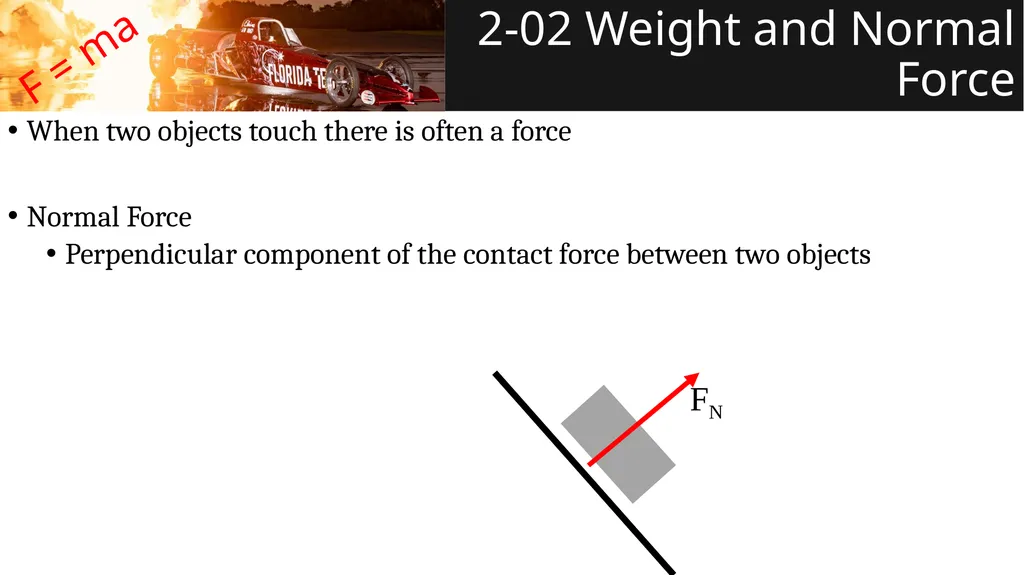
2-02 Weight and Normal Force When two objects touch there is often a force
Normal Force
Perpendicular component of the contact force between two objects F = ma<br>
Normal Force
Perpendicular component of the contact force between two objects F = ma<br>
20
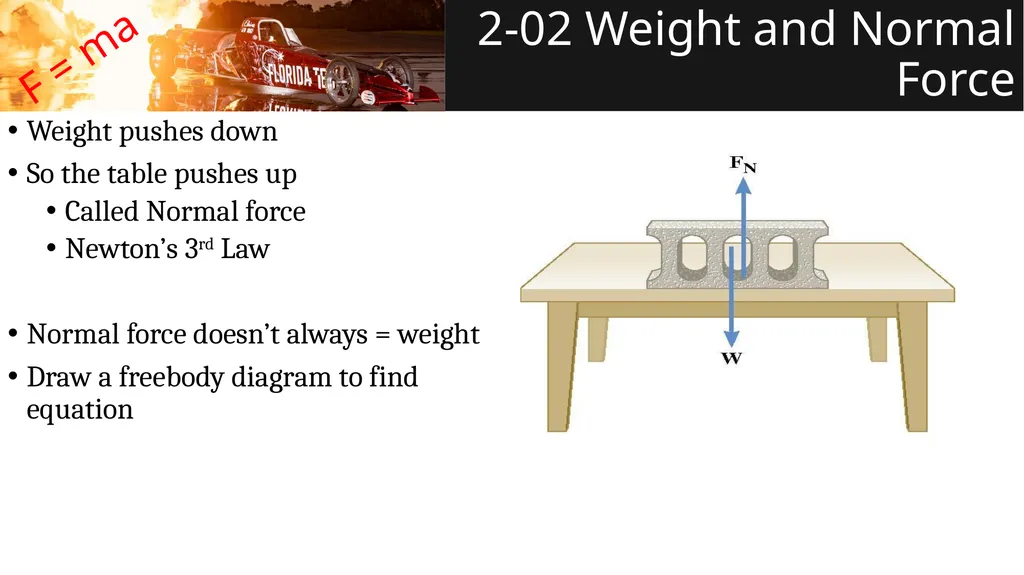
2-02 Weight and Normal Force Weight pushes down
So the table pushes up
Called Normal force
Newton’s 3rd Law
Normal force doesn’t always = weight
Draw a freebody diagram to find equation F = ma<br>
So the table pushes up
Called Normal force
Newton’s 3rd Law
Normal force doesn’t always = weight
Draw a freebody diagram to find equation F = ma<br>
21
2-02 Weight and Normal Force A 30-kg box of books is sitting on the floor. A 20-kg child is sitting on the box. What is the normal force between the child and the box?
What is the normal force between the box and the floor? F = ma<br>
What is the normal force between the box and the floor? F = ma<br>
22
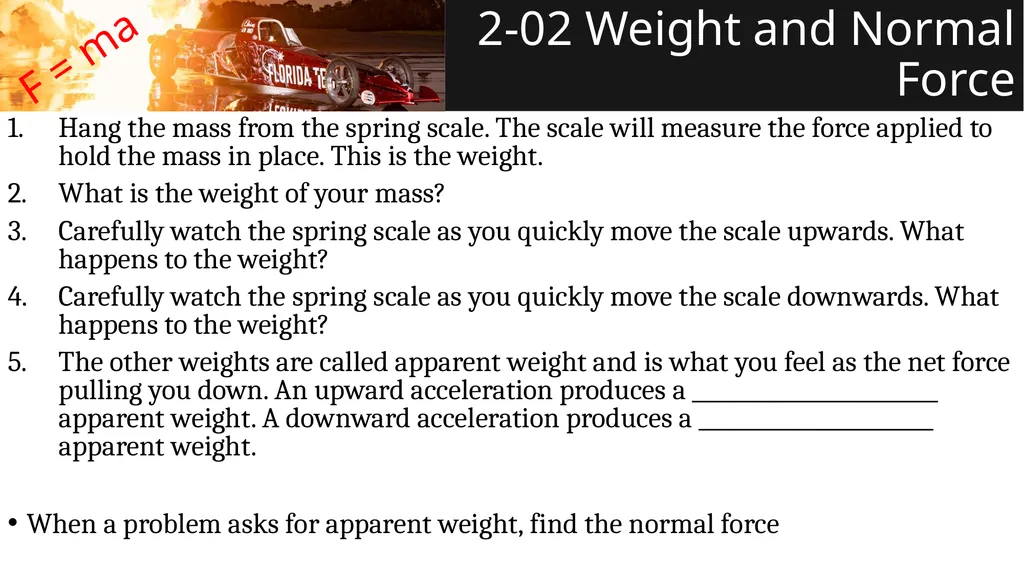
2-02 Weight and Normal Force Hang the mass from the spring scale. The scale will measure the force applied to hold the mass in place. This is the weight.
What is the weight of your mass?
Carefully watch the spring scale as you quickly move the scale upwards. What happens to the weight?
Carefully watch the spring scale as you quickly move the scale downwards. What happens to the weight?
The other weights are called apparent weight and is what you feel as the net force pulling you down. An upward acceleration produces a _______________________ apparent weight. A downward acceleration produces a ______________________ apparent weight.
When a problem asks for apparent weight, find the normal force F = ma<br>
What is the weight of your mass?
Carefully watch the spring scale as you quickly move the scale upwards. What happens to the weight?
Carefully watch the spring scale as you quickly move the scale downwards. What happens to the weight?
The other weights are called apparent weight and is what you feel as the net force pulling you down. An upward acceleration produces a _______________________ apparent weight. A downward acceleration produces a ______________________ apparent weight.
When a problem asks for apparent weight, find the normal force F = ma<br>
23
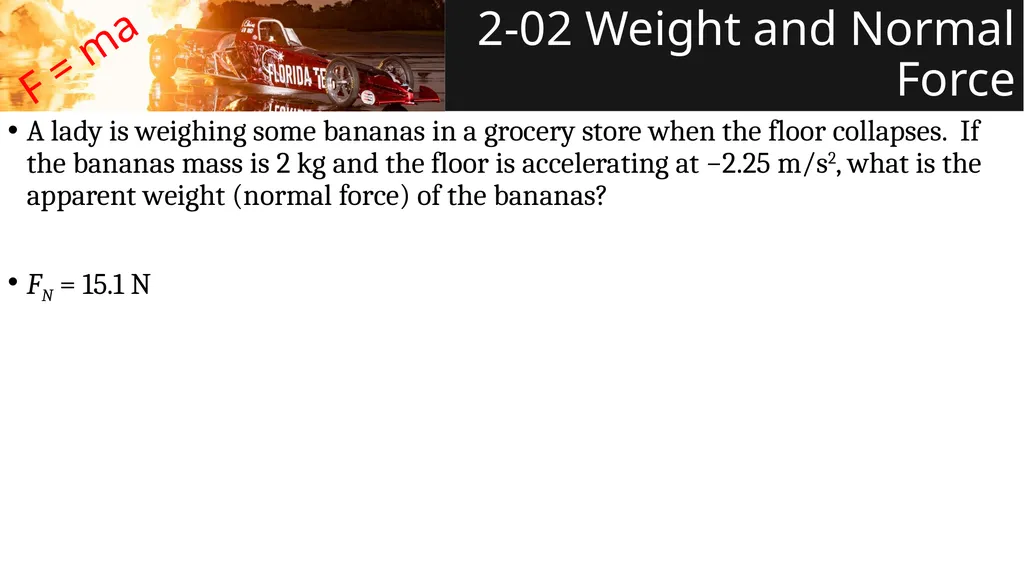
2-02 Weight and Normal Force A lady is weighing some bananas in a grocery store when the floor collapses. If the bananas mass is 2 kg and the floor is accelerating at −2.25 m/s2, what is the apparent weight (normal force) of the bananas?
FN = 15.1 N F = ma<br>
FN = 15.1 N F = ma<br>
24
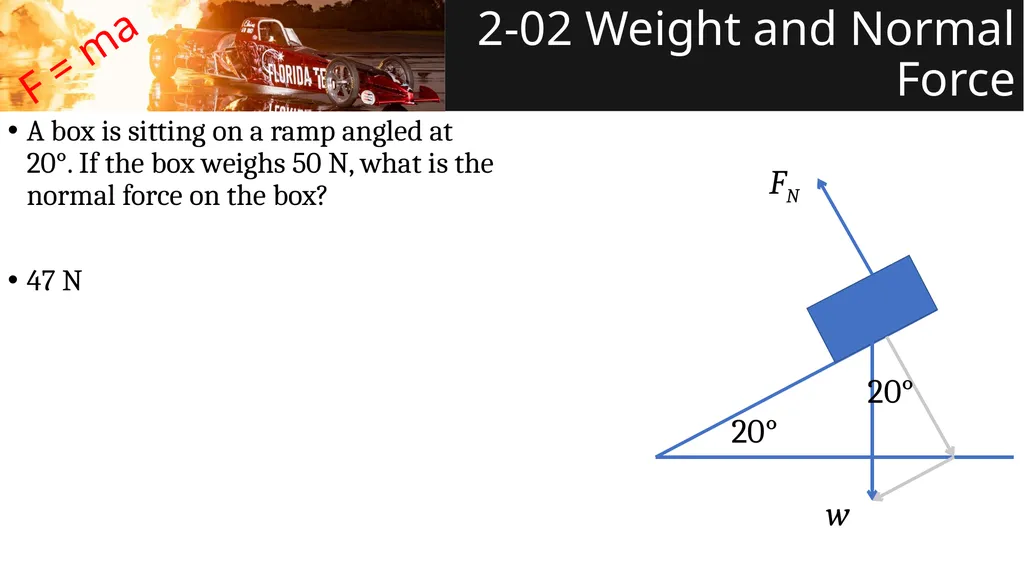
2-02 Weight and Normal Force A box is sitting on a ramp angled at 20°. If the box weighs 50 N, what is the normal force on the box?
47 N F = ma<br>
47 N F = ma<br>
25
2-03 Friction After this lesson you will…
Apply friction to force problems
Understand the difference between static and kinetic friction F = ma<br>
Apply friction to force problems
Understand the difference between static and kinetic friction F = ma<br>
26
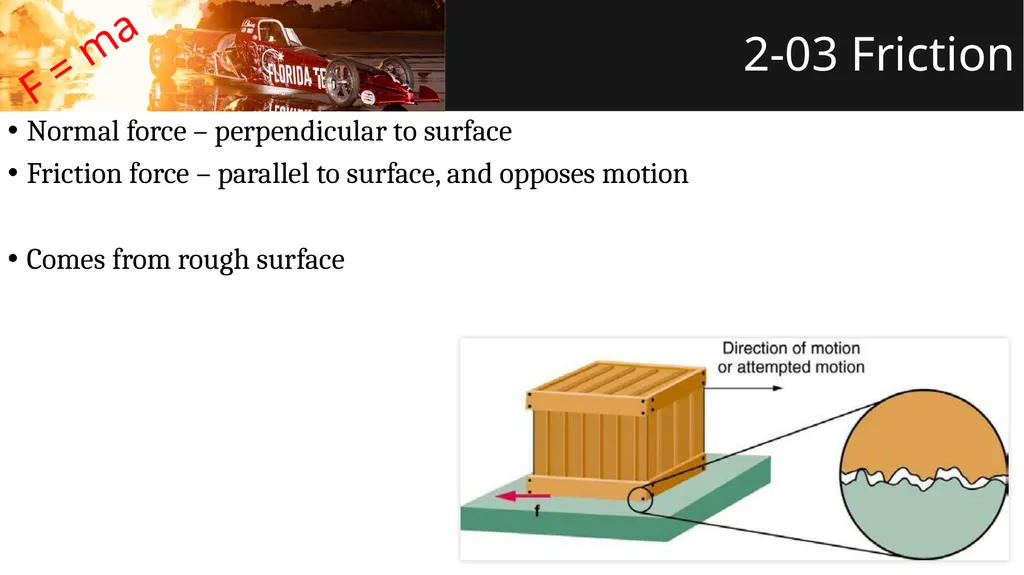
2-03 Friction Normal force – perpendicular to surface
Friction force – parallel to surface, and opposes motion
Comes from rough surface F = ma<br>
Friction force – parallel to surface, and opposes motion
Comes from rough surface F = ma<br>
27
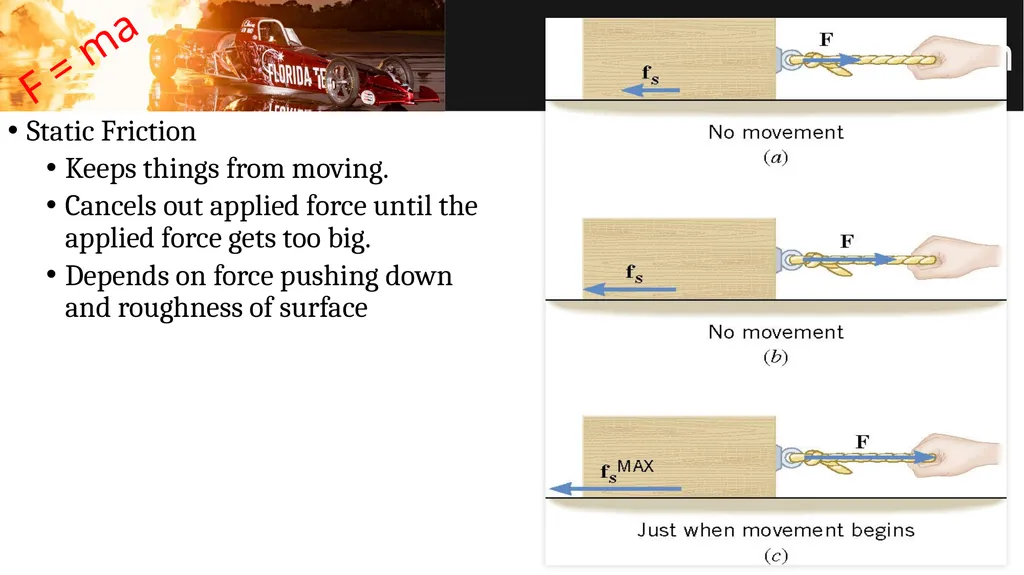
2-03 Friction Static Friction
Keeps things from moving.
Cancels out applied force until the applied force gets too big.
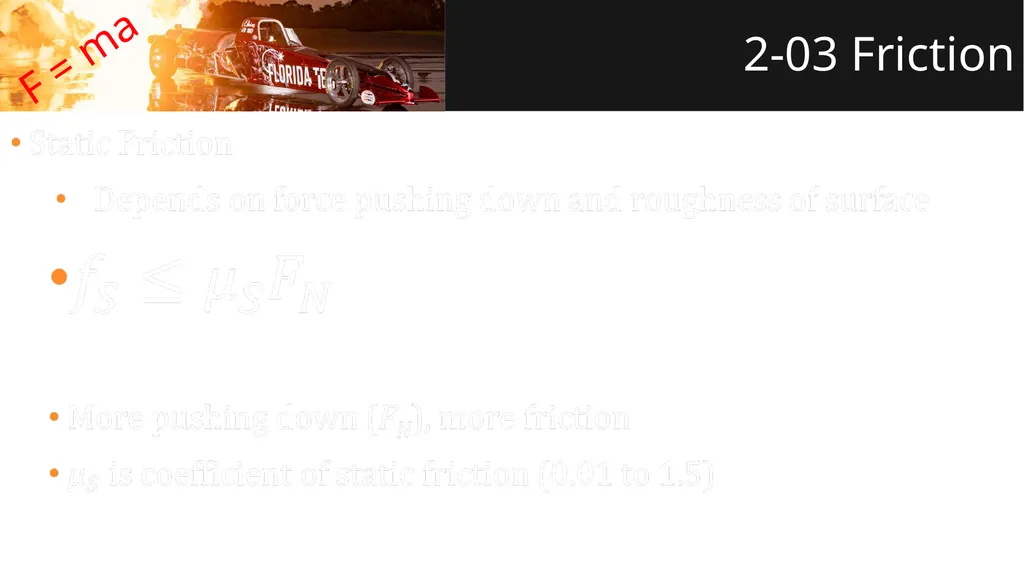
Depends on force pushing down and roughness of surface F = ma<br>
Keeps things from moving.
Cancels out applied force until the applied force gets too big.
Depends on force pushing down and roughness of surface F = ma<br>
28
2-03 Friction F = ma<br>
29
2-03 Friction F = ma<br>
30
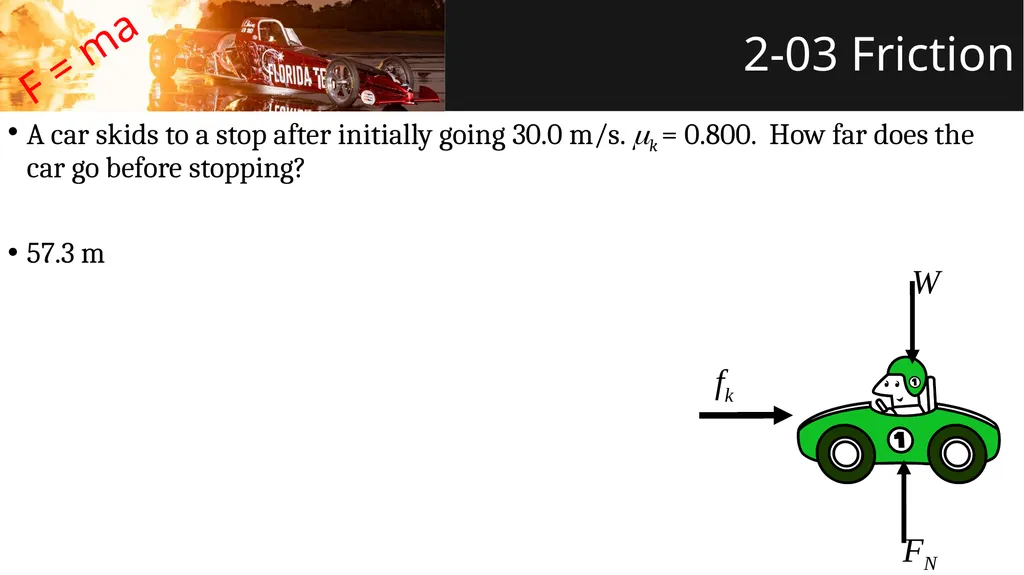
2-03 Friction A car skids to a stop after initially going 30.0 m/s. k = 0.800. How far does the car go before stopping?
57.3 m F = ma<br>
57.3 m F = ma<br>
31
2-03 Friction F = ma<br>
32
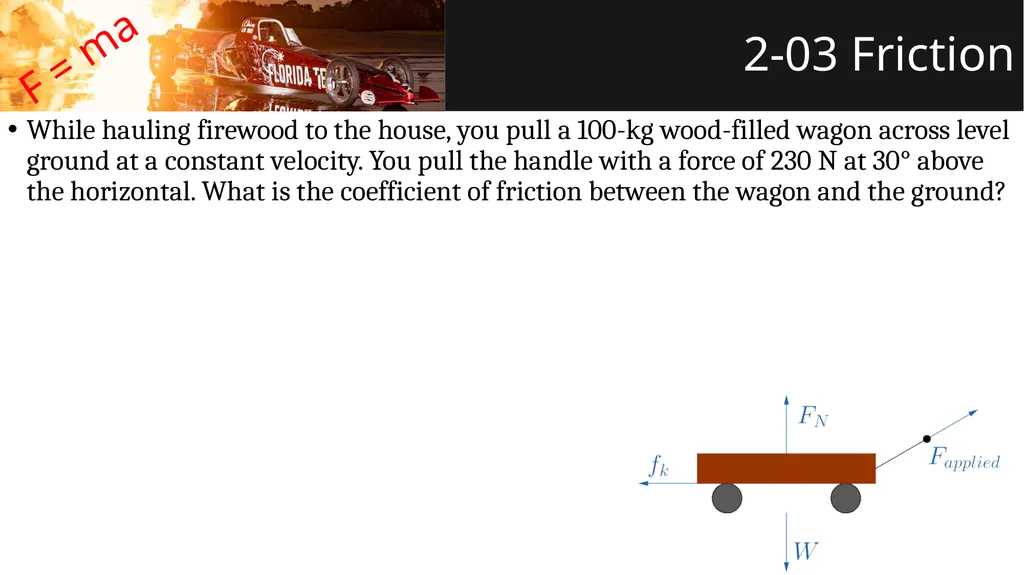
2-03 Friction While hauling firewood to the house, you pull a 100-kg wood-filled wagon across level ground at a constant velocity. You pull the handle with a force of 230 N at 30° above the horizontal. What is the coefficient of friction between the wagon and the ground? F = ma<br>
33
2-04 Tension, Hooke's Law, and Equilibrium After this lesson you will…
Find spring force
Apply tension and spring force in force problems
Solve equilibrium force problems F = ma<br>
Find spring force
Apply tension and spring force in force problems
Solve equilibrium force problems F = ma<br>
34
2-04 Tension, Hooke's Law, and Equilibrium Do the lab on your worksheet F = ma<br>
35
2-04 Tension, Hooke's Law, and Equilibrium F = ma<br>
36
2-04 Tension, Hooke's Law, and Equilibrium Tension
Pulling force from rope, chain, etc.
Everywhere the rope connects to something, there is an identical tension F = ma<br>
Pulling force from rope, chain, etc.
Everywhere the rope connects to something, there is an identical tension F = ma<br>
37
2-04 Tension, Hooke's Law, and Equilibrium F = ma<br>
38
2-04 Tension, Hooke's Law, and Equilibrium The helicopter in the drawing is moving horizontally to the right at a constant velocity. The weight of the helicopter is 53,800 N. The lift force L generated by the rotating blade makes an angle of 21.0° with respect to the vertical. What is the magnitude of the lift force?
57600 N F = ma<br>
57600 N F = ma<br>
39
2-04 Tension, Hooke's Law, and Equilibrium A stoplight is suspended by two cables over a street. Weight of the light is 110 N and the cables make a 122° angle with each side of the light. Find the tension in each cable.
104 N F = ma<br>
104 N F = ma<br>
40
2-04 Tension, Hooke's Law, and Equilibrium A mountain climber, in the process of crossing between two cliffs by a rope, pauses to rest. She weighs 535 N. Find the tensions in the rope to the left and to the right of the mountain climber. F = ma<br>
41
2-04 Tension, Hooke's Law, and Equilibrium A 10-g toy plastic bunny is connected to its base by a spring. The spring is compressed and a suction cup on the bunny holds it to the base so that the bunny doesn't move. If the spring is compressed 3 cm and has a constant of 330 N/m, how much force must the suction cup provide? F = ma<br>
42
2-05 Nonequilibrium and Fundamental Forces After this lesson you will…
Know the fundamental forces
Solve nonequilibrium force problems F = ma<br>
Know the fundamental forces
Solve nonequilibrium force problems F = ma<br>
43
2-05 Nonequilibrium and Fundamental Forces Four Basic Forces
All forces are made up of only 4 forces
Gravitational - gravity
Electromagnetic – static electricity, magnetism
Weak Nuclear - radioactivity
Strong Nuclear – keeps nucleus of atoms together F = ma<br>
All forces are made up of only 4 forces
Gravitational - gravity
Electromagnetic – static electricity, magnetism
Weak Nuclear - radioactivity
Strong Nuclear – keeps nucleus of atoms together F = ma<br>
44
2-05 Nonequilibrium and Fundamental Forces All occur because particles with that force property play catch with a different particle
Electromagnetic uses photons
Scientists are trying to combine all forces together in Grand Unified Theory
Have combined electric, magnetic, weak nuclear
Gravity is the weakest
We feel it because the electromagnetic cancels out over large areas
Nuclear forces are strong but only over short distance F = ma<br>
Electromagnetic uses photons
Scientists are trying to combine all forces together in Grand Unified Theory
Have combined electric, magnetic, weak nuclear
Gravity is the weakest
We feel it because the electromagnetic cancels out over large areas
Nuclear forces are strong but only over short distance F = ma<br>
45
2-05 Nonequilibrium and Fundamental Forces A 1380-kg car is moving due east with an initial speed of 27.0 m/s. After 8.00 s the car has slowed down to 17.0 m/s. Find the magnitude and direction of the net force that produces the deceleration. F = ma<br>
46
2-05 Nonequilibrium and Fundamental Forces F = ma<br>
47
2-05 Nonequilibrium and Fundamental Forces F = ma<br>
48
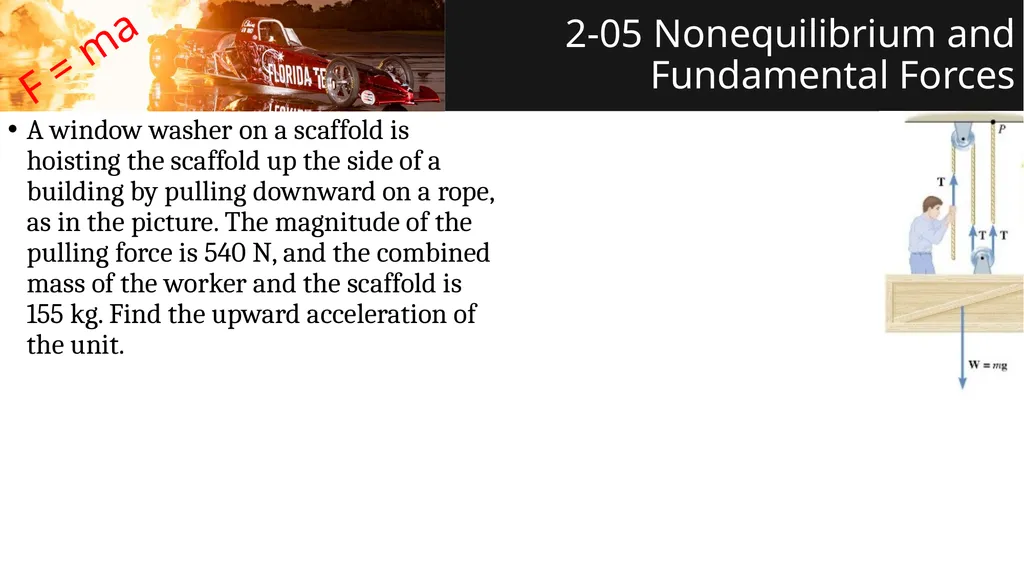
2-05 Nonequilibrium and Fundamental Forces A window washer on a scaffold is hoisting the scaffold up the side of a building by pulling downward on a rope, as in the picture. The magnitude of the pulling force is 540 N, and the combined mass of the worker and the scaffold is 155 kg. Find the upward acceleration of the unit. F = ma<br>