MORAL DECISION MAKING HOW TO ENSURE I AM DOING GODS WILL PRUDENCE: The moral virtue that inclines us to lead good, ethical, and moral lives of action Being filled with care Listening to your conscience DISCERNMENT: A decision-making
"MORAL DECISION MAKING HOW TO ENSURE I AM DOING" is the property of its rightful owner. Permission is granted to
download and print the materials on this website for personal, non-commercial use only, and to display it
on your personal computer provided you do not modify the materials and that you retain all copyright
notices contained in the materials. By downloading content from our website, you accept the terms of this
agreement.
Presentation Transcript
01
MORAL DECISION MAKING HOW TO ENSURE I AM DOING GOD’S WILL<br>
02
PRUDENCE:
The moral virtue that inclines us to lead good, ethical, and moral lives of action
Being filled with care
Listening to your conscience
DISCERNMENT:
A decision-making process that attends to the implications and consequences of an action or choice. THE FIRST TOOLS<br>
03
Your acts must promote the true good of humans or they are wrong
Make sure your actions always conform to objective norms of morality like the ten Commandments, laws, school rules, etc. RULES OF MORALITY<br>
04
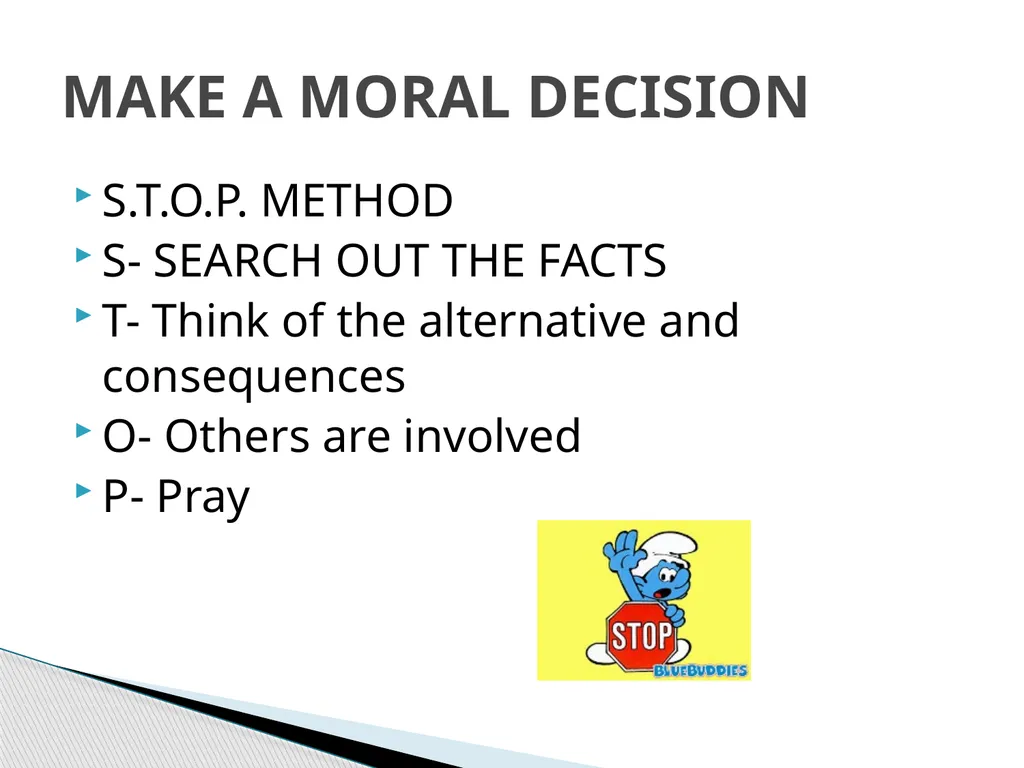
S.T.O.P. METHOD
S- SEARCH OUT THE FACTS
T- Think of the alternative and consequences
O- Others are involved
P- Pray MAKE A MORAL DECISION<br>
05
MORAL OBJECT (“WHAT”)
The content/matter of your decision
Reveals whether our action is good/bad
? Think of actions that are “bad”… Why are they labeled such? SEARCH FOR THE FACTS<br>
06
INTENTION-(“WHY”)
The aim or objective of an action
Why am I doing this?
Are my reasons pure?
Keep the intention good-for something to be morally good both the action and intention must be good
The end does not justify the means-for an action to be moral, the means must be moral SEARCH FOR THE FACTS<br>
07
MEANS
A method, course of action, or instrument by which something can be accomplished
CIRCUMSTANCES
The conditions or facts attending an event and having some bearing on it. Can increase or decrease the moral goodness or evil of an action.
Circumstances of themselves cannot change the moral quality of acts themselves: they can make neither good nor right an action that is in itself evil (CCC 1754) SEARCH FOR THE FACTS<br>
08
Do your research, acknowledge the facts, don’t let yourself use preconceived notions or biased information for decisions. Acknowledge that factual information is often more relevant than public opinion! SEARCH FOR THE FACTS<br>
09
ALTERNATIVES:
Until the alternatives are considered, moral decisions should not be made
Thinking out alternatives involves creativity & CONFLICT RESOLUTION SKILLS THINK ABOUT ALTERNATIVES/CONSEQUENCES<br>
10
CONSEQUENCES:
We should never act without considering the consequences of our actions
Consequences are not the only decisive factor in the morality of actions: the moral object itself may have been a decisive factor
Ask the following question: Would I be willing to allow everyone in a similar situation to act this way? THINK ABOUT ALTERNATIVES/CONSEQUENCES<br>
11
Think about the consequences specifically.
Take a moment to consider the options you have. There is often more than one or two options to consider. THINK<br>
12
BE CONSIDERATE OF OTHERS
We must always ask how our proposed actions will affect others
We must heed the advice of those who are wiser than us
Who are they? OTHERS<br>
13
An important moral choice rarely just involves you!
How will your parents, friends, coaches, feel about your choice?
Would you lie to cover up the decision you made?
Would that dishonesty be worth it? OTHERS<br>
14
WHY PRAY?
Christian moral living is sustained by prayer
“The living relationship of the children of God with their Father who is good beyond measure, with his Son Jesus Christ and with the Holy Spirit (CCC2565)
Prayer is a conversation with God consisting of two parts: talking & LISTENING PRAY<br>
15
A COVERSATION WITH God doesn’t have to be formal. It is unreasonable to think that with each tough choice you will suddenly drop to your knees and ask God for a direct answer.
However, in the interest in being careful when we consider our moral decisions, we must always bring our concerns to God.
WHAT WOULD JESUS DO?
HOW DOES THE CHURCH FEEL? PRAYER<br>