01
Moral naturalism Michael Lacewing
enquiries@alevelphilosophy.co.uk © Michael Lacewing<br>
02
Metaethics What is morality, philosophical speaking?
Can ethical claims be objectively true or false?
Are moral properties part of reality?
Cognitivism: moral judgments, e.g. ‘Murder is wrong’
Express beliefs that the claim is true
Can be true or false
Aim to describe how the world is (c) Michael Lacewing<br>
03
Three quick arguments If there were no facts about moral right and wrong, it wouldn’t be possible to make mistakes.
Morality feels like a demand from ‘outside’ us, independent of what we want or feel.
How is moral progress possible, unless some views about morality are better than others? © Michael Lacewing<br>
04
Moral realism Moral realism: good and bad are properties of situations and people, right and wrong are properties of actions
Moral judgements are true or false depending on whether they ascribe the moral properties something actually has
What is the nature of these properties?
Naturalism: moral properties are natural properties
Non-naturalism: moral properties are a distinct, non-natural kind of property © Michael Lacewing<br>
05
The debate over naturalism Moral claims aren’t analytically true
So if they are true at all, they are synthetic properties
Empiricism: synthetic propositions are known a posteriori
But can we know moral judgments through sense experience and scientific investigation?
If not, then either rationalism is true or moral realism is false
If moral judgments are not objectively true, why teach children morality or punish crimes? © Michael Lacewing<br>
06
Moral naturalism Naturalism: moral properties are natural (e.g. psychological) properties
Reductive naturalism
‘Natural’: properties that can be identified through sense experience and science
Reductionism: things in one domain are identical with things in another
Non-reductive naturalism
Morality is an expression of the natural capacities of human beings
Not ‘supernatural’, not ‘non-natural’
But moral properties can’t be reduced © Michael Lacewing<br>
07
Utilitarianism as naturalism ‘The only good is happiness’
Can be interpreted reductively, i.e. goodness and happiness are the same property
Happiness is a psychological (natural) property
Rightness is maximising happiness © Michael Lacewing<br>
08
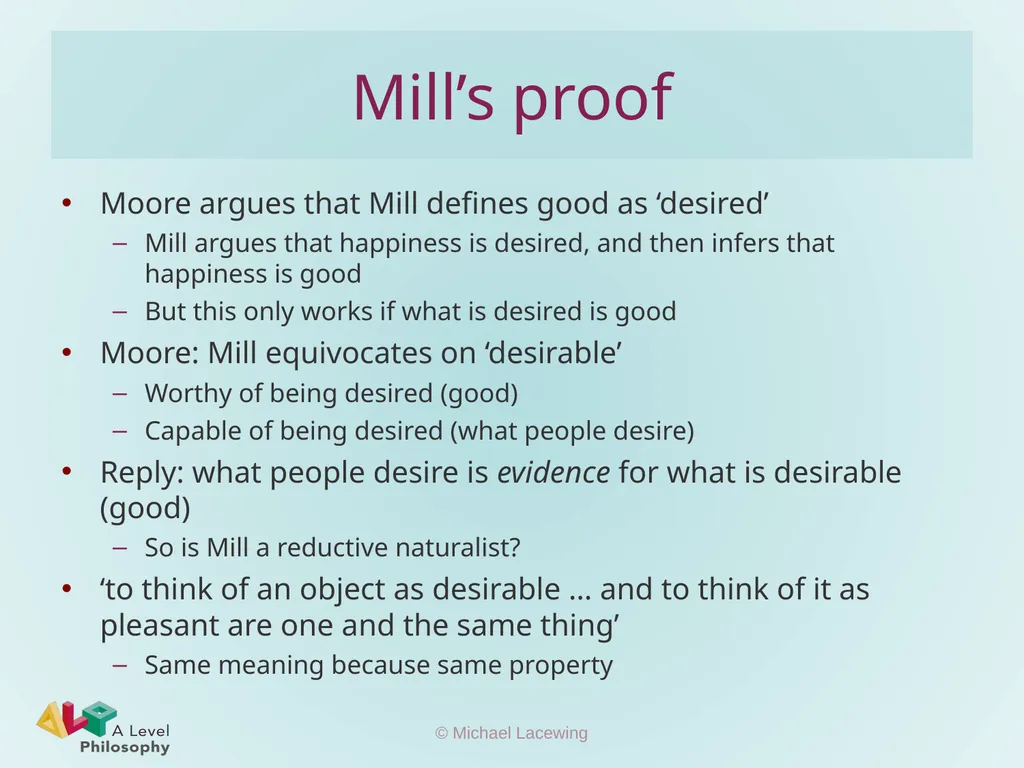
Mill’s proof Moore argues that Mill defines good as ‘desired’
Mill argues that happiness is desired, and then infers that happiness is good
But this only works if what is desired is good
Moore: Mill equivocates on ‘desirable’
Worthy of being desired (good)
Capable of being desired (what people desire)
Reply: what people desire is evidence for what is desirable (good)
So is Mill a reductive naturalist?
‘to think of an object as desirable … and to think of it as pleasant are one and the same thing’
Same meaning because same property © Michael Lacewing<br>
09
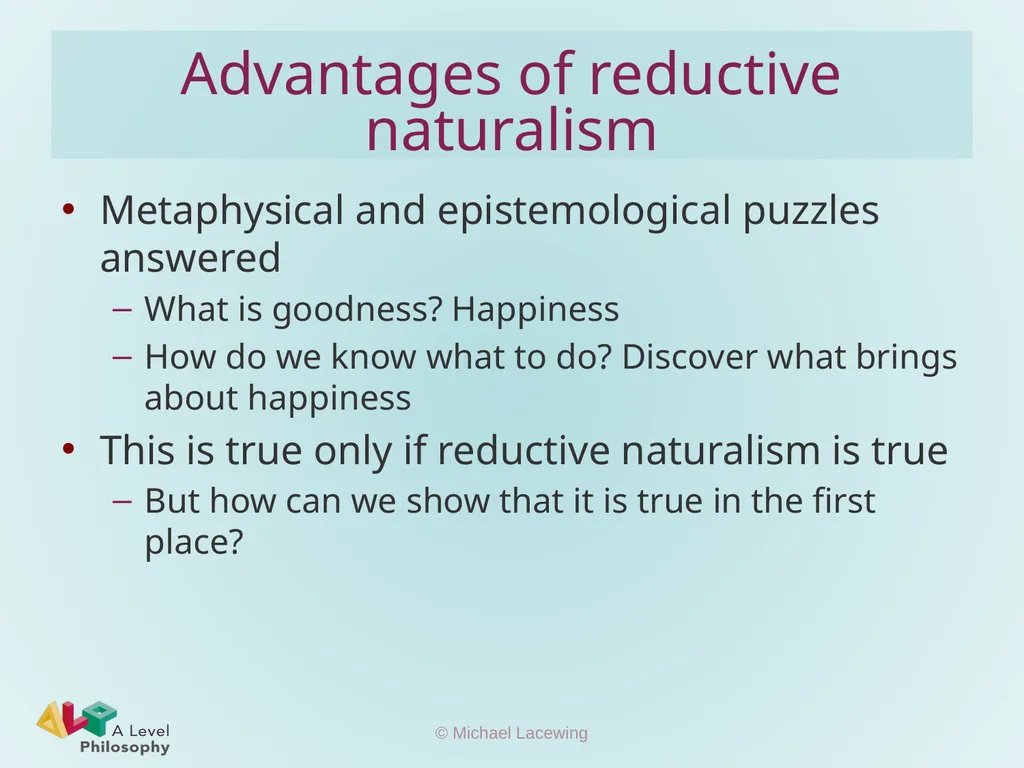
Advantages of reductive naturalism Metaphysical and epistemological puzzles answered
What is goodness? Happiness
How do we know what to do? Discover what brings about happiness
This is true only if reductive naturalism is true
But how can we show that it is true in the first place? © Michael Lacewing<br>
10
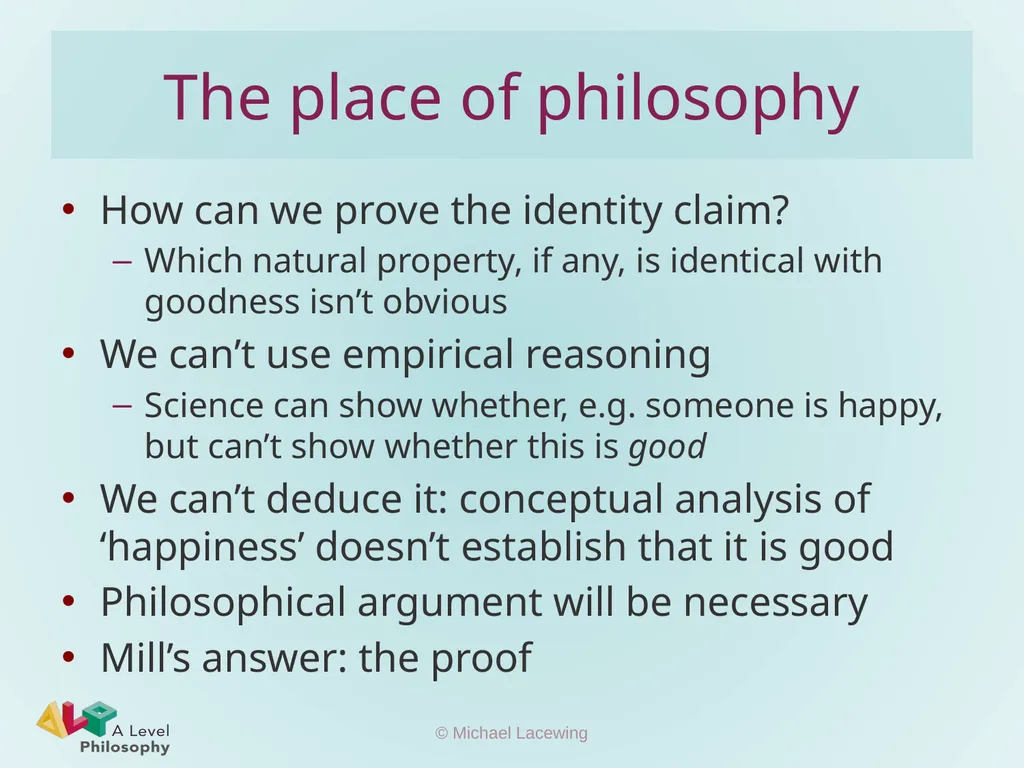
The place of philosophy How can we prove the identity claim?
Which natural property, if any, is identical with goodness isn’t obvious
We can’t use empirical reasoning
Science can show whether, e.g. someone is happy, but can’t show whether this is good
We can’t deduce it: conceptual analysis of ‘happiness’ doesn’t establish that it is good
Philosophical argument will be necessary
Mill’s answer: the proof © Michael Lacewing<br>
11
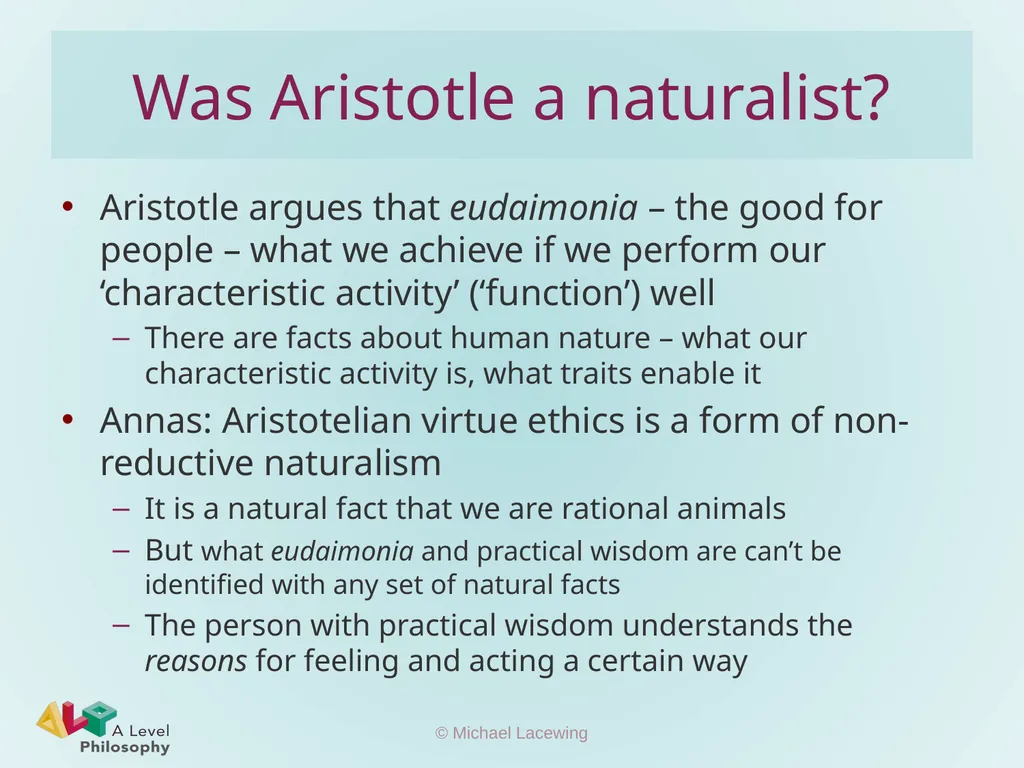
Was Aristotle a naturalist? Aristotle argues that eudaimonia – the good for people – what we achieve if we perform our ‘characteristic activity’ (‘function’) well
There are facts about human nature – what our characteristic activity is, what traits enable it
Annas: Aristotelian virtue ethics is a form of non-reductive naturalism
It is a natural fact that we are rational animals
But what eudaimonia and practical wisdom are can’t be identified with any set of natural facts
The person with practical wisdom understands the reasons for feeling and acting a certain way © Michael Lacewing<br>
Show all 11 slides