Morality How does Priestley explore issues of morality in An Inspector Calls? Write about: The ideas about morality in the play How Priestley presents these ideas by the way he writes Morality: concerning the distinction between right and
"Morality How does Priestley explore issues of" is the property of its rightful owner. Permission is granted to
download and print the materials on this website for personal, non-commercial use only, and to display it
on your personal computer provided you do not modify the materials and that you retain all copyright
notices contained in the materials. By downloading content from our website, you accept the terms of this
agreement.
Presentation Transcript
01
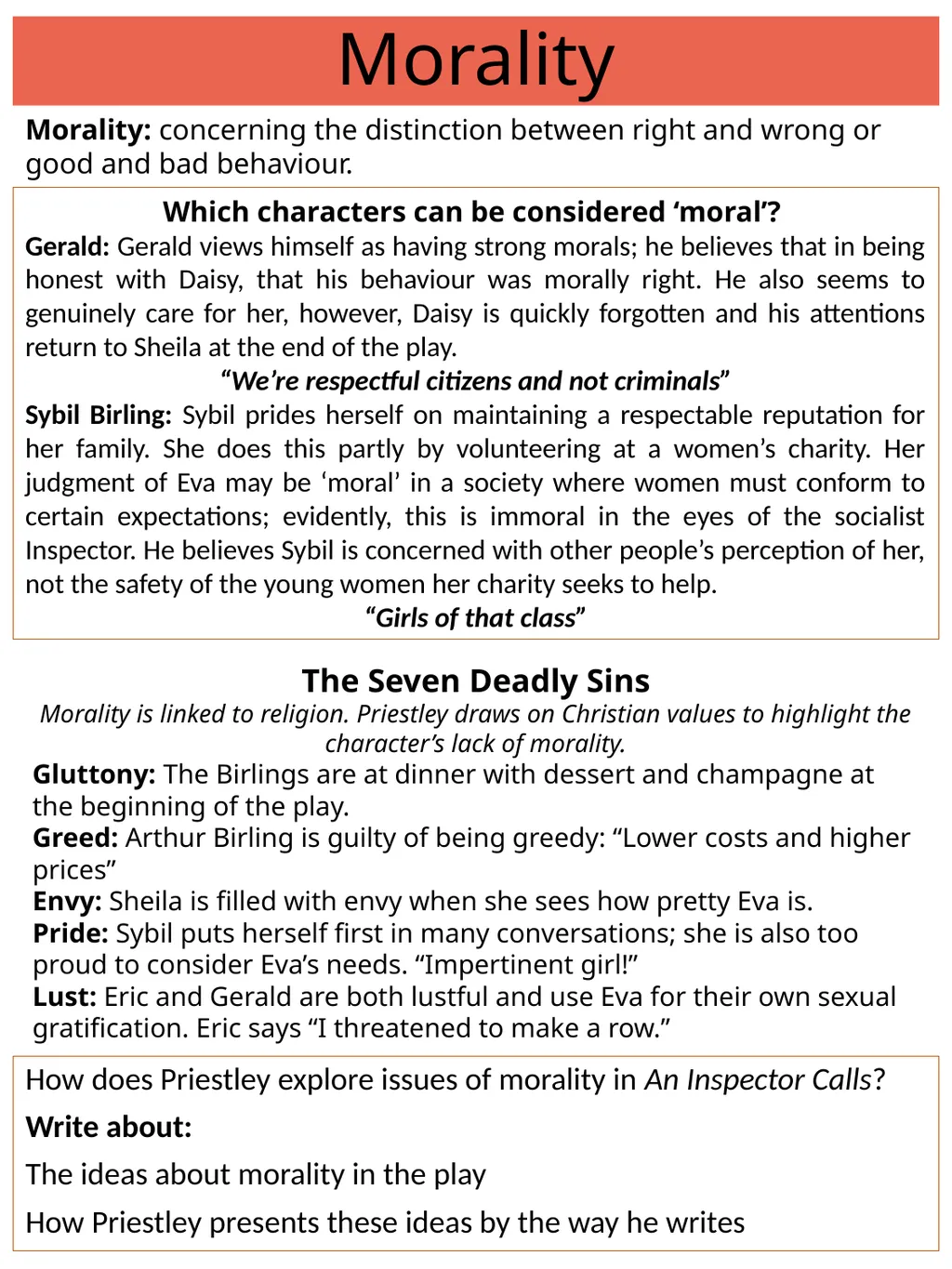
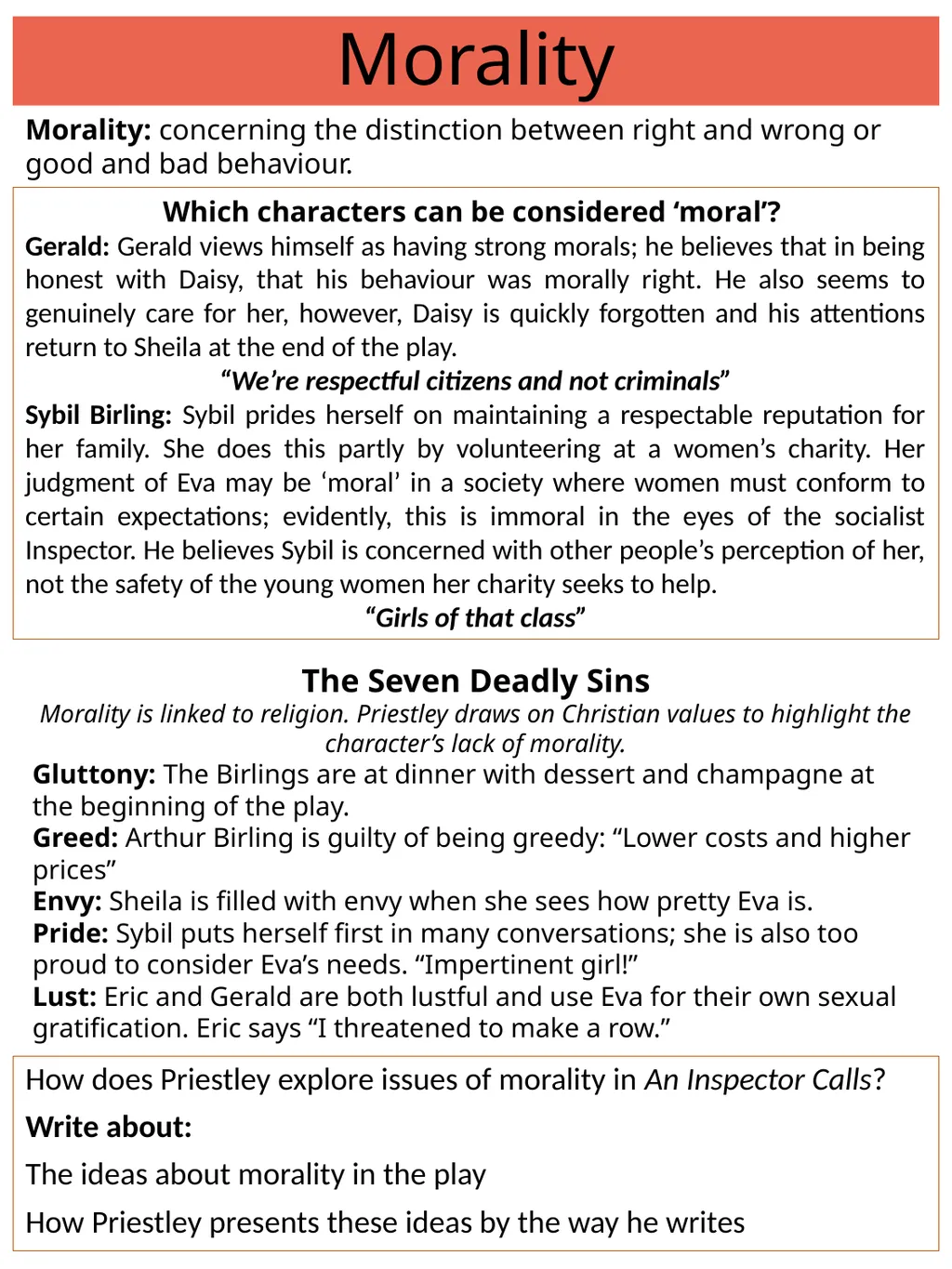
Morality How does Priestley explore issues of morality in An Inspector Calls?
Write about:
The ideas about morality in the play
How Priestley presents these ideas by the way he writes Morality: concerning the distinction between right and wrong or good and bad behaviour. Which characters can be considered ‘moral’?
Gerald: Gerald views himself as having strong morals; he believes that in being honest with Daisy, that his behaviour was morally right. He also seems to genuinely care for her, however, Daisy is quickly forgotten and his attentions return to Sheila at the end of the play.
“We’re respectful citizens and not criminals”
Sybil Birling: Sybil prides herself on maintaining a respectable reputation for her family. She does this partly by volunteering at a women’s charity. Her judgment of Eva may be ‘moral’ in a society where women must conform to certain expectations; evidently, this is immoral in the eyes of the socialist Inspector. He believes Sybil is concerned with other people’s perception of her, not the safety of the young women her charity seeks to help.
“Girls of that class” The Seven Deadly Sins
Morality is linked to religion. Priestley draws on Christian values to highlight the character’s lack of morality.
Gluttony: The Birlings are at dinner with dessert and champagne at the beginning of the play.
Greed: Arthur Birling is guilty of being greedy: “Lower costs and higher prices”
Envy: Sheila is filled with envy when she sees how pretty Eva is.
Pride: Sybil puts herself first in many conversations; she is also too proud to consider Eva’s needs. “Impertinent girl!”
Lust: Eric and Gerald are both lustful and use Eva for their own sexual gratification. Eric says “I threatened to make a row.”<br>
02
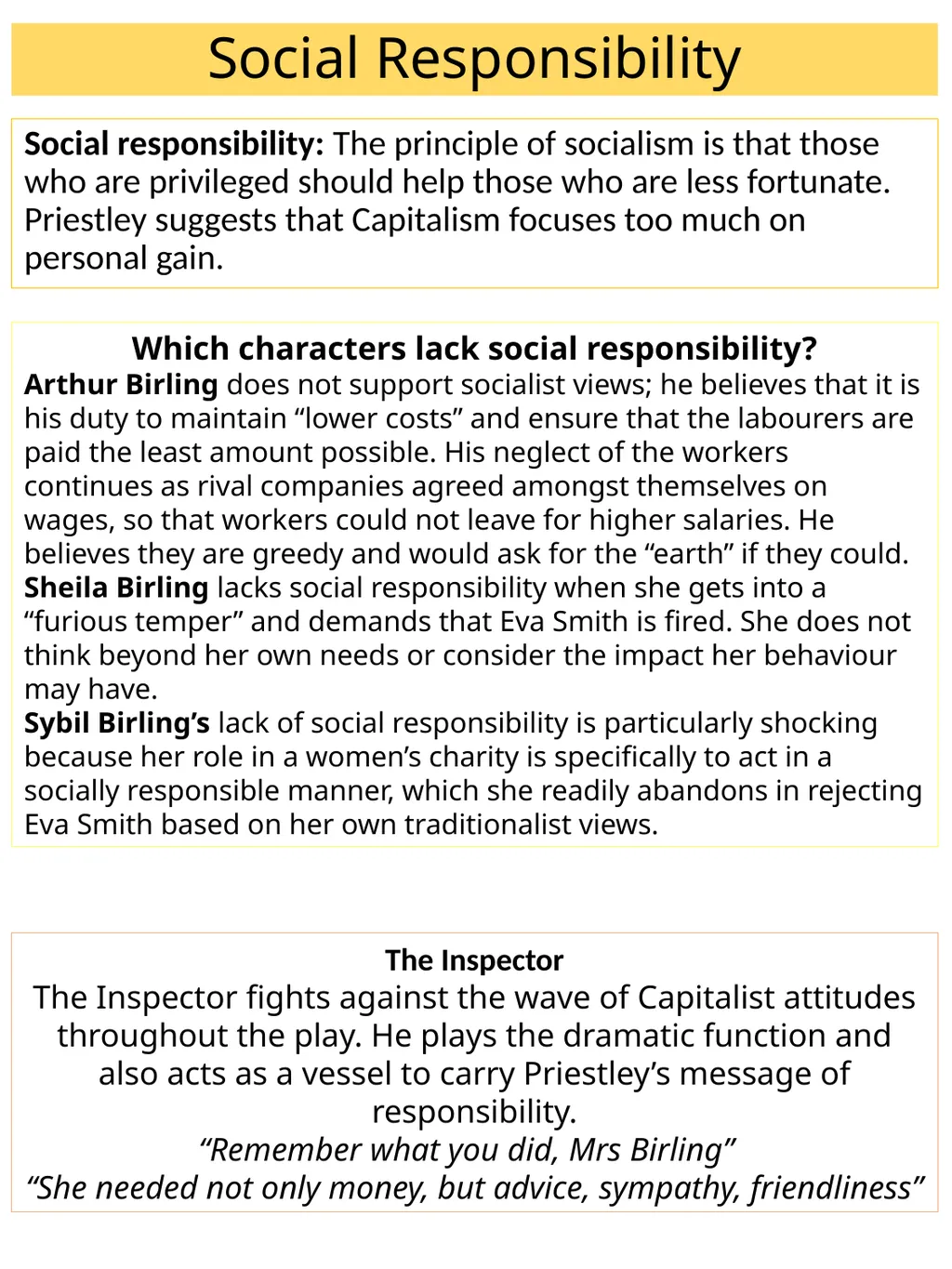
Social Responsibility Social responsibility: The principle of socialism is that those who are privileged should help those who are less fortunate. Priestley suggests that Capitalism focuses too much on personal gain. Which characters lack social responsibility?
Arthur Birling does not support socialist views; he believes that it is his duty to maintain “lower costs” and ensure that the labourers are paid the least amount possible. His neglect of the workers continues as rival companies agreed amongst themselves on wages, so that workers could not leave for higher salaries. He believes they are greedy and would ask for the “earth” if they could.
Sheila Birling lacks social responsibility when she gets into a “furious temper” and demands that Eva Smith is fired. She does not think beyond her own needs or consider the impact her behaviour may have.
Sybil Birling’s lack of social responsibility is particularly shocking because her role in a women’s charity is specifically to act in a socially responsible manner, which she readily abandons in rejecting Eva Smith based on her own traditionalist views. The Inspector
The Inspector fights against the wave of Capitalist attitudes throughout the play. He plays the dramatic function and also acts as a vessel to carry Priestley’s message of responsibility.
“Remember what you did, Mrs Birling”
“She needed not only money, but advice, sympathy, friendliness”<br>
03
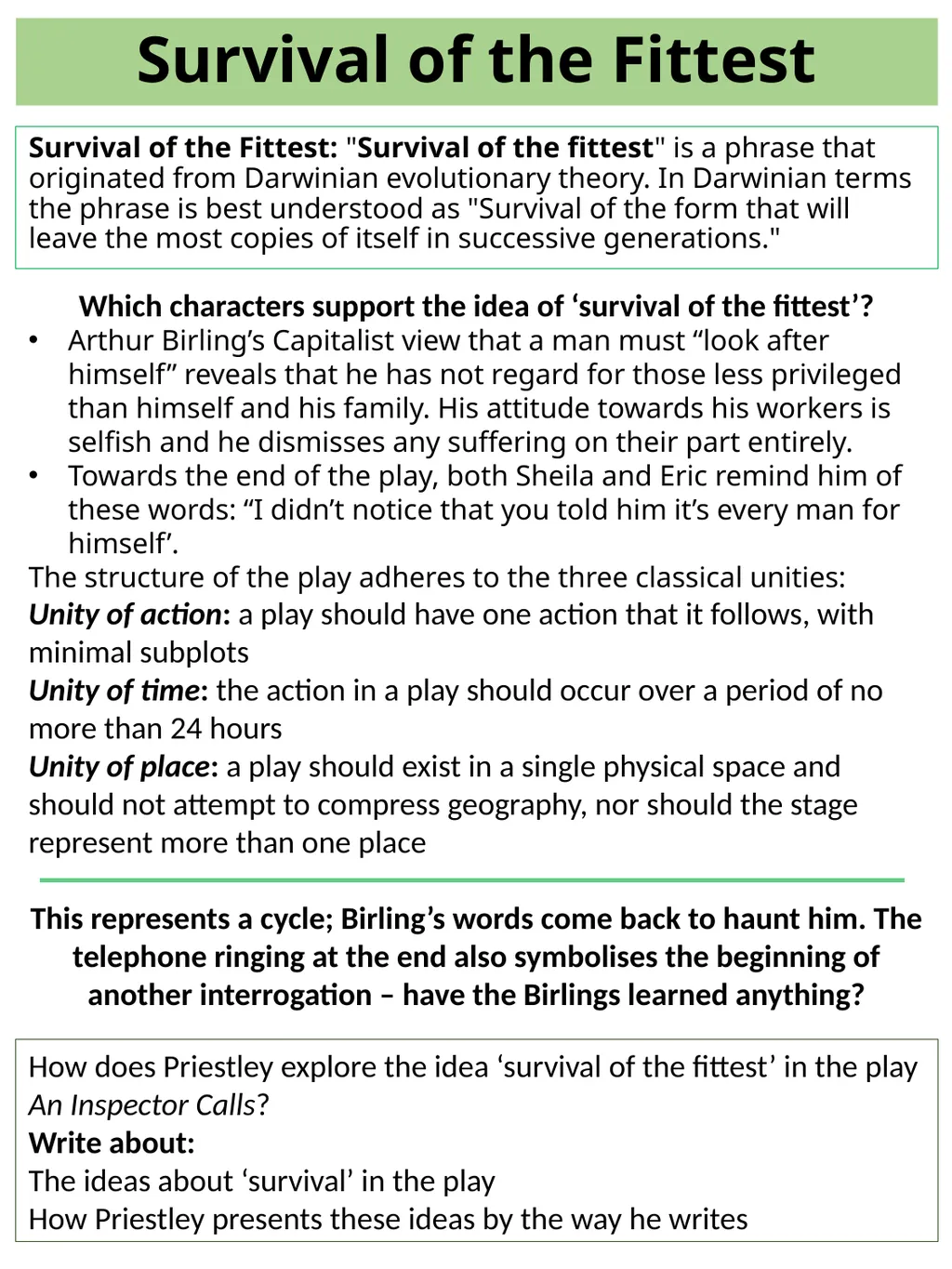
Survival of the Fittest Survival of the Fittest: "Survival of the fittest" is a phrase that originated from Darwinian evolutionary theory. In Darwinian terms the phrase is best understood as "Survival of the form that will leave the most copies of itself in successive generations." Which characters support the idea of ‘survival of the fittest’?
Arthur Birling’s Capitalist view that a man must “look after himself” reveals that he has not regard for those less privileged than himself and his family. His attitude towards his workers is selfish and he dismisses any suffering on their part entirely.
Towards the end of the play, both Sheila and Eric remind him of these words: “I didn’t notice that you told him it’s every man for himself’.
The structure of the play adheres to the three classical unities:
Unity of action: a play should have one action that it follows, with minimal subplots
Unity of time: the action in a play should occur over a period of no more than 24 hours
Unity of place: a play should exist in a single physical space and should not attempt to compress geography, nor should the stage represent more than one place
This represents a cycle; Birling’s words come back to haunt him. The telephone ringing at the end also symbolises the beginning of another interrogation – have the Birlings learned anything? How does Priestley explore the idea ‘survival of the fittest’ in the play An Inspector Calls?
Write about:
The ideas about ‘survival’ in the play
How Priestley presents these ideas by the way he writes<br>
04
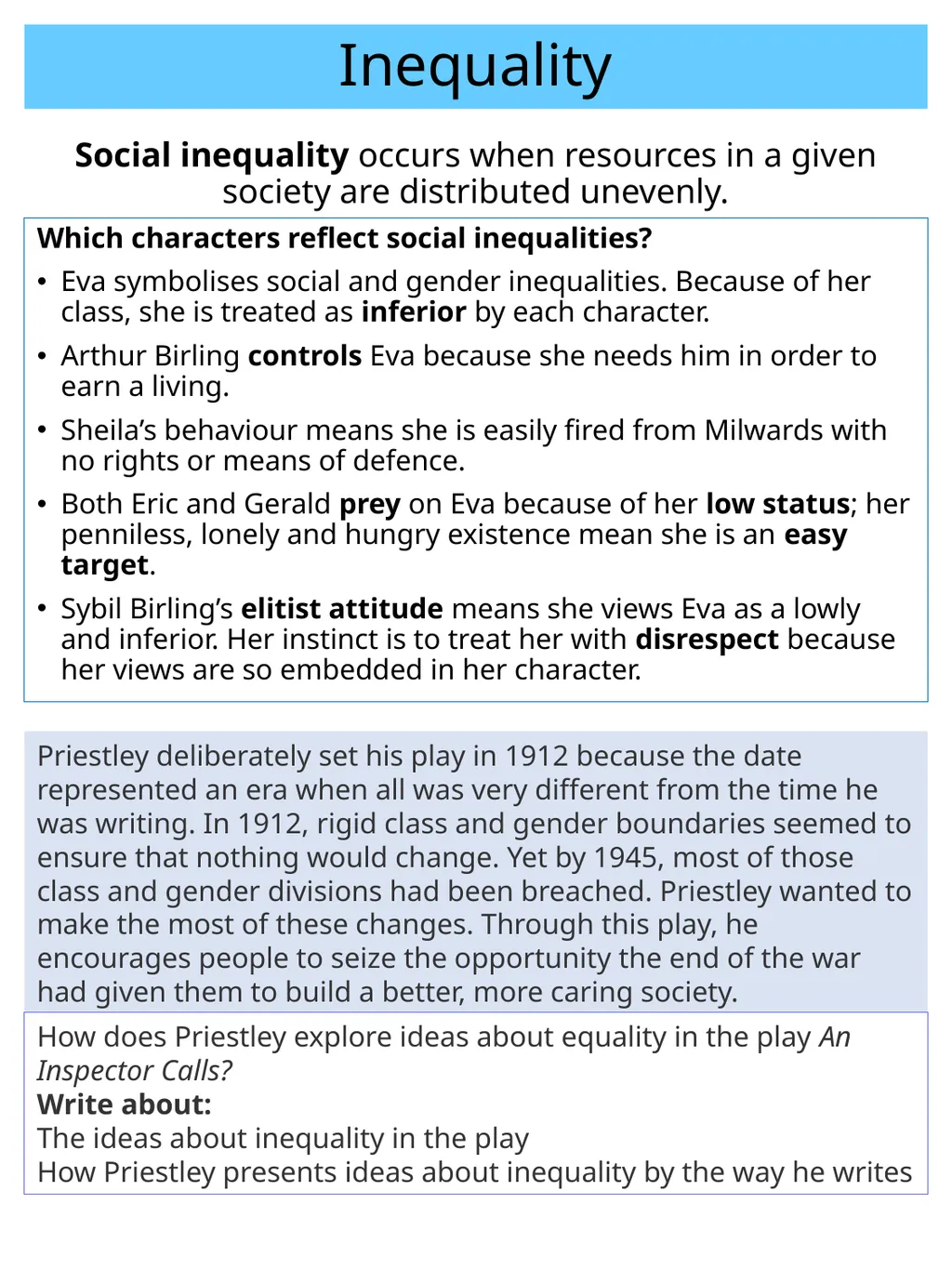
Inequality Social inequality occurs when resources in a given society are distributed unevenly. Which characters reflect social inequalities?
Eva symbolises social and gender inequalities. Because of her class, she is treated as inferior by each character.
Arthur Birling controls Eva because she needs him in order to earn a living.
Sheila’s behaviour means she is easily fired from Milwards with no rights or means of defence.
Both Eric and Gerald prey on Eva because of her low status; her penniless, lonely and hungry existence mean she is an easy target.
Sybil Birling’s elitist attitude means she views Eva as a lowly and inferior. Her instinct is to treat her with disrespect because her views are so embedded in her character. Priestley deliberately set his play in 1912 because the date represented an era when all was very different from the time he was writing. In 1912, rigid class and gender boundaries seemed to ensure that nothing would change. Yet by 1945, most of those class and gender divisions had been breached. Priestley wanted to make the most of these changes. Through this play, he encourages people to seize the opportunity the end of the war had given them to build a better, more caring society. How does Priestley explore ideas about equality in the play An Inspector Calls?
Write about: The ideas about inequality in the play
How Priestley presents ideas about inequality by the way he writes<br>
05
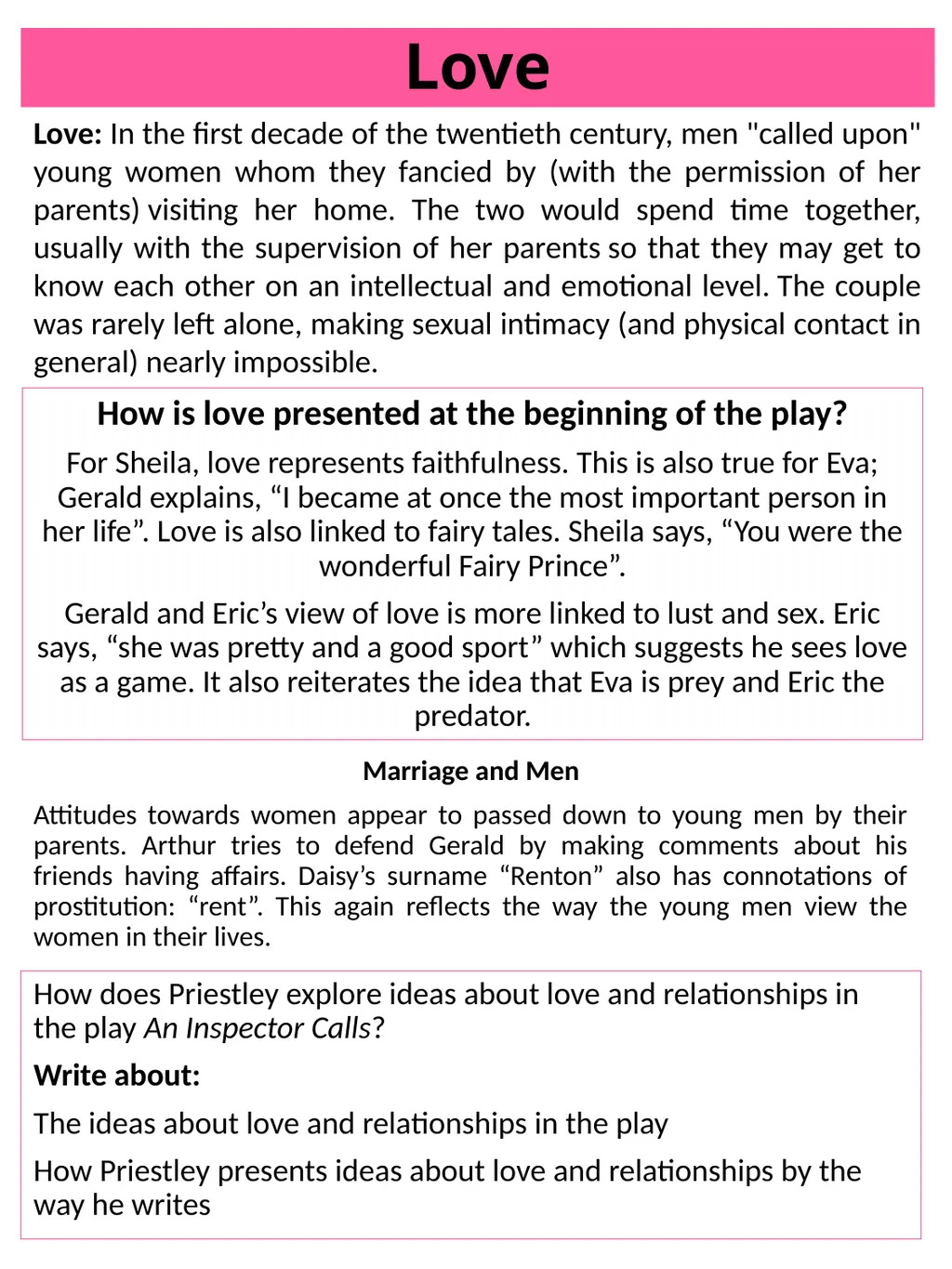
Love How is love presented at the beginning of the play?
For Sheila, love represents faithfulness. This is also true for Eva; Gerald explains, “I became at once the most important person in her life”. Love is also linked to fairy tales. Sheila says, “You were the wonderful Fairy Prince”.
Gerald and Eric’s view of love is more linked to lust and sex. Eric says, “she was pretty and a good sport” which suggests he sees love as a game. It also reiterates the idea that Eva is prey and Eric the predator. Love: In the first decade of the twentieth century, men "called upon" young women whom they fancied by (with the permission of her parents) visiting her home. The two would spend time together, usually with the supervision of her parents so that they may get to know each other on an intellectual and emotional level. The couple was rarely left alone, making sexual intimacy (and physical contact in general) nearly impossible. How does Priestley explore ideas about love and relationships in the play An Inspector Calls?
Write about:
The ideas about love and relationships in the play
How Priestley presents ideas about love and relationships by the way he writes Marriage and Men
Attitudes towards women appear to passed down to young men by their parents. Arthur tries to defend Gerald by making comments about his friends having affairs. Daisy’s surname “Renton” also has connotations of prostitution: “rent”. This again reflects the way the young men view the women in their lives.<br>