
Moving from Competence to Responsiveness:

Description: Moving from Competence to Responsiveness: Broaching Conversations around Race, Power, Privilege Erin Cannella, PhD (Sheherhers) Amani Johnson, PhD (Sheherhers) Learning Objectives 1. Apply APA guidelines in psychotherapy with regards
Related Topics
Download Presentation
"Moving from Competence to Responsiveness:" is the property of its rightful owner. Permission is granted to download and print the materials on this website for personal, non-commercial use only, and to display it on your personal computer provided you do not modify the materials and that you retain all copyright notices contained in the materials. By downloading content from our website, you accept the terms of this agreement.
Presentation Transcript
slide1. Moving from Competence to Responsiveness: Broaching Conversations around Race, Power, & Privilege Erin Cannella, PhD
(She/her/hers)
Amani Johnson, PhD
(She/her/hers)<br>
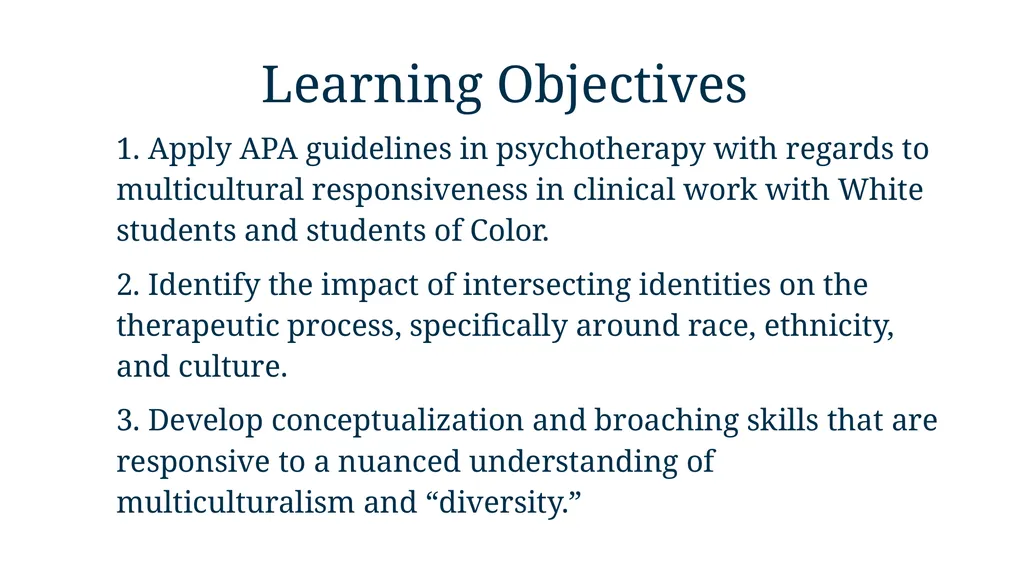
slide2. Learning Objectives 1. Apply APA guidelines in psychotherapy with regards to multicultural responsiveness in clinical work with White students and students of Color.
2. Identify the impact of intersecting identities on the therapeutic process, specifically around race, ethnicity, and culture.
3. Develop conceptualization and broaching skills that are responsive to a nuanced understanding of multiculturalism and “diversity.”<br>
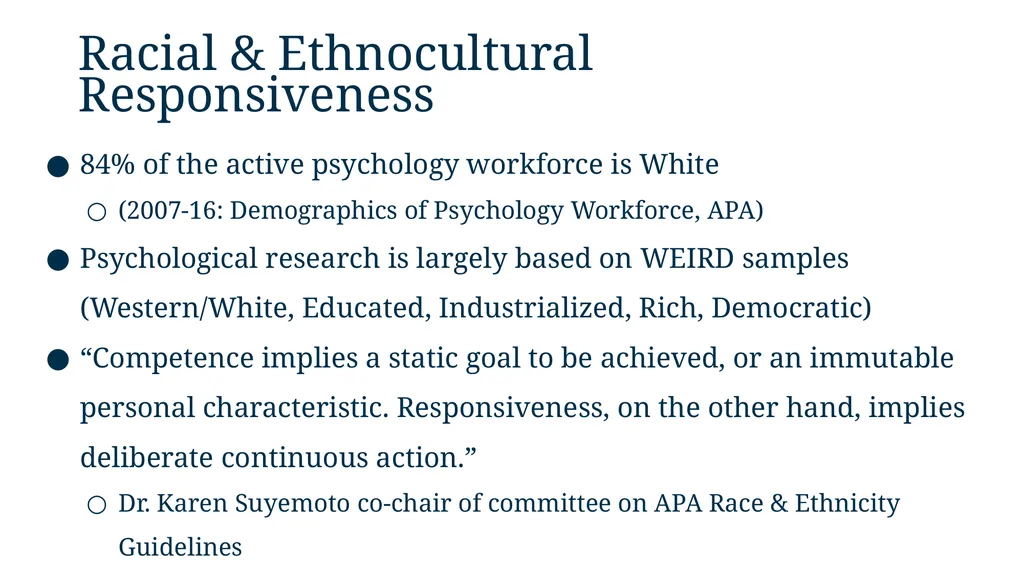
slide4. Racial & Ethnocultural Responsiveness 84% of the active psychology workforce is White
(2007-16: Demographics of Psychology Workforce, APA)
Psychological research is largely based on WEIRD samples (Western/White, Educated, Industrialized, Rich, Democratic)
“Competence implies a static goal to be achieved, or an immutable personal characteristic. Responsiveness, on the other hand, implies deliberate continuous action.”
Dr. Karen Suyemoto co-chair of committee on APA Race & Ethnicity Guidelines<br>
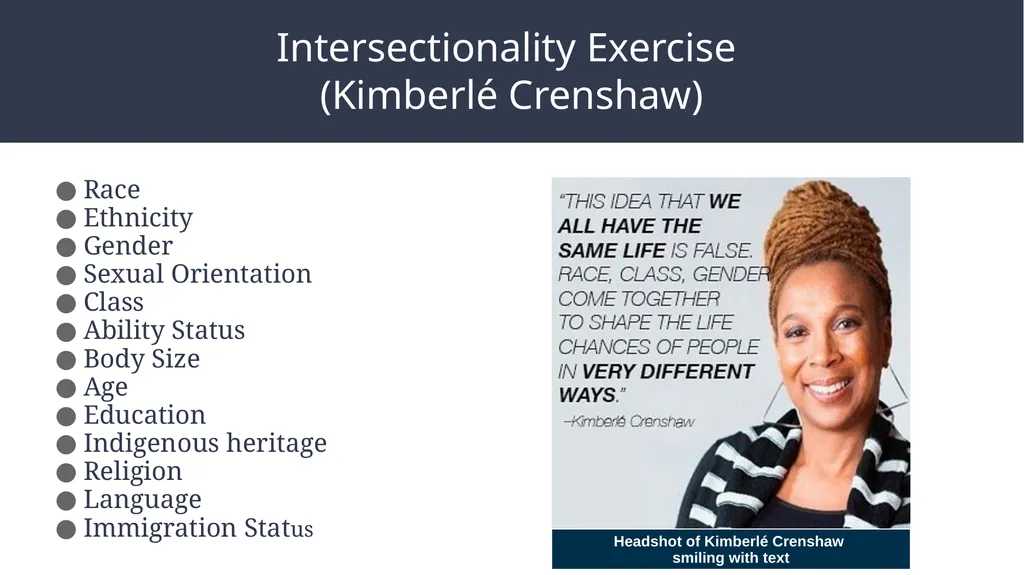
slide5. Intersectionality Exercise (Kimberlé Crenshaw) Race
Ethnicity
Gender
Sexual Orientation
Class
Ability Status
Body Size
Age
Education
Indigenous heritage
Religion
Language
Immigration Status<br>
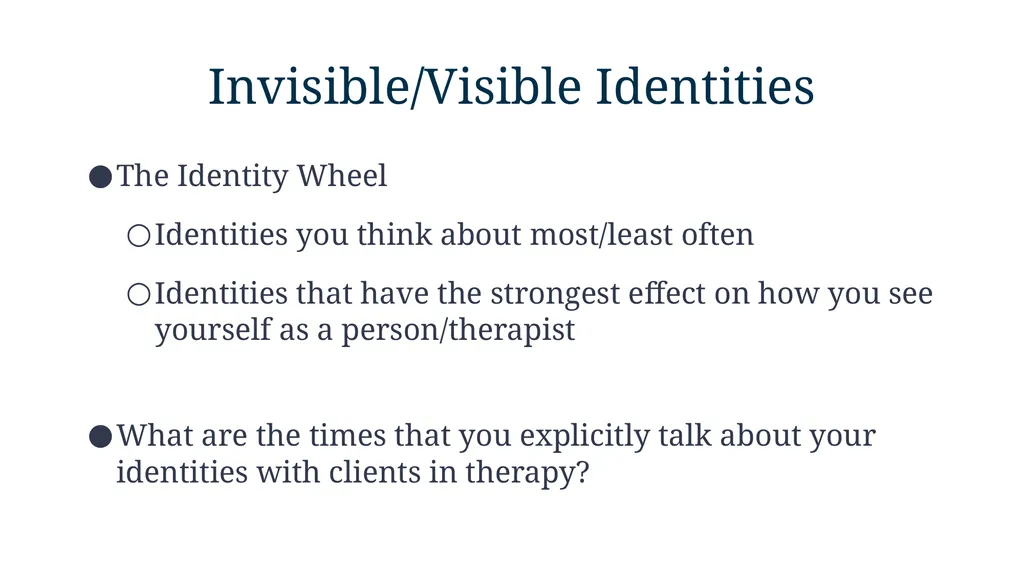
slide6. Invisible/Visible Identities The Identity Wheel
Identities you think about most/least often
Identities that have the strongest effect on how you see yourself as a person/therapist
What are the times that you explicitly talk about your identities with clients in therapy?<br>
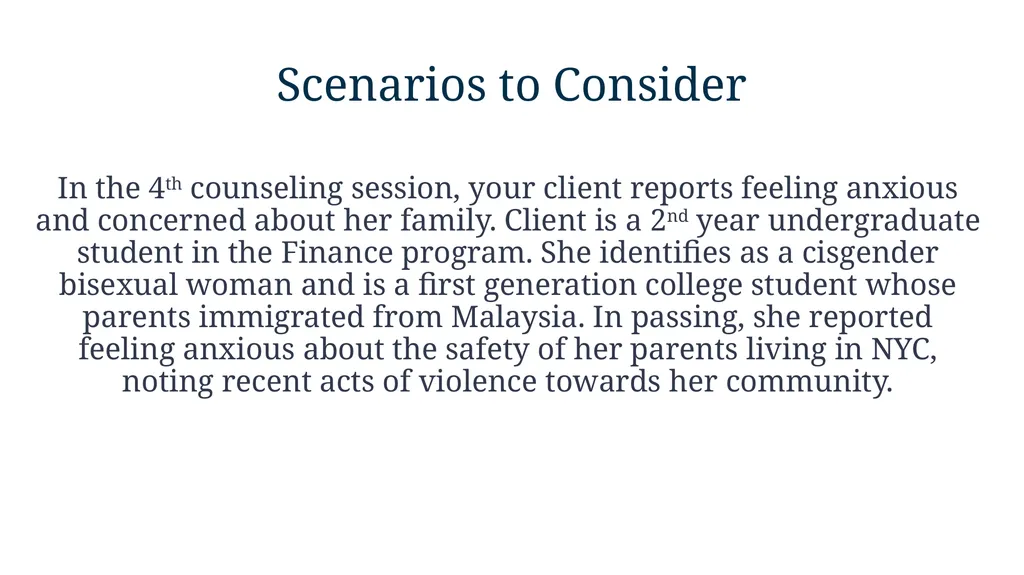
slide7. Scenarios to Consider In the 4th counseling session, your client reports feeling anxious and concerned about her family. Client is a 2nd year undergraduate student in the Finance program. She identifies as a cisgender bisexual woman and is a first generation college student whose parents immigrated from Malaysia. In passing, she reported feeling anxious about the safety of her parents living in NYC, noting recent acts of violence towards her community.<br>
slide8. Reflection Questions What are some factors that may impact your conceptualization of this client from a culturally responsive perspective?
What are some ways you can provide support to this client while acknowledging the impact of cultural/systemic factors?
Describe some ways you could broach cultural factors, as they relate to the client’s presenting concerns.<br>
slide9. Broaching (Day-Vines et al., 2007) The counselor's invitation to discuss racial and cultural factors that may influence the clinical work.
What are the important aspects of your culture/identities that you’d like to discuss? This can include…..
In what ways, if any, do the identities you just talked about impact the problem you are bringing in today?
I’m ______ you’re _____.<br>
slide10. Core Tenets of Broaching (King, 2021) Broaching…
is the counselor’s responsibility
is a process that occurs on an ongoing basis
addresses dynamic and intersecting identities
occurs on multiple levels
requires flexibility<br>
slide11. Broaching (King & Borders, 2019) Recommendations for Practice are debated:
Timing of skill
Language Used
Goals of Broaching
Emphasis on similarities/differences<br>
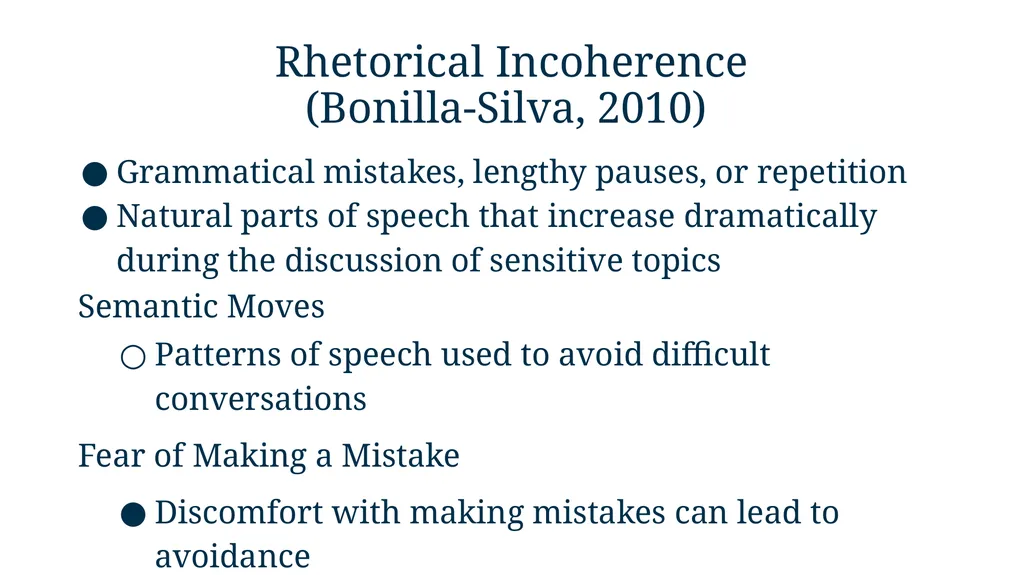
slide12. Rhetorical Incoherence
(Bonilla-Silva, 2010) Grammatical mistakes, lengthy pauses, or repetition
Natural parts of speech that increase dramatically during the discussion of sensitive topics
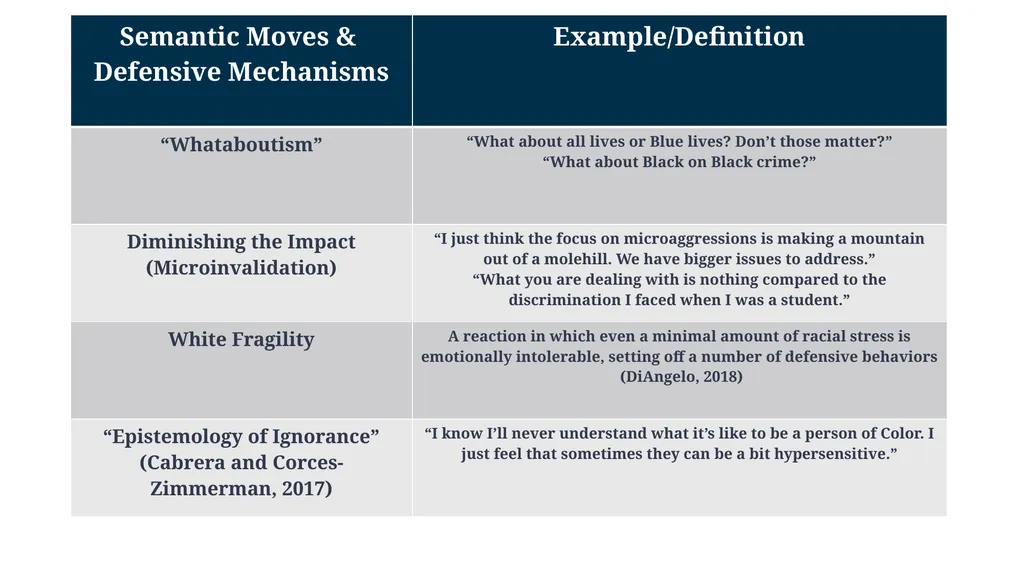
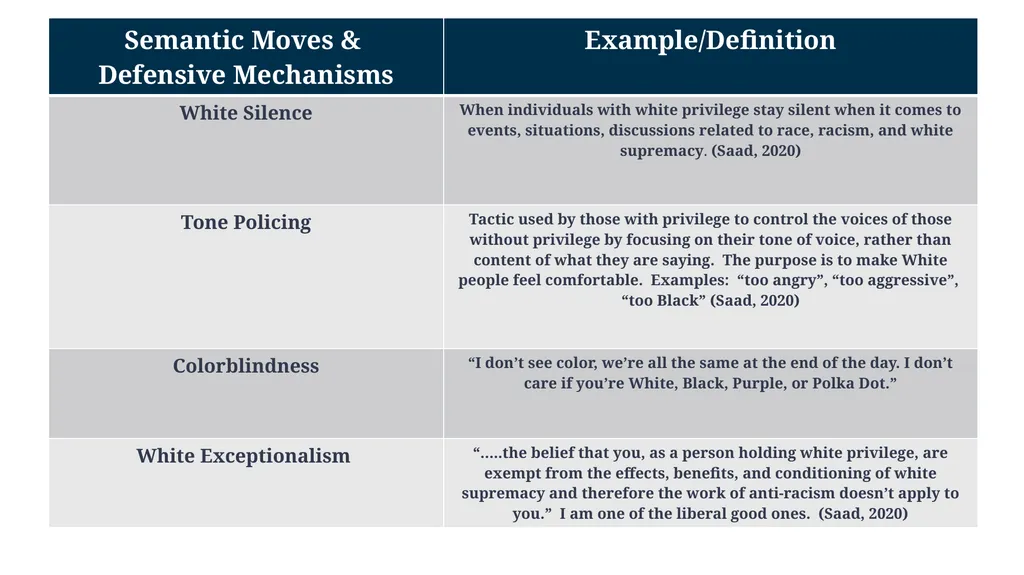
Semantic Moves
Patterns of speech used to avoid difficult conversations
Fear of Making a Mistake
Discomfort with making mistakes can lead to avoidance<br>
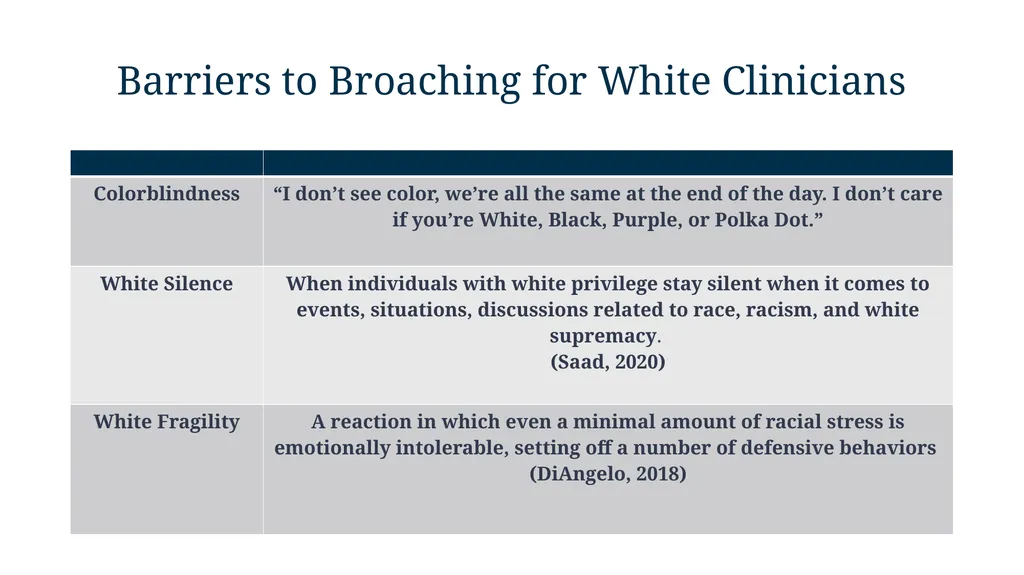
slide13. Barriers to Broaching for White Clinicians<br>
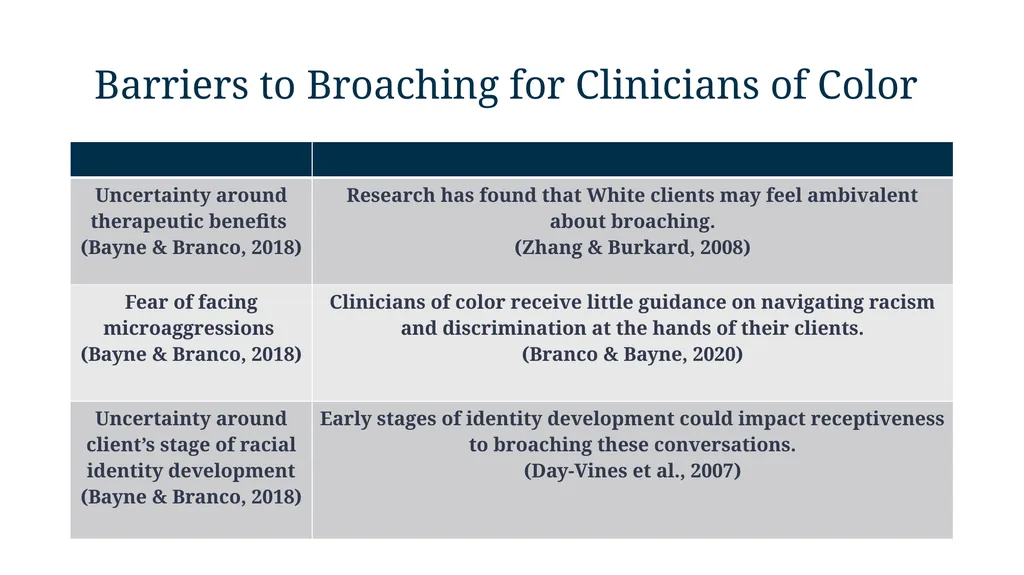
slide14. Barriers to Broaching for Clinicians of Color<br>
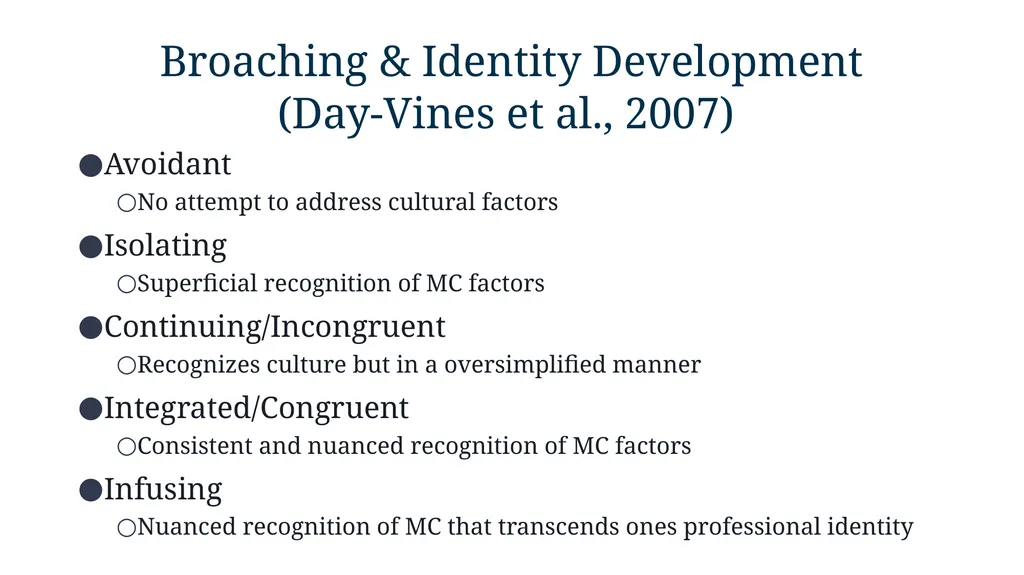
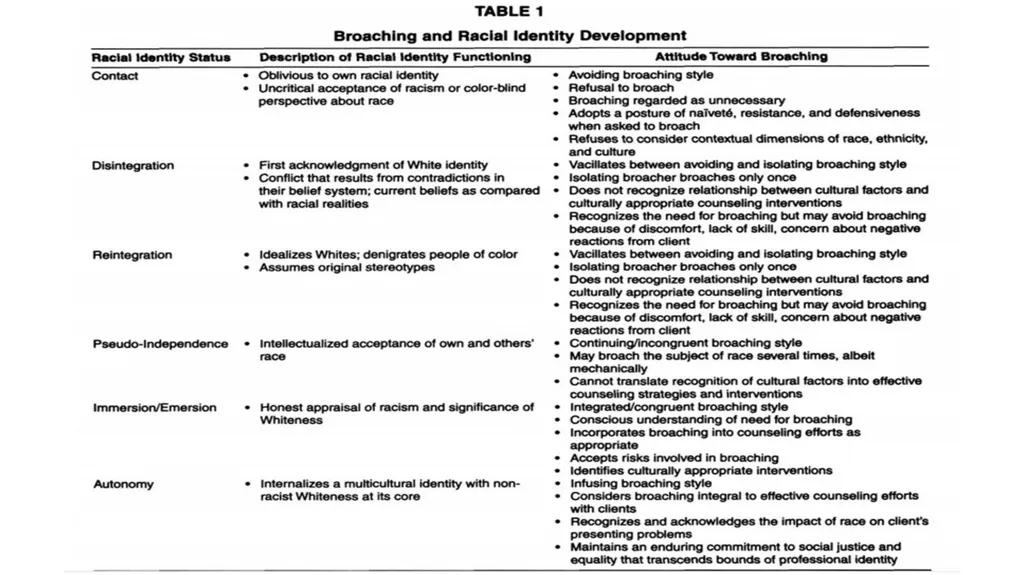
slide15. Broaching & Identity Development (Day-Vines et al., 2007) Avoidant
No attempt to address cultural factors
Isolating
Superficial recognition of MC factors
Continuing/Incongruent
Recognizes culture but in a oversimplified manner
Integrated/Congruent
Consistent and nuanced recognition of MC factors
Infusing
Nuanced recognition of MC that transcends ones professional identity<br>
slide16. Scenarios to Consider You are meeting with a client after 2 sessions who reports symptoms of depression and anxiety that seem to be exacerbated by the academic setting. Client identifies as a cisgender heterosexual Black man. He is a 2nd year medical student and is one of few Black students in his cohort. Client reports feeling on-edge and unsure of himself in clinical/academic settings. As a result, he reports feeling overwhelmed with low motivation and fatigue.<br>
slide17. Reflection Questions What are some factors that may impact your conceptualization of this client from a culturally responsive perspective?
What are some ways you can provide support to this client while acknowledging the impact of cultural/systemic factors?
Describe some ways you could broach cultural factors, as they relate to the client’s presenting concerns.<br>
slide18. In-Roads for Conversations on Race Sense of Belonging on campus
Imposter’s Syndrome
Perfectionism
1st generation students
Stereotype Threat
Microaggressions (i.e. intersecting identities)
Transferable skills (tolerating discomfort)
Allyship (Conveyor Belt Analogy)<br>
slide19. Scenarios to Consider In session six of the work, your client acknowledges a desire to address gender identity concerns more directly. Client is White and identifies as Agnostic and heterosexual. They report feeling as though a non-binary identity resonates as a good fit, but note some uncertainty about how this would be perceived by family, friends, peers, and colleagues. In session, they have disclosed this to you and requested they/them pronouns. However, this is not something they have addressed with others.<br>
slide20. Reflection Questions What are some factors that may impact your conceptualization of this client from a culturally responsive perspective?
What are some ways you can provide support to this client while acknowledging the impact of cultural/systemic factors?
Describe some ways you could broach cultural factors, as they relate to the client’s presenting concerns.<br>
slide21. Thank you! Questions/Comments?<br>
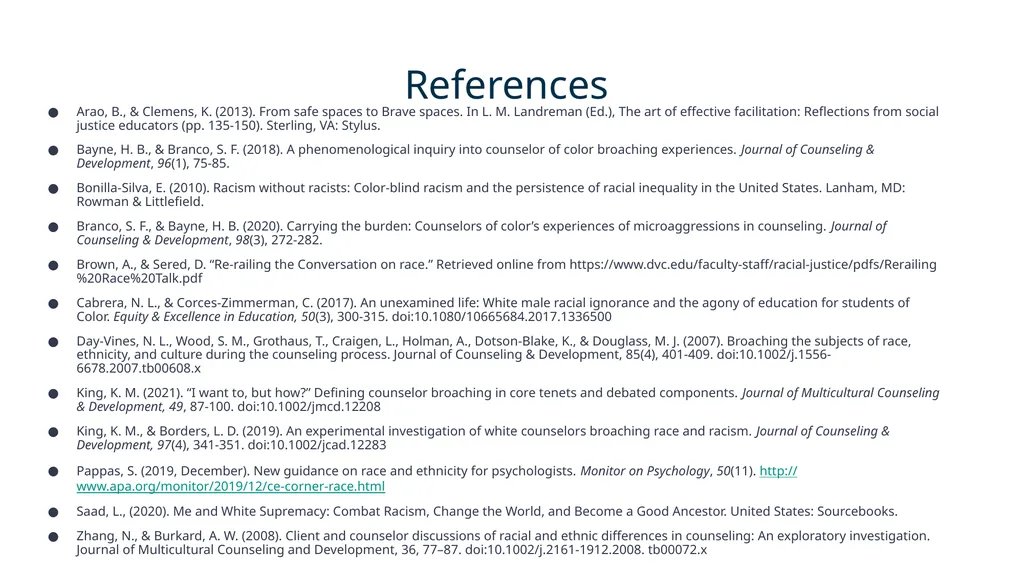
slide22. References Arao, B., & Clemens, K. (2013). From safe spaces to Brave spaces. In L. M. Landreman (Ed.), The art of effective facilitation: Reflections from social justice educators (pp. 135-150). Sterling, VA: Stylus.
Bayne, H. B., & Branco, S. F. (2018). A phenomenological inquiry into counselor of color broaching experiences. Journal of Counseling & Development, 96(1), 75-85.
Bonilla-Silva, E. (2010). Racism without racists: Color-blind racism and the persistence of racial inequality in the United States. Lanham, MD: Rowman & Littlefield.
Branco, S. F., & Bayne, H. B. (2020). Carrying the burden: Counselors of color’s experiences of microaggressions in counseling. Journal of Counseling & Development, 98(3), 272-282.
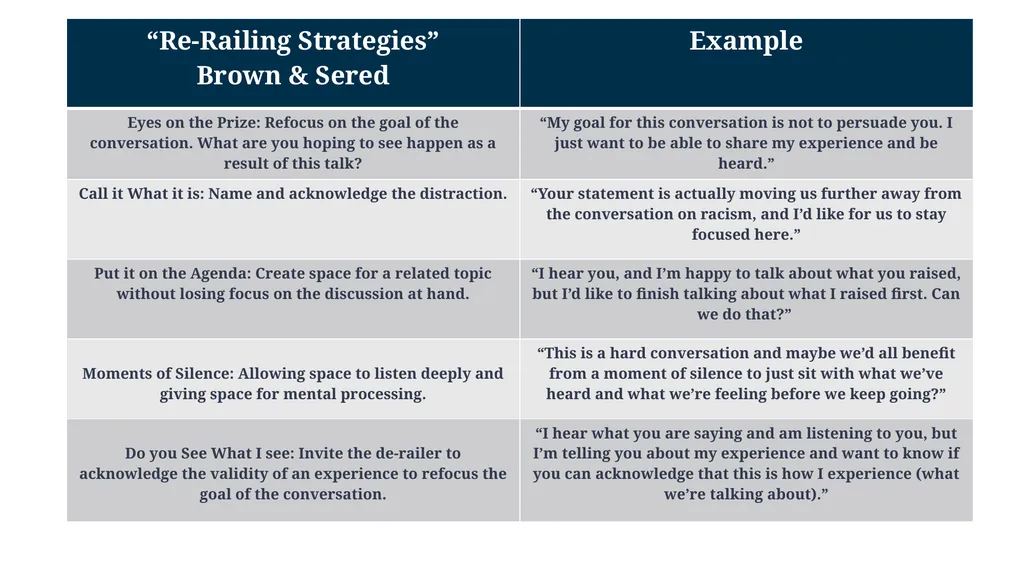
Brown, A., & Sered, D. “Re-railing the Conversation on race.” Retrieved online from https://www.dvc.edu/faculty-staff/racial-justice/pdfs/Rerailing%20Race%20Talk.pdf
Cabrera, N. L., & Corces-Zimmerman, C. (2017). An unexamined life: White male racial ignorance and the agony of education for students of Color. Equity & Excellence in Education, 50(3), 300-315. doi:10.1080/10665684.2017.1336500
Day‐Vines, N. L., Wood, S. M., Grothaus, T., Craigen, L., Holman, A., Dotson‐Blake, K., & Douglass, M. J. (2007). Broaching the subjects of race, ethnicity, and culture during the counseling process. Journal of Counseling & Development, 85(4), 401-409. doi:10.1002/j.1556-6678.2007.tb00608.x
King, K. M. (2021). “I want to, but how?” Defining counselor broaching in core tenets and debated components. Journal of Multicultural Counseling & Development, 49, 87-100. doi:10.1002/jmcd.12208
King, K. M., & Borders, L. D. (2019). An experimental investigation of white counselors broaching race and racism. Journal of Counseling & Development, 97(4), 341-351. doi:10.1002/jcad.12283
Pappas, S. (2019, December). New guidance on race and ethnicity for psychologists. Monitor on Psychology, 50(11). http://www.apa.org/monitor/2019/12/ce-corner-race.html
Saad, L., (2020). Me and White Supremacy: Combat Racism, Change the World, and Become a Good Ancestor. United States: Sourcebooks.
Zhang, N., & Burkard, A. W. (2008). Client and counselor discussions of racial and ethnic differences in counseling: An exploratory investigation. Journal of Multicultural Counseling and Development, 36, 77–87. doi:10.1002/j.2161-1912.2008. tb00072.x<br>
slide23. Supplemental Slides<br>
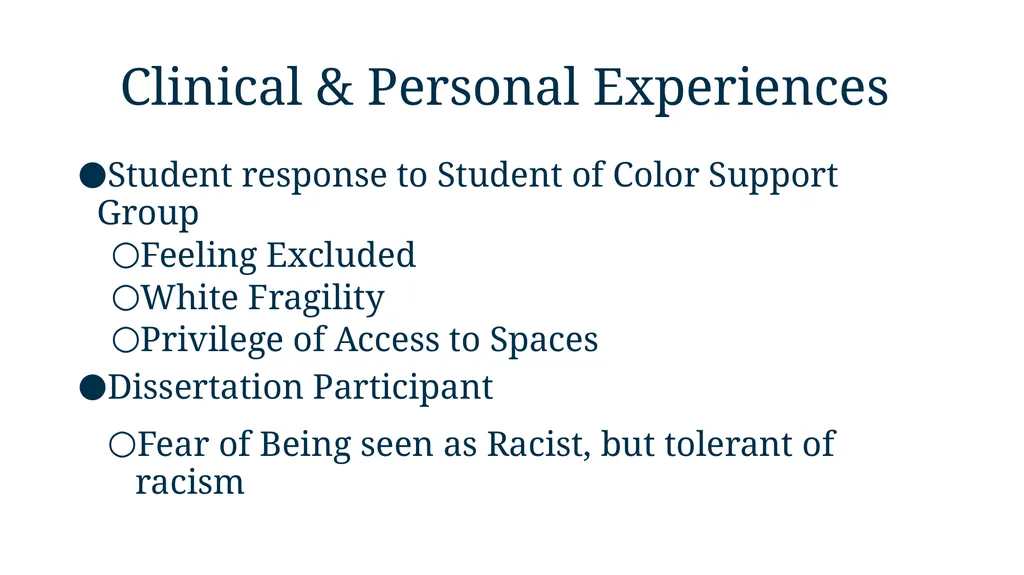
slide28. Clinical & Personal Experiences Student response to Student of Color Support Group
Feeling Excluded
White Fragility
Privilege of Access to Spaces
Dissertation Participant
Fear of Being seen as Racist, but tolerant of racism<br>
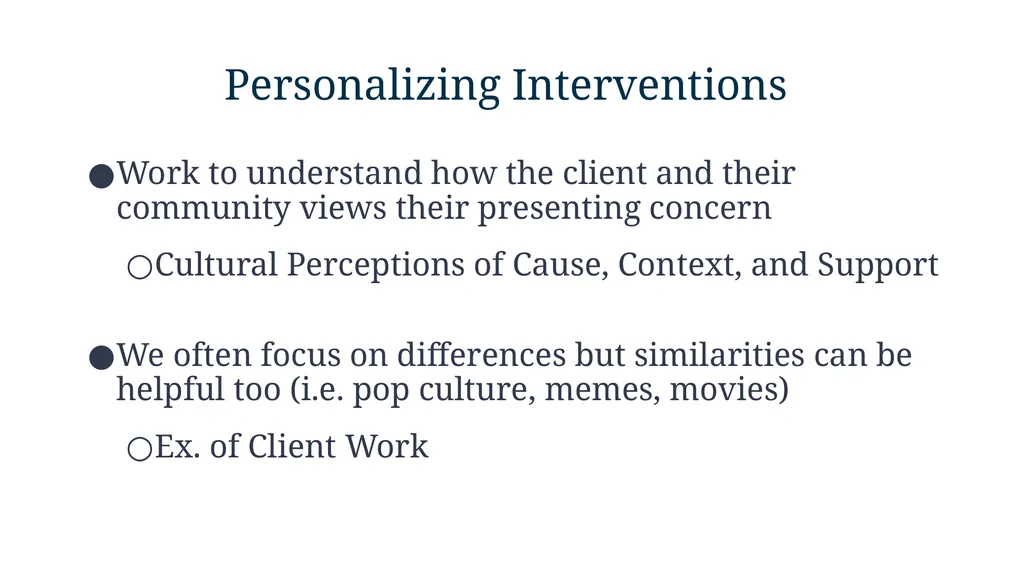
slide29. Personalizing Interventions Work to understand how the client and their community views their presenting concern
Cultural Perceptions of Cause, Context, and Support
We often focus on differences but similarities can be helpful too (i.e. pop culture, memes, movies)
Ex. of Client Work<br>
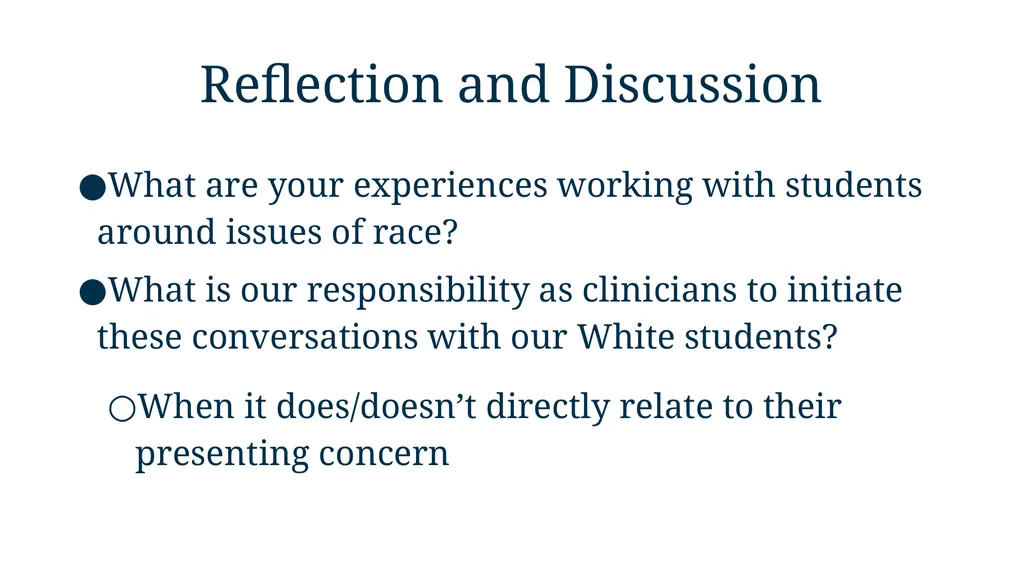
slide30. Reflection and Discussion What are your experiences working with students around issues of race?
What is our responsibility as clinicians to initiate these conversations with our White students?
When it does/doesn’t directly relate to their presenting concern<br>
(She/her/hers)
Amani Johnson, PhD
(She/her/hers)<br>
slide2. Learning Objectives 1. Apply APA guidelines in psychotherapy with regards to multicultural responsiveness in clinical work with White students and students of Color.
2. Identify the impact of intersecting identities on the therapeutic process, specifically around race, ethnicity, and culture.
3. Develop conceptualization and broaching skills that are responsive to a nuanced understanding of multiculturalism and “diversity.”<br>
slide4. Racial & Ethnocultural Responsiveness 84% of the active psychology workforce is White
(2007-16: Demographics of Psychology Workforce, APA)
Psychological research is largely based on WEIRD samples (Western/White, Educated, Industrialized, Rich, Democratic)
“Competence implies a static goal to be achieved, or an immutable personal characteristic. Responsiveness, on the other hand, implies deliberate continuous action.”
Dr. Karen Suyemoto co-chair of committee on APA Race & Ethnicity Guidelines<br>
slide5. Intersectionality Exercise (Kimberlé Crenshaw) Race
Ethnicity
Gender
Sexual Orientation
Class
Ability Status
Body Size
Age
Education
Indigenous heritage
Religion
Language
Immigration Status<br>
slide6. Invisible/Visible Identities The Identity Wheel
Identities you think about most/least often
Identities that have the strongest effect on how you see yourself as a person/therapist
What are the times that you explicitly talk about your identities with clients in therapy?<br>
slide7. Scenarios to Consider In the 4th counseling session, your client reports feeling anxious and concerned about her family. Client is a 2nd year undergraduate student in the Finance program. She identifies as a cisgender bisexual woman and is a first generation college student whose parents immigrated from Malaysia. In passing, she reported feeling anxious about the safety of her parents living in NYC, noting recent acts of violence towards her community.<br>
slide8. Reflection Questions What are some factors that may impact your conceptualization of this client from a culturally responsive perspective?
What are some ways you can provide support to this client while acknowledging the impact of cultural/systemic factors?
Describe some ways you could broach cultural factors, as they relate to the client’s presenting concerns.<br>
slide9. Broaching (Day-Vines et al., 2007) The counselor's invitation to discuss racial and cultural factors that may influence the clinical work.
What are the important aspects of your culture/identities that you’d like to discuss? This can include…..
In what ways, if any, do the identities you just talked about impact the problem you are bringing in today?
I’m ______ you’re _____.<br>
slide10. Core Tenets of Broaching (King, 2021) Broaching…
is the counselor’s responsibility
is a process that occurs on an ongoing basis
addresses dynamic and intersecting identities
occurs on multiple levels
requires flexibility<br>
slide11. Broaching (King & Borders, 2019) Recommendations for Practice are debated:
Timing of skill
Language Used
Goals of Broaching
Emphasis on similarities/differences<br>
slide12. Rhetorical Incoherence
(Bonilla-Silva, 2010) Grammatical mistakes, lengthy pauses, or repetition
Natural parts of speech that increase dramatically during the discussion of sensitive topics
Semantic Moves
Patterns of speech used to avoid difficult conversations
Fear of Making a Mistake
Discomfort with making mistakes can lead to avoidance<br>
slide13. Barriers to Broaching for White Clinicians<br>
slide14. Barriers to Broaching for Clinicians of Color<br>
slide15. Broaching & Identity Development (Day-Vines et al., 2007) Avoidant
No attempt to address cultural factors
Isolating
Superficial recognition of MC factors
Continuing/Incongruent
Recognizes culture but in a oversimplified manner
Integrated/Congruent
Consistent and nuanced recognition of MC factors
Infusing
Nuanced recognition of MC that transcends ones professional identity<br>
slide16. Scenarios to Consider You are meeting with a client after 2 sessions who reports symptoms of depression and anxiety that seem to be exacerbated by the academic setting. Client identifies as a cisgender heterosexual Black man. He is a 2nd year medical student and is one of few Black students in his cohort. Client reports feeling on-edge and unsure of himself in clinical/academic settings. As a result, he reports feeling overwhelmed with low motivation and fatigue.<br>
slide17. Reflection Questions What are some factors that may impact your conceptualization of this client from a culturally responsive perspective?
What are some ways you can provide support to this client while acknowledging the impact of cultural/systemic factors?
Describe some ways you could broach cultural factors, as they relate to the client’s presenting concerns.<br>
slide18. In-Roads for Conversations on Race Sense of Belonging on campus
Imposter’s Syndrome
Perfectionism
1st generation students
Stereotype Threat
Microaggressions (i.e. intersecting identities)
Transferable skills (tolerating discomfort)
Allyship (Conveyor Belt Analogy)<br>
slide19. Scenarios to Consider In session six of the work, your client acknowledges a desire to address gender identity concerns more directly. Client is White and identifies as Agnostic and heterosexual. They report feeling as though a non-binary identity resonates as a good fit, but note some uncertainty about how this would be perceived by family, friends, peers, and colleagues. In session, they have disclosed this to you and requested they/them pronouns. However, this is not something they have addressed with others.<br>
slide20. Reflection Questions What are some factors that may impact your conceptualization of this client from a culturally responsive perspective?
What are some ways you can provide support to this client while acknowledging the impact of cultural/systemic factors?
Describe some ways you could broach cultural factors, as they relate to the client’s presenting concerns.<br>
slide21. Thank you! Questions/Comments?<br>
slide22. References Arao, B., & Clemens, K. (2013). From safe spaces to Brave spaces. In L. M. Landreman (Ed.), The art of effective facilitation: Reflections from social justice educators (pp. 135-150). Sterling, VA: Stylus.
Bayne, H. B., & Branco, S. F. (2018). A phenomenological inquiry into counselor of color broaching experiences. Journal of Counseling & Development, 96(1), 75-85.
Bonilla-Silva, E. (2010). Racism without racists: Color-blind racism and the persistence of racial inequality in the United States. Lanham, MD: Rowman & Littlefield.
Branco, S. F., & Bayne, H. B. (2020). Carrying the burden: Counselors of color’s experiences of microaggressions in counseling. Journal of Counseling & Development, 98(3), 272-282.
Brown, A., & Sered, D. “Re-railing the Conversation on race.” Retrieved online from https://www.dvc.edu/faculty-staff/racial-justice/pdfs/Rerailing%20Race%20Talk.pdf
Cabrera, N. L., & Corces-Zimmerman, C. (2017). An unexamined life: White male racial ignorance and the agony of education for students of Color. Equity & Excellence in Education, 50(3), 300-315. doi:10.1080/10665684.2017.1336500
Day‐Vines, N. L., Wood, S. M., Grothaus, T., Craigen, L., Holman, A., Dotson‐Blake, K., & Douglass, M. J. (2007). Broaching the subjects of race, ethnicity, and culture during the counseling process. Journal of Counseling & Development, 85(4), 401-409. doi:10.1002/j.1556-6678.2007.tb00608.x
King, K. M. (2021). “I want to, but how?” Defining counselor broaching in core tenets and debated components. Journal of Multicultural Counseling & Development, 49, 87-100. doi:10.1002/jmcd.12208
King, K. M., & Borders, L. D. (2019). An experimental investigation of white counselors broaching race and racism. Journal of Counseling & Development, 97(4), 341-351. doi:10.1002/jcad.12283
Pappas, S. (2019, December). New guidance on race and ethnicity for psychologists. Monitor on Psychology, 50(11). http://www.apa.org/monitor/2019/12/ce-corner-race.html
Saad, L., (2020). Me and White Supremacy: Combat Racism, Change the World, and Become a Good Ancestor. United States: Sourcebooks.
Zhang, N., & Burkard, A. W. (2008). Client and counselor discussions of racial and ethnic differences in counseling: An exploratory investigation. Journal of Multicultural Counseling and Development, 36, 77–87. doi:10.1002/j.2161-1912.2008. tb00072.x<br>
slide23. Supplemental Slides<br>
slide28. Clinical & Personal Experiences Student response to Student of Color Support Group
Feeling Excluded
White Fragility
Privilege of Access to Spaces
Dissertation Participant
Fear of Being seen as Racist, but tolerant of racism<br>
slide29. Personalizing Interventions Work to understand how the client and their community views their presenting concern
Cultural Perceptions of Cause, Context, and Support
We often focus on differences but similarities can be helpful too (i.e. pop culture, memes, movies)
Ex. of Client Work<br>
slide30. Reflection and Discussion What are your experiences working with students around issues of race?
What is our responsibility as clinicians to initiate these conversations with our White students?
When it does/doesn’t directly relate to their presenting concern<br>