
Mule Deer Adaptive Harvest Management Deer
NS
Published · 39 slides · 0 views

1 / 1


Description
Mule Deer Adaptive Harvest Management Deer Management Goal: Manage for the long-term welfare of Montanas deer resource and provide recreational opportunities that reflect the dynamic nature of deer populations. Mule Deer Adaptive Harvest
Related Topics
Download this presentation From Below
"Mule Deer Adaptive Harvest Management Deer" is the property of its rightful owner. Permission is granted to download and print the materials on this website for personal, non-commercial use only, and to display it on your personal computer provided you do not modify the materials and that you retain all copyright notices contained in the materials. By downloading content from our website, you accept the terms of this agreement.
Share
Embed code
Presentation Transcript
01
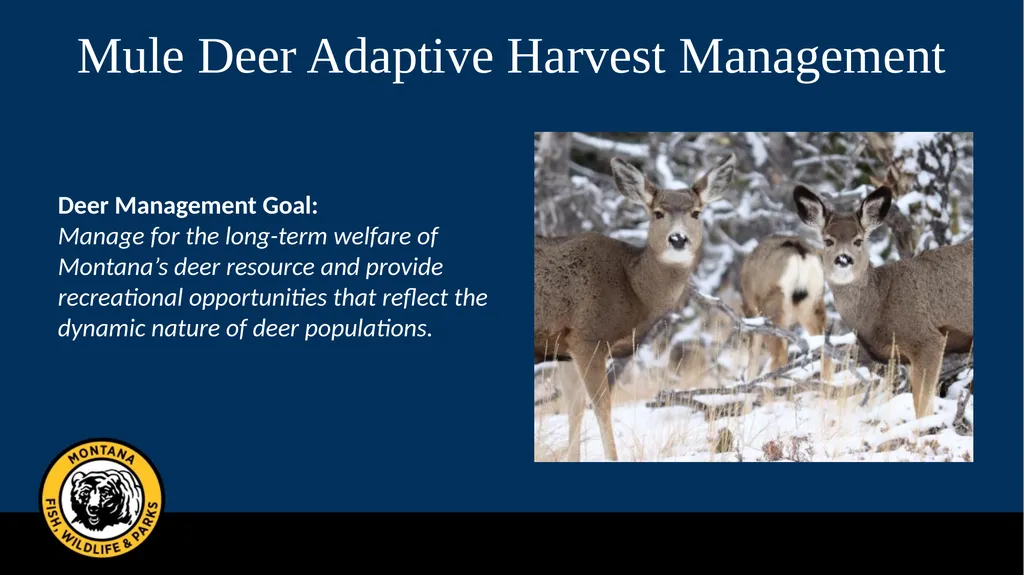
Mule Deer Adaptive Harvest Management Deer Management Goal:
Manage for the long-term welfare of Montana’s deer resource and provide recreational opportunities that reflect the dynamic nature of deer populations.<br>
Manage for the long-term welfare of Montana’s deer resource and provide recreational opportunities that reflect the dynamic nature of deer populations.<br>
02
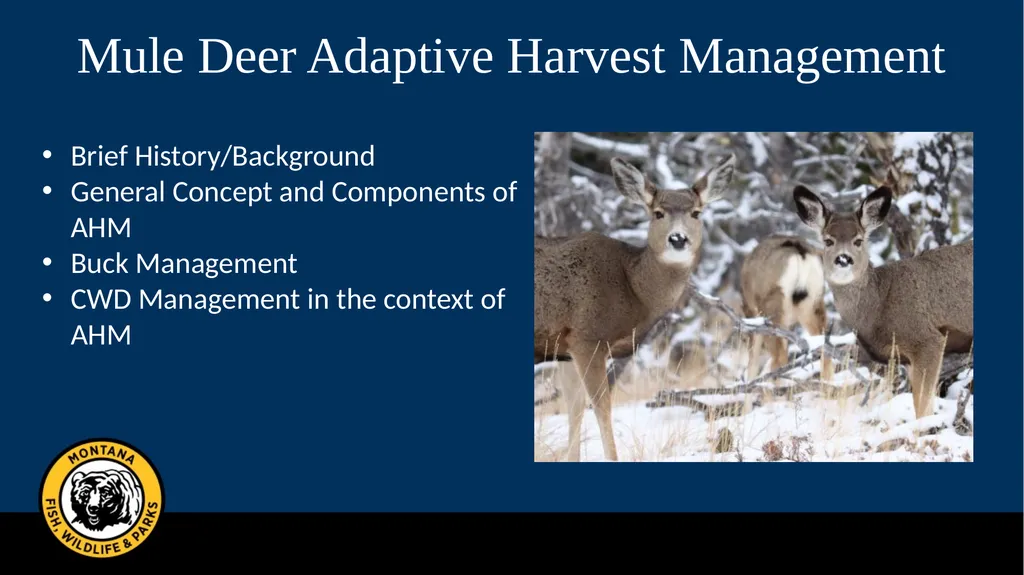
Mule Deer Adaptive Harvest Management Brief History/Background
General Concept and Components of AHM
Buck Management
CWD Management in the context of AHM<br>
General Concept and Components of AHM
Buck Management
CWD Management in the context of AHM<br>
03
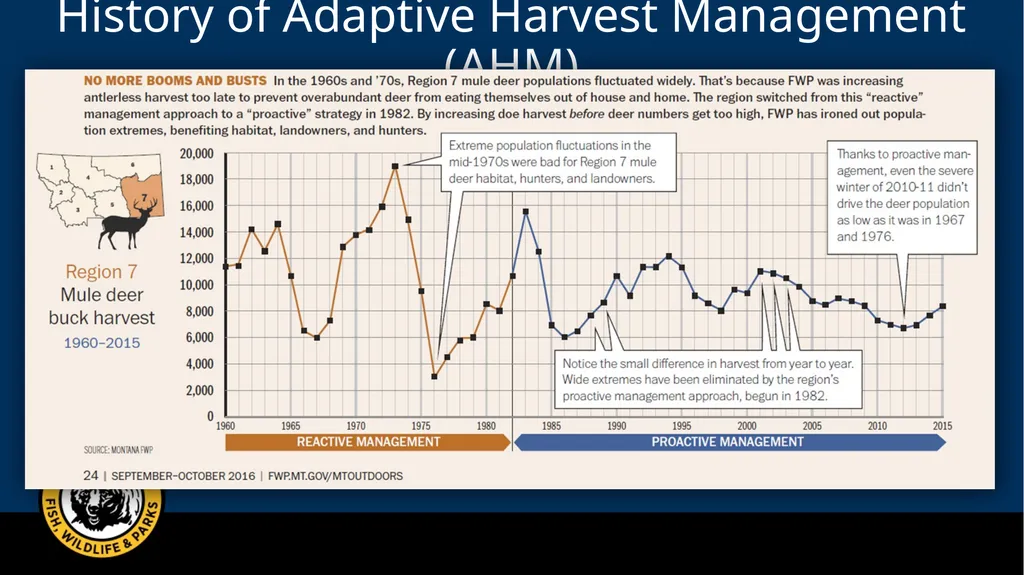
History of Adaptive Harvest Management (AHM) 1998- FWP Commission adopted Deer Management Policy
Provided basis for establishing deer
Population Objectives
Hunting Regulation Strategies
2001- Original AHM document adopted by Commission
Used guidance from Deer Management Policy
Further formalized protocols for establishing population objectives, hunter harvest management, monitoring of mule deer, etc.
2021- FWP completed/updated the current AHM document
Used the 2001 AHM plan as the base template
Updated and refined protocols for establishing population objectives, hunter harvest management, monitoring of mule deer, etc.
Important to note that all three documents reiterate the need for adaptive management and learning as deer demographics and ecological processes change in time.<br>
Provided basis for establishing deer
Population Objectives
Hunting Regulation Strategies
2001- Original AHM document adopted by Commission
Used guidance from Deer Management Policy
Further formalized protocols for establishing population objectives, hunter harvest management, monitoring of mule deer, etc.
2021- FWP completed/updated the current AHM document
Used the 2001 AHM plan as the base template
Updated and refined protocols for establishing population objectives, hunter harvest management, monitoring of mule deer, etc.
Important to note that all three documents reiterate the need for adaptive management and learning as deer demographics and ecological processes change in time.<br>
04
History of Adaptive Harvest Management (AHM) 1998- FWP Commission adopted Deer Management Policy
Provided basis for establishing deer
Population Objectives
Hunting Regulation Strategies
2001- Original AHM document adopted by Commission
Used guidance from Deer Management Policy
Further formalized protocols for establishing population objectives, hunter harvest management, monitoring of mule deer, etc.
2021- FWP completed/updated the current AHM document
Used the 2001 AHM plan as the base template
Updated and refined protocols for establishing population objectives, hunter harvest management, monitoring of mule deer, etc.
Important to note that all three documents reiterate the need for adaptive management and learning as deer demographics and ecological processes change in time.<br>
Provided basis for establishing deer
Population Objectives
Hunting Regulation Strategies
2001- Original AHM document adopted by Commission
Used guidance from Deer Management Policy
Further formalized protocols for establishing population objectives, hunter harvest management, monitoring of mule deer, etc.
2021- FWP completed/updated the current AHM document
Used the 2001 AHM plan as the base template
Updated and refined protocols for establishing population objectives, hunter harvest management, monitoring of mule deer, etc.
Important to note that all three documents reiterate the need for adaptive management and learning as deer demographics and ecological processes change in time.<br>
05
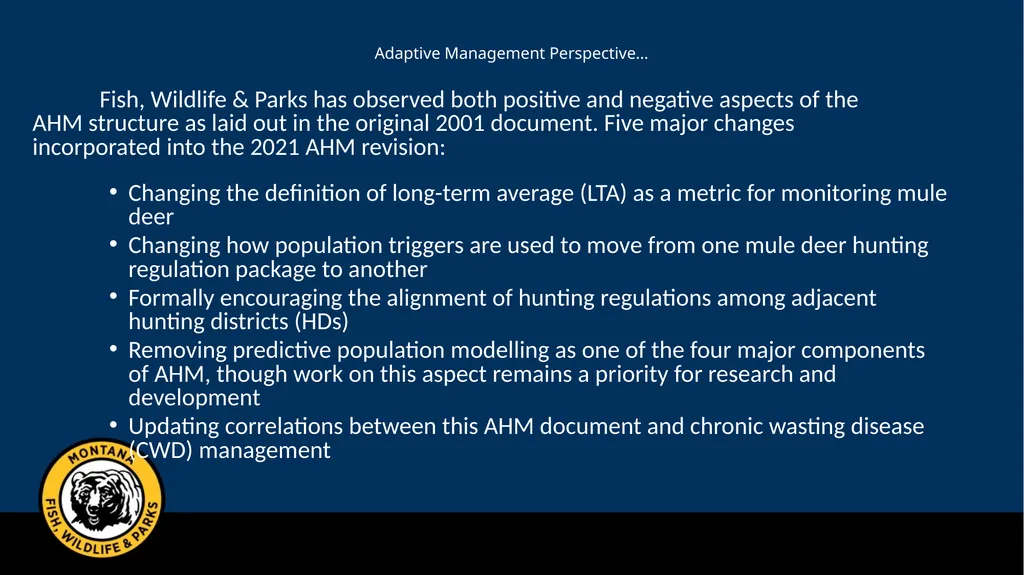
Adaptive Management Perspective… Fish, Wildlife & Parks has observed both positive and negative aspects of the AHM structure as laid out in the original 2001 document. Five major changes incorporated into the 2021 AHM revision:
Changing the definition of long-term average (LTA) as a metric for monitoring mule deer
Changing how population triggers are used to move from one mule deer hunting regulation package to another
Formally encouraging the alignment of hunting regulations among adjacent hunting districts (HDs)
Removing predictive population modelling as one of the four major components of AHM, though work on this aspect remains a priority for research and development
Updating correlations between this AHM document and chronic wasting disease (CWD) management<br>
Changing the definition of long-term average (LTA) as a metric for monitoring mule deer
Changing how population triggers are used to move from one mule deer hunting regulation package to another
Formally encouraging the alignment of hunting regulations among adjacent hunting districts (HDs)
Removing predictive population modelling as one of the four major components of AHM, though work on this aspect remains a priority for research and development
Updating correlations between this AHM document and chronic wasting disease (CWD) management<br>
06
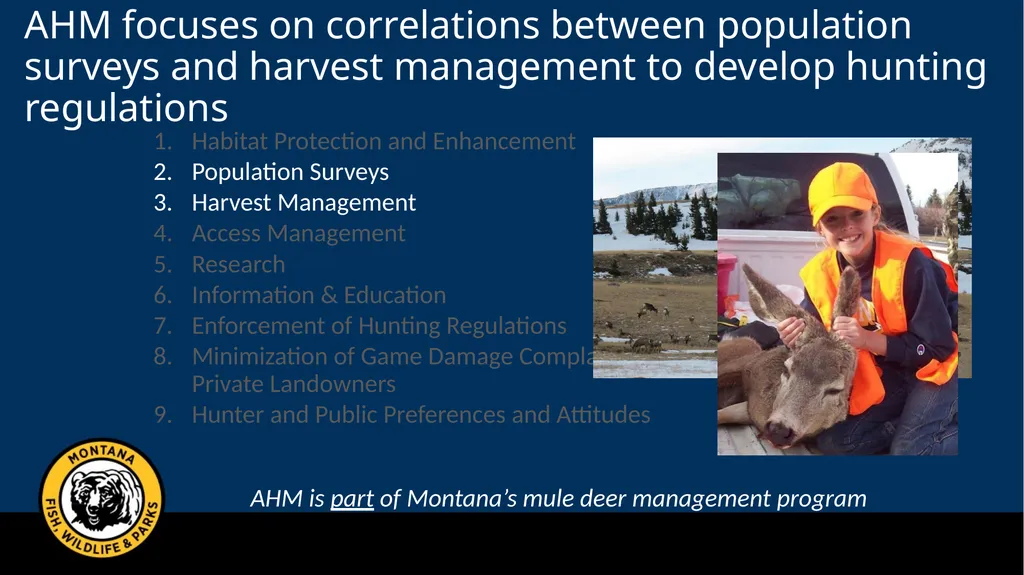
Montana’s mule deer management program integrates the following elements: Habitat Protection and Enhancement
Population Surveys
Harvest Management
Access Management
Research
Information & Education
Enforcement of Hunting Regulations
Minimization of Game Damage Complaints from Private Landowners
Hunter and Public Preferences and Attitudes<br>
Population Surveys
Harvest Management
Access Management
Research
Information & Education
Enforcement of Hunting Regulations
Minimization of Game Damage Complaints from Private Landowners
Hunter and Public Preferences and Attitudes<br>
07
AHM focuses on correlations between population surveys and harvest management to develop hunting regulations Habitat Protection and Enhancement
Population Surveys
Harvest Management
Access Management
Research
Information & Education
Enforcement of Hunting Regulations
Minimization of Game Damage Complaints from Private Landowners
Hunter and Public Preferences and Attitudes AHM is part of Montana’s mule deer management program<br>
Population Surveys
Harvest Management
Access Management
Research
Information & Education
Enforcement of Hunting Regulations
Minimization of Game Damage Complaints from Private Landowners
Hunter and Public Preferences and Attitudes AHM is part of Montana’s mule deer management program<br>
08
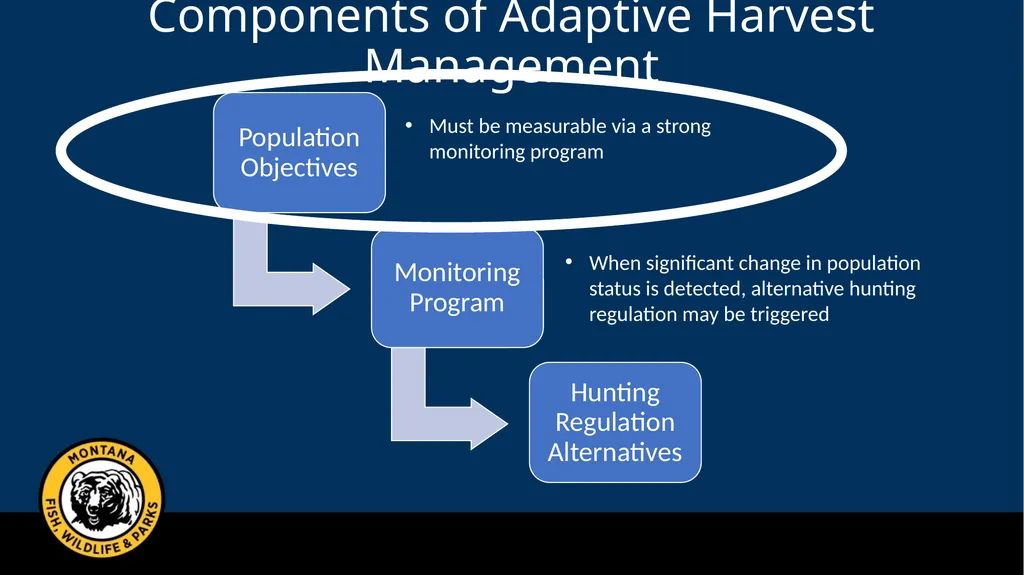
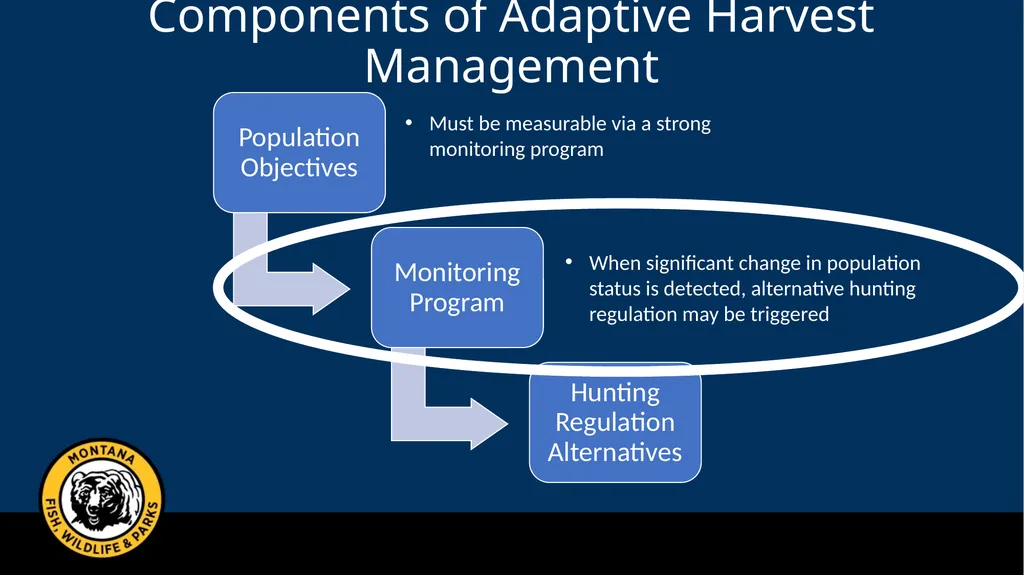
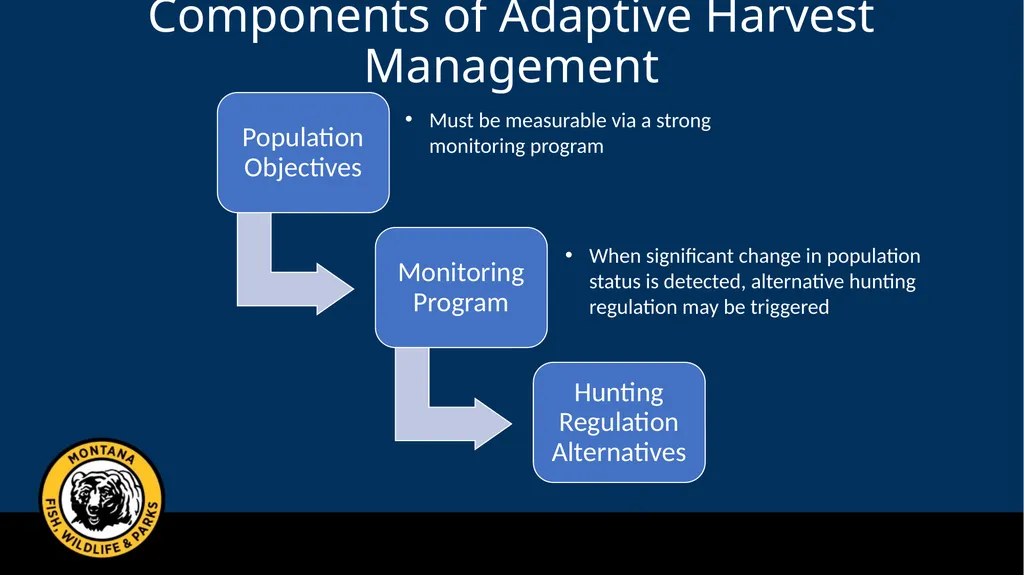
Must be measurable via a strong monitoring program When significant change in population status is detected, alternative hunting regulation may be triggered Components of Adaptive Harvest Management<br>
09
Mule Deer Population Objectives and
Monitoring Program Objectives defined for groups of hunting districts known as Population Management Units (PMUs)<br>
10
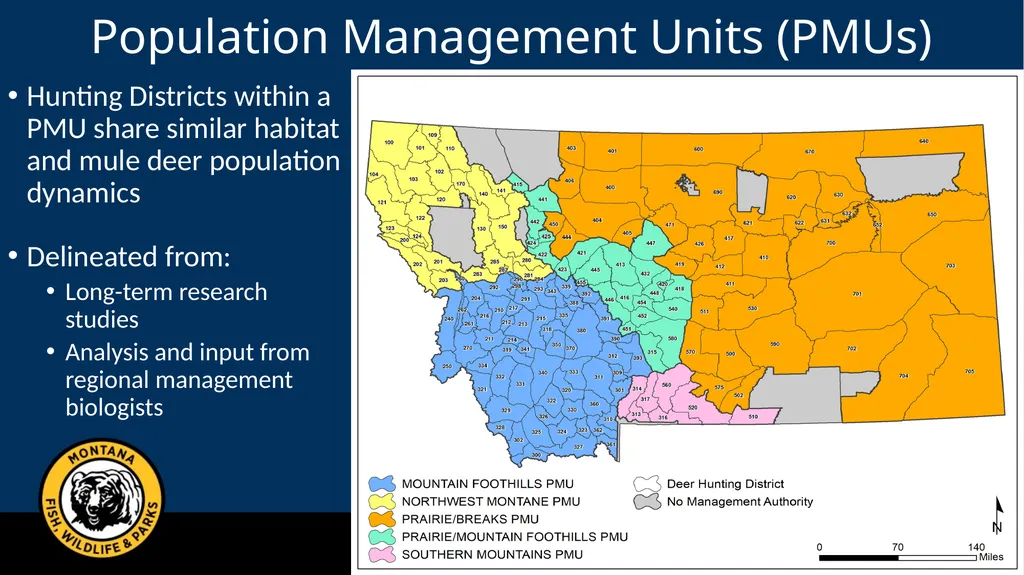
Population Management Units (PMUs) Hunting Districts within a PMU share similar habitat and mule deer population dynamics
Delineated from:
Long-term research studies
Analysis and input from regional management biologists<br>
Delineated from:
Long-term research studies
Analysis and input from regional management biologists<br>
11
Mule Deer Population Objectives and
Monitoring Program Objectives defined for groups of hunting districts known as Population Management Units (PMUs)
Objectives and hunting regulations listed for each PMU are largely determined by characteristics of the population and the potential for hunter harvest<br>
Objectives and hunting regulations listed for each PMU are largely determined by characteristics of the population and the potential for hunter harvest<br>
12
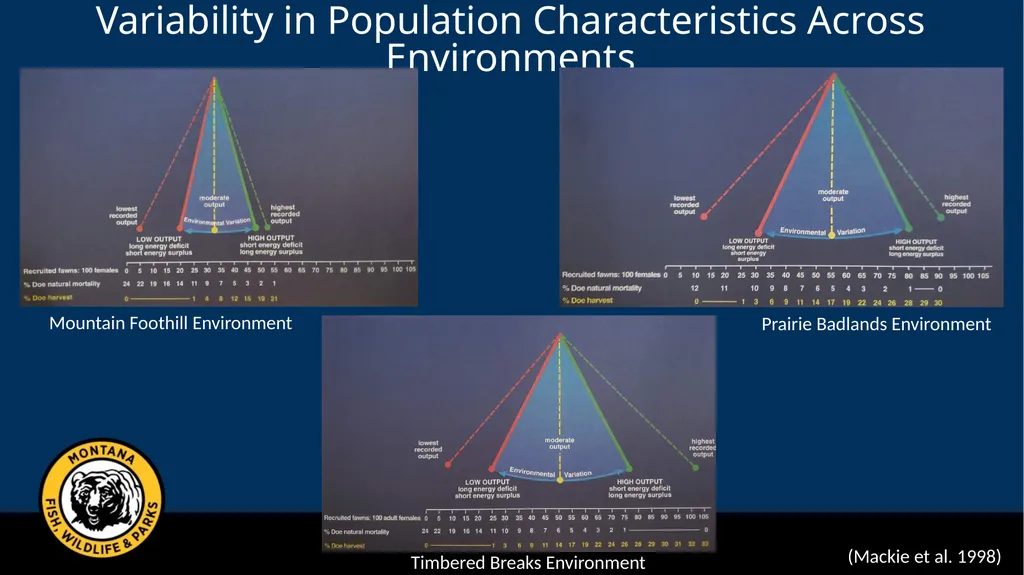
Variability in Population Characteristics Across Environments Mountain Foothill Environment Timbered Breaks Environment Prairie Badlands Environment (Mackie et al. 1998)<br>
13
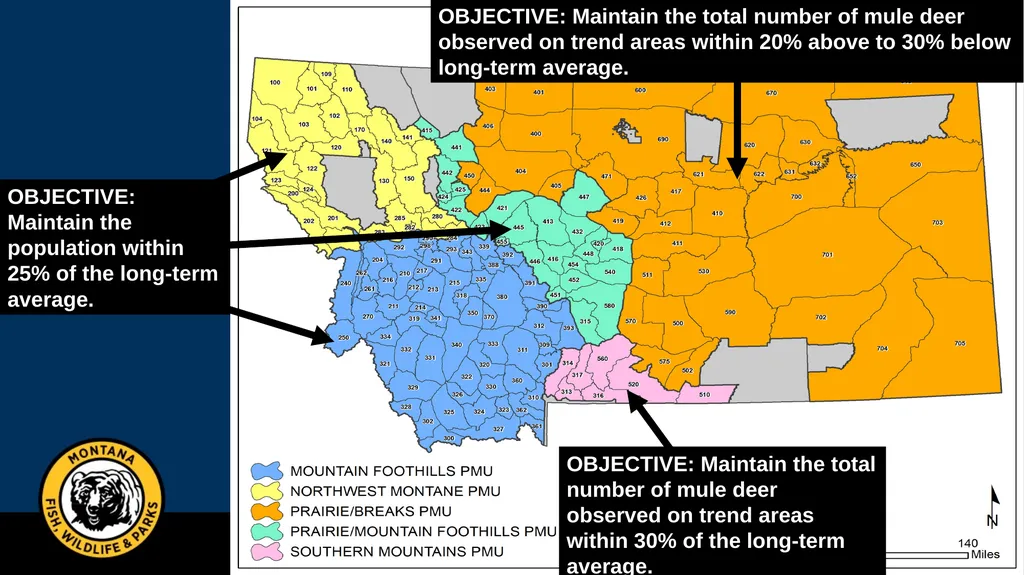
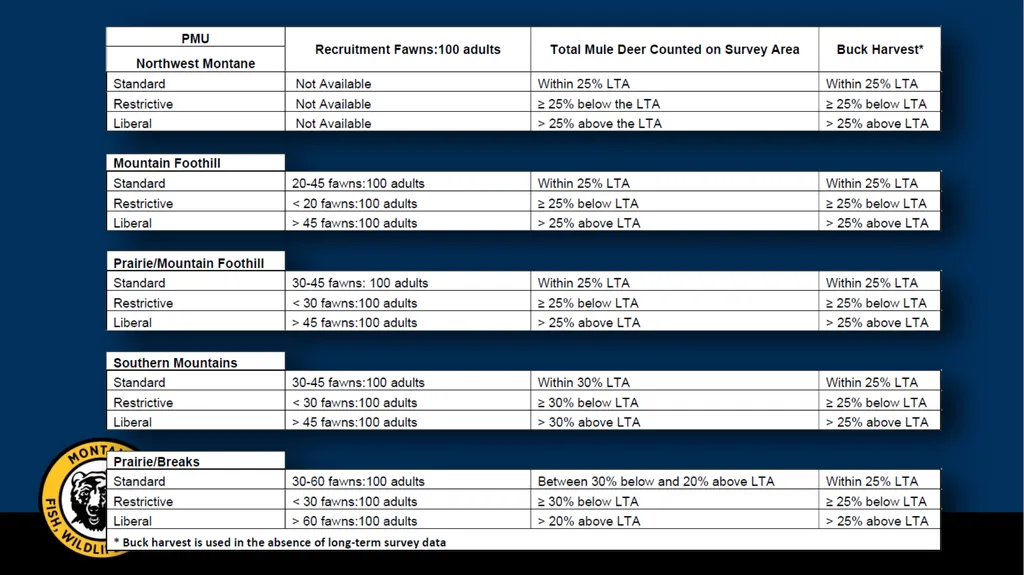
Objective: Maintain the population within 25% of the long-term average. Objective: Maintain the total number of mule deer observed on trend areas within 20% above to 30% below long-term average. Objective: Maintain the total number of mule deer observed on trend areas within 30% of the long-term average.<br>
14
Must be measurable via a strong monitoring program When significant change in population status is detected, alternative hunting regulation may be triggered Components of Adaptive Harvest Management<br>
15
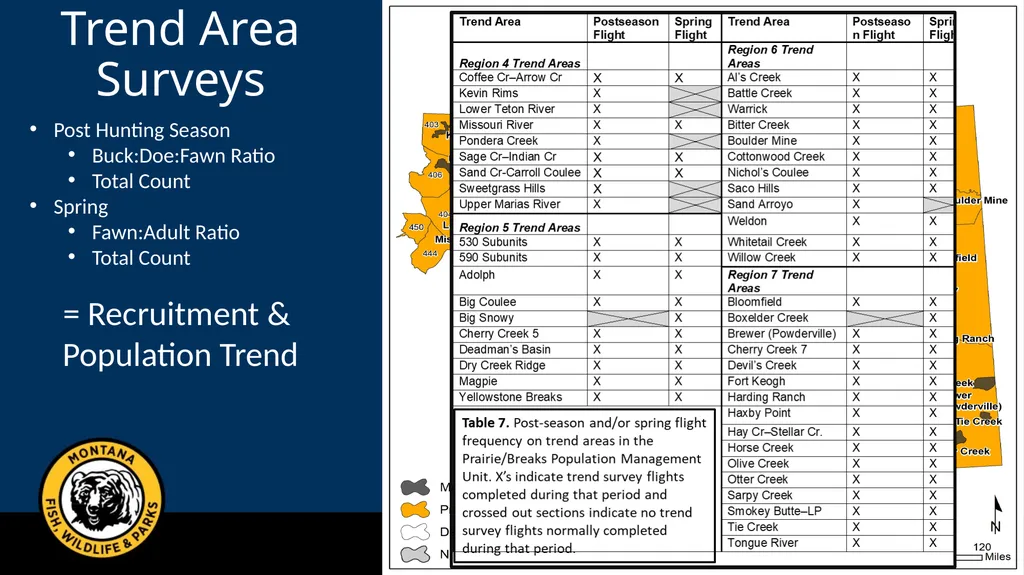
Trend Area Surveys Post Hunting Season
Buck:Doe:Fawn Ratio
Total Count
Spring
Fawn:Adult Ratio
Total Count = Recruitment &
Population Trend<br>
Buck:Doe:Fawn Ratio
Total Count
Spring
Fawn:Adult Ratio
Total Count = Recruitment &
Population Trend<br>
16
Areas Where Surveys are Unfeasible… Buck Harvest Rates Deer demographic trends on some trend areas are less reliable indices of population size
Aerial surveys are unfeasible due to habitat type (e.g., dense forests)
Total counts on trend areas vary widely because of factors unrelated to population size
example: migratory mule deer that may or may not be on the trend area at the time of survey
Buck harvest (on general deer license) can be a reliable indicator of overall population trend (correlated to recruitment)
Buck harvest may be used in conjunction with trend survey data to recommend hunting regulations<br>
Aerial surveys are unfeasible due to habitat type (e.g., dense forests)
Total counts on trend areas vary widely because of factors unrelated to population size
example: migratory mule deer that may or may not be on the trend area at the time of survey
Buck harvest (on general deer license) can be a reliable indicator of overall population trend (correlated to recruitment)
Buck harvest may be used in conjunction with trend survey data to recommend hunting regulations<br>
17
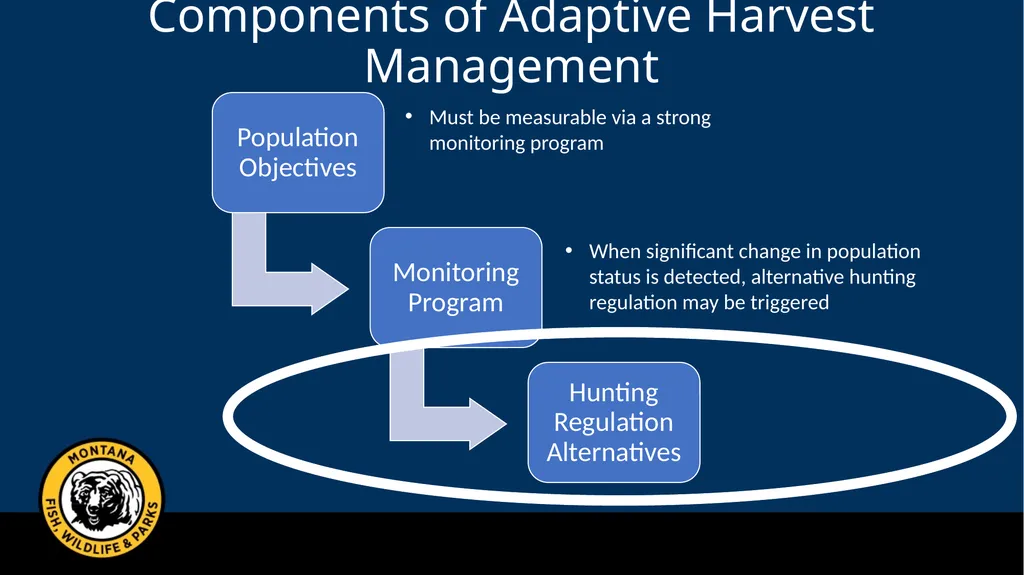
Must be measurable via a strong monitoring program When significant change in population status is detected, alternative hunting regulation may be triggered Components of Adaptive Harvest Management<br>
18
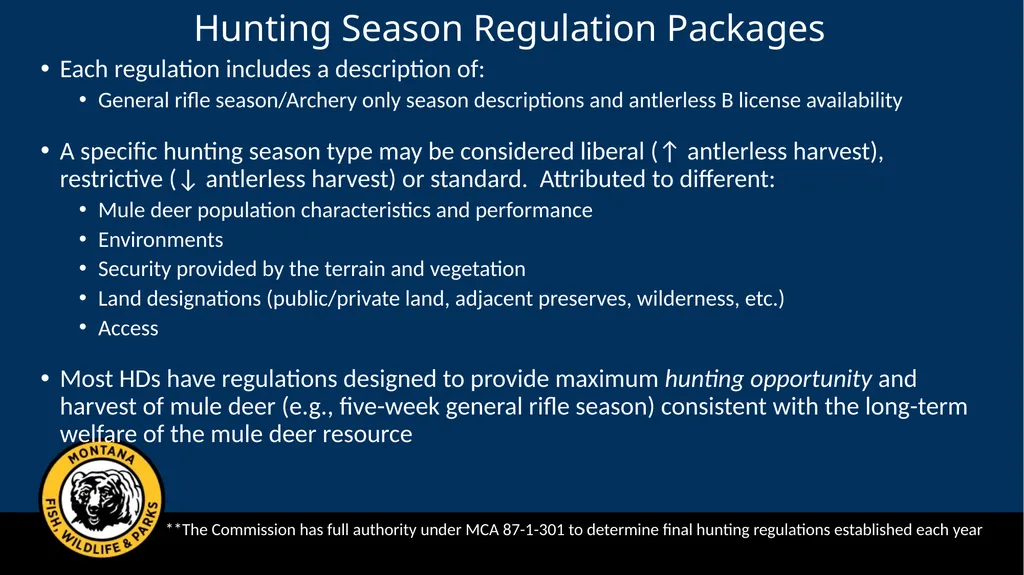
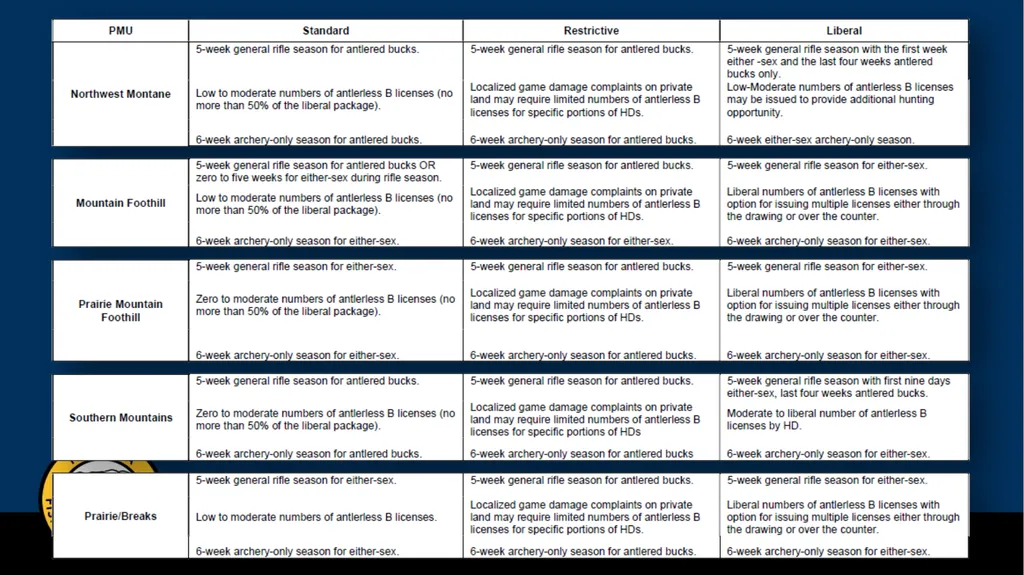
Hunting Season Regulation Packages Each regulation includes a description of:
General rifle season/Archery only season descriptions and antlerless B license availability
A specific hunting season type may be considered liberal (↑ antlerless harvest), restrictive (↓ antlerless harvest) or standard. Attributed to different:
Mule deer population characteristics and performance
Environments
Security provided by the terrain and vegetation
Land designations (public/private land, adjacent preserves, wilderness, etc.)
Access
Most HDs have regulations designed to provide maximum hunting opportunity and harvest of mule deer (e.g., five-week general rifle season) consistent with the long-term welfare of the mule deer resource **The Commission has full authority under MCA 87-1-301 to determine final hunting regulations established each year<br>
General rifle season/Archery only season descriptions and antlerless B license availability
A specific hunting season type may be considered liberal (↑ antlerless harvest), restrictive (↓ antlerless harvest) or standard. Attributed to different:
Mule deer population characteristics and performance
Environments
Security provided by the terrain and vegetation
Land designations (public/private land, adjacent preserves, wilderness, etc.)
Access
Most HDs have regulations designed to provide maximum hunting opportunity and harvest of mule deer (e.g., five-week general rifle season) consistent with the long-term welfare of the mule deer resource **The Commission has full authority under MCA 87-1-301 to determine final hunting regulations established each year<br>
19
Must be measurable via a strong monitoring program When significant change in population status is detected, alternative hunting regulation may be triggered Components of Adaptive Harvest Management<br>
20
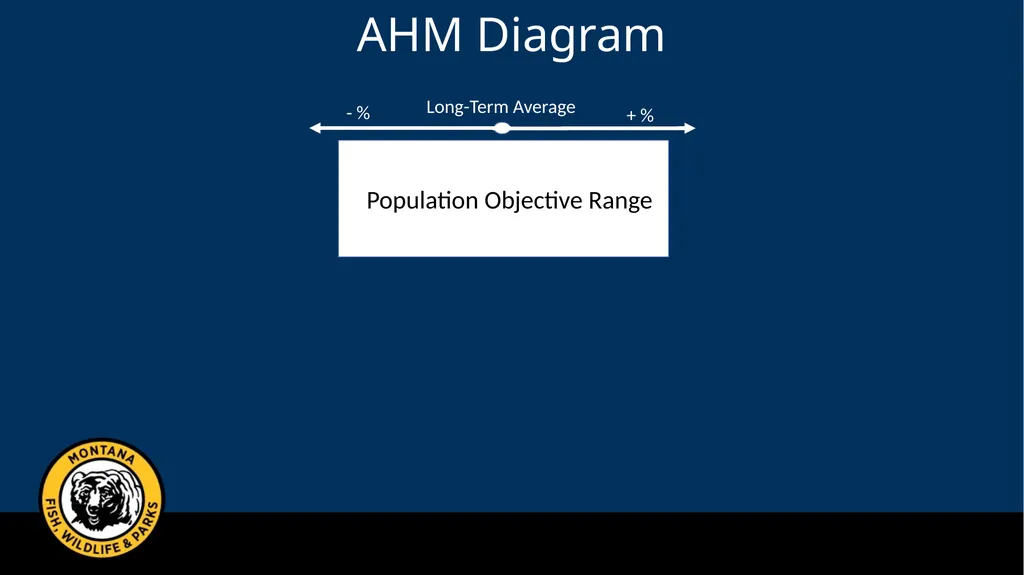
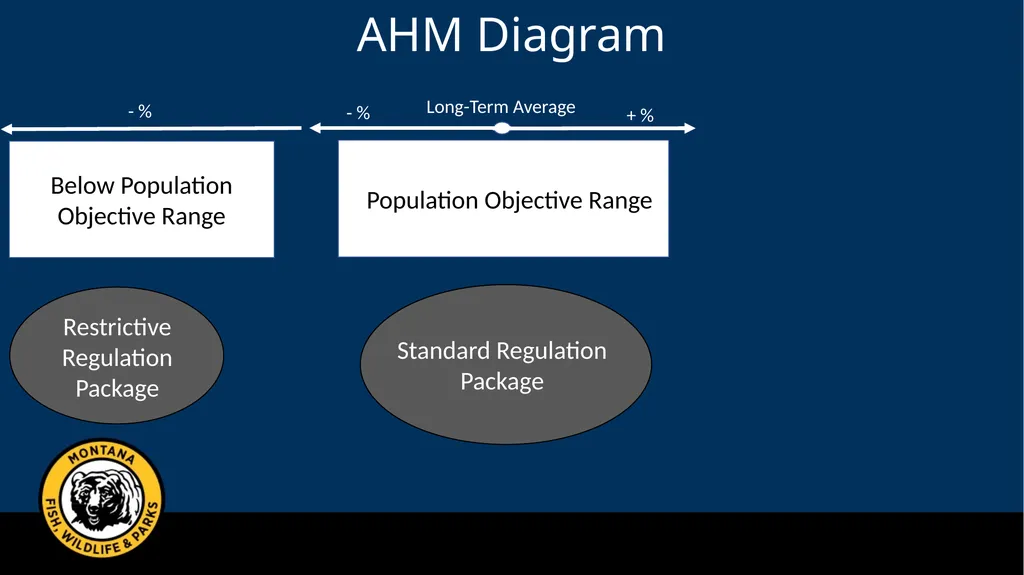
Long-Term Average + % - % AHM Diagram Population Objective Range<br>
21
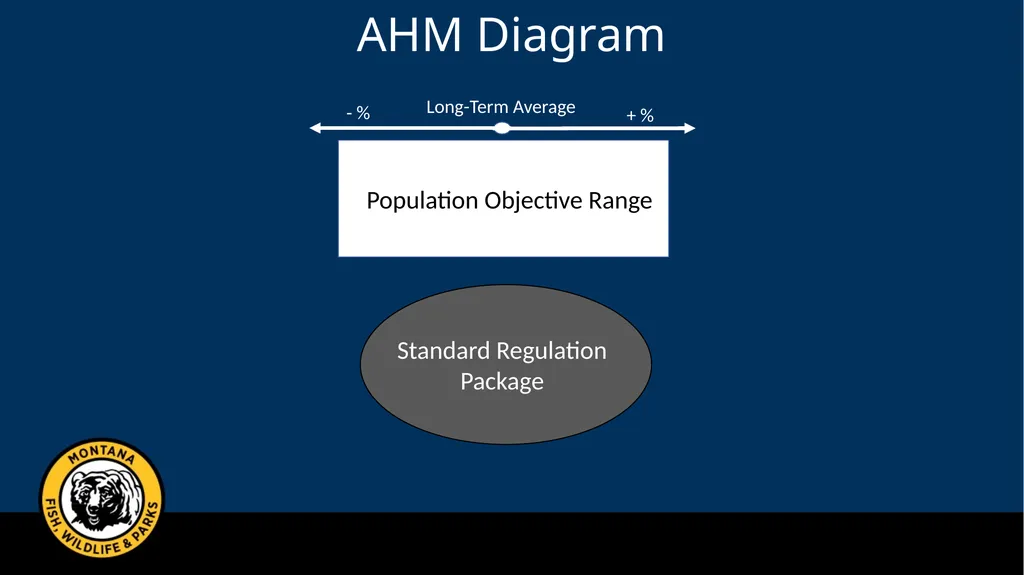
Long-Term Average + % - % Population Objective Range Standard Regulation Package AHM Diagram<br>
22
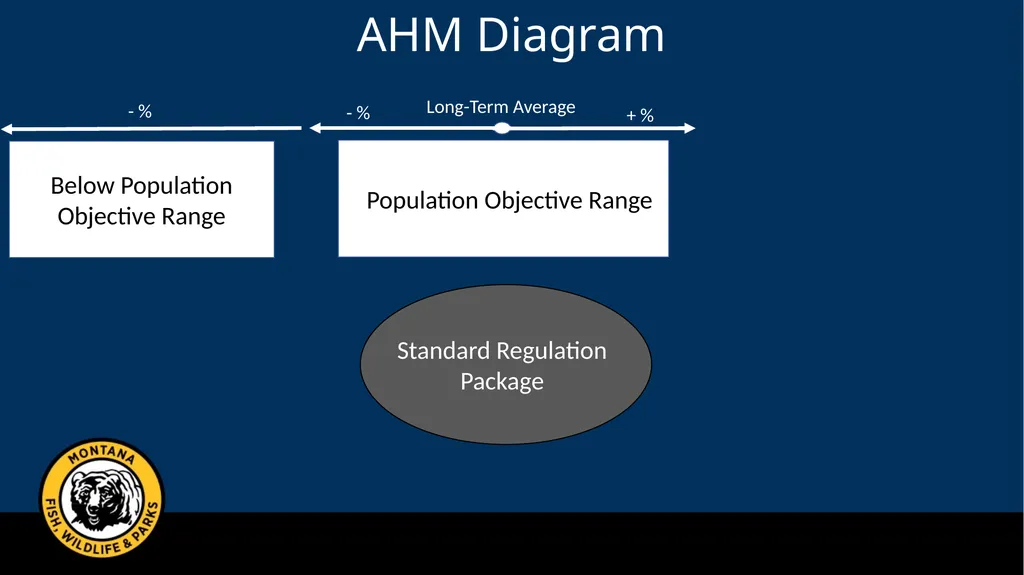
Long-Term Average + % - % Population Objective Range Below Population Objective Range - % AHM Diagram Standard Regulation Package<br>
23
Long-Term Average + % - % Population Objective Range Below Population Objective Range Standard Regulation Package Restrictive Regulation Package - % AHM Diagram<br>
24
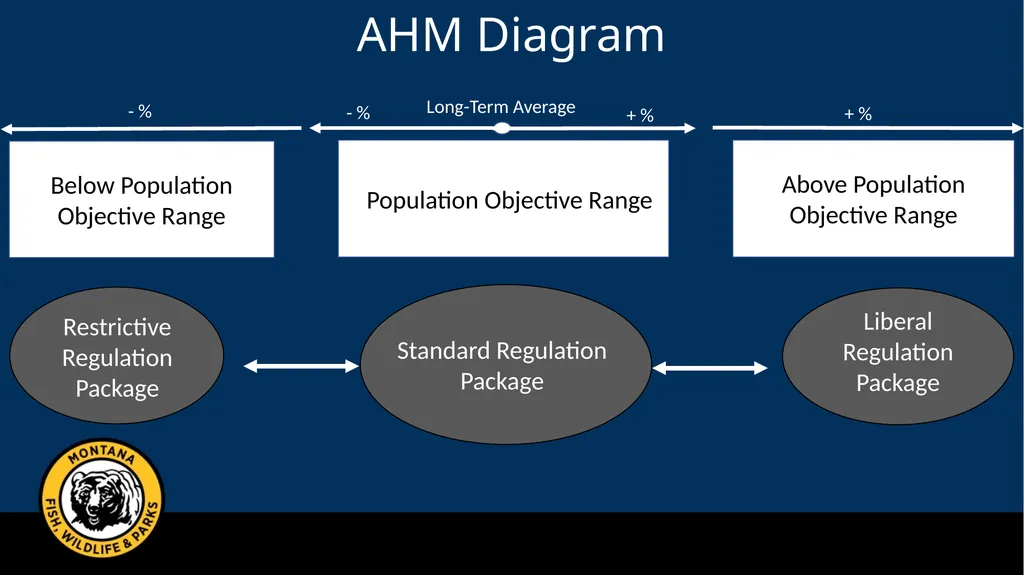
Long-Term Average + % - % Population Objective Range Above Population Objective Range Below Population Objective Range Standard Regulation Package Liberal Regulation Package Restrictive Regulation Package + % - % AHM Diagram<br>
25
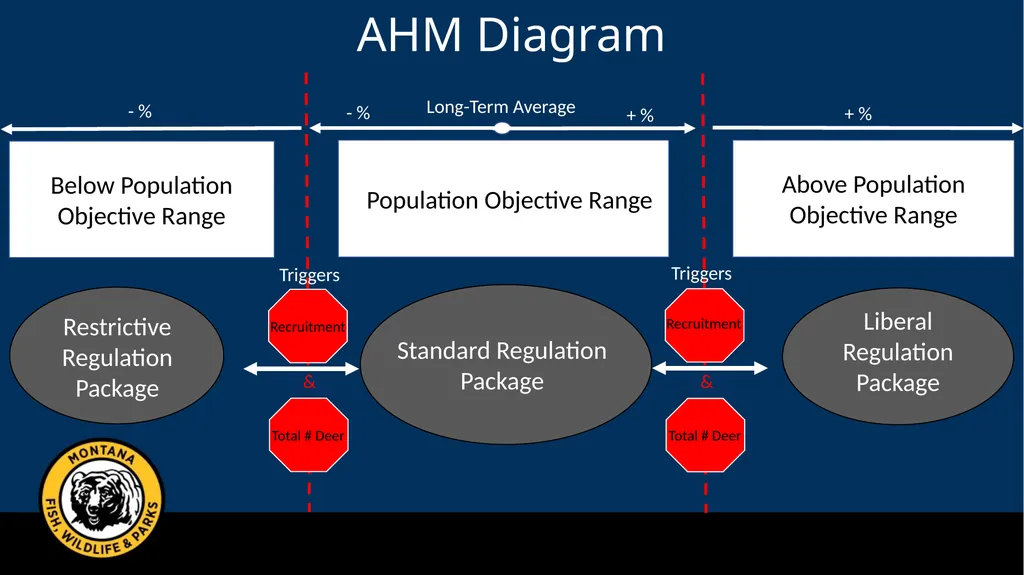
Long-Term Average + % - % Population Objective Range Above Population Objective Range Below Population Objective Range Standard Regulation Package Liberal Regulation Package Restrictive Regulation Package + % - % Recruitment Total # Deer Recruitment Total # Deer Triggers Triggers & & AHM Diagram<br>
26
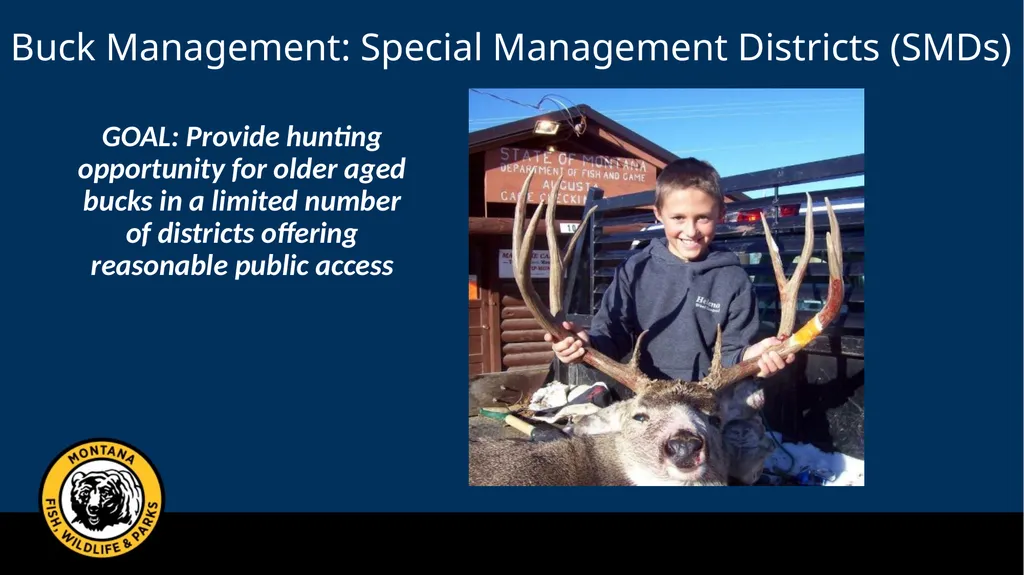
Buck Management: Special Management Districts (SMDs) GOAL: Provide hunting opportunity for older aged bucks in a limited number of districts offering reasonable public access<br>
27
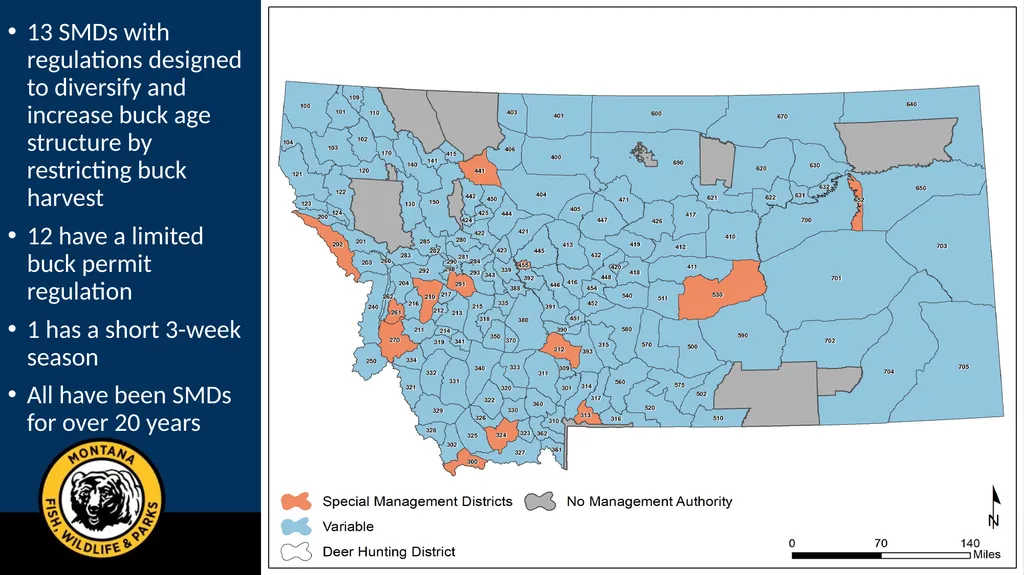
13 SMDs with regulations designed to diversify and increase buck age structure by restricting buck harvest
12 have a limited buck permit regulation
1 has a short 3-week season
All have been SMDs for over 20 years<br>
12 have a limited buck permit regulation
1 has a short 3-week season
All have been SMDs for over 20 years<br>
28
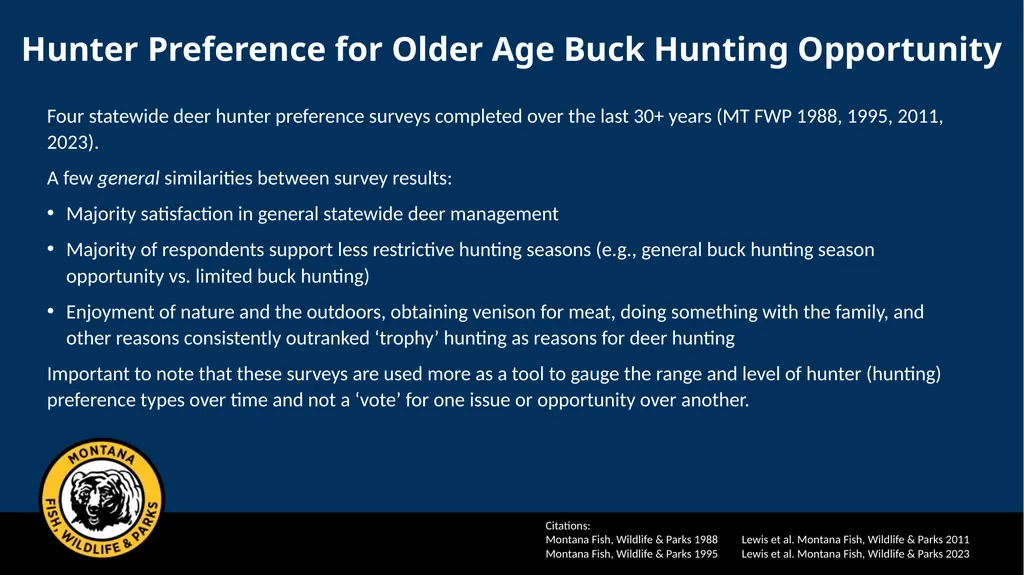
Hunter Preference for Older Age Buck Hunting Opportunity Four statewide deer hunter preference surveys completed over the last 30+ years (MT FWP 1988, 1995, 2011, 2023).
A few general similarities between survey results:
Majority satisfaction in general statewide deer management
Majority of respondents support less restrictive hunting seasons (e.g., general buck hunting season opportunity vs. limited buck hunting)
Enjoyment of nature and the outdoors, obtaining venison for meat, doing something with the family, and other reasons consistently outranked ‘trophy’ hunting as reasons for deer hunting
Important to note that these surveys are used more as a tool to gauge the range and level of hunter (hunting) preference types over time and not a ‘vote’ for one issue or opportunity over another. Citations:
Montana Fish, Wildlife & Parks 1988 Lewis et al. Montana Fish, Wildlife & Parks 2011
Montana Fish, Wildlife & Parks 1995 Lewis et al. Montana Fish, Wildlife & Parks 2023<br>
A few general similarities between survey results:
Majority satisfaction in general statewide deer management
Majority of respondents support less restrictive hunting seasons (e.g., general buck hunting season opportunity vs. limited buck hunting)
Enjoyment of nature and the outdoors, obtaining venison for meat, doing something with the family, and other reasons consistently outranked ‘trophy’ hunting as reasons for deer hunting
Important to note that these surveys are used more as a tool to gauge the range and level of hunter (hunting) preference types over time and not a ‘vote’ for one issue or opportunity over another. Citations:
Montana Fish, Wildlife & Parks 1988 Lewis et al. Montana Fish, Wildlife & Parks 2011
Montana Fish, Wildlife & Parks 1995 Lewis et al. Montana Fish, Wildlife & Parks 2023<br>
29
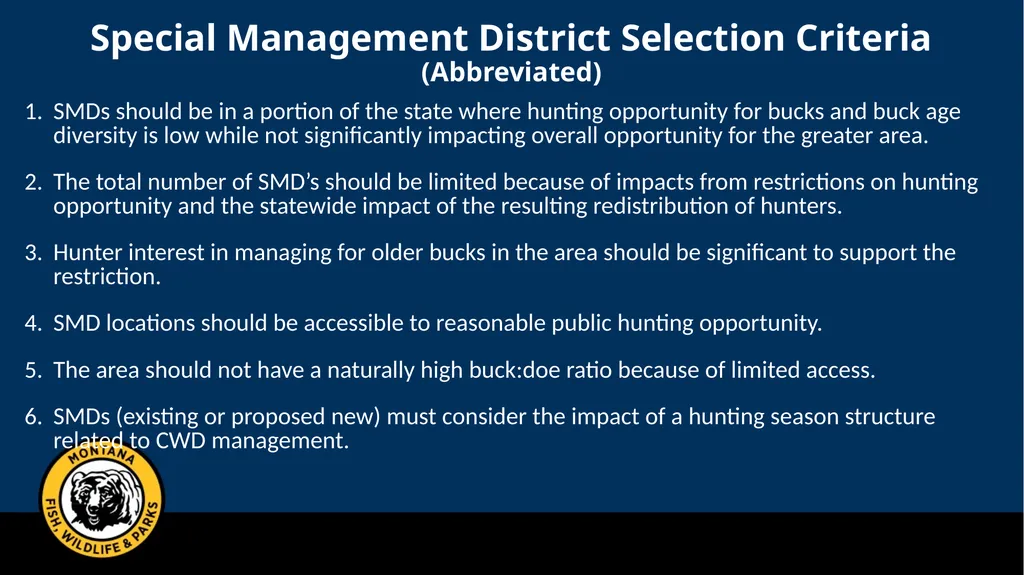
Special Management District Selection Criteria
(Abbreviated) SMDs should be in a portion of the state where hunting opportunity for bucks and buck age diversity is low while not significantly impacting overall opportunity for the greater area.
The total number of SMD’s should be limited because of impacts from restrictions on hunting opportunity and the statewide impact of the resulting redistribution of hunters.
Hunter interest in managing for older bucks in the area should be significant to support the restriction.
SMD locations should be accessible to reasonable public hunting opportunity.
The area should not have a naturally high buck:doe ratio because of limited access.
SMDs (existing or proposed new) must consider the impact of a hunting season structure related to CWD management.<br>
The total number of SMD’s should be limited because of impacts from restrictions on hunting opportunity and the statewide impact of the resulting redistribution of hunters.
Hunter interest in managing for older bucks in the area should be significant to support the restriction.
SMD locations should be accessible to reasonable public hunting opportunity.
The area should not have a naturally high buck:doe ratio because of limited access.
SMDs (existing or proposed new) must consider the impact of a hunting season structure related to CWD management.<br>
30
Buck Management: Special Management Districts (SMDs) *Special management districts are not the same as HDs where the buck regulation has changed to limited or unlimited buck permits due to other deer management/demographic and/or human social interests (improve buck:doe ratios, controlling hunter numbers, CWD, etc.). GOAL: Provide hunting opportunity for older aged bucks in a limited number of districts offering reasonable public access<br>
31
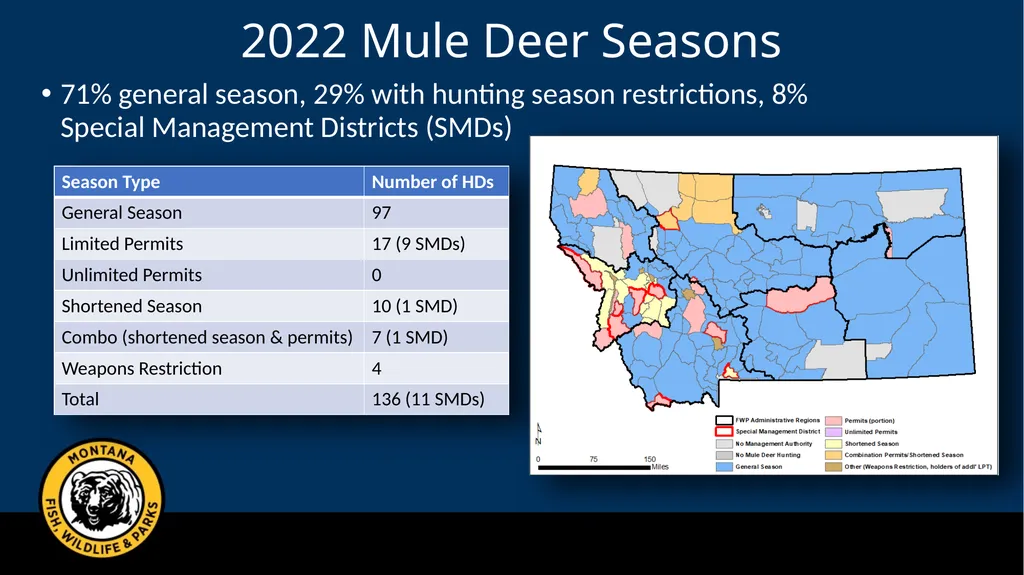
2022 Mule Deer Seasons 71% general season, 29% with hunting season restrictions, 8% Special Management Districts (SMDs)<br>
32
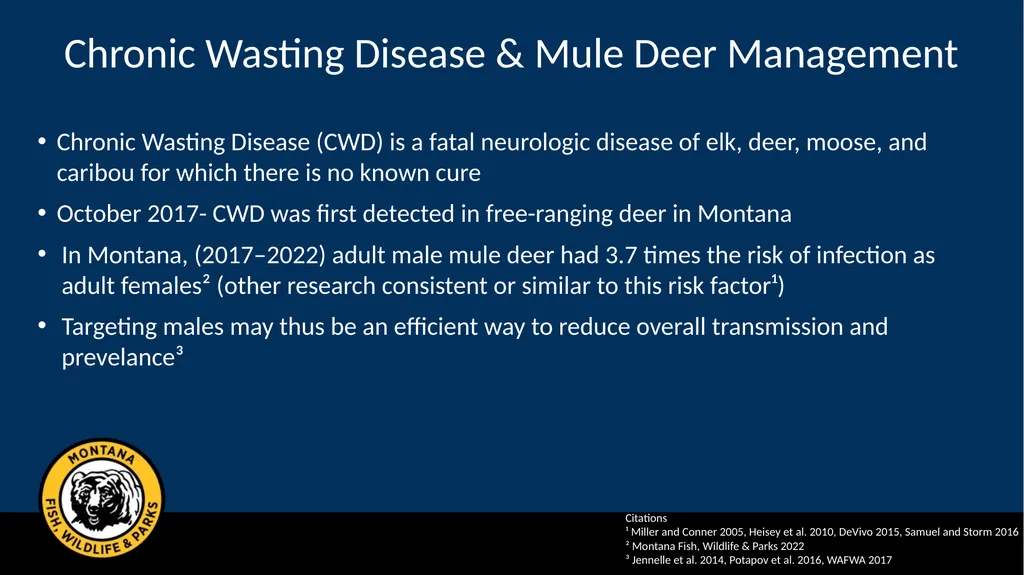
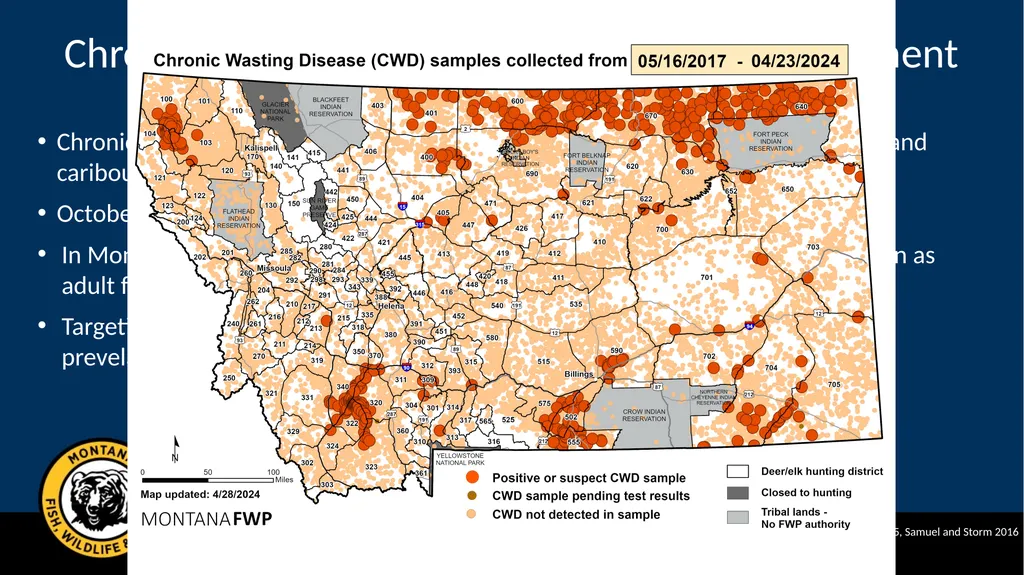
Chronic Wasting Disease & Mule Deer Management Chronic Wasting Disease (CWD) is a fatal neurologic disease of elk, deer, moose, and caribou for which there is no known cure
October 2017- CWD was first detected in free-ranging deer in Montana
In Montana, (2017‒2022) adult male mule deer had 3.7 times the risk of infection as adult females² (other research consistent or similar to this risk factor¹)
Targeting males may thus be an efficient way to reduce overall transmission and prevelance³ Citations
¹ Miller and Conner 2005, Heisey et al. 2010, DeVivo 2015, Samuel and Storm 2016
² Montana Fish, Wildlife & Parks 2022
³ Jennelle et al. 2014, Potapov et al. 2016, WAFWA 2017<br>
October 2017- CWD was first detected in free-ranging deer in Montana
In Montana, (2017‒2022) adult male mule deer had 3.7 times the risk of infection as adult females² (other research consistent or similar to this risk factor¹)
Targeting males may thus be an efficient way to reduce overall transmission and prevelance³ Citations
¹ Miller and Conner 2005, Heisey et al. 2010, DeVivo 2015, Samuel and Storm 2016
² Montana Fish, Wildlife & Parks 2022
³ Jennelle et al. 2014, Potapov et al. 2016, WAFWA 2017<br>
33
Chronic Wasting Disease & Mule Deer Management Chronic Wasting Disease (CWD) is a fatal neurologic disease of elk, deer, moose, and caribou for which there is no known cure
October 2017- CWD was first detected in free-ranging deer in Montana
In Montana, (2017‒2022) adult male mule deer had 3.7 times the risk of infection as adult females² (other research consistent or similar to this risk factor¹)
Targeting males may thus be an efficient way to reduce overall transmission and prevelance³ Citations
¹ Miller and Conner 2005, Heisey et al. 2010, DeVivo 2015, Samuel and Storm 2016
² Montana Fish, Wildlife & Parks 2022
³ Jennelle et al. 2014, Potapov et al. 2016, WAFWA 2017<br>
October 2017- CWD was first detected in free-ranging deer in Montana
In Montana, (2017‒2022) adult male mule deer had 3.7 times the risk of infection as adult females² (other research consistent or similar to this risk factor¹)
Targeting males may thus be an efficient way to reduce overall transmission and prevelance³ Citations
¹ Miller and Conner 2005, Heisey et al. 2010, DeVivo 2015, Samuel and Storm 2016
² Montana Fish, Wildlife & Parks 2022
³ Jennelle et al. 2014, Potapov et al. 2016, WAFWA 2017<br>
34
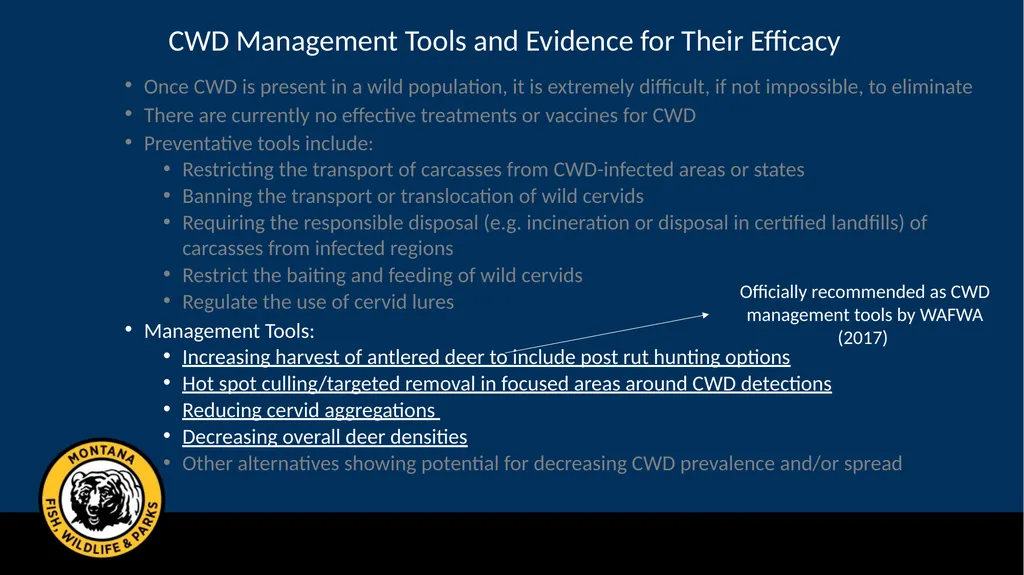
CWD Management Tools and Evidence for Their Efficacy Once CWD is present in a wild population, it is extremely difficult, if not impossible, to eliminate
There are currently no effective treatments or vaccines for CWD
Preventative tools include:
Restricting the transport of carcasses from CWD-infected areas or states
Banning the transport or translocation of wild cervids
Requiring the responsible disposal (e.g. incineration or disposal in certified landfills) of carcasses from infected regions
Restrict the baiting and feeding of wild cervids
Regulate the use of cervid lures
Management Tools:
Increasing harvest of antlered deer to include post rut hunting options
Hot spot culling/targeted removal in focused areas around CWD detections
Reducing cervid aggregations
Decreasing overall deer densities
Other alternatives showing potential for decreasing CWD prevalence and/or spread Officially recommended as CWD management tools by WAFWA (2017)<br>
There are currently no effective treatments or vaccines for CWD
Preventative tools include:
Restricting the transport of carcasses from CWD-infected areas or states
Banning the transport or translocation of wild cervids
Requiring the responsible disposal (e.g. incineration or disposal in certified landfills) of carcasses from infected regions
Restrict the baiting and feeding of wild cervids
Regulate the use of cervid lures
Management Tools:
Increasing harvest of antlered deer to include post rut hunting options
Hot spot culling/targeted removal in focused areas around CWD detections
Reducing cervid aggregations
Decreasing overall deer densities
Other alternatives showing potential for decreasing CWD prevalence and/or spread Officially recommended as CWD management tools by WAFWA (2017)<br>
35
Management of CWD in the Context of AHM The Montana Chronic Wasting Disease Management Plan will serve as the guiding principles and strategies in management of CWD
Regardless of prevalence, any detection of CWD needs to be addressed through active management (e.g., increased antlered buck harvest, hot spot culling, reduce aggregations, etc. – WAFWA recommended CWD management tools)
CWD management generally exceeds AHM management and the goal of CWD management is reduce the potential for negative population level effects, i.e. reduce potential for increased distribution of the disease and increased prevalence.
Mule deer population size and demographic triggers within PMU’s will continue to guide mule deer management (e.g., hunting regulation packages and/or SMDs) in CWD positive areas, however:
Managing for CWD, short- and long-term, may differ or even conflict with AHM prescriptions
Liberalizing permit levels and/or complete removal of an areas special buck management status will be considered<br>
Regardless of prevalence, any detection of CWD needs to be addressed through active management (e.g., increased antlered buck harvest, hot spot culling, reduce aggregations, etc. – WAFWA recommended CWD management tools)
CWD management generally exceeds AHM management and the goal of CWD management is reduce the potential for negative population level effects, i.e. reduce potential for increased distribution of the disease and increased prevalence.
Mule deer population size and demographic triggers within PMU’s will continue to guide mule deer management (e.g., hunting regulation packages and/or SMDs) in CWD positive areas, however:
Managing for CWD, short- and long-term, may differ or even conflict with AHM prescriptions
Liberalizing permit levels and/or complete removal of an areas special buck management status will be considered<br>
36
Summary Mule Deer Adaptive Harvest Management:
Population Objectives
Hunting Regulation Strategies
Special Management Districts
Monitoring Program
Chronic Wasting Disease Management
Questions?
Brent Lonner
MT FWP Area Wildlife Biologist – Fairfield
BLonner@mt.gov
406-467-2488 (O) / 406-590-1637 (C)<br>
Population Objectives
Hunting Regulation Strategies
Special Management Districts
Monitoring Program
Chronic Wasting Disease Management
Questions?
Brent Lonner
MT FWP Area Wildlife Biologist – Fairfield
BLonner@mt.gov
406-467-2488 (O) / 406-590-1637 (C)<br>