04
What is a probability A belief, a confidence, a likelihood
“There’s a 60% chance it will rain tomorrow.”
Based on the information I have, if we were to simulate the future 100 times, I’d expect it to rain 60 of them.
I think it’s a little more likely to rain than not
You have a 1/18 chance of rolling a 3 with two dice.
If you roll an infinite number of pairs of dice, 1 out of 18 of them will sum to 3.
Probabilities are expectations, according to some information and assumptions.
E.g., it will either rain tomorrow or not<br>
05
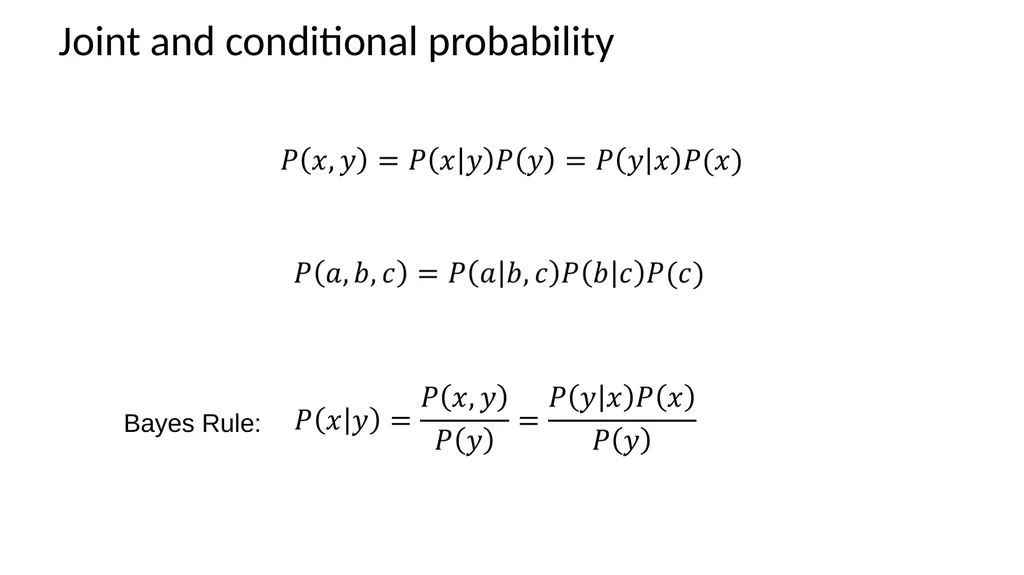
Joint and conditional probability Bayes Rule:<br>
06
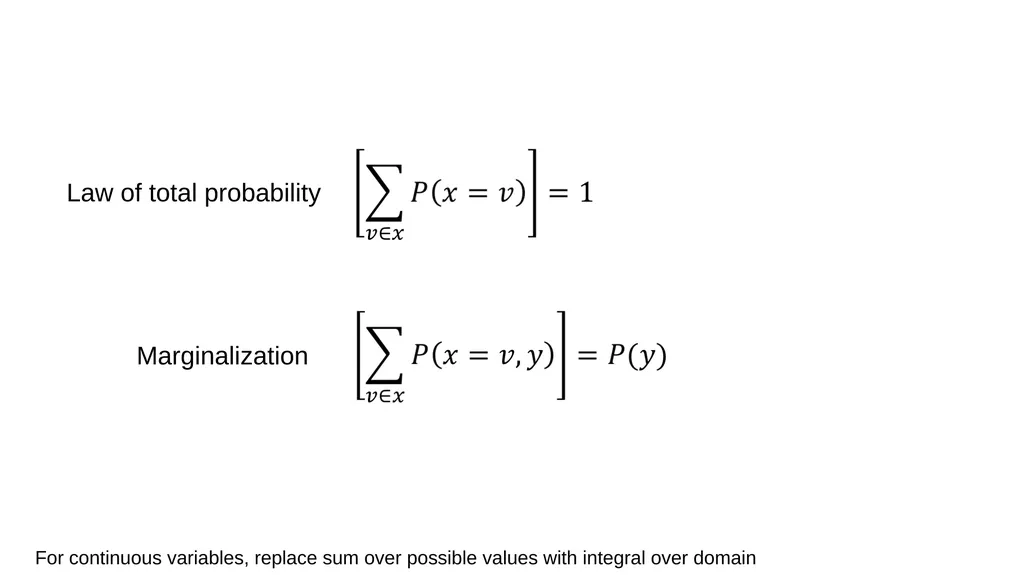
Law of total probability Marginalization For continuous variables, replace sum over possible values with integral over domain<br>
07
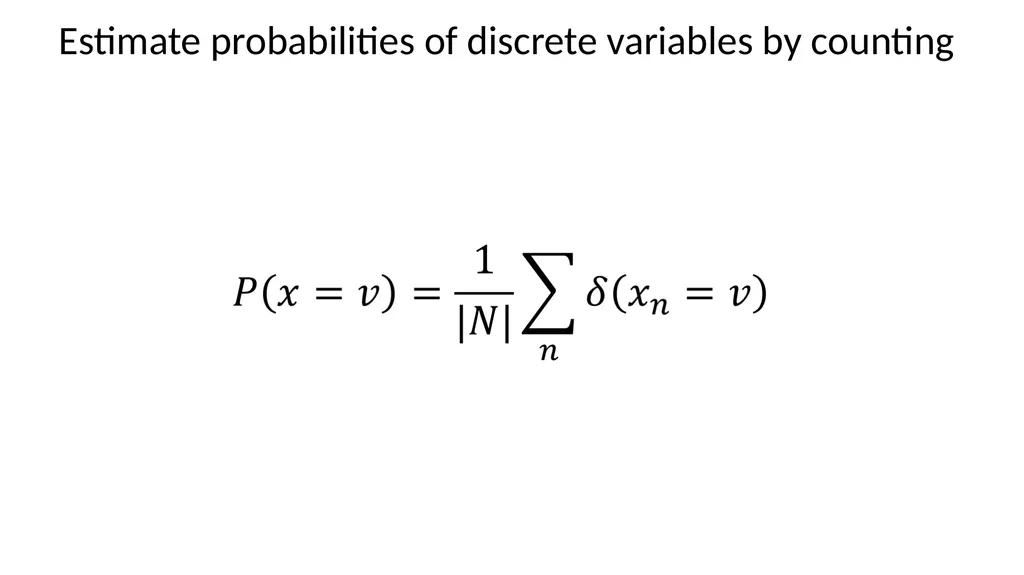
Estimate probabilities of discrete variables by counting<br>
08
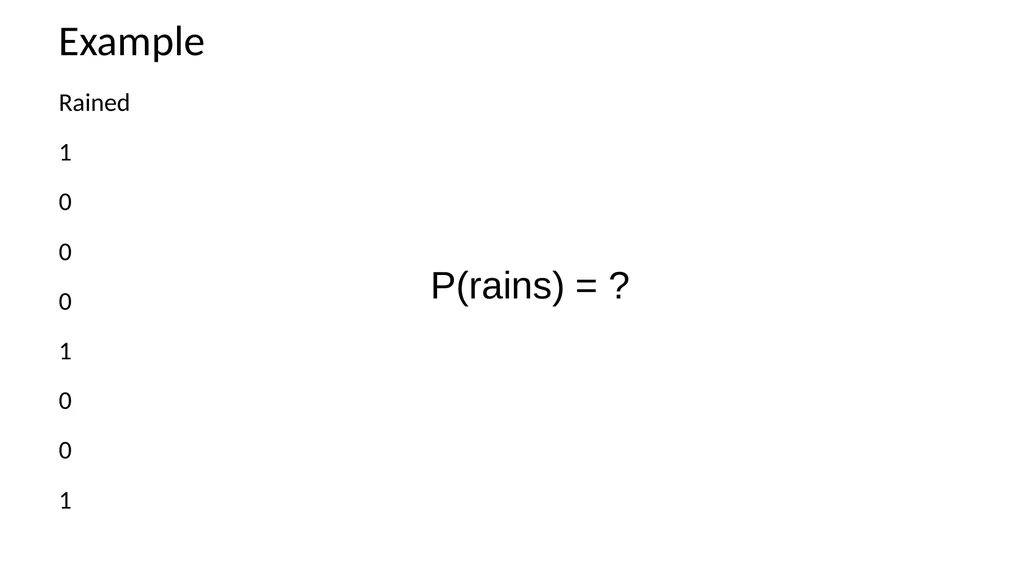
Example P(rains) = ?<br>
09
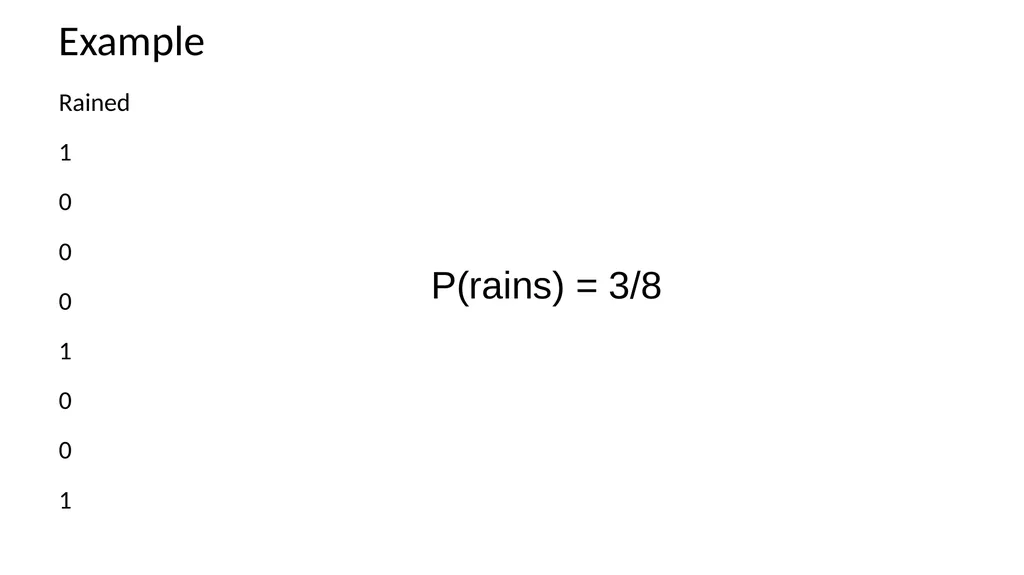
Example P(rains) = 3/8<br>
10
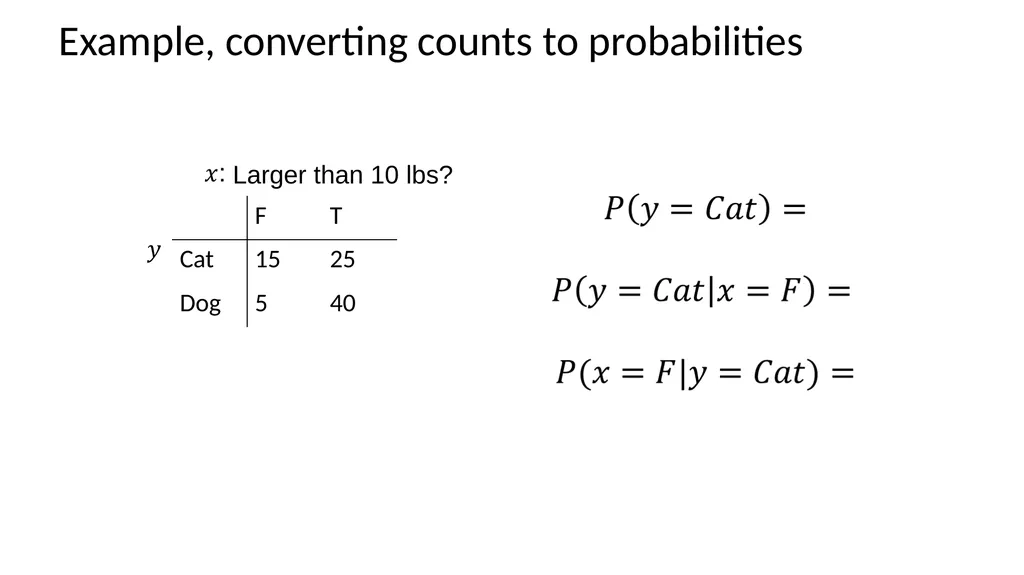
Example, converting counts to probabilities Larger than 10 lbs?<br>
11
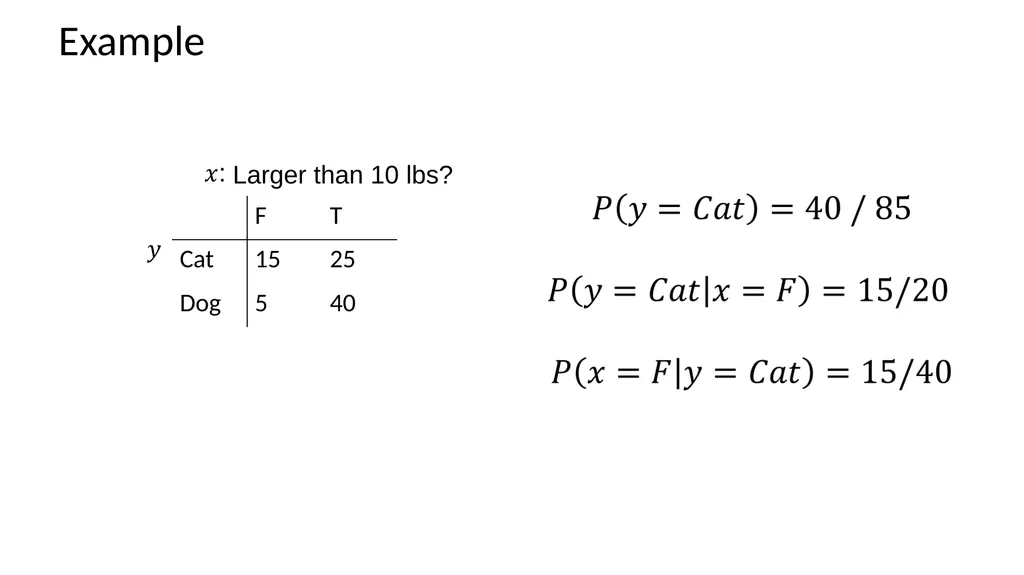
Example Larger than 10 lbs?<br>
12
A is independent of B if (and only if)<br>
13
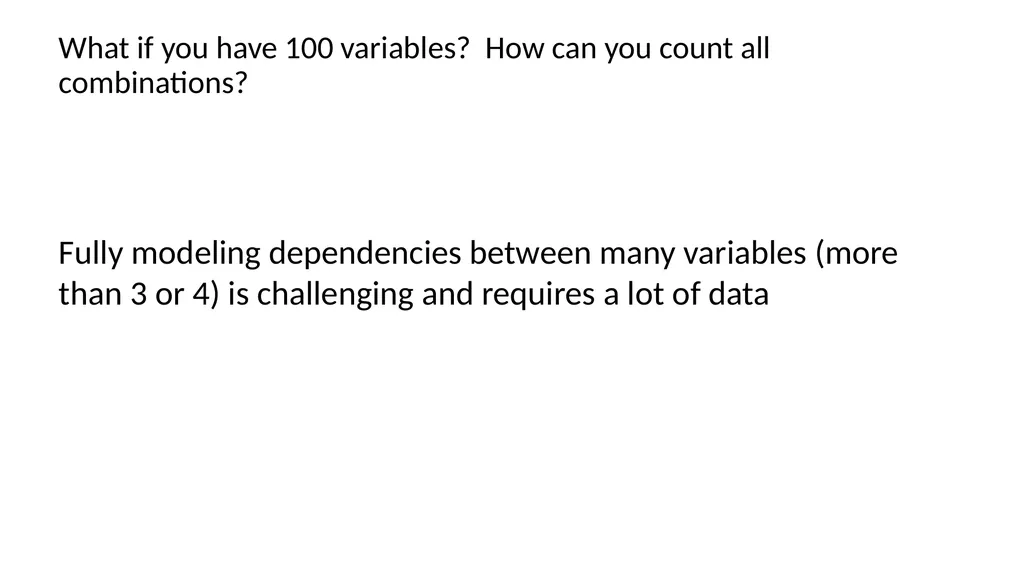
What if you have 100 variables? How can you count all combinations? Fully modeling dependencies between many variables (more than 3 or 4) is challenging and requires a lot of data<br>
14
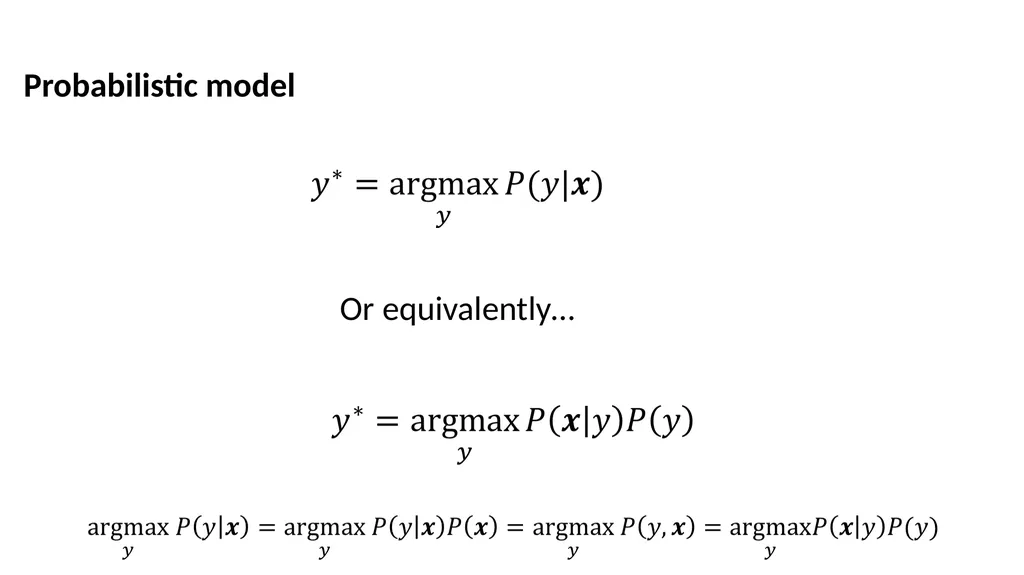
Probabilistic model Or equivalently…<br>
16
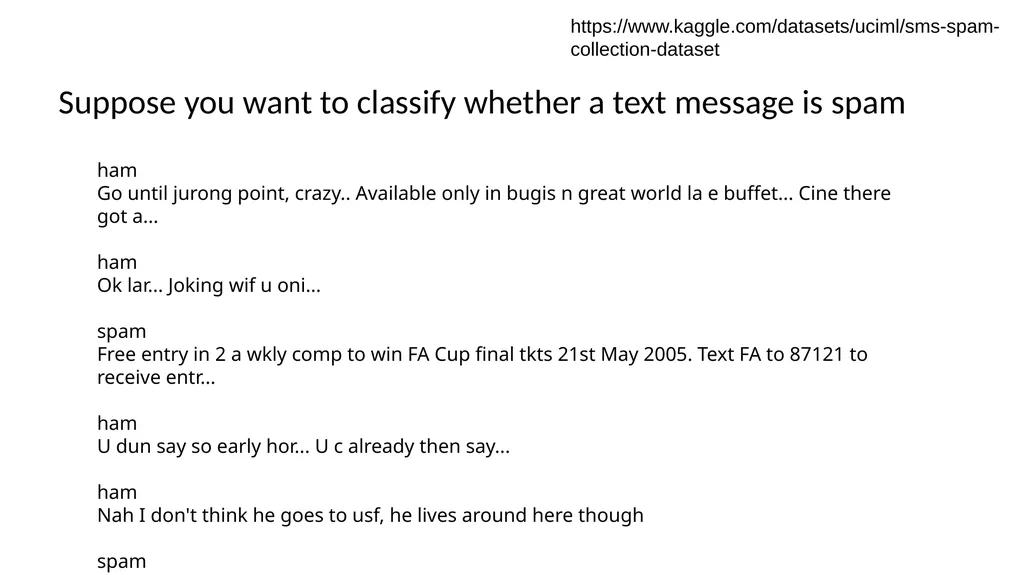
Suppose you want to classify whether a text message is spam ham
Go until jurong point, crazy.. Available only in bugis n great world la e buffet... Cine there got a...
ham
Ok lar... Joking wif u oni...
spam
Free entry in 2 a wkly comp to win FA Cup final tkts 21st May 2005. Text FA to 87121 to receive entr...
ham
U dun say so early hor... U c already then say...
ham
Nah I don't think he goes to usf, he lives around here though
spam
FreeMsg Hey there darling it's been 3 week's now and no word back! I'd like some fun you up for it s... https://www.kaggle.com/datasets/uciml/sms-spam-collection-dataset<br>
17
Suppose you want to classify whether a text message is spam or not
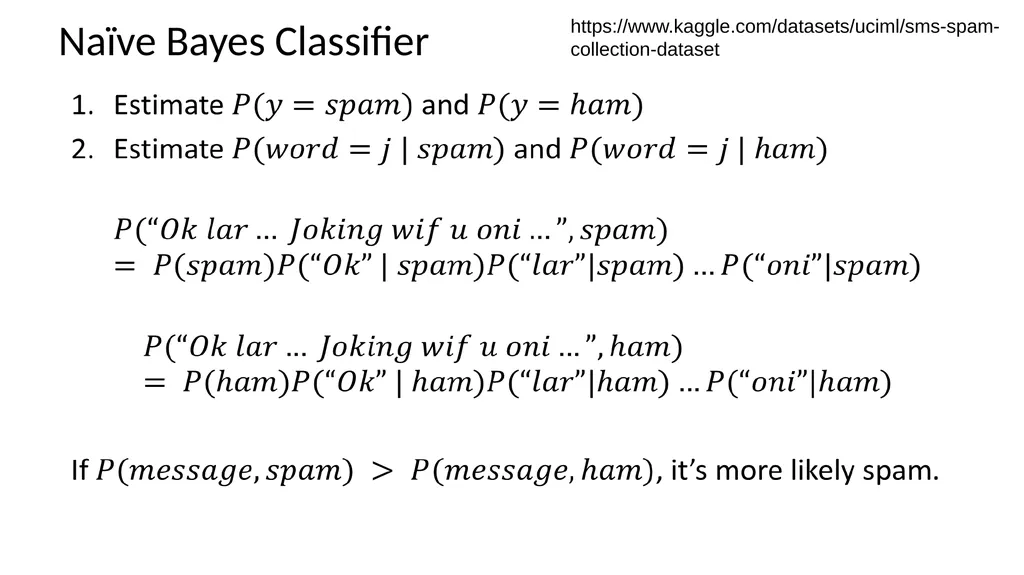
P(“Ok lar... Joking wif u oni...”) probably is 0 in the training set because you might not get exactly the same message twice
How to model? https://www.kaggle.com/datasets/uciml/sms-spam-collection-dataset<br>
19
Naïve Bayes Classifier https://www.kaggle.com/datasets/uciml/sms-spam-collection-dataset<br>
20
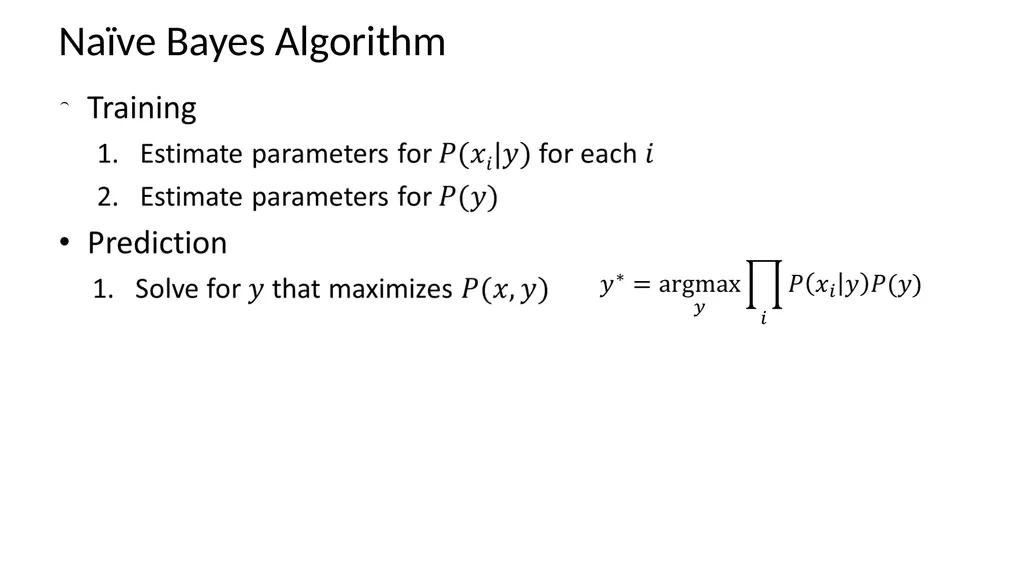
Naïve Bayes Algorithm<br>
21
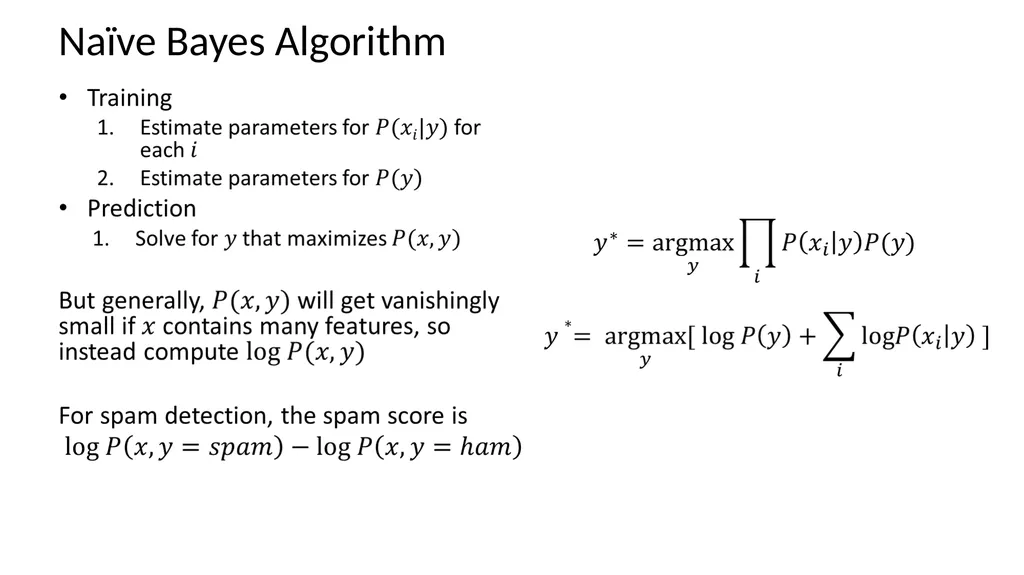
Naïve Bayes Algorithm<br>
22
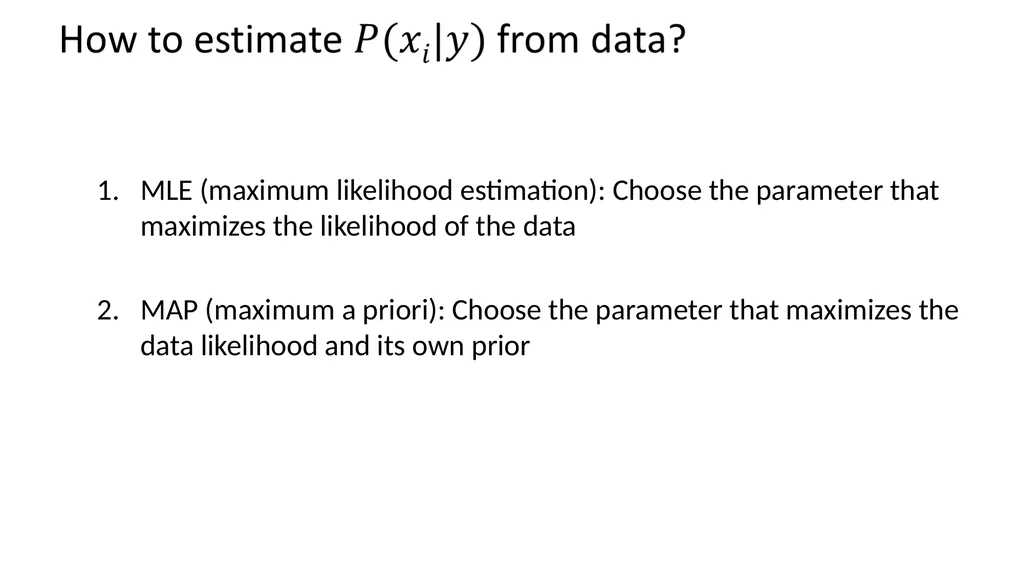
MLE (maximum likelihood estimation): Choose the parameter that maximizes the likelihood of the data
MAP (maximum a priori): Choose the parameter that maximizes the data likelihood and its own prior<br>
23
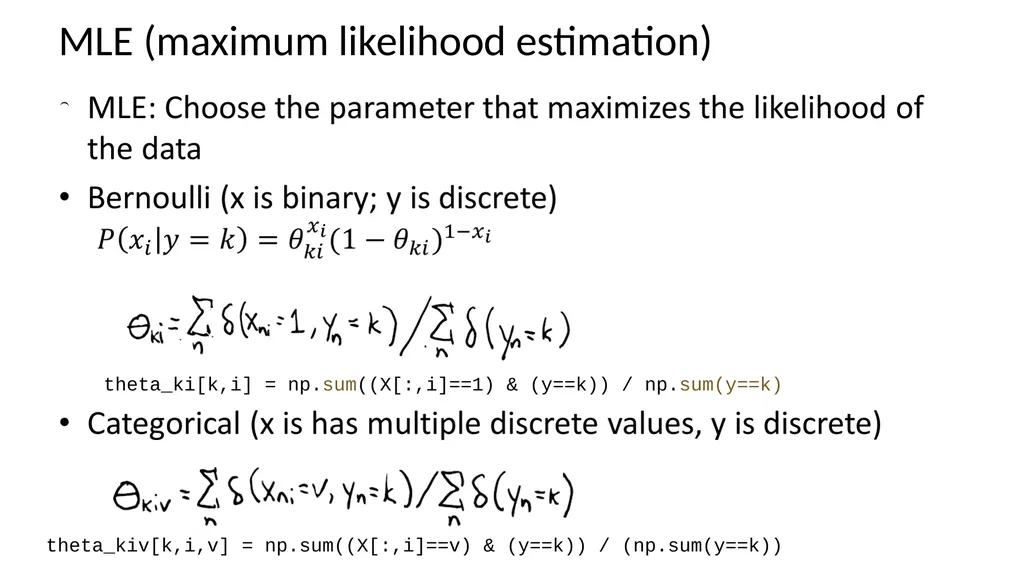
MLE (maximum likelihood estimation) theta_ki[k,i] = np.sum((X[:,i]==1) & (y==k)) / np.sum(y==k) theta_kiv[k,i,v] = np.sum((X[:,i]==v) & (y==k)) / (np.sum(y==k))<br>
24
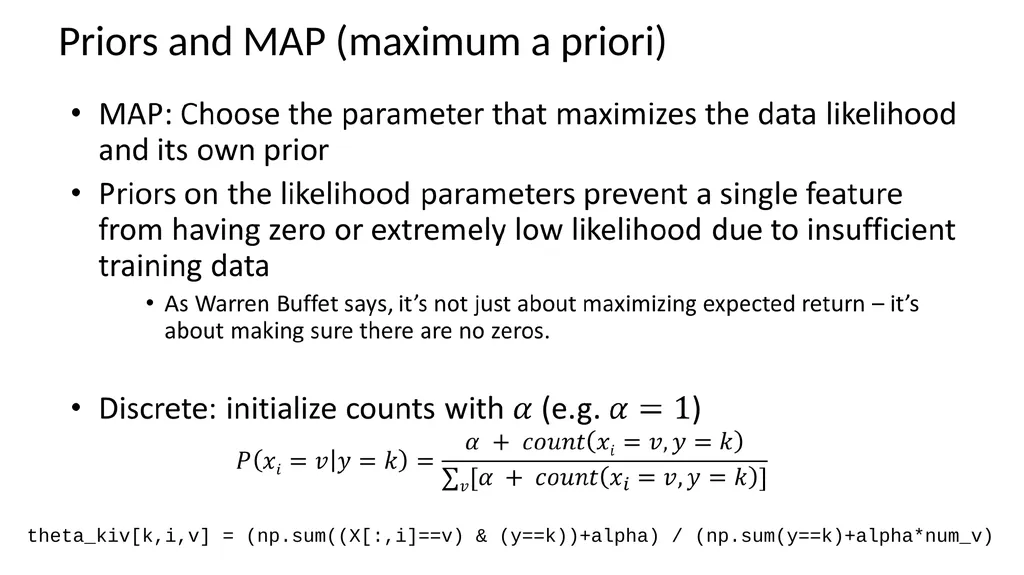
Priors and MAP (maximum a priori) theta_kiv[k,i,v] = (np.sum((X[:,i]==v) & (y==k))+alpha) / (np.sum(y==k)+alpha*num_v)<br>
25
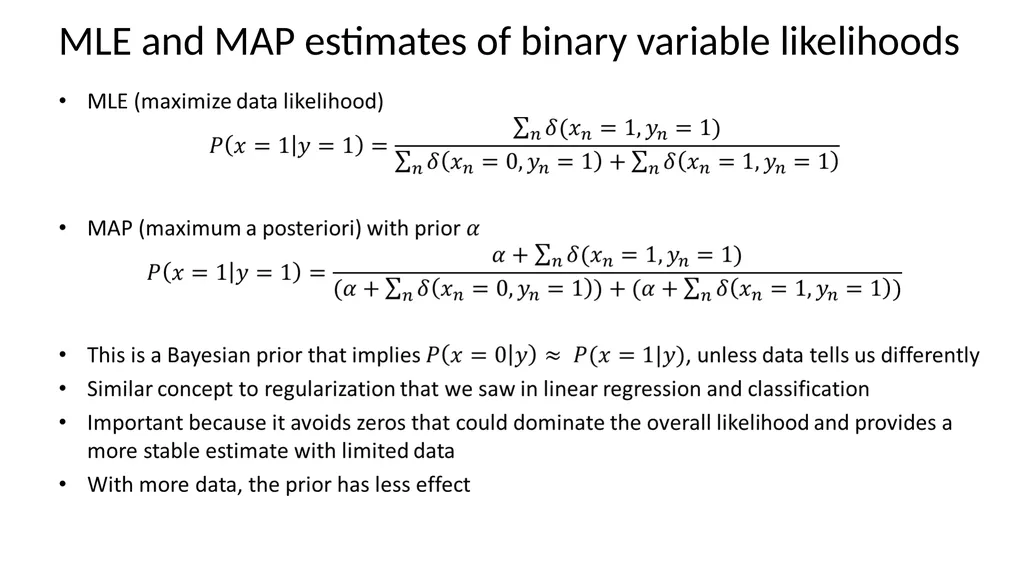
MLE and MAP estimates of binary variable likelihoods<br>
26
Q1-Q3 https://tinyurl.com/AML441-L8r<br>
27
mu[k,i] = np.mean(X[y==k,i], axis=0)
sigma[k, i] = np.std(X[y==k,i], axis=0)<br>
28
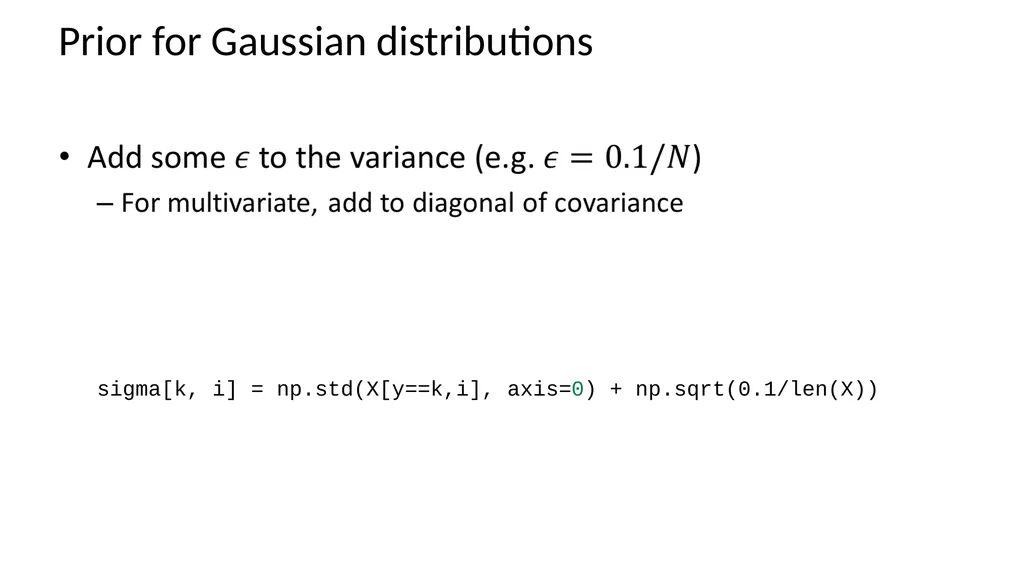
Prior for Gaussian distributions sigma[k, i] = np.std(X[y==k,i], axis=0) + np.sqrt(0.1/len(X))<br>
29
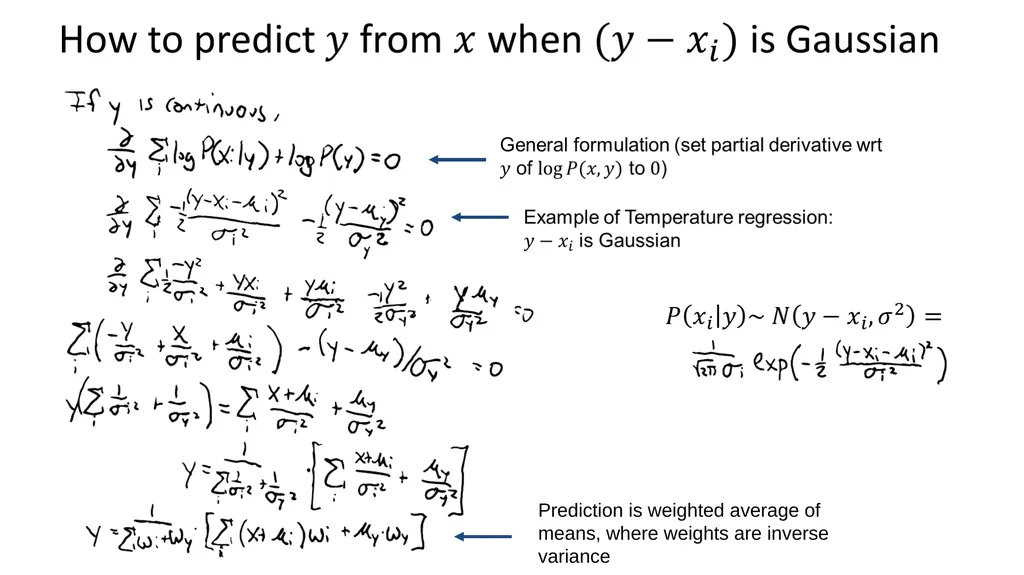
How to predict y from x? Turning product into sum of logs is an important frequently used trick for argmax/argmin!<br>
30
Prediction is weighted average of means, where weights are inverse variance<br>
31
Q4-Q6 https://tinyurl.com/AML441-L8r<br>
32
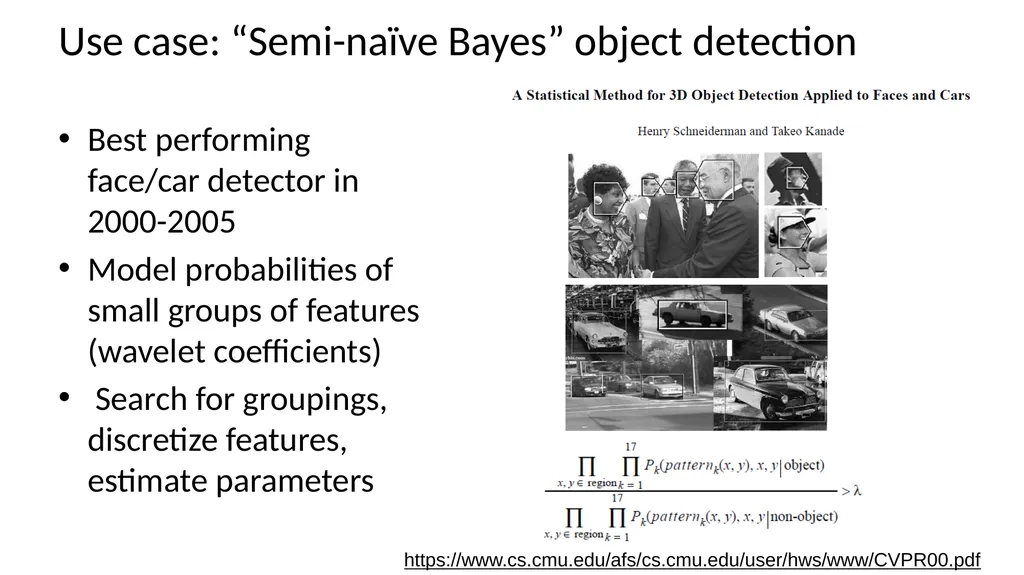
Use case: “Semi-naïve Bayes” object detection Best performing face/car detector in 2000-2005
Model probabilities of small groups of features (wavelet coefficients)
Search for groupings, discretize features, estimate parameters https://www.cs.cmu.edu/afs/cs.cmu.edu/user/hws/www/CVPR00.pdf<br>
33
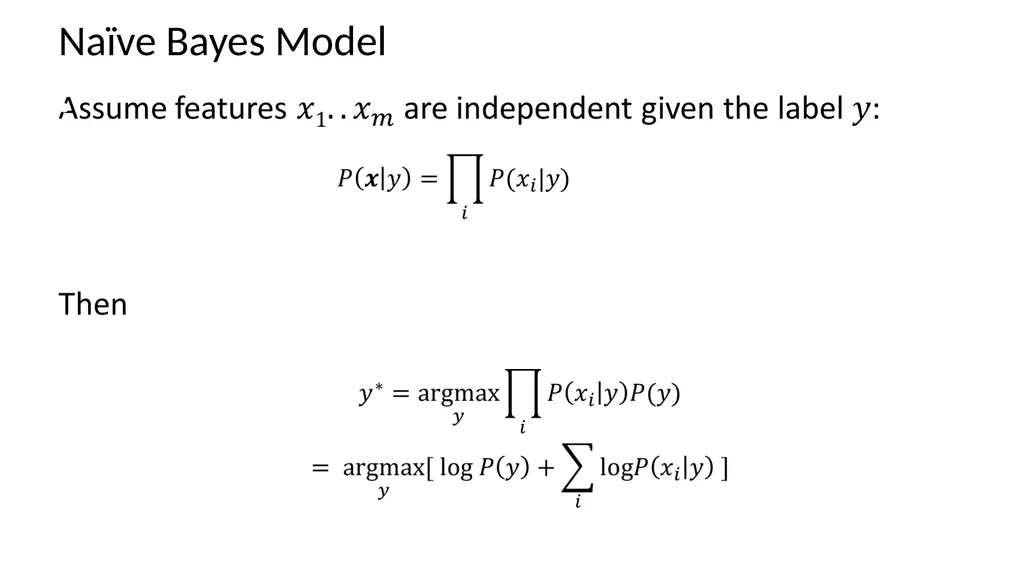
Naïve Bayes Summary Key Assumptions
Features are independent, given the labels
Model Parameters
Parameters of probability functions P(xi|y) and P(y)
Designs
Choice of probability function
When to Use
Limited training data
Features are not highly interdependent
Want something fast to code, train, and test
When Not to Use
Logistic or linear regression will usually work better if there is sufficient data (more flexible / fewer assumptions than Naïve Bayes)
Does not provide a good confidence estimate because it “overcounts” influence of dependent variables<br>
34
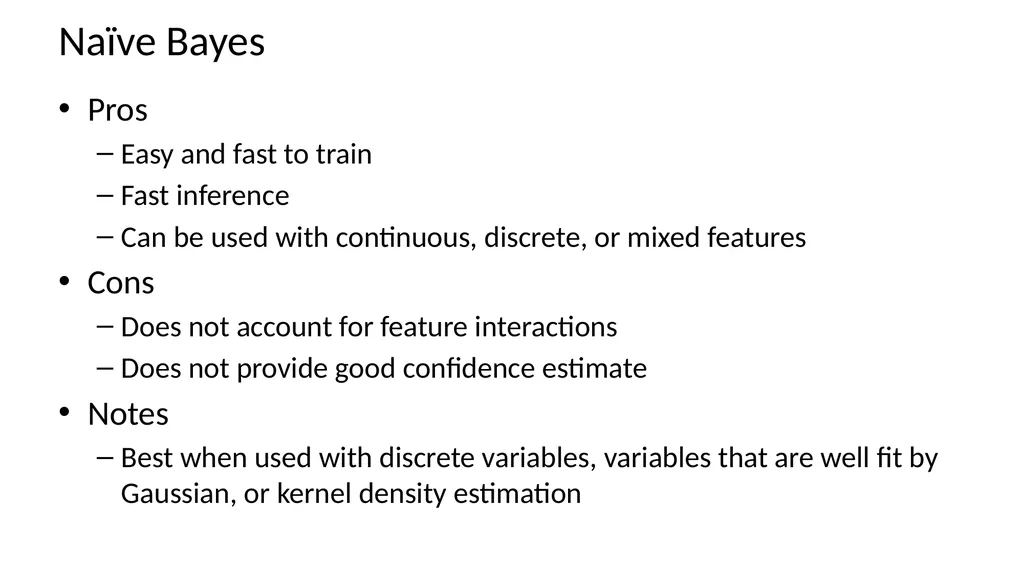
Naïve Bayes Pros
Easy and fast to train
Fast inference
Can be used with continuous, discrete, or mixed features
Cons
Does not account for feature interactions
Does not provide good confidence estimate
Notes
Best when used with discrete variables, variables that are well fit by Gaussian, or kernel density estimation<br>
35
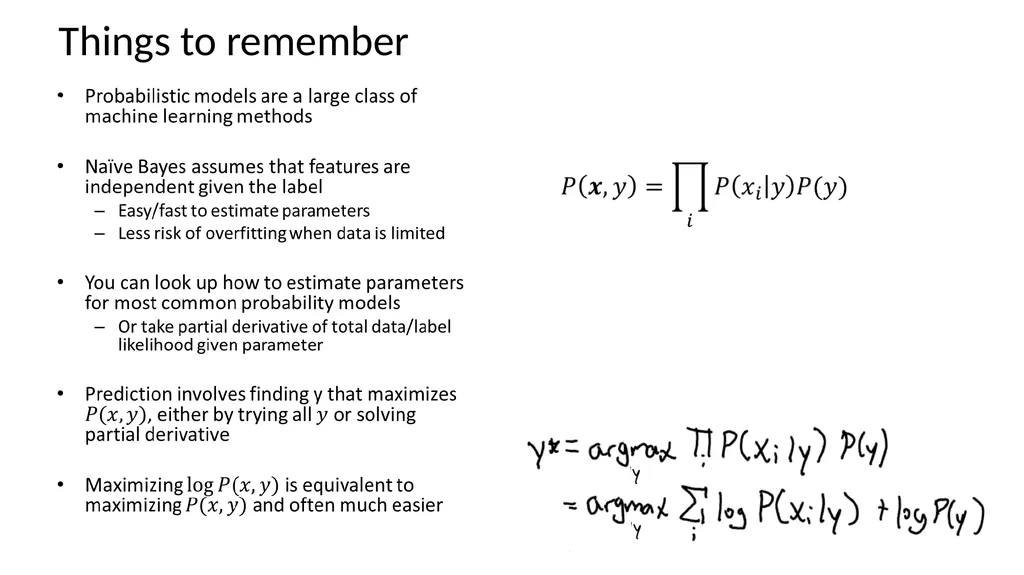
Things to remember<br>
36
Next week EM and Density Estimation<br>