
NASDA Survey Training July 2026 Update on NASS
EM
Published · 42 slides · 0 views

1 / 1

Description
NASDA Survey Training July 2026 Update on NASS Transition - Federal New Network - HERE July Quick Reference Guide Click Here for National Data Center - Survey Calendar July Quick Reference Guide (contd) July Citrus Production The July
Related Topics
Share
Embed code
Download this presentation From Below
"NASDA Survey Training July 2026 Update on NASS" is the property of its rightful owner. Permission is granted to download and print the materials on this website for personal, non-commercial use only, and to display it on your personal computer provided you do not modify the materials and that you retain all copyright notices contained in the materials. By downloading content from our website, you accept the terms of this agreement.
Presentation Transcript
01
NASDA Survey Training July 2026<br>
02
Update on NASS Transition - Federal New Network - HERE<br>
03
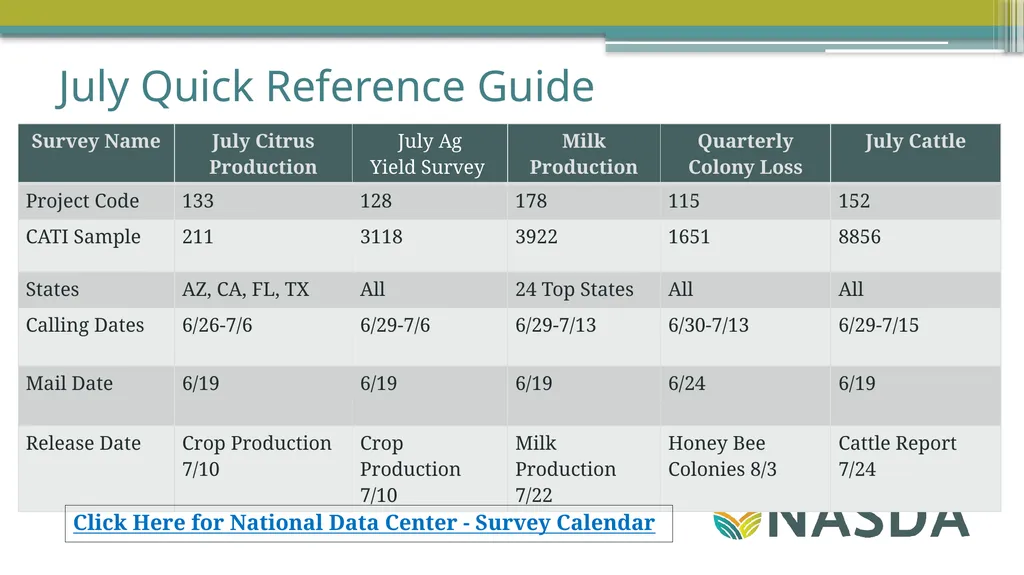
July Quick Reference Guide Click Here for National Data Center - Survey Calendar<br>
04
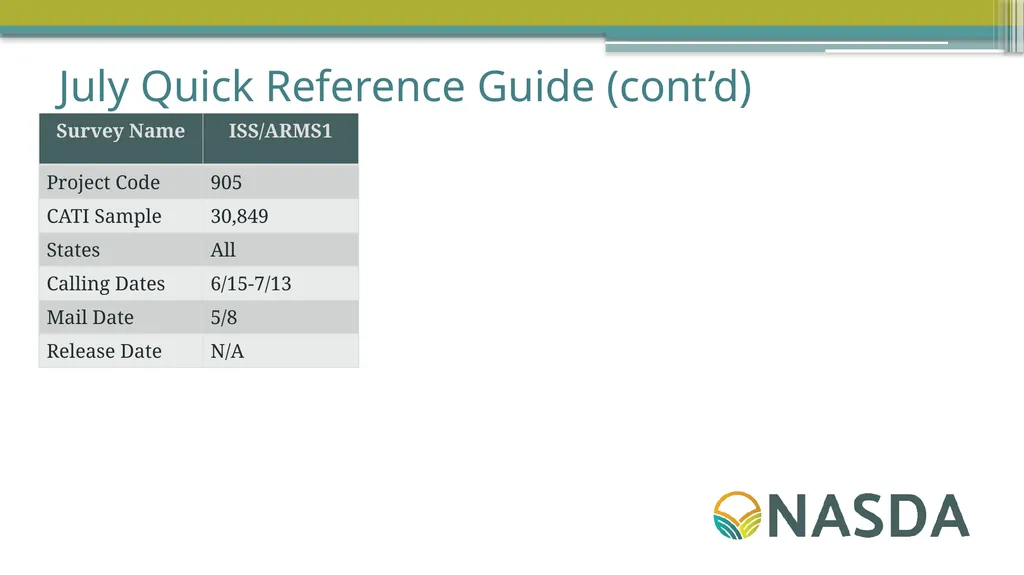
July Quick Reference Guide (cont’d)<br>
05
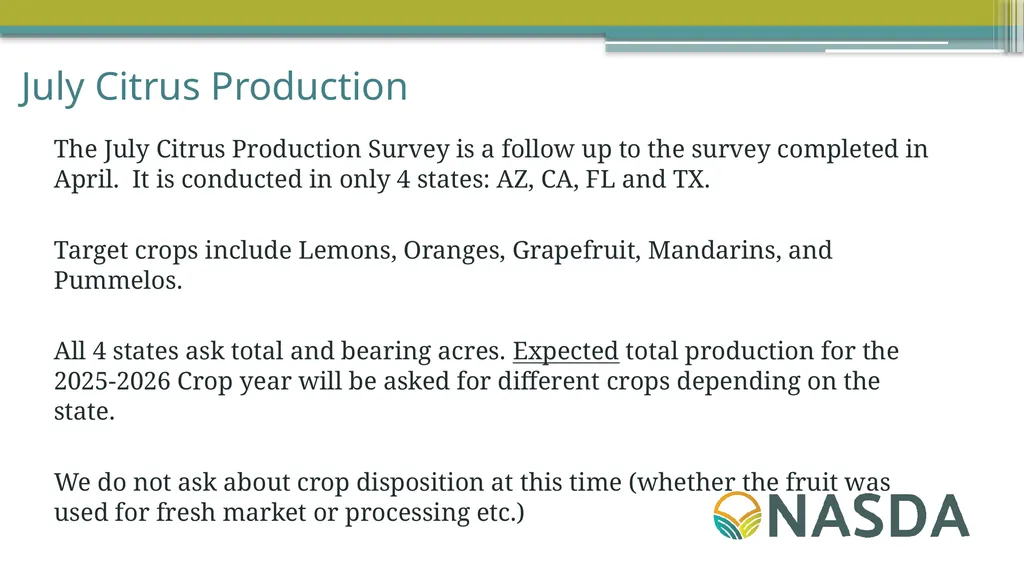
July Citrus Production The July Citrus Production Survey is a follow up to the survey completed in April. It is conducted in only 4 states: AZ, CA, FL and TX.
Target crops include Lemons, Oranges, Grapefruit, Mandarins, and Pummelos.
All 4 states ask total and bearing acres. Expected total production for the 2025-2026 Crop year will be asked for different crops depending on the state.
We do not ask about crop disposition at this time (whether the fruit was used for fresh market or processing etc.)<br>
06
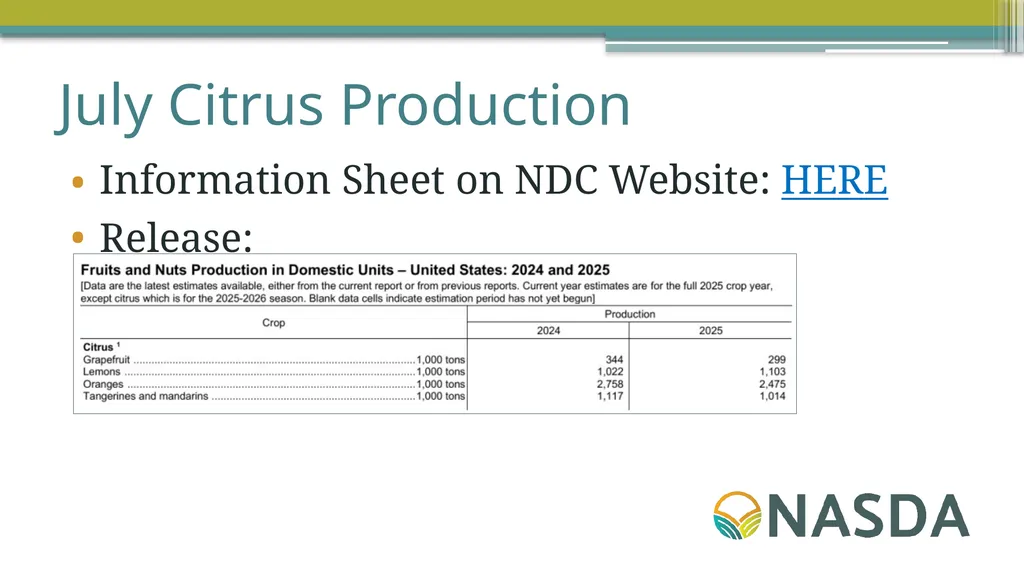
July Citrus Production Information Sheet on NDC Website: HERE
Release:<br>
Release:<br>
07
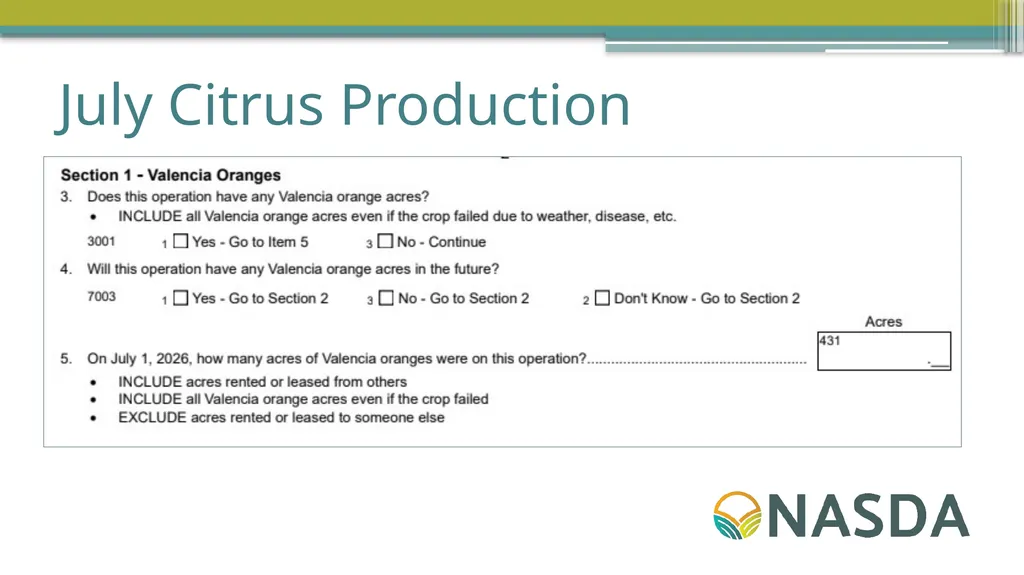
July Citrus Production<br>
08
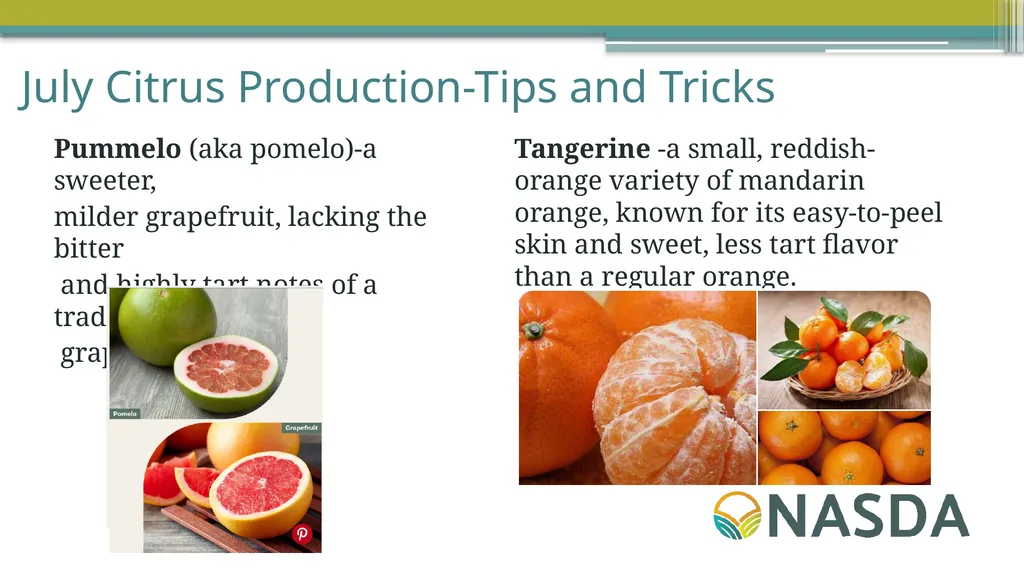
July Citrus Production-Tips and Tricks Pummelo (aka pomelo)-a sweeter,
milder grapefruit, lacking the bitter
and highly tart notes of a traditional
grapefruit Tangerine -a small, reddish-orange variety of mandarin orange, known for its easy-to-peel skin and sweet, less tart flavor than a regular orange.<br>
milder grapefruit, lacking the bitter
and highly tart notes of a traditional
grapefruit Tangerine -a small, reddish-orange variety of mandarin orange, known for its easy-to-peel skin and sweet, less tart flavor than a regular orange.<br>
09
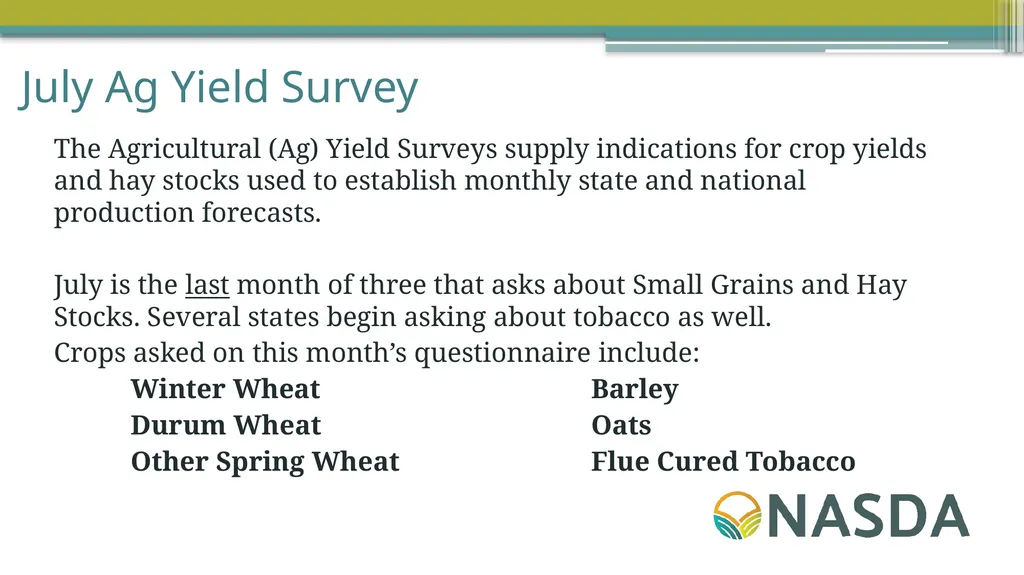
July Ag Yield Survey The Agricultural (Ag) Yield Surveys supply indications for crop yields and hay stocks used to establish monthly state and national production forecasts.
July is the last month of three that asks about Small Grains and Hay Stocks. Several states begin asking about tobacco as well.
Crops asked on this month’s questionnaire include:
Winter Wheat Barley
Durum Wheat Oats
Other Spring Wheat Flue Cured Tobacco<br>
July is the last month of three that asks about Small Grains and Hay Stocks. Several states begin asking about tobacco as well.
Crops asked on this month’s questionnaire include:
Winter Wheat Barley
Durum Wheat Oats
Other Spring Wheat Flue Cured Tobacco<br>
10
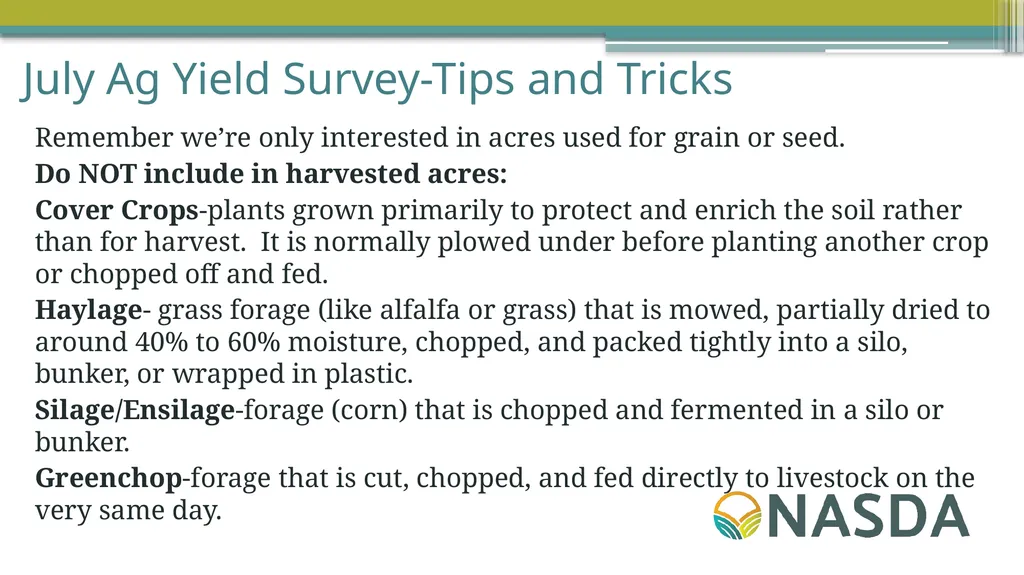
July Ag Yield Survey-Tips and Tricks Remember we’re only interested in acres used for grain or seed.
Do NOT include in harvested acres:
Cover Crops-plants grown primarily to protect and enrich the soil rather than for harvest. It is normally plowed under before planting another crop or chopped off and fed.
Haylage- grass forage (like alfalfa or grass) that is mowed, partially dried to around 40% to 60% moisture, chopped, and packed tightly into a silo, bunker, or wrapped in plastic.
Silage/Ensilage-forage (corn) that is chopped and fermented in a silo or bunker.
Greenchop-forage that is cut, chopped, and fed directly to livestock on the very same day.<br>
11
July Ag Yield Information Sheet on NDC Website: HERE
Yield
Most important data to collect
DK need to probe. Ask for best estimate.<br>
Yield
Most important data to collect
DK need to probe. Ask for best estimate.<br>
12
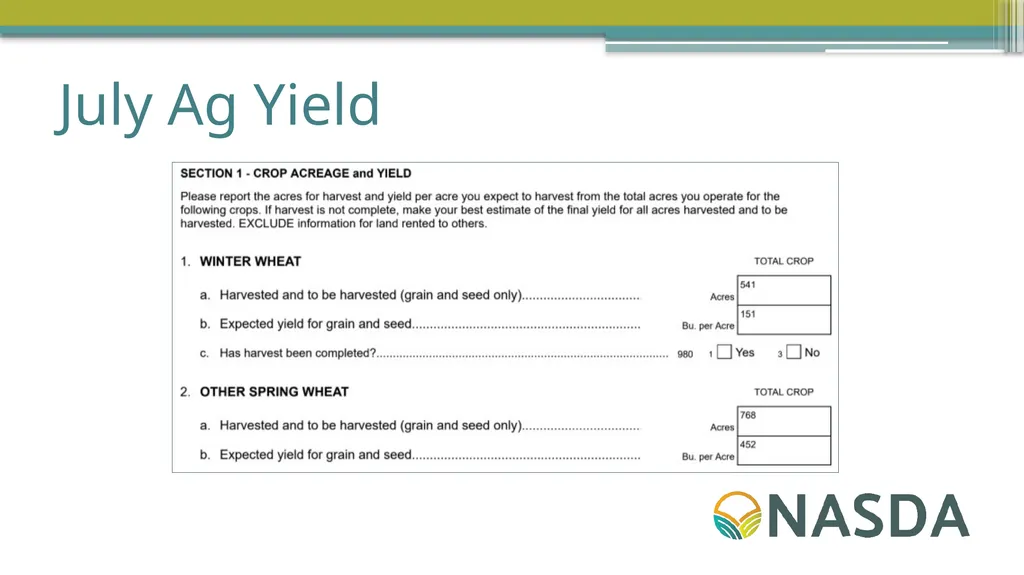
July Ag Yield<br>
13
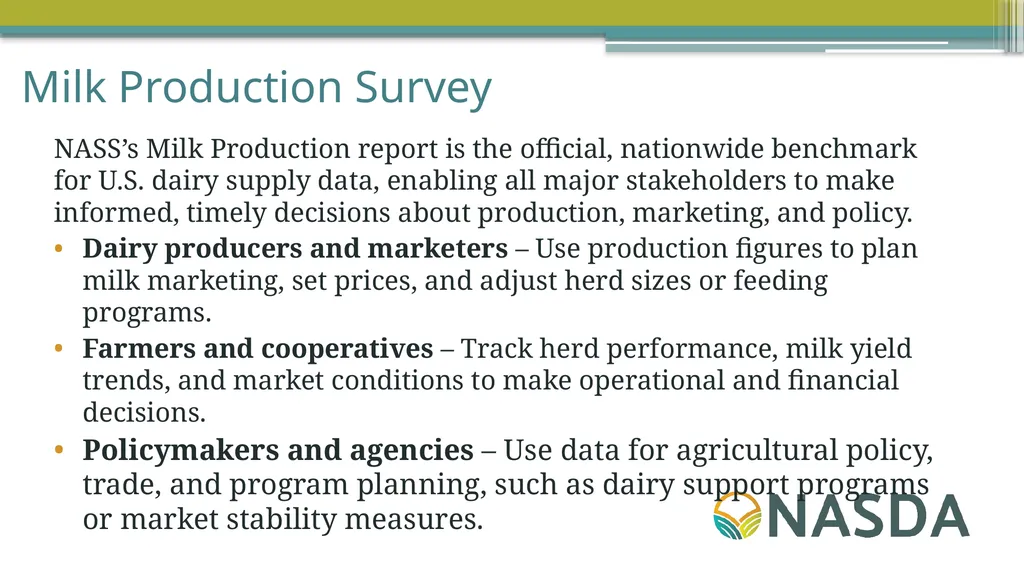
Milk Production Survey NASS’s Milk Production report is the official, nationwide benchmark for U.S. dairy supply data, enabling all major stakeholders to make informed, timely decisions about production, marketing, and policy.
Dairy producers and marketers – Use production figures to plan milk marketing, set prices, and adjust herd sizes or feeding programs.
Farmers and cooperatives – Track herd performance, milk yield trends, and market conditions to make operational and financial decisions.
Policymakers and agencies – Use data for agricultural policy, trade, and program planning, such as dairy support programs or market stability measures.<br>
14
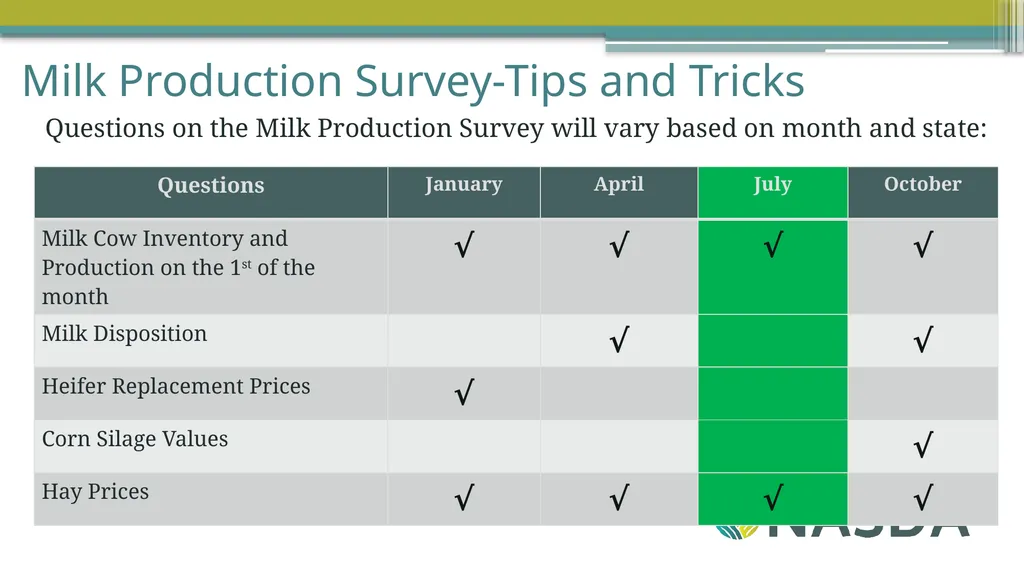
Milk Production Survey-Tips and Tricks Questions on the Milk Production Survey will vary based on month and state:<br>
15
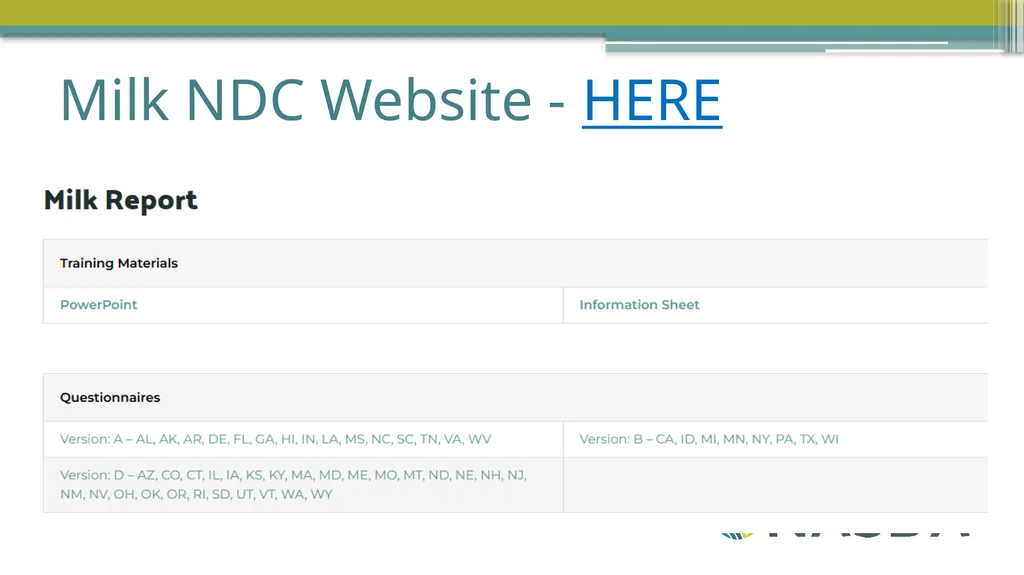
Milk NDC Website - HERE<br>
16
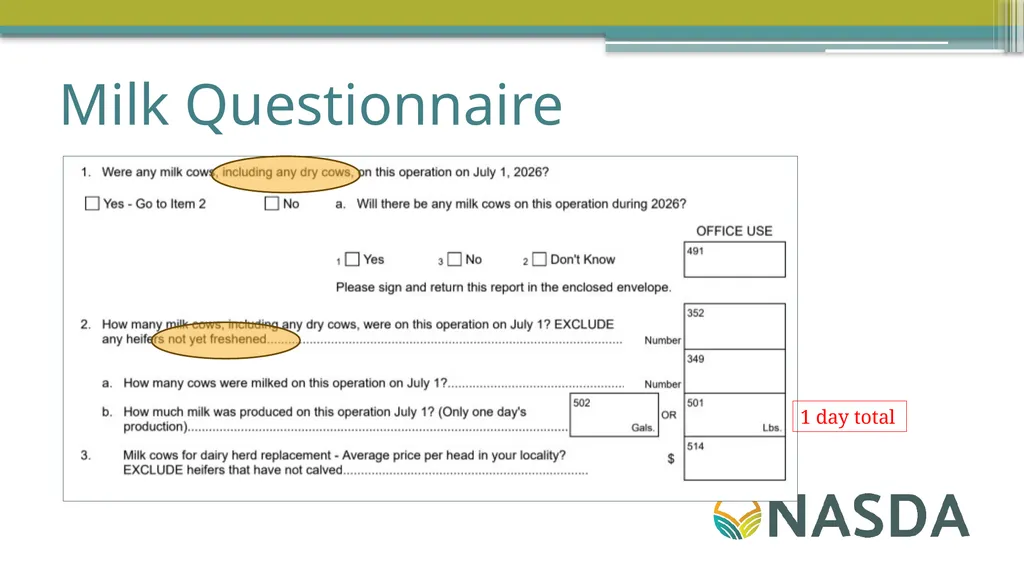
Milk Questionnaire 1 day total<br>
17
Quarterly Bee Colony Loss This quarterly survey done in Jan, April, July and Oct. obtains information on bee diseases and loss that is not collected during the Annual Bee & Honey survey.
Bee pollination has become a big business and is critical to the U.S. food supply. Disease and death loss have become a topic of great interest, and this survey allows industry experts to measure and track those items.
This survey collection information on the total number of colonies owned, regardless of location, how many colonies were in each state AND how many of those colonies were: lost/dead out, requeened and/or received nucs/packages, and added while in that state.<br>
18
Quarterly Bee Colony Loss-Tips and Tricks How the pollination business works:
Beekeepers and growers establish agreements to place a specific number of hives during the crop's bloom. Large-scale commercial beekeepers operate migratory businesses loading hives onto tractor-trailers and moving their bees across the country to follow different growing seasons.
Because of this movement of bees, collecting accurate data can be challenging! Be sure to follow the instructions closely to avoid omissions/double counting.<br>
19
Quarterly Colony Loss Information Sheet on NDC Website: HERE
Key to this survey – Leave good NOTES<br>
Key to this survey – Leave good NOTES<br>
20
July Cattle Survey The Cattle Survey is conducted twice a year in January and July. Estimates are made for inventory and value (dairy and beef), number and size of operations, cattle on feed and calf crops.
In January, the sample size is larger allowing NASS to publish estimates by state and by size groups. In July, the sample is smaller and the estimates are published at the U.S. Level only.
Like other NASS surveys, producers, processors, and feed dealers all watch these reports closely to see cattle market supplies and make future decisions for their farms and businesses.<br>
21
Understanding the Cattle Industry Cattle Information on NDC Website: HERE
If assigned to call cattle you are authorized 30 minutes PC152 to review this document.<br>
If assigned to call cattle you are authorized 30 minutes PC152 to review this document.<br>
22
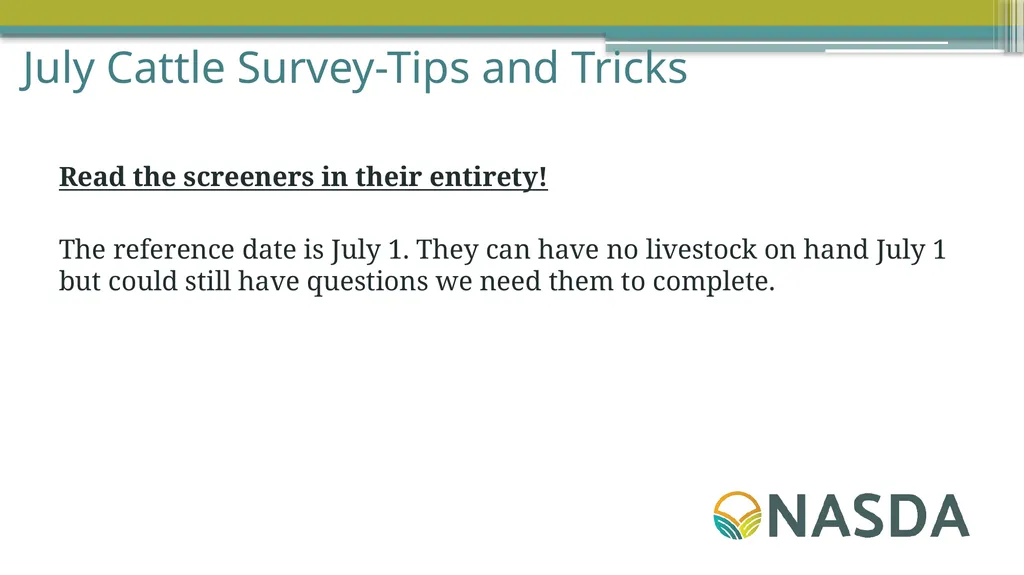
July Cattle Survey-Tips and Tricks Read the screeners in their entirety!
The reference date is July 1. They can have no livestock on hand July 1 but could still have questions we need them to complete.<br>
The reference date is July 1. They can have no livestock on hand July 1 but could still have questions we need them to complete.<br>
23
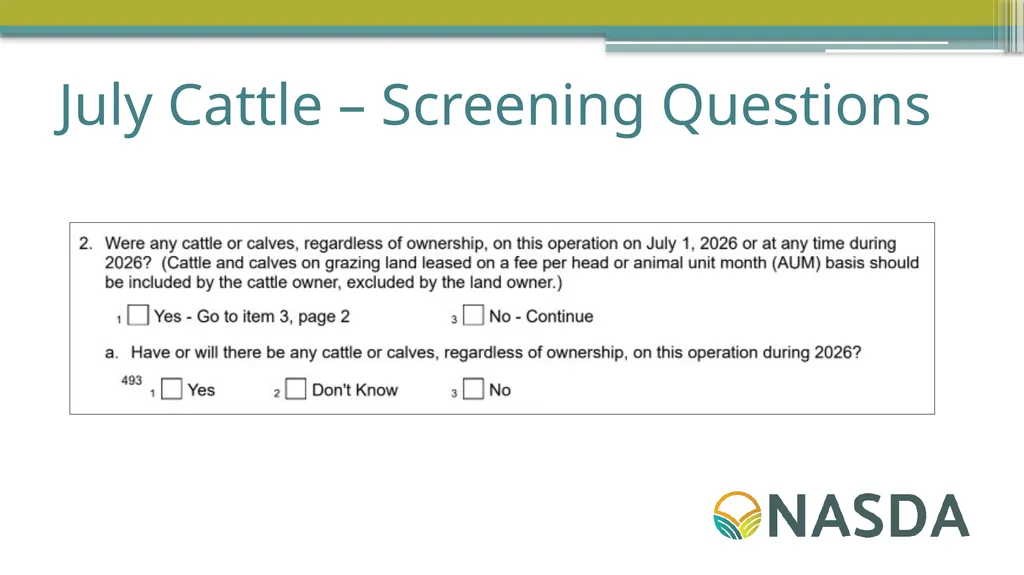
July Cattle – Screening Questions<br>
24
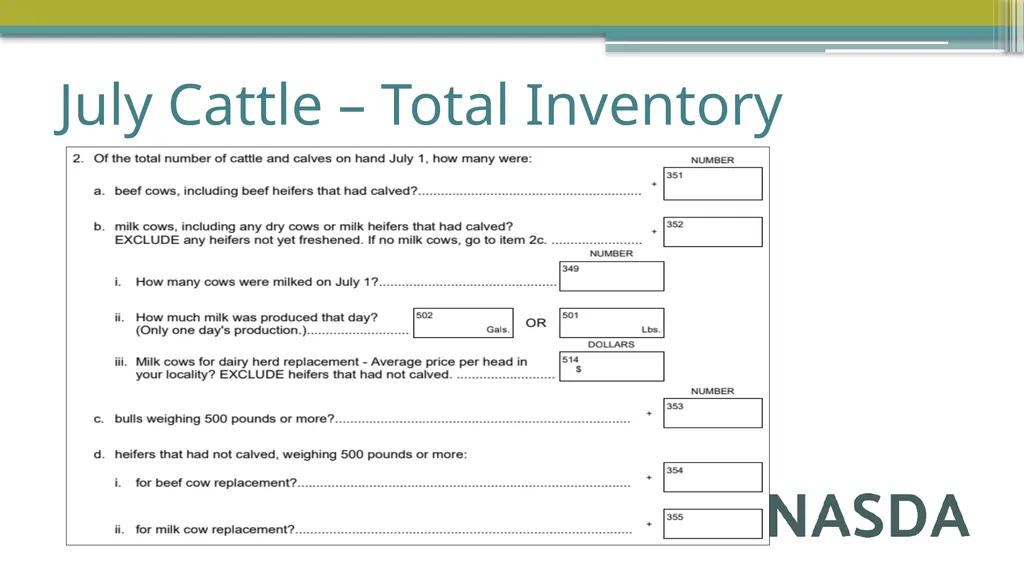
July Cattle – Total Inventory<br>
25
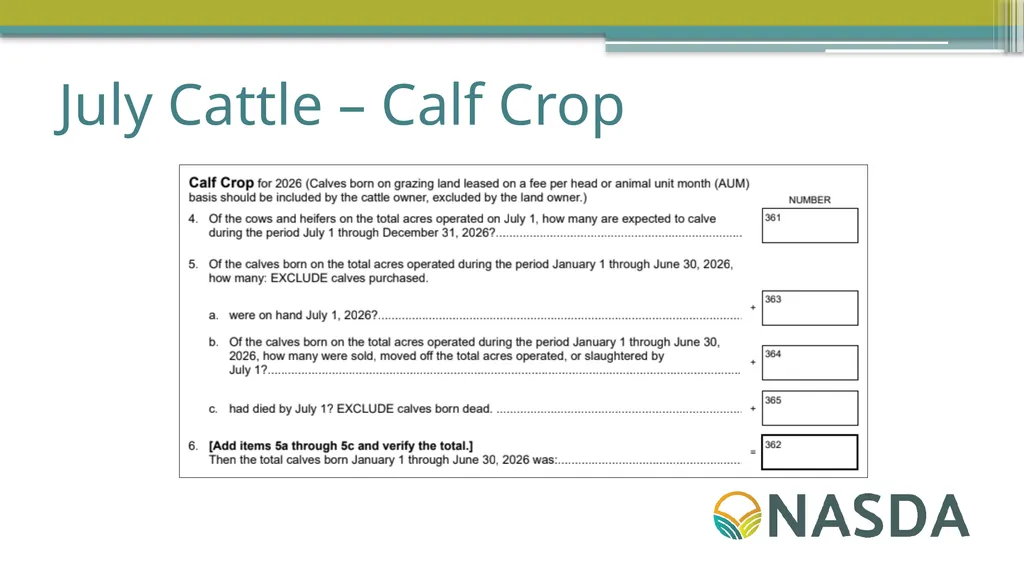
July Cattle – Calf Crop<br>
26
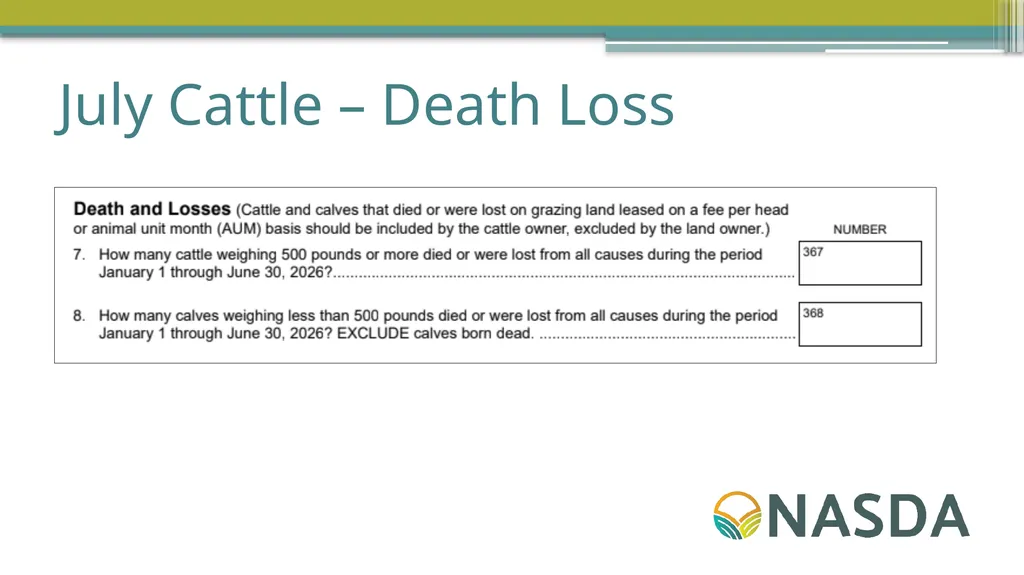
July Cattle – Death Loss<br>
27
July Cattle – Cattle on Feed Know the difference between cattle on feed and backgrounding.
Backgrounding/preconditioning adds weight to cattle before the fattening phase. Backgrounding is a phase allowing growth of calves that maximizes profit before selling to a feedlot for finishing.<br>
Backgrounding/preconditioning adds weight to cattle before the fattening phase. Backgrounding is a phase allowing growth of calves that maximizes profit before selling to a feedlot for finishing.<br>
28
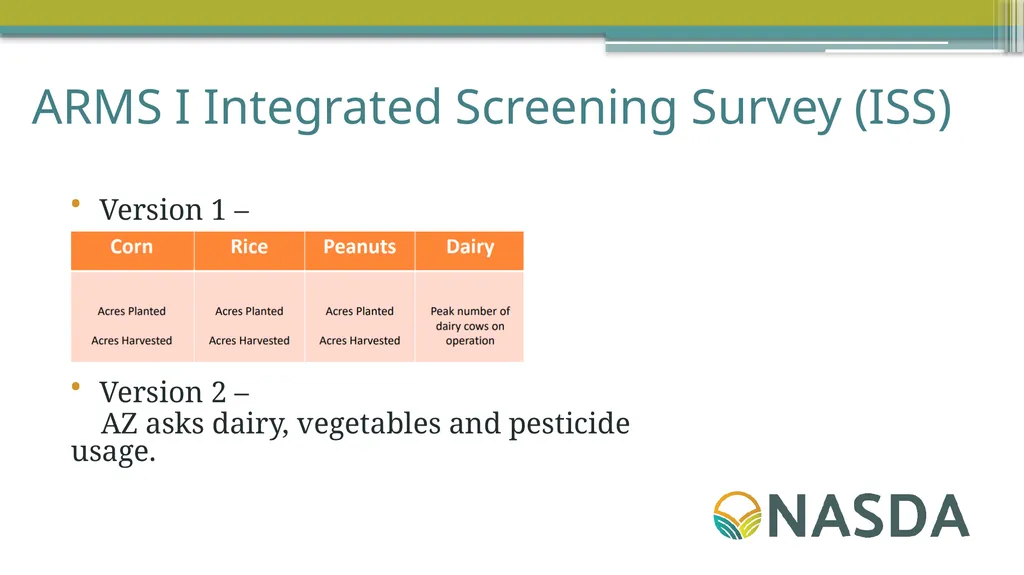
ARMS 1 Integrated Screening Survey (ISS) The ARMS 1 Survey is the screening survey to determine eligibility to be sampled for the ARMS 2, ARMS 3, and Chem Use Surveys.
Questions asked include the presence of corn, rice, peanuts, vegetables, and dairy cows; all target commodities for ARMS 2/3. (AZ asks dairy, vegetables and pesticide usage.)
ARMS data are the USDA’s primary source of information on agricultural resource use and costs, farm sector financial conditions and farm household finances. ARMS data also provides the farm sector portion of the GDP.<br>
29
ARMS I Integrated Screening Survey (ISS) Easiest survey completed at the NDC that mistakes are made.
Must leave clear notes on an operations status.<br>
Must leave clear notes on an operations status.<br>
30
ARMS I Integrated Screening Survey (ISS) Version 1 –
Version 2 –
AZ asks dairy, vegetables and pesticide usage.<br>
Version 2 –
AZ asks dairy, vegetables and pesticide usage.<br>
31
ARMS 1 Integrated Screening Survey (ISS)– Tips and Tricks Need a high completion rate to obtain enough eligible records for ARMS 2 and 3.
Be careful to properly identify farm status:
In Business: watch for small farms that may not consider themselves a farm (only need $1000 or more in sales/ag payments)
OOB: watch for landlords only (do not operate any land)<br>
Be careful to properly identify farm status:
In Business: watch for small farms that may not consider themselves a farm (only need $1000 or more in sales/ag payments)
OOB: watch for landlords only (do not operate any land)<br>
32
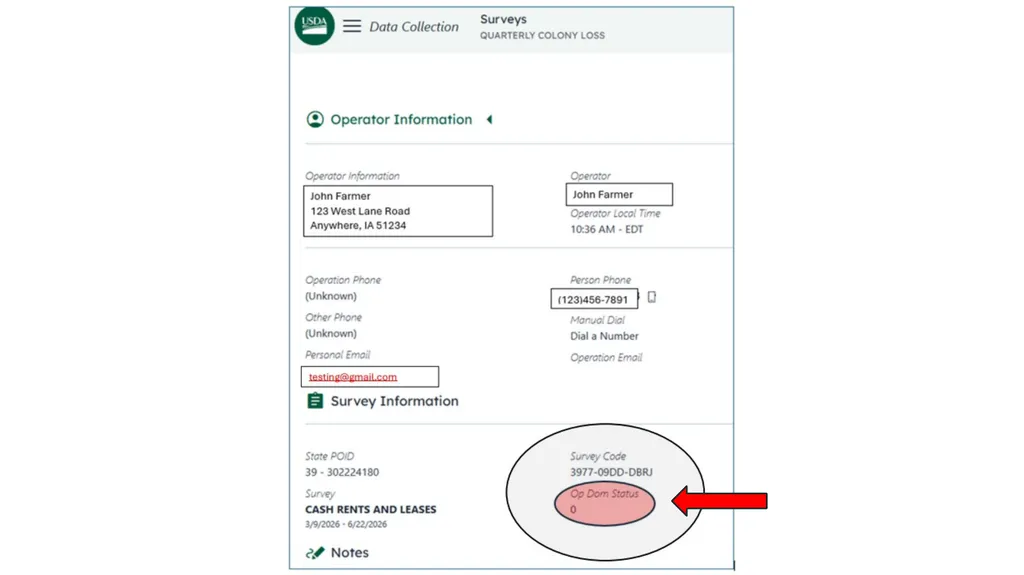
Callers Corner-Who’s the Target?? Tools The dial screen in READI gives you a clue as to the target.<br>
33
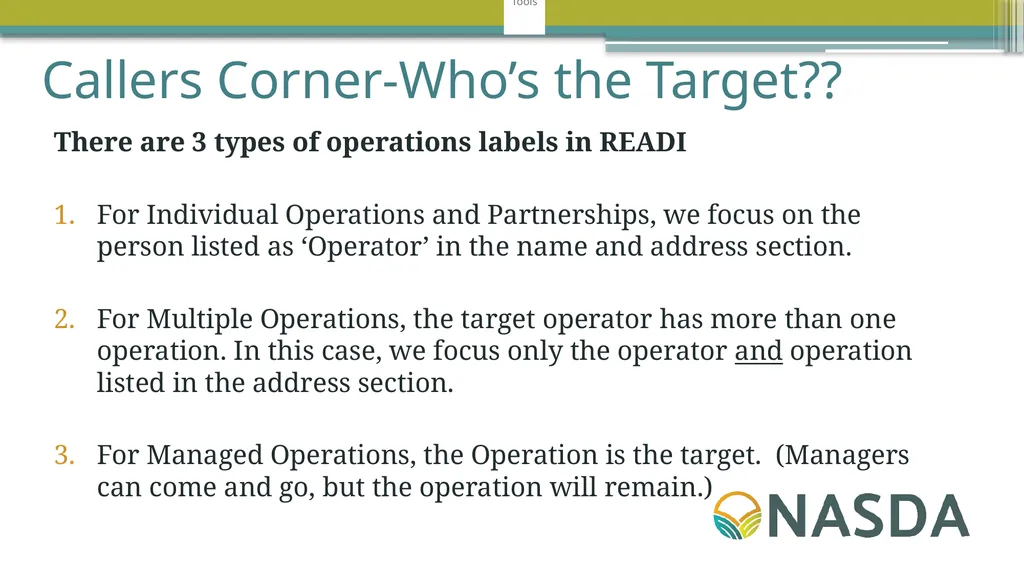
Callers Corner-Who’s the Target?? Tools There are 3 types of operations labels in READI
For Individual Operations and Partnerships, we focus on the person listed as ‘Operator’ in the name and address section.
For Multiple Operations, the target operator has more than one operation. In this case, we focus only the operator and operation listed in the address section.
For Managed Operations, the Operation is the target. (Managers can come and go, but the operation will remain.)<br>
34
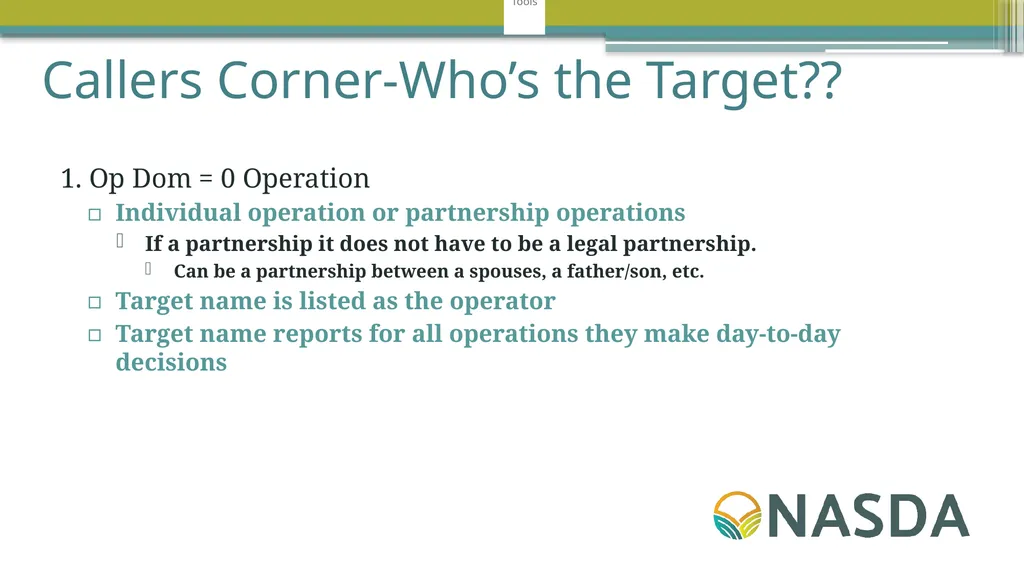
Callers Corner-Who’s the Target?? Tools 1. Op Dom = 0 Operation
Individual operation or partnership operations
If a partnership it does not have to be a legal partnership.
Can be a partnership between a spouses, a father/son, etc.
Target name is listed as the operator
Target name reports for all operations they make day-to-day decisions<br>
Individual operation or partnership operations
If a partnership it does not have to be a legal partnership.
Can be a partnership between a spouses, a father/son, etc.
Target name is listed as the operator
Target name reports for all operations they make day-to-day decisions<br>
35
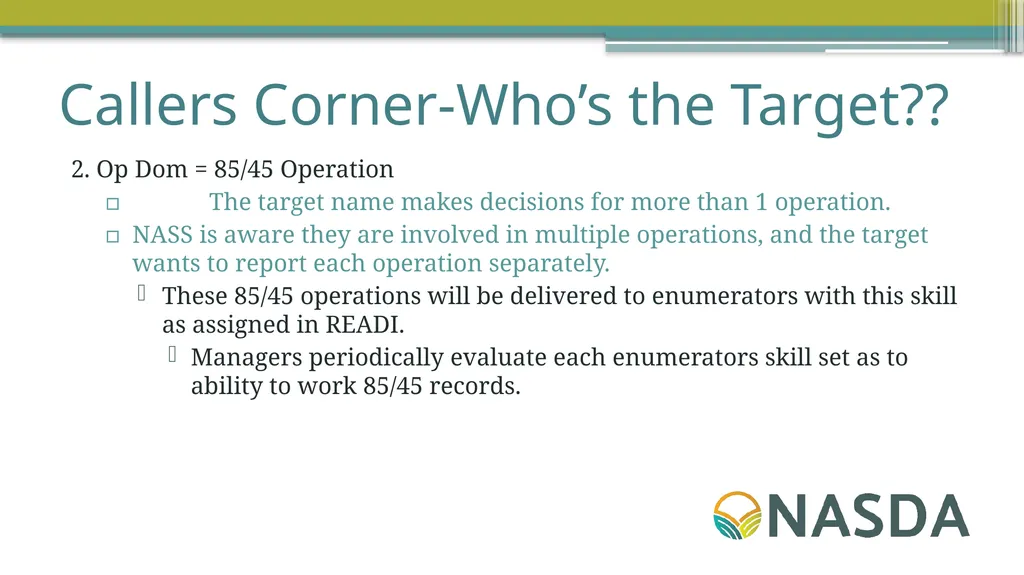
Callers Corner-Who’s the Target?? 2. Op Dom = 85/45 Operation
The target name makes decisions for more than 1 operation.
NASS is aware they are involved in multiple operations, and the target wants to report each operation separately.
These 85/45 operations will be delivered to enumerators with this skill as assigned in READI.
Managers periodically evaluate each enumerators skill set as to ability to work 85/45 records.<br>
36
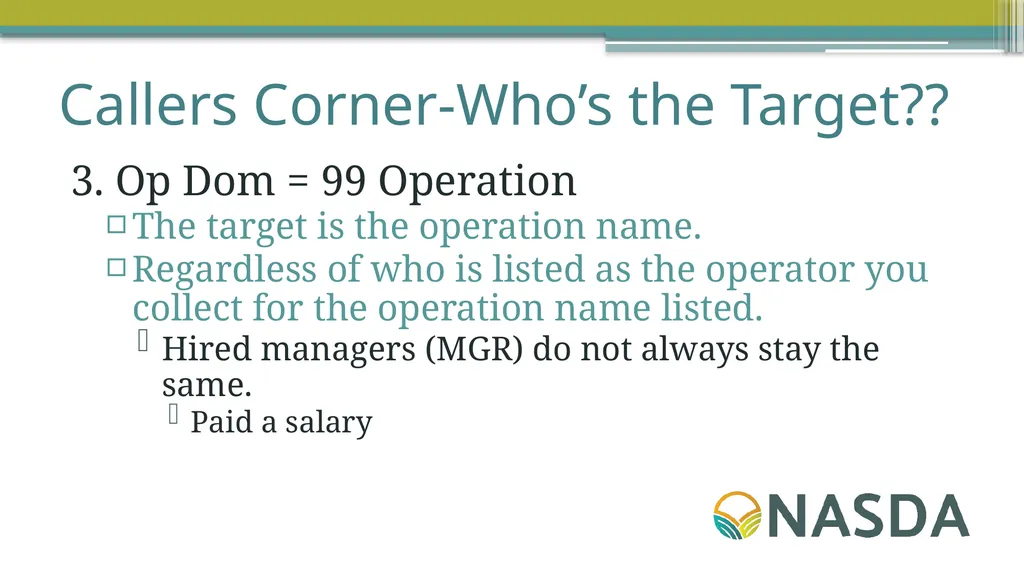
Callers Corner-Who’s the Target?? 3. Op Dom = 99 Operation
The target is the operation name.
Regardless of who is listed as the operator you collect for the operation name listed.
Hired managers (MGR) do not always stay the same.
Paid a salary<br>
The target is the operation name.
Regardless of who is listed as the operator you collect for the operation name listed.
Hired managers (MGR) do not always stay the same.
Paid a salary<br>
37
Callers Corner-Who’s the Target?? Tools **Remember – you can certainly talk to someone other than the target to complete the questionnaire - just know your target!!<br>
38
Current Events Impacting our Farmers Historic Wheat Losses: The USDA’s WASDE report lowered the U.S. winter
wheat crop projection to 1.03 billion bushels—the lowest production level since 1965. This drop is primarily driven by prolonged drought in the Southern Plains, resulting in USDA condition ratings hitting record lows.
Federal Trade Commission (FTC) Fertilizer Investigation: The FTC launched a formal antitrust probe
into the fertilizer industry to investigate allegations of market collusion
and rapidly escalating input costs for growers.<br>
39
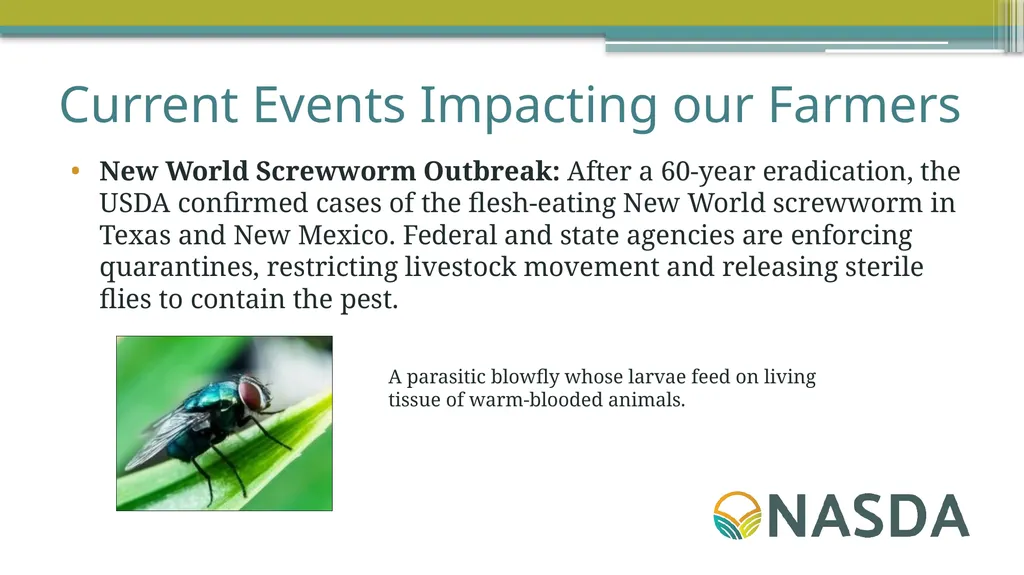
Current Events Impacting our Farmers New World Screwworm Outbreak: After a 60-year eradication, the USDA confirmed cases of the flesh-eating New World screwworm in Texas and New Mexico. Federal and state agencies are enforcing quarantines, restricting livestock movement and releasing sterile flies to contain the pest. A parasitic blowfly whose larvae feed on living
tissue of warm-blooded animals.<br>
tissue of warm-blooded animals.<br>
40
New World Screwworm To date 19 confirmed cases
18 cases in TX
Quarantine restrictions in place on 16 counties
Affection cattle/goat
Risk to people is low and is not contagious.<br>
18 cases in TX
Quarantine restrictions in place on 16 counties
Affection cattle/goat
Risk to people is low and is not contagious.<br>
41
Questions<br>