
Navigating Performance Discussions and the
AS
Published · 38 slides · 0 views
1 / 1




Description
Navigating Performance Discussions and the Accommodation Process AskJAN.org JAN is a service of the U.S. Department of Labors Office of Disability Employment PolicyODEP. Training Overview Navigating Performance Discussions and the
Related Topics
Download this presentation From Below
"Navigating Performance Discussions and the" is the property of its rightful owner. Permission is granted to download and print the materials on this website for personal, non-commercial use only, and to display it on your personal computer provided you do not modify the materials and that you retain all copyright notices contained in the materials. By downloading content from our website, you accept the terms of this agreement.
Share
Embed code
Presentation Transcript
01
Navigating Performance Discussions
and the Accommodation Process AskJAN.org
JAN is a service of the U.S. Department of Labor’s Office of Disability Employment Policy/ODEP.<br>
JAN is a service of the U.S. Department of Labor’s Office of Disability Employment Policy/ODEP.<br>
02
Training Overview Navigating Performance Discussions and the Accommodation Process
Learn effective strategies for approaching performance conversations and navigating a disability disclosure that may lead to providing reasonable accommodations. This Job Accommodation Network (JAN) training provides supervisors and managers with the practical skills, knowledge, and confidence to navigate the accommodation process effectively. Learn what to say and how to collaboratively explore accommodation solutions when performance is a factor. This training will include scenarios featuring various health conditions, limitations, and job tasks. 2<br>
Learn effective strategies for approaching performance conversations and navigating a disability disclosure that may lead to providing reasonable accommodations. This Job Accommodation Network (JAN) training provides supervisors and managers with the practical skills, knowledge, and confidence to navigate the accommodation process effectively. Learn what to say and how to collaboratively explore accommodation solutions when performance is a factor. This training will include scenarios featuring various health conditions, limitations, and job tasks. 2<br>
03
Job Accommodation Network (JAN) Established in 1983, JAN is a free, confidential, direct assistance provider for employers, people with disabilities, and others.
JAN is the leading source for practical guidance on workplace accommodations, the accommodation process, and technical assistance on Title I of the Americans with Disabilities Act (ADA) and related laws.
JAN is a national service provided by the U.S. Department of Labor’s Office of Disability Employment Policy (ODEP). 3<br>
JAN is the leading source for practical guidance on workplace accommodations, the accommodation process, and technical assistance on Title I of the Americans with Disabilities Act (ADA) and related laws.
JAN is a national service provided by the U.S. Department of Labor’s Office of Disability Employment Policy (ODEP). 3<br>
04
JAN is a Trusted Partner
in the Accommodation Process Accommodation information is provided by qualified and experienced subject matter experts who deliver individualized consultation that meets the user where they are, and considers the following:
Job requirements of the employer
Specific job tasks of the employee
Functional limitations of the individual
Environment in which the employee must work
For more information, go to AskJAN.org. 4<br>
Job requirements of the employer
Specific job tasks of the employee
Functional limitations of the individual
Environment in which the employee must work
For more information, go to AskJAN.org. 4<br>
05
The ADA at 35—
Impact on Employment The Americans with Disabilities Act (ADA) is a landmark civil rights law passed in 1990 to prohibit discrimination based on disability.
Title I of the ADA helps people with disabilities enter or stay in the workforce.
Ensures people with disabilities can fully engage in work.
Levels the playing field to ensure fair treatment and opportunity.
Gives people the right to ask for what they need to succeed at work.
The ADA laid the groundwork, but its power depends on continued education, implementation, and collective commitment. 5<br>
Title I of the ADA helps people with disabilities enter or stay in the workforce.
Ensures people with disabilities can fully engage in work.
Levels the playing field to ensure fair treatment and opportunity.
Gives people the right to ask for what they need to succeed at work.
The ADA laid the groundwork, but its power depends on continued education, implementation, and collective commitment. 5<br>
06
The ADA at 35—
Reasonable Accommodations Employment rates for people with disabilities have steadily improved, but rates are still lower than for those without disabilities.
Reasonable accommodations make a difference.
Workplace adjustments often start as accommodations—but benefit everyone (e.g., flexible work arrangements).
Accommodations can be simple and no or low-cost.
Accommodations support productivity and retention.
Celebrating 35 years reminds us to protect the progress made— and to keep pushing forward. 6<br>
Reasonable accommodations make a difference.
Workplace adjustments often start as accommodations—but benefit everyone (e.g., flexible work arrangements).
Accommodations can be simple and no or low-cost.
Accommodations support productivity and retention.
Celebrating 35 years reminds us to protect the progress made— and to keep pushing forward. 6<br>
07
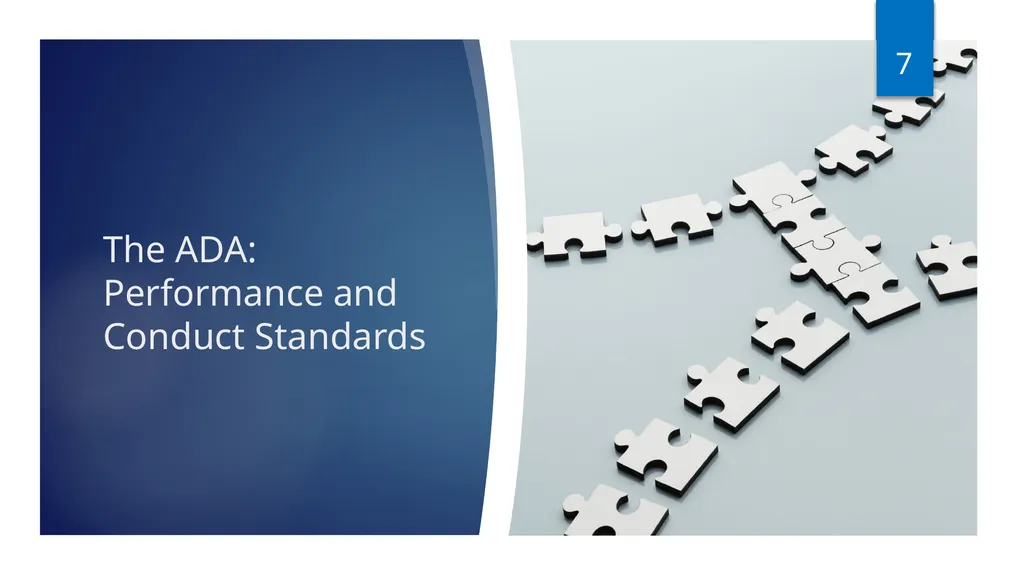
The ADA: Performance and Conduct Standards 7<br>
08
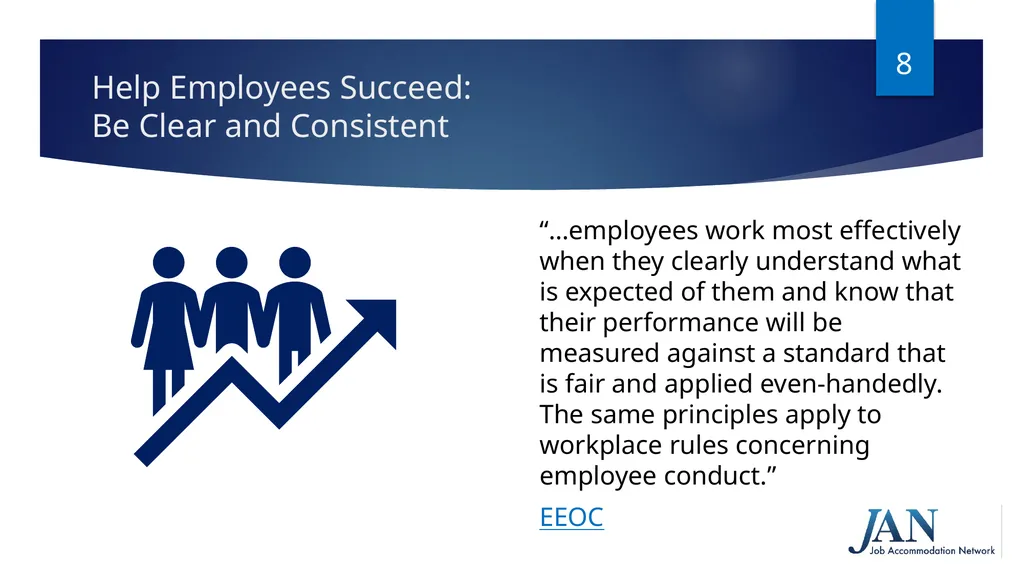
Help Employees Succeed:
Be Clear and Consistent “…employees work most effectively when they clearly understand what is expected of them and know that their performance will be measured against a standard that is fair and applied even-handedly. The same principles apply to workplace rules concerning employee conduct.”
EEOC 8<br>
EEOC 8<br>
09
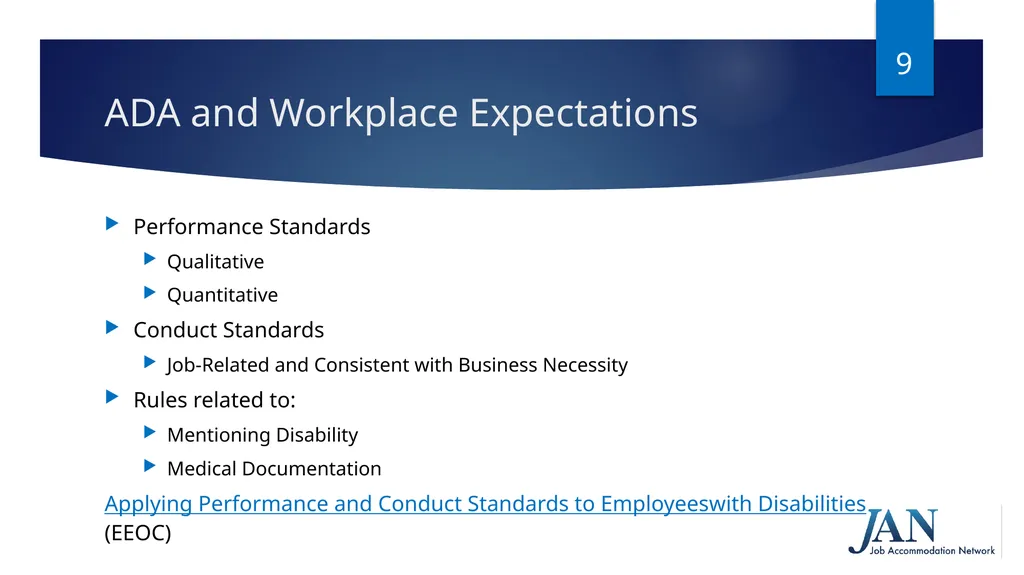
ADA and Workplace Expectations Performance Standards
Qualitative
Quantitative
Conduct Standards
Job-Related and Consistent with Business Necessity
Rules related to:
Mentioning Disability
Medical Documentation
Applying Performance and Conduct Standards to Employees with Disabilities (EEOC) 9<br>
Qualitative
Quantitative
Conduct Standards
Job-Related and Consistent with Business Necessity
Rules related to:
Mentioning Disability
Medical Documentation
Applying Performance and Conduct Standards to Employees with Disabilities (EEOC) 9<br>
10
Enforcing Performance and
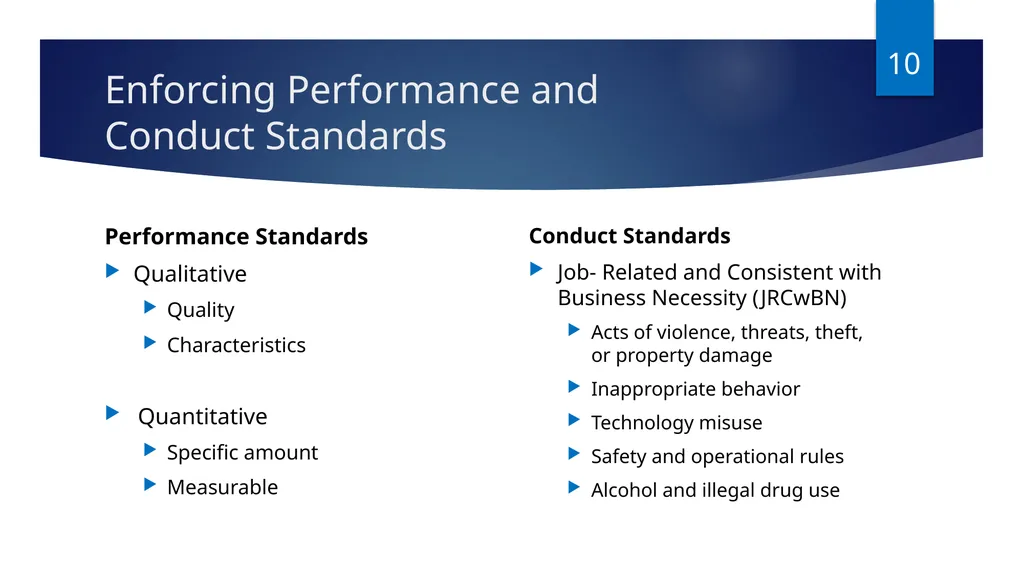
Conduct Standards Performance Standards
Qualitative
Quality
Characteristics
Quantitative
Specific amount
Measurable Conduct Standards
Job- Related and Consistent with Business Necessity (JRCwBN)
Acts of violence, threats, theft, or property damage
Inappropriate behavior
Technology misuse
Safety and operational rules
Alcohol and illegal drug use 10<br>
Qualitative
Quality
Characteristics
Quantitative
Specific amount
Measurable Conduct Standards
Job- Related and Consistent with Business Necessity (JRCwBN)
Acts of violence, threats, theft, or property damage
Inappropriate behavior
Technology misuse
Safety and operational rules
Alcohol and illegal drug use 10<br>
11
Using Accommodations to
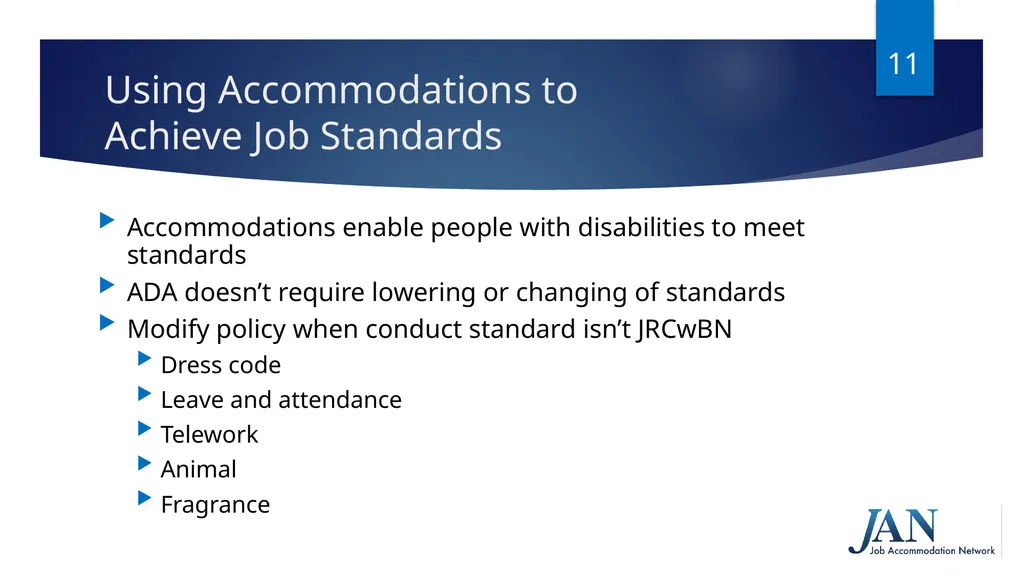
Achieve Job Standards Accommodations enable people with disabilities to meet standards
ADA doesn’t require lowering or changing of standards
Modify policy when conduct standard isn’t JRCwBN
Dress code
Leave and attendance
Telework
Animal
Fragrance 11<br>
ADA doesn’t require lowering or changing of standards
Modify policy when conduct standard isn’t JRCwBN
Dress code
Leave and attendance
Telework
Animal
Fragrance 11<br>
12
Performance Management of Employees with Disabilities 12<br>
13
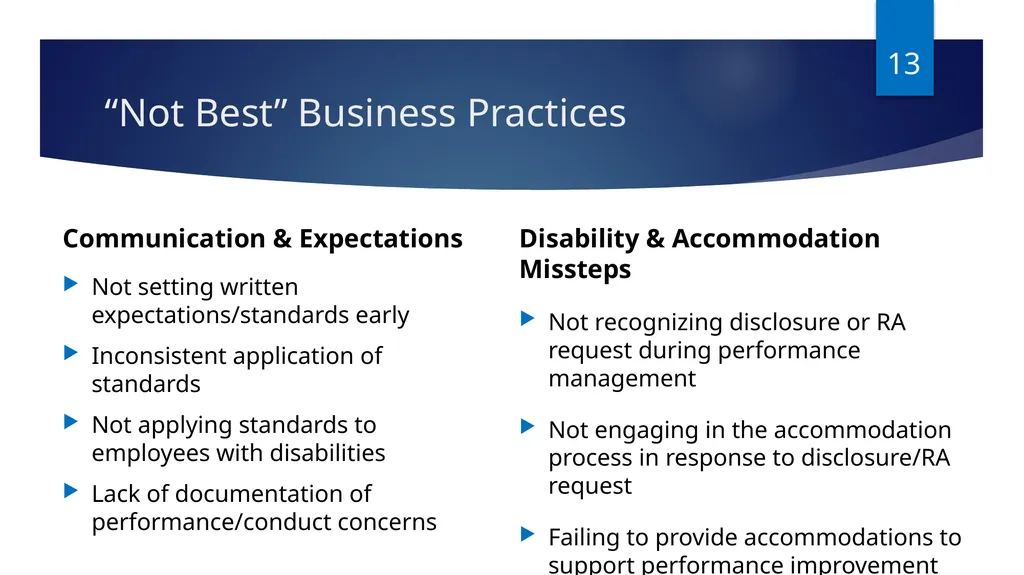
“Not Best” Business Practices Communication & Expectations
Not setting written expectations/standards early
Inconsistent application of standards
Not applying standards to employees with disabilities
Lack of documentation of performance/conduct concerns Disability & Accommodation Missteps
Not recognizing disclosure or RA request during performance management
Not engaging in the accommodation process in response to disclosure/RA request
Failing to provide accommodations to support performance improvement 13<br>
Not setting written expectations/standards early
Inconsistent application of standards
Not applying standards to employees with disabilities
Lack of documentation of performance/conduct concerns Disability & Accommodation Missteps
Not recognizing disclosure or RA request during performance management
Not engaging in the accommodation process in response to disclosure/RA request
Failing to provide accommodations to support performance improvement 13<br>
14
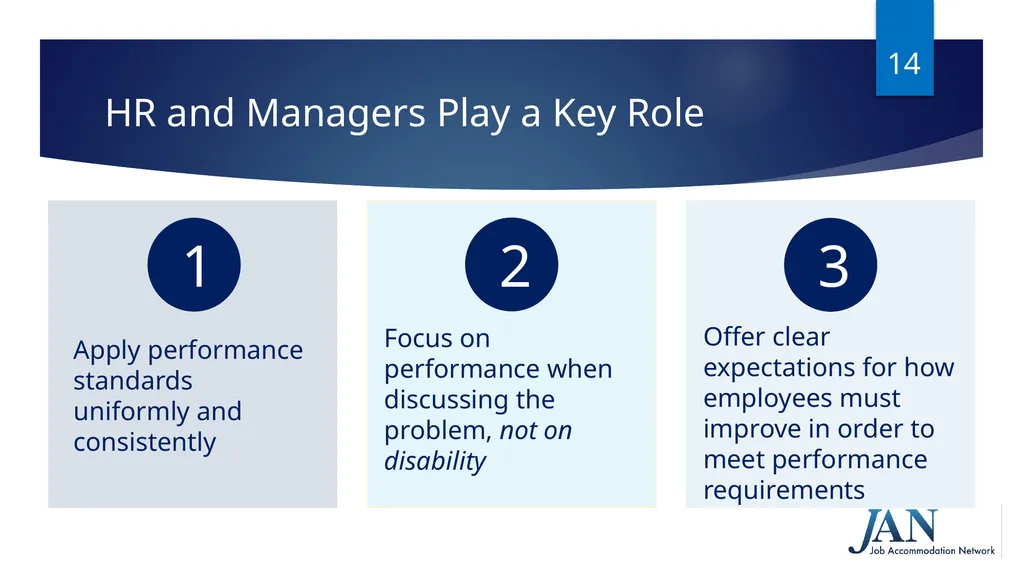
HR and Managers Play a Key Role 14 1 Apply performance standards uniformly and consistently 2 Focus on performance when discussing the problem, not on disability 3 Offer clear expectations for how employees must improve in order to meet performance requirements<br>
15
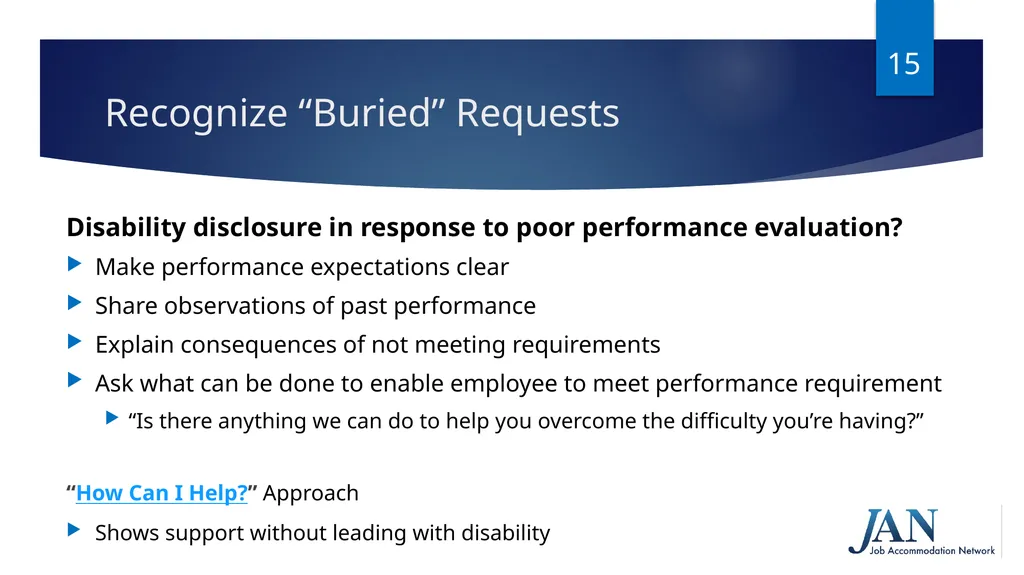
Recognize “Buried” Requests Disability disclosure in response to poor performance evaluation?
Make performance expectations clear
Share observations of past performance
Explain consequences of not meeting requirements
Ask what can be done to enable employee to meet performance requirement
“Is there anything we can do to help you overcome the difficulty you’re having?”
“How Can I Help?” Approach
Shows support without leading with disability 15<br>
Make performance expectations clear
Share observations of past performance
Explain consequences of not meeting requirements
Ask what can be done to enable employee to meet performance requirement
“Is there anything we can do to help you overcome the difficulty you’re having?”
“How Can I Help?” Approach
Shows support without leading with disability 15<br>
16
Addressing Disability
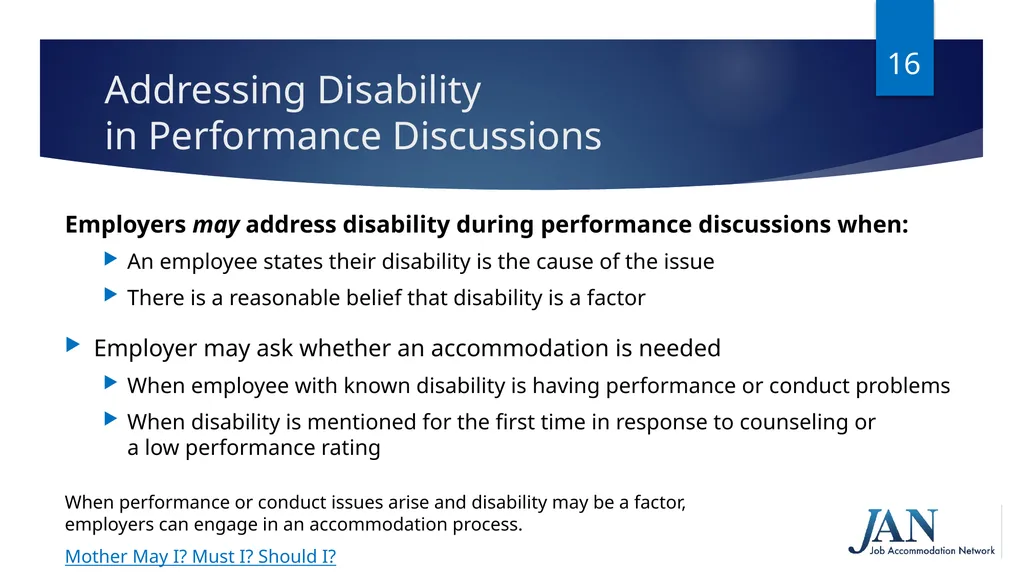
in Performance Discussions Employers may address disability during performance discussions when:
An employee states their disability is the cause of the issue
There is a reasonable belief that disability is a factor
Employer may ask whether an accommodation is needed
When employee with known disability is having performance or conduct problems
When disability is mentioned for the first time in response to counseling or a low performance rating
When performance or conduct issues arise and disability may be a factor, employers can engage in an accommodation process.
Mother May I? Must I? Should I? 16<br>
An employee states their disability is the cause of the issue
There is a reasonable belief that disability is a factor
Employer may ask whether an accommodation is needed
When employee with known disability is having performance or conduct problems
When disability is mentioned for the first time in response to counseling or a low performance rating
When performance or conduct issues arise and disability may be a factor, employers can engage in an accommodation process.
Mother May I? Must I? Should I? 16<br>
17
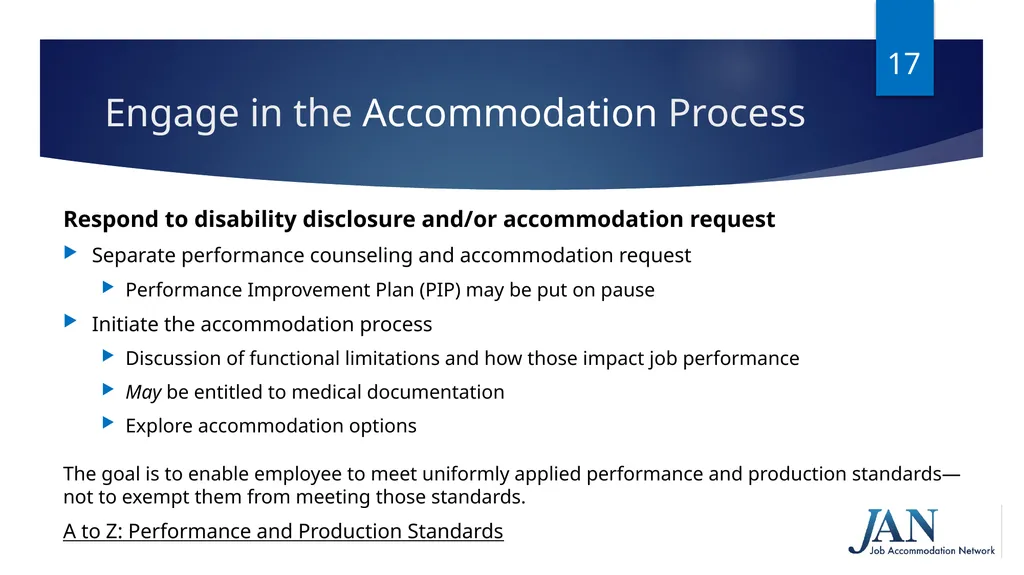
Engage in the Accommodation Process Respond to disability disclosure and/or accommodation request
Separate performance counseling and accommodation request
Performance Improvement Plan (PIP) may be put on pause
Initiate the accommodation process
Discussion of functional limitations and how those impact job performance
May be entitled to medical documentation
Explore accommodation options
The goal is to enable employee to meet uniformly applied performance and production standards—not to exempt them from meeting those standards.
A to Z: Performance and Production Standards 17<br>
Separate performance counseling and accommodation request
Performance Improvement Plan (PIP) may be put on pause
Initiate the accommodation process
Discussion of functional limitations and how those impact job performance
May be entitled to medical documentation
Explore accommodation options
The goal is to enable employee to meet uniformly applied performance and production standards—not to exempt them from meeting those standards.
A to Z: Performance and Production Standards 17<br>
18
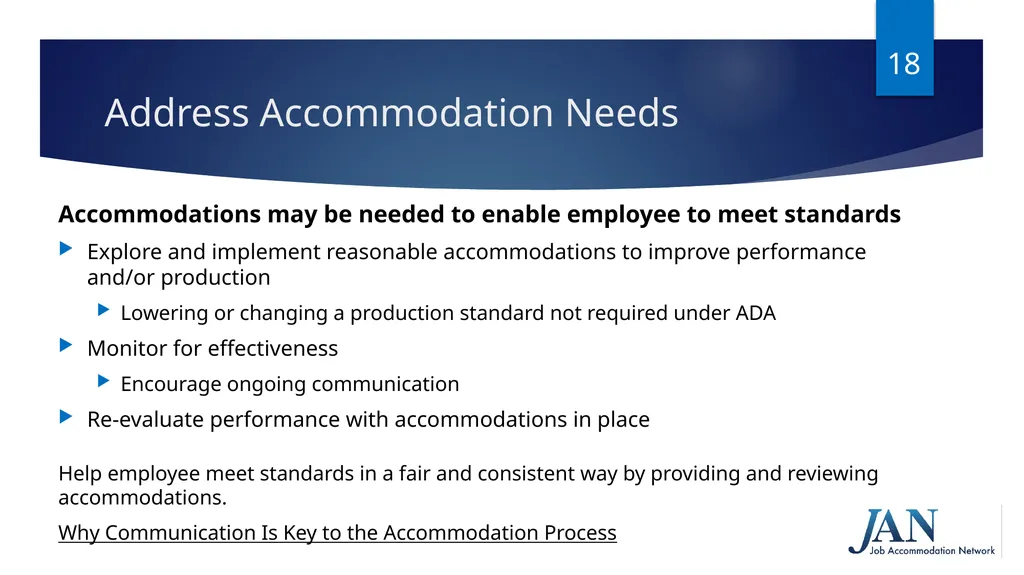
Address Accommodation Needs Accommodations may be needed to enable employee to meet standards
Explore and implement reasonable accommodations to improve performance and/or production
Lowering or changing a production standard not required under ADA
Monitor for effectiveness
Encourage ongoing communication
Re-evaluate performance with accommodations in place
Help employee meet standards in a fair and consistent way by providing and reviewing accommodations.
Why Communication Is Key to the Accommodation Process 18<br>
Explore and implement reasonable accommodations to improve performance and/or production
Lowering or changing a production standard not required under ADA
Monitor for effectiveness
Encourage ongoing communication
Re-evaluate performance with accommodations in place
Help employee meet standards in a fair and consistent way by providing and reviewing accommodations.
Why Communication Is Key to the Accommodation Process 18<br>
19
Examples 19<br>
20
Performance Improvement Plan An employee is written up after several verbal warnings for inappropriate conduct. She is placed on a thirty-day plan of improvement and warned that if the behavior doesn’t stop within the stated time period, she will be let go. The employee decides to disclose her disability and ask for accommodations to assist her in responding more appropriately to coworkers.
How do we manage a Performance Improvement Plan (PIP) when in a counseling session the employee relates the performance issues to a disability? 20<br>
How do we manage a Performance Improvement Plan (PIP) when in a counseling session the employee relates the performance issues to a disability? 20<br>
21
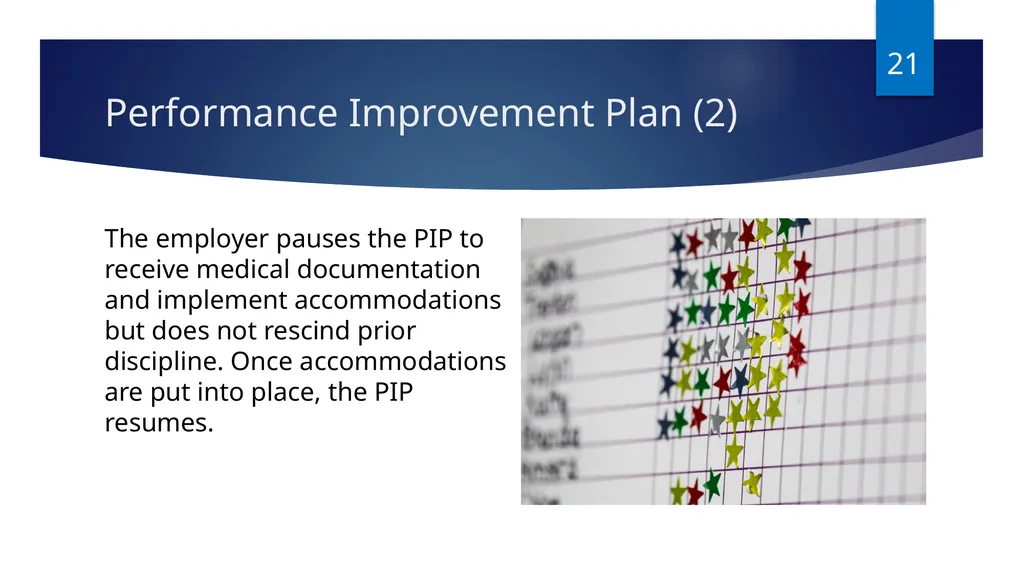
Performance Improvement Plan (2) The employer pauses the PIP to receive medical documentation
and implement accommodations
but does not rescind prior discipline. Once accommodations are put into place, the PIP resumes. 21<br>
22
Separate the Issues An employee was turning in paperwork late and when disciplined he started screaming at his supervisor and throwing things. Later he disclosed he is autistic and was very frustrated because he could not remember details when communicated verbally. His supervisor rarely put assignments and deadlines in writing. 22<br>
23
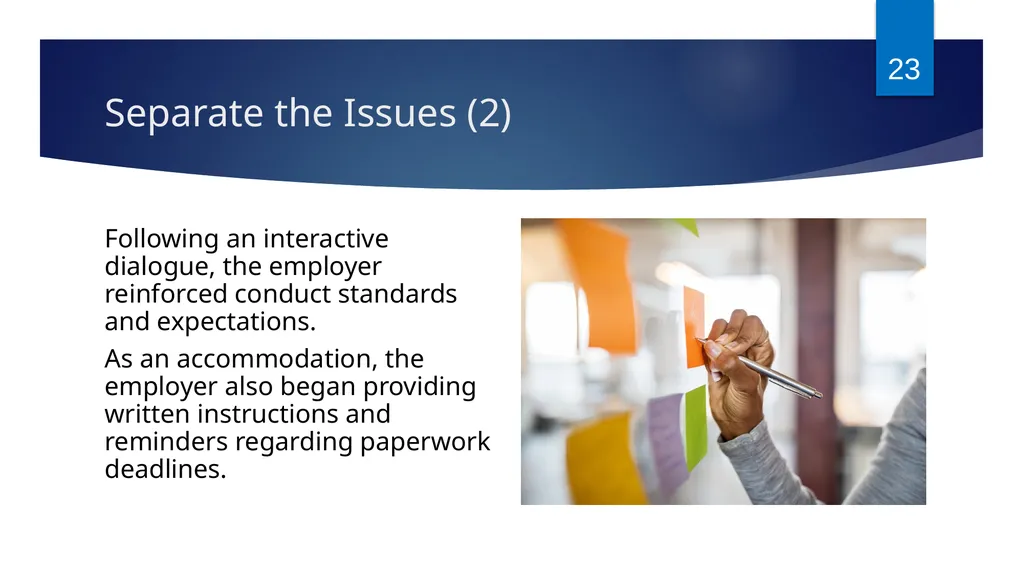
Separate the Issues (2) Following an interactive dialogue, the employer reinforced conduct standards and expectations.
As an accommodation, the employer also began providing written instructions and reminders regarding paperwork deadlines. 23<br>
As an accommodation, the employer also began providing written instructions and reminders regarding paperwork deadlines. 23<br>
24
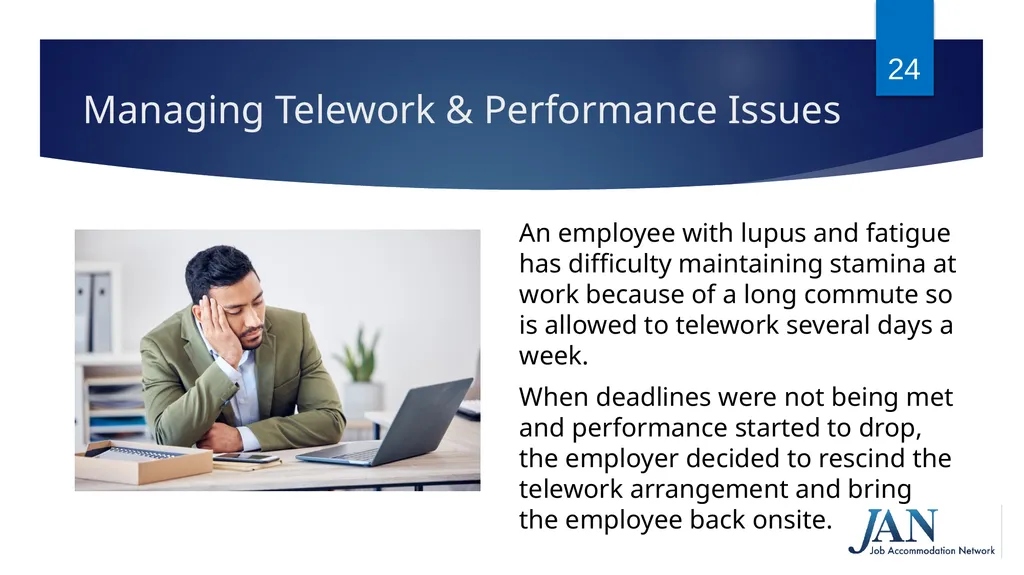
Managing Telework & Performance Issues An employee with lupus and fatigue has difficulty maintaining stamina at work because of a long commute so
is allowed to telework several days a week.
When deadlines were not being met and performance started to drop, the employer decided to rescind the telework arrangement and bring the employee back onsite. 24<br>
When deadlines were not being met and performance started to drop, the employer decided to rescind the telework arrangement and bring the employee back onsite. 24<br>
25
Managing Telework & Performance Issues (2) After consulting with JAN, the employer chose to use the “How Can I Help?” approach to initiate the conversation. The employee disclosed that they had been dealing with personal issues outside of work, which have been resolved. They assured the employer that their job performance would improve.
Key Takeaway: Rescinding an accommodation without fully understanding the situation can be problematic. 25<br>
Key Takeaway: Rescinding an accommodation without fully understanding the situation can be problematic. 25<br>
26
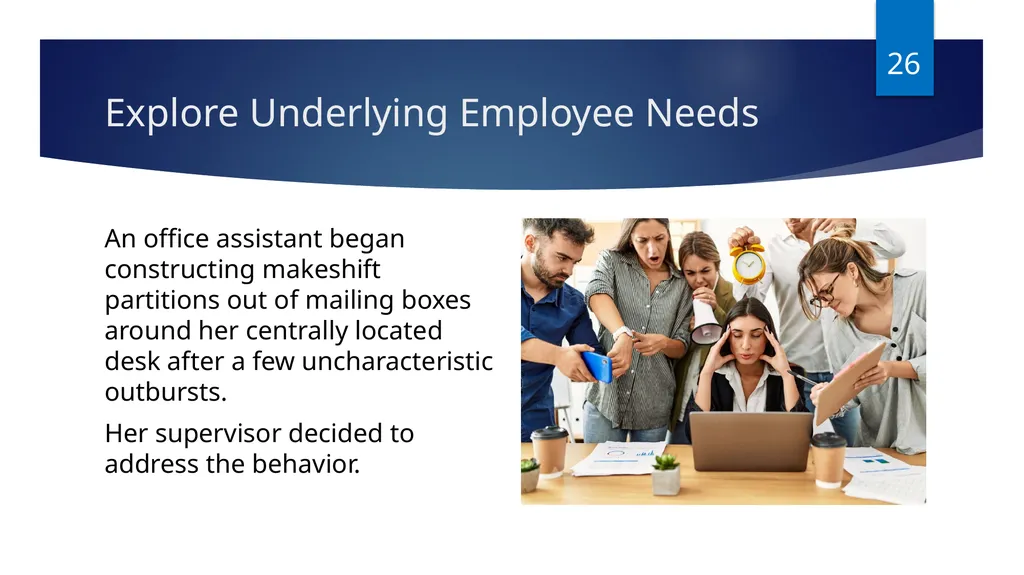
Explore Underlying Employee Needs An office assistant began constructing makeshift partitions out of mailing boxes around her centrally located desk after a few uncharacteristic outbursts.
Her supervisor decided to address the behavior. 26<br>
Her supervisor decided to address the behavior. 26<br>
27
Explore Underlying Employee Needs (2) The employee previously told the supervisor she was struggling and needed more privacy.
The supervisor responded, “We would all like more privacy—just go back to work.”
Key Takeaway: Instead of dismissing the request, the supervisor could have asked follow-up questions to understand the underlying issue and find an effective solution. 27<br>
The supervisor responded, “We would all like more privacy—just go back to work.”
Key Takeaway: Instead of dismissing the request, the supervisor could have asked follow-up questions to understand the underlying issue and find an effective solution. 27<br>
28
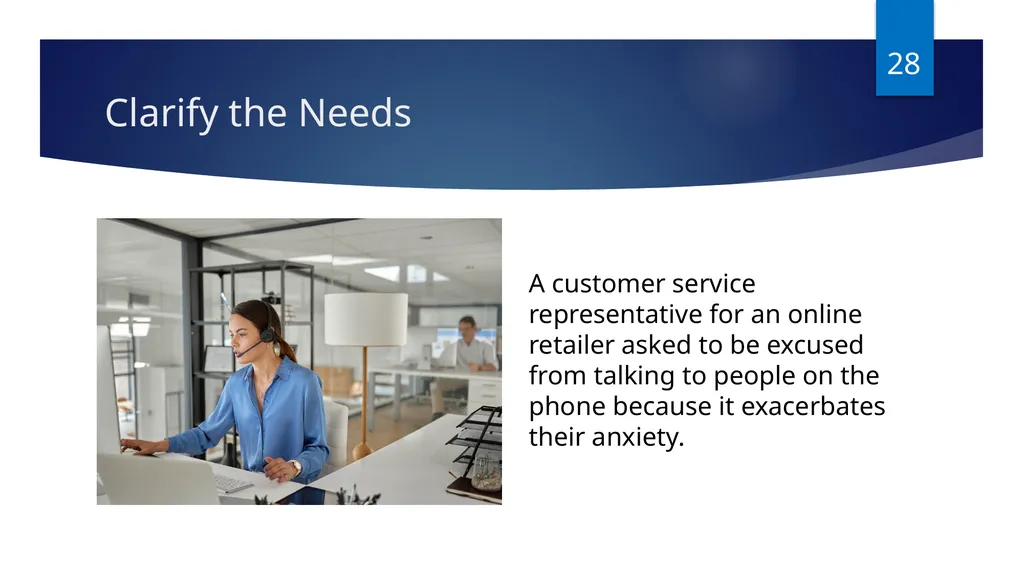
Clarify the Needs A customer service representative for an online retailer asked to be excused from talking to people on the phone because it exacerbates their anxiety. 28<br>
29
Clarify the Needs (2) The employer denied the request citing that assisting customers via phone was considered an essential function.
After the employee appealed the employer’s decision and discussed the cause of their anxiety, the employer was able to provide accommodations that enabled the employee to continue talking on the phone.
Key Takeaway: Never overlook a full conversation; try to get specifics to explore accommodation ideas. 29<br>
After the employee appealed the employer’s decision and discussed the cause of their anxiety, the employer was able to provide accommodations that enabled the employee to continue talking on the phone.
Key Takeaway: Never overlook a full conversation; try to get specifics to explore accommodation ideas. 29<br>
30
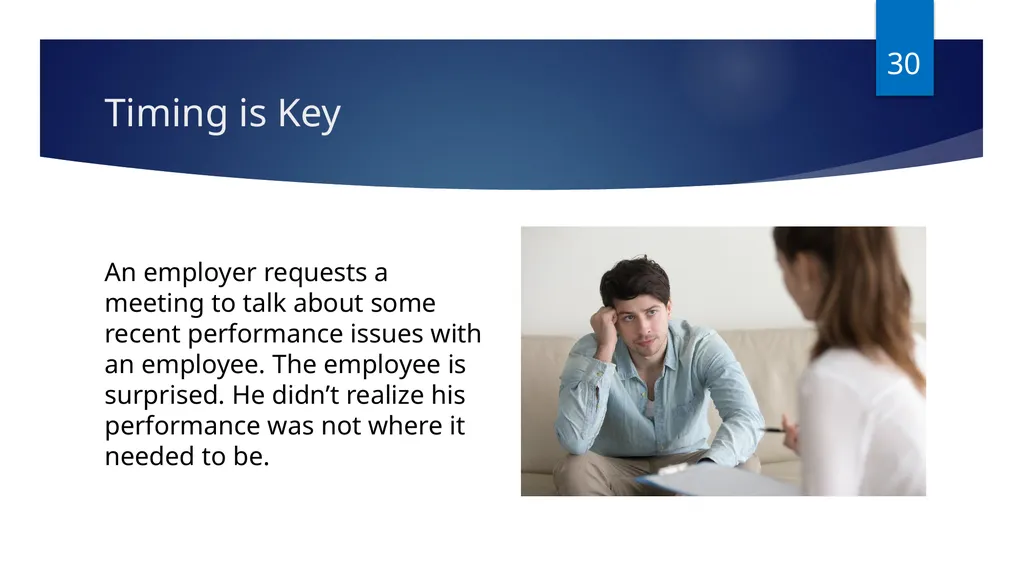
Timing is Key An employer requests a meeting to talk about some recent performance issues with an employee. The employee is surprised. He didn’t realize his performance was not where it needed to be. 30<br>
31
Timing is Key (2) The employer explained the performance issues, outlined the expected standards, and clarified the potential consequences if performance did not improve in a timely manner.
Key Takeaway: Address performance issues early to give the employee the best chance to succeed. 31<br>
Key Takeaway: Address performance issues early to give the employee the best chance to succeed. 31<br>
32
Conversation Starters for Feedback and Performance Talks 32<br>
33
Opening the Conversation Neutrally and Supportively “I’d like to talk with you about some recent performance concerns and see how we can work together to address them.”
“Let’s review some workplace expectations and talk about any challenges you might be facing in meeting them.”
“This is a check-in to understand what’s going on and to see what support might be helpful.” 33<br>
“Let’s review some workplace expectations and talk about any challenges you might be facing in meeting them.”
“This is a check-in to understand what’s going on and to see what support might be helpful.” 33<br>
34
Inviting Disclosure Without Making Assumptions “If there’s anything going on that might be affecting your performance—personal, health-related, or otherwise—you’re welcome to share it if you feel comfortable. We want to be supportive.”
“Sometimes employees face challenges that aren’t immediately visible. If there’s something affecting your work that we should be aware of, we can explore available support or resources.”
"I’m not making any assumptions, but if there’s something affecting your performance that we should be aware of, we can explore options for support. That’s always something we’re open to if needed." 34<br>
“Sometimes employees face challenges that aren’t immediately visible. If there’s something affecting your work that we should be aware of, we can explore available support or resources.”
"I’m not making any assumptions, but if there’s something affecting your performance that we should be aware of, we can explore options for support. That’s always something we’re open to if needed." 34<br>
35
Emphasizing Collaboration and Support “Our goal is to support your success here while also addressing the issues we’ve identified.”
“We want to work with you to find solutions and ensure you’re set up for success moving forward.”
“Please let me know if there’s anything we can do to better support you in meeting your responsibilities.” 35<br>
“We want to work with you to find solutions and ensure you’re set up for success moving forward.”
“Please let me know if there’s anything we can do to better support you in meeting your responsibilities.” 35<br>
36
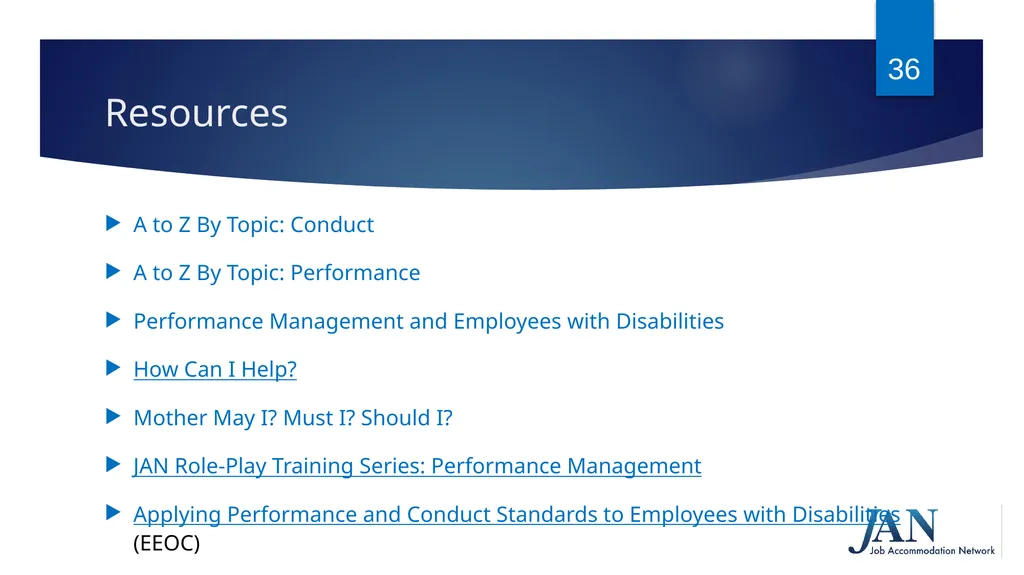
Resources A to Z By Topic: Conduct
A to Z By Topic: Performance
Performance Management and Employees with Disabilities
How Can I Help?
Mother May I? Must I? Should I?
JAN Role-Play Training Series: Performance Management
Applying Performance and Conduct Standards to Employees with Disabilities (EEOC) 36<br>
A to Z By Topic: Performance
Performance Management and Employees with Disabilities
How Can I Help?
Mother May I? Must I? Should I?
JAN Role-Play Training Series: Performance Management
Applying Performance and Conduct Standards to Employees with Disabilities (EEOC) 36<br>
37
Ask JAN!
We can help. AskJAN.org 800.526.7234 Live Chat @ AskJAN.org Email JAN@AskJAN.org 37 37<br>
38
Social Media Job Accommodation Network Job Accommodation Network JANatJAN JANinformation 38<br>