
NCA5 Website: https://nca2023.globalchange.gov
Description: NCA5 Website: https:nca2023.globalchange.gov Chapter Website: https:nca2023.globalchange.govchapter31 NCA5 Atlas: https:atlas.globalchange.gov Figure captions can be found in the slide notes of this deck Social media: usgcrp, NCA5
Related Topics
Download Presentation
"NCA5 Website: https://nca2023.globalchange.gov" is the property of its rightful owner. Permission is granted to download and print the materials on this website for personal, non-commercial use only, and to display it on your personal computer provided you do not modify the materials and that you retain all copyright notices contained in the materials. By downloading content from our website, you accept the terms of this agreement.
Presentation Transcript
slide1. NCA5 Website: https://nca2023.globalchange.gov
Chapter Website: https://nca2023.globalchange.gov/chapter/31
NCA5 Atlas: https://atlas.globalchange.gov
Figure captions can be found in the slide notes of this deck
Social media: @usgcrp, #NCA5<br>
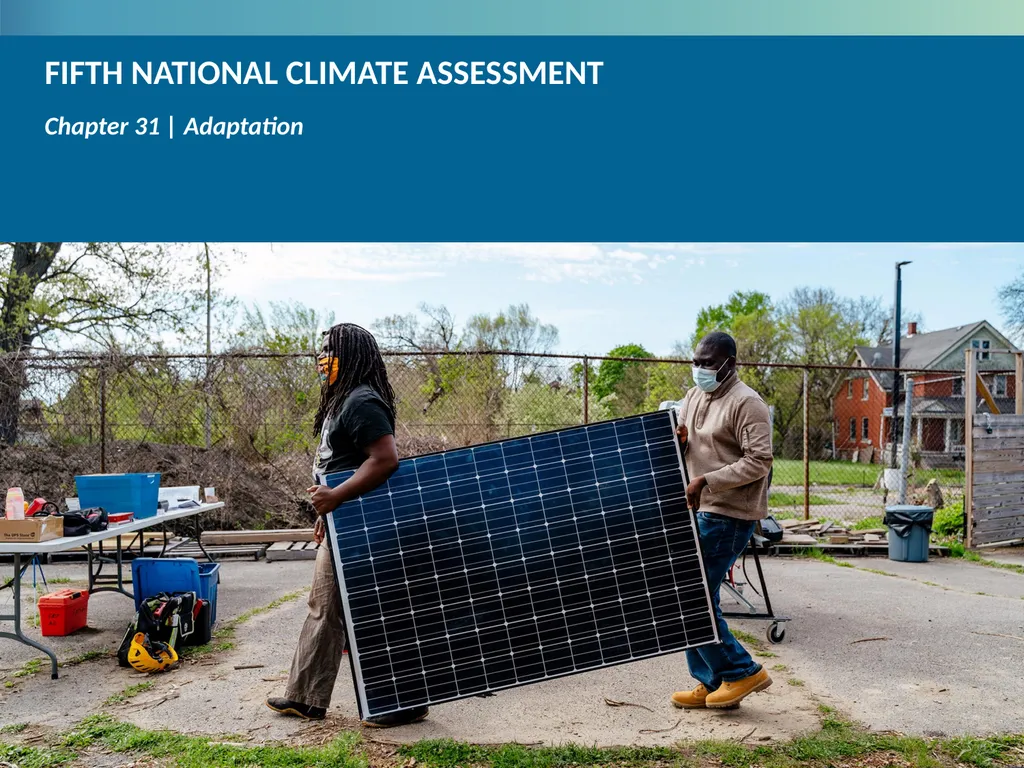
slide2. Chapter 31 | Adaptation<br>
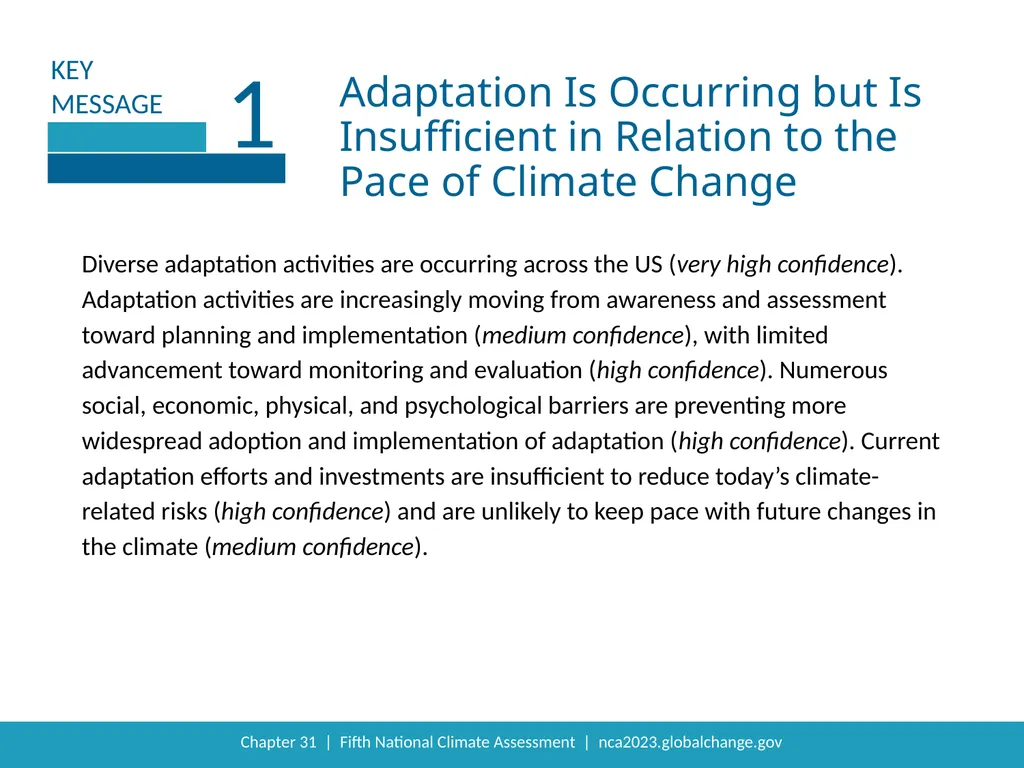
slide3. Adaptation Is Occurring but Is Insufficient in Relation to the Pace of Climate Change Diverse adaptation activities are occurring across the US (very high confidence). Adaptation activities are increasingly moving from awareness and assessment toward planning and implementation (medium confidence), with limited advancement toward monitoring and evaluation (high confidence). Numerous social, economic, physical, and psychological barriers are preventing more widespread adoption and implementation of adaptation (high confidence). Current adaptation efforts and investments are insufficient to reduce today’s climate-related risks (high confidence) and are unlikely to keep pace with future changes in the climate (medium confidence). 1<br>
slide4. Effective Adaptation Requires Centering Equity People and communities are affected by climate change in different ways (very high confidence). How people and institutions adapt depends on social factors, including individual and community preferences, capacity, and access to resources (very high confidence). Adaptation processes, decisions (about whether, where, and how adaptation occurs), and actions that do not explicitly address the uneven distribution of climate harms, and the social processes and injustices underlying these disparities, can exacerbate social inequities and increase exposure to climate harms (high confidence). 2<br>
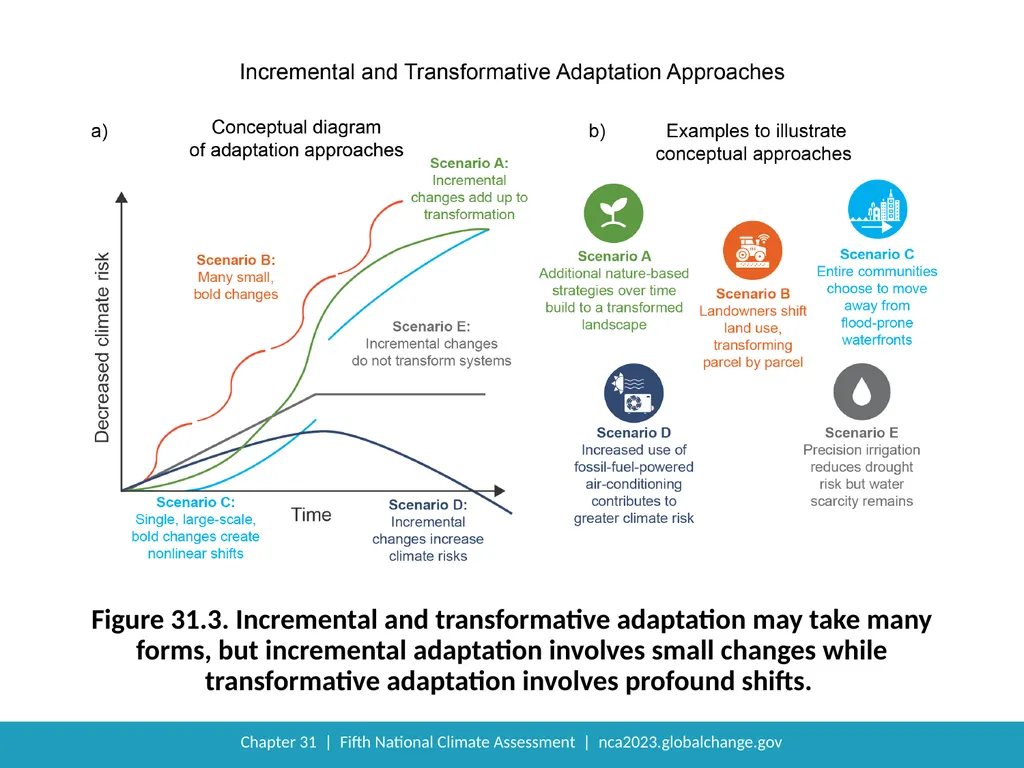
slide5. Transformative Adaptation Will Be Needed to Adequately Address Climate-Related Risks Climate adaptation actions undertaken in the United States to date have generally been small in scale and incremental in approach, involving minor changes to business as usual (very high confidence). Transformative adaptation, which involves more fundamental shifts in systems, values, and practices, will be necessary in many cases to adequately address the risks of current and future climate change (high confidence). New monitoring and evaluation methods will also be needed to assess the effectiveness and sufficiency of adaptation and to address equity (high confidence). 3<br>
slide6. Effective Adaptation Governance Empowers Multiple Voices to Navigate Competing Goals Adaptation involves actors from government, private-sector, nongovernmental (e.g., nonprofit and for-profit institutions), and civil society organizations, which often have different priorities and approaches (high confidence). Adaptation decision-makers must balance competing goals while also addressing uncertainties regarding future climate change and the ways that political, social, and technological systems will be transformed (high confidence). To minimize the potential for adaptation actions to benefit some at the expense of others, adaptation processes must emphasize collaboration, center equity and justice, and incorporate a wide range of values and knowledge sources (medium confidence). 4<br>
slide7. Adaptation Requires More Than Scientific Information and Understanding Effective adaptation to a changing climate requires both decision-relevant climate information and evidence-based decision-making approaches (high confidence). Adaptation requires that researchers intentionally collaborate with communities to identify goals, assess vulnerability, improve capacity, and address contextual factors, such as values, culture, risk perception, and historic injustices (medium confidence). Climate services can be improved by ensuring access for historically disinvested communities and by attention to procedural and recognitional equity when scientists work with communities and decision-makers (medium confidence). 5<br>
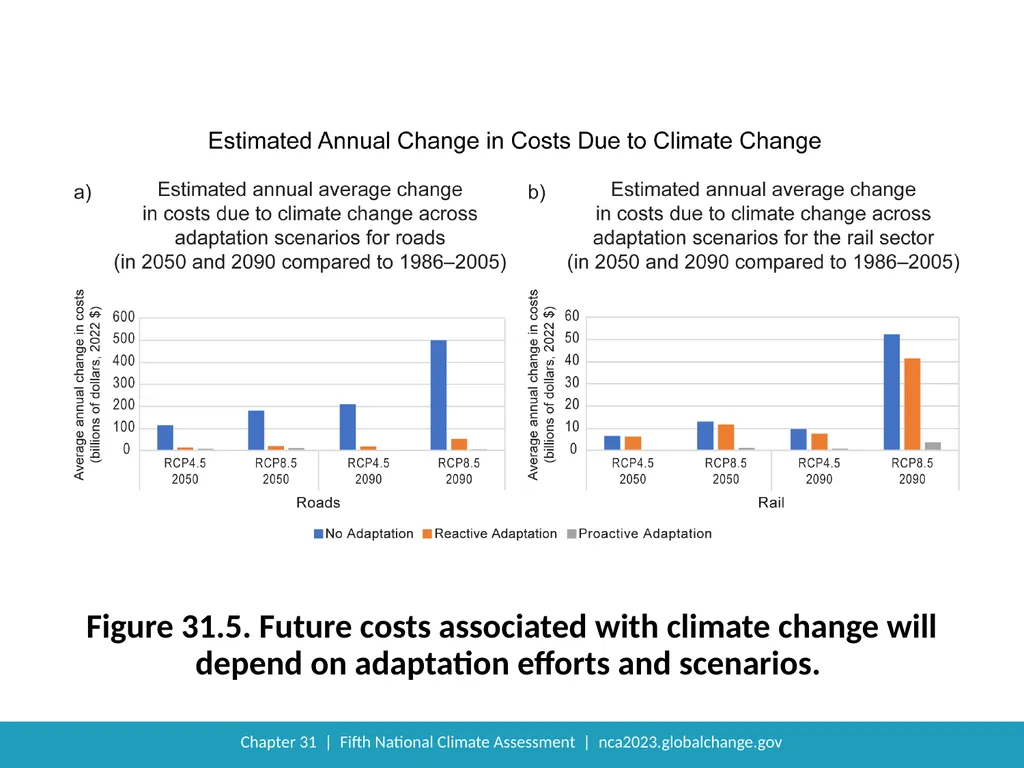
slide8. Adaptation Investments and Financing Are Difficult to Track and May Be Inadequate Investments in adaptation are being made at the federal, state, territorial, Tribal, and local levels, as well as within the private sector, but they are not always evenly distributed, coordinated, tracked, or reported (high confidence) and may be inadequate (medium confidence). Future adaptation investment needs are expected to be significant, although projected amounts vary due to uncertainty in future emissions trajectories, associated impacts, and the timing of implementation (high confidence). Proactive adaptation can reduce some of the most severe costs of future climate change, particularly under very high emissions scenarios in the late 21st century (medium confidence), although adaptation is still needed in the present for communities and infrastructure that may not be well adapted to face current climate conditions (high confidence). 6<br>
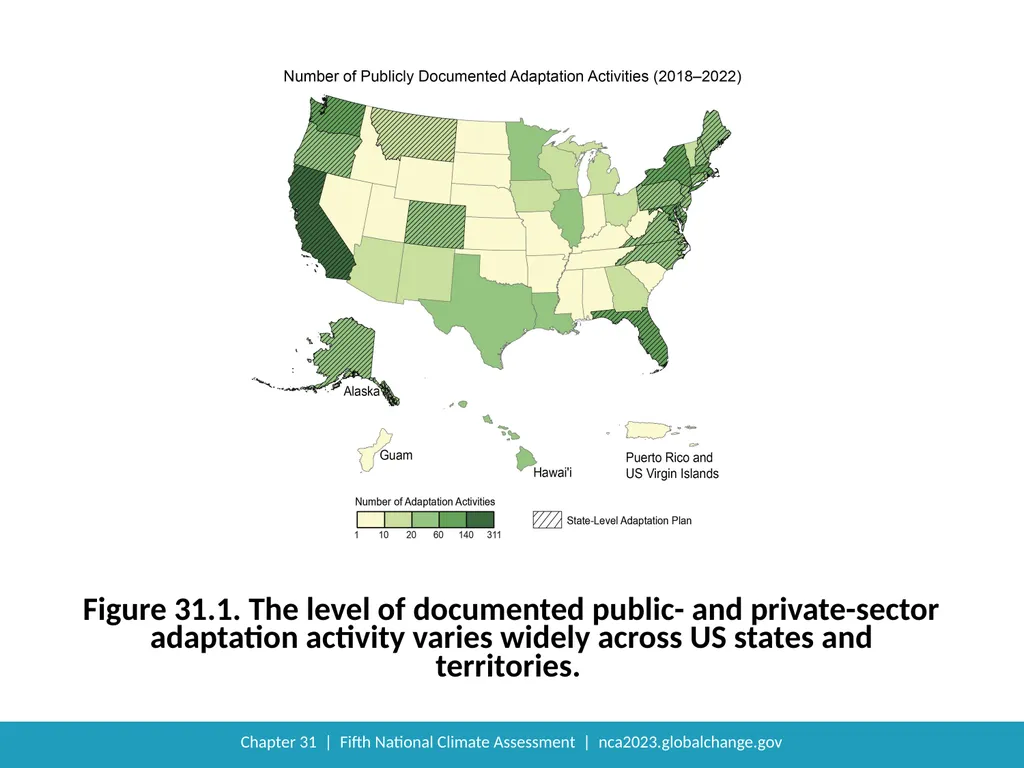
slide9. Figure 31.1. The level of documented public- and private-sector adaptation activity varies widely across US states and territories.<br>
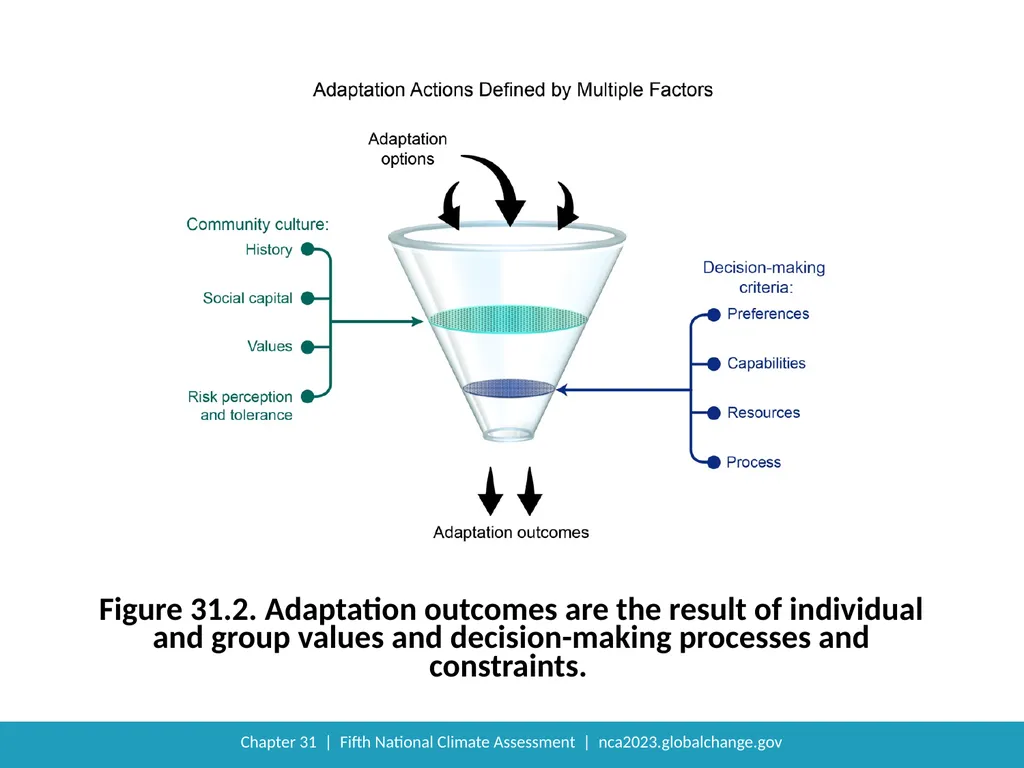
slide10. Figure 31.2. Adaptation outcomes are the result of individual and group values and decision-making processes and constraints.<br>
slide11. Figure 31.3. Incremental and transformative adaptation may take many forms, but incremental adaptation involves small changes while transformative adaptation involves profound shifts.<br>
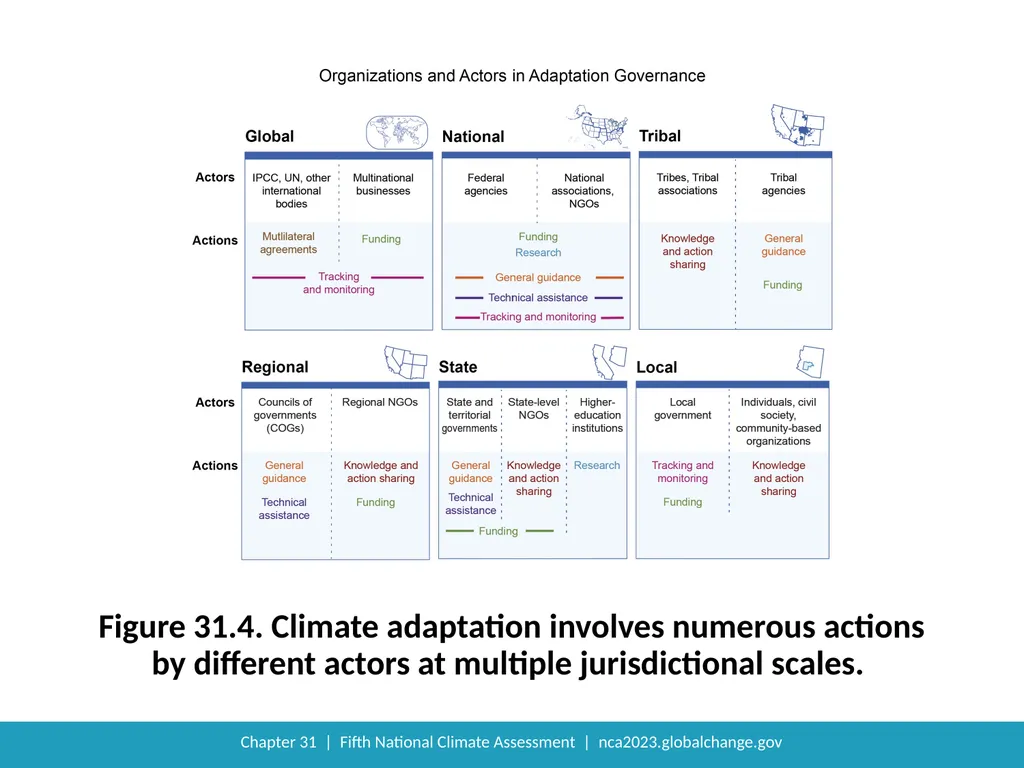
slide12. Figure 31.4. Climate adaptation involves numerous actions by different actors at multiple jurisdictional scales.<br>
slide13. Figure 31.5. Future costs associated with climate change will depend on adaptation efforts and scenarios.<br>
slide14. Federal Coordinating Lead Author
Travis A. Dahl, US Army Corps of Engineers
Chapter Lead
Emily Wasley, WSP
Agency Chapter Lead Author
Caitlin F. Simpson, National Oceanic and Atmospheric Administration
Chapter Authors
Laura West Fischer, Electric Power Research Institute
Jennifer F. Helgeson, National Institute of Standards and Technology
Melissa A. Kenney, University of Minnesota, Institute on the Environment
Adam Parris, ICF
A.R. Siders, University of Delaware, Biden School of Public Policy and Administration
Eric Tate, University of Iowa
Nicola Ulibarri, University of California, Irvine
Technical Contributors
Samuel J. Capasso III, Federal Emergency Management Agency
Shailee Desai, University of Massachusetts Boston
Tess Doeffinger, University of Delaware, Disaster Research Center
Carolyn A.F. Enquist, US Geological Survey, Southwest Climate Adaptation Science Center
Elisabeth Gilmore, Carleton University
Sharon Hausam, South Central Climate Adaptation Science Center
Jacqueline Patterson, The Chisholm Legacy Project
Morgan Richmond, Climate Policy Initiative
Daniel Rizza, Climate Central
Elizaveta Sukhinenko, WSP
Stacy A. Swann, Climate Finance Advisors, a Member of WSP
Bella Tonkonogy, Climate Policy Initiative
Art von Lehe, US Environmental Protection Agency
Review Editor
Josh Sawislak, Deloitte Consulting LLP
USGCRP Coordinators
Reid Sherman, US Global Change Research Program / ICF
Joshua Hernandez, US Global Change Research Program / ICF<br>
slide15. Wasley, E., T.A. Dahl, C.F. Simpson, L.W. Fischer, J.F. Helgeson, M.A. Kenney, A. Parris, A.R. Siders, E. Tate, and N. Ulibarri, 2023: Ch. 31. Adaptation. In: Fifth National Climate Assessment. Crimmins, A.R., C.W. Avery, D.R. Easterling, K.E. Kunkel, B.C. Stewart, and T.K. Maycock, Eds. U.S. Global Change Research Program, Washington, DC, USA. https://doi.org/10.7930/NCA5.2023.CH31 https://nca2023.globalchange.gov/chapter/31<br>
Chapter Website: https://nca2023.globalchange.gov/chapter/31
NCA5 Atlas: https://atlas.globalchange.gov
Figure captions can be found in the slide notes of this deck
Social media: @usgcrp, #NCA5<br>
slide2. Chapter 31 | Adaptation<br>
slide3. Adaptation Is Occurring but Is Insufficient in Relation to the Pace of Climate Change Diverse adaptation activities are occurring across the US (very high confidence). Adaptation activities are increasingly moving from awareness and assessment toward planning and implementation (medium confidence), with limited advancement toward monitoring and evaluation (high confidence). Numerous social, economic, physical, and psychological barriers are preventing more widespread adoption and implementation of adaptation (high confidence). Current adaptation efforts and investments are insufficient to reduce today’s climate-related risks (high confidence) and are unlikely to keep pace with future changes in the climate (medium confidence). 1<br>
slide4. Effective Adaptation Requires Centering Equity People and communities are affected by climate change in different ways (very high confidence). How people and institutions adapt depends on social factors, including individual and community preferences, capacity, and access to resources (very high confidence). Adaptation processes, decisions (about whether, where, and how adaptation occurs), and actions that do not explicitly address the uneven distribution of climate harms, and the social processes and injustices underlying these disparities, can exacerbate social inequities and increase exposure to climate harms (high confidence). 2<br>
slide5. Transformative Adaptation Will Be Needed to Adequately Address Climate-Related Risks Climate adaptation actions undertaken in the United States to date have generally been small in scale and incremental in approach, involving minor changes to business as usual (very high confidence). Transformative adaptation, which involves more fundamental shifts in systems, values, and practices, will be necessary in many cases to adequately address the risks of current and future climate change (high confidence). New monitoring and evaluation methods will also be needed to assess the effectiveness and sufficiency of adaptation and to address equity (high confidence). 3<br>
slide6. Effective Adaptation Governance Empowers Multiple Voices to Navigate Competing Goals Adaptation involves actors from government, private-sector, nongovernmental (e.g., nonprofit and for-profit institutions), and civil society organizations, which often have different priorities and approaches (high confidence). Adaptation decision-makers must balance competing goals while also addressing uncertainties regarding future climate change and the ways that political, social, and technological systems will be transformed (high confidence). To minimize the potential for adaptation actions to benefit some at the expense of others, adaptation processes must emphasize collaboration, center equity and justice, and incorporate a wide range of values and knowledge sources (medium confidence). 4<br>
slide7. Adaptation Requires More Than Scientific Information and Understanding Effective adaptation to a changing climate requires both decision-relevant climate information and evidence-based decision-making approaches (high confidence). Adaptation requires that researchers intentionally collaborate with communities to identify goals, assess vulnerability, improve capacity, and address contextual factors, such as values, culture, risk perception, and historic injustices (medium confidence). Climate services can be improved by ensuring access for historically disinvested communities and by attention to procedural and recognitional equity when scientists work with communities and decision-makers (medium confidence). 5<br>
slide8. Adaptation Investments and Financing Are Difficult to Track and May Be Inadequate Investments in adaptation are being made at the federal, state, territorial, Tribal, and local levels, as well as within the private sector, but they are not always evenly distributed, coordinated, tracked, or reported (high confidence) and may be inadequate (medium confidence). Future adaptation investment needs are expected to be significant, although projected amounts vary due to uncertainty in future emissions trajectories, associated impacts, and the timing of implementation (high confidence). Proactive adaptation can reduce some of the most severe costs of future climate change, particularly under very high emissions scenarios in the late 21st century (medium confidence), although adaptation is still needed in the present for communities and infrastructure that may not be well adapted to face current climate conditions (high confidence). 6<br>
slide9. Figure 31.1. The level of documented public- and private-sector adaptation activity varies widely across US states and territories.<br>
slide10. Figure 31.2. Adaptation outcomes are the result of individual and group values and decision-making processes and constraints.<br>
slide11. Figure 31.3. Incremental and transformative adaptation may take many forms, but incremental adaptation involves small changes while transformative adaptation involves profound shifts.<br>
slide12. Figure 31.4. Climate adaptation involves numerous actions by different actors at multiple jurisdictional scales.<br>
slide13. Figure 31.5. Future costs associated with climate change will depend on adaptation efforts and scenarios.<br>
slide14. Federal Coordinating Lead Author
Travis A. Dahl, US Army Corps of Engineers
Chapter Lead
Emily Wasley, WSP
Agency Chapter Lead Author
Caitlin F. Simpson, National Oceanic and Atmospheric Administration
Chapter Authors
Laura West Fischer, Electric Power Research Institute
Jennifer F. Helgeson, National Institute of Standards and Technology
Melissa A. Kenney, University of Minnesota, Institute on the Environment
Adam Parris, ICF
A.R. Siders, University of Delaware, Biden School of Public Policy and Administration
Eric Tate, University of Iowa
Nicola Ulibarri, University of California, Irvine
Technical Contributors
Samuel J. Capasso III, Federal Emergency Management Agency
Shailee Desai, University of Massachusetts Boston
Tess Doeffinger, University of Delaware, Disaster Research Center
Carolyn A.F. Enquist, US Geological Survey, Southwest Climate Adaptation Science Center
Elisabeth Gilmore, Carleton University
Sharon Hausam, South Central Climate Adaptation Science Center
Jacqueline Patterson, The Chisholm Legacy Project
Morgan Richmond, Climate Policy Initiative
Daniel Rizza, Climate Central
Elizaveta Sukhinenko, WSP
Stacy A. Swann, Climate Finance Advisors, a Member of WSP
Bella Tonkonogy, Climate Policy Initiative
Art von Lehe, US Environmental Protection Agency
Review Editor
Josh Sawislak, Deloitte Consulting LLP
USGCRP Coordinators
Reid Sherman, US Global Change Research Program / ICF
Joshua Hernandez, US Global Change Research Program / ICF<br>
slide15. Wasley, E., T.A. Dahl, C.F. Simpson, L.W. Fischer, J.F. Helgeson, M.A. Kenney, A. Parris, A.R. Siders, E. Tate, and N. Ulibarri, 2023: Ch. 31. Adaptation. In: Fifth National Climate Assessment. Crimmins, A.R., C.W. Avery, D.R. Easterling, K.E. Kunkel, B.C. Stewart, and T.K. Maycock, Eds. U.S. Global Change Research Program, Washington, DC, USA. https://doi.org/10.7930/NCA5.2023.CH31 https://nca2023.globalchange.gov/chapter/31<br>