
Next Generation HR and Pay System Ministerial

Description: Next Generation HR and Pay System Ministerial Transition 2019: Introductory Briefing NextGen Mandate 12 NextGen Initiative The Government announced 16 million over two years, beginning in 201819, to work with experts, federal public
Related Topics
Download Presentation
"Next Generation HR and Pay System Ministerial" is the property of its rightful owner. Permission is granted to download and print the materials on this website for personal, non-commercial use only, and to display it on your personal computer provided you do not modify the materials and that you retain all copyright notices contained in the materials. By downloading content from our website, you accept the terms of this agreement.
Presentation Transcript
slide1. Next Generation HR and Pay System
Ministerial Transition 2019: Introductory Briefing<br>
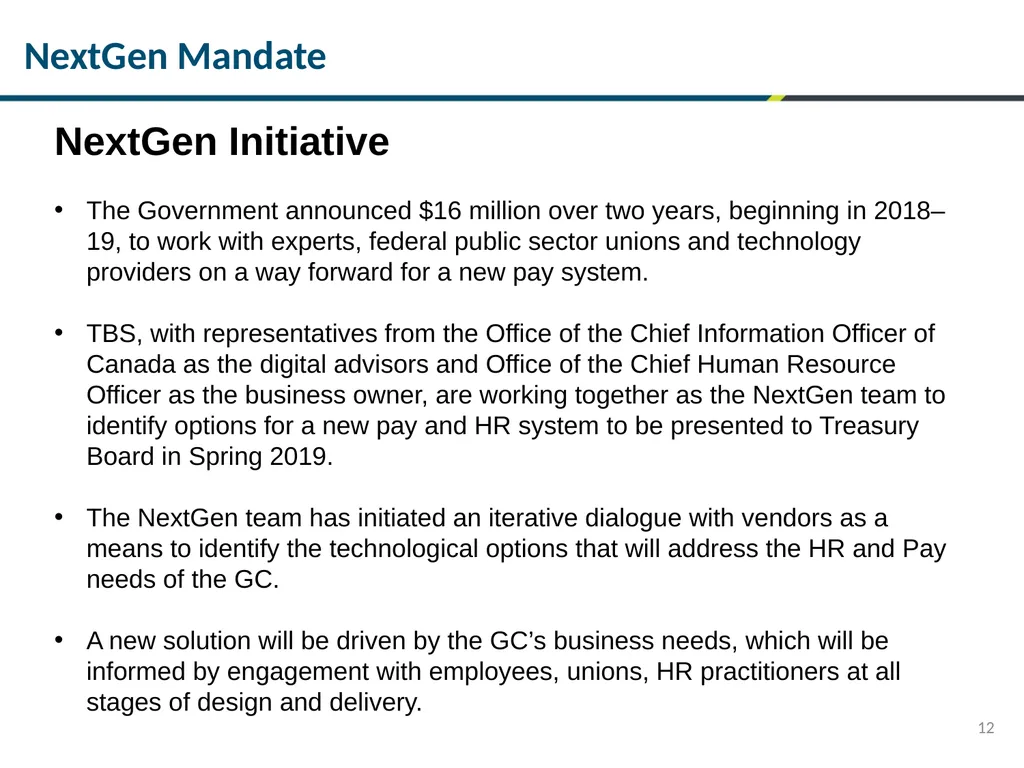
slide2. NextGen Mandate 12 NextGen Initiative
The Government announced $16 million over two years, beginning in 2018–19, to work with experts, federal public sector unions and technology providers on a way forward for a new pay system.
TBS, with representatives from the Office of the Chief Information Officer of Canada as the digital advisors and Office of the Chief Human Resource Officer as the business owner, are working together as the NextGen team to identify options for a new pay and HR system to be presented to Treasury Board in Spring 2019.
The NextGen team has initiated an iterative dialogue with vendors as a means to identify the technological options that will address the HR and Pay needs of the GC.
A new solution will be driven by the GC’s business needs, which will be informed by engagement with employees, unions, HR practitioners at all stages of design and delivery.<br>
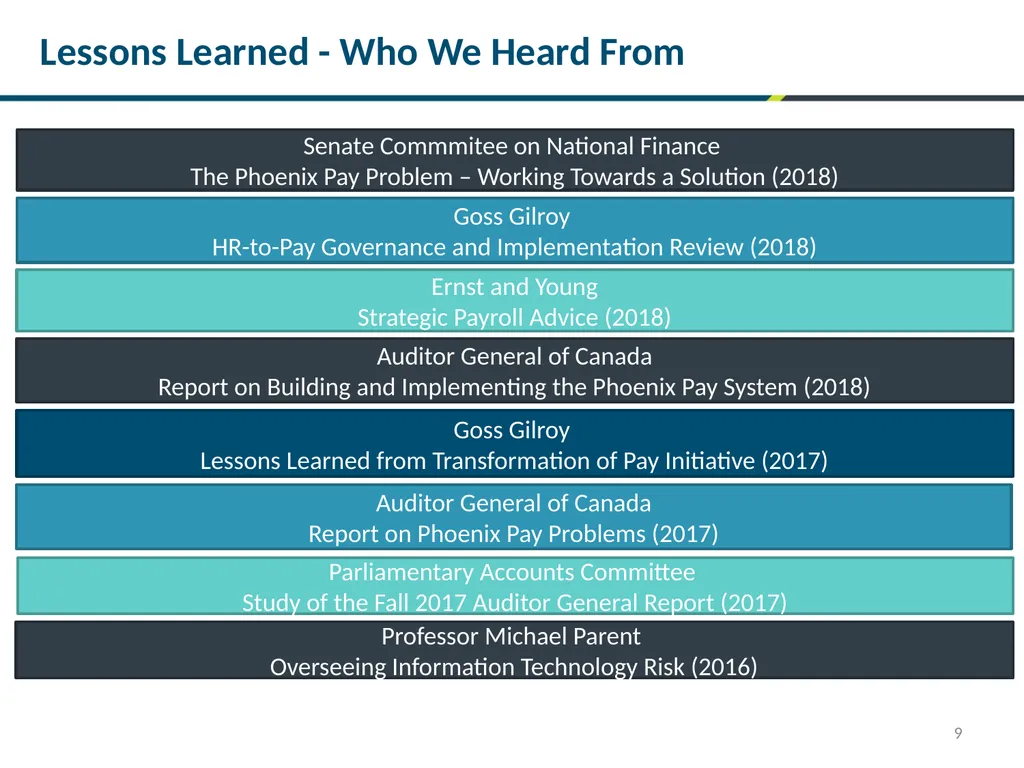
slide3. 9 Lessons Learned - Who We Heard From Senate Commmitee on National Finance
The Phoenix Pay Problem – Working Towards a Solution (2018) Goss Gilroy HR-to-Pay Governance and Implementation Review (2018) Ernst and Young
Strategic Payroll Advice (2018) Goss Gilroy Lessons Learned from Transformation of Pay Initiative (2017) Professor Michael Parent
Overseeing Information Technology Risk (2016) Auditor General of Canada
Report on Phoenix Pay Problems (2017) Parliamentary Accounts Committee
Study of the Fall 2017 Auditor General Report (2017) Auditor General of Canada
Report on Building and Implementing the Phoenix Pay System (2018)<br>
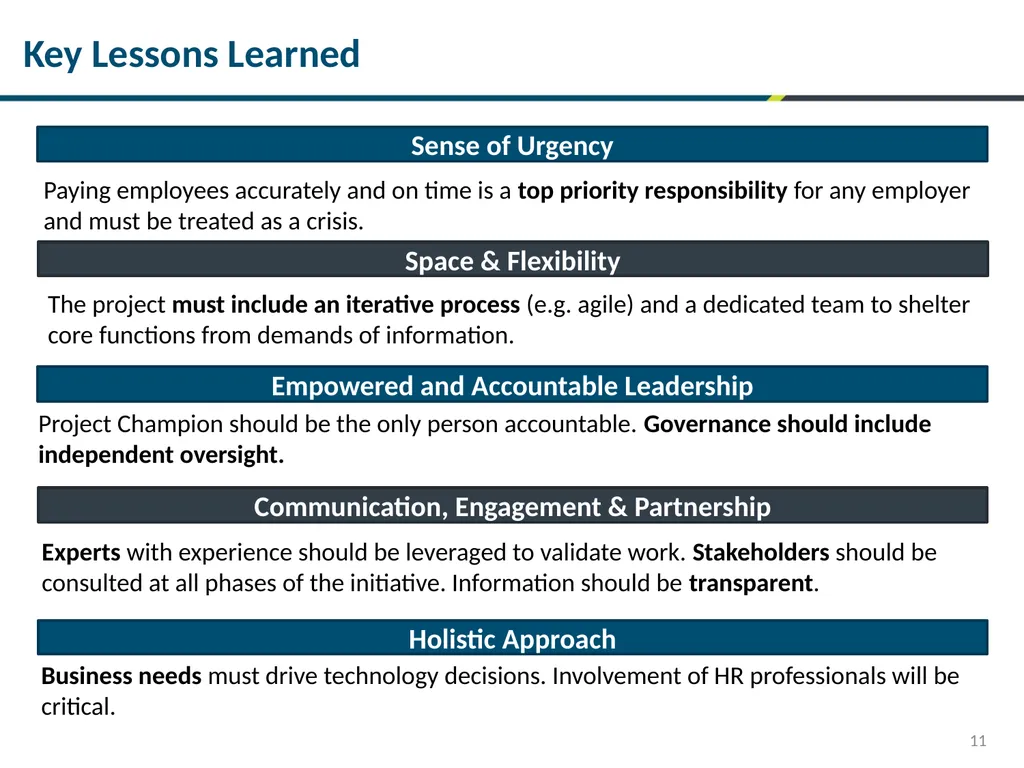
slide4. Key Lessons Learned 11 Empowered and Accountable Leadership Space & Flexibility Sense of Urgency Communication, Engagement & Partnership Holistic Approach Project Champion should be the only person accountable. Governance should include independent oversight. Experts with experience should be leveraged to validate work. Stakeholders should be consulted at all phases of the initiative. Information should be transparent. Business needs must drive technology decisions. Involvement of HR professionals will be critical. The project must include an iterative process (e.g. agile) and a dedicated team to shelter core functions from demands of information. Paying employees accurately and on time is a top priority responsibility for any employer and must be treated as a crisis.<br>
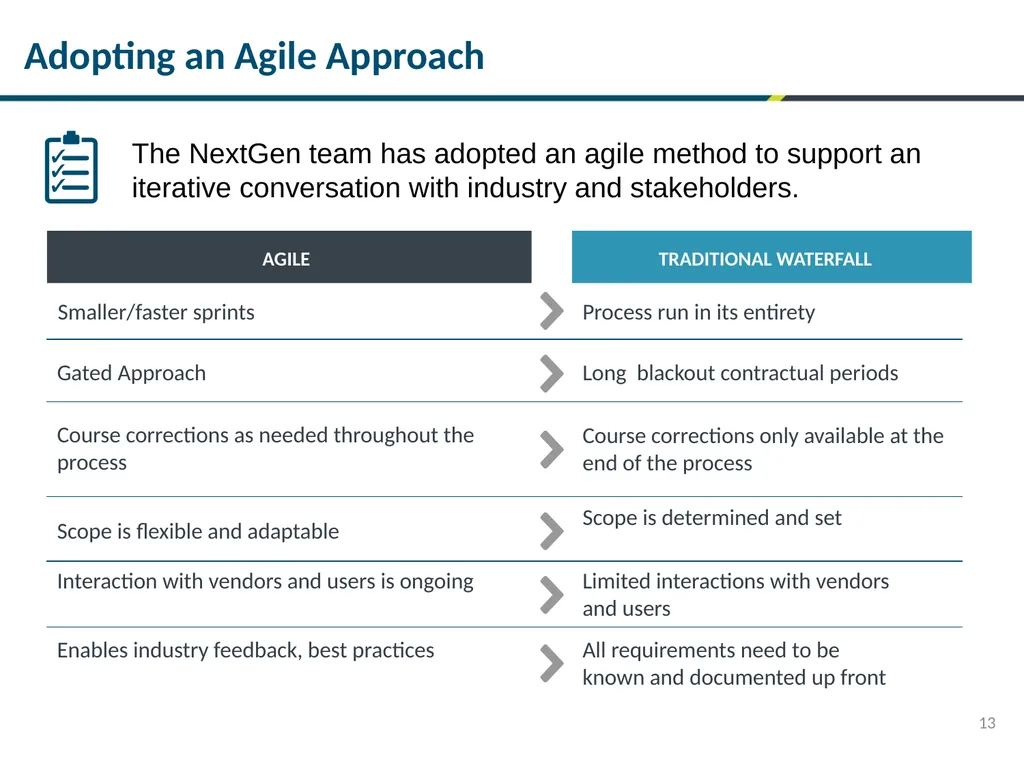
slide5. Adopting an Agile Approach 13 The NextGen team has adopted an agile method to support an iterative conversation with industry and stakeholders.<br>
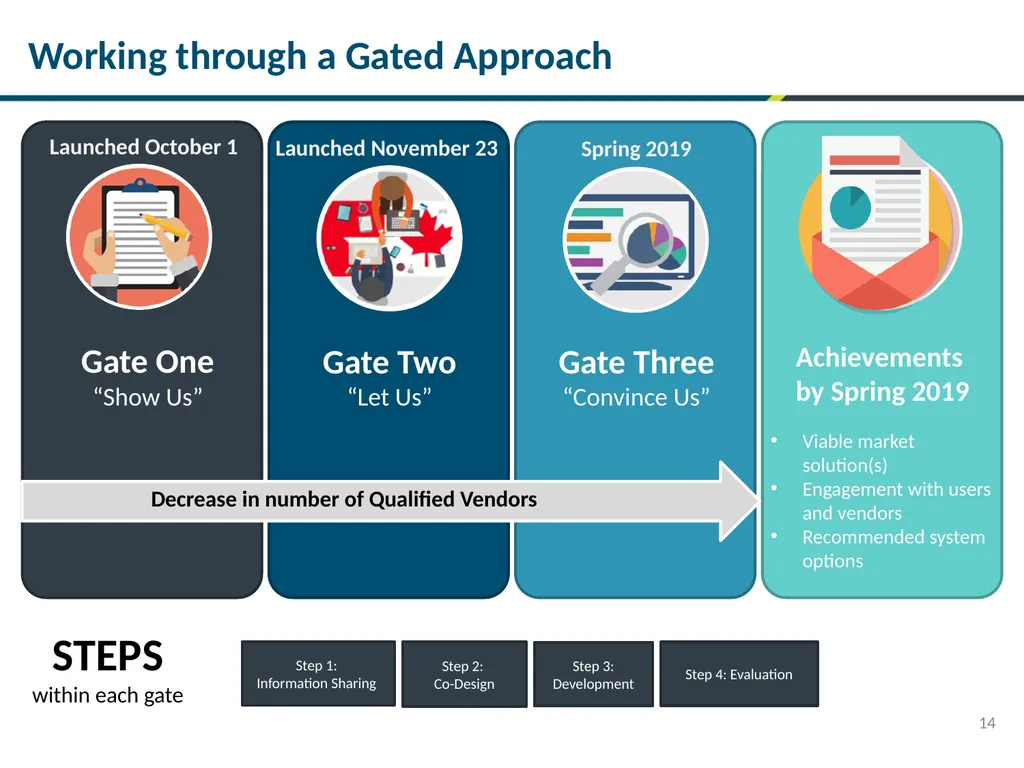
slide6. 14 Working through a Gated Approach Launch of Gate One Gate One “Show Us” Gate Two “Let Us” Gate Three “Convince Us” Launched October 1 Launched November 23 Spring 2019 Achievements by Spring 2019 Viable market solution(s)
Engagement with users and vendors
Recommended system options Decrease in number of Qualified Vendors STEPS
within each gate Step 1: Information Sharing Step 2: Co-Design Step 3: Development Step 4: Evaluation<br>
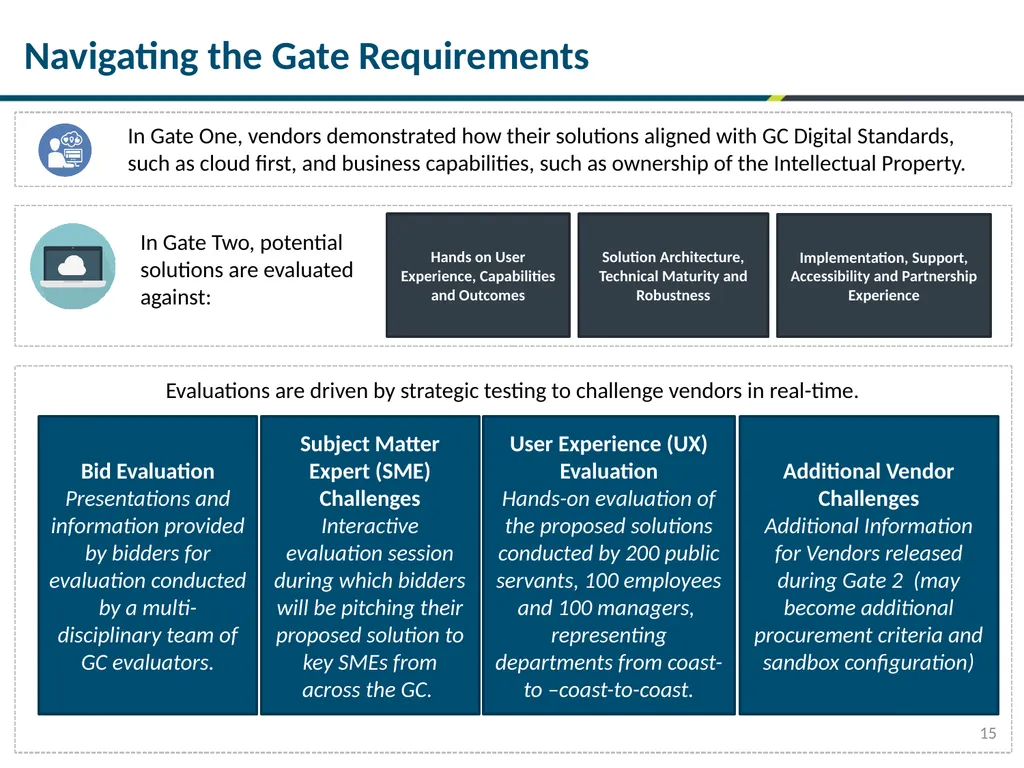
slide7. 15 Navigating the Gate Requirements In Gate One, vendors demonstrated how their solutions aligned with GC Digital Standards, such as cloud first, and business capabilities, such as ownership of the Intellectual Property. In Gate Two, potential solutions are evaluated against: Evaluations are driven by strategic testing to challenge vendors in real-time. Subject Matter Expert (SME) Challenges
Interactive evaluation session during which bidders will be pitching their proposed solution to key SMEs from across the GC. Additional Vendor Challenges
Additional Information for Vendors released during Gate 2 (may become additional procurement criteria and sandbox configuration) User Experience (UX) Evaluation Hands-on evaluation of the proposed solutions conducted by 200 public servants, 100 employees and 100 managers, representing departments from coast-to –coast-to-coast. Bid Evaluation
Presentations and information provided by bidders for evaluation conducted by a multi-disciplinary team of GC evaluators.<br>
slide8. Engagement Built-in 16 EXTERNAL ENGAGEMENT INTERNAL ENGAGEMENT ORGANIZATIONS INDUSTRY Vendors
Consulting firms Other Governments (Alberta, Australia, California)
Large enterprises Digital Advisory Board DEPARTMENTS UNIONS USERS COMMUNITY OF SPECIALISTS UNIQUE DEPARTMENTS Core public service
Central agencies
Agencies/Crown Corporations Individual pay system
(DND, RCMP, CRA)
Secure environments
(CSE, CSIS) CFOs
CIOs
Heads of HR
Accessibility
Security Deputy Ministers
Ministers
Parliamentary Committees Bargaining agents PSPC
SSC, PSC, CSPS Official Languages
UX/UI Design
Enterprise Architecture Review Board SENIOR OFFICIALS Employees
HR practitioners
Compensation Advisors
Managers LEARNINGS Industry best practices
Lessons learned from similar undertakings
Interoperability with existing systems
Compatibility requirements
User interface
Functionality (e.g. onboarding, talent management, recruitment)
Security
Accessibility
Complex work environments
Business transformation
Data migration
Cloud Connectivity PROJECT PARTNERS ENGAGEMENT Parliamentary Briefings
HR Workshops
Industry Day
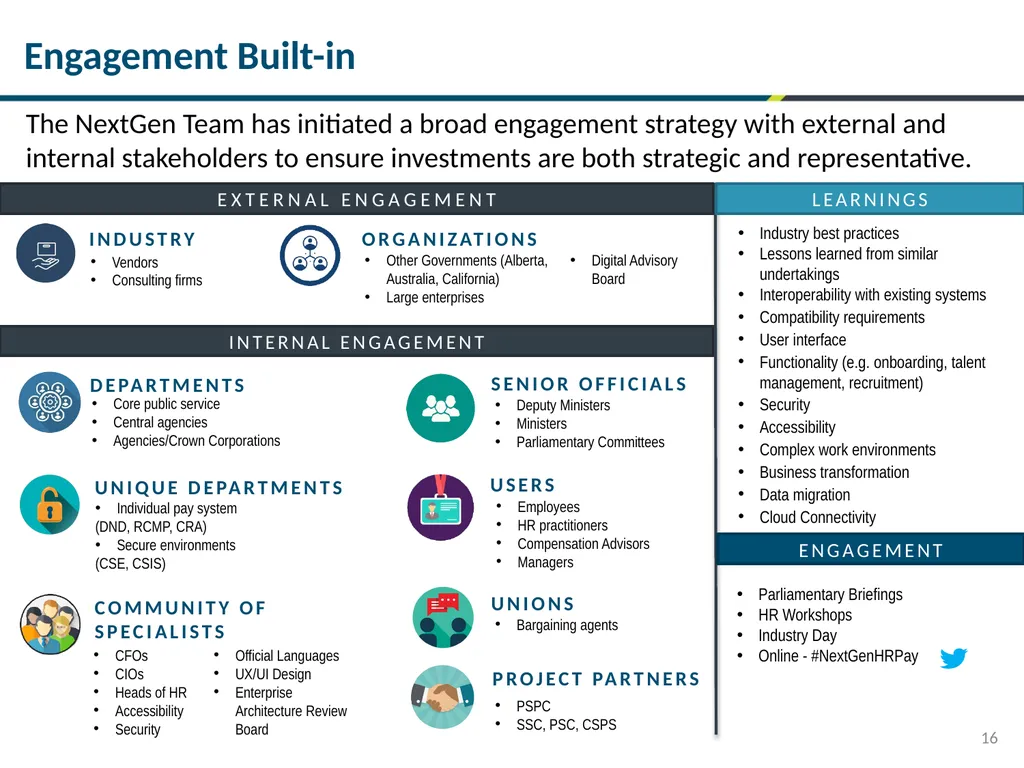
Online - #NextGenHRPay The NextGen Team has initiated a broad engagement strategy with external and internal stakeholders to ensure investments are both strategic and representative.<br>
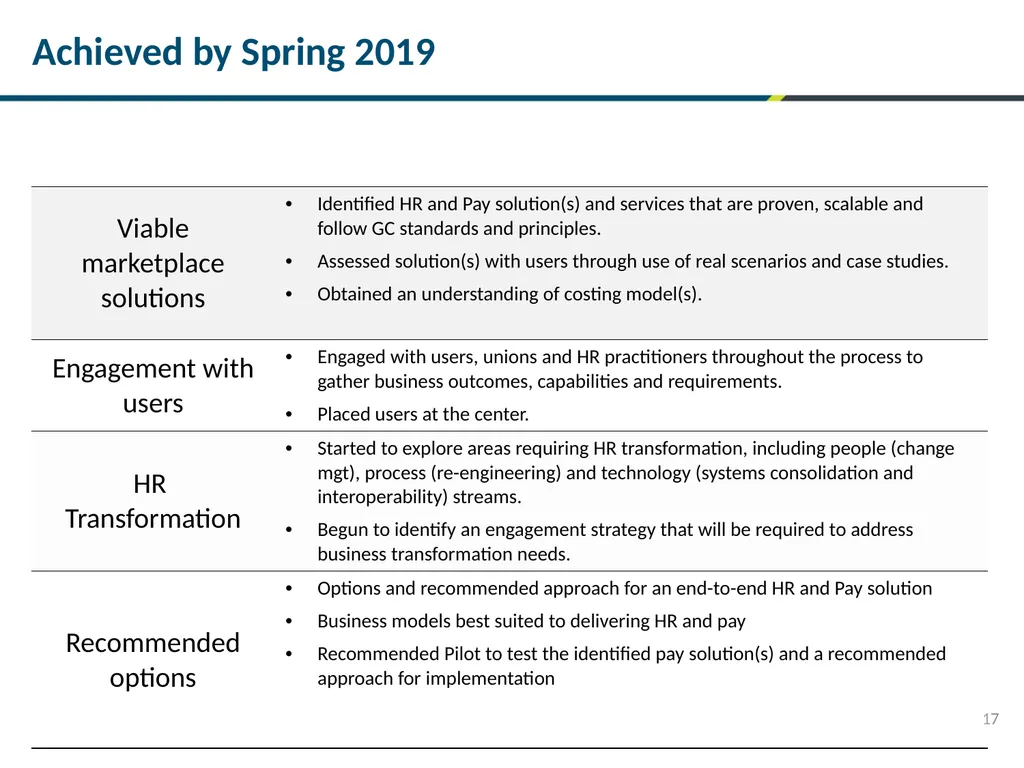
slide9. 17 Achieved by Spring 2019<br>
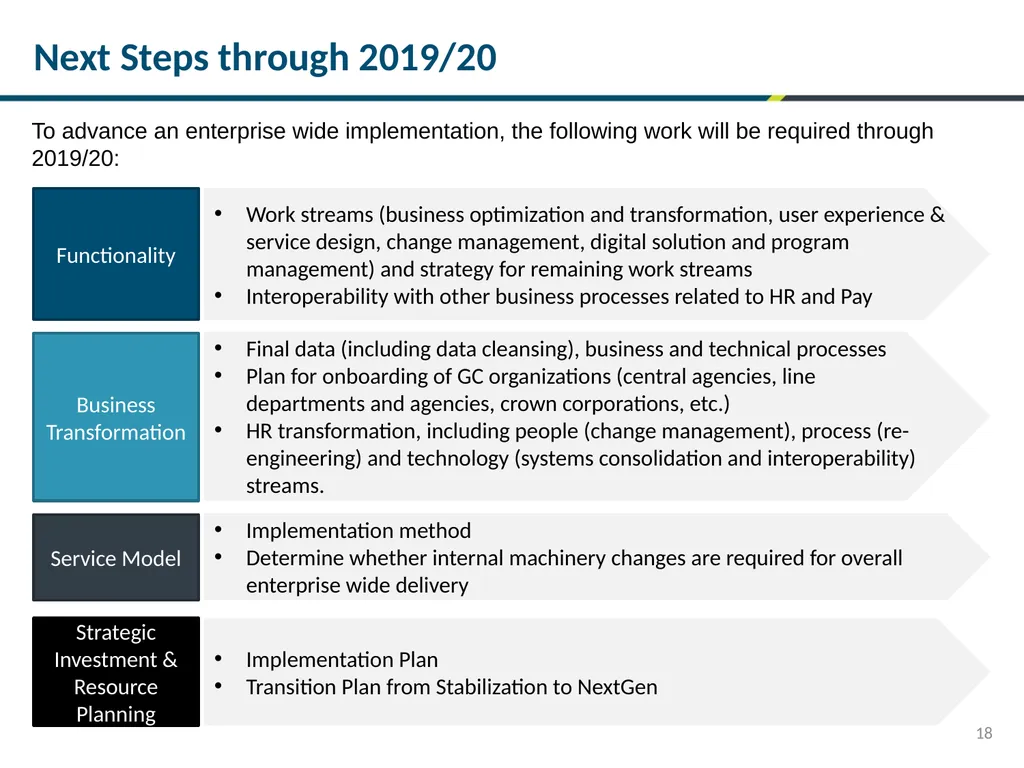
slide10. 18 Next Steps through 2019/20 Strategic Investment & Resource Planning Functionality Business Transformation Service Model Implementation Plan
Transition Plan from Stabilization to NextGen Implementation method
Determine whether internal machinery changes are required for overall enterprise wide delivery Work streams (business optimization and transformation, user experience & service design, change management, digital solution and program management) and strategy for remaining work streams
Interoperability with other business processes related to HR and Pay Final data (including data cleansing), business and technical processes
Plan for onboarding of GC organizations (central agencies, line departments and agencies, crown corporations, etc.)
HR transformation, including people (change management), process (re-engineering) and technology (systems consolidation and interoperability) streams. To advance an enterprise wide implementation, the following work will be required through 2019/20:<br>
Ministerial Transition 2019: Introductory Briefing<br>
slide2. NextGen Mandate 12 NextGen Initiative
The Government announced $16 million over two years, beginning in 2018–19, to work with experts, federal public sector unions and technology providers on a way forward for a new pay system.
TBS, with representatives from the Office of the Chief Information Officer of Canada as the digital advisors and Office of the Chief Human Resource Officer as the business owner, are working together as the NextGen team to identify options for a new pay and HR system to be presented to Treasury Board in Spring 2019.
The NextGen team has initiated an iterative dialogue with vendors as a means to identify the technological options that will address the HR and Pay needs of the GC.
A new solution will be driven by the GC’s business needs, which will be informed by engagement with employees, unions, HR practitioners at all stages of design and delivery.<br>
slide3. 9 Lessons Learned - Who We Heard From Senate Commmitee on National Finance
The Phoenix Pay Problem – Working Towards a Solution (2018) Goss Gilroy HR-to-Pay Governance and Implementation Review (2018) Ernst and Young
Strategic Payroll Advice (2018) Goss Gilroy Lessons Learned from Transformation of Pay Initiative (2017) Professor Michael Parent
Overseeing Information Technology Risk (2016) Auditor General of Canada
Report on Phoenix Pay Problems (2017) Parliamentary Accounts Committee
Study of the Fall 2017 Auditor General Report (2017) Auditor General of Canada
Report on Building and Implementing the Phoenix Pay System (2018)<br>
slide4. Key Lessons Learned 11 Empowered and Accountable Leadership Space & Flexibility Sense of Urgency Communication, Engagement & Partnership Holistic Approach Project Champion should be the only person accountable. Governance should include independent oversight. Experts with experience should be leveraged to validate work. Stakeholders should be consulted at all phases of the initiative. Information should be transparent. Business needs must drive technology decisions. Involvement of HR professionals will be critical. The project must include an iterative process (e.g. agile) and a dedicated team to shelter core functions from demands of information. Paying employees accurately and on time is a top priority responsibility for any employer and must be treated as a crisis.<br>
slide5. Adopting an Agile Approach 13 The NextGen team has adopted an agile method to support an iterative conversation with industry and stakeholders.<br>
slide6. 14 Working through a Gated Approach Launch of Gate One Gate One “Show Us” Gate Two “Let Us” Gate Three “Convince Us” Launched October 1 Launched November 23 Spring 2019 Achievements by Spring 2019 Viable market solution(s)
Engagement with users and vendors
Recommended system options Decrease in number of Qualified Vendors STEPS
within each gate Step 1: Information Sharing Step 2: Co-Design Step 3: Development Step 4: Evaluation<br>
slide7. 15 Navigating the Gate Requirements In Gate One, vendors demonstrated how their solutions aligned with GC Digital Standards, such as cloud first, and business capabilities, such as ownership of the Intellectual Property. In Gate Two, potential solutions are evaluated against: Evaluations are driven by strategic testing to challenge vendors in real-time. Subject Matter Expert (SME) Challenges
Interactive evaluation session during which bidders will be pitching their proposed solution to key SMEs from across the GC. Additional Vendor Challenges
Additional Information for Vendors released during Gate 2 (may become additional procurement criteria and sandbox configuration) User Experience (UX) Evaluation Hands-on evaluation of the proposed solutions conducted by 200 public servants, 100 employees and 100 managers, representing departments from coast-to –coast-to-coast. Bid Evaluation
Presentations and information provided by bidders for evaluation conducted by a multi-disciplinary team of GC evaluators.<br>
slide8. Engagement Built-in 16 EXTERNAL ENGAGEMENT INTERNAL ENGAGEMENT ORGANIZATIONS INDUSTRY Vendors
Consulting firms Other Governments (Alberta, Australia, California)
Large enterprises Digital Advisory Board DEPARTMENTS UNIONS USERS COMMUNITY OF SPECIALISTS UNIQUE DEPARTMENTS Core public service
Central agencies
Agencies/Crown Corporations Individual pay system
(DND, RCMP, CRA)
Secure environments
(CSE, CSIS) CFOs
CIOs
Heads of HR
Accessibility
Security Deputy Ministers
Ministers
Parliamentary Committees Bargaining agents PSPC
SSC, PSC, CSPS Official Languages
UX/UI Design
Enterprise Architecture Review Board SENIOR OFFICIALS Employees
HR practitioners
Compensation Advisors
Managers LEARNINGS Industry best practices
Lessons learned from similar undertakings
Interoperability with existing systems
Compatibility requirements
User interface
Functionality (e.g. onboarding, talent management, recruitment)
Security
Accessibility
Complex work environments
Business transformation
Data migration
Cloud Connectivity PROJECT PARTNERS ENGAGEMENT Parliamentary Briefings
HR Workshops
Industry Day
Online - #NextGenHRPay The NextGen Team has initiated a broad engagement strategy with external and internal stakeholders to ensure investments are both strategic and representative.<br>
slide9. 17 Achieved by Spring 2019<br>
slide10. 18 Next Steps through 2019/20 Strategic Investment & Resource Planning Functionality Business Transformation Service Model Implementation Plan
Transition Plan from Stabilization to NextGen Implementation method
Determine whether internal machinery changes are required for overall enterprise wide delivery Work streams (business optimization and transformation, user experience & service design, change management, digital solution and program management) and strategy for remaining work streams
Interoperability with other business processes related to HR and Pay Final data (including data cleansing), business and technical processes
Plan for onboarding of GC organizations (central agencies, line departments and agencies, crown corporations, etc.)
HR transformation, including people (change management), process (re-engineering) and technology (systems consolidation and interoperability) streams. To advance an enterprise wide implementation, the following work will be required through 2019/20:<br>